
The Neuroprotective Role of Exercise in Alzheimer’s Disease: An Integrative Review of Animal and Human Studies


Abstract
1. Introduction
1.1. Positioning in Relation to the Recent Literature
1.2. Distinction of the Present Review
- Systematically interconnecting effects across multiple biological scales (molecular → organelle → cellular → organ → organ-system) and their overlapping signaling pathways.
- Providing a balanced synthesis of both human clinical trials/RCTs and transgenic rodent AD models, emphasizing translational relevance and timing of intervention.
- Incorporating mind–body (Tai Chi, yoga, dancing), dual-task, aerobic, resistance, and multimodal modalities with modality-specific mechanistic insights.
- Highlighting emerging gut–brain, muscle–brain, and other inter-organ axes as integrative hubs that link peripheral exercise adaptations to central AD pathology.
- Particularly, it delivers a detailed comparison of different exercise forms—including aerobic, resistance, mind–body, dual-task/multimodal, and multidomain interventions that combine physical activity with cognitive training—and evaluates their differential impacts on cognitive outcomes, neuroplasticity, and AD-related pathology.
2. Neuroprotective Role of Exercise in Animal and Human Studies
2.1. Findings in Animal Studies

| Study | Model Used | Age (Months) | Design | Results |
|---|---|---|---|---|
| [57,58] | Male rats | 2 | Up to 12 weeks wheel-running | ↑ Neurotrophic level and signaling (BDNF), improvement in memory task |
| [51] | APP/PS1 male and female mice | 6 | 4 months treadmill running exercise, 5x/week | ↑ White matter volume, ↑spatial learning and memory abilities in female mice |
| [59,60] | APP/PS1-AD male mice, mixed gender respectively | 6 | 4 weeks–4 months resistance exercise | ↓ Plasma corticosterone, ↑ microglial cells around plaques, ↑BDNF ↑cognitive outcomes |
| [56] | Amnestic mice | 2 | 4 weeks treadmill running | ↓ Neuroinflammation; improved cognition and memory |
| [45] | APP/PS1-AD mice (gender not specified) | 3 | 12 weeks treadmill exercise | ↑ Mitochondrial biogenesis, mitophagy; ↑ synaptic markers ↑ memory |
| [61] | Male and female AD rates (treated with STZ) | 3 (11–12 weeks old) | 12 weeks treadmill exercise 5x/week | ↑ Hippocampal BDNF in females not males |
| [62] | Male rat AD model | 2 | 4 weeks aerobics training | ↑ Synaptic plasticity and recognition memory |
| [49] | Female ovariectomized, D-Gal Wistar AD rats | 6–7 | 6 weeks, resistance, aerobic, or combined resistance and aerobic exercise, 3x/week | Muscle hypertrophy (soleus and flexor digitorum brevis) ↑ Cognition ↓ Hippocampal and cortical Aβ and oxidative stress ↑ Serum IGF-1 ↑ Hipp IGF-1 only in aerobic exercise and NGF only in combined exercise. No change in BDNF |
| [47] | Male 3xTg AD mice | 3 | 9 weeks of resistance and aerobic exercise 3x/week | Muscle hypertrophy (gastrocnemius) ↑ Grip strength ↓ Hippocampal and cortex Aβ ↑ Serum IGF-1 |
| [46] | Male 3xTg AD mice | 9 | 4 weeks of resistance exercise 3x/week | ↑ Cognitive function ↓ Hipp and cortex Aβ, total tau, TNF-α (FC), IL-1β (liver, serum) ↑ Pro-inflammatory IL-6 (FC, hipp) cytokine, PGC-1 (hipp) ↓ Microglia and astrocytes activation; |
| [48] | Male APP/PS1 (C57Bl/6) | 6–7 | 4 weeks of resistance exercise 5x/week | ↑ Motor activity ↓ Hipp Aβ plaques, ↓ hippocampal pro-inflammatory IL-6, IL-4, IL-1a cytokine |
| [50] | Male Wistar AD rats (treated with STZ) | adult | 8 weeks resistance exercise 3x/week | ↑ Learning and memory, ↑ Hippocampal neurotrophins (BDNF, NGF, NT3), and Trk [49] (A and B) receptors |
2.2. Findings in Human Studies
| A. Healthy Older Adults | |||||
| Study (Examples) | N | Population | Duration | Exercise Type | Key Outcomes |
| [64] | 120 | Older adults | 12 months | Aerobic walking | ↑ Hippocampal volume, spatial memory, ↑ BDNF |
| [65] | 65 | Older adults | 12 months | Aerobic walking | ↑ Temporal lobe connectivity, in link to ↑ BDNF and VEGF |
| [101] | 63 | Older women with subjective memory decline and CVD risk | 12 weeks | Cognitive mind–body modalities (yoga or MET) | ↑ Hippocampal subregion connectivity |
| [66] | 585 | Older adults | 6 months | Multicomponent exercise (mindfulness, aerobic and resistance training) | No change in episodic memory and cognition |
| DR’s EXTRA [67] | 1401 | Older adults | 4 years | Different types | No change in cognition, except combining moderate-intensity aerobic exercise and a healthy diet |
| ALFA Study [69] | 337 | Middle-aged adults (45–65) | 4 years | Moderate/vigorous activities | ↑ Cortical thickness; ↓ dose-dependent amyloid burden |
| [102]; [103] | 1967 | Middle-aged and older (more women) | Multi-years | Square dance | ↑ Cognition, hippocampal volume, mental health |
| B. Mild Cognitive Impairment (MCI) | |||||
| Study (Examples) | N | Population/Stage | Duration | Exercise Type | Key Outcomes |
| [78] | 296 | Amnestic MCI | 6 months | Moderate–high aerobic | Preserved cognition and hippocampal volume without decline |
| [81] | 100 | MCI | 6 months | High-intensity resistance | ↑ Global cognition and certain aspects of executive cognition |
| The SYNERGIC Study [82,84,104] | 175, 120, 175 | MCI | 20 weeks | Aerobic, resistance + cognitive training | ↑ Global cognition, e.g., gait performance; functional brain connectivity |
| [85] | 155 | MCI | 12 months | Resistance | ↑ Cognitive executive function (Stroop test) |
| [88] | 555 | MCI | 12 months | Structured lifestyle (physical) activity | ↑ Global cognition and memory |
| [83] | 308 | MCI | 12 months | Multicomponent | ↑ Global cognition and MMSE, ↓ temporal lobe atrophy |
| [77] | 323 | MCI | Daily physical actiivity | Moderate–high aerobic | ↓ Brain atrophy |
| C. Mild–Moderate Alzheimer’s Disease | |||||
| Study | N | Population/Stage | Duration | Exercise Type | Key Outcomes |
| ADEX [91] | 200 | Mild AD | 16 weeks | Moderate-to-high-intensity aerobic | ↓ NPI, possible cognitive benefit with high intensity exercise and adherence |
| FIT-AD [92,105] | 90 | Mild–moderate AD | 6 months | Moderate–high aerobic cycling | ↓ White matter hyperintensity progression (not the brain volume). No cognitive benefit, large inter-individual differences |
| DAPA [96,97,98] | 494 | Mild–moderate AD | 12 months | Moderate–hard aerobic and resistance | No cognitive benefit, slight worsening of cognition, and reduction in QALY |
| [99,100] | 210 | AD | 12 months | Home multicomponent | Slow decline (functional independence and executive function), no other cognitive benefit |
| [95] | 72 | AD | 12-week | Multicomponent | ↑ Cognition and ↓ depression |
2.3. Timing of Exercise Intervention Is Critical for Prevention or Delay of Progression in AD
The Critical Window of Exercise Intervention for AD Prevention in Middle-Aged Adults
3. Forms of Exercise and Their Links to Cognitive Benefits
3.1. Aerobic and Resistance Exercise and Their Benefits
3.2. Mind–Body Exercises and Their Benefits
3.3. Dual-Task and Multimodal Exercise and Their Benefits
3.4. Comparative Effectiveness Across Modalities
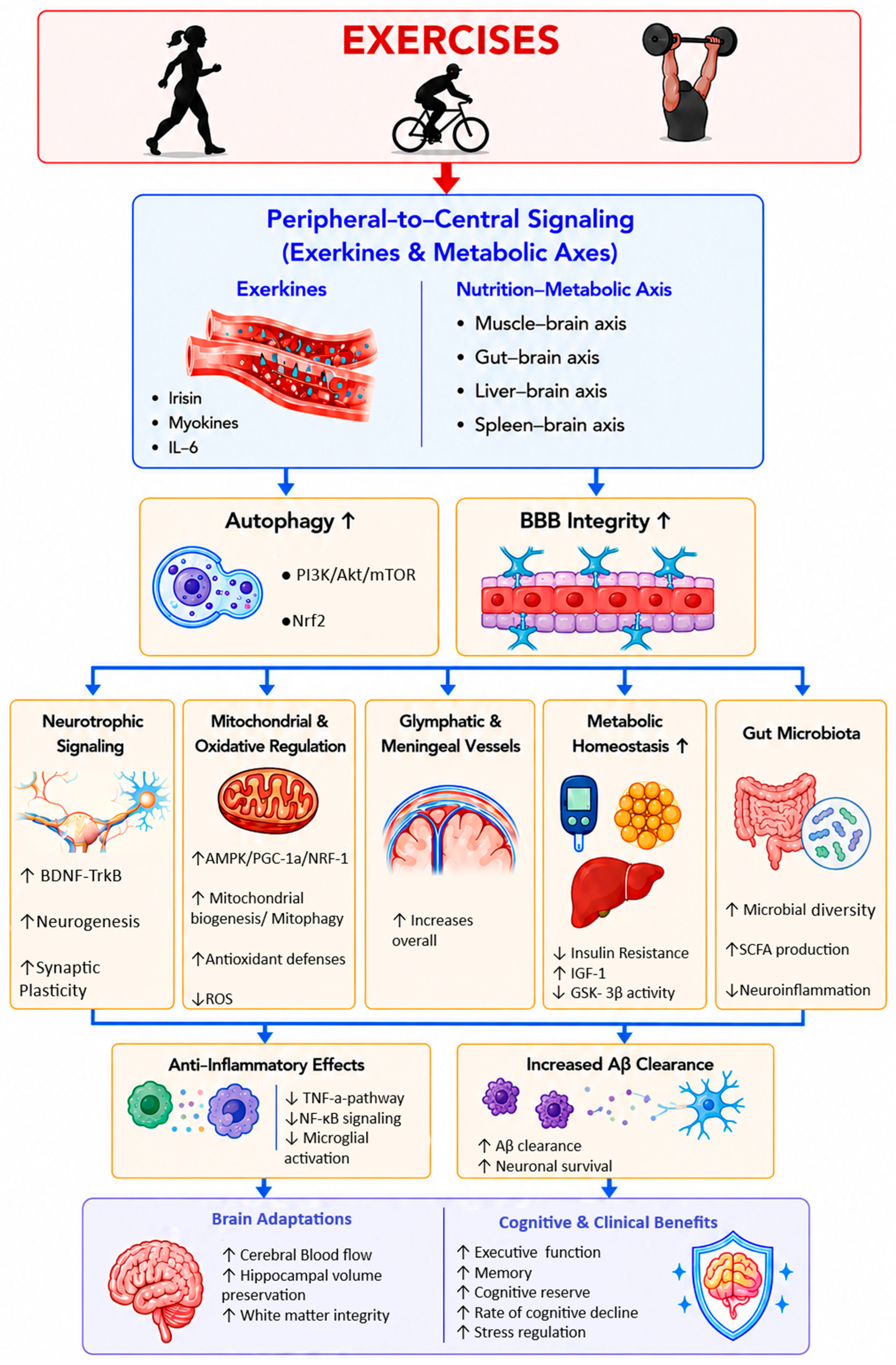
4. Mechanisms of the Neuroprotective Role of Exercise
4.1. Changes in Structural and Functional Brain Integrity Induced by Exercise in Humans
| Level | Mechanism | Key Mediators/ Pathways | Main Effects in AD Context | Supporting Evidence (Selected References) | Stage-Specific Notes |
|---|---|---|---|---|---|
| Molecular/Cellular | Neurotrophic signaling | BDNF-TrkB, CREB-BDNF, proBDNF | ↑ Synaptic plasticity, neurogenesis, dendritic spine density; memory preservation | [3,12,124] | Most robust in preclinical/MCI; ↓ sensitivity in advanced AD |
| Molecular/Cellular | Anti-inflammatory effects | ↓ TNF-α, IL-6, NF-κB; ↓ microglial/astrocyte activation; ↑ IL-10 | ↓ ER stress, downstream inflammatory signaling, ↓ neuronal damage, shifted to neuroprotective milieu | [23,35,56,124,151] | HIIT favors neuroprotective astrocyte phenotype |
| Cellular/Bioenergetic | Mitochondrial biogenesis and iron homeostasis | PGC-1α/NRF-1 (biogenesis); mitophagy; ↑ antioxidant defenses | ↑ Mitochondrial density & efficiency; ↓ ROS/oxidative stress; preserved ATP production | [32,33,34,124,152] | Dual biogenesis + mitophagy counters AD mitochondrial fragmentation/damage |
| Cellular | Autophagy | Irisin-mediated autophagy-activating pathways including AMPK | ↑ Neuroplasticity | [36,153] | ↑ Autophagy in the hippocampus alleviating AD pathology |
| Systemic/Structural | Vascular & network preservation | ↑ Cerebral blood flow; preserved hippocampal/white matter integrity | Enhanced perfusion, network coherence (esp. mind–body modalities), ↓central arterial stiffness | [101,154,155] | Stabilizes early-stage atrophy; mind–body enhances emotion/memory networks |
| Integrated Outcome | Multi-target convergence | Overlapping pathways (neurogenesis, etc., see Figure 1) | ↑ Neurogenesis and neuronal resilience, cognitive reserve; slowed progression (esp. early intervention) | [15,16,40,63,69] | Greatest efficacy in preclinical/MCI stages; more modest effects in moderate–advanced AD stage |
| Systemic/Integrative | Exerkine-mediated signaling | ↑ Exerkines, e.g., myokines (those derived from muscle) | Peripheral-to-central communication: ↑ neuronal survival, ↓ inflammation, ↑ plasticity | [20,38,63,113,149,156,157] | ↑Neuroprotective proteins in NDEVs (BDNF, humanin); APOE ε4 carriers show amplified response |
| Integrative/Organ level | Gut microbiota | Gut–brain axis through metabolic, immune, neural, and endocrine pathways and Nrf2 signaling | ↑ Cellular antioxidant defense, mitochondrial function and anti-inflammation | [17,29,150,158] | Diet and exercise |
| Integrative/Organ system level | Meningeal lymphatic vessel and glymphatic flow | AQP4-mediated glymphatic flow | ↓ Extracellular Aβ toxic protein Converting to neuroprotective astrocyte type polarization of both astrocytes and microglia, enhances their phagocytic abilities | [39,41,109,159,160] | Most robust in early stage/MCI; compromised in advanced AD |
| Metabolic | Reducing glucose level | Increasing insulin sensitivity | ↑ IGF-1 and cognition ↓ GSK-3β | [26] | Diet and exercise |
4.2. Multi-Level Mechanisms of the Neuroprotective Role of Exercise
4.2.1. Neurotrophic Factors and Synaptic Plasticity in Link to Exercise
4.2.2. Reduction in Neuroinflammation in Link to Exercise
4.2.3. Mitochondrial Quality Control and Bioenergetics in Link to Exercise
4.2.4. Exerkines as Systemic Mediators in Exercise
4.2.5. Exercise Modulation of Gut–Brain Axis and Brain Waste Clearance Systems (Meningeal Lymphatics and Glymphatic System)
4.3. Gender Differences in the Neuroprotective Role of Exercise
5. Discussion and Conclusions
6. Limitations and Future Directions
- Large-scale, multicenter, longitudinal RCTs with diverse, representative populations and extended follow-up to clarify long-term effects on progression, mechanisms, and functional outcomes;
- Standardized protocols using wearable technologies for objective dosing/adherence monitoring;
- Personalized prescriptions tailored to disease stage, genotype (e.g., APOE), comorbidities, and preferences;
- Integration of exercise with cognitive, dietary, or other multidomain interventions to maximize synergistic effects;
- Head-to-head comparisons among modalities (e.g., mind–body vs. aerobic vs. multimodal) and intensity levels, with domain-specific cognitive endpoints.
Author Contributions
Funding
Institutional Review Board Statement
Informed Consent Statement
Data Availability Statement
Acknowledgments
Conflicts of Interest
Abbreviations
| 3xTg | Triple-transgenic |
| Ab | Amyloid-beta |
| AD | Alzheimer’s disease |
| ADAS-Cog | Alzheimer’s Disease Assessment Scale–Cognitive subscale |
| AMPK | Adenosine monophosphate-activated protein kinase |
| APOE | Apolipoprotein E |
| APOE ε 4 | Apolipoprotein E gene, epsilon 4 variant |
| APP/PS1 | Amyloid precursor protein/presenilin-1 |
| AQP4 | Aquaporin-4 |
| ARIAs | Amyloid-related imaging abnormalities |
| A+T+ | Amyloid-positive/tau-positive |
| BBB | Blood–brain barrier |
| BDNF | Brain-derived neurotrophic factor |
| BMI | Body mass index |
| CNS | Central nervous system |
| CSF | Cerebrospinal fluid |
| CTBS | Cathepsin B |
| CVD | Cardiovascular disease |
| D-Gal | D-galactose |
| ER | Endoplasmic reticulum |
| FC | Frontal cortex |
| FNDC5 | Fibronectin type III domain-containing protein 5 |
| GSK-3β | Glycogen synthase kinase-3 beta |
| Hipp | Hippocampus |
| HIIT | High-intensity interval training |
| IGF-1 | Insulin-like growth factor-1 |
| IL-1b | Interleukin-1 beta |
| IL-6 | Interleukin-6 |
| IL-10 | Interleukin-10 |
| ISF | Interstitial fluid |
| LDL | Low-density lipoprotein |
| MCI | Mild cognitive impairment |
| MGBA | Microbiota–gut–brain axis |
| MMSE | Mini-mental state examination |
| MoCA | Montreal cognitive assessment |
| MR | Magnetic resonance imaging |
| MTCC | Mindful Tai Chi Chuan |
| NDEVs | Neuron-derived extracellular vesicles |
| NFT | Neurofibrillary tangle |
| NF-κB | Nuclear factor, kappa-light-chain-enhancer of activated B cell |
| NGF | Nerve growth factor |
| NPI | Neuropsychiatric inventory |
| NPS | Neuropsychiatric symptoms |
| NRF-1 | Nuclear respiratory factor 1 |
| Nrf2 | Nuclear factor erythroid 2-related factor 2 |
| NT3 | Neurotrophin-3 |
| PGC-1a | Peroxisome proliferator-activated receptor gamma coactivator 1-alpha |
| p-tau | Phosphorylated tau |
| proBDNF | Precursor brain-derived neurotrophic factor |
| QALY | Quality-adjusted life year |
| RAVLT | Rey Auditory Verbal Learning Test |
| RCT | Randomized controlled trial |
| ROS | Reactive oxygen species |
| SCFA | Short-chain fatty acid |
| SPPB | Short physical performance battery |
| STZ | Streptozotocin |
| t-tau | Total tau |
| TGF-β | Transforming growth factor-beta |
| TMT | Trail making test |
| TNF-a | Tumor necrosis factor-alpha |
| Trk | Tropomyosin receptor kinase |
| TrkB | Tropomyosin receptor kinase B |
| VEGF | Vascular endothelial growth factor |
References
- 2024 Alzheimer’s disease facts and figures. Alzheimer’s Dement. 2024, 20, 3708–3821. [CrossRef] [PubMed] [PubMed Central]
- Silva, M.V.F.; Lores, C.M.G.; Alves, L.C.V.; Souza, L.C.; Borges, K.B.G.; Carvalho, M.G. Alzheimer’s disease: Risk factors and potentially protective measures. J. Biomed. Sci. 2019, 26, 33. [Google Scholar] [CrossRef]
- De la Rosa, A.; Olaso-Gonzalez, G.; Arc-Chagnaud, C.; Millan, F.; Salvador-Pascual, A.; García-Lucerga, C.; Blasco-Lafarga, C.; Garcia-Dominguez, E.; Carretero, A.; Correas, A.G. Physical exercise in the prevention and treatment of Alzheimer’s disease. J. Sport Health Sci. 2020, 9, 394–404. [Google Scholar] [CrossRef] [PubMed]
- Long, J.M.; Holtzman, D.M. Alzheimer Disease: An Update on Pathobiology and Treatment Strategies. Cell 2019, 179, 312–339. [Google Scholar] [CrossRef] [PubMed]
- 2026 Alzheimer’s disease facts and figures. Alzheimer’s Dement. 2026, 22, e71345. [CrossRef] [PubMed Central]
- Xiao, D.; Zhang, C. Current therapeutics for Alzheimer’s disease and clinical trials. Explor. Neurosci. 2024, 3, 255–271. [Google Scholar] [CrossRef]
- Ionescu-Tucker, A.; Cotman, C.W. Emerging roles of oxidative stress in brain aging and Alzheimer’s disease. Neurobiol. Aging 2021, 107, 86–95. [Google Scholar] [CrossRef]
- Voss, M.W.; Soto, S.; Yoo, S.; Sodoma, M.; Vivar, C.; Praag, H. Exercise and Hippocampal Memory Systems. Trends Cogn. Sci. 2019, 23, 318–333. [Google Scholar] [CrossRef]
- Aghjayan, S.L.; Bournia, T.; Kang, C.; Xueping, Z.; Stillman, C.M.; Donofry, S.D.; Kamarack, T.W.; Marsland, A.L.; Voss, M.W.; Fraundorf, S.H. Aerobic exercise improves episodic memory in late adulthood: A systematic review and meta-analysis. Commun. Med. 2022, 2, 15. [Google Scholar] [CrossRef]
- Sakazaki, A.; Lui, A.; Muhammad, H.; Vu, C.; Roux, A.; Lacayo, P.; Murakami, S. Minimum physical activities protective against Alzheimer’s disease in late life: A systematic review. J. Osteopath. Med. 2026, 126, 47–68. [Google Scholar] [CrossRef]
- Livingston, G.; Huntley, J.; Liu, K.Y.; Costafreda, S.G.; Selbaek, G.; Alladi, S.; Ames, D.; Banerjee, S.; Burns, A.; Brayne, C. Dementia prevention, intervention, and care: 2024 report of the Lancet standing Commission. Lancet 2024, 404, 572–628. [Google Scholar] [CrossRef] [PubMed]
- Cotman, C.W.; Berchtold, N.C.; Christie, L.A. Exercise builds brain health: Key roles of growth factor cascades and inflammation. Trends Neurosci. 2007, 30, 464–472, Erratum in Trends Neurosci. 2007, 30, 489. [Google Scholar] [CrossRef]
- Alves, L.; Hashiguchi, D.; Loss, C.M.; Praag, H.; Longo, B.M. Vascular dysfunction in Alzheimer’s disease: Exploring the potential of aerobic and resistance exercises as therapeutic strategies. J. Alzheimer’s Dis. 2025, 104, 963–979. [Google Scholar] [CrossRef]
- López-Ortiz, S.; Valenzuela, P.L.; Seisdedos, M.M.; Morales, J.S.; Vega, T.; Castillo-García, A.; Nisticò, R.; Mercuri, N.B.; Lista, S.; Lucia, A.; et al. Exercise interventions in Alzheimer’s disease: A systematic review and meta-analysis of randomized controlled trials. Ageing Res. Rev. 2021, 72, 101479. [Google Scholar] [CrossRef]
- López-Ortiz, S.; Valenzuela, P.L.; Seisdedos, M.M.; Morales, J.S.; Vega, T.; Castillo-Gar ecìa, A.; Nisticò, R.; Mercuri, N.B.; Lista, S.; Lucia, A. Physical Exercise and Alzheimer’s Disease: Effects on Pathophysiological Molecular Pathways of the Disease. Int. J. Mol. Sci. 2021, 22, 2897. [Google Scholar] [CrossRef]
- López-Ortiz, S.; Lista, S.; Valenzuela, P.L.; Pinto-Fraga, J.; Carmona, R.; Caraci, F.; Caruso, G.; Toschi, N.; Emanuele, E.; Gabelle, A. Effects of physical activity and exercise interventions on Alzheimer’s disease: An umbrella review of existing meta-analyses. J. Neurol. 2023, 270, 711–725. [Google Scholar] [CrossRef]
- Zhao, H.; Wu, W.; Men, X. Mechanism of Exercise-Regulated Intestinal Flora for Alzheimer’s Disease Based on Gut-Brain Axis. Nutrients 2026, 18, 254. [Google Scholar] [CrossRef] [PubMed]
- Nicolas, S.; Dohm-Hansen, S.; Lavelle, A.; Bastiaanssen, T.F.F.; English, J.A.; Cryan, J.F.; Nolan, Y.M. Exercise mitigates a gut microbiota-mediated reduction in adult hippocampal neurogenesis and associated behaviours in rats. Transl. Psychiatry 2024, 14, 195. [Google Scholar] [CrossRef] [PubMed]
- Ben Ezzdine, L.; Dhahbi, W.; Dergaa, I.; Ceylan, H.I.; Guelmani, N.; Saad, H.B.; Chamari, K.; Stefanica, V.; Omri, A.E. Physical activity and neuroplasticity in neurodegenerative disorders: A comprehensive review of exercise interventions, cognitive training, and AI applications. Front. Neurosci. 2025, 19, 1502417. [Google Scholar] [CrossRef]
- Delgado-Peraza, F.; Nogueras-Ortiz, C.; Simonsen, A.H.; Knight, D.L.D.; Yao, P.J.; Goetzl, E.J.; Jensen, C.S.; Høgh, P.; Gottrup, H.; Vestergaard, K. Neuron-derived extracellular vesicles in blood reveal effects of exercise in Alzheimer’s disease. Alzheimer’s Res. Ther. 2023, 15, 156, Erratum in Alzheimer’s Res. Ther. 2024, 16, 18. [Google Scholar] [CrossRef]
- Kirk-Sanchez, N.J.; McGough, E.L. Physical exercise and cognitive performance in the elderly: Current perspectives. Clin. Interv. Aging 2014, 9, 51–62. [Google Scholar] [CrossRef]
- Jiayuan, Z.; Xiang-Zi, J.; Li-Na, M.; Jin-Wei, Y.; Xue, Y. Effects of Mindfulness-Based Tai Chi Chuan on Physical Performance and Cognitive Function among Cognitive Frailty Older Adults: A Six-Month Follow-Up of a Randomized Controlled Trial. J. Prev. Alzheimer’s Dis. 2022, 9, 104–112. [Google Scholar] [CrossRef]
- Grzenda, A.; Siddarth, P.; Milillo, M.M.; Aguilar-Faustino, Y.; Khalsa, D.S.; Lavretsky, H. Cognitive and immunological effects of yoga compared to memory training in older women at risk for alzheimer’s disease. Transl. Psychiatry 2024, 14, 96. [Google Scholar] [CrossRef]
- Ornish, D.; Madison, K.; Kivipelto, M.; Kemp, C.; McCulloh, C.E.; Galasko, D.; Artz, J.; Rentz, D.; Lin, J.; Norman, K. Effects of intensive lifestyle changes on the progression of mild cognitive impairment or early dementia due to Alzheimer’s disease: A randomized, controlled clinical trial. Alzheimer’s Res. Ther. 2024, 16, 122. [Google Scholar] [CrossRef]
- Zhou, J.; Zhang, X.; Yin, S.; Xue, S.; He, Q.; Chen, S.; Xue, X. Molecular mechanisms of exercise-induced improvements in Alzheimer’s disease: A focus on lipid homeostasis. Transl. Neurodegener. 2026, 15, 11. [Google Scholar] [CrossRef]
- Wang, B.; Shao, Y.; Liang, R. Exercise Suppresses Insulin Resistance: A Potential Mechanism for Improving the Interaction Between Type 2 Diabetes and Alzheimer’s Disease. J. Integr. Neurosci. 2026, 25, 44389. [Google Scholar] [CrossRef]
- Xenos, D.; Mancinetti, F.; Mecocci, P.; Boccardi, V. The muscle-brain axis in type 2 diabetes: Molecular pathways linking sarcopenia and cognitive decline. Ageing Res. Rev. 2026, 113, 102955. [Google Scholar] [CrossRef]
- Yang, S.; Sang, H.W.; Kim, S.; Cho, E.J.; Choi, Y.; Kang, D.W.; Jang, Y.C.; Park, D.H.; Kwak, H.B.; Yook, J.S. Therapeutic potential of exerkines in neurodegenerative and mental disorders: A narrative review. Front. Physiol. 2026, 17, 1793043. [Google Scholar] [CrossRef]
- Peng, T.; Zhang, Z.; Ding, N.; Zhang, J. Mechanistic Investigation of Exercise Interventions in Rodent Models of Alzheimer’s Disease and Prospects for Clinical Translation. Neural Plast. 2026, 2026, e6718671. [Google Scholar] [CrossRef]
- Chen, J.; Wang, L.; Zhou, Y.; Zhao, S.; Chen, Q.; Zheng, K. The liver as a metabolic and immune hub in Alzheimer’s disease: From mechanisms to therapeutic opportunities. J. Prev. Alzheimer’s Dis. 2026, 13, 100478. [Google Scholar] [CrossRef]
- Wang, T.; Feng, L.; Tian, Z. The therapeutic potential of early exercise in Alzheimer’s disease: Focus on the brain-spleen axis. Ageing Res. Rev. 2026, 114, 102980. [Google Scholar] [CrossRef]
- Bucarey, J.L.; Casas, M.; Espinosa, A. Mitochondrial Iron Handling and Lipid Peroxidation as Drivers of Ferroptosis. Int. J. Mol. Sci. 2026, 27, 2232. [Google Scholar] [CrossRef]
- Xiao, X.; Yan, X.; iang, C.; Yang, Y. Metabolic dysfunction and mitochondrial failure in Alzheimer’s disease: Integrating pathophysiology, clinical evidence and emerging interventions. Front. Neurol. 2026, 17, 1772036. [Google Scholar] [CrossRef]
- Ke, Z.; Wang, B.; Liang, R. Modulation of mitochondrial quality by exercise mimetics: A potential strategy for the prevention and treatment of Alzheimer’s disease. J. Alzheimer’s Dis. 2026, 110, 1509–1532. [Google Scholar] [CrossRef]
- Haixia, T.; Bo, X. Exercise impact on IRE1α signaling: Novel insights into Alzheimer’s disease prevention and treatment. Biochem. Biophys. Res. Commun. 2026, 797, 153156. [Google Scholar] [CrossRef]
- Li, Q.; Zhao, R.; Tian, X.; Xu, H. Molecular mechanisms underlying exercise-enhanced autophagy in improving neuroplasticity in Alzheimer’s disease. Front. Aging Neurosci. 2026, 18, 1780247. [Google Scholar] [CrossRef]
- Li, W.; Wang, W.H.; Song, Y.; Li, X.J.; Li, Y.; Wang, X.; Tian, T.T.; Hang, X.; Zhao, L. Mechanistic advances in exercise-mediated regulation of autophagy dysfunction in Alzheimer’s disease (Review). Int. J. Mol. Med. 2026, 57, 84. [Google Scholar] [CrossRef]
- Alzoughool, F.; Alanagreh, L.; Aljawarneh, Y.; Zraigat, H.; Alzghool, M. The Multifaceted Role of Irisin in Neurological Disorders: A Systematic Review Integrating Preclinical Evidence with Clinical Observations. Neurol. Int. 2026, 18, 15. [Google Scholar] [CrossRef]
- Liu, R.; Deng, Q.; Gong, L.; Yang, L. Role Shift of Glial Cells from Physiology to Pathology in Alzheimer’s Disease: The Regulatory Impact of Exercise. Neurosci. Bull. 2026, 1–33. [Google Scholar] [CrossRef]
- Dębiec, M.; Rojek, M. Adult Neurogenesis in Neurodegenerative Diseases: Mechanisms of Dysregulation in Alzheimer’s and Parkinson’s Disease. Int. J. Mol. Sci. 2026, 27, 2742. [Google Scholar] [CrossRef]
- Ghayourvahdat, A.; Azimizonuzi, H.; Ahmed, M. Physical exercise as a non-pharmacological strategy to enhance glymphatic function. IBRO Neurosci. Rep. 2026, 20, 206–217. [Google Scholar] [CrossRef]
- Brendborg, N.; Febbraio, M.A. Intervention points for the role of physical activity in prevention and treatment of Alzheimer’s disease. J. Physiol. 2026, 604, 2411–2420. [Google Scholar] [CrossRef]
- Cotman, C.W.; Berchtold, N.C. Exercise: A behavioral intervention to enhance brain health and plasticity. Trends Neurosci. 2002, 25, 295–301. [Google Scholar] [CrossRef]
- Choi, S.H.; Bylykbashi, E.; Chatila, Z.K.; Lee, S.W.; Pulli, B.; Clemenson, G.D.; Kim, E.; Rompala, A.; Oran, M.K.; Asselin, C. Combined adult neurogenesis and BDNF mimic exercise effects on cognition in an Alzheimer’s mouse model. Science 2018, 361, eaan8821. [Google Scholar] [CrossRef]
- Zhao, N.; Yan, Q.-W.; Xia, J.; Zhang, X.-L.; Li, B.-X.; Yin, L.-Y.; Xu, B. Treadmill Exercise Attenuates Aβ-Induced Mitochondrial Dysfunction and Enhances Mitophagy Activity in APP/PS1 Transgenic Mice. Neurochem. Res. 2020, 45, 1202–1214. [Google Scholar] [CrossRef]
- Liu, Y.; Chu, J.M.T.; Yan, T.; Zhang, Y.; Chen, Y.; Chang, R.C.C.; Wong, G.T.C. Short-term resistance exercise inhibits neuroinflammation and attenuates neuropathological changes in 3xTg Alzheimer’s disease mice. J. Neuroinflammation 2020, 17, 4. [Google Scholar] [CrossRef]
- Pena, G.S.; Paez, H.G.; Johnson, T.K.; Halle, J.L.; Carzoli, J.P.; Visavadiya, N.P.; Zourdos, M.C.; Whitehurst, M.A.; Khamoui, A.V. Hippocampal Growth Factor and Myokine Cathepsin B Expression following Aerobic and Resistance Training in 3xTg-AD Mice. Int. J. Chronic Dis. 2020, 2020, 5919501. [Google Scholar] [CrossRef]
- Hashiguchi, D.; Campos, H.C.; Wuo-Silva, R.; Faber, J.; da Silva, S.G.; Coppi, A.A.; Arida, R.M.; Longo, B.M. Resistance Exercise Decreases Amyloid Load and Modulates Inflammatory Responses in the APP/PS1 Mouse Model for Alzheimer’s Disease. J. Alzheimer’s Dis. 2020, 73, 1525–1539. [Google Scholar] [CrossRef]
- Özbeyli, D.; Sari, G.; Özkan, N.; Karademir, B.; Yüksel, M.; Cilingir Kaya, Ö.T.; Kasimay Cakir, Ö. Protective effects of different exercise modalities in an Alzheimer’s disease-like model. Behav. Brain Res. 2017, 328, 159–177. [Google Scholar] [CrossRef]
- Jafarzadeh, G.; Shakerian, S.; Farbood, Y.; Ghanbarzadeh, M. Effects of Eight Weeks of Resistance Exercises on Neurotrophins and Trk Receptors in Alzheimer Model Male Wistar Rats. Basic Clin. Neurosci. 2021, 12, 349–359. [Google Scholar] [CrossRef]
- Zhou, C.N.; Chao, F.L.; Zhang, Y.; Jiang, L.; Zhang, L.; Luo, Y.M.; Xiao, Q.; Chen, L.M.; Tang, Y. Sex Differences in the White Matter and Myelinated Fibers of APP/PS1 Mice and the Effects of Running Exercise on the Sex Differences of AD Mice. Front. Aging Neurosci. 2018, 10, 243. [Google Scholar] [CrossRef]
- Vasconcelos-Filho, F.S.L.; Oliveira, L.C.R.; de Freitas, T.B.C.; de Pontes, P.A.D.S.; da Rocha-E-Silva, R.C.; Godinho, W.D.N.; Chaves, E.M.C.; da Silva, C.G.L.; Chaves, E.M.C.; da Silva, C.G.L.; et al. Effect of involuntary chronic physical exercise on beta-amyloid protein in experimental models of Alzheimer’s disease: Systematic review and meta-analysis. Exp. Gerontol. 2021, 153, 111502. [Google Scholar] [CrossRef]
- He, K.; Nie, L.; Yang, C.; Liu, Z.; Huang, X.; Li, S.; Yang, X. Exhaustive exercise decreases tau phosphorylation and modifies biological processes associated with the protein translation and electron transport chain in P301L tau transgenic mice. Exp. Gerontol. 2024, 187, 112375. [Google Scholar] [CrossRef]
- Zhang, M.; Shi, L.; Meng, X.; Dong, Y.; Sun, Y.; Qian, Q.; Jin, Q. Mechanism study of exercise intervention on circadian disruption in Alzheimer’s disease. Front. Neurosci. 2025, 19, 1696673. [Google Scholar] [CrossRef]
- Liang, J.; Wang, C.; Zhang, H.; Huang, J.; Xie, J.; Chen, N. Exercise-Induced Benefits for Alzheimer’s Disease by Stimulating Mitophagy and Improving Mitochondrial Function. Front. Aging Neurosci. 2021, 13, 755665. [Google Scholar] [CrossRef]
- Choi, J.W.; Jo, S.W.; Kim, D.E.; Paik, I.Y.; Balakrishnan, R. Aerobic exercise attenuates LPS-induced cognitive dysfunction by reducing oxidative stress, glial activation, and neuroinflammation. Redox Biol. 2024, 71, 103101. [Google Scholar] [CrossRef]
- Berchtold, N.C.; Chinn, G.; Chou, M.; Kesslak, J.P.; Cotman, C.W. Exercise primes a molecular memory for brain-derived neurotrophic factor protein induction in the rat hippocampus. Neuroscience 2005, 133, 853–861. [Google Scholar] [CrossRef]
- Adlard, P.A.; Perreau, V.M.; Engesser-Cesar, C.; Cotman, C.W. The timecourse of induction of brain-derived neurotrophic factor mRNA and protein in the rat hippocampus following voluntary exercise. Neurosci. Lett. 2004, 363, 43–48. [Google Scholar] [CrossRef]
- Campos, H.C.; Ribeiro, D.E.; Hashiguchi, D.; Glaser, T.; Milanis, M.S.; Gimenes, C.; Suchecki, D.; Arida, R.M.; Ulrich, H.; Longo, B.M. Neuroprotective effects of resistance physical exercise on the APP/PS1 mouse model of Alzheimer’s disease. Front. Neurosci. 2023, 17, 1132825. [Google Scholar] [CrossRef]
- Azevedo, C.V.; Otaviano, S.F.S.D.; Campos, H.C.; Figueiredo, E.V.; Pereira, A.R.; Alves, L.; Braga, M.; Gimenes, C.; Boldarine, V.T.; Oyama, L.M. Distinct effects of long-term resistance exercise on cognitive deficits, neurotrophins, and amyloid pathology in male and female APP/PS1 mice. J. Alzheimer’s Dis. 2025, 108, 1790–1806. [Google Scholar] [CrossRef]
- Naghibi, S.; Joneydi, M.S.; Barzegari, A.; Davoodabadi, A.; Ebrahimi, A.; Eghdami, E.; Fahimpour, N.; Ghorbani, M.; Mohammadikia, E.; Rostami, M. Treadmill exercise sex-dependently alters susceptibility to depression-like behaviour, cytokines and BDNF in the hippocampus and prefrontal cortex of rats with sporadic Alzheimer-like disease. Physiol. Behav. 2021, 241, 113595. [Google Scholar] [CrossRef]
- Zhang, L.; Liu, Y.; Wang, X.; Wu, H.; Xie, J.; Liu, Y. Treadmill exercise ameliorates hippocampal synaptic injury and recognition memory deficits by TREM2 in AD rat model. Brain Res. Bull. 2025, 223, 111280. [Google Scholar] [CrossRef]
- Mitchell, A.K.; Bliss, R.R.; Church, F.C. Exercise, Neuroprotective Exerkines, and Parkinson’s Disease: A Narrative Review. Biomolecules 2024, 14, 1241. [Google Scholar] [CrossRef]
- Erickson, K.I.; Voss, M.W.; Prakash, R.S.; Basak, C.; Szabo, A.; Chaddock, L.; Kim, J.S.; Heo, S.; Alves, H.; White, S.M. Exercise training increases size of hippocampus and improves memory. Proc. Natl. Acad. Sci. USA 2011, 108, 3017–3022. [Google Scholar] [CrossRef]
- Voss, M.W.; Erickson, K.I.; Prakash, R.S.; Chaddock, L.; Kim, J.S.; Alves, H.; Szabo, A.; Phillips, S.M.; Wojcicki, T.R.; Mailey, E.L. Neurobiological markers of exercise-related brain plasticity in older adults. Brain Behav. Immun. 2013, 28, 90–99. [Google Scholar] [CrossRef]
- Lenze, E.J.; Voegtle, M.; Miller, J.P.; Ances, B.M.; Balota, D.A.; Barch, D.; Depp, C.A.; Diniz, B.S.; Eyler, L.T.; Foster, E.R. Effects of Mindfulness Training and Exercise on Cognitive Function in Older Adults: A Randomized Clinical Trial. JAMA 2022, 328, 2218–2229. [Google Scholar] [CrossRef]
- Komulainen, P.; Tuomilehto, J.; Savonen, K.; Männik ekö, R.; Hassinen, M.; Lakka, T.A.; Høanninen, T.; Kiviniemi, V.; Jacobs, D.R.; Kivipelto, M. Exercise, diet, and cognition in a 4-year randomized controlled trial: Dose-Responses to Exercise Training (DR’s EXTRA). Am. J. Clin. Nutr. 2021, 113, 1428–1439. [Google Scholar] [CrossRef]
- Geda, Y.E.; Silber, T.C.; Roberts, R.O.; Knopman, D.S.; Christianson, T.J.H.; Pankratz, V.S.; Boeve, B.F.; Tangalos, E.G.; Peterson, R.C. Computer activities, physical exercise, aging, and mild cognitive impairment: A population-based study. Mayo Clin. Proc. 2012, 87, 437–442. [Google Scholar] [CrossRef]
- Akinci, M.; Aguilar-Domínguez, P.; Palpatzis, E.; Shrekari, M.; Gar ecía-Prat, M.; Deulofeu, C.; Fauria, K.; Garcia-Aymerich, J.; Gispert, J.D.; Suárez-Calvet, M. Physical activity changes during midlife link to brain integrity and amyloid burden. Alzheimer’s Dement. 2025, 21, e70007. [Google Scholar] [CrossRef]
- Boa Sorte Silva, N.C.; Barha, C.K.; Erickson, K.I.; Kramer, A.F.; Liu-Ambrose, T. Physical exercise, cognition, and brain health in aging. Trends Neurosci. 2024, 47, 402–417. [Google Scholar] [CrossRef]
- Cheng, A.; Zhao, Z.; Liu, H.; Yang, J.; Luo, J. The physiological mechanism and effect of resistance exercise on cognitive function in the elderly people. Front. Public Health 2022, 10, 1013734. [Google Scholar] [CrossRef] [PubMed]
- Nagamatsu, L.S.; Chan, A.; Davis, J.C.; Beattie, B.L.; Graf, P.; Voss, M.W.; Sharma, D.; Liu-Ambrose, T. Physical activity improves verbal and spatial memory in older adults with probable mild cognitive impairment: A 6-month randomized controlled trial. J. Aging Res. 2013, 2013, 861893. [Google Scholar] [CrossRef]
- Alfini, A.J.; Weiss, L.R.; Nielson, K.A.; Verber, M.D.; Smith, J.C. Resting Cerebral Blood Flow After Exercise Training in Mild Cognitive Impairment. J. Alzheimer’s Dis. 2019, 67, 671–684. [Google Scholar] [CrossRef]
- Izquierdo, M.; Barreto, P.S.; Arai, H.; Bischoff-Ferrari, H.A.; Cadore, E.L.; Cesari, M.; Chen, L.K.; Coen, P.M.; Courneya, K.S.; Duque, G. Global consensus on optimal exercise recommendations for enhancing healthy longevity in older adults (ICFSR). J. Nutr. Health Aging 2025, 29, 100401. [Google Scholar] [CrossRef]
- Kruijff, I.; van Wegen, E.E.H.; Mul, J.D.; Jaspers, R.T.; Schrantee, A.; Scherder, E.J.A.; Lucassen, P.J.; van Dam, A.M. Effects of physical exercise on cognitive impairment in patients with Alzheimer’s disease, Parkinson’s disease or mild cognitive impairment: A systematic review and meta-analysis. Eur. Rev. Aging Phys. Act. 2026. [Google Scholar] [CrossRef] [PubMed]
- Dai, S.; Yuan, S.; Zhang, X.; Zhong, X.; Jiang, C. Effect of Physical Activity on Cognitive Function of Patients with Alzheimer’s Disease: A Meta-analysis. J. Integr. Neurosci. 2026, 25, 42702. [Google Scholar] [CrossRef]
- Doi, T.; Makizako, H.; Shimada, H.; Tsutsumimoto, K.; Hotta, R.; Nakakubo, S.; Park, H.; Suzuki, T. Objectively measured physical activity, brain atrophy, and white matter lesions in older adults with mild cognitive impairment. Exp. Gerontol. 2015, 62, 1–6. [Google Scholar] [CrossRef] [PubMed]
- Baker, L.D.; Pa, J.A.; Katula, J.A.; Aslanyan, V.; Salmon, D.P.; Jacobs, D.M.; Chmelo, E.A.; Hodge, H.; Morrison, R.; Mathews, G. Effects of exercise on cognition and Alzheimer’s biomarkers in a randomized controlled trial of adults with mild cognitive impairment: The EXERT study. Alzheimer’s Dement. 2025, 21, e14586. [Google Scholar] [CrossRef]
- Wang, S.; Wei, Y.; Li, Y.; Qing, H.; Yan, Y.; Cheng, Y. Effects of different exercise modalities on four major neurodegenerative diseases and their molecular mechanisms. Neuroscience 2026, 601, 121–135. [Google Scholar] [CrossRef]
- Broadhouse, K.M.; Singh, M.F.; Suo, C.; Gates, N.; Wen, W.; Brodaty, H.; Jain, N.; Wilson, G.C.; Meiklejohn, J.; Singh, N. Hippocampal plasticity underpins long-term cognitive gains from resistance exercise in MCI. Neuroimage Clin. 2020, 25, 102182. [Google Scholar] [CrossRef]
- Singh, M.A.F.; Gates, N.; Saigal, N.; Wilson, G.C.; Meiklejohn, J.; Brodaty, H.; Wen, W.; Singh, N.; Baune, B.T.; Suo, C. The Study of Mental and Resistance Training (SMART) study—Resistance training and/or cognitive training in mild cognitive impairment: A randomized, double-blind, double-sham controlled trial. J. Am. Med. Dir. Assoc. 2014, 15, 873–880, Erratum in J. Am. Med. Dir. Assoc. 2021, 22, 479–481. [Google Scholar] [CrossRef]
- Pieruccini-Faria, F.; Son, S.; Zou, G.; Almeida, Q.J.; Middleton, L.E.; Bray, N.W.; Lussier, M.; Shoemaker, J.K.; Speechley, M.; Liu-Ambrose, T. Synergistic effects of exercise, cognitive training and vitamin D on gait performance and falls in mild cognitive impairment-secondary outcomes from the SYNERGIC trial. Age Ageing 2025, 54, afaf242. [Google Scholar] [CrossRef]
- Suzuki, T.; Shimada, H.; Makizako, H.; Doi, T.; Yoshida, D.; Ito, K.; Shimokata, H.; Washimi, Y.; Endo, H.; Kato, T. A randomized controlled trial of multicomponent exercise in older adults with mild cognitive impairment. PLoS ONE 2013, 8, e61483. [Google Scholar] [CrossRef] [PubMed]
- Bray, N.W.; Pieruccini-Faria, F.; Witt, S.T.; Bartha, R.; Doherty, T.J.; Nagamatsu, L.S.; Almeida, Q.J.; Liu-Ambrose, T.; Middleton, L.E.; Bherer, L. Combining exercise with cognitive training and vitamin D(3) to improve functional brain connectivity (FBC) in older adults with mild cognitive impairment (MCI). Results from the SYNERGIC trial. Geroscience 2023, 45, 1967–1985. [Google Scholar] [CrossRef] [PubMed]
- Liu-Ambrose, T.; Nagamatsu, L.S.; Graf, P.; Beattie, B.L.; Ashe, M.C.; Handy, T.C. Resistance training and executive functions: A 12-month randomized controlled trial. Arch. Intern. Med. 2010, 170, 170–178. [Google Scholar] [CrossRef]
- Manser, P.; Rosio, M.; Schmidt, A.; Michels, L.; de Bruin, E.D. Structural brain improvements following individually tailored serious exergame-based training in mild neurocognitive disorders: Exploratory randomized controlled trial. Alzheimer’s Res. Ther. 2025, 17, 190. [Google Scholar] [CrossRef]
- Sakurai, T.; Sugimoto, T.; Akatsu, H.; Doi, T.; Fujiwara, Y.; Hirakawa, A.; Kinoshita, F.; Kuzuya, M.; Lee, S.; Matsumoto, N. Japan-Multimodal Intervention Trial for the Prevention of Dementia: A randomized controlled trial. Alzheimer’s Dement. 2024, 20, 3918–3930. [Google Scholar] [CrossRef]
- Lam, L.C.; Chan, W.C.; Leung, T.; Fung, A.W.T.; Leung, E.M.F. Would older adults with mild cognitive impairment adhere to and benefit from a structured lifestyle activity intervention to enhance cognition?: A cluster randomized controlled trial. PLoS ONE 2015, 10, e0118173. [Google Scholar] [CrossRef]
- Mulhall, S.; Gibson, D.; Longley, W.A.; D’Cunha, N.M. Improving Access to Cognitive Interventions for People with Dementia in Australian Community-Based Settings. Australas. J. Ageing 2026, 45, e70140. [Google Scholar] [CrossRef] [PubMed]
- Araque Caballero, M.Á.; Suárez-Calvet, M.; Duering, M.; Franzmeier, N.; Benzinger, T.; Fagan, A.M.; Bateman, R.J.; Jack, C.R.; Levin, J.; Dichgans, M.; et al. White matter diffusion alterations precede symptom onset in autosomal dominant Alzheimer’s disease. Brain 2018, 141, 3065–3080. [Google Scholar] [CrossRef]
- Hoffmann, K.; Sobol, N.A.; Frederiksen, K.S.; Beyer, N.; Vogel, A.; Vestergaard, K.; Braendgaard, H.; Gottrup, H.; Lolk, A.; Wermuth, L. Moderate-to-High Intensity Physical Exercise in Patients with Alzheimer’s Disease: A Randomized Controlled Trial. J. Alzheimer’s Dis. 2016, 50, 443–453. [Google Scholar] [CrossRef]
- Yu, F.; Salisbury, D.; Mathiason, M.A. Inter-individual differences in the responses to aerobic exercise in Alzheimer’s disease: Findings from the FIT-AD trial. J. Sport Health Sci. 2021, 10, 65–72. [Google Scholar] [CrossRef]
- Yu, F.; Vock, D.M.; Zhang, L.; Salisbury, D.; Nelson, N.W.; Chow, L.S.; Smith, G.; Barclay, T.R.; Dysken, M.; Wyman, J.F. Cognitive Effects of Aerobic Exercise in Alzheimer’s Disease: A Pilot Randomized Controlled Trial. J. Alzheimer’s Dis. 2021, 80, 233–244. [Google Scholar] [CrossRef]
- Enette, L.; Vogel, T.; Merle, S.; Valard-Guiguet, A.G.; Ozier-Lafontaine, N.; Neviere, R.; Leuly-Joncart, C.; Fanon, J.L.; Lang, P.O. Effect of 9 weeks continuous vs. interval aerobic training on plasma BDNF levels, aerobic fitness, cognitive capacity and quality of life among seniors with mild to moderate Alzheimer’s disease: A randomized controlled trial. Eur. Rev. Aging Phys. Act. 2020, 17, 2. [Google Scholar] [CrossRef]
- Lok, N.; Tosun, A.S.; Lok, S.; Temel, V.; Aydin, Z. Effect of physical activity program applied to patients with Alzheimer’s disease on cognitive functions and depression level: A randomised controlled study. Psychogeriatrics 2023, 23, 856–863. [Google Scholar] [CrossRef]
- Khan, I.; Petrou, S.; Khan, K.; Mistry, D.; Lall, R.; Sheehan, B.; Lamb, S.; DAPA Trial Group. Does Structured Exercise Improve Cognitive Impairment in People with Mild to Moderate Dementia? A Cost-Effectiveness Analysis from a Confirmatory Randomised Controlled Trial: The Dementia and Physical Activity (DAPA) Trial. Pharmacoecon Open 2019, 3, 215–227. [Google Scholar] [CrossRef]
- Lamb, S.E.; Mistry, D.; Alleyne, S.; Atherton, N.; Brown, D.; Copsey, B.; Dosanjh, S.; Finnegan, S.; Fordham, B.; Griffiths, F. Aerobic and strength training exercise programme for cognitive impairment in people with mild to moderate dementia: The DAPA RCT. Health Technol. Assess. 2018, 22, 1–202. [Google Scholar] [CrossRef]
- Lamb, S.E.; Sheehan, B.; Atherton, N.; Nichols, V.; Collins, H.; Mistry, D.; Dosanjh, S.; Slowther, A.M.; Khan, I.; Petrou, S. Dementia And Physical Activity (DAPA) trial of moderate to high intensity exercise training for people with dementia: Randomised controlled trial. BMJ 2018, 361, k1675. [Google Scholar] [CrossRef]
- Pitkälä, K.H.; Pöysti, M.M.; Laakkonen, M.L.; Tilvis, R.S.; Savikko, N.; Kautiainen, H.; Strandberg, T.E. Effects of the Finnish Alzheimer disease exercise trial (FINALEX): A randomized controlled trial. JAMA Intern. Med. 2013, 173, 894–901. [Google Scholar] [CrossRef]
- Öhman, H.; Savikko, N.; Strandberg, T.; Kautiainen, H.; Raivio, M.; Laakkonen, M.L.; Tilvis, R.; Pitälä, K.H. Effects of Exercise on Functional Performance and Fall Rate in Subjects with Mild or Advanced Alzheimer’s Disease: Secondary Analyses of a Randomized Controlled Study. Dement. Geriatr. Cogn. Disord. 2016, 41, 233–241. [Google Scholar] [CrossRef]
- Kilpatrick, L.A.; Siddarth, P.; Krause-Sorio, B.; Milillo, M.M.; Aguilar-Faustino, Y.; Ercoli, L.; Narr, K.L.; Khalsa, D.S.; Lavretsky, H. Impact of Yoga Versus Memory Enhancement Training on Hippocampal Connectivity in Older Women at Risk for Alzheimer’s Disease. J. Alzheimer’s Dis. 2023, 95, 149–159. [Google Scholar] [CrossRef]
- Ou, K.L.; Wong, M.Y.C.; Chung, P.K.; Chui, K.Y.K. Effect of Square Dance Interventions on Physical and Mental Health among Chinese Older Adults: A Systematic Review. Int. J. Environ. Res. Public Health 2022, 19, 6181. [Google Scholar] [CrossRef]
- Zhang, H.; Gao, Y.; Zhang, Y.; Ma, H. Effects of dance interventions on cognitive function, balance, mobility, and life quality in older adults: A systematic review and Bayesian network meta-analysis. Arch. Gerontol. Geriatr. 2025, 131, 105775. [Google Scholar] [CrossRef]
- Montero-Odasso, M.; Zou, G.; Speechley, M.; Almeida, Q.J.; Liu-Ambrose, T.; Middleton, L.E.; Camicioli, R.; Bray, N.W.; Li, K.Z.H.; Fraser, S. Effects of Exercise Alone or Combined with Cognitive Training and Vitamin D Supplementation to Improve Cognition in Adults with Mild Cognitive Impairment: A Randomized Clinical Trial. JAMA Netw. Open 2023, 6, e2324465. [Google Scholar] [CrossRef]
- Yu, F.; Mathiason, M.A.; Han, S.Y.; Gunter, J.L.; Jones, D.; Botha, H.; Jack, C., Jr. Mechanistic Effects of Aerobic Exercise in Alzheimer’s Disease: Imaging Findings From the Pilot FIT-AD Trial. Front. Aging Neurosci. 2021, 13, 703691. [Google Scholar] [CrossRef]
- Sobol, N.A.; Hoffmann, K.; Frederiksen, K.S.; Vogel, A.; Vestergaard, K.; Braendgaard, H.; Gottrup, H.; Lolk, A.; Wermuth, L.; Jakobsen, S. Effect of aerobic exercise on physical performance in patients with Alzheimer’s disease. Alzheimer’s Dement. 2016, 12, 1207–1215. [Google Scholar] [CrossRef]
- Clemmensen, F.K.; Hoffmann, K.; Siersma, V.; Sobol, N.; Beyer, N.; Anderson, B.B.; Vogel, A.; Lolk, A.; Gottrup, H.; Høgh, P. The role of physical and cognitive function in performance of activities of daily living in patients with mild-to-moderate Alzheimer’s disease—A cross-sectional study. BMC Geriatr. 2020, 20, 513. [Google Scholar] [CrossRef]
- Toots, A.; Littbrand, H.; Boström, G.; Hörnsten, C.; Holmberg, H.; Lundin-Olsson, L.; Lindelöf, N.; Nordström, P.; Gustafson, Y.; Rosendahl, E. Effects of Exercise on Cognitive Function in Older People with Dementia: A Randomized Controlled Trial. J. Alzheimer’s Dis. 2017, 60, 323–332. [Google Scholar] [CrossRef]
- Liu, Y.; Hu, P.P.; Zhai, S.; Feng, W.X.; Zhang, R.; Li, Q.; Marshall, C.; Xiao, M.; Wu, T. Aquaporin 4 deficiency eliminates the beneficial effects of voluntary exercise in a mouse model of Alzheimer’s disease. Neural Regen. Res. 2022, 17, 2079–2088, Erratum in Neural Regen. Res. 2024, 19, 1255. [Google Scholar] [CrossRef]
- Zhang, M.; Jia, J.; Yang, Y.; Zhang, L.; Wang, X. Effects of exercise interventions on cognitive functions in healthy populations: A systematic review and meta-analysis. Ageing Res. Rev. 2023, 92, 102116. [Google Scholar] [CrossRef]
- de Souto Barreto, P.; Delrieu, J.; Andrieu, S.; Vellas, B.; Rolland, Y. Physical Activity and Cognitive Function in Middle-Aged and Older Adults: An Analysis of 104,909 People From 20 Countries. Mayo Clin. Proc. 2016, 91, 1515–1524. [Google Scholar] [CrossRef]
- Xu, X.; Xu, Y.; Shi, R. Association between obesity, physical activity, and cognitive decline in Chinese middle and old-aged adults: A mediation analysis. BMC Geriatr. 2024, 24, 54. [Google Scholar] [CrossRef]
- Brisendine, M.H.; Drake, J.C. Integrative physiology of skeletal muscle for maintaining cognitive health. J. Physiol. 2026, 604, 2448–2457. [Google Scholar] [CrossRef]
- Reed, K.S.; Frescoln, A.M.; Keleher, Q.; Brellenthin, A.G.; Kohut, M.L.; Lefferts, W.K. Effects of aerobic exercise training on cerebral pulsatile hemodynamics in middle-aged adults with elevated blood pressure/stage 1 hypertension. J. Appl. Physiol. 2024, 136, 1376–1387. [Google Scholar] [CrossRef]
- de Lima, N.S.; De Sousa, R.A.L.; Amorim, F.T.; Gripp, F.; Magalhaes, C.O.D.E.; Pinto, S.H.; Peixoto, M.F.D.; Monteiro-Junior, R.S.; Bourbeau, K.; Cassilhas, R.C. Moderate-intensity continuous training and high-intensity interval training improve cognition, and BDNF levels of middle-aged overweight men. Metab. Brain Dis. 2022, 37, 463–471. [Google Scholar] [CrossRef]
- Fiscella, A.J.; Andel, R. The Association Between Physical Activity, Obesity, and Cognition in Middle-Aged and Older Adults. J. Aging Phys. Act. 2024, 32, 397–407. [Google Scholar] [CrossRef]
- Zhang, J.; Tam, W.W.S.; Hounsri, K.; Kusuyama, J.; Wu, V.X. Effectiveness of Combined Aerobic and Resistance Exercise on Cognition, Metabolic Health, Physical Function, and Health-related Quality of Life in Middle-aged and Older Adults with Type 2 Diabetes Mellitus: A Systematic Review and Meta-analysis. Arch. Phys. Med. Rehabil. 2024, 105, 1585–1599. [Google Scholar] [CrossRef]
- Castells-Sánchez, A.; Roig-Coll, F.; Dacosta-Aguayo, R.; Lamonja-Vicente, A.; To erán-Monserrat, P.; Pera, G.; García-Molina, A.; Tormos, J.M.; Montero-Alía, P.; Hera-Tébar, A. Molecular and Brain Volume Changes Following Aerobic Exercise, Cognitive and Combined Training in Physically Inactive Healthy Late-Middle-Aged Adults: The Projecte Moviment Randomized Controlled Trial. Front. Hum. Neurosci. 2022, 16, 854175. [Google Scholar] [CrossRef]
- Dimitriadis, S.I.; Castells-eSánchez, A.; Roig-Coll, F.; Dacosta-Aguayo, R.; Lamonja-Vicente, N.; Totrán-Monserrat, P.; García-Molina, A.; Monte-Rubio, G.; Stillman, C.; Perera-Lluna, A. Intrinsic functional brain connectivity changes following aerobic exercise, computerized cognitive training, and their combination in physically inactive healthy late-middle-aged adults: The Projecte Moviment. Geroscience 2024, 46, 573–596. [Google Scholar] [CrossRef]
- Cai, H.; Zhang, K.; Wang, M.; Li, X.; Ran, F.; Han, Y. Effects of mind-body exercise on cognitive performance in middle-aged and older adults with mild cognitive impairment: A meta-analysis study. Medicine 2023, 102, e34905. [Google Scholar] [CrossRef]
- Raffin, J. Does Physical Exercise Modify the Pathophysiology of Alzheimer’s Disease in Older Persons? JAR Life 2024, 13, 77–81. [Google Scholar] [CrossRef] [PubMed]
- Kong, J.; Xie, Y.; Fan, R.; Wang, Q.; Luo, Y.; Dong, P. Exercise orchestrates systemic metabolic and neuroimmune homeostasis via the brain-muscle-liver axis to slow down aging and neurodegeneration: A narrative review. Eur. J. Med. Res. 2025, 30, 475. [Google Scholar] [CrossRef] [PubMed]
- Mahalakshmi, B.; Maurya, N.; Lee, S.D.; Kumar, V.B. Possible Neuroprotective Mechanisms of Physical Exercise in Neurodegeneration. Int. J. Mol. Sci. 2020, 21, 5895. [Google Scholar] [CrossRef]
- Pinho, R.A.; Muller, A.P.; Marqueze, L.F.; Radak, Z.; Arida, R.M. Physical exercise-mediated neuroprotective mechanisms in Parkinson’s disease, Alzheimer’s disease, and epilepsy. Braz. J. Med. Biol. Res. 2024, 57, e14094. [Google Scholar] [CrossRef]
- Dong, Y.; Shi, L.; Ma, Y.; Liu, T.; Sun, Y.; Jin, Q. Gender Differences in the Effects of Exercise Interventions on Alzheimer’s Disease. Brain Sci. 2025, 15, 812. [Google Scholar] [CrossRef]
- Zhang, S.; Zhen, K.; Su, Q.; Chen, Y.; Lv, Y.; Yu, L. The Effect of Aerobic Exercise on Cognitive Function in People with Alzheimer’s Disease: A Systematic Review and Meta-Analysis of Randomized Controlled Trials. Int. J. Environ. Res. Public Health 2022, 19, 15700. [Google Scholar] [CrossRef]
- Zhang, J.; Ye, W.; Li, W.; Zhang, F.; Wu, Z. Comparative efficacy of exercise interventions for cognitive health in older adults: A network meta-analysis. Exp. Gerontol. 2025, 206, 112768. [Google Scholar] [CrossRef]
- Azevedo, C.V.; Hashiguchi, D.; Campos, H.C.; Figueiredo, E.V.; Otaviano, S.F.S.D.; Penitente, A.R.; Arida, R.M.; Longo, B.M. The effects of resistance exercise on cognitive function, amyloidogenesis, and neuroinflammation in Alzheimer’s disease. Front. Neurosci. 2023, 17, 1131214. [Google Scholar] [CrossRef]
- Steen, E.; Terry, B.M.; Rivera, E.J.; Cannon, J.L.; Neely, T.R.; Tavares, R.; Xu, X.J.; Wands, J.R.; de la Monte, S.M. Impaired insulin and insulin-like growth factor expression and signaling mechanisms in Alzheimer’s disease--is this type 3 diabetes? J. Alzheimer’s Dis. 2005, 7, 63–80. [Google Scholar] [CrossRef]
- de la Monte, S.M. Type 3 diabetes is sporadic Alzheimer׳s disease: Mini-review. Eur. Neuropsychopharmacol. 2014, 24, 1954–1960. [Google Scholar] [CrossRef] [PubMed]
- Wang, X.; Wu, J.; Ye, M.; Wang, L.; Zheng, G. Effect of Baduanjin exercise on the cognitive function of middle-aged and older adults: A systematic review and meta-analysis. Complement. Ther. Med. 2021, 59, 102727. [Google Scholar] [CrossRef] [PubMed]
- Liu-Ambrose, T.; Falck, R.S.; Dao, E.; Best, J.R.; Davis, J.C.; Bennett, K.; Hall, P.H.; Hsiung, G.Y.R.; Middleton, L.E.; Goldsmith, G.H. Effect of Exercise Training or Complex Mental and Social Activities on Cognitive Function in Adults with Chronic Stroke: A Randomized Clinical Trial. JAMA Netw. Open 2022, 5, e2236510. [Google Scholar] [CrossRef] [PubMed]
- Radić, B.; Blazekovic’, A.; Durakovic’, D.; Jurisic’-Kvesic’, A.; Bilic’, E.; Borovecki, F. Could Mental and Physical Exercise Alleviate Alzheimer’s Disease? Psychiatr. Danub. 2021, 33, 1267–1273. [Google Scholar]
- Xu, F.; Zhang, Y.; Tan, D.; He, Y.; Feir, Q.; Xu, K. Effects of exercise on cognitive function in older patients with Alzheimer’s disease: A meta-regression and meta-analysis. Front. Public Health 2026, 14, 1793973. [Google Scholar] [CrossRef]
- Liao, J.; Yang, Y.J.; Xu, D. Multiyear Square Dancing Is Associated with Superior Mental Processing Capacity But Not Memory in Middle-Aged and Older Chinese Women: A Cross-Sectional Propensity Score Matching Analysis. J. Phys. Act. Health 2020, 17, 736–743. [Google Scholar] [CrossRef]
- Li, X.; Peng, A.; Li, L.; Chen, L. Association between walking and square dancing-oriented leisure-time physical activity and cognitive function among middle-aged and elderly people in Southwest China. BMC Geriatr. 2023, 23, 28. [Google Scholar] [CrossRef]
- Zhao, X.; Liu, D.; Wang, J. Association of Tai Chi and Square Dance with Cognitive Function in Chinese Older Adults. Healthcare 2024, 12, 1878. [Google Scholar] [CrossRef]
- Qiu, J.; Wang, J.; Song, W.; Shu, W.; Kim, S.M. Dose-Related Effects of Different Tai Chi Styles Versus Traditional Community-Based Exercises on Cardiometabolic Health and Physical Function in Middle-Aged and Older Adults: Randomized Controlled Trial. JMIR Aging 2026, 9, e80125. [Google Scholar] [CrossRef]
- Yao, X.; Zhao, Y.; Yin, M.; Li, Z. Acceptability and feasibility of public square dancing for community senior citizens with mild cognitive impairment and depressive symptoms: A pilot study. Int. J. Nurs. Sci. 2021, 8, 401–408. [Google Scholar] [CrossRef]
- Zhao, Y.; Yin, M.; Yao, X.; Li, Z. Effects of nurse-led square dancing on older patients with mild cognitive impairment combined with depressive symptoms: A pilot study. Geriatr. Nurs. 2021, 42, 1164–1171. [Google Scholar] [CrossRef] [PubMed]
- Zhu, Y.; Gao, Y.; Guo, C.; Qi, M.; Xiao, M.; Wu, H.; Ma, J.; Zhong, Q.; Ding, H.; Zhou, Q. Effect of 3-Month Aerobic Dance on Hippocampal Volume and Cognition in Elderly People with Amnestic Mild Cognitive Impairment: A Randomized Controlled Trial. Front. Aging Neurosci. 2022, 14, 771413. [Google Scholar] [CrossRef] [PubMed]
- Gardener, S.L.; Fuller, S.J.; Naismith, S.L.; Baker, L.; Kivipelto, M.; Villemagne, V.L.; Grieve, S.M.; Yates, P.; Rainey-Smith, S.R.; Chen, J. The AUstralian multidomain Approach to Reduce dementia Risk by prOtecting brain health with lifestyle intervention study (AU-ARROW): A study protocol for a single-blind, multi-site, randomized controlled trial. Alzheimer’s Dement. 2024, 10, e12466. [Google Scholar] [CrossRef]
- Xiao, D.; Wang, K.; Theriault, L.; Charbel, E. White matter integrity and key structures affected in Alzheimer’s disease characterized by diffusion tensor imaging. Eur. J. Neurosci. 2022, 56, 5319–5331. [Google Scholar] [CrossRef]
- Mendez Colmenares, A.; Voss, M.W.; Fanning, J.; Salerno, E.A.; Gothe, N.P.; Thomas, M.L.; McAuley, E.; Kramer, A.F.; Burzynska, A.Z. White matter plasticity in healthy older adults: The effects of aerobic exercise. Neuroimage 2021, 239, 118305. [Google Scholar] [CrossRef]
- Oberlin, L.E.; Verstynen, T.D.; Burzynska, A.Z.; Voss, M.W.; Prakash, R.S.; Chaddock-Heyman, L.; Wong, C.; Fanning, J.; Awick, E.; Gothe, N. White matter microstructure mediates the relationship between cardiorespiratory fitness and spatial working memory in older adults. Neuroimage 2016, 131, 91–101. [Google Scholar] [CrossRef]
- ten Brinke, L.F.; Bolandzadeh, N.; Nagamatsu, L.S.; Hsu, C.L.; Davis, J.C.; Miran-Khan, K.; Liu-Ambrose, T. Aerobic exercise increases hippocampal volume in older women with probable mild cognitive impairment: A 6-month randomised controlled trial. Br. J. Sports Med. 2015, 49, 248–254. [Google Scholar] [CrossRef]
- Voss, M.W.; Heo, S.; Prakash, R.S.; Erickson, K.I.; Alves, H.; Chaddock, L.; Szabo, A.N.; Mailey, E.L.; Wójcicki, T.R.; White, S.M.; et al. The influence of aerobic fitness on cerebral white matter integrity and cognitive function in older adults: Results of a one-year exercise intervention. Hum. Brain Mapp. 2013, 34, 2972–2985. [Google Scholar] [CrossRef]
- Wu, H.; Zhu, Y.; Yang, X.; Li, J.; Meng, F.; Qi, M.; Ding, H.; Tian, S.; Wang, T. White matter integrity of default mode network after a 3-month aerobic dance program in patients with amnestic mild cognitive impairment: A secondary analysis of a randomized clinical trial. Quant. Imaging Med. Surg. 2025, 15, 2016–2028. [Google Scholar] [CrossRef]
- Gaitán, J.M.; Moon, H.Y.; Stremlau, M.; Dubal, D.B.; Cook, D.B.; Okonkwo, O.C.; van Praag, H. Effects of Aerobic Exercise Training on Systemic Biomarkers and Cognition in Late Middle-Aged Adults at Risk for Alzheimer’s Disease. Front. Endocrinol. 2021, 12, 660181. [Google Scholar] [CrossRef] [PubMed]
- Wang, F. Polyphenols and physical activity stimulate gut microbiota mediated Nrf2 signaling to combat neurodegeneration. Pathol. Res. Pract. 2026, 283, 156478. [Google Scholar] [CrossRef] [PubMed]
- Feng, S.; Wu, C.; Zou, P.; Deng, Q.; Chen, Z.; Li, M.; Zhu, L.; Li, F.; Liu, T.C.Y.; Duan, R. High-intensity interval training ameliorates Alzheimer’s disease-like pathology by regulating astrocyte phenotype-associated AQP4 polarization. Theranostics 2023, 13, 3434–3450. [Google Scholar] [CrossRef]
- Feng, L.; Li, B.; Yong, S.S.; Wen, X.; Tian, Z. The emerging role of exercise in Alzheimer’s disease: Focus on mitochondrial function. Ageing Res. Rev. 2024, 101, 102486. [Google Scholar] [CrossRef]
- Ariyath, A.; Mputhia, Z.; Dougherty, C.; Rahuman, B.K.; Fernando, W.M.A.D.B.; Brown, B.; Gardener, S.L.; Rainey-Smith, S.R.; Martins, R.; Bharadwaj, P. Regulation of autophagy-mediated pathways by diet, physical activity, and sleep in Alzheimer’s disease. Alzheimer’s Dement. 2026, 22, e71191. [Google Scholar] [CrossRef]
- Burzynska, A.Z.; Wong, C.N.; Voss, M.W.; Cooke, G.E.; McAuley, E.; Kramer, A.F. White matter integrity supports BOLD signal variability and cognitive performance in the aging human brain. PLoS ONE 2015, 10, e0120315. [Google Scholar] [CrossRef] [PubMed]
- Tomoto, T.; Ding, K.; Cullum, C.M.; Zhang, R. Cerebral blood flow regulation, central arterial stiffness and traumatic brain injury: Effects of aerobic exercise training. Exp. Physiol. 2026. Epub ahead of printing. [Google Scholar] [CrossRef]
- Bieri, G.; Bratt, K.J.B.; Fuseya, Y.; Aghayev, T.; Sucharov, J.; Horowitz, A.M.; Philip, A.R.; Fonseca-Valencia, K.; Chu, R.; Phan, M. Liver exerkine reverses aging- and Alzheimer’s-related memory loss via vasculature. Cell 2026, 189, 1499–1516.e25. [Google Scholar] [CrossRef] [PubMed]
- Lin, J.; Shao, X.; Shi, T.; Wang, H.; Zhang, P.; Zhou, Y.; Liu, N.; He, Y.; Fang, D.; Shi, Y. Exercise alleviates cognitive dysfunction in Alzheimer’s disease mice via skeletal muscle-derived extracellular vesicles that enhance plaque clearance by microglia. Nat. Aging 2026, 6, 579–596. [Google Scholar] [CrossRef] [PubMed]
- Noble, N.; Gold, A.; Zhu, J. The impact of nutritional and exercise interventions on Alzheimer’s disease pathophysiology via modulation of the microbiota-gut-brain-axis. Nutr. Neurosci. 2026, 29, 371–388. [Google Scholar] [CrossRef]
- Li, Y.; Li, J.; Liu, X.; Wang, T.; Ma, L.; She, R.; Chang, Y. The Role of the Glymphatic System in Alzheimer’s Disease: Mechanisms, Evidence, and Therapeutic Implications. Rejuvenation Res. 2026. [Google Scholar] [CrossRef]
- Wang, J.; Li, J. The Role of Exercise in Regulating Brain Health and Aging through Glymphatic Function. Neuroscientist 2026, 32, 143–157. [Google Scholar] [CrossRef]
- Komulainen, P.; Pedersen, M.; Hanninen, T.; Bruunsgaard, H.; Lakka, T.A.; Kivipelto, M.; Hassinen, M.; Rauramaa, T.H.; Pedersen, B.K.; Rauramaa, R. BDNF is a novel marker of cognitive function in ageing women: The DR’s EXTRA Study. Neurobiol. Learn. Mem. 2008, 90, 596–603. [Google Scholar] [CrossRef] [PubMed]
- Wrann, C.D.; White, J.P.; Salogiannis, J.; Laznik-Bogoslavski, D.; Wu, J.; Ma, D.; Lin, J.D.; Greenberg, M.E.; Spiegelman, B.M. Exercise induces hippocampal BDNF through a PGC-1α/FNDC5 pathway. Cell Metab. 2013, 18, 649–659. [Google Scholar] [CrossRef] [PubMed]
- Cai, Q.; Tammineni, P. Mitochondrial Aspects of Synaptic Dysfunction in Alzheimer’s Disease. J. Alzheimer’s Dis. 2017, 57, 1087–1103. [Google Scholar] [CrossRef]
- Nakhal, M.M.; Yassin, L.K.; Alyaqoubi, R.; Saeed, S.; Alderei, A.; Alhammadi, A.; Alshehhi, M.; Almehairbi, A.; Houqani, S.A.; BaniYas, S. The Microbiota-Gut-Brain Axis and Neurological Disorders: A Comprehensive Review. Life 2024, 14, 1234. [Google Scholar] [CrossRef]
- Sanchez-Martinez, J.; Solis-Urra, P.; Olivares-Arancibia, J.; Plaza-Diaz, J. Physical Exercise and Mechanism Related to Alzheimer’s Disease: Is Gut-Brain Axis Involved? Brain Sci. 2024, 14, 974. [Google Scholar] [CrossRef]
- Schoultz, I.; Claesson, M.J.; Dominguez-Bello, M.G.; Hallenius, F.F.; Konturek, P.; Korpela, K.; Laursen, M.F.; Penders, J.; Roager, H.; Vatanen, T. Gut microbiota development across the lifespan: Disease links and health-promoting interventions. J. Intern. Med. 2025, 297, 560–583. [Google Scholar] [CrossRef]
- Wang, R.; Li, J.; Li, X.; Guo, Y.; Chen, P.; Peng, T. Exercise-induced modulation of miRNAs and gut microbiome: A holistic approach to neuroprotection in Alzheimer’s disease. Rev. Neurosci. 2025, 36, 717–747. [Google Scholar] [CrossRef] [PubMed]
- Buccellato, F.R.; D’Anca, M.; Serpente, M.; Arighi, A.; Galimberti, D. The Role of Glymphatic System in Alzheimer’s and Parkinson’s Disease Pathogenesis. Biomedicines 2022, 10, 2261. [Google Scholar] [CrossRef]
- Formolo, D.A.; Yu, J.; Lin, K.; Tsang, H.W.H.; Ou, H.; Kranz, G.S.; Yau, S.Y. Leveraging the glymphatic and meningeal lymphatic systems as therapeutic strategies in Alzheimer’s disease: An updated overview of nonpharmacological therapies. Mol. Neurodegener. 2023, 18, 26. [Google Scholar] [CrossRef]
- Liang, S.; Liu, H.; Wang, X.; Lin, H.; Zheng, L.; Zhang, Y.; Peng, L.; Huang, S.; Chen, L. Aerobic exercise improves clearance of amyloid-β via the glymphatic system in a mouse model of Alzheimer’s Disease. Brain Res. Bull. 2025, 222, 111263. [Google Scholar] [CrossRef]
- Oriquat, G.; Ali, A.M.; Patel, P.N.; Hanumanthayya, M.; Priyadarshini-Nayak, P.; Bainsal, N.; Urazbaeva, D.; Djumaniyazova, M.; Ghahari, A.A. Modulating glymphatic clearance in Alzheimer’s disease: Molecular mechanisms, imaging biomarkers, and emerging interventions. Behav. Brain Res. 2026, 505, 116138. [Google Scholar] [CrossRef]
- Barros-Aragão, F.G.Q.; Januszkiewicz, E.; Hunter, T.; Silva, N.d.M.L.E.; Felice, F.G.D. Physical activity in Alzheimer’s disease prevention: Sex differences and the roles of BDNF and irisin. Front. Neuroendocrinol. 2025, 77, 101189. [Google Scholar] [CrossRef] [PubMed]
- Khadilkar, S.; Bhanushali, J.M.; Mahto, A.P.; Khadilkar, S. Cognition in menopausal women. Int. J. Gynaecol. Obstet. 2026. [Google Scholar] [CrossRef] [PubMed]
- Coughlan, G.T.; Klinger, H.M.; Boyle, R.; Betthauser, T.J.; Binette, A.P.; Christenson, L.; Chadwick, T.; Hansson, O.; Harrison, T.M. Sex Differences in Longitudinal Tau-PET in Preclinical Alzheimer Disease: A Meta-Analysis. JAMA Neurol. 2025, 82, 364–375. [Google Scholar] [CrossRef] [PubMed]

Disclaimer/Publisher’s Note: The statements, opinions and data contained in all publications are solely those of the individual author(s) and contributor(s) and not of MDPI and/or the editor(s). MDPI and/or the editor(s) disclaim responsibility for any injury to people or property resulting from any ideas, methods, instructions or products referred to in the content. |
© 2026 by the authors. Licensee MDPI, Basel, Switzerland. This article is an open access article distributed under the terms and conditions of the Creative Commons Attribution (CC BY) license.
Share and Cite
Xiao, D.; Duvvuri, A.; Makrigiannis, L.V.; Fuller, C. The Neuroprotective Role of Exercise in Alzheimer’s Disease: An Integrative Review of Animal and Human Studies. Neurol. Int. 2026, 18, 113. https://doi.org/10.3390/neurolint18060113
Xiao D, Duvvuri A, Makrigiannis LV, Fuller C. The Neuroprotective Role of Exercise in Alzheimer’s Disease: An Integrative Review of Animal and Human Studies. Neurology International. 2026; 18(6):113. https://doi.org/10.3390/neurolint18060113
Chicago/Turabian StyleXiao, Danqing, Akshita Duvvuri, Lenna V. Makrigiannis, and Catherine Fuller. 2026. "The Neuroprotective Role of Exercise in Alzheimer’s Disease: An Integrative Review of Animal and Human Studies" Neurology International 18, no. 6: 113. https://doi.org/10.3390/neurolint18060113
APA StyleXiao, D., Duvvuri, A., Makrigiannis, L. V., & Fuller, C. (2026). The Neuroprotective Role of Exercise in Alzheimer’s Disease: An Integrative Review of Animal and Human Studies. Neurology International, 18(6), 113. https://doi.org/10.3390/neurolint18060113