
Potential Effects of Music on Non-Motor Symptoms in Parkinson’s Disease: Translating Mechanisms to Therapy

 ,
,  , ,
, , 
Abstract
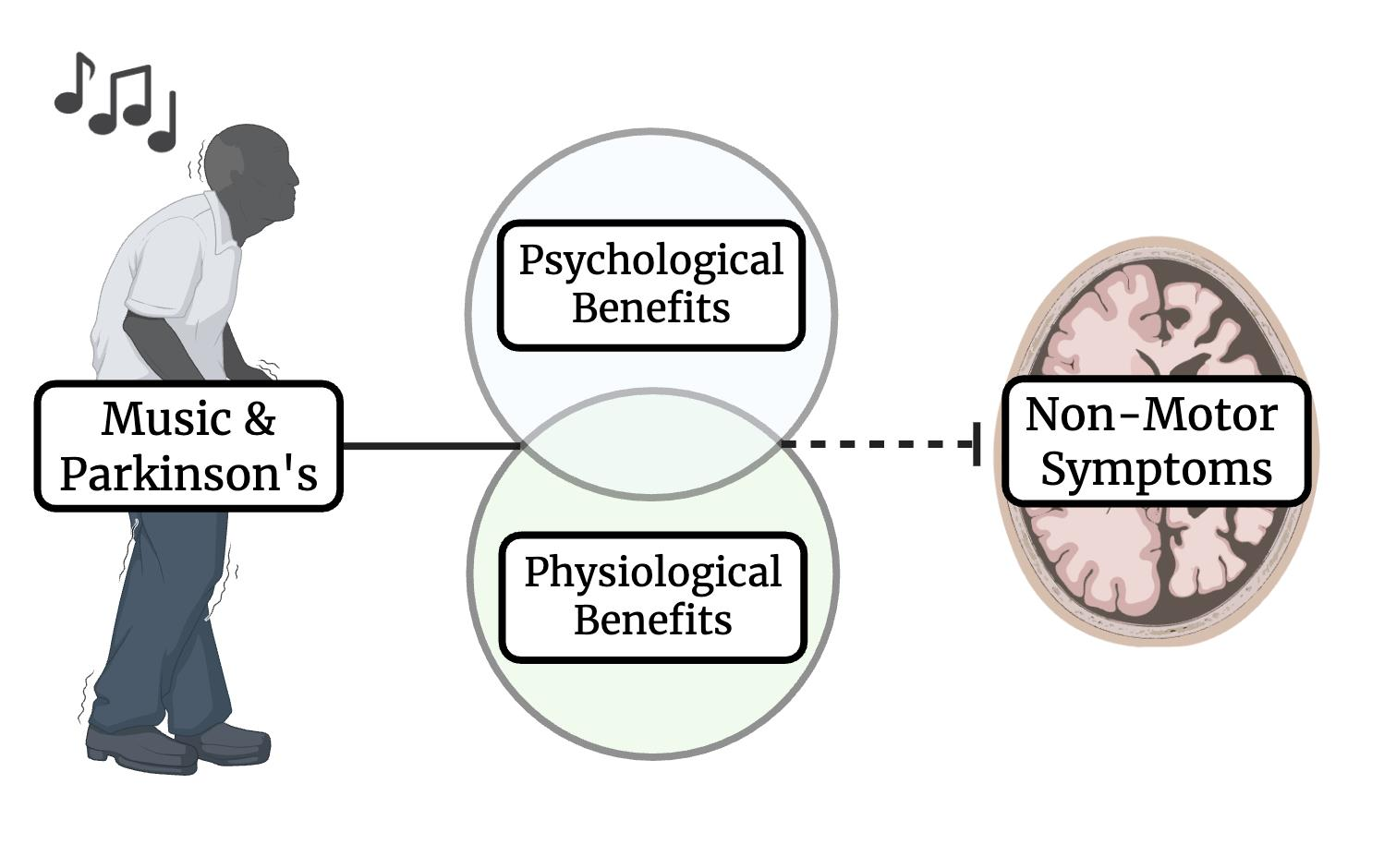
1. Introduction
2. Methods
2.1. Design and Purpose of the Narrative Review
2.2. Literature Search, Inclusion, and Synthesis
3. Physiological and Psychological Effects of Music
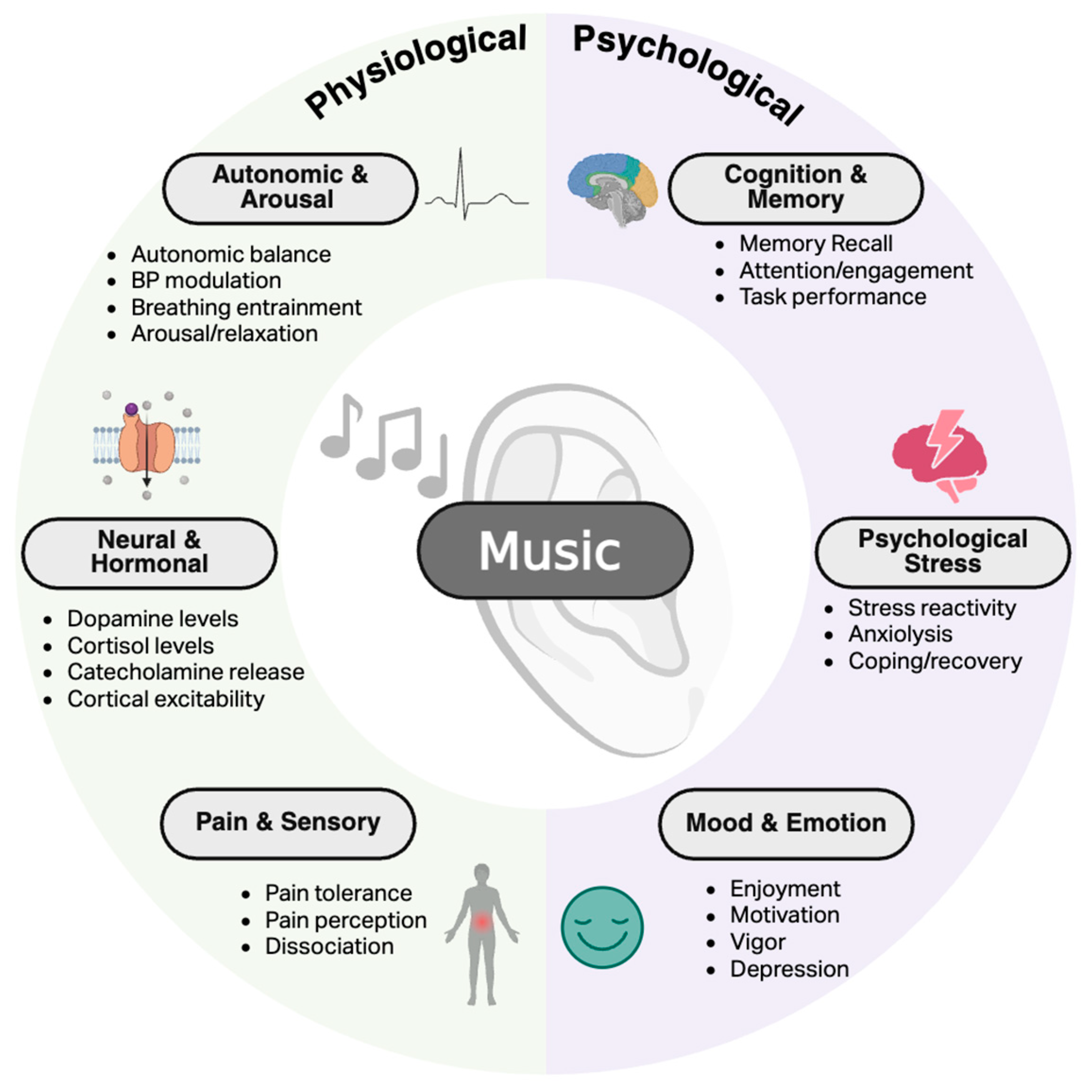
3.1. Overview
3.2. Physiological Domain
3.2.1. Autonomic Activity and Arousal
3.2.2. Neural and Hormonal
3.2.3. Pain and Sensory
3.3. Psychological Domain
3.3.1. Cognition and Memory
3.3.2. Mood and Emotion
3.3.3. Psychological Stress
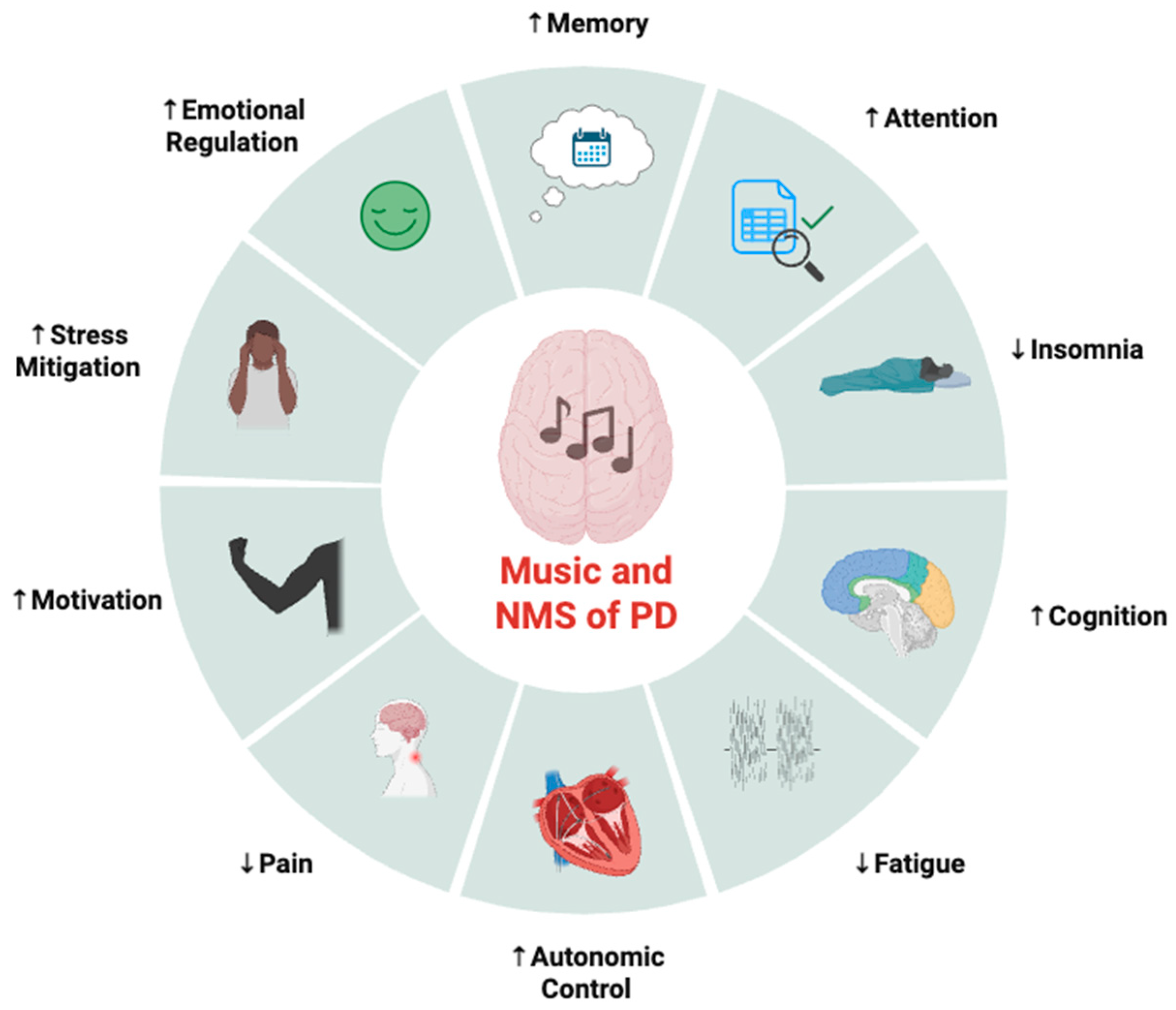
4. Therapeutic Potential on Non-Motor Symptoms in Parkinson’s Disease
4.1. Overview
4.2. Cognition and Executive Function

| Dopamine Receptor | Associated Brain Regions | Cognitive Implications When Depleted |
|---|---|---|
| D1 | striatum, substantia nigra pars compacta, nucleus accumbens, hippocampus, anterior cingulate cortex | ↓ executive functioning, ↓ motivation, ↓ attention, ↓ long-term memory, ↓ cognitive flexibility, ↓ learning |
| D2 | Striatum, hippocampus substantia nigra, insular lobe, prefrontal cortex, anterior cingulate cortex | ↓ executive functioning; ↓ working memory; ↓ inhibition, ↓ error detection |
| D3 | Nucleus accumbens, insular cortex, amygdala, hypothalamus | ↓ inhibition, ↓ cognitive flexibility, ↓ executive functioning |
| D4 | Frontal cortex, amygdala, striatum | ↓ attention, ↑ hyperactivity, ↓ executive functioning |
| D5 | Hippocampus, thalamus, striatum, nucleus accumbens | ↓ long-term memory, ↓ working memory, ↓ cognitive regulation, ↓ learning |
4.3. Memory and Attention
4.4. Insomnia and Sleep
4.5. Apathy and Motivation Loss
4.6. Mood and Emotional Dysregulation
4.7. Anxiety and Stress
4.8. Pain and Sensory Dysfunction
5. Therapeutic Application, Limitations, Challenges, and Future Directions
Author Contributions
Funding
Institutional Review Board Statement
Informed Consent Statement
Data Availability Statement
Acknowledgments
Conflicts of Interest
References
- Rocca, W.A. The burden of Parkinson’s disease: A worldwide perspective. Lancet Neurol. 2018, 17, 928–929. [Google Scholar] [CrossRef] [PubMed]
- Hermanowicz, N.; Jones, S.A.; Hauser, R.A. Impact of non-motor symptoms in Parkinson’s disease: A PMDAlliance survey. Neuropsychiatr. Dis. Treat. 2019, 15, 2205–2212. [Google Scholar] [PubMed]
- Pfeiffer, R.F. Non-motor symptoms in Parkinson’s disease. Park. Relat. Disord. 2016, 22, S119–S122. [Google Scholar]
- Sprenger, F.; Poewe, W. Management of motor and non-motor symptoms in Parkinson’s disease. CNS Drugs 2013, 27, 259–272. [Google Scholar]
- Shukla, A.K.; Nilgirwar, P.S.; Bali, S.D. Current pharmacological treatments for neurodegenerative diseases. In The Neurodegeneration Revolution; Elsevier: Amsterdam, The Netherlands, 2025; pp. 117–126. [Google Scholar]
- Salimpoor, V.N.; Benovoy, M.; Larcher, K.; Dagher, A.; Zatorre, R.J. Anatomically distinct dopamine release during anticipation and experience of peak emotion to music. Nat. Neurosci. 2011, 14, 257–262. [Google Scholar] [CrossRef]
- Salimpoor, V.N.; Van Den Bosch, I.; Kovacevic, N.; McIntosh, A.R.; Dagher, A.; Zatorre, R.J. Interactions between the nucleus accumbens and auditory cortices predict music reward value. Science 2013, 340, 216–219. [Google Scholar] [CrossRef]
- Vuust, P.; Heggli, O.A.; Friston, K.J.; Kringelbach, M.L. Music in the brain. Nat. Rev. Neurosci. 2022, 23, 287–305. [Google Scholar] [CrossRef]
- Chanda, M.L.; Levitin, D.J. The neurochemistry of music. Trends Cogn. Sci. 2013, 17, 179–193. [Google Scholar] [CrossRef]
- Ballmann, C.G.; Rogers, R.R.; Porrill, S.L.; Washmuth, N.B. Implications for the Ergogenic Benefits of Self-Selected Music in Neurological Conditions: A Theoretical Review. Neurol. Int. 2025, 17, 106. [Google Scholar] [CrossRef]
- Ballmann, C.G. The influence of music preference on exercise responses and performance: A review. J. Funct. Morphol. Kinesiol. 2021, 6, 33. [Google Scholar] [CrossRef]
- Lee, H.; Ko, B. Effects of music-based interventions on motor and non-motor symptoms in patients with Parkinson’s disease: A systematic review and meta-analysis. Int. J. Environ. Res. Public Health 2023, 20, 1046. [Google Scholar]
- Raglio, A. Music therapy interventions in Parkinson’s disease: The state-of-the-art. Front. Neurol. 2015, 6, 185. [Google Scholar] [CrossRef] [PubMed]
- Boso, M.; Politi, P.; Barale, F.; Emanuele, E. Neurophysiology and neurobiology of the musical experience. Funct. Neurol. 2006, 21, 187. [Google Scholar] [PubMed]
- Hovaguimian, A. Dysautonomia: Diagnosis and management. Neurol. Clin. 2023, 41, 193–213. [Google Scholar] [PubMed]
- Feigofsky, S.; Fedorowski, A. Defining cardiac dysautonomia–different types, overlap syndromes; case-based presentations. J. Atr. Fibrillation 2020, 13, 2403. [Google Scholar]
- Koelsch, S.; Fritz, T.; Cramon, D.Y.V.; Müller, K.; Friederici, A.D. Investigating emotion with music: An fMRI study. Hum. Brain Mapp. 2006, 27, 239–250. [Google Scholar]
- Hilz, M.J.; Stadler, P.; Gryc, T.; Nath, J.; Habib-Romstoeck, L.; Stemper, B.; Buechner, S.; Wong, S.; Koehn, J. Music induces different cardiac autonomic arousal effects in young and older persons. Auton. Neurosci. 2014, 183, 83–93. [Google Scholar] [CrossRef]
- Mojtabavi, H.; Saghazadeh, A.; Valenti, V.E.; Rezaei, N. Can music influence cardiac autonomic system? A systematic review and narrative synthesis to evaluate its impact on heart rate variability. Complement. Ther. Clin. Pract. 2020, 39, 101162. [Google Scholar]
- Xu, L.; Wang, J.; Wen, X.; Sun, Z.; Sun, R.; Xu, L.; Qian, X. Physiological state can help predict the perceived emotion of music: Evidence from ECG and EDA signals. Am. J. Life Sci. 2021, 9, 105–119. [Google Scholar] [CrossRef]
- Bartolomé-Tomás, A.; Sánchez-Reolid, R.; Fernández-Sotos, A.; Latorre, J.M.; Fernández-Caballero, A. Arousal detection in elderly people from electrodermal activity using musical stimuli. Sensors 2020, 20, 4788. [Google Scholar] [CrossRef]
- Delleli, S.; Ouergui, I.; Ballmann, C.G.; Messaoudi, H.; Trabelsi, K.; Ardigo, L.P.; Chtourou, H. The effects of pre-task music on exercise performance and associated psycho-physiological responses: A systematic review with multilevel meta-analysis of controlled studies. Front. Psychol. 2023, 14, 1293783. [Google Scholar]
- Rogers, R.R.; Williams, T.D.; Nester, E.B.; Owens, G.M.; Ballmann, C.G. The influence of music preference on countermovement jump and maximal isometric performance in active females. J. Funct. Morphol. Kinesiol. 2023, 8, 34. [Google Scholar] [CrossRef] [PubMed]
- Bernardi, L.; Porta, C.; Sleight, P. Cardiovascular, cerebrovascular, and respiratory changes induced by different types of music in musicians and non-musicians: The importance of silence. Heart 2006, 92, 445–452. [Google Scholar] [PubMed]
- Bernardi, L.; Porta, C.; Casucci, G.; Balsamo, R.; Bernardi, N.F.; Fogari, R.; Sleight, P. Dynamic interactions between musical, cardiovascular, and cerebral rhythms in humans. Circulation 2009, 119, 3171–3180. [Google Scholar] [CrossRef]
- Sharma, P.; Jain, A.; Singh, K.; Kumar, A.; Sandhu, G.; Sharma, S. Musical Genres and Their Influence on Heart Rate Variability and Blood Pressure: A cross-sectional study. Eur. J. Cardiovasc. Med. 2024, 14, 601–607. [Google Scholar]
- Koelsch, S.; Cheung, V.K.; Jentschke, S.; Haynes, J.-D. Neocortical substrates of feelings evoked with music in the ACC, insula, and somatosensory cortex. Sci. Rep. 2021, 11, 10119. [Google Scholar] [CrossRef]
- Faber, S.E.; Belden, A.G.; Loui, P.; McIntosh, R. Age-related variability in network engagement during music listening. Netw. Neurosci. 2023, 7, 1404–1419. [Google Scholar] [CrossRef]
- Moraes, M.M.; Rabelo, P.C.; Pinto, V.A.; Pires, W.; Wanner, S.P.; Szawka, R.E.; Soares, D.D. Auditory stimulation by exposure to melodic music increases dopamine and serotonin activities in rat forebrain areas linked to reward and motor control. Neurosci. Lett. 2018, 673, 73–78. [Google Scholar] [CrossRef]
- Ballmann, C.G.; McCullum, M.J.; Rogers, R.R.; Marshall, M.R.; Williams, T.D. Effects of preferred vs. nonpreferred music on resistance exercise performance. J. Strength Cond. Res. 2021, 35, 1650–1655. [Google Scholar] [CrossRef]
- Putkinen, V.; Seppälä, K.; Harju, H.; Hirvonen, J.; Karlsson, H.K.; Nummenmaa, L. Pleasurable music activates cerebral µ-opioid receptors: A combined PET-fMRI study. Eur. J. Nucl. Med. Mol. Imaging 2025, 52, 3540–3549. [Google Scholar] [CrossRef]
- Kim, K.J.; Lee, S.N.; Lee, B.H. Music therapy inhibits morphine-seeking behavior via GABA receptor and attenuates anxiety-like behavior induced by extinction from chronic morphine use. Neurosci. Lett. 2018, 674, 81–87. [Google Scholar] [CrossRef]
- Kanduri, C.; Raijas, P.; Ahvenainen, M.; Philips, A.K.; Ukkola-Vuoti, L.; Lähdesmäki, H.; Järvelä, I. The effect of listening to music on human transcriptome. PeerJ 2015, 3, e830. [Google Scholar] [CrossRef]
- Kunikullaya, K.; Pranjić, M.; Rigby, A.; Pallás-Ferrer, I.; Anand, H.; Kunnavil, R.; Jaschke, A.C. The molecular basis of music-induced neuroplasticity in humans: A systematic review. Neurosci. Biobehav. Rev. 2025, 175, 106219. [Google Scholar] [CrossRef] [PubMed]
- Linnemann, A.; Ditzen, B.; Strahler, J.; Doerr, J.M.; Nater, U.M. Music listening as a means of stress reduction in daily life. Psychoneuroendocrinology 2015, 60, 82–90. [Google Scholar] [CrossRef] [PubMed]
- Yamamoto, T.; Ohkuwa, T.; Itoh, H.; Kitoh, M.; Terasawa, J.; Tsuda, T.; Kitagawa, S.; Sato, Y. Effects of pre-exercise listening to slow and fast rhythm music on supramaximal cycle performance and selected metabolic variables. Arch. Biochem. Biophys. 2003, 111, 211–214. [Google Scholar] [CrossRef]
- Reybrouck, M.; Vuust, P.; Brattico, E. Neural correlates of music listening: Does the music matter? Brain Sci. 2021, 11, 1553. [Google Scholar] [CrossRef]
- Hole, J.; Hirsch, M.; Ball, E.; Meads, C. Music as an aid for postoperative recovery in adults: A systematic review and meta-analysis. Lancet 2015, 386, 1659–1671. [Google Scholar] [CrossRef]
- Garza-Villarreal, E.A.; Jiang, Z.; Vuust, P.; Alcauter, S.; Vase, L.; Pasaye, E.H.; Cavazos-Rodriguez, R.; Brattico, E.; Jensen, T.S.; Barrios, F.A. Music reduces pain and increases resting state fMRI BOLD signal amplitude in the left angular gyrus in fibromyalgia patients. Front. Psychol. 2015, 6, 1051. [Google Scholar] [CrossRef]
- Blum, K.; Chen, T.J.; Chen, A.L.; Madigan, M.; Downs, B.W.; Waite, R.L.; Braverman, E.R.; Kerner, M.; Bowirrat, A.; Giordano, J. Do dopaminergic gene polymorphisms affect mesolimbic reward activation of music listening response? Therapeutic impact on Reward Deficiency Syndrome (RDS). Med. Hypotheses 2010, 74, 513–520. [Google Scholar] [CrossRef]
- Menon, V.; Levitin, D.J. The rewards of music listening: Response and physiological connectivity of the mesolimbic system. Neuroimage 2005, 28, 175–184. [Google Scholar] [CrossRef]
- Wood, P.B. Role of central dopamine in pain and analgesia. Expert Rev. Neurother. 2008, 8, 781–797. [Google Scholar] [CrossRef] [PubMed]
- Mallik, A.; Chanda, M.L.; Levitin, D.J. Anhedonia to music and mu-opioids: Evidence from the administration of naltrexone. Sci. Rep. 2017, 7, 41952. [Google Scholar] [CrossRef] [PubMed]
- Puri, N. Creation of Music-Induced Analgesia in Chronic Pain Patients through Endogenous Opioid Production: A Narrative Review. Int. J. Pain Manag. 2024, 1, 16–31. [Google Scholar] [CrossRef]
- Dobek, C.E.; Beynon, M.E.; Bosma, R.L.; Stroman, P.W. Music modulation of pain perception and pain-related activity in the brain, brain stem, and spinal cord: A functional magnetic resonance imaging study. J. Pain 2014, 15, 1057–1068. [Google Scholar] [CrossRef]
- Johnsen, E.L.; Tranel, D.; Lutgendorf, S.; Adolphs, R. A neuroanatomical dissociation for emotion induced by music. Int. J. Psychophysiol. 2009, 72, 24–33. [Google Scholar] [CrossRef]
- Ballmann, C.G.; Maynard, D.J.; Lafoon, Z.N.; Marshall, M.R.; Williams, T.D.; Rogers, R.R. Effects of listening to preferred versus non-preferred music on repeated wingate anaerobic test performance. Sports 2019, 7, 185. [Google Scholar] [CrossRef]
- Nixon, K.M.; Parker, M.G.; Elwell, C.C.; Pemberton, A.L.; Rogers, R.R.; Ballmann, C.G. Effects of music volume preference on endurance exercise performance. J. Funct. Morphol. Kinesiol. 2022, 7, 35. [Google Scholar] [CrossRef]
- Radocy, R.E.; Boyle, J.D. Psychological Foundations of Musical Behavior; Charles C Thomas Publisher: Springfield, IL, USA, 2012. [Google Scholar]
- Aalbers, S.; Fusar-Poli, L.; Freeman, R.E.; Spreen, M.; Ket, J.C.; Vink, A.C.; Maratos, A.; Crawford, M.; Chen, X.J.; Gold, C. Music therapy for depression. Cochrane Database Syst. Rev. 2017, 11, CD004517. [Google Scholar]
- Mendes, C.G.; Diniz, L.A.; Marques Miranda, D. Does music listening affect attention? A literature review. Dev. Neuropsychol. 2021, 46, 192–212. [Google Scholar] [CrossRef]
- Peck, K.J.; Girard, T.A.; Russo, F.A.; Fiocco, A.J. Music and memory in Alzheimer’s disease and the potential underlying mechanisms. J. Alzheimer’s Dis. 2016, 51, 949–959. [Google Scholar] [CrossRef]
- De Witte, M.; Spruit, A.; Van Hooren, S.; Moonen, X.; Stams, G.-J. Effects of music interventions on stress-related outcomes: A systematic review and two meta-analyses. Health Psychol. Rev. 2020, 14, 294–324. [Google Scholar]
- Dimitriadis, T.; Della Porta, D.; Perschl, J.; Evers, A.W.; Magee, W.L.; Schaefer, R.S. Motivation and music interventions in adults: A systematic review. Neuropsychol. Rehabil. 2024, 34, 649–678. [Google Scholar] [PubMed]
- Rhoads, K.J.; Sosa, S.R.; Rogers, R.R.; Kopec, T.J.; Ballmann, C.G. Sex differences in response to listening to self-selected music during repeated high-intensity sprint exercise. Sexes 2021, 2, 60–68. [Google Scholar]
- Robbins, T.W. Cognition: The ultimate brain function. Neuropsychopharmacology 2011, 36, 1–2. [Google Scholar] [PubMed]
- Tang, L.; Feng, Z.; Zhang, Y.; Tong, F. The effects of music-based interventions on cognitive function in cognitively normal older adults: A systematic review and meta-analysis. Front. Psychol. 2025, 16, 1632873. [Google Scholar] [CrossRef]
- Thaut, M.H.; Gardiner, J. Musical attention control training. In Handbook of Neurologic Music Therapy; Oxford University Press: Oxford, UK, 2014; pp. 257–269. [Google Scholar]
- Hegde, S. Training (MEFT)®. In Handbook of Neurologic Music Therapy; Oxford University Press: Oxford, UK, 2025; p. 352. [Google Scholar]
- Echauri, G.; Gassull, L.; Gardiner, J.C.; Thaut, M.H. Musical Mnemonics Training (MMT)®. In Handbook of Neurologic Music Therapy; Oxford University Press: Oxford, UK, 2025; p. 371. [Google Scholar]
- Soares, J.M.; Marques, P.; Magalhães, R.; Santos, N.C.; Sousa, N. Brain structure across the lifespan: The influence of stress and mood. Front. Aging Neurosci. 2014, 6, 330. [Google Scholar] [CrossRef]
- Koelsch, S. A coordinate-based meta-analysis of music-evoked emotions. NeuroImage 2020, 223, 117350. [Google Scholar]
- Fuentes-Sánchez, N.; Pastor, R.; Escrig, M.A.; Elipe-Miravet, M.; Pastor, M.C. Emotion elicitation during music listening: Subjective self-reports, facial expression, and autonomic reactivity. Psychophysiology 2021, 58, e13884. [Google Scholar]
- Vuilleumier, P.; Trost, W. Music and emotions: From enchantment to entrainment. Ann. N. Y. Acad. Sci. 2015, 1337, 212–222. [Google Scholar] [CrossRef]
- Thoma, M.V.; Scholz, U.; Ehlert, U.; Nater, U.M. Listening to music and physiological and psychological functioning: The mediating role of emotion regulation and stress reactivity. Psychol. Health 2012, 27, 227–241. [Google Scholar]
- McEwen, B.S.; Bowles, N.P.; Gray, J.D.; Hill, M.N.; Hunter, R.G.; Karatsoreos, I.N.; Nasca, C. Mechanisms of stress in the brain. Nat. Neurosci. 2015, 18, 1353–1363. [Google Scholar] [CrossRef] [PubMed]
- Gianaros, P.J.; Wager, T.D. Brain-body pathways linking psychological stress and physical health. Curr. Dir. Psychol. Sci. 2015, 24, 313–321. [Google Scholar] [CrossRef]
- Dedovic, K.; D’Aguiar, C.; Pruessner, J.C. What stress does to your brain: A review of neuroimaging studies. Can. J. Psychiatry 2009, 54, 6–15. [Google Scholar] [CrossRef] [PubMed]
- Krause, A.E.; Scott, W.G.; Flynn, S.; Foong, B.; Goh, K.; Wake, S.; Miller, D.; Garvey, D. Listening to music to cope with everyday stressors. Music. Sci. 2023, 27, 176–192. [Google Scholar]
- de Witte, M.; Aalbers, S.; Vink, A.; Friederichs, S.; Knapen, A.; Pelgrim, T.; Lampit, A.; Baker, F.A.; van Hooren, S. Music therapy for the treatment of anxiety: A systematic review with multilevel meta-analyses. EClinicalMedicine 2025, 84, 103293. [Google Scholar]
- De Witte, M.; Pinho, A.d.S.; Stams, G.-J.; Moonen, X.; Bos, A.E.; Van Hooren, S. Music therapy for stress reduction: A systematic review and meta-analysis. Health Psychol. Rev. 2022, 16, 134–159. [Google Scholar]
- Jiang, J.; Rickson, D.; Jiang, C. The mechanism of music for reducing psychological stress: Music preference as a mediator. Arts Psychother. 2016, 48, 62–68. [Google Scholar] [CrossRef]
- Huang, B.; Hao, X.; Long, S.; Ding, R.; Wang, J.; Liu, Y.; Guo, S.; Lu, J.; He, M.; Yao, D. The benefits of music listening for induced state anxiety: Behavioral and physiological evidence. Brain Sci. 2021, 11, 1332. [Google Scholar] [CrossRef]
- Tan, M.; Zhou, X.; Shen, L.; Li, Y.; Chen, X. Music’s Dual Role in Emotion Regulation: Network Analysis of Music Use, Emotion Regulation Self-Efficacy, Alexithymia, Anxiety, and Depression. Depress. Anxiety 2024, 2024, 1790168. [Google Scholar]
- Chin, T.; Rickard, N.S. Emotion regulation strategy mediates both positive and negative relationships between music uses and well-being. Psychol. Music 2014, 42, 692–713. [Google Scholar]
- Fang, C.; Lv, L.; Mao, S.; Dong, H.; Liu, B. Cognition deficits in Parkinson’s disease: Mechanisms and treatment. Park. Dis. 2020, 2020, 2076942. [Google Scholar] [CrossRef] [PubMed]
- Wallace, E.R.; Segerstrom, S.C.; van Horne, C.G.; Schmitt, F.A.; Koehl, L.M. Meta-analysis of cognition in Parkinson’s disease mild cognitive impairment and dementia progression. Neuropsychol. Rev. 2022, 32, 149–160. [Google Scholar] [PubMed]
- Foerde, K.; Shohamy, D. The role of the basal ganglia in learning and memory: Insight from Parkinson’s disease. Neurobiol. Learn. Mem. 2011, 96, 624–636. [Google Scholar] [CrossRef] [PubMed]
- Jellinger, K.A. Morphological basis of Parkinson disease-associated cognitive impairment: An update. J. Neural Transm. 2022, 129, 977–999. [Google Scholar] [CrossRef]
- Bohnen, N.I.; Albin, R.L. The cholinergic system and Parkinson disease. Behav. Brain Res. 2011, 221, 564–573. [Google Scholar] [CrossRef]
- Paredes-Rodriguez, E.; Vegas-Suarez, S.; Morera-Herreras, T.; De Deurwaerdere, P.; Miguelez, C. The noradrenergic system in Parkinson’s disease. Front. Pharmacol. 2020, 11, 435. [Google Scholar] [CrossRef]
- Rondou, P.; Haegeman, G.; Van Craenenbroeck, K. The dopamine D4 receptor: Biochemical and signalling properties. Cell. Mol. Life Sci. 2010, 67, 1971–1986. [Google Scholar] [CrossRef]
- Zhou, Z.; Yan, Y.; Gu, H.; Sun, R.; Liao, Z.; Xue, K.; Tang, C. Dopamine in the prefrontal cortex plays multiple roles in the executive function of patients with Parkinson’s disease. Neural Regen. Res. 2024, 19, 1759–1767. [Google Scholar] [CrossRef]
- Leh, S.E.; Petrides, M.; Strafella, A.P. The neural circuitry of executive functions in healthy subjects and Parkinson’s disease. Neuropsychopharmacology 2010, 35, 70–85. [Google Scholar]
- Joyce, J.N.; Millan, M.J. Dopamine D3 receptor agonists for protection and repair in Parkinson’s disease. Curr. Opin. Pharmacol. 2007, 7, 100–105. [Google Scholar]
- Calabrò, R.S.; Naro, A.; Filoni, S.; Pullia, M.; Billeri, L.; Tomasello, P.; Portaro, S.; Di Lorenzo, G.; Tomaino, C.; Bramanti, P. Walking to your right music: A randomized controlled trial on the novel use of treadmill plus music in Parkinson’s disease. J. Neuroeng. Rehabil. 2019, 16, 68. [Google Scholar] [PubMed]
- Impellizzeri, F.; Maggio, M.G.; De Pasquale, P.; Bonanno, M.; Bonanno, L.; De Luca, R.; Paladina, G.; Alibrandi, A.; Milardi, D.; Thaut, M. Coupling neurologic music therapy with immersive virtual reality to improve executive functions in individuals with Parkinson’s disease: A Quasi-Randomized Clinical Trial. Clin. Park. Relat. Disord. 2024, 11, 100277. [Google Scholar] [PubMed]
- Bugos, J.A.; Lesiuk, T.; Nathani, S. Piano training enhances Stroop performance and musical self-efficacy in older adults with Parkinson’s disease. Psychol. Music 2021, 49, 615–630. [Google Scholar]
- Spina, E.; Barone, P.; Mosca, L.L.; Lombardi, A.; Longo, K.; Iavarone, A.; Amboni, M. Music therapy for motor and nonmotor symptoms of Parkinson’s disease: A prospective, randomized, controlled, single-blinded study. J. Am. Geriatr. Soc. 2016, 64, e36–e39. [Google Scholar] [CrossRef]
- Schlaug, G.; Altenmüller, E.; Thaut, M. Music listening and music making in the treatment of neurological disorders and impairments. Music Percept. 2010, 27, 249–250. [Google Scholar]
- Schmid, D.G. Prospects of cognitive-motor entrainment: An interdisciplinary review. Front. Cogn. 2024, 3, 1354116. [Google Scholar] [CrossRef]
- Wang, Y.N.; Wen, X.N.; Chen, Y.; Xu, N.; Zhang, J.H.; Hou, X.; Liu, J.P.; Li, P.; Chen, J.Y.; Wang, J.H. Effects of movement training based on rhythmic auditory stimulation in cognitive impairment: A meta-analysis of randomized controlled clinical trial. Front. Neurosci. 2024, 18, 1360935. [Google Scholar] [CrossRef]
- Lesiuk, T.; Bugos, J.A.; Murakami, B. A rationale for music training to enhance executive functions in Parkinson’s disease: An overview of the problem. Healthcare 2018, 6, 35. [Google Scholar] [CrossRef]
- Rajakumar, K.D.; Mohan, J. A systematic review on effect of music intervention on cognitive impairment using EEG, fMRI, and cognitive assessment modalities. Results Eng. 2024, 22, 102224. [Google Scholar] [CrossRef]
- Ahuja, S.; Gupta, R.K.; Damodharan, D.; Philip, M.; Venkatasubramanian, G.; Keshavan, M.S.; Hegde, S. Effect of music listening on P300 event-related potential in patients with schizophrenia: A pilot study. Schizophr. Res. 2020, 216, 85–96. [Google Scholar] [CrossRef]
- Latif, S.; Jahangeer, M.; Maknoon Razia, D.; Ashiq, M.; Ghaffar, A.; Akram, M.; El Allam, A.; Bouyahya, A.; Garipova, L.; Ali Shariati, M.; et al. Dopamine in Parkinson’s disease. Clin. Chim. Acta 2021, 522, 114–126. [Google Scholar] [CrossRef] [PubMed]
- Hely, M.A.; Reid, W.G.; Adena, M.A.; Halliday, G.M.; Morris, J.G. The Sydney multicenter study of Parkinson’s disease: The inevitability of dementia at 20 years. Mov. Disord. 2008, 23, 837–844. [Google Scholar] [CrossRef] [PubMed]
- Aarsland, D.; Batzu, L.; Halliday, G.M.; Geurtsen, G.J.; Ballard, C.; Ray Chaudhuri, K.; Weintraub, D. Parkinson disease-associated cognitive impairment. Nat. Rev. Dis. Primers 2021, 7, 47. [Google Scholar] [CrossRef]
- Aarsland, D.; Zaccai, J.; Brayne, C. A systematic review of prevalence studies of dementia in Parkinson’s disease. Mov. Disord. 2005, 20, 1255–1263. [Google Scholar] [CrossRef] [PubMed]
- Owens-Walton, C.; Jakabek, D.; Power, B.D.; Walterfang, M.; Hall, S.; van Westen, D.; Looi, J.C.L.; Shaw, M.; Hansson, O. Structural and functional neuroimaging changes associated with cognitive impairment and dementia in Parkinson’s disease. Psychiatry Res. Neuroimaging 2021, 312, 111273. [Google Scholar] [CrossRef]
- Eichenbaum, H. Prefrontal-hippocampal interactions in episodic memory. Nat. Rev. Neurosci. 2017, 18, 547–558. [Google Scholar] [CrossRef]
- Prasuhn, J.; Prasuhn, M.; Fellbrich, A.; Strautz, R.; Lemmer, F.; Dreischmeier, S.; Kasten, M.; Munte, T.F.; Hanssen, H.; Heldmann, M.; et al. Association of Locus Coeruleus and Substantia Nigra Pathology with Cognitive and Motor Functions in Patients with Parkinson Disease. Neurology 2021, 97, e1007–e1016. [Google Scholar] [CrossRef]
- Weintraub, D.; Dietz, N.; Duda, J.E.; Wolk, D.A.; Doshi, J.; Xie, S.X.; Davatzikos, C.; Clark, C.M.; Siderowf, A. Alzheimer’s disease pattern of brain atrophy predicts cognitive decline in Parkinson’s disease. Brain 2012, 135, 170–180. [Google Scholar] [CrossRef]
- Xu, R.; Hu, X.; Jiang, X.; Zhang, Y.; Wang, J.; Zeng, X. Longitudinal volume changes of hippocampal subfields and cognitive decline in Parkinson’s disease. Quant. Imaging Med. Surg. 2020, 10, 220–232. [Google Scholar] [CrossRef]
- Fusar-Poli, L.; Bieleninik, L.; Brondino, N.; Chen, X.J.; Gold, C. The effect of music therapy on cognitive functions in patients with dementia: A systematic review and meta-analysis. Aging Ment. Health 2018, 22, 1097–1106. [Google Scholar] [CrossRef]
- Moreira, S.V.; Justi, F.; Gomes, C.F.A.; Moreira, M. Music Therapy Enhances Episodic Memory in Alzheimer’s and Mixed Dementia: A Double-Blind Randomized Controlled Trial. Healthcare 2023, 11, 2912. [Google Scholar] [CrossRef] [PubMed]
- Li, A.; Yang, Y.; Jiang, Q.; Wu, T.; Li, T. Effectiveness and applications of neurologic music therapy in motor and non-motor rehabilitation for older adults with Parkinson’s disease: A systematic review and meta-analysis. Front. Neurol. 2025, 16, 1679881. [Google Scholar] [CrossRef] [PubMed]
- Duan, X.; Liu, H.; Hu, X.; Yu, Q.; Kuang, G.; Liu, L.; Zhang, S.; Wang, X.; Li, J.; Yu, D. Insomnia in Parkinson’s disease: Causes, consequences, and therapeutic approaches. Mol. Neurobiol. 2025, 62, 2292–2313. [Google Scholar] [CrossRef] [PubMed]
- Si, T.L.; Wang, Y.-Y.; Li, J.-X.; Bai, W.; Sun, H.-L.; Rao, S.-Y.; Zhu, H.-Y.; Ungvari, G.S.; Su, Z.; Cheung, T. Poor sleep quality among patients with Parkinson’s disease: A meta-analysis and systematic review. Front. Psychiatry 2025, 16, 1606743. [Google Scholar] [CrossRef]
- Xu, Z.; Anderson, K.N.; Saffari, S.E.; Lawson, R.A.; Chaudhuri, K.R.; Brooks, D.; Pavese, N. Progression of sleep disturbances in Parkinson’s disease: A 5-year longitudinal study. J. Neurol. 2021, 268, 312–320. [Google Scholar] [CrossRef]
- Vetrivelan, R.; Qiu, M.-H.; Chang, C.; Lu, J. Role of basal ganglia in sleep–wake regulation: Neural circuitry and clinical significance. Front. Neuroanat. 2010, 4, 145. [Google Scholar] [CrossRef]
- Asadpoordezaki, Z.; Coogan, A.N.; Henley, B.M. Chronobiology of Parkinson’s disease: Past, present and future. Eur. J. Neurosci. 2023, 57, 178–200. [Google Scholar] [CrossRef]
- Costa, E.d.C.; Filho, C.A.K.; Esteves, A.M.; Guelfi, É.T.N.; Vuillerme, N.; Barbieri, F.A. Sleep “ON”, sleep better! Positive effects of levodopa on sleep behaviour in people with Parkinson’s disease. J. Sleep Res. 2024, 33, e14240. [Google Scholar] [CrossRef]
- Wallace, D.M.; Wohlgemuth, W.K.; Trotti, L.M.; Amara, A.W.; Malaty, I.A.; Factor, S.A.; Nallu, S.; Wittine, L.; Hauser, R.A. Practical evaluation and management of insomnia in Parkinson’s disease: A review. Mov. Disord. Clin. Pract. 2020, 7, 250–266. [Google Scholar] [CrossRef]
- Petrovsky, D.V.; Ramesh, P.; McPhillips, M.V.; Hodgson, N.A. Effects of music interventions on sleep in older adults: A systematic review. Geriatr. Nurs. 2021, 42, 869–879. [Google Scholar] [CrossRef]
- Cayley, W.E., Jr.; James, J. Insomnia Therapy: Listening to Music. Am. Fam. Physician 2023, 107, 463–464. [Google Scholar]
- Tang, R.; Gong, S.; Li, J.; Hu, W.; Liu, J.; Liao, C. Efficacy of non-pharmacological interventions for sleep quality in Parkinson’s disease: A systematic review and network meta-analysis. Front. Neurosci. 2024, 18, 1337616. [Google Scholar] [CrossRef]
- Dickson, G.T.; Schubert, E. How does music aid sleep? Literature review. Sleep Med. 2019, 63, 142–150. [Google Scholar] [CrossRef]
- Cordi, M.J.; Ackermann, S.; Rasch, B. Effects of relaxing music on healthy sleep. Sci. Rep. 2019, 9, 9079. [Google Scholar] [CrossRef] [PubMed]
- Morris, L.-A.; Harrison, S.J.; Melzer, T.R.; Dalrymple-Alford, J.C.; Anderson, T.J.; MacAskill, M.R.; Le Heron, C.J. Altered nucleus accumbens functional connectivity precedes apathy in Parkinson’s disease. Brain 2023, 146, 2739–2752. [Google Scholar] [CrossRef] [PubMed]
- Lang, S.; Yoon, E.J.; Kibreab, M.; Kathol, I.; Cheetham, J.; Hammer, T.; Sarna, J.; Ismail, Z.; Monchi, O. Mild behavioral impairment in Parkinson’s disease is associated with altered corticostriatal connectivity. NeuroImage Clin. 2020, 26, 102252. [Google Scholar] [PubMed]
- Tessitore, A.; Hariri, A.R.; Fera, F.; Smith, W.G.; Chase, T.N.; Hyde, T.M.; Weinberger, D.R.; Mattay, V.S. Dopamine modulates the response of the human amygdala: A study in Parkinson’s disease. J. Neurosci. 2002, 22, 9099–9103. [Google Scholar] [CrossRef]
- Nyberg, E.M.; Tanabe, J.; Honce, J.M.; Krmpotich, T.; Shelton, E.; Hedeman, J.; Berman, B.D. Morphologic changes in the mesolimbic pathway in Parkinson’s disease motor subtypes. Park. Relat. Disord. 2015, 21, 536–540. [Google Scholar] [CrossRef]
- Sun, H.-H.; Hu, J.-B.; Chen, J.; Wang, X.-Y.; Wang, X.-L.; Pan, P.-L.; Liu, C.-F. Abnormal spontaneous neural activity in Parkinson’s disease with “pure” apathy. Front. Neurosci. 2020, 14, 830. [Google Scholar] [CrossRef]
- Baggio, H.C.; Segura, B.; Garrido-Millan, J.L.; Marti, M.J.; Compta, Y.; Valldeoriola, F.; Tolosa, E.; Junque, C. Resting-state frontostriatal functional connectivity in Parkinson’s disease–related apathy. Mov. Disord. 2015, 30, 671–679. [Google Scholar] [CrossRef]
- Reijnders, J.S.; Scholtissen, B.; Weber, W.E.; Aalten, P.; Verhey, F.R.; Leentjens, A.F. Neuroanatomical correlates of apathy in Parkinson’s disease: A magnetic resonance imaging study using voxel-based morphometry. Mov. Disord. 2010, 25, 2318–2325. [Google Scholar] [CrossRef] [PubMed]
- Quinci, M.A.; Belden, A.; Goutama, V.; Gong, D.; Hanser, S.; Donovan, N.J.; Geddes, M.; Loui, P. Longitudinal changes in auditory and reward systems following receptive music-based intervention in older adults. Sci. Rep. 2022, 12, 11517. [Google Scholar] [CrossRef] [PubMed]
- Gold, B.P.; Mas-Herrero, E.; Zeighami, Y.; Benovoy, M.; Dagher, A.; Zatorre, R.J. Musical reward prediction errors engage the nucleus accumbens and motivate learning. Proc. Natl. Acad. Sci. USA 2019, 116, 3310–3315. [Google Scholar] [PubMed]
- Lepping, R.J.; Atchley, R.A.; Chrysikou, E.; Martin, L.E.; Clair, A.A.; Ingram, R.E.; Simmons, W.K.; Savage, C.R. Neural processing of emotional musical and nonmusical stimuli in depression. PLoS ONE 2016, 11, e0156859. [Google Scholar] [CrossRef]
- Cong, S.; Xiang, C.; Zhang, S.; Zhang, T.; Wang, H.; Cong, S. Prevalence and clinical aspects of depression in Parkinson’s disease: A systematic review and meta-analysis of 129 studies. Neurosci. Biobehav. Rev. 2022, 141, 104749. [Google Scholar] [CrossRef]
- Blonder, L.X.; Slevin, J.T. Emotional dysfunction in Parkinson’s disease. Behav. Neurol. 2011, 24, 201–217. [Google Scholar]
- Castrioto, A.; Thobois, S.; Carnicella, S.; Maillet, A.; Krack, P. Emotional manifestations of PD: Neurobiological basis. Mov. Disord. 2016, 31, 1103–1113. [Google Scholar] [CrossRef]
- Ballanger, B.; Klinger, H.; Eche, J.; Lerond, J.; Vallet, A.E.; Le Bars, D.; Tremblay, L.; Sgambato-Faure, V.; Broussolle, E.; Thobois, S. Role of serotonergic 1A receptor dysfunction in depression associated with Parkinson’s disease. Mov. Disord. 2012, 27, 84–89. [Google Scholar] [CrossRef]
- Costello, H.; Berry, A.J.; Reeves, S.; Weil, R.S.; Joyce, E.M.; Howard, R.; Roiser, J.P. Disrupted reward processing in Parkinson’s disease and its relationship with dopamine state and neuropsychiatric syndromes: A systematic review and meta-analysis. J. Neurol. Neurosurg. Psychiatry 2022, 93, 555–562. [Google Scholar] [CrossRef]
- Caminiti, S.P.; Presotto, L.; Baroncini, D.; Garibotto, V.; Moresco, R.M.; Gianolli, L.; Volonté, M.A.; Antonini, A.; Perani, D. Axonal damage and loss of connectivity in nigrostriatal and mesolimbic dopamine pathways in early Parkinson’s disease. NeuroImage Clin. 2017, 14, 734–740. [Google Scholar] [CrossRef]
- Luo, C.; Song, W.; Chen, Q.; Zheng, Z.; Chen, K.; Cao, B.; Yang, J.; Li, J.; Huang, X.; Gong, Q. Reduced functional connectivity in early-stage drug-naive Parkinson’s disease: A resting-state fMRI study. Neurobiol. Aging 2014, 35, 431–441. [Google Scholar] [CrossRef] [PubMed]
- Barone, P. Treatment of depressive symptoms in Parkinson’s disease. Eur. J. Neurol. 2011, 18, 11–15. [Google Scholar] [CrossRef] [PubMed]
- Bomasang-Layno, E.; Fadlon, I.; Murray, A.N.; Himelhoch, S. Antidepressive treatments for Parkinson’s disease: A systematic review and meta-analysis. Park. Relat. Disord. 2015, 21, 833–842. [Google Scholar] [CrossRef]
- Mills, K.A.; Greene, M.C.; Dezube, R.; Goodson, C.; Karmarkar, T.; Pontone, G.M. Efficacy and tolerability of antidepressants in Parkinson’s disease: A systematic review and network meta-analysis. Int. J. Geriatr. Psychiatry 2018, 33, 642–651. [Google Scholar] [CrossRef] [PubMed]
- Ramaswamy, M.; Philip, J.L.; Priya, V.; Priyadarshini, S.; Ramasamy, M.; Jeevitha, G.; Mathkor, D.M.; Haque, S.; Dabaghzadeh, F.; Bhattacharya, P. Therapeutic use of music in neurological disorders: A concise narrative review. Heliyon 2024, 10, e35564. [Google Scholar] [CrossRef]
- Fodor, D.M.; Breda, X.-M.; Valean, D.; Marta, M.M.; Perju-Dumbrava, L. Music as add-on therapy in the rehabilitation program of parkinson’s disease patients—A Romanian pilot study. Brain Sci. 2021, 11, 569. [Google Scholar] [CrossRef]
- Pannese, A.; Grandjean, D.; Frühholz, S. Amygdala and auditory cortex exhibit distinct sensitivity to relevant acoustic features of auditory emotions. Cortex 2016, 85, 116–125. [Google Scholar] [CrossRef]
- Liégeois-Chauvel, C.; Bénar, C.; Krieg, J.; Delbé, C.; Chauvel, P.; Giusiano, B.; Bigand, E. How functional coupling between the auditory cortex and the amygdala induces musical emotion: A single case study. Cortex 2014, 60, 82–93. [Google Scholar] [CrossRef]
- Barr, H.J.; Wall, E.M.; Woolley, S.C. Dopamine in the songbird auditory cortex shapes auditory preference. Curr. Biol. 2021, 31, 4547–4559. [Google Scholar] [CrossRef]
- Broen, M.P.; Narayen, N.E.; Kuijf, M.L.; Dissanayaka, N.N.; Leentjens, A.F. Prevalence of anxiety in Parkinson’s disease: A systematic review and meta-analysis. Mov. Disord. 2016, 31, 1125–1133. [Google Scholar]
- Upneja, A.; Paul, B.S.; Jain, D.; Choudhary, R.; Paul, G. Anxiety in Parkinson’s disease: Correlation with depression and quality of life. J. Neurosci. Rural Pract. 2021, 12, 323. [Google Scholar]
- Dissanayaka, N.N.; White, E.; O’Sullivan, J.D.; Marsh, R.; Pachana, N.A.; Byrne, G.J. The clinical spectrum of anxiety in Parkinson’s disease. Mov. Disord. 2014, 29, 967–975. [Google Scholar] [CrossRef] [PubMed]
- Criaud, M.; Kim, J.-H.; Zurowski, M.; Lobaugh, N.; Chavez, S.; Houle, S.; Strafella, A.P. Anxiety in Parkinson’s disease: Abnormal resting activity and connectivity. Brain Res. 2021, 1753, 147235. [Google Scholar] [CrossRef] [PubMed]
- Prediger, R.D.; Matheus, F.C.; Schwarzbold, M.L.; Lima, M.M.; Vital, M.A. Anxiety in Parkinson’s disease: A critical review of experimental and clinical studies. Neuropharmacology 2012, 62, 115–124. [Google Scholar] [CrossRef] [PubMed]
- Linnemann, A.; Strahler, J.; Nater, U.M. Assessing the effects of music listening on psychobiological stress in daily life. J. Vis. Exp. JoVE 2017, 120, 54920. [Google Scholar]
- Huang, P.; Xuan, M.; Gu, Q.; Yu, X.; Xu, X.; Luo, W.; Zhang, M. Abnormal amygdala function in Parkinson’s disease patients and its relationship to depression. J. Affect. Disord. 2015, 183, 263–268. [Google Scholar] [CrossRef]
- Georgiou, S.G.; Galatos, A.D. Proposed physiological and neurobiological mechanisms of music’s effect, with a focus on the perioperative period: Literature evidence from human, canine and feline medicine. Vet. Sci. 2025, 12, 770. [Google Scholar] [CrossRef]
- Soares, N.M.; Pereira, G.M.; Altmann, V.; de Almeida, R.M.M.; Rieder, C.R. Cortisol levels, motor, cognitive and behavioral symptoms in Parkinson’s disease: A systematic review. J. Neural Transm. 2019, 126, 219–232. [Google Scholar] [CrossRef]
- Koelsch, S.; Jäncke, L. Music and the heart. Eur. Heart J. 2015, 36, 3043–3049. [Google Scholar] [CrossRef]
- Darki, C.; Riley, J.; Dadabhoy, D.P.; Darki, A.; Garetto, J. The effect of classical music on heart rate, blood pressure, and mood. Cureus 2022, 14, e27348. [Google Scholar] [CrossRef]
- Thoma, M.V.; La Marca, R.; Brönnimann, R.; Finkel, L.; Ehlert, U.; Nater, U.M. The effect of music on the human stress response. PLoS ONE 2013, 8, e70156. [Google Scholar] [CrossRef]
- Groarke, J.M.; Groarke, A.; Hogan, M.J.; Costello, L.; Lynch, D. Does listening to music regulate negative affect in a stressful situation? Examining the effects of self-selected and researcher-selected music using both silent and active controls. Appl. Psychol. Health Well-Being 2020, 12, 288–311. [Google Scholar] [CrossRef] [PubMed]
- Herbert, R. Everyday Music Listening: Absorption, Dissociation and Trancing; Routledge: Oxford, UK, 2016. [Google Scholar]
- van der Heide, A.; Speckens, A.E.; Meinders, M.J.; Rosenthal, L.S.; Bloem, B.R.; Helmich, R.C. Stress and mindfulness in Parkinson’s disease–a survey in 5000 patients. Npj Park. Dis. 2021, 7, 7. [Google Scholar] [CrossRef] [PubMed]
- Ogonowski, N.S.; Chafota, F.; Cao, F.; Lim, A.W.Y.; Flores-Ocampo, V.; Díaz-Torres, S.; Ceja, Z.; García-Marín, L.M.; Farrell, S.F.; Kumar, K.R. Chronic pain in Parkinson’s disease: Prevalence, sex differences, regional anatomy and comorbidities. Ann. Clin. Transl. Neurol. 2025, 12, 2422–2432. [Google Scholar] [CrossRef] [PubMed]
- Ford, B. Pain in Parkinson’s disease. Mov. Disord. 2010, 25, S98–S103. [Google Scholar] [CrossRef]
- Tai, Y.-C.; Lin, C.-H. An overview of pain in Parkinson’s disease. Clin. Park. Relat. Disord. 2020, 2, 1–8. [Google Scholar] [CrossRef]
- Sung, S.; Vijiaratnam, N.; Chan, D.W.C.; Farrell, M.; Evans, A.H. Pain sensitivity in Parkinson’s disease: Systematic review and meta-analysis. Park. Relat. Disord. 2018, 48, 17–27. [Google Scholar] [CrossRef]
- Thompson, T.; Gallop, K.; Correll, C.U.; Carvalho, A.F.; Veronese, N.; Wright, E.; Stubbs, B. Pain perception in Parkinson’s disease: A systematic review and meta-analysis of experimental studies. Ageing Res. Rev. 2017, 35, 74–86. [Google Scholar] [CrossRef]
- Peña-Zelayeta, L.; Delgado-Minjares, K.M.; Villegas-Rojas, M.M.; León-Arcia, K.; Santiago-Balmaseda, A.; Andrade-Guerrero, J.; Pérez-Segura, I.; Ortega-Robles, E.; Soto-Rojas, L.O.; Arias-Carrión, O. Redefining non-motor symptoms in Parkinson’s disease. J. Pers. Med. 2025, 15, 172. [Google Scholar] [CrossRef]
- Cattaneo, C.; Jost, W.H. Pain in Parkinson’s disease: Pathophysiology, classification and treatment. J. Integr. Neurosci. 2023, 22, 132. [Google Scholar] [CrossRef]
- Lee, J.H. The effects of music on pain: A meta-analysis. J. Music Ther. 2016, 53, 430–477. [Google Scholar] [PubMed]
- Bernatzky, G.; Presch, M.; Anderson, M.; Panksepp, J. Emotional foundations of music as a non-pharmacological pain management tool in modern medicine. Neurosci. Biobehav. Rev. 2011, 35, 1989–1999. [Google Scholar] [CrossRef] [PubMed]
- Lu, X.; Thompson, W.F.; Zhang, L.; Hu, L. Music reduces pain unpleasantness: Evidence from an EEG study. J. Pain Res. 2019, 3331–3342. [Google Scholar] [CrossRef] [PubMed]
- Ruscheweyh, R.; Kreusch, A.; Albers, C.; Sommer, J.; Marziniak, M. The effect of distraction strategies on pain perception and the nociceptive flexor reflex (RIII reflex). Pain 2011, 152, 2662–2671. [Google Scholar] [CrossRef]
- Garza-Villarreal, E.A.; Pando, V.; Vuust, P.; Parsons, C. Music-induced analgesia in chronic pain conditions: A systematic review and meta-analysis. BioRxiv 2017, 20, 105148. [Google Scholar]
- Ashoori, A.; Eagleman, D.M.; Jankovic, J. Effects of Auditory Rhythm and Music on Gait Disturbances in Parkinson’s Disease. Front. Neurol. 2015, 6, 234. [Google Scholar] [CrossRef]
- Wu, Z.; Kong, L.; Zhang, Q. Research Progress of Music Therapy on Gait Intervention in Patients with Parkinson’s Disease. Int. J. Environ. Res. Public Health 2022, 19, 9568. [Google Scholar] [CrossRef]
- Müller, B.; Assmus, J.; Herlofson, K.; Larsen, J.P.; Tysnes, O.-B. Importance of motor vs. non-motor symptoms for health-related quality of life in early Parkinson’s disease. Park. Relat. Disord. 2013, 19, 1027–1032. [Google Scholar] [CrossRef]
- Martinez-Martin, P.; Rodriguez-Blazquez, C.; Kurtis, M.M.; Chaudhuri, K.R.; Group, N.V. The impact of non-motor symptoms on health-related quality of life of patients with Parkinson’s disease. Mov. Disord. 2011, 26, 399–406. [Google Scholar] [CrossRef]
- Voruz, P.; Guérin, D.; Péron, J. Impact of motor symptom asymmetry on non-motor outcomes in Parkinson’s disease: A systematic review. Npj Park. Dis. 2025, 11, 188. [Google Scholar] [CrossRef]
- Baizabal-Carvallo, J.F.; Alonso-Juarez, M.; Fekete, R. Top motor and non-motor complaints in patients with Parkinson’s disease. Front. Aging Neurosci. 2025, 17, 1664934. [Google Scholar] [CrossRef]
- Ballmann, C.G.; Porrill, S.L.; Rogers, R.R.; Ervin, Z.H.; Neal, B.R.; Nguyen, H.M.; Spears, P.N.; Strickland, J.E.; Zavala, J.; Washmuth, N.B. Effects of Censoring Explicit Language in Music on Resistance Exercise Performance. J. Funct. Morphol. Kinesiol. 2025, 10, 224. [Google Scholar] [CrossRef]
- Istok, E.; Brattico, E.; Jacobsen, T.; Ritter, A.; Tervaniemi, M. ‘I love Rock ‘n’ Roll’—Music genre preference modulates brain responses to music. Biol. Psychol. 2013, 92, 142–151. [Google Scholar] [CrossRef]


| Category | MeSH Terms | Other Keywords |
|---|---|---|
| Population | Parkinson’s disease | Dementia, Neurodegeneration, Non-motor, Non-motor symptoms, Parkinson’s, Parkinsonism |
| Intervention | Music, Music therapy | Auditory, Music listening |
| Measurement | Functional Neuroimaging, Magnetic Resonance Imaging Neuroimaging, Neuropsychological Tests, Positron-Emission Tomography, Psychophysiological | Functional MRI, Physical performance, Physiological, Psychological, Subjective, Task performance |
| Psychological Variables | Affect, Anxiety, Attention, Apathy, Arousal, Cognition, Cognitive dysfunction, Depression, Emotion, Executive function, Mood disorder, Motivation, Quality of life, Subjective stress | Affective state, Dissociation, Encoding, Enjoyment, Language, Long-term memory, Memory, Short-term memory, Vigor |
| Physiological Variables | Amygdala, Blood pressure, Brain, Chronic pain, Cortisol, Dopamine, Dysautonomia, Fatigue, Heart rate, Hyperalgesia, Norepinephrine, Nucleus Accumbens, Pain, Serotonin, Sleep | Anterior Cingulate Cortex, Autonomic, Cortical, Heart rate variability, Limbic, Mesocorticolimbic, Paralimbic, Parasympathetic, Physiological Stress, Prefrontal cortex, Sympathetic |
Disclaimer/Publisher’s Note: The statements, opinions and data contained in all publications are solely those of the individual author(s) and contributor(s) and not of MDPI and/or the editor(s). MDPI and/or the editor(s) disclaim responsibility for any injury to people or property resulting from any ideas, methods, instructions or products referred to in the content. |
© 2026 by the authors. Licensee MDPI, Basel, Switzerland. This article is an open access article distributed under the terms and conditions of the Creative Commons Attribution (CC BY) license.
Share and Cite
Ballmann, C.G.; Schmid, D.G.; Rogers, R.R.; Oakes, H.K.; Osburn, S.C. Potential Effects of Music on Non-Motor Symptoms in Parkinson’s Disease: Translating Mechanisms to Therapy. Neurol. Int. 2026, 18, 45. https://doi.org/10.3390/neurolint18030045
Ballmann CG, Schmid DG, Rogers RR, Oakes HK, Osburn SC. Potential Effects of Music on Non-Motor Symptoms in Parkinson’s Disease: Translating Mechanisms to Therapy. Neurology International. 2026; 18(3):45. https://doi.org/10.3390/neurolint18030045
Chicago/Turabian StyleBallmann, Christopher G., Daphne G. Schmid, Rebecca R. Rogers, Hannah K. Oakes, and Shelby C. Osburn. 2026. "Potential Effects of Music on Non-Motor Symptoms in Parkinson’s Disease: Translating Mechanisms to Therapy" Neurology International 18, no. 3: 45. https://doi.org/10.3390/neurolint18030045
APA StyleBallmann, C. G., Schmid, D. G., Rogers, R. R., Oakes, H. K., & Osburn, S. C. (2026). Potential Effects of Music on Non-Motor Symptoms in Parkinson’s Disease: Translating Mechanisms to Therapy. Neurology International, 18(3), 45. https://doi.org/10.3390/neurolint18030045