
The Driving Profile of Individuals with Schizophrenia: Cognitive Characteristics, Pharmacological Treatment and Driving Competence—A Scoping Review

 , , , ,
  and
and
Abstract
1. Introduction
2. Materials and Methods
2.1. Transparency and Openness
2.2. Scoping Review Research Questions
- (1)
- Which cognitive, pharmacological, and functional domains are associated with driving-related functioning in individuals with schizophrenia?
- (2)
- How are these domains conceptually and empirically related to driving-related outcomes, including simulated and real-world measures?
- (3)
- What methodological or conceptual gaps remain in defining this profile across the existing literature?
2.3. Search Strategy
2.4. Eligibility Criteria
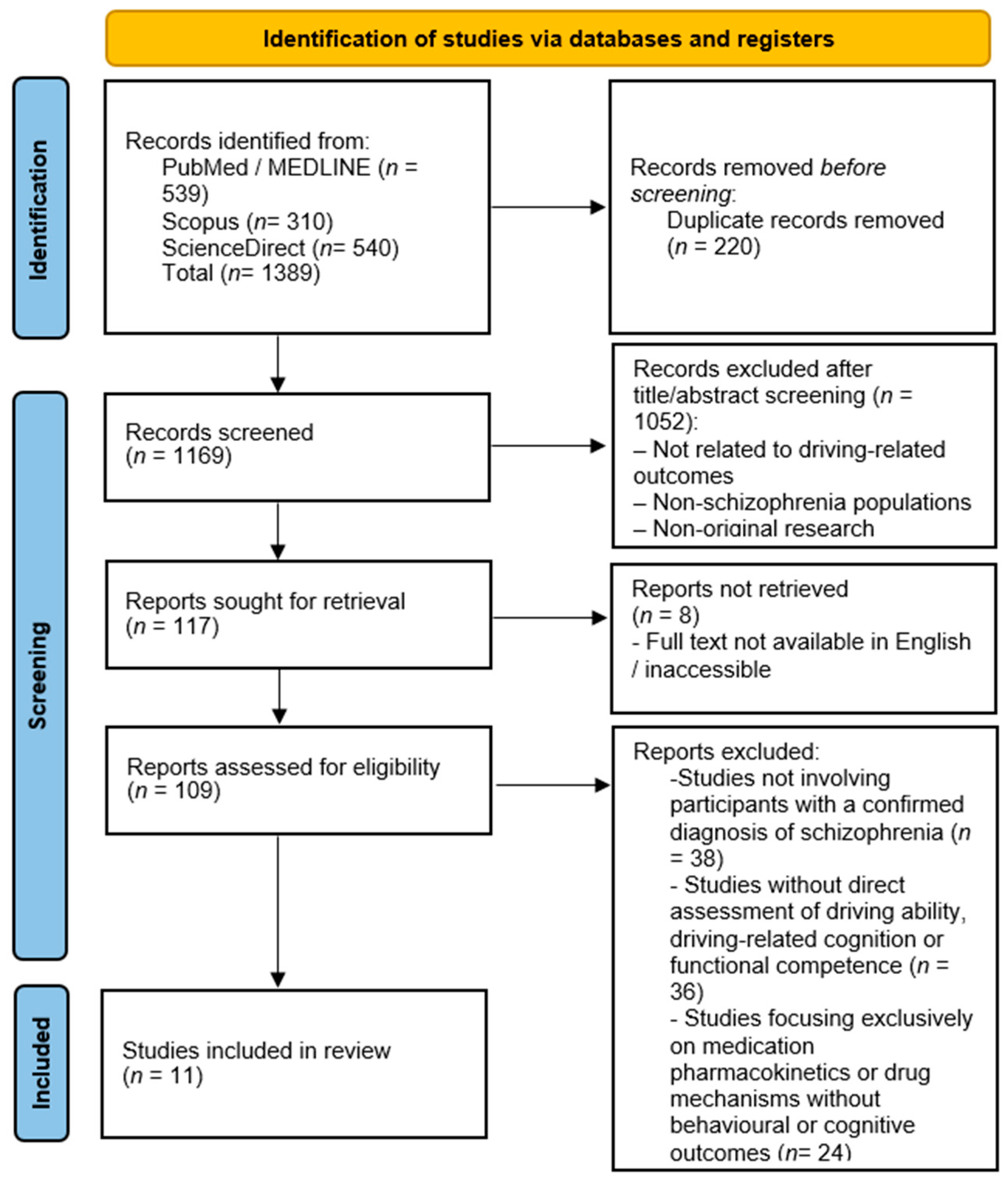
2.5. Study Selection and Data Extraction
3. Results
3.1. Study Characteristics
- –
- Cognitive, psychomotor and functional performance investigations, employing simulator-based paradigms, reaction-time tasks, and comprehensive neuropsychological batteries to evaluate attention, perception, motor control, and executive functioning relevant to driving performance as domains examined in relation to driving competence [6,7,14,16,18,29].
- –
- –
3.2. Driving-Related Measures and Assessment Approaches
3.3. Cognitive, Clinical, Pharmacological and Functional Correlates of Driving Performance in Schizophrenia
3.4. Driving Participation, Licensing and Mobility Outcomes
3.5. Crash Risk and Real-World Driving Safety
4. Discussion
4.1. Summary of Main Findings
4.2. Comparison with Previous Literature
4.3. Defining the Driving Profile of Individuals with Schizophrenia
4.4. Clinical and Functional Implications
4.5. Limitations
5. Conclusions
Supplementary Materials
Author Contributions
Funding
Institutional Review Board Statement
Informed Consent Statement
Data Availability Statement
Conflicts of Interest
Abbreviations
| aOR | Adjusted Odds Ratio |
| COG | Vienna Concentration Test |
| CPAD | Computerized Psychomotor and Attention Diagnostic Battery |
| DLPFC | Dorsolateral Prefrontal Cortex |
| DT | Vienna Determination Test |
| EEG | Electroencephalography |
| EPS | Extrapyramidal Symptoms |
| fNIRS | Functional Near-Infrared Spectroscopy |
| GAF | Global Assessment of Functioning |
| HCs | Healthy Controls |
| ICF | International Classification of Functioning Mini-Mental State Examination |
| MMSE | |
| MPR | Medication Possession Ratio |
| MSAS | Modified Simpson–Angus Scale |
| PANSS | Positive and Negative Syndrome Scale |
| PCC | Population–Concept–Context |
| PRISMA-ScR | Preferred Reporting Items for Systematic Reviews and Meta-Analyses Extension for Scoping Reviews |
| SDLP | Standard Deviation of Lateral Position |
| TAVT-MB | Vienna Test System for Traffic and Motor Skills |
| TMT-A/TMT-B | Trail Making Test, Part A/Part B |
| VIGIL | Vienna Vigilance Test |
| WCST | Wisconsin Card Sorting Test |
| WMS-R | Wechsler Memory Scale-Revised |
| WTS | Vienna Test System |
References
- World Health Organization. Schizophrenia; World Health Organization: Geneva, Switzerland, 2023; Available online: https://www.who.int/news-room/fact-sheets/detail/schizophrenia (accessed on 15 December 2025).
- Anwar, A.; Mustafa, A.M.; Abdou, K.; Rabie, M.A.; El-Shiekh, R.A.; El-Dessouki, A.M. A Comprehensive Review on Schizophrenia: Epidemiology, Pathogenesis, Diagnosis, Conventional Treatments, and Proposed Natural Compounds Used for Management. Naunyn-Schmiedeberg’s Arch. Pharmacol. 2025, 398, 15231–15255. [Google Scholar] [CrossRef]
- Chiu, C.W.; Law, C.K.; Cheng, A.S. Driver Assessment Service for People with Mental Illness. Hong Kong J. Occup. Ther. 2019, 32, 77–83. [Google Scholar] [CrossRef]
- Staples, J.A.; Daly-Grafstein, D.; Khan, M.; Pei, L.X.; Erdelyi, S.; Rezansoff, S.N.; Chan, H.; Honer, W.G.; Brubacher, J.R. Antipsychotic Treatment Adherence and Motor Vehicle Crash Among Drivers with Schizophrenia: A Case-Crossover Study. CMAJ 2025, 197, E612–E619. [Google Scholar] [CrossRef]
- Staples, J.A.; Daly-Grafstein, D.; Khan, M.; Pei, L.X.; Erdelyi, S.; Rezansoff, S.N.; Chan, H.; Honer, W.G.; Brubacher, J.R. Schizophrenia, Antipsychotic Treatment Adherence and Driver Responsibility for Motor Vehicle Crash: A Population-Based Retrospective Study in British Columbia, Canada. BMJ Open 2024, 14, e080609. [Google Scholar] [CrossRef]
- Noh, S.; Na, E.; Park, S.J.; Kim, S.H.; Evins, A.E.; Roh, S. Effects of various antipsychotics on driving-related cognitive performance in adults with schizophrenia. J. Psychiatr. Res. 2020, 131, 152–159. [Google Scholar] [CrossRef] [PubMed]
- Biedermann, F.; Kurzthaler, I.; Haibach, M.; Pardeller, S.; Pichler, T.; Kemmler, G.; Holzner, B.; Hofer, A. Driving fitness in clinically stable outpatients with chronic schizophrenia. Compr. Psych. 2022, 118, 152340. [Google Scholar] [CrossRef]
- Brunnauer, A.; Buschert, V.; Segmiller, F.; Zwick, S.; Bufler, J.; Schmauss, M.; Messer, T.; Möller, H.J.; Frommberger, U.; Bartl, H.; et al. Mobility behaviour and driving status of patients with mental disorders-An exploratory study. Int. J. Psychiatry Clin. Pract. 2016, 20, 40–46. [Google Scholar] [CrossRef] [PubMed]
- Steinert, T.; Veit, F.; Schmid, P.; Jacob Snellgrove, B.; Borbé, R. Participating in mobility: People with schizophrenia driving motorized vehicles. Psychiatry Res. 2015, 228, 719–723. [Google Scholar] [CrossRef] [PubMed]
- Unsworth, C.A.; Baker, A.M.; So, M.H.; Harries, P.; O’Neill, D. A systematic review of evidence for fitness-to-drive among people with the mental health conditions of schizophrenia, stress/anxiety disorder, depression, personality disorder and obsessive compulsive disorder. BMC Psychiatry 2017, 17, 318. [Google Scholar] [CrossRef]
- Rapoport, M.J.; Chee, J.N.; Prabha, T.; Dow, J.; Gillespie, I.; Koppel, S.; Charlton, J.L.; O’nEill, D.; Donaghy, P.C.; Ho, A.O.; et al. A systematic review of the risks of motor vehicle crashes associated with psychiatric disorders. Can. J. Psychiatry 2022, 68, 221–240. [Google Scholar] [CrossRef]
- Brunnauer, A.; Herpich, F.; Zwanzger, P.; Laux, G. Driving performance under treatment of most frequently prescribed drugs for mental disorders: A systematic review of patient studies. Int. J. Neuropsychopharmacol. 2021, 24, 679–693. [Google Scholar] [CrossRef] [PubMed]
- Karakitsiou, G.; Plakias, S.; Arvaniti, A.; Katsikidou, M.; Kedraka, K.; Samakouri, M. Driving Performance in Schizophrenia: The Role of Neurocognitive Correlates—A Systematic Review. Brain Sci. 2025, 15, 1094. [Google Scholar] [CrossRef] [PubMed]
- Okada, H.; Sawamura, D.; Kunita, K.; Ogasawara, H.; Maeda, K.; Morimoto, T.; Ikeda, N. Prefrontal activation during simulated driving in people with schizophrenia: A functional near-infrared spectroscopy study. Psychiatry Res. 2023, 326, 115285. [Google Scholar] [CrossRef] [PubMed]
- Okada, H.; Komagata, S.; Takagi, M.; Kamata, Y.; Matsumoto, J.; Maeyama, T.; Takashio, Y.; Matoba, M. Characteristics of real-world driving behavior in people with schizophrenia: A naturalistic study utilizing drive recorders. Schizophrenia 2025, 11, 67. [Google Scholar] [CrossRef]
- Fuermaier, A.B.M.; Piersma, D.; Huntjens, R.J.C.; de Waard, D.; Westermann, C.; Bossert, M.; Lange, K.W.; Weisbrod, M.; Bruggeman, R.; Aschenbrenner, S.; et al. Simulated car driving and its association with cognitive abilities in patients with schizophrenia. Schizophr. Res. 2019, 204, 171–177. [Google Scholar] [CrossRef]
- Lajunen, T.; Sullman, M.J.M.; Gaygısız, E. Self-assessed driving skills and risky driver behaviour among young drivers: A cross-sectional study. Front. Psychol. 2022, 13, 840269. [Google Scholar] [CrossRef]
- Okada, H.; Morimoto, T.; Ikeda, N. Exploratory study on driving ability of people with schizophrenia: Relationships among cognitive function, symptoms, and brain activity. Schizophr. Res. 2024, 264, 290–297. [Google Scholar] [CrossRef]
- Dun, C.; Palmer, C.; Turville, M. Driving a motor vehicle and living with a mental health condition: The personal and professional experiences of consumer lived experience staff. Aust. Occup. Ther. J. 2025, 72, e13000. [Google Scholar] [CrossRef]
- Pardeller, S.; Biedermann, F.; Haibach, M.; Holzner, B.; Kemmler, G.; Kurzthaler, I.; Hofer, A. Driving abilities in patients with schizophrenia. Schizophr. Bull. 2020, 46, S163. [Google Scholar] [CrossRef]
- World Health Organization. International Classification of Functioning, Disability and Health (ICF); World Health Organization: Geneva, Switzerland, 2001. [Google Scholar]
- Michon, J.A. A critical review of driver behaviour models: What do we know, what should we do? In Human Behaviour and Traffic Safety; Evans, L., Schwing, R.C., Eds.; Plenum Press: New York, NY, USA, 1985; pp. 485–520. [Google Scholar] [CrossRef]
- Fuller, R. The task-capability interface model of the driving process. Recherche-Transports-Sécurité 2000, 66, 47–57. [Google Scholar] [CrossRef]
- Arksey, H.; O’Malley, L. Scoping studies: Towards a methodological framework. Int. J. Soc. Res. Methodol. 2005, 8, 19–32. [Google Scholar] [CrossRef]
- Levac, D.; Colquhoun, H.; O’Brien, K.K. Scoping studies: Advancing the methodology. Implement. Sci. 2010, 5, 69. [Google Scholar] [CrossRef]
- Peters, M.D.J.; Godfrey, C.; McInerney, P.; Khalil, H.; Larsen, P.; Marnie, C.; Pollock, D.; Tricco, A.C.; Munn, Z. Best practice guidance and reporting items for the development of scoping review protocols. JBI Evid. Synth. 2022, 20, 953–968. [Google Scholar] [CrossRef]
- Tricco, A.C.; Lillie, E.; Zarin, W.; O’Brien, K.K.; Colquhoun, H.; Levac, D.; Moher, D.; Peters, M.D.J.; Horsley, T.; Weeks, L.; et al. PRISMA Extension for Scoping Reviews (PRISMA-ScR): Checklist and explanation. Ann. Intern. Med. 2018, 169, 467–473. [Google Scholar] [CrossRef]
- Hellinger, N.; Lipskaya-Velikovsky, L.; Weizman, A.; Ratzon, N.Z. Comparing executive functioning and clinical and sociodemographic characteristics of people with schizophrenia who hold a driver’s license to those who do not. Can. J. Occup. Ther. 2019, 86, 70–80. [Google Scholar] [CrossRef]
- Segmiller, F.M.; Buschert, V.; Laux, G.; Nedopil, N.; Palm, U.; Furjanic, K.; Zwanzger, P.; Brunnauer, A. Driving skills in unmedicated first- and recurrent-episode schizophrenic patients. Eur. Arch. Psychiatry Clin. Neurosci. 2017, 267, 83–88. [Google Scholar] [CrossRef]
- Westerhuis, F.; Van Dijken, J.H.; Veldstra, J.L.; Brookhuis, K.A.; Verster, J.C.; Van de Loo, A.J.A.E.; Vinckenbosch, F.R.J.; Vermeeren, A.; Van der Sluiszen, N.N.J.J.M.; Ramaekers, J.G.; et al. Driving performance of long-term users of sedating antidepressants and benzodiazepines. Traffic Inj. Prev. 2024, 25, 902–911. [Google Scholar] [CrossRef] [PubMed]
- Joachimiak, P.; Jaracz, K.; Jaracz, J. Neuropsychological exponents for the driving ability in remitted bipolar patients. Int. J. Bipolar Disord. 2022, 10, 2. [Google Scholar] [CrossRef]
- Stolwyk, R.J.; Scally, K.A.; Charlton, J.L.; Bradshaw, J.L.; Iansek, R.; Georgiou-Karistianis, N. Self-regulation of driving behavior in people with Parkinson disease. Cogn. Behav. Neurol. 2015, 28, 80–91. [Google Scholar] [CrossRef] [PubMed]
- Katsouri, I.; Athanasiadis, L.; Bekiaris, E.; Konsta, A.; Tsouvala, M.; Voucharas, I.; Tsolaki, M. Compensatory strategies and driving adap-tation techniques of people with mental disorders. PRIME 2021, 14, 29–41. [Google Scholar]
- Stratou, E.; Gerosideris, N.; Daskalou, S.D.; Katsouri, I.G. Enhancing Cognitive Functioning in Schizophrenia Through Occupational Therapy Interventions: A Systematic Review. OTJR Occup. Ther. J. Res. 2025. Epub ahead of print. [Google Scholar] [CrossRef] [PubMed]
- Spargo, C.; Laver, K.; Berndt, A.; Adey-Wakeling, Z.; George, S. Occupational Therapy Interventions to Improve Driving Performance in Older People With Mild Cognitive Impairment or Early-Stage Dementia: A Systematic Review. Am. J. Occup. Ther. 2021, 75, 7505205070. [Google Scholar] [CrossRef] [PubMed]
- Okada, H. A pilot study on the possibility of improving driving skills in stable people with schizophrenia: A comparison of short-term learning effects among inexperienced drivers. J Psychiatr. Res. 2025, 191, 684–690. [Google Scholar] [CrossRef] [PubMed]


| Author (Year) | Design/Methods | Sample | Focus | Driving-Related Measures | Key Findings |
|---|---|---|---|---|---|
| Steinert et al. (2015) [9] | Cross-sectional interviews (questionnaire and cognitive test) | 150 patients with schizophrenia/schizoaffective disorder | Active driving and predictors | License possession, driving activity, accident history; Trail Making Test A, GAF. | Participation: 64% licensed; 32% active drivers. Cognitive/Functional correlates: higher TMT-A, higher GAF, fewer hospitalizations, no substance use. |
| Brunnauer et al. (2016) [8] | Cross-sectional survey (structured questionnaire) | 1.497 psychiatric inpatients (incl. schizophrenia) and 313 neurological controls | Driving participation and licensing | Self-reported license status, active driving, and car use. | Participation: lower licensing (67% vs. 89% controls); lowest rates in schizophrenia subgroup. Demographic/Clinical correlates of driving cessation: female sex, older age, pension status, schizophrenia diagnosis. |
| Segmiller et al. (2017) [29] | Comparative study (Wiener Test system psychomotor battery) | 13 first-episode (FES) schizophrenia inpatients, 13 recurrent-episode (RES) schizophrenia inpatients, 20 HCs | Psychomotor driving skills in unmedicated schizophrenia | WTS: Visual Perception (TAVT-MB), Reactivity (DT), Concentration (COG), Vigilance (VIGIL); PANSS. | Cognitive/Psychomotor impairment: 58% impaired (WTS criteria). Additional deficit: visual perception (first-episode). No association: medication status, PANSS severity. |
| Fuermaier et al. (2019) [16] | Experimental study with driving simulator and neuropsychological battery. | 31 schizophrenia patients; 31 healthy controls. | Cognitive correlates of simulated driving. | Driving simulator: collisions, reaction time, lane control, merging; neuropsychological tests-attention, inhibition, planning, processing speed. | Behavioral (simulator): slower speed; merging difficulty; no increased collisions. Cognitive correlates: reduced attention; impaired inhibition/planning. |
| Hellinger et al. (2019) [28] | Cross-sectional study (neuropsychological and clinical assessment) | 60 schizophrenia outpatients (31 with license, 29 without). | Clinical, cognitive, socio-demographic predictors of license possession | License status; WCST, PANSS, MMSE; hospitalizations, employment. | Participation: license holders vs. non-drivers. Cognitive/Clinical correlates: higher MMSE, better WCST, fewer hospitalizations, lower general/negative symptoms. |
| Noh et al. (2020) [6] | Cross-sectional neurocognitive assessment | 102 adults with schizophrenia on antipsychotic monotherapy (haloperidol, risperidone, olanzapine, aripiprazole, paliperidone) | Effect of antipsychotic type on driving-related cognition | CPAD battery: visual perception, attention, working memory, inhibitory control; TMT-B, digit span. | Fitness classification: 63% fit. Medication comparison (observational): higher competence with aripiprazole (75%), paliperidone (82%) vs. haloperidol (33%), risperidone (57%). Cognitive differences across regimens. |
| Biedermann et al. (2022) [7] | Naturalistic, cross-sectional study | 50 clinically stable outpatients with chronic schizophrenia | Driving fitness and clinical correlates. | PANSS (Wallwork/Fortgang), MSAS (EPS), Vienna Test System, expert rating. | Clinical fitness: 44% competent; 20% partial; 36% incompetent. Negative correlates: EPS, older age, higher antipsychotic dosage. Residual symptom: disorganization. |
| Okada et al. (2023) [14] | Experimental neuroimaging study | 20 people with schizophrenia (PWS) + 20 healthy controls (HCs) | Prefrontal activation patterns and potential driving difficulties | Driving simulator (braking, curves); fNIRS of DLPFC activation. | Behavioral (simulator): no performance differences. Neurophysiological: reduced left DLPFC activation; slower reaction times. |
| Okada et al. (2024) [18] | Cross-sectional multimodal study | 42 schizophrenia patients (licensed drivers). | Cognitive, neural, and behavioral correlates of driving. | TMT-A/B, WMS-R, Zoo Map Test, PANSS; fNIRS; simulator: brake reaction, steering, SDLP, hazard prediction. | Behavioral (simulator): braking, hazard perception deficits. Cognitive predictors: processing speed, memory, planning. Exploratory classification: ~79% accuracy (within sample). |
| Staples et al. (2024) [5] | Population-based retrospective cohort study | 808.432 licensed drivers; 2.551 with schizophrenia | Crash responsibility and medication adherence | Crash data (police), validated responsibility tool; Medication Possession Ratio (MPR). | Safety outcome: higher crash responsibility (aOR 1.67). Medication adherence (MPR ≥ 0.8): not protective. |
| Staples et al. (2025) [4] | Population-based case-crossover study | 1.130 crashes involving drivers with schizophrenia | Antipsychotic adherence and crash risk. | Police crash data; MPR 30 days pre-crash vs. control interval. | Safety outcome: perfect adherence (MPR ≈ 1.0) associated with reduced crash risk (aOR 0.50); effect consistent across sex, age, and substance use. |
| Domain | Key Determinants | Driving-Related Impact | Representative Studies |
|---|---|---|---|
| Cognitive | Attention, executive function, processing speed, working memory, visual perception | Structured driving performance (lane control, hazard perception, reaction time, braking efficiency, merging behavior) | Okada et al. [14]; Fuermaier et al. [16]; Okada et al. [18]; Hellinger et al. [28]; Segmiller et al. [29] |
| Psychomotor | Reaction speed, vigilance, motor coordination | Psychomotor driving performance (fitness indices, response to critical events) | Biedermann et al. [7]; Fuermaier et al. [16]; Segmiller et al. [29] |
| Clinical | Symptom stability, illness stage, hospitalization history | Driving participation and fitness classification (license possession, context-dependent fitness-to-drive judgments) | Biedermann et al. [7]; Brunnauer et al. [8]; Steinert et al. [9]; Hellinger et al. [28]; Segmiller et al. [29] |
| Pharmacological | Antipsychotic type, dosage, extrapyramidal symptoms | Cognitive and psychomotor performance indicators; clinical competence ratings | Noh et al. [6]; Biedermann et al. [7] |
| Treatment adherence | Medication Possession Ratio (MPR), consistency of antipsychotic treatment | Safety outcomes (crash responsibility, real-world crash risk) | Staples et al. [4]; Staples et al. [5] |
| Functional and behavioral | Insight, self-regulation, compensatory strategies | Adaptive driving behavior and risk mitigation | Steinert et al. [9]; Fuermaier et al. [16]; Okada et al. [18] |
| Neurophysiological | Dorsolateral prefrontal cortex activation (fNIRS) | Neurocognitive correlates of structured driving performance (reaction time, hazard perception under load) | Okada et al. [14]; Okada et al. [18] |
Disclaimer/Publisher’s Note: The statements, opinions and data contained in all publications are solely those of the individual author(s) and contributor(s) and not of MDPI and/or the editor(s). MDPI and/or the editor(s) disclaim responsibility for any injury to people or property resulting from any ideas, methods, instructions or products referred to in the content. |
© 2026 by the authors. Licensee MDPI, Basel, Switzerland. This article is an open access article distributed under the terms and conditions of the Creative Commons Attribution (CC BY) license.
Share and Cite
Stratou, E.; Porfyri, G.-N.; Gamvroula, A.; Theodorou, K.; Daskalou, S.D.; Gerosideris, N.; Tsakni, G.; Christidi, F.; Tsiakiri, A.; Vlotinou, P.; et al. The Driving Profile of Individuals with Schizophrenia: Cognitive Characteristics, Pharmacological Treatment and Driving Competence—A Scoping Review. Neurol. Int. 2026, 18, 46. https://doi.org/10.3390/neurolint18030046
Stratou E, Porfyri G-N, Gamvroula A, Theodorou K, Daskalou SD, Gerosideris N, Tsakni G, Christidi F, Tsiakiri A, Vlotinou P, et al. The Driving Profile of Individuals with Schizophrenia: Cognitive Characteristics, Pharmacological Treatment and Driving Competence—A Scoping Review. Neurology International. 2026; 18(3):46. https://doi.org/10.3390/neurolint18030046
Chicago/Turabian StyleStratou, Elpida, Georgia-Nektaria Porfyri, Aikaterini Gamvroula, Katerina Theodorou, Symeon Dimitrios Daskalou, Nikolaos Gerosideris, Georgia Tsakni, Foteini Christidi, Anna Tsiakiri, Pinelopi Vlotinou, and et al. 2026. "The Driving Profile of Individuals with Schizophrenia: Cognitive Characteristics, Pharmacological Treatment and Driving Competence—A Scoping Review" Neurology International 18, no. 3: 46. https://doi.org/10.3390/neurolint18030046
APA StyleStratou, E., Porfyri, G.-N., Gamvroula, A., Theodorou, K., Daskalou, S. D., Gerosideris, N., Tsakni, G., Christidi, F., Tsiakiri, A., Vlotinou, P., & Katsouri, I. G. (2026). The Driving Profile of Individuals with Schizophrenia: Cognitive Characteristics, Pharmacological Treatment and Driving Competence—A Scoping Review. Neurology International, 18(3), 46. https://doi.org/10.3390/neurolint18030046