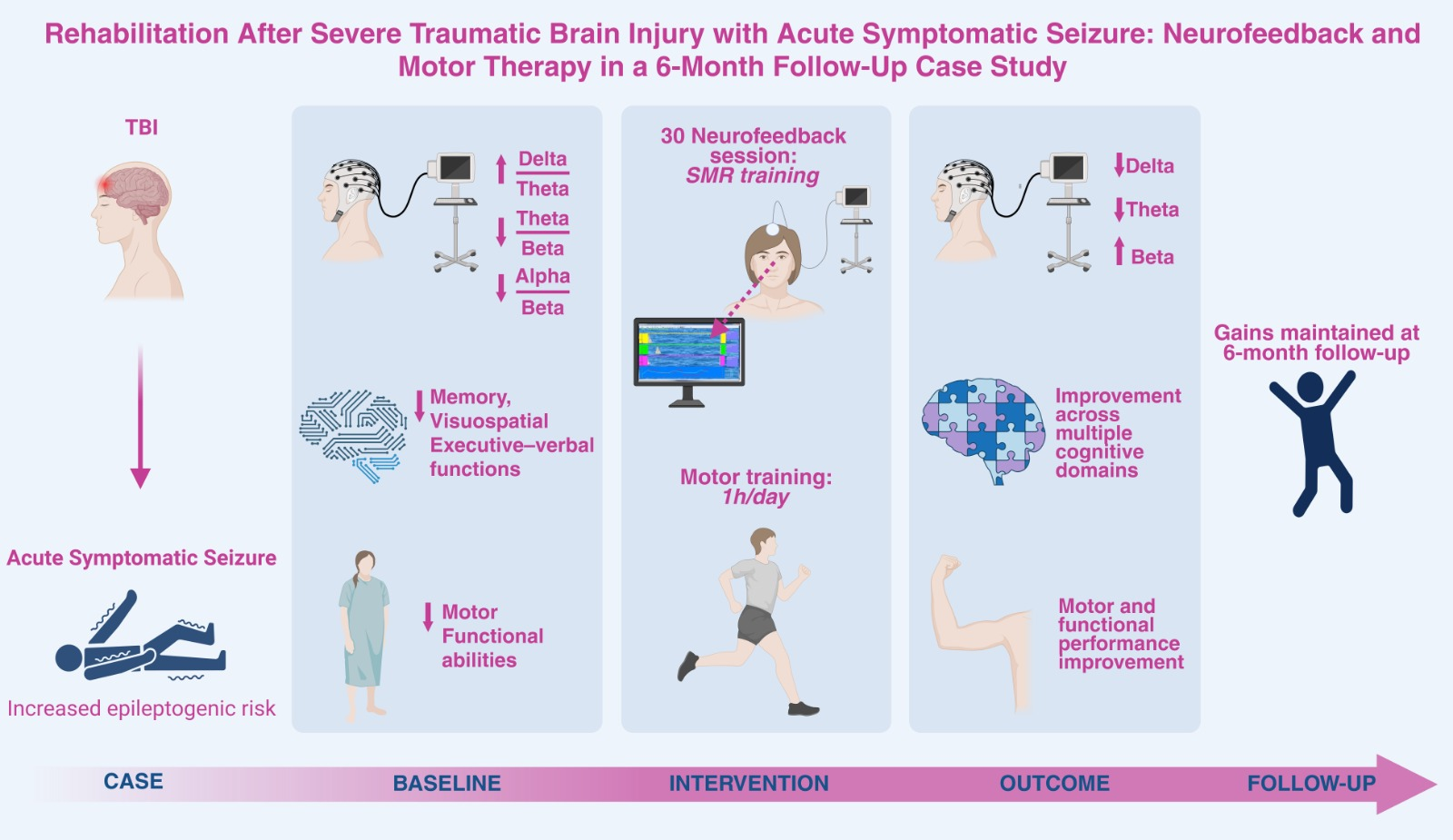

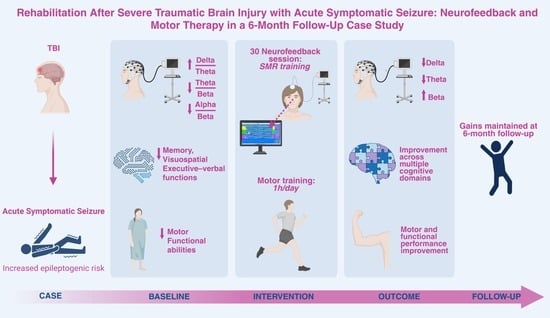
Rehabilitation After Severe Traumatic Brain Injury with Acute Symptomatic Seizure: Neurofeedback and Motor Therapy in a 6-Month Follow-Up Case Study
 , and
, and
Abstract
1. Introduction

| Diagnostic Criteria Post-Traumatic Epilepsy (PTE) |
|
| Temporal Classification of Post-Traumatic Seizures |
|
2. Materials and Methods
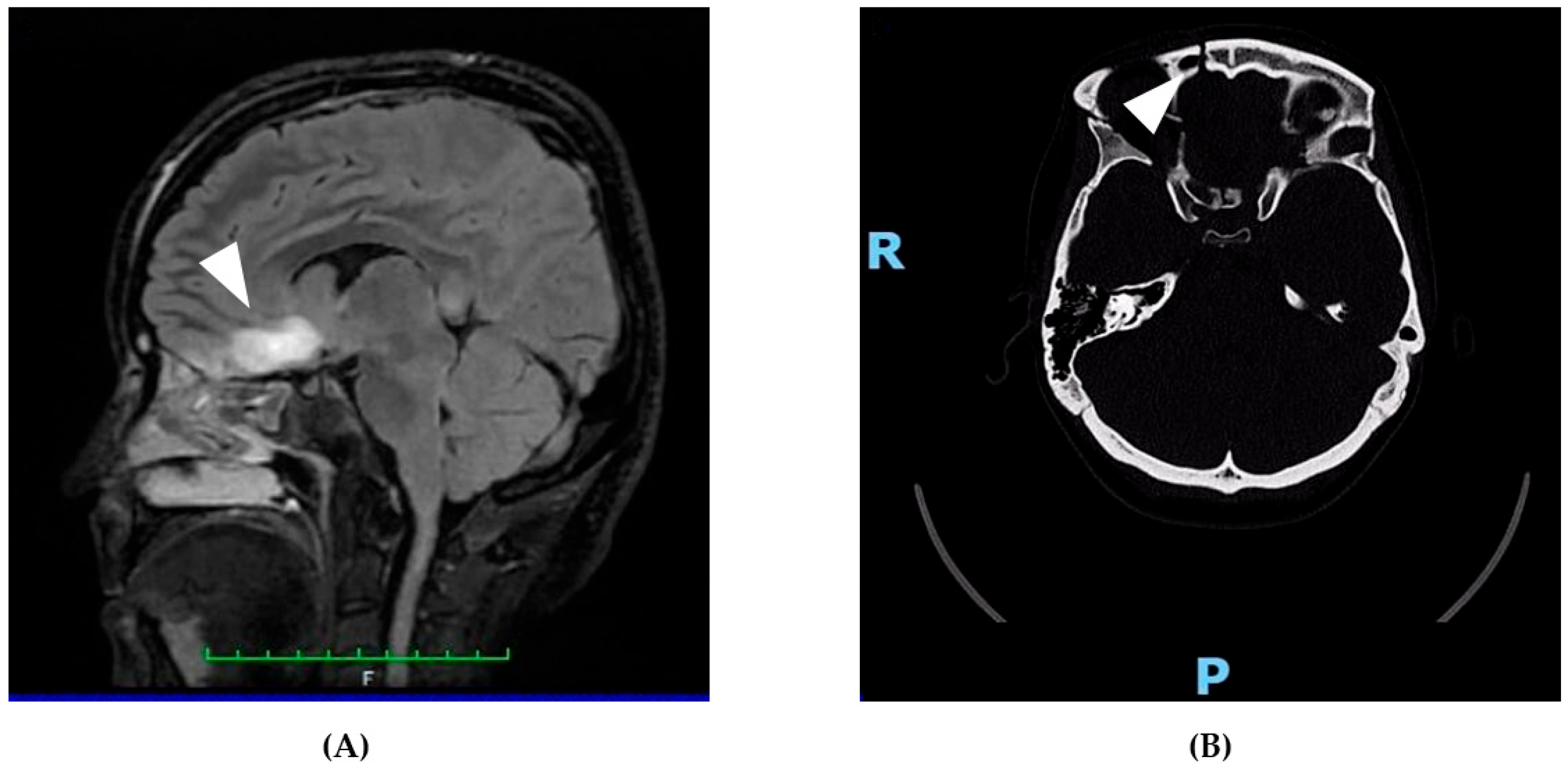
2.1. Case Presentation
2.2. Neuromotor and Functional Assessment
2.3. EEG Assessment
2.4. Rehabilitation Procedure
2.5. EEG Acquisition and Data Processing
2.6. Neuropsychological Assessment
2.7. Neurofeedback Training
2.8. Statistical Analyses
3. Results
3.1. EEG Measures
EEG Changes at 6-Month Follow-Up
3.2. Neuropsychological Profile Pre- and Post- NF Training and at 6-Months Follow-Up
3.3. Motor Changes Pre- and Post-NFB Training
4. Discussion
5. Conclusions
Author Contributions
Funding
Institutional Review Board Statement
Informed Consent Statement
Data Availability Statement
Acknowledgments
Conflicts of Interest
References
- Szaflarski, J.P.; Nazzal, Y.; Dreer, L.E. Post-traumatic epilepsy: Current and emerging treatment options. Neuropsychiatr. Dis. Treat. 2014, 10, 1469–1477. [Google Scholar] [CrossRef][Green Version]
- Sui, S.; Sun, J.; Chen, X.; Fan, F.B. Risk of Epilepsy Following Traumatic Brain Injury: A Systematic Review and Meta-analysis. J. Head Trauma Rehabil. 2023, 38, E289–E298. [Google Scholar] [CrossRef]
- Lowenstein, D.H. Epilepsy after head injury: An overview. Epilepsia 2009, 50, 4–9. [Google Scholar] [CrossRef]
- Beghi, E.; Carpio, A.; Forsgren, L.; Hesdorffer, D.C.; Malmgren, K.; Sander, J.W.; Tomson, T.; Hauser, W.A. Recommendation for a definition of acute symptomatic seizure. Epilepsia 2010, 51, 671–675. [Google Scholar] [CrossRef]
- Pease, M.; Gupta, K.; Moshé, S.L.; Correa, D.J.; Galanopoulou, A.S.; Okonkwo, D.O.; Gonzalez-Martinez, J.; Shutter, L.; Diaz-Arrastia, R.; Castellano, J.F. Insights into epileptogenesis from post-traumatic epilepsy. Nat. Rev. Neurol. 2024, 20, 298–312. [Google Scholar] [CrossRef] [PubMed]
- Ding, K.; Gupta, P.K.; Diaz-Arrastia, R. Epilepsy after Traumatic Brain Injury. In Translational Research in Traumatic Brain Injury; Laskowitz, D., Grant, G., Eds.; CRC Press/Taylor and Francis Group: Boca Raton, FL, USA, 2016. [Google Scholar]
- Shrivastava, A.; Dwivedi, S.; Guptaa, P.; Chaurasia, R.; Ghosi, A.; Anand, A.; Kumar, A. A review of current status of epilepsy after traumatic brain injuries: Pathophysiology, clinical outcomes, and emerging treatment strategies. Adv. Neurol. 2025, 4, 8356. [Google Scholar] [CrossRef]
- Wilson, L.; Stewart, W.; Dams-O’Connor, K.; Diaz-Arrastia, R.; Horton, L.; Menon, D.K.; Polinder, S. The chronic and evolving neurological consequences of traumatic brain injury. Lancet Neurol. 2017, 16, 813–825. [Google Scholar] [CrossRef] [PubMed]
- Novak, A.; Vizjak, K.; Rakusa, M. Cognitive Impairment in People with Epilepsy. J. Clin. Med. 2022, 11, 267. [Google Scholar] [CrossRef]
- Cho, S.-J.; Park, E.; Baker, A.; Reid, A.Y. Post-Traumatic Epilepsy in Zebrafish Is Drug-Resistant and Impairs Cognitive Function. J. Neurotrauma 2021, 38, 3174–3183. [Google Scholar] [CrossRef]
- Ngadimon, I.W.; Aledo-Serrano, A.; Arulsamy, A.; Mohan, D.; Khoo, C.S.; Cheong, W.L.; Shaikh, M.F. An Interplay Between Post-Traumatic Epilepsy and Associated Cognitive Decline: A Systematic Review. Front. Neurol. 2022, 13, 827571. [Google Scholar] [CrossRef]
- Golub, V.M.; Reddy, D.S. Post-Traumatic Epilepsy and Comorbidities: Advanced Models, Molecular Mechanisms, Biomarkers, and Novel Therapeutic Interventions. Pharmacol. Rev. 2022, 74, 387–438. [Google Scholar] [CrossRef]
- Hung, C.; Chen, J.W.Y. Treatment of post-traumatic epilepsy. Curr. Treat. Options Neurol. 2012, 14, 293–306. [Google Scholar] [CrossRef]
- Pingue, V.; Mele, C.; Nardone, A. Post-traumatic seizures and antiepileptic therapy as predictors of the functional outcome in patients with traumatic brain injury. Sci. Rep. 2021, 11, 4708. [Google Scholar] [CrossRef] [PubMed]
- Semple, B.D.; Zamani, A.; Rayner, G.; Shultz, S.R.; Jones, N.C. Affective, neurocognitive and psychosocial disorders associated with traumatic brain injury and post-traumatic epilepsy. Neurobiol. Dis. 2019, 123, 27–41. [Google Scholar] [CrossRef]
- Chmielewska, N.; Szyndler, J. Innovations in epilepsy treatment: Pharmacological strategies and machine learning applications. Neurol. Neurochir. Pol. 2025, 59, 199–209. [Google Scholar] [CrossRef]
- Chang, P.-F.J.; Baxter, M.F.; Rissky, J. Effectiveness of Interventions Within the Scope of Occupational Therapy Practice to Improve Motor Function of People with Traumatic Brain Injury: A Systematic Review. Am. J. Occup. Ther. 2016, 70, 7003180020p1–7003180020p5. [Google Scholar] [CrossRef]
- Subramanian, S.K.; Fountain, M.K.; Hood, A.F.; Verduzco-Gutierrez, M. Upper Limb Motor Improvement after Traumatic Brain Injury: Systematic Review of Interventions. Neurorehabilit. Neural Repair 2022, 36, 17–37. [Google Scholar] [CrossRef]
- Gauthier, L.V.; Taub, E.; Perkins, C.; Ortmann, M.; Mark, V.W.; Uswatte, G. Remodeling the brain: Plastic structural brain changes produced by different motor therapies after stroke. Stroke 2008, 39, 1520–1525. [Google Scholar] [CrossRef] [PubMed]
- Schaechter, J.D. Motor rehabilitation and brain plasticity after hemiparetic stroke. Prog. Neurobiol. 2004, 73, 61–72. [Google Scholar] [CrossRef]
- Liepert, J.; Uhde, I.; Gräf, S.; Leidner, O.; Weiller, C. Motor cortex plasticity during forced-use therapy in stroke patients: A preliminary study. J. Neurol. 2001, 248, 315–321. [Google Scholar] [CrossRef]
- Cavalcante, B.R.R.; Improta-Caria, A.C.; de Melo, V.H.; De Sousa, R.A.L. Exercise-linked consequences on epilepsy. Epilepsy Behav. 2021, 121, 108079. [Google Scholar] [CrossRef]
- Loriette, C.; Ziane, C.; Ben Hamed, S. Neurofeedback for cognitive enhancement and intervention and brain plasticity. Rev. Neurol. 2021, 177, 1133–1144. [Google Scholar] [CrossRef]
- Egner, T.; Sterman, M.B. Neurofeedback treatment of epilepsy: From basic rationale to practical application. Expert Rev. Neurother. 2006, 6, 247–257. [Google Scholar] [CrossRef]
- Sterman, M.B.; Egner, T. Foundation and practice of neurofeedback for the treatment of epilepsy. Appl. Psychophysiol. Biofeedback 2006, 31, 21–35. [Google Scholar] [CrossRef]
- Chen, P.-Y.; Su, I.-C.; Shih, C.-Y.; Liu, Y.-C.; Su, Y.-K.; Wei, L.; Luh, H.-T.; Huang, H.-C.; Tsai, P.-S.; Fan, Y.-C.; et al. Effects of Neurofeedback on Cognitive Function, Productive Activity, and Quality of Life in Patients With Traumatic Brain Injury: A Randomized Controlled Trial. Neurorehabilit. Neural Repair 2023, 37, 277–287. [Google Scholar] [CrossRef] [PubMed]
- Brown, J.; Clark, D.; Pooley, A.E. Exploring the Use of Neurofeedback Therapy in Mitigating Symptoms of Traumatic Brain Injury in Survivors of Intimate Partner Violence. J. Aggress. Maltreat. Trauma 2019, 28, 764–783. [Google Scholar]
- Dahl, M.G. Neurofeedback with PTSD and Traumatic Brain Injury (TBI). In Restoring the Brain; Routledge: Oxford, UK, 2020; pp. 256–284. [Google Scholar]
- Popa, L.L.; Chira, D.; Ștefan, S.; Mureșanu, D.F. Non-Invasive Systems Application in Traumatic Brain Injury Rehabilitation. Brain Sci. 2023, 13, 1594. [Google Scholar] [CrossRef] [PubMed]
- White, R.D.; Turner, R.P.; Arnold, N.; Bernica, A.; Lewis, B.N.; Swatzyna, R.J. Treating Severe Traumatic Brain Injury: Combining Neurofeedback and Hyperbaric Oxygen Therapy in a Single Case Study. Clin. EEG Neurosci. 2022, 53, 519–531. [Google Scholar] [CrossRef]
- Ortega, M.A.; Fraile-Martinez, O.; García-Montero, C.; Callejón-Peláez, E.; Sáez, M.A.; Álvarez-Mon, M.A.; García-Honduvilla, N.; Monserrat, J.; Álvarez-Mon, M.; Bujan, J.; et al. A General Overview on the Hyperbaric Oxygen Therapy: Applications, Mechanisms and Translational Opportunities. Medicina 2021, 57, 864. [Google Scholar] [CrossRef]
- Englander, J.; Bushnik, T.; Duong, T.T.; Cifu, D.X.; Zafonte, R.; Wright, J.; Hughes, R.; Bergman, W. Analyzing risk factors for late posttraumatic seizures: A prospective, multicenter investigation. Arch. Phys. Med. Rehabil. 2003, 84, 365–373. [Google Scholar] [CrossRef]
- Pitkänen, A.; Bolkvadze, T.; Immonen, R. Anti-epileptogenesis in rodent post-traumatic epilepsy models. Neurosci. Lett. 2011, 497, 163–171. [Google Scholar] [CrossRef]
- Finnigan, S.P.; Walsh, M.; Rose, S.E.; Chalk, J.B. Quantitative EEG indices of sub-acute ischaemic stroke correlate with clinical outcomes. Clin. Neurophysiol. 2007, 118, 2525–2532. [Google Scholar] [CrossRef]
- Marzbani, H.; Marateb, H.R.; Mansourian, M. Neurofeedback: A Comprehensive Review on System Design, Methodology and Clinical Applications. Basic Clin. Neurosci. 2016, 7, 143–158. [Google Scholar]
- Sitaram, R.; Ros, T.; Stoeckel, L.; Haller, S.; Scharnowski, F.; Lewis-Peacock, J.; Weiskopf, N.; Blefari, M.L.; Rana, M.; Oblak, E.; et al. Closed-loop brain training: The science of neurofeedback. Nat. Rev. Neurosci. 2016, 18, 86–100. [Google Scholar] [CrossRef] [PubMed]
- Batail, J.M.; Bioulac, S.; Cabestaing, F.; Daudet, C.; Drapier, D.; Fouillen, M.; Fovet, T.; Hakoun, A.; Jardri, R.; Jeunet, C.; et al. EEG neurofeedback research: A fertile ground for psychiatry? L’Encéphale 2019, 45, 245–255. [Google Scholar] [CrossRef] [PubMed]
- Spinnler, H.; Tognoni, G.; Gruppo italiano per lo studio neuropsicologico dell’invecchiamento. Standardizzazione e taratura italiana di test neuropsicologic. Ital. J. Neurol. Sci. 1987, 6, 21–120. [Google Scholar]
- Carlesimo, G.A.; De Risi, M.; Monaco, M.; Costa, A.; Fadda, L.; Picardi, A.; Di Gennaro, G.; Caltagirone, C.; Grammaldo, L. Normative data for measuring performance change on parallel forms of a 15-word list recall test. Neurol. Sci. 2014, 35, 663–668. [Google Scholar] [CrossRef]
- Carlesimo, G.A.; Caltagirone, C.; Gainotti, G.; Fadda, L.; Gallassi, R.; Lorusso, S.; Marfia, G.; Marra, C.; Nocentini, U.; Parnetti, L. The Mental Deterioration Battery: Normative data, diagnostic reliability and qualitative analyses of cognitive impairment. Eur. Neurol. 1996, 36, 378–384. [Google Scholar] [CrossRef]
- Orsini, A.; Grossi, D.; Capitani, E.; Laiacona, M.; Papagno, C.; Vallar, G. Verbal and spatial immediate memory span: Normative data from 1355 adults and 1112 children. Ital. J. Neurol. Sci. 1987, 8, 539–548. [Google Scholar] [CrossRef]
- Novelli, G.; Papagno, C.; Capitani, E.; Laiacona, M. Tre test clinici di ricerca e produzione lessicale. Taratura su sogetti normali. Arch. Psicol. Neurol. Psichiatr. 1986, 47, 477–506. [Google Scholar]
- Novelli, C.; Papagno, C.; Capitani, E.; Laiacona, M. Tre test clinici di memoria verbale a lungo termine: Taratura su soggetti normali. Arch. Psicol. Neurol. Psichiatr. 1986, 47, 278–296. [Google Scholar]
- Caffarra, P.; Vezzadini, G.; Dieci, F.; Zonato, F.; Venneri, A. Rey-Osterrieth complex figure: Normative values in an Italian population sample. Neurol. Sci. 2002, 22, 443–447. [Google Scholar] [CrossRef] [PubMed]
- Caffarra, P.; Vezzadini, G.; Dieci, F.; Zonato, F. Una versione abbreviata del test di Stroop: Dati normativi nella popolazione italiana. Nuova Riv. Neurol. 2002, 12, 111–115. [Google Scholar]
- Amato, M.P.; Portaccio, E.; Goretti, B.; Zipoli, V.; Ricchiuti, L.; De Caro, M.F.; Patti, F.; Vecchio, R.; Sorbi, S.; Trojano, M. The Rao’s Brief Repeatable Battery and Stroop test: Normative values with age, education and gender corrections in an Italian population. Mult. Scler. J. 2006, 12, 787–793. [Google Scholar] [CrossRef] [PubMed]
- Pedrabissi, L.; Santinello, M. Verifica della validità dello STAI forma Y di Spielberger. Boll. Psicol. Appl. 1989, 191–192, 11–14. [Google Scholar]
- Ghisi, M.; Sanavio, E.; Sica, C.; Flebus, G.B.; Montano, A. Beck Depression Inventory-II; Adattamento italiano: Manuale. ITA; Organizzazioni Speciali: Florence, Italy, 2006. [Google Scholar]
- Ros, T.; Baars, B.J.; Lanius, R.A.; Vuilleumier, P. Tuning pathological brain oscillations with neurofeedback: A systems neuroscience framework. Front. Hum. Neurosci. 2014, 8, 1008. [Google Scholar] [CrossRef]
- Keller, I. Neurofeedback Therapy of Attention Deficits in Patients with Traumatic Brain Injury. J. Neurother. 2001, 5, 19–32. [Google Scholar] [CrossRef][Green Version]
- Arroyo-Ferrer, A.; de Noreña, D.; Serrano, J.I.; Ríos-Lago, M.; Romero, J.P. Cognitive rehabilitation in a case of traumatic brain injury using EEG-based neurofeedback in comparison to conventional methods. J. Integr. Neurosci. 2021, 20, 449–457. [Google Scholar] [CrossRef]
- Vilou, I.; Varka, A.; Parisis, D.; Afrantou, T.; Ioannidis, P. EEG-Neurofeedback as a Potential Therapeutic Approach for Cognitive Deficits in Patients with Dementia, Multiple Sclerosis, Stroke and Traumatic Brain Injury. Life 2023, 13, 365. [Google Scholar] [CrossRef]
- Thibault, R.T.; Lifshitz, M.; Raz, A. The self-regulating brain and neurofeedback: Experimental science and clinical promise. Cortex 2016, 74, 247–261. [Google Scholar] [CrossRef]
- McDonald, B.C.; Flashman, L.A.; Saykin, A.J. Executive dysfunction following traumatic brain injury: Neural substrates and treatment strategies. NeuroRehabilitation 2002, 17, 333–344. [Google Scholar] [CrossRef] [PubMed]
- Zheng, Z.; Zhao, X.; Cui, X.; Liu, X.; Zhu, X.; Jiang, Y.; Li, J. Subtle Pathophysiological Changes in Working Memory-Related Potentials and Intrinsic Theta Power in Community-Dwelling Older Adults with Subjective Cognitive Decline. Innov. Aging 2023, 7, igad004. [Google Scholar] [CrossRef]
- Sibilano, E.; Brunetti, A.; Buongiorno, D.; Lassi, M.; Grippo, A.; Bessi, V.; Micera, S.; Mazzoni, A.; Bevilacqua, V. An attention-based deep learning approach for the classification of subjective cognitive decline and mild cognitive impairment using resting-state EEG. J. Neural Eng. 2023, 20, 016048. [Google Scholar] [CrossRef]
- Wang, S.-Y.; Lin, I.-M.; Fan, S.-Y.; Tsai, Y.-C.; Yen, C.-F.; Yeh, Y.-C.; Huang, M.-F.; Lee, Y.; Chiu, N.-M.; Hung, C.-F.; et al. The effects of alpha asymmetry and high-beta down-training neurofeedback for patients with the major depressive disorder and anxiety symptoms. J. Affect. Disord. 2019, 257, 287–296. [Google Scholar]
- Walker, J.E.; Kozlowski, G.P. Neurofeedback treatment of epilepsy. Child Adolesc. Psychiatr. Clin. 2005, 14, 163–176, viii. [Google Scholar] [CrossRef]
- Nicholson, A.A.; Densmore, M.; Frewen, P.A.; Neufeld, R.W.; Théberge, J.; Jetly, R.; Lanius, R.A.; Ros, T. Homeostatic normalization of alpha brain rhythms within the default-mode network and reduced symptoms in post-traumatic stress disorder following a randomized controlled trial of electroencephalogram neurofeedback. Brain Commun. 2023, 5, fcad068. [Google Scholar] [CrossRef]
- du Bois, N.; Bigirimana, A.D.; Korik, A.; Kéthina, L.G.; Rutembesa, E.; Mutabaruka, J.; Mutesa, L.; Prasad, G.; Jansen, S.; Coyle, D. Neurofeedback with low-cost, wearable electroencephalography (EEG) reduces symptoms in chronic Post-Traumatic Stress Disorder. J. Affect. Disord. 2021, 295, 1319–1334. [Google Scholar] [CrossRef]
- Leem, J.; Cheong, M.J.; Yoon, S.-H.; Kim, H.; Jo, H.-G.; Lee, H.; Kim, J.; Kim, H.Y.; Kim, G.-W.; Kang, H.W. Neurofeedback self-regulating training in patients with Post traumatic stress disorder: A randomized controlled trial study protocol. Integr. Med. Res. 2020, 9, 100464. [Google Scholar] [CrossRef]
- Corrigan, F.; Wee, I.C.; Collins-Praino, L.E. Chronic motor performance following different traumatic brain injury severity—A systematic review. Front. Neurol. 2023, 14, 1180353. [Google Scholar] [CrossRef] [PubMed]

| Clinical Case Features Overview | |
|---|---|
| Age | 31 years old |
| Gender | Female |
| Medical History and Physical Examination | No alcohol, smoking or addiction habits |
| Neurological Assessment | Ideomotor slowing, ataxic gait, impaired coordination on cerebellar tests, restricted right horizontal gaze with pain and diplopia, multi-segmental muscular hypotrophy, limited lower limb endurance, tender right frontal craniofacial wound. |
| Cognitive Assessment | Normal overall functioning; specific deficits in deferred episodic memory, short-term memory deficits, remote visuospatial skills, complex executive functions, and strategic verbal production |
| Motor Assessment | At admission, the patient exhibited reduced postural control with limited autonomy in transfers and ambulation, decreased global muscle strength (below the later 4+/5 level), impaired trunk stability (TCT = 45), and diminished functional independence (Barthel = 70). Care needs were elevated (RCS-E = 8), and short-term memory deficits were already evident. The Timed Up and Go test was still performable at this stage. |
| Pharmacological treatment | Levetiracetam 500 mg twice daily, Inhixa 4000 IU, omeprazole 20 mg, intravenous hydration, and ondansetron 8 mg as needed. For neuropathic pain affecting the dental arch, she refused Pregabalin, therefore Novafon vibration sessions were administered by the speech and language therapist, which resulted in significant symptomatic relief. |
| Condition | Band | Pre Mean ± SD | Post Mean ± SD | p-Value |
|---|---|---|---|---|
| EC | Delta | 2.33 ± 0.45 | −0.10 ± 0.23 | 0.0046 |
| EC | Theta | 3.61 ± 1.55 | 1.22 ± 1.06 | 0.0155 |
| EO | Theta | 3.56 ± 1.90 | 1.14 ± 1.15 | 0.0329 |
| Condition | Band | Pre Mean ± SD | Post Mean ± SD | p-Value |
|---|---|---|---|---|
| EC | Theta | 2.97 ± 0.99 | 1.52 ± 1.03 | 0.0107 |
| EC | Beta | −3.07 ± 1.76 | 0.42 ± 0.98 | 0.0278 |
| EO | Theta | 3.52 ± 0.67 | 2.12 ± 0.86 | 0.0073 |
| EO | Alpha | −1.74 ± 0.62 | −0.59 ± 0.29 | 0.0426 |
| EO | Beta | −3.27 ± 1.65 | 0.19 ± 0.78 | 0.0204 |
| EO | High-Beta | −1.92 ± 1.05 | 0.03 ± 0.47 | 0.0378 |
| Condition | Ratio | Pre Mean ± SD | Post Mean ± SD | p-Value |
|---|---|---|---|---|
| EC | Theta/Beta | 4.01 ± 1.53 | 0.77 ± 1.32 | 0.0060 |
| EO | Theta/Beta | 4.12 ± 1.73 | 1.12 ± 1.15 | 0.0124 |
| EO | Alpha/Beta | 0.02 ± 0.27 | −0.56 ± 0.23 | 0.0032 |
| EO | Theta/High-beta | 3.13 ± 1.34 | 0.82 ± 0.79 | 0.0262 |
| Variable | Pre Median (IQR) | Post Median (IQR) | Follow Median (IQR) | p-Value | p-Value (A vs. B) | p-Value (B vs. C) | p-Value (A vs. C) |
|---|---|---|---|---|---|---|---|
| Delta | 2.269 (0.515) | −0.168 (0.170) | 0.135 (0.413) | 0.0008 | 0.0391 | 0.1215 | 0.013 |
| Theta | 3.439 (1.252) | 0.996 (0.966) | 0.296 (0.328) | 0.0003 | 0.0391 | 0.0098 | 0.013 |
| Alpha | 0.011 (0.186) | −0.074 (0.302) | −0.614 (0.445) | 0.0015 | 0.1823 | 0.0098 | 0.013 |
| Beta | 0.220 (0.304) | 0.398 (0.284) | −0.159 (0.401) | 0.0076 | 0.3571 | 0.0098 | 0.0434 |
| High_Beta | −0.481 (0.342) | −0.094 (0.142) | −0.058 (0.135) | 0.0724 | 0.1823 | 0.3828 | 0.0434 |
| Alpha1 | 0.176 (0.227) | −0.091 (0.376) | −0.430 (0.284) | 0.0008 | 0.0521 | 0.0098 | 0.013 |
| Alpha2 | −0.153 (0.293) | −0.338 (0.497) | −0.873 (0.496) | 0.0022 | 0.4253 | 0.0098 | 0.013 |
| Beta1 | 0.287 (0.394) | 0.260 (0.288) | −0.432 (0.684) | 0.0098 | 0.9453 | 0.0098 | 0.0223 |
| Beta2 | 0.357 (0.312) | 0.559 (0.254) | −0.111 (0.480) | 0.0022 | 0.4253 | 0.0098 | 0.013 |
| Beta3 | −0.303 (0.257) | 0.095 (0.235) | −0.238 (0.323) | 0.0302 | 0.0977 | 0.0098 | 0.3125 |
| Variable | Pre Median (IQR) | Post Median (IQR) | Follow Median (IQR) | p-Value | p-Value (A vs. B) | p-Value (B vs. C) | p-Value (A vs. C) |
|---|---|---|---|---|---|---|---|
| Delta | 0.036 (0.591) | −0.367 (0.398) | 0.493 (0.175) | 0.0022 | 0.0781 | 0.026 | 0.0234 |
| Theta | 3.347 (0.633) | 1.707 (0.738) | 0.988 (0.539) | 0.0003 | 0.0087 | 0.026 | 0.0098 |
| Alpha | −1.819 (0.583) | −0.448 (0.385) | −0.716 (0.384) | 0.0008 | 0.0087 | 0.0586 | 0.0098 |
| Beta | −2.924 (1.573) | 0.368 (0.506) | 0.365 (0.365) | 0.0025 | 0.0087 | 1.0 | 0.0098 |
| High_Beta | −1.748 (0.824) | −0.091 (0.424) | 0.520 (0.084) | 0.0003 | 0.0087 | 0.026 | 0.0098 |
| Alpha1 | −1.432 (0.631) | −0.083 (0.175) | −0.168 (0.252) | 0.0098 | 0.0087 | 1.0 | 0.0174 |
| Alpha2 | −1.732 (0.401) | −0.597 (0.772) | −1.006 (0.589) | 0.0015 | 0.0087 | 0.0781 | 0.0098 |
| Beta1 | −2.040 (0.618) | 0.665 (0.705) | −0.018 (0.722) | 0.0015 | 0.0087 | 0.1302 | 0.0098 |
| Beta2 | −2.077 (1.447) | 0.679 (0.427) | 0.750 (0.054) | 0.0025 | 0.0087 | 0.8008 | 0.0098 |
| Beta3 | −2.412 (1.191) | 0.020 (0.291) | 0.344 (0.194) | 0.0022 | 0.0087 | 0.1562 | 0.0098 |
| Variable | Pre (A) Median (IQR) | Post (B) Median (IQR) | Follow (C) Median (IQR) | p-Value | p-Value (A vs. B) | p-Value (B vs. C) | p-Value (A vs. C) |
|---|---|---|---|---|---|---|---|
| Delta/Theta | −2.162 (1.656) | −1.645 (0.958) | −0.269 (0.519) | 0.0022 | 0.1215 | 0.013 | 0.0087 |
| Delta/Alpha | 0.988 (0.218) | −0.011 (0.258) | 0.649 (0.155) | 0.0008 | 0.013 | 0.013 | 0.0156 |
| Delta/Beta | 1.931 (0.641) | −0.475 (0.201) | 0.245 (0.172) | 0.0003 | 0.013 | 0.013 | 0.0087 |
| Delta/High-Beta | 2.490 (0.876) | −0.200 (0.170) | −0.074 (0.164) | 0.0022 | 0.013 | 0.7422 | 0.0087 |
| Theta/Alpha | 2.712 (0.617) | 1.058 (0.657) | 1.028 (0.586) | 0.0015 | 0.013 | 0.4253 | 0.0087 |
| Theta/Beta | 3.654 (1.188) | 0.822 (0.769) | 0.414 (0.352) | 0.0022 | 0.013 | 0.1855 | 0.0087 |
| Theta/High-Beta | 3.163 (1.207) | 0.720 (0.775) | 0.016 (0.169) | 0.0003 | 0.013 | 0.013 | 0.0087 |
| Alpha/Beta | 0.018 (0.340) | −0.443 (0.345) | −0.702 (0.256) | 0.0022 | 0.0195 | 0.0335 | 0.0087 |
| Alpha/High-Beta | 0.318 (0.495) | −0.125 (0.400) | −0.675 (0.248) | 0.0008 | 0.0195 | 0.013 | 0.0087 |
| Beta/High-Beta | 0.557 (0.680) | 0.204 (0.514) | −0.429 (0.329) | 0.0025 | 0.5469 | 0.013 | 0.0087 |
| Test | Pre (A) | Post (B) | Follow-Up (C) | RCI (A vs. B) | RCI (B vs. C) | RCI (A vs. C) |
|---|---|---|---|---|---|---|
| MMSE | 27 | 30 | 30 | 2.68 | 0.00 | 2.68 |
| FAB | 16 | 18 | 17 | 1.79 | −0.89 | 0.89 |
| RWL_IM | 50 | 59 | 64 | 8.05 | 4.47 | 12.52 |
| RWL_D | 6 | 10 | 12 | 3.58 | 1.79 | 5.37 |
| FIG_REY_D | 10 | 20 | 14 | 8.94 | −5.37 | 3.58 |
| DIGITSPAN | 6 | 5 | 6 | −0.89 | 0.89 | 0.00 |
| CORSI SPAN | 5 | 6 | 5 | 0.89 | −0.89 | 0.00 |
| TMT-A | 54 | 31.17 | 27.61 | −20.42 | −3.18 | −23.60 |
| TMT-B | 174 | 75.24 | 86 | −88.33 | 9.62 | −78.71 |
| BKW_DIGIT | 4 | 5 | 4 | 0.89 | −0.89 | 0.00 |
| STROOP_TIME | 27.87 | 18.72 | 8.32 | −8.18 | −9.30 | −17.49 |
| STROOP_ERR | 2 | 1 | 0 | −0.89 | −0.89 | −1.79 |
| PH_FLU | 19 | 32 | 31 | 11.63 | −0.89 | 10.73 |
| SEMAN_FLU | 24 | 33 | 37 | 8.05 | 3.58 | 11.63 |
| CDT | 8 | 8 | 10 | 0.00 | 1.79 | 1.79 |
| FIG_R_COPY | 31 | 34.5 | 28.5 | 3.13 | −5.37 | −2.24 |
| BDI | 13 | 10 | 5 | −2.68 | −4.47 | −7.16 |
| STAI-1 | 66 | 32 | 28 | −30.41 | −3.58 | −33.99 |
| STAI-2 | 33 | 34 | 31 | 0.89 | −2.68 | −1.79 |
| Test | Pre (A) | Post (B) | Follow-Up (C) | RCI (A vs. B) | RCI (B vs. C) |
|---|---|---|---|---|---|
| TUG | 9.94 | 2.5 | 1.2 | −16.64 | −2.91 |
| TCT | 45 | 100 | 100 | 100.42 | 0 |
| BARTHEL | 70 | 95 | 100 | 79.06 | 15.81 |
| RCS-E | 8 | 4 | 2 | −8.16 | −4.08 |
| FIM | 75 | 125 | 126 | 176.78 | 3.54 |
| MRC | 3 | 5 | 5 | 3.65 | 0 |
Disclaimer/Publisher’s Note: The statements, opinions and data contained in all publications are solely those of the individual author(s) and contributor(s) and not of MDPI and/or the editor(s). MDPI and/or the editor(s) disclaim responsibility for any injury to people or property resulting from any ideas, methods, instructions or products referred to in the content. |
© 2026 by the authors. Licensee MDPI, Basel, Switzerland. This article is an open access article distributed under the terms and conditions of the Creative Commons Attribution (CC BY) license.
Share and Cite
Leone, A.; Digioia, L.; Paulangelo, R.; Brugnera, N.; Lorenzon, L.; Montenegro, F.; Fiore, P.; Battista, P.; De Trane, S.; Lagravinese, G. Rehabilitation After Severe Traumatic Brain Injury with Acute Symptomatic Seizure: Neurofeedback and Motor Therapy in a 6-Month Follow-Up Case Study. Neurol. Int. 2026, 18, 14. https://doi.org/10.3390/neurolint18010014
Leone A, Digioia L, Paulangelo R, Brugnera N, Lorenzon L, Montenegro F, Fiore P, Battista P, De Trane S, Lagravinese G. Rehabilitation After Severe Traumatic Brain Injury with Acute Symptomatic Seizure: Neurofeedback and Motor Therapy in a 6-Month Follow-Up Case Study. Neurology International. 2026; 18(1):14. https://doi.org/10.3390/neurolint18010014
Chicago/Turabian StyleLeone, Annamaria, Luna Digioia, Rosita Paulangelo, Nicole Brugnera, Luciana Lorenzon, Fabiana Montenegro, Pietro Fiore, Petronilla Battista, Stefania De Trane, and Gianvito Lagravinese. 2026. "Rehabilitation After Severe Traumatic Brain Injury with Acute Symptomatic Seizure: Neurofeedback and Motor Therapy in a 6-Month Follow-Up Case Study" Neurology International 18, no. 1: 14. https://doi.org/10.3390/neurolint18010014
APA StyleLeone, A., Digioia, L., Paulangelo, R., Brugnera, N., Lorenzon, L., Montenegro, F., Fiore, P., Battista, P., De Trane, S., & Lagravinese, G. (2026). Rehabilitation After Severe Traumatic Brain Injury with Acute Symptomatic Seizure: Neurofeedback and Motor Therapy in a 6-Month Follow-Up Case Study. Neurology International, 18(1), 14. https://doi.org/10.3390/neurolint18010014