

The Multifaceted Role of Irisin in Neurological Disorders: A Systematic Review Integrating Preclinical Evidence with Clinical Observations

 , , ,
, , ,
Abstract
1. Introduction
2. Materials and Methods
2.1. Protocol and Registration
2.2. Eligibility Criteria
2.3. Information Sources and Search Strategy
2.4. Study Selection
2.5. Data Extraction
2.6. Risk of Bias Assessment
3. Results
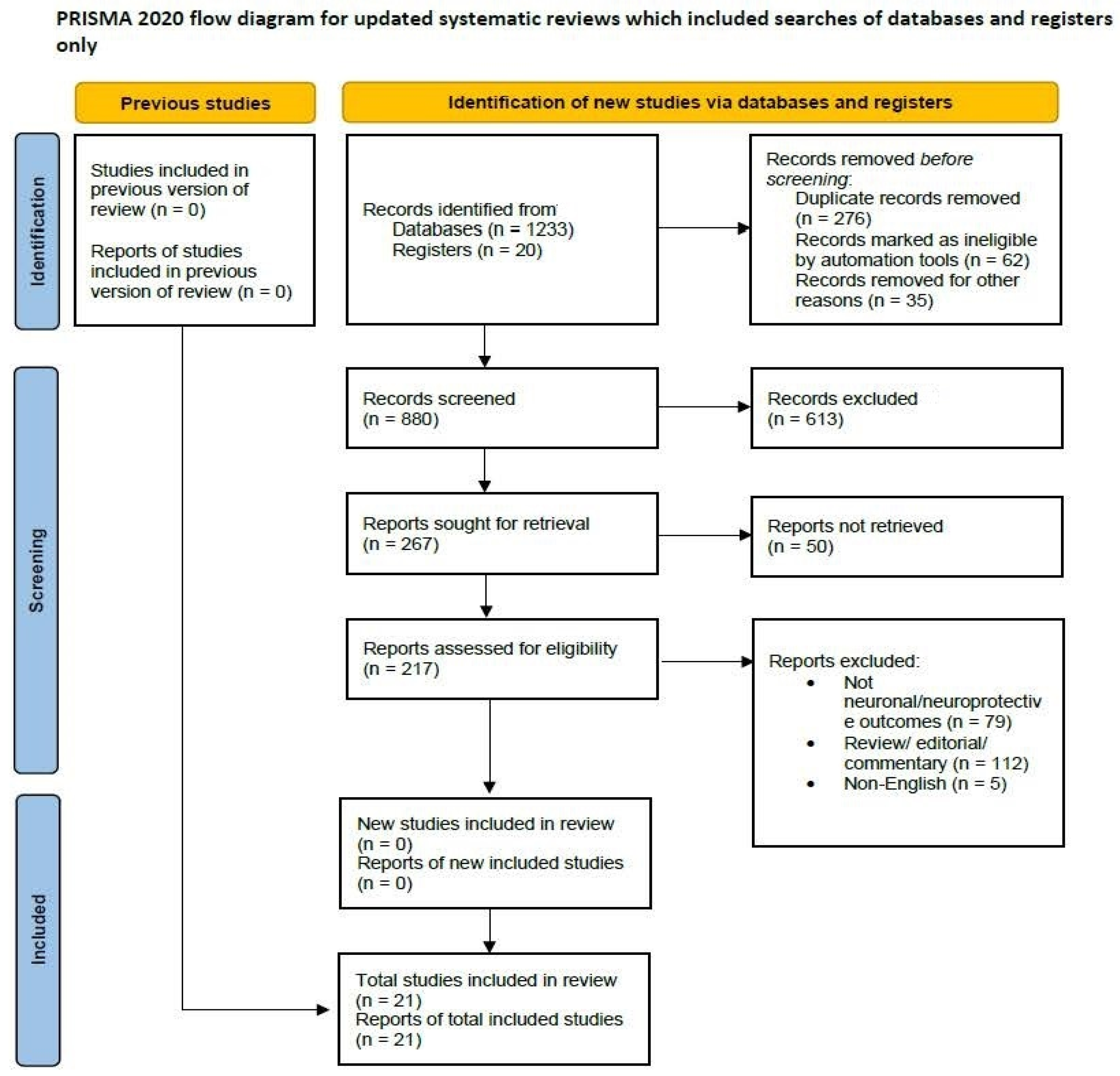
3.1. Study Selection
3.2. Study Characteristics
3.3. Synthesis of Results
3.4. Risk of Bias Across Studies
4. Discussion
5. Conclusions
Supplementary Materials
Author Contributions
Funding
Institutional Review Board Statement
Informed Consent Statement
Data Availability Statement
Conflicts of Interest
Abbreviations
| PD | Parkinson’s disease |
| AD | Alzheimer’s disease |
| FNDC5 | Fibronectin type III domain-containing protein 5 |
| BDNF | Brain-derived neurotrophic factor |
References
- Alzoughool, F.; Al-Zghoul, M.B.; Ghanim, B.Y.; Gollob, M.; Idkaidek, N.; Qinna, N.A. The Role of Interventional Irisin on Heart Molecular Physiology. Pharmaceuticals 2022, 15, 863. [Google Scholar] [CrossRef] [PubMed] [PubMed Central]
- Wrann, C.D.; White, J.P.; Salogiannnis, J.; Laznik-Bogoslavski, D.; Wu, J.; Ma, D.; Lin, J.D.; Greenberg, M.E.; Spiegelman, B.M. Exercise induces hippocampal BDNF through a PGC-1α/FNDC5 pathway. Cell Metab. 2013, 18, 649–659. [Google Scholar] [CrossRef] [PubMed] [PubMed Central]
- Lourenco, M.V.; de Freitas, G.B.; Raony, Í.; Ferreira, S.T.; De Felice, F.G. Irisin stimulates protective signaling pathways in rat hippocampal neurons. Front. Cell. Neurosci. 2022, 16, 953991. [Google Scholar] [CrossRef] [PubMed] [PubMed Central]
- Zhang, X.; Xu, S.; Hu, Y.; Liu, Q.; Liu, C.; Chai, H.; Luo, Y.; Jin, L.; Li, S. Irisin exhibits neuroprotection by preventing mitochondrial damage in Parkinson’s disease. NPJ Park. Dis. 2023, 9, 13. [Google Scholar] [CrossRef] [PubMed] [PubMed Central]
- Wang, Y.; Tian, M.; Tan, J.; Pei, X.; Lu, C.; Xin, Y.; Deng, S.; Zhao, F.; Gao, Y.; Gong, Y. Irisin ameliorates neuroinflammation and neuronal apoptosis through integrin αVβ5/AMPK signaling pathway after intracerebral hemorrhage in mice. J. Neuroinflamm. 2022, 19, 82. [Google Scholar] [CrossRef] [PubMed] [PubMed Central]
- Liu, Y.; Zhu, C.; Guo, J.; Chen, Y.; Meng, C. The Neuroprotective Effect of Irisin in Ischemic Stroke. Front. Aging Neurosci. 2020, 12, 588958. [Google Scholar] [CrossRef] [PubMed] [PubMed Central]
- Kam, T.-I.; Park, H.; Chou, S.-C.; Van Vranken, J.G.; Mittenbühler, M.J.; Kim, H.; A, M.; Choi, Y.R.; Biswas, D.; Wang, J.; et al. Amelioration of pathologic α-synuclein-induced Parkinson’s disease by irisin. Proc. Natl. Acad. Sci. USA 2022, 119, e2204835119. [Google Scholar] [CrossRef] [PubMed] [PubMed Central]
- Zhu, M.; Peng, Q.; Li, S.; Zhang, G.; Zhang, Z. Irisin promotes autophagy and attenuates NLRP3 inflammasome activation in Parkinson’s disease. Int. Immunopharmacol. 2025, 149, 114201. [Google Scholar] [CrossRef] [PubMed]
- Li, N.; Wang, B.; Wang, Y.; Tian, X.; Lin, J.; Sun, X.; Sun, Y.; Zhang, X.; Xu, H.; Li, M.; et al. Exercise Ameliorates Dysregulated Mitochondrial Fission, Mitochondrial Respiration, and Neuronal Apoptosis in Parkinson’s Disease Mice via the Irisin/AMPK/SIRT1 Pathway. Mol. Neurobiol. 2025, 62, 8843–8856. [Google Scholar] [CrossRef] [PubMed]
- Zarbakhsh, S.; Safari, M.; Aldaghi, M.R.; Sameni, H.; Ghahari, L.; Lagmouj, Y.K.; Jaberi, K.R.; Parsaie, H. Irisin protects the substantia nigra dopaminergic neurons in the rat model of Parkinson’s disease. Iran J. Basic Med. Sci. 2019, 22, 722–728. [Google Scholar] [CrossRef] [PubMed]
- Lourenco, M.V.; Frozza, R.L.; De Freitas, G.B.; Zhang, H.; Kincheski, G.C.; Ribeiro, F.C.; Gonçalves, R.A.; Clarke, J.R.; Beckman, D.; Staniszewski, A.; et al. Exercise-linked FNDC5/irisin rescues synaptic plasticity and memory defects in Alzheimer’s models. Nat. Med. 2019, 25, 165–175. [Google Scholar] [CrossRef] [PubMed] [PubMed Central]
- Islam, M.R.; Valaris, S.; Young, M.F.; Haley, E.B.; Luo, R.; Bond, S.F.; Mazuera, S.; Kitchen, R.R.; Caldarone, B.J.; Bettio, L.E.B.; et al. Exercise hormone irisin is a critical regulator of cognitive function. Nat. Metab. 2021, 3, 1058–1070. [Google Scholar] [CrossRef] [PubMed] [PubMed Central]
- Zhang, D.-Q.; Li, G.; Fu, Z.-D.; Huang, Y.-S.; Feng, X.-L.; Chen, L.-J.; Wang, R.; Zhao, W.-J.; Li, Q. Irisin ameliorates cognitive impairment in a lipopolysaccharide-induced neuroinflammation mouse model by inhibiting the NLRP3 inflammasome pathway in microglia. Neuropharmacology 2025, 278, 110572. [Google Scholar] [CrossRef] [PubMed]
- Bretland, K.A.; Lin, L.; Bretland, K.M.; Smith, M.A.; Fleming, S.M.; Dengler-Crish, C.M. Irisin treatment lowers levels of phosphorylated tau in the hippocampus of pre-symptomatic female but not male htau mice. Neuropathol. Appl. Neurobiol. 2021, 47, 967–978. [Google Scholar] [CrossRef] [PubMed] [PubMed Central]
- Zhang, Q.; Xiang, S.; Chen, X.; Rong, Y.; Huang, L.; Chen, Z.; Yao, K.; Chen, W.; Deng, C.; Wang, J. Irisin attenuates acute glaucoma-induced neuroinflammation by activating microglia-integrin αVβ5/AMPK and promoting autophagy. Int. Immunopharmacol. 2024, 138, 112545. [Google Scholar] [CrossRef] [PubMed]
- Ozdemir-Kumral, Z.N.; Akgün, T.; Haşim, C.; Ulusoy, E.; Kalpakçıoğlu, M.K.; Yüksel, M.F.; Okumuş, T.; Us, Z.; Akakın, D.; Yüksel, M.; et al. Intracerebroventricular administration of the exercise hormone irisin or acute strenuous exercise alleviates epileptic seizure-induced neuroinflammation and improves memory dysfunction in rats. BMC Neurosci. 2024, 25, 36. [Google Scholar] [CrossRef] [PubMed] [PubMed Central]
- Wang, J.; Gao, S.; Fu, S.; Li, Y.; Su, L.; Li, X.; Wu, G.; Jiang, J.; Zhao, Z.; Yang, C.; et al. Irisin reprograms microglia through activation of STAT6 and prevents cognitive dysfunction after surgery in mice. Brain Behav. Immun. 2025, 125, 68–91. [Google Scholar] [CrossRef] [PubMed]
- Wu, H.; Guo, P.; Jin, Z.; Li, X.; Yang, X.; Tang, C.; Wang, Y.; Ke, J. Serum levels of irisin predict short-term outcomes in ischemic stroke. Cytokine 2019, 122, 154303. [Google Scholar] [CrossRef] [PubMed]
- Tu, W.-J.; Qiu, H.-C.; Liu, Q.; Li, X.; Zhao, J.-Z.; Zeng, X. Decreased level of irisin, a skeletal muscle cell-derived myokine, is associated with post-stroke depression in the ischemic stroke population. J. Neuroinflamm. 2018, 15, 133. [Google Scholar] [CrossRef] [PubMed] [PubMed Central]
- Chen, Y.; Du, Z.-H.; Chen, H.-Y.; Pan, Y. Effect of staged acupuncture on serum irisin level and neurological rehabilitation in patients with ischemic stroke. Zhongguo Zhen Jiu 2022, 42, 857–862. [Google Scholar] [CrossRef] [PubMed]
- Shi, X.; Gu, Q.; Fu, C.; Ma, J.; Li, D.; Zheng, J.; Chen, S.; She, Z.; Qi, X.; Li, X.; et al. Relationship of irisin with disease severity and dopamine uptake in Parkinson’s disease patients. NeuroImage Clin. 2024, 41, 103555. [Google Scholar] [CrossRef] [PubMed] [PubMed Central]
- Pignataro, P.; Dicarlo, M.; Zecca, C.; Urso, D.; Dell’ABate, M.T.; Vilella, D.; Borlizzi, F.; Zerlotin, R.; Oranger, A.; Colaianni, G.; et al. Correlation Between Irisin and Cognitive Functions in Alzheimer Dementia. Ann. Clin. Transl. Neurol. 2025, 12, 1743–1752. [Google Scholar] [CrossRef] [PubMed]
- Dicarlo, M.; Pignataro, P.; Zecca, C.; Dell’Abate, M.T.; Urso, D.; Gnoni, V.; Giugno, A.; Borlizzi, F.; Zerlotin, R.; Oranger, A.; et al. Irisin Levels in Cerebrospinal Fluid Correlate with Biomarkers and Clinical Dementia Scores in Alzheimer Disease. Ann. Neurol. 2024, 96, 61–73. [Google Scholar] [CrossRef] [PubMed]
- Lourenco, M.V.; Ribeiro, F.C.; Sudo, F.K.; Drummond, C.; Assunção, N.; Vanderborght, B.; Tovar-Moll, F.; Mattos, P.; De Felice, F.G.; Ferreira, S.T. Cerebrospinal fluid irisin correlates with amyloid-β, BDNF, and cognition in Alzheimer’s disease. Alzheimer’s Dement. 2020, 12, e12034. [Google Scholar] [CrossRef] [PubMed] [PubMed Central]
- Huang, X.; Wang, J.; Zhang, S.; Zhao, X.; An, R.; Lan, Y.; Yi, M.; Wan, Q. Plasma BDNF/Irisin Ratio Associates with Cognitive Function in Older People. J. Alzheimer’s Dis. 2024, 99, 1261–1271. [Google Scholar] [CrossRef] [PubMed]
- Page, M.J.; McKenzie, J.E.; Bossuyt, P.M.; Boutron, I.; Hoffmann, T.C.; Mulrow, C.D.; Shamseer, L.; Tetzlaff, J.M.; Akl, E.A.; Brennan, S.E.; et al. The PRISMA 2020 statement: An updated guideline for reporting systematic reviews. BMJ 2021, 372, 71. [Google Scholar] [CrossRef]


| Table 1 Study Ref. | Study Type | Aims | Condition | Setting | Sample Size | Finding |
|---|---|---|---|---|---|---|
| Wang Y. et al., 2022 [5] | Experimental animal study | To investigate the impact of irisin treatment on neuroinflammation and neuronal apoptosis after intracerebral hemorrhage, and to explore the role of integrin αVβ5/AMPK signaling | Intracerebral hemorrhage (ICH) | Laboratory (intrastriatal injection model in mice) |
| Post-treatment with irisin improved neurological function, decreased brain edema, and reduced both neuroinflammation and neuronal apoptosis |
| Kam T. et al., 2022 [7] | Pre-clinical (Animal and Cell Study) | To investigate if irisin prevents pathologic α-synuclein-induced neurodegeneration in a mouse model of Parkinson’s disease. | Parkinson’s Disease (PD) | Laboratory (in vivo mouse model and in vitro primary cortical neuron cultures) | Animal model (n = 12–13 in each group) and cell culture study (n = 3–4 per experiment) | Irisin reduced pathologic α-syn by enhancing endolysosomal degradation of pathologic α-syn |
| Zhang X. et al., 2023 [4] | Pre-clinical (Animal/Cell Study) | To investigate the protective effects of irisin on Parkinson’s disease (PD) models and its mechanism of action. | Parkinson’s Disease (PD) | Laboratory (in vitro and in vivo models) and Clinical (PD patients) Shanghai Tongji Hospital, Tongji University School of Medicine e |
| Irisin exerts neuroprotective effects in Parkinson’s models by activating Akt/ERK signaling to improve mitochondrial function, reduce apoptosis/oxidative stress, and preserve motor and neuronal integrity, supporting its potential as a PD therapy, p < 0.05 |
| Zhu, et al., 2025 [8] | Pre-clinical (In Vitro and In Vivo) | To investigate if irisin promotes autophagy and attenuates NLRP3 inflammasome activation in Parkinson’s disease models. | Parkinson’s Disease (PD) | Laboratory (Cell culture: BV2, SH-SY5Y; Animal model: C57BL/6 mice) |
| The findings suggest that irisin may offer neuroprotection against α-synuclein pathology in Parkinson’s disease, indicating its potential as a promising therapeutic target for both prevention and treatment. p < 0.05 |
| Li N et al., 2025 [9] | Pre-clinical (Animal Study) | To investigate how exercise affects MPTP-induced PD pathology, focusing on the Irisin/AMPK/S IRT1 pathway, mitochondrial function, and apoptosis. | Parkinson’s Disease (PD) | Laboratory (Animal model) | 32 male C57BL/6J mice (8 control, 24 MPTP-induced PD model) | Exercise elevated nigral irisin, p-AMPK, and SIRT1, which were reversed by Cyclo RGDyk, blocking AMPK/SIRT1 pathway activation and eroding mitochondrial benefits and anti-apoptotic effects. p < 0.05 |
| Zarbakhsh S. et al., 2019 [10] | Pre-clinical (Animal Study) | To evaluate whether co-treatment with Irisin and bone marrow stem cells (BMSCs) can protect dopaminergic neurons in a Parkinson’s disease model | Parkinson’s Disease (PD) | Laboratory (Animal model) | 35 adult male Wistar rats (divided into 5 groups of n = 7 | Co-treatment with irisin and BMSCs protects dopaminergic neurons from degeneration and apoptosis following MPTP administration |
| Lourenco, et al., 2019 [11] | Pre-clinical (Animal/Cell Study) | To investigate the role of exercise-induced FNDC5/irisin in synaptic plasticity and memory in Alzheimer’s disease models. | Alzheimer’s Disease (AD) | Laboratory (in vitro, in vivo models) and Clinical (human post-mortem brain tissue, CSF) |
| Brain-specific FNDC5/irisin knockdown impaired synaptic plasticity and memory in mice, while irisin restoration through adenoviral overexpression or exercise rescued these deficits in Alzheimer’s disease models |
| Islam, et al., (2021) [12] | Preclinical Animal Study | To determine if the exercise-induced hormone irisin is the critical mediator of exercise’s cognitive benefits and to evaluate its therapeutic potential for Alzheimer’s disease (AD). | Cognitive Function, Aging, Alzheimer’s Disease | Laboratory (in vivo & in vitro) | Mice: Global FNDC5 KO (FSKO), WT, APP/PS1, 5xFAD models. Sample sizes vary per experiment (e.g., n = 5–15/group). | Peripheral delivery of irisin (via AAV in liver) elevated central irisin levels, crossed the BBB, and improved cognitive function and reduced neuroinflammation in two AD mouse models (APP/PS1 and 5xFAD) |
| Zhang, et al., 2025 [13] | Preclinical (In vivo and In vitro) | To investigate the protective effects and mechanisms of irisin on LPS-induced inflammatory cognitive impairment. | Lipopolysaccharide (LPS)-induced neuroinflammation and cognitive impairment. | Laboratory setting (Animal facility and cell culture lab) Department of Neurology, Hospital of Hainan Medical University, Haikou, China | In vivo: 36 mice (n = 12/group) In vitro: BV2 and PC12 cell lines (n = 3–6/group, repeated 3 times) | Irisin exerted neuroprotection in LPS-treated mice by improving cognition and attenuating hippocampal injury. These effects were mediated by shifting microglial polarization from M1 to M2, suppressing the NLRP3 inflammasome, reducing cytokine release, and shielding neurons from microglia-driven toxicity and apoptosis |
| Lourenco, et al., 2022 [3] | In vitro (primary rat hippocampal neurons) | To investigate the neuroprotective signaling pathways stimulated by irisin in hippocampal neurons. | Alzheimer’s Disease (AD) pathology, Oxidative stress | Laboratory (cell culture) and Analysis of human RNAseq dataset (Aging, Dementia and TBI Study) | n = 3–7 independent culture experiments per assay. | Results show that irisin triggers protective responses in hippocampal neurons, supporting the potential of irisin signaling as a beneficial strategy for Alzheimer’s disease. |
| Bretland, et al., 2021 [14] | In vivo (animal model) | To determine if irisin could prevent the emergence of early tau pathology and neuroinflammation in a pre-symptomatic tauopathy model | Alzheimer’s Disease (tauopathy) | Northeast Ohio Medical University, Rootstown, OH, USA. | 30 mice for primary analysis (16 transgenic htau, 14 non-transgenic C57BL/6J controls) | Results suggest therapeutic potential for irisin in reducing early tau pathology and neuroinflammation, with efficacy observed only in females |
| Zhang, et al., 2024 [15] | In vivo (mouse model) and In vitro (cell line) | To investigate the neuroprotective effects of irisin and its mechanism of action via the integrin αVβ5/AMPK/autophagy pathway in microglia. | Acute Ocular Hypertension (AOH)- induced retinal injury (model for acute glaucoma) and LPS-induced microglial inflammation. | Laboratory (Tongji Hospital, China) | Male C57BL/6, WT, and FNDC5-/-mice (6–8 weeks old). Group sizes ranged from n = 3 to n = 7 per experiment. In vitro: BV2 microglial cell line. | Irisin attenuates AOH-induced neuroinflammation and retinal ganglion cell (RGC) death. ultimately providing a neuroprotective effect. |
| Ozdemir-Kumral, et al., 2024 [16] | In vivo (rat model) | To evaluate the neuroprotective effects of centrally administered irisin and acute exhausting exercise against oxidative brain injury and memory dysfunction due to a pentylenetetrazole (PTZ)-induced single seizure. | Pentylenetetrazole (PTZ)-induced epileptic seizure | Laboratory (Marmara University, Türkiye) | 48 female Sprague-Dawley rats (230–280 g, 12 weeks old). 8 rats per experimental group. | Both central administration of irisin and acute exhaustive exercise before seizure induction conferred neuroprotection by delaying seizure onset, restoring the glutamate/GABA balance, reducing oxidative stress, preserving antioxidant defenses, minimizing neuronal damage, and improving seizure-related memory deficits, with exercise additionally enhancing cerebral BDNF Expression. |
| Wang, et al., 2025 [17] | Preclinical (Mice) | To investigate the role of irisin in preventing Postoperative Cognitive Dysfunction (POCD) and its mechanism of action via microglial reprogramming. | Postoperative Cognitive Dysfunction (POCD), Neuroinflammation, Dementia | Laboratory (Peking University) and Hospital (Peking University First Hospital) | Mice: Group sizes typically n = 5–8 for molecular, n = 8–13 for behavioral tests. | Irisin pretreatment prevented surgery- or LPS-induced neuroinflammation, neuronal hyperexcitability, synaptic loss, and cognitive impairment, while prophylactic administration reduced early postoperative cognitive dysfunction and alleviated anesthesia-induced hypothermia. |
| Table 2 Study Ref. | Study Type | Aims | Condition | Setting | Sample Size | Finding |
|---|---|---|---|---|---|---|
| Wu H. et al., 2019 [18] | Prospective observational clinical study (3-month follow-up) | To determine serum irisin levels and investigate their associations with functional outcomes in first-ever acute ischemic stroke (AIS) patients | Acute ischemic stroke (AIS) | Department of Emergency, Zhongnan Hospital of Wuhan University, Wuhan, China. | 324 AIS patients | A low serum irisin level is a predictor of poor early functional outcome in ischemic stroke patients |
| Tu W.J. et al., 2018 [19] | Prospective observational cohort study (6-month follow-up) | To determine serum irisin levels and investigate their associations with post-stroke depression (PSD) after first-ever acute ischemic stroke | Post-stroke depression (PSD) in acute ischemic stroke (AIS) patients | Three stroke centers in China | 1205 AIS patients | The data suggested that reduced serum levels of irisin were powerful biological markers for the risk of developing PSD even after adjustment by variables |
| Chen Y. et al., 2022 [20] | Randomized Controlled Trial (RCT) | To observe the effect of staged acupuncture on serum irisin level, neurological deficit, balance ability, and spasticity in patients with ischemic stroke. | Ischemic Stroke | Clinical (likely a hospital or research center, as patients and healthy subjects were recruited) | 90 total (60 patients divided into two groups of 30, plus 30 healthy subjects in a normal group) | The staged acupuncture could increase the serum irisin level, improve the neurological function, balance ability and spasticity in patients with ischemic stroke |
| Zhang X. et al., 2023 [4] | Human Clinical Observation | To investigate the protective effects of irisin on Parkinson’s disease (PD) models and its mechanism of action. | Parkinson’s Disease (PD) | Shanghai Tongji Hospital, Tongji University School of Medicine | 23 patients | Peripherally delivered irisin might be a promising candidate for therapeutic targeting of PD. |
| Shi, et al., 2024 [21] | Case–control study | To investigate the relationship of irisin with disease severity and dopamine uptake in Parkinson’s disease patients. | Parkinson’s Disease (PD) | Henan Provincial People’s Hospital, Zhengzhou, China | 100 PD patients and 70 healthy controls | Plasma irisin levels were reduced in Parkinson’s disease, declined with disease progression, inversely correlated with α-synuclein and motor severity (UPDRS-III), positively correlated with cognitive function (MoCA), and were associated with greater striatal dopamine uptake, particularly contralateral to the affected limb |
| Lourenco, et al., 2019 [11] | Human Clinical Observation | To investigate the role of exercise-induced FNDC5/irisin in synaptic plasticity and memory in Alzheimer’s disease models. | Alzheimer’s Disease (AD) | Human post-mortem brain tissue, CSF) | CSF and plasma cohort:
| FNDC5/irisin is significantly reduced in the AD brain and CSF, while plasma levels remain largely unchanged, resulting in a decreased CSF/plasma irisin ratio; these findings indicate a CNS-specific dysregulation of irisin that is disrupted in Alzheimer’s disease and Lewy body dementia |
| Pignataro P. et al., 2025 [22] | Clinical Cohort Study | To investigate the association of cerebrospinal fluid (CSF) and serum irisin levels with multidomain cognition in a biologically defined cohort of patients with Alzheimer’s disease (AD) pathology. | Alzheimer’s Disease (AD), Mild Cognitive Impairment (MCI), Subjective Memory Complaint (SMC) | University of Bari “A. Moro”, Bari, Italy | 146 subjects total: AD (n = 82), MCI (n = 44), SMC (n = 20) | CSF and irisin levels significantly correlated with global cognitive efficiency (MMSE) and multiple specific cognitive domains (memory, executive functions, attention, visuospatial abilities, language). |
| Dicarlo, et al. (2024) [23] | Clinical Cohort Study | To study CSF and plasma irisin levels, their correlation with AD biomarkers (Aβ, tau) and clinical scores (CDR-SOB), and investigate sex differences. | Alzheimer’s Disease (AD), Mild Cognitive Impairment (MCI), Subjective Memory Complaint (SMC) | University of Bari “A. Moro”, Bari, Italy. | 146 subjects total: AD Dementia (n = 82), MCI (n = 44), SMC (n = 20) | Findings suggest CSF irisin is a potential biomarker for AD progression, with a more pronounced role in female pathophysiology. |
| Lourenco, et al. (2020) [24] | Clinical Cohort Study | To investigate whether cerebrospinal fluid (CSF) irisin levels correlate with AD biomarkers (Aβ, tau), brain-derived neurotrophic factor (BDNF), and cognitive performance in humans | Alzheimer’s Disease (AD), Non-Demented Controls (NDC) | Memory clinic at D’Or Institute of Research and Education (IDOR) in Rio de Janeiro, Brazil | 39 subjects total: AD (n = 14), Non-Demented Controls (NDC; n = 25) | Findings suggest that reduced CSF irisin and BDNF in AD are more closely related to amyloid pathology than to general neurodegeneration (as measured by t-tau). |
| Lourenco et al., 2022 [3] | Human post-mortem data analysis | To investigate the neuroprotective signaling pathways stimulated by irisin in hippocampal neurons. | Alzheimer’s Disease (AD) pathology, Oxidative stress | Laboratory (cell culture) and Analysis of human RNAseq dataset (Aging, Dementia and TBI Study) | Subjects > 77 years old (n is not reported). | Hippocampal FNDC5/irisin expression shows an age-related decline and is inversely associated with Alzheimer’s disease neuropathology, particularly tau burden, indicating disrupted brain irisin signaling in aging and AD. |
| Huang X. et al., 2024 [25] | Cross-sectional study | To examine differences in plasma biomarkers between people with MCI and cognitively normal individuals, and explore their relations with cognitive performance. | Mild Cognitive Impairment (MCI) | Shanghai Jiao Tong University, Shanghai, China | 250 older adults (124 with MCI, 126 cognitively normal) | The plasma BDNF/irisin ratio may be a reliable biomarker for reflecting MCI odds and cognitive performance. |
| Wang, et al., 2025 [17] | Observational, cross-sectional case–control study | To investigate the role of irisin in preventing Postoperative Cognitive Dysfunction (POCD) and its mechanism of action via microglial reprogramming. | Postoperative Cognitive Dysfunction (POCD), Neuroinflammation, Dementia | Peking University First Hospital | Human: 37 patients (18 Control, 19 Dementia) | In elderly patients (>70 years), lower preoperative serum irisin levels were associated with an increased risk of long-term postoperative dementia, showing a ~31% reduction compared with cognitively normal controls and a negative correlation with age in affected individuals |
Disclaimer/Publisher’s Note: The statements, opinions and data contained in all publications are solely those of the individual author(s) and contributor(s) and not of MDPI and/or the editor(s). MDPI and/or the editor(s) disclaim responsibility for any injury to people or property resulting from any ideas, methods, instructions or products referred to in the content. |
© 2026 by the authors. Licensee MDPI, Basel, Switzerland. This article is an open access article distributed under the terms and conditions of the Creative Commons Attribution (CC BY) license.
Share and Cite
Alzoughool, F.; Alanagreh, L.; Aljawarneh, Y.; Zraigat, H.; Alzghool, M. The Multifaceted Role of Irisin in Neurological Disorders: A Systematic Review Integrating Preclinical Evidence with Clinical Observations. Neurol. Int. 2026, 18, 15. https://doi.org/10.3390/neurolint18010015
Alzoughool F, Alanagreh L, Aljawarneh Y, Zraigat H, Alzghool M. The Multifaceted Role of Irisin in Neurological Disorders: A Systematic Review Integrating Preclinical Evidence with Clinical Observations. Neurology International. 2026; 18(1):15. https://doi.org/10.3390/neurolint18010015
Chicago/Turabian StyleAlzoughool, Foad, Loai Alanagreh, Yousef Aljawarneh, Haitham Zraigat, and Mohammad Alzghool. 2026. "The Multifaceted Role of Irisin in Neurological Disorders: A Systematic Review Integrating Preclinical Evidence with Clinical Observations" Neurology International 18, no. 1: 15. https://doi.org/10.3390/neurolint18010015
APA StyleAlzoughool, F., Alanagreh, L., Aljawarneh, Y., Zraigat, H., & Alzghool, M. (2026). The Multifaceted Role of Irisin in Neurological Disorders: A Systematic Review Integrating Preclinical Evidence with Clinical Observations. Neurology International, 18(1), 15. https://doi.org/10.3390/neurolint18010015