1. Introduction
The European Union has long committed to the introduction of smart meters as a core element in the policies that target end-user energy awareness, system competitiveness, and environmental sustainability of energy markets [
1]. Through smart meters, end users can access real-time load consumption data and information on energy cost and power availability. This enables behind-the-meter optimization, reducing electricity costs, improves grid efficiency and foster the participation in demand-response programs and flexibility services [
2,
3,
4,
5,
6,
7]. Smart metering has been directly addressed in Directive 2019/944 on ‘Common rules for the internal market in electricity’ [
8], as enabling technology to support (i) flexible connection agreements (Art. 6), (ii) dynamic electricity price contracts (Art. 11), and (iii) aggregation markets based on Demand-Response schemes (Art. 13 and 17). With reference to the ‘Functional reference architecture for communications in smart metering systems’ [
9],
access to smart meter data is envisaged both via the Home Area Network (HAN), mainly for real-time home automation, and
via the Advanced Metering Infrastrucure (AMI) Head End system, i.e cloud platforms, for historical data and data sharing with third parties and other non real-time information, such as non firm available power and day ahead prices, which will be discussed in this work.
As reported by many sources [
4,
10,
11] already by the end of 2022 a major number of EU countries had already achieved a substantial share of smart meter installations in domestic households, with Spain, Italy, Norway, Sweden, Finland and Denmark notably reporting over >90% coverage. On the other hand, several Central European countries, such as Germany and Poland, were still lagging behind, with households coverage well below 20%.
This paper comes from a large European collaboration and focuses on the opportunities and challenges of integrating home EV chargers, i.e., wallboxes, with domestic smart meters. According to the situation described, the situation for Vehicle Grid Integration (VGI) in 2025 should look quite promising, at least in all EU countries were smart meter roll-outs were fully accomplished already in 2022. However, as we find in this work, despite widespread adoption, the installed smart meters respond to a wide range of different design criteria defined by Member States and local authorities and implement very different communication protocols both at the physical/transport layer (f.e. PLC/DLMS/COSEM, RJ45/M-Bus, etc.) as well as at the application layer (Prime, Chain2, EN 13757, …) which, in fact, hinder the ability of commercial wallboxes to use smart meter data for behind-the-meter charging optimization and grid flexibility services.
The paper is organized as follows. First, we point out relevant use cases where the direct integration of the wallbox and the smart meter has a clear edge over more complex solutions where Customer Energy Managers or external cloud platforms are involved. We then compare the technical specifications of smart meters in selected European countries (IT, ESP, DK, NO, GER) and highlight the differences in supported interfaces, data shared with the end user, and all information relevant to the provision of smart charging solutions and flexibility services. Finally, we identify and propose remedial actions to tackle the most pressing issues that hinder the exploitation of smart meters data for the development of advanced charging functionalities and flexibility services.
2. The Case for Wallbox—Smart Meter Direct Integration
The impact of EVs on distribution networks is well recognized [
12,
13], and the literature on VGI and flexibility services is rich of case studies based on the use of custom Energy Management Systems (EMS) and V1G/V2G flexibility schemes, for instance [
14,
15,
16,
17,
18,
19,
20]. While fully electrified households with rooftop PV generation, EVs and a smart EMS can greatly optimize behind-the-meter load consumption, reduce energy costs and provide grid flexibility services, it is also important to note that this situation is far from the reality of most European households. As reported by Eurostat [
21],
most Europeans live in flats in densely populated urban areas where buildings often have a centralized heating and cooling system. As consequence, residential flats have relatively modest volumes of electricity consumption, between 2–4 MWh/year. Furthermore, small heat pumps and water boilers usually offer limited energy saving functionalities which are based on proprietary apps and are not designed to integrate with one another, unless a specific remote-switching, such as the French Linky system, is in place [
5]. All these conditions make the adoption of customer EMS not attractive to most Europeans for the limited economic gain versus the effort towards understanding home automation, energy bills and consumption patterns. Indeed, 73% of households in the EU are under a
regulated fixed-price or market-based fixed-price electricity contracts [
4]. Looking at 2030 and beyond, when EVs are expected to be widely adopted, this situation is not going to change significantly and in most cases
EVs will be the only relevant flexible loads on the household or parking premise of bigger residential buildings. In these cases, we argue that a direct coordination between the wallbox and the smart meter is the simplest and most cost-effective solution to achieve both behind-the-meter load management and for the provision of novel demand-response services based on real-time local grid signals, such as low voltage flexible connection agreements.
In the next few paragraphs we discuss representative use cases where the direct integration between the wallbox and the smart meter is readily beneficial to the end user and grid operators.
2.1. Local Load Management
The
Home Area Network (HAN) is the optimal environment for local load management due to its low latency, simplified topology, and complete user control over connected devices. In a typical household where the EV is the only flexible load, if a wallbox can directly connect to the smart meter on the HAN and gain information on the contracted power and the real-time power consumption of all other non-flexible appliances, the maximum recharging power can be easily calculated to deliver the fastest recharging possible without any risk of circuit breakings or penalties for excessive power withdrawals. Furthermore, if the smart meter is also able to signal information on local real-time PV generation, the same logic can be extended to optimize renewable auto-consumption. This real-time integration between commercial wallboxes and smart meters data on the HAN was realized in [
22] (more on that in
Section 2.2.1). While this is use case is commonly achieved with a custom domotic system that typically consists of an additional sub-meter and a local controller, if smart meter data are directly available on the HAN and only one flexible load is connected, all these extra electronic components become unnecessary, and only increase equipment costs, stand-by load consumption and, ultimately, vendor lock-in situations and electronic waste.
2.2. Flexible Connection Agreements
In order to promote load shifting towards hours when the grid is not congested, grid operators and electricity providers can design
electricity contracts where the available power is not constant over time, but may change throughout the day according to either pre-established time intervals or local grid conditions. These contracts, also known as Conditional Connections Agreements (CCA) or non-firm connections, can be particularly effective especially at the distribution level to prevent grid congestions, as they provide a simple instrument for local load management
not linked to intricate and still immature mechanisms of distribution systems flexibility markets [
23]. A comprehensive study on CCAs and their use for flexibility services in MV/LV distribution networks is presented in [
20], also addressing the technical challenges of obtaining local grid signals during pilot implementation. From the networking point of view, a flexible connection agreement requires the ability of system operators to communicate any change in available power to a customer’s flexible loads. Arguably,
the AMI provides the optimal gateway to signal this information, since it is the only element common to all possible service configuration.
2.2.1. Non-Firm Connections at Household Level
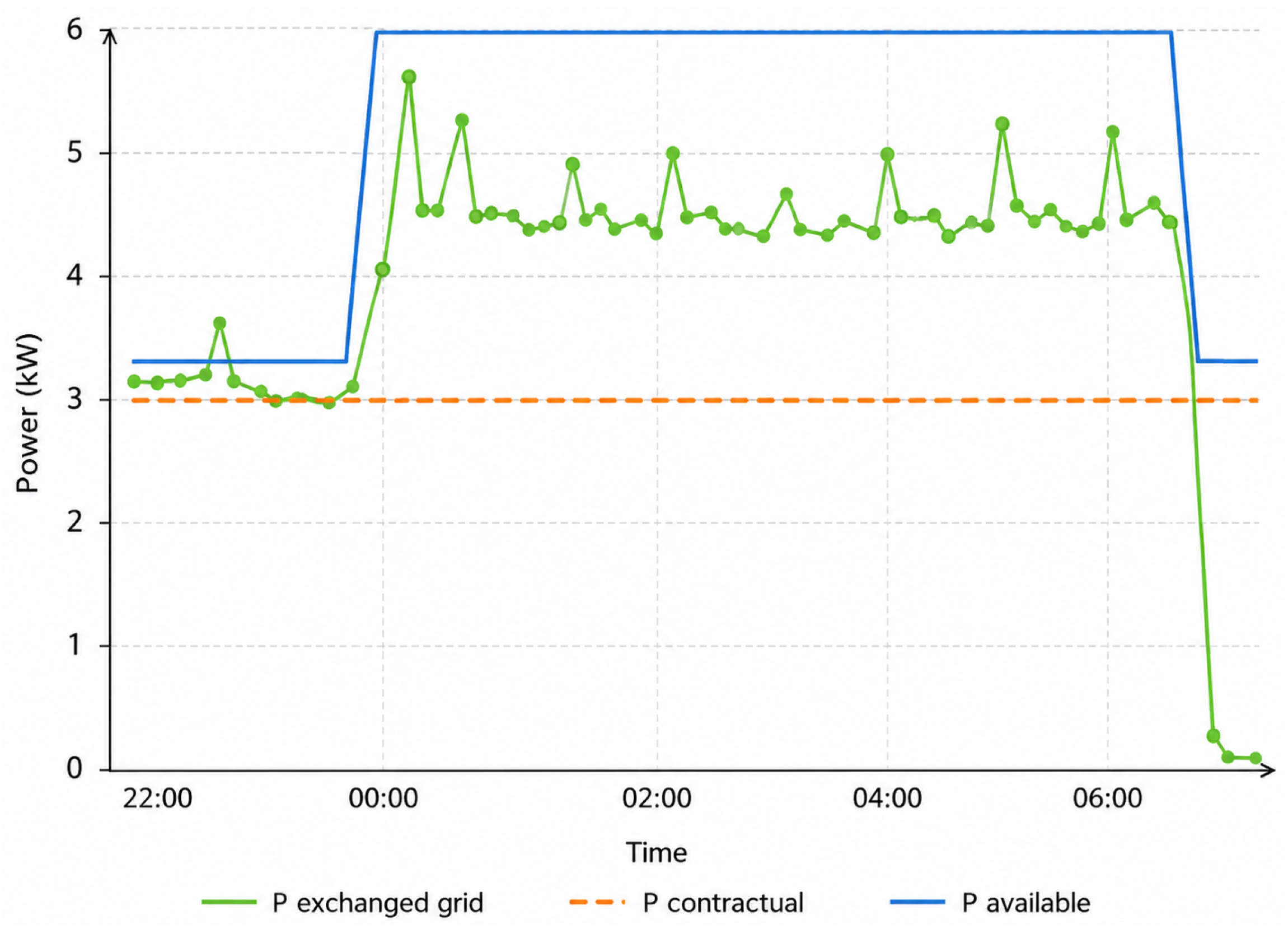
Leveraging on the early deployment of the smart metering infrastructure, an experimental campaign was conducted in 2023 and 2024 in Italy to test the ability of installed smart meters for the provision of non firm connection agreements at the household level [
22]. The campaign involved different commercial manufacturers to also asses smart meter interoperability at country level. The tests covered different aspects from basic local load management (as described in the previous section) up to the implementation of a flexible connection agreement proposed by the Italian NRA specifically devoted to EV owners and residential households (
https://www.arera.it/en/atti-e-provvedimenti/dettaglio/20/541-20, accessed on 21 June 2026). The flexible connection under examination allows EV owners with a standard, 3 kW fixed power domestic contract to withdraw up to 6 kW at night time (from 23 PM to 7 AM). In order to take advantage of this extra power available, the wallboxes were upgraded with a dedicated PLC interface to acquire this information directly from the smart meter on the HAN, thus
demonstrating the real-time execution of arbitrary non-firm connections from smart meter signals on the HAN. The resulting charging behaviour is shown in
Figure 1 for one particular charging event. The same result was achieved in different households with different electricity contracts and charging equipments and EVs. In order to achieve this level of interoperability, information on the time-changing available power has to be signalled directly from the smart meters to the wallboxes, which in turn
need not to know any specific logic related to the connection agreement itself nor dedicated and not commercially scalable communication interfaces with the DSOs. To achieve the same result without direct coordination with the smart meters would have required a much bigger coordination effort among all actors involved.
2.2.2. Non-Firm Connections in Large Residential Buildings
In [
18], the situation of multiple EV chargers in a community parking, as may be the case in large residential buildings, is analysed, finding that coordinated smart charging based on non-firm connection can lead to significant energy savings and prevent overloading at the local transformer. In order to achieve this, the authors envisage the deploy of an external aggregator responsible to set up several communication channels to read data from at least three sources: (i) a local sub-meter (ii) the Charging Station Controller (CSC), and (iii) the local grid operator. The resulting communication architecture is rather complex in terms of number of devices, signals exchanged, and data security and storage. Again, if all data related to real-time load consumption and actual available power could be directly retrieved from the local/cloud interfaces of the AMI, the CSC could locally handle all the functionalities offloaded to the external aggregator, removing unnecessary electronic components, data exchanges and business actors.
To be noted that, depending on the contractual requirements to comply with the change in available power, this information can be signalled either on the HAN by the smart meter if sharp real-time response is expected, or via the AMI cloud back-end system if the information can be handled with at least minutes in advance.
2.3. Support for (Upcoming) V2G and V2H Technologies
Not yet widespread, but Vehicle-to-Grid (V2G) and Vehicle-to-Home (V2H) technologies are quickly reaching commercial maturity in recent years following the final approval of the ISO 15188-20 protocol, which specifies the technical requirements for AC and DC bidirectional charging. While V2G use cases are not yet authorized in many countries due lack of clarity on tax rules, grid tariffs and safety concerns, we focus here on the fact that demonstrated technological maturity in AC bidirectional charging opens the door for V2H use cases in private environments, like households and private parking areas. As discussed in [
19], V2H in combination with time of use tariffs is currently the only profitable use case for behind-the-meter (no grid services) usage of bidirectional power transfer. In the theoretical study, using the common time-of-use tariffs for residential households in Denmark, it is argued that an EV connected to the charging station could leverage price fluctuations to buy/sell electricity at the most profitable times, and power up the house appliances as well, following a priority system. A real-time price signal would be required for optimal results, but even a simple indication of the currently applied tariff, already available to the Danish users via their smart meters (see
Section 3.3) is already enough to achieve economic savings. Again, direct communication between the smart meter and the EV charging station would greatly simplify the use case structure, avoiding the establishment of complex communication infrastructures without the need for an external aggregator. Moreover, the SCALE project, funded by the European Union, has demonstrated that, in the countries involved in the project, V2G and V2H are promising, but not broadly profitable yet. Calculations on the return of investment can be found in deliverable 5.1 [
24]. Integration with the home smart meter would in this case further improve an already promising use case for V2G and V2H.
3. Review of European Smart Meters and National Cloud Platforms
In this section, we review the landscape of smart metering technologies and Advanced Metering Infrastructure (AMI) deployments currently operating across Europe, with particular attention to their utilization within e-mobility pilot activities for end users applications. The analysis aims to synthesize the key lessons learned to date regarding the availability, quality, and usability of smart meter data, as well as the functional capabilities and limitations of existing smart metering systems in supporting local flexibility and Electric Vehicle Grid Integration (VGI).
Thus, following the ‘Functional reference architecture for communications in smart metering systems’ [
9], in this work we pay special attention to the two interfaces devoted to end user applications: the Home Area Network (HAN) and the AMI Head end systems, which we will reference from now on simply as cloud platforms. The technical details of the data flow from physical smart meters to DSO backend systems are beyond the scope of this work. However, the time delay between local measurement and data availability on national cloud platforms is reported and analysed, as it significantly impacts real world use cases. In
Table 1 and
Table 2 we summarized the main indicators by country.
3.1. ITALY
In Italy, all smart meters implement the Power Line Communication (PLC) technology developed by E-Distribuzione. The communication with DSOs is bidirectional and makes use of the A-band PLC (3–95 kHz), which in Europe is reserved for energy operators. The communication with the end-user on the HAN is mono-directional and follows the Chain 2 protocol, which is an application layer specification on top of the C-band PLC (125–140 kHz) DLMS/COSEM protocol (
https://www.e-distribuzione.it/open-meter/chain-2.html, accessed on 21 June 2026).
3.1.1. Home Area Network
The smart meter interface on the HAN is thus
uniform throughout the whole country and follows the Chain2 PLC protocol, which prescribe that every 15 min and at every significant change in power consumption, the smart meter signals with a COSEM frame on the HAN all relevant real-time information for home automation and behind-the-meter load optimization, as already shown
Figure 1. This COSEM frame contains both the main electrical measurements voltage, current, frequency, active power, as well as contractual information such as available and contractual power, holding time-of-use tariff (a proxy for the energy cost) and available power. It is worth noting that the PLC communication interface is disabled by default, and can be activated upon request to the DSO, who are also responsible for data encryption. For this reason, it was established that
only Chain2 qualified vendors are allowed to ask DSOs for decryption keys. As a result, very few commercial products are available on the Italian market that can read smart meter data and make it available to end users via more common IoT protocols such as modbus or MQTT. Adoption of these products has so far been limited, with sub-metering still being the most common solution for home automation.
3.1.2. National Online Platform
All smart meter data are published by the DSOs on a single national online platform (
https://www.consumienergia.it/portaleConsumi, accessed on 21 June 2026), where citizens, regardless of their grid operator or electricity provider can authenticate and view/download their data. Data is usually available on the online platform several days after actual recording. This delay is due to several factors: first, the limited bandwidth and range of PLC systems means that meters data shall be collected by local concentrators placed in the LV or MV substations, aggregated at daily intervals and only then sent asyncronously to the DSOs central systems with standard IT communication protocols. Secondly, before publication DSOs shall also validate the acquired measurements, thereby introducing further delays.
With regards to data availability for the end user, we observe several limitations: authentication on the online plaftorm is only allowed through the national citizen digital identification protocol, which requires strong, two-factors authentication and does not allow remote programmatic access nor data sharing with third party platforms. Furthermore, validated data are not usually available within 48 h from the actual time of measurement, inconsistencies are commonly experienced and there is no official figures for the accuracy of the numbers reported.
3.2. SPAIN
The massive installation of smart meters in Spain was driven by the Orden ITC/3860/2007, which mandated the complete substitution of traditional electricity meters with smart meters by 2018. This process is currently regulated by the Orden ICT/155/2020, which defines the features of smart meters.
3.2.1. Home Area Network
Similarly to Italy, the main technology used for data communication on the Home Area Network is PLC, however
no single application layer protocol is prescribed, and different protocols can be found: the PLC PRIME (PoweRline Intelligent Metering Evolution) protocol [
27], led by Iberdrola and compatible with most commercial smart meters (ZIV, Elster, Circutor, GE, Itron, Janz, Landis + Gyr, ORBIS) and the Meters&More protocol, which is proprietary to Endesa and is also used in Italy. Both protocols are open. In Catalonia, 94% of smart meters are operated with the Meters&More protocol, whereas the remaining 6% with the PLC Prime [
28].
3.2.2. National Online Platform
Similarly to the Italian system, data concentrators are deployed in substations to collect data, which are then transmitted with asynchronous, scheduled procedures to DSO control centers via fiber optic or 4G/5G routers.
The initial directive in 2015 [
29] required grid operators to independently set up proprietary cloud platforms to make energy consumption data accessible to their customers. As a result, a number of cloud platforms where deployed that did not meet basic cybersecurity standards and resulted in inconsistent interfaces and user experiences. To fix these problems, the direction is now changing in favour of a single central online platform, called Datadis (
https://www.datadis.es/home) that not only ensure proper data management strategies, but also offer a common data model for all consumers and data retention in case of switch of electricity supplier or smart meter equipment.
Through its open API, which also support access token authentication, it facilitates automation in energy management. While this platform has the clear potential to simplify interoperability across Spain, to date, no smart charging projects have been found that integrate Datadis data for smart meters, energy pricing, or energy management systems.
3.3. DENMARK
In 2013, the Danish parliament decided that, by 2020, all the Danish households should have been equipped with a smart meter (
https://www.ea-energianalyse.dk/wp-content/uploads/2020/10/Liberalisation_of_the_Danish_power_sector_2020_09.pdf, accessed on 21 June 2026). As of 2023, the rollout has been successful and more than 90 % of the Danish households are equipped with smart meters [
4]. The most widespread models are the Kamstup Omnipower (
https://www.kamstrup.com/en-en/product-centre/omnipower-three-phase-meter, accessed on 21 June 2026), and the MTR 3000/3500 Series IEC Poly Phase (PLC/M2M) smart meters by Networked Energy Services (
https://www.networkedenergy.com/en/resources/datasheets-networked-energy-services, accessed on 21 June 2026). Both these models support back-end communication via Ethernet, PLC (Power Line Communication), or LTE (3G/4G).
3.3.1. Home Area Network
As in the case for Spain, the smart meters interfaces on the HAN are not standardized through the country, and few options can be found: the OSGP (Open Smart Grid Protocol) for the MTR 3000/3500, and the DLMS/COSEM for the Kamstrup Omnipower. While the first is an IEC standard, globally adopted for smart metering activities and with support to many devices and media, the second one is more niche and is mostly used in Europe/US for smart grid and utility automation, and provides a more specialised environment.
From the functional point of view, both smart meters are usually set to measure the RMS phase current, line-to-ground RMS voltage, and the phase differences between the currents and the voltages. Additional capabilities to record the total/single harmonic distortion, operating frequency, single phase voltage and currents are also available, but usually disabled. The estimated parameters are instead the cumulated energy (absorbed/injected), instantaneous active and reactive power (absorbed/injected). The time resolution spans from 5 to 60 min, but the vast majority of the smart meters are set to only record hourly values, as increasing the measurement frequency would rapidly increase the size of the recorded dataset. The effect of net hourly net metering on Danish prosumers was studied in [
30], and it was found that self-consumption increases by 15% when moving from instantaneous per phase netting to hourly summation, with a corresponding saving of at least 50/year € can be achieved by considering the sum of the three phase positive and negative currents.
3.3.2. National Online Platform
The Danish system allows each smart meter owner to access electricity information via the eloverblik.dk website (
https://eloverblik.dk/), which gives them access to a database for smart metering data called Datahub (
https://energinet.dk/data-om-energi/datahub/, accessed on 21 June 2026), created and managed by the Danish TSO, Energinet. The access is managed via the digital citizen ID (MitID) and requires strong two-factor authentication by the user the smart meter is registered to. Within the authenticated area, the user can
enable remote API access for Third Parties with a token that has one year validity. The data is usually available with a 8 h delay from the measurement time, which is much faster than what is achieved in Italy and Spain, but which nevertheless doesn’t allow for any smart meter real time control. The Datahub manages, at present, 3.3 million metering points (
https://en.energinet.dk/media/irmcgncr/danish-electricity-retail-market.pdf, accessed on 21 June 2026). The DataHub also works as a data exchange platform for DSOs, energy retailers, and third party service providers. DSOs read the consumption from the smart meters, then the information is sent to the DataHub, where it can be accessed by both energy and service providers. This way, users can seamlessly change their provider, since the database for billing is unique and owned by the TSO, and service providers can access the data they require to provide services and create new data-based business models. Balance responsible parties (BRPs) receive data from the DataHub every day, and they can use it to balance the production and consumption during the different market auctions, for the customers they represent.
3.4. NORWAY
Norway’s smart meter rollout is among the most comprehensive in Europe, with nearly 99% of metering points in the low-voltage distribution grid equipped with Advanced Metering Systems (AMS) by 2023 [
31]. There are three main suppliers of AMS meters in Norway: Kaifa, Kamstrup, and Aidon.
All implement the HAN interface and data transmission according to the national standardization coordinated by NVE and NEK (respectively, Norwegian Water Resources and Energy Directorate and Norwegian Electrotechnical Committee), and are capable of automated 15-min to 1-h resolution data transmission to grid companies and the national data hub, Elhub. While there are minor differences in update intervals and list structures, the core functionalities and data content are harmonized across all suppliers to meet regulatory requirements [
32,
33].
3.4.1. Home Area Network
As pointed out, the HAN interface is uniform across the whole country and consists of an RJ45 connector and implements the M-Bus protocol (EN 13757-2) to deliver real-time metering data directly to end users. Once activated by the grid company, the HAN port delivers detailed, near real-time information, including (
https://www.nek.no/info-ams-han-brukere/, accessed on 21 June 2026):
Real-time active power consumption (typically updated every 2–10 s, depending on meter and configuration)
Energy consumption (kWh), with hourly resolution
Voltage and current per phase (e.g., L1, L2, L3), with 10 s resolution
Reactive power (import/export) and, for prosumers, active power exported to the grid
Meter identification data (serial number, OBIS list version, etc.)
Access to the HAN port is consumer-controlled and must be requested from the local grid company. Once opened, a variety of devices, such as home energy management systems, smart EV chargers, or in-home displays, can be connected to the HAN port to read and use this data for home automation, visualization, or cloud-based analytics.
3.4.2. National Online Platform
Smart meters in Norway are designed for automated, two-way communication with the Distribution System Operator (DSO). Consumption data is typically sampled at hourly intervals, configurable down to 15 min. The Norwegian smart metering infrastructure employs a hierarchical architecture where smart meters communicate over RF mesh networks to local concentrators, which then use GSM/LTE cellular networks to transmit aggregated data to the DSO’s AMI Head-End System [
34]. The data is then forwarded to the national online platform Elhub (
https://elhub.no). Elhub, operated by the Norwegian TSO Statnett, is the digital backbone of Norway’s electricity market, receiving all validated metering data from DSOs and providing secure, standardized access to suppliers, aggregators, and authorized third parties. The data in Elhub includes basic information at measurement points, such as energy consumption, installed capacity, and capacity limits. This data is made available to the users only the day after the actual measurements. In addition,
Elhub contains the hourly spot price for electricity in each Norwegian price area, expressed in NOK per kWh. This price is set the day before delivery and is available for each hour of the following day, allowing consumers and market actors to plan and adapt consumption in response to expected price changes [
35].
End-users can access their data in Elhub through secure authentication using the national digital identification protocol, BankID, which requires two-factor authentication. They also have full control over their data and can manage access rights by granting or revoking permissions to third parties. In addition, Elhub provides detailed data via dedicated APIs to grid companies, power suppliers, and authorized authorities for purposes such as statistics, analysis, or control. Elhub publishes several open aggregated datasets, for example per pricing area, per grid settlement area, and per municipality.
3.4.3. Real World Experiences
After the rollout of smart meters in Norway, a range of pilot projects have tested both the Elhub platform and the HAN port, each serving different roles. Elhub has been used on market-focused initiatives, providing standardized hourly or 15-min consumption data, that can support billing and market analytics, which can be used for demand response as demonstrated in pilots from iFlex and CINELDI projects [
6,
26]. Its main advantage is the ease of integration for third-party services, as access typically requires only customer consent and no additional hardware. However, since Elhub data is made available to market actors and end users on a daily basis, and not in real time, in its current version cannot be used for device-level, real-time flexibility control. On the other hand, the HAN port offers direct, high-frequency, real-time data access right at the customer’s premises—an essential feature for advanced flexibility services and local energy management, as tested in projects like ENERGYTICS [
25]. This local high-resolution data stream enables immediate response from local measurements, independently on cloud connectivity. However, it is important to note that while the HAN port can provide real-time data locally, many smart services still depend on cloud connectivity for receiving price signals or remote control, so true “offline” operation is not always guaranteed. Conversely, solutions relying solely on Elhub data are limited by the daily update cycle and may face challenges in locations with poor connectivity, such as building basements where EV chargers are often installed. Overall, the collective experience from Norwegian pilots shows that Elhub is best suited for standardized, market-wide applications and analytics, while the HAN port is indispensable for real-time, device-level monitoring and control. This makes them complementary tools in the smart operation of flexible loads such as EV chargers.
3.5. GERMANY
Germany started in late 2020 the deployment of its AMI with the commissioning of smart meters certified according to the technical standard TR-03109 (v2.0) of the Federal Office for Information Security (BSI) [
36]. As of 2024, the smart meter rollout has not yet achieved 10% of residential households [
4,
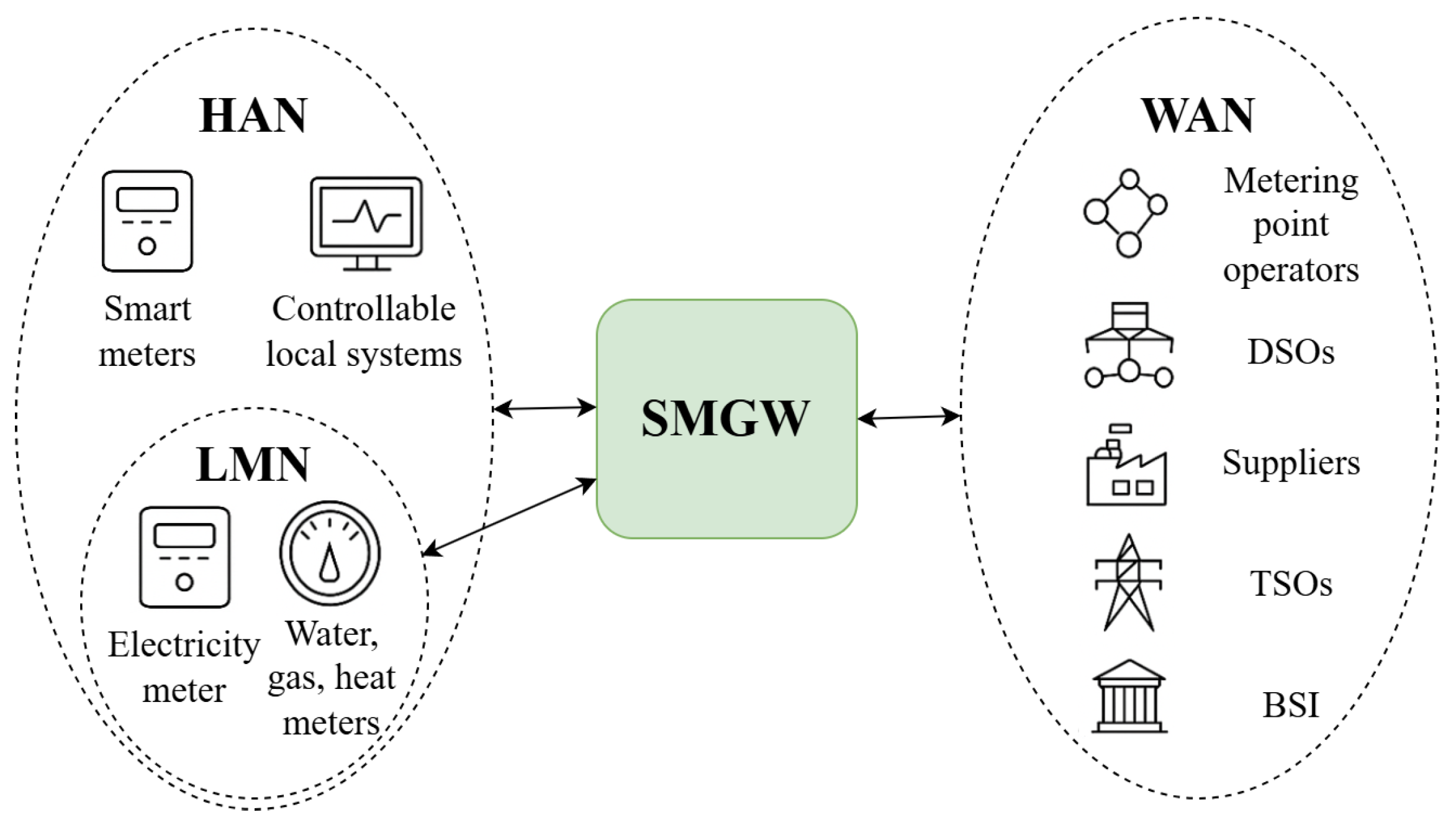
5] and it lags behind the coverage rates achieved in many European countries. The German smart metering system, depicted in
Figure 2, is built around a highly secure device called the
Smart Meter Gateway (SMGW), which tightly controls how data can be accessed both locally (HAN) and remotely (cloud/WAN), where data access is restricted by means of IP access rules and HTTP Digest authentication certificates managed by the BSI’s Smart Metering Public Key Infrastructure (SM-PKI) [
37,
38].
3.5.1. Home Area Network
At household level, a Local Metrological Network (LMN) is defined where all local meters data (electricity, gas, water, …) are collected by the SMGW, and exposed via the only physical interface where end users and their smart electrical appliances can directly access smart meter data and implement control strategies. A number of use cases, mostly focussed on heat pumps and thermal management systems, have been evaluated in real-world pilot projects [
5], where it is stressed that only the commercial devices able to comply with the strict SMGW security requirements were able to leverage the SMGW interface, which in perspective risks isolating the German market from foreign manufacturers.
3.5.2. National Access Platform
From the cloud perspective,
there is no unique national platform for all citizens, and direct access for end users is very limited. The SMGW only communicates outward with certified market actors, and external systems cannot initiate connections to it. This means that users cannot directly access their data via standardized online platforms or APIs. Instead, data access is only mediated through supplier or operator platforms, which are not standardized and often do not support automation or third-party integration. While the system is in principle designed to support advanced features like dynamic pricing, these are not implemented yet. In [
5], the need for a unified national cloud platform is identified as the first priority to enhance the German AMI, with clear potential to accelerating both the smart meter rollout and the uptake of flexibility solutions requiring smart meter data.
4. Results and Discussion
It is already a few years since most European countries have achieved a high level of smart meters installation, and the few that are still lagging behind, such as Germany, have already established a clear rollout plan and regulated all communication protocols and IT architectures for their smart metering infrastructures. In stark contrast to this situation, and despite the theoretical evidence of technical and economical benefits, a general lack of commercial products and energy services able to leverage smart meters data is observed. Unfortunately, this is also true at the research level, where relatively few pilot activities were found prototyping smart products and testing new energy services directly based on smart meter data. From this review and our first hand experience in [
6,
22,
25,
26], we identify several reasons for explaining this situation.
4.1. Hurdles on the Home Area Network
Acquiring smart meter data directly on the HAN is an excellent technical option for sharp real-time, device-level monitoring and control [
22,
25]. Unfortunately, any commercial product targeting the European single market is bound to collide with the complexity of technologies and protocols adopted by different local smart metering systems. This leads to a
market fragmentation issue, where implementations should be tailored for national or regional markets, increasing product development and distribution costs, thereby inhibiting any commercial initiative. Beyond this market aspect, the development of a dedicated HAN interface may also face
technical challenges:
Documentation: It is typically hard to gather the complete list of relevant technical and non-technical information required to estimate the full implementation effort. Documentation may be overwhelming, only available in national language and not always updated with actual meter implementations.
Restricted access: Access to smart meters encryption keys may be reserved only to few qualified operators, preventing early testing and hampering product development;
Interoperability: Even when a single communication technology is chosen, such as PLC, different application layer protocols (PRIME, Chain2, OSGP, …) are specified. This leads quickly to software interoperability issues, and the inability for a single product to deliver the same functionalities in different installations;
Lack of grid signals: In order to test innovative flexibility services such as Conditional Connections Agreements and V2H services, more data than real-time load consumption is needed. Above all, the the available power and the real-time energy price;
Future uncertainty: The lack of products and services based on smart meter data means that the actual protocols might change in the future, putting at risk today’s research and development efforts.
4.2. Cloud Platforms Limitations
Cloud platforms are currently the most widely adopted industry solution for home automation (HVAC, boilers, wallboxes, …) thanks to ease of adoption of IoT protocols and mobile applications. In the same way, smart metering cloud platforms could already provide the easiest and most interoperable access to smart meter data, as indeed discussed in [
5,
6]. Nevertheless, most smart metering cloud platforms reviewed in this work are affected by severe limitations that prevent their use for cloud automation or energy consumption analysis:
Timeliness: Non validated real-time data is missing and only validated load consumption is available, but usually with more than 24 h delay from from the actual time of measurement;
Accessibility: Strict authentication policies like 2FA prevent third party access for energy consumption analytics, tariffs comparison and savings opportunities, remote monitoring and basic automation;
Completeness: Electricity price data and other grid signals, such as available capacity and time-of-use tariffs are rarely available. These are are necessary to interpret load data, electricity consumption optimization and any basic cloud automation.
5. Recommendations
In the current situation, thus, several obstacles hinder the implementation of pilot activities and early commercial initiatives, which are even more essential given the technical complexity of both e-mobility and smart metering protocols. To pave the way to new pilot projects, stress-test deployed protocols and data streams, and align industry stakeholders on real world use case realization, further coordinated efforts are required. Accordingly, we devise a set of recommendations addressing both near-term (2030) and mid-term objectives (2035).
Short-term: Cloud platforms shall be unique at country level and offer a well-documented API with token based authentication suitable for third parties and programmatic access. Systems based on distinct Metering Point Operators (such as DE) shall either guarantee that each platform implements the exact same API, or provide a unique gateway interface. NRAs are invited to monitor on the fulfillment of EU DIR 2019/944 (Art. 20.a) regarding end users data access rights;
Short-term: Electricity pricing data and other grid signals, such as non-firm available capacity, shall be collected and shared both on the HAN and cloud platforms at the suitable frequency to timely inform the end-user and let it react in response. NRAs are invited to widen the minimal information requirements to the end user;
Short-term: A coordinated effort at EU level from the Agency for the Cooperation of Energy Regulators (ACER) is praised to support NRAs in drafting the cloud platform requirements and to promote uniform data access across the EU.
Mid-term: While sharp real-time automation is not in the scope of cloud platforms, non validated real time data, if made available, would be more than suitable for cloud automation. Research bodies and power system operators shall investigate the technical and non technical limits of current AMI with respect to the transmission of non validated data outside of the HAN networks.
Mid-term: More pilots are required for integration at the HAN level. National and EU funding agencies are invited to sponsor R&D projects aiming at viable products able to leverage smart meters data. Research centres should contribute with open-sourcing software and hardware prototypes and bringing the lessons learned to the relevant standardization bodies and Technical Committees.
Mid-term: The requirements, technical and non technical, for system level implementation of V2G, V2H and Flexible Connection Agreements are still under discussions. The current generation of smart meters was not meant to support such use cases, nor the advanced flexibility services technically enabled. Research bodies and power system operators shall investigate the upgrades to current AMI to enable the transmission of relevant grid signals via the smart meter interface and unlock the provision of advanced services.
6. Conclusions
In this article, we reviewed the opportunities and challenges related to the use of smart meter data for EV charging optimization, highlighting the potential improvements with respect to the present situation where smart charging is mostly achieved with simple, even manual, charging scheduling. As we progress with new renewable capacity and get closer to the technical limits of distribution grids, more effective and automated
EV charging solutions directly based on smart meter data will offer a key technological advantage, avoid vendor lock-in situations, enable optimal real-time local load balancing and the provision of grid flexibility services. Despite this clear potential and the successful deployments of smart metering systems, the development of EV charging solutions that rely on smart meter data has yet to take off, both at cloud and HAN levels. Our comprehensive analysis, in
Section 3 and
Section 4, links this situation to a number of technical issues, regulatory and market aspects, whose root cause ultimately lies in the
fragmented and varied landscape of smart metering systems across Europe, which makes it practically hard to design commercial products or research prototypes suitable for smart meter protocols and prevents widespread adoption of the few successfull experiences. To reverse this course of events, in
Section 5, we elaborate a set of
Recommendations for National Regulatory Authorities, funding organizations, research centres and industry partners aimed at enhancing the capabilities of current National Cloud Platforms, and at starting new pilot projects for HAN integration.
Regarding National Cloud Platforms, we argue that they have a strong, but tapped, potential for low cost, interoperable cloud automation. Shortly, cloud platform shall allow third party access via token based authentication and widen the scope of data provided to encompass also energy prices, grid signals and non validated real-time data. Most of these changes are well aligned with requirements in European Directives and can be adopted in the short term.
Regarding integration at the HAN level, given the complexity of both e-mobility and smart metering ecosystems, the kickstart of new pilot projects is deemed essential to (i) stress-test protocols and data streams (ii) align all stakeholders on real world use cases implementations and (iii) provide open source hardware and software prototypes to lessen industry efforts and ease commercial initiatives. Furthermore, with the advance of commercial bidirectional charging technologies, there is a clear need to anticipate the requirements for V2G and V2H use cases, which definitively need sharp, real-time local control of the active load.
Ultimately, in the mid-term (2035) we envision the completion of a wide range of pilot results and industry experiences on the integration of smart meter data for advanced V1G and V2G applications. These results shall be actively shared in the technical discussion tables and study committees guiding the definition of technical and functional requirements for future AMI systems, which are expected to accelerate soon since new rollouts in Europe are planned in the first half of the next decade. By then, it is crucial to have already identified and successfully tackled the most relevant challenges hindering the exploitation of smart meter data.
Author Contributions
Conceptualization, A.C. and M.G.; validation, A.C., F.C., M.G., T.A.Z., J.E., A.P., M.S., M.M., A.Y. and A.M.; formal analysis, A.C., F.C., M.G., T.A.Z., J.E., A.P., M.S., M.M., A.Y. and A.M.; writing—original draft preparation, A.C., F.C., M.G., T.A.Z., J.E., A.P., M.S., M.M., A.Y. and A.M.; writing—review and editing, A.C., F.C., M.G., T.A.Z., J.E., A.P., M.S., M.M., A.Y. and A.M. All authors have read and agreed to the published version of the manuscript.
Funding
This work has been undertaken within the framework of the Horizon Europe research and innovation program under FLOW project grant agreement No. 101056730.
Data Availability Statement
No new data were created or analyzed in this study. Data sharing is not applicable to this article.
Acknowledgments
Andrea Cazzaniga acknowledges funding from the Research Fund for the Italian Electrical System under the Three-Year Research Plan 2025–2027 (MASE, Decree n.388 of 6 November 2024). The authors would also like to acknowledge the assistance of the RYC2021-033477-I grant, funded by MCIN/AEI/10.13039/501100011033 and by the European Union “NextGenerationEU”/PRTR.
Conflicts of Interest
The authors declare no conflicts of interest.
Abbreviations
The following abbreviations are used in this manuscript:
| ACER | Agency for the Cooperation of Energy Regulators |
| AMI | Advanced Metering Infrastructure |
| COSEM | Companion Specification for Energy Metering |
| DLMS | Device Language Message Specification |
| DSO | Distribution System operator |
| HAN | Home Area Network |
| PLC | Power Line Communication |
| OSGP | Open Smart Grid Protocol |
| SMGW | Smart Meter GateWay |
| VGI | Vehicle Grid Integration |
References
- European Commission. Smart Grids and Meters. 2025. Available online: https://energy.ec.europa.eu/topics/markets-and-consumers/smart-grids-and-meters_en (accessed on 4 April 2025).
- Andreadou, N.; Guardiola, M.O.; Fulli, G. Telecommunication Technologies for Smart Grid Projects with Focus on Smart Metering Applications. Energies 2016, 9, 375. [Google Scholar] [CrossRef]
- Marques, A.; Serrano, M.; Alacreu, L. Landscape Analysis for Energy Platforms. 2023. Available online: https://digital-strategy.ec.europa.eu/en/library/empowering-consumers-leveraging-digital-technology-facilitate-voluntary-energy-reductions (accessed on 21 June 2026).
- ACER. Energy Retail—Active Consumer Participation is Key to Driving the Energy Transition: How Can It Happen? Technical Report; Market Monitoring Report; Agency for the Cooperation of Energy Regulators: Bruxelles, Belgium, 2024. [Google Scholar]
- FFE. Technical Framework Conditions for Demand-Side Flexibility; Technical Report; Forschungsstelle für Energiewirtschaft: Munich, Germany, 2025. [Google Scholar] [CrossRef]
- iFlex. Available online: https://www.sintef.no/projectweb/cineldi/pilot-projects-in-cineldi/iflex/ (accessed on 22 April 2025).
- Ostergaard, J.; Ziras, C.; Bindner, H.W.; Kazempour, J.; Marinelli, M.; Markussen, P.; Rosted, S.H.; Christensen, J.S. Energy Security Through Demand-Side Flexibility: The Case of Denmark. IEEE Power Energy Mag. 2021, 19, 46–55. [Google Scholar] [CrossRef]
- European Commission. Directive (EU) 2019/944 on Common Rules for the Internal Market for Electricity; European Commission: Brussels, Belgium, 2019. [Google Scholar]
- TR 50572:2011 E; Functional Reference Architecture for Communications in Smart Metering Systems. Technical Report; CEN-CENELEC-ETSI: Brussels, Belgium, 2011. Available online: https://www.cencenelec.eu/media/CEN-CENELEC/AreasOfWork/CEN-CENELEC_Topics/Smart%20Grids%20and%20Meters/Smart%20Meters/cen-clc-etsi-tr50572_2011.pdf (accessed on 21 June 2026).
- Vitiello, S.; Andreadou, N.; Ardelean, M.; Fulli, G. Smart Metering Roll-Out in Europe: Where Do We Stand? Cost Benefit Analyses in the Clean Energy Package and Research Trends in the Green Deal. Energies 2022, 15, 2340. [Google Scholar] [CrossRef]
- De Paola, A.; Kotsakis, E. Clean Energy Technology Observatory: Smart Grids in the European Union—2023 Status Report on Technology Development Trends, Value Chains and Markets; EU Publications: Luxembourg, 2023. [Google Scholar] [CrossRef]
- ENTSO-E. Electric Vehicle Integration into Power Grids; Technical Report; Position Paper; European Network of Transmission System Operators for Electricity: Brussels, Belgium, 2021. [Google Scholar]
- Zunino, P.; Unterluggauer, T.; Marinelli, M.; Engelhardt, J. Impact of electric vehicles on low-voltage distribution networks: A critical review. eTransportation 2026, 28, 100594. [Google Scholar] [CrossRef]
- Knezović, K.; Martinenas, S.; Andersen, P.B.; Zecchino, A.; Marinelli, M. Enhancing the Role of Electric Vehicles in the Power Grid: Field Validation of Multiple Ancillary Services. IEEE Trans. Transp. Electrif. 2017, 3, 201–209. [Google Scholar] [CrossRef]
- Giordano, F.; Ciocia, A.; Leo, P.D.; Mazza, A.; Spertino, F.; Tenconi, A.; Vaschetto, S. Vehicle-to-Home Usage Scenarios for Self-Consumption Improvement of a Residential Prosumer with Photovoltaic Roof. IEEE Trans. Ind. Appl. 2020, 56, 2945–2956. [Google Scholar] [CrossRef]
- Reza, F.e.a. Smart charging of electric vehicles considering photovoltaic power production and electricity consumption: A review. eTransportation 2020, 4, 100056. [Google Scholar] [CrossRef]
- Sørensen, A.; Lindberg, K.; Sartori, I.; Andresen, I. Analysis of residential EV energy flexibility potential based on real-world charging reports and smart meter data. Energy Build. 2021, 241, 110923. [Google Scholar] [CrossRef]
- Secchi, M.; Macii, D.; Barchi, G.; Marinelli, M. Centralised vehicle-to-grid smart charging supported by PV generation for power variance minimisation at the transformer: A user’s perspective analysis. eTransportation 2025, 24, 100394. [Google Scholar] [CrossRef]
- Menchaca Santos, D.; Thüne, P.; Zepter, J.M.; Marinelli, M. Business cases for degradation-aware bidirectional charging of residential users and heavy-duty vehicle fleets. eTransportation 2025, 23, 100389. [Google Scholar] [CrossRef]
- Unterluggauer, T.; Hipolito, F.; Andersen, P.; Rich, J.; Marinelli, M. Conditional connection agreements for electric vehicle charging: Review, design, and implementation of solutions for the low-voltage power distribution grid. Renew. Sustain. Energy Rev. 2026, 227, 116427. [Google Scholar] [CrossRef]
- Eurostat. Population and Social Conditions; General and Regional Statistics; European Commission: Brussels, Belgium, 2025. [Google Scholar] [CrossRef]
- Marcolin, P.; Cazzaniga, A.; Mauri, G. Assessment of CIR/RO Aggregation Model for Domestic Charging: First Experimental Results. In 2023 AEIT International Annual Conference (AEIT); IEEE: New York, NY, USA, 2023. [Google Scholar] [CrossRef]
- Unterluggauer, T.; Sevdari, K.; Marinelli, M. Technical Demonstration of Conditional Connection Agreements for Urban EV Charging Clusters. In 2024 International Conference on Renewable Energies and Smart Technologies (REST); IEEE: New York, NY, USA, 2024; pp. 1–5. [Google Scholar] [CrossRef]
- Chen, B.; Boukir, K.; Steen, D.; Frengstad, Å.M.; Bouwman, R.; de Brey, B.; Ungar, J.; Tóth-Báló, T.; Berg, R.; van der Ree, B. D5.1: Return on Investment Calculation; Horizon Europe Project, Grant Agreement No. 101056874. Dissemination Level: Public. Version 1.0; SCALE (Smart Charging Alignment for Europe): Arnhem, The Netherlands, 2025. [Google Scholar]
- ENERGYTICS. 2017. Available online: https://www.sintef.no/en/projects/2017/energytics/ (accessed on 21 June 2026).
- Hofmann, M. Implicit Demand Side Flexibility as an Alternative to Investments in the Transmission Grid. Doctoral Dissertation, Norwegian University of Science and Technology (NTNU), Trondheim, Norway, 2024. [Google Scholar]
- González-Sotres, L.; Mateo, C.; Frías, P.; Rodríguez-Morcillo, C.; Matanza, J. Replicability analysis of PLC PRIME networks for smart metering applications. IEEE Trans. Smart Grid 2016, 9, 827–835. [Google Scholar]
- Prat, P.S. Acceso a los Datos de Consumo Eléctrico de los Contadores Digitales y su Uso; Technical Report; Autoritat Catalana de la Competència: Barcelona, Spain, 2017. [Google Scholar]
- Boletin Oficial del Estado (BOE). Resolución de 2 de Junio de 2015, de la Secretaría de Estado de Energía. 2015. Available online: https://www.boe.es/eli/es/res/2015/06/02/(1) (accessed on 21 June 2026).
- Ziras, C.; Calearo, L.; Marinelli, M. The effect of net metering methods on prosumer energy settlements. Sustain. Energy Grids Netw. 2021, 27, 100519. [Google Scholar] [CrossRef]
- Norwegian Water Resources and Energy Directorate (NVE). Norways Smart Meter Journey Completes as 99% of Norwegians Now Have a Smart Meter. Available online: https://www.nve.no/norwegian-energy-regulatory-authority/nve-rme-news/latest-news/norways-smart-meter-journey-completes-as-99-of-norwegians-now-have-a-smart-meter/ (accessed on 21 June 2026).
- Lervik, M. System for Acquisition and Analyzing of Data from Smart Meters. Master’s Thesis, Norwegian University of Science and Technology (NTNU), Trondheim, Norway, 2019. [Google Scholar]
- Norsk Elektroteknisk Komite. Informasjon til Utviklere. 22 April 2025. Available online: https://www.nek.no/info-ams-han-utviklere/ (accessed on 21 June 2026).
- Willett, H. Security Evaluation of Communication Interfaces on Smart Meters. Master’s Thesis, Norwegian University of Science and Technology (NTNU), Trondheim, Norway, 2018. [Google Scholar]
- Buxrud, K.; Eide, S.; Johannessen, E.; Berg, H.; Lie, M.L. Effect of Price on Electricity Demand in Norwegian Households—A Study of Differences in Two Price Areas; Technical Report; Statnett: Oslo, Norway, 2023. [Google Scholar]
- BSI. Technische Richtlinie TR-03109-1: Anforderungen an die Interoperabilität der Kommunikationseinheit eines Intelligenten Messsystems; Technical Report; Bundesamt für Sicherheit in der Informationstechnik (BSI): Bonn, Germany, 2024. [Google Scholar]
- BSI. Smart-Meter-Gateway: Cybersicherheit für die Digitalisierung der Energiewirtschaft; Technical Report; Bundesamt für Sicherheit in der Informationstechnik (BSI): Bonn, Germany, 2024; Version 2.0. [Google Scholar]
- BSI. Technische Richtlinie TR-03109-4: Smart Metering PKI—Public Key Infrastruktur für Smart Meter Gateways; Technical Report; Bundesamt für Sicherheit in der Informationstechnik (BSI): Bonn, Germany, 2024. [Google Scholar]
| Disclaimer/Publisher’s Note: The statements, opinions and data contained in all publications are solely those of the individual author(s) and contributor(s) and not of MDPI and/or the editor(s). MDPI and/or the editor(s) disclaim responsibility for any injury to people or property resulting from any ideas, methods, instructions or products referred to in the content. |
© 2026 by the authors. Published by MDPI on behalf of the World Electric Vehicle Association. Licensee MDPI, Basel, Switzerland. This article is an open access article distributed under the terms and conditions of the Creative Commons Attribution (CC BY) license.





 ,
,