Article

Determining Charging Infrastructure Requirements for Electrified Long-Haul Freight Traffic on German Motorways: A Dual-Perspective Analysis

Chair of Methods for Product Development and Mechatronics, Technische Universität Berlin, Straße des 17. Juni 135, 10623 Berlin, Germany
*
Author to whom correspondence should be addressed.
World Electr. Veh. J. 2026, 17(7), 326; https://doi.org/10.3390/wevj17070326 (registering DOI)
Submission received: 30 April 2026 / Revised: 5 June 2026 / Accepted: 17 June 2026 / Published: 24 June 2026

Abstract

The electrification of long-haul freight transport requires a comprehensive public charging infrastructure along motorways. This study presents a framework combining multi-agent transport simulation (MATSim) with evolutionary bi-objective optimization (NSGA-II) to determine the number and spatial distribution of high-power charging (HPC) points for battery-electric trucks (BETs) on the German motorway network. Beyond infrastructure sizing, the approach also quantifies the impact of BET charging on the duration and distance of long-haul truck trips. The optimization simultaneously addresses the perspectives of two key stakeholders: charge point operators (CPOs), who seek to maximize charger utilization, and logistics operators, who aim to minimize waiting times. The results yield a range of Pareto-optimal configurations balancing the two objectives. A multi-iteration replanning step further lets trucks adapt their routes to experienced waiting times for a more realistic performance assessment, reducing mean waiting times by up to 92%. We evaluate five electrification levels from 1% to 20% across two charging network scenarios with 347 and 779 potential locations, respectively. For the balanced solutions—the knee-point configurations that best reconcile both objectives—at a 10% electrification level, the optimized network reaches a temporal charger utilization of 23% to 32% at mean waiting times of about 1.4 to 1.9 min per charging process. Compared with an internal combustion engine truck (ICET) reference, BET trip durations increase by only 0.9% to 1.3% due to charging detours. Overall, the fast-charging network planned by the German federal government appears sufficient for the HPC demand at electrification levels up to 10% to 15%, whereas additional low-power charging (LPC) infrastructure beyond the planned locations will be needed to cover overnight charging requirements.

1. Introduction

As the global shift toward sustainable energy solutions accelerates in response to climate change, the transportation sector remains a key area for emission reduction. In the context of decarbonizing road transport, the European Union (EU) has introduced ambitious CO2 emission performance standards for new heavy-duty vehicles [1]. Battery-electric trucks (BETs) are emerging as a central technology in this transition, with high-power charging (HPC) during intermediate stops playing a critical role. To support the deployment of such infrastructure, the EU has enacted the Alternative Fuels Infrastructure Regulation (AFIR), which sets minimum requirements for publicly accessible charging stations along the Trans-European Transport Network (TEN-T) [2].
Germany, as the EU member state with the highest annual volume of road freight transport, faces a particular challenge in electrifying long-haul operations and ensuring adequate public charging infrastructure [3]. Although slow depot charging (below 44 kW) is expected to meet the needs of most small and medium electric trucks [4], long-haul trucks are likely to obtain approximately 50% of their required energy from public chargers [5]. This makes analysis and optimization of the charging infrastructure for long-haul freight transport, defined here as trips exceeding 300 km, a critical priority. Moreover, providing a robust data-driven foundation for infrastructure planning facilitates further techno-economic and environmental assessments, such as those demonstrated by [6].
Several studies have investigated the charging infrastructure requirements for BETs in long-haul freight transport [7,8,9,10,11,12,13]. Reference (Ref.) [7] proposes a demand-oriented charging network for Germany using an agent-based microscopic simulation. However, the study does not address overnight charging or apply an optimization approach for charging infrastructure placement. Ref. [8] enhances this model by refining route planning, break scheduling, and queuing behavior within the multi-agent simulation framework (MATSim [14]). Ref. [9] uses an agent-based simulation procedure in combination with a greedy, heuristic optimization procedure to identify the minimal number of fast-charging stations required to electrify 90% of trips in the simulation. They show that 26 strategically placed charging stations are required to electrify 90% of the long-haul freight traffic in Sweden.
Alternative approaches avoid microscopic simulations. Refs. [10,11] use node-based models with queuing theory, estimating infrastructure needs based on traffic volumes. These models assume uniform daily mileage and do not consider existing rest areas or differentiate charging technologies in detail. Ref. [13] considers real rest areas as potential charging locations and limited capacities according to available parking spaces. They deploy a capacity-constrained flow refueling location model to determine a minimal public fast-charging network for BETs in Germany identifying optimal charging locations and the number of charging points required per location for a BET share of 15%. At the European scale, ref. [12] employs a trip-chain model aligned with EU driving regulations, estimating Germany’s infrastructure need for a 15% electrification level, without distinguishing between public and depot charging.
Another study investigates the time losses of BET trips compared to ICET trips [15]. They develop an optimization algorithm to minimize time losses in truck operation attributed to recharging requirements and suboptimal driver decisions. They investigate a set of long-distance freight trips and identify the battery size, charging infrastructure and charging power required to keep time losses below 30 min compared to internal combustion engine trucks (ICETs). The study does not explicitly model charging infrastructure but assumes an average charger ability with fixed waiting times. Additionally, ref. [16] investigates the electrification of truck traffic from the charge point operator perspective through examining the competition between two CPOs at the same site. They deploy an agent-based model where the charging decisions of agents are based on charging prices and the length of waiting queues while CPOs try to improve profitability through adjusting prices and numbers of charging points.
Our study aims to comprehensively assess the public charging infrastructure needs for battery-electric long-haul freight transport along the German motorway network and the impact of BET charging on the distance and duration of long-haul truck trips, incorporating the distinct perspectives of two key stakeholder groups: logistics companies and charge point operators (CPOs). In particular, we address four guiding questions: first, how many HPC charging points are required, how they should be distributed across the motorway network at different electrification levels, and how the conflicting interests of charge point operators and logistics operators can be balanced; second, how adaptive rerouting in response to experienced waiting times affects the assessed infrastructure performance; third, what additional travel time and distance battery-electric operations incur compared to a conventional truck reference; and fourth, whether the planned federal fast-charging network for Germany is sufficient to meet the resulting charging requirements and where additional infrastructure is needed. To achieve this, our study extends the method developed in [17].
The contributions of our study to the existing body of research are as follows. First, we present a dual-perspective optimization framework that simultaneously considers the objectives of CPOs (maximizing charger utilization) and logistics operators (minimizing waiting times), yielding Pareto-optimal infrastructure configurations rather than single-objective solutions. Second, we extend the optimization with multi-iteration MATSim replanning, enabling agents to dynamically reroute to avoid congested charging infrastructure based on experienced waiting times. This closes a significant gap in existing approaches that do not consider route changes in response to capacity constraints, allowing for a more realistic determination of charging infrastructure performance. Third, we introduce an ICET reference scenario that allows a direct quantification of the additional travel time and distance that BET operations incur compared to conventional truck operations, decomposed into unavoidable overhead from charging stops and additional delays caused by infrastructure capacity limitations. Fourth, we evaluate two distinct infrastructure scenarios, a policy scenario based on the planned fast-charging network for BETs by the German Federal Ministry of Transport and an extended scenario incorporating additional rest areas, across five electrification levels from 1% to 20%, providing planners with a comprehensive range of deployment pathways. To the best of the authors’ knowledge, no prior study combines these four aspects in a single framework, an integration that allows a more realistic determination of charging infrastructure requirements and a clearer quantification of the impact of electrification on long-haul truck trips.
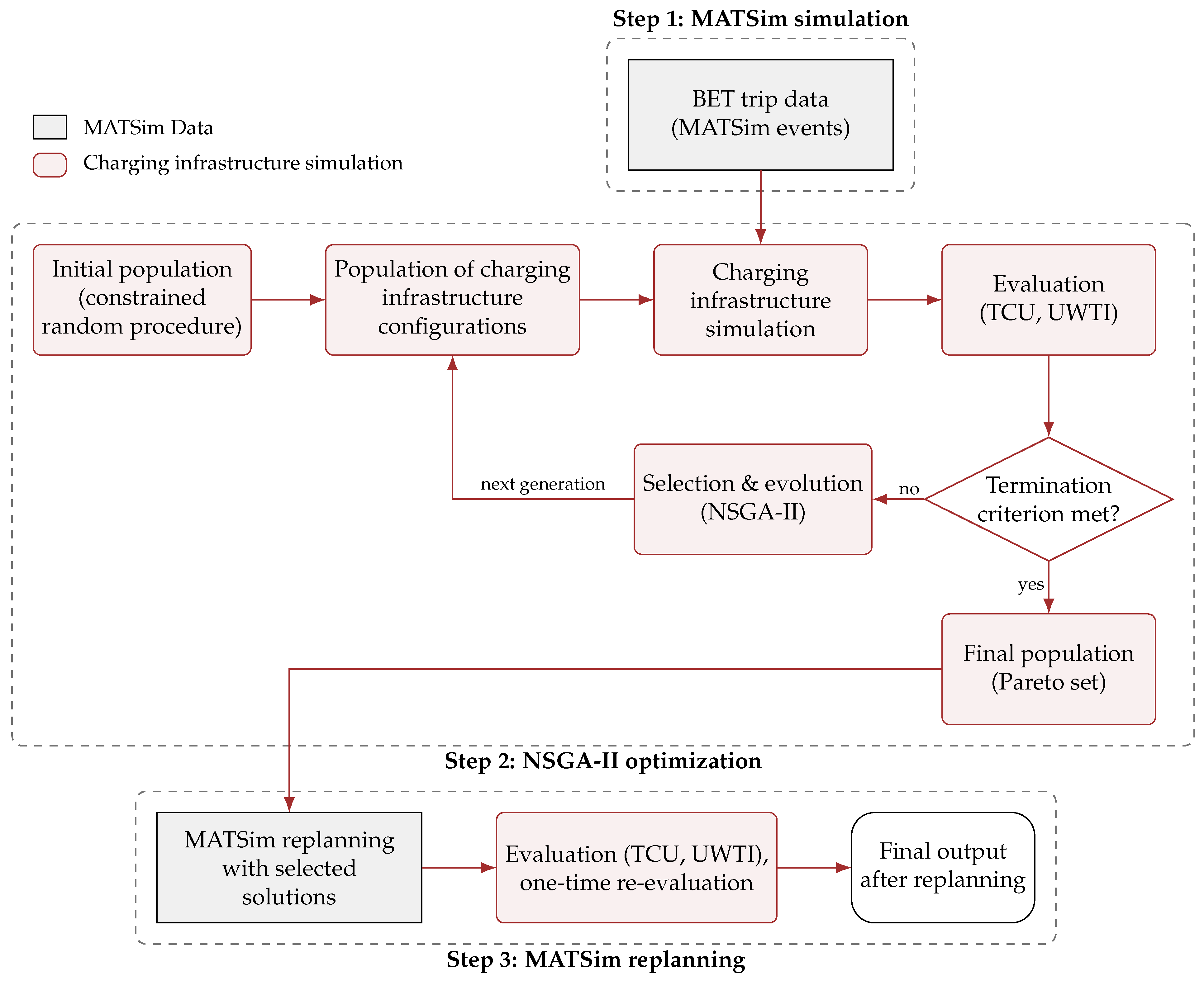
The extended method is outlined in Figure 1 and consists of multiple components. It combines multi-agent simulation (MATSim [14]) with evolutionary bi-objective optimization (NSGA-II [18]) to design efficient public charging infrastructure for long-haul battery-electric trucks in Germany. It simulates truck traffic and charging demand, and then optimizes charger placement by balancing two goals: maximizing charger utilization (for CPOs) and minimizing user waiting times (for logistics operators). The optimization focuses on HPC and evaluates each configuration through a simulation-based evaluation procedure.
The method follows a three-step approach while the third step is part of the method extension. In Step 1, single-iteration MATSim runs generate synthetic BET trip and break data for each electrification level (1%, 5%, 10%, 15%, 20%) with unlimited charging infrastructure at the available charging locations. In Step 2, the NSGA-II optimization determines Pareto-optimal HPC charging infrastructure configurations based on the trip data from Step 1. In Step 3, multi-iteration MATSim replanning runs are performed for selected solutions of the 10% electrification scenario, allowing agents to adapt their charging station choices based on experienced waiting times. Additionally, an ICET reference scenario without any charging requirements serves as a baseline for comparison. The new MATSim results are once again evaluated using the simulation-based evaluation procedure of the optimization algorithm to ensure comparability of the results.

2. Method

This paper extends the method developed in [17]. The following sections detail its key components and their enhancements. Section 2.1 describes the MATSim scenario used to generate synthetic BET trip data, including the two charging location scenarios, the ICET reference scenario, and the updated charging behavior model. Section 2.2 presents the bi-objective optimization that determines Pareto-optimal HPC infrastructure configurations. Section 2.3 introduces the new MATSim replanning step that enables agents to adapt their routing in response to charging infrastructure congestion.

2.1. MATSim Scenario

2.1.1. Traffic Simulation

The transport simulation software MATSim is employed to generate synthetic origin–destination (OD) trajectories (trip data) based on publicly available data as described in [7]. The specifications of the MATSim scenarios are provided in Table 1. The spatial and temporal distribution of truck trajectories is calibrated to realistically reflect long-haul freight traffic on the German road network, using traffic count data from 2020. Each of the five electrification levels between 1% and 20% corresponds to a defined proportion of long-haul trips operated by BETs. Only BET-operated trips are considered within the simulation and at least the start or end of each trip is located within German borders, excluding transit traffic. According to European regulations, trip plans include mandatory breaks, a 45-min pause after 4.5 h of driving followed by an 11-h rest after 9 h total driving time [19]. This is a simplified representation of the EU regulation that does not account for every break constellation. To determine the actual charging duration during these breaks, a charging overhead of five minutes is deducted which accounts for interactions between driver and charging infrastructure. These breaks are scheduled at designated rest areas along the major German road network. Charging activities occur during these breaks, and the rest areas also serve as candidate sites to deploy the charging infrastructure. For these baseline runs, the charging capacity at every candidate location is left unconstrained, so that no vehicle is delayed or rerouted because of occupied chargers and the generated trip demand stays independent of the charger capacity at the candidate locations. Although the MATSim scenarios provide chronological trip and break data for BETs, they do not track individual vehicles over multiple trips, as a new agent is initialized for each trip [7]. All vehicles are uniformly modeled as semi-trailer trucks, each with a gross vehicle weight of 40 tons, since this is the most common configuration used in German long-haul traffic [20]. The specifications of BETs and charging infrastructure were discussed with industry partners from the HoLa project consortium to ensure realistic assumptions for our studies [21]. Therefore, the battery capacity of the vehicles is set to 600 kWh with an energy consumption rate of 1.2 kWh per kilometer. Within MATSim, the HPC charging power is set to 720 kW. The charging targets differ by charging type. HPC charges the battery to a target state of charge (SoC) of 90%, reflecting the diminishing charging power at high SoC levels. Low-power charging (LPC), which occurs during the 11-h rest period, charges the battery to 100% SoC, as the extended charging duration allows for full replenishment at lower power levels.

2.1.2. Charging Location Scenarios

In contrast to the original scenario described in [17], which uses 526 potential charging locations, this work considers two distinct charging location scenarios. The first, referred to as the policy scenario, comprises 350 locations based on the truck fast charging network planned by the federal transport ministry [22]. The location list used for our study can be found at [23]. Since three of the 350 locations are situated so close to the national border that they are not covered by the road network used in the simulation, the total number of locations in this scenario is reduced to 347. It should be noted that this charging network is still in the planning stage and meanwhile there is an updated version of this list available [22]. The updated list substitutes seven locations with other locations. The total number of sites is equal. The second, referred to as the extended scenario, extends the policy locations with additional managed service areas and truck stops (Autohöfe), resulting in approximately 779 potential locations. The information on rest areas and available parking lots along German motorways is taken from Toll Collect GmbH while the information on truck stops was gathered by own research [24,25]. In both scenarios, the charger input files distinguish between HPC and LPC charging points, with their number and power configurable separately. A dedicated rest area file contains all rest areas and truck stops available in [24,25] along the road network, which can be used for break scheduling if no charging is needed.

2.1.3. ICET Reference Scenario

An ICET reference scenario serves as the baseline for a comparison of trip distance and trip duration. In this scenario, trucks have unlimited range and do not require any charging stops. Mandatory breaks are still carried out in accordance with EU driving time regulations and can be scheduled at all available rest areas from the rest area file. Since the rest areas are mainly situated at motorways and the MATSim network also contains federal roads it can happen that no rest area is nearby. Therefore, ICETs are also allowed to take their break at their current position if no suitable rest area is reachable within the remaining driving time. This is assumed to reduce detours which would unnecessarily increase ICET trip distance and duration.

2.1.4. Charging Behavior

The initial SoC distribution is derived from the end-SoC distribution observed at trip completion at the end of a MATSim run. Half of all agents start their trip with a fully charged battery at 100% SoC, while the remaining 50% receive a start SoC sampled from the derived end-SoC distribution. This is an approach to reflect the heterogeneity of real-world fleet operations, where not all vehicles have access to overnight depot charging before every trip.
Agents starting at 100% SoC are assumed to have access to destination or depot charging at their tour endpoint, as a full battery at trip start implies prior charging at the origin. The remaining agents, who start with a lower SoC, can only charge en route during driving breaks. This distinction influences charging decisions, as agents with access to endpoint charging do not charge en route if they can reach their destination without falling below the minimum SoC threshold of 20%, knowing that they will be able to charge at their destination for a lower price.
The stop logic and routing have been enhanced compared to the original method. An energy-aware interaction mechanism now permits an additional intermediate stop outside the regular mandatory breaks if the projected SoC at the destination or break point would fall below the minimum threshold. In this case vehicles recharge only the amount of energy necessary to reach the next regular break point or their trip end. Furthermore, routing follows a leg-wise iterative approach. After each stop, the route is recalculated from the end of the last leg to the destination, rather than computing a single route from origin to destination. This prevents route inaccuracies that previously arose when detours were inserted into a pre-calculated route. The maximum permissible detour is limited to 10 km per leg.

2.2. Charging Infrastructure Optimization

We formulate the planning of HPC infrastructure as a bi-objective integer optimization problem that is solved with the NSGA-II algorithm. The decision variables are the numbers of HPC charging points installed at the candidate locations. Let L denote the set of candidate charging locations identified in Section 2.1, and let
x j Z 0 , j L ,
denote the number of HPC charging points placed at location j. The full decision vector x = ( x j ) j L thus defines one charging infrastructure configuration, referred to as an individual in the evolutionary algorithm. Only HPC points are subject to optimization, while the LPC infrastructure is determined in a separate post-processing step (Section 2.2.5). The two objective functions evaluated for each configuration are defined in Section 2.2.1, and the constraints that delimit the feasible search space are stated in Section 2.2.2.

2.2.1. Objective Functions

The charging infrastructure scenarios are evaluated using two objective functions: the Temporal Charger Utilization (TCU) and the User Waiting Time Index (UWTI) [17]. TCU quantifies the efficiency of infrastructure usage by measuring the proportion of time that charging points are actively in use relative to the total scenario duration:
TCU ( x ) = p P ( x ) t p charge T scen · j L x j
Here, P ( x ) is the set of charging processes that result from configuration x , t p charge is the active charging time of process p, and T scen is the total scenario duration. It is reported as a percentage by multiplying the ratio by 100, with higher values indicating more effective utilization of the installed charging capacity. The UWTI, in contrast, adopts the user’s perspective and reflects the service quality experienced at the charging infrastructure. For each of the n ( x ) charging processes it converts the individual waiting time into a score and additionally penalizes processes whose waiting time exceeds an upper limit:
UWTI ( x ) = 1 n ( x ) i = 1 n ( x ) 1 k · w i if w i w max 0 if w i > w max
Here, n ( x ) is the number of charging processes, w i is the waiting time of process i, and w max is the maximum allowed waiting time. A process without any waiting attains the maximum score of one, and the score decreases linearly with the waiting time at a constant rate k of 0.01 per minute. Once the waiting time w i surpasses the threshold w max of 90 min, the score drops to zero, representing a delay that users would no longer accept. The UWTI of a complete configuration is obtained as the mean score across all of its charging processes.

2.2.2. Optimization Problem and Constraints

Combining the decision variables of Equation (1) with the two objective functions of Equations (2) and (3), the charging infrastructure optimization problem reads
max x F ( x ) with F ( x ) = TCU ( x ) , UWTI ( x )
subject to
1 x j min P j , C j                 j L + ,
x j = 0                 j L L + ,
x j Z 0                 j L .
Maximizing UWTI is equivalent to minimizing user waiting times, so that Equation (4) captures the trade-off between the CPO perspective (high utilization) and the logistics operator perspective (low waiting times). Here, the maximization of the vector-valued objective F ( x ) is understood in the Pareto sense. In general, no single configuration x maximizes both objectives, so the problem yields a set of non-dominated (Pareto-optimal) solutions rather than a single optimum. In the constraints, L + L denotes the subset of locations at which at least one charging process occurs in the unconstrained MATSim baseline run, P j is the number of available parking spaces at location j, and C j is the maximum number of simultaneous charging activities observed at location j in the MATSim output. Constraint (5) bounds each active location between one charging point and the smaller of its physical parking capacity and its observed peak simultaneous demand, Constraint (6) excludes locations without any charging demand, and Constraint (7) enforces integrality. Since TCU and UWTI cannot be expressed in closed form as functions of x , both objectives are evaluated through the simulation-based procedure described in Section 2.2.4, which motivates the use of a population-based metaheuristic such as NSGA-II rather than an exact solver. NSGA-II and SPEA2 are Pareto-based evolutionary algorithms that handle the integer-encoded configurations directly through genetic operators, and comparative studies on discrete bi-objective design problems find both to perform comparably, with NSGA-II achieving the best Pareto-front coverage [26]. MOPSO, in contrast, is formulated for continuous search spaces and would require an additional discretization of particle positions to be applied to our integer decision variables. NSGA-II has furthermore been shown to scale to large-scale multiobjective problems, including combinatorial ones with thousands of binary decision variables [27], a scale that comfortably exceeds our placement problem with its several hundred integer decision variables. Its low computational overhead per generation is an additional advantage here, since each configuration is evaluated through a costly simulation run. Table 2 summarizes the notation introduced in this section.

2.2.3. Initial Population

In addition to the truck trip data, the evolutionary optimization requires an initial population of charging infrastructure configurations, referred to as individuals. Following the constrained random procedure introduced in [17], we generate 400 individuals whose charger placements respect the bounds imposed by Constraints (5)–(7). In contrast to [17], where the number of charging points per location is drawn from a single placement probability, we divide the generation into six density levels. Each level is defined by a probability interval that governs how densely the locations are equipped toward their upper bound, as listed in Table 3. Each level generates a subset of the 400 individuals, with the placement probability sampled uniformly between its lower value p min and its upper value p max . The levels range from sparse configurations, in which only few of the admissible charging points are placed, to near upper bound configurations, in which almost all locations are equipped close to their upper bound. This level-based initialization guarantees that the starting population evenly covers the full spectrum of infrastructure densities and therefore both ends of the trade-off between TCU and UWTI from the first generation onward. All 400 individuals are simulated and evaluated at the start of the optimization. The 60 best-performing individuals are then selected to form the population for the subsequent optimization.

2.2.4. Simulation-Based Evaluation

In the charging infrastructure simulation, charging events occurring during the mandatory 45-min breaks are classified as HPC, while those taking place during the 11-h rest periods are treated as LPC. Notably, the effective charging duration is derived from the respective break duration minus the five-minute charging overhead, resulting in 40 min for HPC during regular breaks and 10 h 55 min for LPC during rest periods. In contrast to MATSim, where a fixed charging power of 720 kW is applied, the simulation-based evaluation calculates the charging power as the mean power required to reach the respective target SoC within the fixed charging duration, while ensuring that the mean charging power does not exceed 900 kW. For irregular recharge stops with varying duration, the charging power is set to 720 kW, consistent with the MATSim scenario. As the optimization procedure focuses solely on HPC infrastructure, the individuals in the evolutionary algorithm encode only the number of HPC points per location. Consequently, only the HPC infrastructure is subject to optimization.
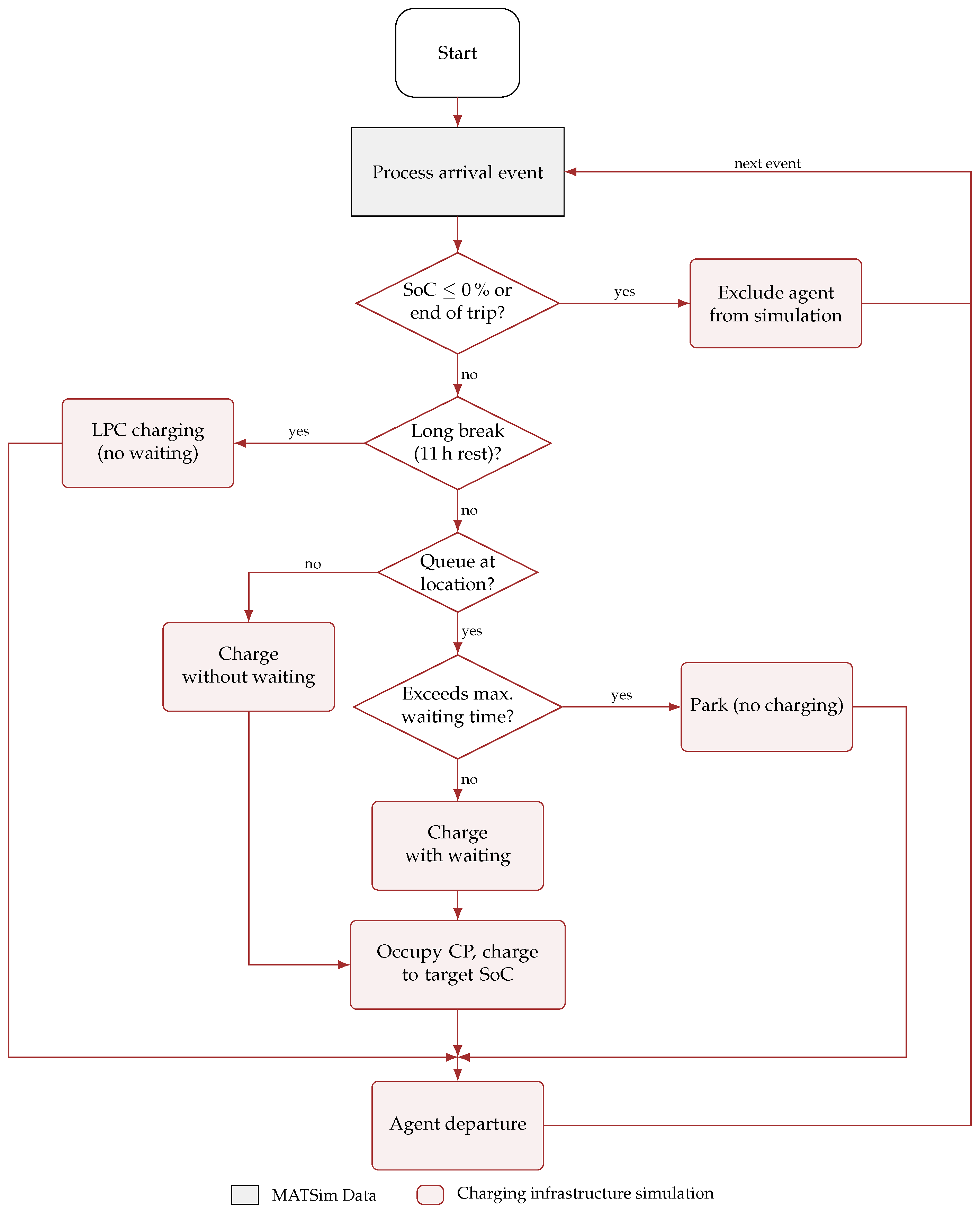
Both the generated individuals and the BET trip data serve as input to the charging infrastructure simulation. Each individual is assessed by replaying the MATSim trip data through this charging model, processing truck arrivals at the candidate locations in chronological order, as illustrated in Figure 2. An arrival is skipped when the agent has already been depleted to zero SoC, or when it corresponds to the end of a trip, since charging at the trip end is not modeled. For every remaining arrival, the available break length follows from the gap between the arrival and departure times. Extended rest periods are served by an LPC process without any waiting, as described in Section 2.2.5, whereas short breaks pass through the charging decision logic shown in Figure 2. These short breaks comprise both the mandatory 45-min driving breaks and any irregular intermediate stops triggered by insufficient energy to reach the next break point or destination (see Section 2.1.4). A truck that finds a free charging point starts charging immediately and occupies it for the effective break duration. If all points are occupied, it joins the queue only when the expected waiting time stays below the tolerated threshold. Otherwise, it remains parked for the duration of the break without charging. In contrast to [17] the decision whether a charging process is necessary or not is removed from the optimization procedure since this decision is now made before within the MATSim scenario as described in Section 2.1.4. Each charging process is assigned a UWTI score. When a charging attempt is refused because the waiting time exceeds the maximum threshold despite charging being necessary, a penalty UWTI of zero is assigned. Refused processes where charging was unnecessary are not penalized. Based on these performance indicators, each individual is evaluated with respect to the two objective functions. A genetic algorithm (NSGA-II) is then employed to evolve the population by selecting the best-performing individuals and using them to generate a new population through crossover and mutation operations. This iterative optimization ultimately produces a final set of Pareto-optimal charging infrastructure configurations. These configurations represent different trade-offs between the evaluation criteria, thereby reflecting the diverse priorities of both logistics companies and CPOs.

2.2.5. Low-Power Charging

For LPC charging, no decision-making process is involved during simulation. LPC is treated as always available without capacity constraints in both the MATSim simulation and the optimization. Trucks encountering an extended rest period are assumed to charge without incurring any waiting time or detours. As the optimization procedure focuses solely on HPC infrastructure, the required LPC charging power per location is determined during the charging infrastructure simulation, while the number of LPC points per location is derived from the peak concurrent overnight demand in a separate post-optimization step. It is important to note that the number of LPC charging points at a location is not constrained by the available parking spaces since LPC infrastructure is not optimized.

2.2.6. Parametrization, Termination and Solution Selection

The NSGA-II operates with a population size of 60 individuals. New individuals are generated using two-point crossover with a crossover rate of 60%. Mutation is applied gene-wise, where each gene (i.e., the number of charging points at a location) is independently modified with a given probability. The mutation rate is set to 3% for the first 200 generations and reduced to 1% thereafter to balance exploration and exploitation. The maximum number of generations is set to 700.
In addition to this upper limit, an adaptive termination criterion has been introduced. The algorithm terminates early when the hypervolume of the Pareto archive improves by less than 0.1% over the preceding 100 generations. This criterion ensures that computational resources are not wasted on marginal improvements while still allowing sufficient convergence for complex scenarios.
The population size of 60 was chosen to match the available hardware, so that the costly simulation-based evaluation of a full generation can be executed in parallel on the 64-core machine used in this study. The crossover and mutation rates follow the values established in the underlying method [17] and lie within the ranges commonly used for NSGA-II, while the maximum of 700 generations was adopted because that study showed that the Pareto front improves only marginally beyond this point. Because the optimization additionally applies the adaptive convergence criterion described above, the actual computational effort is governed by the convergence of the Pareto archive rather than by a fixed generation budget, which makes the parametrization robust with respect to both convergence and computational efficiency.
Following the optimization, an automated solution selection procedure identifies five representative solutions distributed across the Pareto front for each electrification level. These comprise the two boundary points (i.e., the solutions with the highest TCU and the highest UWTI, respectively), the knee point (the solution offering the best compromise between both objectives), and two intermediate solutions positioned between the knee point and each boundary. This standardized selection enables systematic comparison across electrification levels and charging location scenarios. In addition, a reference solution is computed for each electrification level by assigning sufficient charging points at every location to eliminate most waiting times. Since upper bounds for charging infrastructure placement are set according to the number of parking spaces, minor waiting times can occur in the reference solution if the charging demand exceeds the parking space. This reference solution serves as an upper bound for infrastructure demand and provides a baseline against which the optimized solutions can be compared.

2.3. MATSim Replanning

The optimization in step 2 evaluates charging infrastructure configurations using single-iteration MATSim data, where agents follow predetermined routes (shortest path) without reacting to congestion at charging locations. To capture realistic demand redistribution effects, step 3 introduces multi-iteration MATSim replanning runs. These runs are performed for the five selected solutions of the 10% electrification scenario, for both the policy and the extended charging location scenario, resulting in ten runs in total.
Each replanning run comprises 100 MATSim iterations. In each iteration, agents may be rerouted to alternative charging stations with a probability that decreases over the course of the simulation: 30% for iterations 1–50, 10% for iterations 51–90, and 0% for iterations 91–100. This number of iterations, together with the annealing of the rerouting probability to zero over the final iterations, was sufficient for the experienced waiting times to settle into a stable equilibrium before the run terminates.
After each iteration, the experienced waiting times at each charging station are recorded in hourly bins. In subsequent iterations, agents use the average waiting times from the previous iteration to inform their charging station choice. When rerouting is triggered, each agent evaluates up to five candidate charging stations and selects the one with the lowest combined cost, measured as the sum of detour time and expected waiting time while not exceeding a detour distance of 10 km per charging process. This mechanism redistributes charging demand away from congested hotspots toward less frequented stations, thereby reducing peak waiting times and improving overall system performance.

3. Results

This section presents the optimization results for all electrification levels (1% to 20%) and both charging network scenarios. First, Section 3.1 provides an overview of charging infrastructure demand across all scenarios. Subsequent sections focus on the 10% electrification level, for which MATSim replanning runs were conducted using five selected solutions per charging network as described in Section 2.2.6.

3.1. Optimization Results Across All Electrification Levels

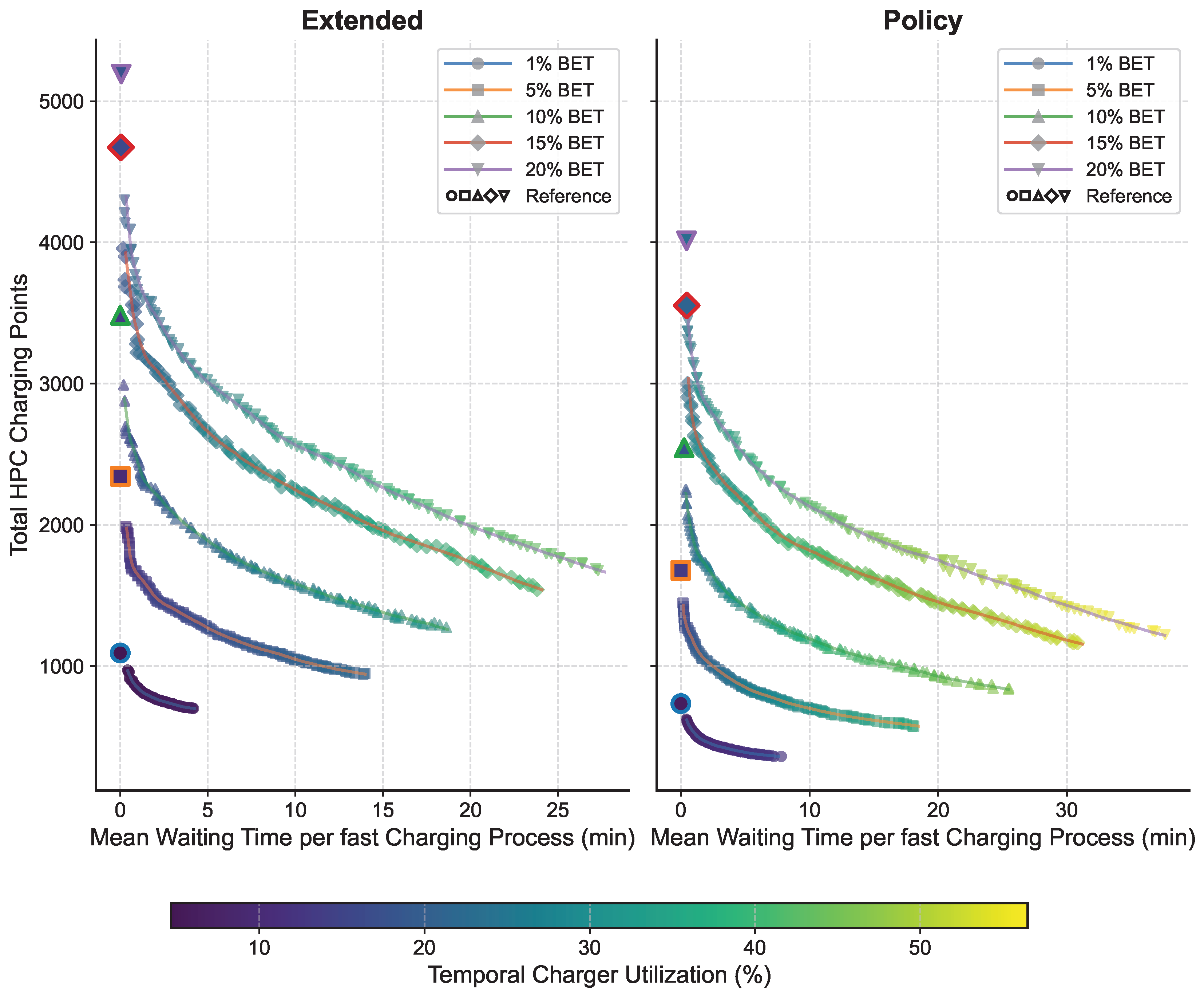
Each electrification level represents the proportion of long-haul freight trips conducted by BETs. Figure 3 illustrates the final non-dominated sets of solutions for the extended and the policy charging network across all electrification levels, together with the corresponding reference solutions. Table 4 lists the boundary values of selected characteristics within these non-dominated sets.
The number of required HPC charging points does not increase linearly with the electrification level. Rather, the rate of increase diminishes as electrification progresses. For instance, in the extended scenario, the upper bound of the non-dominated set rises from 986 charging points at 1% to 4777 at 20%, representing a roughly fivefold increase for a twentyfold growth in BET trip share. This sub-linear scaling arises because higher electrification levels allow charging demand to be distributed more evenly across locations, improving the utilization of existing infrastructure. The distance between the non-dominated set and the reference solution highlights the potential for optimization. At the 1% electrification level this potential is comparatively limited, whereas at 20% more than 1000 HPC charging points can be saved relative to the reference with only a marginal increase in waiting time. This effect is present in both charging networks, but slightly less pronounced in the policy scenario due to the smaller number of available locations. The temporal charger utilization of the reference solutions increases with higher electrification levels even without optimization. The optimization procedure amplifies this trend further, accompanied by rising waiting times when the number of charging points is reduced.
The policy scenario generally requires fewer HPC charging points than the extended scenario. This is a direct consequence of the smaller number of available charging locations (347 vs. approximately 779). With fewer locations, the charging demand is concentrated at fewer sites, and each location serves a larger catchment area. The optimization therefore achieves the required coverage with fewer total charging points. However, this concentration leads also to higher mean waiting times and higher temporal charger utilization, as shown in Table 4. At the 20% electrification level, the policy scenario reaches utilization values of up to 56.5% and mean waiting times of up to 39.7 min, compared to 44.3% and 29.7 min in the extended scenario.

3.2. Effect of MATSim Replanning

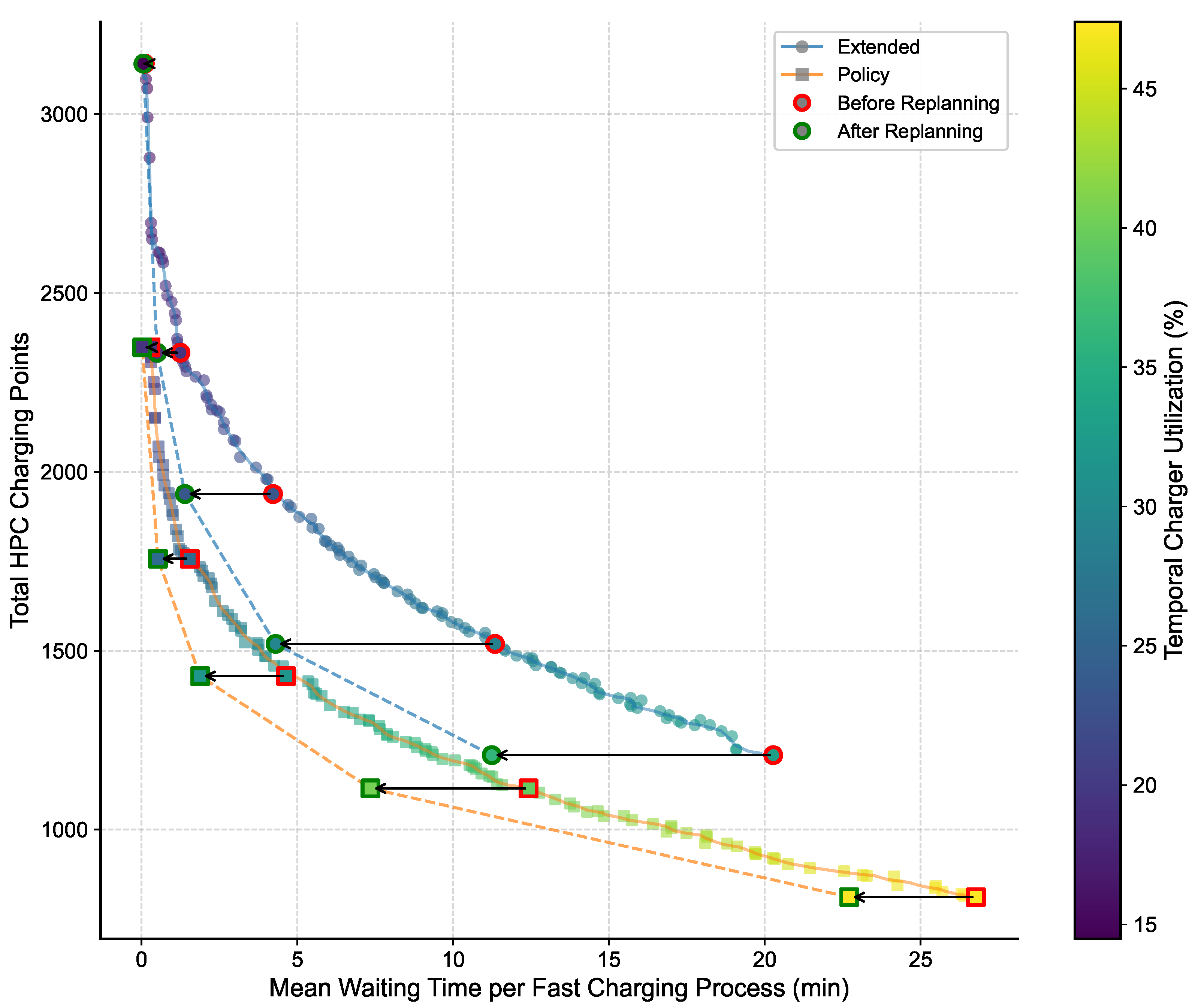
As described in Section 2.2.6, five solutions from the non-dominated set of the 10% electrification scenario are selected per charging network for MATSim replanning. Figure 4 shows the position of these solutions before and after replanning, and Table 5 lists the corresponding key performance indicators.
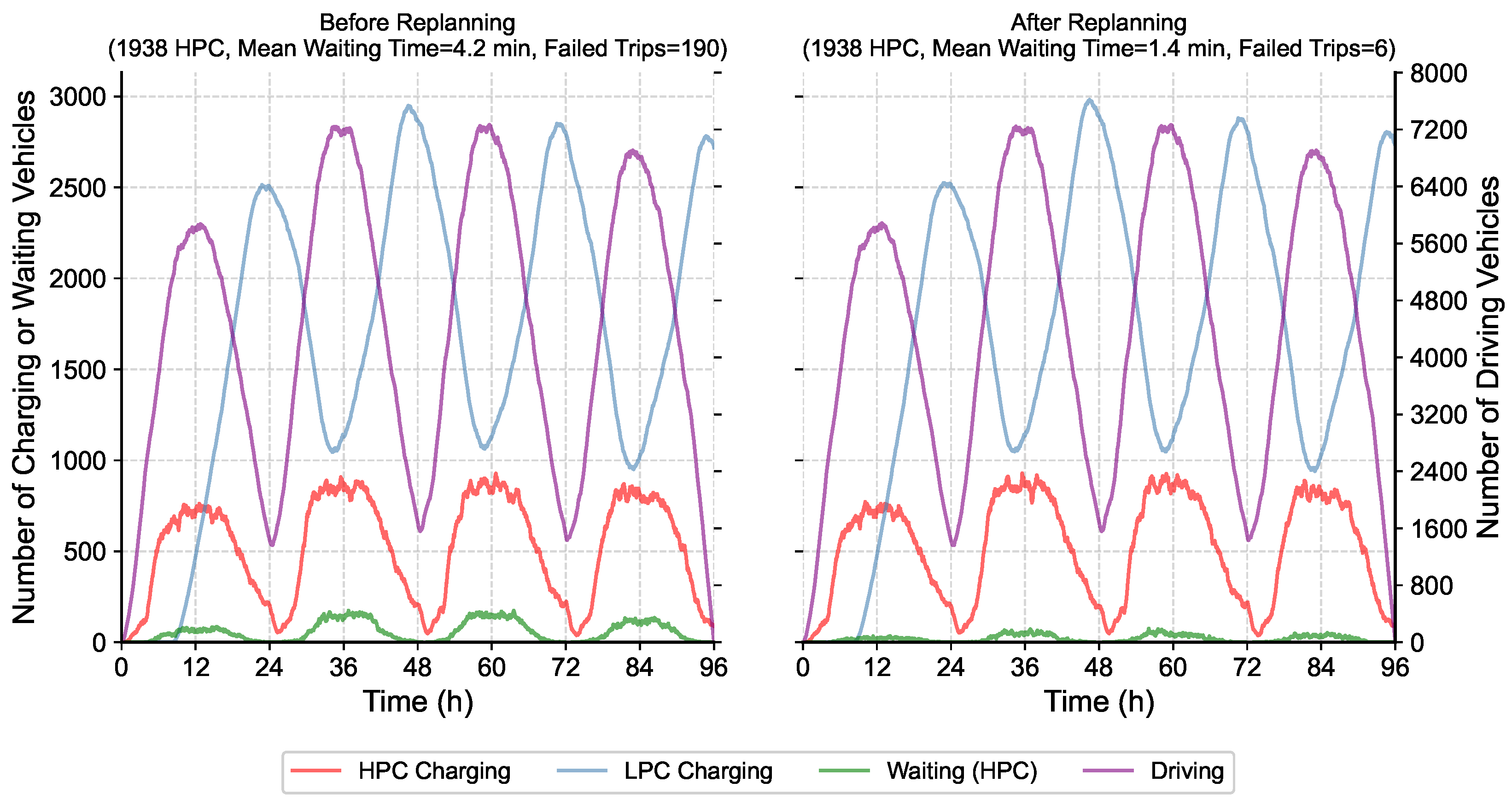
All selected solutions exhibit lower mean waiting times after replanning, with the largest absolute reductions observed for solutions that had the highest waiting times before replanning. In the extended scenario, the balanced solution (knee-point) improves from 4.2 to 1.4 min (−67%), while the highest-utilization solution decreases from 20.3 to 11.2 min (−45%). This reduction in waiting time represents the most important effect of the replanning procedure and demonstrates the successful adaptation of agents to the constrained availability of charging infrastructure. The temporal charger utilization remains largely unaffected for solutions with low to moderate waiting times. For solutions with high initial waiting times, utilization increases slightly after replanning because the number of failed trips decreases substantially, resulting in more completed charging processes. In the extended scenario, failed trips drop from 5511 (8%) to 393 (0.6%) for the highest-utilization solution and from 190 to 6 for the balanced solution. Figure 5 illustrates this effect for the balanced solution of the extended scenario by showing the number of driving, charging and waiting vehicles over the course of the simulation before (left) and after replanning (right). The figure reveals a cyclical pattern of driving behavior between day and night, with HPC charging peaking during daytime hours and LPC charging peaking at night. After replanning, the waiting peaks are visibly reduced while the overall driving and charging patterns remain unchanged.
From the logistics company perspective, the low-waiting-time solutions are of particular interest as they minimize operational delays. After replanning, the low-waiting-time solution of the policy scenario requires approximately 1800 HPC charging points to achieve a mean waiting time of 0.5 min at a TCU of 26%. In the extended scenario, a comparable waiting time of 0.5 min is reached with approximately 2300 charging points at a TCU of 19.5%.

3.3. Spatial Distribution of Charging Infrastructure

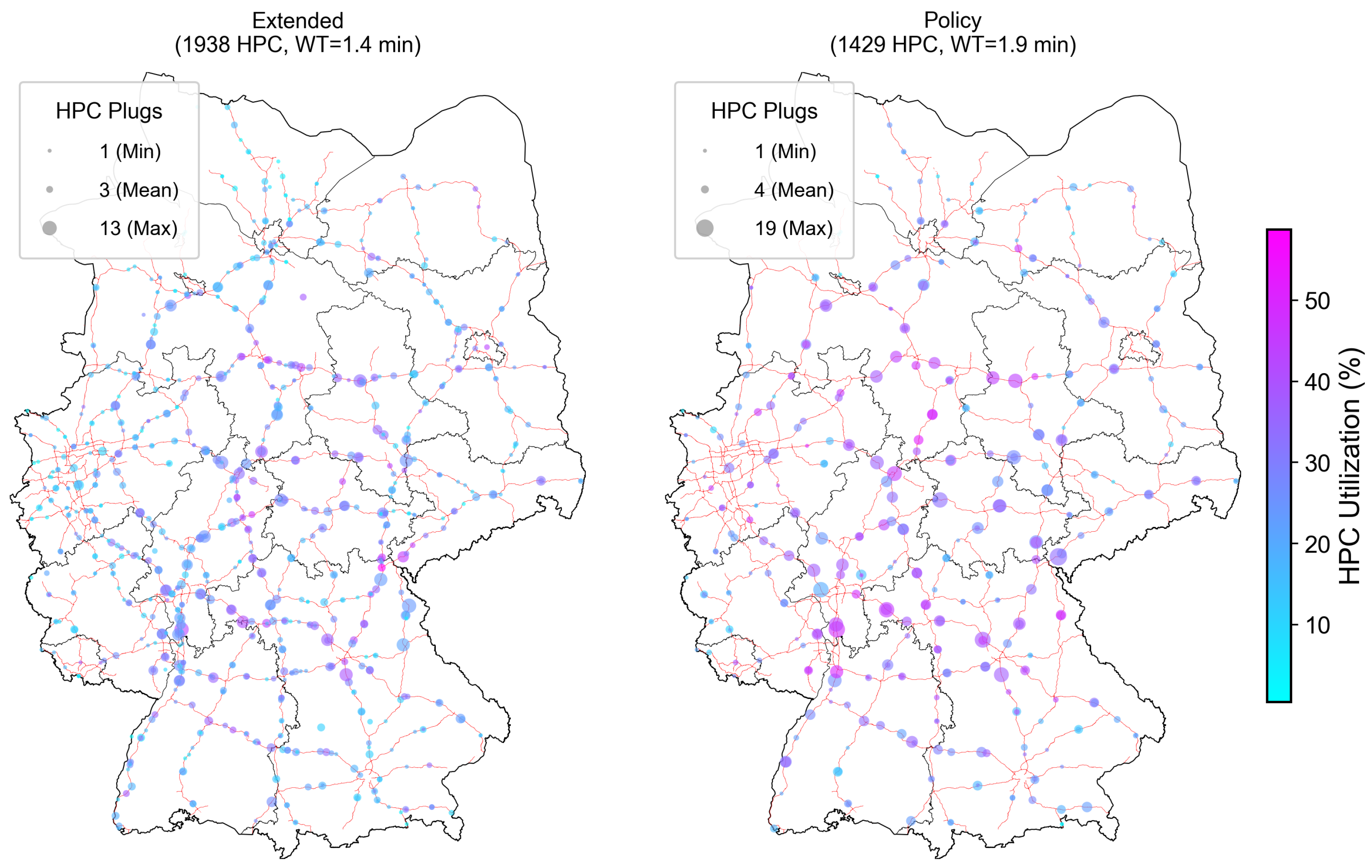
This section analyzes the spatial distribution of charging infrastructure for the balanced solution of the 10% electrification level. Figure 6 shows the distribution of HPC charging points across all locations, with dot size indicating the number of HPC points and color indicating the utilization at each location. On average, each location is equipped with three HPC points, with a maximum of 19 points at a single location. Locations in the policy scenario generally have more charging points per site and higher utilization, reaching values above 45%, compared to the extended scenario. In both charging networks, the number of charging points and utilization tend to increase toward the center of Germany.
Table 6 lists the total number of HPC and LPC charging points as well as the available parking spots for the balanced solution across all electrification levels. Although the method does not optimize the distribution of LPC infrastructure, it provides an estimation of overnight charging demand as described in Section 2.2.5. At the 10% electrification level, HPC and LPC charging points together occupy approximately 13% of the available parking spots in the extended scenario and approximately 30% in the policy scenario. While this indicates that parking capacity is generally sufficient at this electrification level, the policy scenario already allocates a significant share of its more limited parking space to charging infrastructure. With increasing electrification, this share rises to over 23% in the extended scenario and over 50% in the policy scenario at 20% electrification. The number of deficit sites, i.e., locations where the combined demand for HPC and LPC charging points exceeds the available parking spots, grows accordingly from zero at 1% to 60 (extended) and 65 (policy) at the 20% electrification level.

3.4. Comparison of BET and ICET Trips

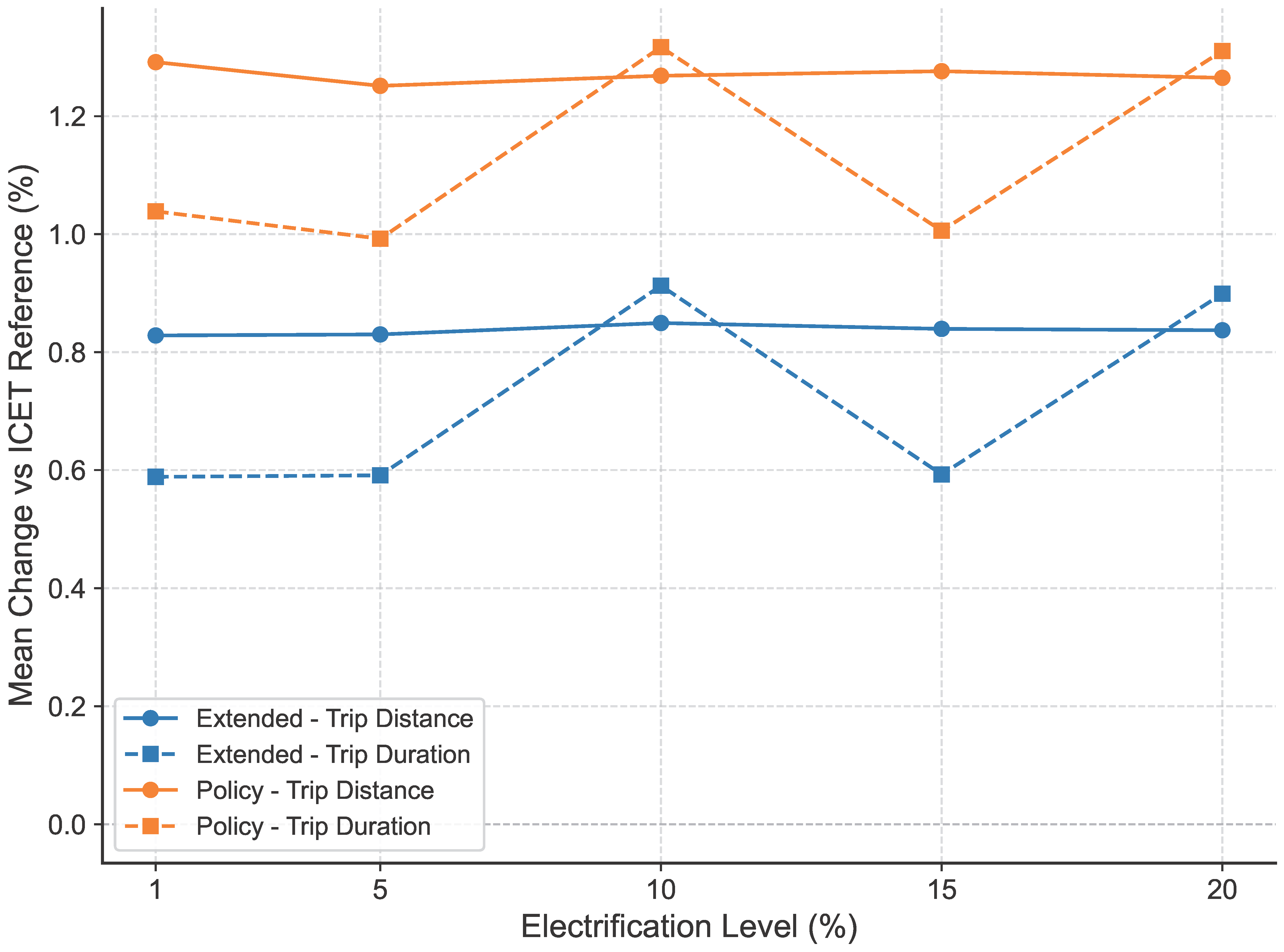
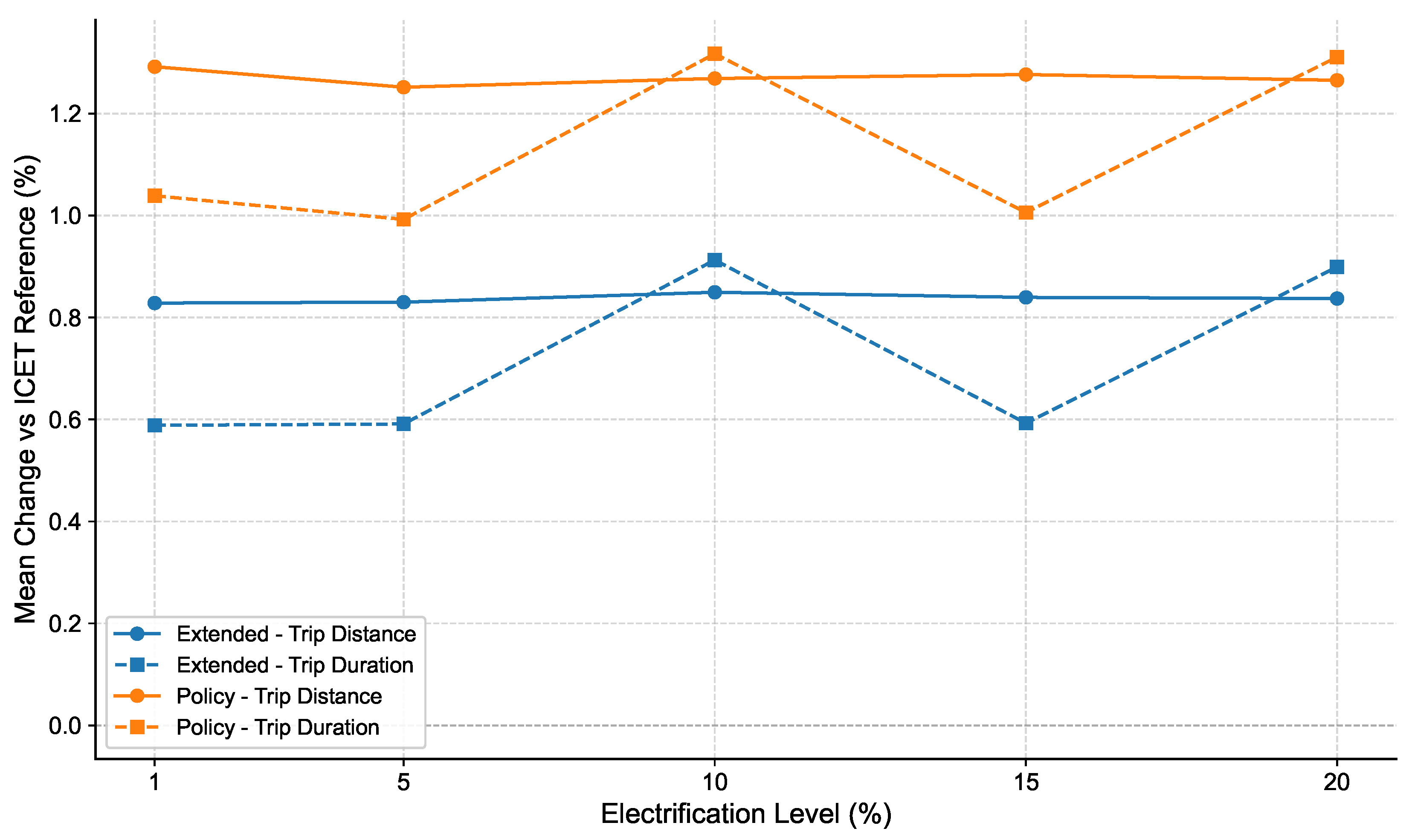
From the logistics company perspective, it is important to understand the impact of charging-related detours on trip distance and duration. To isolate this effect, we compare the BET scenarios against an ICET reference scenario (Section 2.1.3), in which trucks follow the same driving time regulations but are not constrained by charging infrastructure locations. Figure 7 shows the mean change in trip distance and trip duration for the initial BET runs with unlimited charging infrastructure (step 1), where no waiting times occur and the entire increase results from routing detours. Across all electrification levels, the extended scenario increases mean trip distance by approximately 0.8%, while the policy scenario shows an increase of approximately 1.3%. This difference arises because the policy network offers fewer charging locations, requiring vehicles to deviate further from their original routes. Trip duration increases follow the same pattern, with the policy scenario showing approximately 0.4 percentage points higher values than the extended scenario across all electrification levels.
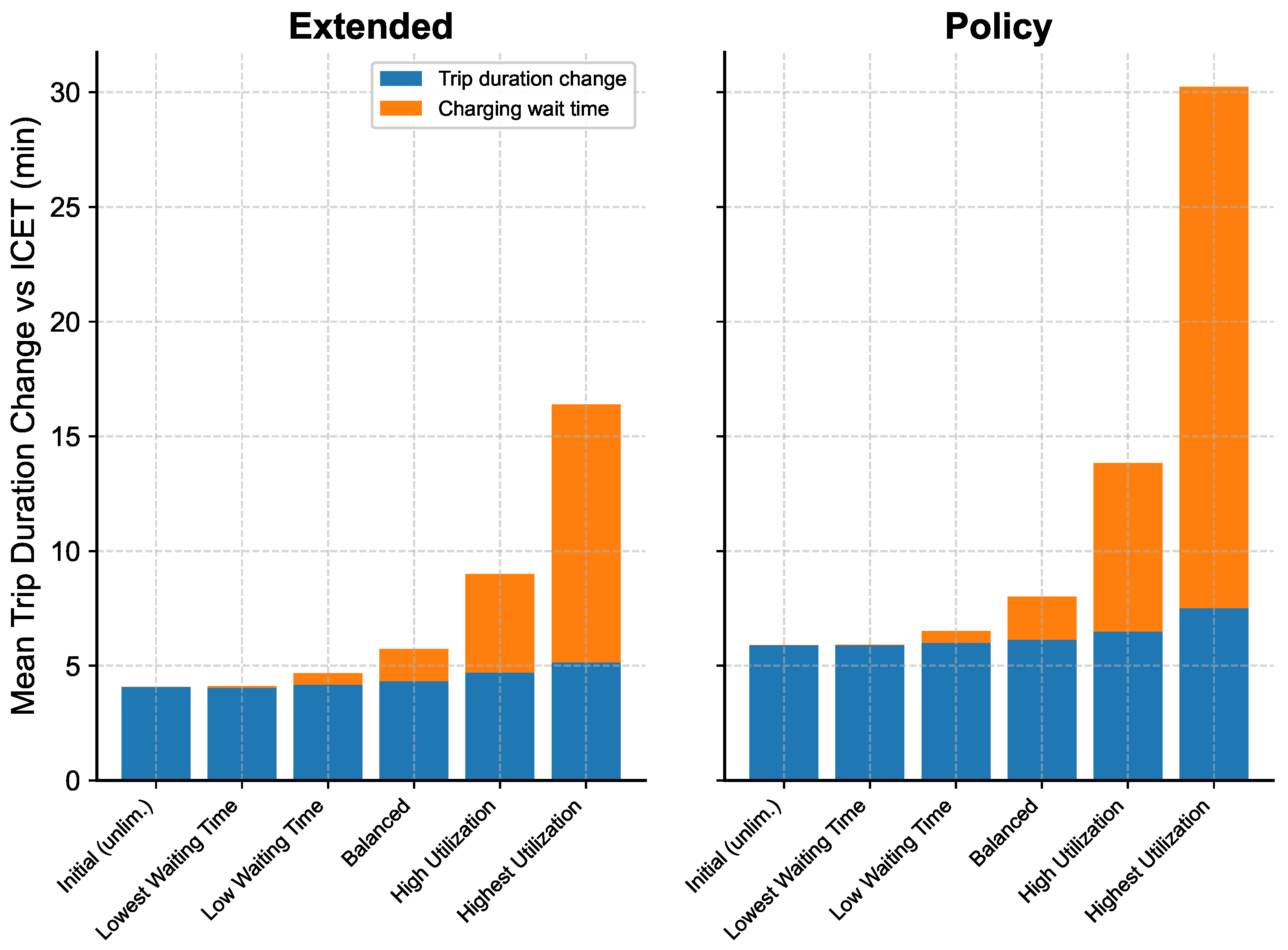
Figure 8 extends this comparison to include the five selected solutions of the 10% electrification scenario after replanning, decomposing the total trip duration change into two components: the increase due to detours and charging stops (blue), and the additional waiting time at occupied charging points (orange). In the low-waiting-time solutions, trip prolongation is almost entirely caused by detours, confirming that with sufficient infrastructure, waiting times remain negligible. As the number of charging points decreases toward the high utilization solutions, waiting time becomes the dominant component of trip prolongation. In the Highest Utilization solution, mean waiting times reach 11.2 min per trip in the extended scenario and 22.7 min in the policy scenario, resulting in total trip duration increases of 3.7% and 6.8%, respectively.
Table 7 provides the detailed trip characteristics for all solutions. Mean trip distances in the BET scenarios range from 478 to 481 km compared to 474 km in the ICET reference, indicating that charging detours add 4 to 7 km on average.

3.5. Energy Demand

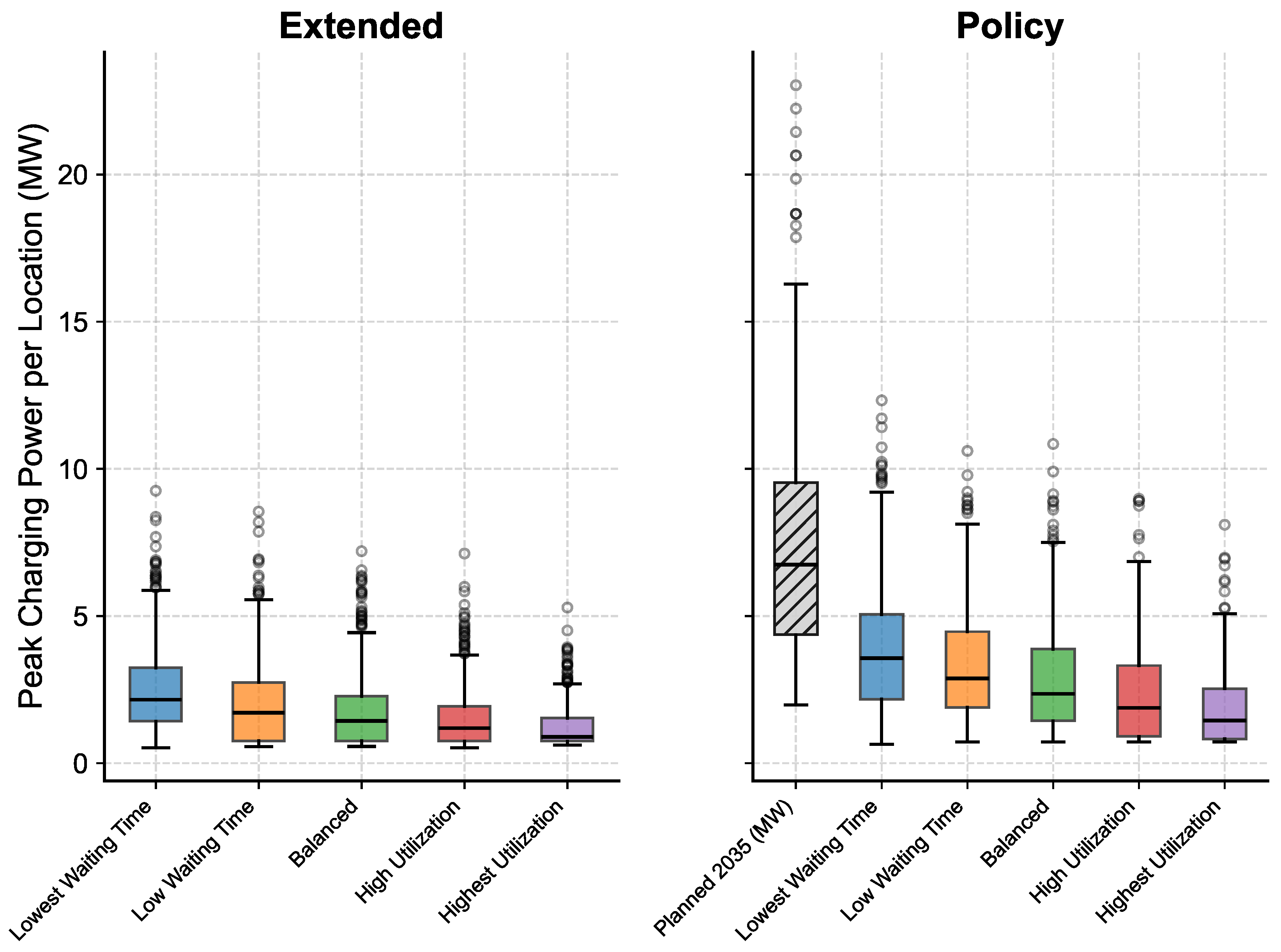
Figure 9 shows the distribution of peak charging power per location for the five selected solutions in the 10% electrification scenario after replanning, representing the grid connection capacity required at each site. Solutions with more charging points (low-waiting-time end of the Pareto front) exhibit higher peak power demands per location. In the extended scenario, the Lowest Waiting Time solution shows a median peak power of approximately 2 to 3 MW, with the highest individual site not exceeding 10 MW. In the policy scenario, the Lowest Waiting Time solution shows a median of approximately 2.5 to 5 MW and a maximum of up to 12.5 MW, reflecting the higher concentration of demand across fewer locations. For the policy scenario, the figure also displays the grid connection capacities planned by the federal government for 2035 [23]. These planned capacities are given in MVA. We derived the maximum charging power using an efficiency factor of 0.95 and a power factor of 0.95 to include the ratio of active and reactive power according to [28]. This shows a median of 6.8 MW and a maximum of 23 MW, exceeding the simulated requirements at the 10% electrification level across all solutions. We do not consider a simultaneity factor for the comparison since the results do not show the combined nominal charging power of the charging points but the actual required average charging power at the location.
Table 8 provides the peak grid connection requirements across all electrification levels, separated into HPC-only and combined HPC+LPC demand. At lower electrification levels, LPC contributes only marginally to peak power, as the median values for HPC-only and HPC+LPC are nearly identical. At 20% electrification, the difference becomes more visible, with median combined demand reaching up to 3.2 MW in the extended scenario and 5.4 MW in the policy scenario. Maximum peak power per site ranges from 1.4 MW at 1% electrification in the extended scenario to 20.6 MW at 20% electrification in the policy scenario.
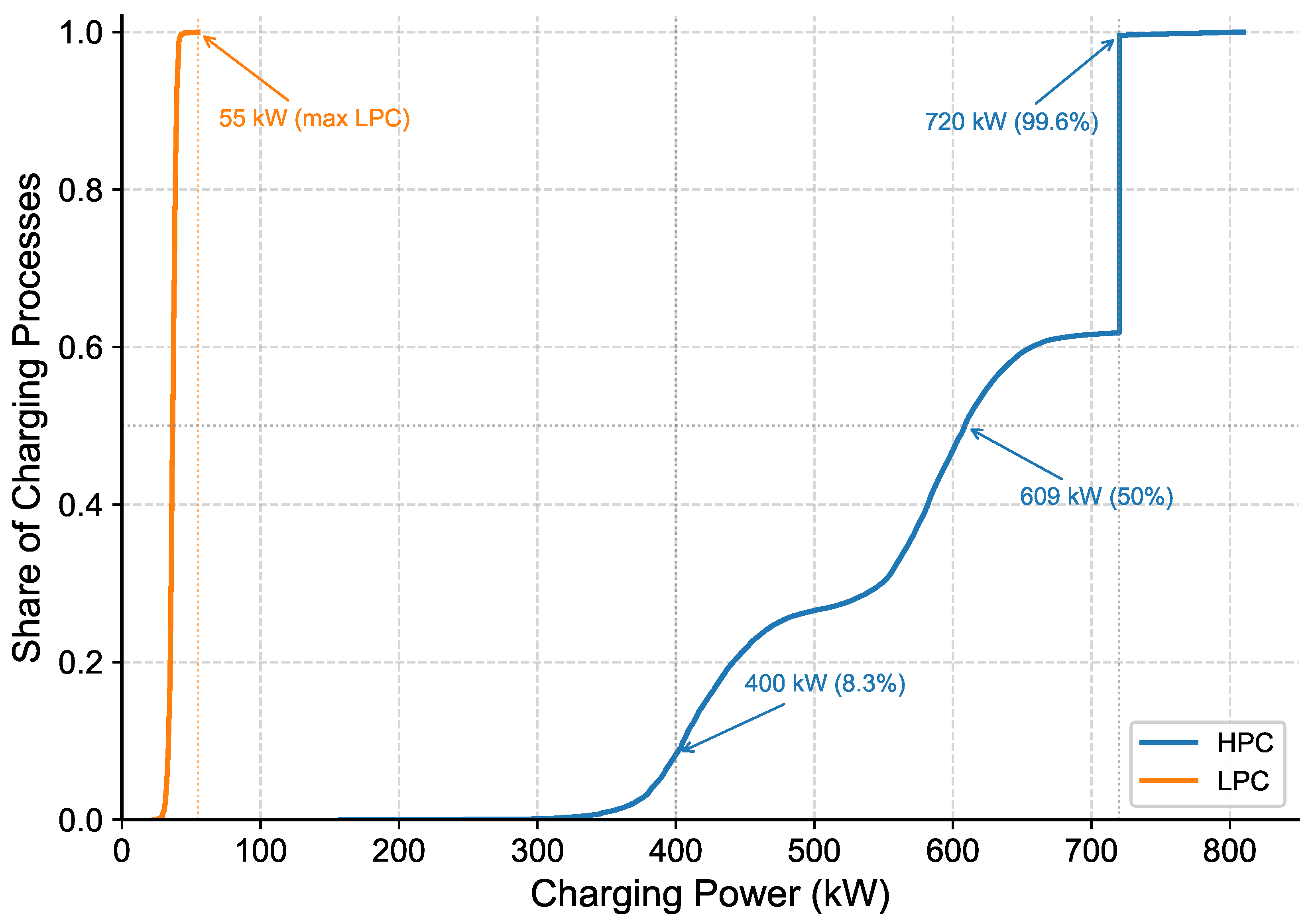
Figure 10 shows the cumulative distribution of mean charging power per process for HPC and LPC. Since a linear charging curve is assumed, the mean charging power depends on the SoC range over which each process charges. The maximum LPC charging power is 55 kW per process. For HPC, 8.3% of processes require less than 400 kW, while 99.6% remain below 720 kW. The distinct step at 720 kW corresponds to irregular charging stops triggered by low SoC (Section 2.1.4), which always charge at the full 720 kW rate. A small share of HPC processes lies above 720 kW, forming the short final rise at the top right of the curve. During the regular breaks the charging duration is fixed, so the mean charging power of such a process follows directly from the SoC range that has to be charged within this fixed time. A regular-break process therefore exceeds the nominal 720 kW when a large SoC range must be charged, up to a maximum of about 900 kW, which corresponds to charging the full 600 kWh battery within the 40-min effective charging time of a regular break. As the curve shows, the share of such processes is very small.

4. Discussion

Our study aimed to quantify the number of charging points required for varying levels of long-haul truck electrification on the German motorway network with respect to the trade-off between stakeholder requirements from CPOs and logistics operators, respectively. Using a mesoscopic long-haul freight traffic scenario (MATSim) combined with an evolutionary optimization approach, a Pareto-optimal set of charging infrastructure distributions was identified for five electrification levels and two charging networks with different charging location density. For each electrification level and charging network, five solutions were selected representing different trade-offs between stakeholder perspectives, with user waiting times reflecting logistics priorities and TCU representing CPO interests. For the 10% electrification scenario the effects of route adaptation according to charging infrastructure availability were investigated for the selected solutions of both charging networks.

4.1. Charging Infrastructure Demand for Long-Haul Freight Transport in Germany

Some previous research articles have investigated the required number of charging points for BETs in Germany, providing a basis for comparison with our study’s findings.
Ref. [12] employs a trip chain approach to model long-haul truck traffic across Europe at a 15% electrification level. For each origin–destination pair, the authors construct a sequence of mandatory breaks and rest periods according to EU driving regulations and allocate charging demand to 25 × 25 km2 charging areas along the routes without applying an optimization approach. For Germany, they estimate a need for 1360 MCS (comparable to HPC) and 10,300 CCS (comparable to LPC) charging points. While both studies confirm that LPC demand exceeds HPC demand, our results yield a substantially lower LPC requirement and a higher HPC requirement at the 15% electrification level. Specifically, the policy scenario results in a range of 1116 to 3316 HPC points and 5423 LPC points, whereas the extended scenario yields 1482 to 4270 HPC and 6071 LPC points. When selecting solutions with an average waiting time of five minutes, as assumed in [12], our study yields HPC point counts ranging from 2200 (policy) to 2700 (extended) without replanning (Figure 3). Based on the replanning effect observed for the 10% electrification level (Figure 4), it can be estimated that the number of HPC points required to maintain a mean waiting time of five minutes at the 15% level is reduced to approximately 1800 (policy) to 2300 (extended). This still represents a notable difference compared to the 1360 HPC points estimated by [12].
Multiple methodological differences contribute to this discrepancy. First, the two studies rely on different datasets, resulting in different OD demand matrices for freight transport. Ref. [12] uses the ETISplus dataset covering all of Europe, while our study is based on the MATSim scenario described in [7], which uses a dataset provided by the German Federal Ministry of Transport (BMV). As shown in [7], the BMV dataset is more accurate for the trips considered in our transport model and yields a slightly higher weekly mileage for trips at least starting or ending in Germany compared to ETISplus, resulting in a higher energy demand. Additionally, we include all trips exceeding 300 km, while ref. [12] considers only trips exceeding 360 km or 4.5 h of driving time, thereby excluding trips in the 300–360 km range that are captured in our study. Furthermore, our model simulates a four-day period from Monday to Thursday, whereas ref. [12] estimates charging infrastructure demand for a single representative day. Temporal variation in charging demand and local peaks across the four-day period increase the total infrastructure requirements.
Second, ref. [12] applies a different parametrization. In their model, HPC processes occupy a charging point for 30 min, whereas we assume an occupation time equal to the full break duration of 45 min, since the driver is not permitted to move the vehicle during the mandatory break. The shorter occupation time increases throughput per charging point and consequently reduces the number of HPC points required for a given demand level. Moreover, ref. [12] implicitly assumes that all vehicles start with 100% SoC which seems unrealistic. In our model only 50% of trips start fully charged due to access to destination or depot charging. The remaining 50% start with a SoC distribution derived from prior trip data (see Section 2.1.4), which increases charging demand earlier in the trip. Additionally, ref. [12] sizes the battery capacity of each truck according to the energy consumption between break points, preventing intermediate charging stops due to low SoC. In contrast, our model uses a fixed battery capacity, which can lead to additional intermediate HPC stops and thus a higher HPC demand. This battery sizing approach in [12] also mitigates the effect of the higher assumed motorway energy consumption of 1.8 kWh/km compared to 1.2 kWh/km in our study, since the vehicles are assigned sufficient battery capacity and the charging power is scaled to demand. Consequently, higher energy consumption does not translate into higher HPC demand but into higher required charging power ratings and battery capacities. Moreover, the aggregation of charging demand into 25 × 25 km2 areas may further underestimate the required number of HPC points, as demand peaks at individual locations within an aggregated area do not necessarily coincide temporally. The combination of these methodological differences leads to a structural underestimation of HPC demand for long-haul traffic in Germany in [12], explaining the observed discrepancy.
The discrepancy in LPC demand can be attributed to additional methodological differences. Ref. [12] includes transit traffic with trips spanning long distances and extended trip durations, which increases the number of overnight rest periods along German motorways. In contrast, our model captures domestic and bilateral freight traffic more accurately based on the BMV dataset. Furthermore, agents starting with 100% SoC in our model only charge en route when they cannot reach their destination without falling below the minimum SoC threshold of 20%, which reduces en route LPC demand compared to a model where all vehicles require overnight charging on every trip.
Ref. [10] applies a coverage-oriented approach combined with queueing theory to determine a HPC network for long-haul BETs in Germany. Traffic counting stations along German motorways serve as potential charging locations, and the corresponding traffic counts are used to estimate the number of charging events per location. The authors evaluate two network densities: a close-meshed network with a location every 50 km (264 locations) and a wide-meshed network with a location every 100 km (142 locations). Using queueing theory, they estimate a total of 1198 HPC points for the close-meshed and 1003 HPC points for the wide-meshed network to serve peak traffic at all locations with a mean waiting time of five minutes, without applying an optimization approach to the spatial distribution of charging points. Consistent with our findings, the network with fewer locations requires fewer total HPC points to serve the same demand. However, the estimated totals are also considerably lower than in our study. Several methodological differences contribute to this discrepancy. First, as discussed above, the charging networks investigated by [10] contain significantly fewer locations compared to our scenarios, which structurally reduces the total HPC plug demand. The most influential factor, however, is the assumed occupation time. Similar to [12], ref. [10] assumes an average charging duration of 30 min, which significantly reduces the required number of HPC points. Ref. [10] conducts a sensitivity analysis showing that increasing the average charging duration to 60 min raises the HPC plug requirement to 2121 (close-meshed) and 1857 (wide-meshed). Our study assumes an average occupation time of 45 min to account for mandatory driving breaks, and the resulting HPC plug counts fall between these two estimates, supporting the conclusion that the assumed occupation time is a primary driver of the discrepancy between the studies.
Ref. [13] applies a capacity-constrained flow refueling location model (CFRLM) to derive a minimal HPC network for BETs in Germany, using real parking space data at potential locations as capacity constraints. The model considers only HPC during mandatory breaks and does not account for LPC during overnight rest periods. The authors identify 124 optimal HPC locations for a fully electrified long-haul freight fleet (trips exceeding 300 km) and evaluate the infrastructure requirements for a 15% electrification level at these locations, estimating a need for 2032 HPC points. As in the previously discussed studies, they assume a charging duration of 30 min and a mean waiting time of five minutes. Our 15% policy scenario with 347 locations yields approximately 2200 HPC points for a comparable mean waiting time of five minutes without the estimated reduction due to the replanning approach, resulting in similar overall estimates. Given that the shorter charging duration of 30 min was identified as a key factor reducing HPC plug requirements in the comparisons above, the similar totals require explanation. The primary reason is that ref. [13] serves all charging demand exclusively through HPC infrastructure, whereas our study distributes approximately 19% of the total recharged energy to LPC infrastructure during overnight rest periods. This additional HPC demand in [13] compensates for the lower plug requirements resulting from the shorter assumed charging duration. The total recharged energy reported by [13] amounts to 3.8 TWh per year, which corresponds to approximately 42 GWh over four average days. Since truck traffic is concentrated on working days, the actual energy demand from Monday to Thursday is expected to exceed this average. In our study, the total recharged energy at the 15% electrification level amounts to approximately 48 GWh over the simulated period from Monday to Thursday, which is consistent with the higher traffic volumes on these days [7]. The comparable energy totals confirm that the discrepancy in HPC plug counts between the studies can be attributed primarily to the treatment of LPC infrastructure.

4.2. Stakeholder Implications

From the CPO perspective, a charging network with fewer locations, such as the policy scenario in our study, is favorable compared to a network with more locations, as indicated by the higher average temporal charger utilization (TCU). Particularly at early electrification stages, the policy scenario can lead to earlier profitability for CPOs by reducing the time to amortization of initial infrastructure investments through higher charger utilization. Our results also show that beyond a certain point, further increasing TCU leads to fewer charging processes and consequently less energy sold by the CPO. This indicates that it is in the CPO’s interest to maintain a certain level of service quality, as excessively long waiting times cause drivers to avoid affected locations.
While our study uses TCU as the optimization criterion, other studies focus on the energetic charger utilization (ECU) of charging infrastructure, which is the more relevant metric for assessing CPO profitability as it directly reflects the revenue-generating energy throughput [13,16,29]. In our method, TCU and ECU behave in a similar way since HPC points are never blocked without charging or used for LPC processes with low charging power resulting in a meaningful metric to reflect the CPO perspective. For the purpose of comparing our results with other studies, however, we additionally compute the ECU of HPC infrastructure. Table 9 shows the ECU for the selected balanced solutions across all five electrification levels of our study.
The ECU is computed assuming a maximum charging power of 1 MW per HPC plug. Since our simulation covers the period from Monday to Thursday, we estimate the annual ECU under two different assumptions: that the average weekday demand is representative of six days per week, and of five days per week, respectively. The six-day assumption is likely to overestimate the actual utilization since the freight traffic volume on an average Saturday is also significantly lower compared to the weekdays [7]. Consistent with the findings for TCU, the policy scenario yields higher ECU than the extended scenario across all electrification levels. At the 20% electrification level, the ECU in our study reaches approximately 17% to 20% in the policy scenario and 12% to 14% in the extended scenario.
Ref. [29] concludes that increasing ECU enables lower prices for public fast charging, finding that a utilization rate between 20% and 25% can make charging stations profitable at a price of 0.17 EUR/kWh. The required utilization rate decreases to approximately 4% at charging prices of 0.40 EUR/kWh, which corresponds to the current charging tariffs of the CPO Milence [30]. Considering these findings, our results indicate that an HPC charging network in Germany is likely to be profitable for CPOs even at the 1% electrification level, provided that the network is limited to a number of locations comparable to the policy scenario. For logistics operators, however, the lower utilization at early electrification stages implies higher prices for public fast charging. This creates an interesting alignment of interests: logistics operators also benefit from higher utilization rates, as these enable lower charging prices. Consequently, logistics operators could benefit from charging networks with moderately higher waiting times, if the resulting cost savings from lower charging prices exceed the additional costs induced by waiting.
From the logistics operator perspective, it is essential that fleet electrification does not cause major disruptions to daily operations through increased trip durations or distances resulting from detours or waiting times at public charging infrastructure. To quantify this impact, we compared the BET simulation results with a reference case representing an ICET scenario without recharging requirements, as described in Section 2.1.3. Our results reveal a structural increase in trip duration and distance that is independent of the number of HPC points at charging locations. The relevant factor is rather the density of charging locations, as the extended charging infrastructure network consistently yields lower increases compared to the policy network. In addition to detours, waiting at public charging infrastructure is a potential driver of increased trip durations. To assess waiting times within the optimized charging networks more realistically, we used MATSim replanning, which enables agents to alter their routes based on observed infrastructure usage as described in Section 2.3. We consider this approach to yield more realistic waiting time estimates than single-iteration results, as it is reasonable to assume that logistics operators will adjust route planning and use technologies such as reservation systems to avoid congested charging locations while accepting minor detours. Our results show that the improved demand distribution across available charging locations significantly reduces waiting times. Alternatively, the number of HPC points can be reduced while maintaining moderate waiting times, resulting in increased utilization rates and consequently lower charging costs for the logistics operator, as discussed above. Ref. [15] developed an algorithm for route optimization from a single-BET perspective, determining the time loss per trip due to recharging requirements as a function of battery capacity and charging power for an idealized charging network offering unlimited charging points every 50 km along the major German road network. For trips with a length of 650 to 700 km, they determine additional driving times between zero and ten minutes for BETs with a battery capacity of 600 kWh and an average charging power of 720 kW. These results align with our findings, which show average increases of approximately 4 to 5 min for trips with an average distance of 480 km, depending on the density of the charging infrastructure network.
Overall, our results demonstrate that the interests of CPOs and logistics operators are not entirely opposing but exhibit notable overlaps, as both stakeholders benefit from moderately high utilization rates. This interdependence, however, makes identifying the most beneficial charging infrastructure configuration more challenging, since the current optimization objectives of TCU and UWTI do not fully capture the underlying cost structures. Future work should therefore replace these objectives with comprehensive cost models that holistically represent the economic perspectives of both CPOs and logistics operators, enabling the identification of infrastructure configurations that are jointly optimal from a financial standpoint. Such models should also account for future uncertainties associated with the electrification of road freight transport, including technology-related and market risks [31].

4.3. Policy Implications

This study explicitly investigates a policy scenario consisting of 347 charging locations, corresponding to the truck charging network planned by the German federal government [22]. The federal government plans to deploy 1800 MCS (Megawatt Charging System) and 2400 CCS (Combined Charging System) charging points at these locations. MCS chargers are required to provide a minimum charging power of one MW, while CCS chargers must deliver at least 400 kW for fast charging and 100 kW for overnight charging [32]. Our results suggest that these 1800 MCS charging points (corresponding to HPC in our study) are sufficient to provide a well-performing fast-charging network with mean waiting times below one minute per charging process at a 10% electrification level, provided that the charging points are optimally distributed. This implies that the planned infrastructure could also accommodate slightly higher electrification levels at the cost of increased mean waiting times. According to our results, the additional CCS charging points are sufficient for only 8.3% of the fast charging processes (Figure 10) and can reduce the load on MCS chargers to some extent, but should primarily be deployed as LPC infrastructure for long rest periods of BETs. However, since we estimate a demand of 3546 LPC charging points at the 10% electrification level, the planned number of 2400 CCS chargers is likely not sufficient to cover overnight charging needs. The planned grid connection capacities for the year 2035 exceed the simulated peak power demand in our 10% electrification scenario for all investigated solutions (Figure 9), which is consistent with the finding that the planned number of charging points would also be sufficient for slightly higher electrification levels.

4.4. Limitations

The estimates of charging infrastructure requirements are highly dependent on the underlying freight transport data. Our MATSim scenario uses goods flow data for Germany provided by the Federal Ministry of Transport for the year 2010, scaled to represent the year 2020 [7]. This scaling may lead to an underestimation of current traffic volumes. Future work should update the scenario to reflect current or projected freight transport volumes.
Furthermore, the MATSim model only includes trips that start or end within German borders, thereby excluding transit traffic. Consequently, the charging demand generated by trucks passing through Germany without an origin or destination inside the country is not captured, potentially leading to an underestimation of the required charging infrastructure. In addition, we model the charging demand for a four-day period from Monday to Thursday, excluding Friday, weekends, and seasonal variations in goods flow. These temporal limitations can affect the estimated utilization of charging infrastructure and waiting times, as charging demand varies over the course of a week and throughout the year. We also assume that driving breaks always last 45 min or 11 h, respectively. In everyday operations, logistics operators make use of various exemptions that allow drivers to adopt slightly different break patterns, potentially affecting charging duration and required charging power [19]. Moreover, we make simplified assumptions regarding technical parameters of vehicles and charging infrastructure. We assume a uniform vehicle with a battery capacity of 600 kWh and an energy consumption of 1.2 kWh/km which ignores that a real-world vehicle fleet will contain vehicles with different battery sizes and energy consumption, potentially influencing charging demand. Additionally, we assume a linear charging curve, whereas real-world charging profiles are non-linear. This simplification affects the maximum charging power required to maintain the assumed charging durations and can lead to an underestimation of the total power demand at charging locations. The key technical assumptions affect the results in different ways. A smaller assumed battery capacity would increase the number of intermediate en-route charging stops and thus the HPC demand, whereas a larger capacity would shift charging toward fewer stops and toward depot or overnight charging. Since we assume that drivers may not move the vehicle during the mandatory break, a charging point stays occupied for the full break duration even when charging finishes earlier, so that the number of charging points is governed by this occupancy rather than by the charging power. Under this assumption, the linear charging curve mainly affects the estimated peak power and grid connection sizing rather than the number of points. If vehicles were instead allowed to free the charging point once charging is complete, higher charging powers and the correspondingly shorter charging times would reduce the number of required charging points, as each point could then serve more vehicles per day, similar to a conventional diesel refueling station. Shorter effective break durations, for instance when breaks are split, would reduce the energy transferred per stop and therefore increase either the number of stops or the required charging power. These assumptions primarily influence the absolute magnitude of the estimated requirements, whereas the qualitative trade-off between the stakeholder perspectives and the relative comparison between the charging network scenarios remain robust. Moreover, the policy charging network in our study corresponds to the planned fast-charging network for trucks. Our simulations and analyses are based on the location list which can be found in [23]. Meanwhile, an updated location list was published which is available in [22]. This list contains minor changes including the substitution of seven locations. The total number of locations remains the same as well as the total planned grid connection. On the methodological side, the parameters of the optimization algorithm, such as the population size, the crossover and mutation rates, and the number of generations, were not themselves optimized, and no formal sensitivity analysis of these parameters was carried out, while the adaptive convergence criterion limits their influence on the resulting Pareto front, a systematic tuning and sensitivity analysis could further improve the convergence behavior and is left for future work. Beyond the aspects discussed above, the scope of this study is deliberately bounded. It focuses explicitly on BETs and does not consider alternative electrification technologies such as electric road systems or hydrogen fuel cells, which are investigated in [33,34,35]. The impact of charging infrastructure on the electrical grid, as examined in [36,37], is also beyond the scope of this work.

5. Conclusions and Future Work

This study presents a comprehensive assessment of public HPC infrastructure for BET long-haul freight transport in Germany, combining multi-agent simulation with evolutionary optimization to yield suitable charging infrastructure distributions representing trade-offs between CPO and logistics operator perspectives. We extend the method of a previous study by enabling the adaptation of BET routes according to the available charging infrastructure. This allows a more realistic assessment of charging infrastructure performance and the impact of waiting times and detours on trip durations and distances compared to the use of conventional ICETs. Additionally, we consider real rest areas and truck stops with truck parking capacity constraints to assign realistic numbers of charging points to the locations. Moreover, we analyzed two charging networks with different densities of charging locations to consider the effect of different numbers of locations that offer charging infrastructure for BETs. Our findings provide valuable insights for CPOs and logistics operators when adapting to increasing truck electrification as well as for planners and power grid operators. Our results address the four guiding questions as follows. For five electrification levels from 1% to 20% and two different charging networks we determined different distributions of HPC points, ranging from solutions with very low waiting times and lower utilization to solutions with high utilization at the cost of longer waiting times. For a balanced solution in the 10% electrification scenario, the denser extended network achieves lower waiting times and shorter trip durations, whereas the sparser policy network reaches a higher charger utilization. This reflects the trade-off between the logistics operator and CPO perspectives. The approach proves valuable because the resulting Pareto front reveals that accepting already very low to moderate average waiting times leads to a significant reduction in the required number of charging points. This demonstrates that our dual-perspective approach delivers meaningful infrastructure configurations that explicitly cover both stakeholder perspectives rather than a single compromise solution, so that a specific operating point along the Pareto front can be selected according to the priorities of CPOs and logistics operators.
The required number of charging points does not grow proportionally with increasing electrification, indicating the more efficient use of existing charging infrastructure at higher electrification levels. The rerouting of BET trips reduces waiting times substantially, confirming the importance of adaptive routing for a realistic charging infrastructure assessment. A static assessment that ignores such adaptation therefore overestimates the required charging infrastructure. In practice, this adaptive routing could be enabled, for example, by reservation and route planning systems that let trucks account for expected waiting times when planning their stops. The mean trip durations and distances increase only moderately due to unavoidable charging detours and can both be reduced by a higher density of charging locations. Additional waiting times appear to be lower compared to detour effects for solutions yielding moderate mean waiting times but can become the major contributor of additional time in solutions with low numbers of charging points. Overall, this indicates that, given sufficient charging infrastructure availability and location density, the time disadvantages of battery-electric long-haul operation remain small, even when moderate average waiting times are accepted. Determining which time disadvantages are still acceptable in practice would require a complete cost model from the logistics operator perspective.
The fast-charging network planned by the federal ministry of transport, containing 1800 MCS and 2400 CCS charging points across 350 locations, appears to be sufficient for the high-power charging requirements at low to moderate electrification levels, according to our results. However, our results suggest that the planned charging infrastructure cannot meet the required number of LPC charging points to charge during rest and overnight periods. Therefore, it seems reasonable not to limit LPC infrastructure to the locations of the planned fast-charging network due to the limited parking space availability. The grid connection requirements at 10% electrification remain well within the planned capacities for 2035, supporting the federal rollout strategy while indicating that there is a need for additional strategies to cover charging requirements when electrification increases significantly.
The dual-perspective analysis provides valuable information for CPOs, logistics operators and planners supporting the electrification of long-haul road freight transport in Germany.
Future work should address some key limitations of our study. To make the most realistic assumptions for future charging infrastructure requirements, the MATSim freight transport model should be updated with new data on goods flow within Germany and Europe to represent future freight transport volumes as well as transit traffic that neither starts nor ends in Germany. Additionally, to increase the accuracy of predicted charging demand it would be beneficial to incorporate a detailed energy consumption model into MATSim to reflect different energy consumptions depending on different factors such as travel speed, loading or road slope. Moreover, the development of comprehensive cost models for the CPO and logistics operator perspective is necessary to determine which charging infrastructure solution is best for both stakeholders from a financial point of view. Finally, the method should be applied to a real-world logistics network incorporating specific requirements of a logistics operator taking into account multiple factors such as depot charging availability, available grid connection and specific requirements of transport tasks. This would support the shift from strategic planning to the implementation of electrified logistics networks. Moreover, the HoLa project, which pilots high-power charging for long-haul trucks in real operation, will generate measured charging and infrastructure usage data. Future work should compare these real-world data with our simulated results to validate the model and refine the estimated charging infrastructure requirements. We will address these aspects in future research.

Author Contributions

Conceptualization, D.F., T.T. and D.G.; Methodology, D.F.; Software, D.F.; Validation, D.F.; Formal analysis, D.F.; Investigation, D.F.; Resources, D.F.; Data curation, D.F.; Writing—original draft, D.F.; Writing—review & editing, D.F.; Visualization, D.F.; Supervision, D.G.; Project administration, D.F. and T.T.; Funding acquisition, D.G. All authors have read and agreed to the published version of the manuscript.

Funding

This research was funded by the German Federal Ministry of Transport as part of the project HoLa, grant number 03EMF0404D and by the German Federal Ministry of Research, Technology and Space as part of the Research Campus Mobility2Grid grant number 03SF0674A.

Data Availability Statement

The original contributions presented in this study are included in the article. Further inquiries can be directed to the corresponding author.

Acknowledgments

Claude Sonnet 4.6 and Claude Opus 4.6 were used to improve language and formatting of text and figures. The content of our research remains unaffected by this.

Conflicts of Interest

The authors declare no conflicts of interest. The funders had no role in the design of the study; in the collection, analyses, or interpretation of data; in the writing of the manuscript; or in the decision to publish the results.

Abbreviations

The following abbreviations are used in this manuscript:
AFIRAlternative Fuels Infrastructure Regulation
BETBattery-electric truck
CCSCombined Charging System
CFRLMCapacity-constrained flow refueling location model
CPOCharge point operator
ECUEnergetic charger utilization
EUEuropean Union
HPCHigh-power charging
ICETInternal combustion engine truck
LPCLow-power charging
MATSimMulti-Agent Transport Simulation
MCSMegawatt Charging System
NSGA-IINon-dominated Sorting Genetic Algorithm II
ODOrigin–destination
Ref.Reference
SoCState of charge
TCUTemporal Charger Utilization
TEN-TTrans-European Transport Network
UWTIUser Waiting Time Index

References

  1. European Parliament and Council. Regulation (EU) 2024/1610 of the European Parliament and of the Council of 14 May 2024 Amending Regulation (EU) 2019/1242 as Regards Strengthening the CO2 Emission Performance Standards for New Heavy-Duty Vehicles and Integrating Reporting Obligations, Amending Regulation (EU) 2018/858 and Repealing Regulation (EU) 2018/956 (Text with EEA Relevance). Legislative Body: CONSIL, EP. 2024. Available online: http://data.europa.eu/eli/reg/2024/1610/oj/eng (accessed on 16 June 2026).
  2. European Parliament and of the Council. Regulation (EU) 2023/1804 of the European Parliament and of the Council of 13 September 2023 on the Deployment of Alternative Fuels Infrastructure, and Repealing Directive 2014/94/EU (Text with EEA Relevance). 2023. Available online: https://eur-lex.europa.eu/legal-content/EN/TXT/?uri=celex%3A32023R1804 (accessed on 16 June 2026).
  3. Eurostat. National Road Freight Transport by Distance Class and Type of Transport (tkm)—Annual Data. 2022. Available online: https://ec.europa.eu/eurostat/databrowser/view/road_go_na_dctt/default/table?lang=en&category=road.road_go.road_go_nat (accessed on 16 June 2026).
  4. Speth, D.; Plötz, P. Depot slow charging is sufficient for most electric trucks in Germany. Transp. Res. Part D Transp. Environ. 2024, 128, 104078. [Google Scholar] [CrossRef]
  5. NOW GmbH. Marktentwicklung Klimafreundlicher Technologien im Schweren Strassengüterverkehr; Technical Report; Nationale Organisation Wasserstoff- und Brennstoffzellentechnologie: Berlin, Germany, 2023; Available online: https://www.klimafreundliche-nutzfahrzeuge.de/wp-content/uploads/2023/02/Marktentwicklung-klimafreundlicher-Technologien-im-schweren-Strassengueterverkehr.pdf (accessed on 16 June 2026).
  6. Syré, A.M.; Göhlich, D. Decarbonization of Long-Haul Heavy-Duty Truck Transport: Technologies, Life Cycle Emissions, and Costs. World Electr. Veh. J. 2025, 16, 76. [Google Scholar] [CrossRef]
  7. Menter, J.; Fay, T.A.; Grahle, A.; Göhlich, D. Long-Distance Electric Truck Traffic: Analysis, Modeling and Designing a Demand-Oriented Charging Network for Germany. World Electr. Veh. J. 2023, 14, 205. [Google Scholar] [CrossRef]
  8. Tietz, T.; Fay, T.A.; Schlenther, T.; Göhlich, D. Electric Long-Haul Trucks and High-Power Charging: Modelling and Analysis of the Required Infrastructure in Germany. World Electr. Veh. J. 2025, 16, 96. [Google Scholar] [CrossRef]
  9. Ingelström, M.; Pourroshanfekr Arabani, H.; Alaküla, M.; Márquez-Fernández, F.J. Placement of Fast-Charging Infrastructure for Long-Haul Road Freight Based on Spatio-Temporal Evaluation of En-Route Energy Needs. IEEE Trans. Transp. Electrif. 2026, 12, 53–65. [Google Scholar] [CrossRef]
  10. Speth, D.; Plötz, P.; Funke, S.; Vallarella, E. Public fast charging infrastructure for battery electric trucks—A model-based network for Germany. Environ. Res. Infrastruct. Sustain. 2022, 2, 025004. [Google Scholar] [CrossRef]
  11. Speth, D.; Sauter, V.; Plötz, P. Where to Charge Electric Trucks in Europe—Modelling a Charging Infrastructure Network. World Electr. Veh. J. 2022, 13, 162. [Google Scholar] [CrossRef]
  12. Shoman, W.; Yeh, S.; Sprei, F.; Plötz, P.; Speth, D. Battery electric long-haul trucks in Europe: Public charging, energy, and power requirements. Transp. Res. Part D Transp. Environ. 2023, 121, 103825. [Google Scholar] [CrossRef]
  13. Speth, D.; Plötz, P.; Wietschel, M. An optimal capacity-constrained fast charging network for battery electric trucks in Germany. Transp. Res. Part A Policy Pract. 2025, 193, 104383. [Google Scholar] [CrossRef]
  14. MATSim.org. 2025. Available online: https://matsim.org/ (accessed on 16 June 2026).
  15. Zähringer, M.; Teichert, O.; Balke, G.; Schneider, J.; Lienkamp, M. Optimizing the Journey: Dynamic Charging Strategies for Battery Electric Trucks in Long-Haul Transport. Energies 2024, 17, 973. [Google Scholar] [CrossRef]
  16. Karlsson, J.; Grauers, A. Agent-Based Investigation of Competing Charge Point Operators for Battery Electric Trucks. Energies 2024, 17, 2901. [Google Scholar] [CrossRef]
  17. Fadranski, D.; Tietz, T.; Göhlich, D. Methodology for optimizing charging infrastructure distribution for long-haul freight traffic based on multi-agent simulation and evolutionary bi-objective optimization. Procedia Comput. Sci. 2025, 257, 951–958. [Google Scholar] [CrossRef]
  18. Deb, K.; Pratap, A.; Agarwal, S.; Meyarivan, T. A fast and elitist multiobjective genetic algorithm: NSGA-II. IEEE Trans. Evol. Comput. 2002, 6, 182–197. [Google Scholar] [CrossRef]
  19. European Parliament and of the Council. Regulation (EC) No 561/2006 of the European Parliament and of the Council of 15 March 2006 on the Harmonisation of Certain Social Legislation Relating to Road Transport and Amending Council Regulations (EEC) No 3821/85 and (EC) No 2135/98 and Repealing Council Regulation (EEC) No 3820/85 (Text with EEA Relevance)—Declaration. 2006. Available online: https://eur-lex.europa.eu/legal-content/EN/TXT/?uri=CELEX%3A32006R0561 (accessed on 16 June 2026).
  20. Eurostat. Road Freight Transport by Vehicle Characteristics. 2025. Available online: https://ec.europa.eu/eurostat/statistics-explained/index.php?title=Road_freight_transport_by_vehicle_characteristics (accessed on 22 April 2026).
  21. HoLa Projekt. Hochleistungsladen im Lkw-Fernverkehr: Details zum Projekt HoLa. 2026. Available online: https://hochleistungsladen-lkw.de/hola-de/projekt/ (accessed on 22 April 2026).
  22. Nationale Leitstelle Ladeinfrastruktur. Ladeinfrastruktur für Nutzfahrzeuge|Nationale Leitstelle Ladeinfrastruktur. 2026. Available online: https://nationale-leitstelle.de/aktuelles-service/newshub/eine-milliarde-euro-fuer-den-aufbau-von-ladeinfrastruktur-fuer-schwere-nutzfahrzeuge/ (accessed on 22 April 2026).
  23. Nationale Leitstelle Ladeinfrastruktur. Standorte für das LKW-Schnellladenetz an Rastanlagen mit Benötigten Netzanschlussleistungen. 2024. Available online: https://tubcloud.tu-berlin.de/s/pZ26wKr6orXxK3s (accessed on 16 June 2026).
  24. Toll Collect GmbH. Stellplatz-Informationsdienst—Statische Daten. 2025. Available online: https://mobilithek.info/offers/871802523304550400 (accessed on 22 April 2026).
  25. Diego Fadranski. Autohöfe in Deutschland mit Parkplatzzahl. 2026. Available online: https://tubcloud.tu-berlin.de/s/pZ26wKr6orXxK3s (accessed on 16 June 2026).
  26. Kashani, A.R.; Gandomi, A.H.; Azizi, K.; Camp, C.V. Multi-objective optimization of reinforced concrete cantilever retaining wall: A comparative study. Struct. Multidiscip. Optim. 2022, 65, 262. [Google Scholar] [CrossRef]
  27. Nebro, A.J.; Galeano-Brajones, J.; Luna, F.; Coello Coello, C.A. Is NSGA-II Ready for Large-Scale Multi-Objective Optimization? Math. Comput. Appl. 2022, 27, 103. [Google Scholar] [CrossRef]
  28. Ladeinfrastruktur, N.L. Leitstelle_LKW-Netzstudie. Technical Report. 2022, p. 32. Available online: https://nationale-leitstelle.de/wp-content/uploads/2022/09/Leitstelle_LKW-Netzstudie.pdf (accessed on 16 June 2026).
  29. Karlsson, J.; Grauers, A. Case Study of Cost-Effective Electrification of Long-Distance Line-Haul Trucks. Energies 2023, 16, 2793. [Google Scholar] [CrossRef]
  30. Milence. Milence Charging Tariffs—Milence. Available online: https://milence.com/charging-tariffs/ (accessed on 29 April 2026).
  31. Goehlich, D.; Spangenberg, F.; Kunith, A. Stochastic total cost of ownership forecasting for innovative urban transport systems. In Proceedings of the 2013 IEEE International Conference on Industrial Engineering and Engineering Management, Bangkok, Thailand, 10–13 December 2013; IEEE: Piscataway, NJ, USA, 2013; pp. 838–842. [Google Scholar] [CrossRef]
  32. Autobahn GmbH des Bundes. Projektexpose_Auschreibung_LKW-Schnellladenetz_Unbewirtschaftete_Rastanlagen. 2024. Available online: https://www.autobahn.de/storage/user_upload/qbank/Projektexpose_Auschreibung_LKW-Schnellladenetz_unbewirtschaftete_Rastanlagen.pdf (accessed on 16 June 2026).
  33. Apostolou, D.; Xydis, G. A literature review on hydrogen refuelling stations and infrastructure. Current status and future prospects. Renew. Sustain. Energy Rev. 2019, 113, 109292. [Google Scholar] [CrossRef]
  34. Arabani, H.P.; Ingelström, M.; Márquez-Fernández, F.J.; Alaküla, M. Electric Road Systems for Electric Vehicle Long-Distance Travel: A Multi-Agent Simulation Approach. In Proceedings of the 2024 IEEE International Conference on Electrical Systems for Aircraft, Railway, Ship Propulsion and Road Vehicles & International Transportation Electrification Conference (ESARS-ITEC), Naples, Italy, 26–29 November 2024; IEEE: Piscataway, NJ, USA, 2024; pp. 1–6. [Google Scholar] [CrossRef]
  35. Rogstadius, J.; Alfredsson, H.; Sällberg, H.; Faxén, K.F. Correcting market failure for no-regret electric road investments under uncertainty. Nat. Commun. 2025, 16, 7398. [Google Scholar] [CrossRef] [PubMed]
  36. Ingelström, M.; Callanan, A.; Márquez-Fernández, F.J. Investigating the Impact of Public En-Route and Depot Charging for Electric Heavy-Duty Trucks Using Agent-Based Transport Simulation and Probabilistic Grid Modeling. World Electr. Veh. J. 2026, 17, 172. [Google Scholar] [CrossRef]
  37. Borlaug, B.; Muratori, M.; Gilleran, M.; Woody, D.; Muston, W.; Canada, T.; Ingram, A.; Gresham, H.; McQueen, C. Heavy-duty truck electrification and the impacts of depot charging on electricity distribution systems. Nat. Energy 2021, 6, 673–682. [Google Scholar] [CrossRef]
Figure 1. Flowchart of the three-step method. The method is based on [17] and extended by the MATSim replanning step (Step 3). Own presentation.
Wevj 17 00326 g001
Figure 2. Flowchart of the simulation-based charging infrastructure evaluation, own presentation.
Wevj 17 00326 g002
Figure 3. Pareto-optimal solutions for all electrification levels in the extended (left) and policy scenario (right). Color indicates TCU. Selected solutions are marked with distinct markers; reference solutions are shown as open markers on the y-axis.
Wevj 17 00326 g003
Figure 4. Pareto fronts for the 10% electrification scenario before (red) and after replanning (green). Arrows indicate the shift of selected solutions for the extended (circles) and policy scenario (squares).
Wevj 17 00326 g004
Figure 5. Vehicle activities for the balanced solution (1938 HPC) in the extended 10% scenario before (left) and after replanning (right).
Wevj 17 00326 g005
Figure 6. Spatial distribution of HPC charging points for the balanced solution in the 10% scenario after replanning. Extended (left, 1938 HPC) and policy scenario (right, 1429 HPC). Dot size indicates plug count, color indicates utilization. Map data: OpenStreetMap.
Wevj 17 00326 g006
Figure 7. Mean change in trip distance and duration relative to the ICET reference with unlimited infrastructure (Step 1) across all electrification levels.
Wevj 17 00326 g007
Figure 8. Mean trip duration change relative to the ICET reference for the five selected solutions in the 10% scenario after replanning. Blue: detours for charging stops, orange: waiting time. Extended (left) and policy scenario (right).
Wevj 17 00326 g008
Figure 9. Peak grid connection requirements per location for the five selected solutions in the 10% scenario after replanning. Extended (left) and policy scenario (right). Hatched box: planned 2035 grid capacities.
Wevj 17 00326 g009
Figure 10. Cumulative distribution of mean charging power per process for HPC and LPC in the 10% scenario.
Wevj 17 00326 g010
Table 1. Specifications of the MATSim scenarios (cf. [7], updated).
ParameterSpecification
Simulation areaGermany
Vehicle TypeSemi-trailer truck
Average Payload22 t
Usable battery capacity600 kWh
Average vehicle energy consumption1.2 kWh/km
Average trip distance480 km
Share of electrified trips1%/5%/10%/15%/20%
Simulation periodMonday–Thursday (96 h)
Vehicle start SoC50% at 100%, 50% derived distribution
HPC charging power720 kW
Charging overhead5 min
HPC target SoC90%
LPC target SoC100%
Minimum SoC20%
Charging locations (policy scenario)347
Charging locations (extended scenario)779
Table 2. Nomenclature of the charging infrastructure optimization problem.
SymbolDescription
L Set of all candidate charging locations
L + Subset of locations with at least one charging process in the baseline run, L + L
jIndex of a charging location, j L
P ( x ) Set of charging processes resulting from configuration x
p, iIndex of a charging process
x j Decision variable: number of HPC charging points at location j
x Decision vector x = ( x j ) j L , i.e., one infrastructure configuration (individual)
P j Number of available parking spaces at location j
C j Maximum number of simultaneous charging activities observed at location j
t p charge Active charging time of process p
T scen Total scenario duration
n ( x ) Number of charging processes for configuration x
w i Waiting time of charging process i
w max Maximum allowed waiting time (90 min)
kWaiting time penalty rate (0.01 per minute)
TCU ( x ) Temporal charger utilization (objective 1, to be maximized)
UWTI ( x ) User waiting time index (objective 2, to be maximized)
F ( x ) Vector-valued objective, F ( x ) = ( TCU ( x ) , UWTI ( x ) )
Table 3. Density levels used to initialize the population. For each level, the per-location placement probability is sampled uniformly between p min and p max , spanning sparse to near upper bound charging point densities.
Density Level p min p max
Sparse0.100.50
Low-medium0.300.70
Medium0.400.80
High0.600.95
Very high0.800.95
Near-upper-bound0.901.00
Table 4. Boundary values of the final set of HPC solutions for each scenario.
ScenarioHPC PointsMean WT (min)Utilization (%)Ref. HPCRef. Util. (%)
Extended 1% BET696–9860.3–4.54.7–6.610924.2
Extended 5% BET911–20670.2–15.610.9–22.723439.6
Extended 10% BET1208–31410.1–20.314.5–33.0348313.1
Extended 15% BET1482–42700.1–25.517.7–40.5467316.2
Extended 20% BET1588–47770.1–29.719.2–44.3519317.7
Policy 1% BET356–6360.3 –8.27.2–12.87346.3
Policy 5% BET558–15240.1–19.814.8–36.3167713.5
Policy 10% BET811–23480.3–26.819.4–47.4254617.9
Policy 15% BET1116–33160.5–32.922.7–53.2355321.2
Policy 20% BET1161–37480.5–39.724.4–56.5401222.8
Table 5. Key performance indicators before and after replanning for the 10% scenario. Values: pre → post-replanning.
NetworkSolutionHPCWT (min) Δ WT (min)Util. (%) Δ Util. (%)Failed Trips
ExtendedLowest WT31410.1 →0.1−0.0 (−43.3%)14.5 → 14.5−0.0 (−0.1%)0 →0
ExtendedLow WT23331.2 →0.5−0.7 (−60.0%)19.5 → 19.5−0.0 (−0.0%)13 →1
ExtendedBalanced19384.2 →1.4−2.8 (−67.0%)23.4 → 23.4+0.1 (+0.3%)190 →6
ExtendedHigh Util.151911.3 →4.3−7.0 (−62.1%)28.8 → 29.6+0.8 (+2.8%)1506 →43
ExtendedHighest Util.120820.3 →11.2−9.0 (−44.5%)33.0 → 36.2+3.2 (+9.8%)5511 →393
PolicyLowest WT23480.3 →0.0−0.3 (−92.0%)19.4 → 19.4−0.0 (−0.1%)7 →0
PolicyLow WT17571.5 →0.5−1.0 (−66.1%)25.9 → 25.9+0.0 (+0.1%)106 →0
PolicyBalanced14294.6 →1.9−2.8 (−59.5%)31.7 → 31.8+0.1 (+0.3%)230 →9
PolicyHigh Util.111512.4 →7.3−5.1 (−40.8%)39.4 → 40.5+1.1 (+2.7%)1336 →250
PolicyHighest Util.81126.8 →22.7−4.1 (−15.2%)47.4 → 50.1+2.7 (+5.8%)6387 →2903
Table 6. HPC and LPC infrastructure for the balanced solution across all electrification levels.
NetworkE-LevelSitesTotal HPCTotal LPCParking SpotsDeficit Sites
Extended1%69680764939,9880
Extended5%7531458222542,9415
Extended10%7621938389243,57424
Extended15%7662586607143,71747
Extended20%7673035713843,91260
Policy1%34144254816,5410
Policy5%346858197316,61812
Policy10%3471429354616,71128
Policy15%3471917542316,71151
Policy20%3472182649316,71165
Table 7. Mean trip characteristics for BET compared to the ICET reference in the 10% scenario after replanning. Deltas are relative to the ICET reference.
NetworkSolutionDist. (km) Δ Dist. (%)Dur. (h) Δ Dur. (%)Wait (min)Total (h) Δ Total (%)
ExtendedInitial (unlim.)478+0.857.52+0.910.07.52+0.91
ExtendedLowest Wait.478+0.847.52+0.910.17.52+0.92
ExtendedLow Wait.478+0.867.53+0.930.57.53+1.04
ExtendedBalanced478+0.887.53+0.971.47.55+1.28
ExtendedHigh Util.478+0.947.53+1.054.37.61+2.01
ExtendedHighest Util.478+1.017.54+1.1511.27.73+3.66
PolicyInitial (unlim.)480+1.277.55+1.320.07.55+1.32
PolicyLowest Wait.480+1.277.55+1.320.07.55+1.32
PolicyLow Wait.480+1.287.56+1.340.57.56+1.46
PolicyBalanced480+1.317.56+1.371.97.59+1.79
PolicyHigh Util.480+1.387.56+1.457.37.69+3.09
PolicyHighest Util.481+1.567.58+1.6822.77.96+6.76
Table 8. Peak grid connection requirements per location across all electrification levels (range across five selected solutions). Planned 2035 capacities shown for reference.
ScenarioSitesMdn HPC (MW)Max HPC (MW)Mdn HPC+LPC (MW)Max HPC+LPC (MW)
Extended 1%6890.71.4–3.10.71.4–3.1
Extended 5%7530.7–1.43.2–5.50.8–1.43.2–5.5
Extended 10%7620.7–2.25.4–9.30.9–2.25.4–9.3
Extended 15%7650.8–2.98.1–13.91.2–2.98.1–13.9
Extended 20%7670.8–3.08.4–17.41.4–3.28.4–17.4
Policy 1%3410.7–1.11.9–3.40.7–1.21.9–3.4
Policy 5%3450.7–2.24.8–7.70.9–2.34.8–7.7
Policy 10%3471.4–3.38.0–12.31.5–3.58.0–12.3
Policy 15%3471.5–4.412.2–20.21.9–4.712.2–20.2
Policy 20%3471.5–5.010.2–20.62.1–5.410.3–20.6
Policy Planned 20353506.823
Table 9. Energetic charger utilization (ECU) of HPC for the balanced solutions shown for a maximum charger power of 1000 kW and distinguished for a charging demand of six days per week and five days per week, respectively.
NetworkScenarioHPC PointsECU (6/7 Days)ECU (5/7 Days)
Extended1% BET8072.74%2.28%
Extended5% BET14587.44%6.20%
Extended10% BET193811.20%9.33%
Extended15% BET258613.92%11.60%
Extended20% BET303514.34%11.95%
Policy1% BET4425.05%4.21%
Policy5% BET85812.71%10.59%
Policy10% BET142915.32%12.77%
Policy15% BET191718.81%15.67%
Policy20% BET218219.92%16.60%
Disclaimer/Publisher’s Note: The statements, opinions and data contained in all publications are solely those of the individual author(s) and contributor(s) and not of MDPI and/or the editor(s). MDPI and/or the editor(s) disclaim responsibility for any injury to people or property resulting from any ideas, methods, instructions or products referred to in the content.