1. Introduction
Transport electrification is increasingly being framed not only as a decarbonisation pathway but also as an infrastructure planning issue because the effect of electric vehicles on power systems depends strongly on when and where charging occurs [
1]. Distribution level studies show that synchronised charging can materially increase peak demand, with increases of up to 20% reported when many vehicles begin charging together at the start of the off-peak period [
2]. Research on solar-coupled charging further shows that the value of photovoltaic integration depends strongly on temporal coincidence between solar production and charging demand rather than on installed capacity alone [
3]. These findings make EV charging demand a transport, infrastructure, and energy planning question rather than only a vehicle adoption question [
4].
In Uganda, this question is becoming increasingly relevant as e-mobility moves from policy ambition to early market uptake. The National E-Mobility Strategy targets full transition to e-mobility in public transport and motorcycles by 2030 and in passenger vehicle sales by 2040 [
5]. Uganda’s stock of full electric and hybrid electric vehicles, excluding electric two and three wheelers, increased from 2 units in 2019 to 1127 units in 2024, while 88% of this stock was registered in 2024 [
5]. Local production capacity for electric buses and electric motorcycles also increased from about 2000 vehicles per year in 2021 to more than 10,000 vehicles per year in 2024 [
5]. These trends make charging infrastructure planning increasingly important in the Kampala-Wakiso metropolitan region, where early EV uptake is likely to concentrate [
5].
Despite growing interest in EV charging demand, important evidence gaps remain for African cities. Existing studies have shown that open geospatial methods can provide useful planning insight in data scarce urban contexts, but few studies have jointly estimated projected private EV charging geography, hourly charging demand, and photovoltaic offset potential in a single reproducible workflow for East African cities [
6]. This gap matters because many planning decisions must be made before detailed travel surveys, charging histories, or feeder models are available [
6]. It also matters because the main planning value of solar integration depends on whether projected charging demand occurs during daylight hours or remains concentrated in the evening period [
3].
Existing EVPV-based work has shown that open geospatial modelling can estimate private EV charging demand, infrastructure needs, and PV contribution in data scarce African cities [
6]. However, the planning question remains incomplete when charging locations are treated only as predefined scenarios. For solar integrated charging, the key issue is not only how much EV demand can be offset by PV, but which charging location mix improves temporal alignment with PV generation and reduces the net peak seen by the grid. This study addresses that gap by adapting the EVPV workflow from scenario comparison to charging location optimisation. Workplace and POI charging shares are varied across the feasible charging share space, temporal alignment is evaluated using the daily average Spearman correlation, and PV capacity is swept to compare self sufficiency against absolute net peak load.
Against this context, this study assesses the spatial and temporal distribution of projected EV charging demand and the extent to which solar PV can offset that demand in the Kampala-Wakiso metropolitan region. The study applies an open source geospatial modelling framework to a projected fleet of 60,000 vehicles to estimate where charging demand is likely to concentrate, when it is likely to occur, and how much of that demand can be directly met by PV. It then extends the analysis beyond the home dominant base case by testing how alternative workplace and POI charging shares affect EV PV temporal alignment, self sufficiency, and the grid facing net peak load. The results show that solar integration value depends not only on installed PV capacity, but also on whether charging demand can be shifted towards daytime locations where PV generation is available.
2. Literature Review
Research on EV charging has developed through different modelling approaches, but these approaches do not all answer the same planning question. Travel-survey-based methods are useful for estimating charging demand when household travel data and charging assumptions can be calibrated against observed behaviour [
7]. Their main strength is behavioural grounding, but their performance remains sensitive to assumptions such as battery capacity, charging power, and access to charging [
7]. By contrast, activity-based and agent-based models can represent more detailed travel and charging decisions, but they usually require more extensive datasets and calibration effort, which makes them less transferable to cities where detailed mobility and charging data are limited [
6]. For this reason, recent studies have increasingly adopted simpler spatial interaction and open geospatial approaches for early stage planning in data scarce environments [
6].
It is also necessary to distinguish between studies that estimate charging demand, studies that estimate charging infrastructure, and studies that assess PV complementarity, because these are related but not identical contributions. A method that is suitable for estimating where and when charging demand occurs is not automatically sufficient for estimating how many charging points are needed or how well charging demand aligns with solar generation. In Addis Ababa, a simulated fleet of 100,000 EVs was estimated to generate about 350 MWh of daily charging demand, while workplace charging required about one charging point per three EVs and public charging required about one per thirty EVs [
6]. That result shows that charging location does not only affect the temporal demand profile. It also changes the scale and type of infrastructure that may be required [
6].
The separate literature has also shown that the power system impact of EV adoption depends strongly on charging location and timing. Using charging transaction data from 42 EVs collected over more than one year in an office area, local workplace charging demand was shown to concentrate around specific network areas, and uncontrolled charging created a risk of local congestion when charging was not distributed across the full connection period [
8]. Studies of tariff driven charging behaviour have also shown that time of use pricing does not necessarily remove peak demand problems, because many vehicles may still begin charging in a synchronised manner when the lower tariff period starts [
2]. In one such case, peak demand increased by as much as 20%, while randomising charging start times reduced peak load by 5% relative to the non randomised case [
2]. This shows that grid impact is shaped not only by EV uptake, but also by whether charging is concentrated in time and space [
2].
The literature on home and workplace charging further reinforces this point by showing that charging location is not only a user access issue, but also a system flexibility issue. The same EV fleet can impose different temporal burdens on the grid depending on whether charging is concentrated at home in the evening or shifted toward workplaces during the day [
9]. This distinction is important because it connects EV charging demand with the separate question of renewable energy alignment. If charging remains dominated by evening home charging, then high solar availability alone does not guarantee a strong reduction in grid peak demand [
9].
Studies on PV integrated EV charging reach a related conclusion. The value of PV in EV systems depends not only on installed generation capacity, but also on the degree of temporal overlap between solar production and charging demand [
3]. Smart charging at workplace PV charging stations was shown to improve self consumption by up to 42.6% and self-sufficiency by up to 40.8% [
3]. Coordinated charging combined with PV and storage was also shown to reduce peak demand, network losses, and transformer congestion more effectively than unmanaged charging, with network losses reduced by up to 35.5% in one case study [
4]. These findings show that PV complementarity is not the same as PV availability. A system may have a strong solar resource and still deliver limited peak reduction if charging demand remains concentrated outside daylight hours [
4].
For African cities, the main challenge is that planning decisions often need to be made in the absence of detailed travel surveys, charging histories, and feeder models. Existing African work has shown that open geospatial methods can still provide useful planning insight under these conditions [
6]. However, the existing gap extends beyond the underrepresentation of East African cities in the literature. Few published studies combine projected private passenger EV charging geography, hourly charging demand, and PV offset potential within a single reproducible workflow for an East African urban case without feeder models [
6]. This gap matters because charging demand estimation, infrastructure estimation, and PV complementarity analysis are often treated separately, yet infrastructure planning requires these dimensions to be understood together. This study addresses that gap by using a planning oriented workflow to estimate where charging demand is likely to concentrate, when it is likely to occur, and how much of that demand can be directly offset by PV in the Kampala-Wakiso metropolitan region.
3. Materials and Methods
3.1. Study Area and Scope
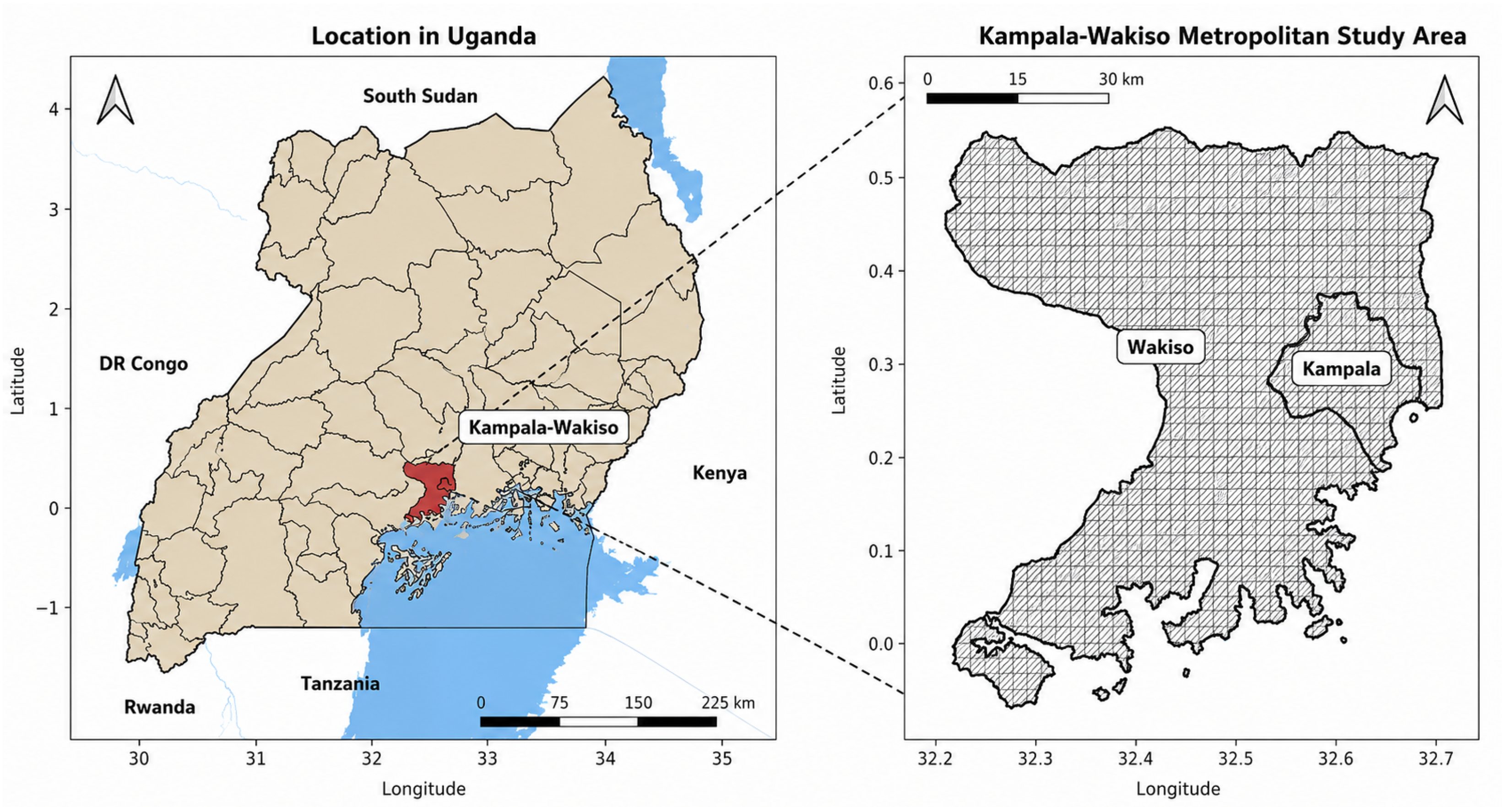
This study focuses on the Kampala-Wakiso metropolitan region in Uganda, shown in
Figure 1, which represents the country’s primary urban centre and the region with the highest concentration of vehicle ownership. The adopted study area covers 2110.4 km
2 and has a population of 5,208,899 people within the study boundary. The analysis considers a projected fleet of 60,000 electric vehicles, derived from the 2018 national vehicle baseline and allocated to the Kampala-Wakiso region according to population distribution.
The temporal scope of the analysis is limited to weekday private passenger mobility, with emphasis on home to work commuting as the dominant daily travel pattern. Charging demand is modelled at hourly resolution over a 24 h cycle. Seasonal variation in solar production and EV-PV complementarity is assessed using meteorological data from the PVGIS solar radiation database. The study is therefore designed as a planning oriented spatiotemporal assessment of charging demand and solar offset potential within an urban region where EV uptake is likely to emerge early and concentrate spatially.
Within this boundary, the EVPV-Simulator links projected weekday mobility, charging demand, and EV-PV complementarity for the Kampala-Wakiso metropolitan region.
3.2. Overview of EVPV-Simulator
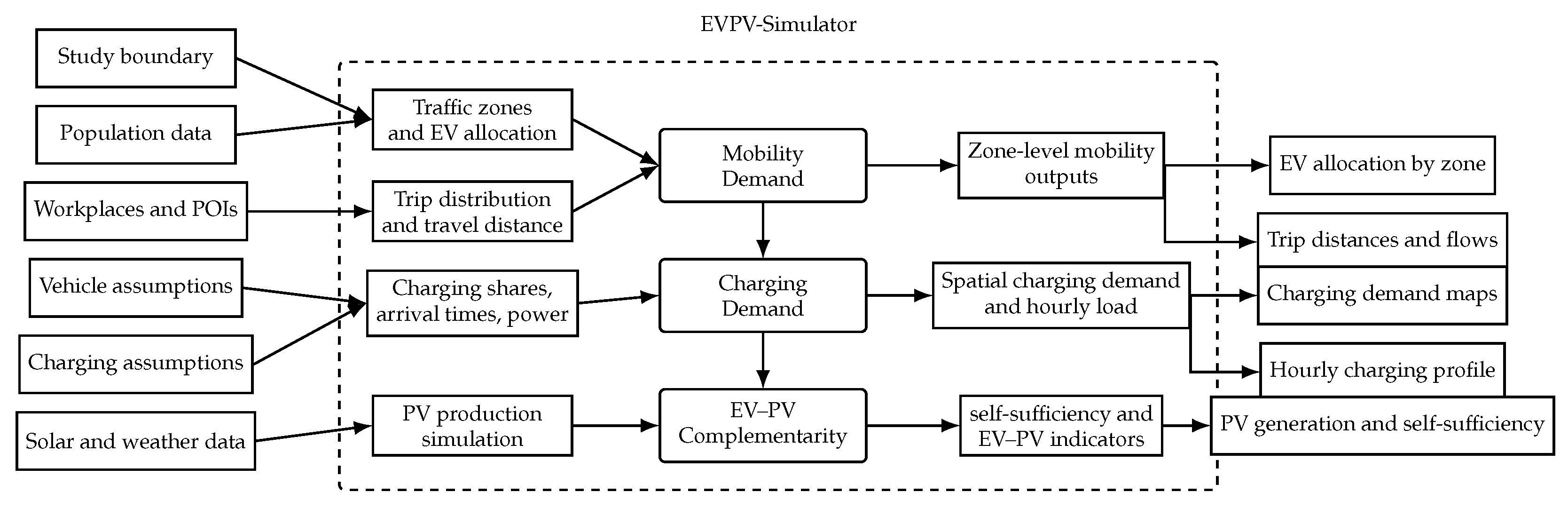
This study uses the EVPV-Simulator, an open-source geospatial modelling framework developed to support planning for privately owned electric vehicles in data-limited urban regions. The framework, illustrated in
Figure 2, links three sequential modelling blocks. First, a mobility demand block divides the study area into traffic zones, allocates vehicles using geospatial inputs such as residential population, workplaces, and points of interest, and estimates daily travel demand between origins and destinations. Second, a charging demand block converts those mobility outputs into spatial and hourly charging demand using fleet characteristics, charging location shares, arrival time assumptions, and available charging powers. Third, an EV-PV complementarity block simulates hourly photovoltaic generation and evaluates the extent to which local PV production can directly meet charging demand through indicators such as self-sufficiency (i.e., the share of charging demand met by coincident PV generation). Detailed model development and the full methodological formulation are presented in the EVPV-Simulator documentation and in the Addis Ababa application paper [
6,
10]. The present study therefore focuses on the Kampala-Wakiso implementation of the framework, including the local datasets, fleet assumptions, charging assumptions, and PV configuration used in this case study.
3.3. Input Datasets and Spatial Preprocessing
For the Kampala-Wakiso application, the EVPV-Simulator was parameterised using openly available geospatial datasets describing the study boundary, residential population, workplaces, and points of interest. Administrative boundaries were obtained from the Global Administrative Areas dataset [
11]. Residential population distribution was derived from the Global Human Settlement Population Grid R2023A using the 2020 epoch [
12]. Workplace and point of interest data were extracted from OpenStreetMap, yielding 1789 workplace locations and 6460 points of interest after processing [
13]. All spatial inputs and model outputs were represented at the traffic zone-level, meaning that vehicle allocation, trip distribution, and charging demand were computed for each zone rather than for individual buildings or exact point locations. The analysis was conducted at the traffic zone-level, with all key variables aggregated and modelled for each 2 km by 2 km zone. These zones served as the basic units for vehicle allocation, trip distribution, and charging demand aggregation. Residential population, workplace counts, and point of interest counts were aggregated to the zone-level for use in the EVPV-Simulator mobility and charging calculations.
3.4. Vehicle, Infrastructure, and Charging Assumptions
3.4.1. Fleet Composition and Vehicle Parameters
The projected fleet size of 60,000 EVs for the Kampala-Wakiso region was estimated using a proportional allocation approach based on national vehicle and population projections. A 2018 national vehicle baseline of approximately 420,000 vehicles was adopted from UBOS statistics on registered motor vehicles and projected to 2040 as the policy horizon used for the passenger vehicle transition scenario in Uganda’s National E-Mobility Strategy [
5,
14]. The Kampala-Wakiso fleet was then estimated from the projected 2040 national fleet using the ratio of the projected Kampala-Wakiso population to the projected national population in 2040 [
15]. This was expressed as:
where
is the estimated EV fleet in Kampala-Wakiso in 2040,
is the projected national vehicle fleet in 2040,
is the projected Kampala-Wakiso population in 2040, and
is the projected national population in 2040.
The simulated EV fleet therefore consists of 60,000 electric vehicles distributed across traffic zones in proportion to the residential population. The composition of the simulated EV fleet was based on Uganda’s 2024 vehicle stock, as reported in the National E-Mobility Outlook Report 2024, in which Battery Electric Vehicles (BEVs) accounted for 8%, Plug-in Hybrid Electric Vehicles (PHEVs) for 2%, and Hybrid Electric Vehicles (HEVs) for 90% [
5]. Since HEVs do not require external charging, they were excluded from the charging demand model. The simulated fleet was therefore represented by an 80% BEV and 20% PHEV split, preserving the relative proportions of the two chargeable vehicle classes in the reported national stock. The BEVs were modelled after the Hyundai Kona Electric, while the PHEVs were modelled after the Haval H6 GT [
16,
17]. The resulting fleet parameters are summarised in
Table 1.
3.4.2. Charging Location Shares and Infrastructure Configuration
Home, workplace, and point of interest (POI) charging are represented using a mixed charging scenario. Charging energy is distributed as 70% at home, 20% at workplaces, and 10% at points of interest. This scenario is consistent with the literature showing that private EV charging is dominated by home charging, while workplace charging and public charging account for smaller but system relevant shares [
1]. In the absence of local EV charging transaction data for Kampala-Wakiso, the adopted split is treated as a reference case rather than a locally calibrated behavioural estimate. It provides the baseline against which alternative charging geographies are tested in the sensitivity analysis.
Charging infrastructure is defined separately for each location type to reflect differences in charging purpose, dwell time, and likely charger utilisation. Home charging is represented by lower power chargers suited to overnight charging. Workplace charging is represented by medium power chargers suited to daytime dwell periods. POI charging is represented by a higher proportion of fast chargers suited to short dwell-time opportunity charging. The adopted charger power distributions are summarised in
Table 2.
The sensitivity design used to test alternative charging share configurations is described in
Section 3.9.
3.4.3. Temporal Charging Windows by Location
Temporal charging assumptions were defined separately for home, workplace, and POI charging in order to represent the different daily activity patterns associated with each location. These assumptions were used to capture the dominant timing of charging demand, which is important for assessing the temporal overlap between EV charging and photovoltaic generation. The adopted time windows and distributions are summarised in
Table 3.
Home charging was assumed to occur mainly after the return trip in the evening, with charging allowed to continue into the overnight period until the vehicle completes charging or reaches its sampled morning departure time within the 05:00 to 10:00 departure window. Workplace charging was represented by a narrower arrival distribution consistent with regular workday schedules. POI charging was assumed to be more dispersed through the daytime period, reflecting discretionary trips such as shopping, dining, and other daytime activities. These assumptions are consistent with published datasets on the arrival and departure behaviour of privately used electric vehicles [
18].
The base case represents unmanaged charging, where vehicles begin charging according to the sampled arrival time, location type, and charger power assumptions. It does not include tariff-driven rescheduling, delayed charging control, or deliberate overnight load shifting. Overnight charging values in the simulated profile therefore represent residual residential charging from vehicles that continue charging after evening arrival, rather than a separate managed off-peak charging strategy.
3.5. Mobility Demand Estimation
The mobility demand block produces the intermediate outputs that link the geospatial inputs to the charging model. These outputs include the spatial allocation of EVs across traffic zones, origin destination commuting distances, outbound and inbound vehicle kilometres travelled, and the resulting daily driving energy demand. These quantities provide the basis for the subsequent charging demand estimation, since they determine how many vehicles are associated with each zone and how much daily energy each vehicle must replenish. To maintain traceability between the mobility and charging stages, three mobility outputs are retained for interpretation of the case study results: the distribution of simulated two-way commuting distances, the mean commuting distance across the simulated fleet, and a spatial indicator of mobility intensity at the traffic zone-level, represented either by average round trip distance or by the concentration of outbound and inbound vehicle kilometres travelled. These outputs are reported to show how the simulated mobility structure shapes the later spatial and temporal charging demand patterns.
3.6. Spatiotemporal Charging Demand Model
The mobility outputs are translated into charging demand by combining daily energy needs with assumptions on charging probability, charging location, arrival time, and available charging power. The model therefore links vehicle allocation, trip distribution, daily energy use, charging location assignment, and hourly charging load construction.
3.6.1. Vehicle Allocation, Trip Distribution, and Vehicle Kilometres Travelled
Electric vehicles are allocated to traffic zones in proportion to residential population. For each zone
i, the number of allocated EVs
is given by:
where
is the population of zone
i,
is the total study area population, and
is the total number of simulated EVs.
Daily mobility is represented through weekday home-to-work commuting flows. Trips between origin zone
i and destination zone
j are estimated using a production-constrained gravity model, following the EVPV-Simulator framework in [
6]. The probability that a vehicle from zone
i travels to zone
j is:
where
is the attractiveness of destination zone
j,
is the Euclidean distance between zone centroids in kilometres,
is the distance-decay parameter, and
is a normalisation constant such that
.
For each traffic zone, round-trip vehicle kilometres travelled are then computed for outbound and inbound commuting flows as:
where the factor of 2 converts centroid-to-centroid distance into a round trip distance [
6]. Accordingly,
represents the total daily round trip distance associated with vehicles residing in zone
i, while
represents the total daily round trip distance associated with vehicles travelling into zone
i for work. Both
and
are expressed in vehicle kilometres per day.
3.6.2. Energy Use and Spatial Charging Demand
Trip energy demand is computed from trip distance and average fleet energy consumption. The energy required for travel from zone
i to zone
j is:
where
is the trip energy demand between zones
i and
j in kWh,
is the inter-zone travel distance in kilometres, and
is the average fleet energy consumption per kilometre in kWh/km.
Daily travel energy demand was derived from simulated travel distance and the weighted average fleet energy consumption. Based on the assumed 80% BEV and 20% PHEV split, was calculated as 0.141 kWh/km.
Zone-level charging demand was then partitioned into home, workplace, and POI components using the assumed charging shares and charging efficiency, following the EVPV-Simulator implementation in [
6]. Home charging demand was linked to outbound residential VKM, workplace charging demand to inbound destination VKM, and POI charging demand was distributed across zones in proportion to POI counts.
3.6.3. Hourly Charging Load Construction
Hourly charging demand was simulated stochastically using the EVPV-Simulator charging framework [
6]. For each vehicle, daily charging occurrence was determined from State of Charge (SoC) depletion following the EVPV-Simulator implementation. Once a vehicle was selected to charge, its charging location, arrival time, and charging power were sampled from the charging location shares, temporal distributions, and charger power distributions defined in
Section 3.4.2 and
Section 3.4.3. Aggregate hourly EV load was then obtained by summing the charging power of all vehicles charging at each hour.
The SoC threshold, charging occurrence logic, arrival time distributions, and charger power assumptions were specified using published EV charging studies because local Kampala-Wakiso charging records are not yet available. The charging decision followed the EVPV-Simulator implementation based on Pareschi et al. [
7]. In this approach, each EV is assigned an individual SoC charging threshold drawn from a normal distribution with a mean of 0.6 and a standard deviation of 0.2. A vehicle is then selected for charging when its simulated daily energy use causes the battery state of charge to fall below its assigned threshold.
Arrival time assumptions were informed by published home and workplace arrival and departure time distributions for privately used EVs [
18]. For charging power, the model assigns charger ratings according to the location-specific charger mix summarised in
Table 2. This mix was defined to reflect the expected differences in dwell time and charging purpose across home, workplace, and POI charging. Home charging was represented mainly by lower power chargers, workplace charging by medium power chargers, and POI charging by a higher share of faster chargers. The residential charging power assumptions were guided by empirical residential charging data from Sorensen et al. [
19], while the public charging power assumptions were informed by charging infrastructure datasets reported by Brown et al. [
20]. These inputs are therefore treated as literature-based proxy assumptions for planning analysis, not as locally calibrated Kampala-Wakiso charging behaviour.
3.7. Photovoltaic Production Modelling
Photovoltaic production was modelled using the pvlib Python 0.11.0 toolbox [
21], which combines meteorological data, irradiance inputs, module characteristics, and installation assumptions to simulate PV generation. Solar resource inputs were obtained from the PVGIS solar radiation database for the Kampala–Wakiso study area [
22]. The meteorological variables used were global horizontal irradiance, direct normal irradiance, diffuse horizontal irradiance, and ambient temperature.
Uganda’s solar resource exhibits only modest seasonal variability. Measured data from 56 ground stations show a bimodal annual solar irradiation profile, with maxima around the equinox periods and a minimum between June and July. The reported average annual irradiation was about 1680 kWh/m
2/year and daily variability below 10%, with the Central region also showing relatively limited seasonal fluctuation [
23]. For this reason, the study uses two temporal treatments. The detailed base-case EV–PV load-profile results are illustrated using a representative 7-day meteorological window, while the charging-location sensitivity analysis reported later in
Section 4.3 uses broader annual aggregate metrics. This allows the study to illustrate the structural temporal mismatch between unmanaged charging demand and daytime PV availability while still assessing the effect of charging geography across a wider temporal range.
The analysis assumes rooftop PV installations on flat urban roofs, representing a first-order approximation of residential, workplace, and commercial rooftop systems in the Kampala-Wakiso region. A fixed tilt angle of 0° was used for all PV capacity scenarios. The azimuth was set to 180° in the model input, although azimuth has no physical effect for a horizontal plane. This configuration was adopted to represent flat-roof deployment and to avoid overestimating PV output through optimised ground-mounted or tilted PV assumptions. PV system parameters were set as follows [
6]:
The 14% system loss factor was used as a conservative overall loss assumption for first-order PV production modelling, consistent with the default value used in PVGIS. In PVGIS, system losses account for losses between PV module output and delivered system output, including cables, inverters, dirt on modules, and module ageing effects.
3.8. EV and PV Complementarity Metric
The complementarity between PV generation and EV charging demand was evaluated using the self-sufficiency ratio. This metric quantifies the share of EV charging demand that can be met directly by coincident PV production over the simulation horizon. It is defined as:
where
is PV generation at time
t,
is EV charging demand at time
t, and the numerator represents the coincident overlap between PV generation and EV demand. The metric ranges from 0, indicating no temporal overlap, to 1, indicating that all EV charging demand is met by coincident PV production.
3.9. Design of the Charging Location Sensitivity and PV Capacity Sweep
A two-stage sensitivity analysis, summarised in
Table 4, was conducted to examine how charging geography influences EV–PV complementarity. The base-case charging shares defined in
Section 3.4.2 were retained as the reference case. Workplace and POI charging shares were then varied across the feasible charging share space, while fleet size, vehicle allocation, trip distribution, charger power distributions, temporal charging assumptions, and PV modelling assumptions were held constant. This design tests the sensitivity of the results to the charging location mix, which is the main behavioural assumption affecting the temporal overlap between EV charging demand and PV generation.
In the first stage, workplace and POI charging shares were varied in increments of 0.05. For each feasible combination, the home charging share was defined as the residual required for the three charging shares to sum to one. The temporal alignment between hourly EV charging demand and hourly PV production was then evaluated using the Spearman correlation coefficient, computed as a daily average over all days of the simulation year.
In the second stage, PV capacity was increased incrementally to evaluate how changes in charging geography affect EV–PV complementarity across different installed capacities. For each charging share configuration, the self-sufficiency ratio and the absolute net daily peak load were evaluated as functions of installed PV capacity. This procedure was used to compare the complementarity performance of different charging share configurations and to identify the cases with the strongest planning relevance for subsequent interpretation.
4. Results and Discussion
This section presents the findings of the Kampala-Wakiso area case study, providing a quantified baseline for the spatiotemporal characteristics of electric vehicle charging demand. The results specifically illustrate the quantified spatial concentration of charging demand across the metropolitan traffic zones, the primary temporal mismatch between unmanaged charging profiles and solar PV production, and the estimated potential for onsite solar to offset charging loads.
4.1. Mobility and Charging Demand
This section presents the simulated mobility outputs that underpin the charging demand model and then examines the resulting charging demand patterns. The mobility results are used to show how weekday commuting structure influences both the magnitude of daily charging energy needs and the spatial concentration of charging demand across the Kampala-Wakiso metropolitan region. In particular, they indicate where vehicles are likely to accumulate during daytime hours and where solar integrated destination charging may therefore provide the greatest benefit.
4.1.1. Mobility Outputs
Before examining charging demand directly, it is useful to first present the key outputs of the mobility model that shape the subsequent charging results. In this study, two outputs are particularly important: the simulated commuting distance distribution and the identification of sink zones based on the balance between daily arrivals and morning departures. Together, these outputs show how the projected weekday travel structure of the Kampala-Wakiso fleet influences both the daily charging requirement of vehicles and the spatial concentration of charging demand.
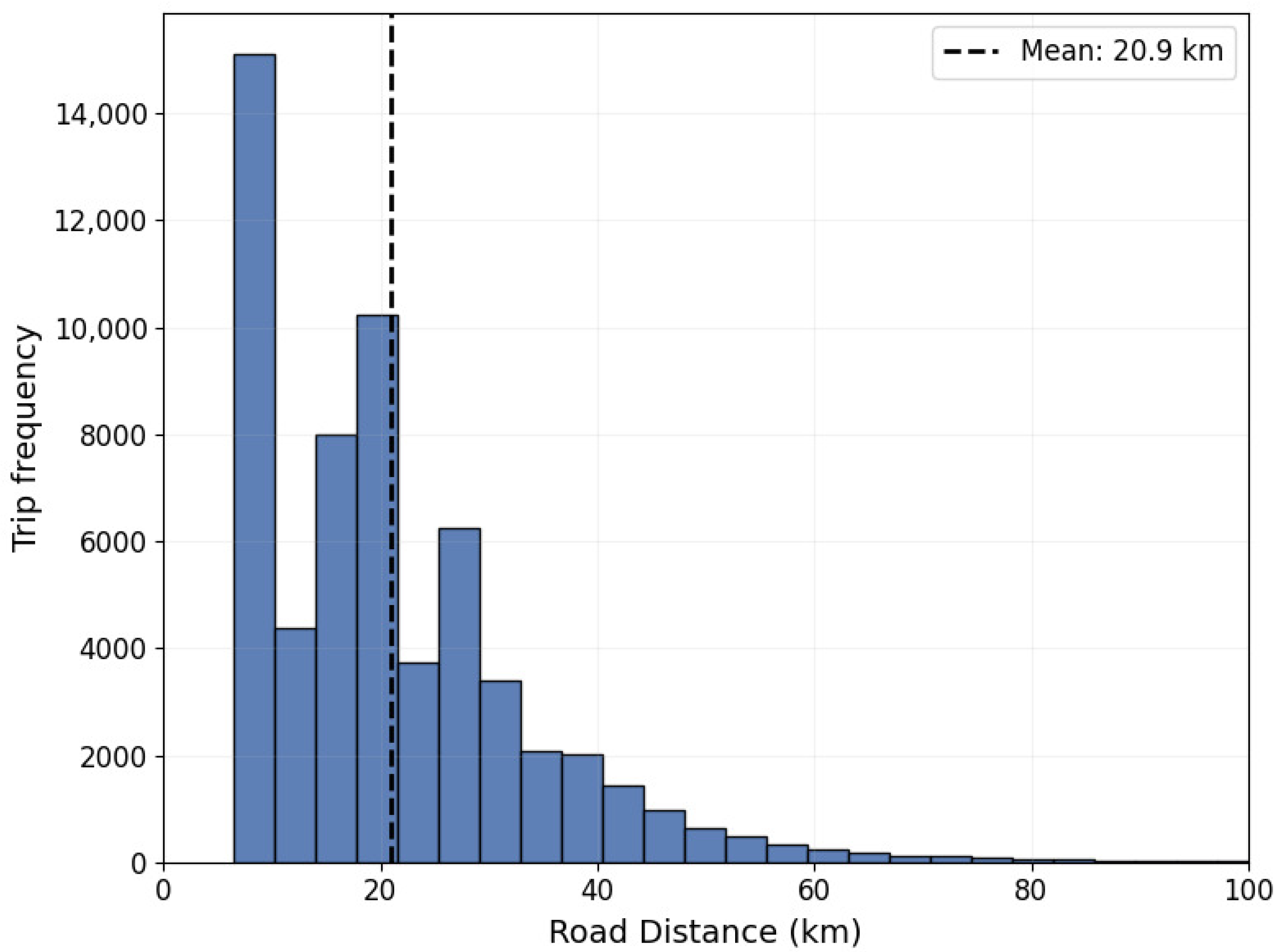
Figure 3 presents the simulated distribution of commuting distances for the projected EV fleet. The distribution is strongly right-skewed, with a dominant concentration of short-range urban trips under 10 km and a steadily declining frequency for longer journeys. The mean commute distance obtained from the simulation was 20.9 km, reflecting a high density of localized travel within the Kampala-Wakiso area. This result provides an important intermediate link between the mobility model and the charging model, as travel distance directly dictates battery depletion and daily energy demand. For illustration, using the energy consumption of the Haval H6 GT PHEV (0.197 kWh/km), a vehicle covering the mean commute distance of 20.9 km would require approximately 4.12 kWh, while a longer 80 km journey would require about 15.76 kWh. This vehicle-level example illustrates the daily energy use magnitude, while the charging model itself utilises the fleet-average consumption defined in
Section 3.6.2. These values show that while individual daily energy requirements are relatively minimal due to shorter commute distances, the high frequency of these trips still creates a substantial aggregate evening charging requirement when daytime charging is not available.
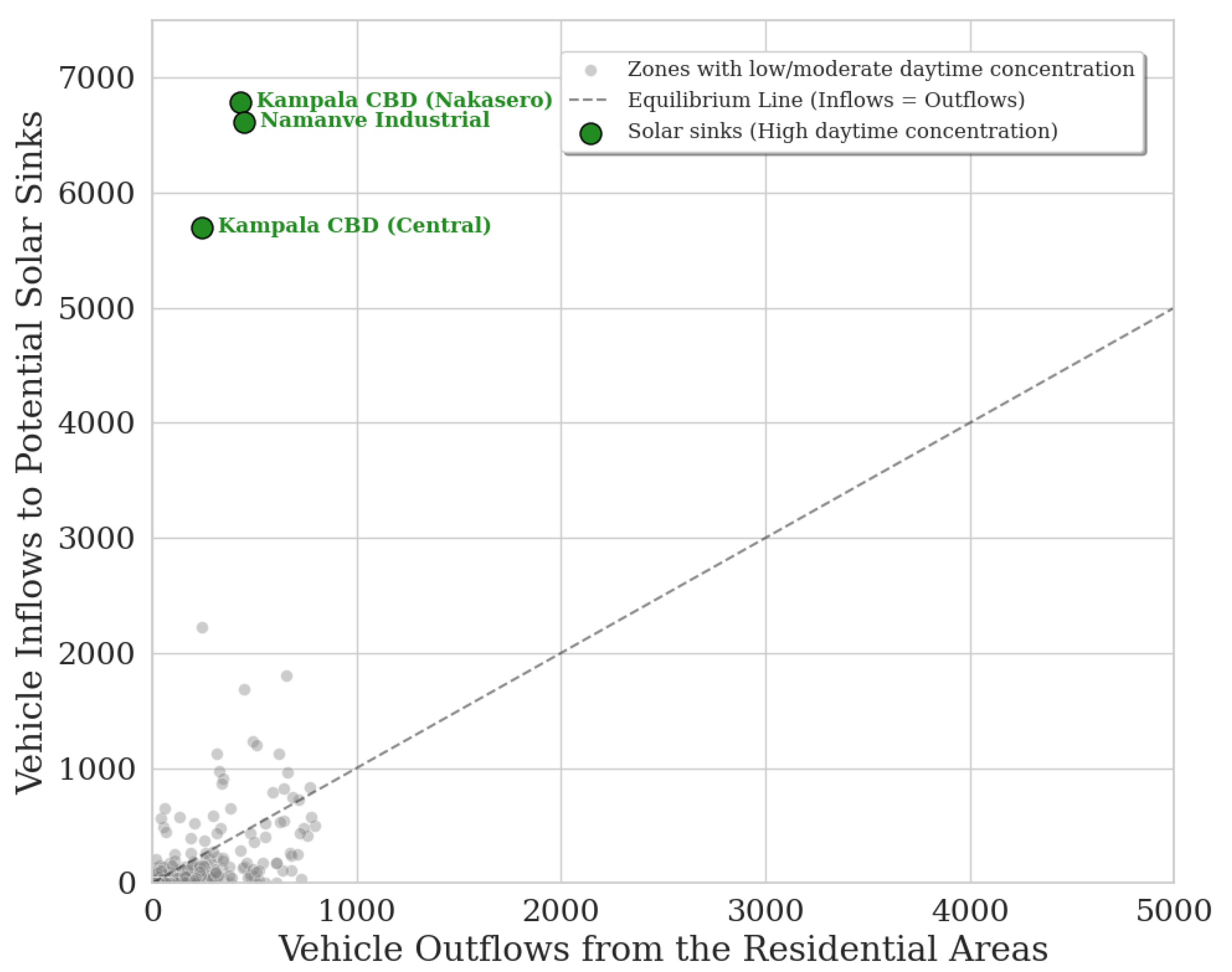
Figure 4 identifies sink zones using the balance between daily arrivals and morning departures. Zones above the 1:1 reference line receive more inflows than outflows and therefore function as daytime activity hubs, while zones below the line are primarily residential origins from which vehicles depart in the morning and return in the evening. The most pronounced sinks are Kampala CBD (Central), Kampala CBD (Nakasero), and the Namanve Industrial Area, which receive daily inflows of up to 6700 trips.
This pattern reflects the metropolitan structure of Kampala-Wakiso rather than a random concentration of simulated trips. Kampala Central Division, which contains the CBD and Nakasero, has a resident population of only 81,658, while Kampala Capital City records a daytime population of about 2.5 million, indicating strong daily inflows into the city core [
24]. Namanve also attracts trips because it is a large employment node: the 2200-acre Kampala Industrial and Business Park has over 71 operational industries directly employing about 30,000 people. These zones therefore attract stronger work-related inflows than surrounding residential and peripheral zones, where workplace and POI densities are lower.
These sink zones are especially relevant for EV charging planning because they represent locations where vehicles accumulate during daytime hours, when solar availability is highest. They therefore provide strong candidates for workplace and destination charging infrastructure intended to improve direct utilisation of PV generation.
Taken together, these mobility outputs provide the behavioural and spatial basis for the charging demand profile. The commuting distance distribution indicates the scale of daily battery depletion across the fleet, while the sink zone analysis shows where vehicles accumulate during daytime hours before returning to residential areas. This explains why unmanaged charging remains weakly aligned with daytime PV availability, with home-based charging dominating the evening peak even though daytime sink zones offer the strongest opportunity for workplace and destination charging.
4.1.2. Temporal Load Characteristics
As shown in
Table 5, the simulated base-case charging profile is dominated by evening and overnight residential charging rather than daytime workplace and POI charging. This is a model result derived from the stochastic charging process and the charging windows defined in
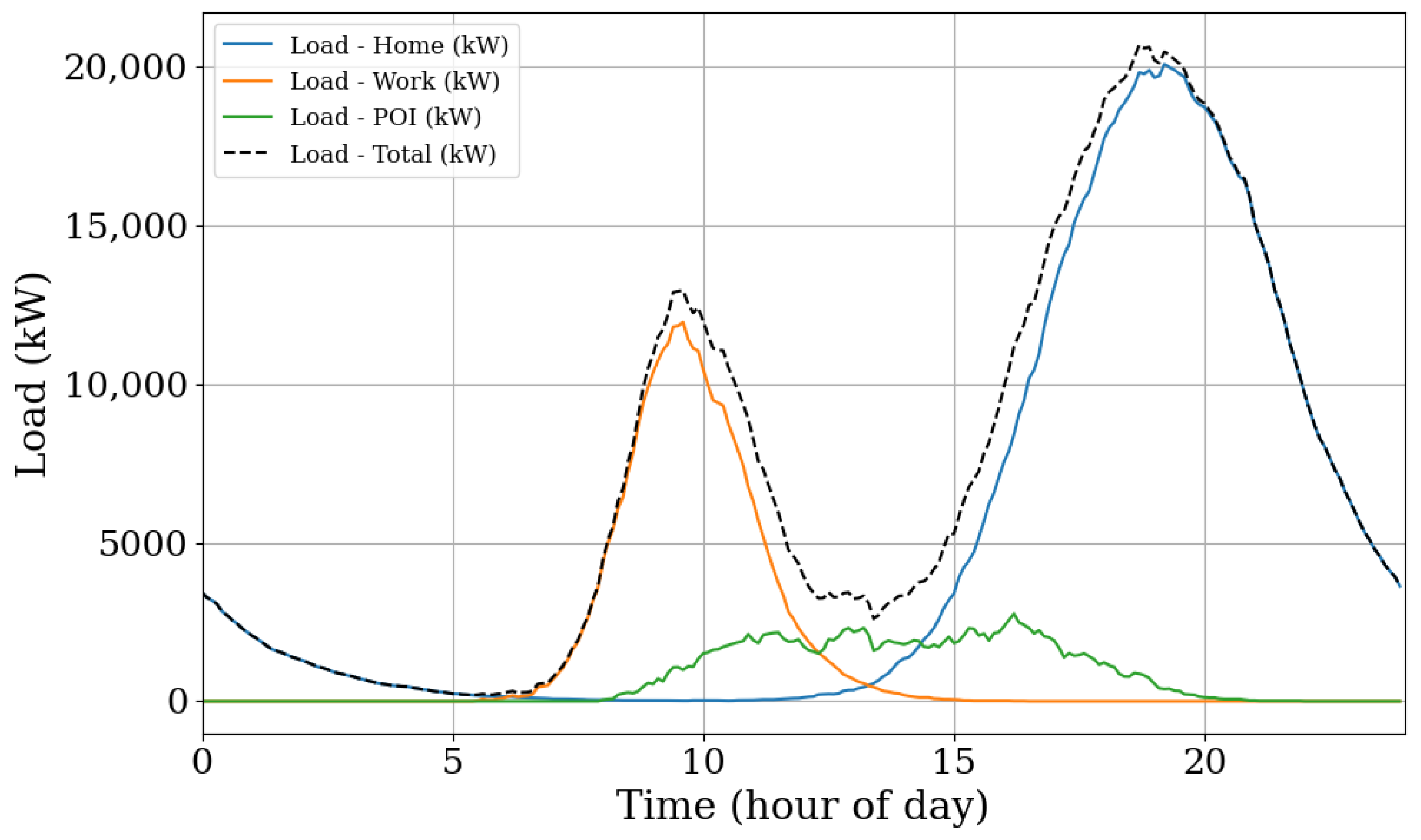
Section 3.4.3. The highest aggregate loads occur between 18:00 and 22:00, with more than 3200 vehicles charging at 18:00 and total load reaching 18.95 MW. The values at 00:00, 02:00, and 04:00 represent residual overnight home charging by vehicles that continue charging after evening arrival until charging is completed or the sampled morning departure time is reached. The decline after 22:00 therefore reflects charging completion under the assumed unmanaged charging behaviour.
During the daytime period from 08:00 to 16:00, when solar irradiance is highest, charging demand at workplaces and POIs remains much lower than the evening residential peak. The temporal profile therefore shows a clear mismatch between unmanaged charging behaviour and solar availability. Charging demand is relatively low when solar generation potential is highest and rises sharply later in the day as residential charging becomes dominant. This pattern indicates limited coincidence between daytime PV output and charging demand under the simulated unmanaged charging case. It therefore identifies daytime charging access, managed charging, and tariff-based flexibility as relevant areas for further planning assessment, rather than demonstrating load shifting within the present model.
Figure 5 shows the temporal distribution of charging demand across residential locations, workplaces, and points of interest, together with the aggregated total load. The profile confirms that daytime charging is concentrated mainly in workplace and POI locations, while the evening peak is dominated by residential charging, reflecting typical commuting patterns. This distribution is important for the PV assessment because it shows that the highest charging demand occurs after daytime solar production has declined. As a result, the contribution of PV to direct peak reduction remains limited under the simulated unmanaged charging pattern.
4.1.3. Spatial Demand Distribution
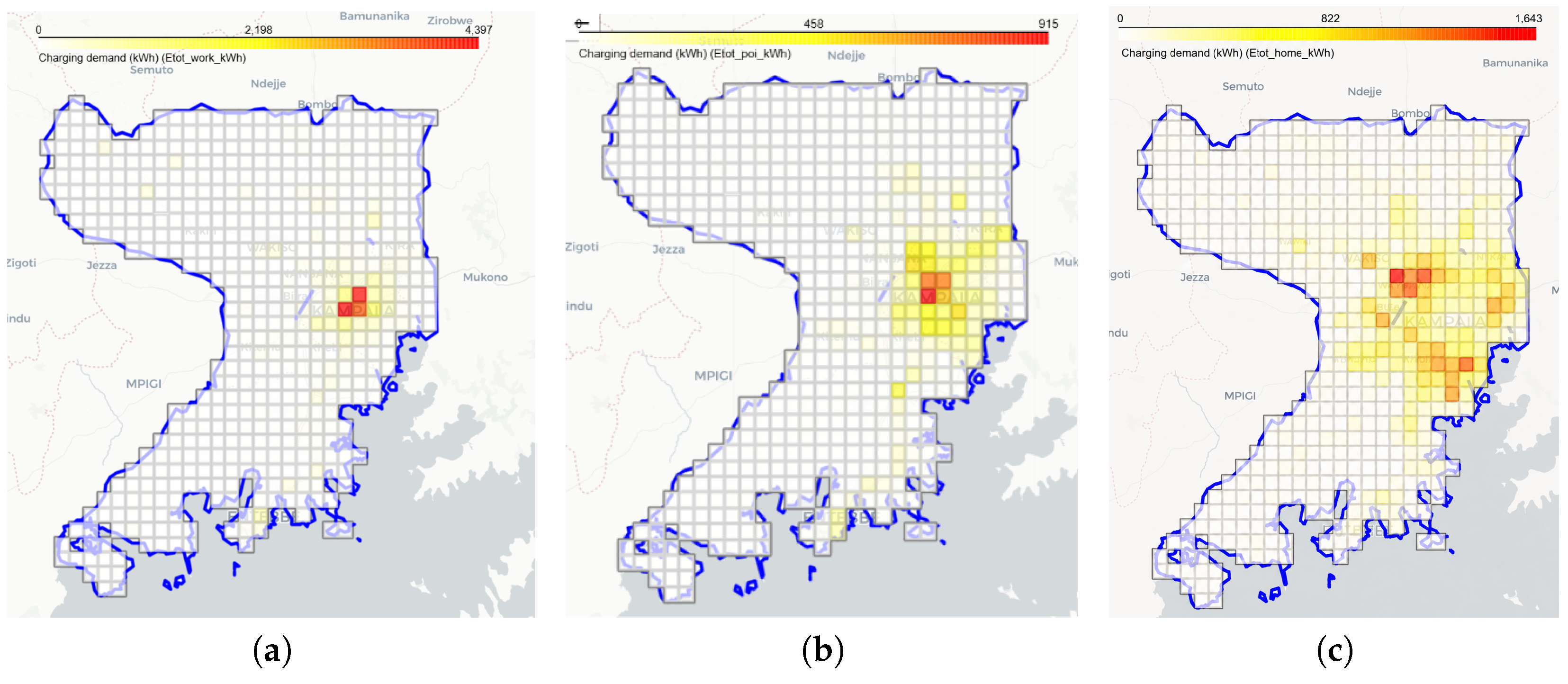
Spatial data outputs from this study identify critical sink zones characterised by high vehicle concentrations. These areas represent priority locations for subsequent local network impact assessments due to the high projected charging demand concentration. High demand areas, such as the zone covering Kibuye, exhibit a concentration of approximately 857 vehicles, corresponding to an estimated energy demand of 1985.76 kWh. In contrast, peripheral zones such as Masuliita, located on the north-western edge of Wakiso District, contain fewer than five vehicles and demonstrate negligible demand, estimated at 7.12 kWh.
These identified hotspots therefore represent priority locations for targeted solar offsetting and destination charging interventions, as well as for follow on feeder studies. Local Kampala evidence already shows that concentrated residential EV charging can stress specific low voltage assets under unmanaged charging conditions [
25], which makes these hotspot zones relevant screening locations for subsequent distribution impact assessment.
Figure 6 shows clear differences in the spatial distribution of charging demand by location type. Workplace charging demand is concentrated in a relatively small number of central activity zones, while point of interest charging is spread more broadly across the urban core and adjacent mixed use areas. Home charging demand is the most spatially extensive, with elevated demand distributed across a wider set of residential zones around Kampala and into Wakiso. Across all three maps, charging demand declines toward the peripheral parts of the study area. These patterns indicate that daytime charging opportunities are more spatially concentrated at destination based locations, whereas residential charging creates the broadest spatial footprint in the region.
4.1.4. Grid Context and Local Planning Significance
To contextualise the simulated unmanaged EV charging peak, ERA reports that Uganda’s domestic maximum demand reached 1023.2 MW in June 2025, while total maximum demand stood at 1202.9 MW and installed generation capacity reached 2098.2 MW [
26,
27]. In UETCL’s base-case demand forecast, national peak demand rises to 3536 MW by 2040, comprising 1426 MW of domestic demand, 164 MW of exports, and 1941 MW of industrial loads [
28]. Against these national values, the simulated unmanaged EV charging peak of approximately 21.5 MW corresponds to about 2.10% of the current national domestic peak and about 0.61% of the projected 2040 national peak.
However, this national comparison understates the local planning significance of the result. The simulated unmanaged EV peak cannot, on its own, prove transformer overload, voltage violation, or network collapse, because such conclusions require feeder-level load flow analysis, actual transformer loading, feeder topology, voltage profiles, and the allocation of EV charging demand to specific network nodes. Nevertheless, public grid planning data show that the 21.5 MW peak is large enough to be material at substation level if concentrated spatially.
Using a power factor of 0.9, the simulated 21.5 MW unmanaged EV peak is equivalent to approximately 23.9 MVA. Publicly available Kampala metropolitan substation data indicate installed capacities of 160 MVA at Lugogo, 160 MVA at Kampala North, 140 MVA at Mutundwe, 120 MVA at Queensway, 120 MVA at Namanve, 40 MVA at Kawanda, and 20 MVA at Kawaala [
29]. Across these selected primary substations, the combined installed capacity is approximately 760 MVA, and the screening comparison with the 23.9 MVA EV peak is summarised in
Table 6. However, this aggregate comparison can hide local constraints. If the same EV peak were concentrated near a single demand node, it would be equivalent to about 14.9% of a 160 MVA substation, 17.1% of a 140 MVA substation, 19.9% of a 120 MVA substation, 59.7% of a 40 MVA substation, and more than the installed capacity of a 20 MVA substation. This comparison shows that the planning risk is not national supply adequacy, but local coincidence between EV charging demand and available substation, transformer, and feeder headroom.
This concern is consistent with public transmission planning evidence. UETCL states that the Kampala Metropolitan Transmission System Improvement Project is intended to meet growing demand in the Greater Kampala Metropolitan Area by enhancing substation capacity and reducing outages [
30]. UETCL also reported that rapid demand growth in GKMA has affected existing substations and transmission lines, with substation loads almost reaching maximum capacity and causing power reliability incidents [
31]. The Grid Development Plan further reports loading violations and N-1 violations affecting Kampala-area assets, including Kawanda, Lugogo, Mutundwe, Kampala North, and Kawaala [
28]. In this context, the simulated 21.5 MW evening charging peak should be interpreted as a screening-level indicator of additional local stress, rather than as proof of overload at a specific asset.
4.2. Base-Case Potential for Offsetting Charging Demand with Solar PV
To evaluate the technical feasibility of regional solar supported e-mobility, this study adopts a 1 MW solar PV installation as a modular analytical benchmark. This unit size is used as a scalable reference point, allowing for a systematic assessment of the total capacity required to transition the fleet from a grid dependent load to a solar synchronised system.
4.2.1. Solar Resource Availability and Misalignment
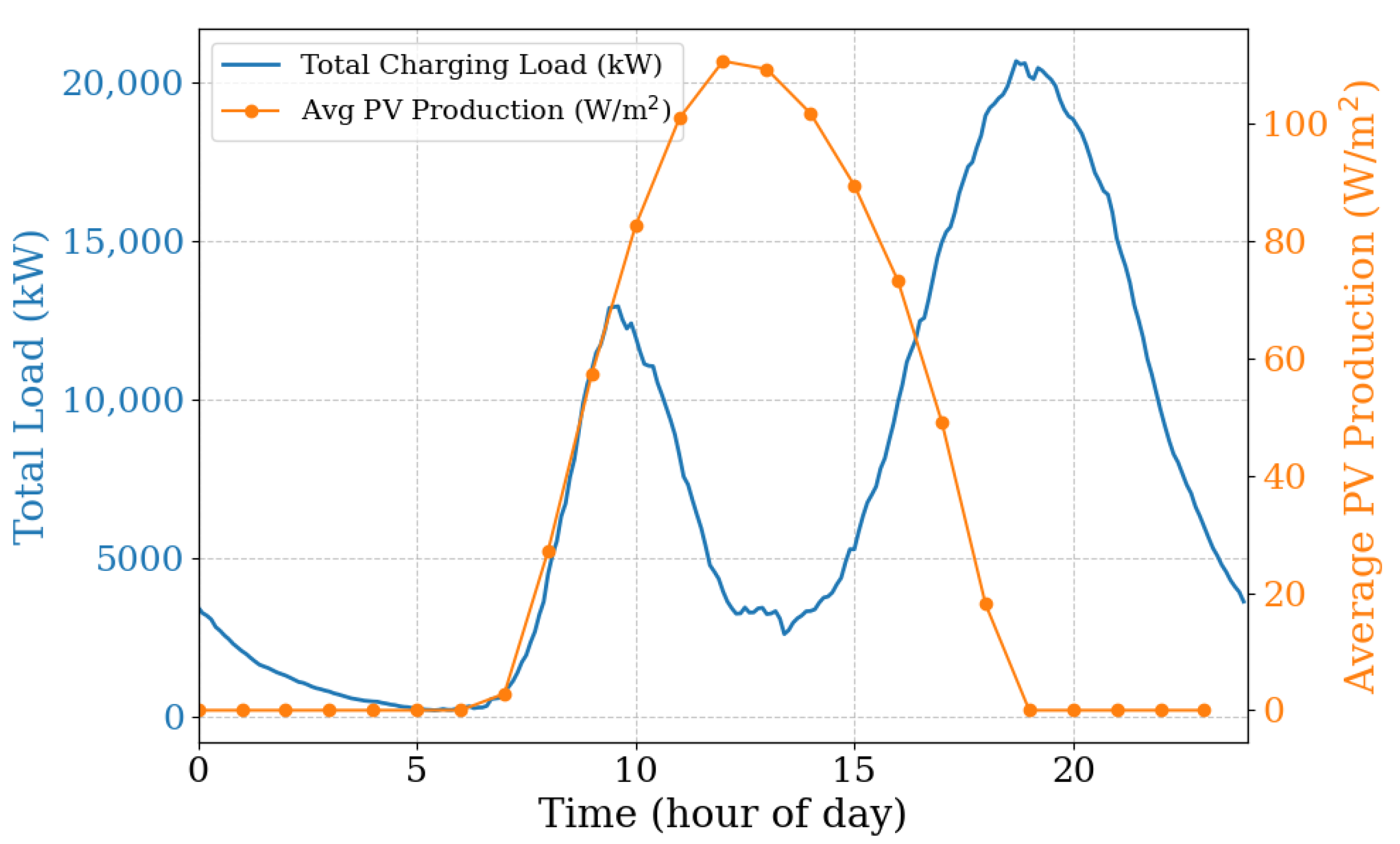
The Kampala-Wakiso region has a high solar potential, characterised by a high specific yield of 1368.58 kWh/kWp/yr. Analysis of the diurnal production profile in
Figure 7 shows that generation begins at 07:00, reaches a peak intensity of 142.61 W/m
2 at midday, and concludes by 19:00.
Despite this potential, there is a marked temporal mismatch with current consumption patterns. For the 1 MW reference case, under stochastic charging behaviour, the average direct solar energy contribution to the EV fleet is approximately 2.3–2.7%. Even with a simulated self-consumption ratio of 1.0, solar generation does not offset the evening peak because the dominant charging period occurs after daytime PV production has ended, resulting in full grid dependence during the nighttime peak.
4.2.2. Base-Case Self-Sufficiency Ratio and Capacity Scaling
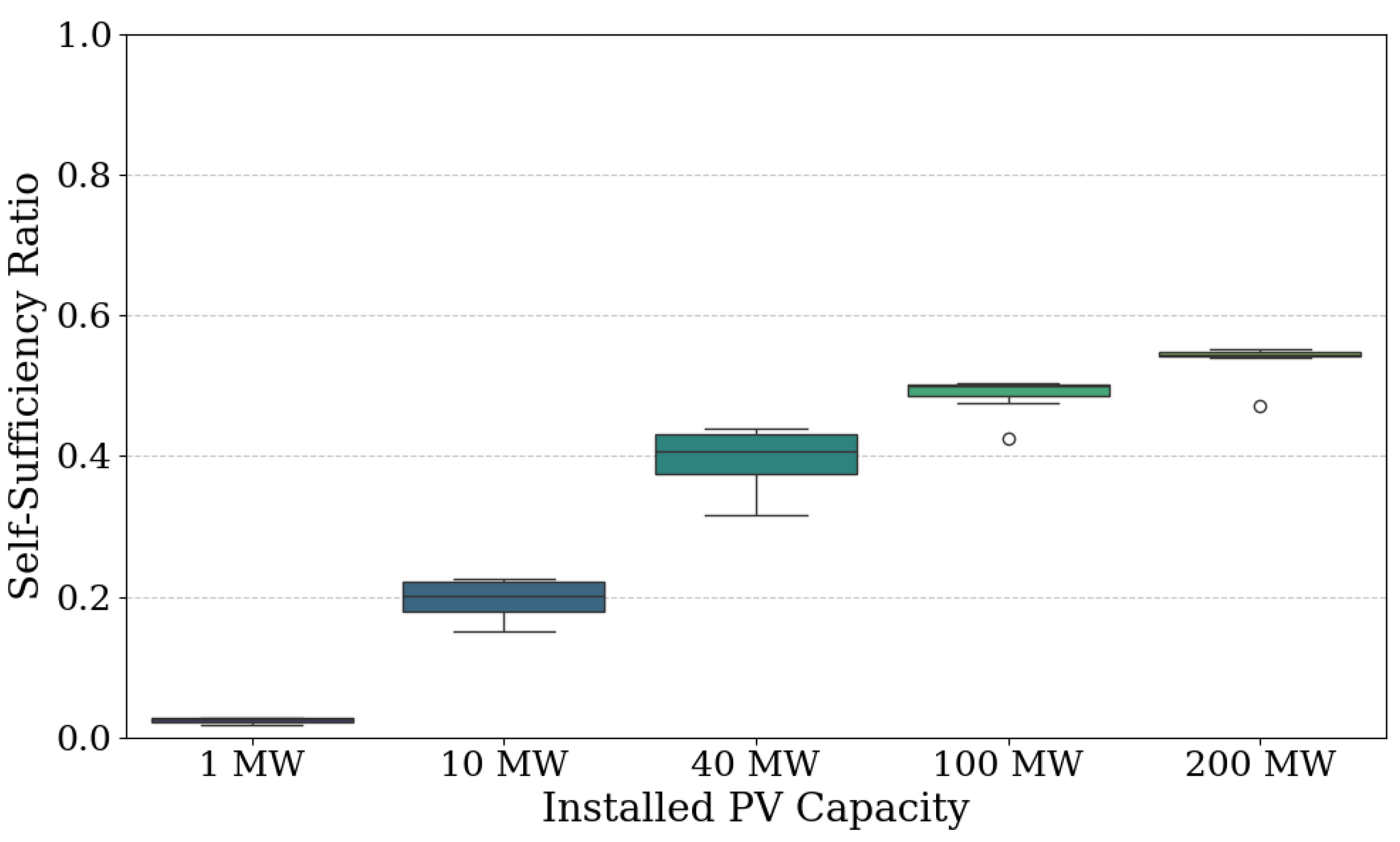
The self-sufficiency ratio (SSR) was used as the primary metric for evaluating the share of EV charging demand that can be met directly by coincident solar generation. To assess how PV scaling affects this relationship under the base-case charging pattern, installed PV capacity was evaluated at five levels: 1 MW, 10 MW, 40 MW, 100 MW, and 200 MW. These capacities were used to identify how strongly additional PV capacity improves direct solar contribution and where diminishing returns begin to emerge. The results in this subsection are based on a representative 7-day meteorological window from PVGIS for the Kampala region and are intended as a base-case illustration of EV–PV interaction under the current charging pattern.
Figure 8 shows that increasing capacity from 1 MW to 40 MW raises the SSR from 2.3% to 39.6%, indicating that moderate PV expansion can substantially improve the share of EV charging demand met directly by solar energy. Beyond this range, however, the marginal gains become smaller. Increasing capacity from 100 MW to 200 MW raises the SSR from 48% to 53%, showing that the system approaches a saturation ceiling under the unmanaged base-case charging pattern.
The variability of SSR also changes across capacity levels. At 40 MW, the system exhibits the widest spread, indicating stronger day-to-day sensitivity to weather conditions. At this scale, PV capacity is large enough for cloud cover to materially affect coincident solar contribution, but not yet large enough to maintain surplus generation during less favourable conditions. By contrast, at 200 MW, the distribution becomes more stable because the system is sufficiently oversized to provide close to the maximum usable solar contribution even on weaker solar days. The higher consistency at this capacity therefore reflects saturation rather than improved temporal alignment.
These results clarify the role of PV scaling in the base-case. Under the current home-dominant charging pattern, increasing PV capacity can substantially improve self-sufficiency, but only up to a point. Beyond 100 MW, additional PV capacity yields smaller gains because the main limitation is no longer solar resource availability, but the weak temporal overlap between midday PV production and evening charging demand. The results therefore reinforce the interpretation of 40 MW as a useful benchmark: it delivers a substantial increase in self-sufficiency while still making the limitations of unmanaged charging clearly visible. Further improvement beyond this point is likely to depend less on PV expansion alone and more on complementary measures such as daytime charging alignment, energy storage systems (ESS), or managed charging strategies. The broader charging location sensitivity analysis in
Section 4.3 extends this assessment using annual aggregate metrics.
4.2.3. Base-Case 40 MW Net Load and Peak Reduction
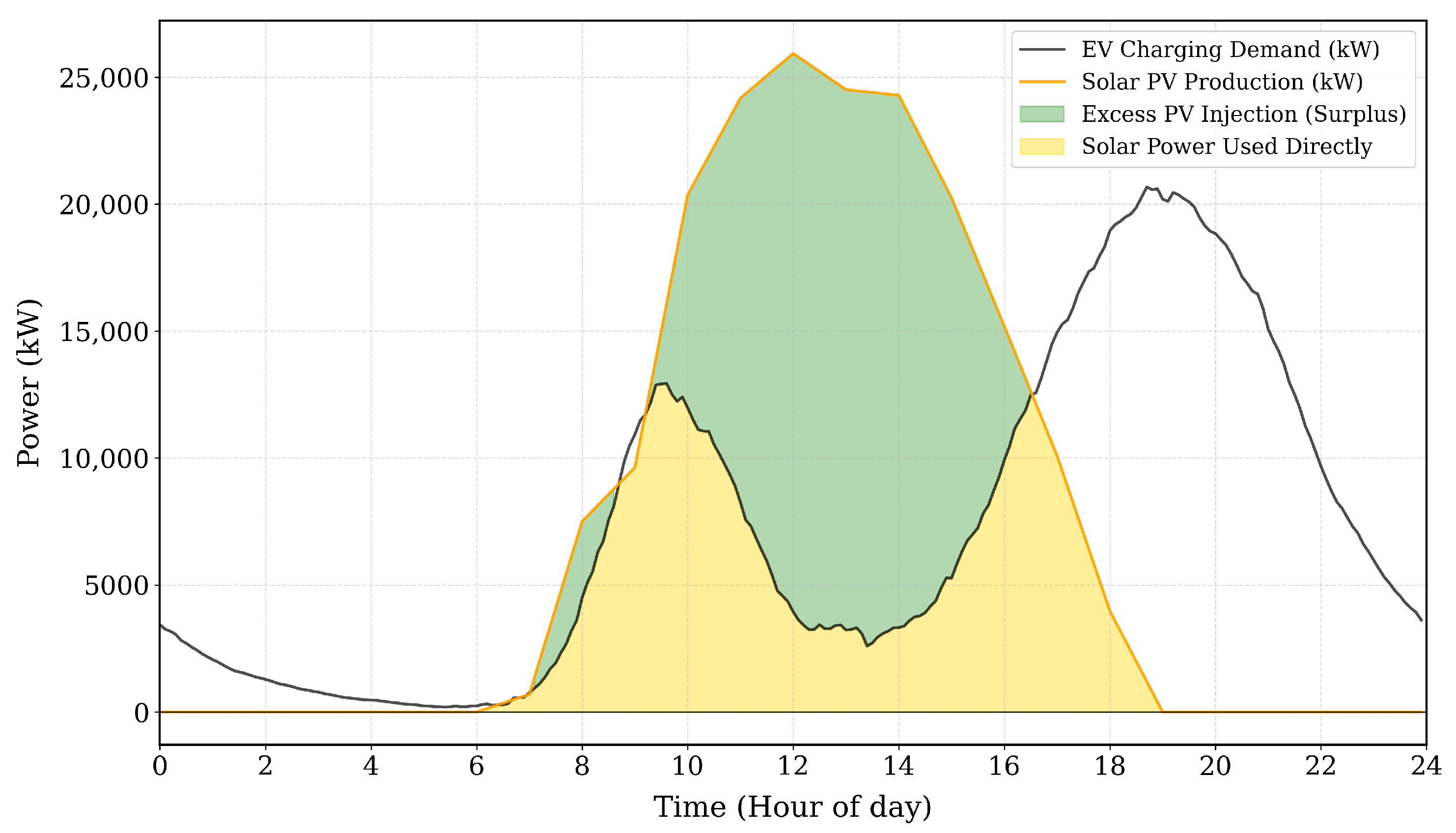
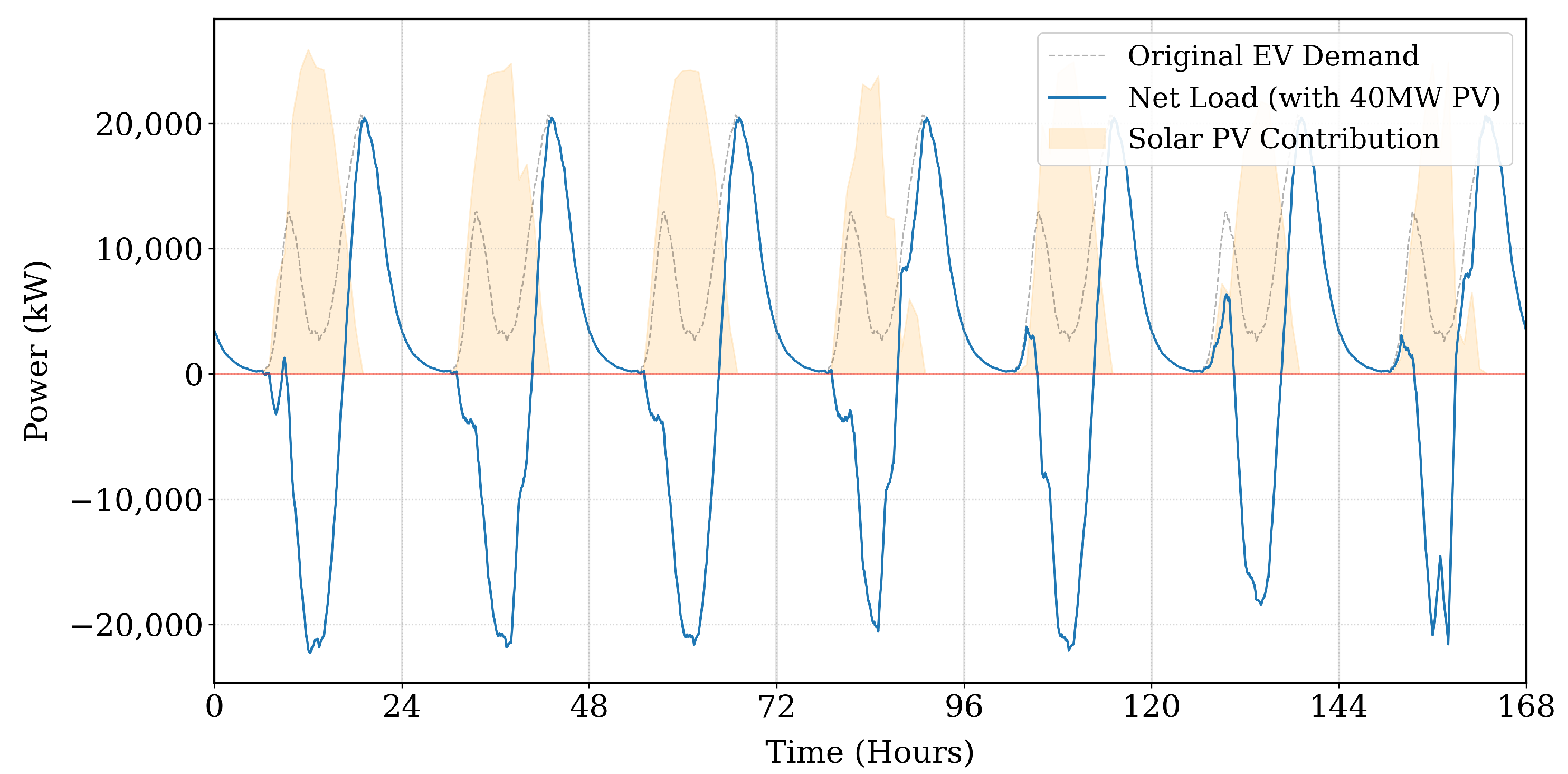
When scaling the solar infrastructure to a 40 MW array, the simulation reveals significant clean energy potential alongside technical inefficiencies. The total daily clean energy potential reaches 186.57 MWh, yet only 75.18 MWh (40%) is directly consumed by the fleet. A substantial surplus of 111.4 MWh (59.7%) is generated daily as shown in
Figure 9.
The 40 MW scenario produces a substantial midday surplus of 111.4 MWh because PV output is highest when a large share of the fleet is not charging. This indicates a limitation in temporal alignment under unmanaged charging behaviour. From a planning perspective, the result suggests that workplace and commercial charging locations merit further assessment because they offer longer daytime dwell periods and may improve direct utilisation of PV output.
The net load profile for the 40 MW Solar PV scenario shown in
Figure 10 tracks the EV demand and the resulting net load over a one week simulation period. The net load represents the actual burden on the grid when solar energy is utilised to charge the EV fleet.
Analysis reveals that the peak demand without solar is 21.5 MW, while the peak demand with solar remains nearly unchanged at 21.41 MW, corresponding to a reduction of only 0.20%. Consistent with the temporal mismatch described in
Section 4.2.1, the 40 MW case therefore produces only a negligible reduction in the evening peak. Although midday PV output creates substantial surplus generation, this does not materially reduce the peak charging demand seen later in the day. In this configuration, PV contributes more to annual energy offset than to direct peak reduction, indicating that meaningful peak mitigation would require additional flexibility measures such as energy storage or greater alignment of charging demand with daytime solar availability.
These base-case results show that PV expansion alone has limited influence on the evening peak under the current home-dominant charging pattern. This motivates a second step in which charging geography is varied in order to test whether improved temporal alignment can raise self-sufficiency and reduce the absolute net peak more effectively.
4.3. Charging Location Sensitivity and PV Capacity Sweep
The base-case analysis in
Section 4.2 showed that the current home-dominant charging pattern remains weakly aligned with daytime PV availability. The analysis was therefore extended by treating charging geography as a variable rather than as a fixed scenario assumption. Workplace and POI charging shares were varied across the feasible charging share space to identify combinations that improve temporal alignment between EV demand and PV generation. The best-performing region was then assessed across a PV capacity sweep to determine whether higher self-sufficiency also corresponds to lower grid-facing net peak load.
This is the main methodological extension of the present study. Instead of evaluating only a small number of predefined charging scenarios, the analysis treats the charging location mix as a planning variable and searches the feasible home, workplace, and POI charging share space. This allows the study to identify not only whether daytime charging improves EV–PV complementarity, but also which region of charging configurations provides the strongest temporal alignment. Linking this charging share sweep to a PV capacity sweep then makes it possible to distinguish between PV capacity that maximises direct solar utilisation and PV capacity that minimises the absolute net load seen by the grid.
4.3.1. Charging Share Sweep and Temporal Alignment
To quantify the effect of charging geography on EV–PV complementarity, the Spearman correlation coefficient between hourly EV charging demand and hourly PV production was evaluated across the feasible charging share space using a step size of 0.05. The Spearman coefficient was selected because it captures the degree to which the temporal profiles of charging demand and PV production follow similar hourly patterns, and it has been widely used in studies of renewable energy complementarity [
32]. Because PV production varies from day to day, the Spearman coefficient was first computed separately for each day of the year for every feasible charging share combination, yielding 365 daily values. The reported value is therefore the mean of these daily coefficients, and represents the typical annual temporal alignment between charging demand and PV production rather than the result for a single day.
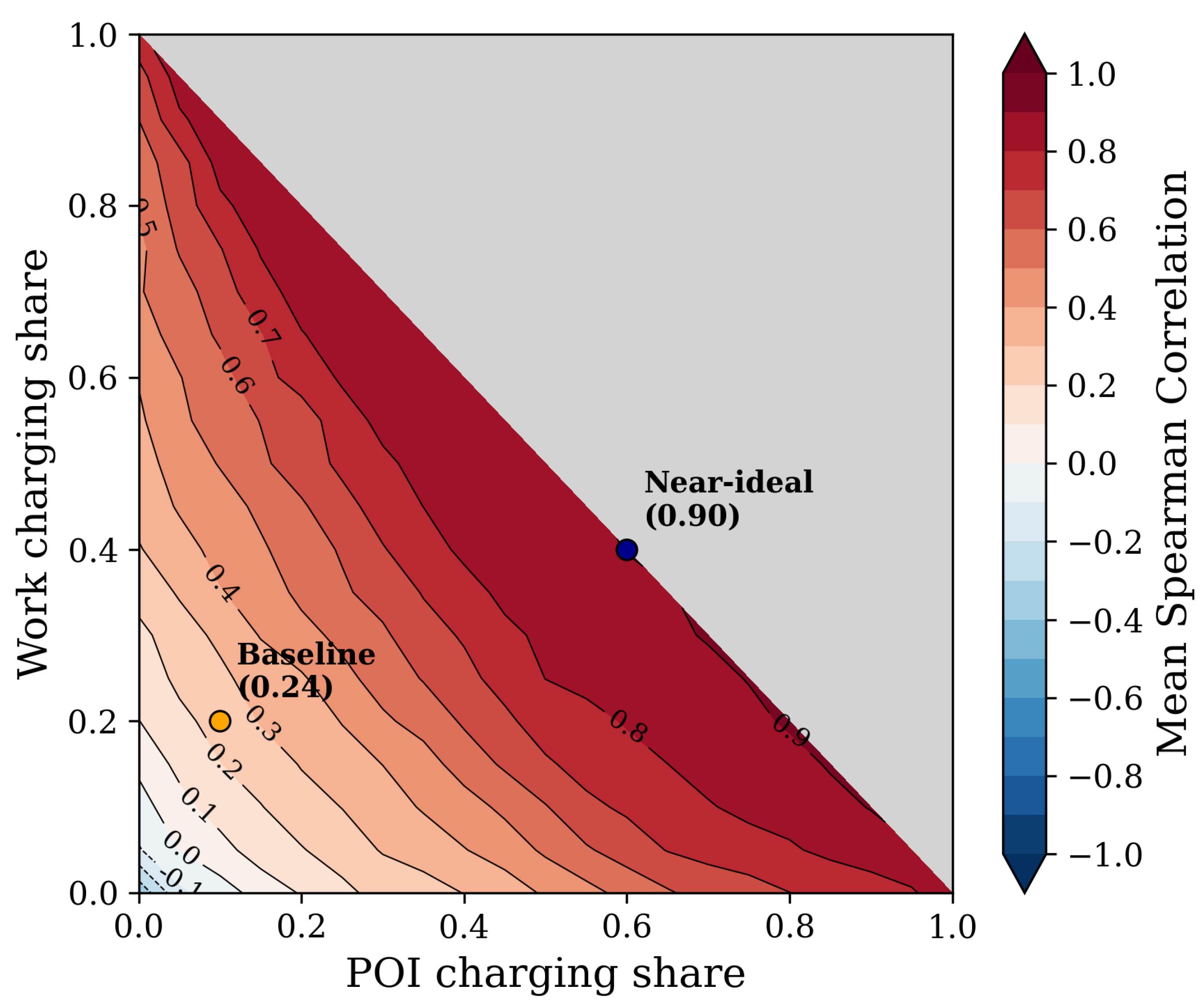
Figure 11 presents the resulting contour plot, where each point represents a feasible combination of home, workplace, and POI charging shares.
The results show that temporal alignment varies strongly across the charging share space, with correlation values ranging from approximately −0.3 to +0.9. As shown in
Figure 11, the base scenario shows a positive but relatively low correlation of 0.24, which is consistent with the weak temporal alignment already observed between unmanaged charging demand and PV production in the base-case. As charging shifts away from home and towards workplaces and POIs, the correlation improves substantially. Increasing the POI charging share improves alignment slightly faster than increasing the workplace charging share, and the highest values are obtained for combinations dominated by these two locations. The maximum correlation, approximately 0.9, is typically reached when the POI share is at least 60%, with the remainder occurring at workplaces.
An important result is that the high correlation region is broad rather than concentrated at a single isolated optimum. Many charging share combinations achieve correlation values above 0.8, which indicates that there is some flexibility in designing daytime-oriented charging strategies while still preserving strong EV–PV complementarity. Based on this result, a near optimal scenario with 60% charging at POIs and 40% at workplaces was selected for further PV capacity analysis.
4.3.2. Self-Sufficiency and Net Peak Load Under the Selected Scenario
Using the selected near optimal scenario, the self-sufficiency ratio and the absolute net daily peak load were evaluated as functions of installed PV capacity.
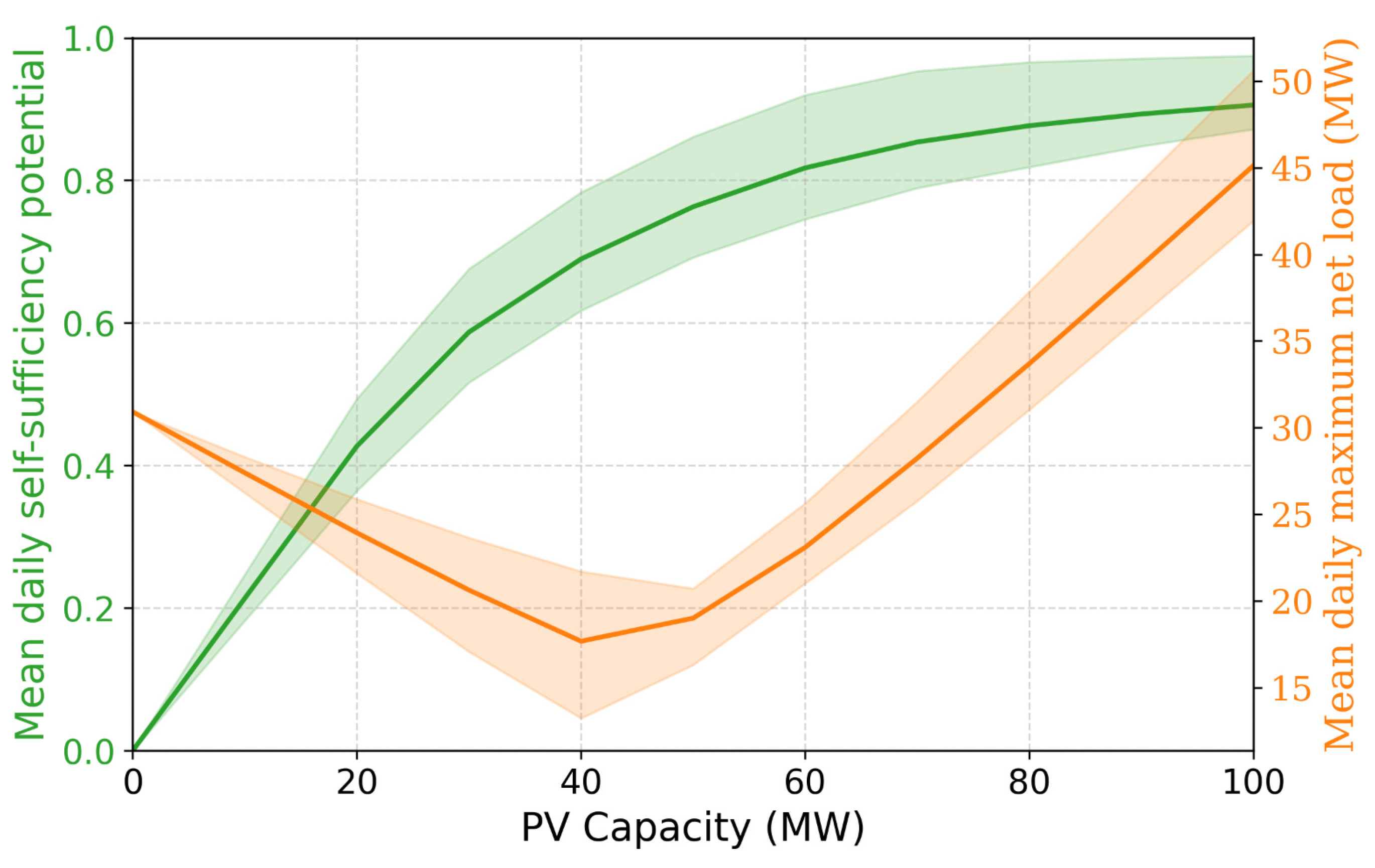
Figure 12 shows the mean and interquartile range across all days of the year for PV capacities between 0 and 100 MW.
The self-sufficiency ratio increases monotonically with installed PV capacity and exceeds 80% at around 60 MW. Day-to-day variability remains limited, as indicated by the relatively narrow interquartile range. This suggests that the selected charging configuration improves direct utilisation of PV generation in a stable manner across the year.
The absolute net peak load follows a different trend. A minimum is observed at approximately 40 MW. Below this level, the maximum net load is driven primarily by charging demand, and increasing PV capacity reduces the net peak through direct PV utilisation. Beyond 40 MW, self-sufficiency continues to improve, but additional PV increasingly creates daytime surplus peaks that exceed the remaining demand driven peak. As a result, the absolute net peak begins to rise again. This indicates that the PV capacity that best improves self-sufficiency is not necessarily the same as the PV capacity that minimises the absolute net load seen by the grid.
4.3.3. Planning Implications of the Selected Scenario
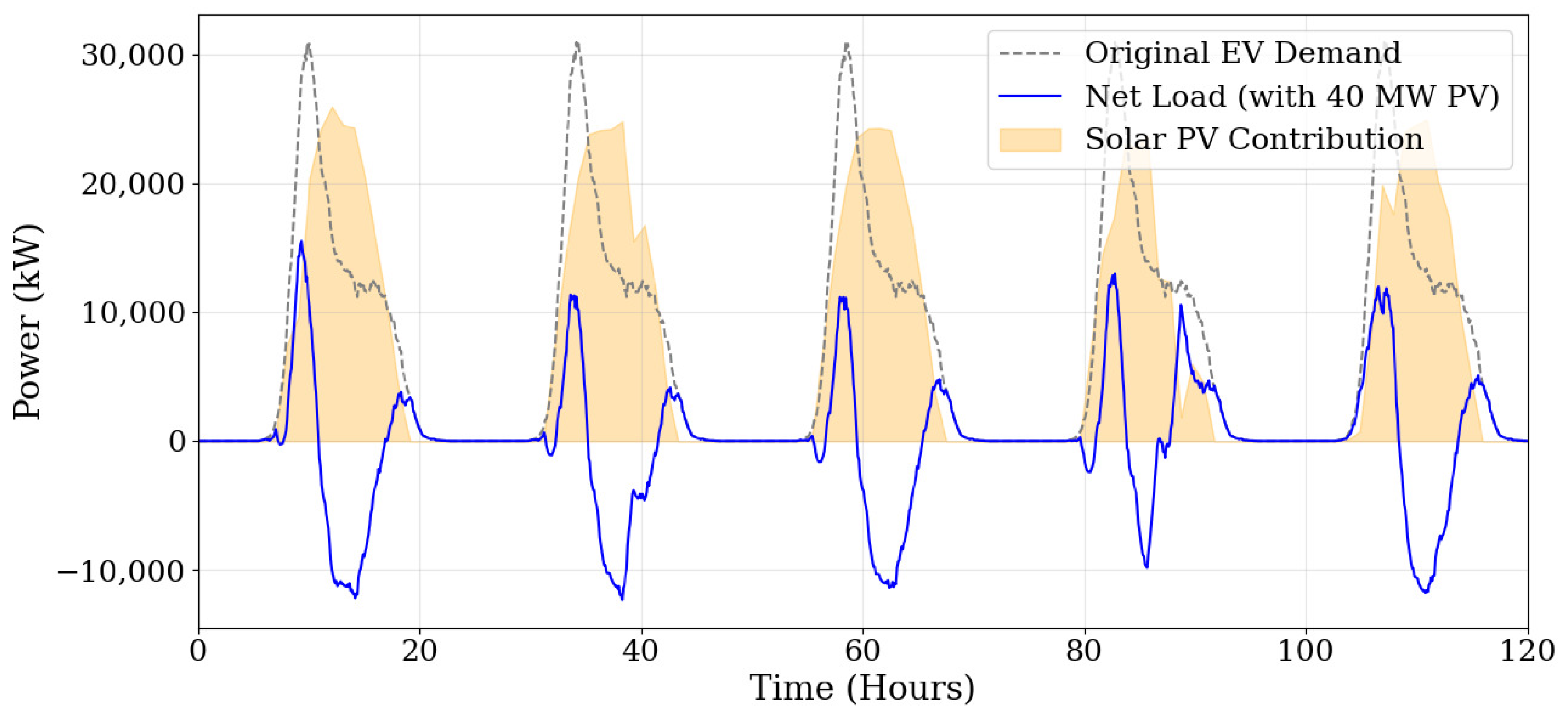
Figure 13 shows the daily net load profile for the first five days of the year under the selected near optimal scenario with 40 MW of installed PV, while
Table 7 summarises the corresponding scenario metrics and planning implications.
Relative to the baseline case, the temporal alignment between EV demand and PV production is visibly improved, and the EV demand peak is reduced. However, the stronger daytime alignment also creates afternoon PV surplus, which becomes increasingly important at higher PV capacities.
Although the selected 40% workplace and 60% POI scenario provides the strongest planning insight from the sensitivity analysis, it should be interpreted as a daytime charging benchmark rather than an expected near term behavioural outcome. Achieving this level of daytime charging would require coordinated investment in workplace chargers, public destination chargers, and parking-based charging facilities, since workplace charging and public parking have been identified as priority use cases for solar integrated EV charging [
33]. It would also require tariff structures, user information, and operational incentives that encourage charging during periods of higher solar availability, as workplace charging studies show that financial incentives and informational nudges can influence charging timing and workplace charging use [
34]. In addition, charging reliability, payment access, and charger location would need to be considered because public charging deployment depends not only on charger quantity, but also on accessibility, usability, and reliable operation [
35,
36]. Equity considerations are also important, since users without home charging access, workplace parking, or convenient destination charging may otherwise be excluded from the benefits of solar aligned charging. This is particularly relevant for residents of multi-unit dwellings, who often have limited access to residential charging and may face higher costs and less charging flexibility [
37]. For this reason, the selected scenario is best understood as an upper planning benchmark for daytime charging access, while intermediate workplace and POI charging shares may be more realistic during early deployment.
These results refine the interpretation of the base-case findings. Under the current home-dominant charging structure, PV scaling alone has limited influence on the evening peak. However, shifting charging toward daytime workplace and destination locations materially improves EV–PV complementarity and raises the share of EV demand that can be met directly by PV generation. The results also show that the planning objective matters. If the main objective is to maximise self-sufficiency, larger PV capacities continue to deliver gains. If the main objective is to minimise the absolute net peak seen by the grid, the selected near optimal scenario suggests that a PV capacity of around 40 MW provides the best balance before PV surplus peaks become dominant.
From a planning perspective, the results therefore support two linked conclusions. First, the value of PV depends strongly on where charging occurs, not only on how much PV is installed. Second, charging access at workplaces and public destinations should be treated as a central planning variable in future charging infrastructure strategies, because it can materially improve both solar utilisation and local grid relief.
5. Conclusions
This study assessed how projected electric vehicle charging demand and solar photovoltaic generation interact in the Kampala-Wakiso metropolitan region under data-constrained planning conditions. The analysis was motivated by a practical planning question: whether solar PV can meaningfully support future EV charging demand when charging is spatially concentrated and temporally shaped by commuting behaviour. By combining geospatial vehicle allocation, weekday mobility estimation, stochastic charging load construction, PV production modelling, and EV–PV complementarity assessment, the study examined where charging demand is likely to concentrate, when it is likely to occur, and how much of that demand can be directly met by solar energy.
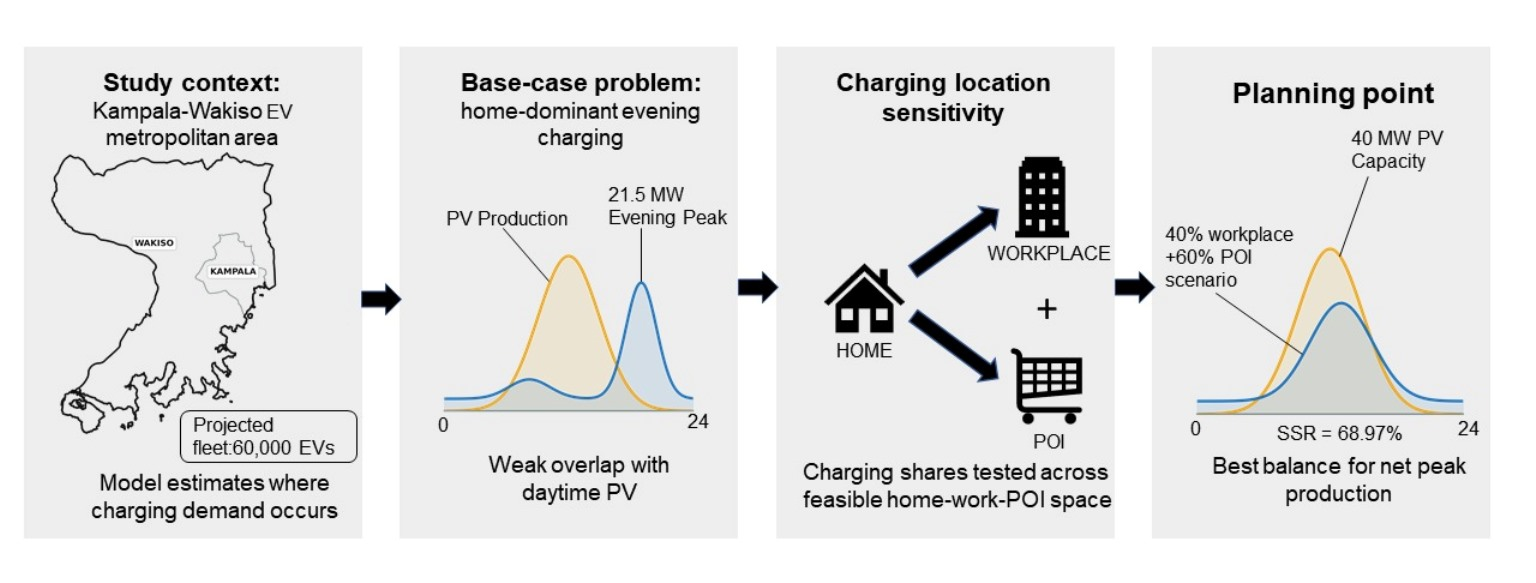
The analysis shows that the value of PV integration cannot be assessed from installed PV capacity alone. Under the home-dominant base case, unmanaged charging produces a pronounced evening peak of approximately 21.5 MW, with demand concentrated mainly in residential locations after daytime solar production has declined. In this case, increasing PV capacity improves the share of EV charging demand met directly by solar energy, but has limited influence on the evening peak. At 40 MW of installed PV capacity, the self-sufficiency ratio reaches 39.6%, while peak demand falls by only 0.20%. This confirms that the main limitation is not the availability of solar resource, but the weak temporal overlap between midday PV generation and evening residential charging demand.
The charging location sensitivity analysis extends this finding by showing that charging geography is a decisive planning variable. By varying workplace and POI charging shares across the feasible charging share space, the study shows that EV–PV temporal alignment improves substantially when charging shifts towards daytime locations. Under the selected near-optimal scenario, with 40% workplace charging and 60% POI charging, the self-sufficiency ratio reaches 68.97% at 40 MW of installed PV capacity. The analysis also shows that self-sufficiency and net peak reduction do not necessarily favour the same PV capacity. In the selected daytime-oriented scenario, the absolute net daily peak load reaches its minimum around 40 MW, while larger PV capacities continue to increase self-sufficiency but also create larger daytime surplus peaks.
These findings provide a more nuanced basis for solar-integrated EV charging planning. For Kampala-Wakiso, PV expansion alone is unlikely to provide meaningful peak mitigation if charging remains concentrated at home in the evening. Charging access at workplaces and public destinations should therefore be treated as a core infrastructure planning variable, because it can improve direct solar utilisation and reduce the grid-facing net peak more effectively than PV expansion alone. The results also show that PV sizing should not be guided only by maximising self-sufficiency. It should also account for the absolute net load seen by the grid, since excessive PV capacity can increase daytime surplus even when the share of EV demand met by solar energy continues to rise.
The findings have direct institutional relevance for EV infrastructure planning in Uganda. They support more deliberate tariff and charging policy design by the Electricity Regulatory Authority (ERA) and the Ministry of Energy and Mineral Development (MEMD), further development of solar-coupled charging systems and smart charging approaches through the Ministry of Science, Technology and Innovation (MoSTI), and more targeted infrastructure planning by Kampala Capital City Authority (KCCA) and other urban authorities in the high-demand zones identified by the analysis. They are also relevant to the National Environment Management Authority (NEMA) and wider climate policy processes because they show that transport electrification and renewable energy integration need to be planned together if emissions reduction is to be pursued without creating avoidable pressure on the distribution network.
The study should be interpreted within its planning-oriented scope. It does not perform feeder-level load flow modelling, explicit rooftop feasibility assessment, or techno-economic optimisation of PV and storage. The findings therefore identify charging concentration, temporal mismatch, PV offset potential, and the screening-level significance of the 21.5 MW unmanaged charging peak, but they do not directly prove transformer overload, voltage violation, or network collapse at specific sites. Future work should extend the framework by incorporating feeder-level electrical validation using actual transformer loading, feeder topology, voltage profiles, and spatial allocation of EV chargers. Further work should also assess explicit PV siting constraints, battery energy storage, managed charging, tariff-based charging control, and broader fleet categories such as commercial logistics, public transport, and two and three-wheelers.
Overall, the study shows that solar integration can make a substantial contribution to EV energy supply in Kampala-Wakiso, but its value depends strongly on charging geography. Under home-dominant charging, PV improves energy self-sufficiency but has limited effect on the evening peak. When charging shifts towards daytime workplace and destination locations, EV–PV complementarity improves markedly, and the planning case for solar-integrated charging becomes stronger. The central implication is that future EV charging strategies should plan charging location, PV capacity, and grid impact together rather than treating them as separate infrastructure questions.




 ,
,