1. Introduction
Modern power-system dynamics are changing significantly because of the increasing penetration of inverter-based renewable energy sources. The large-scale displacement of conventional synchronous generators has significantly reduced the available rotational inertia, initiating rapid frequency swings, high rates of change of frequency (ROCOF), and an augmented vulnerability to transient post-disturbance instability [
1,
2,
3]. As has been recently pointed out, low-inertia operation has been presented as a characteristic feature of future power systems and microgrids and has resulted in the need to implement advanced control strategies to maintain the stability and quality of power [
4,
5].
Unlike synchronous generators, inverter-based resources (IBRs) are interfaced through power-electronic converters and do not inherently provide mechanical inertia or natural damping [
6,
7]. As a result, conventional grid-following control may provide insufficient support in weak grids and isolated microgrids with high renewable penetration. This limitation has motivated grid-forming control strategies that generate voltage and frequency references rather than only following an existing grid waveform [
8]. The Virtual Synchronous Generator (VSG) is one of the most widely studied grid-forming approaches because it provides a clear physical analogy with synchronous-machine dynamics and is compatible with established power system stability concepts [
2,
9,
10].
Accompanied by the development of power-electronic control strategies, recent studies have focused on the fusion of intelligent monitoring and diagnostic tools in electrical systems. As an example, the deep learning-based system has been broadly utilized in fault diagnosis in rotating machines, and it was able to detect incipient faults with high accuracy under complex operating conditions [
11]. These data-based methods increase the reliability of the system and are increasingly becoming a subject that is considered jointly with control-oriented methods in the context of modern energy systems.
Moreover, the development of multimotor drive systems emphasizes the increasing complexity of contemporary electrical infrastructures, in which a combination of multiple machines and converters can be found in coordinated settings. Recent review studies have touched on structural diversity, advanced control strategies, and related challenges in multimotor systems, as well as the need to have robust and adaptive control methodologies to ensure stability and performance under varying load conditions [
12].
Likewise, the fault diagnosis and fault-tolerant control of permanent-magnet synchronous machines (PMSMs) have received a lot of attention, especially in high-reliability applications. The studies highlight the need to consider control design and system resilience considerations when it comes to inverter-based resources like VSG-controlled systems [
13].
The VSG concept is a replication of the behavior of a swing equation of a synchronous machine which has an impact of virtual inertia and damping through software-based control loops. They have been shown, through large amounts of empirical evidence, to enable VSG-controlled inverters to provide significant frequency regulation, as well as transient stability, and grid-supporting capabilities in converter-dominated electrical systems [
14,
15]. MDPI journals such as
Energies and
Electronics support the idea that well-tuned VSGs could be useful in preventing the rate of change of frequency (ROCOF) and frequency nadir phenomena in low-inertia microgrids [
16,
17].
Despite these advances, much of the existing VSG literature focuses on controller architecture, parameter optimization, or coordination with energy storage while assuming simplified or purely passive load models. In practical microgrids, loads are more diverse and include voltage-dependent impedance loads, electronically controlled constant-power loads (CPLs), and composite ZIP behavior [
18]. Recent studies have shown that load-model fidelity can strongly affect small-signal stability, voltage regulation, and power-sharing performance in inverter-based systems [
19,
20].
In particular, CPLs are characterized by negative incremental impedance, which can reduce effective damping and destabilize grid-forming inverters if not properly considered [
21,
22,
23]. Previous studies have investigated CPL stabilization using complex or adaptive control approaches, but these methods may increase implementation complexity and obscure practical tuning guidance. Moreover, systematic comparisons of VSG dynamic performance under constant impedance (Z), constant power load (CPL), and composite ZIP loads within the same framework and under identical operating conditions remain limited. This gap motivates a unified comparison in which the observed load-dependent behavior is linked directly to practical parameter-tuning requirements.
The given knowledge gap is especially relevant to single and weak-grid microgrids, where load structures can change both quickly and unpredictably. Combining grid-forming grid inverter control and realistic load dynamics is essential in ensuring the reliability and resilience of the operation of a microgrid, as highlighted in recent MDPI publications [
24,
25]. However, limited exhaustive benchmarking research that separates AC-side dynamics and measures the effect of the various categories of load on VSG frequency and voltage response are rare.
This manuscript was motivated by the urgency of the operation of contemporary power systems and presents a detailed model and dynamic appraisal of a Virtual Synchronous Generator operating with three canonical load paradigms: constant impedance (Z), constant power (CPL), and aggregated ZIP loads. In contrast to most of the available literature, this study considers all types of loads under same-system conditions to ensure that the effects of all load types on the dynamics of VSG are uniformly and fairly compared. This investigation provides a definitive comparative assessment of load-related stability qualities, since the same control structures and disturbance structures are maintained in all the cases. The results provide practical information on the tuning of virtual inertia and damping needed to maintain the stability of the synchronous-like dynamics, as well as the potential impact of appropriate parameter choices, to support the maintenance of synchronous-like dynamics in the context of destabilizing CPL effects.
The main contribution of this work is not the proposal of a new VSG controller, but a unified comparative analysis of how Z, CPL, and ZIP load models affect the dynamic performance and tuning requirements of a VSG-controlled inverter. All load cases are evaluated using the same system configuration and disturbance conditions, allowing the destabilizing influence of the CPL component to be isolated and compared with passive Z-load and mixed ZIP-load behavior. The study further connects the observed dynamic behavior to a reduced-order small-signal stability interpretation and to measurable performance indicators, including ROCOF, frequency nadir, and settling time.
2. System Modeling and Methodology
The system consists of a three-phase voltage-source inverter, LC output filter, and VSG control layer. The VSG incorporates the following:
A swing equation with virtual inertia M and damping D;
A governor-based P–f droop loop for frequency regulation;
A Q–V loop for voltage magnitude restoration;
Voltage and current controllers;
dc–ac transformations and PWM generation.
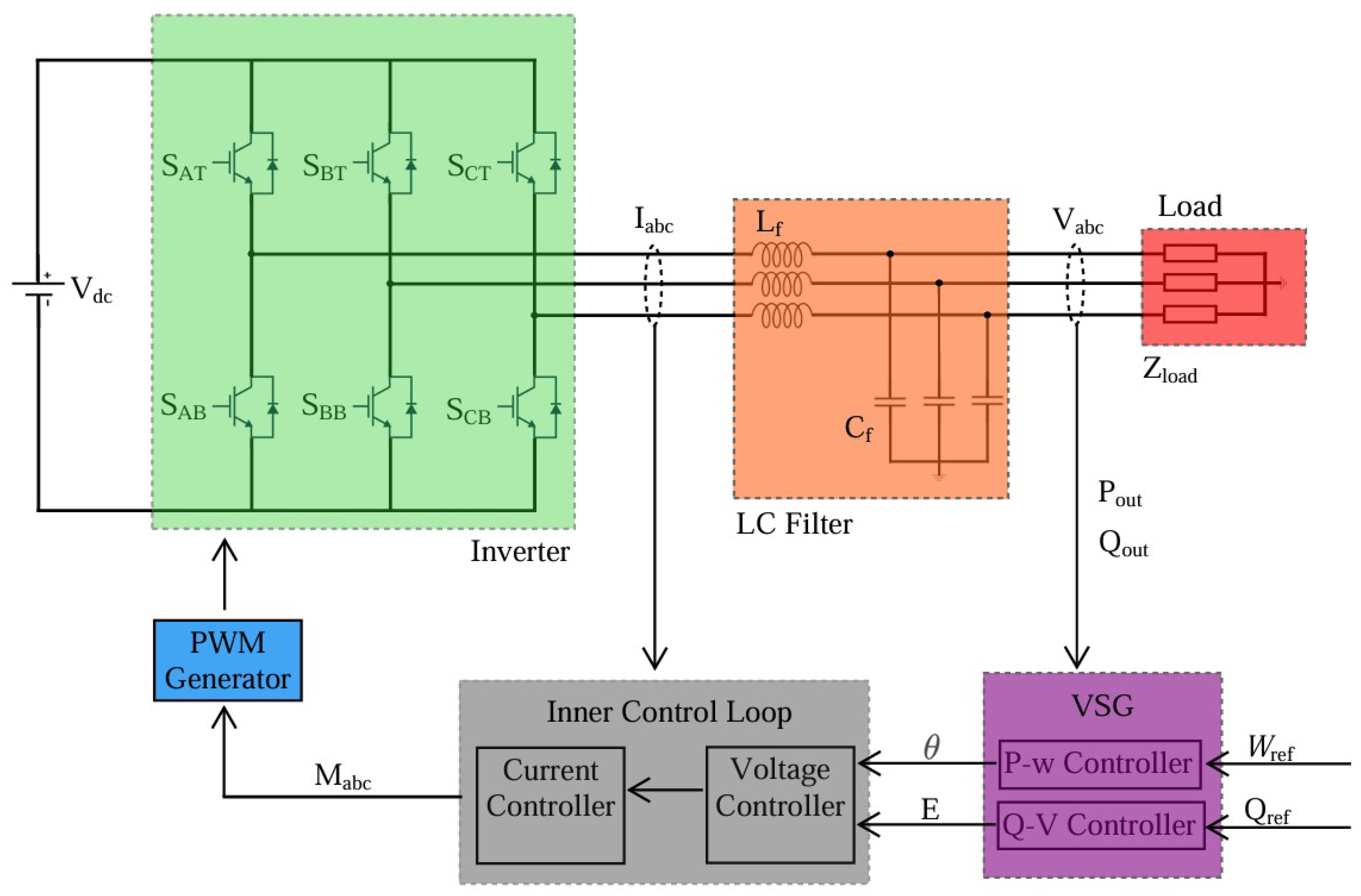
The proposed VSG test bed shown in
Figure 1 consists of a rigid DC source which drives a three-phase voltage source inverter, an LC filter on the output, and a programmable load to the point of common coupling (PCC). For consistency, the angular frequency
used in the control block representation is denoted as
in the analytical small-signal model.
To make the inverter behave more like a conventional synchronous machine, the VSG controller makes it possible to simulate dynamic behavior. It simulates the weighting and attenuating properties of rotary generators through the use of control algorithms applied to the digital sphere of the inverter. The VSG forms the outermost layer at the top of the control architecture, which takes the feedback of the active and reactive power of the inverter and generates two main outputs:
The angular frequency , which governs the inverter phase angle .
The internal voltage amplitude (E), which serves as the voltage reference for the inner loops.
With traditional synchronous generators, rotor inertia has helped counter sudden changes in frequency caused by changes in the load. This inertial effect is simulated in the VSG framework in an entirely virtual construct, using a mathematical model which is a swing equation, as shown below:
Here,
M represents the virtual inertia constant, which determines the converter frequency response to power imbalance [s];
D is the damping coefficient, a coefficient that would summarize the mechanical damping effects that enable the equilibration of frequency about a perturbation [W.s/rad] or [pu];
signifies the mechanical (reference) power which the virtual governor produces [W] or [pu];
represents the electrical output power, which is identified in the analysis above [W] or [pu].
In this work, all control parameters are expressed in per-unit (pu), unless otherwise stated.
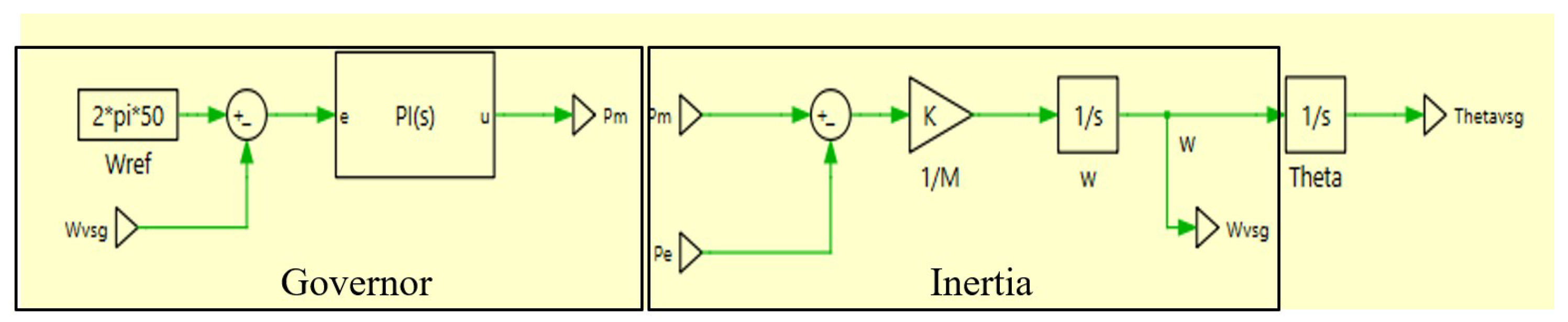
Figure 2 illustrates the active power–frequency control path represented by the swing equation. The design requires suitable inertia, damping, and droop coefficients to balance stability and responsiveness, as summarized in
Table 1.
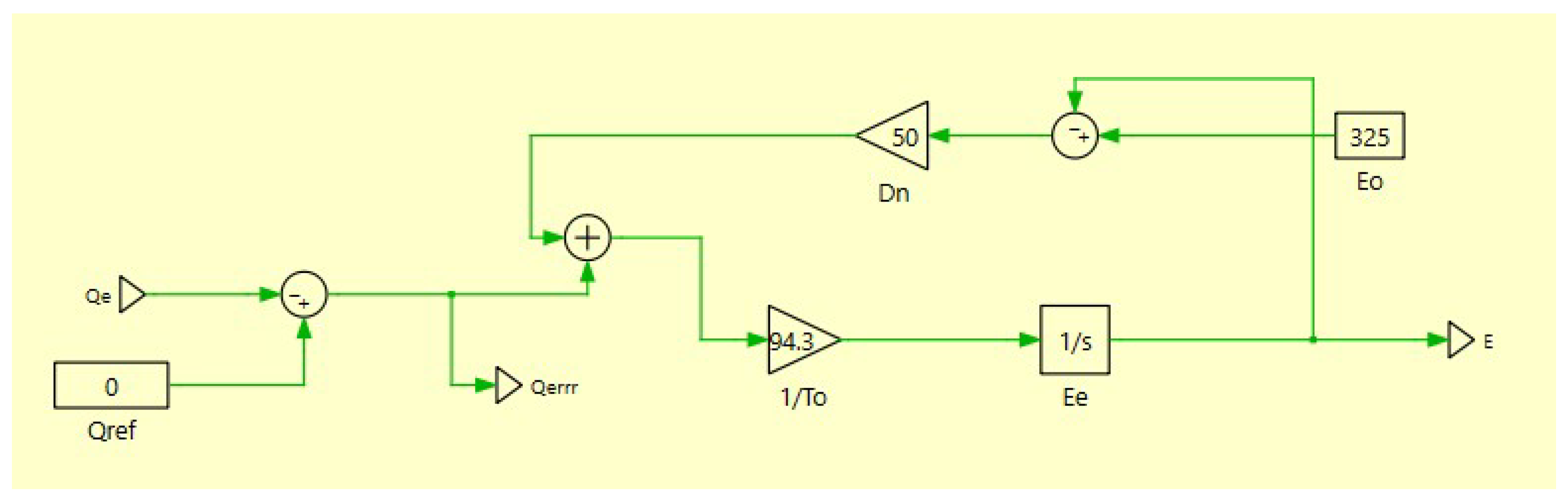
Besides frequency regulation through active power control, the VSG should also regulate the voltage magnitude by controlling the transfer of the reactive power with the load or grid.
Figure 3 represents the
Q-V control loop, which is the historical replica of the excitation system, that is, the automatic voltage regulator (AVR) of a synchronous generator. The inverter maintains the required amount of output voltage, even in cases where reactive load changes take place, so that it supports not only the voltage stability but also allows a distributed unit to share reactive power.
The combined effect of these parameters determines the VSG’s ability to emulate generator-like frequency behavior, as summarized in
Table 2. The baseline validation configuration of
s,
pu, and
provides a reference trade-off between transient smoothness, response speed, and steady-state accuracy.
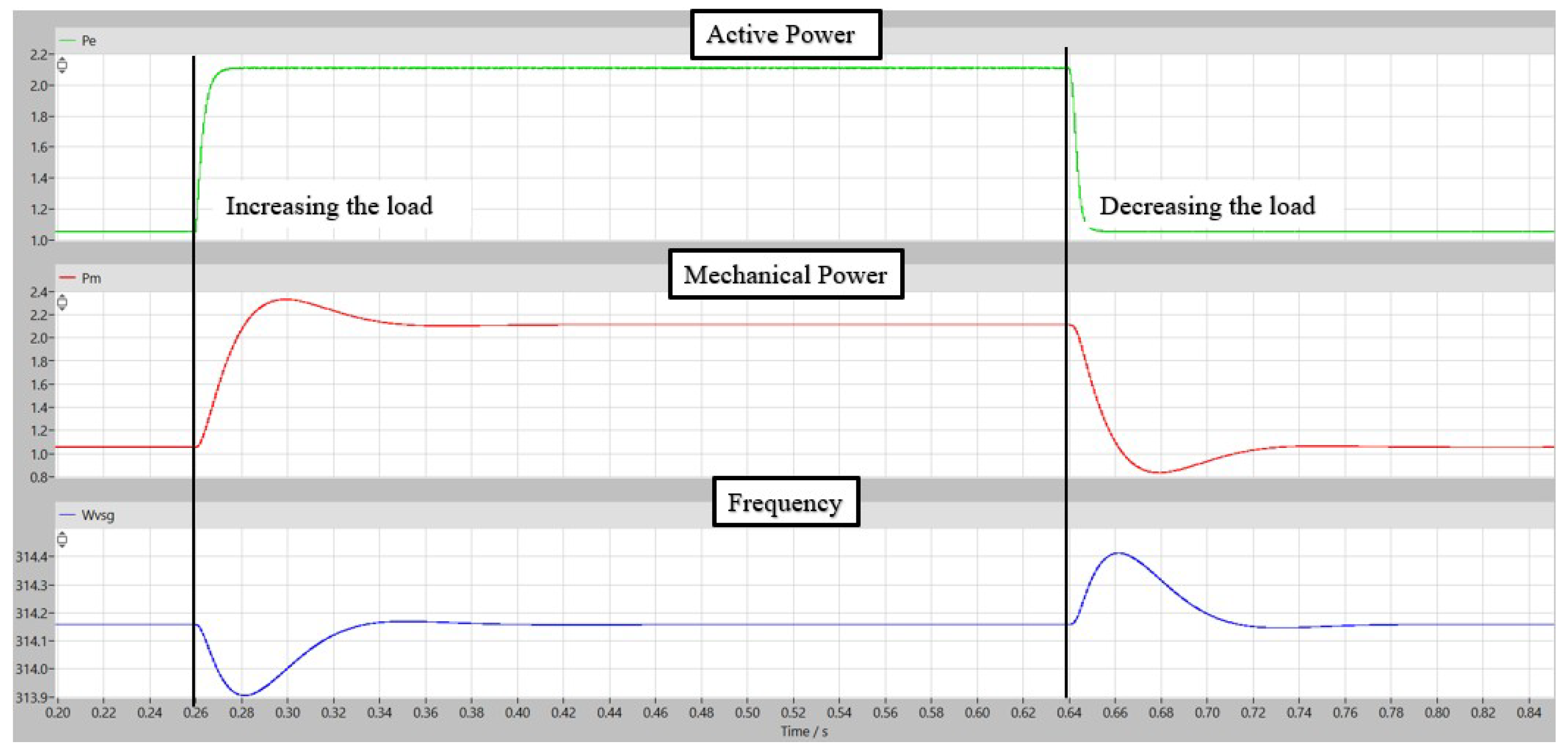
The model was validated by observing a realistic swing transient in the output frequency, with an initial deviation followed by gradual recovery, as predicted by the analytical swing-equation model and shown in
Figure 4.
3. Small-Signal Stability Analysis
To support the time-domain simulations with an analytical interpretation, a reduced-order small-signal stability analysis is conducted. The model is linearized around an operating point to isolate the dominant active power–frequency dynamics and to show how different load models affect the effective damping and stability margin of the VSG.
3.1. Dynamic Model of VSG
The basic concept of operating the VSG control is based on the simulation of the synchronous generator swing equation:
Here,
The droop mechanism is implemented as follows:
where
is the droop gain (pu/Hz).
We consider the above components and substitute them into the following swing equation:
3.2. Linearization Around Operating Point
Let the operating equilibrium satisfy
Define the small perturbations
This equation represents the first-order frequency dynamics of the VSG.
3.3. Load Modeling for Small-Signal Analysis
In order to clarify the effect of specific loads, we model their incremental power behavior.
3.3.1. Resistive Load (R Load)
For resistive loads, the voltage–frequency coupling is weak, and the incremental power response generally contributes a passive damping effect. Therefore, the Z-load case is expected to be comparatively stable and is used as the reference case for the later simulations.
3.3.2. ZIP Load
For a constant current load,
The load behaves as moderate impedance and introduces limited destabilizing interaction.
3.3.3. Constant Power Load (CPL)
For a constant power load,
To maintain constant power,
Small-signal linearization yields
Thus, CPL behaves as a negative incremental impedance:
This negative impedance characteristic reduces effective damping and can destabilize the VSG system.
3.4. Characteristic Equation and Stability Condition
Combining VSG frequency dynamics with load dynamics, the small-signal system can be expressed as
where
represents load-induced power perturbation. Here,
represents the load-dependent power perturbation term. For constant power loads, this term is denoted as
to highlight its negative incremental impedance characteristic. The characteristic equation becomes
For stability,
which requires
For a CPL, since
, the stability condition becomes
The mathematical solution confirms the assertion that an increase in the moment of inertia, (M), reduces oscillatory behavior and that an increase in the damping coefficient, (D), increases the margin of stability, more so at constant power load (CPL) conditions.
The small-signal model presented here is intentionally reduced in order to isolate the dominant active-power–frequency dynamics of the VSG under different load types. In this formulation, the coupling between active and reactive power and the detailed voltage-loop dynamics are not fully included; this simplification allows a clear engineering stability condition to be obtained for comparing constant impedance (Z), constant power load (CPL), and composite ZIP load behavior.
However, the effect of voltage dynamics is indirectly captured through the load-dependent power perturbation term , particularly in the CPL case where voltage variation results in negative incremental impedance. A more complete theoretical assessment could be achieved by employing a full-order state-space model that includes P–Q coupling, voltage-loop dynamics, filter states, and eigenvalue analysis. This is identified as an important extension for future work.
Based on the derived stability condition, a practical tuning guideline can be established. For constant power loads (CPLs), which exhibit negative incremental impedance, the damping coefficient D must be selected such that it compensates for the destabilizing effect of the load, satisfying the condition .
The virtual inertia M can then be adjusted to shape the transient response, particularly to limit the rate of change of frequency (ROCOF) and improve settling behavior. This provides a stability-guided basis for parameter selection by linking controller tuning directly to load characteristics rather than relying only on trial-and-error simulation.
4. DC Energy Storage Considerations
The VSG uses converter control to emulate the inertial response of a synchronous machine. In a practical implementation, however, the emulated inertial energy must be supplied by the DC-side source, such as a battery energy storage system or DC-link capacitor. The simulations in this paper assume an ideal stiff DC source so that the effect of load dynamics on the VSG control can be isolated. This assumption is useful for comparison, but it does not remove the practical power and energy limits of the DC-side source.
In an actual implementation, the DC source must provide the inertial power
and the associated energy requirement over a disturbance interval is
Therefore, the achievable virtual inertia is constrained by the available stored energy, the DC-link dynamics, and the inverter current and power ratings. If the selected inertia or damping values require transient power beyond these limits, current saturation or DC-link voltage deviation can occur.
Consequently, practical VSG parameter selection must satisfy both the stability requirement and the physical limits of the energy source and converter. When the required inertial power exceeds the available limit, the inverter cannot maintain both voltage and frequency indefinitely. The resulting response depends on the load type—constant-impedance loads may settle at a reduced voltage level, whereas CPL-dominated loads may experience voltage collapse or instability. Detailed battery state-of-charge and DC-link dynamic modelling is outside the scope of the present paper and is identified as a future extension.
5. Load Modeling
5.1. Constant Impedance (Z) Load
For a linear impedance load with equivalent per-phase impedance represented by
It is shown that, for a constant impedance, and
5.2. Constant Power (CPL) Load
A constant-power load, by definition, maintains constant active power,
, regardless of the terminal voltage, V. The equivalent is a single-phase resistive one:
If we want
(constant), then we can rearrange to make
For a three-phase balanced load, the total active power is
Therefore, the variable resistance must satisfy
5.3. ZIP Load
In the case of a three-phase load with a phase RMS voltage V that is sufficiently close to the nominal voltage
, the ZIP active-power model can be given in the form of a weighted polynomial
with the constraint
where
Z: constant-impedance component ;
I: constant-current component ;
P: constant-power component
To provide commonality and consistency in the selection of parameters between the various simulation scenarios, a master summary of all the controller, filter, and load parameters is provided in
Table 3. The table differentiates between baseline settings, untuned comparative test settings, and tuned settings used in cases of CPL and ZIP.
6. Transient Performance Under Load Step
To enable a quantitative evaluation of system performance under different load conditions, the following key performance indicators (KPIs) are used: (i) rate of change of frequency (ROCOF), defined as the maximum absolute slope of the frequency response after the disturbance (Hz/s); (ii) frequency nadir, defined as the minimum frequency reached after the disturbance (Hz); (iii) settling time, defined as the time required for the frequency response to return to and remain within a specified tolerance band around steady state (s); and (iv) voltage deviation, defined as the maximum departure of RMS voltage from its nominal value (V or pu). These measures provide a consistent basis for comparing transient stability across the load models.
A 10% load increase was applied at
s for all three loads using identical untuned VSG parameters:
s,
pu,
V/pu, and initial active power
kW.
Table 4 summarizes the three test scenarios. Each case uses a specific load model and the same disturbance condition to evaluate the VSG response to voltage-dependent demand and constant-power behavior.
6.1. Case 1: Z-Load Response
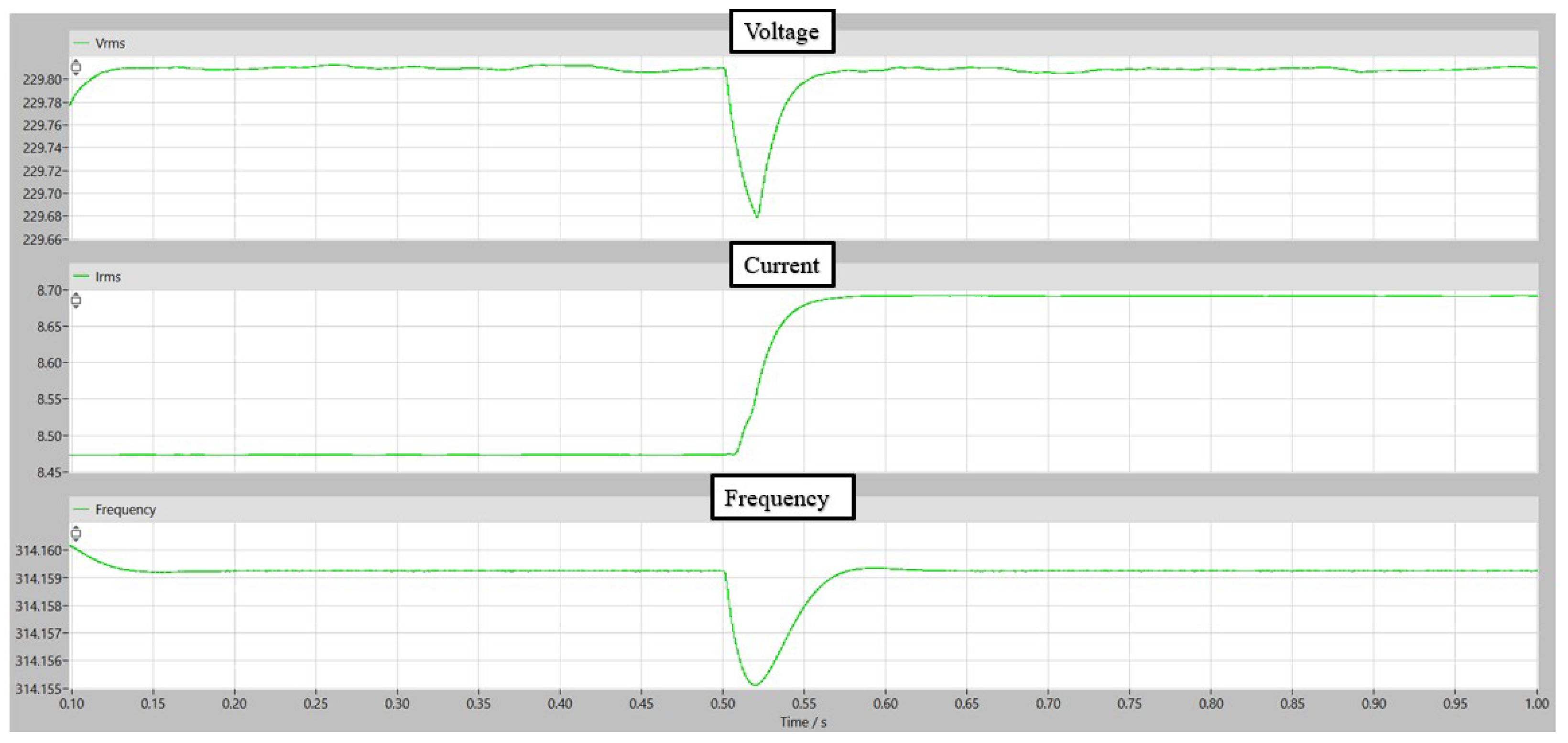
The Z-load case is the test case that is used as a base case of a VSG system. With this arrangement, the current through the load is linearly dependent on the applied voltage, and the power consumption is proportional to the square of the magnitude of the voltage. Therefore, it will give a stable and purely passive loading condition, which can be used to assess the basic voltage and frequency control capability of the VSG.
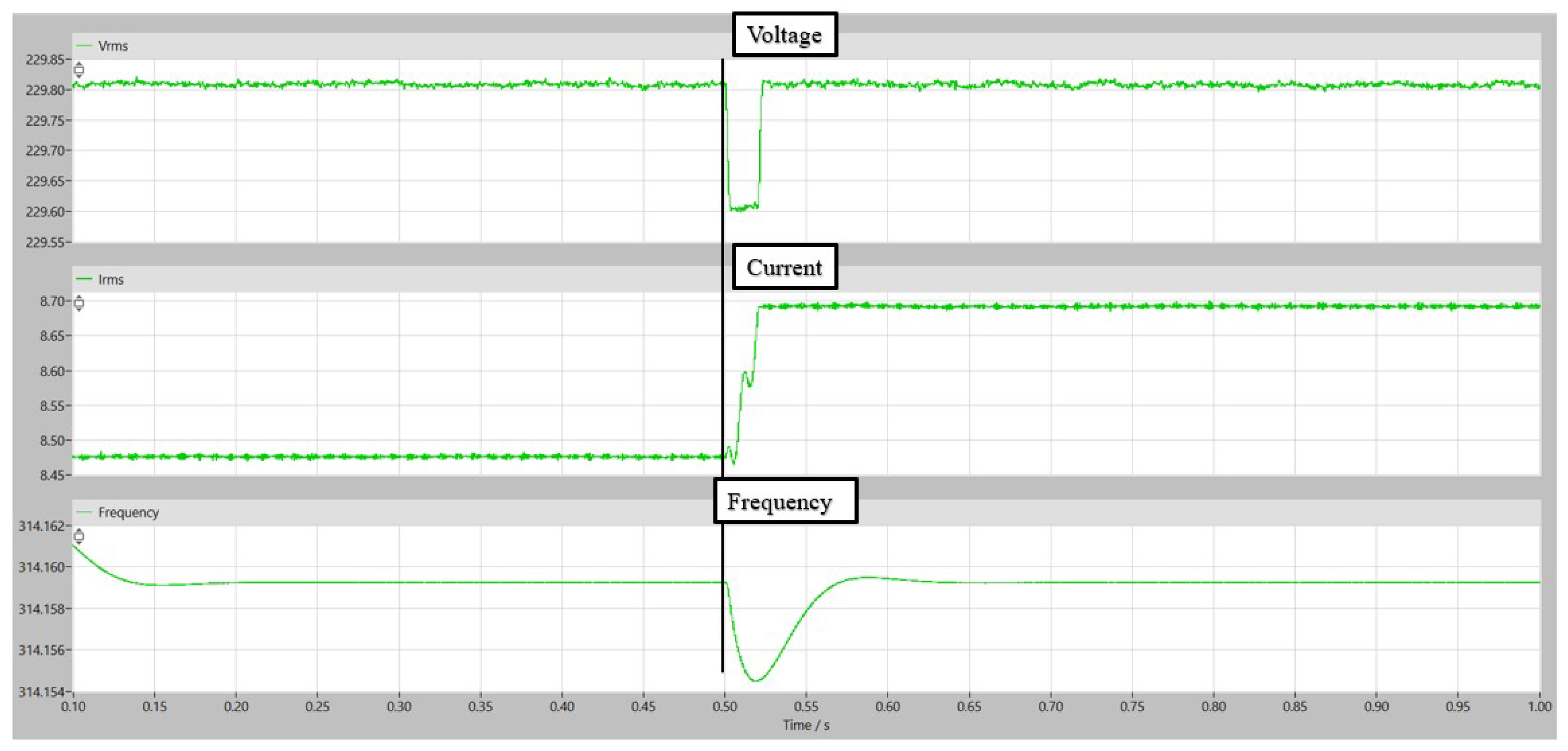
Figure 5 shows the RMS voltage, RMS current, and frequency response of the Z-load case. The system remains stable during the load transition because the resistive component provides inherent damping. The VSG produces a short frequency excursion at
s due to the active-power imbalance, and the damping term
mitigates the transient. The Z-load case has a low ROCOF of approximately 0.5 Hz/s, a frequency nadir of approximately 49.8 Hz, and a settling time of approximately 0.2 s, indicating a stable and well-damped response.
6.2. Case 2: CPL Response
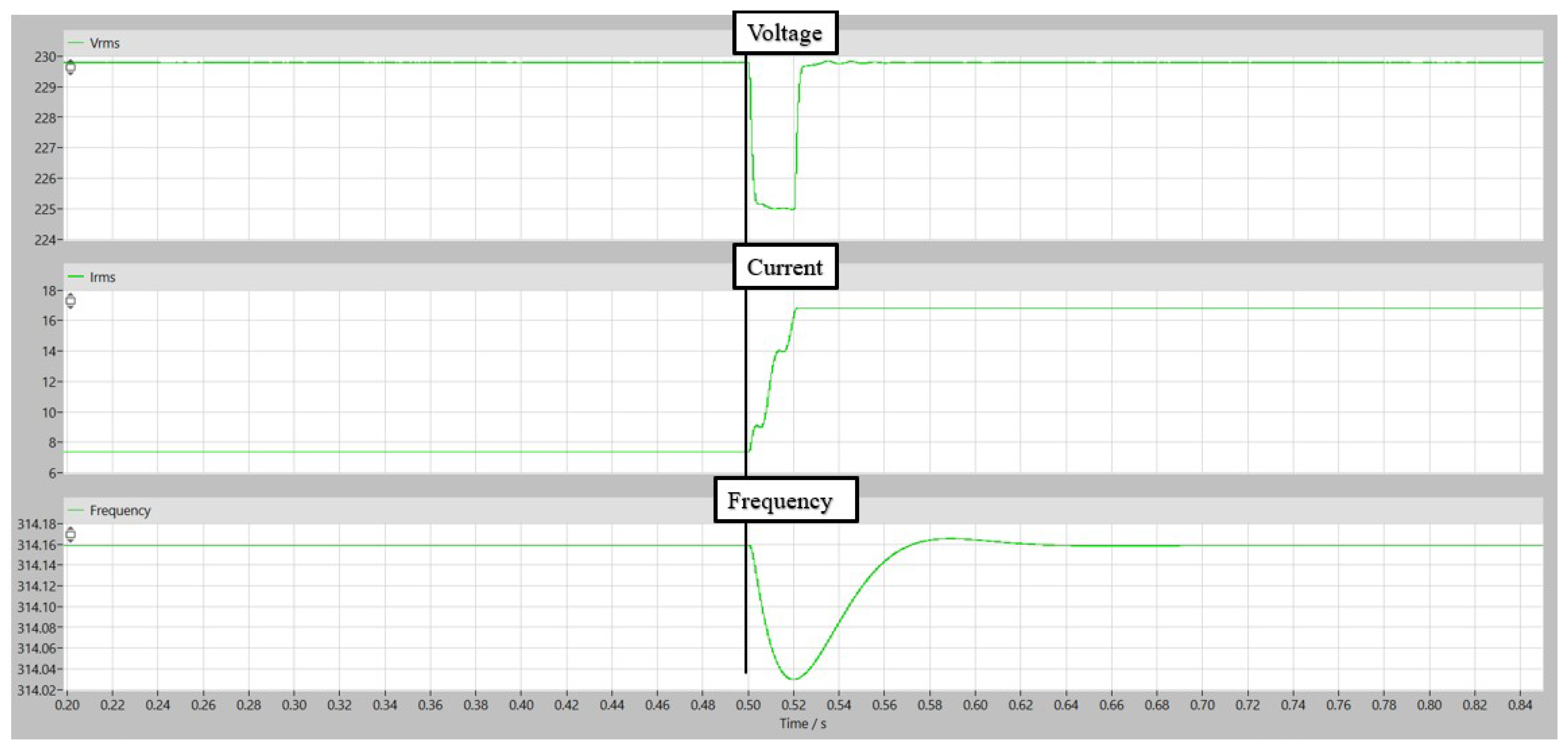
The CPL case is the most challenging test condition because the load attempts to maintain constant active power despite voltage variations. This behavior introduces negative incremental impedance, which can reduce the effective damping of the VSG system and may lead to oscillation or instability.
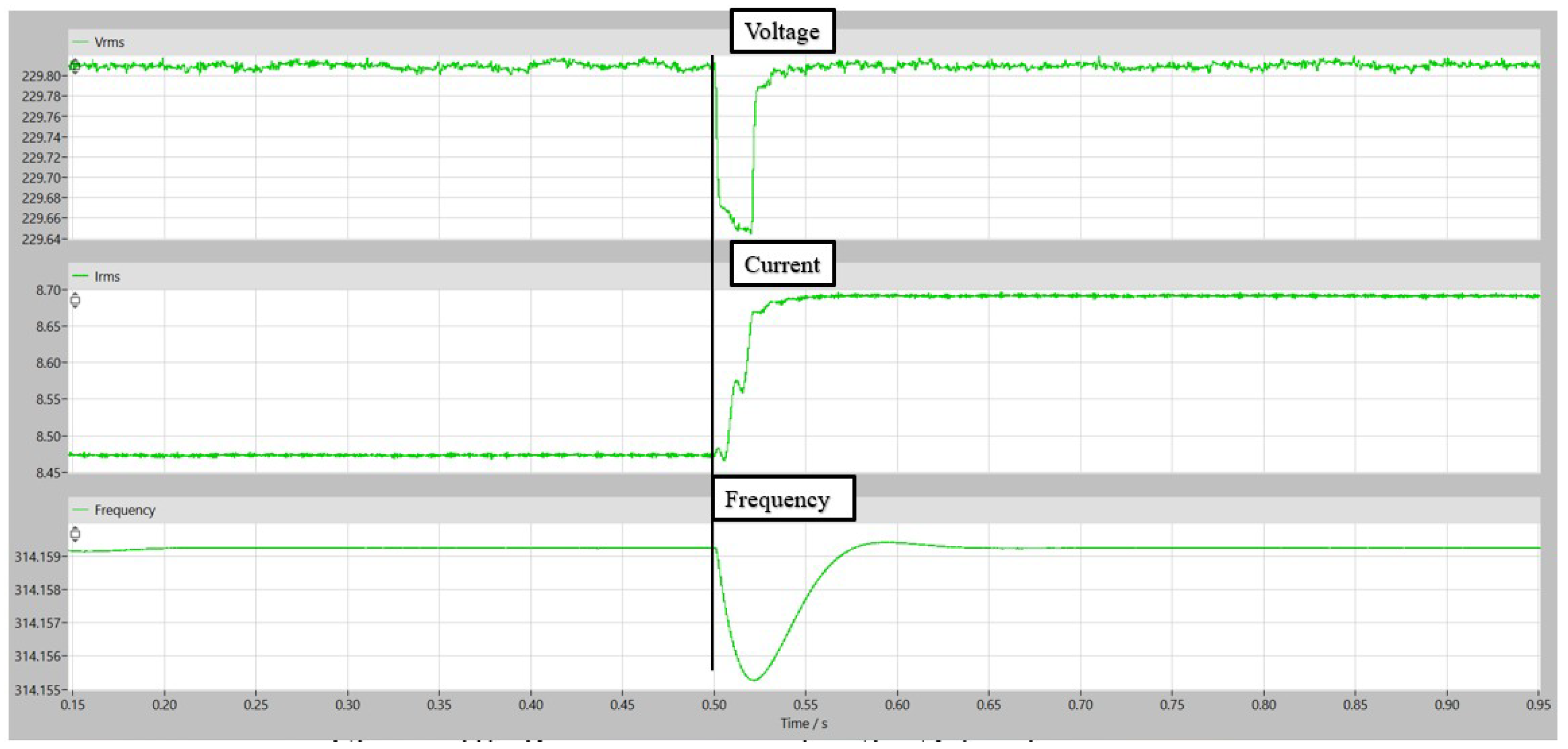
Figure 6 illustrates the RMS voltage, RMS current, and frequency response of the VSG under the untuned CPL condition.
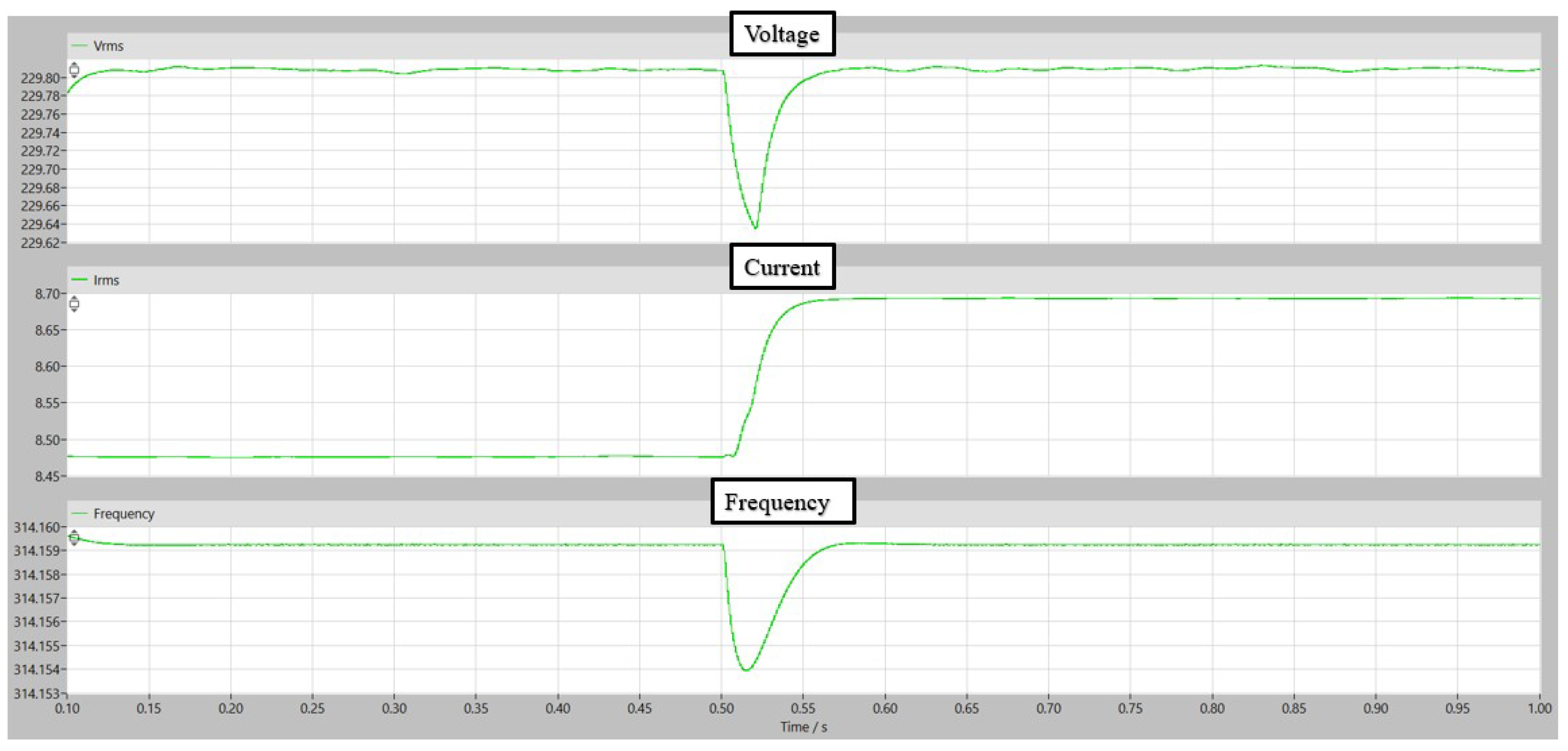
The negative incremental impedance of the CPL creates an oscillatory tendency and can drive the system toward instability. The tuning changes are summarized in
Table 5, and the resulting response is shown in
Figure 7.
After tuning, the voltage recovers without a secondary dip, the current reaches its new steady-state value more smoothly, and the frequency nadir is improved. The untuned CPL case exhibits a high ROCOF of approximately 2.5 Hz/s and a frequency nadir of approximately 48.5 Hz, with persistent oscillatory behavior. After tuning, ROCOF is reduced to approximately 1.0 Hz/s, the frequency nadir improves to approximately 49.5 Hz, and the settling time is approximately 0.3 s.
6.3. Case 3: ZIP Response
The ZIP load case represents a more realistic mixed-load condition because it combines voltage-dependent impedance (Z), current (I), and power (P) components. Consumer loads in microgrids are rarely purely resistive or purely constant-power; instead, they often contain a combination of these behaviors. Therefore, the VSG was tested with a ZIP load to evaluate voltage and frequency regulation under nonlinear and voltage-sensitive demand conditions.
The ZIP load model used in this study consisted of three weighted components defined as
such that
Figure 8 illustrates the measured voltage, current, and frequency response under the ZIP load. Compared with the purely resistive Z-load, the ZIP load introduces moderate coupling among voltage, current, and active power. During the voltage dip, the current-dependent component produces a temporary increase in real-power demand, which is mitigated by the virtual inertia action of the VSG. The ZIP case shows intermediate behavior, with a ROCOF value of approximately 0.8 Hz/s, a frequency nadir of approximately 49.6 Hz, and a settling time of approximately 0.25 s.
6.3.1. Parameter Tuning
The nonlinear relation between load power and voltage introduces moderate coupling between active and reactive power exchange. To reduce the low-frequency oscillations observed in the ZIP response, the damping coefficient
D was increased to 0.09, and the virtual inertia
M was increased to 40, as shown in
Figure 9. The ZIP coefficients were kept unchanged, so the improved response is due to the VSG control parameter tuning rather than a change in load composition. After tuning, the voltage ripple is reduced, the current reaches its new operating point without additional oscillations, and the frequency deviation converges more rapidly.
These results show that although the ZIP load is less destabilizing than the CPL case, increasing virtual damping and inertia improves the smoothness and physical realism of the dynamic response.
The ZIP load composition is unchanged before and after tuning; therefore, the improvement in stability is attributed to the tuning of the VSG control parameters summarized in
Table 6.
A summary table is included below (
Table 7) for all three different load compositions.
The quantitative comparison shows that the CPL condition produces the largest instability, as indicated by it having the highest ROCOF and lowest frequency nadir. Proper tuning significantly improves the CPL response. The ZIP load exhibits intermediate behavior, while the Z-load remains the most stable because of its passive impedance characteristic.
6.3.2. Comparative Analysis of Load Models
To assess VSG performance under different load characteristics, all three load models were tested under the same operating conditions and the same load-step disturbance.
Table 8 presents the steady-state and transient values obtained from each test.
Z-loads provide the most stable and predictable response, with negligible overshoot and rapid recovery to nominal operating conditions. ZIP-load effects are moderate and can be mitigated by the VSG voltage and frequency regulation loops. CPLs are the most challenging because their negative incremental impedance reduces effective damping; therefore, additional virtual damping and appropriate virtual inertia are required to maintain stable operation. These results confirm that load characteristics play a central role in VSG tuning, especially in microgrids with a high share of electronically controlled constant-power loads.
7. Conclusions
This study analyzed the behavior of a VSG-controlled inverter under Z-, CPL, and ZIP load conditions. The proposed VSG model reproduces the inertial and damping behavior of synchronous machines through a virtual swing equation, governor-based active power–frequency control, and voltage–reactive-power droop control. The unified modelling framework enables the dynamic influence of three representative load models, constant impedance (Z), constant power load (CPL), and composite ZIP load, to be compared under identical system and disturbance conditions.
The results show that virtual inertia, damping, and droop coefficients are critical for maintaining stable VSG behavior under different load models. Z-loads are comparatively insensitive to retuning because of their passive impedance characteristic. CPLs, however, introduce negative incremental impedance and therefore require sufficient damping and appropriate virtual inertia to reduce oscillatory responses. The ZIP case shows intermediate behavior because only part of the load behaves as constant power.
The quantitative results confirm these trends. The Z-load case has a low ROCOF of approximately 0.5 Hz/s, a frequency nadir of approximately 49.8 Hz, and a settling time of approximately 0.2 s. The untuned CPL case is significantly less stable, with the ROCOF reaching approximately 2.5 Hz/s and the frequency nadir falling to approximately 48.5 Hz. After tuning, the CPL response improves, with the ROCOF reduced to approximately 1.0 Hz/s and a settling time of approximately 0.3 s. The ZIP load case shows intermediate behavior, with a ROCOF value of approximately 0.8 Hz/s and a settling time of approximately 0.25 s. These results demonstrate that appropriate tuning of virtual inertia and damping improves the stability of VSG operation under different load conditions.
The reduced-order stability interpretation provides a practical tuning guideline: the damping contribution must exceed the destabilizing CPL term, expressed as , while M is selected to shape ROCOF and settling behavior. This study also highlights that emulated inertia is constrained by the DC-side energy source and converter current limits. Future work will extend the present framework to include full DC-link and battery dynamics, eigenvalue validation of a full-order state-space model, and dynamic load-transition scenarios such as Z-to-CPL and ZIP-to-CPL operation.