
Value-Based Encroachment Strategy for Electric and Autonomous Vehicles: Evidence from Kuwait



Abstract
1. Introduction
1.1. The State of Kuwait and the Gulf Market
1.2. Technological Background: Electric and Autonomous Vehicles
2. Materials and Methods
2.1. The Multidimensional Construct of Value
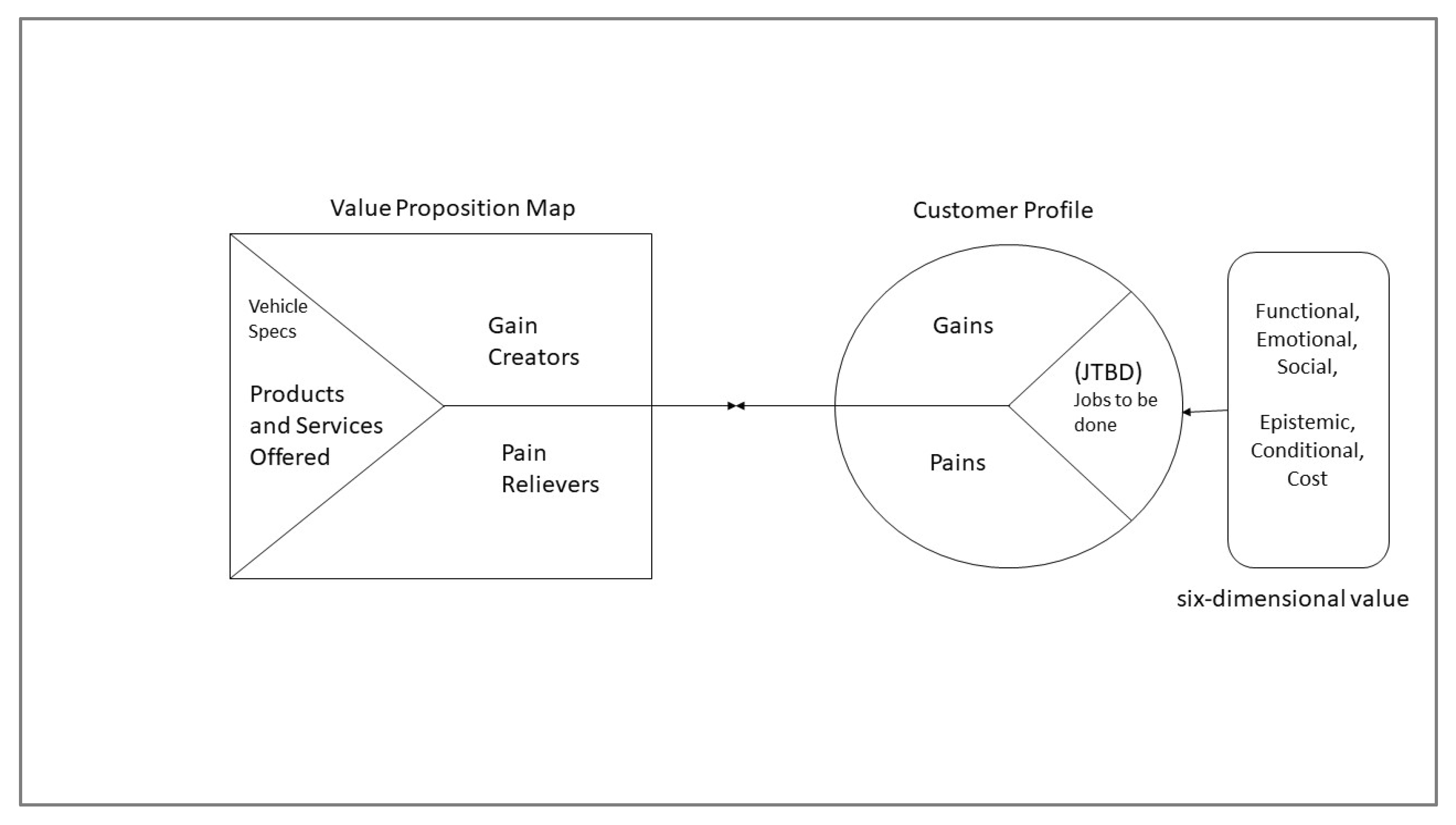
2.2. The Value Proposition Canvas
2.3. Technology Adoption and Encroachment Strategies
2.4. Propositions
2.5. Methodology
3. Results
3.1. Adoption of EVs Versus HEVs and PHEVs
“I tried using public charging stations; there are only a few in Kuwait... I prefer using my electric car for short trips like going to supermarkets and dropping kids”.(Respondent 12)
“I’m a Porsche guy through and through. Right now, I roll with a Cayenne, but I’ve got my eye on the new Macan 4S electric—sleek, elegant, and worth a try. Don’t get me wrong though, the Cayenne is my baby; I’m not letting it go”.(Respondent 37)
3.2. Market Encroachment Strategy
3.3. Autonomous Transportation: From Consumer Resistance to Industrial Utility
4. Discussion
4.1. Mapping Value Propositions to the Consumer Profile
4.2. Diverged Engagement: Prestige vs. Portability
4.3. The Dual-Encroachment Strategy of Chinese High-Tech Vehicles
4.4. Autonomous Vehicles: Consumer Skepticism vs. Industrial Opportunities
4.5. Actionable Policy: The Automotive Innovation Sandbox
4.6. Strategic Implications for the GCC Region
4.7. Limitations and Future Work
5. Conclusions
Author Contributions
Funding
Institutional Review Board Statement
Informed Consent Statement
Data Availability Statement
Acknowledgments
Conflicts of Interest
References
- Athanasopoulou, L.; Bikas, H.; Papacharalampopoulos, A.; Stavropoulos, P.; Chryssolouris, G. An industry 4.0 approach to electric vehicles. Int. J. Comput. Integr. Manuf. 2023, 36, 334–348. [Google Scholar] [CrossRef]
- Fedotov, P. Critical Analysis of the Electric Vehicle Industry: Five forces and strategic action fields. Exch. Interdiscip. Res. J. 2022, 10, 43–56. [Google Scholar] [CrossRef]
- Asna, M.; Deb, S.; Shareef, H. Re-Envisioning Electric Vehicle Charging Infrastructure and Sustainable Energy Transitions in the Gulf Cooperation Council Countries. Energies 2026, 19, 1367. [Google Scholar] [CrossRef]
- Chaziza, M. Electric Vehicle Market: A New Arena for Cooperation between China and Gulf Cooperation Council States. Asian Perspect. 2024, 48, 525–548. [Google Scholar] [CrossRef]
- Balaji, A.K.; Soori, P.K. Sustainable transportation infrastructure for smart cities in the gulf cooperation council: The case of electric vehicle charging. In Smart Cities in the Gulf: Current State, Opportunities, and Challenges; Springer Nature: Singapore, 2018; pp. 107–121. [Google Scholar]
- Ottesen, A.; Banna, S.; Alzougool, B. Attitudes of drivers towards electric vehicles in Kuwait. Sustainability 2022, 14, 12163. [Google Scholar] [CrossRef]
- Büttner, C. Transformation: Acceptance factors for electrifying corporate fleets in service companies—An extension of the UTAUT and an empirical study with decision-makers. Eur. Transp. Res. Rev. 2025, 17, 43. [Google Scholar] [CrossRef]
- Chonsalasin, D.; Champahom, T.; Limpasirisuwan, N.; Jomnonkwao, S.; Ratanavaraha, V. Urban-Rural Differences in Electric Vehicle Adoption Intentions: Integrated TAM, TPB, UTAUT with Environmental Identity. Civ. Eng. J. 2025, 11, 1891–1923. [Google Scholar] [CrossRef]
- Coffman, M.; Bernstein, P.; Wee, S. Electric vehicles revisited: A review of factors that affect adoption. Transp. Rev. 2017, 37, 79–93. [Google Scholar] [CrossRef]
- Dash, A. Determinants of EVs adoption: A study on green behavior of consumers. Smart Sustain. Built Environ. 2021, 10, 125–137. [Google Scholar] [CrossRef]
- Hidayatullah, M.I.; Sumarwan, U. A Comprehensive Analysis of the Factors Influencing Electric Vehicle Purchase Intentions in Indonesia: A Study Based on the UTAUT 2 Model. J. Appl. Bus. Manag./J. Apl. Bisnis Dan Manaj. 2025, 11, 818. [Google Scholar] [CrossRef]
- Qingxiong, M. The Technology Acceptance Model: A Meta-Analysis of Empirical Findings. J. Organ. End User Comput. 2004, 16, 59–72. [Google Scholar]
- Sindi, H.F.; Ul-Haq, A.; Hassan, M.S.; Iqbal, A.; Jalal, M. Penetration of electric vehicles in Gulf region and its influence on energy and economy. IEEE Access 2021, 9, 89412–89431. [Google Scholar] [CrossRef]
- Ali Bahbahani Partners. Kuwait Automotive Market 2025: Sales & Key Trends. Alibahbahani Blogs. Available online: https://www.alibahbahani.com/blogs/kuwait-automotive-market-2025 (accessed on 18 May 2026).
- Worldometer. Kuwait Population. Available online: https://www.worldometers.info/world-population/kuwait-population/ (accessed on 18 May 2026).
- Public Authority for Civil Information. Statistical Report. 2025. Available online: https://data.worldbank.org/country/kuwait/ (accessed on 18 May 2026).
- Measured World. Kuwait Economic Statistics. Available online: https://measuredworld.com (accessed on 18 May 2026).
- Ken Research. Kuwait New and Used Vehicle Market Outlook to 2030. Available online: https://kenresearch.com (accessed on 18 May 2026).
- Verified Market Research. Kuwait Used Car Market Size and Forecast. Available online: https://verifiedmarketresearch.com (accessed on 18 May 2026).
- Kuwait News. 30 December 2025. Kuwait Sets Fixed Gasoline Prices for 3 Months. Available online: https://timeskuwait.com (accessed on 18 May 2026).
- Gulf News. 17 August 2024. Kuwait Explores Fuel Subsidy Reforms. Available online: https://gulfnews.com (accessed on 18 May 2026).
- Mordor Intelligence. GCC Electric Vehicle Market—Size, Share & Industry Analysis: Growth Trends and Forecasts (2026–2031). Available online: https://www.mordorintelligence.com/industry-reports/gcc-electric-vehicle-market (accessed on 18 May 2026).
- International Energy Agency (IEA). Global EV Outlook 2025: Trends in Electric Car Markets. Available online: https://www.iea.org/reports/global-ev-outlook-2025 (accessed on 18 May 2026).
- Hamwi, H.; Alasseri, R.; Aldei, S.; Al-Kandari, M. A pilot study of electrical vehicle performance, efficiency, and limitation in Kuwait’s harsh weather and environment. Energies 2022, 15, 7466. [Google Scholar] [CrossRef]
- Ottesen, A.; Toglaw, S.; AlQuaoud, F.; Simovic, V. How to Sell Zero Emission Vehicles when the Petrol is almost for Free: Case of Kuwait. J. Manag. Sci. 2022, 9, 1–20. [Google Scholar] [CrossRef]
- Alternative Fuels Data Center (AFDC). Electric Vehicle Charging Stations; U.S. Department of Energy, Office of Energy Efficiency & Renewable Energy: Washington, DC, USA, 2024. Available online: https://afdc.energy.gov/fuels/electricity-stations (accessed on 18 May 2026).
- SAE International. J3016_202104: Taxonomy and Definitions for Terms Related to Driving Automation Systems for On-Road Motor Vehicles. Warrendale, PA, USA, 2021. Available online: https://www.sae.org/standards/content/j3016_202104/ (accessed on 18 May 2026).
- Weiss, M.; Zerfass, A.; Helmers, E. Fully electric and plug-in hybrid cars: An analysis of learning rates, user costs, and costs for mitigating CO2 and air pollutant emissions. J. Clean. Prod. 2019, 212, 1478–1489. [Google Scholar] [CrossRef]
- Deloitte. 2026 Global Automotive Consumer Study: Key Findings on Powertrain Preferences and Charging Infrastructure; Deloitte Development LLC: Oakland, CA, USA, 2026; Available online: https://www.deloitte.com/us/en/about/press-room/deloitte-launches-gacs.html (accessed on 18 May 2026).
- Venkatesh, V.; Morris, M.G.; Davis, G.B.; Davis, F.D. User acceptance of information technology: Toward a unified view. MIS Q. 2003, 27, 425–478. [Google Scholar] [CrossRef]
- Ottesen, G.G.; Berg, A.J. Sustainable mobility transitions in oil-rich economies: The case of the Gulf Cooperation Council. Energy Res. Soc. Sci. 2022, 91, 102713. [Google Scholar] [CrossRef]
- Toglaw, S.; Aloqaily, M. Connected, Autonomous, Electric Vehicles: The Optimum Value for a Successful Business Model. In Proceedings of the IEEE—The Fifth International Conference on Internet of Things: Systems, Management and Security (IoTSMS 2018), Valencia, Spain, 15–18 October 2018. [Google Scholar]
- Sheth, J.N.; Newman, B.I.; Gross, B.L. Why we buy what we buy: A theory of consumption values. J. Bus. Res. 1991, 22, 159–170. [Google Scholar] [CrossRef]
- Sweeney, J.C.; Soutar, G.N. Consumer perceived value: The development of a multiple item scale. J. Retail. 2001, 77, 203–220. [Google Scholar] [CrossRef]
- Smith, J.B.; Colgate, M. Customer value creations: A practical framework. J. Mark. Theory Pract. 2007, 15, 7–23. [Google Scholar] [CrossRef]
- Osterwalder, A.; Pigneur, Y.; Bernarda, G.; Smith, A. Value Proposition Design: How to Create Products and Services Customers Want; John Wiley & Sons, Inc.: Hoboken, NJ, USA, 2014. [Google Scholar]
- Pedreño-Santos, A.; García-Madariaga, J. A conceptual framework for customer value management. Rev. Mark. Public. 2022, 5, 43–65. [Google Scholar] [CrossRef]
- Park, J. Recent trends in the public acceptance of autonomous vehicles: A review. Vehicles 2025, 7, 45. [Google Scholar] [CrossRef]
- Kainth, J.S.; Verma, H.V. Consumer perceived value: Construct apprehension and its evolution. J. Adv. Soc. Res. 2011, 1, 20–57. [Google Scholar]
- Osterwalder, A.; Pigneur, Y.; Tucci, C.L. Clarifying business models: Origins, present, and future of the concept. Commun. Assoc. Inf. Syst. 2005, 16, 1–25. [Google Scholar] [CrossRef]
- Anton, T.S.; Trupp, A.; Stephenson, M.L.; Chong, K.L. The Technology Adoption Model Canvas (TAMC): A smart framework to guide the advancement of microbusinesses in emerging economies. Smart Cities 2023, 6, 3297–3318. [Google Scholar] [CrossRef]
- Davis, F.D. Perceived usefulness, perceived ease of use, and user acceptance of information technology. MIS Q. 1989, 13, 319–340. [Google Scholar] [CrossRef]
- Alzahrani, K.A.; Hall-Ellis, S.D.; Al-Samarraie, H. Factors influencing consumers’ intentions to adopt electric vehicles in the Gulf Cooperation Council countries. J. Clean. Prod. 2019, 218, 818–833. [Google Scholar] [CrossRef]
- Ahmed, S.; Al-Ghamdi, S.G. Adoption of electric vehicles in the GCC: A technology acceptance model approach. Sustainability 2021, 13, 12177. [Google Scholar] [CrossRef]
- Schmidt, G.M. Low-end and high-end encroachment strategies for new products. Int. J. Innov. Manag. 2004, 8, 167–191. [Google Scholar] [CrossRef]
- Van Orden, J.; van der Rhee, B.; Schmidt, G.M. Encroachment patterns of the “best products” from the last decade. J. Prod. Innov. Manag. 2011, 28, 726–743. [Google Scholar] [CrossRef]
- Benzidia, A.; Luca, R.; Boika, A. Disruptive innovation, business models, and encroachment strategies: Buyer’s perspective on electric and hybrid vehicle technology. Technol. Forecast. Soc. Change 2021, 165, 120520. [Google Scholar] [CrossRef]
- Al-Buenain, A.; Al-Kuwari, M.; Al-Marri, S. The impact of environmental policy on the Gulf automotive market. Gulf Econ. Rev. 2021, 12, 88–104. [Google Scholar]
- GLMM—Gulf Labor Markets, Migration and Population. 2024. Available online: https://gulfmigration.grc.net/ (accessed on 18 May 2026).
- Cao, Y.; Zhao, C.; Zhang, Y.; Jin, Y. Optimizing resource allocation and energy efficiency in vehicle mobile-edge computing with blockchain integration. IEEE Internet Things J. 2025, 12, 36807–36818. [Google Scholar] [CrossRef]



| Type | Full Term | Description |
|---|---|---|
| BEV | Battery Electric Vehicle | 100% electric; no tailpipe; no engine (e.g., Tesla, BYD Seal). |
| PHEV | Plug-in Hybrid Electric Vehicle | Contains a plug for electric charge and a gas tank. Can drive 50–80 km on electricity alone. |
| HEV | Hybrid Electric Vehicle | “Self-charging” (e.g., standard Prius). No plug; the engine charges the small battery. |
| NEV | New Energy Vehicle | The umbrella term in China for all plug-in cars (e.g., BEV + PHEV). |
| Charge Level | Electric Current | Typical Power kW | BEV Charge Time | PHEV Charge Time | Best Use |
|---|---|---|---|---|---|
| Level 1 | AC | 1.3–2.4 | 30–50 h | 6–10 h | Emergency/low mileage |
| Level 2 | AC | 7–22 | 6–10 h | 1.5–3 h | Home/work/overnight |
| Level 3 | DC | 50–150 | 30–50 min | N/A | Quick top-ups at shopping centers |
| Ultra-Fast | DC | 250–400 | 12–20 min | N/A | Highway fast stations |
| Level of Autonomy | Description | |
|---|---|---|
| L1 | Driver Support Systems | Assist with steering and acceleration (adaptive cruise control). |
| L2 | Vehicle controls steering and braking (basic autopilot). Driver must monitor. | |
| L3 | Conditional Automation | Vehicle manages most driving tasks in limited scenarios (e.g., traffic jams) but requires driver intervention when prompted. |
| L4 | High Automation | Vehicle can operate independently in specific environments (e.g., geo-fenced urban areas). |
| L5 | Full Automation | Vehicle performs all driving tasks under all conditions, with no human input required. |
| Value Dimension | Description |
|---|---|
| Functional Value | Practical utility and performance of a product (e.g., desiring a hybrid car for fuel efficiency and low maintenance cost). |
| Social Value | The product’s ability to enhance social image or status (for example, driving a BMW or Porsche Taycan signals prestige and modernity). |
| Emotional Value | Emotional attachment and positive feelings for the product and its consumption (for example, the excitement, love, affection, and pride associated with owning a luxury BYD or Tesla EV with cutting-edge technology). |
| Epistemic Value | The value attached to knowing and experiencing a new product. It captures the consumer motivation to try something new because they want to learn, explore, or experience an innovation (for example, consumers buying high-tech cars with advanced levels of autonomy and AI-enabled features to experience new technology). |
| Conditional Value | Value derived from specific circumstances or contexts (for example, a customer choosing an SUV for desert driving or buying a pickup truck for specific purposes). |
| Functional Value (Instrumental) | How Functional/Useful a Product Is at Fulfilling a Customer’s Desired Goal. This Can Be Extended by Process Simplifiers to Offer Simple and Easy Solutions to Customers. |
|---|---|
| Symbolic Value (Expressive) | The value derived from the psychological meanings associated with a product (e.g., companies that develop a strong brand name focusing on style or an image that suggests the customer’s lifestyle). |
| Experiential Value (Hedonic) | The extent to which a product creates a good experience for a customer and appeals to their hedonic consumption based on sensory pleasure. |
| Cost Value (Sacrifice) | The focus on value for money. Companies that act as price minimizers offer value based on lower price. |
| Value Dimension | Extension of Value Dimensions |
|---|---|
| Functional value | Engagement can provide practical benefits (e.g., loyalty points, exclusive offers). |
| Social value | Through engagement with the product, customers gain recognition by being part of a brand community. |
| Emotional value | Engagement creates feelings of belonging, excitement, or pride (e.g., sharing EV experiences online). |
| Epistemic value | Customers learn and satisfy their curiosity through engagement (e.g., attending EV demo events, testing autonomous shuttles). |
| Conditional value | Engagement is related to a specific condition (e.g., operating an autonomous vehicle in a controlled area at the airport). |
Disclaimer/Publisher’s Note: The statements, opinions and data contained in all publications are solely those of the individual author(s) and contributor(s) and not of MDPI and/or the editor(s). MDPI and/or the editor(s) disclaim responsibility for any injury to people or property resulting from any ideas, methods, instructions or products referred to in the content. |
© 2026 by the authors. Published by MDPI on behalf of the World Electric Vehicle Association. Licensee MDPI, Basel, Switzerland. This article is an open access article distributed under the terms and conditions of the Creative Commons Attribution (CC BY) license.
Share and Cite
Toglaw, S.; Ahmad, A.A.; Salem, Z. Value-Based Encroachment Strategy for Electric and Autonomous Vehicles: Evidence from Kuwait. World Electr. Veh. J. 2026, 17, 292. https://doi.org/10.3390/wevj17060292
Toglaw S, Ahmad AA, Salem Z. Value-Based Encroachment Strategy for Electric and Autonomous Vehicles: Evidence from Kuwait. World Electric Vehicle Journal. 2026; 17(6):292. https://doi.org/10.3390/wevj17060292
Chicago/Turabian StyleToglaw, Sam, Ahmad Al Ahmad, and Ziad Salem. 2026. "Value-Based Encroachment Strategy for Electric and Autonomous Vehicles: Evidence from Kuwait" World Electric Vehicle Journal 17, no. 6: 292. https://doi.org/10.3390/wevj17060292
APA StyleToglaw, S., Ahmad, A. A., & Salem, Z. (2026). Value-Based Encroachment Strategy for Electric and Autonomous Vehicles: Evidence from Kuwait. World Electric Vehicle Journal, 17(6), 292. https://doi.org/10.3390/wevj17060292