Article

Multi-Modal Diagnosis of Aging in NMC631 Cells Using Incremental Capacity and Electrochemical Impedance Spectroscopy


MOBI-Electromobility Research Centre, Department of Electrical and Energy Technology, Vrije Universiteit Brussel, Pleinlaan 2, 1050 Brussels, Belgium
*
Author to whom correspondence should be addressed.
World Electr. Veh. J. 2026, 17(5), 227; https://doi.org/10.3390/wevj17050227
Submission received: 26 February 2026 / Revised: 13 April 2026 / Accepted: 20 April 2026 / Published: 23 April 2026

Abstract

Electric vehicles are becoming more common daily because countries are moving towards net-zero emissions. Different generations of NMC battery cells are used for EV applications. This work investigates the degradation behavior of high-energy 75 Ah prismatic NMC631 lithium-ion cells using a combined incremental capacity analysis (ICA) and electrochemical impedance spectroscopy (EIS) framework under different conditions. Cells are cycled at an identical C-rates and depths of discharge (DoD), and at different temperatures to systematically evaluate the impact of temperature on electrochemical aging. ICA results revealed that cells cycled at low temperatures maintain stable peaks and a high SoH (>90%) after completing 1600 full equivalent cycles (FECs). EIS analysis confirms the distinct impedance evolution patterns. Degradation mode analysis is performed using the ICA, and EIS highlights the combined evolution of conductivity loss, loss of lithium inventory, and loss of active material. It also highlights different degradation path trajectories under identical operating conditions stem from the progressive amplification of internal cell heterogeneities during aging. The results demonstrate that combining ICA and EIS provides complementary insights into degradation evolution and enables clear differentiation between gradual aging and sudden failure pathways in high-energy NMC cells.

1. Introduction

Transportation electrification is being driven by multiple technologies, including battery electric vehicles (BEV), plug-in hybrid electric vehicles (PHEV), and fuel cell electric vehicles (FCEVs) [1], all contributing to the broader net-zero transition [2,3]. Lithium-ion batteries (LIBs) are the cornerstone of modern energy storage, powering applications from consumer electronics to electric vehicles (EVs). Energy-efficient and intelligent system-level optimizations are also critical in modern energy systems [4]. Among LIB cathodes, lithium nickel manganese cobalt oxides (NMC) stand out for their well-rounded performance, lifespan, and specific energy [5]. In fact, NMC-based cells are used by most EV manufacturers due to their high energy density, adequate power capability, and long-term stability [6,7]. Recently, nickel-rich NMC formulations (Ni content ≥ 60%) have gained attention as next-generation cathodes because they deliver high specific capacity at reduced cobalt content. One such composition is NMC (631), which contains roughly half the cobalt of the earlier NMC (622), NMC (532) chemistry, while still achieving excellent capacity and thermal stability. This makes NMC (631) a promising candidate for lowering costs and improving sustainability without sacrificing performance [8]. Understanding how batteries perform at different operating temperatures is essential for maintaining efficiency and durability.
Comparative studies show that NMC811 provides superior specific energy, but it suffers from more pronounced interfacial degradation and thermal reactivity compared to lower-Ni generation chemistries such as NMC532 [9]. In contrast, NMC532 demonstrates improved structured stability and reduced degradation rates due to its lower nickel content, albeit at the expense of lower capacity and energy density [9]. Additionally, intermediate chemistries such as NMC622 exhibit balanced behavior but strongly depend on the operating conditions, with Ni-rich systems showing more heterogeneous and accelerated aging [10]. These findings position NMC631 as an intermediate composition that potentially balances the high energy density of Ni-rich systems with the improved stability of lower-Ni generation. Understanding how batteries perform at different operating temperatures is therefore essential for maintaining efficiency and durability.
Macroscopically, the degradation of Li-ion batteries is characterized by two concurrent phenomena: capacity fade and power fade. Capacity fade refers to the gradual loss of dischargeable capacity, whereas power fade is associated with an increase in internal resistance. In real systems, both phenomena occur simultaneously, and their relative contributions depend strongly on the operating conditions and temperature history. A key challenge is that cells exhibiting a similar state of health (SoH) in terms of capacity may have different degradation paths [11,12]. These different degradation paths are due to different degradation mechanisms happening inside the battery. Different diagnostic methods are used to characterize the battery cells. They are broadly categorized into invasive and non-invasive techniques [13]. The invasive approach relies on disassembling cells and performing post-mortem material characterization on the harvested electrodes and separators. Techniques such as X-ray diffraction (XRD), and scanning and transmission electron microscopy (SEM/TEM) provide direct, high-resolution insights into morphological and chemical changes at the electrode level. However, these techniques are destructive, time-consuming, and unsuitable for operational monitoring. Non-invasive approaches infer degradation mechanisms from measurements performed on cells, making them more suitable for in-operando diagnostics. Pseudo-open circuit potential (pOCV) tests are used to identify and quantify the degradation modes (DMs). Incremental capacity analysis (ICA) and differential voltage analysis (DVA), based on the p-OCV, are used to quantify DMs such as loss of lithium inventory (LLI) and loss of active material (LAM). ICA is sensitive to the voltage-capacity behavior of the cell; therefore, it is extensively applied for SoH estimation [14,15,16], remaining useful life prediction [17,18], and degradation analysis [19,20,21]. ICA and its inverse technique, differential voltage analysis (DVA), were first introduced by [22] as the first non-technique for diagnosis from laboratory testing data. ICA reflects the combined response of both electrodes, making mechanistic interpretation challenging. On the other hand, electrochemical impedance spectroscopy (EIS) is also a non-invasive technique that probes the frequency-dependent impedance to separate the ohmic, charge-transfer, and diffusion contributions [23], while distribution of relaxation times (DRT) analysis mathematically deconvolves the impedance spectrum into characteristic time constants associated with different electrochemical processes [24,25]. Incremental capacity is calculated by using the following Equation (1):
I C =   d Q d V     Q V
Operating temperature is a critical factor influencing battery performance and longevity. At low temperatures (e.g., around 0–5 °C), cell kinetics slow dramatically—ion diffusion and charge-transfer reactions are hindered, leading to higher internal resistance and a marked drop in usable capacity [26,27]. Conversely, elevating the temperature tends to improve immediate performance (by accelerating electrochemical kinetics), but this comes at the cost of hastened side reactions and degradation. High operating temperatures significantly accelerate aging mechanisms like solid electrolyte interphase (SEI) growth and loss of active material [28], resulting in permanent capacity loss over time. Maintaining cells within an optimal temperature window is therefore essential to balance efficiency and durability.
Different studies have investigated the impact of temperature on well-established generations of NMC chemistries, such as NMC111, and high-nickel systems like NMC811 under varying thermal conditions. Mastuda et al. [29] and Wang et al. [30] studied the temperature-dependent behavior, including capacity fade and resistance growth for NMC111 and NMC111 blended with an LMO cathode. Meanwhile, a recent study [31] on NMC811 has provided detailed insights into electrode-level degradation mechanisms and impedance evolution over cycling. Kubal et al. [32] performed a comparative study across multiple Ni-based cathodes (e.g., NMC111, NMC532, NMC622, and NMC811) that has highlighted the strong influence of temperature on performance. However, despite this growing body of work, there remains a significant gap in the literature concerning intermediate high-energy chemistries such as NMC631, particularly in pouch cell configurations under controlled temperature conditions. This is important because NMC631 represents a transitional composition between moderate and high-Ni systems, where degradation pathways may differ due to the structural stability and reactivity of Ni-rich generations. Consequently, insights derived from NMC11 or NMC811 cannot be directly generalized to the NMC631 generation.
Degradation in Li-ion batteries is inherently a multiphysics process, where different mechanisms do not occur independently but rather evolve simultaneously and interact with one another. Due to their overlapping and interdependent nature, it makes it difficult to fully interpret degradation behavior using a single diagnostic perspective. As a result, relying on one method alone may lead to a loss of critical information. This limitation can be observed in the ICA analysis, where as the battery ages, the curves become shortener and compressed. This gradual shortening of features reduces the clarity of the electrochemical signatures and limits the ability to track degradation phenomena accurately. In such cases, complementary information becomes essential to better understand the underlying processes. EIS provides this additional perspective by offering deeper insights into the changes occurring within the cell during aging. Therefore, combining ICA and EIS enables a more comprehensive and reliable interpretation of degradation behavior.
This study investigates the degradation modes of high-energy NMC631 with 75 Ah capacity cells through ICA and EIS analysis at different temperatures. This study seeks to fill that gap by systematically characterizing the performance of NMC (631) prismatic cells under three representative temperatures: 5 °C (cold), 25 °C (moderate), and 45 °C (hot). Using a standardized 1C charge and 1C discharge protocol, we capture the cell’s behavior under realistic operating conditions across cold, moderate, and elevated temperatures. We then apply ICA and EIS diagnostics to these cycling tests, correlating temperature-induced changes in the incremental capacity curves and impedance spectra with underlying physical and electrochemical changes in the cell. This combined approach provides a multifaceted view of the NMC631’s performance envelope, yielding new data and insights. The results offer valuable guidance for battery scientists and engineers working on high-energy lithium-ion cells, supporting the development of robust battery systems that can maintain reliability from winter cold to summer heat.
The rest of the paper includes the experimental setup details in Section 2. Section 3 discusses the results, starting with the first ICA, EIS, and DRT analysis, and followed by the degradation modes identification through ICA and EIS. Finally, Section 4 ends with a conclusion.

2. Experimental Setup

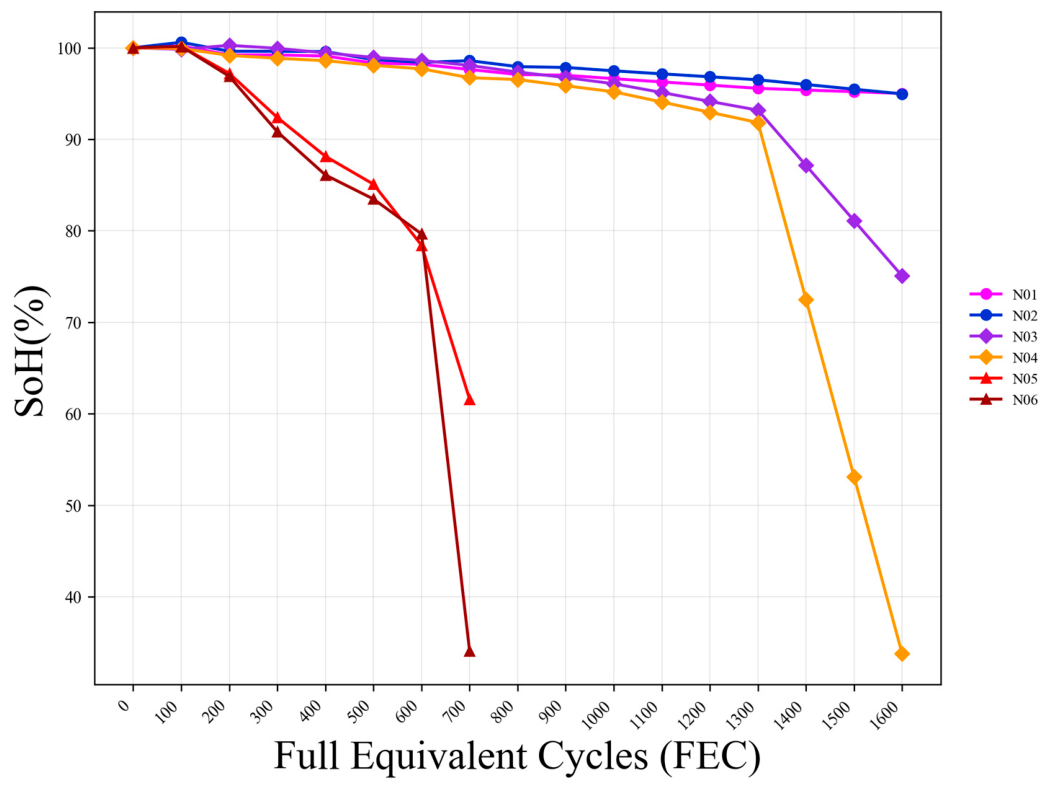
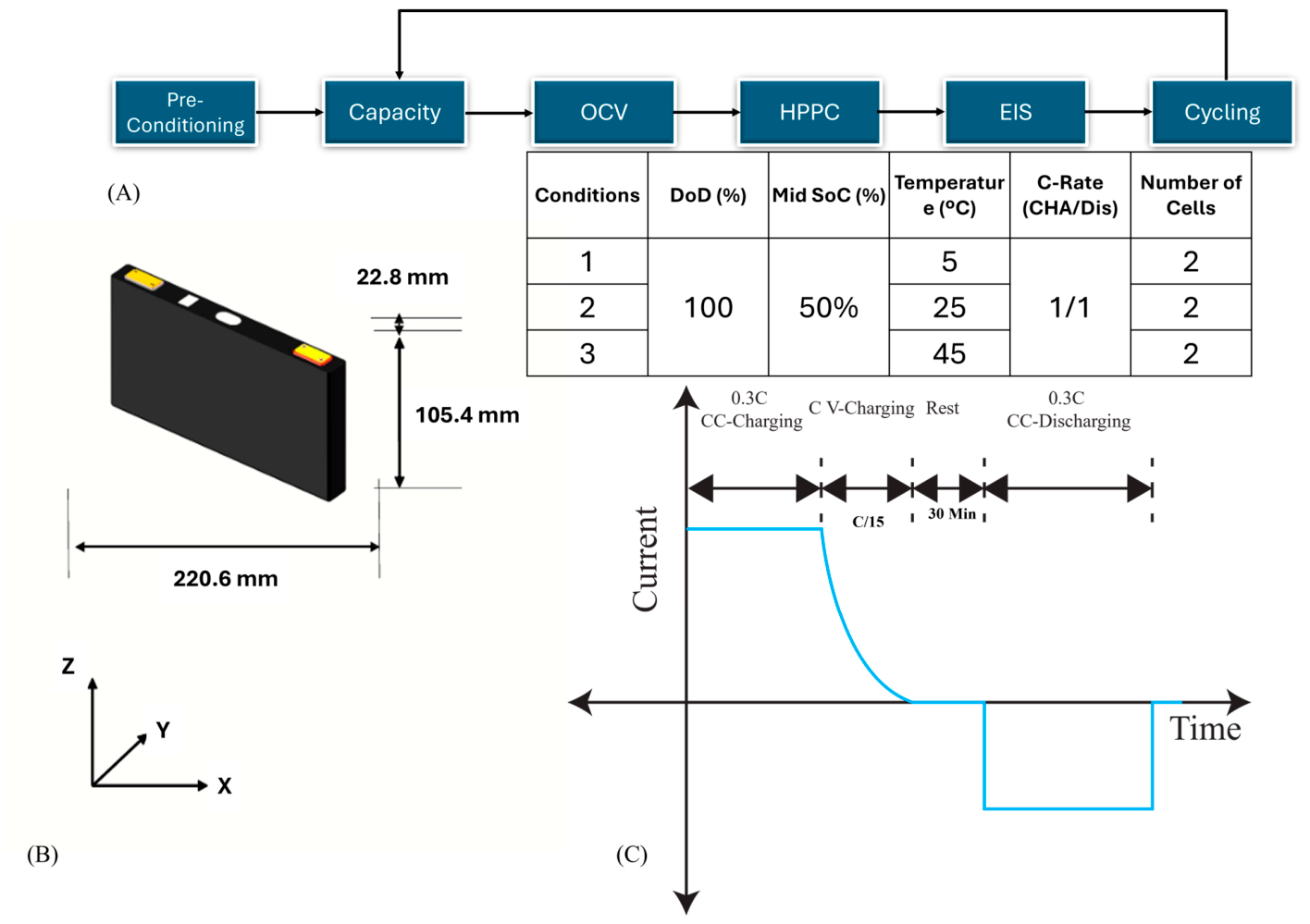
The specifications of the cells are in Table 1. It includes six cells tested under various conditions, with two cells per condition. The degradation trajectories of the cells are presented in Figure 1. Figure 2 illustrates the testing workflow and sample cell specifications. Three conditions are selected under which batteries are tested. For each condition, two cells are tested to prove the repeatability of the experiment. In the characterization of the cells after completing the 100 full equivalent cycles (FECs), the capacity and OCV tests are performed at a C/3-rate at the cycling temperature. Before performing EIS, cells undergo a capacity test at 25 °C to check the capacity value under stable conditions, and then EIS is performed at 25 °C. Thermal chambers are used to keep the ambient temperature constant. The preliminary findings compare the cells’ Beginning-of-Life (BoL) performance with their state after 100 Full Equivalent Cycles (100 FEC). Cells reaching more than 1000 FECs, characterization is performed after every 300 FECs.

3. Results

3.1. ICA

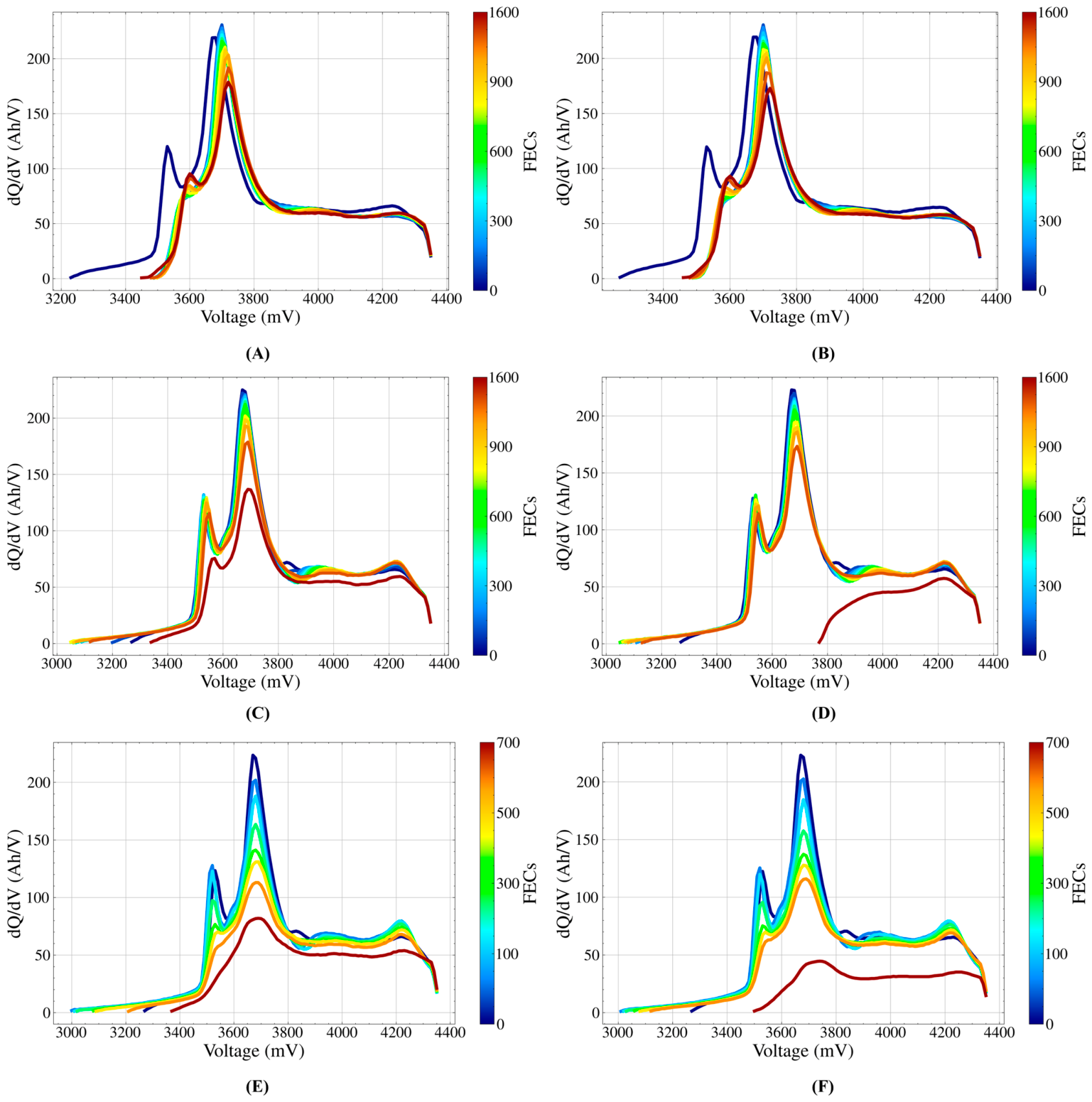
The ICA results in Figure 3 illustrate the dQ/dV (change in charge over the change in voltage) curves across a voltage range for various operating temperatures. Cells underwent cycling from a minimum of 700 FECs to 1600 FECs, providing detailed insights into their SoH evolution. The ICA peaks represent key electrochemical reactions and changes in battery behavior with cycling, allowing for insights into capacity fading and resistance growth over time.
For cells N01 and N02, under 5 °C cycling, the ICA curves remain relatively consistent throughout cycling, maintaining clear and sharp peak definitions around 3600–3800 mV, which indicates stable phase transition behavior with minor degradation. Corresponding SoH data for the cells is in Table 2. Both cells maintain more than 90% SoH after 1600 FECs. This stability suggests minimal structural degradation and electrolyte-side reactions within this cycling regime and these operating conditions. This stability suggests that degradation mechanisms are suppressed under these operating conditions. The full depth of discharge (100%) at low temperatures significantly reduces mechanical stress on electrode materials by avoiding complete discharge cycles.
Cells N03 and N04, operating under Condition II (Figure 3C,D), exhibited significantly different ICA evolution at the end of life despite being tested under identical conditions. Cell N03 shows a gradual decrease in peak intensity with cycling while maintaining recognizable dual-peak features, indicating progressive but controlled degradation. The primary peak before 3.6 V and the main peak at 3.7 V decrease in amplitude and slightly broaden with increasing FECs. Nevertheless, the overall ICA evolution remains identifiable even in later cycles. The Cell N04 evolution along the cycles remains identical to cell N03 until 1300 FECs; however, it displays pronounced degradation after that, with significant suppression of the main peak, and complete disappearance of the first peak due to the polarization, corresponding to a severe health decline. Compared to the low-temperature cells, the 25 °C condition accelerates the performance degradation.
Cells N05 and N06, subjected to Condition III (Figure 3E,F), experienced dramatic capacity loss, with SoH values plummeting to 61.6% and 34.08%, respectively. The combination of full depth of discharge cycling, complete SoC range utilization, and, most critically, elevated temperature (45 °C), created ideal conditions for accelerated degradation. High temperature acts as a catalyst for numerous degradation mechanisms: it speeds up SEI layer growth on the anode, accelerates electrolyte decomposition reactions, enhances transition metal dissolution from cathode materials, increases gas generation within the cell, and potentially damages electrode binders, leading to delamination. These multifaceted degradation processes manifest clearly in the ICA curves, which show substantial peak height reduction and shape changes in the 4000–4200 mV region as cycling progresses. In NMC cathodes, this voltage region is typically associated with high-voltage phase transitions between monoclinic and hexagonal phases at highly delithiated states [31]. The sudden transition is attributed to the interaction of multiple degradation mechanisms. At high state of charge and temperature, the cathode surface becomes highly reactive due to the formation of high valence transition metal species (e.g., Ni4+), which strongly promotes electrolyte oxidation and parasitic reactions [33]. The visible evolution of these curves provides a detailed fingerprint of the ongoing degradation mechanisms.
The significant difference in degradation rates between cells N05 and N06, despite identical testing conditions, highlights an important reality in battery manufacturing—inherent cell-to-cell variability. While both cells experienced catastrophic capacity loss, N50 degraded much more severely than N49. This difference likely stems from microscopic variations in electrode microstructure, small differences in electrolyte composition or quantity, variations in electrode alignment, particle size distribution differences, or minor impurity level variations. The extreme conditions of high-temperature full cycling effectively magnified these small manufacturing differences, resulting in dramatically different lifespans between otherwise identical cells.

3.2. EIS Analysis

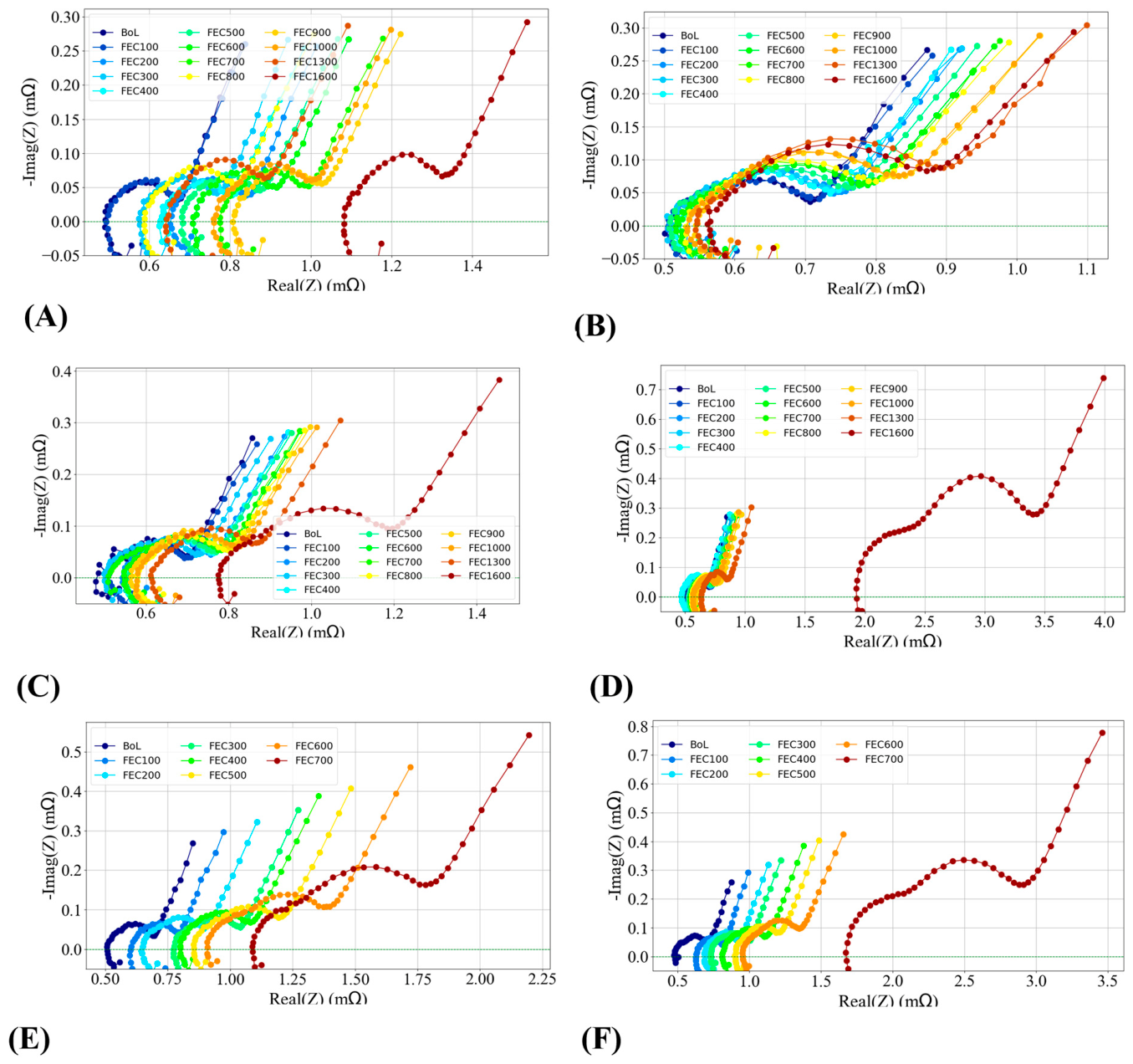
EIS results for all six cells from the beginning of life to 600 or 700 FEC are presented in Figure 3. The data presented in the figure are the Nyquist curves at 100% SoC. These Nyquist plots display the relationship between the real (x-axis) and imaginary (y-axis) components of impedance across different frequencies (ranging from 1 kHz to 23 mHz), offering insights into various electrochemical processes occurring within the batteries as they age. Figure 4A,B represent the EIS results for cells operating under condition I. Although both cells operate under identical conditions, their impedance evolution shows distinct behavior. For cell N01, the impedance spectra mainly exhibit a progressive rightward shift with cycling while maintaining a relatively similar arc shape, indicating a gradual increase in overall impedance without the significant distortion of the spectral features. In contrast, cell N02 shows a noticeable enlargement of the semi-circle region with increasing FEC, reflecting a different evolution pattern compared to N01, which cannot be captured in the ICA results. Despite these differences, the overall spectral evolution remains orderly and continuous, without any abrupt changes, which aligns with the health status of the battery cells.
Figure 4C,D represent the EIS results for cells operating under condition II for cell N03 and N04, respectively. Compared to the 5 °C cells, the Nyquist spectra for these cells show more pronounced impedance changes and a clear divergence between cells. Cell N02 exhibits a gradual rightward shift and moderate expansion of the semi-circle arc, indicating steady impedance growth while largely preserving the spectral shape throughout the cycling. In contrast, cell N04 displays a significantly stronger increase in impedance at higher FECs, where the Nyquist curve expands substantially and the ohmic resistance shifts markedly toward a higher value. The separation between the 1300 FECs and the last 1600 FECs is significant.
Figure 4E,F represent the EIS results for cells operating under condition III at 45 °C. The EIS data for these cells reveals dramatic changes that correlate with their severe capacity loss observed in the ICA. The key observation is the substantial growth of impedance across all frequency regions. There is a significant shift observed in the Nyquist curves, which indicates an increase in ohmic resistance, which is the combination of contact resistance and electrolyte [34]. The semi-circle region is also growing dramatically, which represents the increase in charge transfer resistance [35]. In the later cycles at 600 and 700 FEC, there are indications of two semi-circle regions, where the first one shows the SEI layer growth, and then the second is an increase in charge transfer resistance. Furthermore, the low-frequency region also shows significant changes, with the curves extending much further along both axes compared to the other conditions. This extension indicates severely compromised lithium-ion diffusion pathways, likely due to structural degradation within the electrodes, and gas formation blocking ion transport channels. Most notably, the 700 FEC measurements (gray markers) in Figure 3F for the N06 cell show dramatically different behavior compared to earlier cycles, which is also observed in the ICA analysis and its SoH value of 34%.

3.3. DRT Analysis

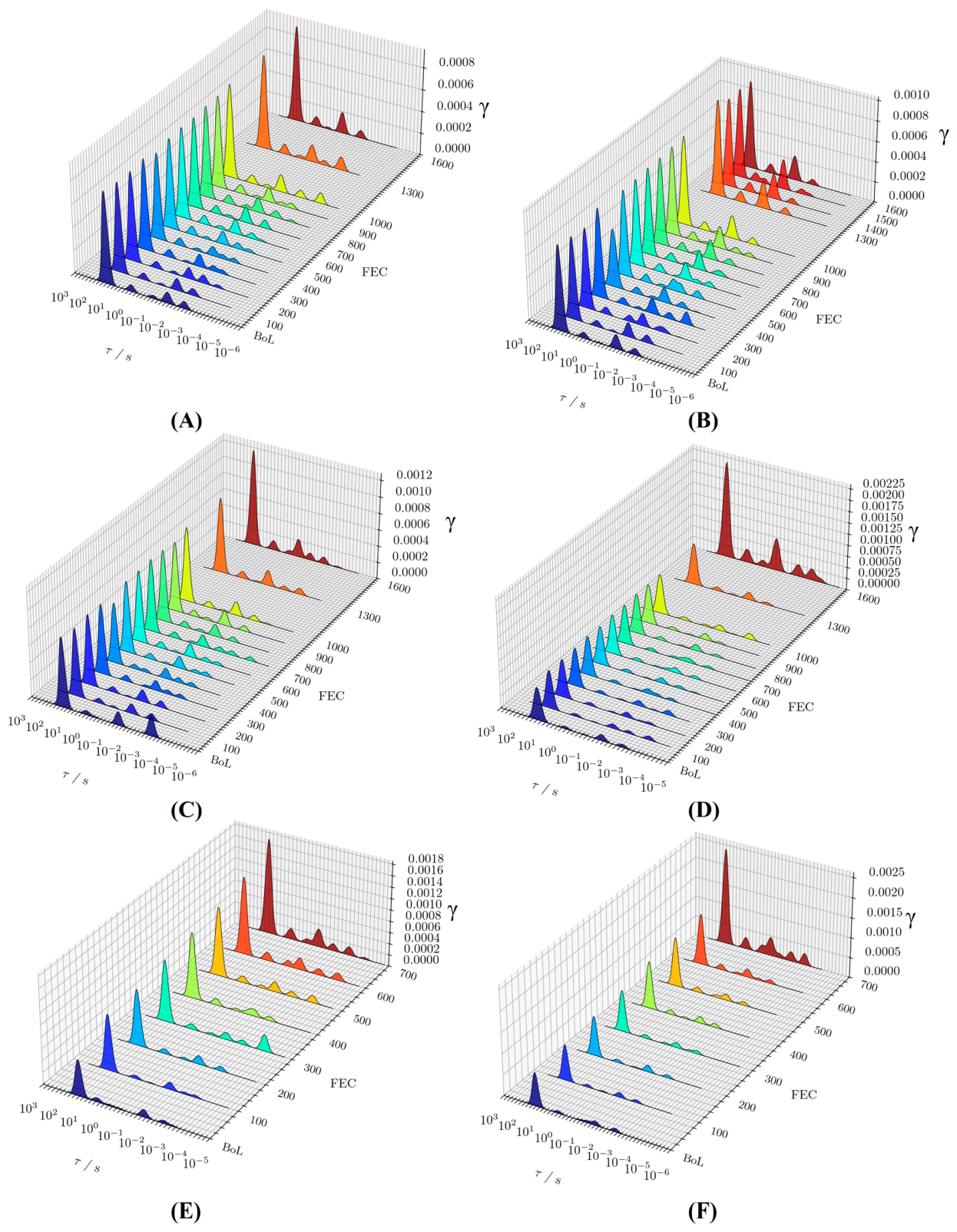
The distribution of relaxation times (DRT) method is employed to deconvolute the EIS response of the investigated cells into distinct physicochemical processes occurring over different characteristic time constants. Unlike equivalent circuit models (ECMs), which require an a priori assumption about the number and type of circuit elements, it automatically fits the circuit elements based on their characteristic relaxation times [36,37]. Mathematically complex impedance Z ( ω ) relates to the distribution function γ ( τ ) through the following integral equation:
Z ω = R o + R p o l 0 γ τ 1 + j ω τ d τ
where R o represents the ohmic resistance, R p o l denotes the polarization resistance, and ω is the angular frequency. The function γ τ describes the contribution of each relaxation time τ to the polarization. The DRT results of the cells under study are shown in Figure 5.
Under condition 1 (5 °C), Cell N01 and N02 in Figure 5A,B maintained remarkable impedance stability throughout the cycling. After completing the 1600 FECs, the magnitude of the dominant peaks remained consistently low (maximum γ     8 × 10 4   f o r   N 01   a n d   10 × 10 4   f o r   N 02 ). This suppressed impedance growth aligns with the high capacity retention observed, where both cells have >90% SoH. These results suggest that at lower operating temperatures, there is a progressive but controlled increase in interfacial resistance, typically associated with electrolyte and charge transfer resistance.
In contrast, Cell N03 and N04 (Figure 5C,D), cycled under condition 2 at 25 °C, show a different DRT evolution. With an increase in FECs, a slow growth at the start and a substantial growth in the magnitude of the intermediate-to-long relaxation time peaks are observed. Initially, the patterns for both cells are similar; however, after 1000 FECs with continuous 300 FEC cycling, the degradation trend for both cells changes. After completing the 1600 FECs, Cell N03 and N04 reached 75% and 33% SoH, respectively.
The most pronounced degradation signatures are observed for cells N05 and N06 (Figure 5E,F) at an elevated temperature of 45 °C. DRT spectra reveal gradual changes in the peak height across intermediate and especially long relaxation time constants. Elevated temperature is known to accelerate parasitic reactions, including electrolyte decomposition and SEI/CEI growth, and this effect is clearly manifested in the strong increase in the interface-related peaks. Moreover, the dominance of long-relaxation-time components indicates several transport limitations. Cell N06 exhibits extreme degradation characterized by a dominant peak, suggesting that one or more bottleneck processes are effectively throttling electrochemical performance and leading to catastrophic capacity loss.
Overall, the DRT analysis reveals a clear correlation between the evolution of relaxation time distributions and the observed SoH decay across all the test conditions. Cells cycled under condition 1 maintain a relatively stable DRT profile dominated by moderate resistance growth, resulting in limited capacity fade after completing 1600 FECs. Under conditions 2 and 3, significant changes in the peaks coincide with the substantial SOH degradation.

3.4. Degradation Modes Identification

ICA and EIS emerged as powerful diagnostic tools for identifying and quantifying degradation modes in Li-ion batteries, using standard low C-rates [38,39]. By examining how the peaks and valleys in the incremental capacity curve dQ/dV evolve during aging, they enable researchers to link observable changes in voltage-capacity behavior to specific degradation modes, such as loss of lithium inventory (LLI) and loss of active material (LAM). Degradation mode analysis provides a more mechanistic view of battery aging by attributing capacity loss to underlying physical processes.

3.4.1. ICA Based

CLICA
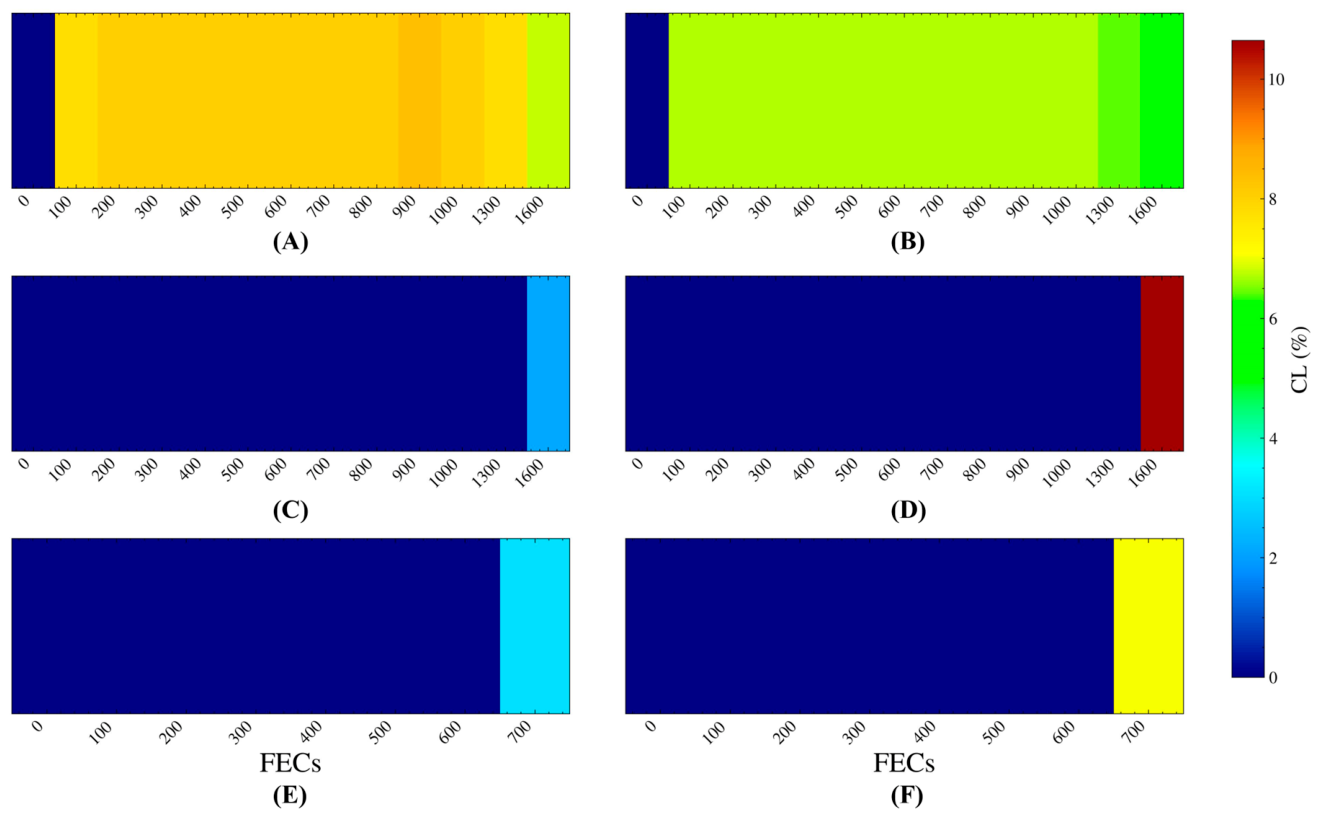
The conductivity loss (CLICA) from the OCV charging curve is calculated using the relative change in the start voltage of the charging curve, defined as
C L I C A % = V start , i V start , 0 V start , 0 × 100
Importantly, this start voltage is taken after the discharge step, once the cell has relaxed. During relaxation, partial voltage recovery occurs; however, residual polarization remains due to internal resistance and kinetic limitations. As the cell ages, increased ohmic resistance and interfacial polarization cause a larger voltage rise at the beginning of the subsequent charge step. Therefore, the starting voltage shifts toward higher voltages in the ICA curves, as shown in Figure 3.
CLICA results are shown in Figure 6. The evolution of CLICA reveals a distinct stability trend for 5 °C after the BoL. In contrast, at 25 °C and 45 °C, CL remains low during the early cycling but rises significantly at the end of life for more degraded cells. This late-stage increase corresponds to enhanced polarization and internal resistance growth, confirming that conductivity loss becomes prominent.
LLIICA
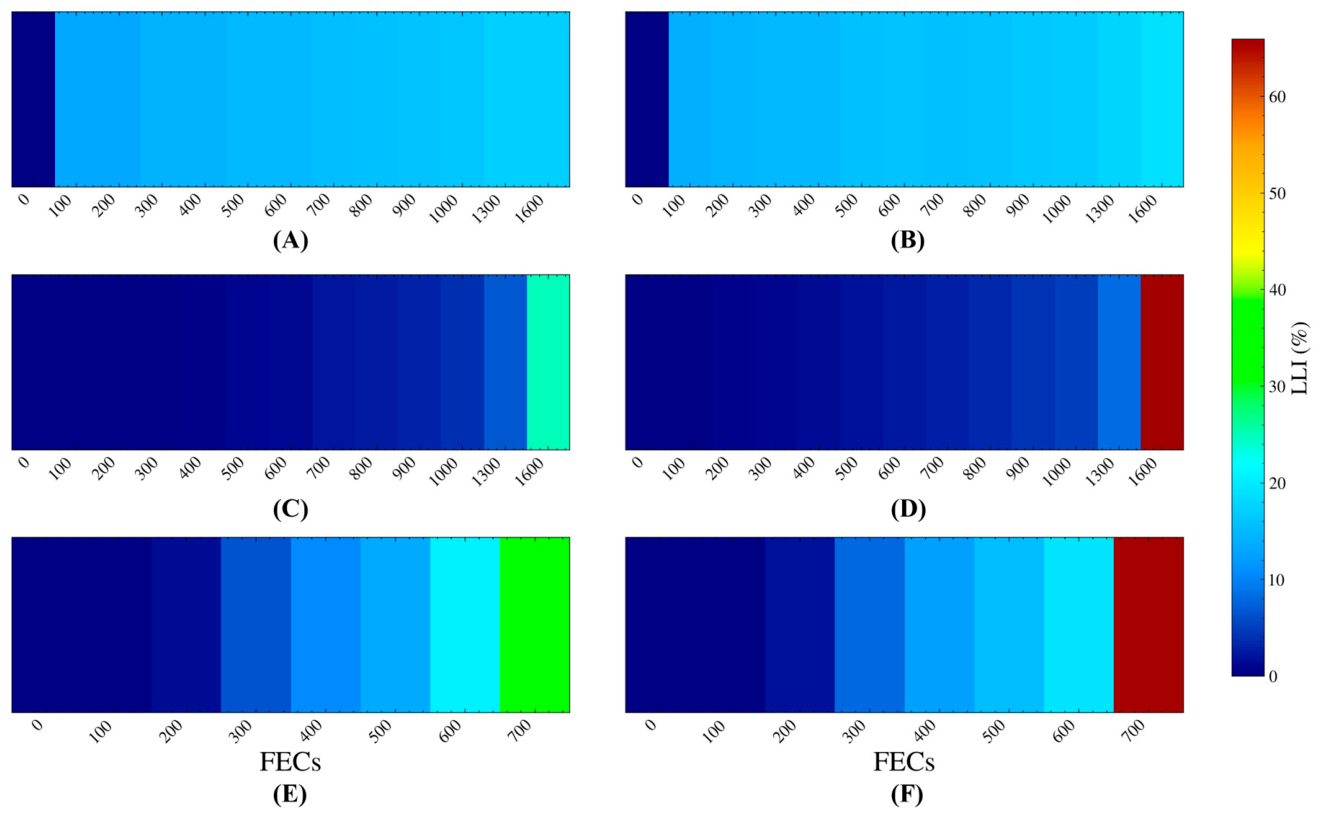
LLI represents the reduction in the amount of cyclable Li available for intercalation, typically caused by solid electrolyte interphase (SEI) layer growth and lithium plating. It is calculated by tracking the evolution of maximum capacity (Q) over cycles:
L L I I C A % = max Q 1 max Q n max Q 1 × 100
The heatmap in Figure 7 shows the evolution of LLI for the cells at different temperatures. At 5 °C, cells N01 and N02 exhibit the slowest degradation progression. The LLI values increase gradually over cycling but remain within a relatively narrow range throughout the cycling up to 1600 FECs. This indicates a steady and controlled consumption of cyclable Li, and the color remains consistent throughout the cycling. At low temperatures, the primary concern is usually the lithium plating; however, the 1C rate at 5 °C appears to induce gradual degradation rather than immediate catastrophic failure. The 5 °C cells are still above 90% SoH and undergoing cycling. At 25 °C, it remains stable until 1000 FECs. Beyond 1300 FECs, a sharp increase is observed, with values reaching nearly 60% loss by 1600 FECs, indicating significant consumption of cyclable Li at the end-of-life stage.
LLI accelerates rapidly, exceeding 10% within the first 200 FECs and reaching nearly 30% and 70% by 700 FECs for two cells, respectively. The elevated temperature enhances parasitic chemical reactions such as SEI growth and electrolyte decomposition, leading to faster consumption of LLI.
LAMICA
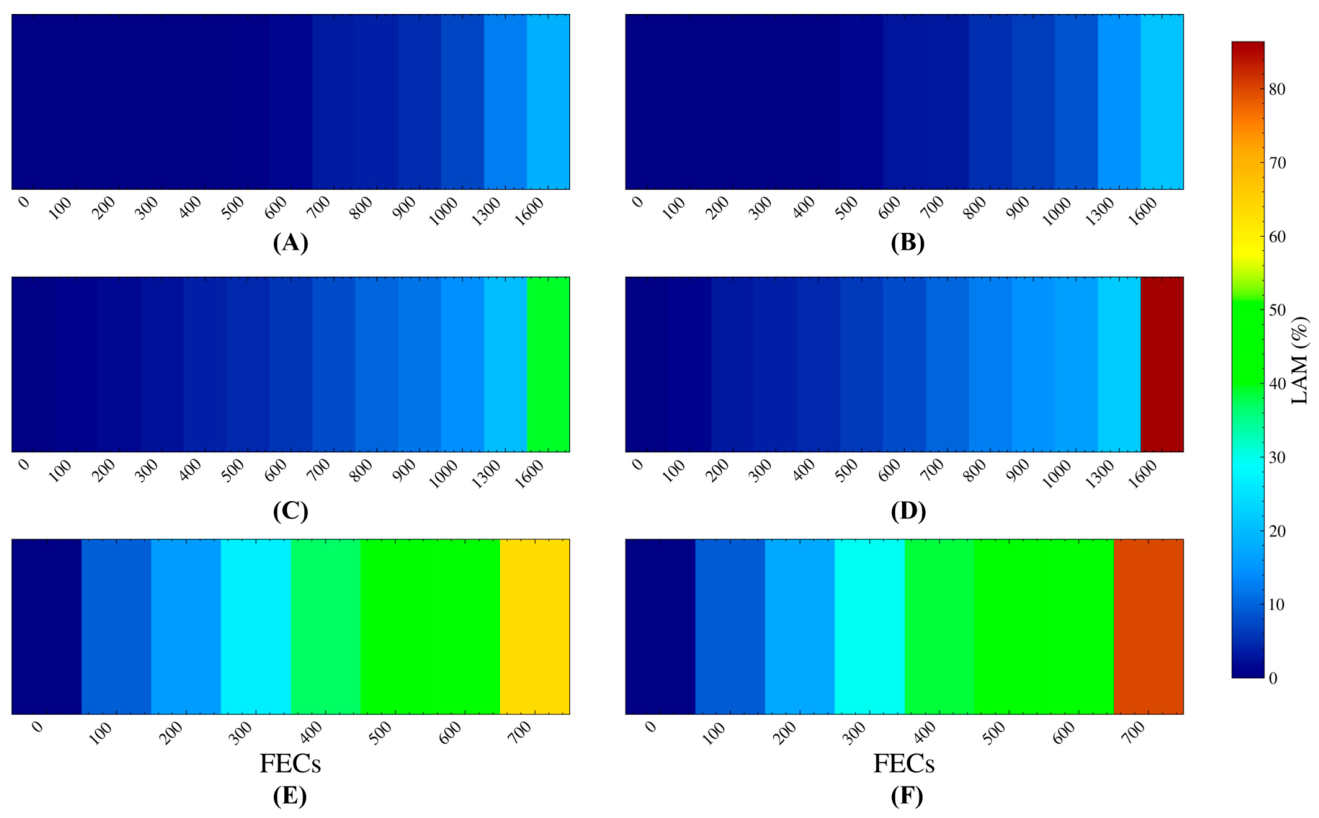
Loss of active material (LAM) refers to the reduction in the amount of electrode material available to host Li, often due to reasons like particle cracking, electrical isolation, etc. It is calculated by observing the reduction in peak height. This method serves as an estimation method for the structural health of the electrodes. LAM from the ICA curve is calculated using the following formula:
L A M I C A % = max d Q 1 d V 1 max d Q n d V n max d Q 1 d V 1 × 100
Similar to LLI, LAM in the cells at 5 °C is limited after prolonged cycling. The evolution of LAM at different temperatures is presented in Figure 8. The gradual decline in ICA peak amplitude from Figure 3 indicates progressive but mild loss of electrochemically active sites. The structural degradation appears limited under low-temperature operation, suggesting that aging is not dominated by active material isolation in this regime, as the cells are still above 90% SoH and under cycling. At 25 °C (Cell N03 and N04), the LAM increase is more noticeable. Cell N03 shows a gradual monotonic rise in LAM, indicating progressive loss of active material contribution. However, Cell N04 demonstrates a sudden late-stage increase in LAM, coinciding with the strong SoH drop and LLI increase. The simultaneous growth of LLI and LAM in this cell suggests coupled degradation processes, where structural damage amplifies polarization, which in turn accelerates lithium inventory depletion. This behavior reflects a clear knee-point mechanism leading to rapid capacity deterioration.
At 45 °C (Condition III), LAM becomes the dominant degradation signature. Both cell N05 and N06 exhibit rapid and substantial reductions in ICA peak amplitude, indicating a significant loss of active material. The relatively low Soh levels (61% and 34%) confirm that structural degradation plays a major role in capacity fade under high-temperature cycling. In the most degraded cells, D and F, the high LAM values indicate extensive structural breakdown.
The combined LLI and LAM analysis demonstrates that temperature not only accelerates degradation but also shifts the dominant degradation mechanism. At 5 °C, degradation is slow and primarily associated with moderate lithium inventory loss, while structural integrity remains largely intact. At 25 °C, the degradation becomes heterogeneous, with evidence of knee-point behavior and strong coupling between the LLI and LAM in Cell D. At 45 °C, degradation is significantly accelerated and dominated by both LLI and LAM in the cell that has 34% SoH. Thus, under the same c-rates, and 100% depth of discharge (DoD), increasing the temperature transitions the degradation modes from gradual lithium consumption toward pronounced structural electrode failure and early capacity collapse.

3.4.2. EIS Based

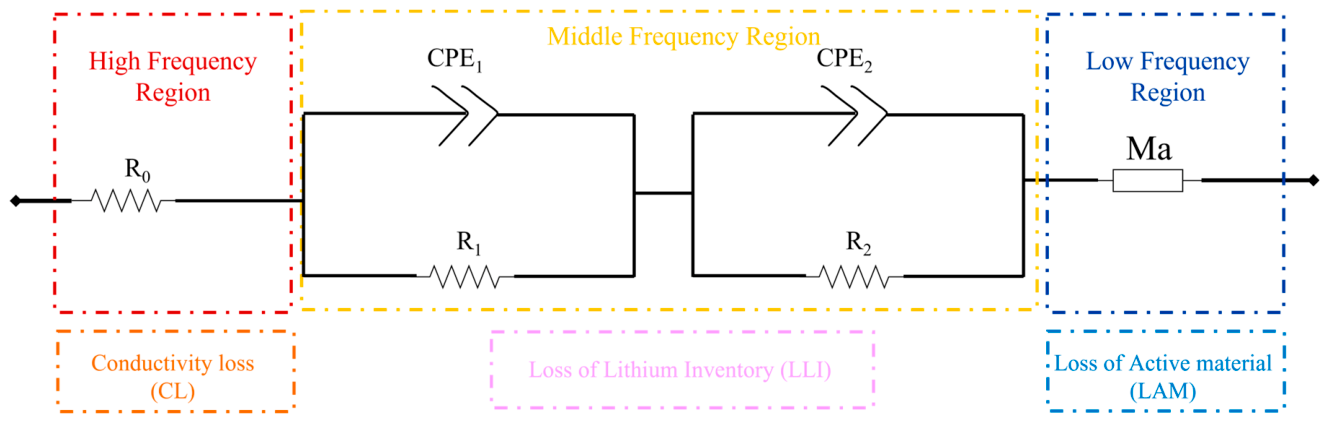
To gain a better understanding of the degradation mechanisms beyond incremental capacity analysis, EIS data is used to quantify the degradation mechanisms through parameter extraction from the fitted equivalent circuit model (ECM). The experimental data obtained at different FECs are fitted using a physically interpretable ECM structure representing the dominant electrochemical processes within the cells. The selected ECM used for data fitting is shown in Figure 9.
The experimental data are fitted to the ECM at different aging states, and cycle-dependent parameter evolution is extracted. These fitted parameters are used to quantify degradation modes based on relative changes in impedance compared to the beginning of life (BoL) condition. By tracking the evolution of fitted parameters ( R o ,   R 2 ,   a n d   M a , o )   f r o m   t h e   i n i t i a l   c y c l e to a subsequent cycle (n), specific degradation modes can be quantified as a percentage change:
C o n d u c t i v i y   L o s s   ( C . L ) =   R o h m ,   n     R o h m , 0   R o h m , 0   × 100
L L I   ( % ) = R 2 ,   n R 2,0 R 2,0 × 100
L A M   ( % ) = M a ,   n M a , 0 M a , 0 × 100
C.LEIS
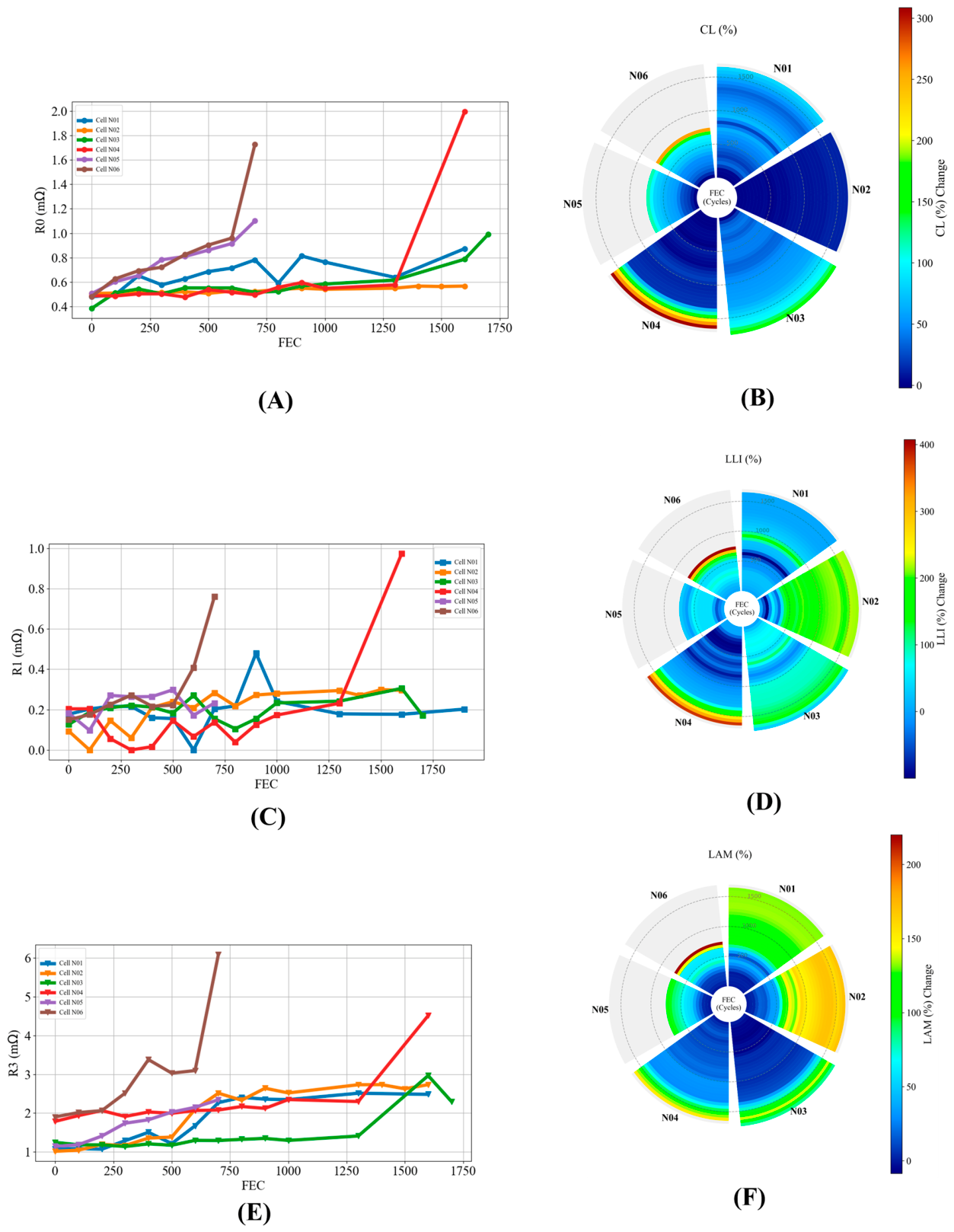
The conductivity loss derived from the evolution of R o reflects an increase in electrolyte resistance, current collector resistance, and contact resistance. Its increase indicates deterioration in the overall conductivity pathways [40]. At 5 °C, the conductivity loss remains moderate across the cycling. Some fluctuations are observed at 1300 FEC, but the overall increase is gradual. The N01 cell conductivity loss is higher compared to the N02 cell, as is also prominent in the EIS plot in Figure 4. The polar plot in Figure 10B with the consistent blue hue color indicates the minimal CL. This suggests that at lower temperatures, the electrolyte retains its ionic conductivity, and the mechanical contacts within the cell remain intact. Since these cells are still under testing, their long-term conductivity evolution remains to be monitored.
At 25 °C (Cell N03 and N04), the conductivity loss becomes significantly more pronounced. Cell N03 exhibits a steady increase in Ro, indicating progressive deterioration of conductive pathways, likely due to electrolyte depletion and interfacial contact degradation. However, cell N04 displays a latent failure mode. It maintains a stable Ro ( ~ 0.5   m Ω ) for the first 1300 FECs, followed by an exponential spike, exceeding > 2.0   m Ω by 1600 FECs. The polar plot in Figure 10B highlights this with a deep red outer ring for N04, representing a massive increase > 300 % in CL. This sharp increase correlates with the severe SoH drop to 33.7% and indicates a substantial degradation of ionic transport pathways.
At 45 °C (Cell N05, N06), conductivity loss accelerates significantly. Elevated temperatures enhance electrolyte decomposition and side reactions, leading to increased resistance and possible degradation of the separator, and contact interfaces. Cell N06, particularly, shows a pronounced growth in Ro, corresponding to its severe degradation in SOH (34%). The elevated conductivity loss at high temperatures confirms that conductivity degradation becomes an important contributor to performance under thermal stress. Compared to 5 °C and 25 °C, the rate of conductivity is clearly temperature-activated. Overall, CLEIS results demonstrate that conductivity degradation is strongly influenced by temperature and becomes severe under high thermal stress and early-stage aging.
LLIEIS
LLIEIS is derived from charge transfer resistance R C T , represents degradation in interfacial reaction kinetics. An increase in R C T indicates reduced electrochemical activity at the electrode-electrolyte interface, commonly associated with SEI thickening, lithium consumption, and reduced availability of active Li.
At 5 °C, LLIEIS increases gradually but remains limited. Up to 500 FECs, resistance values remain within 0.2   m Ω . After that, a more pronounced difference starts to be visible. After 1000 FECs R C T remains stable for both cells, but for N02, it is higher than N01. And it is more clearly visible in Figure 10A,B. The stability of R C T aligns with the high SoH value and the ICA-based LLI analysis, confirming that the lithium inventory depletion remains modest under low temperatures. The absence of an abrupt increase suggests stable interfacial kinetics and no severe lithium depletion at this stage.
At 25 °C, LLIEIS shows more pronounced growth. Cell N03 demonstrates a steady increase in R C T , corresponding to progressive lithium consumption. In contrast, N04 exhibits a strong late-cycle escalation in LLIEIS, consistent with its severe SoH decline. The resistance increase for this cell went up to 400%. At 45 °C, it increases rapidly and reaches more than 0.7   m Ω within 700 FECs. But for N05, it remains stable. It confirms that, at 45 °C, LLIEIS is also not linear. The high heat promotes continuous electrolyte decomposition, which results in gas formation and it makes the cell swell.
LAMEIS
The evolution of diffusion resistance, represented by the R3 parameter, serves as an indicator of loss of active material (LAM) and shows a clear evolution with cycling and a strong dependence on aging severity. At 5 °C, cells exhibit a steady, progressive increase in R3, increasing from roughly 1   m Ω between 2.5 and 3.0 m Ω over 1600 FECs. At 25 °C, cell N03 maintains a stable diffusion resistance near 1.3 m Ω for 1300 cycles before experiencing a sudden degradation spike to 3.0 m Ω as shown in Figure 10E. N04 has the highest increase, more than 4 m Ω which aligns with the SoH decrease for this cell. However, the 45 °C drives catastrophic failure for cell N06. This transition reflects the onset of accelerated degradation, where structural changes within the electrode significantly hinder the diffusion process.
The polar heatmap in Figure 10F translates these absolute resistance shifts into percentage-based LAMEIS degradation, highlighting distinctly different aging trajectories. The early-onset structural collapse of cell N06 is visually clear, manifesting as a sharp, dark red band indicating a massive relative change exceeding 200% within the first 700 FECs. Cells at 5 °C maintain a broad green to yellow gradient over their cycling. Conversely, Cell N03 and N04 displays prolonged periods of structural stability (blue region) followed by an abrupt transition to green and yellow at their outer edges, confirming that the active material isolation often manifests as a sudden “knee” effect at the end of life.

4. Discussion

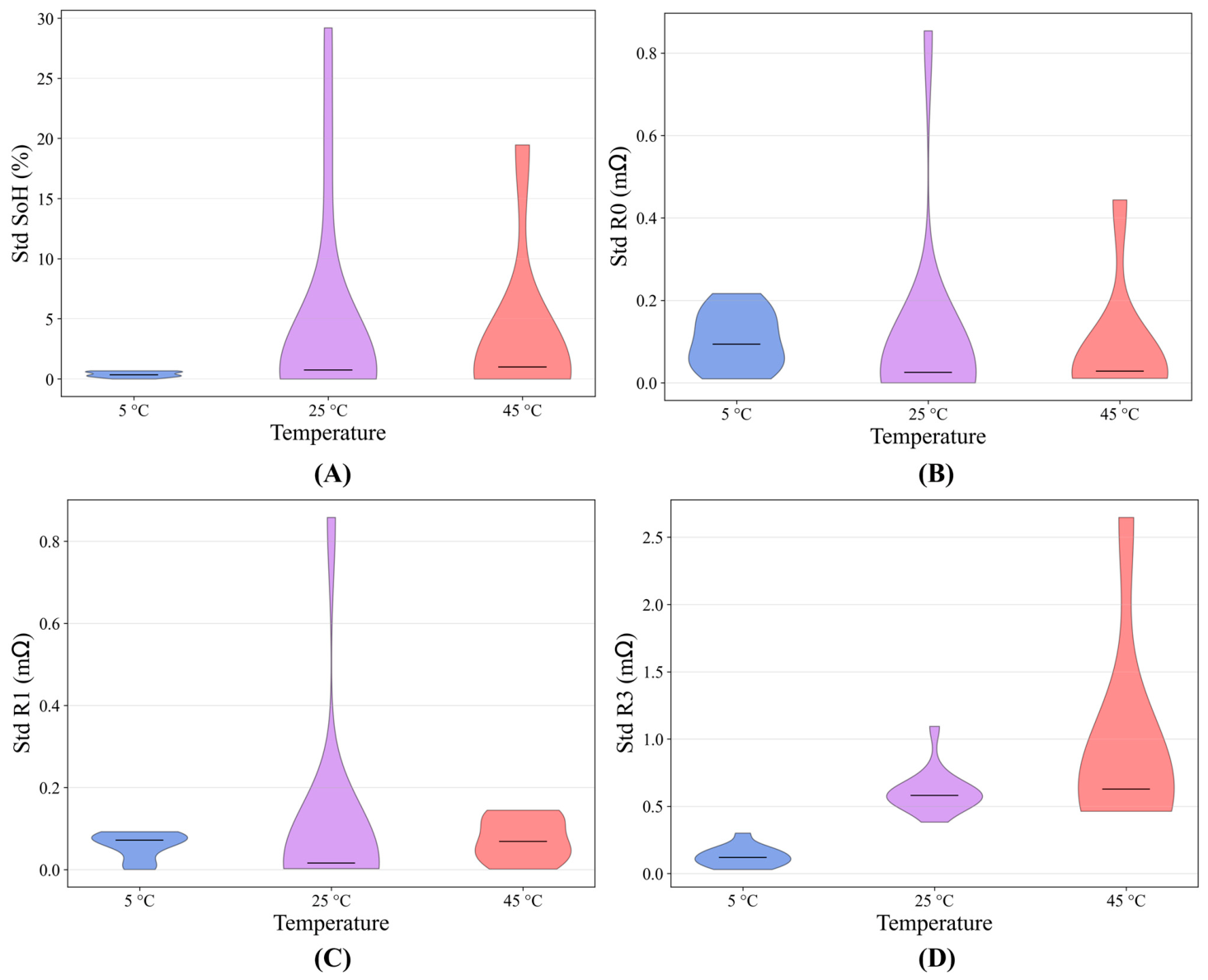
The results demonstrate that degradation in NMC631 cells is strongly governed by operating temperature, while also being influenced by inherent cell-to-cell variability. To quantitatively assess this variability, a statistical analysis in Figure 11A is performed by incorporating standard deviation and coefficient of variation (CoV) of SoH across the cells tested under identical temperature conditions. The results reveal that at 5 °C, the degradation behavior is consistent, with the final standard deviation of 0.0035% and average CoV of 0.4%, indicating uniform and stable aging. In contrast, significantly higher variability is observed at elevated temperatures. At 25 °C, the Std increases to 29.2% with a CoV of 6.19%, while at 45 °C values of 19.46% and 5.78% are obtained, respectively. This increasing dispersion highlights that temperature not only accelerates degradation but also amplifies internal heterogeneities, leading to divergent aging trajectories under identical cycling conditions. This highlights that degradation is not only condition-dependent but also sensitive to internal cell heterogeneities, which become amplified during long-term cycling.
A key observation is that the variability within intra-group cells does not originate at the beginning of life but rather emerges progressively during cycling. At early stages, cells within each temperature group exhibit minimal dispersion and closely aligned degradation trajectories, indicating comparable initial conditions and limited influence of manufacturing variations. However, as cycling progresses, a clear divergence in behavior is observed, particularly beyond 1000 FEC at 25 °C and 600 FEC at 45 °C where variability increases sharply. This delayed onset of dispersion suggests that variability is primarily driven by degradation processes rather than initial manufacturing inconsistencies. This trend is further supported by the analysis of internal resistance evolution using the fitted ECM parameters as illustrated in Figure 11B–D. At 5 °C, all resistance components show a narrow and symmetric distribution, reflecting a stable and uniform distribution. R1 distribution is higher as compared to the Ro and R3 because the charge transfer resistance for Cell 02 is increasing at a higher rate over cycles. At higher temperatures, the distribution becomes wider and increasingly skewed, indicating the emergence of non-linear and cell-specific behavior.
These observations indicate that temperature-dependent degradation mechanisms progressively amplify small internal differences within cells, leading to divergent aging trajectories under identical operating conditions. At elevated temperatures, this amplification becomes more pronounced, resulting in non-identical cell behaviors within the same group. This highlights that degradation-induced variability is a dynamic phenomenon that evolves with degradation, rather than a static property determined solely by manufacturing.
While the statistical analysis highlights the macroscopic variability in degradation behavior, a deeper understanding of the underlying electrochemical processes requires a complementary diagnostic perspective. A key contribution of this work is the demonstration of the advantages of a multi-modal diagnostic approach. ICA effectively captures the evolution of voltage-capacity behavior and highlights changes in curve features during aging. However, as degradation progresses, shifting and compression of ICA curves reduce the clarity of diagnostic information. In contrast, EIS provides complementary insights into the internal changes inside the cell, revealing the impedance growth and electrochemical dynamics that are not apparent in ICA data. For instance, for the cells under 5 °C, the two cells show similar signatures of ICA, but their EIS behavior evolves differently. Therefore, the integration of ICA and EIS enables a more robust and comprehensive interpretation of degradation behavior.
The results further indicate that degradation mechanisms are not independent but evolve in an interdependent manner. This is particularly evident at higher temperatures, where multiple processes interact and accelerate aging, leading to non-linear degradation behavior and early failure. Finally, this work contributes to addressing the limited understanding of intermediate Ni-rich chemistry high-energy cells under controlled temperature conditions. It proves that these cells perform significantly better at lower temperatures, exhibiting a longer life cycle as compared to their performance at 25 °C and 45 °C. The findings provide practical insights for improving thermal management strategies.
The future work will focus on extending the proposed multi-modal framework by incorporating post-mortem analysis techniques, such as scanning electron microscopy (SEM) to directly correlate electrochemical signatures with structural and material-level degradation. This will further enhance the understanding of degradation mechanisms and improve the interpretability of diagnostic methods. Additionally, extending the dataset to larger sample sizes and incorporating intermediate temperature conditions will further improve statistical robustness and model generalizability.

5. Conclusions

A comprehensive degradation analysis of high-energy prismatic NMC631 cells by combining ICA and EIS under controlled thermal cycling conditions. The results demonstrate that temperature strongly influences both the rate and trajectory of degradation, while also revealing significant cell-to-cell variability, even under an identical cycling protocol. Cells cycled at 5 °C exhibit stable ICA signatures and moderate impedance growth, indicating slow and controlled aging behavior. In contrast, cells cycled at 25 °C show divergent evolution, where one cell experiences gradual degradation while another undergoes a pronounced late-life transition characterized by rapid impedance increase, ICA peak suppression, and severe SoH loss. Elevated temperature (45 °C) accelerates degradation substantially, leading to rapid impedance growth and early capacity collapse.
The combined ICA–EIS approach proves particularly valuable because each method captures different aspects of aging evolution. ICA sensitively tracks changes in voltage-capacity behavior, while EIS reveals early variations in impedance evolution that are not always visible in ICA alone, including differences between cells cycled under identical conditions. Degradation mode quantification further shows that conductivity loss, loss of lithium inventory, and loss of active material evolve differently depending on temperature and aging stage, with evidence of knee-point behavior emerging in more severely aged cells. Overall, the study demonstrates that multi-modal diagnostics are essential for understanding underlying degradation pathways in Li-ion cells and provide a stronger foundation for predictive aging models and temperature-aware battery management strategies.

Author Contributions

Conceptualization, K.R., M.B. and M.S.H.; Methodology, K.R. and M.S.H.; Validation, K.R.; Investigation, K.R. and M.B.; Data curation, K.R.; Writing—original draft, K.R.; Writing—review & editing, M.B.; Visualization, K.R.; Supervision, M.B. and M.S.H.; Project administration, M.S.H.; Funding acquisition, M.B. and M.S.H. All authors have read and agreed to the published version of the manuscript.

Funding

The authors gratefully acknowledge the project NEMO, which has received funding from the European Union’s Horizon Europe research and innovation program under grant agreement No. 101102944.

Data Availability Statement

The original contributions presented in this study are included in the article. Further inquiries can be directed to the corresponding author.

Conflicts of Interest

The authors declare no conflicts of interest.

Abbreviations

The following abbreviations are used in this manuscript:
EVElectric Vehicles
ICAIncremental Capacity Analysis
EISElectrochemical Impedance Spectroscopy
DRTDistribution of relaxation times
CLConductivity Loss
LLILoss of Lithium Inventory
LAMLoss of active material

References

  1. Jia, C.; He, H.; Zhou, J.; Li, J.; Wei, Z.; Li, K.; Li, M. A Novel Deep Reinforcement Learning-Based Predictive Energy Management for Fuel Cell Buses Integrating Speed and Passenger Prediction. Int. J. Hydrogen Energy 2025, 100, 456–465. [Google Scholar] [CrossRef]
  2. Šimaitis, J.; Lupton, R.; Vagg, C.; Butnar, I.; Sacchi, R.; Allen, S. Battery Electric Vehicles Show the Lowest Carbon Footprints among Passenger Cars across 1.5–3.0 °C Energy Decarbonisation Pathways. Commun. Earth Environ. 2025, 6, 476. [Google Scholar] [CrossRef] [PubMed]
  3. Hou, F.; Chen, X.; Chen, X.; Yang, F.; Ma, Z.; Zhang, S.; Liu, C.; Zhao, Y.; Guo, F. Fuel Cell-Based Hybrid Electric Vehicles: An Integrated Review of Current Status, Key Challenges, Recommended Policies, and Future Prospects. Green Energy Intell. Transp. 2023, 2, 100121. [Google Scholar] [CrossRef]
  4. Khan, M.I.; Becerra Machado, N.R.; Nassihi, A.; Sadaqa, A.; da Silva, B. Exploiting Low-Power Techniques of a Flash-Based SoC FPGA for Energy-Efficient Edge Processing. Appl. Sci. 2026, 16, 2648. [Google Scholar] [CrossRef]
  5. Saaid, F.I.; Kasim, M.F.; Winie, T.; Elong, K.A.; Azahidi, A.; Basri, N.D.; Yaakob, M.K.; Mastuli, M.S.; Amira Shaffee, S.N.; Zolkiffly, M.Z.; et al. Ni-Rich Lithium Nickel Manganese Cobalt Oxide Cathode Materials: A Review on the Synthesis Methods and Their Electrochemical Performances. Heliyon 2024, 10, e23968. [Google Scholar] [CrossRef]
  6. Salgado, R.M.; Danzi, F.; Oliveira, J.E.; El-Azab, A.; Camanho, P.P.; Braga, M.H. The Latest Trends in Electric Vehicles Batteries. Molecules 2021, 26, 3188. [Google Scholar] [CrossRef]
  7. Gorsch, J.; Schneiders, J.; Frieges, M.; Kisseler, N.; Klohs, D.; Heimes, H.; Kampker, A.; Muñoz Castro, M.; Siebecke, E. Contrasting a BYD Blade Prismatic Cell and Tesla 4680 Cylindrical Cell with a Teardown Analysis of Design and Performance. Cell Rep. Phys. Sci. 2025, 6, 102453. [Google Scholar] [CrossRef]
  8. Zhang, N.; Li, J.; Li, H.; Liu, A.; Huang, Q.; Ma, L.; Li, Y.; Dahn, J.R. Structural, Electrochemical, and Thermal Properties of Nickel-Rich LiNixMnyCozO2 Materials. Chem. Mater. 2018, 30, 8852–8860. [Google Scholar] [CrossRef]
  9. Zhang, G.; Tan, S.; Sun, C.; Zhang, K.; Deng, B.; Liao, C. Effects of Ni Content on Energy Density, Capacity Fade and Heat Generation in Li[NixMnyCoz]O2/Graphite Lithium-Ion Batteries. Micromachines 2025, 16, 1075. [Google Scholar] [CrossRef] [PubMed]
  10. Yang, Z.; Charalambous, H.; Trask, S.E.; Montoya, A.; Jansen, A.; Wiaderek, K.M.; Bloom, I. Extreme Fast Charge Aging: Effect of Electrode Loading and NMC Composition on Inhomogeneous Degradation in Graphite Bulk and Electrode/Electrolyte Interface. J. Power Sources 2022, 549, 232119. [Google Scholar] [CrossRef]
  11. von Bülow, F.; Heinrich, F.; Paxton, W.A. The Future of Battery Data and the State of Health of Lithium-Ion Batteries in Automotive Applications. Commun. Eng. 2024, 3, 173. [Google Scholar] [CrossRef]
  12. Raza, K.; Samadi, A.F.; Berecibar, M.; Hosen, M.S. From EV to Stationary Energy Storage: EIS-Based SoH Estimation for Second Life Li-Ion Batteries. J. Energy Storage 2026, 141, 119316. [Google Scholar] [CrossRef]
  13. Zhang, W.; Zhou, J.; Zhuang, L.; Zhang, Y.; Wu, X. Interpretable State of Health Estimation Framework Based on Distribution of Relaxation Times Features Mapped to Degradation Mechanisms. J. Power Sources 2026, 670, 239437. [Google Scholar] [CrossRef]
  14. Maures, M.; Capitaine, A.; Delétage, J.Y.; Vinassa, J.M.; Briat, O. Lithium-Ion Battery SoH Estimation Based on Incremental Capacity Peak Tracking at Several Current Levels for Online Application. Microelectron. Reliab. 2020, 114, 113798. [Google Scholar] [CrossRef]
  15. Wu, Y.; Xue, Q.; Shen, J.; Lei, Z.; Chen, Z.; Liu, Y. State of Health Estimation for Lithium-Ion Batteries Based on Healthy Features and Long Short-Term Memory. IEEE Access 2020, 8, 28533–28547. [Google Scholar] [CrossRef]
  16. Berecibar, M.; Dubarry, M.; Villarreal, I.; Omar, N.; Van Mierlo, J. Degradation mechanisms detection for HP and HE NMC cells based on incremental capacity curves. In Proceedings of the 2016 IEEE Vehicle Power and Propulsion Conference (VPPC); IEEE: Piscataway, NJ, USA, 2016; ISBN 9781509035281. [Google Scholar]
  17. Tang, Y.; Zhong, S.; Wang, P.; Zhang, Y.; Wang, Y. Remaining Useful Life Prediction of High-Capacity Lithium-Ion Batteries Based on Incremental Capacity Analysis and Gaussian Kernel Function Optimization. Sci. Rep. 2024, 14, 23524. [Google Scholar] [CrossRef]
  18. Pang, X.; Liu, X.; Jia, J.; Wen, J.; Shi, Y.; Zeng, J.; Zhao, Z. A Lithium-Ion Battery Remaining Useful Life Prediction Method Based on the Incremental Capacity Analysis and Gaussian Process Regression. Microelectron. Reliab. 2021, 127, 114405. [Google Scholar] [CrossRef]
  19. Chen, S.; Zhang, Q.; Wang, D.; Hao, Z.; Liang, X.; Hu, B. Physics-Informed Neural Networks for Degradation Diagnosis of Lithium-Ion Batteries via Electrochemical Impedance Spectroscopy. J. Energy Storage 2025, 140, 119127. [Google Scholar] [CrossRef]
  20. Iurilli, P.; Brivio, C.; Carrillo, R.E.; Wood, V. Physics-Based SoH Estimation for Li-Ion Cells. Batteries 2022, 8, 204. [Google Scholar] [CrossRef]
  21. Figgener, J.; Bors, J.; Kuipers, M.; Hildenbrand, F.; Junker, M.; Koltermann, L.; Woerner, P.; Mennekes, M.; Haberschusz, D.; Kairies, K.-P.; et al. Degradation Mode Estimation Using Reconstructed Open Circuit Voltage Curves from Multi-Year Home Storage Field Data. arXiv 2024, arXiv:2411.08025. [Google Scholar] [CrossRef]
  22. Bloom, I.; Jansen, A.N.; Abraham, D.P.; Knuth, J.; Jones, S.A.; Battaglia, V.S.; Henriksen, G.L. Differential Voltage Analyses of High-Power, Lithium-Ion Cells: 1. Technique and Application. J. Power Sources 2005, 139, 295–303. [Google Scholar] [CrossRef]
  23. Teliz, E.; Zinola, C.F.; Díaz, V. Identification and Quantification of Ageing Mechanisms in Li-Ion Batteries by Electrochemical Impedance Spectroscopy. Electrochim. Acta 2022, 426, 140801. [Google Scholar] [CrossRef]
  24. Feng, X.; Ouyang, M.; Liu, X.; Lu, L.; Xia, Y.; He, X. Thermal runaway mechanism of lithium ion battery for electric vehicles: A review. Energy Storage Mater. 2018, 10, 246–267. [Google Scholar] [CrossRef]
  25. Wang, F.; Liu, S.; Chen, S.; Zhang, Q.; Wang, D.; Ma, X.; Dai, X. SOH Estimation for Lithium-Ion Batteries Using the Distribution of Relaxation Time and Feature Optimized Multilayer Perceptron. iScience 2025, 28, 113443. [Google Scholar] [CrossRef]
  26. Luo, H.; Wang, Y.; Feng, Y.H.; Fan, X.Y.; Han, X.; Wang, P.F. Lithium-Ion Batteries under Low-Temperature Environment: Challenges and Prospects. Materials 2022, 15, 8166. [Google Scholar] [CrossRef]
  27. Wittman, R.; Dubarry, M.; Ivanov, S.; Juba, B.W.; Romàn-Kustas, J.; Fresquez, A.; Langendorf, J.; Grant, R.; Taggart, G.; Chalamala, B.; et al. Characterization of Cycle-Aged Commercial NMC and NCA Lithium-Ion Cells: I. Temperature-Dependent Degradation. J. Electrochem. Soc. 2023, 170, 120538. [Google Scholar] [CrossRef]
  28. Madani, S.S.; Shabeer, Y.; Allard, F.; Fowler, M.; Ziebert, C.; Wang, Z.; Panchal, S.; Chaoui, H.; Mekhilef, S.; Dou, S.X.; et al. A Comprehensive Review on Lithium-Ion Battery Lifetime Prediction and Aging Mechanism Analysis. Batteries 2025, 11, 127. [Google Scholar] [CrossRef]
  29. Matsuda, T.; Ando, K.; Myojin, M.; Matsumoto, M.; Sanada, T.; Takao, N.; Imai, H.; Imamura, D. Investigation of the Influence of Temperature on the Degradation Mechanism of Commercial Nickel Manganese Cobalt Oxide-Type Lithium-Ion Cells during Long-Term Cycle Tests. J. Energy Storage 2019, 21, 665–671. [Google Scholar] [CrossRef]
  30. Wang, J.; Purewal, J.; Liu, P.; Hicks-Garner, J.; Soukazian, S.; Sherman, E.; Sorenson, A.; Vu, L.; Tataria, H.; Verbrugge, M.W. Degradation of Lithium Ion Batteries Employing Graphite Negatives and Nickel-Cobalt-Manganese Oxide + Spinel Manganese Oxide Positives: Part 1, Aging Mechanisms and Life Estimation. J. Power Sources 2014, 269, 937–948. [Google Scholar] [CrossRef]
  31. Laakso, E.; Efimova, S.; Colalongo, M.; Kauranen, P.; Lahtinen, K.; Napolitano, E.; Ruiz, V.; Moškon, J.; Gaberšček, M.; Park, J.; et al. Aging Mechanisms of NMC811/Si-Graphite Li-Ion Batteries. J. Power Sources 2024, 599, 234159. [Google Scholar] [CrossRef]
  32. Kubal, J.J.; Knehr, K.W.; Susarla, N.; Tornheim, A.; Dunlop, A.R.; Dees, D.D.; Jansen, A.N.; Ahmed, S. The Influence of Temperature on Area-Specific Impedance and Capacity of Li-Ion Cells with Nickel-Containing Positive Electrodes. J. Power Sources 2022, 543, 231864. [Google Scholar] [CrossRef]
  33. Li, T.; Yuan, X.Z.; Zhang, L.; Song, D.; Shi, K.; Bock, C. Degradation Mechanisms and Mitigation Strategies of Nickel-Rich NMC-Based Lithium-Ion Batteries; Springer: Singapore, 2020; Volume 3, ISBN 0123456789. [Google Scholar]
  34. Lazanas, A.C.; Prodromidis, M.I. Electrochemical Impedance Spectroscopy—A Tutorial. ACS Meas. Sci. Au 2023, 3, 162–193. [Google Scholar] [CrossRef]
  35. Meddings, N.; Heinrich, M.; Overney, F.; Lee, J.S.; Ruiz, V.; Napolitano, E.; Seitz, S.; Hinds, G.; Raccichini, R.; Gaberšček, M.; et al. Application of Electrochemical Impedance Spectroscopy to Commercial Li-Ion Cells: A Review. J. Power Sources 2020, 480, 228742. [Google Scholar] [CrossRef]
  36. Iurilli, P.; Brivio, C.; Carrillo, R.; Wood, V. EIS2MOD: A DRT-Based Modeling Framework for Li-Ion Cells. IEEE Trans. Ind. Appl. 2022, 58, 1429–1439. [Google Scholar] [CrossRef]
  37. Wildfeuer, L.; Gieler, P.; Karger, A. Combining the Distribution of Relaxation Times from EIS and Time-Domain Data for Parameterizing Equivalent Circuit Models of Lithium-Ion Batteries. Batteries 2021, 7, 52. [Google Scholar] [CrossRef]
  38. Dubarry, M.; Anseán, D. Best Practices for Incremental Capacity Analysis. Front. Energy Res. 2022, 10, 1023555. [Google Scholar] [CrossRef]
  39. Zhu, C.; Sun, L.; Chen, C.; Tian, J.; Shen, W.; Xiong, R. Lithium-Ion Battery Degradation Diagnosis and State-of-Health Estimation with Half Cell Electrode Potential. Electrochim. Acta 2023, 459, 142588. [Google Scholar] [CrossRef]
  40. Eddahech, A.; Briat, O.; Bertrand, N.; Delétage, J.Y.; Vinassa, J.M. Behavior and State-of-Health Monitoring of Li-Ion Batteries Using Impedance Spectroscopy and Recurrent Neural Networks. Int. J. Electr. Power Energy Syst. 2012, 42, 487–494. [Google Scholar] [CrossRef]
Figure 1. Degradation trajectories of cells under testing.
Wevj 17 00227 g001
Figure 2. High-energy cells overview diagram (A). The flow of reference performance test and cycling under the conditions in these cells is tested (B). Dimensions and 3D view of the sample cell (C). Sample capacity test section (1 cycle).
Wevj 17 00227 g002
Figure 3. ICA results for six cells under testing. For each condition, two cells (A,B). tested at 5 °C, (C,D). at 25 °C and (E,F). at 45 °C.
Wevj 17 00227 g003
Figure 4. Nyquist plots for six cells after 1600 FECs (A,B). Cells are at 5 °C (C,D). Cells are at 25 °C and (E,F) cells are at 45 °C.
Wevj 17 00227 g004
Figure 5. Evolution of peaks of battery cells cycling under the same conditions except temperature (A,B) at 5 °C (C,D), at 25 °C and (E,F) at 45 °C.
Wevj 17 00227 g005
Figure 6. CLICA evolution in cells across different temperatures (A,B) at 5 °C, (C,D) at 25 °C; and (E,F) at 45 °C. The high CLICA value observed at 5 °C is an experimental artifact rather than true degradation. At the beginning of life at 0 FEC, the OCV was measured at 25 °C, while the subsequent tests occurred at 5 °C.
Wevj 17 00227 g006
Figure 7. The evolution of LLIICA across different FEC’s (A,B) at 5 °C, (C,D) at 25 °C; (E,F) at 45 °C. The color scale indicates the percentage of LLI consumption at elevated temperature.
Wevj 17 00227 g007
Figure 8. Distribution of LAM derived from ICA. It illustrates the structural breakdown of cells at 5 °C (A,B), 25 °C (C,D), and 45 °C (E,F).
Wevj 17 00227 g008
Figure 9. Equivalent Circuit Model (ECM) to fit the experimental EIS data.
Wevj 17 00227 g009
Figure 10. Resistance increase and its corresponding degradation modes calculated for the cells at different conditions (A). Ohmic resistance and (B) Conductivity Loss (C.L) calculation. (C) Charge transfer resistance calculation and (D) LLIEIS evolution for the cell. (E) Diffusion resistance calculation and (F) Loss of active material evolution.
Wevj 17 00227 g010
Figure 11. Statistical distribution of degradation variability across different temperatures. The plots represent the spread, density, and median values of (A) SoH variability, and the fitted resistance parameters (B) R0, (C) R1, and (D) R3 for cells tested at 5 °C, 25 °C, and 45 °C.
Wevj 17 00227 g011
Table 1. Li-ion battery cell specifications and EIS experimental details.
Fields DescriptionValues
Battery ChemistryNMC631
Capacity [Ah]75
Nominal Voltage [V]3.72
Voltage Range [V]2.8–4.35
Energy Density–Weight [Wh/kg]220
Energy Density–Volume [Wh/L]505
EIS Freq. Range10 KHz–23 mHz
Excitation Signal (GEIS)2.5 A
Table 2. Last SoH for the cells after cycling up to 1600 FECs.
ConditionsCell No.SoH (%)
Condition IN0195.01
N0294.96
Condition IIN0375.06
N0433.7
Condition IIIN0561.6
N0634.08
Disclaimer/Publisher’s Note: The statements, opinions and data contained in all publications are solely those of the individual author(s) and contributor(s) and not of MDPI and/or the editor(s). MDPI and/or the editor(s) disclaim responsibility for any injury to people or property resulting from any ideas, methods, instructions or products referred to in the content.