


Abstract
To address the waste of mechanical energy from suspension vibrations during vehicle operation, this study proposes a vehicle suspension vibration energy harvester based on the piezoelectric effect and nonlinear magnetic coupling. It aims to recover the mechanical energy generated by suspension vibrations in the course of vehicle operation. The device adopts a multi-cantilever beam array structure. Permanent magnets are symmetrically arranged on the free ends of cantilevers and suspension springs, which enables non-contact excitation and system frequency regulation. It converts mechanical energy into electrical energy by virtue of the direct piezoelectric effect. A finite element simulation model was developed in the study. A dedicated vibration test platform was also constructed. Experimental results show the following performance: Under the operating conditions of 16.75 Hz excitation frequency and 10 kΩ load resistance, a single cantilever beam can generate a peak voltage of 9.59 V. Its maximum output power reaches 7.67 mW. Under simulated Class D road conditions and at a vehicle speed of 90 km/h, the array made up of eight cantilever beams delivers a total output power of 414.37 mW. This study provides a viable technical solution for vehicle suspension vibration energy recovery. It promotes the full utilization of wasted energy, and it is of great significance for advancing sustainable development in the transportation sector.
1. Introduction
With the rapid development of the automotive industry, coupled with the increasingly urgent issues of energy and environmental sustainability, enhancing energy utilization efficiency and achieving sustainable development have become critical research priorities. Within the research context of New Energy Vehicles (NEVs), challenges such as limited driving range underscore the urgent need to explore effective energy recovery technologies. During vehicle operation, a significant amount of mechanical energy is dissipated as vibrations through the suspension system, which has conventionally been regarded as waste energy. However, advancements in energy harvesting technologies, such as piezoelectric and electromagnetic technologies [1,2,3,4], have created opportunities to convert such wasted vibrational energy into usable electrical power. In particular, vibration energy harvesting (VEH) systems based on nonlinear magnetic coupling and structural optimization are capable of effectively capturing broadband vibrational energy and achieving high-efficiency electromechanical conversion without significantly compromising dynamic vehicle performance. This technology not only contributes to reductions in the overall energy consumption of vehicles and prolonged battery lifespan but also offers a promising pathway toward environmentally friendly transportation systems, thereby demonstrating significant research value and application potential.
To date, research on vehicle vibration energy recovery has primarily evolved along two technical pathways: regenerative suspension systems [5,6] and piezoelectric energy harvesting. Mohamed A. A. Abdelkareem [7] reviewed the technical advances in regenerative vehicle suspension systems, providing a detailed comparison of the performance characteristics and application boundaries of different energy recovery systems, such as electromagnetic, hydraulic, and piezoelectric types, and outlined future research directions. In addition, Yao M [8] developed a nonlinear electromagnetic energy harvester specifically for automotive suspensions, thoroughly investigating the influence of key structural parameters on the energy output characteristics. This study provided a theoretical foundation for the optimal design of the system. Taghavifar H [9] proposed a hybrid electromagnetic suspension system that operates independently of any switching control strategy. The study investigated the influence of various variables on the maximum utilizable energy of the suspension system while maintaining ride comfort. To further enhance system performance, Hajidavalloo M R [10] developed a ball screw-based idler pendulum damper and evaluated the effects of various control algorithms in improving ride comfort and energy harvesting efficiency. Another stream of research focuses on the improvement of suspension structure. Xie [11] proposed a damping-tunable vehicle energy-harvesting shock absorber with multiple controllable generators. It aims to address two key issues of traditional hydraulic shock absorbers: vibration energy dissipation and fixed damping. By adopting a ball-screw and gear transmission, the device converts suspension vibration into the rotational motion of generators. Damping adaptation and energy recovery are achieved by controlling the number of activated generators and fine-tuning the adjustable resistor. MTS tests verify its flexible damping adjustment and stable electrical output performance. Building on this work, Wang [12] further proposed a high-efficiency regenerative shock absorber with a dual ball-screw transmission. Both designs utilize mechanical structures to transform the reciprocating motion of the suspension into the unidirectional rotational output of generators. This significantly enhances energy conversion efficiency. Their potential to extend the driving range of electric vehicles has also been validated through real-vehicle experiments.
Meanwhile, piezoelectric energy harvesting technology, as another major technical pathway, demonstrates significant potential in the field of micro-scale power sources due to its flexible configuration and ease of fabrication and has attracted considerable research attention [13,14,15,16,17,18]. This technology also offers a unique approach to vehicle vibration energy recovery. Several scholars have applied this technology to automotive vibration energy harvesting. For instance, AL-Najati I [19] optimized a novel single-end-cap tire strain piezoelectric energy harvester, aiming to power the Tire Pressure Monitoring System (TPMS) [20]. Li Y [21,22] designed a cantilever beam-based piezoelectric energy harvesting device driven by dual gears with automatic switching functionality. By converting linear motion into rotational motion and incorporating a proposed virtual vibrational displacement filtering algorithm with an adjustable gear-pitch design, the energy-capture efficiency was effectively enhanced. Furthermore, to achieve integrated vibration control and energy recovery, Liu C [23] proposed a quasi-zero-stiffness vibration isolation-energy harvesting integrated seat suspension system based on piezoelectric buckling beams. The system utilizes horizontally arranged Euler piezoelectric buckling beams to provide negative stiffness, which are paralleled with vertical positive stiffness springs to achieve low-frequency broadband vibration isolation and high-static-load support. Additionally, piezoelectric materials attached to the beam surfaces convert mechanical vibrations into electrical energy. Building on this concept, Ying Tuo [24] achieved low-frequency vibration isolation and energy recovery through a similar parallel positive–negative stiffness mechanism. The modeling framework was extended from a single-degree-of-freedom system to a multi-degree-of-freedom coupled system that better aligns with the dynamic characteristics of practical vehicle seats, thereby bringing the technology closer to practical implementation.
In addition, algorithmic advancements and refined modeling serve as key enablers for the improvement of vehicle energy utilization efficiency. Samieiyan [25] et al. developed the Adaptive Neuro-Fuzzy Inference System (ANFIS), which integrates the adaptability of neural networks with fuzzy logic. Validated using the NGSIM dataset, this system reduces fuel consumption by up to 4.4% compared to fuzzy logic and metaheuristic optimization techniques. It offers an efficient algorithmic approach to optimizing energy allocation under dynamic driving conditions. Almaazmi [26] et al. developed the explainable federated learning (XFL) framework. It integrates distributed learning with XAI techniques (LIME and SHAP). While safeguarding data privacy, the framework achieves a prediction accuracy of 94.73% for energy consumption and 99.83% for traffic density. Nold and Corman [27] proposed a four-level energy-loss modeling approach for railway vehicles. This approach demonstrates the significant impact of nonlinear losses on energy-optimal trajectories. Compared with simplified models, its refined modeling achieves an additional 2–4% energy-saving gain. It offers general modeling insights for energy-loss quantification and efficiency optimization of transportation vehicles.
Despite significant progress, most regenerative suspension systems still face numerous challenges. Issues such as increased system complexity, the introduction of additional mass, limited dynamic response, and difficulties in integration with existing vehicle suspension systems may adversely affect overall dynamic vehicle performance and consequently compromise the damping performance of the suspension. These factors have hindered the large-scale commercial adoption of this technology. While piezoelectric energy harvesting technology demonstrates promising application prospects in vehicle vibration energy recovery, it still exhibits certain limitations. The main issue arises from the mismatch between the inherently high resonant frequency of piezoelectric materials and the predominantly low-frequency vibration environment commonly encountered during vehicle operation. This frequency mismatch significantly reduces energy harvesting efficiency under low-frequency excitation, thereby restricting the effective energy-capture capability of this technology in vehicle applications.
This paper presents a piezoelectric energy harvester specifically tailored for vehicular suspension systems, aimed at enhancing its energy-capture efficiency under vibrational conditions. The core design involves integrating permanent magnets at the end of the cantilever beam to effectively reduce the system’s natural frequency and mounting permanent magnets onto the vehicle suspension coil spring, thereby broadening the response bandwidth and enhancing energy harvesting performance under typical vehicle excitation conditions. This design harnesses the suspension vibrations generated during vehicle operation to excite the energy harvester via the nonlinear magnetic attractive forces produced between the permanent magnets. To validate the reliability of the system, the variation of the attractive magnetic force with vertical distance under different initial horizontal gaps was first investigated. Through a comparative analysis of the attractive magnetic force and the elastic restoring force of the cantilever beam, the feasibility of this excitation mechanism was verified. Subsequently, a quarter-vehicle two-degree-of-freedom (2-DOF) suspension model was established to investigate the dynamic response characteristics of the suspension under various road conditions and driving speeds. Finally, the variation characteristics of the output voltage and power of the energy harvester with respect to vibration frequency and load resistance were systematically investigated. The variations in output voltage and power as a function of road excitation level and vehicle speed were quantitatively analyzed. By virtue of this scheme, the dissipated vibrational energy generated during vehicle operation can be efficiently captured, offering a feasible and novel pathway for enhancing the energy utilization efficiency of vehicles. Comparison of Representative Studies on Vehicle Suspension Vibration Energy Harvesting Technologies: A comparison of representative studies on vehicle suspension vibration energy harvesting technology is presented in Table 1.
Table 1.
Comparison of representative studies on vehicle suspension vibration energy harvesting technologies.
Section 2 describes the structure and operating principle of the designed energy harvesting device and validates its feasibility. Section 3 establishes the dynamic vibration model and the electromechanical coupling model of the system. Section 4 systematically analyzes the variations in output voltage and power with vibration frequency and load resistance and quantitatively investigates the output performance under different road excitation levels and vehicle speeds. Section 5 summarizes the main research contributions of the work.
2. Design, Working Principle, and Feasibility Analysis of the Energy Harvesting Device
This section begins by describing the core design and working principle of the vibration energy harvesting device, followed by a theoretical and simulation-based analysis to verify the feasibility of the proposed design.
2.1. Structural Design and Working Principle
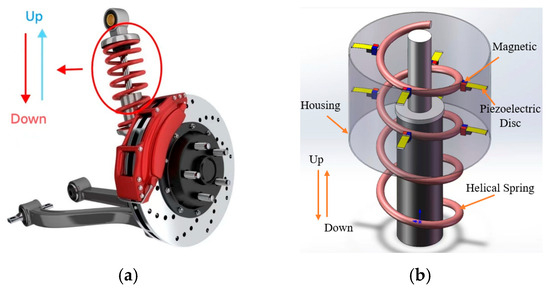
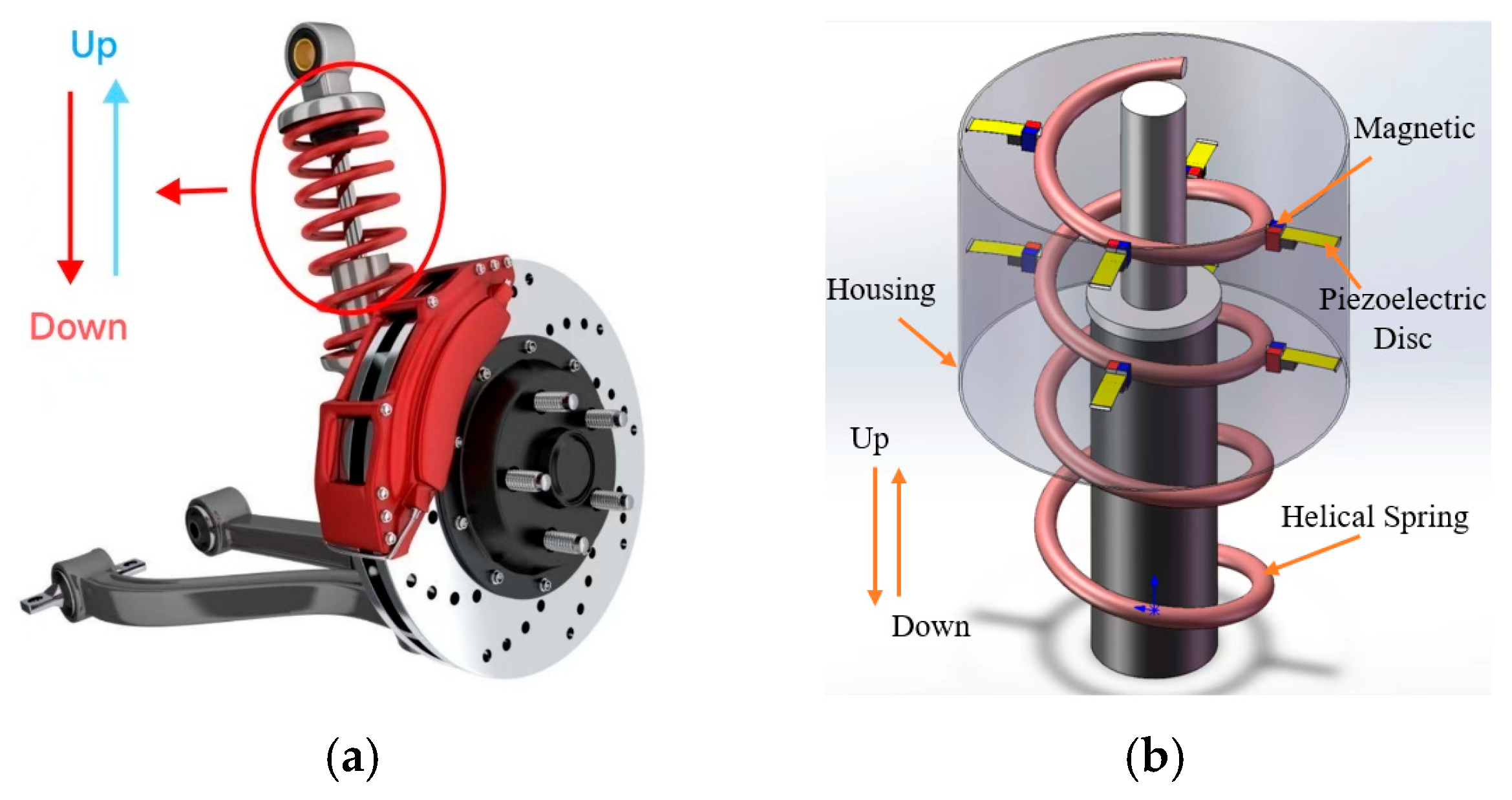
This paper presents a piezoelectric energy harvester designed for vibrational energy recovery in vehicle suspension systems. The core structure of the device comprises an array of eight cantilever beams aligned axially (x-direction) and sixteen permanent magnets, all encapsulated within a cylindrical housing rigidly connected to the vehicle body. The root of each cantilever beam is fixed to the inner wall of the housing, with its free end integrated with a permanent magnet mass. The permanent magnets adopted in this design are N40-grade NdFeB magnets (supplied by Ningbo Yunsheng Co., Ltd., Ningbo, China), with a diameter of 10 mm, height of 4 mm, residual magnetism (Br) of 1.28–1.32 T, coercive force (Hcb) ≥ 955 kA/m, and maximum energy product ((BH)max) of 293–318 kJ/m3. These performance parameters ensure a stable nonlinear magnetic coupling force to drive the deformation of the cantilever beam.
Correspondingly, an additional set of permanent magnets is symmetrically mounted on the vehicle suspension coil spring (adapted to the MacPherson independent suspension, supplied by Wanxiang Qianchao Co., Ltd., Hangzhou, China). The suspension coil spring has a wire diameter of 12 mm, a central diameter of 80 mm, an effective number of turns of 8, and a stiffness of 16,000 N/m, forming a nonlinear magnetic attractive coupling with the permanent magnet mass at the tip of each cantilever beam. As shown in Figure 1, this design addresses critical issues faced by conventional nonlinear energy harvesters, including their limited adaptability to complex and variable vibrational environments due to a reliance on unidirectional excitation responses, as well as the low energy conversion efficiency of conventional cantilever structures. The latter issue stems from a natural frequency significantly higher than the ambient excitation frequency within the ultra-low-frequency spectrum typical of vehicle vibrations. By integrating a mass block at the free end of the cantilever beam, the overall equivalent mass and stiffness of the system are effectively reduced, thereby significantly lowering the natural frequency and promoting a shift of the resonance peak toward the lower frequency region. This tuning mechanism aligns with the vibrational frequency characteristics of vehicle suspension systems, as Sun [28] et al. highlighted that the human body is highly sensitive to 4–8 Hz vertical vibrations (consistent with ISO 2361 From the ISO 2361 [28], the human body is much sensitive to vibrations of 4–8 Hz in the vertical direction.) and that finite frequency-targeted optimization outperforms full-frequency-domain control in suppressing relevant vibrations, while Zhang et al. [29]. revealed, via evolutionary power spectral density (EPSD) analysis, that suspension resonant frequencies form a dynamic frequency domain (DFD) that shifts toward lower ranges with increasing vehicle speed. This frequency-tuning mechanism enables highly efficient matching between the resonance frequency of the energy harvester and the actual vibrational spectrum of vehicles, thereby fundamentally enhancing the device’s energy capture performance in low-frequency vibrational environments.
Figure 1.
Structural design of the energy harvester: (a) suspension structure diagram; (b) diagram of the energy harvesting device structure.
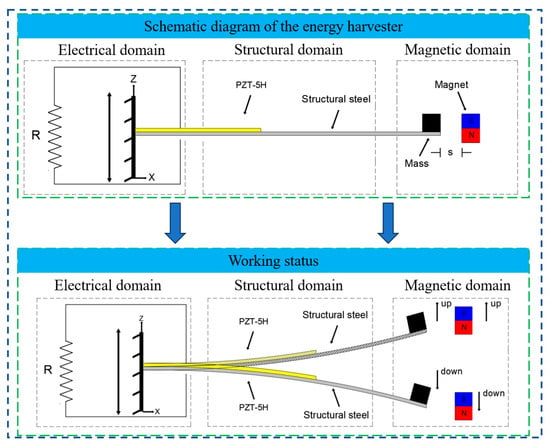
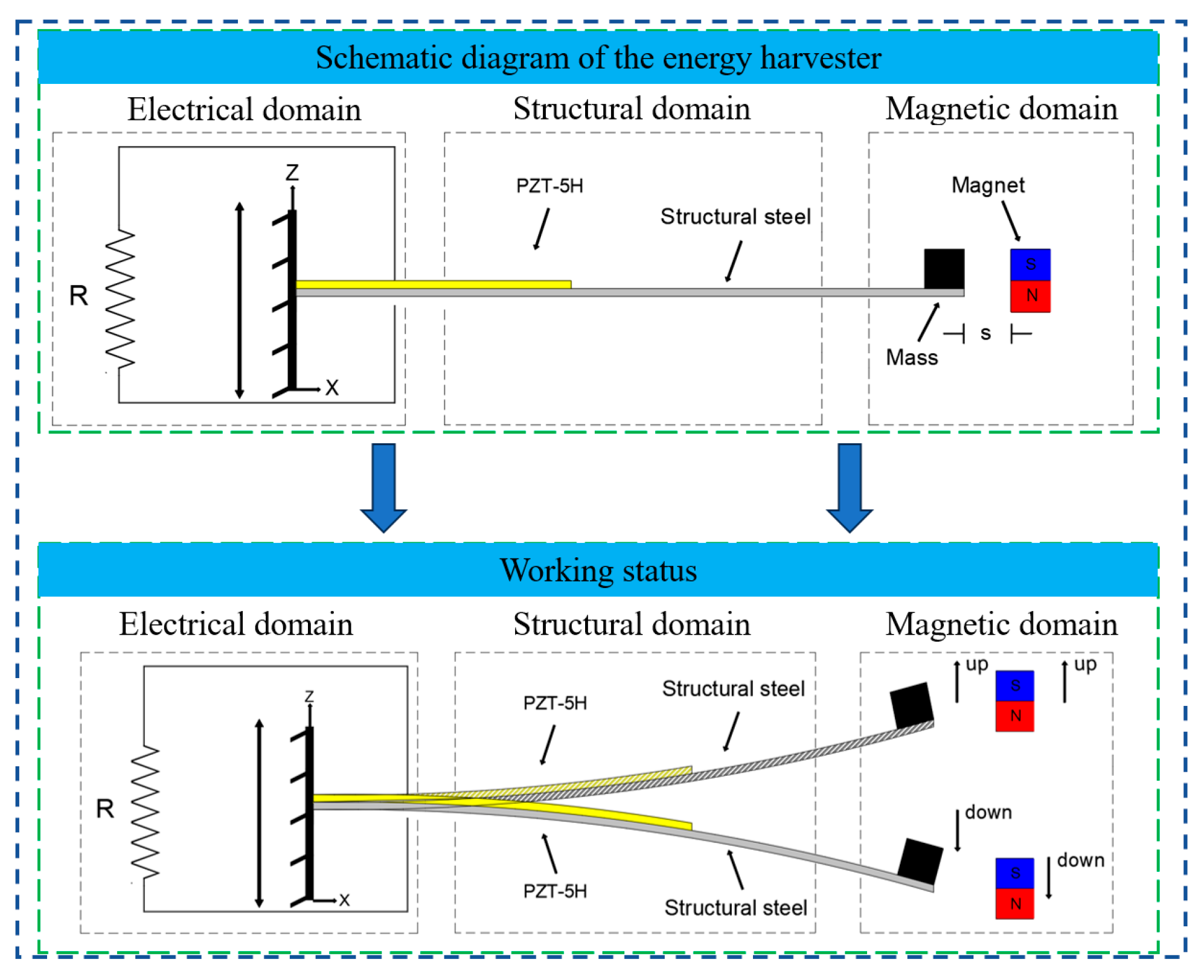
Figure 2 illustrates the operating mechanism of the energy harvester, which functions through the collaborative interaction between the electrical and structural domains. The structural domain is centered on a cantilever beam, with an attached mass at its free end to modulate the natural frequency, while the electrical domain consists of a PZT-5H piezoelectric ceramic patch bonded to the upper surface of the beam. The core operational principle of the system lies in the electromechanical coupling effect. In the static state, the two permanent magnets are horizontally aligned to ensure that the initial magnetic coupling force is in a stable linear interval, avoid pre-bending deformation of the cantilever beam caused by excessive static magnetic attraction, and ensure that the nonlinear characteristics of the magnetic coupling force are controllable during dynamic excitation [30]. When external excitation, such as suspension vibration generated during vehicle operation, induces vibration of the beam, the permanent magnet corresponding to the one at the free end of the cantilever moves following the suspension vibration. The magnetic force generated between the two permanent magnets causes repeated bending deformation of the beam. This mechanical deformation directly induces strain in the PZT-5H piezoelectric patch attached to the beam, which subsequently converts the mechanical strain into electrical charge output through the direct piezoelectric effect, thereby transforming mechanical energy into electrical energy.
Figure 2.
Schematic diagram of the energy harvester.
In addition, the piezoelectric ceramic patch bonded to the cantilever beam surface is PZT-5H (supplied by Baoji Tianbo Electronic Materials Co., Ltd., Baoji, China), with dimensions of 60 mm × 20 mm × 0.2 mm, an electromechanical coupling coefficient (Kp) of 0.68, and a piezoelectric constant (d31) of 320 × 10−12 C/N, which ensures efficient conversion of mechanical strain into electrical energy.
2.2. Feasibility Analysis
In the designed vibrational energy harvesting system, the nonlinear magnetic coupling force between the cylindrical permanent magnet integrated at the end of the piezoelectric cantilever beam and the permanent magnet mounted on the suspension coil spring serves as the core excitation mechanism. The initial gap distance plays a critical role as a key design parameter of the mechanism. When the initial gap distance is excessively large, the coupling strength between the magnets attenuates significantly. As a result, under external excitation along the z-axis, the vibration amplitude of the cantilever beam is suppressed, thereby substantially reducing the electrical output power generated by the piezoelectric transduction layer. Conversely, if the initial gap distance is too small, the attractive force generated between the magnets will significantly exceed the elastic restoration force threshold of the cantilever beam. Such a mechanical imbalance would lead to a complete loss of functionality in the energy harvester.
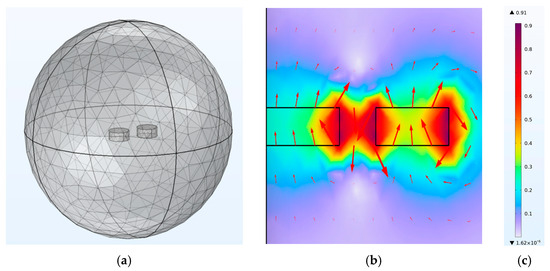
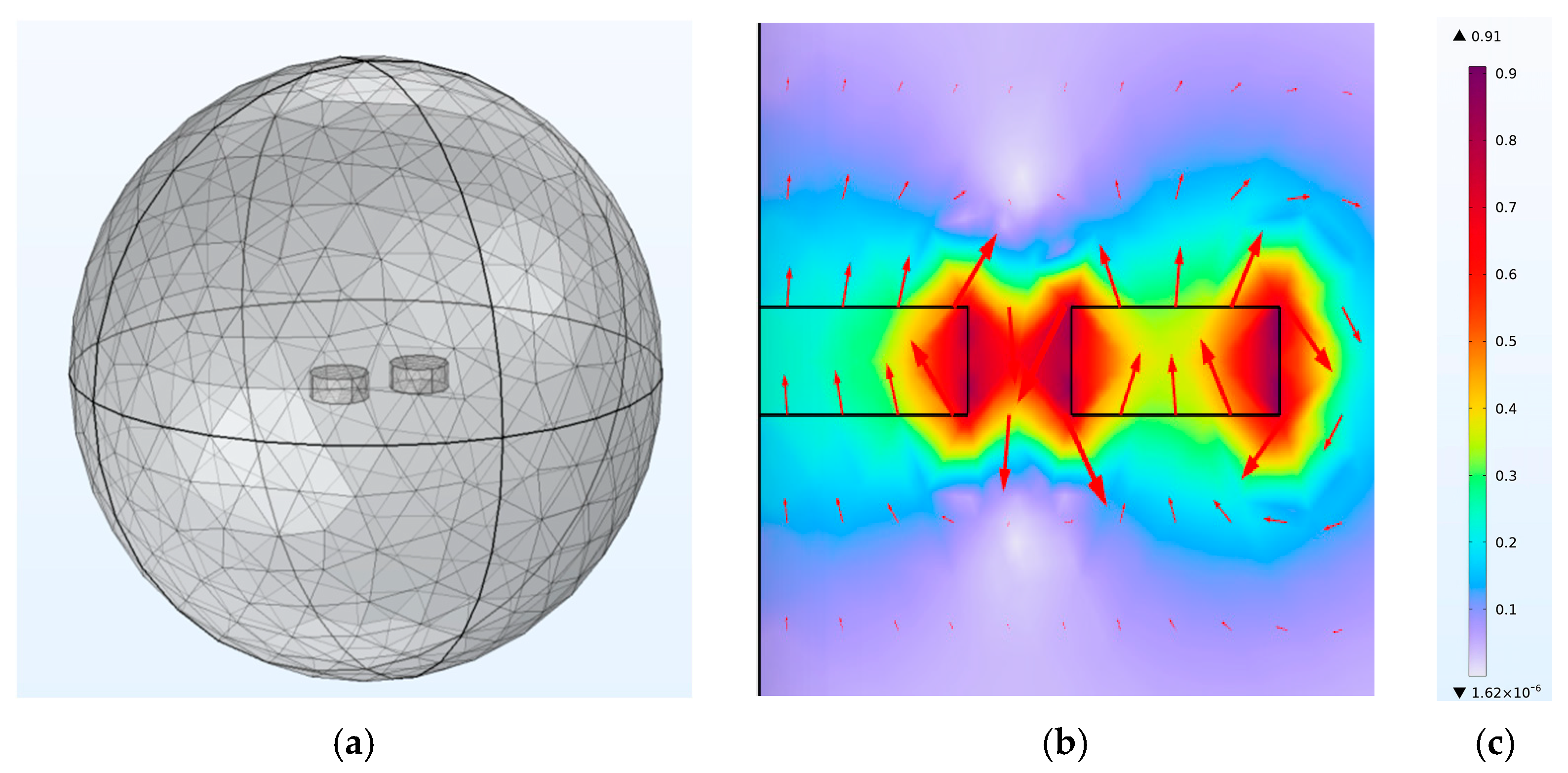
To investigate the relationship between the interaction force of cylindrical permanent magnets and the gap distance, a finite element model was developed using the COMSOL Multiphysics 6.2 platform. The model adopts the Magnetic Fields, No Currents physics interface, which is dedicated to simulating static magnetic field distributions and magnetic force interactions between permanent magnets without external current excitation. The model comprises two cylindrical N40-grade NdFeB magnets of identical dimensions (diameter: 10 mm; height:4 mm), with their magnetization direction defined as the axial direction (z-axis), consistent with the actual installation orientation of the magnets in the energy harvester. The initial gap distance defined as s. In this model, the left magnet is fixed as a constraint, while the right magnet is subjected to a displacement excitation along the z-axis (for a specified gap distance s). The computational domain was set to include the magnet region and the surrounding air domain, with a far-field boundary condition applied to the outer surface of the air domain to simulate the infinite extension of the magnetic field and eliminate boundary reflection effects. Figure 3a displays the meshed model of the magnet system, including the enclosing air domain, while Figure 3b presents the computed contour plot of magnetic flux density, which is utilized to evaluate the interaction force between the magnets.
Figure 3.
Finite element simulation: (a) mesh diagram; (b) magnetic flux density distribution; (c) the magnitude of the magnetic flux density.
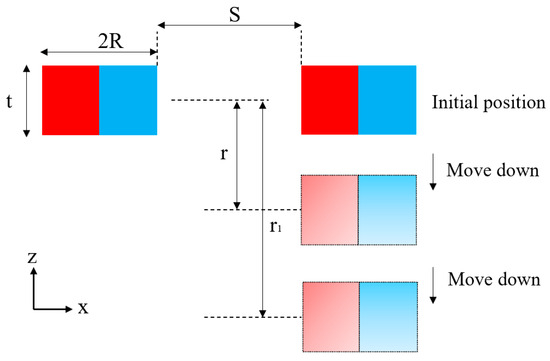
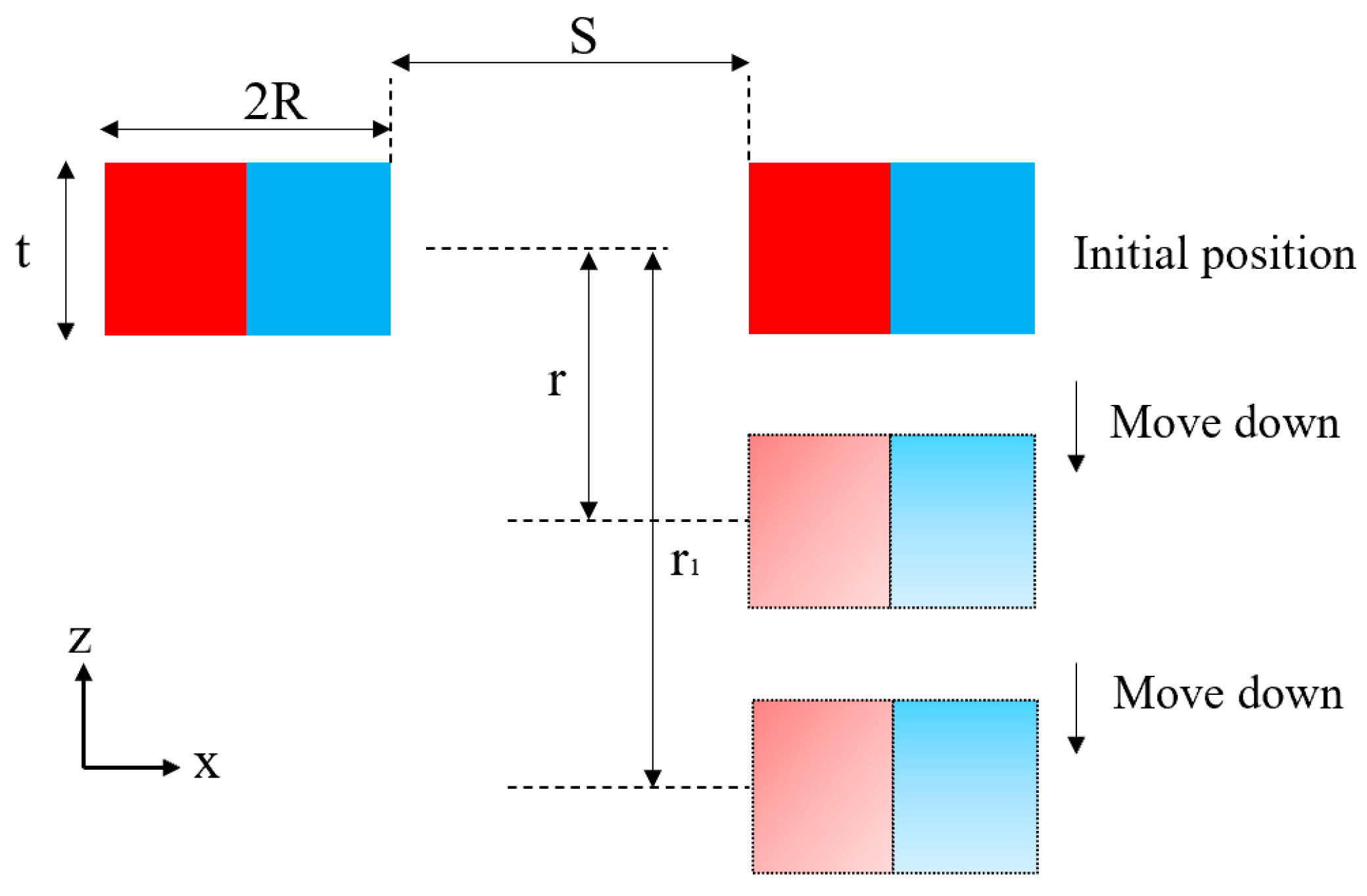
To validate the accuracy of the developed finite element model, this study selected representative methods for comparison based on a literature review. Akoun [31] first proposed the complete analytical expression for the force between magnets, which was further applied to the design of magnetic devices. Furlani [32] derived the expression for the axial force between magnetic disks by using the charge model. Under the condition of uniform magnetization, Vokoun [33] et al. presented the expression for the axial force between two transversely moving cylindrical magnets. Avvari et al. [30] expressed the axial and lateral forces between cylindrical magnets in the form of integrals, which were then used to investigate piezoelectric energy harvesters. Among various analytical approaches for calculating the interaction forces between permanent magnets, Avvari et al. [30] derived expressions for both axial and lateral forces between cylindrical magnets through an integral formulation, which demonstrated high consistency with experimental measurements. Figure 4 illustrates the geometric configuration of two cylindrical magnets under both axial and lateral relative displacements. The derived analytical formula for the lateral force between identical magnets is presented below:
Figure 4.
Schematic of two cylindrical magnets with axial and lateral separation.
In Equation (1), s denotes the axial distance between the magnets, J represents the Bessel function of the first kind and order 1, μ0 is the permeability of free space, ε takes a value of +1 for attraction and a value of −1 for repulsion, q is a dimensionless parameter reflecting the characteristic shape function of the cylindrical magnets and the properties of the magnetic vector potential in Fourier space, M denotes the magnetization, R is the radius, t is the thickness of the magnet, and r indicates the lateral spacing between the magnets.
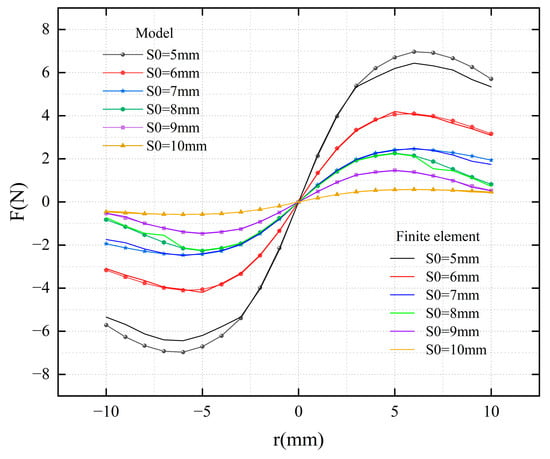
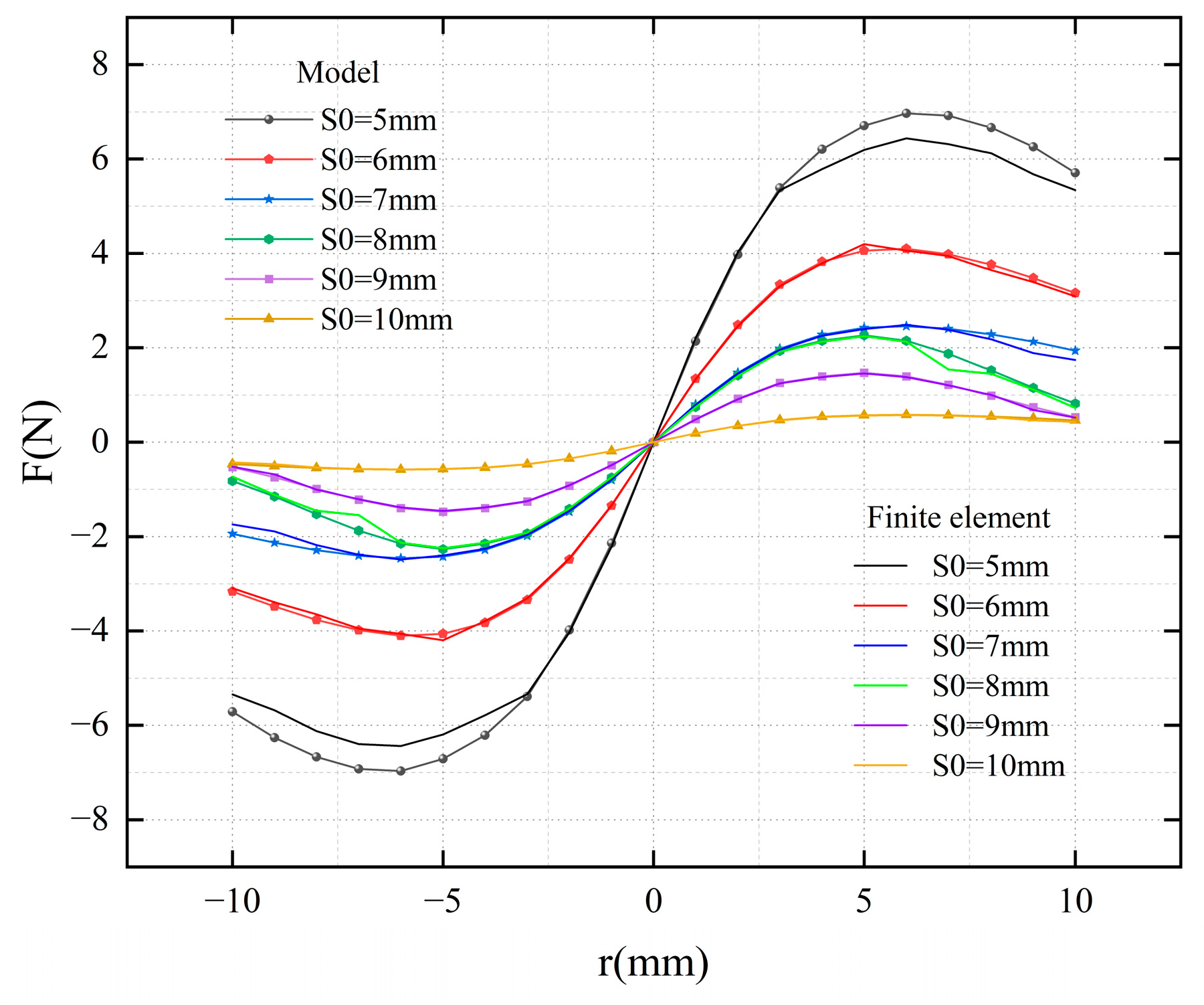
The data obtained from the developed finite element model were compared with those from the model developed by Avvari et al. [30]. As S0 (the initial horizontal distance between the two permanent magnets) increased progressively from 5 mm to 10 mm, both the theoretical model and the finite element model demonstrated a consistent variation trend. The two methods exhibited a highly consistent positively increasing pattern within the parameter range of S0 = 5 mm to S0 = 10 mm. Although minor discrepancies exist in the computational results of the finite element model (FEM), it maintains high overall accuracy. Analysis of the data at 8 mm, as shown in Table 2, indicates that the error ranges approximately from 5% to 10%. The variation trends predicted by both models are highly consistent, with the FEM results being slightly lower than the theoretical values across all dimensional parameters. This reflects the higher sensitivity of the numerical method to the structural mechanical response. Nevertheless, the observed differences remain within an acceptable range and do not undermine the reliability of finite element analysis as an effective tool for evaluating structural performance, as shown in Figure 5.
Table 2.
Piecewise linear approximation of nonlinear magnetic force.
Figure 5.
Variation of the magnetic interaction force.
To investigate the mechanical response of the cantilever beam structure under external loading, with a specific focus on the quantitative relationship between the load applied at its free end and the resulting displacement, this study systematically modeled and analyzed the deflection behavior of a cantilever beam subjected to a concentrated load at the free end based on classical beam theory from mechanics of materials. The study focuses on a composite laminated cantilever beam structure consisting of a piezoelectric ceramic (PZT-5H) layer and an elastic steel substrate. Its equivalent bending stiffness is governed by the geometric dimensions and physical properties of the constituent materials.
In such laminated structures, the synergistic deformation between different material layers necessitates the introduction of an equivalent bending stiffness to characterize the overall flexural resistance. This equivalent stiffness expression comprehensively incorporates the contributions of both the PZT layer and the steel substrate, as given by the following formula:
According to the deflection solution of a cantilever beam subjected to a concentrated force (F) at its free end, the relationship between the free-end deflection and the applied load can be expressed as follows:
Equivalently, the required applied force can be solved as follows:
where Ieq is the equivalent bending stiffness, A is the area of the PZT layer, L is the length of the beam, EPZT is the Young’s modulus of the PZT layer, and Esteel is the Young’s modulus of the elastic steel substrate.
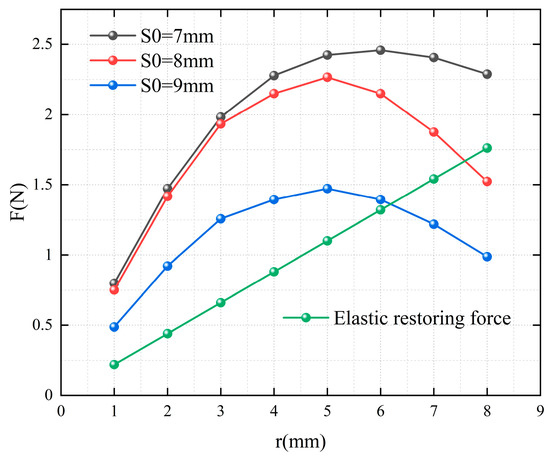
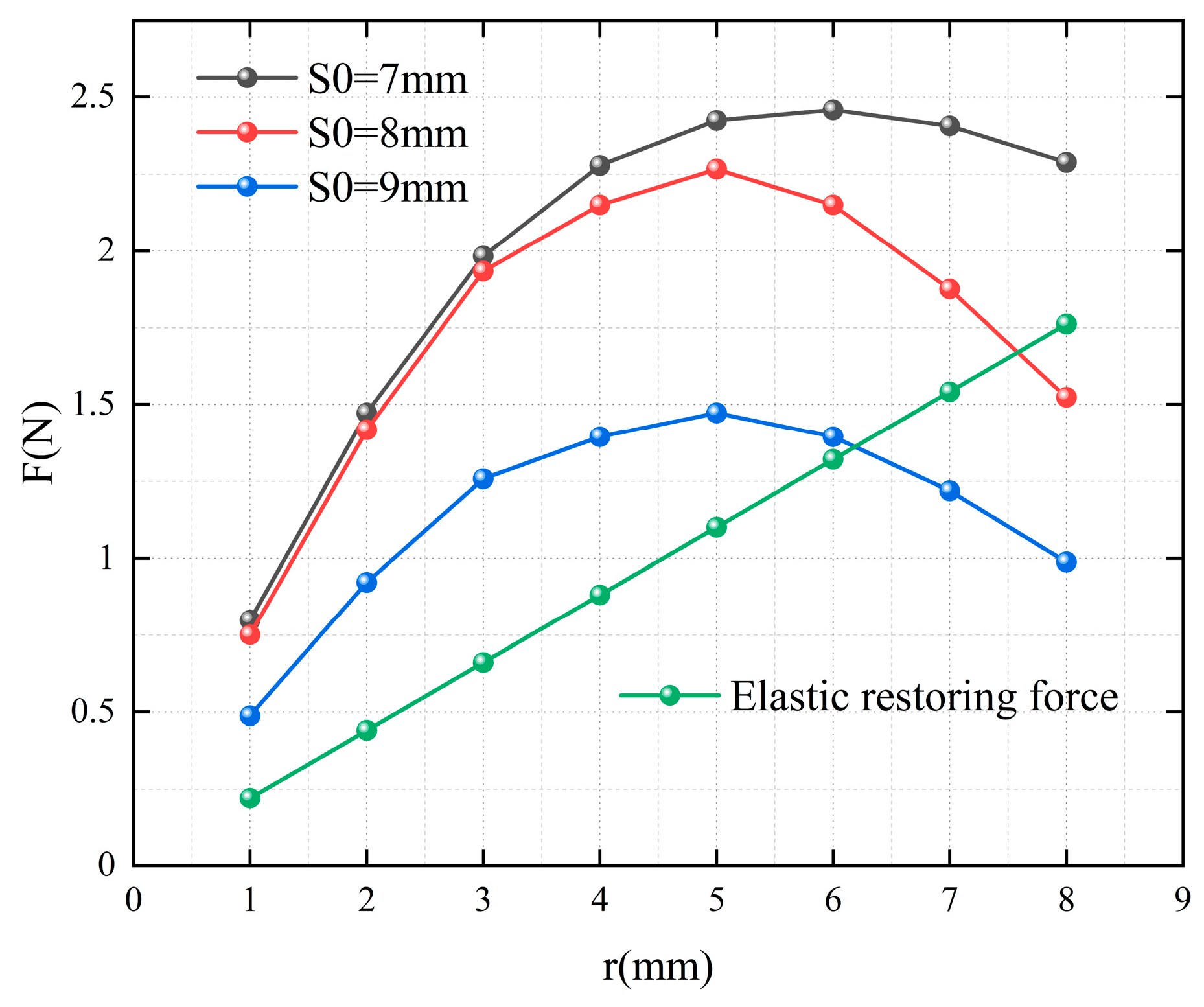
Based on the theoretical model described above, this study further calculated the concentrated load required to achieve a free-end deflection of the cantilever beam ranging from 1 to 8 mm. The calculation results are shown in Figure 6. As the deflection increases, the required external load exhibits a significant non-linear growth trend, indicating that the structure may exhibit geometric nonlinear characteristics. To further evaluate the excitation feasibility of the cantilever beam system, a comparative analysis was conducted between the calculated elastic restoring force and the magnetic attractive force under various initial horizontal gaps. The results indicate that at a horizontal magnet gap of 8 mm, the magnetic attractive force significantly exceeds the elastic restoring force of the beam throughout the displacement range, except near the 8 mm deflection point. This demonstrates that the magnetic configuration can effectively overcome the structural stiffness, achieve the intended deformation of the cantilever beam, and induce a stable electromechanical coupling response. Simultaneously, this gap configuration both ensures excitation effectiveness and prevents excessive structural deformation or damage caused by an overpowering magnetic force, thereby balancing actuation performance and safety. In contrast, when the magnet gap increases to 9 mm, the magnetic attraction force attenuates significantly, becoming insufficient to overcome the beam’s elastic restoring force over most of the deflection range. This results in inadequate excitation and fails to drive the cantilever beam to produce an effective dynamic response.
Figure 6.
Relationship between the elastic restoring force of the beam and the magnetic attractive force.
Therefore, based on a comprehensive trade-off between excitation efficiency and structural integrity, a horizontal gap of 8 mm between the permanent magnet at the free end of the cantilever beam and the fixed magnet on the suspension coil spring is identified as the optimal design parameter. This configuration ensures sufficient excitation of the cantilever beam while effectively preventing structural failure or fatigue damage caused by excessive deformation, thereby significantly enhancing the operational stability and long-term reliability of the entire energy harvesting device.
3. Modeling
This section establishes a time-domain model of road roughness using MATLAB/Simulink 2021b mathematical analysis software to generate random road elevation excitation that conforms to a specified power spectral density. Based on this foundation, a two-degree-of-freedom (2-DOF) vibrational system dynamics model of a quarter-vehicle suspension was established. By incorporating vehicle operating conditions, numerical solutions were obtained, yielding the vertical dynamic displacement response of the vehicle under various road classes and driving speeds. Furthermore, an electromechanical coupling model of a cantilever-type piezoelectric vibration energy harvester was developed, integrating the aforementioned vibrational responses to evaluate its energy recovery performance.
3.1. Vibration Modeling
Vibrations during vehicle operation primarily originate from excitations induced by road roughness, which exhibits statistically significant differences between car and truck wheel tracks, as highlighted by Hassan and Evans [34], who characterized road irregularities using the Heavy Articulated Truck Index (HATI), which is sensitive to long-wavelength features that dominate low-frequency vibrations (1–4 Hz) relevant to suspension responses. As Abdelkareem et al. [35] further verified via a 7-DOF full car model, such road excitations manifest in multiple input modes (bounce, pitch–bounce, and roll–pitch–bounce), with the latter (complex real-world mode) yielding higher vibration intensity and energy harvesting potential (up to 420 W per damper under standard driving cycles like NEDC and WLTP), especially for heavy-duty and off-road vehicles. In this study, the vibration energy harvester was integrated into the suspension system. Road-induced excitations, including those inherent to wheel track-specific roughness and multi-mode dynamic characteristics documented in [35], are transmitted through the suspension to the device, driving it to undergo electromechanical conversion. In terms of modeling methodology, first-order filtered white noise was adopted to generate random road excitation with band-limited characteristics—consistent with the frequency distribution of real-world road roughness validated by both [31,32] through experimental measurements and full-vehicle simulations across diverse road classes (Class A to D)—the mathematical model of which is given by Equation (5).
where f0 denotes the lower cut-off frequency, q(t) represents the random road excitation signal, and G(n0) is the road roughness coefficient. Considering actual vehicle operating conditions, the first four classes of road roughness listed in Table 3 were adopted. The corresponding random road excitation signal was subsequently generated through simulation.
Table 3.
Road roughness classification based on power spectral density.
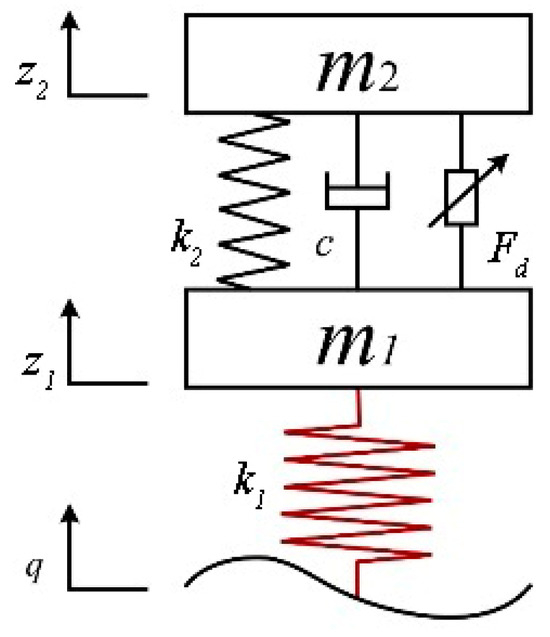
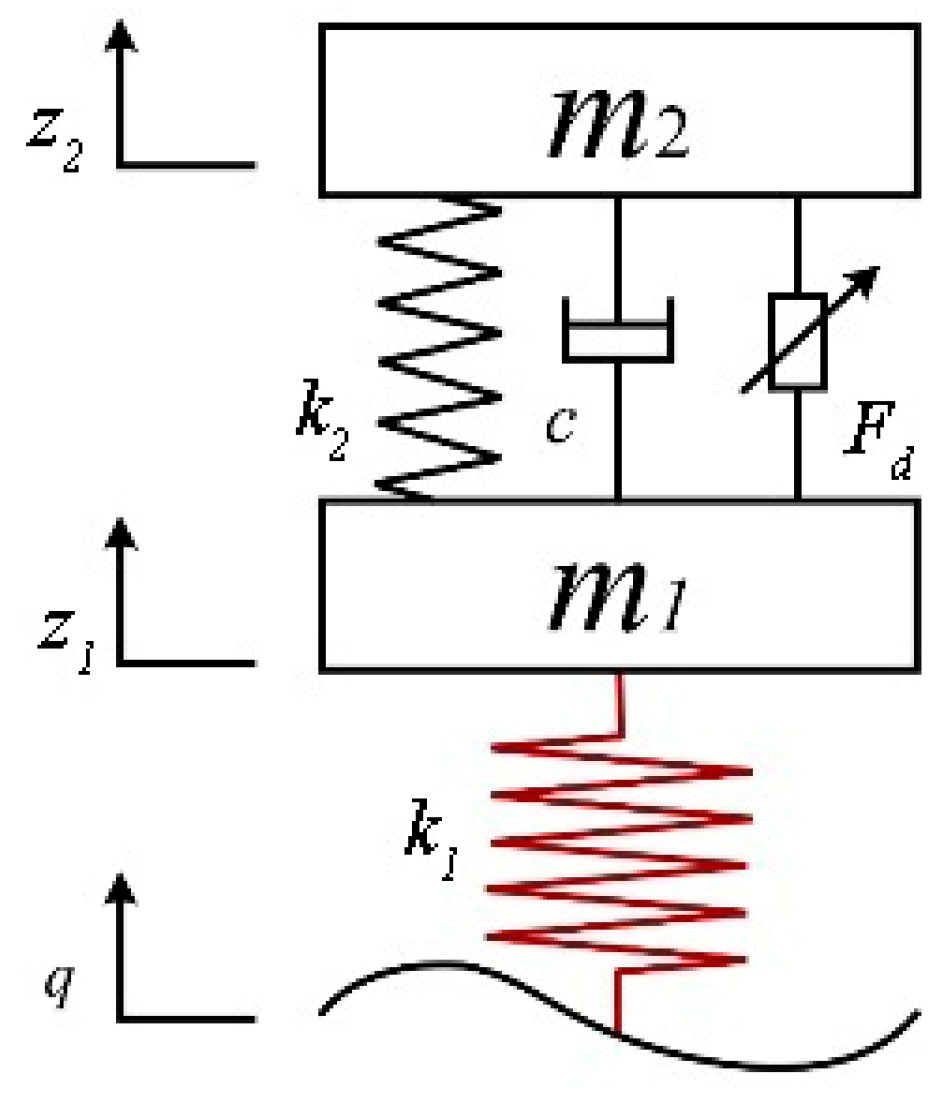
A quarter-car suspension model was established, as shown in Figure 7 above. The governing differential equations of motion for the two-degree-of-freedom quarter-vehicle model were derived based on Newton’s second law of motion as follows.
where ż1 denotes the vertical velocity of the wheel, ż2 represents the vertical velocity of the vehicle body, is the vertical acceleration of the vehicle body, m1 is the unsprung mass (wheel mass), m2 is the sprung mass (vehicle body mass), k1 is the equivalent stiffness of the tire, k2 is the equivalent stiffness of the suspension, c is the equivalent damping coefficient of the suspension, q is the road excitation input, z1 is the vertical displacement of the wheel, z2 is the vertical displacement of the vehicle body, and Fd is the active control force.
Figure 7.
Quarter-vehicle suspension model.
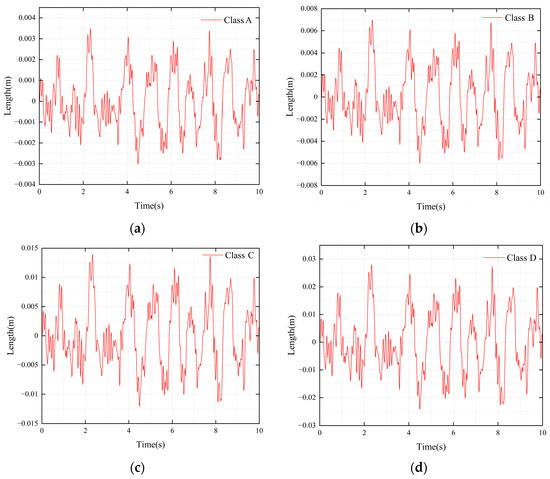
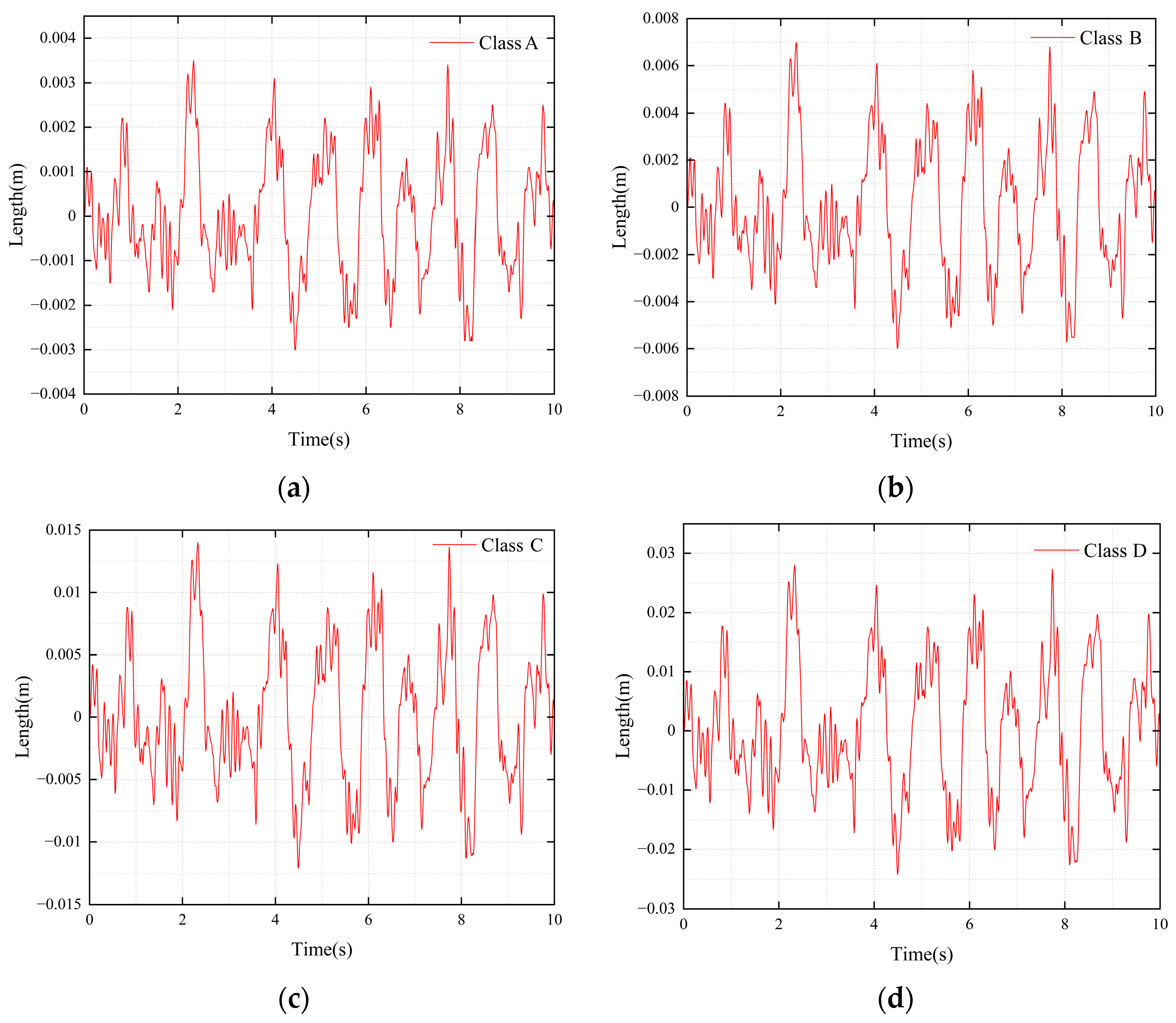
The focus of this study is a passenger car, and the key structural parameters of the vehicle suspension employed in the simulations are listed in Table 4. Based on the system governing differential equations, a dynamic model of the quarter-vehicle suspension system was established in the Simulink environment. Through simulation analysis, the dynamic travel response of the suspension was obtained, as shown in Figure 8.
Table 4.
Simulation parameters of the suspension system.
Figure 8.
The 60 km/h relative vertical displacement of the road surface for classes A–D: (a) grade A pavement; (b) grade B pavement; (c) grade C pavement; (d) grade D pavement.
Simulations of the time-domain response of suspension dynamic travel were conducted for road classes A to D under multiple speed conditions. Through statistical analysis of the time history of suspension dynamic travel under various operating conditions, the root mean square (RMS) value of its amplitude was extracted to serve as the equivalent periodic displacement excitation input at the excitation end of the permanent magnet for the corresponding condition, as shown in Table 5. This provides key boundary conditions for the subsequent establishment of the magnetic–mechanical–electrical coupling model.
Table 5.
Relative vertical displacement of the road surface for road classes A–D at various vehicle speeds.
3.2. Modeling of the Energy Harvesting System
This paper describes a piezoelectric energy harvester integrated into vehicle suspension systems. The device consists of multiple arrays of cantilever beam units with ferromagnetic end masses and corresponding permanent magnets mounted on coil springs, all encapsulated within a cylindrical shell fixed to the vehicle body. Suspension vibration drives the displacement of the permanent magnets and alters the magnetic field, thereby exciting the cantilever beams through magneto-mechanical coupling. This mechanical vibration subsystem can be simplified as a mass–spring–damper model. By exploiting the fact that the natural frequency of the cantilever beams is significantly higher than the vibration-frequency band of the suspension, the system converts low-frequency excitations into high-frequency responses through a nonlinear frequency up-conversion mechanism, thereby enhancing energy harvesting efficiency. The governing equation for the transverse vibrations of the structure of the piezoelectric cantilever beam was established to investigate its electromechanical coupling characteristics. The beam consists of a piezoelectric ceramic layer, a steel substrate, and a tip magnet. Its governing equation for transverse vibration can be expressed as follows:
where mb is the equivalent lumped mass of the system, which includes the mass of the permanent magnet (mmag), the mass of the elastic steel substrate, and the mass of the PZT material. The specific expression is given by
where ρs and ρp denote the densities of the elastic steel and PZT-5H material, respectively, Vs and VP represent their corresponding volumes. The c parameter denotes the equivalent viscous damping coefficient of the system, characterizing the energy dissipation effects of internal structural damping and the surrounding medium. The equivalent bending stiffness coefficient (Kb) is calculated through a piecewise integration method to account for the non-uniform stiffness distribution along the length of the beam, and its reciprocal is given by
Due to the beam structure consisting of a laminated composite of PZT-5H and elastic steel over the interval of [0, LP] and pure elastic steel over [LP, L], its bending stiffness must be modeled in a piecewise manner. Here, L denotes the total length of the cantilever beam; LP represents the coverage length of the PZT patch; and EI1 and EI2 indicate the equivalent bending stiffness of the composite section and the pure steel section, respectively. Their expressions are given as follows:
where L is the total length of the cantilever beam, LP is the coverage length of the piezoelectric patch, ES is the Young’s modulus of the elastic steel layer, EP is the Young’s modulus of the PZT-5H material, IS is the moment of inertia of the steel layer cross-section, AP is the cross-sectional area of a single PZT layer, IP is the moment of inertia of a single PZT layer cross-section, hS is the thickness of the steel layer, hP is the thickness of the PZT layer, EI1 is the equivalent bending stiffness of the composite section, and EI2 is the bending stiffness of the pure steel section.
The external excitation force (Fm(t)) is a time-varying magnetic force originating from the non-contact magnetic interaction between the permanent magnet at the free end of the cantilever beam and the external excitation magnet. Its vertical component can be derived from either the magnetic dipole model or the integral form of the Maxwell stress tensor. This study adopts the following empirical integral expression:
Based on the bending strain distribution of the beam, a piezoelectric output model is further established. According to classical beam theory, the axial strain at any position (x) along the beam is given by
where ω(x, t) is the transverse deflection function of the beam and ℎ denotes the distance from the neutral axis of the piezoelectric layer to its outer surface (i.e., h = hs + hp, taken as the distance above the neutral axis). Based on the d31-mode piezoelectric effect, the total generated charge (Q(t)) is obtained by integrating the strain gradient over the PZT-covered region (0 ≤ x ≤ Lp):
where d31 is the piezoelectric stress constant of the PZT-5H material.
where the equivalent capacitance of the PZT layer is given by
where εr is the relative permittivity of PZT-5H, ε0 is the vacuum permittivity, and b is the width of the beam. Finally, the instantaneous output power across the load resistance (R) is given by
This theoretical model fully characterizes the electromechanical conversion process of the piezoelectric cantilever beam under magnetic excitation, encompassing the complete dynamic behavior, from mechanical vibrational response to electrical energy output, thereby providing a solid theoretical framework for subsequent numerical simulations, parameter optimization, and experimental validation.
The parameter values of the piezoelectric energy harvester listed in Table 6 are not arbitrarily selected. They are rationally determined based on the parameter range of conventional vehicle suspension systems, such as MacPherson independent suspensions with a stiffness range of 10,000–20,000 N/m (see Table 4). They also take into account the low-frequency vibration characteristics of vehicles complying with ISO 2361. For key parameters, the electromechanical coupling coefficient (Kp = 0.68) and piezoelectric constant (d31 = 320 × 10−12 C/N) of PZT-5H piezoelectric ceramics are selected to match the small-amplitude and low-frequency vibration excitation characteristics of suspensions. This ensures efficient conversion of mechanical energy into electrical energy. The dimensional parameters of the piezoelectric ceramic (60 mm × 20 mm × 0.2 mm) and substrate (80 mm × 20 mm × 0.2 mm) are optimized. They achieve a balance between the structural stiffness of the cantilever beam and the installation space of the suspension system. This parameter design strategy ensures that the established electromechanical coupling model is not only applicable to the suspension system in this study. It also has the potential to be extended to a broader range of vehicle suspension types.
Table 6.
System parameters for piezoelectric energy harvester modeling.
4. Experimental Section
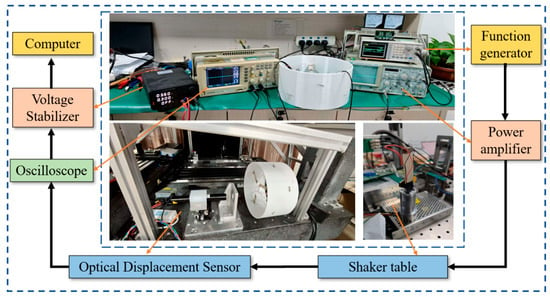
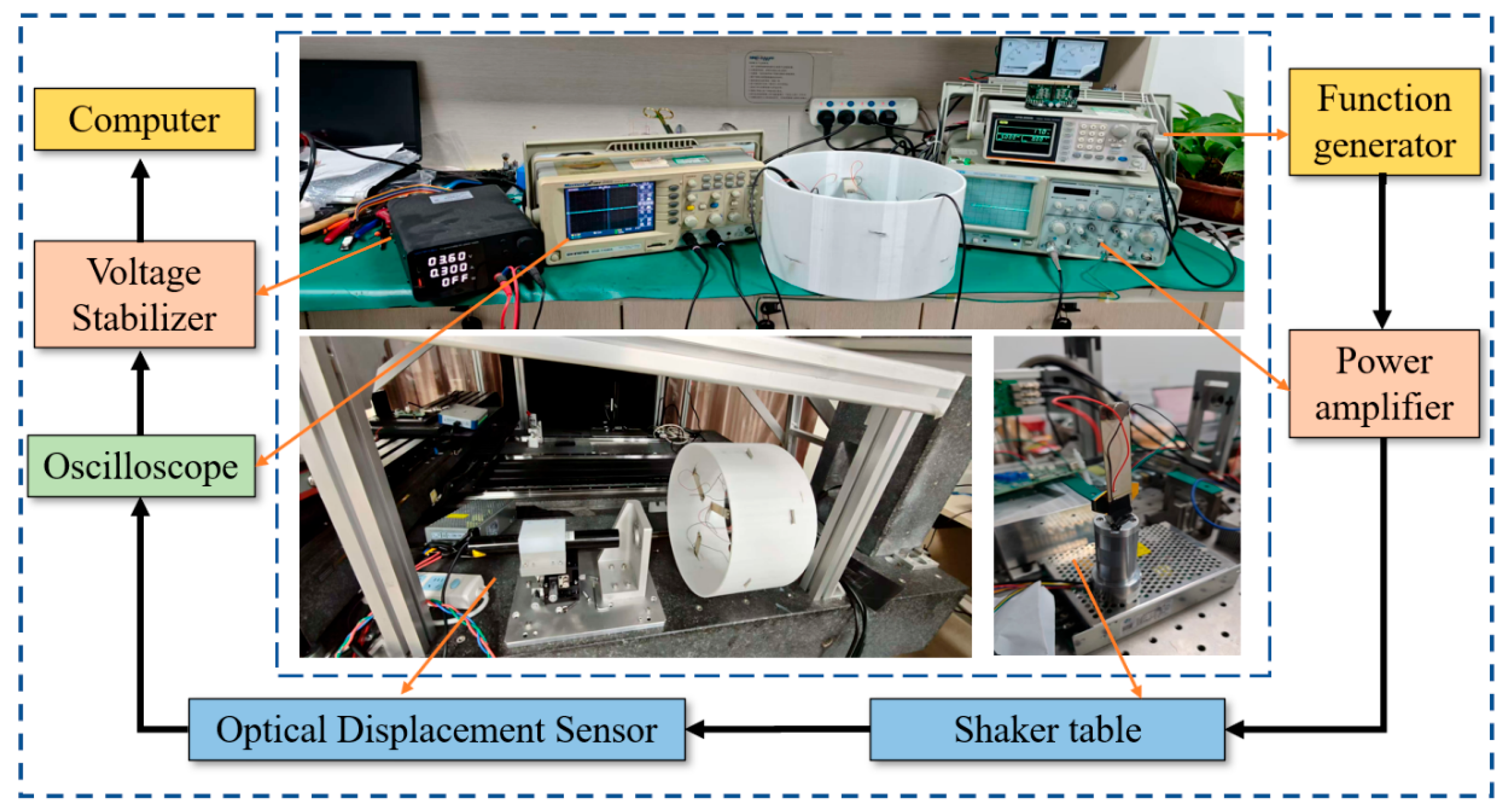
To investigate the impacts of different road classes on the power generation performance of the vehicle vibrational energy harvesting device, a complete experimental test system was established. As shown in Figure 9, the system utilized a function generator to produce electrical signals with adjustable frequency and amplitude, which were then amplified by a power amplifier to drive an electromagnetic shaker, thereby simulating various road excitation conditions. The energy harvesting device under test was mounted on the shaker table, and its vibrational response was monitored in real time using a displacement sensor. The output open-circuit voltage of the harvesting device was recorded by a high-precision oscilloscope, from which the output electrical power was calculated. By comparing and analyzing the output voltage and power of the device under various operating conditions, its power generation capability can be evaluated. The main equipment of the experimental platform includes: an electromagnetic shaker (SA-JZ Wuxi Shiao Technology Co., Ltd., Wuxi, Jiangsu, China), a power amplifier (ATA-101B105B Xi’an Aigtek Electronic Technology Co., Ltd., Xi’an, Shaanxi, China), a function generator (FY6900 Shenzhen FeelTech Technology Co., Ltd., Shenzhen, Guangdong, China), a displacement sensor (WA0708D04 Hottinger Baldwin Messtechnik GmbH, Darmstadt, Hesse, Germany), an oscilloscope (Tektronix MDO3012 Tektronix MDO3012, Tektronix, Inc., Beaverton, OR, USA), and a prototype of the energy harvesting device.
Figure 9.
Vibration test platform.
A finite element model was also developed in COMSOL Multiphysics. First, geometric modeling was performed. Using the software’s Geometry module, the 3D structural models of the cantilever beam substrate (elastic steel), piezoelectric layer (PZT-5H), and permanent magnet (N40-grade NdFeB) were constructed. The data used herein are those mentioned in the preceding sections. Subsequently, the corresponding materials were selected from the material library. Next, mesh generation was performed. Enter the Mesh module and select free tetrahedral mesh. Set the minimum element size to 0.5 mm. Then, boundary conditions and excitation are set. Enter the Physics module and add structural mechanics and piezoelectric effect physics fields. Apply full constraints to the left end of the cantilever beam to simulate the fixed end. Apply the harmonic excitation specified in the table (frequency: 10–30 Hz) to the free end. Meanwhile, properly configure the electrode boundary conditions of the piezoelectric layer to ensure normal charge output. Finally, solution settings and post-processing are completed. The solution frequency range and calculation accuracy are clearly defined.
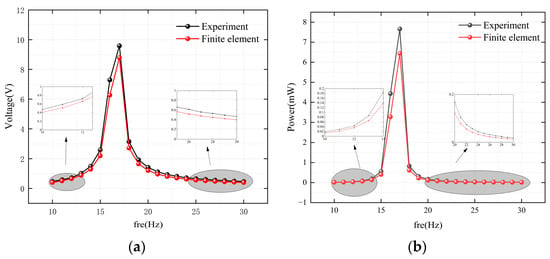
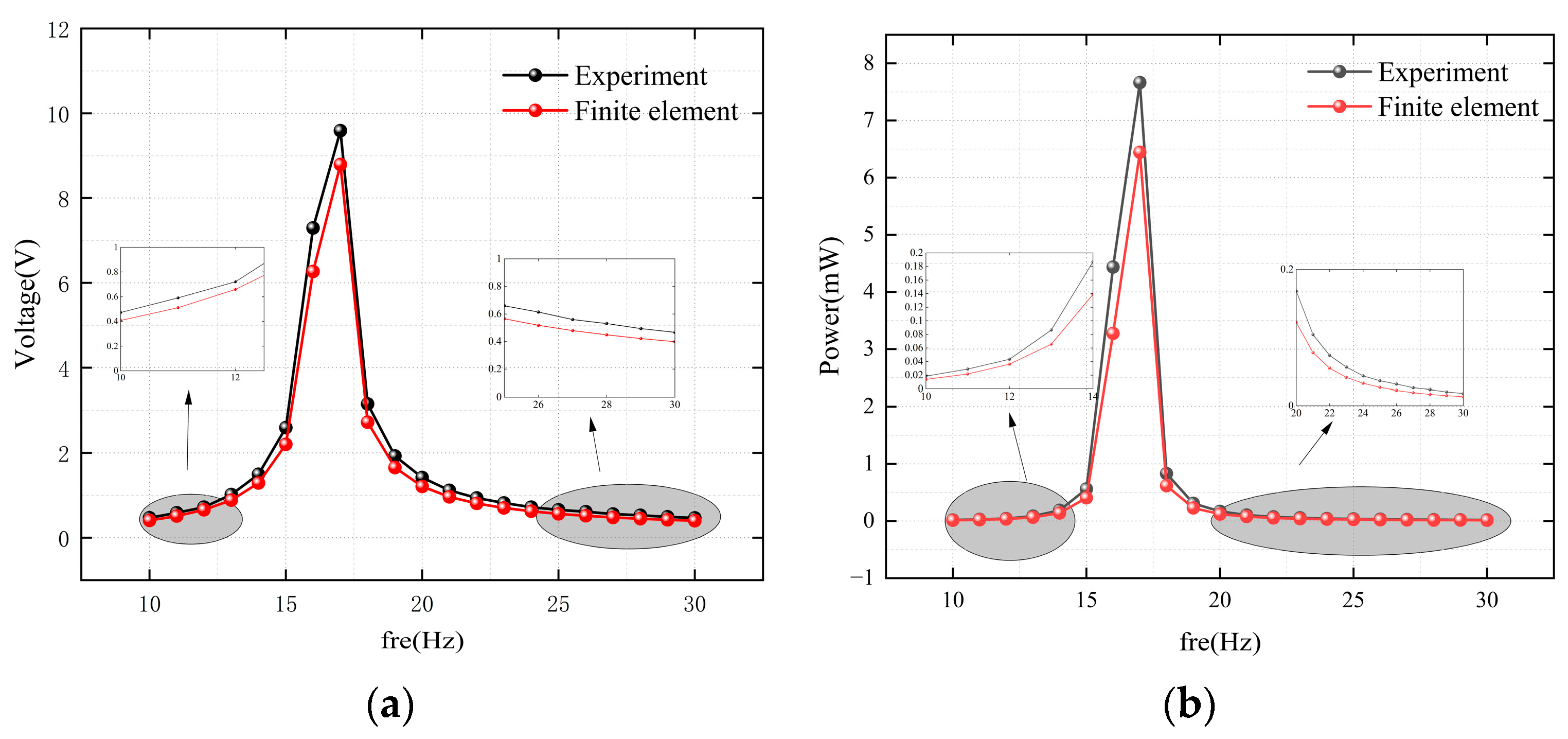
To verify the output voltage characteristics of the unimorph cantilever piezoelectric resonator in the simulation, an experimental analysis was conducted under harmonic vibration conditions. Figure 10 presents the output power and voltage characteristics of the energy harvester at various excitation frequencies. The voltage and power responses of the energy harvester exhibit a distinct peak at 16.75 Hz, which corresponds to the first-order natural frequency of the piezoelectric vibrator. When the excitation frequency deviates from this value, both the output voltage and power exhibit noticeable attenuation. Based on this frequency response characteristic, an excitation frequency of 16.75 Hz was selected for all subsequent experiments to fully exploit the resonant behavior of the system. At this frequency, the measured peak voltage was 9.59 V, and the maximum output power was 7.67 mW.
Figure 10.
Relationship diagram of output voltage and power versus frequency: (a) output voltage versus excitation frequency;w (b) output power versus excitation frequency.
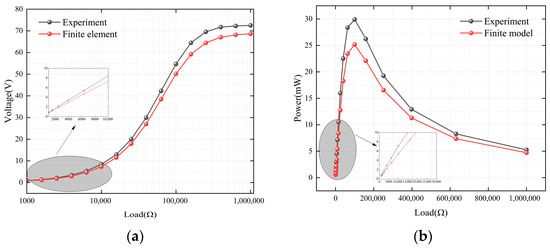
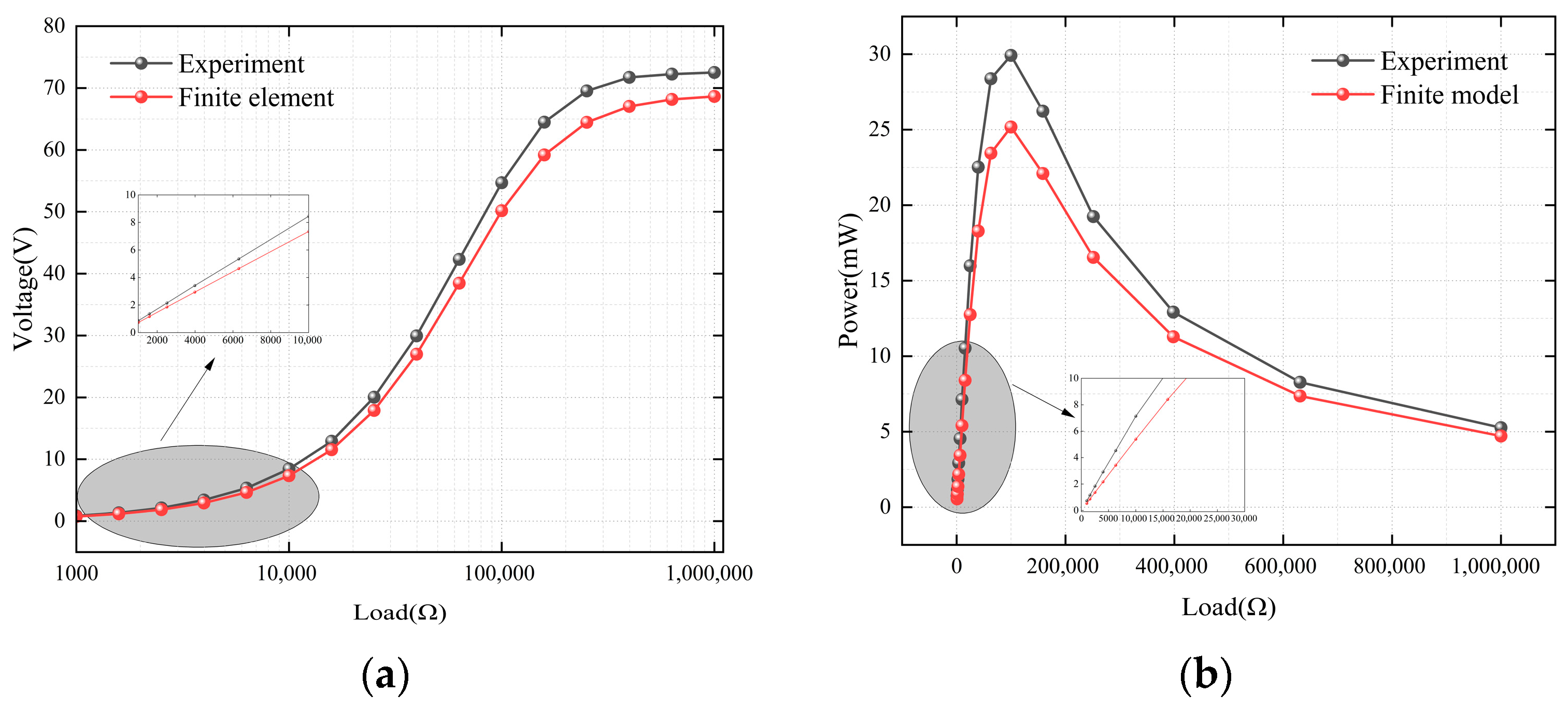
Furthermore, Figure 11 presents the output power and voltage of the energy harvester as functions of load resistance under a vibrational frequency of 16.75 Hz and an acceleration excitation of 1 g. It can be observed that the output voltage increases approximately linearly and rapidly with increasing load resistance. When the load resistance reaches approximately 100 kΩ, the voltage saturates. The output power, however, exhibits a trend of initial increase followed by a decrease with increasing resistance, reaching its maximum value at a load of 10 kΩ. This indicates that this resistance value represents the optimal matching load for the system. This value represents the optimal matching load for the system under the given excitation conditions, enabling maximum power extraction efficiency. The observed trend aligns with the typical impedance characteristics of piezoelectric energy harvesters, where the maximum power point corresponds to the resistive load that balances the inherent capacitive impedance of the piezoelectric element. Therefore, a load resistance of 10 kΩ was adopted in all subsequent experiments to achieve optimal energy harvesting performance.
Figure 11.
Relationship between output voltage, power and load Resistance: (a) variation of output voltage with load resistance; (b) variation of output power with load resistance.
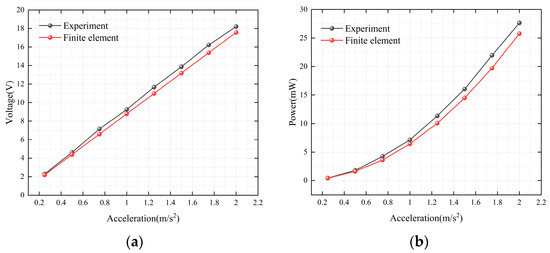
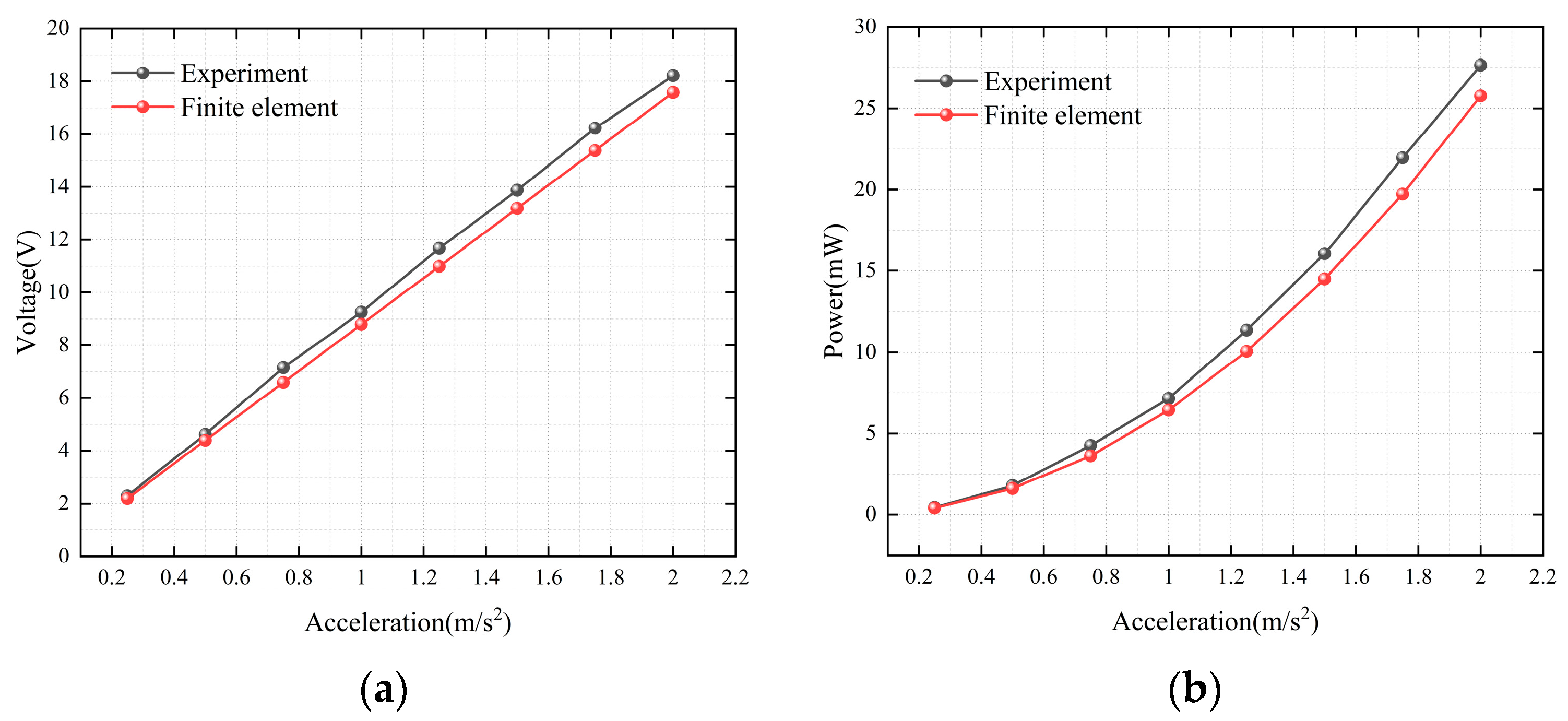
As shown in Figure 12, the input acceleration exhibits a high correlation with the output of the energy harvesting device. The experimental measurements demonstrate excellent agreement with the finite element simulation results. Both the output voltage and output power exhibit a linearly increasing trend with rising acceleration. This is because the increase in acceleration directly leads to a greater force acting on the inertial mass of the energy harvester, which, in turn, induces amplified mechanical strain. Consequently, the output power increases.
Figure 12.
Relationship of output voltage and power versus vibration acceleration: (a) output voltage versus acceleration; (b) output power versus acceleration.
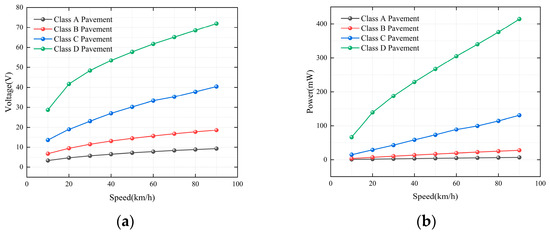
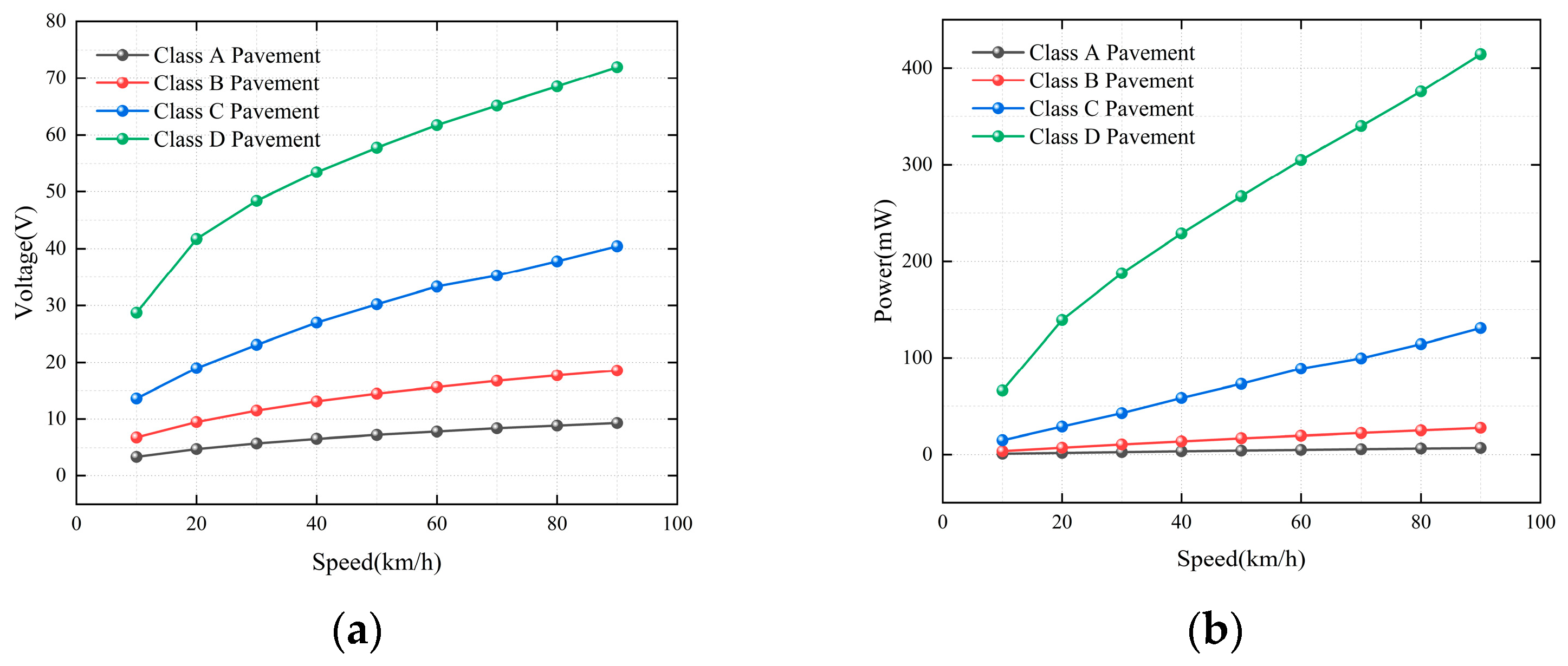
Finally, to investigate the output performance of the energy harvester under different road roughness levels and vehicle excitation speeds, the energy harvester was mounted on a vibration platform. The results are shown in Figure 13.
Figure 13.
Relationship of output voltage and power versus vehicle speed and pavement grade: (a) output voltage versus road class and vehicle speed; (b) output power versus road class and vehicle speed.
Vibrations during vehicle operation primarily originate from road excitation. Given that common road classes in China predominantly fall within grades A to D, this study focuses on analyzing the impact of vehicle-body vertical displacement induced by class A to D road profiles on the dynamic response and power generation performance of the energy harvester. The results indicate a significant positive correlation between vehicle speed and the output of the energy harvesting system, with road roughness also exerting a substantial influence on the output performance. Class D roads demonstrated optimal performance, achieving an output voltage of 71.97 V and a power output of 414.37 mW at a vehicle speed of 90 km/h. In contrast, the output performance of Class A, B, and C roads decreases sequentially as their roughness reduces (Table 7), with Class A roads exhibiting the weakest performance. Under a fixed road class, the output power exhibits a gradually increasing trend with higher vehicle speeds due to the enhanced intensity of vehicle body vibrations. This difference becomes particularly pronounced under high-speed conditions, revealing the critical role of the interaction between excitation frequency (controlled by vehicle speed) and excitation amplitude (determined by road roughness) in maximizing energy harvesting.
Table 7.
Output power under road Classes A–D at different vehicle speeds.
During the experimental process, it was observed that the values of the experimental data were slightly larger than the simulation results. Specifically, under the same excitation conditions, the measured peak output voltage was approximately 8–12% higher than the finite element simulation results. The maximum output power was 10–15% higher. Some of the reasons for this discrepancy include the following:
- The finite element model assumes the root of the cantilever beam to be fully rigidly fixed. However, in the actual experimental setup, the material properties of the mounting bracket and assembly gaps caused slight elastic deformation at the fixed end. This deformation increases the effective vibration amplitude of the cantilever beam and further enhances the output performance of the piezoelectric ceramics.
- In the simulation, the piezoelectric constant (d31) and Young’s modulus of PZT-5H were set as fixed values. The effects of temperature and stress on material properties were neglected. In the experiment, the temperature rise caused by continuous device vibration and stress concentration at the cantilever beam root led to slight changes in the material’s piezoelectric properties. This ultimately resulted in measured output values being higher than the simulation results.
To reduce the deviation between experimental and simulation results in future studies, the following targeted corrective measures are proposed:
- Change the single-point central excitation method to multi-point excitation. Multi-point excitation better matches the actual vibration mode of vehicle suspensions. This reduces the discrepancy between experimental excitation conditions and simulation assumptions.
- Introduce flexible constraints at the fixed end of the cantilever beam in the simulation model. Set the constraint stiffness according to the actual material properties of the mounting bracket. This is to simulate the slight deformation of the fixed end observed in the experiment.
5. Conclusions
This paper presents the design, modeling, and experimental validation of a nonlinear piezoelectric energy harvester incorporating magnetic coupling, specifically tailored for vehicle suspension systems. The harvester effectively reduces the natural frequency of the system by attaching an inertial mass to the cantilever beam and utilizes magnetic attractive forces to achieve efficient excitation under actual vehicle vibration conditions. Through an integrated approach combining theoretical modeling, finite element simulation, and experimental testing, the magnetic characteristics, system dynamics, and electromechanical response were thoroughly analyzed and validated. Experimental results demonstrate that the device achieves a maximum output power of 7.67 mW under resonant laboratory conditions and reaches an output power of 414.37 mW under Class D road excitation at 90 km/h. From a practical application perspective, the energy recovery potential is estimated as follows. Assume an electric vehicle equipped with this device travels 100 km per day on Class D roads. The average driving speed is set at 60 km/h. Based on an average output power of 300 mW, the daily recoverable energy is approximately 1.5 kJ. This energy can power low-power electrical components such as tire pressure monitoring systems and on-board sensors. In the long run, optimizing the array scale to 20 cantilever beams can increase the output power to over 1 W. It is expected to extend the driving range of small electric vehicles by 1–2 km per 100 km. The harvester demonstrates significant sensitivity to variations in vehicle speed and road class. The findings of this study provide a feasible and efficient solution for enhancing low-frequency vibrational energy harvesting in automotive systems, contributing to the efficient collection of wasted energy in vehicles, in addition to promoting the sustainable development of the transportation sector. Future work will focus on optimizing structural parameters to broaden the bandwidth response and evaluating long-term reliability under actual vehicle operating conditions.
Author Contributions
Conceptualization, J.Z. and J.M.; methodology, J.M.; validation, K.M.; formal analysis, J.M.; investigation, J.Z.; resources, J.Z.; data curation, J.Z.; writing—original draft preparation, J.Z.; writing—review and editing, K.M.; visualization, G.G.; supervision, J.M. All authors have read and agreed to the published version of the manuscript.
Funding
This research received no external funding.
Data Availability Statement
The original contributions presented in this study are included in the article. Further inquiries can be directed to the corresponding author.
Acknowledgments
The authors extend their sincere gratitude to Ma Jinlin and Geng Guoqing for their guidance and insightful suggestions throughout this research. Furthermore, the authors would like to acknowledge the Jiangsu University Laboratory for providing critical data and experimental equipment for this study.
Conflicts of Interest
The authors declare no conflicts of interest.
References
- Sharma, S.; Kiran, R.; Azad, P.; Vaish, R. A review of piezoelectric energy harvesting tiles: Available designs and future perspective. Energy Convers. Manag. 2022, 254, 115272. [Google Scholar] [CrossRef] [Scilit]
- Zhang, Y.; Wang, W.; Zheng, R.; Nakano, K.; Cartmell, M.P. A piezoelectric cantilever-asymmetric-conical-pendulum-based energy harvesting under multi-directional excitation. J. Sound Vib. 2024, 569, 118080. [Google Scholar] [CrossRef] [Scilit]
- Fu, H.; Jiang, J.; Hu, S.; Rao, J.; Theodossiades, S. A multi-stable ultra-low frequency energy harvester using a nonlinear pendulum and piezoelectric transduction for self-powered sensing. Mech. Syst. Signal Process. 2023, 189, 110034. [Google Scholar] [CrossRef] [Scilit]
- Liu, H.; Fu, H.; Sun, L.; Lee, C.; Yeatman, E.M. Hybrid energy harvesting technology: From materials, structural design, system integration to applications. Renew. Sustain. Energy Rev. 2021, 137, 110473. [Google Scholar] [CrossRef] [Scilit]
- Fu, C.; Lu, J.; Ge, W.; Tan, C.; Li, B. A Review of Electromagnetic Energy Regenerative Suspension System & Key Technologies. Comput. Model. Eng. Sci. 2023, 135, 1779–1824. [Google Scholar] [CrossRef] [Scilit]
- Zhang, Y.; Guo, K.; Wang, D.; Chen, C.; Li, X. Energy conversion mechanism and regenerative potential of vehicle suspensions. Energy 2017, 119, 961–970. [Google Scholar] [CrossRef] [Scilit]
- Abdelkareem, M.A.A.; Xu, L.; Ali, M.K.A.; Elagouz, A.; Mi, J.; Guo, S.; Liu, Y.; Zuo, L. Vibration energy harvesting in automotive suspension system: A detailed review. Appl. Energy 2018, 229, 672–699. [Google Scholar] [CrossRef] [Scilit]
- Yao, M.; Wang, X.; Wu, Q.; Niu, Y.; Wang, S. Dynamic analysis and design of power management circuit of the nonlinear electromagnetic energy harvesting device for the automobile suspension. Mech. Syst. Signal Process. 2022, 170, 108831. [Google Scholar] [CrossRef] [Scilit]
- Taghavifar, H. A novel energy harvesting approach for hybrid electromagnetic-based suspension system of off-road vehicles considering terrain deformability. Mech. Syst. Signal Process. 2021, 146, 106988. [Google Scholar] [CrossRef] [Scilit]
- Hajidavalloo, M.R.; Gupta, A.; Li, Z.; Tai, W.-C. MPC-Based Vibration Control and Energy Harvesting using Stochastic Linearization for a New Energy Harvesting Shock Absorber. In Proceedings of the 2021 IEEE Conference on Control Technology and Applications (CCTA), San Diego, CA, USA, 9–11 August 2021; pp. 38–43. [Google Scholar]
- Xie, L.; Li, J.; Li, X.; Huang, L.; Cai, S. Damping-tunable energy-harvesting vehicle damper with multiple controlled generators: Design, modeling and experiments. Mech. Syst. Signal Process. 2018, 99, 859–872. [Google Scholar] [CrossRef] [Scilit]
- Wang, Z.; Zhang, T.; Zhang, Z.; Yuan, Y.; Liu, Y. A high-efficiency regenerative shock absorber considering twin ball screws transmissions for application in range-extended electric vehicles. Energy Built Environ. 2020, 1, 36–49. [Google Scholar] [CrossRef] [Scilit]
- Tang, G.; Wang, Z.; Hu, X.; Wu, S.; Xu, B.; Li, Z.; Yan, X.; Xu, F.; Yuan, D.; Li, P.; et al. A Non-Resonant Piezoelectric-Electromagnetic-Triboelectric Hybrid Energy Harvester for Low-Frequency Human Motions. Nanomaterials 2022, 12, 1168. [Google Scholar] [CrossRef] [Scilit]
- Upadrashta, D.; Yang, Y. Finite element modeling of nonlinear piezoelectric energy harvesters with magnetic interaction. Smart Mater. Struct. 2015, 24, 045042. [Google Scholar] [CrossRef] [Scilit]
- Wang, Z.; Fan, K.; Zhao, S.; Wu, S.; Zhang, X.; Zhai, K.; Li, Z.; He, H. Archery-inspired catapult mechanism with controllable energy release for efficient ultralow-frequency energy harvesting. Appl. Energy 2024, 356, 122400. [Google Scholar] [CrossRef] [Scilit]
- Abdelkareem, M.A.A.; Jing, X.; Eldaly, A.B.M.; Choy, Y. 3-DOF X-structured piezoelectric harvesters for multidirectional low-frequency vibration energy harvesting. Mech. Syst. Signal Process. 2023, 200, 110616. [Google Scholar] [CrossRef] [Scilit]
- Bahmanziari, S.; Zamani, A.-A. A new framework of piezoelectric smart tiles based on magnetic plucking, mechanical impact, and mechanical vibration force mechanisms for electrical energy harvesting. Energy Convers. Manag. 2024, 299, 117902. [Google Scholar] [CrossRef] [Scilit]
- Lu, J.-J.; Yan, G.; Qi, W.-H.; Yan, H.; Ma, J.; Shi, J.-W.; Wu, Z.-Y.; Zhang, W.-M. Sliding-boundary-constrained cantilever structure for vibration isolation via nonlinear stiffness modulation. Int. J. Mech. Sci. 2022, 235, 107733. [Google Scholar] [CrossRef] [Scilit]
- Al-Najati, I.; Chan, K.W.; Jasim, A.F.; Pung, S.-Y. Development and Optimization of a New End-Cap Tire-Strain Piezoelectric Energy Harvester (TSPEH). Energy Convers. Manag. 2024, 303, 118109. [Google Scholar] [CrossRef] [Scilit]
- Germer, M.; Marschner, U.; Richter, A. Energy Harvesting for Tire Pressure Monitoring Systems from a Mechanical Energy Point of View. IEEE Internet Things J. 2022, 9, 7700–7714. [Google Scholar] [CrossRef] [Scilit]
- Li, Y.; Xie, C.; Quan, S.; Zen, C.; Li, W. Vibration energy harvesting in vehicles by gear segmentation and a virtual displacement filtering algorithm. Int. J. Energy Res. 2018, 42, 1702–1713. [Google Scholar] [CrossRef] [Scilit]
- Li, Y.; Xie, C.; Quan, S.; Li, W.; Shi, Y. Maximization of piezoelectric vibration energy harvesting of vehicle based on double-gear drive. Energy Sci. Eng. 2019, 7, 1948–1960. [Google Scholar] [CrossRef] [Scilit]
- Liu, C.; Zhao, R.; Yu, K.; Lee, H.P.; Liao, B. A quasi-zero-stiffness device capable of vibration isolation and energy harvesting using piezoelectric buckled beams. Energy 2021, 233, 121146. [Google Scholar] [CrossRef] [Scilit]
- Tuo, J.; Zheng, S.; Chen, X.; Wang, B.; Qi, W. Design of a Quasi-Zero Stiffness Vibration Isolation and Energy Harvesting Integrated Seat Suspension. J. Vib. Eng. Technol. 2025, 13, 222. [Google Scholar] [CrossRef] [Scilit]
- Awasthi, A.; Samieiyan, B. A Novel Anfis-Based Approach for Optimizing Energy Efficiency in Autonomous Vehicles. Energies 2025, 18, 6285. [Google Scholar] [CrossRef] [Scilit]
- Almaazmi, K.I.A.; Almheiri, S.J.; Khan, M.A.; Shah, A.A.; Abbas, S. Enhancing smart city sustainability with explainable federated learning for vehicular energy control. Sci. Rep. 2025, 15, 23888. [Google Scholar] [CrossRef] [Scilit]
- Nold, M.; Corman, F. Increasing realism in modelling energy losses in railway vehicles and their impact to energy-efficient train control. Railw. Eng. Sci. 2024, 32, 257–285. [Google Scholar] [CrossRef] [Scilit]
- Sun, W.; Gao, H.; Kaynak, O. Finite Frequency Control for Vehicle Active Suspension Systems. IEEE Trans. Control Syst. Technol. 2011, 19, 416–422. [Google Scholar] [CrossRef] [Scilit]
- Zhang, B.; Tan, C.A.; Liu, Z.; Hu, Z. Nonstationary time-frequency characteristics of vehicle suspension systems based on evolutionary power spectral density. Proc. Inst. Mech. Eng. Part D J. Automob. Eng. 2024, 239, 1630–1644. [Google Scholar] [CrossRef] [Scilit]
- Sodano, H.; Avvari, P.V.; Tang, L.; Yang, Y.; Soh, C.K. Enhancement of piezoelectric energy harvesting with multi-stable nonlinear vibrations. In Active and Passive Smart Structures and Integrated Systems 2013; SPIE: Bellingham, WA, USA, 2013. [Google Scholar]
- Akoun, G.; Yonnet, J.P. 3D analytical calculation of the forces exerted between two cuboidal magnets. IEEE Trans. Magn. 1984, 20, 1962–1964. [Google Scholar] [CrossRef] [Scilit]
- Furlani, E.P. A formula for the levitation force between magnetic disks. IEEE Trans. Magn. 2002, 29, 4165–4169. [Google Scholar] [CrossRef] [Scilit]
- Vokoun, D.; Beleggia, M.; Heller, L.; Šittner, P. Magnetostatic interactions and forces between cylindrical permanent magnets. J. Magn. Magn. Mater. 2009, 321, 3758–3763. [Google Scholar] [CrossRef] [Scilit]
- Hassan, R.; Evans, R. Road roughness characteristics in car and truck wheel tracks. Int. J. Pavement Eng. 2013, 14, 736–745. [Google Scholar] [CrossRef] [Scilit]
- Abdelkareem, M.A.A.; Xu, L.; Guo, X.; Ali, M.K.A.; Elagouz, A.; Hassan, M.A.; Essa, F.A.; Zou, J. Energy harvesting sensitivity analysis and assessment of the potential power and full car dynamics for different road modes. Mech. Syst. Signal Process. 2018, 110, 307–332. [Google Scholar] [CrossRef] [Scilit]

Disclaimer/Publisher’s Note: The statements, opinions and data contained in all publications are solely those of the individual author(s) and contributor(s) and not of MDPI and/or the editor(s). MDPI and/or the editor(s) disclaim responsibility for any injury to people or property resulting from any ideas, methods, instructions or products referred to in the content. |
© 2026 by the authors. Published by MDPI on behalf of the World Electric Vehicle Association. Licensee MDPI, Basel, Switzerland. This article is an open access article distributed under the terms and conditions of the Creative Commons Attribution (CC BY) license.