


Abstract
To address the limited capability of conventional hydro-pneumatic suspensions in coordinated damping–stiffness regulation, this paper proposes a new semi-active hydro-pneumatic suspension (SAHPS) system based on a dual-valve shock absorber. A damping valve architecture composed of a spring check valve–solenoid proportional valve–spring check valve is arranged between the rod and rodless chambers of the hydraulic cylinder, enabling coordinated adjustment of suspension damping and equivalent stiffness. Furthermore, a genetic algorithm optimization with model predictive control (GA-MPC) is designed to enhance the overall dynamic performance of the suspension while effectively reducing the operating frequency of the solenoid proportional valve. Finally, AMESim–Simulink co-simulations and hardware-in-the-loop (HIL) experiments are conducted under bumpy road excitation and Class C random road conditions. Under Class C random road conditions, compared with passive hydro-pneumatic suspension and semi-active suspension with conventional MPC, the proposed method achieves maximum reductions of 11%, 25%, and 12.9% in the root mean square values of body acceleration, suspension working space, and dynamic tire load, respectively. The discrepancies between experimental and simulation results remain below 7%, confirming the effectiveness of the proposed system and control strategy. This study provides a new technical guidance for low-frequency vibration suppression in vehicle suspension systems.
1. Introduction
The continuous evolution of intelligent chassis technology has elevated electronically controlled suspensions based on real-time road condition feedback to a research hotspot in the automotive engineering field [1,2]. Among them, controllable hydro-pneumatic suspensions (including semi-active and active types) exhibit tremendous potential for engineering applications thanks to their unique integrated structural advantages, excellent high-load bearing capacity, and nonlinear stiffness-damping coupling characteristics [3,4].
Traditional passive hydro-pneumatic suspensions, with fixed and non-adjustable technical parameters, fail to meet the dynamic performance requirements of complex and variable driving conditions. They also cannot adequately satisfy vehicles’ demands for ride comfort and driving safety. Consequently, researchers have focused extensive efforts on controllable hydro-pneumatic suspensions [5,6]. As a representative type of controllable suspension, semi-active hydro-pneumatic suspensions utilize vehicle motion and road surface data collected by sensors to dynamically adjust the output area of solenoid proportional valves. This modulates the fluid flow through the damping valve system and accumulator, enabling real-time control of the suspension output force. In related studies, various advanced control strategies have been proposed to enhance suspension performance. In terms of model-based and optimized control, Rodriguez-Guevara et al. [7] proposed a Linear Parameter Varying (LPV) model for hydraulic active suspension control to reduce system complexity and designed a dual-layer controller combining Model Predictive Control (MPC) with a Linear Quadratic Regulator (LQR). Simulation results demonstrate that this LPV-MPC-LQR strategy effectively improves both ride comfort and road holding. Sibielak et al. [8] developed a nonlinear model for an active suspension system with an asymmetric single-rod electrohydraulic actuator and designed an LQR controller based on a trajectory-linearized model. Simulation and experimental comparisons show that this approach significantly enhances ride comfort while maintaining road holding. Yang et al. [9] proposed a new semi-active hydro-pneumatic inertia-base suspension system and developed a two-stage hierarchical control strategy based on model predictive control (MPC). This approach effectively reduces the computational burden and frequent actuation of hydraulic control valves while maintaining favorable suspension performance. Regarding robust and nonlinear control, Chen et al. [10] proposed an active disturbance rejection sliding mode controller that significantly improves the vertical stability of hydro-pneumatic suspensions under complex road conditions. Flayyih et al. [11] introduced a hydraulic active suspension design method based on integral sliding mode control (ISMC) and nonstandard backstepping control. Simulations confirm that the controller effectively improves ride comfort while keeping suspension travel and tire dynamic load ratio within safe limits. Furthermore, in the area of coordinated and system-level control, Ling et al. [12] designed a cooperative controller with an architecture of “outer-loop LQR and inner-loop modified linear active disturbance rejection control integrated with Kalman filtering,” comprehensively optimizing the overall performance of the pneumatic suspension. Sim et al. [13] established a vehicle-level model for a tractor-mounted semi-active hydro-pneumatic suspension and integrated an LQG optimal control strategy, verifying the algorithm’s effectiveness and potential for improving ride comfort. Diao et al. [14] proposed a hierarchical control strategy that notably enhanced the electrohydraulic suspension’s adaptability to random and pulsed excitations.
The primary role of a suspension system is to enhance the overall dynamic performance of vehicles [15,16]. Hydro-pneumatic suspensions are particularly valued for their compact structure, high load-bearing capacity, and nonlinear stiffness characteristics, which together effectively suppress vehicle body vibrations induced by rough road surfaces [17]. Building on these inherent advantages, several studies have introduced innovative designs to further improve the performance and functionality of hydro-pneumatic suspensions. In the area of energy-aware and adaptive damping, Vimalesh Annadurai et al. [18] proposed a regenerative inerter for semi-active suspension systems. Their design integrates electromagnetic energy harvesting with damping adjustment through nine independently controlled coils. By regulating a power resistor, near-linear tuning of the damping coefficient is achieved, enabling adaptive damping that utilizes vibration energy. This approach not only recovers energy but also maintains a balance between ride comfort and road holding. Regarding component-level innovations, Sun et al. [19] proposed a new hydraulic rebound stopper (HRS) damper model for predicting dynamic behavior. Co-simulation in AMESim and Adams, along with comparison against conventional dampers, demonstrated that the HRS damper induces lower impact forces on uneven roads. In terms of hydraulic configuration design, Liu et al. [20] introduced a suspension design in which the rod and rodless chambers are interconnected. They developed a mechanical–hydraulic integrated virtual prototype using ADAMS and AMESim, verifying that this interconnected hydraulic configuration significantly enhances ride comfort in mining dump trucks.
Based on the aforementioned analysis, this paper proposes a new semi-active hydro-pneumatic suspension (SAHPS) structure with a dual-valve shock absorber. The dual-valve shock absorber features non-interfering operation between the compression and extension strokes, enabling bidirectional independent and precise control to enhance the control degrees of freedom and adjustment accuracy; it also improves the system robustness and fault tolerance capability to ensure driving safety, optimizes the dynamic response characteristics of the system to shorten the adjustment delay, and realizes efficient energy utilization to reduce the system energy consumption. Furthermore, a genetic algorithm- model predictive control (GA-MPC) strategy is developed for this new structure. The proposed structure and control method are validated through theoretical modeling, controller design, multi-condition tests, and a built hardware-in-the-loop (HIL) test platform, which confirms excellent consistency between simulation and experimental results. This research not only enhances vehicle performance and prolongs solenoid valve service life but also reduces system costs and energy consumption, providing an engineering-feasible solution for vehicle low-frequency vibration control.
The core innovations and contributions of this study are as follows:
- (1)
- Two damping valve systems are integrated between the rod and rodless chambers of the hydraulic cylinder, each adopting a “spring check valve-solenoid proportional valve-spring check valve” series configuration.
- (2)
- A GA-MPC strategy is proposed. Under system constraints, it outperforms traditional MPC approaches significantly, effectively improving vehicle ride comfort and tire-ground contact performance while reducing the adjustment frequency of the solenoid valve.
- (3)
- A HIL test platform is established to ensure reliable validation of the system, offering practical engineering solutions for vehicle low-frequency vibration control.
The structure of this paper is as follows. In Section 2, the nonlinear stiffness and damping characteristics of the system are analyzed, and a single-wheel SAHPS model is established. In Section 3, a GA-MPC-based control strategy is proposed, along with its design and implementation process. In Section 4, the superior control performance of the SAHPS is demonstrated through the construction of a co-simulation platform. In Section 5, the effectiveness of the control algorithm is validated via hardware-in-the-loop experiments. Section 6 presents the conclusions of the paper.
2. Nonlinear Dynamic Model of Semi-Active Hydro-Pneumatic Suspension
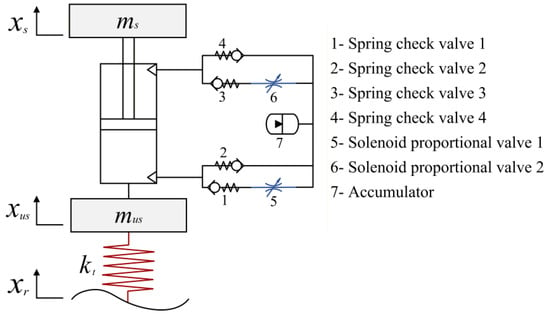
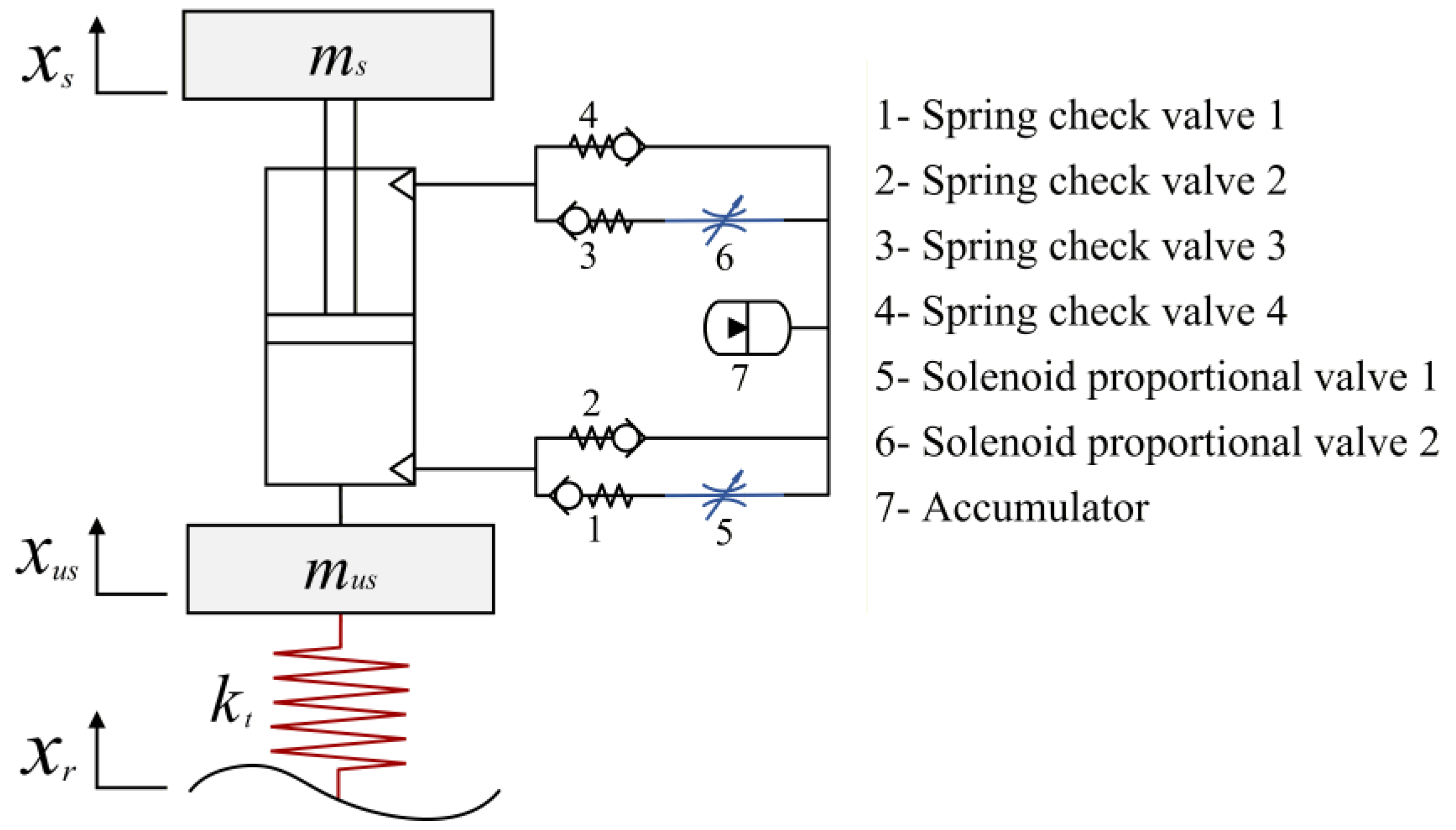
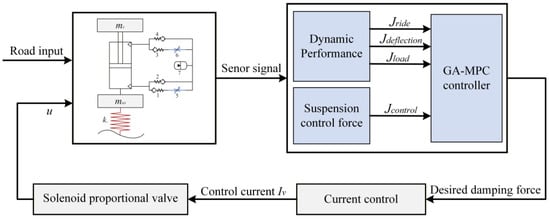
The structure of the new semi-active hydro-pneumatic suspension system proposed is illustrated in Figure 1. This system is mainly composed of two parts: a physical model and a semi-active controller. The hydro-pneumatic suspension employs hydraulic fluid as the force transmission medium and inert gas as the elastic medium, and their interaction endows the suspension with highly complex nonlinear characteristics. In addition, the cylindrical hydraulic damper itself exhibits nonlinear operational characteristics [21]. To facilitate modeling and analysis, the following idealized assumptions are made:
Figure 1.
Physical model of SAHPS.
In the physical model, is the sprung mass, is the unsprung mass, and and stand for their vertical displacements, respectively. is the input of road surface unevenness, and is the tire stiffness. In semi-active control mode, dual solenoid proportional valves act as the core actuators, dynamically adjusting hydraulic flow resistance via the throttling effect. When the suspension is subjected to road excitation, the piston rod undergoes axial compression or extension. At this point, the spring check valves and solenoid proportional valves cooperate to form a damping adjustment mechanism. Driven by the piston, the hydraulic fluid flows along the predefined path of “spring check valve–solenoid proportional valve–spring check valve,” generating the required damping force. The accumulator, filled with high-pressure inert gas, delivers elastic support for the system. By precisely regulating the opening of the solenoid proportional valve, the flow characteristics of the hydraulic circuit can be altered. This enables comprehensive adjustment of both the damping force and elastic force of the suspension, ultimately realizing closed-loop control of the suspension’s output force. This mechanism allows the vehicle to better adapt to complex road conditions, significantly improving handling stability and ride comfort.
2.1. Dynamic Model
Taking the static equilibrium position of the hydro-pneumatic suspension as the origin of the coordinate system, and with the displacement of the piston rod relative to the hydraulic cylinder body as the coordinate axis, the directions of displacement and velocity are defined as positive when the piston rod moves downward relative to the hydraulic cylinder body, and negative in the opposite direction. Based on Newton’s second law, the vertical motion equation is derived as follows:
In the equation, denotes the output force of the hydraulic suspension, which mainly consists of the system elastic force , the damping force induced by fluid flow, and the friction force between the piston and the hydraulic cylinder body. It satisfies the following equation:
Among these, and denote the oil pressures in the rodless chamber and rod chamber, respectively; and represent the cross-sectional areas of the hydraulic cylinder piston and the piston rod, respectively. is the derivative of the suspension’s dynamic stroke, defined as a sign function where the piston’s downward movement relative to the hydraulic cylinder is taken as positive.
2.2. Accumulator Performance Analysis
The primary function of accumulators in hydro-pneumatic suspension systems is to store and release energy by means of the elastic deformation of inert gas (usually nitrogen). Vehicle vibrations induce relative motion between the piston and cylinder body inside the hydraulic cylinder, thereby changing the gas volume within the accumulator. The resulting elastic force is then transmitted to the system through hydraulic fluid. In this process, the influences of linear damping elements and the inherent high stiffness of the fluid itself on the system’s equivalent stiffness can be regarded as negligible [22]. Assuming the enclosed gas undergoes an isentropic process, the change in its pressure complies with the ideal gas equation of state:
and denote the initial gas pressure and instantaneous gas pressure of the accumulator at static equilibrium, respectively; and represent the initial gas volume and instantaneous gas volume of the accumulator, respectively. is a constant, and is the gas polytropic exponent. During vehicle operation, considering the generally high driving speed and frequent reciprocating movement of the suspension, the gas inside the accumulator expands and compresses rapidly from the static equilibrium state. Since the thermal relaxation time of the gas in the accumulator is significantly longer than the dynamic response period of the system, adiabatic boundary conditions are satisfied, making effective heat exchange with the external environment difficult [23,24]. Thus, this process can be treated as adiabatic, .
When the vehicle is at rest, considering the force distribution within the suspension system, the main load-bearing contact area is the cross-sectional area of the piston rod. Under static equilibrium conditions, the gas pressure of the accumulator satisfies the following relationship:
Furthermore, during the closed-loop flow of hydraulic fluid in the system, with the linear displacement of the piston is , the relationship between the instantaneous change in oil volume within the accumulator and the dynamic stroke of the suspension is as follows:
Based on the state equations presented in Equations (3) and (5), the instantaneous gas pressure in the accumulator can be derived as
Furthermore, the nonlinear elastic force generated by the accumulator can be derived as the product of the instantaneous gas pressure and the cross-sectional area of the piston rod:
2.3. Damper Performance Analysis
Solenoid proportional valves and spring check valves serve as core components for achieving damping regulation in controllable hydro-pneumatic suspension systems [25,26]. Among them, solenoid proportional valves realize continuous adjustment of the system damping ratio by dynamically altering the throttling area. When hydraulic fluid flows through the throttling orifice inside the valve, a pressure loss is incurred. This process conforms to the thin-walled orifice throttling theory, where the pressure difference across the orifice and its flow characteristics satisfy Equation (8). Spring check valves prevent reverse fluid flow during the compression and rebound strokes while contributing to the dynamic pressure field regulation within the hydraulic system. This study adopts spring check valves with linear flow-to-pressure-drop characteristics, and their flow-to-pressure-drop relationship satisfies Equation (9). Let , , and denote the pressure drop coefficients of the four spring check valves, respectively.
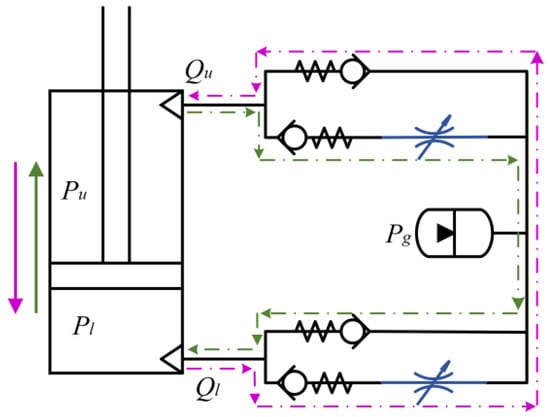
The Working mode of the new hydro-pneumatic suspension is illustrated in Figure 2. Depending on the relative velocity between the piston rod and the hydraulic cylinder, the system presents two dynamic operating states: the compression stroke and the extension stroke . The instantaneous flow rates in the rodless chamber and rod chamber of the hydraulic cylinder are defined as and , respectively. The direction of oil flowing out of the hydraulic cylinder is designated as positive, and inflow as negative.
Figure 2.
Working modes of SAHPS.
During the compression stroke, the oil pressure in the rod chamber is higher than that in the rodless chamber. A volume of oil flows out of the rodless chamber, passing sequentially through spring check valve 1 and solenoid proportional valve 1. Upon diversion, a volume of oil flows through spring check valve 4 into the rod chamber, while a volume of oil enters the accumulator. By combining Equations (8)–(11), the pressure differences between the accumulator and the rodless chamber , as well as between the rod chamber and the accumulator , can be derived, respectively, as follows:
Equations (12) and (13) can be used to summarize the damping force generated under compression conditions as follows:
Similarly, during the extension stroke, the oil pressure in the rodless chamber exceeds that in the rod chamber. A volume of oil flows out of the rod chamber, passing sequentially through spring check valve 3 and solenoid proportional valve 2. Meanwhile, a volume of oil is discharged from the accumulator. After these two oil streams merge, a volume of oil flows through spring check valve 2 into the rodless chamber. By combining Equations (8), (9), (11), and (12), the pressure differences between the accumulator and the rod chamber , as well as between the rodless chamber and the accumulator , can be derived, respectively, as follows:
Equations (15) and (16) can be used to summarize the damping force generated under extension conditions as follows:
2.4. Single Wheel Model
The output force of the hydro-pneumatic suspension is generated by the interaction between the hydraulic cylinder and the piston. Based on the analysis of the stiffness and damping characteristics in Section 2.2 and Section 2.3, with the assumption of uniform oil density and incorporation of Equations (7), (15), and (18), the expression for the suspension output force is derived as follows:
Let ;
Combining Equations (1) and (18), the second-order differential equation for the vertical linear vibration of the suspension is established as follows:
Taking as the state variable and as the input variable of the system, the vertical acceleration of the vehicle body, suspension working space, and dynamic tire load are selected as the output variables , and the system state equations of the single-wheel hydraulic suspension are as follows:
where
3. Design of GA-MPC
Model Predictive Control is an optimization-based control method designed for multivariable systems. It relies on the principle of online rolling optimization, integrating real-time system observations with multi-step forward state trajectories predicted by the predictive model to establish a dynamic optimization framework that incorporates multi-objective cost functions and multivariable constraints. In each control step, a quadratic programming (QP) problem is solved to minimize the cost function, thereby obtaining a globally optimal control sequence for the entire control time domain. Subsequently, the first term of this sequence is executed as the final control command [27,28].
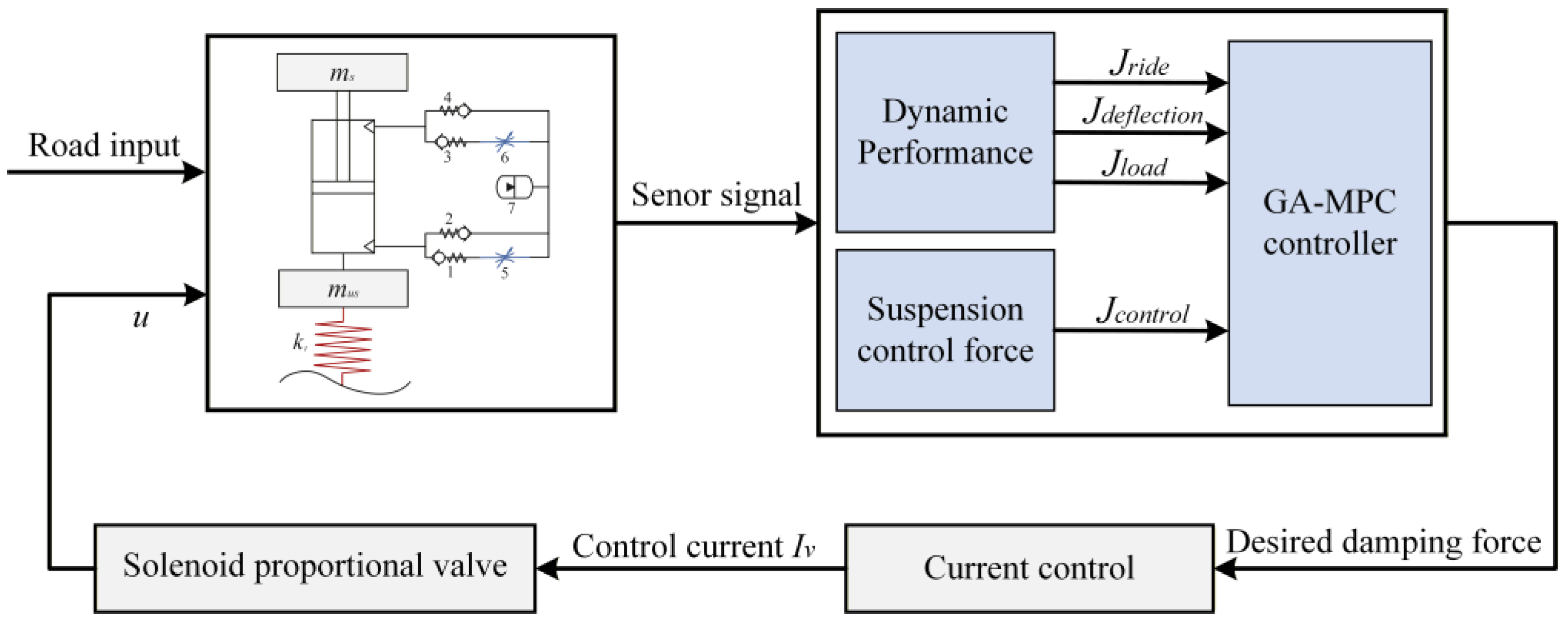
As shown in Figure 3, this research utilizes sensors to collect real-time vehicle status and road surface information as system feedback. Based on the MPC algorithm, it tackles the multivariable optimization control problem to calculate the vertical generalized suspension force under real-time road conditions. The vertical generalized suspension force signal is further converted into control input signals for electromagnetic proportional valves, which regulate hydraulic fluid flow to realize dynamic control of the suspension system. To improve the overall output performance of the suspension system, a quadratic cost function for the MPC controller is designed within a finite prediction time horizon , aiming to synergistically optimize ride comfort metrics , suspension working space metrics , dynamic tire load stability metrics , and control force consumption . This research focuses on the control performance of hydro-pneumatic suspension systems, where road surface information recognition serves as a key prerequisite. Existing studies have verified that current technologies can effectively collect road information [29,30,31].
Figure 3.
Control system diagram.
The state-space equations are transformed into a discrete-time model via the forward Euler method.
where denotes the sampling time step, taken 0.01 s in this paper, is the identity matrix, , , . Based on the discrete model in Equation (22), the suspension system conducts rolling prediction of its state in the time domain:
where
Based on the state-space Equation (20) and prediction model (23), the prediction output matrix of the system is derived as follows:
where
Taking ride comfort, suspension working space, dynamic tire load stability and control inputs as optimization objectives, we further analyze Equation (21) to establish the optimization objective function for the model predictive controller:
where denotes the desired output value of the controlled plant. For suspension systems, smaller performance output values correspond to better controller performance; thus, this study sets as a zero matrix. and represent the deviation between the predicted output and the reference output, and the weighted coefficient matrix of the control input, respectively. , and are the weighting coefficients for the vertical acceleration of the vehicle body, suspension working space, and dynamic tire load, respectively, while is the weighting coefficient for the semi-active control force.
The selection of weight matrices exerts a decisive impact on control performance. In current engineering practice, their values mostly depend on engineers’ experience-based judgments or are obtained through extensive trial-and-error experiments. This method is prone to limitations from subjective experience or constraints of experimental conditions, ultimately affecting the stability and optimality of control performance. As an efficient global optimization algorithm, Genetic Algorithms can effectively enhance the transient response and robustness of the system by minimizing performance indicators such as Integral Squared Error (ISE) and Integral Time Absolute Error (ITAE) [32,33]. Therefore, this study introduces GA to optimize the weighting matrix of MPC, aiming to further improve the overall control performance.
Under passive conditions where the suspension system undergoes high-frequency vibrations, the optimization effects of vehicle vertical acceleration and dynamic tire load are suboptimal. Therefore, this study jointly takes the root mean square (RMS) values of vehicle acceleration and dynamic tire load as optimization objectives, and constructs the following fitness function:
The optimized variables are
The constraints are as follows:
In the above fitness function, and represent the RMS values of body acceleration and dynamic tire load under the GA-MPC strategy, respectively. and denote the RMS values of body vertical acceleration and dynamic tire load under the same simulation parameters for the traditional passive hydro-pneumatic suspension. The genetic algorithm parameter settings for bump excitation road conditions and ISO-C road conditions are shown in Table 1. If the absolute improvement in the optimal fitness value remains below 1 × 10−100 for consecutive 20 generations, the algorithm is considered to have converged to a stable solution and is terminated early. Through quadratic programming, the optimal solution that minimizes is obtained, represent the optimal suspension control force. The aforementioned GA optimization is an offline process. Its computational time is acceptable during the development phase and does not affect the real-time performance of the controller during online operation.
Table 1.
Parameters of the genetic algorithm.
4. Simulation and Analysis
By establishing an AMEsim-Simulink co-simulation platform, the proposed new semi-active hydro-pneumatic suspension structure was verified, and the effectiveness of the GA-MPC strategy in improving the output performance of vehicle suspension under multiple road conditions was confirmed. Representative “bumpy road profiles” and “random road profiles” were selected to simulate real-world road irregularities, mimicking actual driving scenarios. Table 2 presents the structural parameters of the suspension system. To evaluate the suppression mechanism and control characteristics of the designed GA-MPC semi-active controller in terms of suspension vertical displacement, its performance was compared with that of the passive hydro-pneumatic suspension (HPS) and the traditional MPC-based semi-active hydro-pneumatic suspension, The simulation results demonstrate the potential advantages of the proposed system.
Table 2.
Parameters of SAHPS simulation.
4.1. Bump Excitation Profiles
Bump excitation is recognized as a typical deterministic road excitation, adopted to simulate short-duration, high-intensity road impacts encountered during vehicle operation, such as raised bumps and potholes. It is utilized to evaluate the dynamic transient response capability and impact resistance of suspension systems. The corresponding bump road model is constructed by fitting the following equation:
where is the height of the bump, is the length of the bump, the values of and are set to 0.1 m and 5 m, respectively, and the vehicle speed is set to .
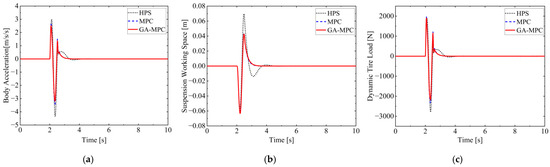
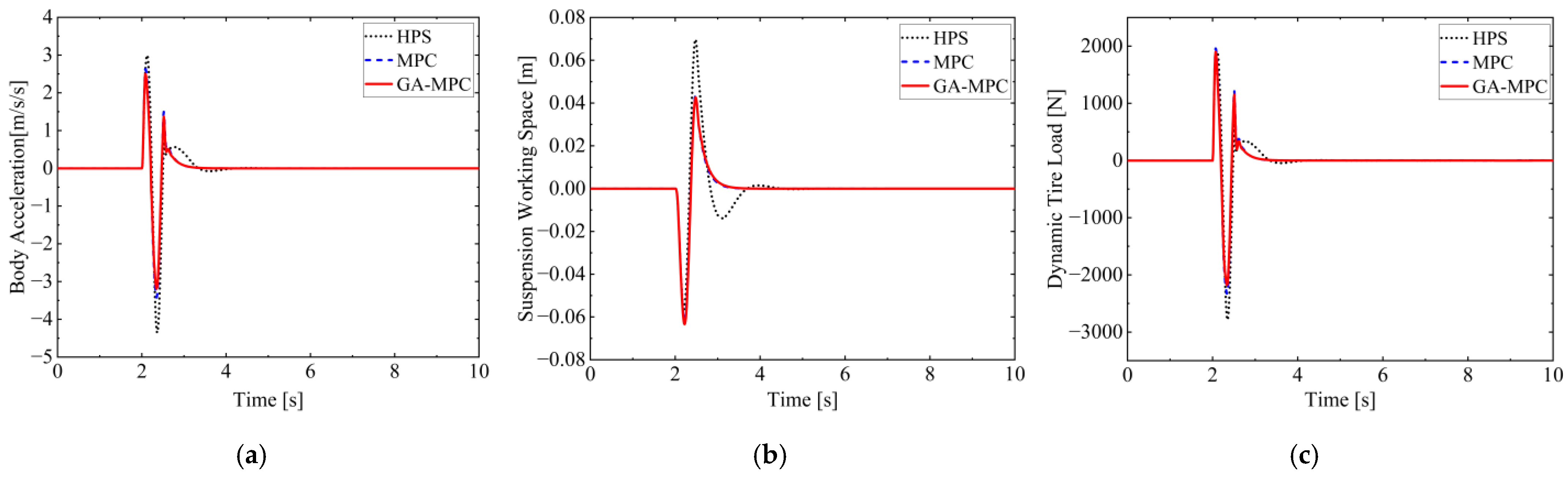
To fully verify the rationality of the proposed new semi-active hydro-pneumatic suspension structure, as well as the effectiveness of the designed Genetic Algorithm-Model Predictive Control strategy in enhancing vehicle suspension performance under bump excitation conditions, Figure 4 presents the dynamic response curves of the passive hydro-pneumatic suspension, the traditional MPC-based semi-active hydro-pneumatic suspension, and the GA-MPC-based semi-active hydro-pneumatic suspension. Table 3 compares the peak-to-peak (PTP) values of body acceleration, suspension working space, and dynamic tire load among the three suspension schemes. Analysis of Figure 4 and Table 3 indicates that both the traditional MPC-controlled and GA-MPC-controlled semi-active suspensions achieve significant dynamic performance improvements compared to the passive hydro-pneumatic suspension. Specifically, the GA-MPC controlled semi-active suspension reduces body acceleration by 22.5%, dynamic tire load by 13.1%, and suspension working space by 15.9%. Although the traditional MPC strategy exhibits a slight advantage over GA-MPC in regulating suspension working space, its performance in attenuating body acceleration and dynamic tire load is relatively inferior. This comparison further confirms that when a vehicle passes through transient impact road conditions, prioritizing ride comfort enhancement and tire ground contact stability should be the core control objectives.
Figure 4.
Dynamic performance of HPS, SAHS based on MPC and GA-MPC under bump excitation input: (a) Body acceleration; (b) Suspension working space; (c) Dynamic tire load.
Table 3.
Comparison of dynamic performance under bump excitation input.
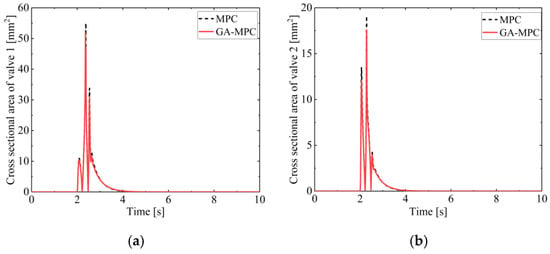
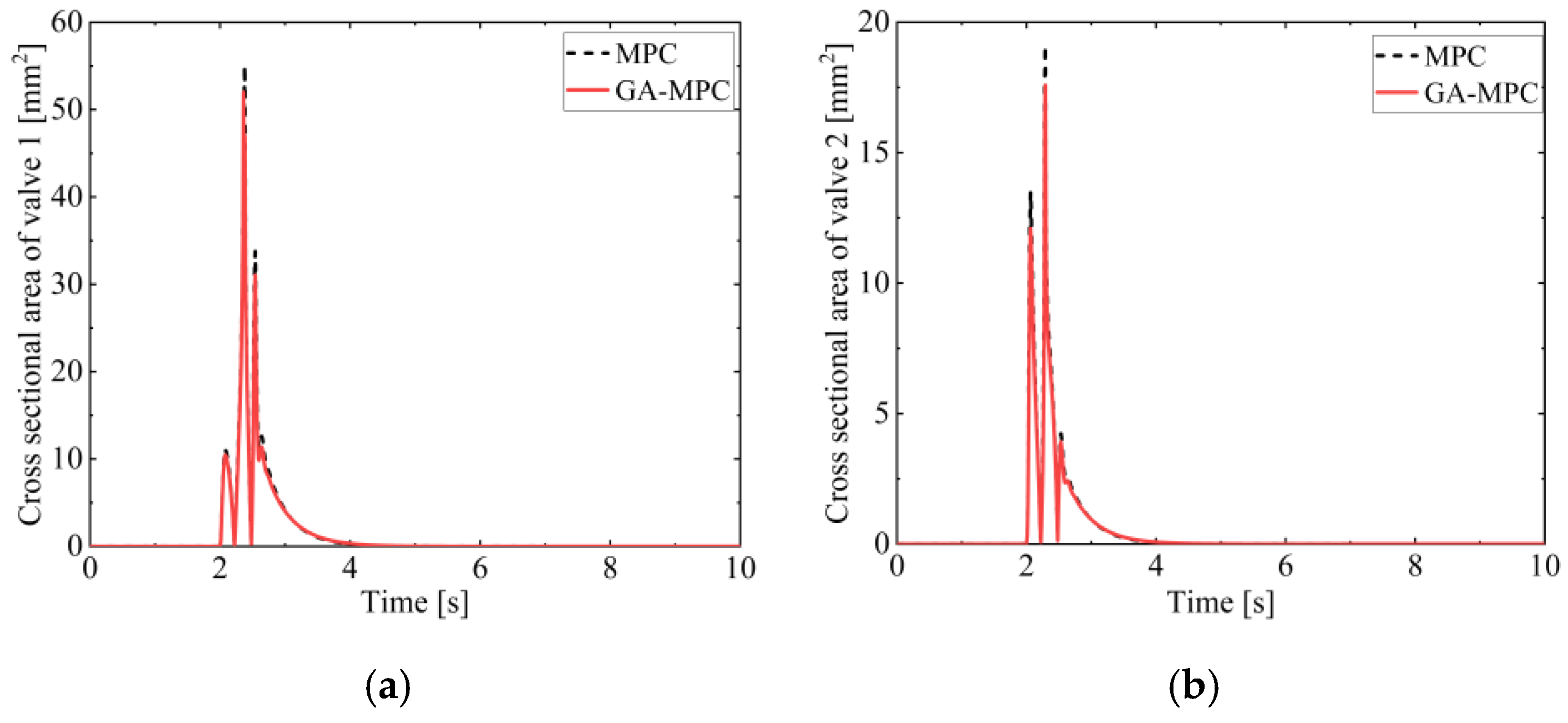
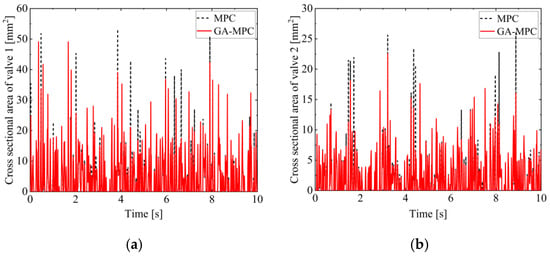
Additionally, Figure 5 compares the valve opening area of solenoid proportional valves 1 and 2 in the semi-active hydro-pneumatic suspension system under bumpy road excitation, adopting the traditional MPC and GA-MPC strategies, respectively. To comprehensively verify the adaptability and robustness of the proposed new semi-active hydro-pneumatic suspension system under random road excitation, the subsequent section will conduct further simulation analysis for this operating condition.
Figure 5.
Cross-sectional areas of the solenoid proportional valve based on MPC and GA-MPC under bump road input: (a) Solenoid proportional valve 1; (b) Solenoid proportional valve 2.
4.2. Random Excitation Profiles
Random road surfaces refer to the continuous vibrations and impacts experienced by vehicles during long-distance driving, resulting from inherent road surface irregularities. As a key factor influencing ride comfort, the time-domain model of random road excitation is represented by Gaussian white noise, expressed as follows:
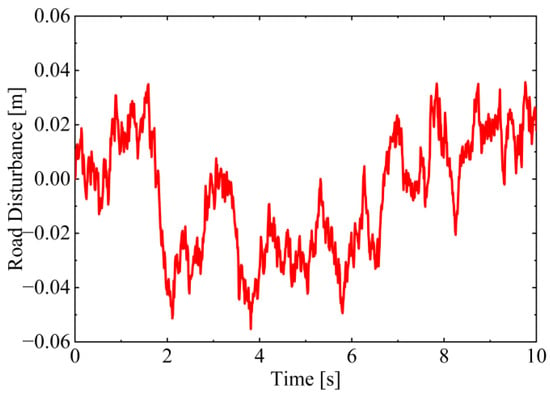
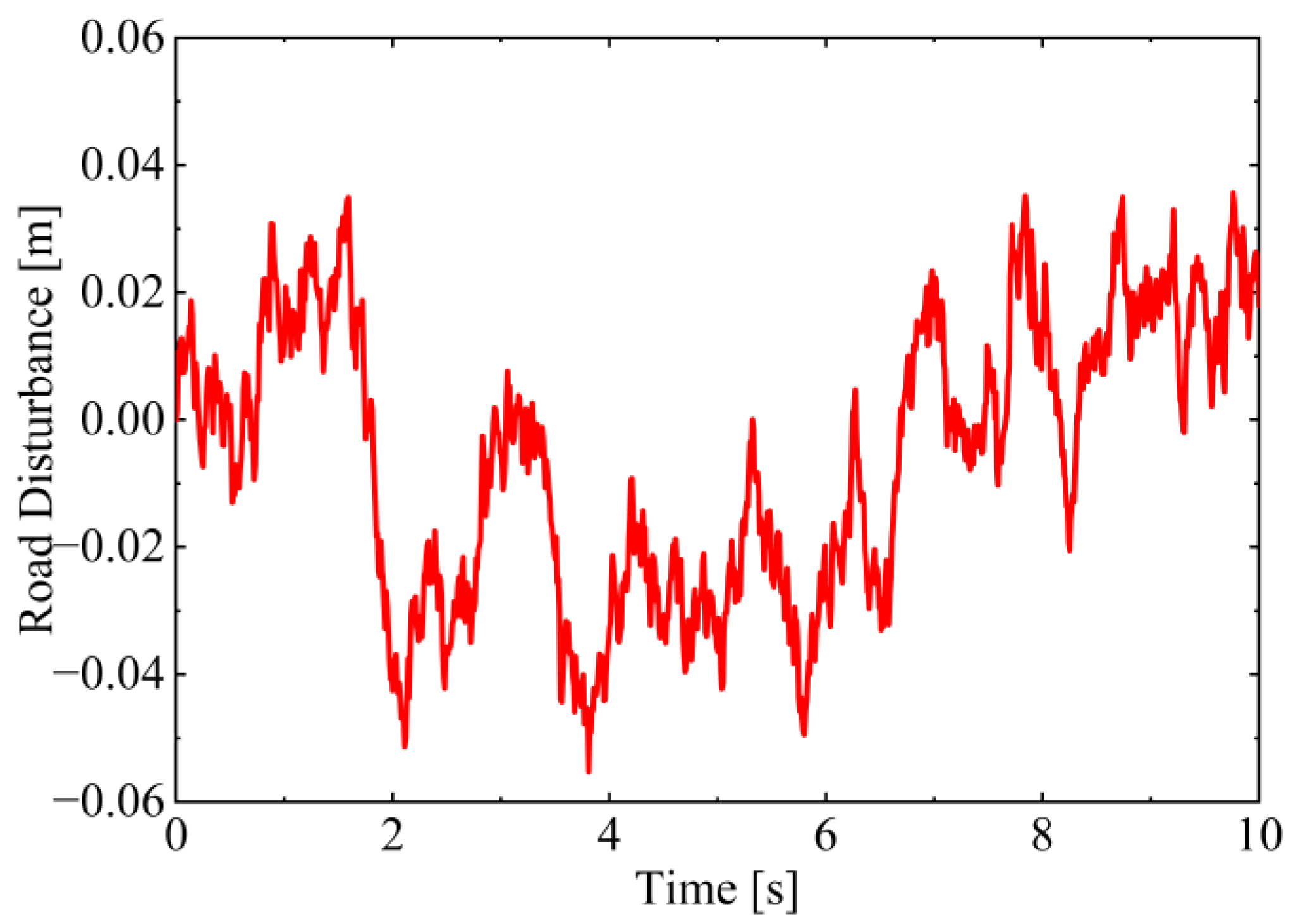
where denotes the low cutoff frequency, is the spatial reference frequency, and represents Gaussian white noise. This study adopts ISO-C road with a driving speed of for simulation analysis, as shown in Figure 6.
Figure 6.
C-class random road profile.
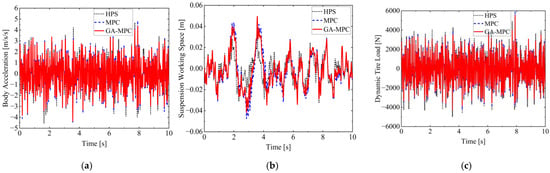
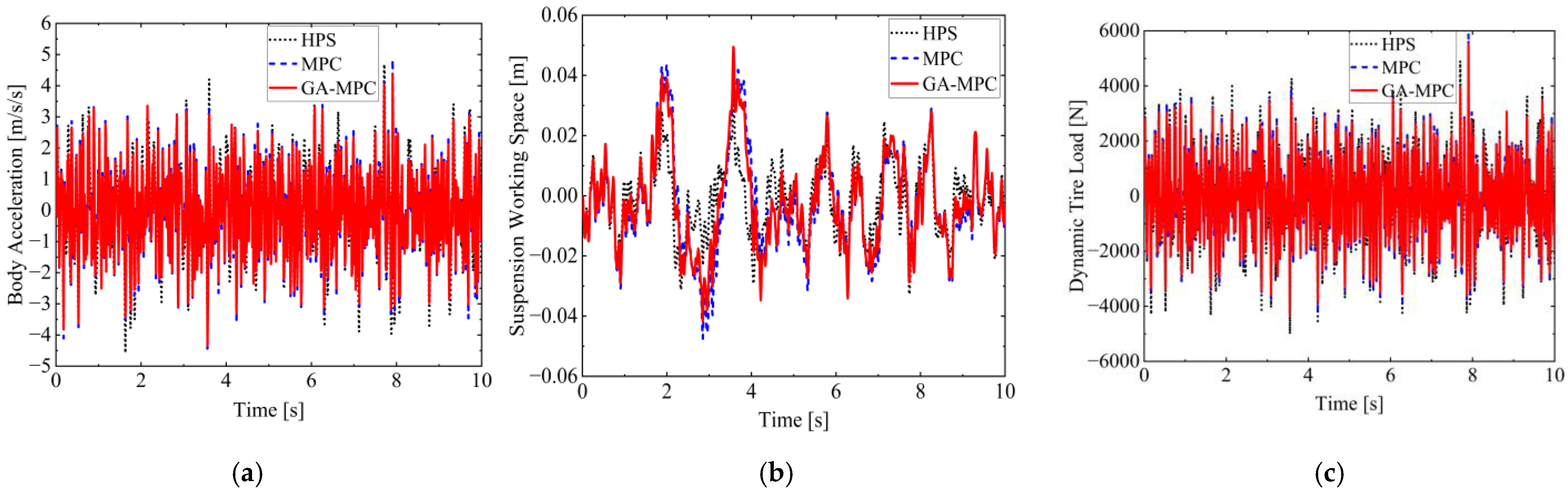
Under Class C random road excitation conditions, Figure 7 presents a comparison of the time-domain dynamic responses among the passive hydro-pneumatic suspension, traditional MPC-based semi-active hydro-pneumatic suspension, and GA-MPC-based semi-active hydro-pneumatic suspension. Table 4 summarizes the RMS values of each suspension’s performance metrics and their percentage reductions relative to the passive suspension. As indicated by the time-domain curves in Figure 7 and the statistical data in Table 4, the passive suspension exhibits higher values in all core metrics—body acceleration, suspension working space, and dynamic tire load—compared to the two semi-active suspensions controlled by traditional MPC and GA-MPC, respectively. Specifically, the traditional MPC-based semi-active suspension reduces body acceleration, suspension working space, and dynamic tire load by 7.5%, 15%, and 8.3% relative to the passive suspension. The GA-MPC-based semi-active suspension achieves more significant optimization effects, further decreasing these metrics by 11%, 25%, and 12.9% compared to the passive suspension. These results demonstrate that the proposed GA-MPC strategy can effectively enhance vehicle ride comfort without compromising tire ground contact performance.
Figure 7.
Dynamic performance of HPS, SAHS based on MPC and GA-MPC under C-class road profile: (a) Body acceleration; (b) Suspension working space; (c) Dynamic tire load.
Table 4.
Comparison of dynamic performance under coupled excitation profiles input.
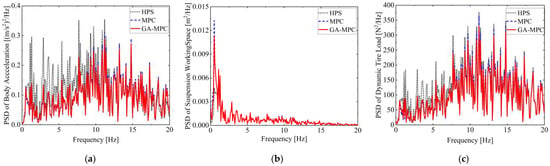
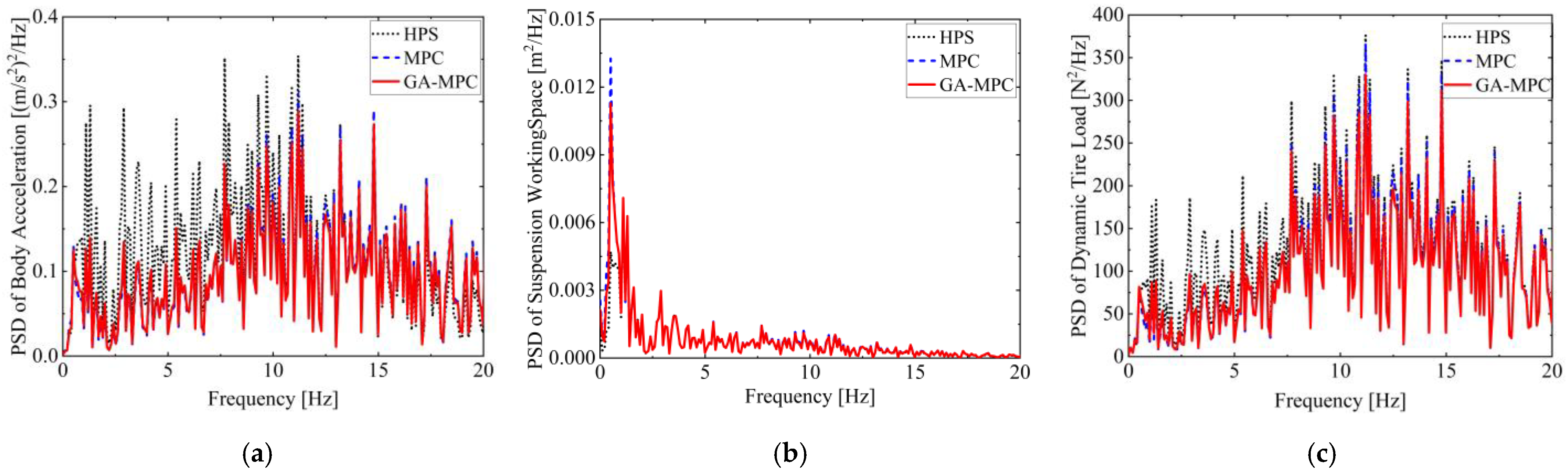
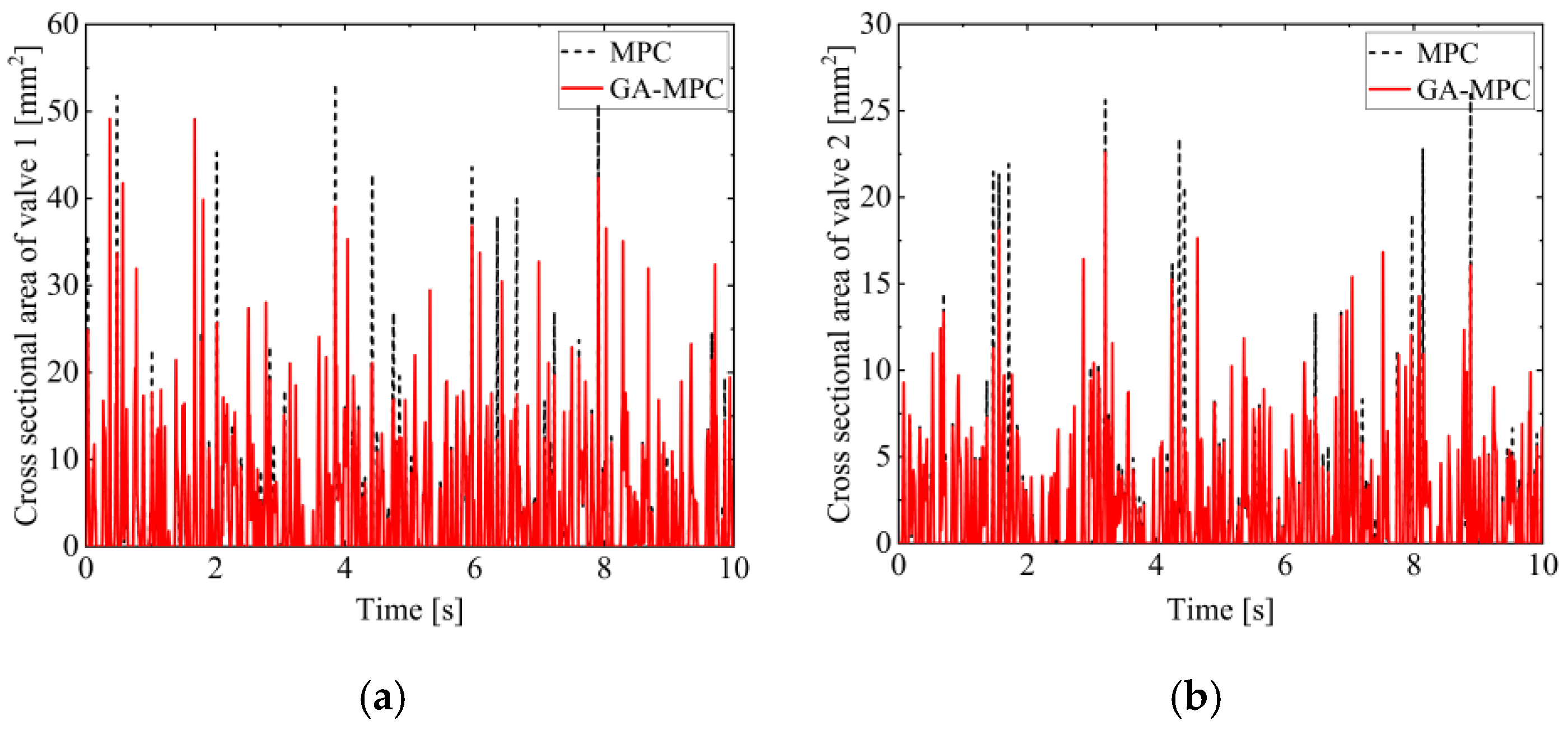
Furthermore, Fast Fourier Transform (FFT) is applied to the dynamic response signals to extract their power spectral density (PSD) characteristics. The frequency-domain analysis in Figure 8 shows that within the entire 0–20 Hz frequency band, both the traditional MPC-based and GA-MPC-based semi-active suspensions effectively reduce body acceleration, with particularly notable improvements in the low-frequency region. The suspension working space slightly increases in the low-frequency band, while differences in the high-frequency band are insignificant; dynamic tire loads are suppressed in the low-frequency range but exhibit slight deterioration in the high-frequency band. It should be noted that the influence of dynamic tire load on vehicle handling stability and driving safety is primarily concentrated in its low-frequency band, which directly determines the adhesion characteristics between the tire and the road surface and thus exerts a pronounced effect on the stability during acceleration, braking, and steering maneuvers. In contrast, the absolute increase in PSD within the high-frequency range is limited and is characterized by short fluctuation periods, resulting in a negligible impact on the average tire–road adhesion coefficient. Combined with the time-domain and frequency-domain analysis results, the superiority and reliability of the GA-MPC-based semi-active hydro-pneumatic suspension in improving the overall dynamic performance of the vehicle are fully validated. Figure 9 compares the cross-sectional area variation curves of solenoid proportional valve 1 and valve 2 under Class C random road excitation, based on the MPC and GA-MPC strategies, respectively. Compared with the MPC strategy, the valve opening variation optimized by GA-MPC is smoother, with significantly reduced high-frequency fluctuations.
Figure 8.
Power spectrum density of HPS, SAHPS based on MPC and GA-MPC under C-class road profile: (a) Body acceleration; (b) Suspension working space; (c) Dynamic tire load.
Figure 9.
Cross-sectional areas of the valve based on MPC and GA-MPC under C-class road profile:(a) Solenoid proportional valve 1; (b) Solenoid proportional valve 2.
5. Experiment Test
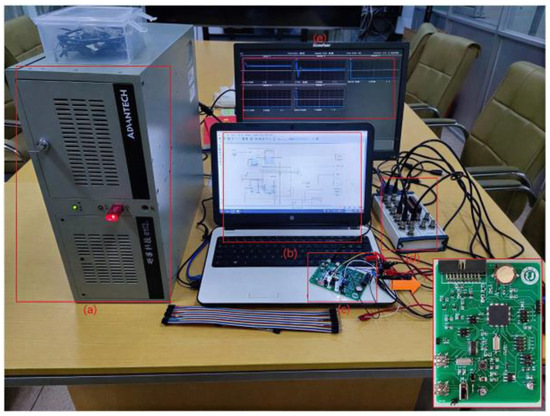
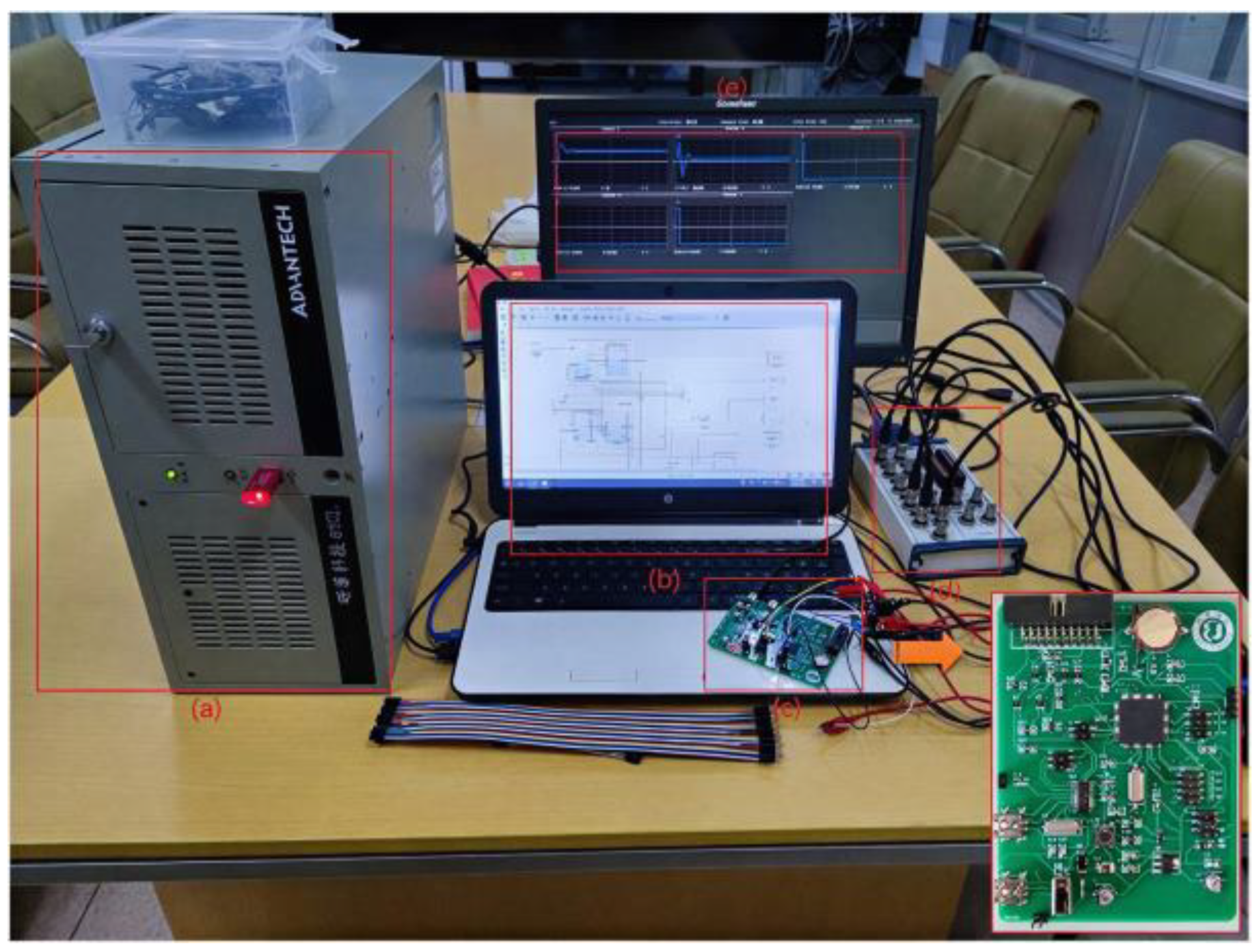
This section constructs an XPC-Target-based hardware-in-the-loop simulation platform architecture to satisfy the real-time control requirements of the semi-active hydro-pneumatic suspension. The platform is mainly composed of an industrial computer, a host computer, an electronic control unit (ECU), I/O boards, and display, with its physical configuration illustrated in Figure 10. The host computer communicates with the industrial computer through Ethernet, undertaking responsibilities such as establishing the suspension system model, configuring parameters, and conducting real-time monitoring. Additionally, it downloads the compiled simulation model to the industrial computer for real-time execution. The I/O board acts as the signal interface between the industrial computer and the ECU, performing dual functions: it serves as a data acquisition card to receive control signals output by the ECU, and as an analog output card to convert the suspension state variables calculated by the simulation model on the industrial computer into voltage signals. These voltage signals are then fed back to the sensor signal interface of the ECU to form a closed-loop control. The ECU is connected to the host computer via a programmer for burning and debugging of the control program.
Figure 10.
HIL test bench: (a) industrial computer; (b) host computer; (c) controller; (d) I/O board, and (e) display.
During the ECU design phase, comprehensive trade-offs were made between the dynamic performance of the hydro-pneumatic suspension, controller functional requirements, and development costs. The input side focuses on an analog-to-digital converter to acquire sensor signals, including suspension deflection, spring-loaded mass velocity, wheel deformation, and unsprung mass velocity. The control targets are centered on body acceleration, suspension working space, and dynamic tire load. In the closed-loop control process, the proposed semi-active hydro-pneumatic suspension generates vibrations in response to road excitation. The sensor model converts system state variables into voltage signals, which are then output as analog voltages to the analog-to-digital converter port of the suspension ECU via the industrial control computer’s I/O board. The ECU peripherals collect these voltage signals, apply mean-value filtering to eliminate noise, and convert the amplitude back to suspension state variables. Based on the reconstructed state variables, the built-in GA-MPC algorithm in the ECU calculates the generalized ideal suspension force, which is further converted into the target drive current of the actuator through an actuator inverse model. The digital current signal is then converted into an analog voltage signal via a digital-to-analog converter and transmitted to the industrial control computer through the ECU output port. Finally, the I/O board of the industrial control computer acquires this control voltage, driving the electromagnetic proportional valve regulator in the simulation model to generate variable damping forces, thereby completing the entire closed-loop control process.
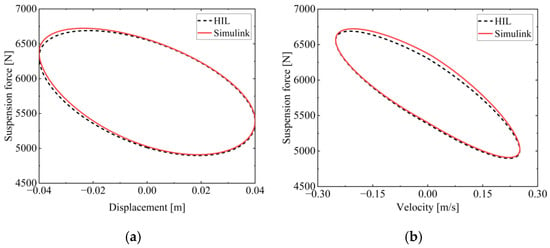
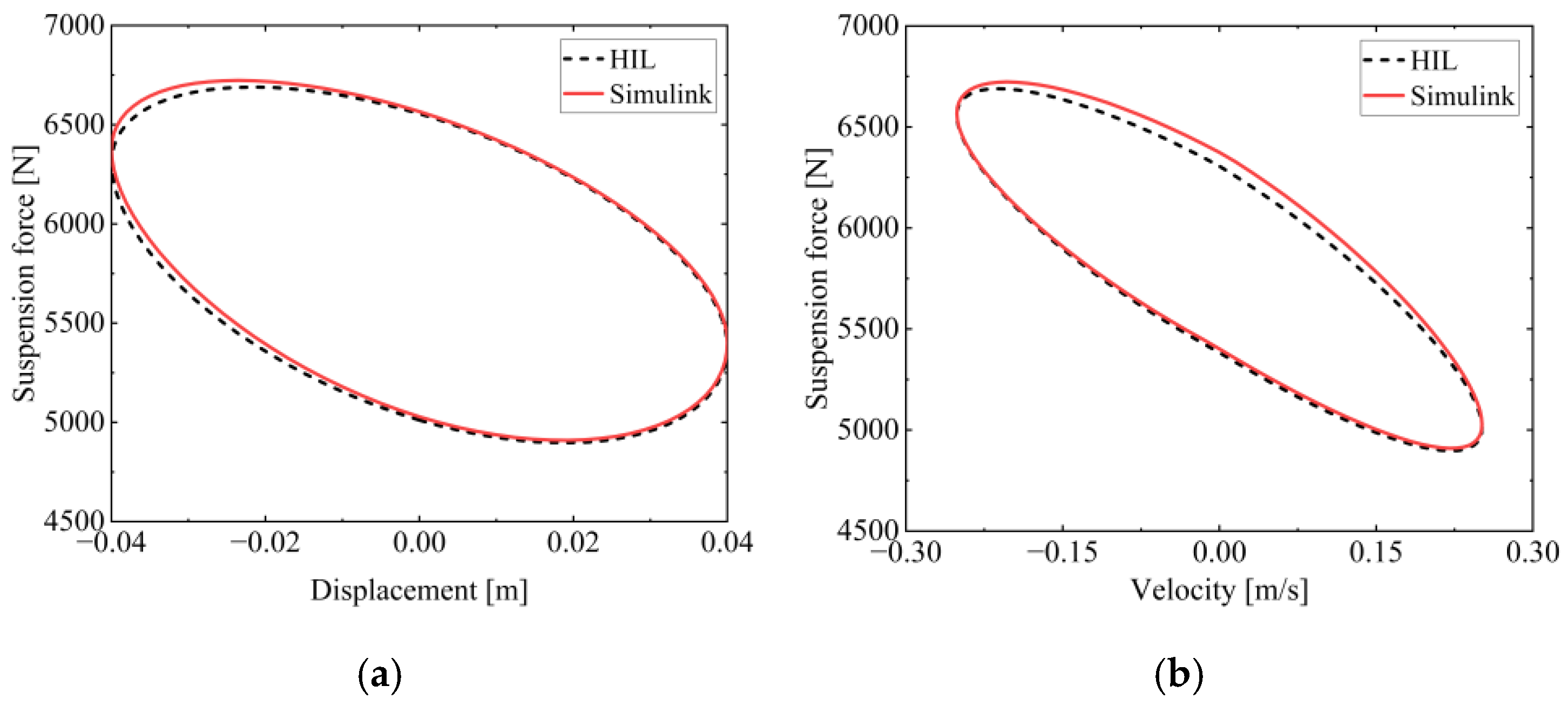
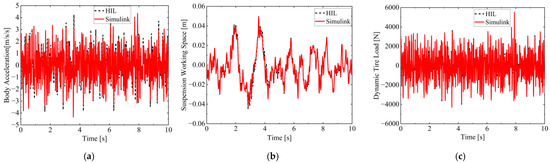
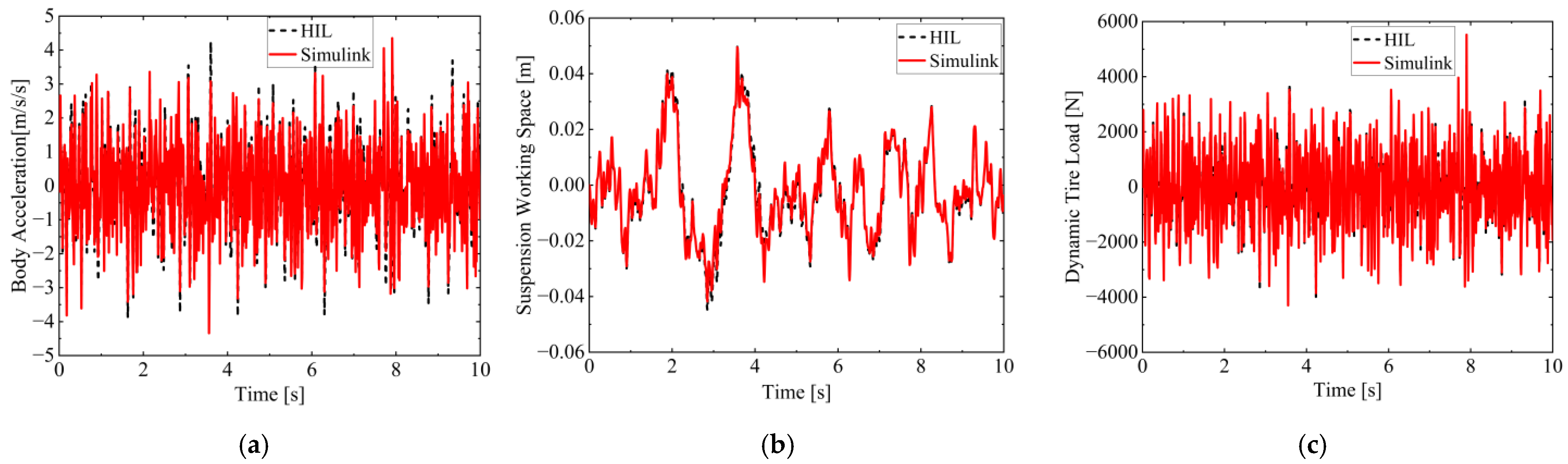
To verify the feasibility of the HIL platform, a sinusoidal signal with an amplitude of 0.04 m was initially adopted as the excitation signal to compare and validate the output force characteristics of the passive hydro-pneumatic suspension. The results illustrated in Figure 11 indicate that the system can normally generate the expected suspension force. Building on this verification result, further HIL simulation tests were conducted under Class C random road excitation. Figure 12 compares the suspension dynamic performance between the HIL simulation based on GA-MPC and the Simulink simulation, revealing a good consistency between the two sets of results. Table 5 lists the performance metric errors between the HIL simulation and Simulink simulation, with all errors below 7%, which falls within the acceptable range. This deviation may be attributed to hardware circuit delays and signal transmission latency. The above results comprehensively validate the reliability and effectiveness of the designed GA-MPC strategy for the semi-active hydro-pneumatic suspension.
Figure 11.
Characteristic comparisons of the simulation results and the HIL results: (a) Suspension force vs. displacement; (b) Suspension force vs. velocity.
Figure 12.
Dynamic performance comparisons of the simulation results and the HIL results: (a) body acceleration; (b) suspension working space; (c) dynamic tire load.
Table 5.
Comparison of the HIL results and the Simulink results.
6. Conclusions
This paper proposes a new semi-active hydro-pneumatic suspension system and establishes its nonlinear mathematical model incorporating fluid dynamics and gas polytropic characteristics. The primary contribution of this work lies in the systematic integration of a new SAHPS architecture and a GA-MPC strategy. The system achieves coordinated regulation of stiffness and damping by adjusting the openings of the solenoid proportional valves. Under the given constraints, this strategy enhances the overall dynamic performance while significantly reducing the operational frequency of the solenoid proportional valves. The findings from the simulations and experimental verification are summarized as follows:
- (1)
- The dual-valve shock absorber proposed in this paper enables independent and high-precision control of the suspension’s compression and extension strokes. This design not only greatly enhances the dynamic adjustability of damping characteristics but also forms a redundant control architecture to improve the overall system reliability and driving safety. In addition, its superior command response speed and shorter actuation delay ensure that the suspension still maintains excellent vehicle vibration suppression performance even under high-frequency excitation.
- (2)
- Dynamic performance simulations were carried out for passive hydro-pneumatic suspension, SAHPS with traditional MPC, and SAHPS with GA-MPC under transient road excitation and Class C random road excitation. The results show that compared with the traditional MPC scheme, the GA-MPC strategy further optimizes body acceleration, suspension working space, and dynamic tire load under bumpy road conditions. Under Class C random road conditions, the control performance of GA-MPC is significantly superior to that of traditional MPC, achieving maximum reductions of 11%, 25%, and 12.9% in the root-mean-square values of body acceleration, suspension working space, and dynamic tire load, respectively, especially in enhancing vehicle ride comfort and tire ground contact performance in the low-frequency range; while effectively reducing the operating frequency of the proportional solenoid valve.
- (3)
- A HIL test platform was built for verification, and the results show good consistency between simulation and experimental data. Under ideal test conditions, the error between simulated and measured data is controlled within 7%, indicating that the SAHPS system can meet the real-time control requirements of the GA-MPC strategy.
- (4)
- This study is based on known road information. Future research will focus on the coordinated control of the vehicle’s body posture and further explore adaptive control algorithms based on road condition identification.
Author Contributions
Conceptualization, X.Z. and R.W.; methodology, J.C.; software, X.Z.; validation, R.D.; formal analysis, R.W.; investigation, J.C.; resources, R.D.; data curation, X.Z.; writing—original draft preparation, X.Z.; writing—review and editing, R.D.; visualization, J.C.; supervision, R.W.; project administration, R.D.; funding acquisition, X.Z. All authors have read and agreed to the published version of the manuscript.
Funding
This research received no external funding.
Data Availability Statement
The original contributions presented in this study are included in the article. Further inquiries can be directed to the corresponding author.
Conflicts of Interest
The authors declare no conflicts of interest.
Abbreviations
| Abbreviations | Nomenclature |
| ECU | Electronic control unit |
| FFT | Fast Fourier Transform |
| GA | Genetic algorithm |
| HIL | Hardware-in-the-loop |
| HRS | Hydraulic rebound stopper |
| LPV | Linear Parameter Varying |
| ISE | Integral Squared Error |
| ISMC | Integral sliding mode control |
| ITAE | Integral Time Absolute Error |
| LQR | Linear quadratic regulator |
| MPC | Model predictive control |
| PTP | Peak-to-peak |
| PSD | Power spectral density |
| QP | Quadratic programming |
| RMS | Root mean square |
| SAHPS | Semi-active hydro-pneumatic suspension |
References
- Ding, R.; Wang, R.; Meng, X.; Chen, L. Mode-switching control and stability analysis of a hybrid electromagnetic actuator for the vehicle suspension. J. Vib. Control 2020, 26, 1804–1814. [Google Scholar] [CrossRef] [Scilit]
- Meng, X.; Kong, L.; Ding, R.; Liu, W.; Wang, R. Research on Active Suspension Control Based on Vehicle Speed Control Under Transient Pavement Excitation. World Electr. Veh. J. 2025, 16, 232. [Google Scholar] [CrossRef] [Scilit]
- Tvrdic, V.; Podrug, S.; Damic, V.; Perkušić, M. Regenerative hydraulic SUSPENSION: Numerical model and Evaluation of Energy Harvesting Potential using bond graphs. Energy Sources Part A Recovery Util. Environ. Eff. 2022, 44, 10409–10432. [Google Scholar] [CrossRef] [Scilit]
- Nguyen, D.N.; Nguyen, T.A. Evaluate the stability of the vehicle when using the active suspension system with a hydraulic actuator controlled by the OSMC algorithm. Sci. Rep. 2022, 12, 19364. [Google Scholar] [CrossRef] [Scilit]
- Chen, Y.; Jiang, M.; Yang, F.; Qian, R.; Zhai, R.; Wang, H.; Xv, S. Research on Dynamic Modeling and Control of Magnetorheological Hydro-Pneumatic Suspension. Actuators 2025, 14, 73. [Google Scholar] [CrossRef] [Scilit]
- Liu, Q.; Liu, X.; Li, B.; Liu, S.; Li, Y.; Luo, Y.; Sha, T. Characteristics and experimental research on semi-active suspension of mining dump truck under parallel fuzzy control strategy. Proc. Inst. Mech. Eng. Part C J. Mech. Eng. Sci. 2025, 239, 9174–9190. [Google Scholar] [CrossRef] [Scilit]
- Rodriguez-Guevara, D.; Favela-Contreras, A.; Beltran-Carbajal, F.; Sotelo, D.; Sotelo, C. Active Suspension Control Using an MPC-LQR-LPV Controller with Attraction Sets and Quadratic Stability Conditions. Mathematics 2021, 9, 2533. [Google Scholar] [CrossRef] [Scilit]
- Sibielak, M.; Konieczny, J.; Smoter, A. Model and Control Synthesis for an Active Vehicle Suspension Strut Involving a Single-Rod Electrohydraulic Actuator. In Proceedings of the 2024 25th International Carpathian Control Conference (ICCC), Krynica Zdrój, Poland, 22–24 May 2024; IEEE: New York, NY, USA, 2024; pp. 1–6. [Google Scholar]
- Yang, L.; Wang, R.; Ding, R.; Liu, W.; Zhu, Z. Investigation on the dynamic performance of a new semi-active hydro-pneumatic inerter-based suspension system with MPC control strategy. Mech. Syst. Signal Process. 2021, 154, 107569. [Google Scholar] [CrossRef] [Scilit]
- Chen, G.; Jiang, Y.; Tang, Y.; Xu, X. Revised adaptive active disturbance rejection sliding mode control strategy for vertical stability of active hydro-pneumatic suspension. ISA Trans. 2023, 132, 490–507. [Google Scholar] [CrossRef] [Scilit] [PubMed]
- Flayyih, M.A.; Hamzah, M.N.; Hassan, J.M. Nonstandard Backstepping Based Integral Sliding Mode Control of Hydraulically Actuated Active Suspension System. Int. J. Automot. Technol. 2023, 24, 1665–1673. [Google Scholar] [CrossRef] [Scilit]
- Ling, Q.; Chen, X.; Niu, L.; Guo, Y.; Chen, S. Performance evaluation and analysis for hydraulic active suspension using the collaborative control method. Meas. Control 2024, 58, 771–783. [Google Scholar] [CrossRef] [Scilit]
- Sim, K.; Lee, H.; Yoon, J.W.; Choi, C.; Hwang, S.-H. Effectiveness evaluation of hydro-pneumatic and semi-active cab suspension for the improvement of ride comfort of agricultural tractors. J. Terramechanics 2017, 69, 23–32. [Google Scholar] [CrossRef] [Scilit]
- Diao, S.; Zhao, X.; Zhao, D.; Dong, Z.; Qin, Y. Active suspension hierarchical control with parameter uncertainty and external disturbance of electro-hydraulic actuators. Appl. Math. Model. 2024, 134, 50–70. [Google Scholar] [CrossRef] [Scilit]
- Fu, Y.; Zhou, X. Multi-objective optimization of multi-axle heavy duty vehicle ride comfort and handling stability based on analytical target cascading method. J. Mech. Sci. Technol. 2023, 37, 5661–5682. [Google Scholar] [CrossRef] [Scilit]
- Chen, P.; Chen, X. Analysis and Improvement of the Dynamic Characteristics of an Electro-Hydrostatic Actuator Based on a Vehicle’s Active Suspension. World Electr. Veh. J. 2025, 16, 586. [Google Scholar] [CrossRef] [Scilit]
- Yin, C.; Zhai, X.; Sun, X.; Wang, S.; Wong, P.K. Design and performance research of a hydro-pneumatic suspension with variable damping and stiffness characteristics. J. Mech. Sci. Technol. 2022, 36, 4913–4923. [Google Scholar] [CrossRef] [Scilit]
- Annadurai, V.; Ramanujam, R.; Keshav Anirudh, G.A.; Amitesh, R.; Subramaniam, A.S.; Raagul Ramana, K. Design of a Regenerative Inerter for a Semi-Active Vehicle Suspension System. In Proceedings of the 2023 2nd International Conference on Automation, Computing and Renewable Systems (ICACRS), Pudukkottai, India, 11–13 December 2023; IEEE: New York, NY, USA, 2023; pp. 145–149. [Google Scholar]
- Sun, J.; Han, C.; Liu, D.; Zhao, X.; Gao, C. Simulation and experimental validation of vehicle dynamic characteristics for the hydraulic rebound stopper shock absorber. J. Mech. Sci. Technol. 2025, 39, 2409–2416. [Google Scholar] [CrossRef] [Scilit]
- Liu, Q.; Liu, X.; Feng, H.; Li, B.; Liu, S.; Luo, Y.; Sha, T. Ride comfort analysis and optimization of a hydro-pneumatic suspension system for a mining dump truck. Proc. Inst. Mech. Eng. Part D J. Automob. Eng. 2024, 239, 3334–3346. [Google Scholar] [CrossRef] [Scilit]
- Mahmoodabadi, M.J.; Nejadkourki, N.; Ibrahim, M.Y. Optimal fuzzy robust state feedback control for a five DOF active suspension system. Results Control Optim. 2024, 17, 100504. [Google Scholar] [CrossRef] [Scilit]
- Li, Z.; Wang, Y.; Du, H.; Hu, Z. Modelling and analysis of full-vehicle hydro-pneumatic suspension system considering real-gas polytropic process. Mech. Syst. Signal Process. 2022, 165, 108406. [Google Scholar] [CrossRef] [Scilit]
- Chen, Z.; Zhang, J. Adaptive Neural Network Control of Heavy Vehicle Air Suspension with Uncertainties. J. Vib. Eng. Technol. 2024, 12, 8899–8915. [Google Scholar] [CrossRef] [Scilit]
- Huang, R.; Yin, A.; Shen, Y.; Du, F.; Yang, X. Optimizing Hydro-Pneumatic Inerter Suspension for Improved Ride Comfort and Handling Stability in Engineering Vehicles Using Simulated Annealing Algorithm. World Electr. Veh. J. 2024, 15, 36. [Google Scholar] [CrossRef] [Scilit]
- Ma, X.; Zheng, F.; Xu, L.; Zhang, Y.; Song, X. Sensitivity computational-fluid-dynamics analysis on the damping performance of a hydro-pneumatic spring damper system. Phys. Fluids 2025, 37, 094110. [Google Scholar] [CrossRef] [Scilit]
- Zhang, S.; Gu, Z.; Wu, W.; Zheng, L.; Liu, J.; Yin, S. Transient numerical investigation of a large-scale hydro-pneumatic suspension considering variations in check valve parameters and operational conditions. Int. J. Numer. Methods Heat Fluid Flow 2019, 30, 1967–1990. [Google Scholar] [CrossRef] [Scilit]
- Lu, Y.; Soltani, A.; Khajepour, A. A coordinated control system for truck cabin suspension based on model predictive control. Int. J. Heavy Veh. Syst. 2022, 29, 518. [Google Scholar] [CrossRef] [Scilit]
- Li, Q.; Chen, Z.; Song, H.; Dong, Y. Model Predictive Control for Speed-Dependent Active Suspension System with Road Preview Information. Sensors 2024, 24, 2255. [Google Scholar] [CrossRef] [Scilit] [PubMed]
- Gui, Q.; Wang, G.; Wang, L.; Cheng, J.; Fang, H. Road surface state recognition using deep convolution network on the low-power-consumption embedded device. Microprocess. Microsyst. 2023, 96, 104740. [Google Scholar] [CrossRef] [Scilit]
- Shi, R.; Yang, S.; Chen, Y.; Wang, R.; Zhang, M.; Lu, J.; Cao, Y. CNN-Transformer for visual-tactile fusion applied in road recognition of autonomous vehicles. Pattern Recognit. Lett. 2023, 166, 200–208. [Google Scholar] [CrossRef] [Scilit]
- Shi, X.; Huang, L.; Chen, Y. V2X and Vision Fusion Based Undulating Road Recognition and Intelligent Vehicle Control. In Proceedings of the 2022 8th International Conference on Big Data Computing and Communications (BigCom), Xiamen, China, 6–7 August 2022; IEEE: New York, NY, USA, 2022; pp. 322–330. [Google Scholar]
- Nguyen, T.A.; Tran, T.T.H.; Hoang, T.B. Design a new algorithm (iL-GA) to optimize controller parameters for an automotive suspension system. World J. Eng. 2024, 22, 711–724. [Google Scholar] [CrossRef] [Scilit]
- Zhang, S.; Li, M.; Li, J.; Xu, J.; Wang, Z.; Liu, S. Research on Ride Comfort Control of Air Suspension Based on Genetic Algorithm Optimized Fuzzy PID. Appl. Sci. 2024, 14, 7787. [Google Scholar] [CrossRef] [Scilit]

Disclaimer/Publisher’s Note: The statements, opinions and data contained in all publications are solely those of the individual author(s) and contributor(s) and not of MDPI and/or the editor(s). MDPI and/or the editor(s) disclaim responsibility for any injury to people or property resulting from any ideas, methods, instructions or products referred to in the content. |
© 2026 by the authors. Published by MDPI on behalf of the World Electric Vehicle Association. Licensee MDPI, Basel, Switzerland. This article is an open access article distributed under the terms and conditions of the Creative Commons Attribution (CC BY) license.