Article

Evaluating the Potential of Sodium-Ion Batteries for Low Voltage Mobility

1
IAV GmbH, Carnotstr. 1, 10587 Berlin, Germany
2
IAV France S.A.S., 4 rue Georges Guynemer, 78280 Guyancourt, France
*
Author to whom correspondence should be addressed.
World Electr. Veh. J. 2026, 17(1), 5; https://doi.org/10.3390/wevj17010005
Submission received: 27 October 2025 / Revised: 8 December 2025 / Accepted: 16 December 2025 / Published: 19 December 2025

Abstract

The automotive industry is under pressure to reduce greenhouse gas emissions. While the growth of electric vehicles is crucial, optimizing low-voltage batteries for conventional powertrain architecture (12–48 V) can help reduce carbon dioxide emissions. Currently, lithium iron phosphate (LFP) batteries dominate the low-voltage battery market due to their stability, safety, and ecological benefits as replacement to lead-acid. However, sodium-ion batteries (SIB) are emerging as a promising alternative to LFP, offering advantages in power, lifespan, cold temperature performance, integration, cost, material availability, and sustainability. These advantages of sodium-ion batteries make them a perfect candidate for fulfilling the requirements typically associated with 48 V applications as well. This contribution evaluates low-voltage SIB prototypes developed by the company IAV GmbH and its partners and explores their potential for automotive applications, aiming to share insights and assess future prospects.

1. Introduction

Within the transport sector, the imperative to limit global warming emissions is driving the automotive industry to reduce the amount of greenhouse gases. In anticipation of the 2035 ban on internal combustion engine (ICE) vehicles, the European Union (EU) mandates a continuous reduction in CO2 emissions from new vehicles fleets sold within its jurisdiction [1]. However, the recent slowdown in electric vehicle (EV) adoption across the EU poses a challenge to achieving these targets [2]. Enhancing the performance of low-voltage batteries—whether the 12 V batteries for onboard networks or the 48 V batteries in mild hybrid electric vehicles (mHEV)—offers significant benefits in terms of performance and energy savings, ultimately contributing to the overall reduction in CO2 emissions in the vehicle fleet.

1.1. Cell Chemistry in Low-Voltage Automotive Batteries

1.1.1. Lead-Acid Batteries

For automotive 12 V applications, lead-acid (Pb-A) batteries are the most commonly used battery technology [3]. In charged state, the cells consist of lead and lead dioxide plates, representing the negative and positive electrodes, respectively. During discharge, these are converted to lead sulfate. The overall battery typically consists of 6 cells connected in series, with each cell having a voltage of approximately 2.0 V, delivering a voltage of 12 V [4]. The main reason for the historical dominance of the lead-acid battery use, especially for internal combustion engine (ICE) vehicles, is its low cost combined with the ability to deliver high discharge currents at low temperatures with a typical starting current ranging from hundreds to even thousands of amperes. The disadvantages of the Pb-A battery technology are a limited lifetime, especially at high depth of discharges (DoD), and a low energy density, usually close to 50 Wh/kg [5,6].

1.1.2. NMC Batteries

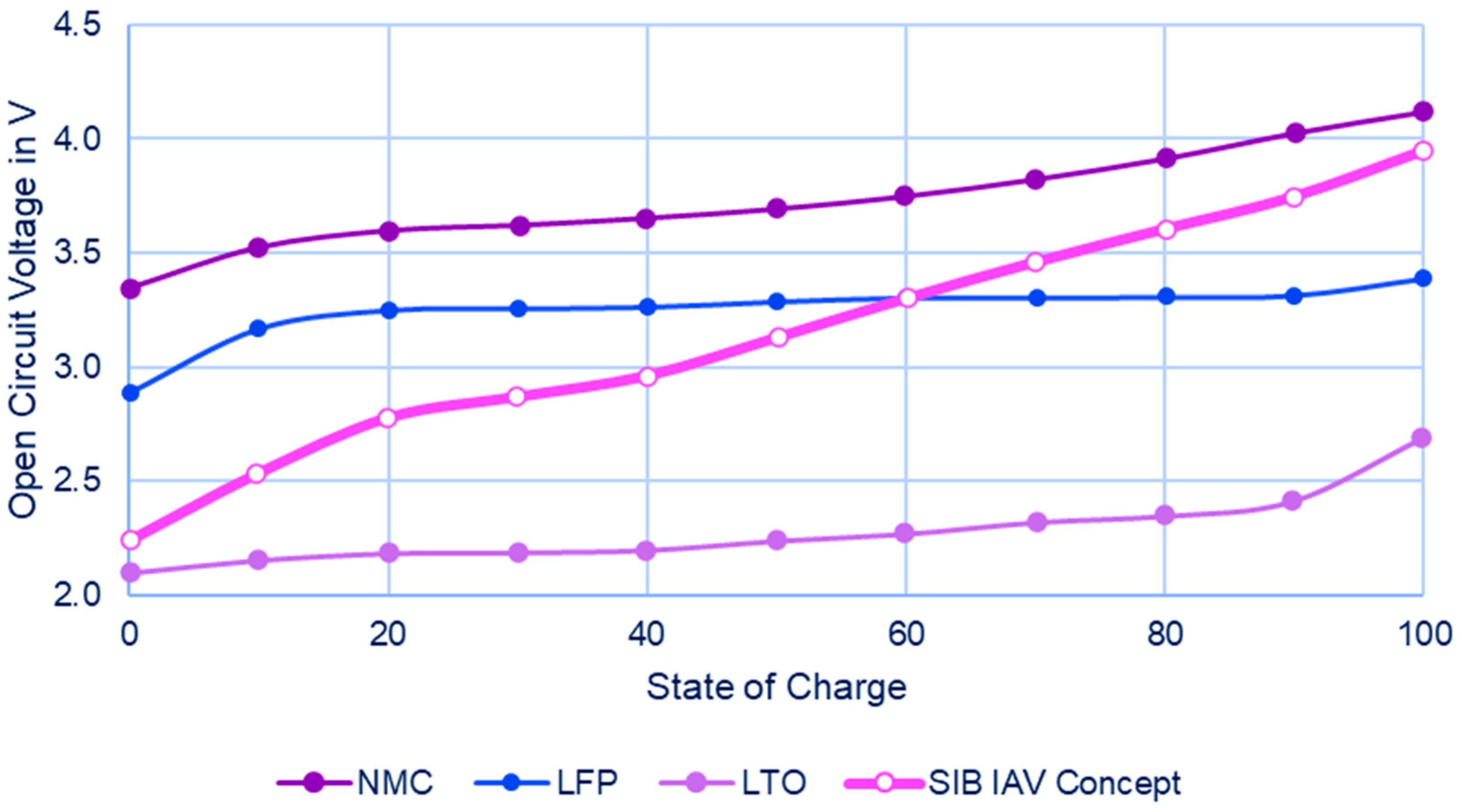
Nickel-manganese-cobalt (NMC) technology employs nickel-manganese-cobalt oxides, LiNixMnyCozO2, introduced in 2001, as cathodic material. The original chemistry was x = y = z = 1/3, also known as NMC 111 or stoichiometric NMC. Later, NMC materials with high nickel content, Ni-rich NMCs, have emerged from 532 to 622 and 811 and even beyond. The higher the nickel content of the NMC material, the larger its specific practical capacity, from 153 mAh/g for NMC111 to 198 mAh/g for NMC811, and thus the energy density has increased significantly by approximately 15% [7]. Nowadays, NMC cells show the highest energy density due to their high capacity and high voltage (mean voltage at 3.7 V Figure 1) with a value of 250 Wh/kg considered common. Energy density values close to 300 Wh/kg at cell level are already available [8]. In addition, increasing the nickel content of the NMC material increases the cell power. Another advantage of Ni-rich NMCs is their limited cost and ecological impact due to a decrease in cobalt content. However, cobalt acts as a stabilizer for the NMC structure. Thus, lowering the cobalt content leads to a faster capacity fade and decreased thermal stability, correlating with a more dramatic thermal runaway of the NMC cells. Last but not least, the economic viability of lithium-ion battery (LIB) cell recycling is highly dependent on the valuable cell materials.

1.1.3. LFP Batteries

Lithium iron phosphate LiFePO4, an olivine-type mineral, was first reported as a cathodic material for LIBs in 1996 [9]. LFP batteries are advantageously cobalt-free, i.e., cheaper and more sustainable than NMC-based batteries. LFP is a stable cathodic material, especially when compared to standard layered metal oxides, LiMO2 (M = transition metal element), such as NMC and lithium manganese oxide. Thus, LFP-based batteries present an extended lifetime and are considered safer than the other Li-ion batteries [10,11]. The LFP material shows poor electronic conductivity, which is critical for the performance of the LFP-based batteries. To mitigate this limitation, commercial LFP cathode particles are normally covered by a thin and conductive carbon coating. The LFP material is also occasionally labeled as LFP/C. The energy density of LFP batteries is dependent on their design. In an energy-type configuration, 200 Wh/kg has already been reached at cell level [12], with even higher values being recently announced (230 Wh/kg). High energy LFP cells have a limited discharge rate, usually peaking at 3 C to 5 C at best.
Power-type cells can reach more than 3 kW/kg (60 C discharge rate), albeit with limited energy density, usually close to 80–90 Wh/kg [13,14]. Low cost, combined with reasonable energy density and good safety propelled the LFP technology forward in recent years to power most of the new EVs, while the NMC cells are used within premium and long driving range vehicles [15]. As already mentioned, LFP is cobalt-free, thus usually considered to be more environmentally friendly than NMC cells. However, recycling of LFP cells is presently not economically viable.

1.1.4. LTO Cells

Still being a niche market, lithium titanate oxide (LTO) cells use Li4Ti5O12 as anode material. The LTO cells offer high power and high stability. LTO cells can intuitively be considered safer than other LIBs. The LTO anode has a medium voltage, compatible with the standard carbonate electrolyte. The fragility of the solid electrolyte interphase (SEI) is much less critical in comparison to standard cells using graphitic anodes. Consequently, the thermal runaway scenario initiated by self-warming of the cell [10] is much less at risk to happen. However, LTO cells suffer from a limited energy density, ca. 50 Wh/kg, due to their low mean voltage of 2.4 V (Figure 1) and the limited capacity of the LTO anode [16]. The LTO cells also suffer from high costs and are not cobalt free, i.e., low sustainability, due to the utilization of NMC-based cathodes [17].

1.2. State of the Art in 12 V Applications

In recent years, the automotive industry has witnessed a growing interest in transitioning from traditional lead-acid 12 V batteries to alternative technologies, primarily driven by concerns over the toxicity of lead and the anticipation of potential future bans. This shift necessitates a comprehensive analysis of the relevance and implications across a handful critical areas including strategy and supply chain, environmental impact, economics, and performance. Among the promising alternatives to lead-acid, the lithium-ion technology has especially emerged as a viable option as discussed in the following sections, also implying changes to the overall system by necessitating the inclusion of a battery management system.
In the low voltage battery segment, among the different Li-ion battery technologies, LFP is considered as one of the best candidates [3]. For certain low voltage applications like 12 V systems, LFP is already replacing Pb-A [3]. Low temperatures (<0 °C) lead to a reversible decrease in the performance of the Li-ion batteries, as expected for all chemical reactions and described by Arrhenius’ law [18]. This performance loss is mostly attributed to the drop in the ionic conductivity of the electrolyte and the rise in the charge transfer resistance between the electrolyte and the electrodes, i.e., the transport of the Li-ions through the cathode electrolyte interphase and SEI and the Li-ion desolvation before insertion in the solid active material [19,20,21]. Furthermore, low temperatures can also lead to irreversible degradation during cell cycling, especially during fast charging. The LFP technology is even more sensitive to cold temperatures than other LIB technologies due to its high activation energy Ea (Arrhenius equation) and the limited 1D ion transport within the LFP material [18,21]. Finally, the SoC evaluation of LFP batteries is complex and cannot solely rely on the measured voltage (Figure 1), inducing supplementary costs for an accurate battery management system [22].

1.3. State of the Art in 48 V Applications

Mild hybrid electric vehicles (mHEVs) are a promising technology for reducing CO2 emissions in the near term. This architecture includes an electric machine alongside a conventional internal combustion engine to improve efficiency and reduces emissions thanks to the application of a 48 V energy storage system. There are different architecture variants of these systems, influencing their performance and cost effectiveness. First, we explore the different architectures of mHEV systems in the following section, focusing on their configurations, benefits, and limitations.

1.3.1. Mild Hybrid Vehicle Architectures

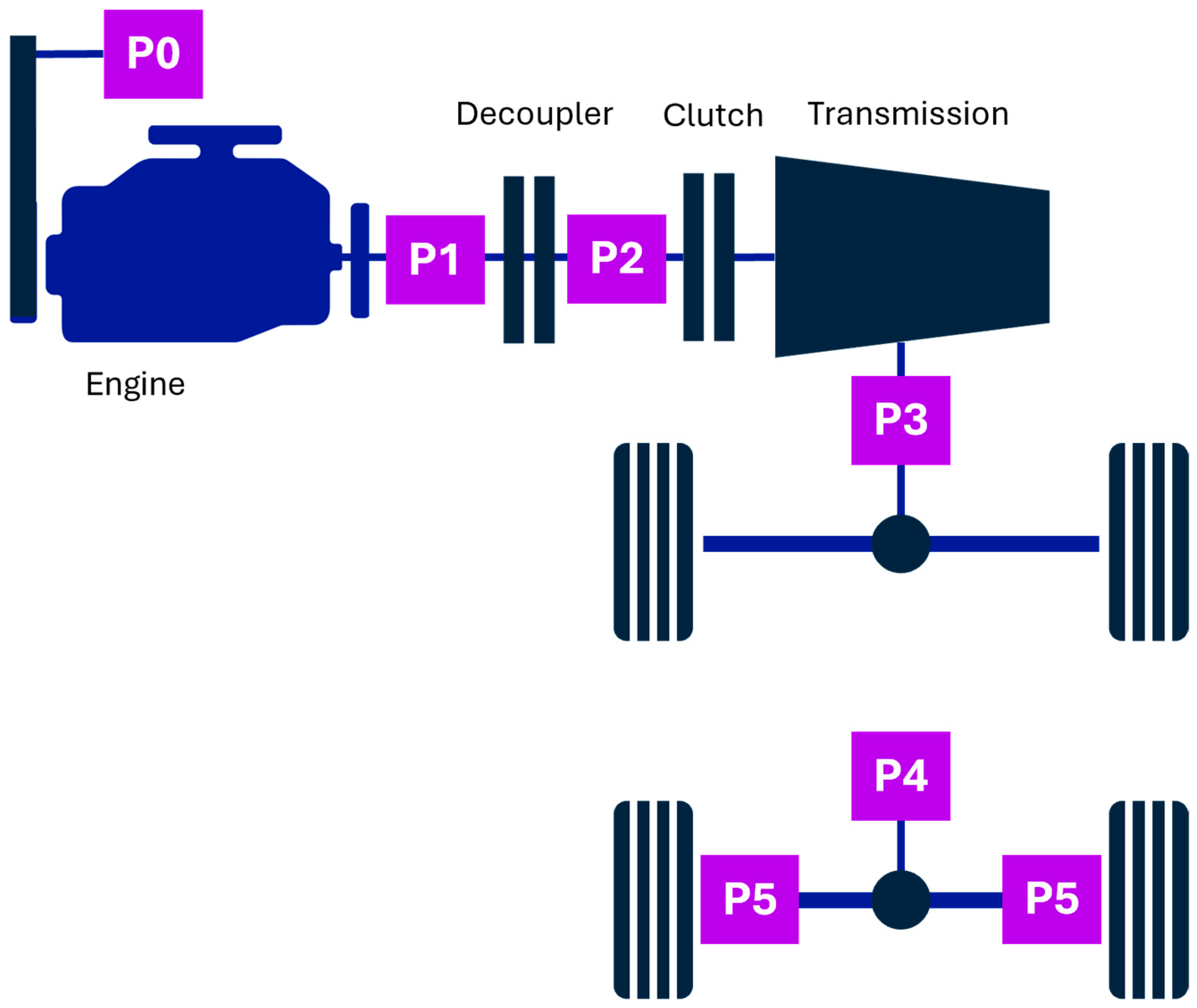
mHEVs can be categorized according to the position of the electric machine within the powertrain architecture, as shown in Figure 2.
The P0 architecture is the simplest form of mild hybridization. It involves integrating an electric machine into the front-end accessory drive belt of the ICE (Figure 2). This setup allows for basic functions like engine stop/start and regenerative braking. While it is cost effective and easy to implement, the P0 architecture suffers from higher friction losses due to the permanent connection between the electric machine and the ICE, reducing the potential for energy recuperation and overall efficiency. In the P1 setup, the electric machine is connected directly to the crankshaft of the ICE. This allows for improved energy recuperation and engine load shifting, enhancing efficiency. However, like the P0 architecture, the P1 system is limited in its ability to provide pure electric driving and has reduced efficiency due to engine friction.
The P2 architecture offers more advanced hybrid functions by decoupling the electric machine from the ICE as shown in Figure 2. It can be mounted coaxially or side-mounted to the transmission. This configuration allows for better energy recuperation, torque assistance, and limited pure electric driving. The P2 system improves efficiency by optimizing the operating point of the electric machine and enabling engine downsizing. On the negative side, the P2 architecture is more complex and costly compared to P0 and P1. The P3 architecture places the electric machine on the output side of the transmission. This setup provides high recuperation potential and allows for pure electric driving. It can also enhance vehicle performance through torque assistance. However, the P3 system cannot start the ICE and lacks the ability to optimize the electric machine’s operating point through variable transmission gear ratios, which limits overall efficiency improvement.
In the P4 configuration, the electric machine is connected to the rear axle, providing electric all-wheel-drive capabilities. This architecture offers high energy recuperation potential and allows for pure electric driving. The P4 system is advantageous for torque vectoring and improved vehicle handling. However, it is more costly due to the additional electric machine. Another disadvantage is the increased unsprung mass, which can affect vehicle dynamics. Finally, the P5 architecture is a more advanced version of the P4 system, featuring individual control of non-driven wheels. This setup enhances safety and handling through torque vectoring and individual brake control. While offering significant benefits in terms of performance, the P5 architecture is expensive and poses safety risks due to uncontrolled yaw moments upon failure of individual electric machines.
The choice of an mHEV architecture depends on the desired balance between performance and cost effectiveness. More complex systems like P2, P3, and P4 + P0 offer substantial CO2 reduction and fuel savings, making them attractive options for reducing emissions in the near term. However, simpler architectures like P0 and P1 provide a cost-effective entry point into hybridization, suitable for manufacturers looking to meet stringent CO2 targets without significant investment.

1.3.2. 48 V Application in Electric Vehicles

Beyond hybrid powertrain applications, 48 V systems are increasingly gaining attention in fully electric vehicles, with first OEMs having already introduced vehicles equipped with 48 V board net systems, such as the Tesla Cybertruck. A fully 48 V-based architecture supplies components like windows, doors, touchscreen, and air suspension pumps. Because of its higher voltage, a 48 V system can send the same power with less current, translating to reduced heat generation, thinner wires, and cheaper, lighter parts. This helps make the system more efficient and cuts down weight. Alternatively, the implementation of a 48 V system enables a significant increase in the peak power levels and thus the application of technologies not feasible at lower voltages, e.g., steer-by-wire, with the Tesla setup using a handful of motors. The increased voltage level also allows for innovative features like PowerShare (bi-directional charging) and makes the overall electrical system more reliable. Tesla’s switch to 48 V in the Cybertruck is a big change for the car industry and helps save costs while making the system simpler and more powerful.

1.3.3. 48 V Energy Storage System State of the Art

State-of-the-art 48 V battery systems mainly use advanced lithium chemistries. NMC is favored for higher energy and power density, LFP for safety and longevity at lower cost, and LTO for extreme durability and fast charging but at a premium price, as discussed in Section 1.1. In this context, the application of new chemistries can help address known pain points related to the state of the art, yielding additional benefits.
The optimal 48 V battery system is application-dependent, considering the specific power and energy requirements related to the target vehicle and powertrain (EV or mHEV). The P2 mild hybrid architecture is considered to offer better balance between cost, complexity, and efficiency compared to P1 and P3. It improves fuel savings and energy recovery more than P1 by placing the e-motor between ICE and transmission, thus reducing losses. While P3 provides slightly better performance, it is more complex and costly. Thus, P2 delivers overall strong efficiency gains with moderate cost and easier integration, making it a popular choice for mild hybrids.

1.4. New Chemistries Evolving

Sodium-ion batteries (SIBs) have emerged as a promising new battery technology in recent years, offering numerous advantages. SIB technology is already reaching an industrial scale with factory production capacities exceeding GWh/year. Its industrial utilization is gaining track in many fields ranging from mobility to stationary applications [23].
SIBs have a similar working principle to other batteries, especially compared to LIBs [24]. The main difference between SIBs and LIBs represents the charge-transferring ion, with Na+ used in SIBs instead of Li+. This change has important effects. SIBs are characterized by a limited energy density compared to LIBs, as the bulkier sodium ions (Shanon’s ionic radius = 102 pm) reduce the packing density of ions in the electrode materials compared to the smaller lithium ions (Shanon’s ionic radius = 76 pm). For example, the graphite commonly used for LIB anodes is not suitable for the storage of sodium ions, as the interlayer distance of graphite does not allow for the insertion of the large sodium ions, resulting in poor specific capacities equivalent to approximately 3% of the value for lithium ions (372 mAh/g) [25]. Thus, hard carbon is commonly used as anode material for SIBs, which is more suited for the storage of sodium ions due to a higher interlayer spacing and the ability to provide a high surface area for ion absorption and capacitive storage, providing a specific capacity of around 300 mAh/g [26]. On the other hand, the behavior of sodium ions within the liquid electrolyte differs from that observed for lithium ions, with sodium ions showing higher ion conductivities and lower desolvation energy barriers for equal boundary conditions [27]. The reduced desorption energy barrier of sodium-ions facilitates their insertion in the lattice of the active materials, thus improving kinetics of the electrode reactions in SIBs [12,27,28,29,30,31]. These differences in the use of battery materials and ion properties translate into an increased low-temperature performance and overall higher rate capabilities for SIBs.
Similar to the term LIB, SIB is a generic term referring to different technologies. Three main families can be distinguished based on their cathode chemistry, each of them having its specific advantages and disadvantages: Prussian Blue and analogs (mostly the Prussian White Na2−xMx[Fe(CN)6]·y H2O), layered metal oxides (globally based on the NaMO2 formula), and polyanions (mostly known for the vanadium fluor-phosphate developed by Tiamat, Na3V2(PO4)2F3, NVPF) [32,33]. While SIBs have a lower energy density compared to their lithium-based counterparts, their high rate capability, low-temperature performance, long cycle life, safety, and abundant raw materials make them attractive for cost-effective and sustainable applications [24]. With these characteristics, sodium-ion technology emerges as an interesting alternative to the incumbent lithium-ion technology in the context of low-voltage applications, particularly when improved low-temperature performance and rate capabilities are important and an inferior energy density is acceptable. This has motivated the development of sodium-ion-based concepts dedicated to 12 V and 48 V applications by the authors, which are presented in the following sections.

2. Low-Voltage Sodium-Ion Concept Development

In 2023, the authors presented a twin high-voltage battery concept combining sodium-ion and lithium-ion solid-state cells. The LIBs offer a long driving range while SIBs provide power, efficiency at low temperatures, and lower the environmental impact sustainability [34]. Along with partners, the authors have recently focused efforts on developing and evaluating low-voltage SIB prototypes, following interest in this technology for power applications in the automotive industry. The purpose of this section is to share some of the results that we obtained through this project and present the developed dedicated, sodium-ion-based 12 V and 48 V battery module concepts, demonstrating the potential of this technology.

2.1. 12 V Sodium-Ion Concept

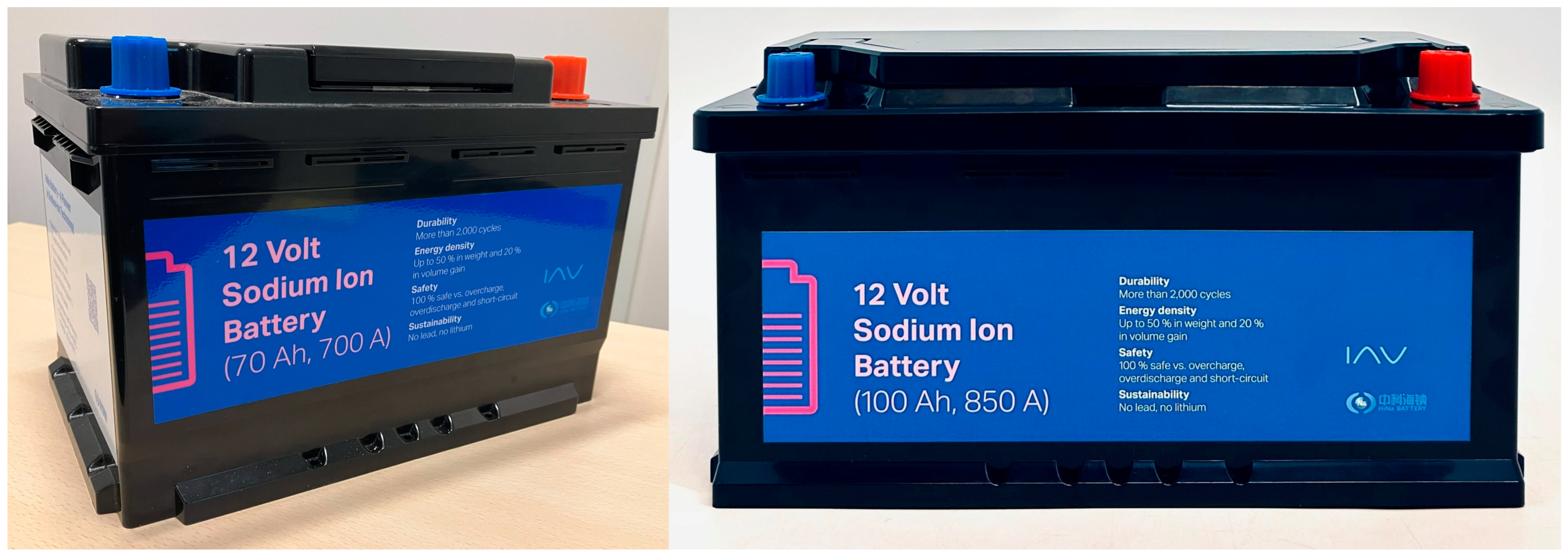
In 2024, the authors presented a 12 V SIB prototype to the public, based on a 7P4S configuration selected for low-end applications and/or EVs (Figure 3). Its characteristics involve a capacity of 70 Ah and a cold cranking amp (CCA) of 565 A for 30 s at −20 °C (945 A at 25 °C). In comparison to state-of-the-art 12 V Pb-A batteries with L3 format, this prototype can save up to 50% in weight and 20% in volume (Table 1).
The employed cylindrical sodium-ion cells manufactured by HiNa in 32140 format are characterized by an energy density of 130 Wh/kg, a high power up to 10 C discharge peak, a long cycle life with 97% capacity retention after 950 cycles at 1 C full cycle, SoC 0–100% range, and temperature performance from −40 °C to 60 °C in discharge and −20 °C to 70 °C in charge, as well as overcharge resistance according to the Chinese GB/T-31485 norm [36]. In addition, the cell voltage is monotonously decreasing with SoC in an almost linear manner (c.f. Figure 1). The SoC evaluation and control of the cell and thus of our 12 V SIB prototype is easy, accurate, and cost-efficient. Last but not least, the employed cells are safe with great resilience against excessive discharge, mechanical abuse, low atmospheric pressure, and heating, in agreement with the GB/T-31485 norm [36].
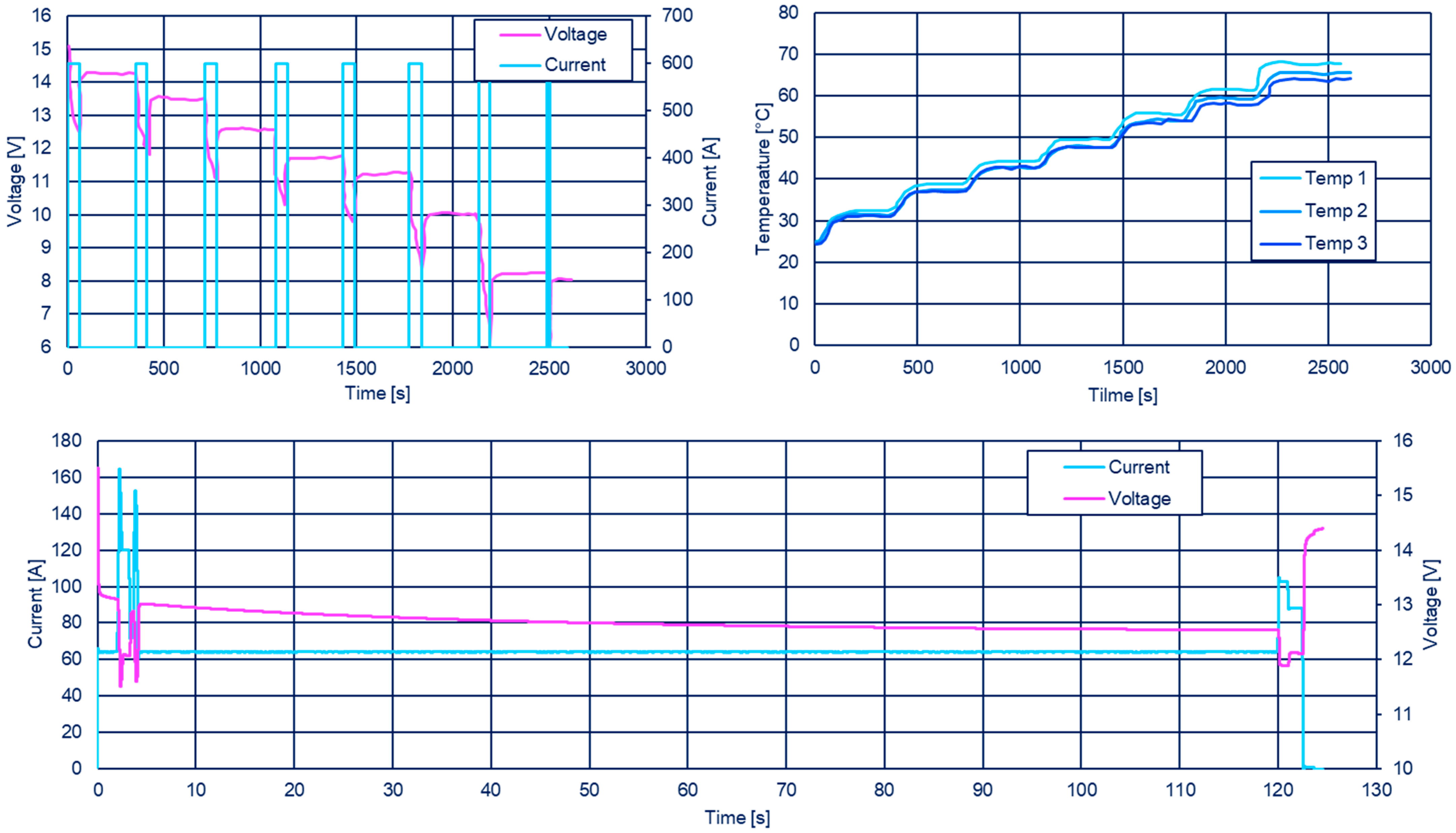
The developed 12 V SIB prototypes are robust even in worst-case scenarios. An abuse test, with fast discharge cycles until full discharge, has shown no significant issues. The test procedure involved resting the battery for 30 min after charging to an open circuit voltage (OCV) value of 15.0 V at room temperature, corresponding to a SoC value of 90%. A discharge at 600 A (8.6 C) was applied for 56 s followed by a 5 min rest. This sequence was repeated until the voltage reached ≤6.0 V, which corresponds to 1.5 V at cell level, i.e., to an over-discharge of 1.0 V beyond the minimum operating voltage. The test was repeated with three different prototypes, yielding equal results (Figure 4 top). The temperature sensor of each prototype was positioned in contact with the electronic board, placed on the insulating fabric above the cells. Note that a temperature of 60 °C is not considered a safety risk for the used SIB cells due to their compliance with safety heating performance testing at 130 °C for 30 min. The 12 V SIB prototype is furthermore able to sustain high current levels even at very low ambient temperatures. At −25 °C, the 12 V SIB prototype can provide a continuous discharge rate of >0.9 C and a peak discharge rate of >2.3 C, with the voltage always staying above 11.5 V and the voltage loss being limited and reversible (Figure 4 bottom).
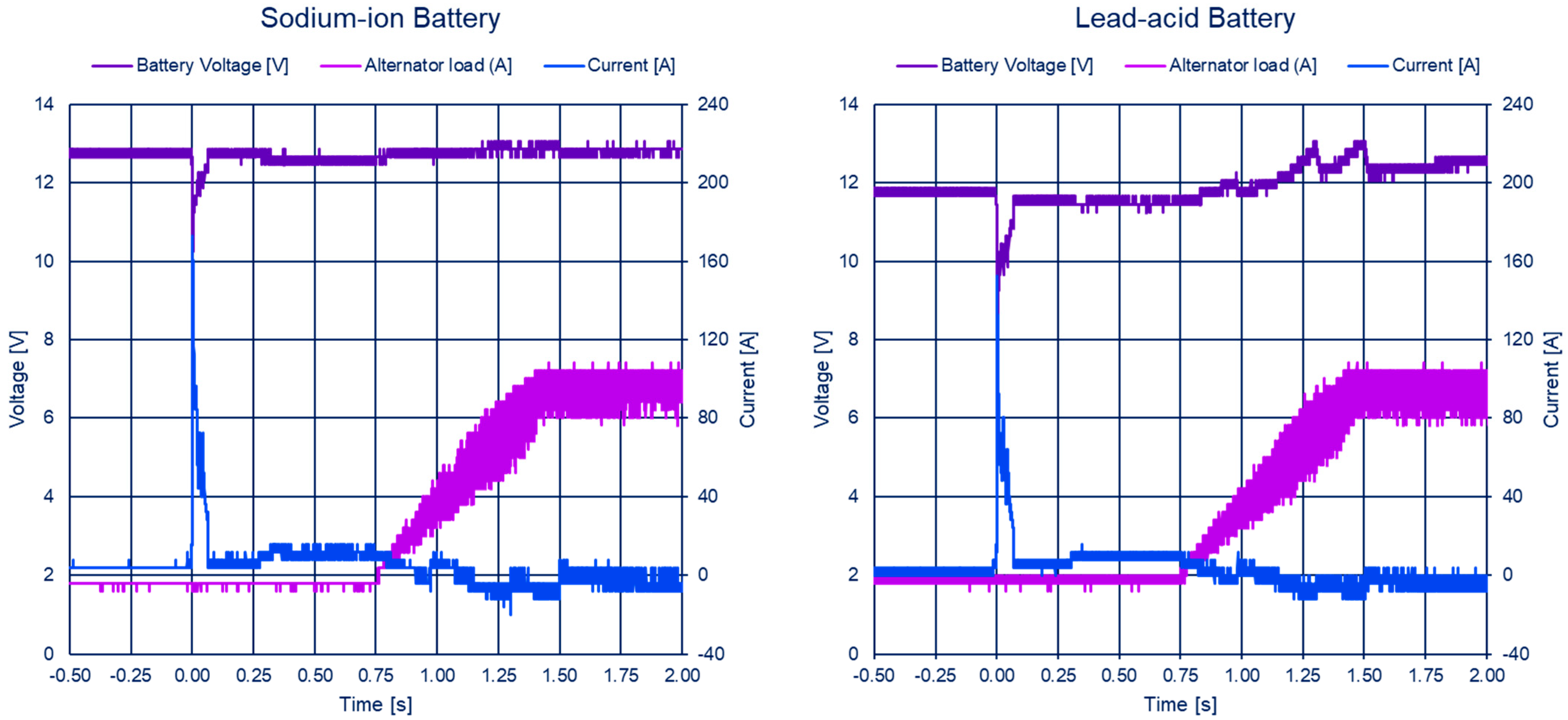
The 12 V SIB prototype (Figure 5) is characterized by an efficiency similar to that of a comparable Pb-A battery in a real case scenario representing the start of a diesel-powered ICE vehicle, with both batteries showing a significant voltage drop, ca. 3.2 V for the SIB and 4.4 V for the lead-acid. In addition, the 12 V SIB has the advantage of having a voltage level significantly superior to 12.0 V at high SoC levels, with a maximum of 15.8 V being achieved. Thus, the discharge current needed to start an ICE can be significantly reduced with the 12 V SIB prototype compared to the original 12 V Pb-A-based battery. Note that a voltage of 15.8 V remains compatible with the upper voltage limit of the automobile electronics following the norm LV 134-1; charging the battery beyond 14.4 V is possible by adapting the regulator of the alternator. However, even at an average SoC (ca. 50–55% in Figure 5), the 12 V SIB remains effective to start a diesel ICE (Figure 5).
In parallel, a high-end application 12 V SIB prototype was developed with a 10P4S configuration employing the same cells. The L5 format battery weighs 13.5 kg with a capacity of 100 Ah and a CCA power of 850 A (Figure 3).

2.2. 48 V Sodium-Ion Concept

Based on the experience and work on the 12 V battery designs, the authors were encouraged to explore a 48 V battery architecture utilizing the same SIB cells. Here, the battery pack layout is especially driven by the requirements on the battery system in terms of electrical, thermal, and safety performance. Based on the identified requirements, a concept design was developed as discussed in the following sections.

2.2.1. Battery System Requirements

Because of the specifics of the mild hybrid application, a 48 V concept has to fulfill a unique set of requirements. As can be inferred from Section 1.3, the type of hybrid architecture used for the hybrid drivetrain is a strong driver of the requirements of the corresponding 48 V battery system. As the P2 architecture is the current state of the art in mild hybrid electric vehicles, we decided to design a 48 V SIB battery system tailored to the requirements of this hybrid architecture. Depending on the size and design of the vehicle platform, a wide range of battery sizes may be used for the P2 architecture. In terms of energy content, net energy capacities from below 1 kWh to around 10 kWh can be considered common. With smaller designs being more space- and cost-efficient and hence tailored to passenger car applications, we decided to stay at the lower end of the aforementioned range.
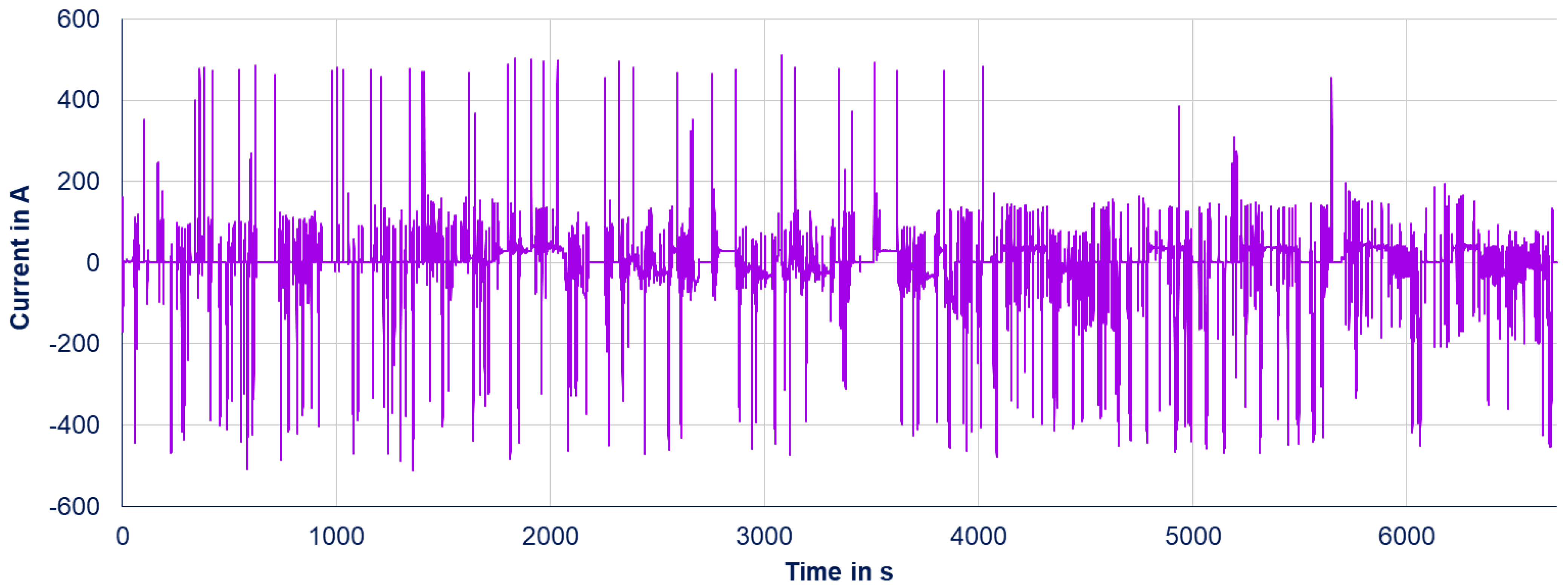
To derive operational requirements, a mission profile is employed based on a roller dyno measurement performed with a P2 mHEV using a lithium-ion battery with approximately 1 kWh of energy capacity. The considered representative drive cycles involve both city and highway driving, as shown in Figure 6 for an ambient temperature of 35 °C. It is evident that the battery is frequently charged (positive current) and discharged (negative current) in a very dynamic manner. The recorded current spikes peak at around 500 A in either direction, equivalent to a current rate exceeding 20 C.
Apart from recuperation and acceleration support, the 48 V battery system is expected to be employed as the primary energy source for high-power auxiliary systems, such as active anti rollbars or steer-by-wire. Numerous complementary internal combustion engine technologies that have been gaining relevance lately require the implementation of a 48 V system as well. For example, electric compressors and turbochargers or electric catalysts are associated with loads peaking at 7–8 kW and durations of up to 10 s for active exhaust gas aftertreatment component heating, requiring current rates peaking at approximately 10 C.
The highly dynamic mission profile with comparably high peak currents, together with the requirement for non-serviceability typically posed to 48 V energy storage systems, significantly restricts the electrochemically accessible SOC range of the battery pack. This is motivated by the fact that high concentration overpotentials must be overcome to drive these currents, especially in extreme SOC ranges. Therefore, the accessible energy capacity for the specific use-case is comparably low, with capacity utilization factors of less than 60%. This constraint also defines the system voltage limits, which are tied to the accessible SOC range at a given cell configuration. Furthermore, due to the frequently applied high overpotentials, heat generation is drastically increased compared to the 12 V use case of the starter battery design. This in turn necessitates a dedicated thermal management system for the 48 V battery system.
To assess the thermal management needs of the 48 V SIB pack, a 1D model of the target 48 V battery pack design was set up, including representations of all relevant components such as cells, holders, busbars, and thermal interface materials. The description of cell behavior is verified with dynamic cell data provided by the supplier.
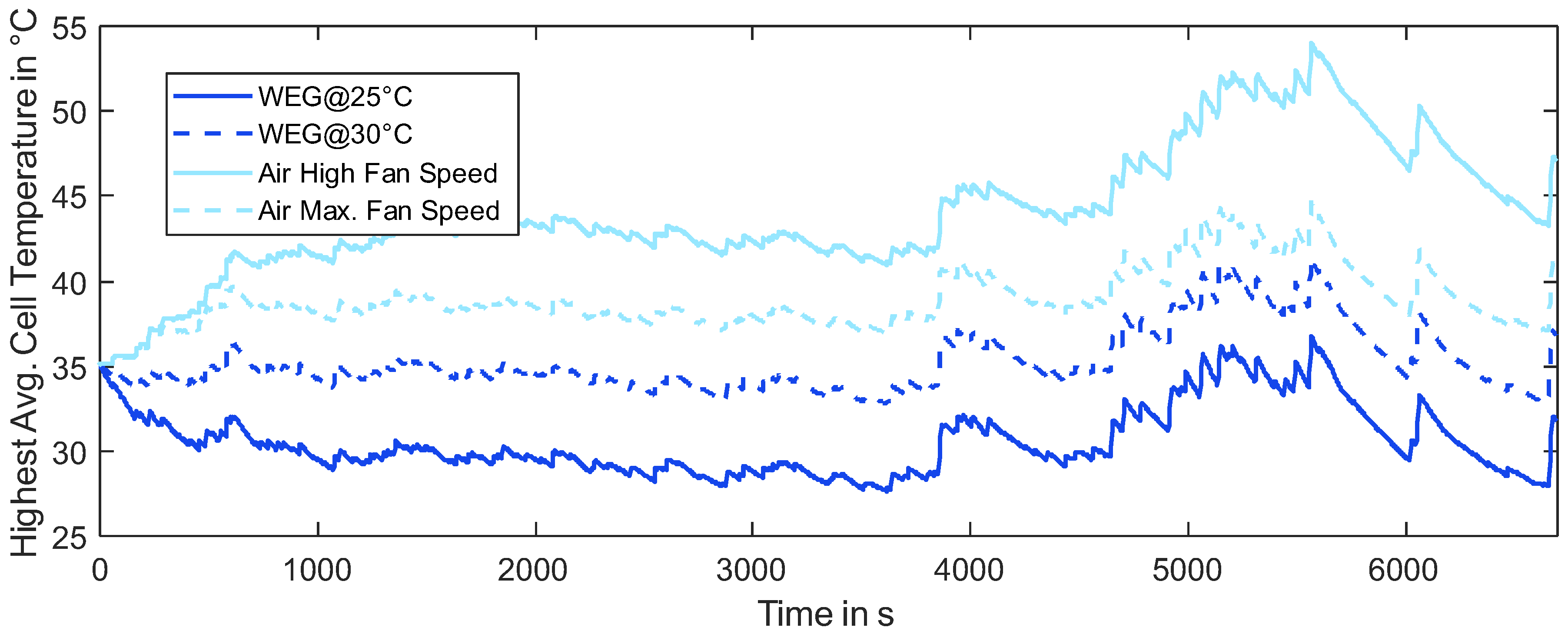
In a first step, simulated thermal management layouts based on air and liquid cooling were compared for the drive cycle mentioned before (see Figure 7). The figure displays the hottest average cell temperatures for a hot scenario with 35 °C ambient temperature. It is evident that especially in the latter part of the cycle (highway driving), large amounts of heat are released, translating to an increased cell temperature. Using an air-cooled pack results in significantly increased cell temperatures with unfavorably high temperature peaks (depending on the fan speed), compared to a liquid cooling scenario using a water–ethylene glycol mixture. For the air-cooling scenario, peaks reached nearly 55 and 45 °C for high and maximum fan speeds, respectively, with both levels considered not feasible because of the corresponding impact on cell longevity. In the case of the liquid cooling approach, peak temperatures of 41 and 37 °C were estimated for cooling medium inlet temperatures of 30 and 25 °C, respectively, at a constant coolant volumetric flow. Furthermore, Figure 7 shows that the temperature variation within the cells is more homogeneous for the liquid cooling approach. Based on these results, despite the implications in terms of costs and system complexity, an active liquid cooling approach is considered necessary for the 48 V SIB concept and has hence been implemented in the design, as discussed in the following section.
The effort in terms of safety performance required for mHEV battery designs and homologation is nearly equivalent to high voltage batteries in BEVs, with the exception of isolation resistance detection and external charge management. In this context, several categories must be addressed. Environmental tests are necessary to assess factors such as temperature shock, vibration, mechanical integrity, and water tightness. Safety tests include thermal propagation, external short circuit, and overcharge assessments. Performance and durability tests are essential to evaluate thermal performance and cycle life. Additionally, EMC tests must be conducted, along with homologation requirements (e.g., according to ECE-R100), such as fire resistance tests and TP alerts, necessitating the use of dedicated venting channels and seals as well as propagation mitigation measures.
The thermal runaway (TR) behavior of sodium-ion cells is mainly linked to the specific cathode material employed within the cell, mirroring the dependency observed in lithium-ion batteries (LIBs). The severity of TR behavior follows a descending order from transition metal oxides to phosphates, pyrophosphates, and fluorophosphates. Metallocyanide-based cathode materials, despite their limited heat release, are deemed critical due to their potential for toxic gas emissions, notably hydrogen cyanide and dicyanide. In comparison to ternary transition metal oxide cathodes utilized in LIBs, the ternary metal oxides incorporated in SIBs demonstrate a less severe TR behavior, a conclusion supported by various publications alongside our own empirical studies [10]. Similarly to LFP cells, SIB cells were emitting only gas, without fire and explosion during thermal runaway under equal triggering conditions. For the SIB cathode chemistry of the employed cells, it is anticipated that the cell will exhibit a more thermally stable behavior than that of NMC-based LIBs, thereby necessitating reduced thermal propagation mitigation measure complexity.

2.2.2. 48 V Concept Design

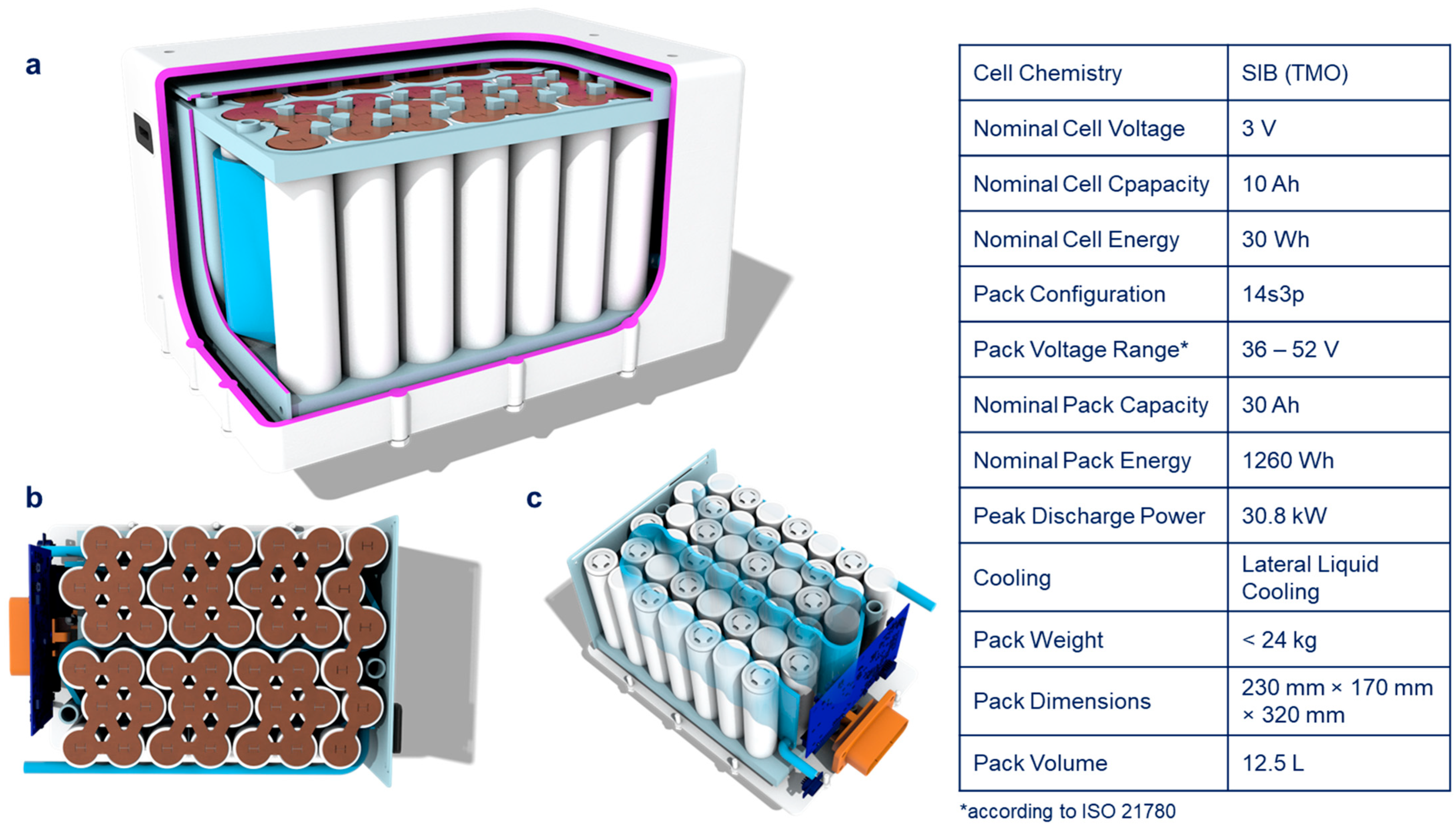
The final 48 V SIB battery pack concept design has been elaborated to match the requirements discussed in the preceding section. Based on the cell specification sheet, a configuration of 14 cells connected in series to meet the required voltage specifications and three cells in parallel to satisfy the continuous and especially peak current specifications well exceeding 500 A was chosen. While increasing the number of cells in parallel could further enhance current capacity, it would result in an undesirable increase in volume. Therefore, the optimal configuration consists of a total of 42 cells, arranged in two banks of 21 cells, as visible in Figure 8, yielding an overall pack capacity of 1.26 kWh.
The final concept design incorporates cells standing upright, secured by top and bottom cell holders, ensuring stability and efficient use of space, as shown in Figure 8. The cells are organized into two banks, each consisting of an arrangement of three by seven cells, to maintain minimal deviation from a squared casing layout for maximized rigidity given the 14s3p configuration. Due to the cells being opposite-terminal cells, this arrangement includes alternating cell orientations to facilitate serial connections with minimal bus bar lengths, optimizing electrical pathways. To further enhance performance, the bus bars connecting the two banks, along with the socket leads, have increased thickness to reduce resistive losses. The alternating orientation requires venting into two voids located at the top and bottom. These are connected to venting channels implemented in the cell holders, thus prohibiting the contact of the hot venting gases with the cells, and are combined into a single volume at one end of the battery casing, featuring a burst membrane for in-pack pressure management (Figure 8).
As established in the previous section, the employed design incorporates liquid cooling as the preferred method over air cooling, enhancing thermal management efficiency. As depicted in Figure 8, a cooling ribbon is placed on every other cell row in the longitudinal direction, ensuring effective heat dissipation across the battery and minimized temperature gradients. The cooling tube has a cross-sectional area of 200 mm2 and contacts each cell on approximately 12% of the lateral cell surface. While being less complex and more cost-efficient, the implementation of a simple (bottom) plate cooling is not feasible because of the opposite-terminal layout of the employed sodium-ion cells. The battery management system board, along with electrical and fluidic connectors, are located at the front end of the battery casing, thus eliminating the prospective for any venting gas contact.

2.2.3. Thermal Performance of the Concept Design

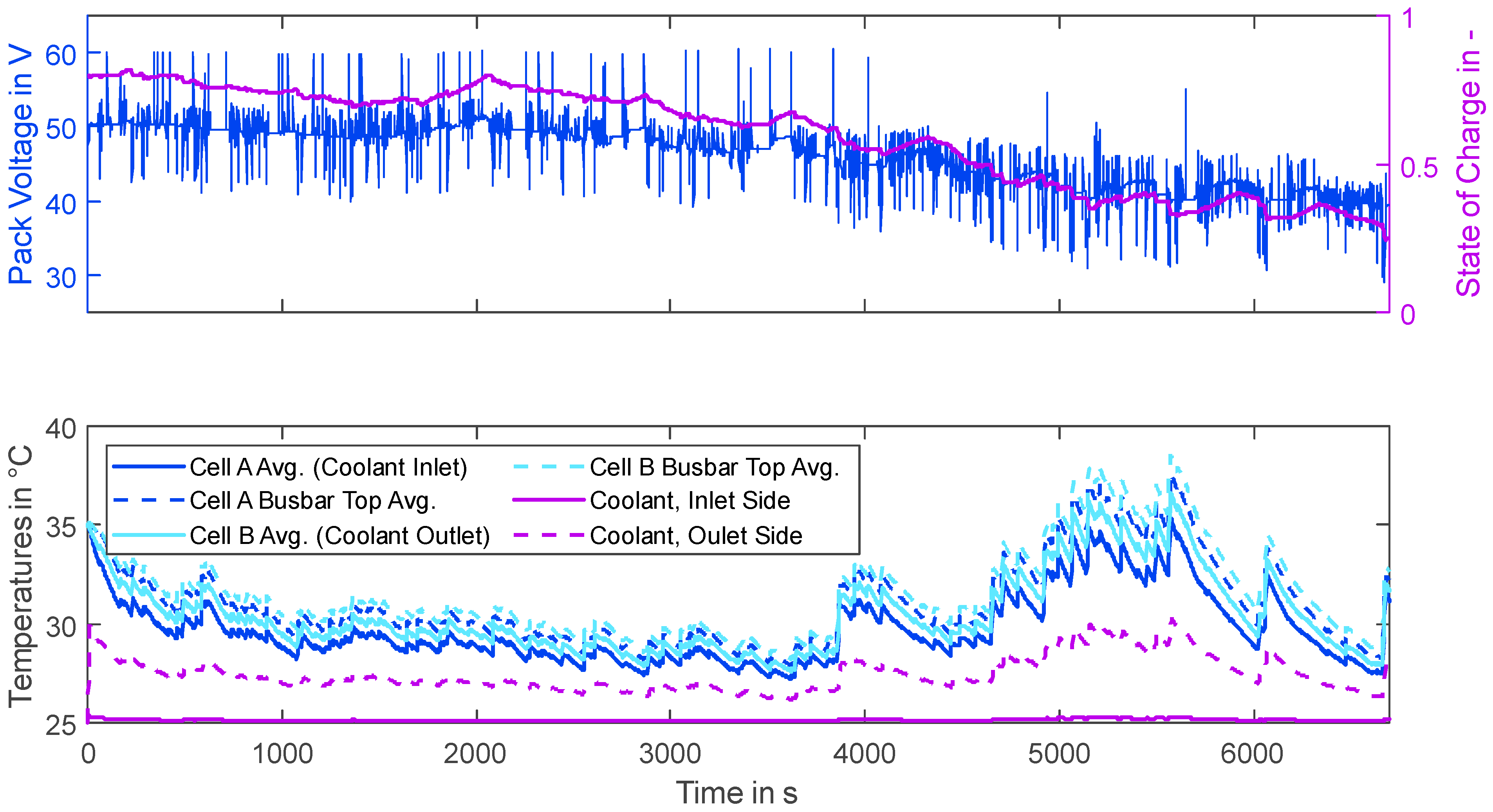
The thermal performance of the final pack design was evaluated using the same one-dimensional modeling methodology employed for the requirements assessment, with the integration of a liquid cooling strategy tailored to the selected design for thermal management. As can be seen in Figure 9 (top), the battery SoC undergoes a gradual discharge throughout the drive cycle, starting at 80%.
During city driving, the operation remains balanced, resulting in a relatively stable SoC profile, whereas highway operation induces a more pronounced discharge. From a component temperature perspective, the cell temperatures are characterized by marginal differences between the coolant inlet and outlet, indicating a good temperature homogeneity within the pack (Figure 9, bottom). The bus bar temperatures are elevated due to the additional resistive losses inherent within the bus bars. Despite the consideration of a thermally demanding mission profile characterized by an ambient temperature of 35 °C and a constant coolant volumetric coolant flow of 1 L/min, neither the bus bar nor the battery cell temperatures approach critical thresholds. This outcome substantiates the reasonable selection of component dimensions, affirming their adequacy in terms of thermal performance. The design choices ensure that the thermal management system can effectively maintain operational integrity and efficiency, even under challenging environmental conditions, thereby validating the robustness of the cooling approach and the overall system architecture.

3. Comparative Study LFP vs. SIB

3.1. Study Design

The comparative study presented in this section focuses on cylindrical 32140 SIB cells as employed in IAV’s 12 V and 48 V battery concepts presented in the previous section, which incorporate a ternary transition metal oxide-based cathode and soft carbon anode. These cells are optimized for high energy capacity, with all data regarding the key performance indicators (KPIs) provided by the cell supplier. In addition to the selected SIB cells, a screening process was conducted to identify further comparable candidates, emphasizing low cost and sustainability characteristics. Lithium-ion batteries with LFP cathode chemistry, currently the dominating newcomer on the low voltage battery market, were identified as meeting the necessary metrics. The comparison between SIB and LFP cell chemistries encompasses performance as well as economic and sustainability comparisons.
Specific data for LFP cell KPIs, particularly current maps for charge and discharge, is not readily available as a single dataset for high-energy cells of the used format. Consequently, we decided to derive these data from a parametrized coupled electrochemical-thermal model, which is validated through literature comparison with available literature data for LFP cells. The simulation environment employs a pseudo 2D (P2D) modeling approach for the electrochemical processes characterizing each cell chemistry, coupled with a 3D temperature (2D-axisymmetric) model of a single cylindrical cell. This modeling approach offers the advantage of providing various parameters that can be adapted for different cell design optimizations, such as high power and high energy designs. Parameter gradients within a battery cell play a crucial role for the cell’s dynamic voltage or current response, where high-power cells differentiate from high-energy cells. Thus, the discretization over the cell thickness and the additional intra-particle dimension offered by P2D models, solving the charge and mass balance equations in the electrodes and electrolyte phases, allows us to consider the discussed parameter gradients and hence the dynamic cell behavior. Accordingly, investigations regarding cell design parameters can be performed for optimizing the cell for one target application. The primary modeling result is the generation of time–current–temperature maps for both charge and discharge, based on three criteria: maximum or minimum cut-off voltages, maximum desired operating temperature, and negative electrode potential to account for the risk of plating formation. Plating is anticipated to occur, particularly for combinations of higher C-rates, lower temperatures, and high state of charge, even if the operating SoC window is reduced, which accelerates cell aging. These time-based maps are generated through an automated iterative process using a Nelder-Mead algorithm-based optimizer.
Supply chain and cost assessments within this study are solely derived from existing literature sources, which provide a comprehensive dataset for LIBs in general as well as LFP chemistries. However, the data available for SIBs is notably limited, and often lacks comparability to the LFP chemistry selected for this study. Thus, we evaluated SIBs as a general category, without differentiating chemical composition variations among SIB cathodes, leading to a generalized understanding of SIB economics. Furthermore, it must be remarked that the SIB cannot benefit from the same production scaling effects.
To compare the sustainability aspects of the considered SIB cells with LFP cells, we conducted an LCA analysis of the cells comprising four phases. For novel battery technologies and cell chemistries, the LCA methodology assesses potential environmental impacts based on differences in electrode active materials, thus aiding in battery concept definition. In the study performed in this contribution, the system boundary is set at the battery cell production (Cradle-to-Gate), as use-phase and end-of-life impacts largely depend on the electricity mix and recycling processes, rather than the technology itself. Furthermore, the possible scenarios for subsequent use of the battery are diverse and complex. In contrast, there are criteria such as cycle life and the use of secondary materials from a recycling loop that are technology dependent and can be of importance along the further life cycle. The manufacturing phase reflects the technology’s impact by being influenced by materials, energy density, processes, and cell design. The functional unit for the LCA study is defined by the battery cell excluding its peripherals, with the outer boundary defined up to the cell housing. The reference flow is one kilowatt-hour (kWh) of energy, also used as normalization unit. The impact assessment uses characterization factors/models from Leiden University (CML 2001—August 2016) and USEtox (2.12) [37]. Five of the European Commission’s 16 recognized impact categories for environmental footprint (EF) are considered, with these being the Global Warming Potential (GWP), Acidification Potential (AP), Abiotic Depletion Potential (ADP elements), Human Toxicity Potential cancer (HTP), and Ecotoxicity Potential (ETP) [38]. These categories offer a holistic view of product system sustainability, highlighting shifts in environmental impacts resulting from technological changes. Dedicated databases (Sphera LCA for Experts Version 10.9.0.31, Content Version 2023.2) provide the basis for assessing cell production impacts [39]. Masses and chemical compositions are sourced from the cell and battery design process. The modeling is performed by adopting a conservative approach, treating waste and scrap via the cut-off approach without credits. Resulting gaps are filled with literature data to ensure sufficient quality. The analysis reflects current standards, with cell production in Europe using the European electricity mix.

3.2. Key Performance Indicators

Table 2 compares typical values for key performance indicators of SIB and LFP cells. While most SIB cells available today are optimized for high energy density, their typical power density is comparable to that of high-power LFP cells. The performance of SIBs is dependent on the specific chemistry employed, Section 1.3, and like in the case of LFP, a SIB cell can be designed either energy- or power-oriented. Thus, the KPIs of SIBs listed in Table 2 can appear broad at first look. The development of SIB technology and market is expected to lead to an optimization of the different SIB designs for the desired target applications.

3.2.1. Energy Density

The current energy density of SIBs typically ranges from 100 to over 170 Wh/kg at the cell level, with CATL recently unveiling a SIB with an energy density of 175 Wh/kg [12,17]. Some next-generation models announced by suppliers, including CATL and Faradion, are anticipated to exceed 190 Wh/kg. This is slightly lower than the energy density of LFP energy-type cells but higher than LFP power-type cells. Typically, LFP energy cells have a specific energy of around 160 Wh/kg, with high-end models reaching up to 205 Wh/kg, such as the recently announced Shenxing CATL. On the other hand, LFP power-type cells have a lower energy density compared to today’s state-of-the-art SIBs, with values ranging from 70 to 90 Wh/kg, as these cells are optimized for very rapid charging and discharging, as well as high cycle life.

3.2.2. Power

SIBs offer the advantage of high-power capability, even in the case of cells optimized for energy density. Generally, SIBs provide higher power density compared to energy-type LFP cells, comparable or slightly inferior to power-type LFP cells. Specifically, sodium-ion cells have reported power densities around 2.5 kW/kg, with the potential to exceed 3.5 kW/kg [17]. This is significantly higher than typical energy-type LFP cells, with specific power densities in the region of 1 kW/kg but also somewhat lower compared to power-type LFP cells, which can reach up to 3.5 kW/kg, depending on their design. Advanced sodium-ion cells, however, may rival or even surpass power-type LFP cells in terms of power delivery capabilities.

3.2.3. Low Temperature and Lifespan

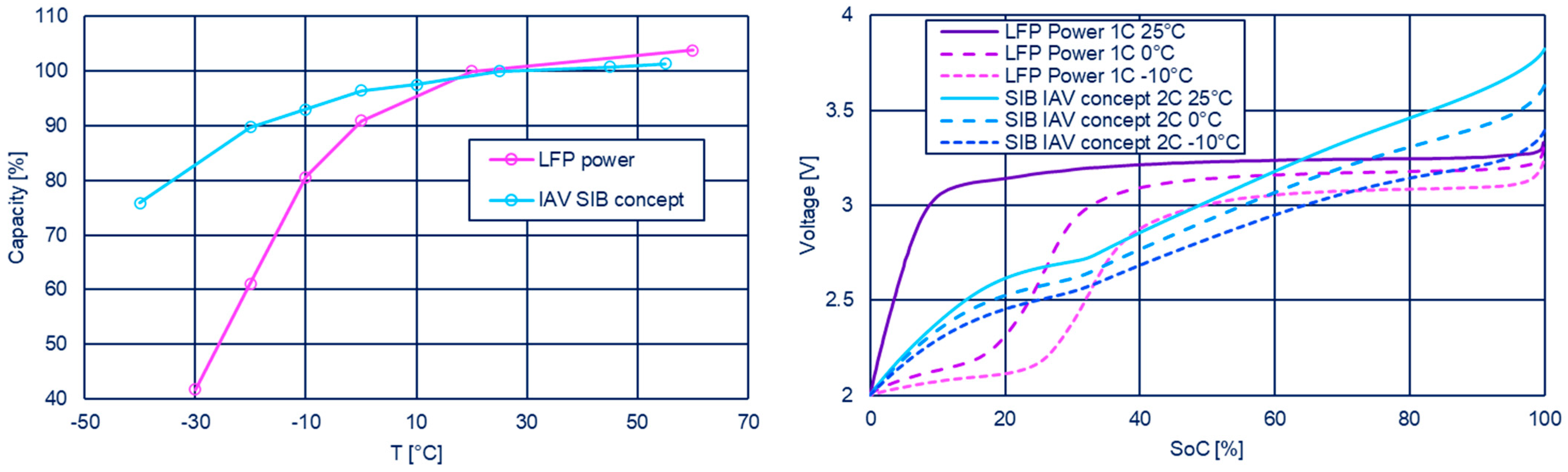
SIBs are generally characterized by a high capacity retention, potentially maintaining over 96% retention after 3850 cycles. A lifespan with 80% State of Health exceeding 25,000 cycles can be anticipated, depending on the cathode chemistry [40]. It is well known that the energy and power of LFP cells significantly decrease at cold temperatures, as also shown in Figure 10 for the cell considered in this study, aligning with academic research [3,28]. In contrast, SIBs demonstrate a more resilient performance, capable of charging at temperatures as low as −20 °C and retaining up to 82% capacity at −30 °C [40].

3.2.4. Integration

When comparing the thermal management needs for high-power applications between sodium-ion and LFP batteries, several important differences appear. Due to their superior low-temperature performance, sodium-ion batteries often do not need active heating systems in cold environments, making thermal management easier in such conditions. Furthermore, their increased ionic conductivity translates to a lower internal resistance, limiting ohmic heat losses in the cells.
On the other hand, LFP batteries, especially those optimized for high current output, produce increased amounts of heat in high load scenarios. This necessitates adapted thermal management systems to prevent overheating, loss of capacity, and faster aging. Cooling methods like advanced liquid cooling are often needed to keep cell temperatures even and safeguard safety and lifespan in high-power LFP battery packs.
Although less sensitive than LFP batteries, sodium-ion batteries also show changes in resistance and impedance depending on temperature, especially when they are at a low state of charge. Because of this, careful management of both temperature and charge level is needed to keep them efficient and long lasting. Even though sodium-ion batteries generally have better thermal stability and a safer design than NMC-based Li-ion cells, reducing the risk of thermal runaway and making thermal management somewhat easier, the employed SIB cell is expected to have a slightly inferior thermal stability to LFP-based cells. Finally, the open circuit voltage curve of the utilized SIB has a steeper slope than LFP counterparts, making accurate estimation of the state of charge easier.
In the next step, the evaluated chemistries are assessed in the perspective of a 48 V application for a mild hybrid powertrain, as detailed for the 48 V SIB concept design presented in the previous section. The final design of the 48 V battery pack is directly influenced by the type of cell and chemistry used, as summarized in Table 3. Due to their respective voltage ranges (see Figure 1), fewer SIB cells are required in series compared to LFP cells to meet the pack voltage requirements. On the other hand, the peak power requirements impact the necessary number of parallel connections. Consequently, configurations of 17s2p and 14s3p are identified as the optimal compromise for the LFP and SIB chemistries, respectively. The resulting 48 V SIB pack is positioned between the 48 V LFP high-energy and LFP high-power options in terms of weight, power, and energy. While power and weight are critical for targeted mHEV applications, limited energy capacity can accelerate cell aging and reduce overall energy recuperation, thus diminishing CO2 reduction potential. It is important to note that the discharge power performance of batteries typically decreases with the state of charge. Additionally, for mHEV applications, the SoC operating window should be restricted to 30–90%, defined at a target operating temperature of 25 °C based on best practices. Detailed optimization in this context can be achieved by incorporating aging mechanisms into the respective models, for example, in the process of developing the battery management system functions.
Overall, the SIB cells weigh approximately 3 kg more than equivalent LFP power cells, offering approximately 20% less maximum power at 25 °C, although their energy content is 77% higher. At 0 °C, the discharge peak power of the 48 V SIB decreases by approximately 17% compared to its performance at 25 °C, whereas the power of LFP power cell-based pack drops by about 50%. The discharge peak power of the SIB at 0 °C is approximately 34% greater than that of the 48 V LFP power cell.
While our 48 V battery concept design includes active thermal management for the pack, which could counteract low-temperature effects, several arguments support the importance of considering the impact of low temperatures on the pack performance impacts. Firstly, 0 °C is not uncommon in many regions worldwide. Also, no temperature management system offers instantaneous efficiency, as there is always a latency period, even in small battery systems. Furthermore, the worst-case scenario must be considered in pack design for safety reasons. In addition, temperature heterogeneities are inevitable with a ribbon cooling design. Thus, temperature gradients are expected to have a lower negative impact on the electrical performance and durability of the 48 V SIB compared to the 48 V LFP system.

3.3. Supply Chain, Sovereignty, and Cost

The value chain for lithium iron phosphate cell manufacturing is largely dominated by China, with the notable exception of lithium mining, where approximately 75% of the lithium raw material is sourced from Chile or Australia. Despite this geographical limitation, China exerts substantial control over the successive stages of the value chain, including refining, cathode and anode material production, and cell manufacturing. Notably, around 90% of the cathode active material for LFP cells is produced within China, underscoring its dominance in this sector. This strategic advantage is further bolstered by China’s approach to mitigating its geographical disadvantage in lithium raw material distribution through either full ownership of mining enterprises at sourcing locations or through joint ventures with incumbent operators [41]. For SIBs, China maintains a dominant position in terms of cell production capacity as well, although key market players are located in Europe. The abundance of sodium, which is approximately three orders of magnitude higher than that of lithium, coupled with its more homogeneous geographical distribution within the lithosphere, renders sodium raw material sourcing more economically viable due to decreased costs associated with material transport and refining. Furthermore, SIBs do not require copper foil as a negative current collector, which further reduces production costs.
However, watt-hour-normalized costs for SIBs currently remain higher than those for LFP batteries, attributable to several factors. The production of hard carbon often used in SIB anodes (although not in the case of the sodium-ion cell considered in this study) is more expensive than the graphite used in LIBs due to purification and electricity demands [42]. Additionally, SIB production cannot currently benefit from the same maturity of supply chains as LIBs, which drives up costs. The production scale of SIBs remains limited compared to LIBs, meaning that economic scaling effects do not apply equally. Furthermore, due to the lower energy density of SIBs, fixed costs for cell manufacturing are higher when assessed on an energy capacity-based metric. Nevertheless, with increased maturity of both technology and production scale, significant cost savings compared to LIBs are anticipated, with estimates suggesting around 30% savings compared to LFP batteries. However, as economic parity is likely to be reached in the mid-2030s, costs are currently only expected to be advantageous from the late 2040s onwards using baseline considerations [43].
In terms of regulatory frameworks, the authors are currently unaware of any legislative push, incentive, or subsidization to prioritize SIBs over any other cell chemistry within automotive applications. Furthermore, SIBs are not treated differently than other cell chemistries in terms of homologation requirements.

3.4. Sustainability

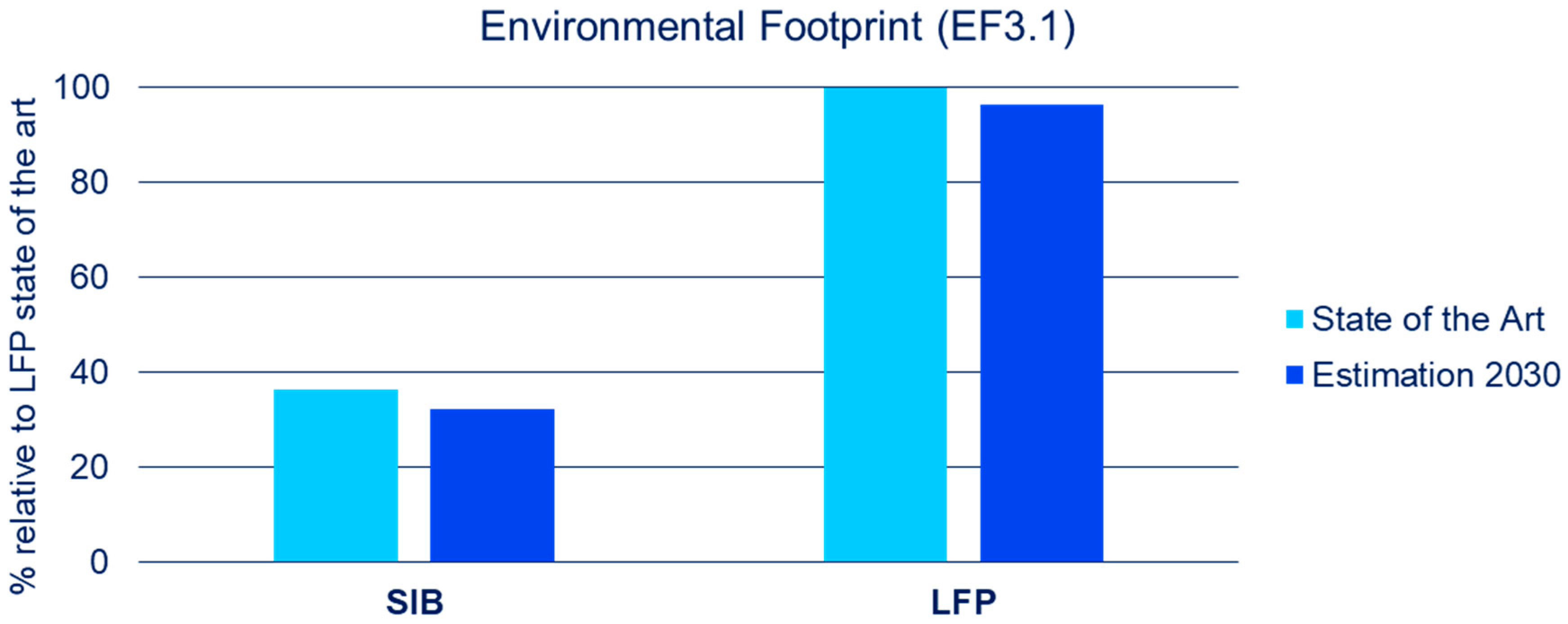
Studies have indicated that Pb-A based batteries, while still dominating the 12 V market as discussed in the introduction section, are characterized by a higher environmental impact compared to the lithium-ion-based formulations gaining on relevance for low-voltage applications [44]. The life cycle assessment performed in this study further reveals a clear advantage in terms of environmental impact for the sodium-ion based cell, which is characterized by more than 60% lower normalized environmental impact compared to its LFP counterpart based on the Environmental Footprint 3.1 methodology (Figure 11). This ratio in environmental impact is not expected to change in the near future, indicated by the values estimated for 2030.
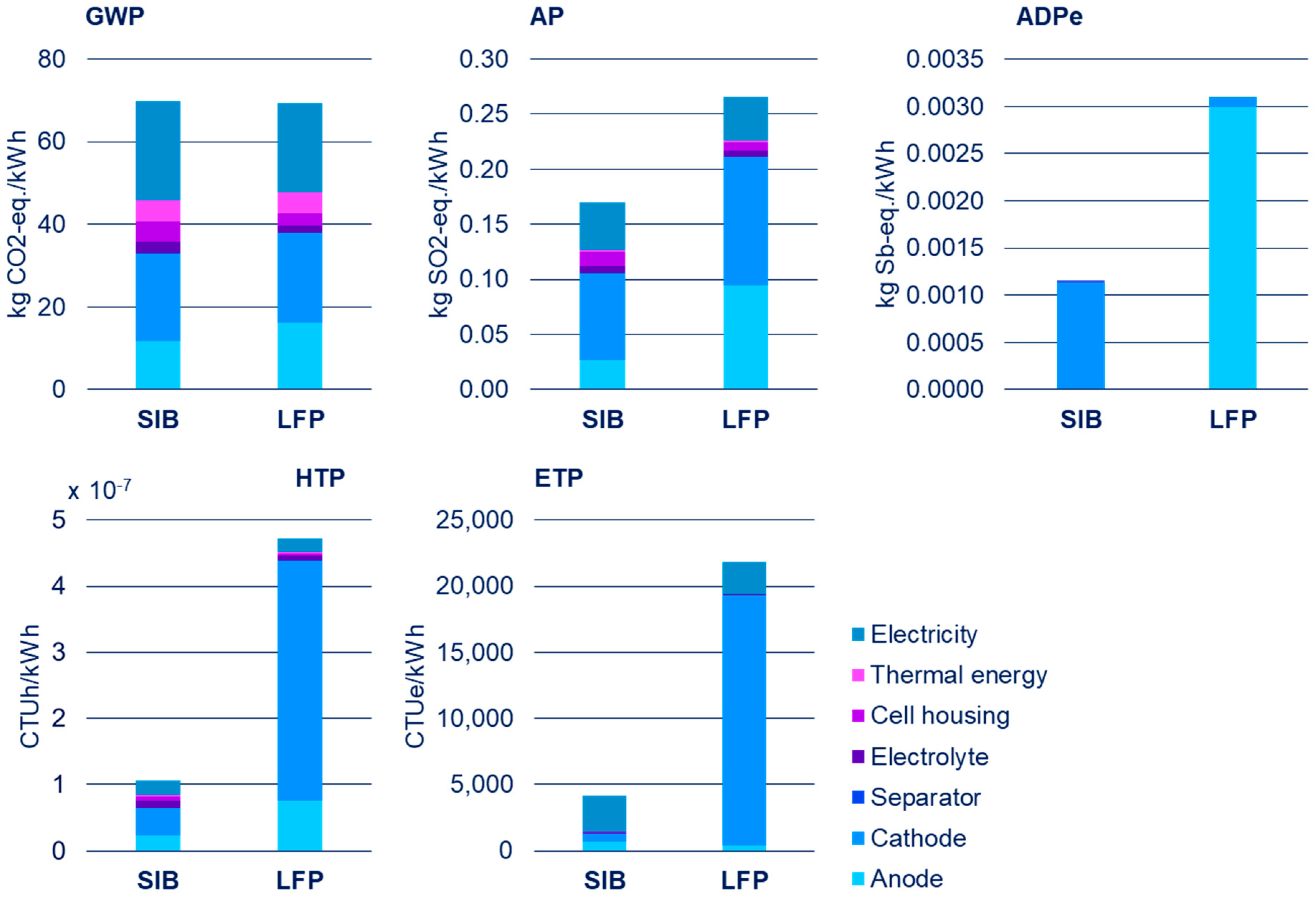
Multiple impact categories must be considered when comparing technologies, with changes in battery cell design and especially chemistry typically resulting in significant shifts in impact categories. This motivates the calculation of an overall sustainability score based on established methodologies, as performed above for EF3.1. The overall normalized result shown in Figure 11 hence reflects five impact categories in total, with the respective values in the single categories shown in Figure 12 for the LFP and SIB cells considered. The SIB has the lowest values in the AP, ADP elements, HTP, and ETP categories and nearly equal GWP per kWh.
GWP values for SIB vary due to active materials, manufacturing processes, and production region [45]. For cylindrical sodium-ion cell production, similar processes to conventional cylindrical LIB cells can be assumed [39]. Established processes handle more material, increasing time and energy consumption. The cathode active material (Fe, Cu, Mn mixed oxides) is represented using literature data. Layered oxides, the largest mass component, are conservatively estimated, with energy requirements sourced from literature. Soft carbon is considered for the anode, being inexpensive and easy to produce.
Based on these assumptions, the considered SIB and LFP cells have similar GWP per kWh, with normalized values of approximately 70 kg CO2-eq./kWh (Figure 12). The SIB benefits from less CO2-intensive anode material that is, however, counterbalanced by heavier cell housing, more electrolyte and higher electricity consumption. Cathode and thermal energy are very similar for the SIB and LFP batteries. In the AP category, the SIB impact is decreased by approximately 33% in comparison to the LFP cell. The main driver of this decrease is the anode, where the impact is decreased by three quarters compared to the LFP cell. The cathode is the second largest contributor to the SIB’s lower impact in the AP category, with AP factor values of approximately 0.8 kg SO2-eq/kWh, which is around 40% lower than the AP impact of the LFP cathode at 0.115 kg SO2-eq/kWh. For ADP, the LFP cell’s copper anode foil is a hotspot, accounting for ~93% of the ADPe value per kWh, while the SIB uses only aluminum foil for both the anode and cathode current collectors. The SIB cathode contains transition metal (Cu, Mn) representing 90% of its ADPe value, which still is less than 40% of the ADPe of LFP.
HTP of the SIB represents 22% of the value calculated for LFP. For the SIB, the cathode is the main contributor, although it represents less than 50% of SIB’s total HTP value. The contributions of the anode and electricity seem almost identical. The composition of HTP contributors of the LFP cell is very different. Its cathode contributes more than 75% of the total HTP value per kWh. The second largest contributor, the anode, reaches 17% of the LFP’s total HTP.
The difference between the SIB and LFP is even higher for the ETP factor, with the former being characterized by less than 20% of the latter’s ETP value. Electricity accounts for around 70% of the total ETP of the SIB. Also in this category, the cathode is the hotspot for LFP with more than 80% of its total ETP, while electricity is only the second largest contributor, accounting for only approximately 15% of LFP’s total ETP.
Thus, SIB technology is favored for its sustainability and comparably low environmental impact over various lithium-ion batteries [34], including lithium iron phosphate as clearly demonstrated in this study. SIBs thus have significant potential for vehicle concepts in terms of sustainability, with industrialization anticipated to further reduce corresponding emissions.

3.5. LFP vs. SIB for Low-Voltage Applications: Summary

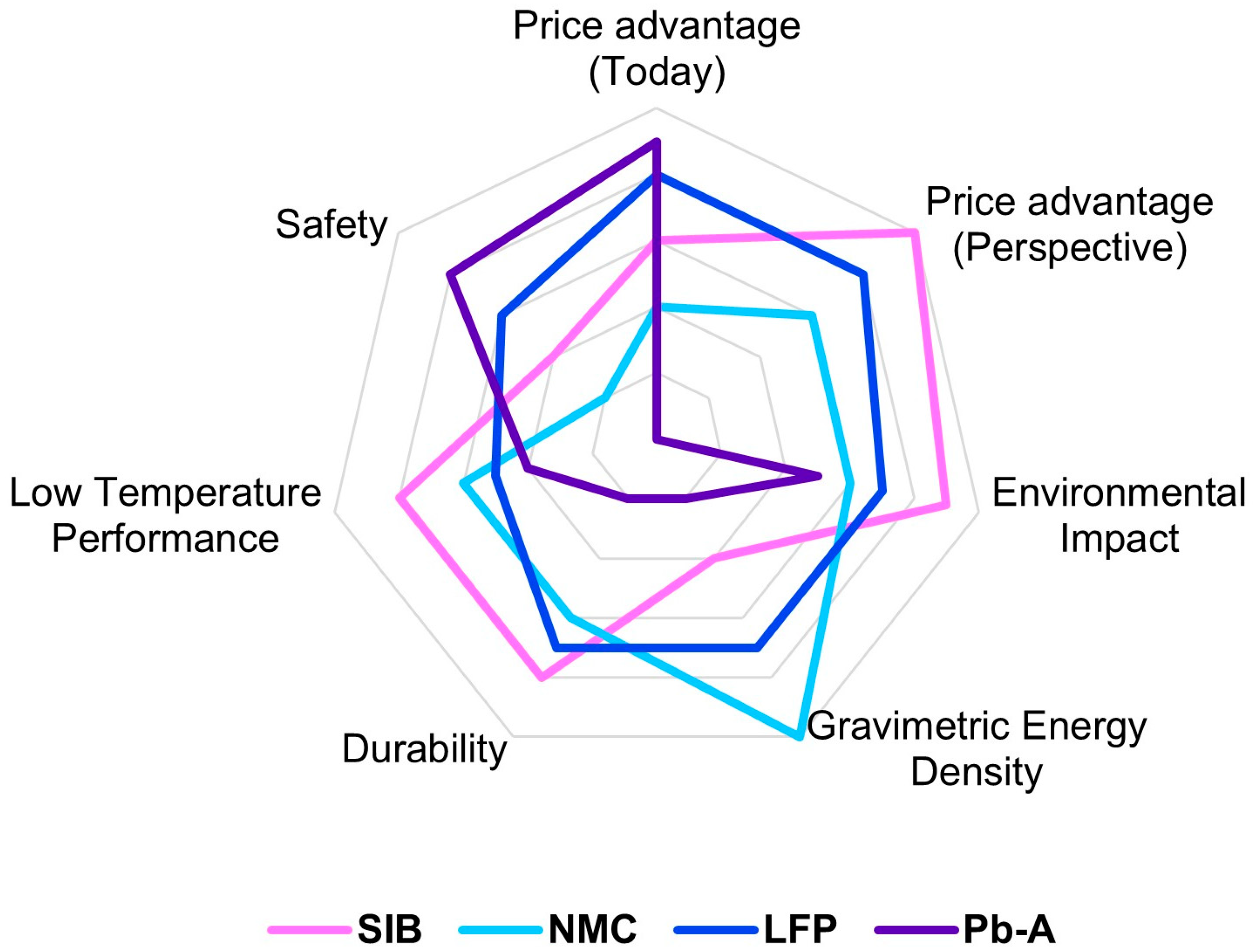
Figure 13 summarizes the study results by comparing the KPIs of different cell chemistries in the context of a 12 V application. We observe that the use of Pb-A, as a reference, market-dominating technology, is mainly driven by its competitive price and ease of integration related to its very safe chemistry. Nonetheless, considering the potential for a future ban due to the high toxicity of lead, these advantages are expected to ultimately lose significance. Present-day alternatives, such as LIB LFP and NMC, stand out as clear replacements, especially given the availability and scalability of these chemistries. A closer look at the potential of SIB suggests it could become an interesting alternative, especially in terms of sustainability, performance, and even future price competitiveness.
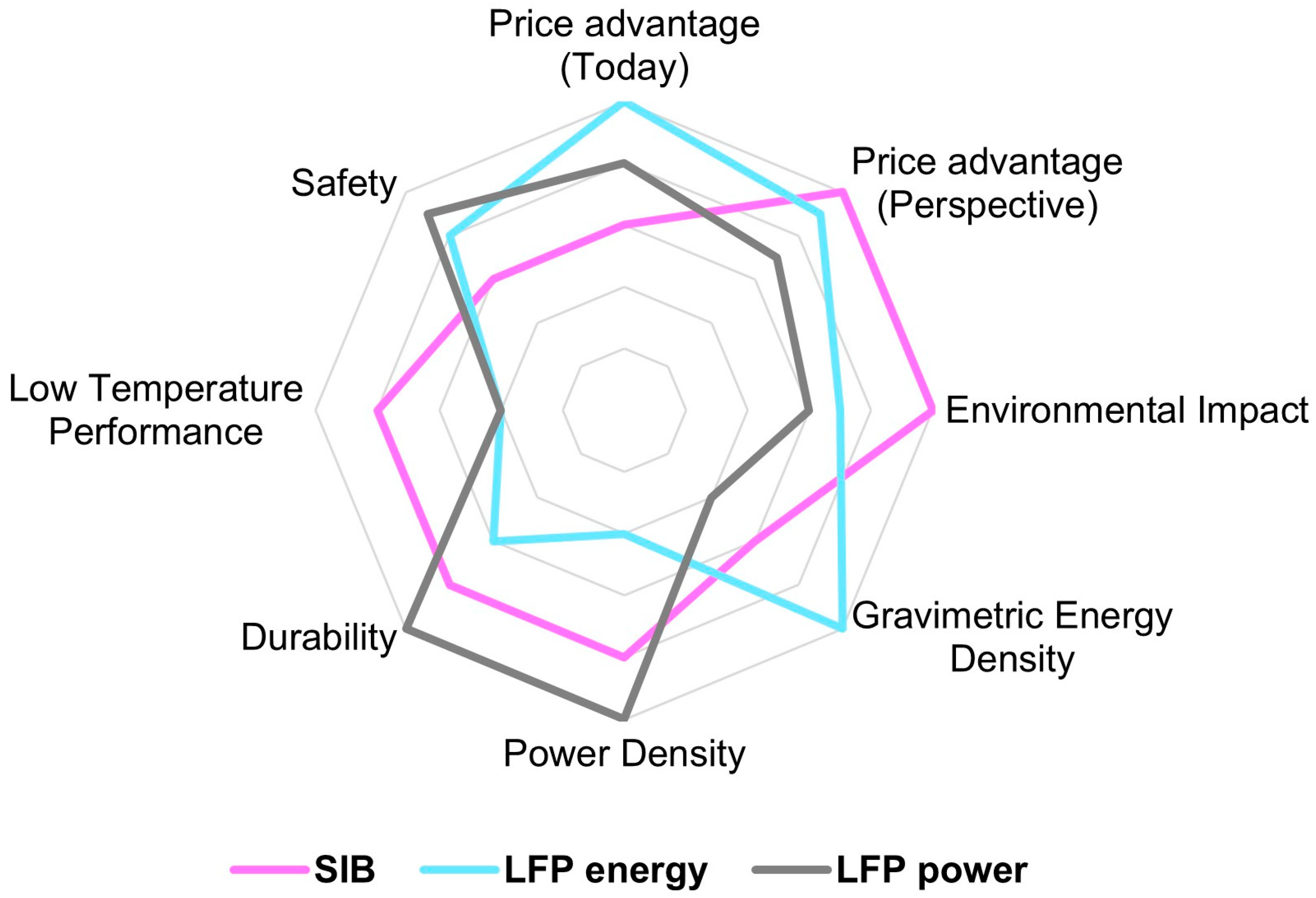
For the 48 V application, the comparison of key KPIs is shown in Figure 14. The evaluation focuses on the main chemistry candidates considered in this study: LFP (both power- and energy-type) and SIB. Although the SIB currently does not have price advantages, it is expected to become the cheapest chemistry in the future as scalability and production increase, based on bill of materials and market projections. It also demonstrates good performance at low temperatures and offers strong sustainability benefits. While it may not be best-in-class in other categories, the performance gaps are relatively small, making this chemistry a strong trade-off option when considering all evaluated factors together.

4. Conclusions and Outlook

Based on IAV’s dedicated 12 V SIB prototype and 48 V SIB concept designs, the study on the potential of SIBs for low-voltage mobility presented in this contribution highlights several important findings and future implications for low-voltage battery technologies. Sodium-ion batteries represent a promising alternative to the typically used lead-acid (12 V) and lithium-ion batteries, mainly because of their robustness, highly abundant raw materials, high durability, good performance, and potential future cost advantages.
Compared to conventional lead-acid starter batteries, the presented 12 V SIB prototype offers a weight reduction of approximately 50%, in combination with an improved low-temperature performance and a drastically improved cycle life of more than 4500 cycles. The 48 V SIB design concept, on the other hand, represents a compelling alternative to state-of-the-art LFP systems as it offers peak discharge powers surpassing that of high-energy LFP cells by 36% at 25 °C and 187% at 0 °C, while offering 77% more energy capacity than high-power optimized LFP cells.
In addition to its excellent safety features, being fully resistant to overcharge according to the Chinese GB/T-31485 norm, over-discharge, and short-circuit conditions, the SIB cells used for the prototype benefit from a lower environmental impact compared to its competitors owing to their lead and lithium-free materials. Based on the results of the performed study, significant improvements in key environmental indicators such as global warming and acidification potentials can be expected by 2030, manifesting SIBs as a sustainable electrochemical energy storage solution for present and future applications. Performance tests across different temperatures show that SIBs deliver a stable discharge energy, which is important for reliable high-power operation in various climates, as typical for low-voltage applications.
In conclusion, this study indicates that sodium-ion batteries do not represent a miraculous solution, as they do not excel in comparison to other technologies across most categories. However, their characterization as a “jack of all trades, master of none” positions them as a potential transformative force in low-voltage mobility, offering a sustainable, safe, and cost-effective alternative to the battery technologies currently dominating the market. The implementation of SIBs can lead to significant advancements in the design and performance of low-voltage systems. Further development and scaling of the SIB technology, supported by research efforts improving energy density, cost reduction strategies, and safety, is expected to support its widespread adoption within the automotive industry, ultimately contributing to a more environmentally friendly and sustainable future.

Author Contributions

Conceptualization, A.F., B.S., K.M. and M.S.; formal analysis, S.S., O.N. and J.W.; data curation, S.S., O.N. and J.W.; writing—original draft preparation, A.F., B.S., S.S., O.N. and J.W.; writing—review and editing, O.N., K.M. and M.S.; visualization, S.S., A.F. and B.S.; supervision, A.F., B.S., K.M. and M.S.; project administration, A.F. and B.S. All authors have read and agreed to the published version of the manuscript.

Funding

This research received no external funding.

Data Availability Statement

The original contributions presented in this study are included in the article. Further inquiries can be directed to the corresponding author.

Acknowledgments

The work presented could only be conducted thanks to the collaboration of many domain-specific specialists with the number of parties involved going beyond the authors list. The authors would like to express their sincere thanks to all colleagues involved.

Conflicts of Interest

Brahim Soltani and Sébastien Sallard are employees of IAV France S.A.S, 4 rue Guynemer, 78280 Guyancourt, France. Alexander Fandakov, Oliver Nolte, Johannes Werfel, Karsten Mueller, and Marc Sens are employees of IAV GmbH, Carnotstrasse 1, 10587 Berlin, Germany. The research was conducted in the absence of any commercial or financial relationships that could be construed as a potential conflict of interest.

Abbreviations

The following abbreviations are used in this manuscript:
ADPAbiotic depletion potential
APAcidification potential
BoLBegin of life
CCACold cranking amp
CO2Carbon dioxide
DoDDepth of discharge
EFEnvironmental footprint
ETPEcotoxicity potential
EUEuropean Union
EVElectric vehicle
GWPGlobal warming potential
HTPHuman toxicity potential cancer
ICEInternal combustion engine
KPIsKey performance indicator
LCALife cycle assessment
LFPLithium ferrous phosphate
LTOLithium titanium oxide
mHEVMild hybrid-electric vehicle
NMCLithium nickel-manganese-cobalt oxide
P2DPeudo-2-dimensional
Pb-ALead-Acid
SEISolid electrolyte interface
SIBSodium-ion battery
TRThermal runaway

References

  1. EU Regulation of the European Parliament and of the Council 2023/851 Approved on 19/04/2023 “Strengthening the CO2 Emission Performance Standards for New Passenger Cars and New Light Commercial Vehicles in Line with the Union’s Increase Climate Ambition. Available online: https://eur-lex.europa.eu/eli/reg/2023/851/oj/eng (accessed on 17 April 2025).
  2. Euro News on 19/09/2024. Available online: https://www.euronews.com/business/2024/09/19/eu-car-industry-calls-for-urgent-action-as-ev-new-car-sales-tumble (accessed on 17 April 2025).
  3. Bauknecht, S.; Wätzold, F.; Schlösser, A.; Kowal, J. Comparing the Cold-Cranking Performance of Lead-Acid and Lithium Iron Phosphate Batteries at Temperatures below 0 °C. Batteries 2023, 9, 176. [Google Scholar] [CrossRef]
  4. Garche, J.; Karden, E.; Moseley, P.T.; Rand, D. Lead–acid batteries for future automobiles: Status and prospects. In Lead–Acid Batteries for Future Automobiles; Elsevier: Amsterdam, The Netherlands, 2017; pp. 601–618. [Google Scholar]
  5. Zhang, P.; Liang, J.; Zhang, F. An Overview of Different Approaches for Battery Lifetime Prediction. IOP Conf. Ser. Mater. Sci. Eng. 2017, 199, 012134. [Google Scholar] [CrossRef]
  6. May, G.J.; Davidson, A.; Monahov, B. Lead batteries for utility energy storage: A review. J. Energy Storage 2018, 15, 145. [Google Scholar] [CrossRef]
  7. Tian, X.; Guo, R.; Bai, Y.; Li, N.; Wang, X.; Wang, J.; Wu, C. High-Performance High-Nickel Multi-Element Cathode Materials for Lithium-Ion Batteries. Batteries 2023, 9, 319. [Google Scholar] [CrossRef]
  8. Li, W.; Erickson, E.M.; Manthiram, A. High-nickel layered oxide cathodes for lithium-based automotive batteries. Nat. Energy 2020, 5, 26. [Google Scholar] [CrossRef]
  9. Pahdi, A.K.; Nanjundaswamy, K.S.; Goodenough, J.B. Phospho-olivines as positive-electrode materials for rechargeable lithium batteries. J. Electrochem. Soc. 1997, 144, 1188. [Google Scholar]
  10. Sallard, S.; Nolte, O.; von Roemer, L.; Soltani, B.; Fandakov, A.; Mueller, K.; Kalogirou, M.; Sens, M. Exploring Thermal Runaway: Role of Battery Chemistry and Testing Methodology. World Electr. Veh. J. 2025, 16, 153. [Google Scholar] [CrossRef]
  11. Preger, Y.; Barkholtz, H.M.; Fresquez, A.; Campbell, D.L.; Juba, B.W.; Romàn-Kustas, J.; Ferreira, S.R.; Chalamala, B.R. Degradation of Commercial Lithium-Ion Cells as a Function of Chemistry and Cycling Conditions. J. Electrochem. Soc. 2020, 167, 120532. [Google Scholar] [CrossRef]
  12. Volta Foundation, Battery Report 2023. Available online: https://volta.foundation/download-the-2023-battery-report (accessed on 17 April 2025).
  13. Startpower Lithium Operating Instructions. Available online: https://cs-batteries.de/mediafiles/Anleitungen/ZM-CSX12125-1500A-D-E.pdf (accessed on 15 March 2025).
  14. EAS Batteries HP601300 LFP 22 Data Sheet. Available online: https://eas-batteries.com/system/files/attachments/Data%20sheet%20HP601300%20LFP%2022%20Ah%20rev.4.6.pdf (accessed on 17 March 2025).
  15. Volta Foundation, Battery Report 2024. Available online: https://volta.foundation/battery-report-2024 (accessed on 17 April 2025).
  16. Toshiba High-Power Cells. Available online: https://www.global.toshiba/ww/products-solutions/battery/scib/product-next/product/cell/high-power.html (accessed on 17 April 2025).
  17. Tarascon, J.-M. Na-ion versus Li-ion Batteries: Complementarity Rather than Competitiveness. Joule 2020, 4, 1613. [Google Scholar] [CrossRef]
  18. Liao, L.; Zuo, P.; Ma, Y.; Chen, X.; An, Y.; Gao, Y.; Yin, G. Effects of temperature on charge/discharge behaviors of LiFePO4 cathode for Li-ion batteries. Electrochim. Acta 2012, 60, 269. [Google Scholar] [CrossRef]
  19. Sun, B.; Qi, X.; Song, D.; Ruan, H. Review of Low-Temperature Performance, Modeling and Heating for Lithium-Ion Batteries. Energies 2023, 16, 7142. [Google Scholar] [CrossRef]
  20. Jow, T.R.; Delp, S.A.; Allen, J.L.; Jones, J.-P.; Smart, M.C. Factors Limiting Li+ Charge Transfer Kinetics in Li-Ion Batteries. J. Electrochem. Soc. 2018, 165, A361. [Google Scholar] [CrossRef]
  21. Belgibayeva, A.; Rakhmetova, A.; Rakhatkyzy, M.; Kairova, M.; Mukushev, I.; Issatayev, N.; Kalimuldina, G.; Nurpeissova, A.; Sun, Y.-K.; Bakenov, Z. Lithium-ion batteries for low-temperature applications: Limiting factors and solutions. J. Power Sources 2023, 557, 232550. [Google Scholar] [CrossRef]
  22. Zhu, G.; Wu, O.; Wang, Q.; Kang, J.; Wang, J.V. The Modeling and SOC Estimation of a LiFePO4 Battery Considering the Relaxation and Overshoot of Polarization Voltage. Batteries 2023, 9, 369. [Google Scholar] [CrossRef]
  23. Energy Storage News. Available online: https://www.energy-storage.news/first-half-world-largest-200mwh-sodium-ion-project-comes-online-china/ (accessed on 17 April 2025).
  24. Zhao, L.; Zhang, T.; Li, W.; Li, T.; Zhang, L.; Zhang, X.; Wang, Z. Engineering of Sodium-Ion Batteries: Opportunities and Challenges. Engineering 2023, 24, 172. [Google Scholar] [CrossRef]
  25. Dong, Y.; Liu, C.; Rui, M.; Zhang, X.; Guan, Y.; Chen, L.; Huang, Q.; Wang, M.; Su, Y.; Wu, F.; et al. Review on Graphite Anodes for Fast-Charging Lithium-Ion Batteries: Mechanism, Modification and Characterizations. Adv. Funct. Mater. 2025, 35, 2506190. [Google Scholar] [CrossRef]
  26. Müller, C.; Wang, Z.; Hofmann, A.; Stüble, P.; Lui-Théato, X.; Klemens, J.; Smith, A. Influences on Reliable Capacity Measurements of Hard Carbon in Highly Loaded Electrodes. Batter. Supercaps 2023, 6, e202300322. [Google Scholar] [CrossRef]
  27. Kim, E.J.; Kumar, P.R.; Gossage, Z.T.; Kubota, K.; Hosaka, T.; Tatara, R.; Komaba, S. Active material and interphase structures governing performance in sodium and potassium ion batteries. Chem. Sci. 2022, 13, 6121. [Google Scholar] [CrossRef] [PubMed]
  28. Mukai, K.; Inoue, T.; Kato, Y.; Shirai, S. Superior Low-Temperature Power and Cycle Performances of Na-Ion Battery over Li-Ion Battery. ACS Omega 2017, 2, 864. [Google Scholar] [CrossRef]
  29. CarNewsChina on 18.11.2024, CATL Announces Second-Generation Sodium Battery, Normal Discharge at −40 °C. Available online: https://carnewschina.com/2024/11/18/catl-announces-second-generation-sodium-battery-normal-discharge-at-40c/ (accessed on 2 February 2025).
  30. Huang, S.; Lui, L.; Han, C.; Tian, C.; Wang, Y.; Li, T.; Zhao, D.; Sui, Y. Solvation Structure and Interface Engineering Synergy in Low-Temperature Sodium-Ion Batteries: Advances and Prospects. Nanomaterials 2025, 15, 820. [Google Scholar] [CrossRef] [PubMed]
  31. Tian, Z.; Zou, Y.; Lui, G.; Wang, Y.; Yin, J.; Ming, J.; Alshareef, H.N. Electrolyte Solvation Structure Design for Sodium Ion Batteries. Adv. Sci. 2022, 9, 2201207. [Google Scholar] [CrossRef] [PubMed]
  32. Gao, Y.; Zhang, H.; Peng, J.; Li, L.; Xiao, Y.; Li, L.; Liu, Y.; Qiao, Y.; Chou, S.-L. A 30-year overview of sodium-ion batteries. Wiley Carbon Energy 2024, 6, e464. [Google Scholar] [CrossRef]
  33. Bhutia, P.T.; Grugeon, S.; El Mejdoubi, A.; Laruelle, S.; Marlair, G. Safety Aspects of Sodium-Ion Batteries: Prospective Analysis from First Generation Towards More Advanced Systems. Batteries 2024, 10, 370. [Google Scholar] [CrossRef]
  34. Sens, M.; Fandakov, A.; Clauß, M.; Werfel, J.; Tourlonias, P.; Prüger, M.; Özkan, E.; Danzer, C.; Kruschel, C.; Meyer, S.; et al. Toward a sustainable vehicle concept, part 1: The high-voltage battery—Technologies and methods. In Proceedings of the 44th International Vienna Motor Symposium, Vienna, Austria, 26–28 April 2023. [Google Scholar]
  35. Cyclenpo Product Website. Available online: www.lifepo4battery-factory.com/product/700-cold-cranking-amp-battery/ (accessed on 25 November 2025).
  36. GB/T-31485-2015; Safety Requirements and Test Methods for Traction Battery of Electric Vehicle. The Standards Press of China (SPC): Beijing, China, 2015.
  37. Leiden University, Department of Industrial Ecology. “CML-IA Characterisation Factors,” Database. 2016. Available online: https://www.universiteitleiden.nl/en/research/research-output/science/cml-ia-characterisation-factors (accessed on 15 February 2023).
  38. Fantke, P.; Bijster, M.; Guignard, C.; Hauschild, M.; Huijbregts, M.; Jolliet, O.; Kounina, A.; Magaud, V.; Margni, M.; McKone, T.E.; et al. USEtox (Corrective Release 2.12). 2019. Available online: https://usetox.org/model/download/usetox2.12 (accessed on 2 February 2025).
  39. Sphera Solutions, Inc. Life Cycle Assessment Software (GaBi); phera LCA for Experts Version 10.9.0.31; Content Version 2023.2; Sphera Solutions, Inc.: Chicago, IL, USA, 2023; Available online: https://sphera.com/solutions/product-stewardship/life-cycle-assessment-software-and-data/ (accessed on 17 April 2025).
  40. Battery Design from Chemistry to Pack. Available online: https://www.batterydesign.net/hina-nacr32140-mp10/ (accessed on 17 April 2025).
  41. Greitemeier, T.; Kampker, A.; Tübke, J.; Lux, S. China’s hold on the lithium-ion battery supply chain: Prospects for competitive growth and sovereign control. J. Power Sources Adv. 2025, 32, 100173. [Google Scholar] [CrossRef]
  42. Liu, Y. Techno-Economic Analysis of Biomass Conversion to Hard Carbon Materials. Master’s Thesis, KTH Royal Institute of Technology, Stockholm, Sweden, 2022. [Google Scholar]
  43. Yao, A.; Benson, S.M.; Chueh, W.C. Critically assessing sodium-ion technology roadmaps and scenarios for techno-economic competitiveness against lithium-ion batteries. Nat. Energy 2025, 10, 404. [Google Scholar] [CrossRef]
  44. Yudhistira, R.; Khatiwada, D.; Sanchez, F. A comparative life cycle assessment of lithium-ion and lead-acid batteries for grid energy storage. J. Clean. Prod. 2022, 358, 131999. [Google Scholar] [CrossRef]
  45. Peters, J.; Baumann, M.; Binder, J.; Weil, M. On the environmental competitiveness of sodium-ion batteries under a full life cycle perspective—A cell-chemistry specific modelling approach. Sustain. Energy Fuels 2021, 5, 6414. [Google Scholar] [CrossRef]
Figure 1. Comparison of open circuit voltage of different LIB and SIB over state of charge.
Wevj 17 00005 g001
Figure 2. Overview of different powertrain layouts in hybrid vehicles, ranging from P0 to P5.
Wevj 17 00005 g002
Figure 3. Images of the IAV’s 12 V SIB prototypes in L3 (left) and L5 (right) formats.
Wevj 17 00005 g003
Figure 4. (Top) Abuse test with fast discharge cycles performed with three 12 V SIB prototypes. Note the thermal sensor was directly located on the top of the 12 V SIBs. (Bottom) Cold start performance of the L3 12 V SIB at −25 °C.
Wevj 17 00005 g004
Figure 5. Real-world ICE start tests in a Renault Clio IV 1.5 dci with the original 12 V Pb-A battery (Bosch S4 008, 74 Ah, (right)) and the L3 12 V SIB prototype (left) including an indication of the peak discharge current; tests were performed at 20 °C with the engine at operating temperature. Headlights and full passenger compartment ventilation were activated to represent a high-load scenario.
Wevj 17 00005 g005
Figure 6. “Hot” 48 V battery mission profile representative for a P2 mHEV with a lithium-ion battery at 35 °C ambient temperature.
Wevj 17 00005 g006
Figure 7. One-dimensional simulation results for the highest average cell temperature in the 48 V SIB module employing different cooling layouts in a hot mission profile (35 °C ambient).
Wevj 17 00005 g007
Figure 8. Overview of the developed 48 V SIB module concept design (a) three-quarter and semi open view, (b) top and open view including electrical connections of the cells and (c) three-quarter and open view including cooling ribbons.
Wevj 17 00005 g008
Figure 9. 48 V SIB module (14s3p configuration) performance and main component temperatures with active water-ethylene-glycol cooling in hot mission profile (25 °C coolant inlet, 35 °C ambient).
Wevj 17 00005 g009
Figure 10. (Left): Relative discharge capacity at different temperatures for the considered transition metal SIB and LFP power cells at 1 C, reference represented by oxide SIB capacity at 20 °C (=100%); (Right): Voltage/SOC performance of the considered LFP and SIB cells at different temperatures.
Wevj 17 00005 g010
Figure 11. Normalized total environmental footprint of LFP and SIB cells based on state of the art and estimated for 2030. Values calculated according to the Environmental Footprint methodology (EF3.1) based on five impact categories, state-of-the-art LFP used as reference (=100%).
Wevj 17 00005 g011
Figure 12. Global Warming Potential (GWP), Acidification Potential (AP), Abiotic Depletion Potential (ADP) elements, Human Toxicity Potential cancer (HTP) and Ecotoxicity Potential (ETP) per kWh from cell production for the considered state-of-the-art SIB and LFP battery cells.
Wevj 17 00005 g012
Figure 13. Comparison of different cell chemistries focusing on 12 V applications, with Pb-A currently dominating the market.
Wevj 17 00005 g013
Figure 14. Comparison of different cell chemistries focusing on 48 V applications.
Wevj 17 00005 g014
Table 1. Comparison of L3-type 12 V starter batteries of different cell chemistries.
KPIIAV 12 V SIB PrototypeTypical 12 V LFP Battery [35]Typical 12 V Lead-Acid Battery
Cell Configuration7p4s1p4s1p6s
Nominal voltage [V]12.012.812.0
Gravimetric energy density [Wh/kg]8410038
Energy Capacity [Wh]8401000840
Capacity [Ah]709070
Weight [kg]101022
CCA [A]565700750
Cycle life (@ 80% DoD)4500+ [24]4000300–500
Low-temperature performanceGood to ModerateModerateModerate to Bad
Safety performance [10]Good to ModerateGoodGood
Table 2. High-level KPI comparison for SIB, high-energy LFP, and high-power LFP cells.
KPISodium-IonLithium Iron Phosphate—High EnergyLithium Iron Phosphate—High Power
Gravimetric energy density [Wh/kg]100–175160–20570–100
Gravimetric power density [W/kg]3000+1600+2200–3500
Cycle life
(80% BoL; 80% DoD)
4000+3000+6000+
Peak C rate
(2 s @ 25 °C)
24–100+8.560
Low-temperature performanceGood to ModerateModerateModerate
Safety performance [10]Good to ModerateGoodGood
Table 3. Comparison of SIB, high-energy LFP, and high-power LFP cell-based 48 V battery pack parameters for a mHEV application.
48 V Pack ParametersSodium-IonLithium Iron Phosphate—High EnergyLithium Iron Phosphate—High Power
Number of cells423434
Configuration14s3p17s2p17s2p
Approximate total cell weight [kg]11.28.99.1
Approximate total cell volume [L]7.35.95.9
Discharge peak power
(2 s @ 25 °C) [kW]
30.822.638.4
Discharge peak power
(2 s @ 0 °C) [kW]
25.68.919.0
Gross Energy [kWh]1.261.610.71
Disclaimer/Publisher’s Note: The statements, opinions and data contained in all publications are solely those of the individual author(s) and contributor(s) and not of MDPI and/or the editor(s). MDPI and/or the editor(s) disclaim responsibility for any injury to people or property resulting from any ideas, methods, instructions or products referred to in the content.