Article

Study on a Dual-Dimensional Compensation Mechanism and Bi-Level Optimization Approach for Real-Time Electric Vehicle Demand Response in Unified Build-and-Operate Communities

1
State Grid Tianjin Electric Power Company, Tianjin 300010, China
2
State Grid Tianjin Electric Power Research Institute, State Grid Tianjin Electric Power Company, Tianjin 300220, China
*
Author to whom correspondence should be addressed.
World Electr. Veh. J. 2026, 17(1), 4; https://doi.org/10.3390/wevj17010004
Submission received: 15 October 2025 / Revised: 7 December 2025 / Accepted: 11 December 2025 / Published: 19 December 2025
(This article belongs to the Section Charging Infrastructure and Grid Integration)

Abstract

With the rapid growth of residential electric vehicles, synchronized charging during peak periods can induce severe load ramping and exceed distribution network capacity limits. To mitigate these issues, governments have promoted a unified build-and-operate community model that enables centralized coordination of community charging and ensures real-time responsiveness to grid dispatch signals. Targeting this emerging operational paradigm, a dual-dimensional compensation mechanism for real-time electric vehicle (EV) demand response is proposed. The mechanism integrates two types of compensation: power regulation compensation, which rewards users for providing controllable power flexibility, and state-of-charge (SoC) loss compensation, which offsets energy deficits resulting from demand response actions. This dual-layer design enhances user willingness and long-term engagement in community-level coordination. Based on the proposed mechanism, a bi-level optimization framework is developed to realize efficient real-time regulation: the upper level maximizes the active response capacity under budget constraints, while the lower level minimizes the aggregator’s total compensation cost subject to user response behavior. Simulation results demonstrate that, compared with conventional fair-share curtailment and single-compensation approaches, the proposed mechanism effectively increases active user participation and reduces incentive expenditures. The study highlights the mechanism’s potential for practical deployment in unified build-and-operate communities and discusses limitations and future research directions.

1. Introduction

Driven by China’s “dual-carbon” strategy and the accelerated penetration of electric vehicles (EVs), the electric vehicle (EV) market is entering a phase of rapid expansion. Statistics from the China Passenger Car Association show that in July 2025, retail sales of new-energy vehicles grew by 36.9% year on year. Market penetration exceeded 51.1%, driving a surge in residential-community charging demand. During nighttime off-peak (valley) tariff periods, a large number of EVs accessing charging points simultaneously can cause superposition effects. This drives up transformer and feeder loading, potentially leading to voltage fluctuations, equipment overloading, and reduced supply reliability [1,2]. These issues have become one of the most pressing challenges to the safe and stable operation of distribution networks [3].
Real-time demand response (RTDR) is widely regarded as a flexible load-control instrument for enhancing grid flexibility and relieving operational stress [4,5]. To promote demand response (DR) deployment in residential communities, China’s National Development and Reform Commission, National Energy Administration, and other ministries jointly issued the Implementation Opinions on Further Enhancing the Service Guarantee Capability of EV Charging Infrastructure. These opinions advocate a unified build-and-operate (UBO) model for residential charging facilities. Under this model, charging aggregators entrusted by homeowners, undertake unified construction, operation, and maintenance, with an emphasis on safety management and green-electricity consumption. Guided by national strategy, the UBO approach, which includes unified planning, centralized construction and retrofit, and integrated operation and maintenance, has become the preferred method for integrating community charging infrastructure and DR mechanisms [6,7]. In these communities, the user base is stable, and charging behavior is highly predictable. This allows the electric vehicle aggregator (EVA) to convert previously uncoordinated and uncontrollable residential charging demand into high-quality, centrally controllable resources. These resources can participate in grid DR in a unified way and generate response revenues [8,9].
Current EVs demand response research largely falls into two categories: price-based demand response and incentive-based demand response. Price-based demand response primarily guides users to adjust their charging behaviors through pricing mechanisms such as time-of-use electricity pricing and dynamic electricity pricing. A substantial body of research has already been conducted in this area [10,11]. For example, ref. [12] develops a coordinated load-management model for building clusters with EV charging, using economic model predictive control to optimize price guidance. Reference [13] segments users by willingness and response potential to design differentiated optimal tariffs that enhance flexibility and participation. Reference [14] used a genetic algorithm to optimize peak and valley periods, aiming to better align with community load characteristics and narrow the peak-valley difference. Reference [15] improved user convenience, optimized home appliance management, and reduced electricity costs by analyzing market prices. Nevertheless, price-based demand response still has limitations. Electricity price signals can only guide user behaviors, but cannot precisely control the amount of load reduction, making it difficult to meet the power grid’s requirements for demand response accuracy [16].
By contrast, incentive-based demand response typically codifies the rights and obligations of both parties via contracts: the EVA optimizes dispatch in response to grid requests and compensates participating EV users accordingly [17,18]. Reference [19] introduces a fixed contract strategy, in which EV users sign fixed-period incentive scheduling agreements with the aggregator, who then conducts optimal scheduling with the objectives of maximizing profit and minimizing load fluctuations. Reference [20] proposes an incentive contract mechanism based on charging dwell time, optimizing charging power profiles, reducing user costs, and increasing aggregator revenues through time adjustments. Uniform pricing or fixed payments fail to capture heterogeneity in users’ willingness to respond, resulting in low overall response efficiency and limiting the potential for active regulation on the residential side. Reference [21] further proposes integrating user profiling with EV optimal scheduling, categorizing users by their regulation potential, and applying differentiated settings in the scheduling model, which significantly enhances the precision of EV charging and discharging control. Reference [22] proposes a community-level EV clustering optimization strategy based on an elastic optimization mechanism. Contracts with participating fleets specify elastic limits, generating charging and discharging schedules that reduce both peak-valley differences and user charging costs. Reference [23] further leverages the cyber-physical-social system in the energy framework to quantify the reserve capacity of EVA, providing a basis for compensation pricing.
The above research has conducted extensive work on optimization modeling and algorithm solutions, but exploration into compensation mechanism design remains relatively limited. In particular, there is still a lack of comprehensive consideration regarding the combined impact of power regulation compensation and state-of-charge (SoC) loss compensation on different user groups.
Building on the above analysis, this paper proposes a dual-dimensional compensation mechanism for real-time demand response of EVs in UBO communities. Based on the centralized data acquisition and real-time control capabilities of the UBO model, rights and obligations are clearly defined through response contracts. Additionally, a two-part incentive mechanism is introduced, consisting of power regulation compensation and SoC loss compensation. The former secures baseline remuneration for users and the EVA, while the latter provides incremental incentives for deeper responses. Algorithmically, we formulate a bi-level optimization model: the upper level maximizes active response power within a budget-share constraint, and the lower level minimizes total compensation cost within the feasibility set defined by the target power and the budget. To meet real-time computational requirements, an improved genetic algorithm is employed to enhance the feasible-solution rate and convergence speed. By applying the proposed mechanism, refined regulation of residential charging loads can be achieved. It taps into residential demand response potential and stimulates users’ awareness of active participation through market-oriented incentives, promoting the shift from passive peak shaving to active response. This provides an implementable path for flexible community regulation and the safe operation of distribution networks.
The rest of this paper is organized as follows: Section 2 introduces the overall framework of the dual-dimensional compensation mechanism; Section 3 elaborates on the construction of the optimization model for the real-time demand response mechanism; Section 4 conducts simulation analysis and presents results based on a typical community case; Section 5 summarizes the key conclusions of the paper and proposes improvement directions for future research.

2. Framework of the Dual-Dimensional Compensation Mechanism

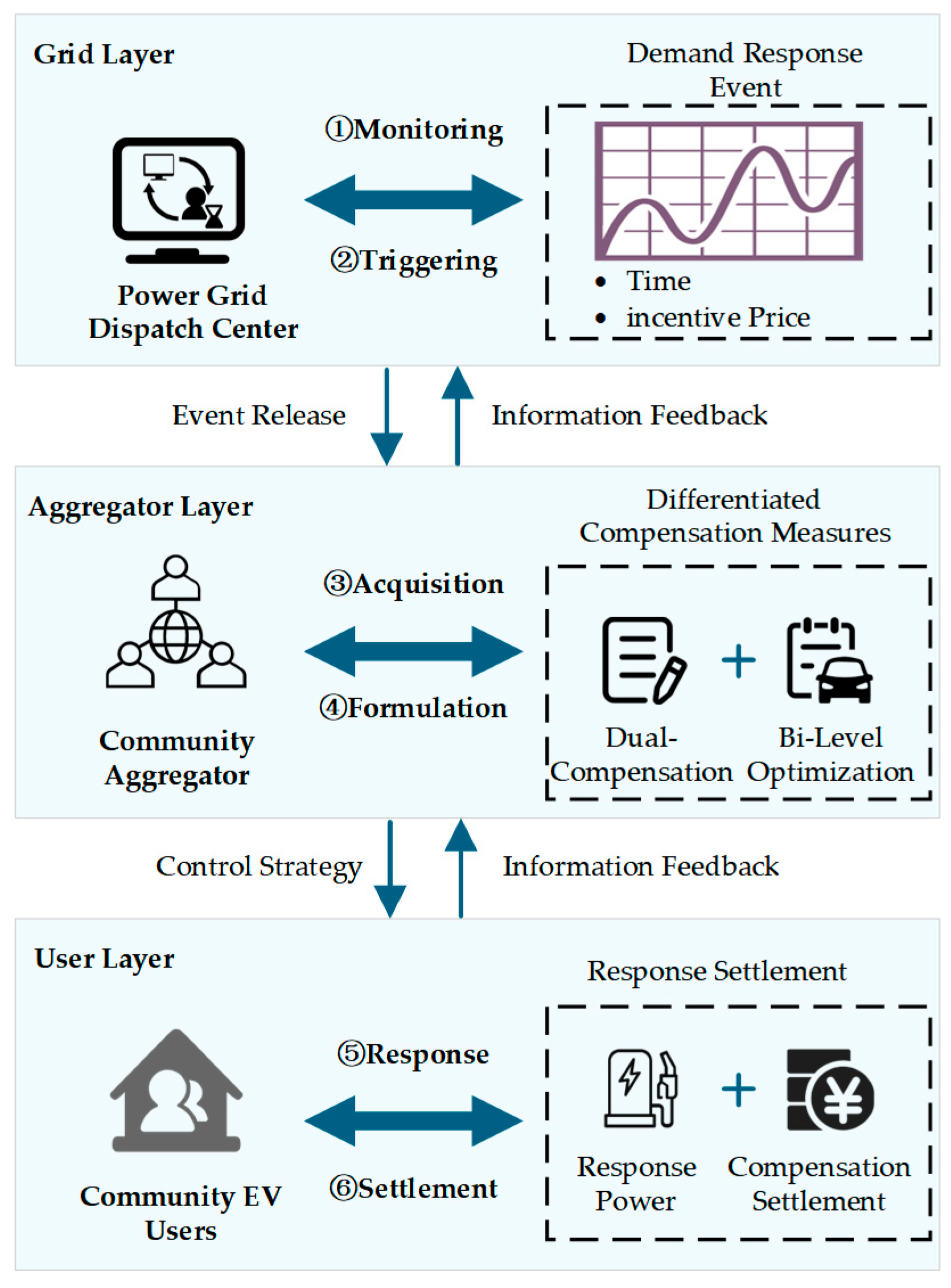
To address real-time load-control requirements in UBO communities, a RTDR mechanism based on dual-dimensional compensation and bi-level optimization is presented. The mechanism is structured around tripartite coordination among the grid, the aggregator, and community users. Specifically, when the grid issues an emergency peak-shaving instruction, the community aggregator regulates the charging power of EVs in real time. This adjustment is based on pre-signed user compensation agreements and the current charging states of the vehicles. By incorporating key constraints, such as user compensation requirements and aggregator profitability, along with other operational limitations, the mechanism achieves community-level peak shaving. It thereby enables refined management and real-time regulation of community loads. The overall framework is shown in Figure 1.
In UBO communities, the EVA is responsible for the centralized construction and operation of charging infrastructure. Residents can sign a DR participation agreement with the EVA. This agreement specifies compensation terms and authorizes the EVA to remotely regulate their charging power during real-time response events. Contracted users are by default included in the adjustable resource pool, while non-contracted users are excluded from active regulation.
In typical RTDR scenarios, the EVA adjusts the charging power of contracted users within the scope of contractual authorizations to meet the grid’s peak-shaving target. The EVA obtains revenue by providing DR services to the distribution network and distributes economic incentives to users according to the agreement.
The specific steps of the proposed mechanism are as follows:
(1)
Monitoring: The power grid monitors the system load in real-time, identifies risks such as peak overload or power supply shortage, and establishes the trigger conditions for DR.
(2)
Triggering: The power grid issues real-time demand response instructions to the community EVA, specifying the target load reduction P t , response duration T d , and incentive price I s
(3)
Acquisition: Upon receiving the instructions, the EVA collects real-time data from the currently connected contracted users. This data includes user constraints (e.g., vehicle pick-up time, expected and minimum SoC), current charging status, and individual compensation curves.
(4)
Formulation: A bi-level optimization model is constructed based on the collected information. The optimal dispatch strategy is then generated by solving the model using the IGA (see Section 3.3):
(5)
Response: The EVA delivers the optimized regulation strategy to charging facilities, which execute the adjustment commands.
(6)
Settlement: After the response period, the EVA settles compensation fees with users who actively responded in accordance with the compensation standards in the agreement.
The proposed mechanism enables rapid dispatch of community charging loads during emergency peak-shaving events. By treating all contracted users as uniformly dispatchable resources, it mitigates resource attrition and enhances community-level response reliability. The closed-loop framework consists of three stages:
i.  
capacity reservation before the event through contractual commitments,
ii. 
real-time regulation during the event,
iii.
performance-based compensation after the event.
This design improves the precision of community energy management and provides a practical pathway for coordinated grid-side control.

3. The Bi-Level Optimization Model

3.1. User Response Model

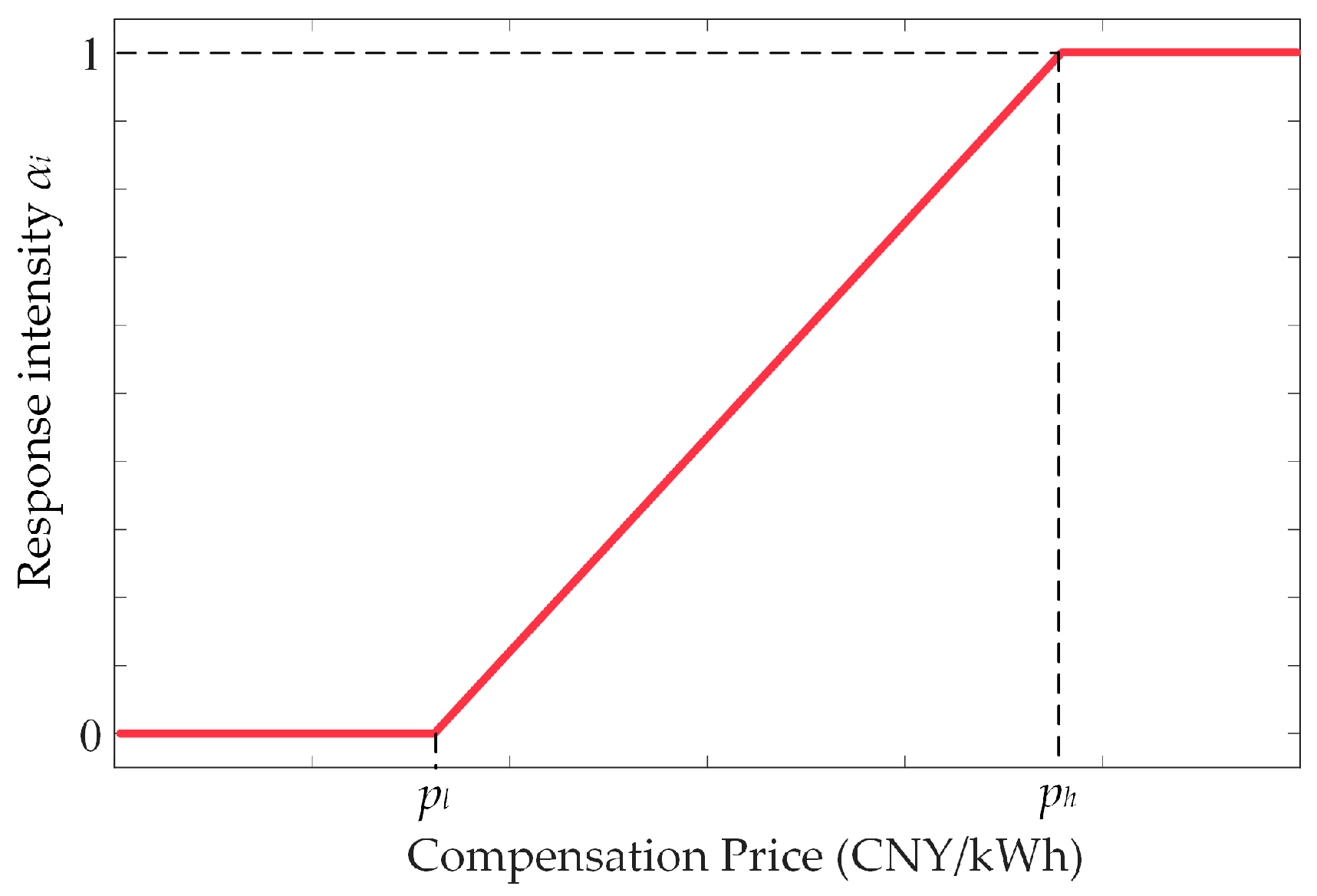
To quantifying the compensation costs of user participation in DR, heterogeneous response willingness is incorporated. Based on consumer psychology models, user response to compensation prices is represented as a piecewise linear function [24], as illustrated in Figure 2.
Where the response intensity α i (ranging from 0 to 1) is defined as the ratio of the power reduction in user i to the rated charging power of the charging pile.
When the compensation price p i is below the dead-zone threshold p l , the incentive is insufficient to offset the user’s perceived cost, and the user does not participate in the DR. Once p i exceeds p l , the user begins to release their regulation potential, with the response intensity increasing linearly as the compensation price rises. When p i reaches the saturation threshold p h , the user’s response intensity attains its maximum and no longer increases. Its mathematical expression is given as follows:
α i ( p i ) = 0                                                             p i < p l   p i p l p h p l                   p l p i < p h     1                                               p i > p h  
Different types of users exhibit heterogeneous sensitivities to compensation prices. In the model, this heterogeneity is captured by variations in the corresponding parameters p l and p h . By adjusting these parameters, the model characterizes the behavioral traits of different user types.
Based on the above analysis, let p i ( α i ) denote the unit compensation price function for user i at a given response intensity α i . Then, the power compensation function C i , p ( α i ) for can be expressed as:
C i , p ( α i ) = p i ( α i ) · α i · P i , b · T d
where P i , b is the rated charging power of user i; T d is response duration. This function represents the economic compensation that user i receives for active power regulation.
When user i participates in the RTDR that results in the final SoC of the battery being lower than the target SoC, their SoC loss needs to be compensated. The SoC loss compensation function C i , s o c ( δ i ) of user i is denoted as:
C i , s o c ( δ i ) = f i ( δ i ) · δ i · E i
S i , f = S i , c + ( 1 α i ) · P i , b · T d + P i , b · T i , r E i
S i , b = S i , c + P i , b · ( T d + T i , r ) E i
δ i = m a x ( 0 , S i , b S i , f )
where δ i denotes the SoC gap of user i between the response and non-response scenarios; f i ( δ i ) represents the unit compensation price corresponding to the SoC gap δ i ; E i is the battery capacity; S i , f is the final SoC of user i after participating in regulation; S i , c is the initial SoC of user i; T i , r denotes the remaining charging time, defined as the interval between the end of the response and the user’s vehicle pickup; S i , b is the final SoC of user i without response (normal charging).
Although the power compensation function and the SoC loss compensation function are modeled independently, the magnitude of the SoC loss is essentially determined by the users’ response intensity α i , as shown in (4). Therefore, the SoC loss compensation function also exhibits piecewise characteristics.
f i ( δ i ( α i ) ) = B · p i ( α i )
where δ is a function of response intensity α , and B denotes the SoC loss compensation coefficient, which is used to balance the relative importance in the total compensation. The larger the value of B, the higher the compensation amount for SoC loss.
The total compensation cost C i , t for user i is the sum of the power regulation compensation and the SoC loss compensation:
C i , t ( α i , δ i ) = C i , p ( α i ) + C i , s o c ( δ i )
This function reflects the essence of the dual-dimensional compensation mechanism. Power regulation compensation addresses the immediate energy loss caused by reduced charging power. In contrast, SoC loss compensation accounts for the reduced driving range that results from the final SoC falling below the target level after the response. An appropriately designed compensation mechanism safeguards user utility and encourages active DR participation. This approach ultimately achieves a win-win outcome for both society and individuals.

3.2. Optimization Model

To balance feasibility and economic efficiency in DR, this paper proposes a bi-level optimization model. The upper-level model ensures that the grid’s response target and cost constraints are satisfied. The lower-level model then minimizes costs within the feasible solution space identified by the upper level.

3.2.1. Upper-Level Optimization Model

The primary objective is to verify whether the user cluster can meet the grid’s target response power P t , under a total cost constraint. A fixed portion of the grid’s subsidy is reserved as the aggregator’s profit to guarantee a minimum margin. The remaining funds form the budget cap for user compensation, covering both power regulation and SoC loss. For modeling simplicity, a subsidy coefficient β (ranging from 0 to 1) is introduced. It represents the proportion of the grid subsidy that can be directly allocated to users. This coefficient is determined jointly by the grid’s subsidy level and the aggregator’s profit margin constraint.
  • Objective Function
The objective is to determine if the target response capacity can be achieved without exceeding the subsidy cap during the response period.
  P m a x = m a x i = 1 N c α i · P i , b P t
where N c denotes the number of contracted users, and P m a x denotes the maximum adjustable power of contracted users.
2.
Constraints
(1)
Total Cost Cap Constraint
The total compensation cost for all contracted users must not exceed the subsidy cap:
s.t. i = 1 N c ( C i , p ( α i ) + C i , s o c ( δ i ) ) β · I s · T d · P t
  • (2)
    Non-Negativity Constraint of Aggregator’s Marginal Revenue
To ensure the economic sustainability of the EVA, the unit incentive price I s from the grid must not be lower than the marginal cost M C i of procuring a unit of response energy from each user.
0 < M C i < I s
where I s is the unit incentive price provided by the grid to the EVA, and M C i is the marginal cost incurred by the EVA to incentivize user i to provide unit response energy. The additional compensation required when the user reduces load by an additional kilowatt-hour. The condition M C i > 0 indicates that as the incentive level increases, the marginal cost to the aggregator also rises.
To accurately determine the maximum response intensity for each user under this constraint, a bisection search algorithm is employed. In each iteration, the marginal cost is calculated using an adaptive finite difference method, with the specific formula as follows:
M C i = C i ( α i + α )     C i ( α i ) α · P i , b · T d
where α is the incremental change in response intensity. The algorithm iteratively evaluates the marginal cost at different intensities through a binary search. This process identifies the maximum feasible response level for each user while ensuring non-negative marginal revenue for the operator, thereby maximizing the overall response potential.
  • (3)
    Boundary Constraint on Response Intensity
The maximum acceptable response intensity α i , m a x for user i is derived from the SoC lower limit S i , m i n and the remaining charging duration T i , r , with the specific formula as follows:
α i , m a x = 1 ( S i , m i n S i , 0 ) · E i P i , b · T i , r P i , b T d ,
S i , min S i , b
0 α i α i , m a x
This constraint ensures that the response intensity of each user remains within the feasible range. The model assumes all users remain connected throughout the response period T d . Any user whose S i , min exceeds the normal charging level S i , b is deemed ineligible and excluded from scheduling.
If the maximum achievable response P m a x from the upper-level is greater than or equal to P t , the lower-level model is activated to minimize the total compensation cost through refined allocation. Otherwise, a mandatory curtailment strategy is implemented:
P m a n = P t P m a x
where P m a n denotes the total mandatory curtailment power.
It should be noted that mandatory curtailment is an emergency security measure, rather than a conventional scheduling method. Therefore, the power adjusted through mandatory curtailment is not included in real-time compensation costs.
Participation in mandatory curtailment imposes additional costs on users. To sustain their long-term engagement, the EVA can implement alternative incentives outside of the real-time response event. These may take the form of post-event benefits, such as service discounts, reward points, or bill deductions. These measures enhance users’ willingness to participate in active regulation and reduce the probability of mandatory curtailment.

3.2.2. Lower-Level Optimization Model

  • Objective Function
The lower-level model minimizes the EVA’s total compensation cost by optimizing the power regulation and SoC loss compensation for each user. The optimization objective is formulated as:
min i = 1 N c ( C i , p ( α i ) + C i , s o c ( δ i ) )
2.
Constraints
(1)
Total Regulation Power Requirement
The EVA response power must satisfy the grid’s demand:
i = 1 N c α i · P i , b P t
  • (2)
    SoC Lower-Bound Constraint
The final SoC of user i after response must not fall below the predefined SoC lower limit S i , m i n to ensure normal usage:
S i , m i n S i , f
The model also incorporates the total cost cap, non-negative marginal revenue, and response intensity boundary constraints from the upper-level model. These combined constraints define the problem’s boundaries for the subsequent solution process.

3.3. Solution of Optimization Model

The objective function of the optimization model is non-smooth. Due to its non-differentiable nature, traditional gradient-based optimization methods are prone to being trapped in local optima. Additionally, these methods are unsuitable for meeting real-time solution requirements in large-scale community-level EV integration scenarios. To address this, this paper adopts the IGA for hierarchical optimization.
Compared with the standard genetic algorithm (GA), the IGA uses parallel population search and randomized operators to enhance solution diversity and global search capability. This reduces the risk of premature convergence to local optima and enables the algorithm to converge to feasible solutions within a limited time frame, making it well-suited for this non-smooth, constrained optimization problem.
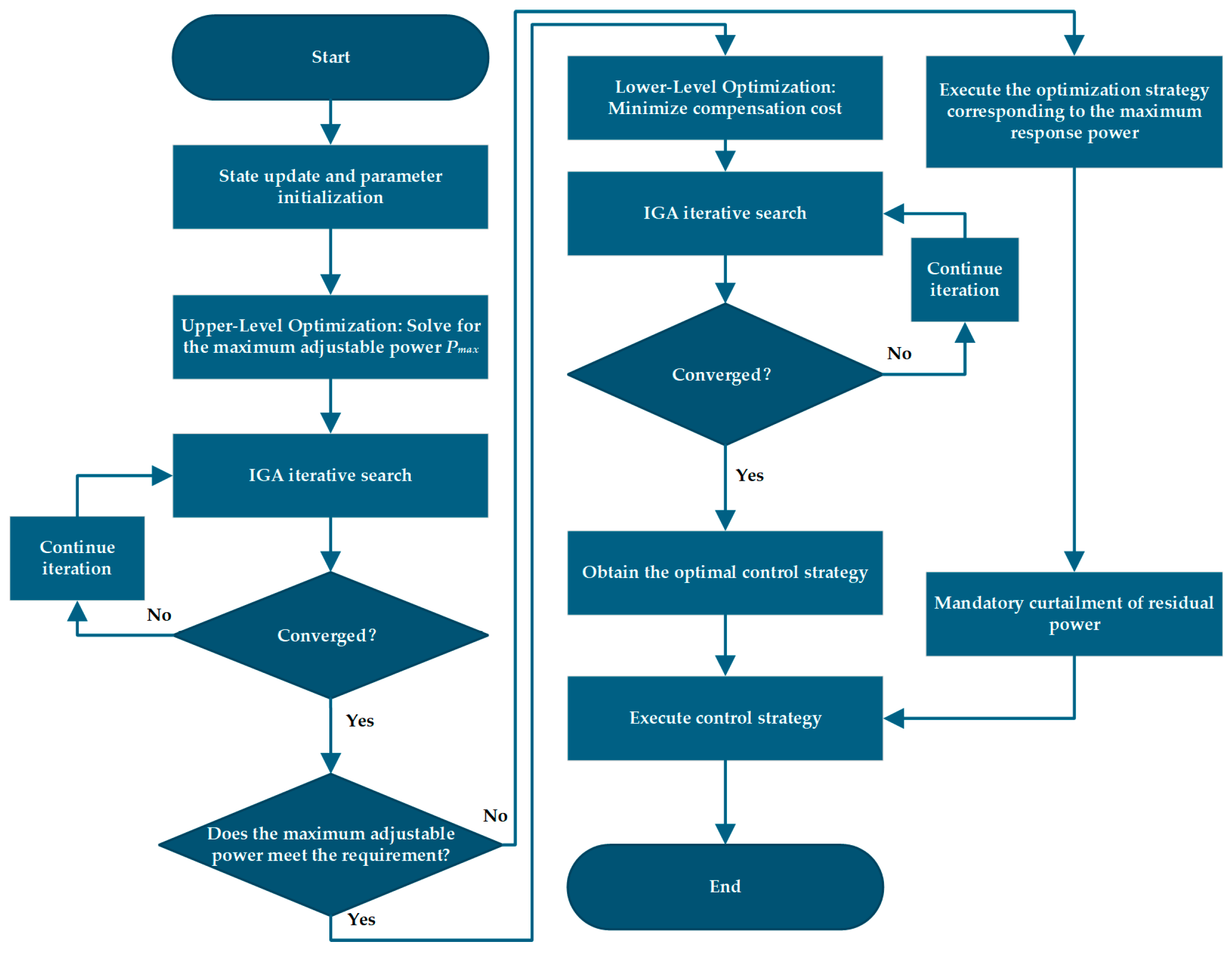
The solving process of the optimization model is illustrated in Figure 3.
Step 1: State Update and Parameter Initialization
When a DR event is triggered, the EVA collects the state information of all connected EVs, including initial SoC, battery capacity, and so on. Meanwhile, it imports parameters issued by the grid, such as target load reduction power, response duration, and unit incentive price.
Step 2: Upper-Level Optimization—Maximizing Response Power
This level takes the response intensity of contracted users as decision variables. It aims to maximize the active response power of contracted users, subject to constraints including total compensation budget, users’ maximum response willingness, and SoC and power boundaries. The algorithm adopts real-valued encoding, representing each user’s response intensity as a gene.
Step 3: Reachability Judgment and Branch Execution
The maximum adjustable power P m a x obtained from the upper-level optimization is compared with the grid target P t . This comparison determines the execution path: if P m a x P t , the lower-level optimization is triggered to seek a cost-optimal allocation; Otherwise, the current maximum power strategy is executed directly, and any remaining power gap is compensated through mandatory curtailment proportional to each user’s baseline power. This forced portion is excluded from compensation costs.
Step 4: Lower-level Optimization—Minimizing Compensation Cost
This layer operates on the condition that the power target is achievable. Its goal is to minimize the total compensation cost while strictly satisfying the power equality constraint. The algorithm enhances the upper-layer framework by strengthening the elite preservation strategy. Furthermore, it uses the total cost directly as the fitness value, which guides the population to converge quickly to low-cost regions. This process enables a refined search for differentiated control strategies.
Step 5: Strategy Output
The final optimized strategy is converted into executable control commands and dispatched to charging piles. The system achieves the required power reduction during the response window and schedules post-event recharging for EVs based on their remaining dwell time.
By applying the IGA hierarchically, this framework achieves the dual objectives of power maximization and cost minimization in sequential stages. It not only ensures global search capability but also, through mechanisms such as feasibility-first judgment and elite preservation, guarantees convergence efficiency and solution quality within limited time.
The parameters of the IGA are set as follows: the initial population size is 120, and the crossover probability (Pc) and mutation probability (Pm) are dynamically adjusted based on the adaptive algorithm proposed by M. Srinivasa et al., with Pc ranging from 0.80 to 0.95 and Pm ranging from 0.05 to 0.15 [25].

4. Case Study

4.1. Case Setup

4.1.1. Fundamental Assumptions

This study focuses on the UBO communities, exploring how to maximize users’ regulatory potential and reduce overall control costs based on their differentiated response willingness. To validate the core mechanism effectively, the simulation is based on the following simplified assumptions:
(1)
Simplified User Behavior: Key user behavior parameters are assumed to be either fixed or drawn from a predefined identical distribution.
(2)
Simplified Model Parameters: Key simulation parameters, such as the compensation curve, are assumed to be fixed and known during a single simulation run.
(3)
Idealized Control Process: The charging equipment providing services for EVs is assumed to have continuously adjustable output power, and communication delays are neglected during the control process.
(4)
Simplified Infrastructure Constraints: Practical factors such as heterogeneous charger types, the number of connections per station, charging limitations in high-rise or underground garages, and potential V2G/V2V capabilities are not explicitly modeled, as the simulation focuses on validating the core mechanism.

4.1.2. Simulation Scenario Configuration

To validate the effectiveness of the proposed bi-level optimization control strategy, a community EV charging case is constructed for simulation analysis. It is assumed that a total of 70 EVs are connected to the aggregator’s management system, among which users 1–50 are contracted users who actively participate in DR under the power regulation and SoC loss compensation agreement, while users 51–70 are non-contracted users who are only subjected to mandatory curtailment under grid stress without active participation.
For simplicity, all EVs are assumed to have identical parameters: a battery capacity of 70 kWh, a rated charging power of 7 kW, and a charging efficiency of 0.92 [26]. To reflect community travel patterns, the EV departure time is fixed at 07:00, while the evening return time follows a normal distribution with a mean of 19:00 and a standard deviation of 1.5 h [27]. The initial SoC is also modeled as a normal distribution with a mean of 0.40 and a standard deviation of 0.10, whereas the target SoC at departure is uniformly set to 0.95 [28]. The detailed parameters are provided in Table A1 in Appendix A.
To characterize the “midnight peak” phenomenon, it is assumed that all users begin charging uniformly at the start of the off-peak period (00:00). Accordingly, the real-time demand response peak-shaving window is defined as [00:00, 03:00]. In accordance with the Tianjin Demand Response Implementation Guidelines, the grid provides the aggregator with a real-time demand response subsidy of 5 CNY/kWh. Considering the construction and operational costs of EVA charging facilities, the subsidy coefficient β is set to 0.8, which ensures that while user incentives are guaranteed, a reasonable profit margin is retained for the EVA.
To capture heterogeneity in user sensitivity to compensation prices while maintaining computational tractability, based on the user response model parameters in Section 3.1, the 50 contracted users are divided into three categories: flexible, neutral, and rigid, in proportions of 40%, 40%, and 20%, respectively [23]. The parameter settings are summarized in Table 1. The curve parameters are reasonably assumed based on consumer behavior principles. In practical applications, where user preferences exhibit uncertainty, further calibration and optimization can be performed using user surveys or historical response data. Additionally, the Monte Carlo method is employed to generate differentiated compensation curves of various types for the 50 users.

4.1.3. Comparative Mechanism Design

To evaluate the optimization performance of the proposed mechanism, two representative control mechanisms are designed as benchmarks for comparative analysis.
  • Mechanism 1 (M1): When the system capacity exceeds limits, the EVA implements a uniform proportional reduction for all users, including both contracted and non-contracted.
  • Mechanism 2 (M2): Contracted users respond actively, and the EVA implements differentiated control according to the signed power regulation and compensation agreement, ensuring the target SoC of users remains unchanged. Any shortfall in active response is compensated via mandatory curtailment.
  • Mechanism 3 (M3-Proposed Mechanism): Contracted users respond actively, and the EVA implements differentiated control according to the signed power regulation and SoC loss compensation agreement. Any shortfall in active response is also compensated via mandatory curtailment.

4.1.4. Evaluation Metrics

To comprehensively evaluate the effectiveness of the real-time demand response strategy, a set of multi-dimensional evaluation metrics is developed, as shown in Table 2. These metrics enable quantitative comparison of the strategy under different scenarios. For consistency, all monetary values are reported in CNY, using the 2024 average exchange rate of 1 USD = 7.1217 CNY, as reported by the National Bureau of Statistics of China.

4.2. Analysis of the RTDR Strategy

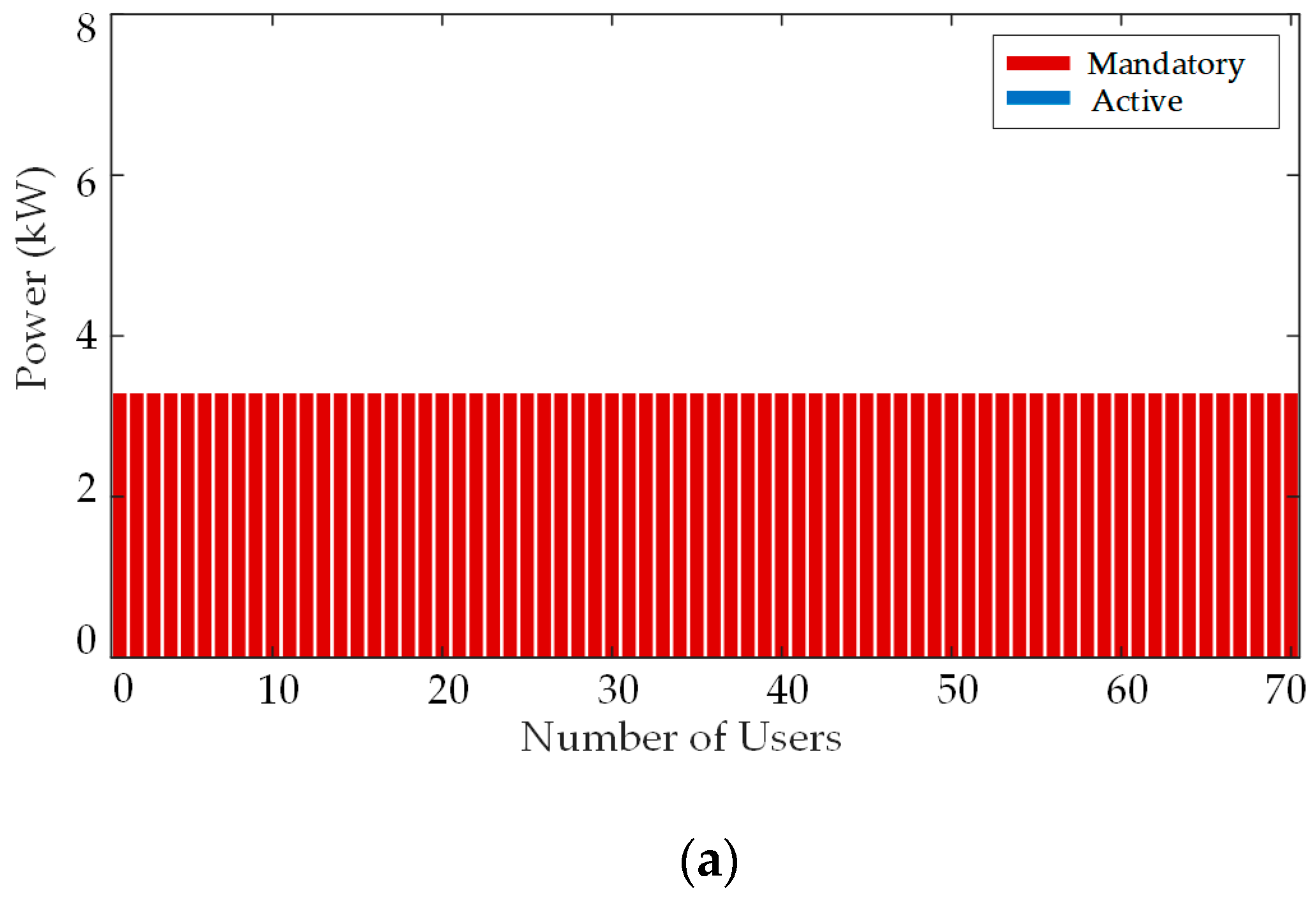
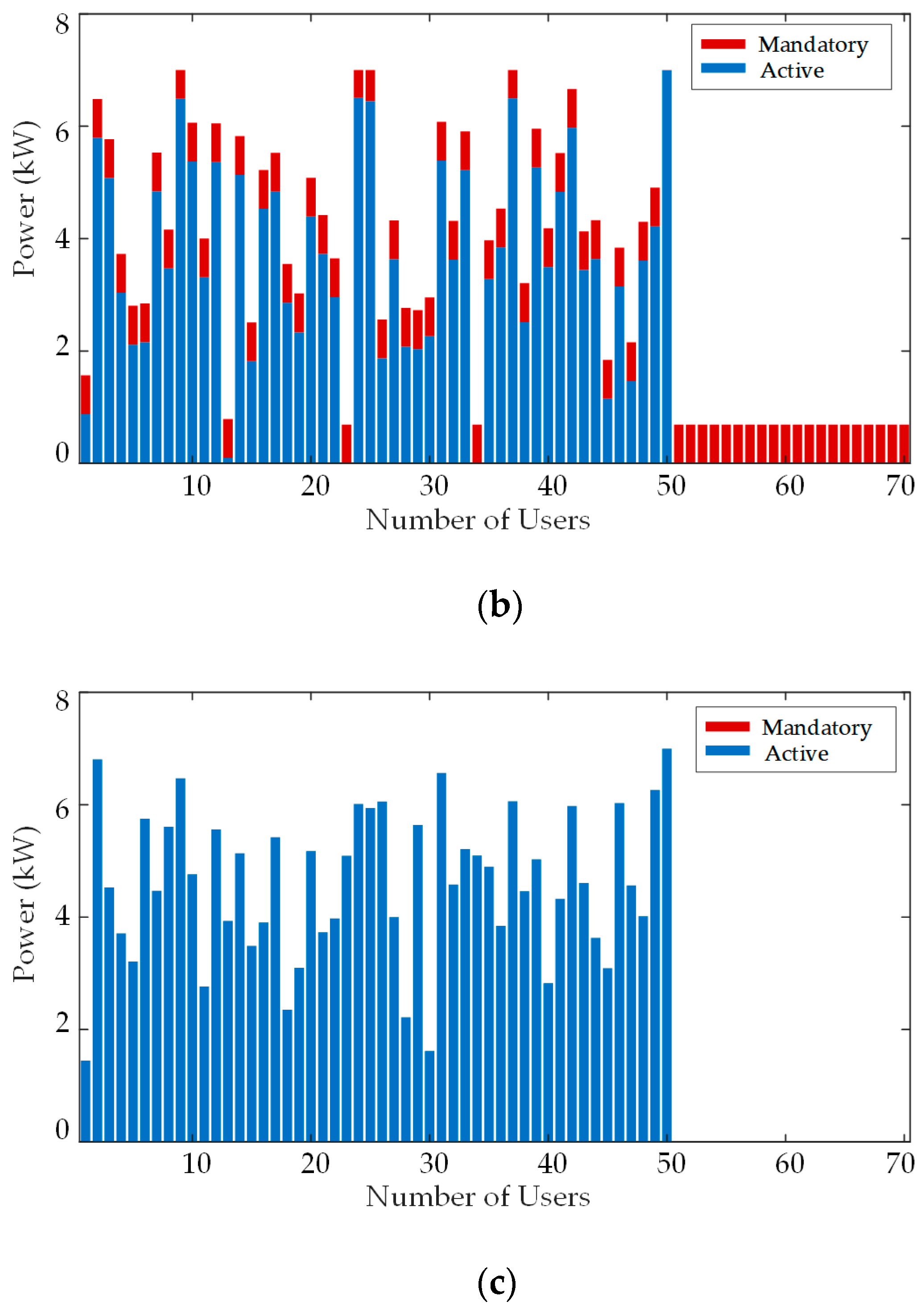
Based on the simulation scenario described in Section 4.1, this section presents a comparative analysis of the execution logic and performance of three control mechanisms. In Mechanism 1, the aggregator applies a uniform proportional power reduction to all users to mitigate load spikes. In Mechanism 2, the aggregator implements differentiated control according to users’ signed power regulation and compensation agreements, ensuring that each user’s target SoC is maintained; any shortfall in active response is compensated through a uniform proportional reduction across all users. Mechanism 3 adopts a dual-dimensional compensation strategy, involving both power regulation and SoC loss compensation. The aggregator applies differentiated control based on the compensation agreements to offset SoC losses, and any remaining shortfall in load reduction is further addressed through a uniform proportional reduction. The active response and mandatory curtailment powers of users under the three mechanisms are illustrated in Figure 4, and the corresponding evaluation metrics are summarized in Table 3.
As shown in Figure 4, the blue and red bars illustrate the active response and mandatory curtailment under different control mechanisms, respectively. The results indicate that Mechanism 1 relies entirely on mandatory curtailment, with 0 kW of active response power. Mechanism 2 achieves 183.02 kW of active response while ensuring users’ target SoC, but still requires 70.44 kW of mandatory curtailment to fill the gap. Mechanism 3, by contrast, achieves the target reduction entirely through active response. Mechanism 1 does not incorporate user incentives, leaving no motivation for voluntary participation. Mechanism 2 introduces power regulation compensation but, due to rigid SoC constraints, part of the user potential remains untapped, thus requiring mandatory curtailment. Mechanism 3 adds SoC loss compensation to power regulation compensation, fully covering users’ implicit costs and thereby effectively mobilizing their willingness to respond.
Table 3 further quantifies the differences among the three mechanisms in terms of regulation effectiveness and economic benefits. Mechanism 1, lacking a market-based compensation strategy, relies solely on uniform proportional load reduction to achieve peak shaving. Although this approach meets the peak reduction targets, it depends entirely on administrative enforcement, resulting in low user acceptance and no DR subsidy revenue for the aggregator, lacking market-driven incentives. Mechanism 2 achieves a relatively high level of active response while ensuring users’ expected SoC, with active response accounting for 79.6% of the total, total user benefits of 1380.2 CNY, and aggregator benefits of 1365.2 CNY. Mechanism 3, built on Mechanism 2, introduces SoC loss compensation, further stimulating user regulation potential. The maximum adjustable power P m a x increases by approximately 30% compared to Mechanism 2, with active response reaching 100%. At the same time, total user benefits rise to 1927.0 CNY and aggregator benefits to 1523.0 CNY, representing improvements of approximately 40% and 12% over Mechanism 2, respectively. By providing sufficient economic incentives, Mechanism 3 achieves the highest user response potential, fully demonstrating enhanced flexibility and market-oriented performance.

4.3. Analysis of Influencing Factors

4.3.1. Control Potential Analysis

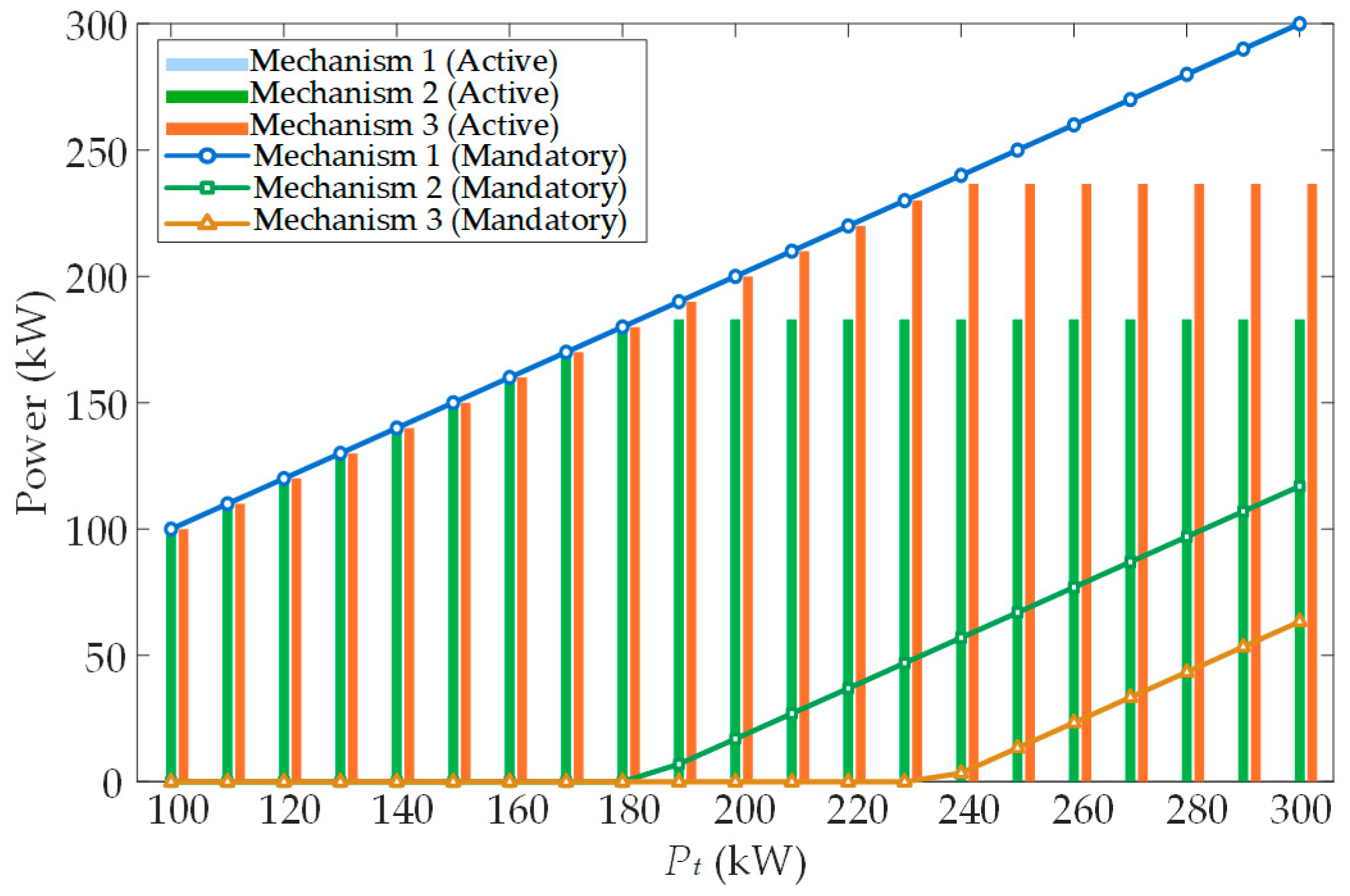
To evaluate the adaptability and scalability of different mechanisms to dynamic peak-shaving requirements, the target power Pt of the grid is gradually increased from 100 kW to 300 kW, covering the potential peak shaving demand under future EV penetration in the community. The distributions of active response and mandatory curtailment under the three mechanisms are shown in Figure 5.
The results in Figure 5 indicate that, within the 100–300 kW target reduction range, Mechanism 1 relies entirely on mandatory curtailment, with mandatory curtailment equal to the target and no active response from users. As the target power increases, deep mandatory curtailment may lead to excessively low SoC, affecting users’ next-day mobility. For Mechanism 2, when the target power is below 183.02 kW, it can be fully met by users’ active responses. However, once the target exceeds this threshold, active response becomes limited, and the excess is compensated through mandatory curtailment. At a target power of 230 kW, mandatory curtailment accounts for 20% of the total during the response period, indicating limited flexibility and market potential. In contrast, Mechanism 3, which incorporates SoC loss compensation, increases users’ maximum adjustable power to 236.60 kW, a 26% improvement over Mechanism 2. At the same target power levels, it consistently maintains a higher proportion of active response, reducing the need for mandatory curtailment, thereby mitigating user experience loss while enhancing the flexibility and reliability of grid control.

4.3.2. Benefit Analysis

(1) Aggregator Revenue Analysis
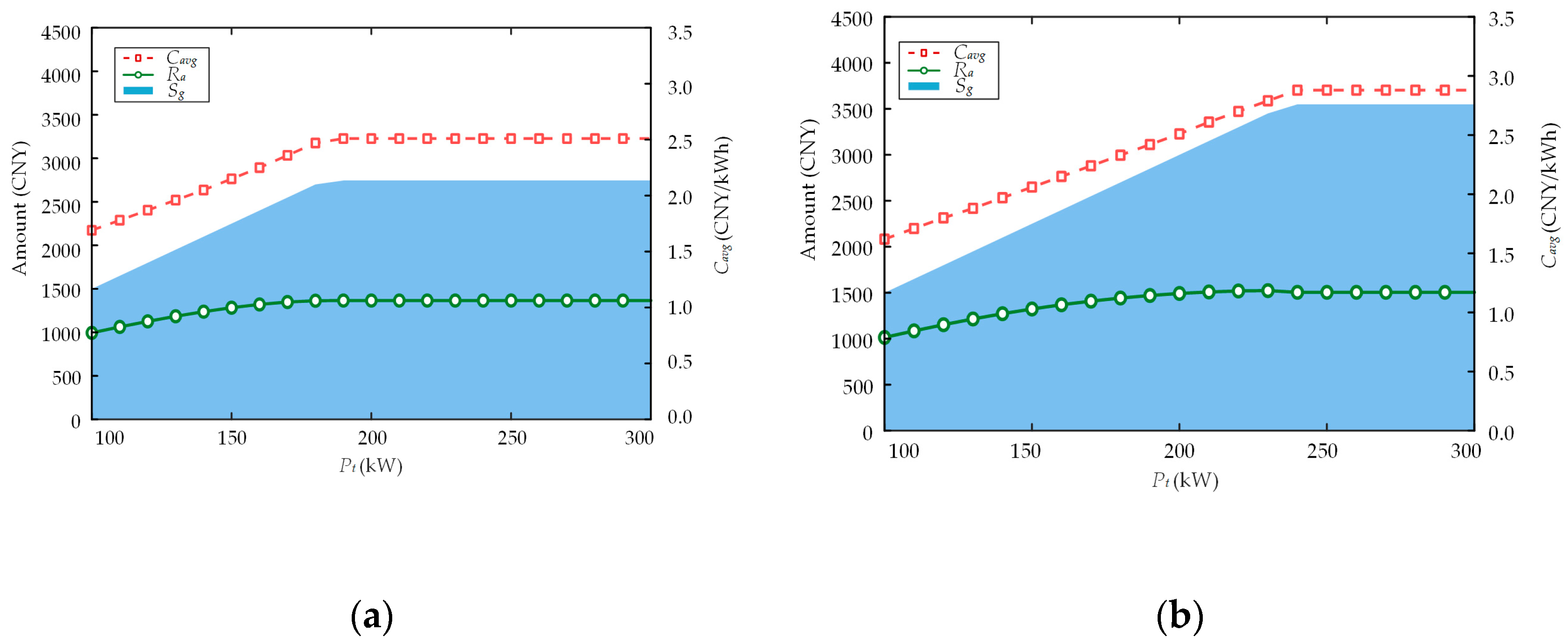
In practical operation, the target load reduction is not fixed but dynamically adjusted according to the real-time operating conditions of the power system. Based on the parameter settings in Section 4.1, this study gradually increases the target power to evaluate the adaptability and economic performance of different control mechanisms under varying levels of emergency. Figure 6 illustrates the evolution of the aggregator’s average compensation cost and revenue under the three mechanisms as the target power increases.
Mechanism 1 does not introduce a market-based compensation scheme, so its revenue remains zero. It relies solely on mandatory curtailment, lacking both flexibility and economic incentives. As shown in Figure 6, the revenue trends of Mechanisms 2 and 3 at the EVA level are similar, both gradually increasing with the target power and then plateauing once the maximum adjustable power is reached. However, because Mechanism 3 incorporates SoC loss compensation, it can stimulate greater user response potential, resulting in higher saturation points for both revenue and average compensation cost compared to Mechanism 2. As the target power continues to rise, low-cost resources are gradually exhausted, and the marginal cost of contracted users increases, eventually requiring the dispatch of high-cost users. Under the principle of non-negative marginal returns, this leads to higher unit compensation costs and a gradual transfer of net benefits toward the platform. Overall, Mechanism 3 achieves a better balance between response scale and revenue across a wider range of target powers, demonstrating stronger regulation capability and greater market adaptability than Mechanism 2.
(2) Analysis of User-Side Benefits
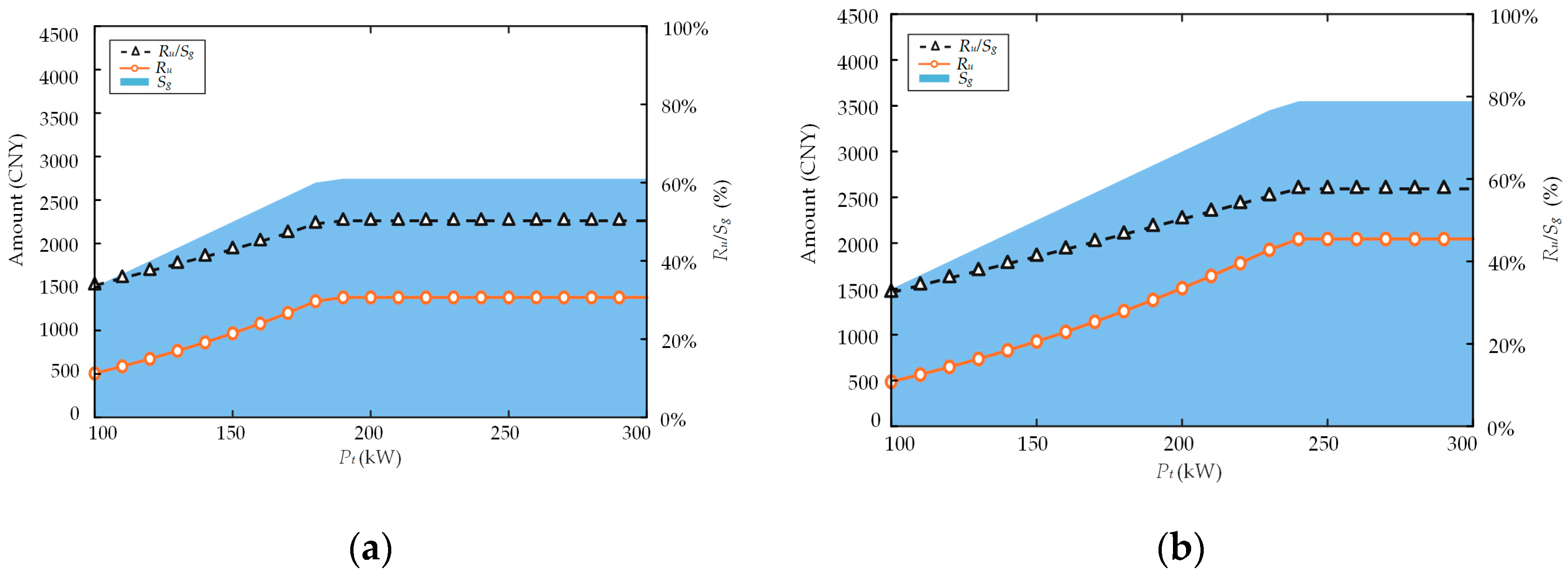
As the grid-side target power increases, the user-side revenue under different mechanisms is illustrated in Figure 7.
Similarly to the previous analysis, this subsection focuses on comparing user-side revenues under Mechanism 2 and Mechanism 3. Overall, user revenues under both mechanisms exhibit an increasing trend as the target power rises. However, Mechanism 3, by introducing SoC loss compensation, can further mobilize flexible and neutral regulation resources, thereby achieving a significantly higher revenue saturation point than Mechanism 2. In addition, compared with Mechanism 2, the maximum share of user revenues under Mechanism 3 can increase by nearly 10%, indicating that the benefits from reduced grid-side investment costs are more effectively transmitted to users. More importantly, this revenue allocation pattern enhances user incentives to participate in demand response and improves the sustainability and market orientation of the overall regulation process.
To facilitate a more direct comparison of user dispatch under a unified target power, this section selects 180 kW as the fixed target power for analyzing user-side benefits. This power level lies within the full active response range of Mechanism 2 and the active response coverage of Mechanism 3, thereby completely excluding the influence of mandatory curtailment on user benefits and focusing on differences in benefit allocation under the active response scenario.
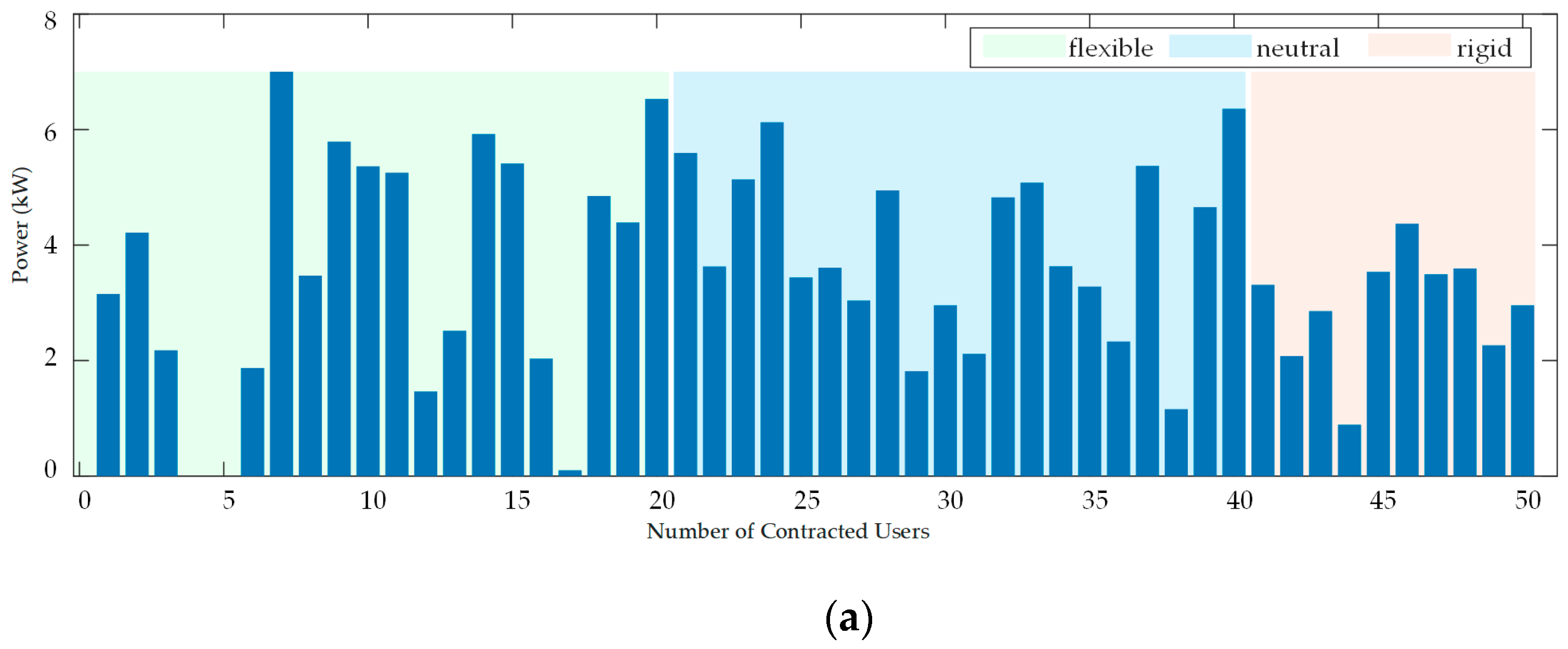
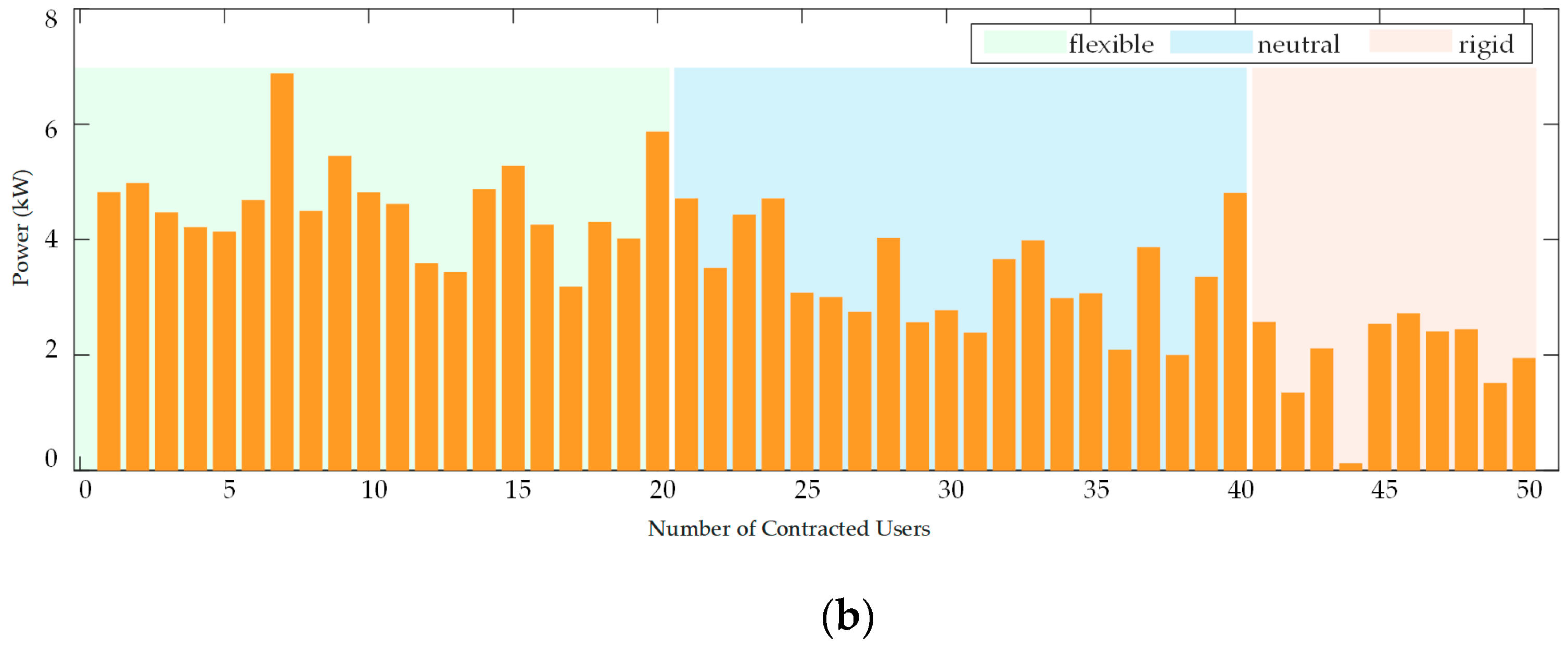
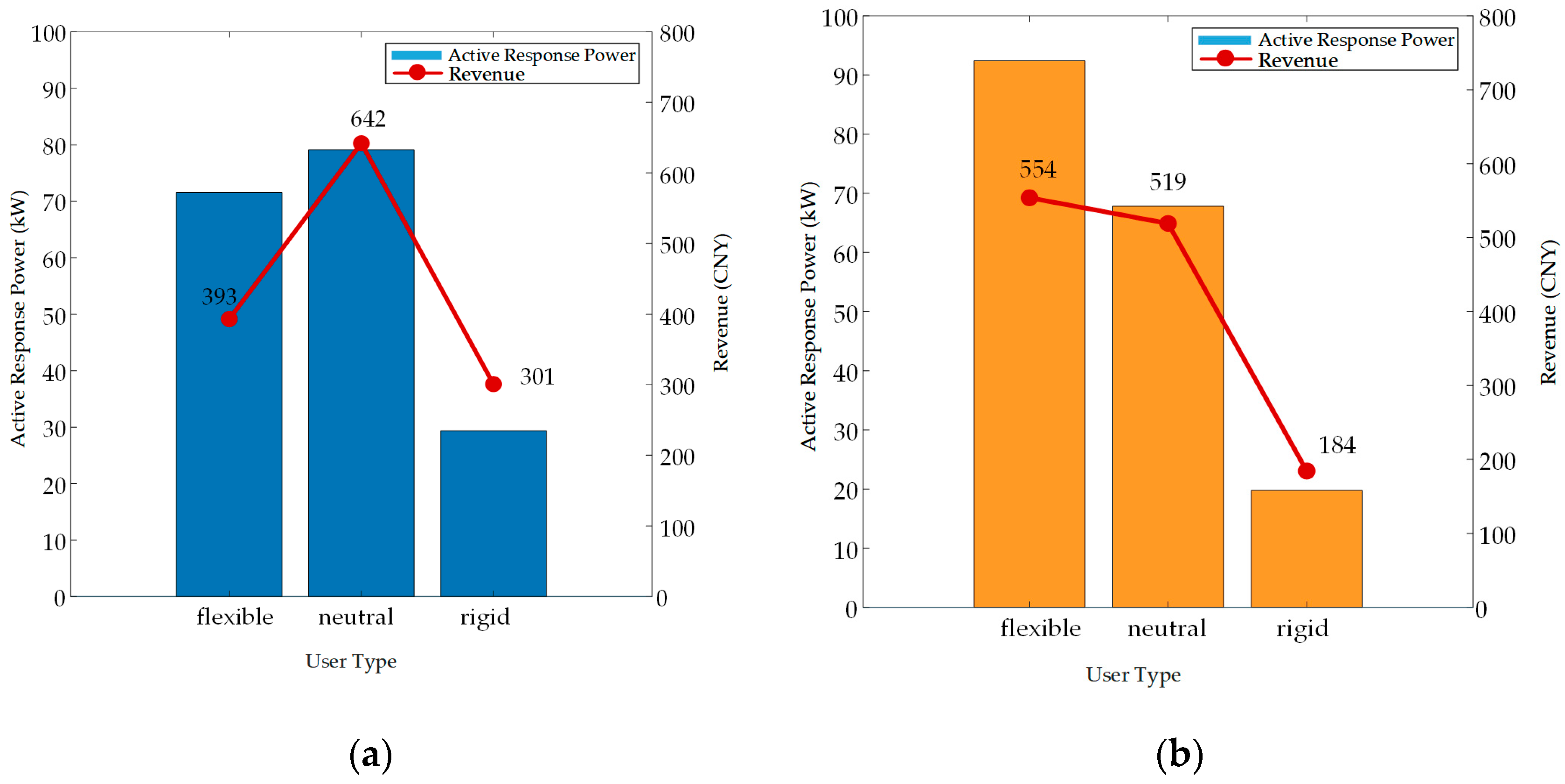
The total benefits of flexible, neutral, and rigid contracted user groups are compared to reveal differences in user benefit distribution across the three mechanisms, and to further assess their effectiveness in prioritizing low-cost users and compensating high-cost users. Figure 8 illustrates the response behaviors of 50 contracted users under different mechanisms, while Figure 9 summarizes and compares the active response power and benefits of different user types.
From the comparison of response power distributions in Figure 8, it is evident that under Mechanism 2, contracted users show highly fluctuating responses, and most flexible users exhibit relatively low power outputs, indicating that their potential remains underutilized. In contrast, Mechanism 3 achieves a broader and more balanced distribution of response power, with the majority of contracted users reaching higher levels. Notably, the average response power of flexible users exceeds 3 kW, clearly demonstrating that the dual-dimensional compensation mechanism effectively activates their latent potential. Neutral users maintain a stable response, while rigid users contribute less than under Mechanism 2, reducing reliance on users with high response difficulty and weak economic efficiency. This leads to optimized resource allocation and broader user participation.
As shown in Figure 9, user types differ significantly in both response power and benefit distribution under the two mechanisms. In Mechanism 2, neutral users dominate, with benefit shares of 29%, 48%, and 23% for flexible, neutral, and rigid users, respectively. This indicates that the mechanism primarily depends on neutral users. In contrast, Mechanism 3, by incorporating SoC loss compensation, substantially enhances the responsiveness of flexible users, making them the largest contributors. Their benefit shares shift to 44%, 41%, and 15%, respectively. These results confirm that Mechanism 3 improves the structure of user-side benefits by applying the principle of “compensation substituting for hard constraints.” This design enables the aggregator to prioritize low- and medium-cost users, significantly increase their benefit levels, and reduce reliance on high-cost users, thereby improving the overall flexibility and sustainability of demand response.

4.3.3. Analysis of SoC Loss Compensation Coefficient

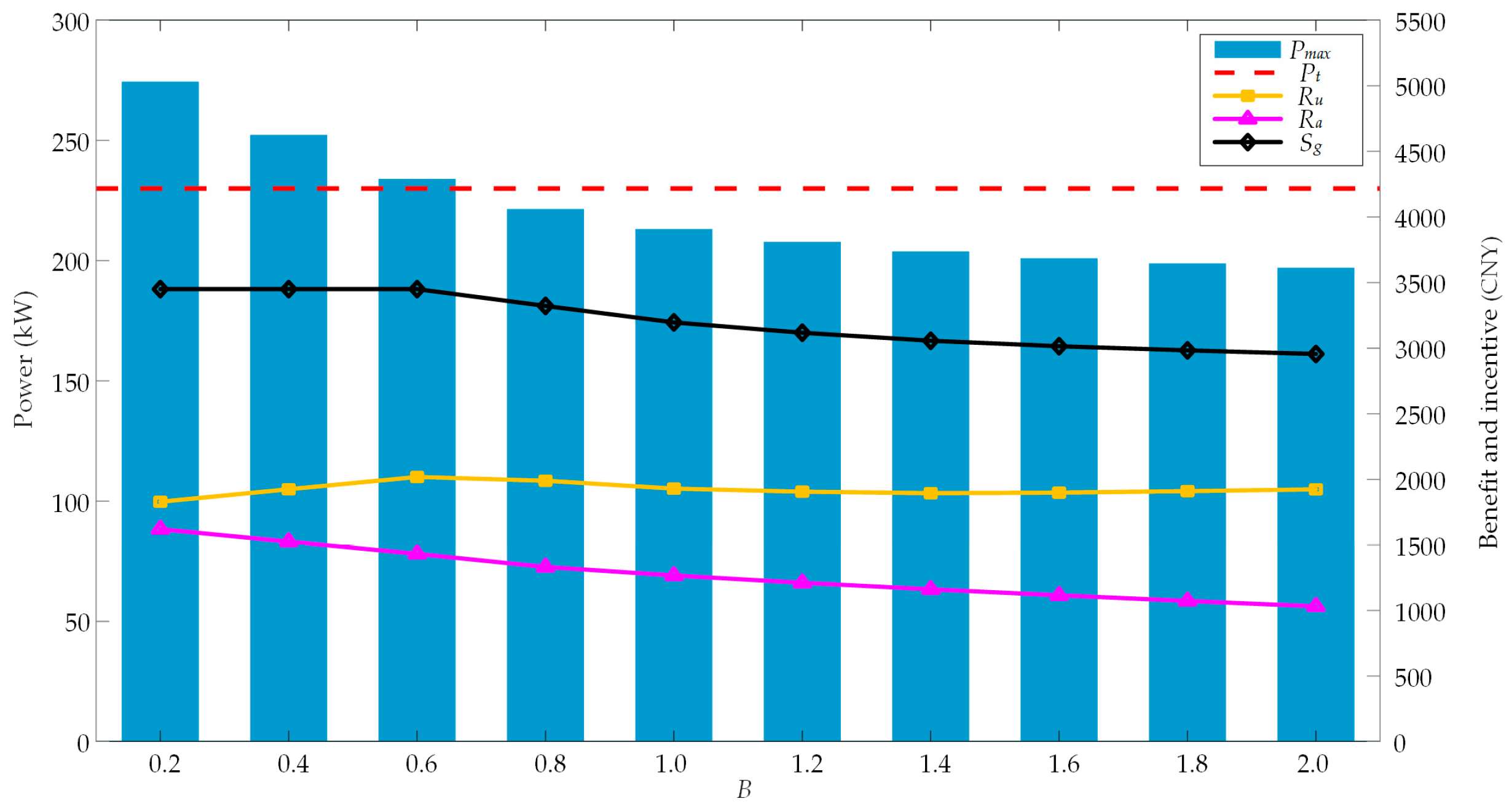
In the dual-dimensional compensation mechanism, parameter B determines the compensation strength for SoC loss (Equation (7)). To analyze the comprehensive impact of B on the regulation effectiveness and multi-party economics, a sensitivity analysis is conducted in this section. The results are shown in Figure 10.
The results indicate that parameter B significantly influences both active response power and the benefits of multiple stakeholders. When B ≤ 0.6, the maximum adjustable power Pmax can fully meet the target power requirement Pt. Within this interval, as B increases, the proportion of SoC loss compensation in the total compensation rises, leading to an increase in the total users’ benefit Ru under the same grid incentive intensity. However, the EVA’s net benefit Ra gradually decreases due to the higher SoC compensation costs it must bear.
When B exceeds 0.6, the proportion of SoC loss compensation within the limited incentive budget increases significantly. This narrows the system’s feasible response interval, resulting in a decrease in Pmax, which can no longer meet the grid’s target demand. Although the total grid-side incentive Sg decreases due to the reduced actual response power, the substantial reduction in the system’s dispatchable demand response resources weakens the overall peak-shaving effect.
Adjusting B effectively allows for a trade-off between power compensation and SoC compensation, thereby flexibly adjusting the EVA’s compensation cost structure. It is recommended to set B at 0.6 as an optimal compromise. Within this range, the system can maintain sufficient Pmax while keeping the benefits for both users and the EVA at relatively reasonable levels.

4.3.4. Target SoC Analysis

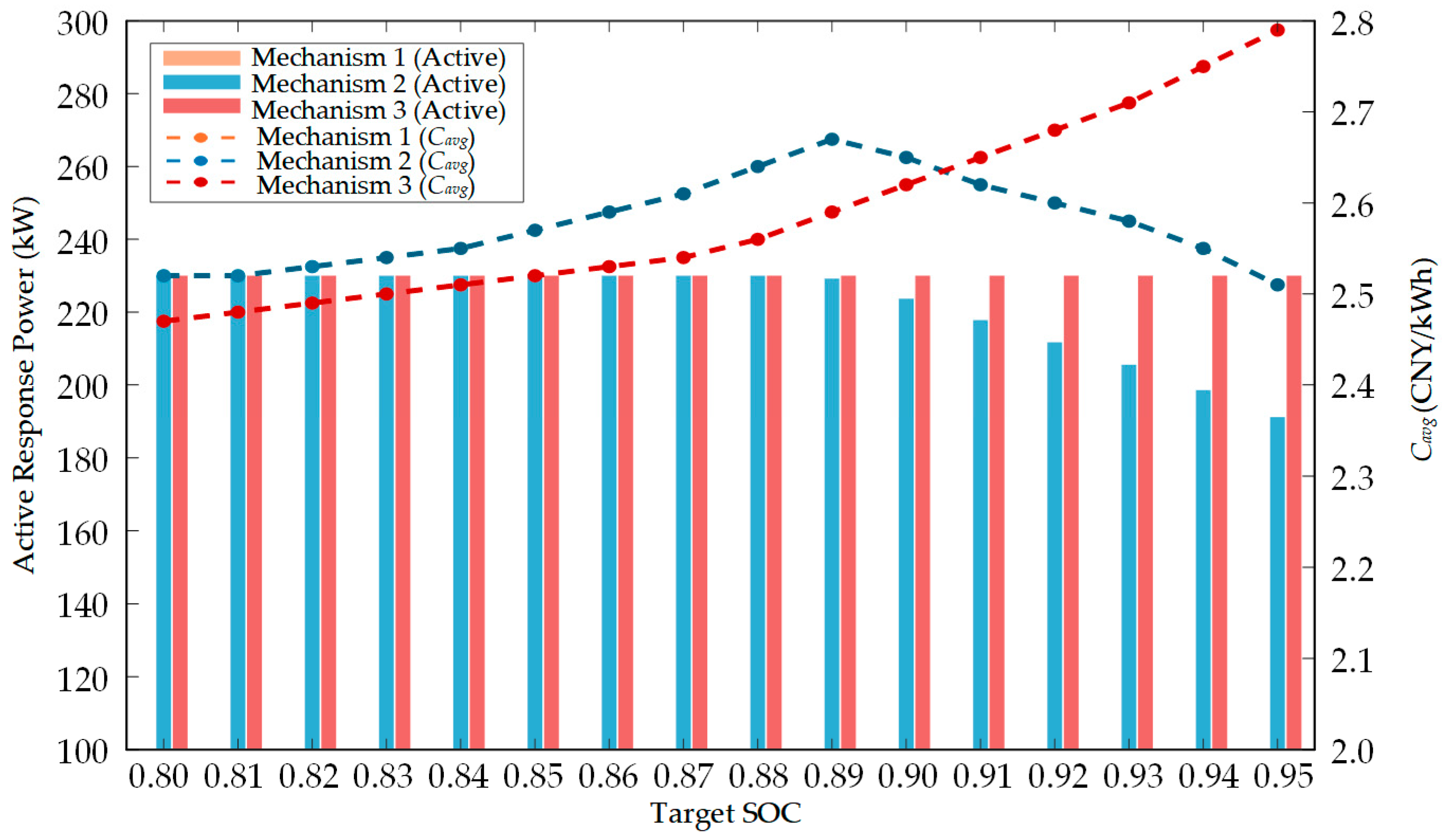
The target SoC is a key user-side constraint that determines the adjustable capacity of EVs. In general, the higher the target SoC, the greater the charging demand of the user, and the smaller the response space available for demand response; conversely, a lower target SoC corresponds to greater response potential. To evaluate the adaptability of the three mechanisms under different target SoC levels, this section fixes the target power at 230 kW and gradually increases the target SoC from 0.8 to 0.95, thereby covering typical user demand scenarios. On this basis, the sensitivity of the mechanisms is analyzed from two perspectives: active response capacity and average compensation cost.
Figure 11 compares the trends of active response capacity and average compensation cost for Mechanisms 2 and 3 under varying target SoC levels. As the target SoC increases from 0.80 to 0.95, the active response under Mechanism 2 declines continuously, reflecting the reduction in dispatchable capacity under stricter SoC constraints. By contrast, Mechanism 3, with SoC loss compensation, mobilizes more users with higher initial SoC and maintains a relatively high response level.
Regarding compensation cost, both mechanisms show rising marginal costs as the target SoC increases. Once response shortfalls occur, Mechanism 2 suffers a rapid drop in active response, leading to a decline in average compensation cost. In contrast, Mechanism 3 sustains higher response levels, causing its average compensation cost to keep increasing. Overall, by combining power regulation and SoC loss compensation, Mechanism 3 expands dispatchable capacity and enhances both demand response potential and aggregator profitability.

4.3.5. Analysis of Battery Capacity

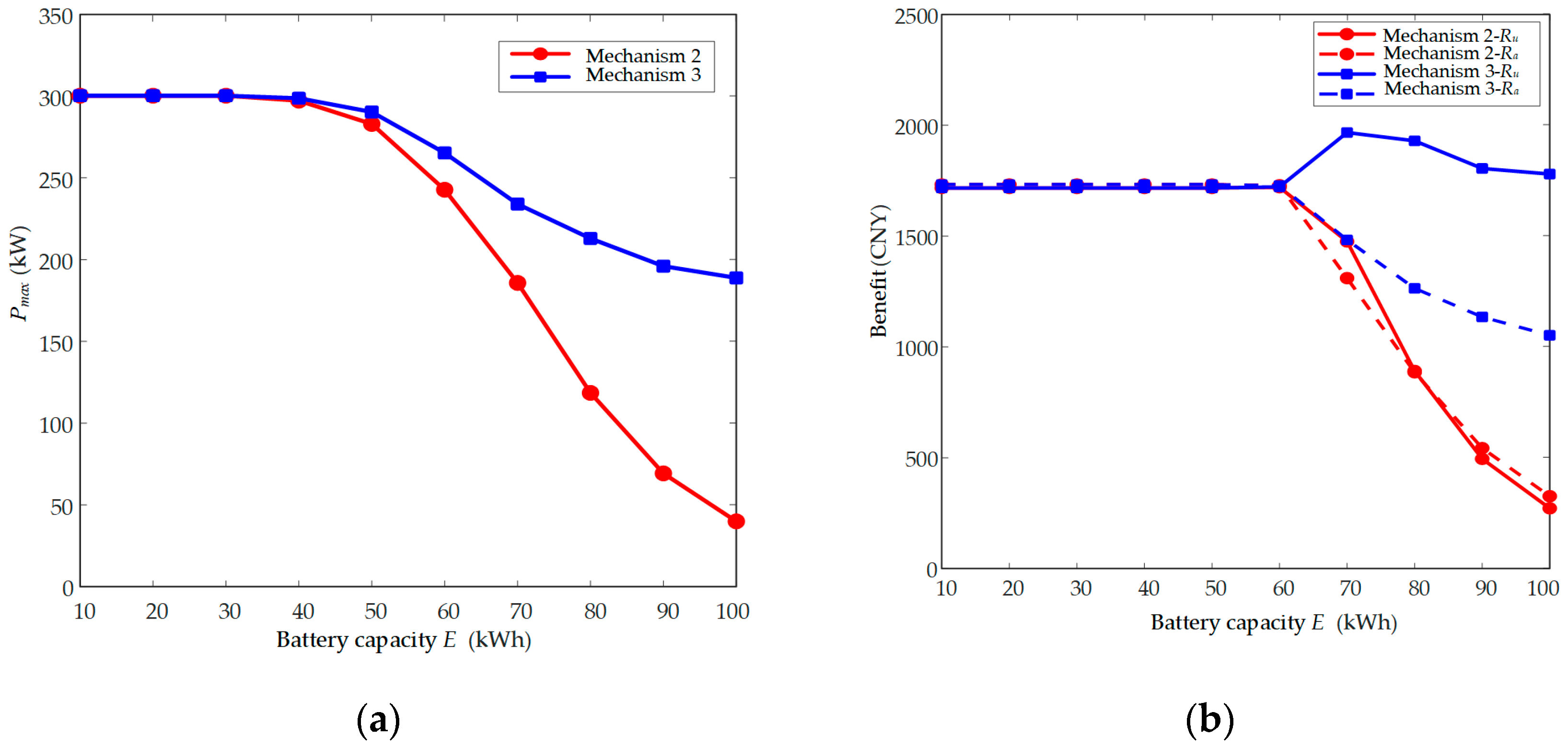
This section evaluates the impact of EV battery capacity E differences on regulation performance. The battery capacity range was set from 10 to 100 kWh to represent typical vehicle configurations. The results are shown in Figure 12.
Results demonstrate that when the battery capacity E ≤ 60 kWh, the maximum adjustable power Pmax, user benefits Ru and EVA benefits Ra remain stable under both mechanisms. However, when E > 60 kWh, the Pmax, Ru, and Ra of Mechanism 2 begin to decline sharply, while Pmax of Mechanism 3 decreases gradually but maintains a higher and more balanced benefit level.
For vehicles with large-capacity batteries, the longer charging time results in a more constrained adjustable power range within a fixed response period, mainly due to the lower SoC limit, which reduces their response intensity. For example, with a battery capacity of 80 kWh, Pmax of Mechanism 2 drops sharply from 183.02 kW to 118.50 kW, a decrease of 35.25%, while Mechanism 3 drops from 236.60 kW to 212.96 kW, a decrease of 9.99%. The above analysis confirms that, through the dual-dimensional compensation mechanism, Mechanism 3 effectively overcomes the response limitations of large-capacity batteries, providing technical feasibility for high-range electric vehicles to participate in grid peak shaving.

4.3.6. Analysis of Subsidy Coefficient

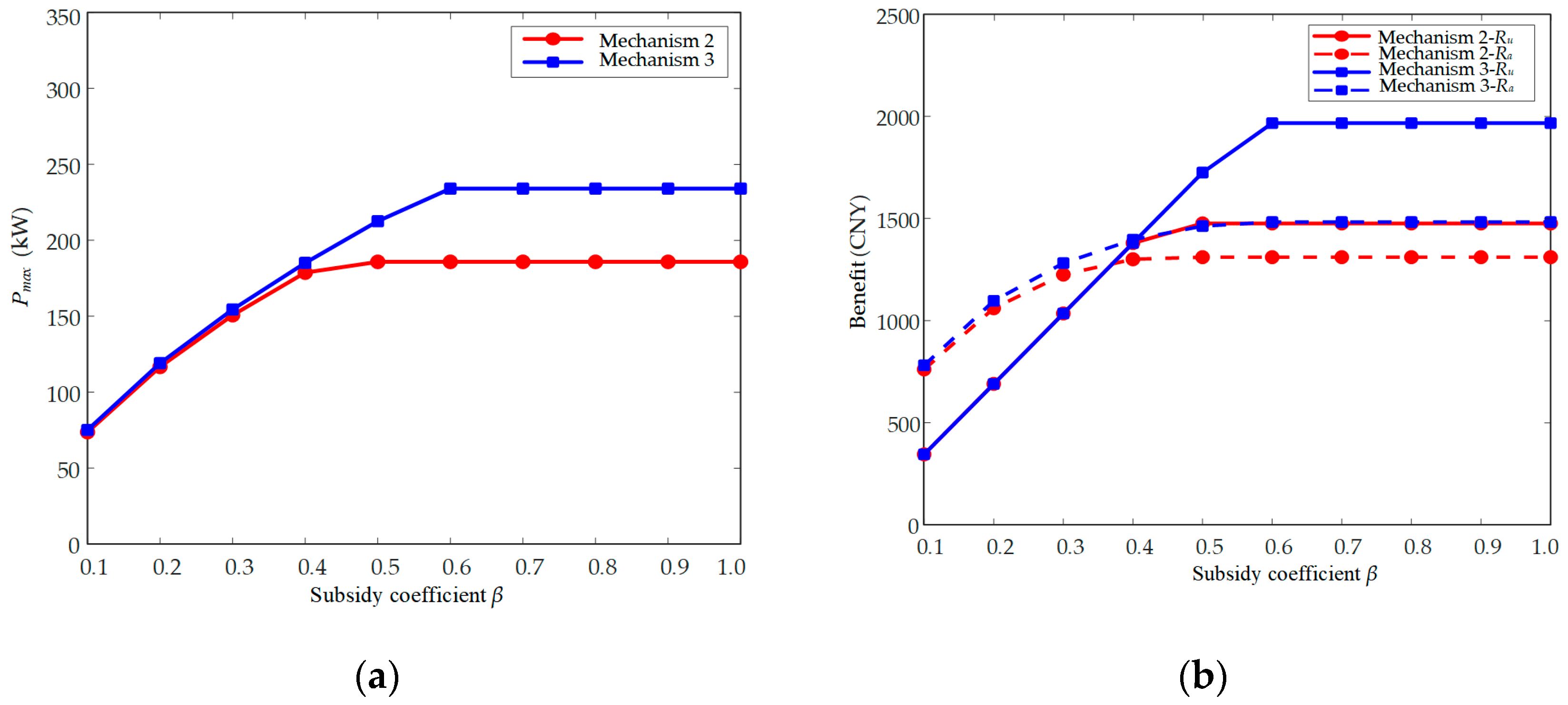
In addition, to further evaluate the impact of the upper limit of subsidy amount on user response behavior and the economic performance of all stakeholders, this study also conducted a sensitivity analysis of subsidy coefficient β, and the relevant results are shown in Figure 13.
Through quantitative analysis of the impact of subsidy coefficient β on Pmax and the benefits of all stakeholders under different mechanisms, it can be observed that all indicators of both mechanisms follow a variation law of “gradually increasing and eventually stabilizing” with the increase in β. However, Mechanism 3 outperforms Mechanism 2 in terms of Pmax, Ru and Rg. In Mechanism 2, due to the existence of rigid SoC constraints, the regulatory flexibility that users can release is limited, and the Pmax fails to reach the target value, with a maximum of only 183.02 kW. In contrast, Mechanism 3 introduces SoC loss compensation, which effectively covers the implicit costs associated with users’ SoC adjustments. This design unlocks additional regulatory potential, enabling the active response power to reach the target of 230 kW. In terms of economic benefits, during the stable phase, Mechanism 3 increases aggregator revenue by 13.13% and user revenue by 33.30% compared to Mechanism 2. These improvements clearly demonstrate its superior incentive efficiency and response efficiency.
Figure 13 shows that when the subsidy coefficient β increases to 0.6, the active response power has reached its physical limit, and subsequent increases in β no longer bring additional gains. This indicates that the mechanism has good robustness against changes in β. Under the condition of β = 0.8 selected in this study, users’ response willingness has been fully stimulated, and the equipment maintenance and operation cost needs of operators can be met simultaneously. Therefore, within a reasonable budget range, the compensation cost constraint will not limit the true potential of active response capacity.

4.4. Algorithm Performance Analysis

4.4.1. Algorithm Comparison

To verify the performance and stability of the algorithm proposed in this study, a comparative analysis is conducted between the IGA used here and the GA. The simulation conditions are consistent with those in Section 4.1. To ensure comparability, both algorithms use the same constraint conditions and initial parameter settings. All simulations are performed on the same computing platform (MATLAB R2024b, Intel i7-12700, 16 GB RAM, Lenovo (manufacturer), Beijing, China).
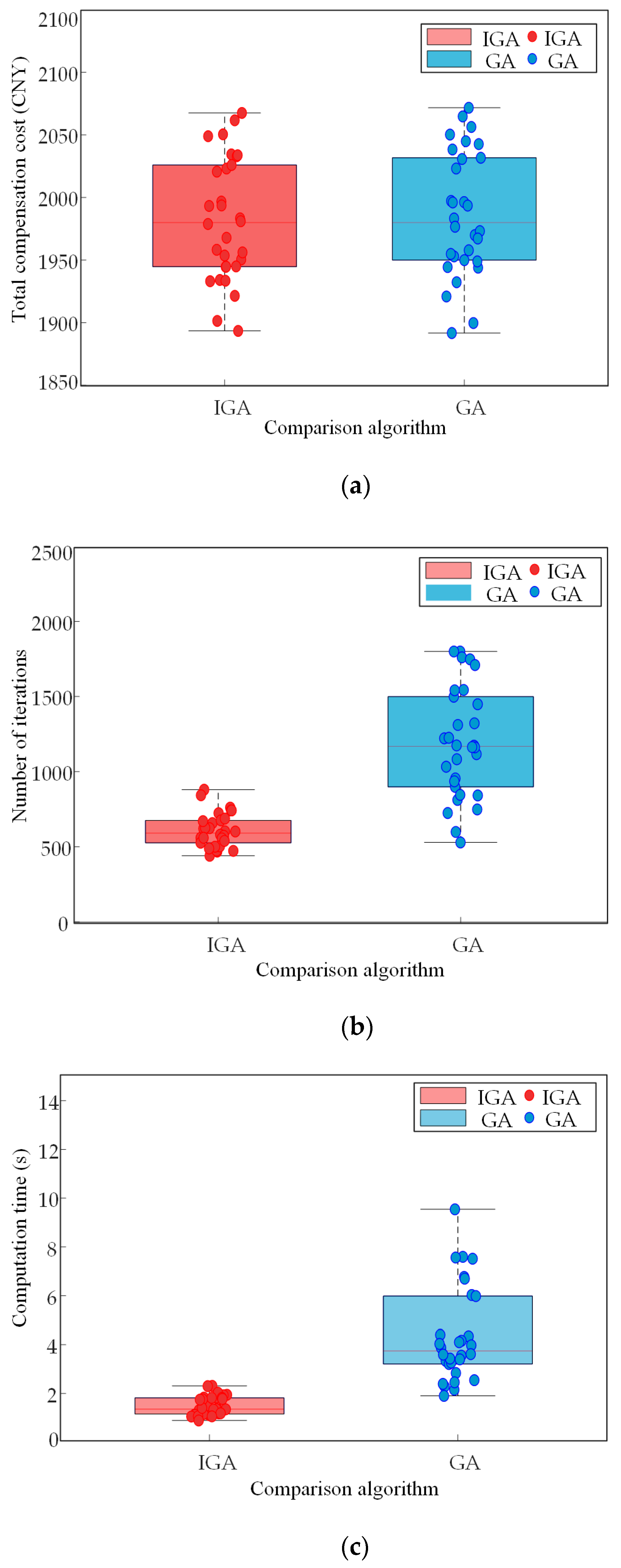
For a comprehensive quantitative evaluation, the results of 30 independent runs of both algorithms are analyzed in terms of three key dimensions: total compensation cost, number of iterations, and computation time. The calculation results and data distribution are presented in Table 4 and Figure 14, respectively.
Statistical analysis results indicate that the IGA significantly outperforms the standard GA in solution accuracy, operational stability, and convergence speed. Specifically, in terms of total compensation cost, the cost distribution of the IGA is more concentrated, and its mean value is significantly lower than that of the GA, demonstrating superior cost control. In terms of convergence efficiency, the average number of iterations for the IGA is 609, representing a 57.32% improvement over the GA. The standard deviation of its iterations also decreases by 69.57% compared to the GA, indicating higher stability during the convergence process. Regarding computation time, the average time consumption of the IGA is 1.50s, 70.36% shorter than the 5.06s required by the GA. Additionally, the standard deviation of computation time drops from 1.96 to 0.39, a decrease of 80.10%, highlighting its significant advantages in computational efficiency and operational consistency.
In summary, while maintaining excellent cost control, the IGA achieves faster convergence, higher solution stability, and stronger robustness compared to the GA.

4.4.2. Applicability Analysis

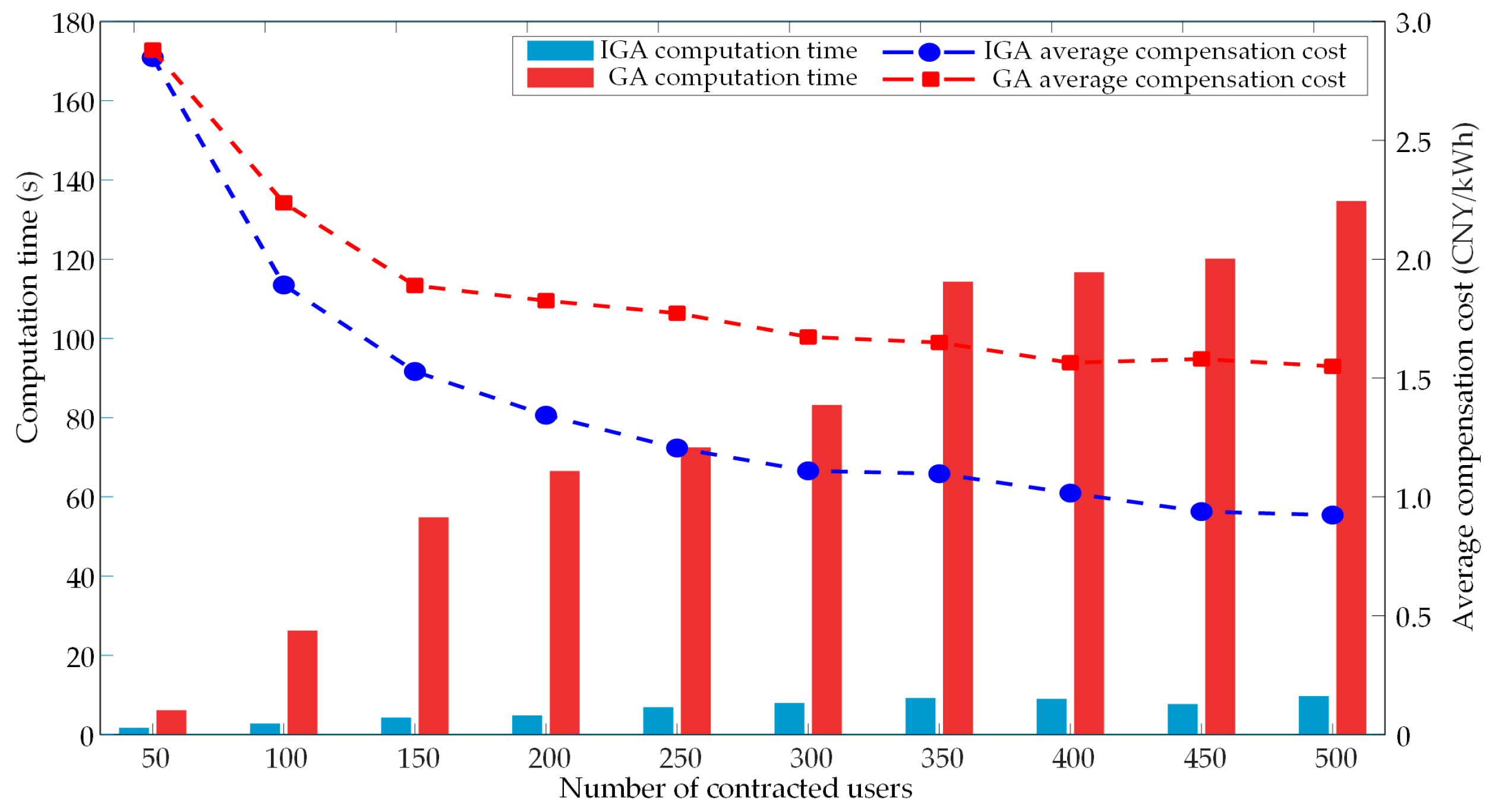
To further verify the applicability and scalability of the proposed method in large-scale scenarios, performance tests are conducted under different contracted user scales (EV scales). The contracted users is gradually increased from 50 to 500, and the variations in the algorithm’s computation time and average compensation cost under are recorded. The results are presented in Figure 15.
As shown in Figure 15, as the scale of EVs increases, the computation time of the IGA gradually rises. When the number of EVs increases from 50 to 500, the computation time increases from 1.71s to 9.71s, showing a relatively small increase. In contrast, the computation time of the standard GA increases sharply with scale, rising from 6.14s to 134.69s. For 500 EVs, the computation time of the GA is approximately 13.9 times that of the IGA.
Regarding the average compensation cost, the cost decreases as the EV scale increases for both algorithms. However, the average compensation cost of the GA remains consistently higher than that of the IGA. When the EV scale reaches 500, the average compensation cost of the IGA is only 0.92 CNY, which is more than 40% lower than the GA’s 1.55 CNY, indicating superior solution quality from IGA. IGA maintains high computational efficiency and solution quality, primarily due to its elite preservation strategy and adaptive crossover/mutation mechanisms, which help reduce ineffective iterations and prevent the loss of high-quality solutions.
In summary, within the tested EV scale range (50–500 EVs), the IGA not only maintains satisfactory solution quality but also demonstrates superior computational efficiency, highlighting its potential applicability in large-scale scheduling scenarios.

4.5. Comparison with Existing Solutions

To comprehensively evaluate the performance and innovation of the proposed dual-dimensional compensation mechanism (M3), a comparative analysis against benchmark and existing methods is conducted. The key findings, highlighting the relative advantages and limitations of each approach, are summarized in Table 5.
The analysis indicates that M1 relies entirely on mandatory, non-market curtailment. Although simple to implement, it lacks economic sustainability. M2 introduces power regulation compensation and provides a certain level of market-based incentives. However, its strict SoC constraint fundamentally limits users’ regulation potential and fails to fully utilize low-cost flexible resources. In contrast, the proposed M3 mechanism employs a dual-dimensional compensation design that integrates both power regulation and SoC loss. This integration significantly enhances user response willingness and fully unleashes regulation potential, thereby improving overall system economics and benefits for all stakeholders.
Moreover, existing studies predominantly focus on optimization models and scheduling algorithms (e.g., [21,22,23]), often lacking effective market-based mechanisms to incentivize deep user participation. To address this gap, this study innovatively develops a user-centric, real-time demand response mechanism. The proposed mechanism incorporates compensation for both power and SoC. At the mechanism-design level, it more fully unlocks demand-side flexibility, thereby facilitating more efficient and adaptive system operation.

5. Conclusions

This paper addresses short-term load surges and distribution network capacity limit violations caused by concentrated EV charging in community scenarios. A real-time demand response compensation mechanism is proposed, combining power regulation compensation and SoC loss compensation within a bi-level optimization framework solved using an improved genetic algorithm.
In the benchmark case study (Section 4.2), compared with the mechanism considering only power regulation compensation, the proposed method increases the share of active response power by nearly 10%, improves user benefits by about 40%, and raises the EVA’s net revenue by approximately 16%. Moreover, the IGA significantly enhances computational efficiency, reducing the average solution time by 70.36% and the number of iterations by 57.32% compared to the standard genetic algorithm, which demonstrates its potential applicability in large-scale scheduling scenarios.
Overall, the dual-dimensional compensation mechanism maximizes the utilization of low-cost, actively participating residential EV resources while ensuring compliance with grid control instructions. The unified mandatory regulation and the single power compensation mechanism are selected as benchmarks in this study, aiming to clearly verify the core contribution of the dual-compensation design within a consistent modeling framework. It enhances user-side regulation potential, reduces overall regulation costs, and compared with proportional mandatory schemes, provides stronger incentives for user participation. This increases the share of user-initiated responses and allows cost-saving benefits to be shared between aggregators and users. In addition, compared with mechanisms relying solely on power regulation incentives, the inclusion of SoC-based compensation further promotes user participation and reduces aggregator costs.
It should be noted that this research remains at a preliminary exploratory stage and has certain limitations. Theoretically, the precise characterization of user behavior models, in-depth analysis of algorithmic computational efficiency, and comparative studies of different algorithmic mechanisms remain insufficient. At the practical application level, considerations of real-world constraints such as data privacy, communication delays, and maintaining user participation willingness are still relatively preliminary. In addition, practical infrastructure constraints (e.g., different types of chargers, station capacity, and V2G/V2V capabilities) are not modeled in detail in this study. These limitations also point to directions for subsequent research.
Future studies will focus on areas such as comparative analysis of different demand response mechanisms, adaptive learning mechanisms, and multi-agent coordination, in order to enhance the theoretical depth and engineering applicability of the proposed model.

Author Contributions

Conceptualization, G.Z. and S.H.; methodology, S.H.; software, S.H.; validation, G.Z.; formal analysis, G.Z.; investigation, G.Z.; resources, S.H.; data curation, S.H.; writing—original draft preparation, S.H.; writing—review and editing, G.Z.; visualization, G.Z.; supervision, G.Z.; project administration, S.H.; funding acquisition, G.Z. All authors have read and agreed to the published version of the manuscript.

Funding

This research was funded by the National Key Research and Development Program of China, grant number 2022YFB2403900.

Institutional Review Board Statement

Not applicable.

Informed Consent Statement

Not applicable.

Data Availability Statement

The data presented in this study are available on request from the corresponding author due to project requirements.

Conflicts of Interest

Author Shuang Hao and Guoqiang Zu were employed by the State Grid Tianjin Electric Power Company. The remaining authors declare that the research was conducted in the absence of any commercial or financial relationships that could be construed as a potential conflict of interest.

Abbreviations

The following abbreviations are used in this manuscript:
EVElectric vehicle
EVs Electric vehicles
RTDRReal-time demand response
DRDemand response
SoCState-of-charge
UBOUnified build-and-operate
EVAElectric vehicle aggregator
IGAImproved genetic algorithm
GAGenetic algorithm

Appendix A

Table A1. Specific Parameter Settings of the Simulation Case.
Parameter NameSymbolValueUnit
Total EV usersN70-
Contract EV users N c 50-
Non-contract EV users N n c 20-
Charging efficiency η 0.95-
Rated charging power P i , b 7kW
Battery capacityEi70kWh
Target SoC S i , t 0.95-
Initial SoC S i , c 0.2–0.4-
Remaining charging time T i , r 4h
Target load reduction P t 230kW
Incentive price I s 5CNY/kWh
Response duration T d 3h
Subsidy coefficient β 0.8-
SoC loss compensation coefficientB0.6-

References

  1. Arthur, R.; Awopone, A.K.; Gyapong, S. Assessment of the Impact of Electric Vehicle Charging on Low Voltage Distribution System in Takoradi. Clean. Energy Syst. 2025, 100226. [Google Scholar] [CrossRef]
  2. Chen, G.; Zhang, Z. Control Strategies, Economic Benefits, and Challenges of Vehicle-to-Grid Applications: Recent Trends Research. World Electr. Veh. J. 2024, 15, 190. [Google Scholar] [CrossRef]
  3. Verma, H.K.; Gupta, N.; Agrawal, P.K.; Niazi, K.; Swarnkar, A. EV charging strategies for office parking lots to relieve local grids. Sustain. Energy, Grids Networks 2025, 44, 101942. [Google Scholar] [CrossRef]
  4. Duan, C.; Bharati, G.; Chakraborty, P.; Chen, B.; Nishikawa, T.; Motter, A.E. Practical Challenges in Real-Time Demand Response. IEEE Trans. Smart Grid 2021, 12, 4573–4576. [Google Scholar] [CrossRef]
  5. da Costa, V.B.F.; de Doile, G.N.D.; Troiano, G.; Dias, B.H.; Bonatto, B.D.; Soares, T.; Filho, W.d.F. Electricity Markets in the Context of Distributed Energy Resources and Demand Response Programs: Main Developments and Challenges Based on a Systematic Literature Review. Energies 2022, 15, 7784. [Google Scholar] [CrossRef]
  6. Chatuanramtharnghaka, B.; Deb, S.; Singh, K.R.; Ustun, T.S.; Kalam, A. Reviewing Demand Response for Energy Management with Consideration of Renewable Energy Sources and Electric Vehicles. World Electr. Veh. J. 2024, 15, 412. [Google Scholar] [CrossRef]
  7. Aldossary, M. Enhancing Urban Electric Vehicle (EV) Fleet Management Efficiency in Smart Cities: A Predictive Hybrid Deep Learning Framework. Smart Cities 2024, 7, 3678–3704. [Google Scholar] [CrossRef]
  8. Zheng, Y.; Chen, Y.; Yang, Q. A Stackelberg-based competition model for optimal participation of electric vehicle load aggregators in demand response programs. Energy 2025, 315, 134414. [Google Scholar] [CrossRef]
  9. Stanelyte, D.; Radziukyniene, N.; Radziukynas, V. Overview of Demand-Response Services: A Review. Energies 2022, 15, 1659. [Google Scholar] [CrossRef]
  10. Lai, S.; Qiu, J.; Tao, Y.; Zhao, J. Pricing for Electric Vehicle Charging Stations Based on the Responsiveness of Demand. IEEE Trans. Smart Grid 2022, 14, 530–544. [Google Scholar] [CrossRef]
  11. Gao, Q.; Li, H.; Peng, K.; Zhang, C.; Qu, X. A real-time charging price strategy of distribution network based on comprehensive demand response of EVs and cooperative game. J. Energy Storage 2024, 101, 113805. [Google Scholar] [CrossRef]
  12. Petrucci, A.; Vallianos, C.; Buonomano, A.; Delcroix, B.; Athienitis, A. Coordinated load management of building clusters and electric vehicles charging: An economic model predictive control investigation in demand response. Energy Convers. Manag. 2025, 339, 119965. [Google Scholar] [CrossRef]
  13. Ye, Z.; Liu, J.; Guo, X.; Jiang, M.; Liu, F.; Hao, H. Charging and Discharging Optimization Strategy for Electric Vehicles in Residential Community Based on User Response Portrait. Smart Power 2022, 50, 87–115. [Google Scholar] [CrossRef]
  14. Ge, S.; Huang, L.; Liu, H. Optimization of Peak-Valley TOU Power Price Time-Period in Ordered Charging Mode of Electric Vehicle. Power Syst. Prot. Control 2012, 40, 1–5. [Google Scholar] [CrossRef]
  15. Sanjana, V.S.; Reddy, Y.M.; Kumar, M.R.; Raju, B.A. Enhancing residential demand response through dynamic pricing forecasting. In Proceedings of the 2023 Second IEEE International Conference on Measurement, Instrumentation, Control and Automation (ICMICA), Kurukshetra, India, 3–5 May 2024. [Google Scholar] [CrossRef]
  16. Alamaniotis, M.; Gatsis, N.; Tsoukalas, L.H. Virtual Budget: Integration of electricity load and price anticipation for load morphing in price-directed energy utilization. Electr. Power Syst. Res. 2018, 158, 284–296. [Google Scholar] [CrossRef]
  17. Strauch, P.; Wang, W.; Langner, F. Model predictive control for demand flexibility of a residential building with multiple distributed energy resources. Energy Build. 2024, 305, 113884. [Google Scholar] [CrossRef]
  18. Vuelvas, J.; Ruiz, F.; Gruosso, G. A time-of-use pricing strategy for managing electric vehicle clusters. Sustain. Energy, Grids Networks 2021, 25, 100411. [Google Scholar] [CrossRef]
  19. Hou, H.; Wang, Y.; Xie, C.; Xiong, B.; Zhang, Q.; Huang, L. A dispatching strategy for electric vehicle aggregator combined price and incentive demand response. IET Energy Syst. Integr. 2021, 3, 508–519. [Google Scholar] [CrossRef]
  20. Diaz-Londono, C.; Cordoba, A.; Vuelvas, J.; Ruiz, F. Mixed Incentive-Based and Direct Control Framework for EV Demand Response. In Proceedings of the 19th IEEE Vehicle Power and Propulsion Conference (VPPC 2023), Milan, Italy, 24–27 October 2023. [Google Scholar] [CrossRef]
  21. Yang, A.; Zhang, G.; Tian, C.; Peng, W.; Liu, Y. Charging Behavior Portrait of Electric Vehicle Users Based on Fuzzy C-Means Clustering Algorithm. Energies 2024, 17, 1651. [Google Scholar] [CrossRef]
  22. Zhang, L.; Sun, C.; Cai, G.; Koh, L.H. Charging and discharging optimization strategy for electric vehicles considering elasticity demand response. eTransportation 2023, 18, 100262. [Google Scholar] [CrossRef]
  23. Hu, J.; Ma, W.; Xue, Y.; Yao, L.; Xie, D. Quantification of Reserve Capacity Provided by Electric Vehicle Aggregator Based on Framework of Cyber-Physical-Social System in Energy. Autom. Power Syst. 2022, 46, 46–54. [Google Scholar] [CrossRef]
  24. Dong, X.; Wei, X.; Zu, G.; Ma, Y.; Yu, X.; Mu, Y. The charge-discharge compensation pricing strategy of electric vehicle aggregator considering users response willingness from the perspective of Stackelberg game. IET Smart Grid 2023, 7, 277–293. [Google Scholar] [CrossRef]
  25. Ponciroli, R.; Stauff, N.E.; Ramsey, J.; Ganda, F.; Vilim, R.B. An Improved Genetic Algorithm Approach to the Unit Commitment/Economic Dispatch Problem. IEEE Trans. Power Syst. 2020, 35, 4005–4013. [Google Scholar] [CrossRef]
  26. Yue, Y.; Zhang, Q.; Zhang, J.; Liu, Y. Orderly Charging and Discharging Group Scheduling Strategy for Electric Vehicles. Appl. Sci. 2023, 13, 13156. [Google Scholar] [CrossRef]
  27. Hou, H.; Wang, Y.; Huang, L.; Xie, C.; Zhang, Q.; Wang, J. Electric Vehicle Aggregator Dispatching Strategy Under Price and Incentive Demand Response. Power Syst. Technol. 2022, 40, 1259–1269. [Google Scholar] [CrossRef]
  28. Qian, K.; Fachrizal, R.; Munkhammar, J.; Ebel, T.; Adam, R.C. The Impact of Considering State-of-Charge-Dependent Maximum Charging Powers on the Optimal Electric Vehicle Charging Scheduling. IEEE Trans. Transp. Electrification 2023, 9, 4517–4530. [Google Scholar] [CrossRef]
Figure 1. The real-time demand response (RTDR) mechanism based on dual-dimensional compensation and bi-level optimization.
Wevj 17 00004 g001
Figure 2. Piecewise function of price-response intensity.
Wevj 17 00004 g002
Figure 3. Solving process of the bi-level optimization model.
Wevj 17 00004 g003
Figure 4. Comparison of composition between active response power and mandatory curtailment power under different mechanisms: (a) Mechanism 1 completely relies on mandatory curtailment; (b) Mechanism 2 is mainly composed of active response, with the gap supplemented by mandatory curtailment; (c) Mechanism 3 is entirely achieved through active response.
Wevj 17 00004 g004aWevj 17 00004 g004b
Figure 5. Analysis of active response and mandatory curtailment under different target power conditions: Mechanism 3 maintains a higher proportion of active response.
Wevj 17 00004 g005
Figure 6. Economic performance improvement of the dual-compensation mechanism from the electric vehicle aggregator’s perspective: (a) average compensation cost and revenue analysis for mechanism 2; (b) average compensation cost and revenue analysis for mechanism 3.
Wevj 17 00004 g006
Figure 7. Enhanced user revenue under the dual-compensation mechanism: (a) Contracted users revenue analysis for Mechanism 2; (b) contracted users revenue analysis for Mechanism 3.
Wevj 17 00004 g007
Figure 8. Analysis of contracted user response under different mechanisms: (a) Mechanism 2 with large fluctuations and underutilized potential of flexible users; (b) Mechanism 3 with balanced response distribution, higher flexible user response.
Wevj 17 00004 g008aWevj 17 00004 g008b
Figure 9. Comparison of active response and benefits among contracted user types under different mechanisms: (a) Under Mechanism 2, neutral users dominate as the primary response source; (b) Under Mechanism 3, flexible users dominate, with an improved revenue structure and reduced reliance on high-cost users.
Wevj 17 00004 g009
Figure 10. The impact of state-of-charge (SoC) loss compensation coefficient B on maximum adjustable power, grid incentives, and multi-party benefits, with a recommended value of B =0.6.
Wevj 17 00004 g010
Figure 11. Analysis of active response power and average compensation cost under different SoC constraints for each mechanism: Mechanism 3 can still maintain a relatively high response level under high target SoC requirements.
Wevj 17 00004 g011
Figure 12. Comparison of maximum adjustable power and benefit across mechanisms under varying battery capacity E: (a) For maximum adjustable power, Mechanism 3 is less sensitive to capacity variations; (b) For user and EVA benefits, Mechanism 3 consistently delivers superior performance.
Wevj 17 00004 g012
Figure 13. Comparison of maximum adjustable power and benefit of each mechanism under varying subsidy coefficient: (a) For maximum adjustable power, Mechanism 3 is less constrained by the subsidy coefficient; (b) For user and EVA benefits, Mechanism 3 provides superior economic performance.
Wevj 17 00004 g013
Figure 14. Boxplots comparing IGA and GA in three performance aspects: (a) Total compensation cost, indicating IGA provides better solving performance; (b) number of iterations, showing IGA requires fewer iterations; (c) computation time, illustrating IGA takes less time to complete.
Wevj 17 00004 g014
Figure 15. Variation trends of computation time and average compensation cost for two algorithms under different contracted user scales; Mechanism 3 has faster solution speed and higher solution quality.
Wevj 17 00004 g015
Table 1. Benefit Analysis of Different Mechanisms.
User TypeplphProportion of Contracted Users
flexible[0, 1][2, 3]40%
neutral[1, 2][3, 4]40%
rigid[2, 3][4, 5]20%
Table 2. Description and benefit analysis of different mechanisms.
SymbolDescriptionFormula
P m a x (kW)The theoretical maximum adjustable power that all contracted users can provide during the real-time demand response (RTDR) period, while satisfying device and user constraints. P m a x =max i = 1 N α i · P i , b
P a c t (kW)The actual active response power provided by contracted users under a given incentive cost level. P a c t = i = 1 N α i · P i , b ·
P m a n (kW)Response power is obtained through mandatory curtailment when active response is insufficient. P m a n = P t P a c t
F (%)The proportion of contracted users’ active response power to the total response power.F= P a c t P t × 100 %
S g (CNY)Total grid-side incentive received by aggregator, corresponding solely to active response. S g = P act · I s · T d
R u (CNY) Total benefit of all contracted users, including power regulation compensation and state-of-charge (SoC) loss compensation.M2: R u = i = 1 N C i , p ( α i )
M3: R u = i = 1 N ( C i , p ( α i ) + C i , s o c ( δ i ) )
R a (CNY) Net aggregator benefit, equal to grid subsidy minus total user compensation. R a = S g R u
C a v g (CNY/kWh) Average compensation cost per unit response power paid by the aggregator.M2: C a v g = i = 1 N C i , p ( α i ) P a c t · T d
M3: C a v g = i = 1 N ( C i , p ( α i ) + C i , s o c ( δ i ) ) P a c t · T d
Table 3. Comparison of evaluation metrics under different mechanisms.
MetricMechanism 1Mechanism 2Mechanism 3
P m a x 0183.02236.60
P t 230230230
P a c t 0183.02230
P m a n 23046.980
F079.6%100%
S g 02745.43450.0
R u 01380.21927.0
R a 01365.21523.0
Table 4. Comparative analysis of performance between IGA and GA: total compensation cost, number of iterations, and computation Time.
Indicators IGAGA
Total compensation cost (CNY)Mean value1982.101986.43
Standard deviation47.9249.55
Number of iterationsMean value6091427
Standard deviation112368
Computation time (s)Mean value1.505.06
Standard deviation0.391.96
Table 5. Comparative analysis of different control mechanisms: advantages and disadvantages.
MethodsAdvantagesDisadvantages
Uniform Proportional Reduction (M1)
  • Simple to implement with low computational complexity;
  • Requires no user incentives or complex contracts.
  • Lacks economic incentives and is unsustainable;
  • Relies entirely on mandatory curtailment, impairing user satisfaction.
Power Regulation Compensation (M2)
  • Introduces market-based incentives, improving user participation compared to M1;
  • Guarantees target SoC, protecting core charging demand;
  • Generates economic benefits for both users and aggregator.
  • User response is limited by rigid SoC constraints;
  • Often requires supplemental mandatory curtailment, reducing flexibility;
  • Underutilizes low-cost, flexible users.
Dual-Dimensional Compensation (M3)
  • Fully mobilizes response potential via SoC loss compensation;
  • Maximizes active response and total economic benefits;
  • Optimizes resource allocation, enhancing system flexibility and economic efficiency;
  • Demonstrates strong adaptability to diverse conditions (e.g., high target power, varying SoC requirements).
  • Involves increased computational complexity due to dual-dimensional compensation;
  • Depends on more complex user contracts and compensation settlement mechanisms.
Other Methods (e.g., Refs. [21,22,23])
  • Employ refined modeling and optimization tools;
  • Effective in specific goals like peak shaving and cost reduction.
  • Focus predominantly on optimal scheduling models, with insufficient emphasis on designing effective market-based incentive mechanisms.
Disclaimer/Publisher’s Note: The statements, opinions and data contained in all publications are solely those of the individual author(s) and contributor(s) and not of MDPI and/or the editor(s). MDPI and/or the editor(s) disclaim responsibility for any injury to people or property resulting from any ideas, methods, instructions or products referred to in the content.