1. Introduction
WPT technology is a prominent enabling technique that achieves contactless energy transmission between a transmitter and receiver through magnetic or electric fields [
1,
2,
3]. By overcoming the inherent safety hazards and flexibility limitations of conventional wired power delivery, WPT has been widely adopted in various sectors, including portable electronics, biomedical implants, unmanned systems, and industrial automation equipment, gradually advancing toward widespread engineering implementation and commercialization [
4,
5,
6,
7].
For medium-power and low-power WPT applications characterized by stringent cost, weight, and size constraints, such as onboard chargers for inspection drones, portable industrial terminals, and consumer electronic devices, single-switch topologies have recently 0attracted increasing attention due to their simplified circuit structures, straightforward control strategies, low component counts, and inherent capability of achieving zero-voltage switching (ZVS) [
8,
9,
10]. However, spatial misalignment during practical operation remains a critical challenge. For instance, inevitable positioning errors during the automatic docking process of autonomous mobile robots (AMRs) or automated guided vehicles (AGVs) cause significant fluctuations in the mutual inductance of the magnetic coupler. This variation leads to instability in the output voltage and power, severely limiting system performance. Consequently, misalignment tolerance has become a pivotal performance indicator determining system stability and practical viability [
11,
12].
To enhance WPT system performance under spatial misalignment, contemporary research has primarily focused on two avenues: (1) the design of magnetic couplers, aiming to shape uniform magnetic field distributions to reduce mutual inductance sensitivity to displacement; and (2) the optimization of compensation topologies to mitigate the sensitivity of system output characteristics to mutual inductance variations [
13].
In terms of magnetic coupling design,
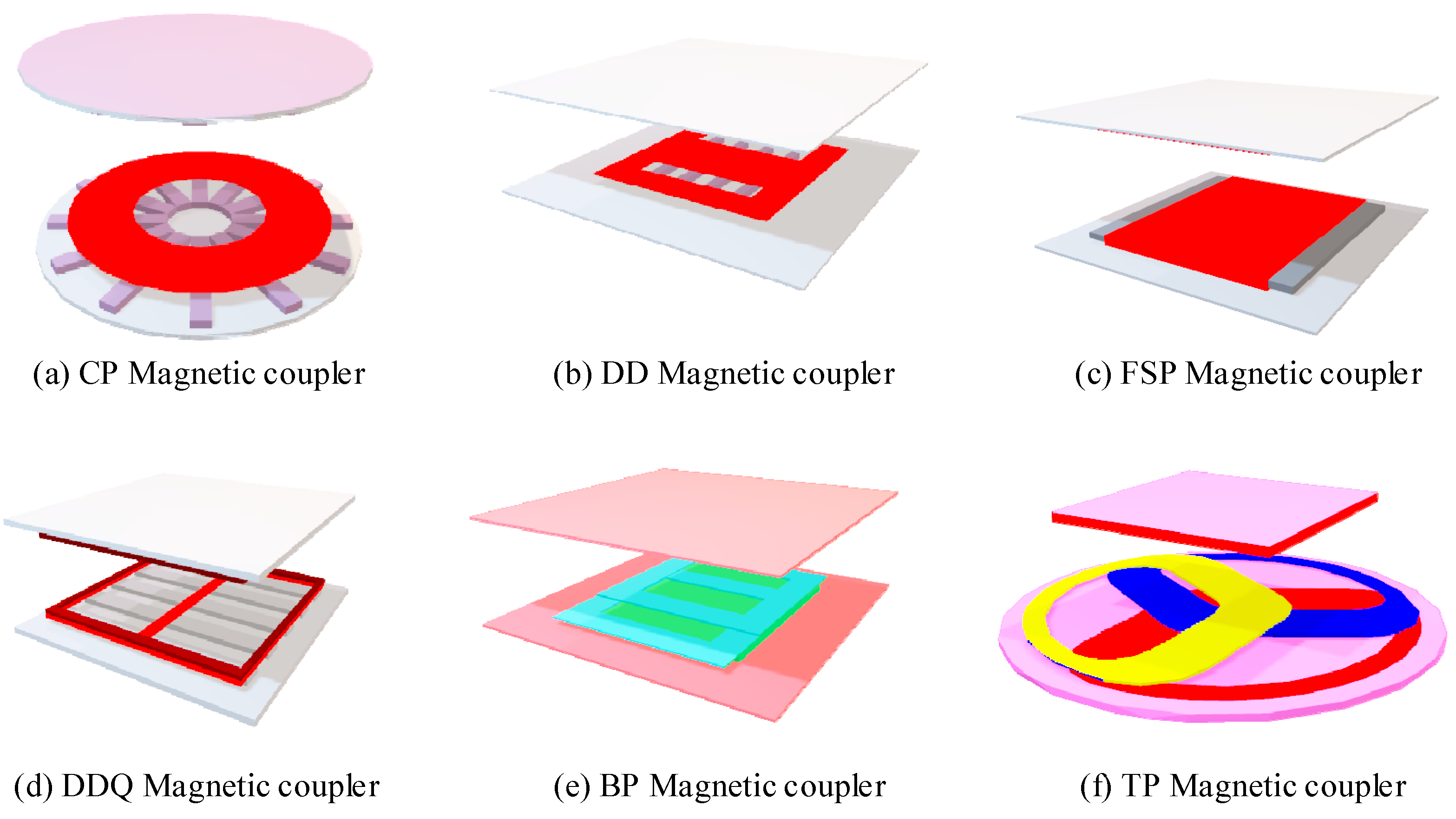
Figure 1 provides an overview of representative coil structures commonly used to enhance misalignment tolerance. The double-D (DD) coil structure improves coupling performance by generating two magnetic fields of opposite polarity, but suffers from power transfer blind zones [
14]. The double-D quadrature (DDQ) coil eliminates this blind zone by reconfiguring the DD structure, at the expense of increased wire usage [
15]. The bi-polar (BP) coil reduces the amount of wire while maintaining similar performance to the DDQ coil [
16]. The flat spiral pad (FSP) coil, owing to its single magnetic flux loop across the ferrite cross-section, avoids magnetic flux cancelation during lateral displacement, thereby exhibiting strong misalignment tolerance along the
X-axis; however, its
Y-axis tolerance remains weaker [
17]. To address this issue, the series DD and solenoid pad (SDDP) structure was introduced to improve tolerance in both the X- and Y-directions [
18]. Furthermore, by integrating the FSP structure, researchers proposed the double-solenoid quadrature pad (DSQP) coil, achieving less than 15% mutual inductance fluctuation within 80% of the coil side length [
19]. The double-layer quadrature double-D (DQDD) coil was then developed by orthogonally combining DD coils to generate a periodically rotating magnetic field, enhancing misalignment and angular tolerance [
20]. A dynamic magnetic-field control mechanism based on the DQDD coil was later proposed to further improve spatial focusing capability and maintain high transmission efficiency under large displacement conditions [
21]. In addition, by constructing a uniform magnetic field, a grid-type flat solenoid pad (GFSP) coil was developed to reduce mutual inductance fluctuation during misalignment, representing a significant advancement in improving misalignment tolerance through magnetic coupling design [
22]. These studies indicate that both application-oriented system-level challenges and coil-structure-level innovations play critical roles in enhancing misalignment tolerance in inductive WPT systems [
23,
24].
In terms of compensation topology, simple fundamental structures such as Series-Series (S-S), Series-Parallel (S-P), Parallel-Series (P-S), and Parallel-Parallel (P-P) exhibit high sensitivity to coupling coefficient variation, resulting in severe performance degradation under misalignment [
25]. To reduce the coupling effect between excitation current and mutual inductance, researchers have proposed several high-order compensation networks. The Inductive Capacitive Capacitive-Inductive Capacitive Capacitive (LCC-LCC) topology provides current decoupling from mutual inductance and achieves load-independent constant current output, but requires a large number of compensation components [
26]. The Inductive Capacitive Capacitive-Series (LCC-S) topology retains the decoupling advantage while simplifying the circuit and providing load-independent constant voltage output [
27]. However, high-order compensation topologies only alleviate the impact of mutual inductance variation and still cannot maintain constant output under large misalignment conditions.
To overcome these limitations, hybrid compensation topologies have been introduced by combining compensation networks with opposite mutual inductance sensitivities. These hybrid structures exploit the complementary output characteristics of the constituent topologies to achieve smoother variations in output voltage or current during misalignment [
28]. Researchers at the University of Auckland combined S-S and LCC-LCC networks in an input-parallel, output-parallel configuration, achieving output power fluctuation below 10% within a certain misalignment range [
29,
30]. Subsequently, they proposed an input-series, output-series configuration, reducing power fluctuation to within 5% [
31]. A topology combining LCC-S and Series-Inductive Capacitive Capacitive (S-LCC) networks in an input-series, output-parallel configuration achieved output voltage fluctuation below 5% for a 775 × 391 mm coil under 160 mm misalignment [
32]. Another hybrid topology combining LCC-LCC and S-S networks in an input-parallel, output-parallel structure achieved similar voltage stability for a 400 × 400 mm coil under 200 mm misalignment [
33]. Researchers at Southwest Jiaotong University further proposed input-parallel, output-series (IPOS) [
34] and input-series, output-parallel (ISOP) [
35] hybrid structures. A recent work [
36] presented a compact dual-coupling SP-S compensated WPT system with misalignment tolerance, which effectively reduced output fluctuation through optimization of the compensation network and resonant parameters. This configuration maintained system compactness without increasing the number of capacitors, addressing the issue of excessive system size and weight. However, for medium- and low-power applications, the use of multiple active devices still leads to increased circuit complexity.
Although these hybrid structures have achieved significant improvements in misalignment tolerance, most rely on dual-bridge or multi-switch topologies, which require numerous passive components, resulting in larger system volume and weight—undesirable for medium- and low-power applications. Moreover, the inclusion of low-power-density inductors at the receiver side further reduces system compactness and power density. Therefore, achieving a compact and lightweight system while maintaining strong misalignment tolerance remains a critical research challenge.
To address the above issues, this paper investigates and designs a single-switch WPT system with misalignment-tolerant characteristics. Based on a single-switch topology, the proposed system combines the LCC-S and S-S compensation networks in an input-series, output-series configuration to form a simplified hybrid-compensated single-switch WPT topology. Under misalignment conditions, one power channel increases while the other decreases, enabling stable output voltage with reduced fluctuation. Compared with traditional hybrid topologies, the proposed structure is simpler and requires only capacitive compensation at the receiver, achieving strong misalignment tolerance with a compact, lightweight configuration.
The main contributions of this work are as follows: (1) modeling and analysis of the proposed system topology; (2) design of a GFSP magnetic coupler; (3) verification of theoretical correctness through MATLAB/Simulink simulation; and (4) experimental validation using a 50 W prototype.
2. Single-Switch WPT System Topology Analysis
2.1. Analysis of LCC-S and S-S Compensation Topologies
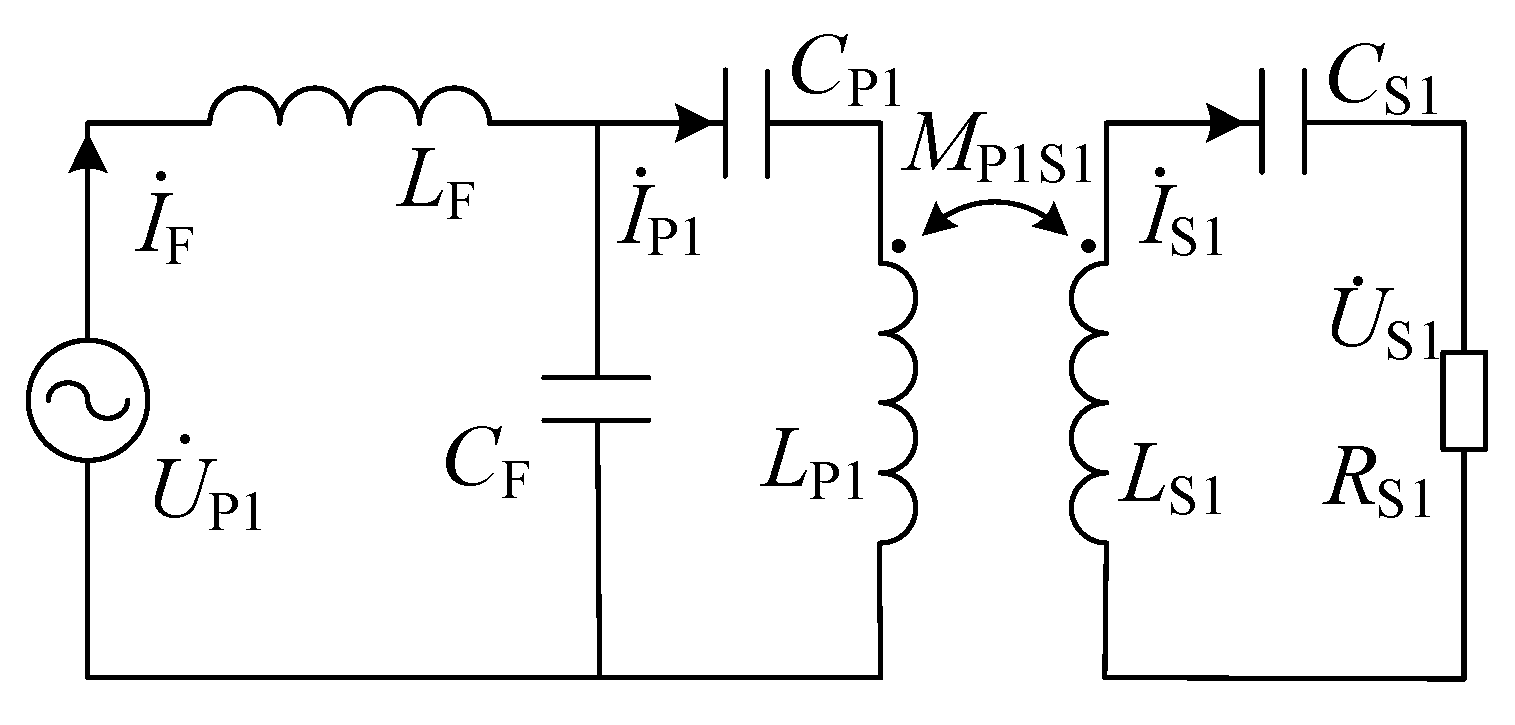
Figure 2 shows the circuit topology of the LCC-S compensated WPT system. In the figure,
LP1 and
LS1 denote the self-inductances of the transmitter and receiver coils, respectively, while
MP1S1 represents the mutual inductance between the two coils.
LF and
CF form the transmitter-side compensation network, and
CP1 and
CS1 are the series compensation capacitors on the transmitter and receiver sides, respectively.
RS1 represents the equivalent AC load resistance before rectification.
IF denotes the input current,
IP1 is the current flowing through the transmitter coil, and
IS1 represents the current of the receiver coil.
The Kirchhoff’s Voltage Law (KVL) equation of the LCC-S compensation topology can be expressed as:
The output voltage can then be derived as:
From (2), it can be observed that the LCC-S compensation topology exhibits a constant-voltage output characteristic, and the output voltage is proportional to the mutual inductance.
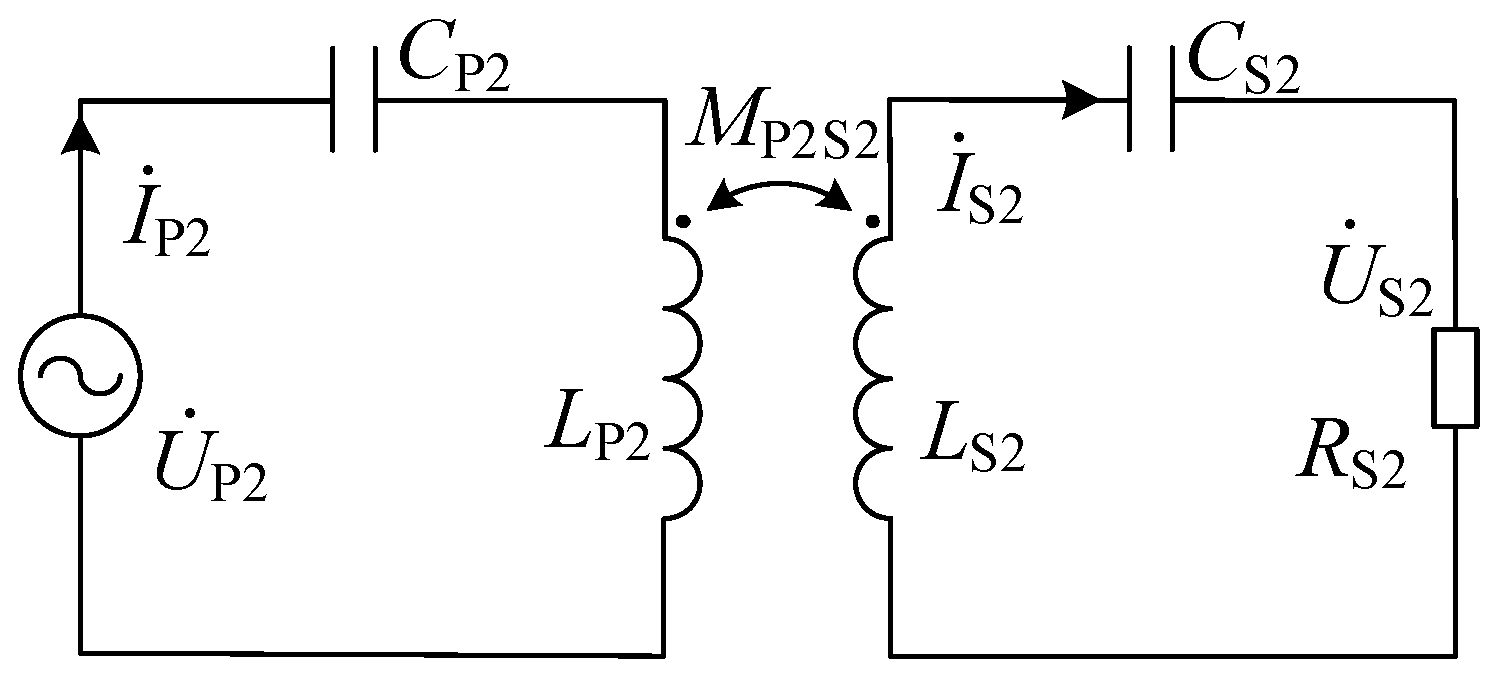
Figure 3 shows the circuit of the S-S compensation topology. In the figure,
LP2 and
LS2 denote the self-inductances of the transmitter and receiver coils, respectively;
MP2S2 represents the mutual inductance between the two coils;
CP2 and
CS2 are the series compensation capacitors;
RS2 is the equivalent AC load resistance before rectification;
IP2 and
IS2 are the excitation current of the transmitter coil and the induced current of the receiver coil, respectively.
The KVL equation of the S-S compensation topology can be expressed as:
The output current can then be derived as:
From (4), it can be found that the S-S compensation topology exhibits a constant-current output characteristic, and the output current is inversely proportional to the mutual inductance.
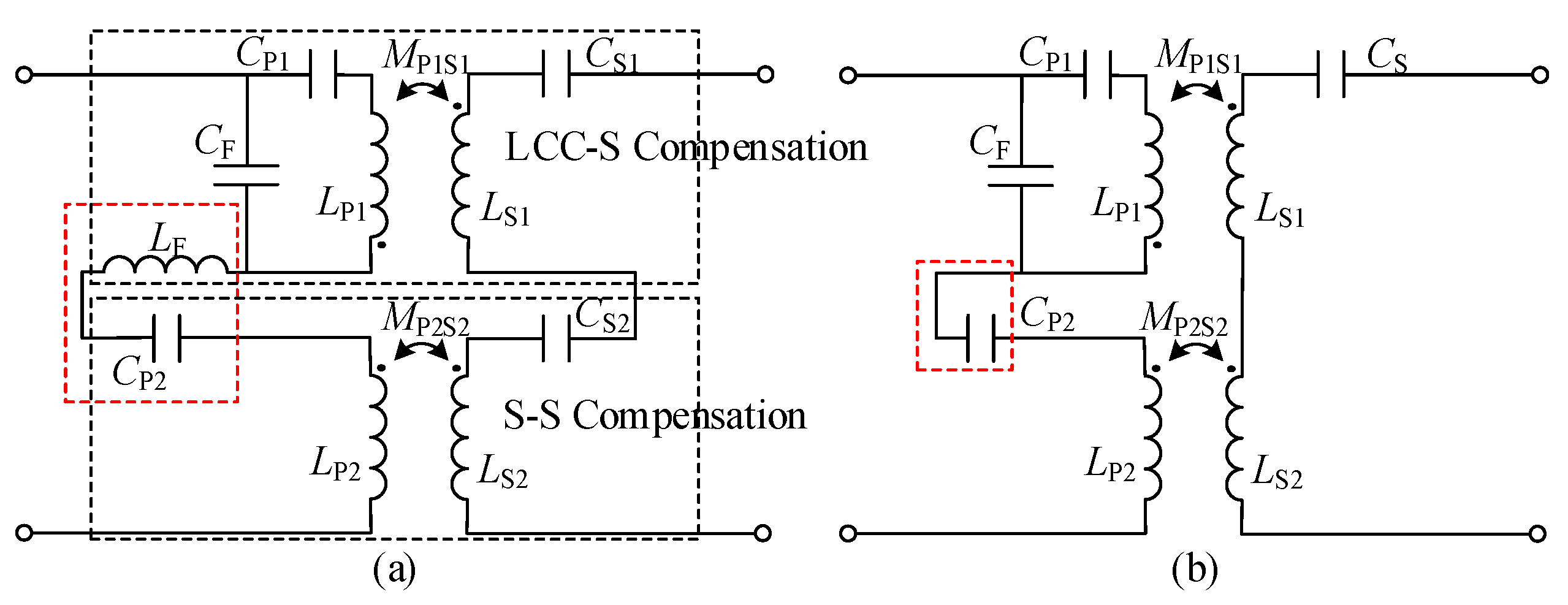
Since the LCC-S and S-S compensation topologies show opposite gain variation tendencies with respect to mutual inductance, combining them can achieve a stable system output within a certain range of coupling variation. The LCC-S and S-S topologies are connected in series on both the transmitter and receiver sides to form the hybrid compensation network. During the combination, the coil polarity must be adjusted so that the output currents of both compensation branches are in phase, as shown in
Figure 4a. When
LP2 >
LF,
CP2 and LF can be simplified as a single compensation capacitor
CP2, and the capacitors
CS1 and
CS2 can also be simplified as a single capacitor
CS, resulting in the simplified hybrid topology shown in
Figure 4b.
2.2. Analysis of Hybrid Compensation Topology and Its Equivalent Model
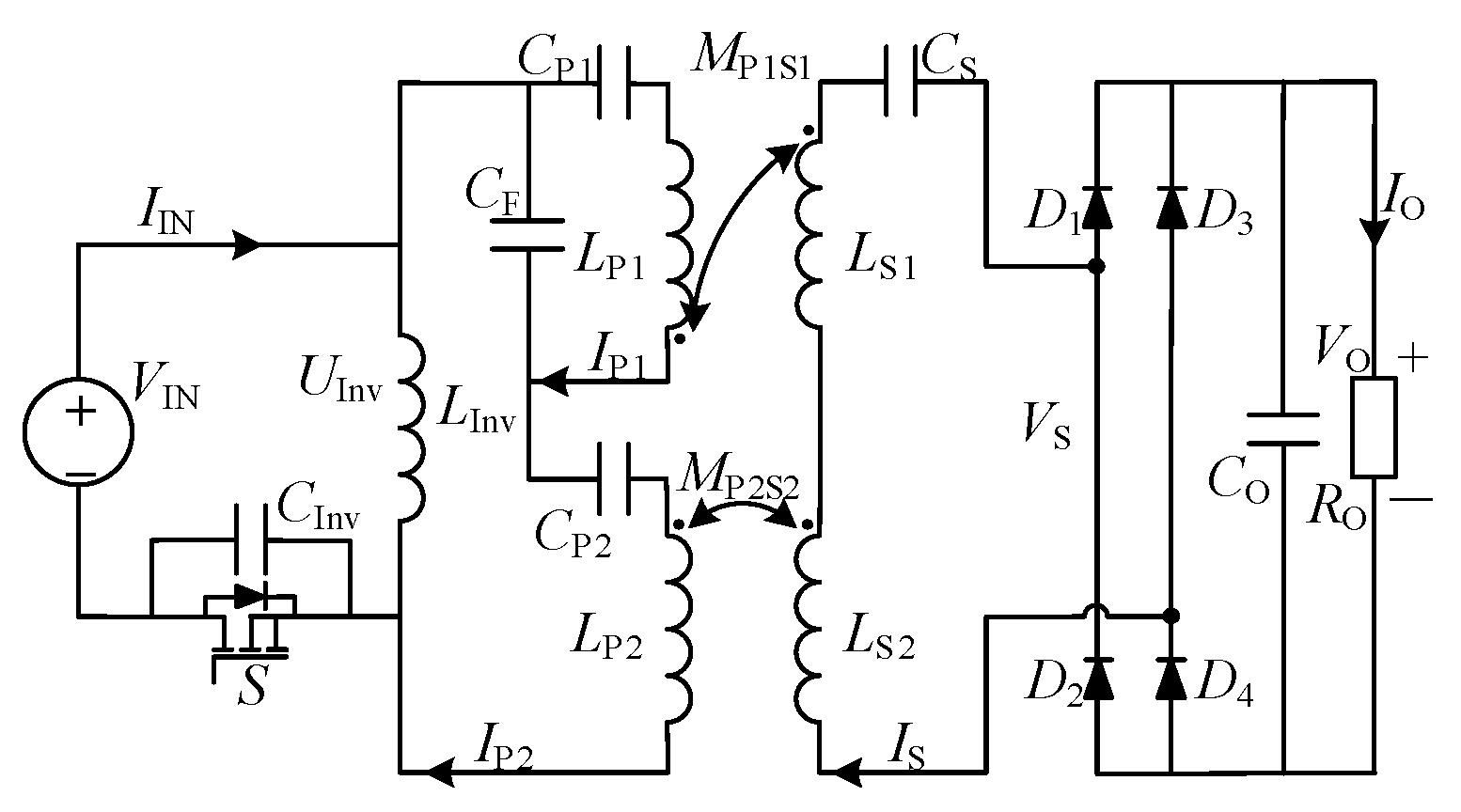
The proposed hybrid-compensated single-switch WPT system is shown in
Figure 5. In this figure,
LP1 and
LP2 denote the self-inductances of the transmitting coils, and
LS1 and
LS2 denote those of the receiving coils.
LS1 and
LS2 are connected in series.
MP1S1 and
MP2S2 represent the mutual inductances between
LP1-
LS1 and
LP2-
LS2, respectively.
CO is the output filter capacitor, and
RO is the load resistance.
IIN denotes the input current,
IP1 and
IP2 are the currents of transmitting coils 1 and 2, respectively, and
IS represents the current flowing through the series-connected receiving coils.
On the transmitter side, CF, CP1, and LP1 form a parallel resonance branch, while CF, CP2, and LP2 form a series resonance branch. On the receiver side, CS, LS1, and LS2 form a series resonance branch. The transmitting coil LP2 functions both as a power transfer coil and as the compensation inductor of the LCC-S topology, achieving a compact and low-cost design. In the circuit, VIN and IIN represent the DC input voltage and current, UInv is the inverter output voltage, IP1 and IP2 are the excitation currents of the transmitting coils, VS is the rectifier input voltage, IS is the induced current on the receiver side, and VO and IO are the output voltage and current, respectively.
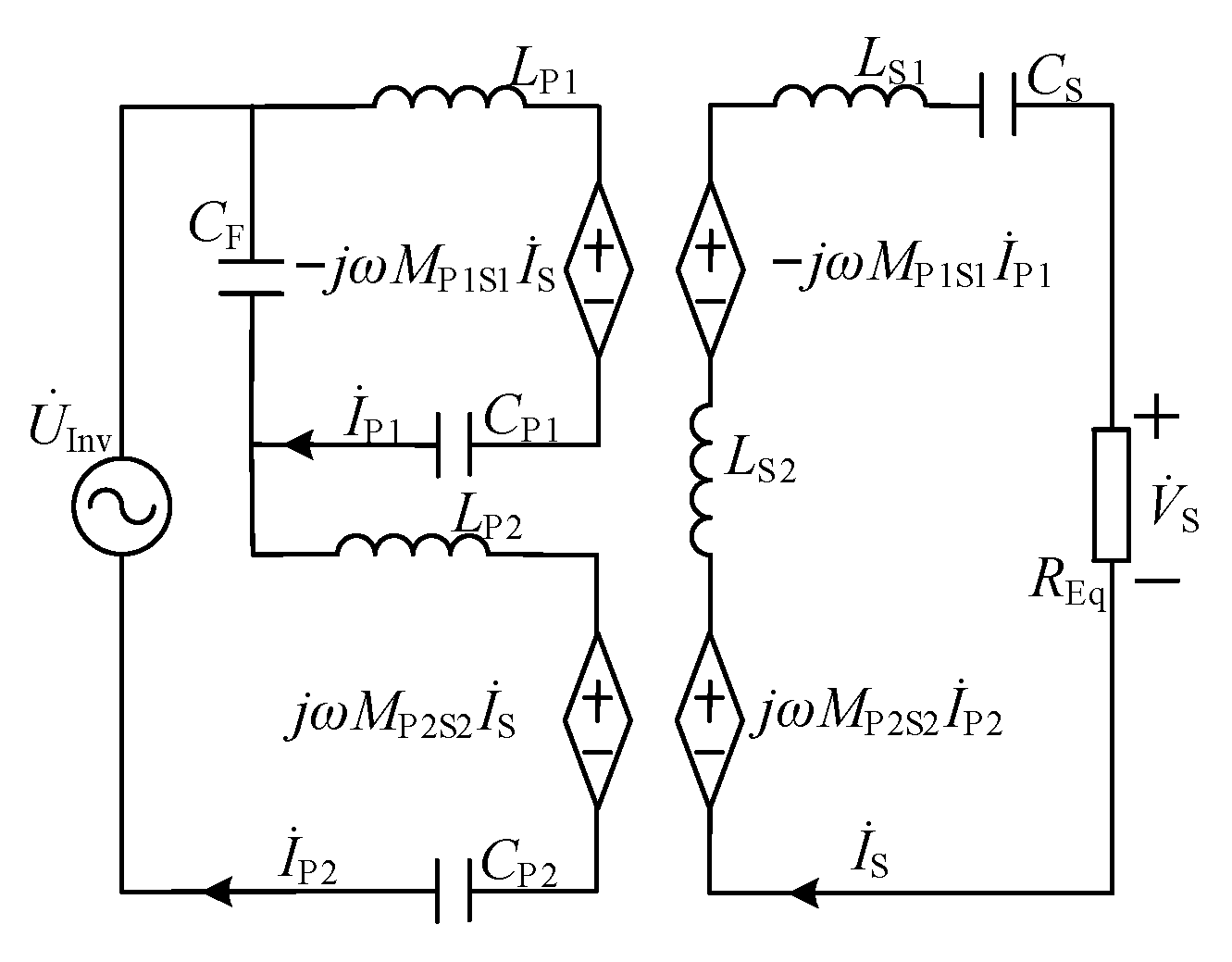
By properly designing the magnetic coupler, cross coupling between coils can be eliminated. The output of the single-switch inverter can be equivalently regarded as a voltage source with a constant amplitude
UInv. Using the fundamental harmonic approximation, the system circuit shown in
Figure 5 can be simplified into the equivalent model shown in
Figure 6, where
REq is the equivalent AC load before rectification, given by
REq = 8
RO/π
2.
IIN denotes the input current,
IP1 and
IP2 are the currents of transmitting coils 1 and 2, respectively, and
IS represents the current flowing through the series-connected receiving coils.
The resonant frequency of the system, ω
0, can be expressed as:
When the system operates at the resonant frequency ω
0, the KVL equations of the circuit can be derived as:
By substituting (5) into (6), the following can be obtained:
Accordingly, the related current expressions can be derived as:
As shown in (8), when the mutual inductances MP1S1 and MP2S2 approach zero, the excitation currents IP1 and IP2 of the transmitting coils do not increase significantly. This effectively eliminates the risk of transmitter overcurrent that commonly occurs in conventional S-S compensated topologies when the receiver moves out of the coupling region, thereby avoiding the need for additional detection and protection circuits and improving the system’s simplicity and reliability.
From (8), the input impedance of the system can be expressed as:
According to (9), since MP1S1, MP2S2, and CF are all positive, the input impedance is inductive, which is favorable for achieving ZVS in the single-switch inverter circuit.
It should be noted that the ZVS condition of the single-switch inverter is governed by the reflected impedance. Although misalignment causes slight variations in the mutual inductance, the reflected impedance remains inductive because MP1S1, MP2S2, and CF are always positive, as indicated by (9).
Therefore, the input impedance stays inductive over the entire misalignment range, and ZVS is consistently maintained.
Based on (8), the output current, voltage, and power can be expressed as:
As shown in (10), under a given AC input voltage UInv and equivalent load resistance REq, the output current, voltage, and power depend solely on the mutual inductances MP1S1 and MP2S2. It is desirable for the variations of MP1S1 and MP2S2 with respect to positional misalignment to be as gradual as possible. Since MP1S1 and MP2S2 exert opposite effects on the output characteristics, where the output current, voltage, and power decrease with the reduction of MP1S1 but increase with the reduction of MP2S2, the coordinated variation in the two within a certain range enables self-compensation of the output performance. Consequently, the proposed system can maintain stable output characteristics under spatial misalignment conditions.
The expression for the system efficiency is given by:
where
RP1 denotes the equivalent series resistance (ESR) of
LP1,
CT, and the conducting switch of the single-switch inverter;
RP2 represents the ESR of
LP2 and
CP1;
RS1 is the ESR of
LS1; and
RS2 corresponds to the ESR of
LS2,
CR, and the two diodes conducting in the rectifier stage.
3. Analysis of the GFSP Magnetic Coupler
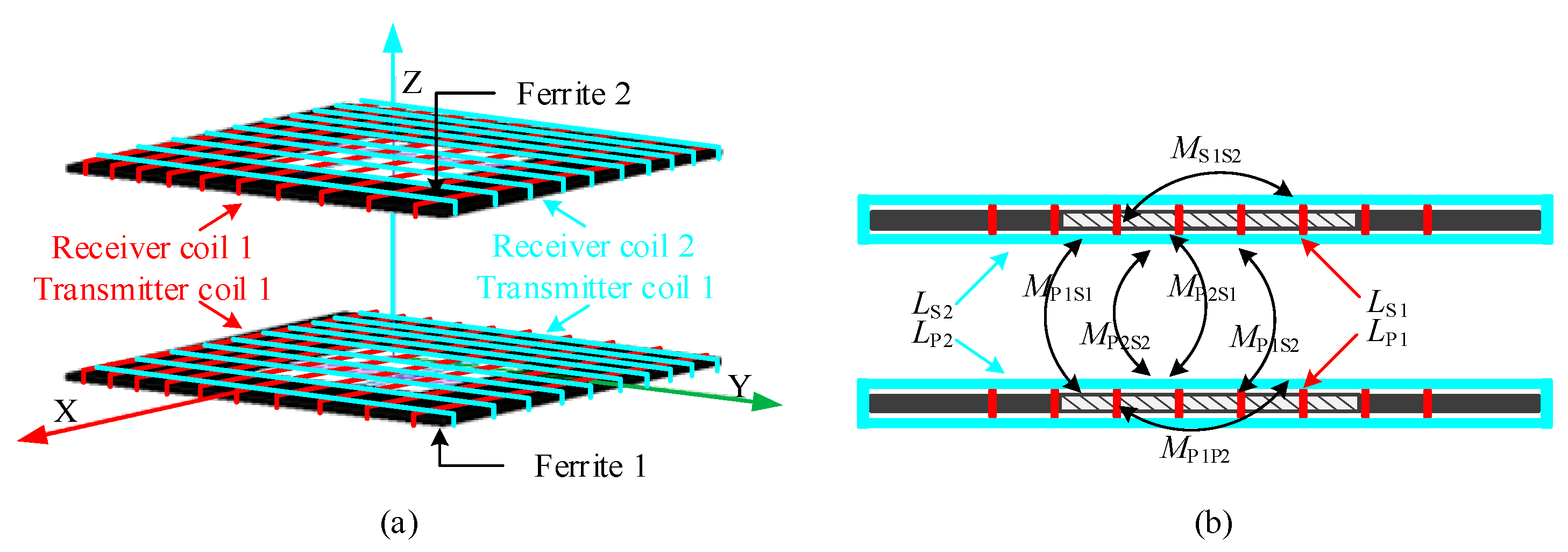
In the previous analysis, the proposed single-switch WPT system with a hybrid compensation topology requires a magnetic coupler that contains two mutually decoupled coil sets, with their mutual inductances exhibiting consistent variation trends under positional misalignment. The GFSP magnetic coupler, as a representative dual-transmitter and dual-receiver configuration, adopts an orthogonal coil arrangement. This configuration ensures mutual decoupling between any two non-corresponding coils, resulting in negligible cross-coupling terms
MP2S1 and
MP1S2 when misalignment occurs along the
X-axis. Moreover, because the ferrite cross-section in the GFSP structure forms a single magnetic flux loop, the coupling system exhibits strong tolerance to lateral displacement. Therefore, the GFSP magnetic coupler is selected for designing the proposed single-switch WPT system. Its structural configuration is illustrated in
Figure 7.
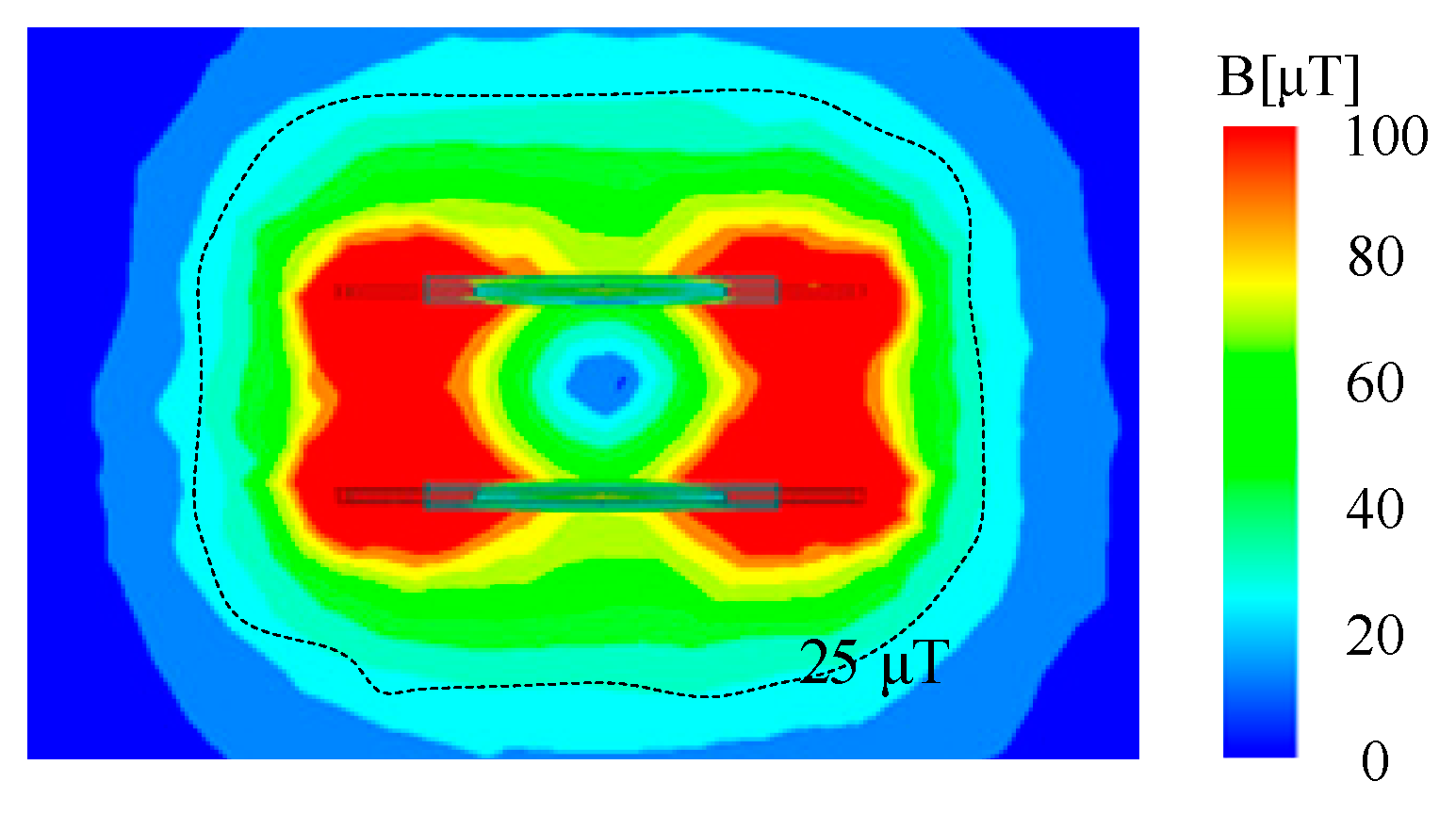
A three-dimensional model of the designed GFSP magnetic coupler was established and simulated using ANSYS Maxwell. The magnetic flux density distribution on the XOZ plane is shown in
Figure 8. As observed, the magnetic field in the coupling region exhibits a typical multilayer equipotential distribution, where the magnetic flux density gradually decreases from the center outward, forming a distinct gradient transition pattern. The red region corresponds to the highest magnetic flux density, approximately 100 μT, mainly concentrated around the coils and ferrite cores, indicating the primary magnetic flux paths. The magnetic field distribution is overall symmetric about the center, suggesting that under the aligned condition, the magnetic fields generated by the two excitation coils on both sides superimpose and maintain spatial balance. The magnetic flux primarily closes through the ferrite core, thereby reducing magnetic leakage.
Additionally, a relatively uniform magnetic field is formed in the central region between the two coils, with a flux density below 0.10 mT, which helps to mitigate severe fluctuations in mutual inductance during positional misalignment and improves system stability under spatial displacement. The magnetic flux density in the outer regions is much weaker, and as highlighted by the 25 μT contour line in
Figure 8, leakage flux mainly occurs near the coil edges with low intensity, remaining below 20 μT at a distance of 10 cm from the coil surface, and thus has minimal impact on the external environment.
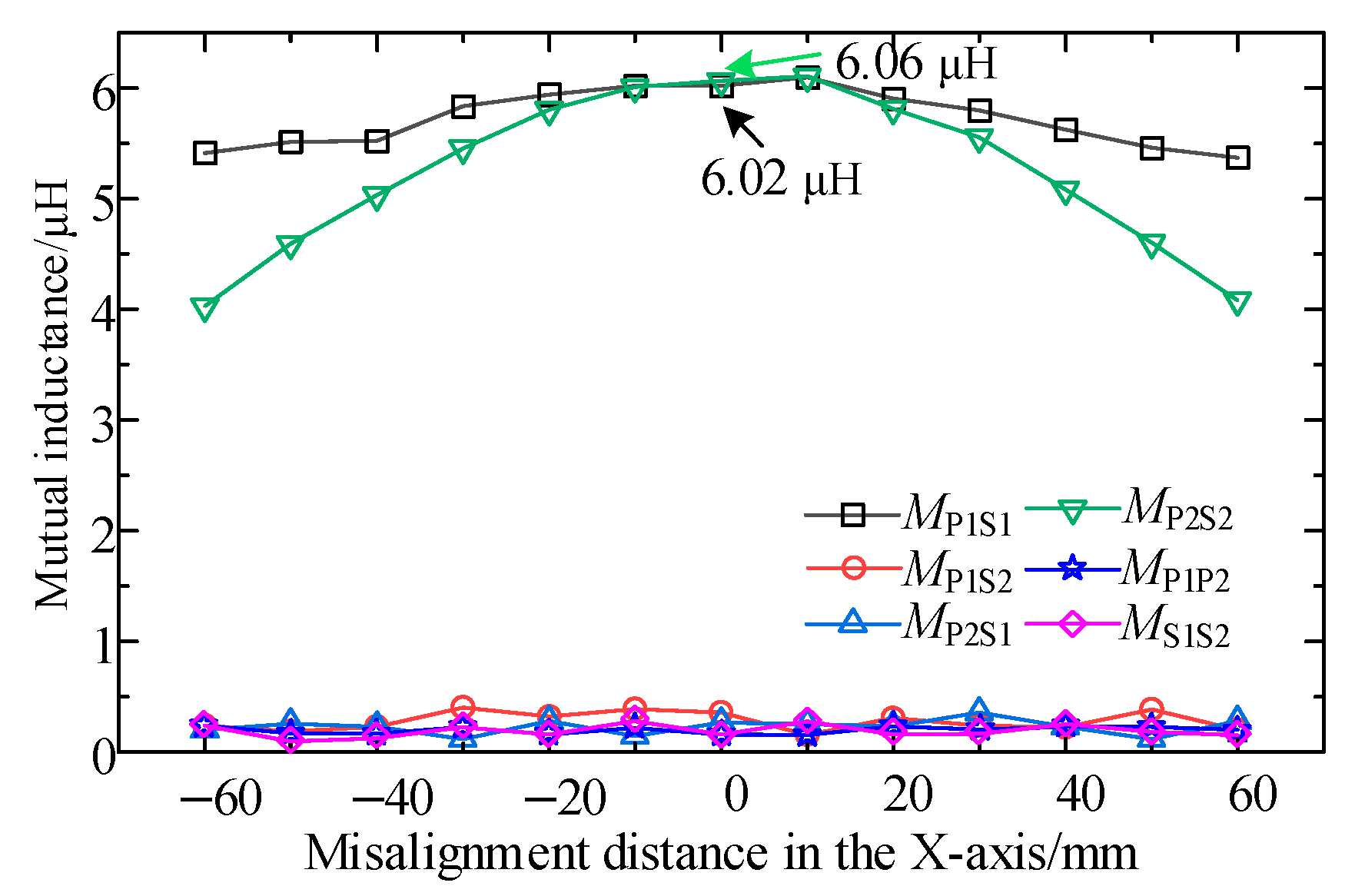
Figure 9 illustrates the variation in mutual inductance in the GFSP magnetic coupler under
X-axis misalignment. As shown, the cross-coupling terms
MP2S1 and
MP1S2 are nearly zero, and the intra-side couplings
MP1P2 and
MS1S2 are also negligible. This is because both the transmitting coils and receiving coils are wound in an orthogonal manner, generating orthogonal magnetic fields that do not induce mutual flux linkage. With the undesired mutual inductance terms effectively suppressed by the orthogonal winding configuration, the GFSP structure maintains robust decoupling even when misalignment occurs along the
X-axis. As the displacement increases, the primary-to-secondary mutual inductance
MP1S1 remains almost constant, while
MP2S2 experiences only a slight decrease. This weak sensitivity to lateral misalignment demonstrates that the GFSP magnetic structure possesses strong anti-misalignment capability in the X-direction.
4. Simulation Analysis
To verify the soft-switching and anti-misalignment performance of the proposed single-switch WPT system, a circuit simulation model was established in MATLAB/Simulink (R2022b). The main circuit parameters are listed in
Table 1. The mutual inductance parameters obtained from ANSYS Maxwell (2022 R2) simulations were incorporated into the model. Under the aligned condition, the simulated mutual inductances were
MP1S1 = 6.02 μH and
MP2S2 = 6.06 μH, while under a 60 mm lateral misalignment along the
X-axis, the mutual inductances were
MP1S1= 5.37 μH and
MP2S2 = 4.08 μH.
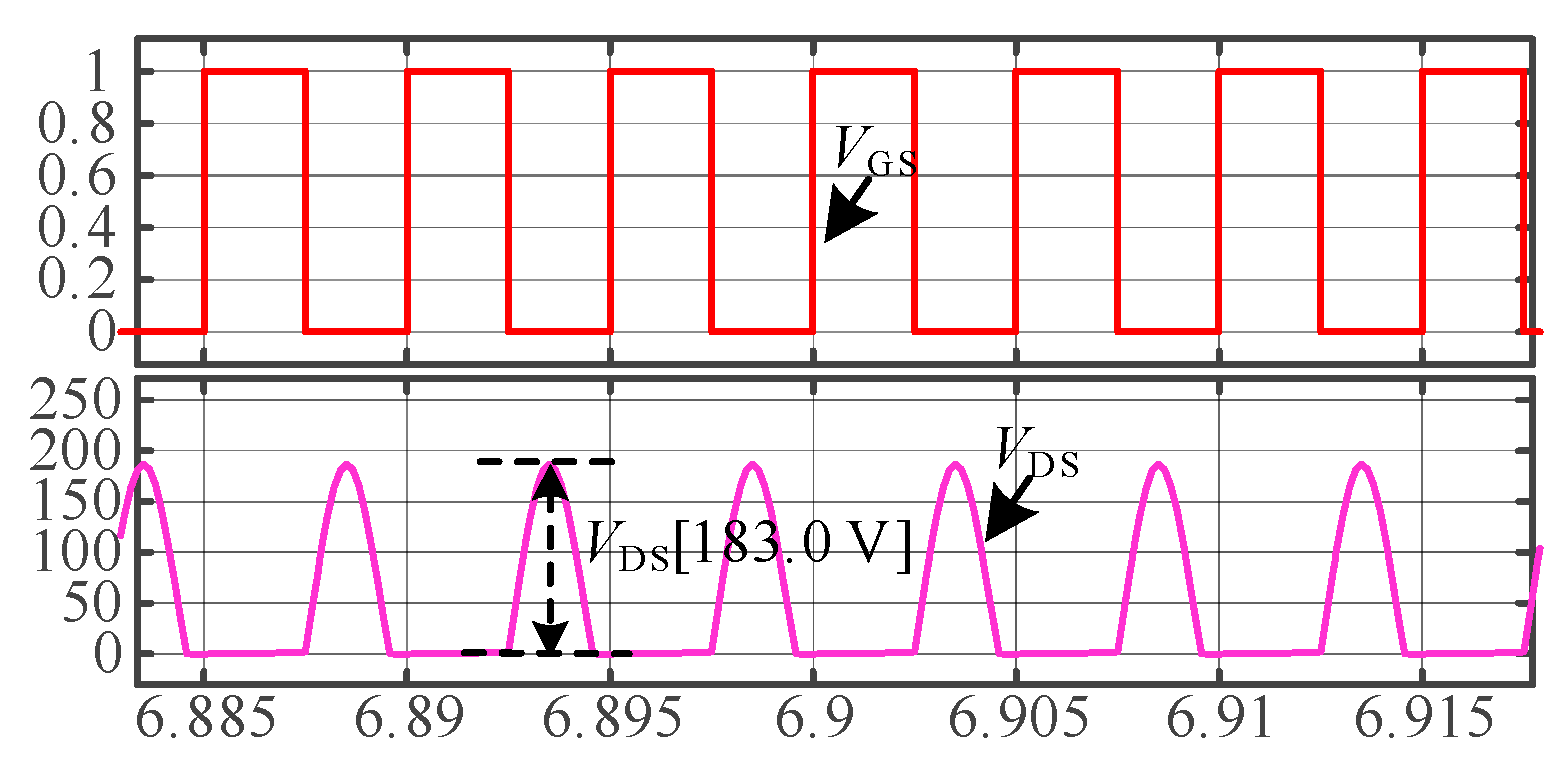
Figure 10 shows the simulated soft-switching waveforms of the MOSFET under the aligned condition. As observed, the peak-to-peak drain-source voltage (
VDS) is 183.0 V. Before the gate-source voltage (
VGS) is applied,
VDS has already decreased to zero, indicating that ZVS is achieved under the aligned condition.
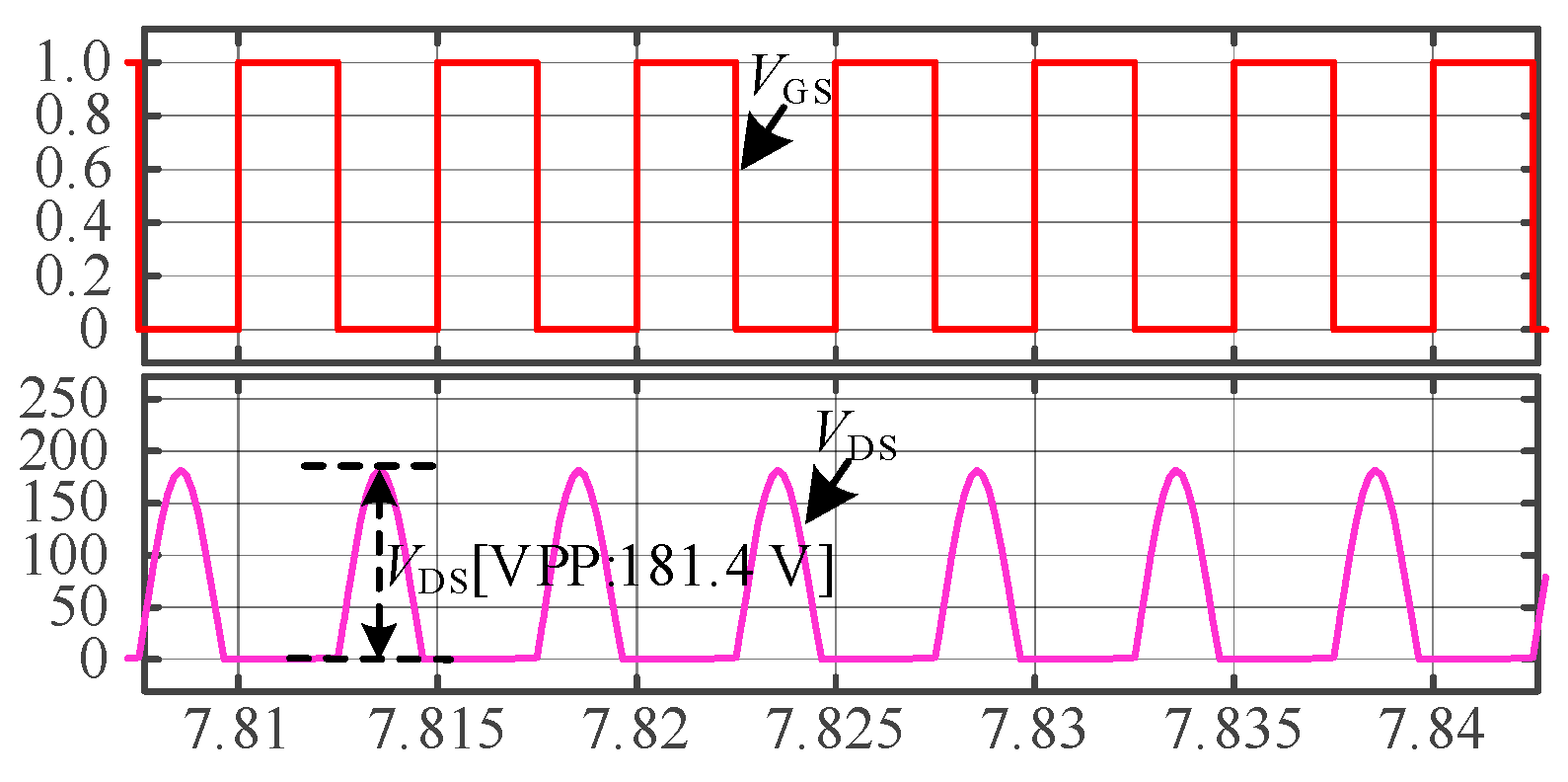
Figure 11 shows the simulated soft-switching waveform of the MOSFET when the magnetic coupler is displaced by 60 mm along the
X-axis. The peak-to-peak
VDS is 181.4 V, and the drain-source voltage drops to zero before the gate signal is applied, confirming that ZVS operation is also achieved under the misaligned condition.
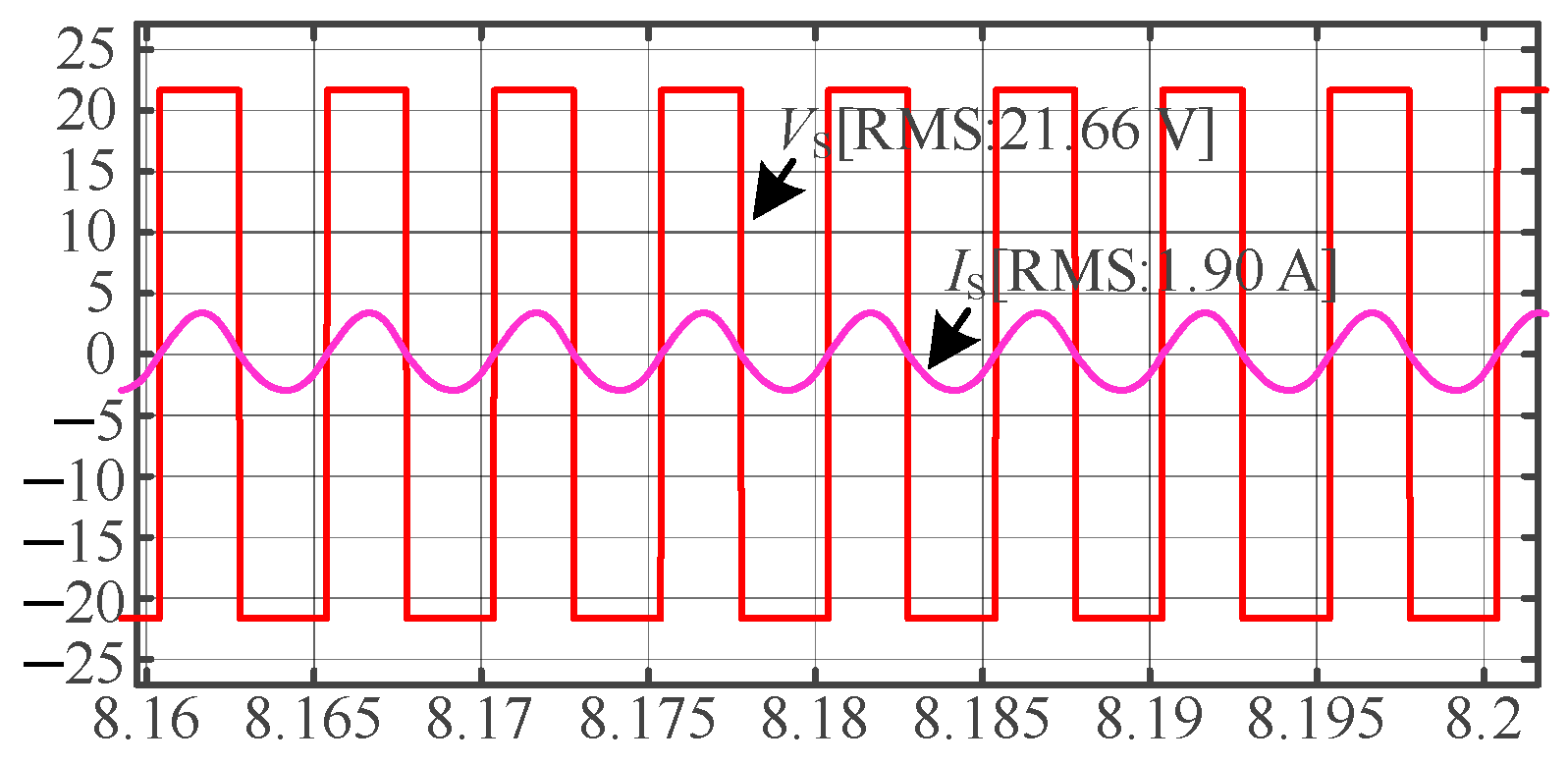
Figure 12 shows the simulated pre-rectification voltage and current waveforms under the aligned condition. The RMS values of the input voltage
VS and current
IS are 21.66 V and 1.90 A, respectively. The voltage and current are in phase, indicating that the system operates at resonance. The waveforms are smooth and exhibit no significant distortion, demonstrating high power transfer efficiency and effective resonance characteristics that ensure stable and synchronized power delivery.
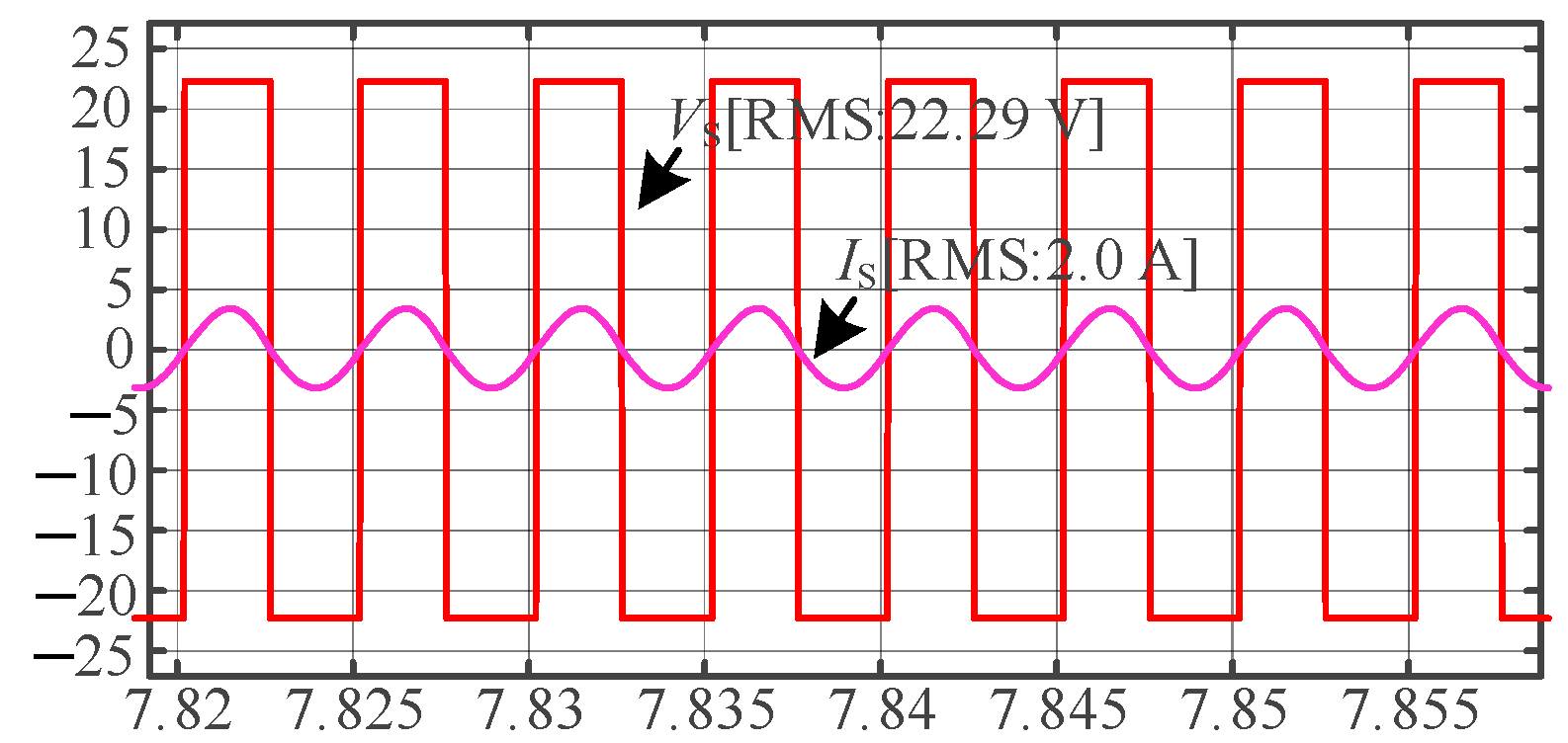
Figure 13 shows the pre-rectification voltage and current waveforms when the coupling structure is displaced by 60 mm along the
X-axis. The RMS values of
VS and
IS are 22.29 V and 2.0 A, respectively. The voltage and current remain in phase, maintaining a resonant condition. The voltage waveform approximates an ideal square wave, while the current waveform remains sinusoidal.
In summary, the simulation results verify that the proposed WPT system achieves ZVS for the switching device under both aligned and misaligned conditions, effectively reducing switching losses. Moreover, the system maintains a good phase alignment between voltage and current before rectification, ensuring resonant operation under different operating conditions. The proposed system thus exhibits excellent soft-switching characteristics, strong anti-misalignment capability, and stable power transmission performance.
5. Experimental Verification
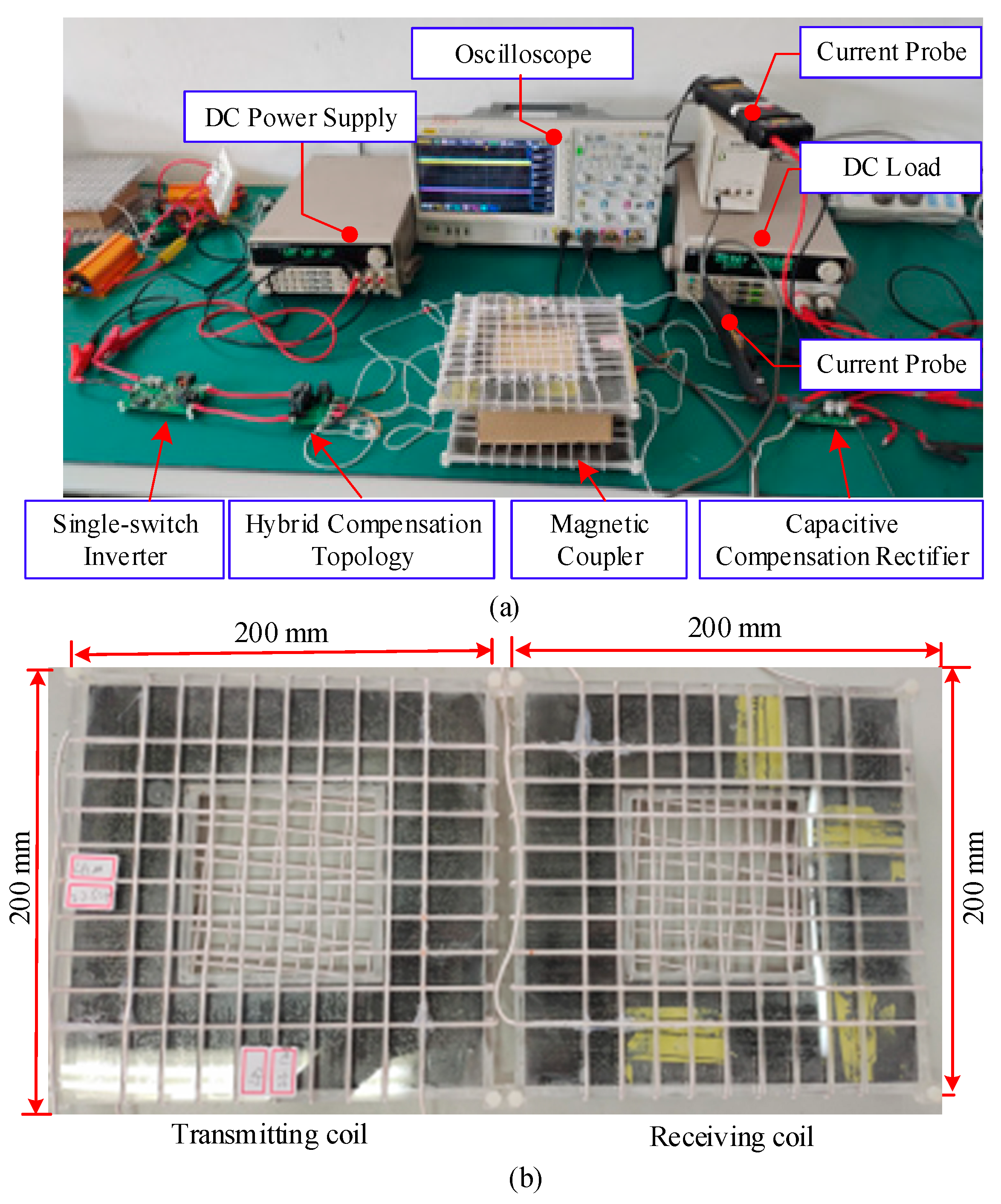
To verify the anti-misalignment performance of the proposed single-switch WPT system, an experimental prototype was built, as shown in
Figure 14a. The system consists of a single-switch inverter, the hybrid compensation network, the GFSP magnetic coupler, and a capacitive rectifier. The circuit parameters are summarized in
Table 2. The MOSFET used in the inverter is the Infineon SiHB33N60E, whose output capacitance
COSS is 156 pF, which is substantially smaller than the designed inverter resonant capacitor
CInv = 71 nF; therefore, the parasitic capacitance has a negligible influence on the resonant characteristics. The physical prototype of the GFSP magnetic coupler is shown in
Figure 14b. The coils are wound using 0.1 mm × 250-strand litz wire, and the ferrite core has dimensions of 200 mm × 200 mm × 2 mm, with a central hollow section of 100 mm per side. The measured mutual inductances are
MP1S1 = 6.10 µH and
MP2S2 = 6.28 µH.
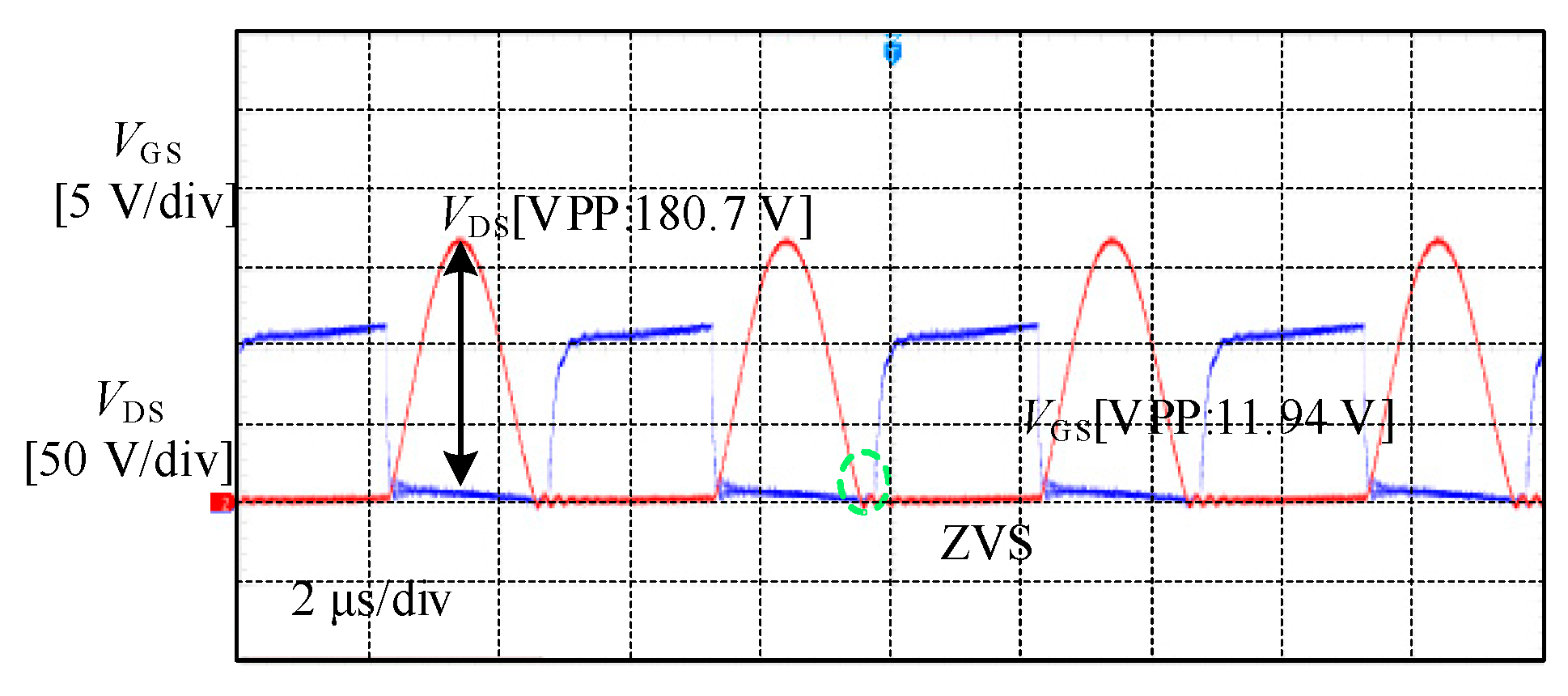
Figure 15 presents the experimentally obtained soft-switching waveforms of the MOSFET when the transmitter and receiver are perfectly aligned. The measured peak-to-peak gate-source and drain-source voltages are 11.94 V and 180.7 V, respectively. As shown in the figure, the drain-source voltage decreases to nearly zero prior to the rising transition of VGS, demonstrating that ZVS is successfully achieved under this condition.
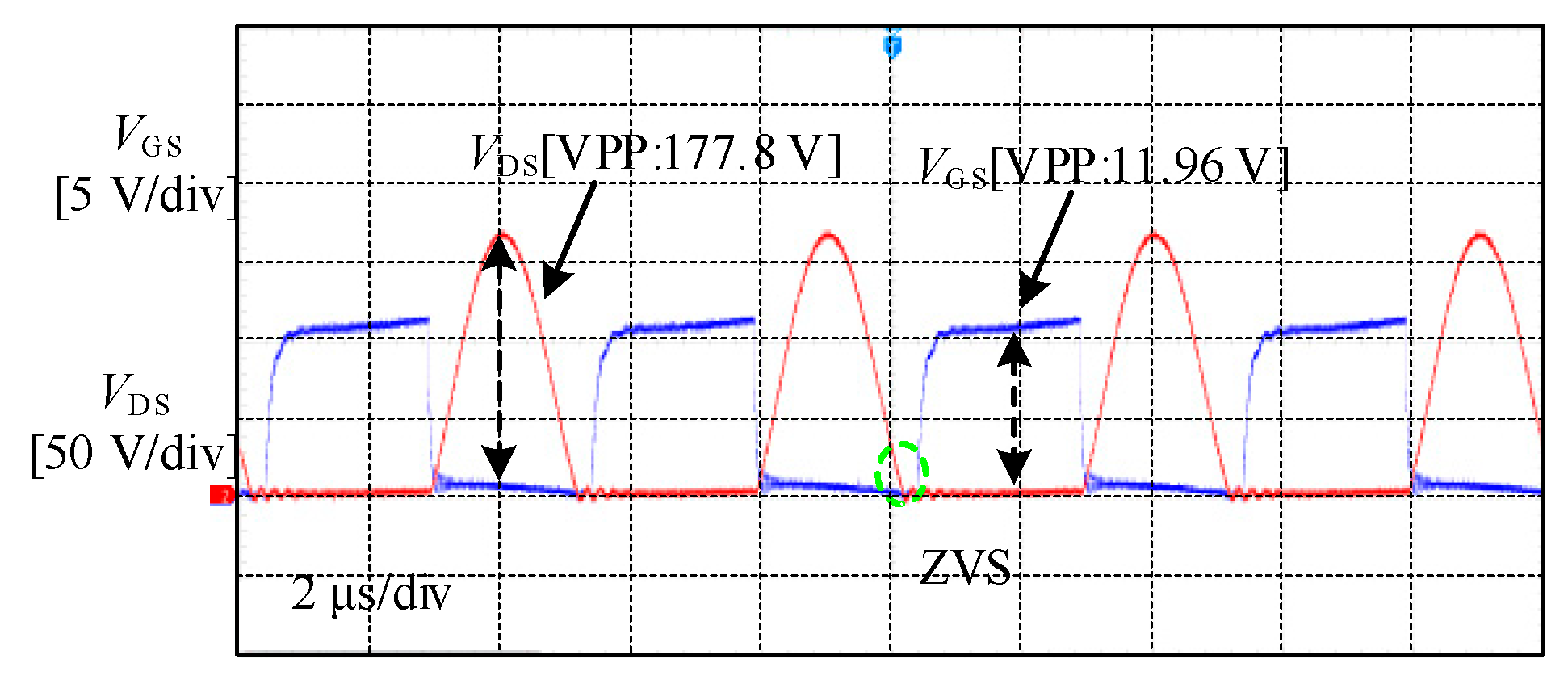
Figure 16 illustrates the soft-switching behavior when the receiver is shifted 60 mm along the
X-axis. In this case, the peak-to-peak values of
VGS and
VDS are measured as 11.96 V and 177.8 V. Although slight variations occur relative to
Figure 15,
VDS still collapses to zero before the gate signal turns on, which confirms that the ZVS operation is well preserved despite the lateral displacement.
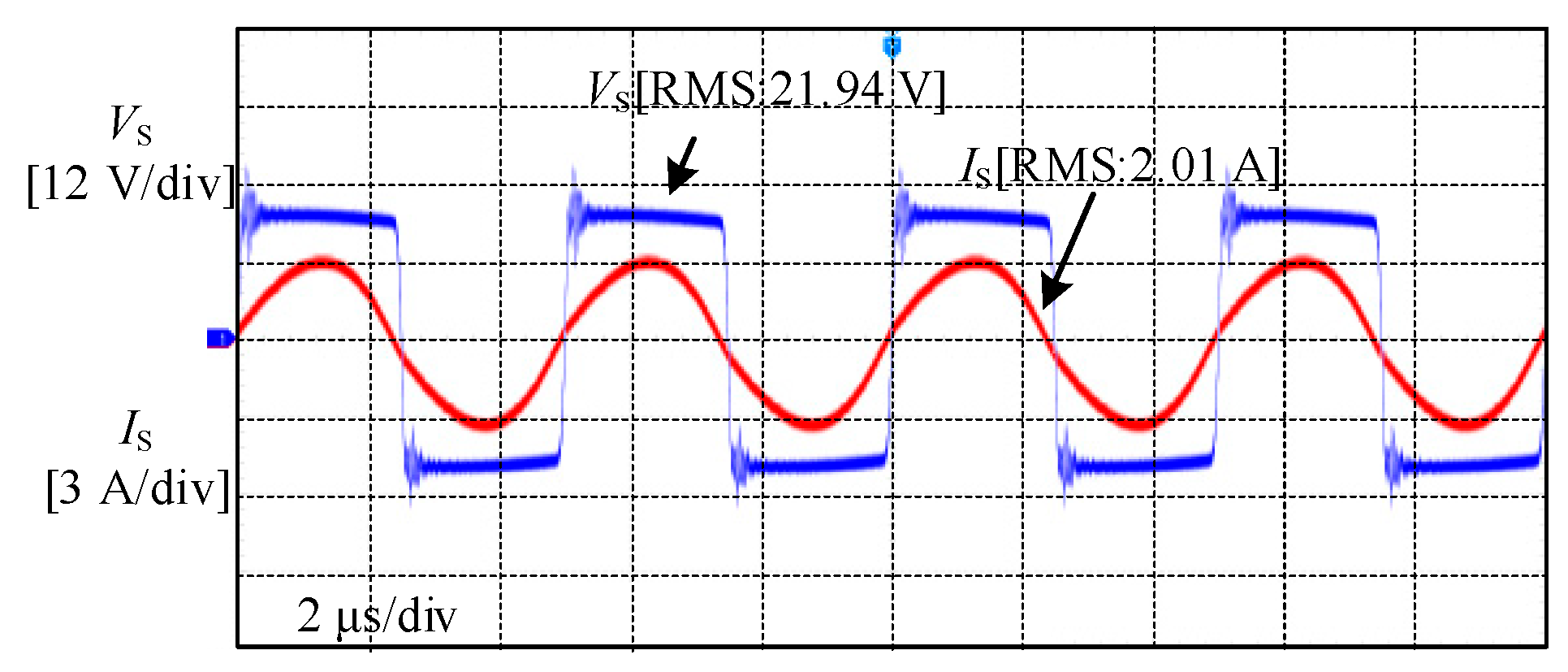
Figure 17 depicts the pre-rectification voltage and current waveforms under the aligned setup. The RMS input voltage
VS is 21.94 V and the corresponding current
IS is 2.01 A. The voltage and current are nearly perfectly synchronized, indicating that the system operates at its resonant point.
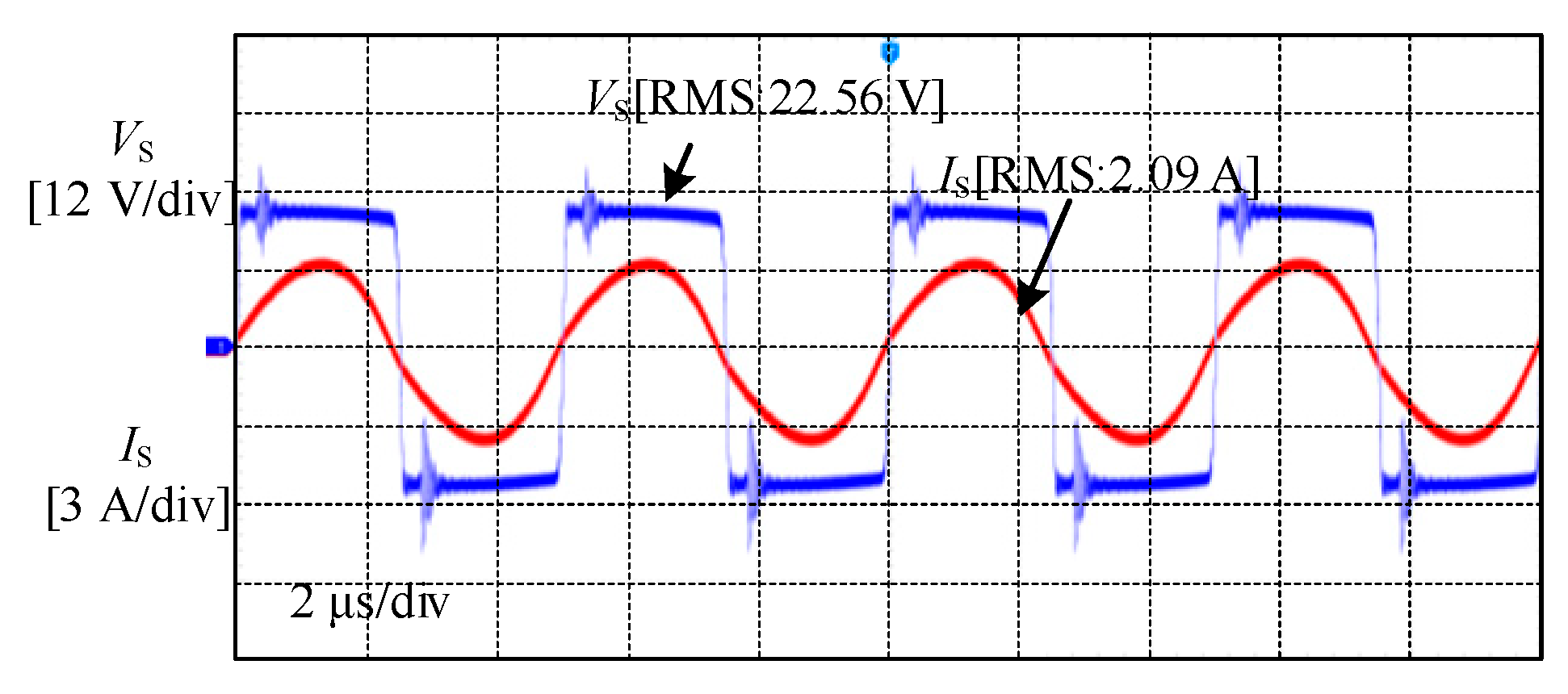
Figure 18 shows the pre-rectification waveforms when the receiver is laterally displaced by 60 mm. The measured RMS magnitudes of
VS and
IS are 22.56 V and 2.09 A. The two waveforms remain in phase, implying that resonance is essentially unaffected. A comparison with
Figure 17 reveals that the input electrical characteristics change only marginally under misalignment, demonstrating the system’s strong ability to maintain resonance in the presence of spatial deviation.
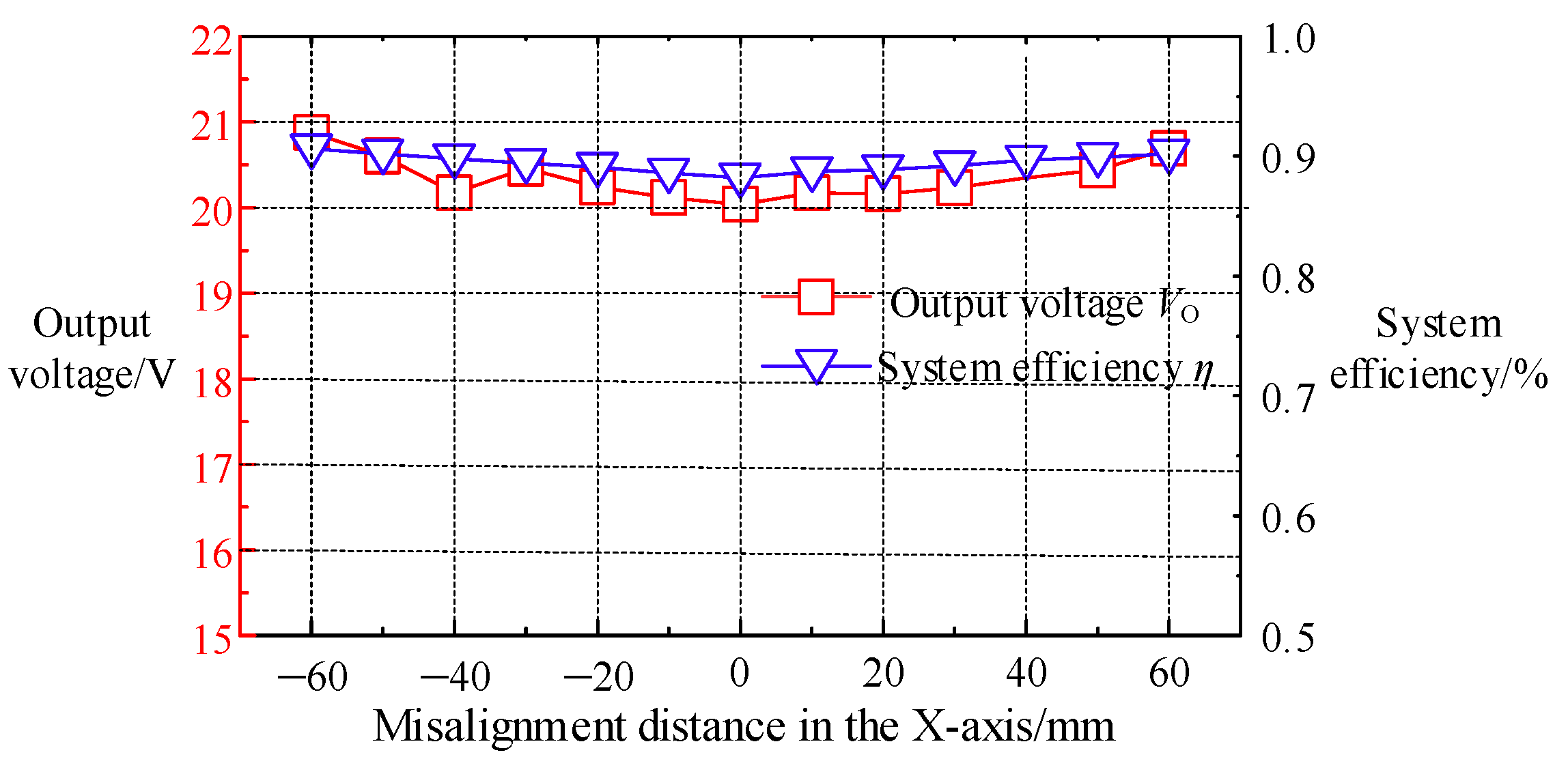
Figure 19 shows the variations in output voltage and efficiency with respect to lateral displacement along the
X-axis. When the load resistance is 10 Ω, the output voltage and efficiency are 20.04 V and 88.2% under the aligned condition, 20.83 V and 90.6% at −60 mm misalignment, and 20.69 V and 90.2% at +60 mm misalignment. The results show that both output voltage
VO and system efficiency η fluctuate minimally with increasing misalignment distance, with voltage fluctuation below 4% and efficiency fluctuation below 3%. These results further demonstrate that the proposed system maintains excellent output stability and energy transfer efficiency under lateral misalignment, confirming its strong anti-misalignment capability.
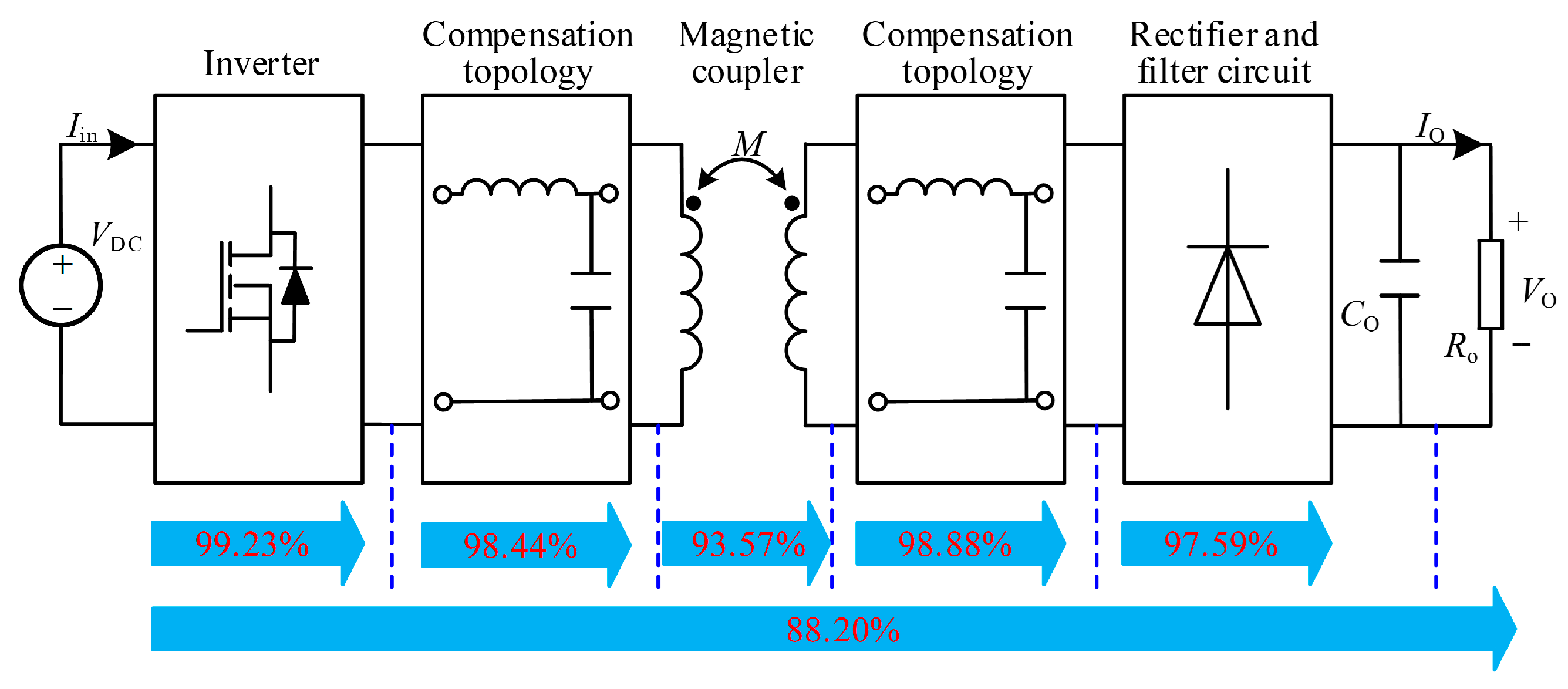
To quantitatively evaluate the loss mechanisms of the proposed WPT system, the loss distribution is analyzed at the rated output power of 50 W with an 8 Ω load. Using the oscilloscope’s mathematical power-calculation function, the active power of each subsystem is measured, enabling the efficiency of every functional stage to be obtained. The measured efficiencies of the inverter, primary compensation network, magnetic coupler, secondary compensation network, and rectifier-filter circuit are 99.23%, 98.44%, 93.57%, 98.88%, and 97.59%, respectively, as illustrated in
Figure 20. It can be observed that the magnetic coupler and the rectifier-filter circuit account for the majority of the total losses, whereas the single-switch inverter exhibits the lowest loss contribution. It should be noted that although high efficiency is maintained under the tested misalignment range, practical magnetic couplers inevitably suffer from flux leakage and coupling degradation under severe misalignment conditions, which may further influence system performance.
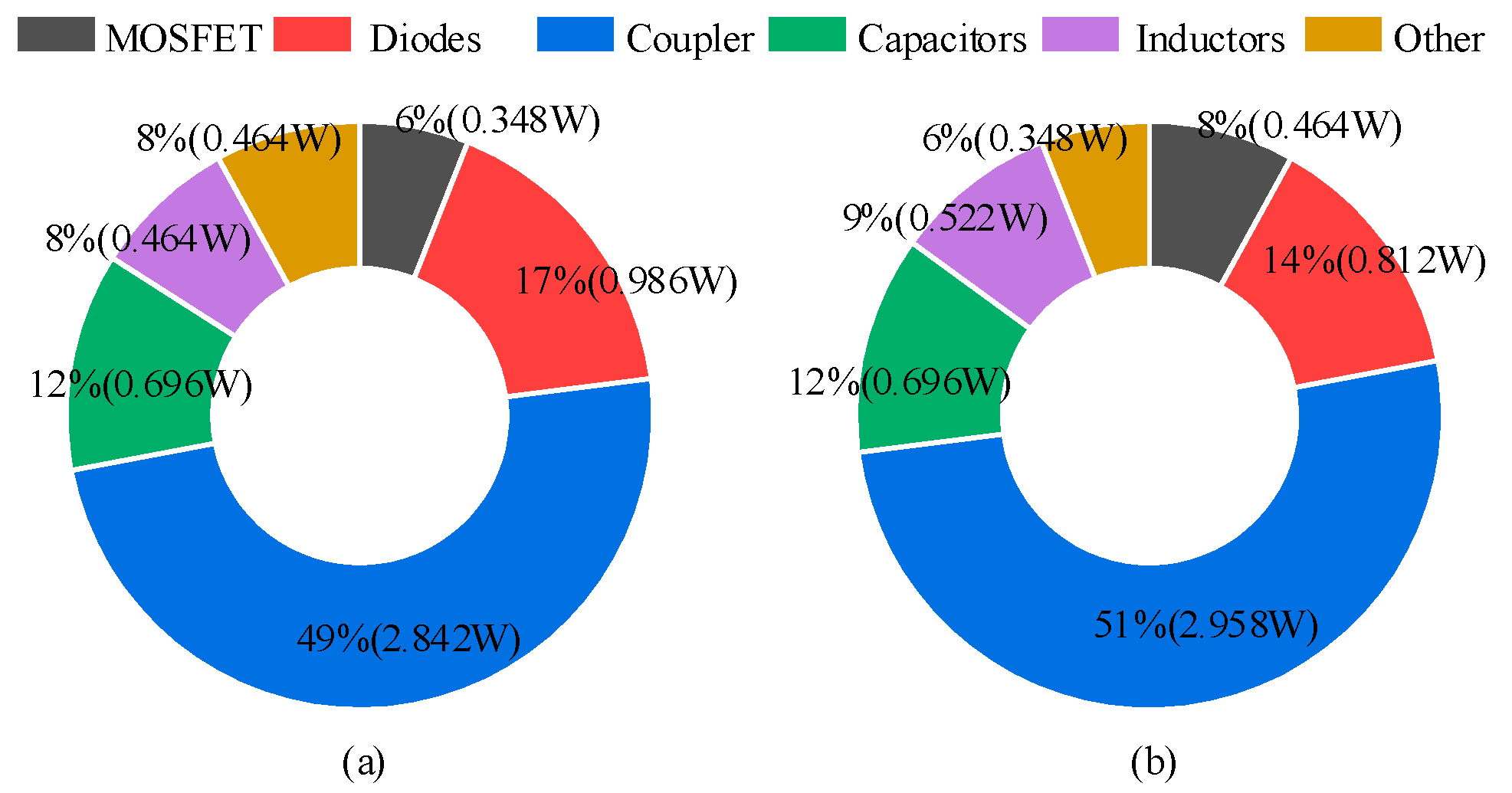
To further determine the contribution of each circuit component, a detailed loss breakdown is provided in
Figure 21 under both perfect alignment and maximum misalignment. Coil and compensation-inductor losses are calculated by
, conduction losses of the MOSFET are obtained using
, while rectifier diode losses are evaluated by the product of the forward voltage drop and conduction current. In the aligned condition, copper and core losses of the coils dominate the total losses, followed by rectifier losses, while capacitor and inductor losses remain relatively low. When the coupler is misaligned, the coupling coefficient reduces to approximately 0.1. To maintain a constant output power, the primary current increases, leading to increased losses in the MOSFET, diode, compensation inductors, and magnetic coupler. Capacitor losses remain nearly unchanged. The loss comparison clearly shows that misalignment results in a higher overall power loss due to the increased current stress in the front-end circuit.
Table 3 compares the proposed system with several representative WPT systems reported in the literature [
30,
31,
32,
33,
34,
35,
36]. Compared with [
30,
31,
31], and [
35], which employed large-sized coils, the proposed GFSP-GFSP magnetic coupler achieves stronger anti-misalignment performance with smaller coil dimensions while maintaining output voltage and efficiency fluctuations within 4% and 3%, respectively, at ±60 mm misalignment. In addition, the compensation topologies in [
30,
31,
32,
33,
34,
35,
36] generally involve multiple bridges and numerous passive components, leading to increased system complexity. In contrast, the proposed hybrid LCC-S and S-S compensation combined with a single-switch inverter simplifies the structure while preserving stable output characteristics under misalignment. Therefore, the proposed system exhibits superior overall performance in terms of anti-misalignment, efficiency, and circuit simplicity, making it highly suitable for medium- and low-power WPT applications.
It should be noted that some reported WPT systems in the literature achieve larger misalignment distances primarily by adopting coils with significantly larger physical dimensions, which naturally extend the magnetic field coverage. In contrast, the misalignment tolerance of the proposed system is evaluated under more compact coil size constraints. In practical implementations, the magnetic coupler performance under misalignment is also influenced by factors such as coil geometry, magnetic material distribution, air-gap variation, and manufacturing tolerances, which may introduce additional flux leakage and efficiency degradation under severe misalignment conditions.
In summary, the experimental results demonstrate that the proposed WPT system can achieve ZVS of the power switch under both aligned and ±60 mm X-axis misalignment conditions, validating its excellent soft-switching performance. The voltage and current waveforms before rectification remain in good phase alignment, indicating that the system consistently operates under resonant conditions. Furthermore, the variations in output voltage and overall efficiency under different misalignment positions are minimal, further confirming the proposed system’s superior misalignment tolerance and stable power transfer capability. These results provide a reliable foundation for the practical application of WPT systems in medium- and low-power scenarios.