
Assessing the Economic Viability and Reliability of Advanced Truck Powertrains: A California Freight Case Study


 , ,
, ,
Abstract
1. Introduction
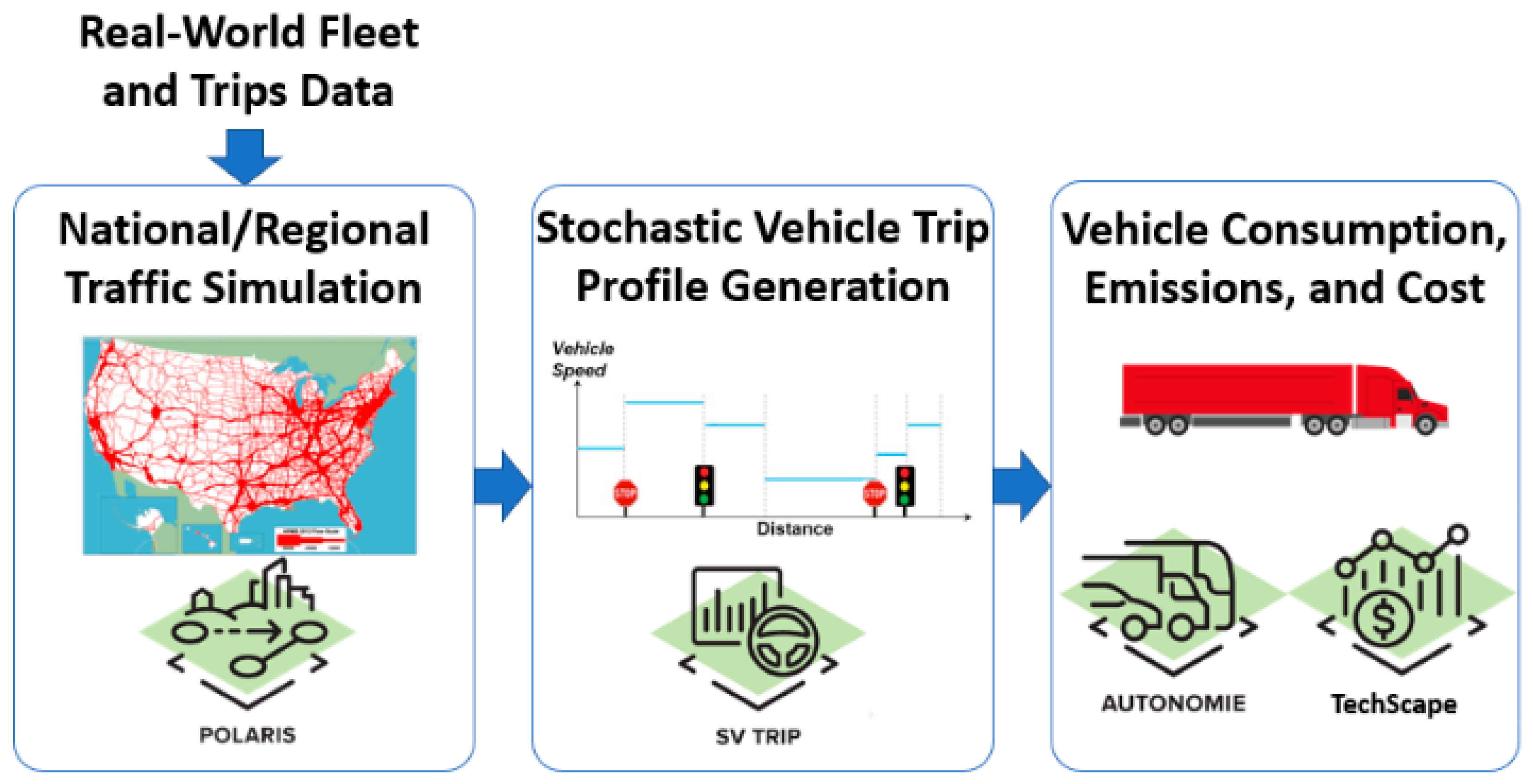
2. Methodology
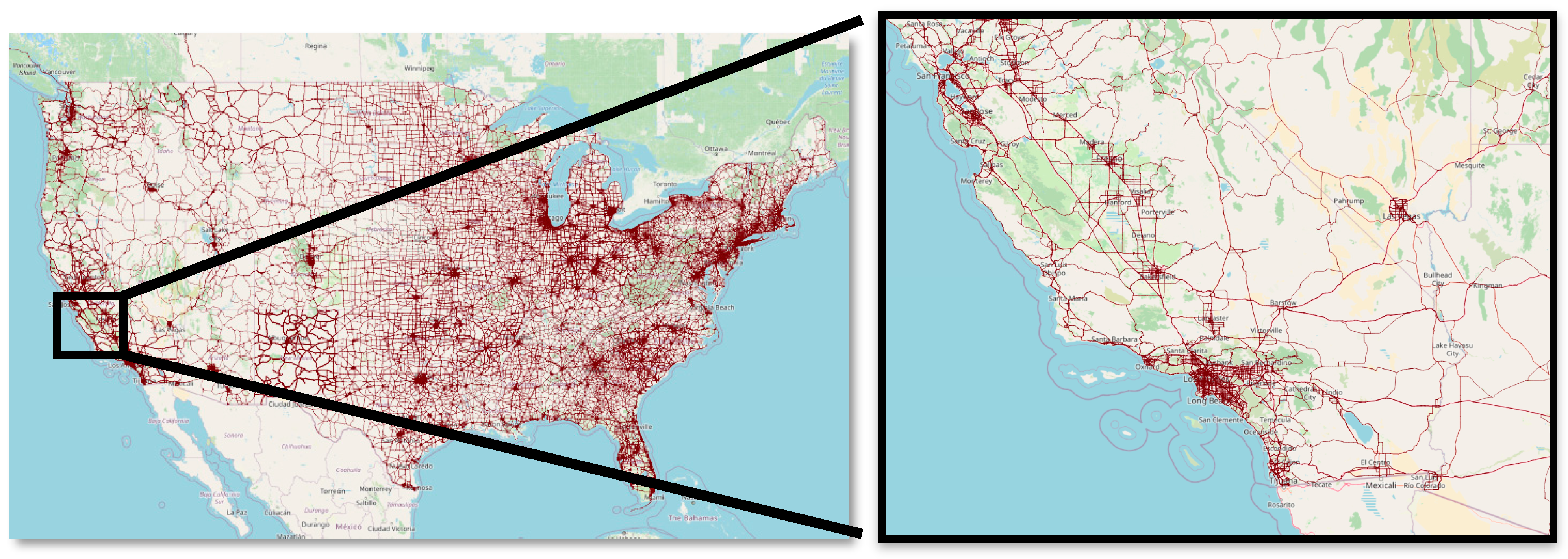
2.1. POLARIS for Transportation System Modeling
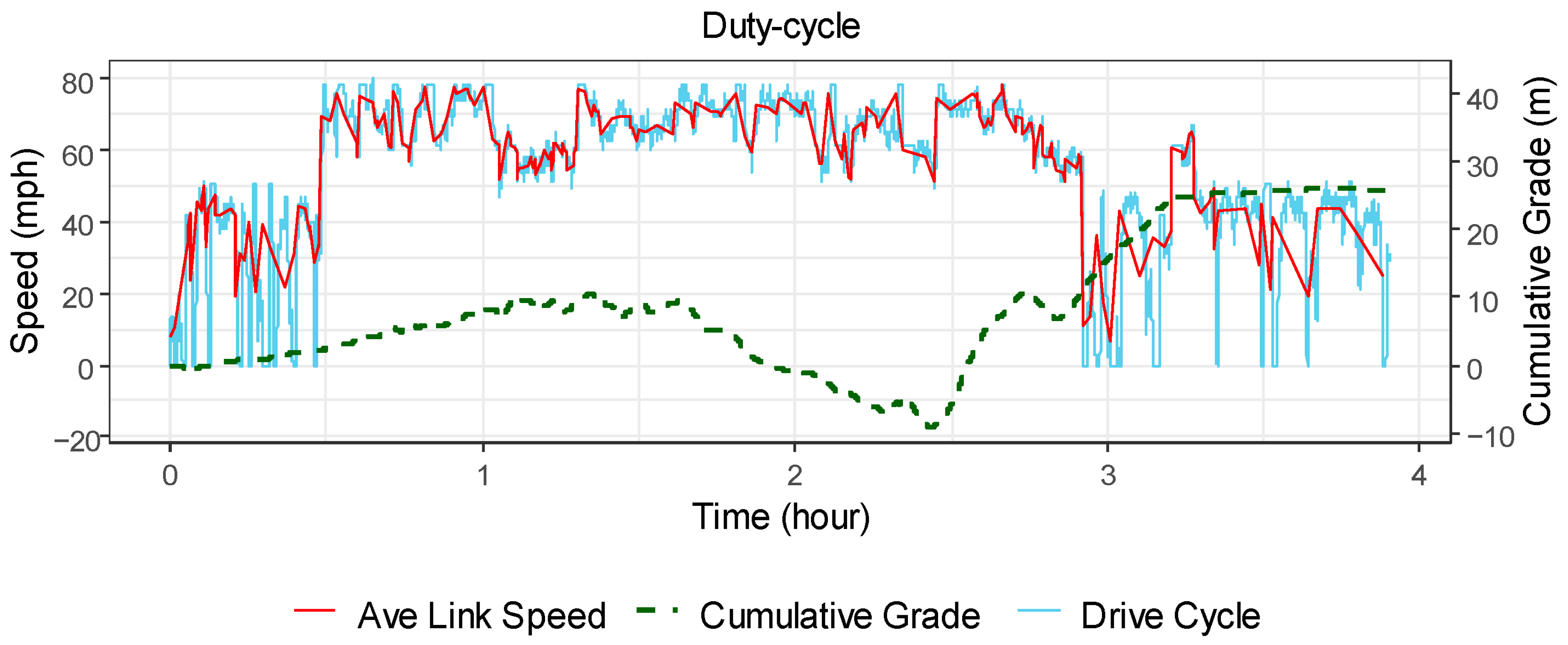
2.2. SVTriP for Trip Profile Generation
2.3. Autonomie for Energy Consumption Evaluation
2.4. TechScape for Techno-Economic Analysis
2.5. Operational Evaluation and Analysis Framework
- ▪
- 0–250 miles,
- ▪
- 250–500 miles,
- ▪
- 500+ miles.
- ▪
- Technology-Level Cost Analysis: This analysis evaluates each powertrain independently within each range bin and identifies which technology yields the lowest LCOD under varying electricity, hydrogen, and diesel price scenarios. This approach helps determine under which market conditions a specific technology becomes the most cost-effective. It can support early-stage assessments of emerging technologies or inform technology developers and policymakers on comparative performance under different market environments.
- ▪
- Fleet-Level Cost Analysis: This analysis simulates how a fleet operator might select a single powertrain to serve all tours within a given range bin. By aggregating LCOD across all tours in each bin, this approach identifies the lowest-cost technology at the system level, offering a practical view for strategic fleet planning. This system-level analysis is especially valuable for fleet managers and decision-makers, offering a practical view of which powertrain minimizes costs at scales across typical daily operations. It enables fleet owners to identify the most economically viable technology for each segment of their business and to plan targeted transitions to lower-cost, lower-emission powertrains.
3. Results and Discussions
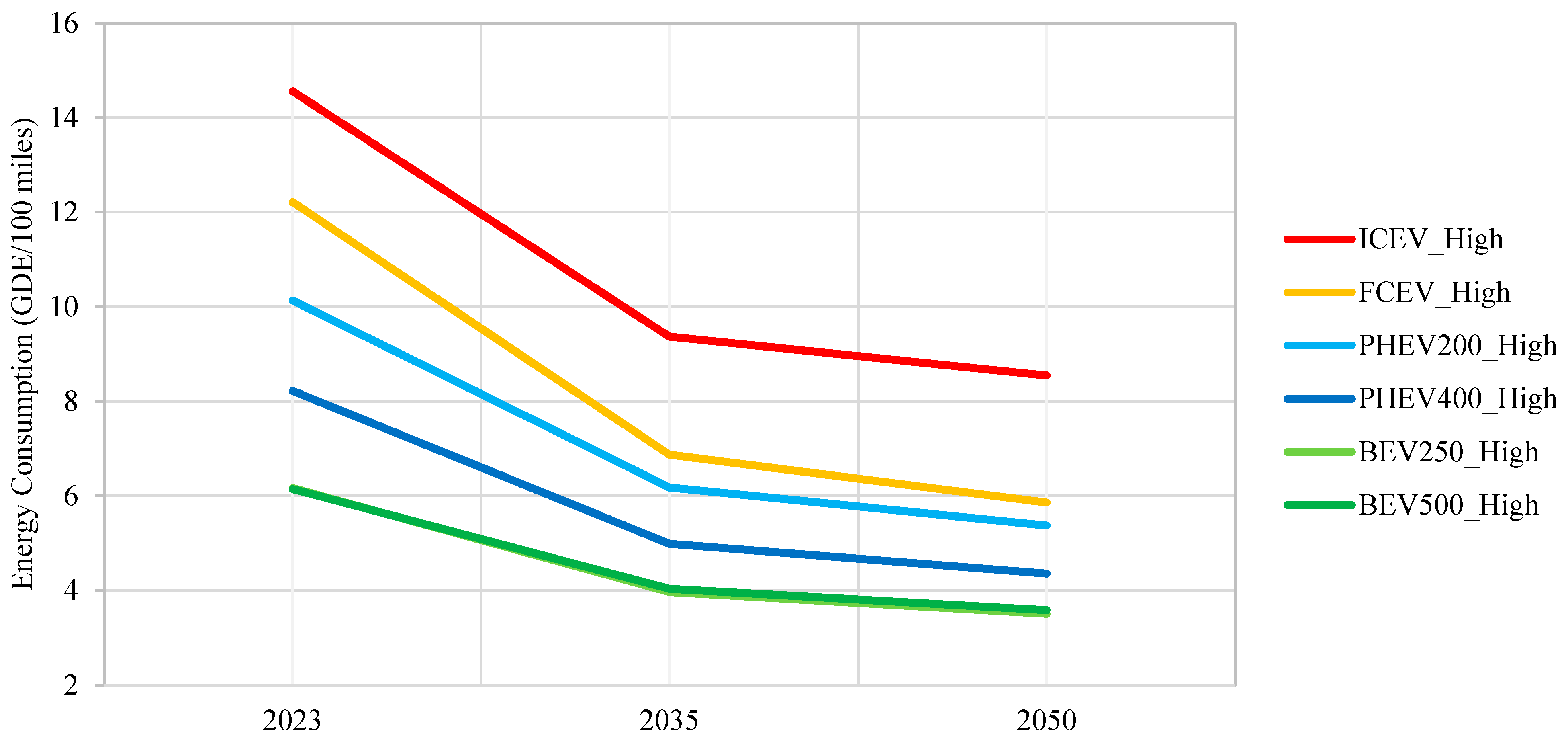
3.1. Energy Consumption Impact
3.2. Cost Impact
- ▪
- 0–250 miles: BEV500 and PHEV400 are excluded, as BEV250 and PHEV250 are sufficient for this range.
- ▪
- 250–500 miles: BEV250 is excluded, since operations are assumed to occur on a single charge.
- ▪
- 500+ miles: No BEVs are included due to range constraints under the single-charge assumption. This limitation will be revisited in future research.
3.2.1. Technology-Level Cost Analysis
- ▪
- Electricity prices: USD 0.10–0.50/kWh;
- ▪
- Hydrogen price: USD 4/kg (fixed);
- ▪
- Diesel prices (from [21]):
- -
- Reference case: USD 3.21/gal in 2035, USD 3.43/gal in 2050;
- -
- High-cost case: USD 5.325/gal in 2035, USD 5.73/gal in 2050.
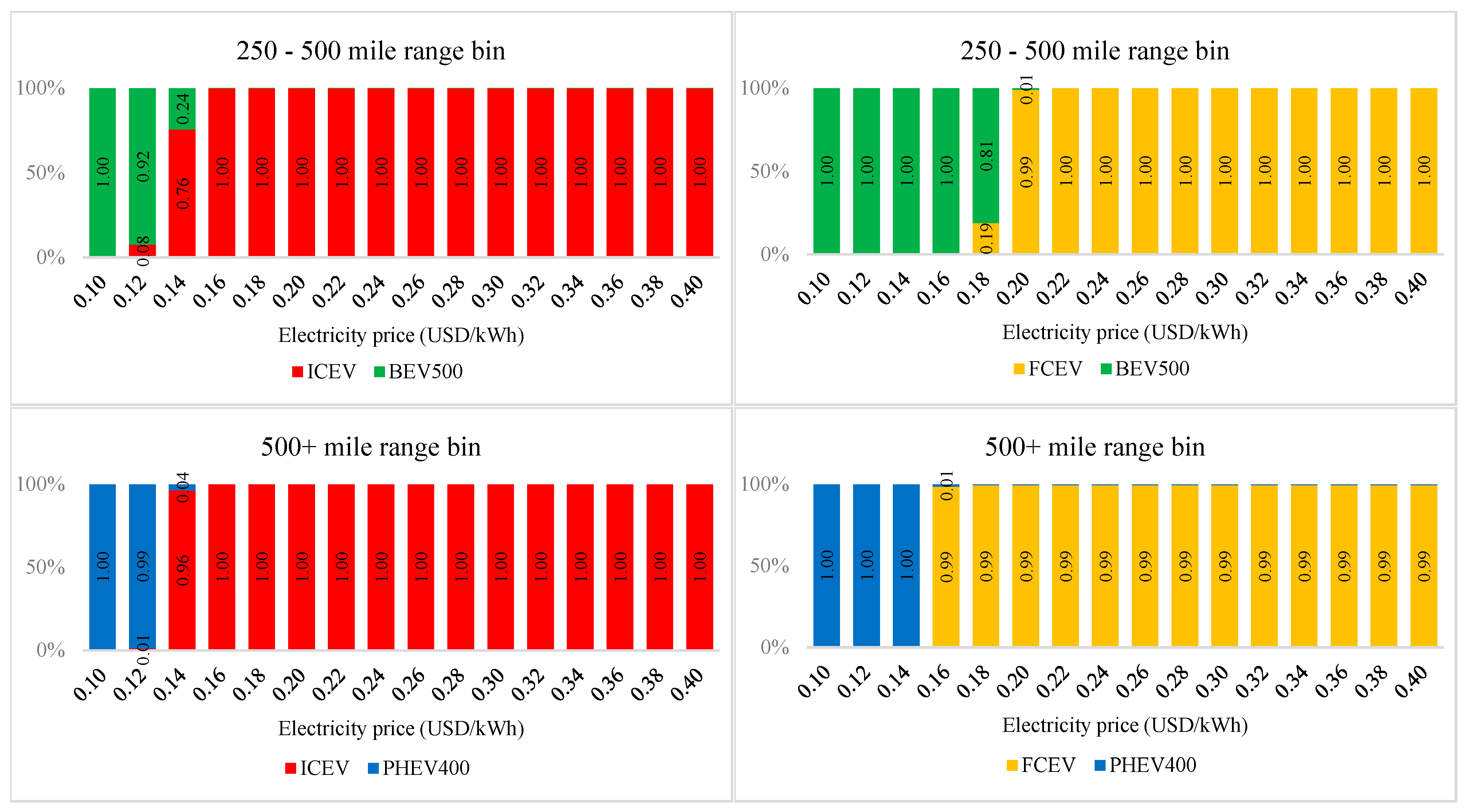
- (a)
- Reference-Diesel-Cost Scenario
- (b)
- High-diesel-cost scenario
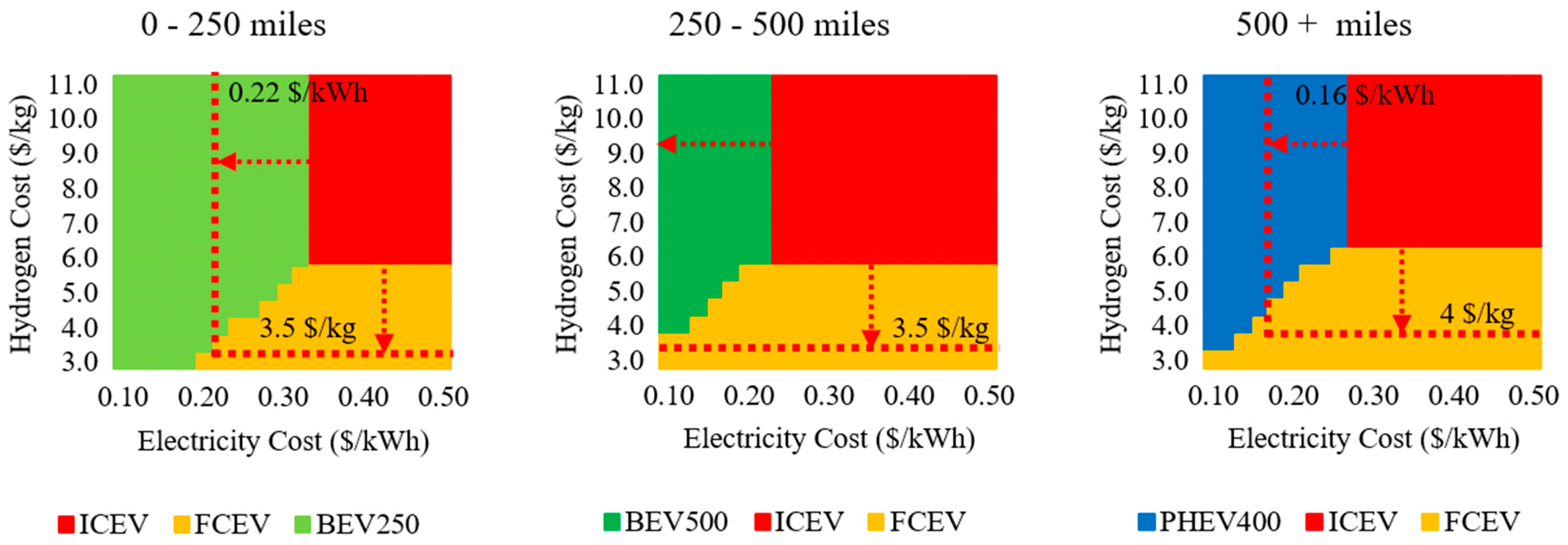
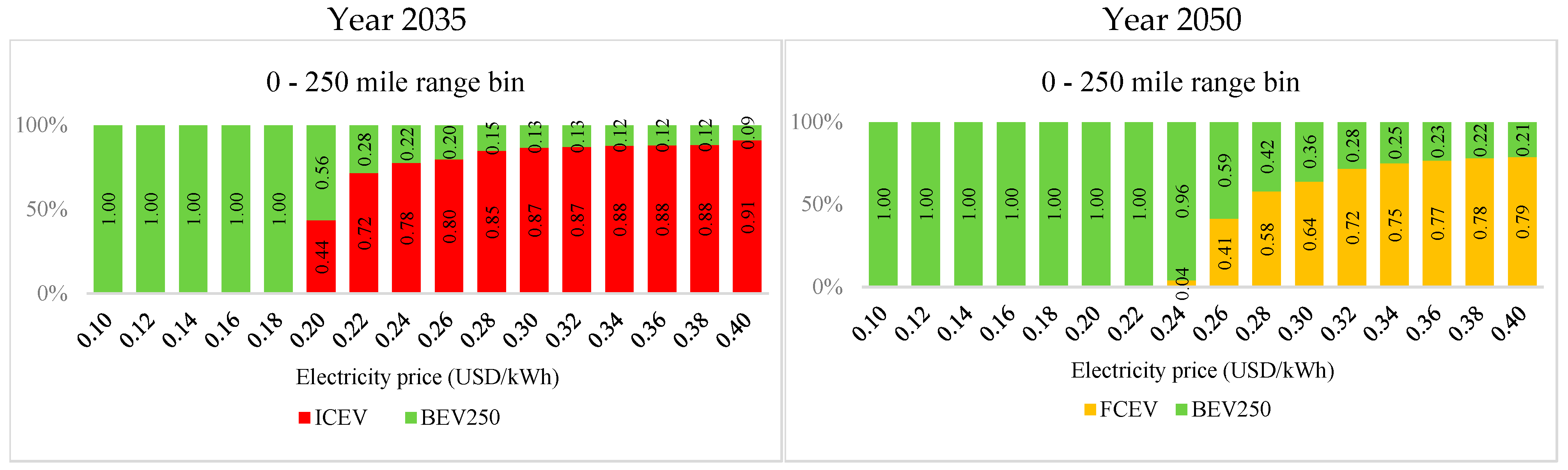
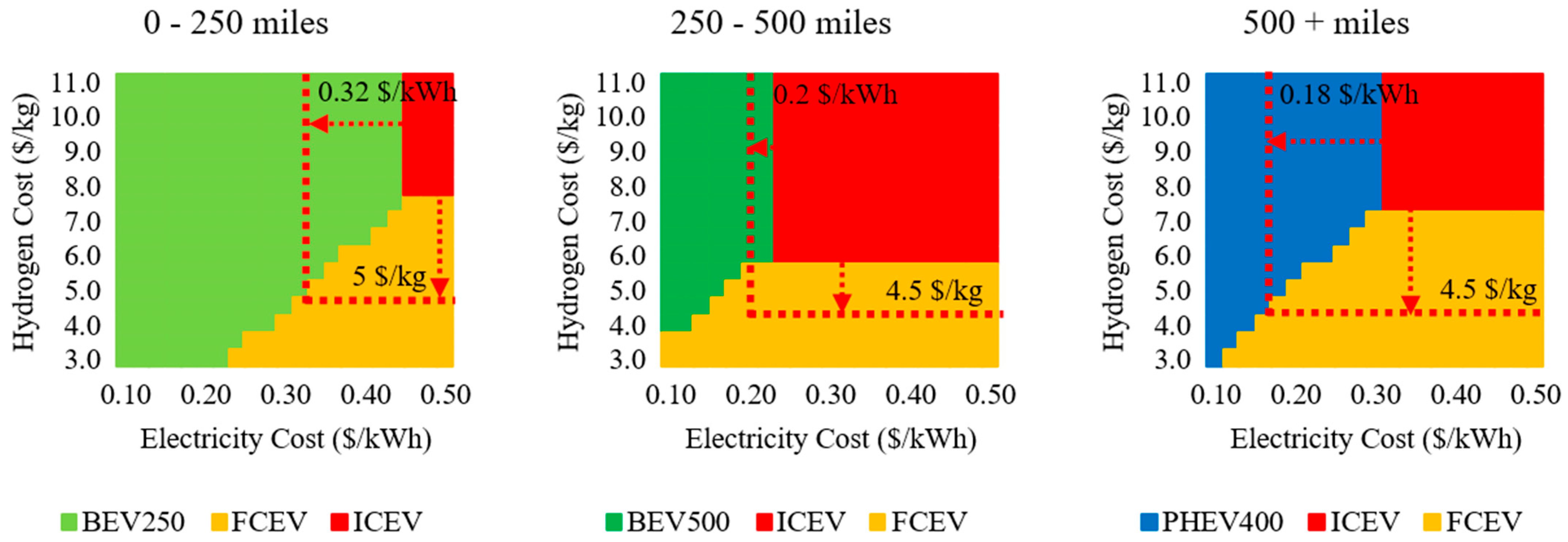
3.2.2. Fleet-Level Cost Analysis
- ▪
- Electricity prices: USD 0.10–0.50/kWh;
- ▪
- Hydrogen prices: USD 3–11/kg;
- ▪
- Diesel prices (from [21]):
- -
- Reference case: USD 3.21/gal in 2035, USD 3.43/gal in 2050;
- -
- High-cost case: USD 5.325/gal in 2035, USD 5.73/gal in 2050.
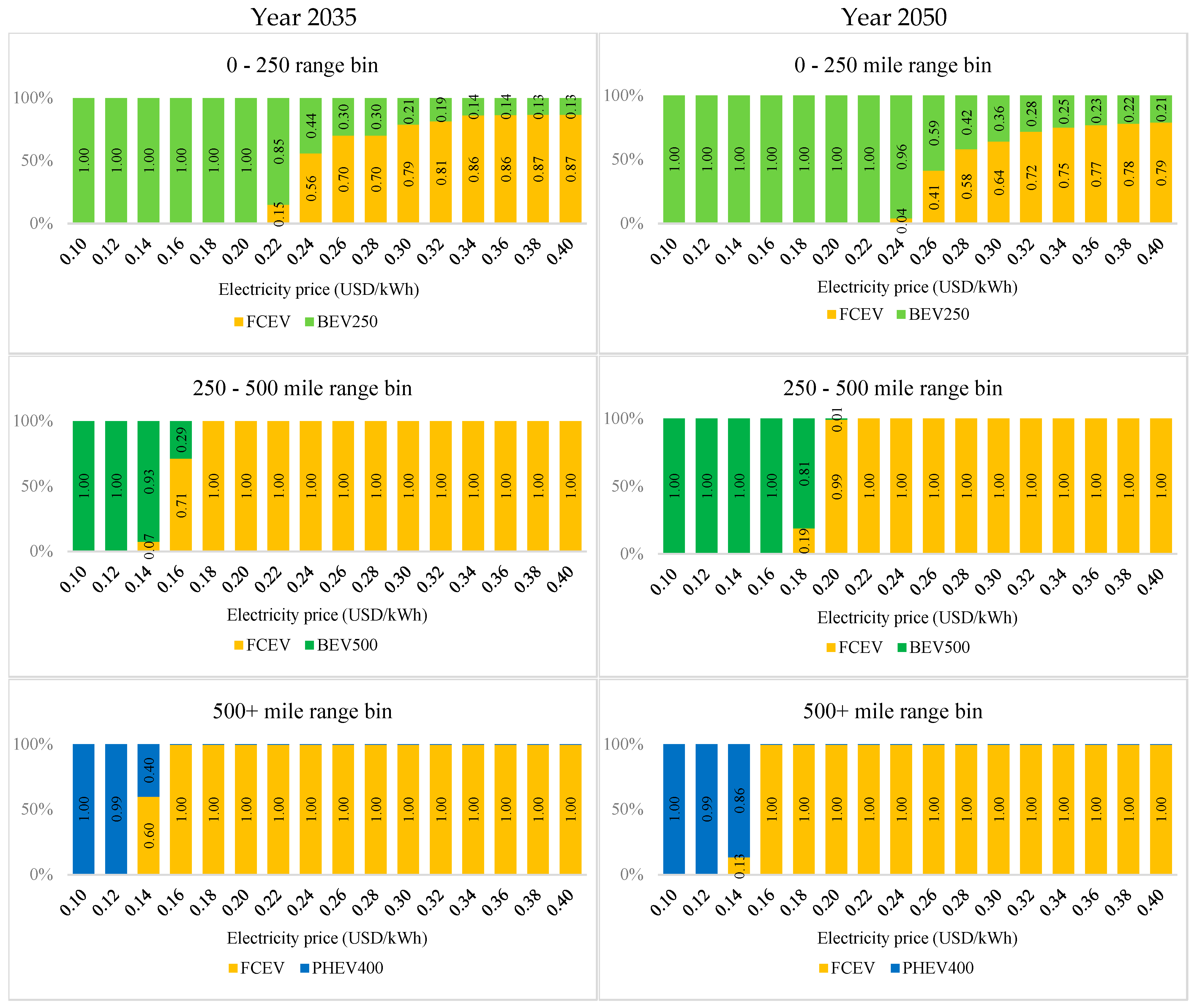
- (a)
- 2035 Results
- 0–250-Mile Range Bin
- 250–500-Mile Range Bin
- 500+-Mile Range Bin
- (b)
- 2050 Results
- 0–250-Mile Range Bin
- 250–500-Mile Range Bin
- 500+-Mile Range Bin
4. Summary and Conclusions
Author Contributions
Funding
Data Availability Statement
Acknowledgments
Conflicts of Interest
References
- FHWA. Highway Statistics 2019. Available online: https://www.fhwa.dot.gov/policyinformation/statistics/2019/vm1.cfm (accessed on 1 June 2022).
- Joshi, S.; Dahodwala, M.; Ahuja, N.; Dhanraj, F.N.; Koehler, E.; Franke, M.; Tomazic, D. Evaluation of Hybrid, Electric and Fuel Cell Powertrain Solutions for Class 6-7 Medium Heavy-Duty Vehicles. SAE Int. J. Adv. Curr. Prac. Mobility 2021, 3, 2955–2971. [Google Scholar] [CrossRef]
- Vijayagopal, R.; Rousseau, A. Electric Truck Economic Feasibility Analysis. World Electr. Veh. J. 2021, 12, 75. [Google Scholar] [CrossRef]
- Haddad, M.; Mansour, C.; Diab, J. System dynamics modeling for mitigating energy use and CO2 emissions of freight transport in Lebanon. In Proceedings of the International Conference on Industrial Engineering and Operations Management, Riyadh, Saudi Arabia, 26–28 November 2019. [Google Scholar]
- Moreno Sader, K.M.; Biswas, S.; Jones, R.; Mennig, M.; Rezaei, R.; Green, W.H. Battery electric long-haul trucking with overnight charging in the United States: A comprehensive costing and emissions analysis. Appl. Energy 2025, 384, 125443. [Google Scholar] [CrossRef]
- Bai, F.; Zhao, F.; Liu, M.; Liu, Z.; Hao, H.; Reiner, D.M. Assessing the viability of renewable hydrogen, ammonia, and methanol in decarbonizing heavy-duty trucks. Appl. Energy 2025, 383, 125293. [Google Scholar] [CrossRef]
- Mu, Z.; Zhao, F.; Bai, F.; Liu, Z.; Hao, H. Evaluating fuel cell vs. battery electric trucks: Economic perspectives in alignment with China’s carbon neutrality target. Sustainability 2024, 16, 2427. [Google Scholar] [CrossRef]
- Basma, H.; Rodríguez, F. A total cost of ownership comparison of truck decarbonization pathways in Europe. In Proceedings of the International Council on Clean Transportation, Washington, DC, USA, 13 November 2023; Working Paper 2023-28. Available online: https://theicct.org/publication/total-cost-ownership-trucks-europe-nov23/ (accessed on 1 December 2025).
- Sun, R.; Sujan, V.A.; Jatana, G. Systemic decarbonization of road freight transport: A comprehensive total cost of ownership model. arXiv 2024. [Google Scholar] [CrossRef]
- Lustbader, J.; Selvam, P.; Bennion, K.; Payne, G.; Hunter, C.; Penev, M.; Brooker, A.; Baker, C.; Birky, A.; Zhang, C.; et al. Transportation Technology Total Cost of Ownership (T3CO); National Renewable Energy Laboratory: Golden, CO, USA, 2024. Available online: https://www.nrel.gov/transportation/t3co (accessed on 1 December 2025).
- Anderson, O.; Hong, W.; Wang, B.; Yu, N. Impact of flexible and bidirectional charging in medium- and heavy-duty trucks on California’s decarbonization pathway. Appl. Energy 2025, 377, 124450. [Google Scholar] [CrossRef]
- Lehmann, J.; Winkenbach, M. Technology and energy choices for fleet asset decarbonization under cost uncertainty. Transp. Res. Part D Transp. Environ. 2025, 139, 104525. [Google Scholar] [CrossRef]
- Auld, J.; Hope, M.; Ley, H.; Sokolov, V.; Xu, B.; Zhang, K. POLARIS: Agent-based modeling framework development and implementation for integrated travel demand and network and operations simulations. Transp. Res. Part C Emerg. Technol. 2016, 64, 101–116. [Google Scholar] [CrossRef]
- Karbowski, D.; Rousseau, A.; Smis-Michel, V.; Vermeulen, V. Trip Prediction Using GIS for Vehicle Energy Efficiency. In Proceedings of the ITS World Congress, Detroit, MI, USA, 7–11 September 2014. [Google Scholar]
- Moawad, A.; Kim, N.; Shidore, N.; Rousseau, A. Assessment of Vehicle Sizing, Energy Consumption and Cost Through Large Scale Simulation of Advanced Vehicle Technologies; ANL/ESD-15/28; Argonne National Lab. (ANL): Argonne, IL, USA, 2016. [Google Scholar] [CrossRef]
- Argonne National Laboratory. TechScape. Available online: https://vms.taps.anl.gov/tools/techscape/ (accessed on 2 June 2025).
- HERE Maps. Developer Guide—HERE Routing API. Available online: https://www.here.com/docs/bundle/routing-api-developer-guide-v8/page/README.html (accessed on 13 July 2025).
- Mansour, C.; Sabri, E.I.; Vijayagopal, R.; Pagerit, S.; Rousseau, A. Assessing the Potential Consumption and Cost Benefits of Next-Generation Technologies for Medium- and Heavy-Duty Vehicles: A Vehicle-Level Perspective. In Proceedings of the 2023 IEEE Vehicle Power and Propulsion, Milano, Italy, 23–27 October 2023. [Google Scholar]
- Islam, E.S.; Nieto Prada, D.; Vijayagopal, R.; Mansour, C.; Phillips, P.; Kim, N.; Alchahir Alhajjar, M.; Rousseau, A. Detailed Simulation Study to Evaluate Future Transportation Decarbonization Potential; Argonne National Laboratory (ANL): Argonne, IL, USA, 2023.
- Islam, E.; Vijayagopal, R.; Rousseau, A. A Comprehensive Simulation Study to Evaluate Future Vehicle Energy and Cost Reduction Potential; Report to the US Department of Energy Contract ANL/ESD-22/6; Argonne National Laboratory (ANL): Argonne, IL, USA, 2022.
- EIA. U.S. Energy Information Administration—EIA—Independent Statistics and Analysis. Available online: https://www.eia.gov/outlooks/aeo/data/browser/#/?id=3-AEO2023&cases=ref2023&sourcekey=0 (accessed on 13 July 2025).
- Bennett, J.; Mishra, P.; Miller, E.; Borlaug, B.; Meintz, A.; Birky, A. Estimating the Breakeven Cost of Delivered Electricity to Charge Class 8 Electric Tractors; National Renewable Energy Lab. (NREL): Golden, CO, USA, 2022.




| Class | Purpose | Daily Driving Range | 0–30 mph | 0–60 mph | 6% Grade Speed | Cruise Speed | Cruise Grade | Max Speed | Max Grade at Launch |
|---|---|---|---|---|---|---|---|---|---|
| (miles) | (s) | (s) | (mph) | (mph) | (%) | (mph) | (%) | ||
| 8 | Sleeper | 500 | 18 | 80 | 30 | 65 | 1.25 | 70 | 15 |
| 8 | Daycab | 250 |
| Truck | Year | Aerodynamic Drag Area (CdA (1)) | Rolling Resistance Coefficient | Accessories Load | Glider Weight | Engine Peak Efficiency | Motor Peak Efficiency | Fuel Cell Peak Efficiency | Battery Specific Energy (2) | Wheel Radius | Gross Vehicle Weight Rating |
|---|---|---|---|---|---|---|---|---|---|---|---|
| (m2) | (-) | (W) | (kg) | (%) | (%) | (%) | (Wh/kg) | (m) | (kg) | ||
| Daycab | 2023 | 5.90 | 0.0054 | 4200 | 6618 | 47 | 93 | 60 | 130 | 0.5 | 40,000 |
| 2035 | 3.54 | 0.0041 | 2625 | 5605 | 52 | 97 | 69 | 270 | |||
| 2050 | 3.19 | 0.0037 | 2100 | 5221 | 55 | 98 | 72 | 385 | |||
| Sleeper | 2023 | 5.29 | 0.0054 | 4200 | 7091 | 47 | 93 | 60 | 130 | 0.5 | 40,000 |
| 2035 | 3.18 | 0.0041 | 2625 | 6005 | 56 | 97 | 69 | 270 | |||
| 2050 | 2.86 | 0.0037 | 2100 | 5594 | 59 | 98 | 72 | 385 |
| Truck | Criteria | Unit | ICEV | PHEV | BEV | FCEV | ||||||||
|---|---|---|---|---|---|---|---|---|---|---|---|---|---|---|
| 2023 | 2035 | 2050 | 2023 | 2035 | 2050 | 2023 | 2035 | 2050 | 2023 | 2035 | 2050 | |||
| Regional Daycab | Range (1) | mile | N/A | 200 | 250 | 250 | ||||||||
| Mass (2) | kg | 9169 | 8059 | 7715 | 13,324 | 8796 | 7760 | 12,719 | 7966 | 6922 | 9704 | 7241 | 6599 | |
| Engine (3) | kW | 382 | 364 | 371 | 224 | 160 | 143 | N/A | N/A | |||||
| Motor (4) | kW | N/A | 528 | 451 | 449 | 436 | 428 | 424 | 498 | 482 | 479 | |||
| Fuel Cell (5) | kW | N/A | N/A | N/A | 383 | 371 | 369 | |||||||
| Battery (6) | kWh | N/A | 587 | 409 | 361 | 720 | 497 | 450 | 18.0 | 15.2 | 14.5 | |||
| SoC (7) | % | N/A | 100 | 100 | 100 | 100 | 100 | 100 | 60 | |||||
| Long-haul Sleeper | Range (1) | mile | N/A | 400 | 500 | 500 | ||||||||
| Mass (2) | kg | 9639 | 8459 | 8087 | 17,416 | 10,408 | 8902 | 17,613 | 10,040 | 8464 | 11,147 | 8038 | 7285 | |
| Engine (3) | kW | 382 | 364 | 371 | 218 | 152 | 135 | N/A | N/A | |||||
| Motor (4) | kW | N/A | 513 | 451 | 448 | 436 | 427 | 423 | 496 | 481 | 478 | |||
| Fuel Cell (5) | kW | N/A | N/A | N/A | 382 | 371 | 368 | |||||||
| Battery (6) | kWh | N/A | 1117 | 775 | 685 | 1359 | 988 | 925 | 18.0 | 15.2 | 14.5 | |||
| SoC (7) | % | N/A | 100 | 100 | 100 | 100 | 100 | 100 | 60 | |||||
| Regional Daycab | Long-Haul Sleeper | |||||
|---|---|---|---|---|---|---|
| 2023 | 2035 | 2050 | 2023 | 2035 | 2050 | |
| USD | USD | USD | USD | USD | USD | |
| ICEV (1) | 146,077 | 153,553 | 157,346 | 161,018 | 178,338 | 185,327 |
| PHEV(2) | 398,411 | 184,780 | 156,454 | 633,668 | 254,611 | 208,133 |
| BEV (3) | 411,668 | 172,908 | 143,671 | 695,490 | 251,320 | 196,056 |
| FCEV (4) | 329,150 | 164,428 | 158,430 | 391,330 | 191,671 | 182,213 |
| Battery Cost | Fuel Cell Cost | |
|---|---|---|
| USD/kWh | USD/kW | |
| 2023 | 350 | 323 |
| 2035 | 105 | 80 |
| 2050 | 62.5 | 80 |
Disclaimer/Publisher’s Note: The statements, opinions and data contained in all publications are solely those of the individual author(s) and contributor(s) and not of MDPI and/or the editor(s). MDPI and/or the editor(s) disclaim responsibility for any injury to people or property resulting from any ideas, methods, instructions or products referred to in the content. |
© 2025 by the authors. Published by MDPI on behalf of the World Electric Vehicle Association. Licensee MDPI, Basel, Switzerland. This article is an open access article distributed under the terms and conditions of the Creative Commons Attribution (CC BY) license (https://creativecommons.org/licenses/by/4.0/).
Share and Cite
Mansour, C.; Kancharla, A.; Bou Gebrael, J.; Alhajjar, M.; Sahin, O.; Zuniga-Garcia, N.; Borhan, H.; Pagerit, S.; Freyermuth, V. Assessing the Economic Viability and Reliability of Advanced Truck Powertrains: A California Freight Case Study. World Electr. Veh. J. 2025, 16, 668. https://doi.org/10.3390/wevj16120668
Mansour C, Kancharla A, Bou Gebrael J, Alhajjar M, Sahin O, Zuniga-Garcia N, Borhan H, Pagerit S, Freyermuth V. Assessing the Economic Viability and Reliability of Advanced Truck Powertrains: A California Freight Case Study. World Electric Vehicle Journal. 2025; 16(12):668. https://doi.org/10.3390/wevj16120668
Chicago/Turabian StyleMansour, Charbel, Amarendra Kancharla, Julien Bou Gebrael, Michel Alhajjar, Olcay Sahin, Natalia Zuniga-Garcia, Hoseinali Borhan, Sylvain Pagerit, and Vincent Freyermuth. 2025. "Assessing the Economic Viability and Reliability of Advanced Truck Powertrains: A California Freight Case Study" World Electric Vehicle Journal 16, no. 12: 668. https://doi.org/10.3390/wevj16120668
APA StyleMansour, C., Kancharla, A., Bou Gebrael, J., Alhajjar, M., Sahin, O., Zuniga-Garcia, N., Borhan, H., Pagerit, S., & Freyermuth, V. (2025). Assessing the Economic Viability and Reliability of Advanced Truck Powertrains: A California Freight Case Study. World Electric Vehicle Journal, 16(12), 668. https://doi.org/10.3390/wevj16120668