Article

Optimizing Electric Motorcycle-Charging Station Locations for Easy Accessibility and Public Benefit: A Case Study in Surakarta


1
Master Program of Industrial Engineering, Faculty of Engineering, Universitas Sebelas Maret, Jl. Ir. Sutami, No. 36A, Surakarta 57126, Indonesia
2
Department of Industrial Engineering, Institut Teknologi Telkom Surabaya, Jl. Ketintang No. 156, Ketintang, Kec. Gayungan, Surabaya 60231, Indonesia
3
Centre of Excellence for Electrical Energy Storage Technology, Universitas Sebelas Maret, Surakarta, Jl. Slamet Riyadi, No. 435, Purwosari, Laweyan, Surakarta 57146, Indonesia
4
Mathematics and Logistics, Jacobs University Bremen German, Campus Ring 1, 28759 Bremen, Germany
*
Author to whom correspondence should be addressed.
World Electr. Veh. J. 2022, 13(12), 232; https://doi.org/10.3390/wevj13120232
Submission received: 6 November 2022 / Revised: 29 November 2022 / Accepted: 30 November 2022 / Published: 5 December 2022

Abstract

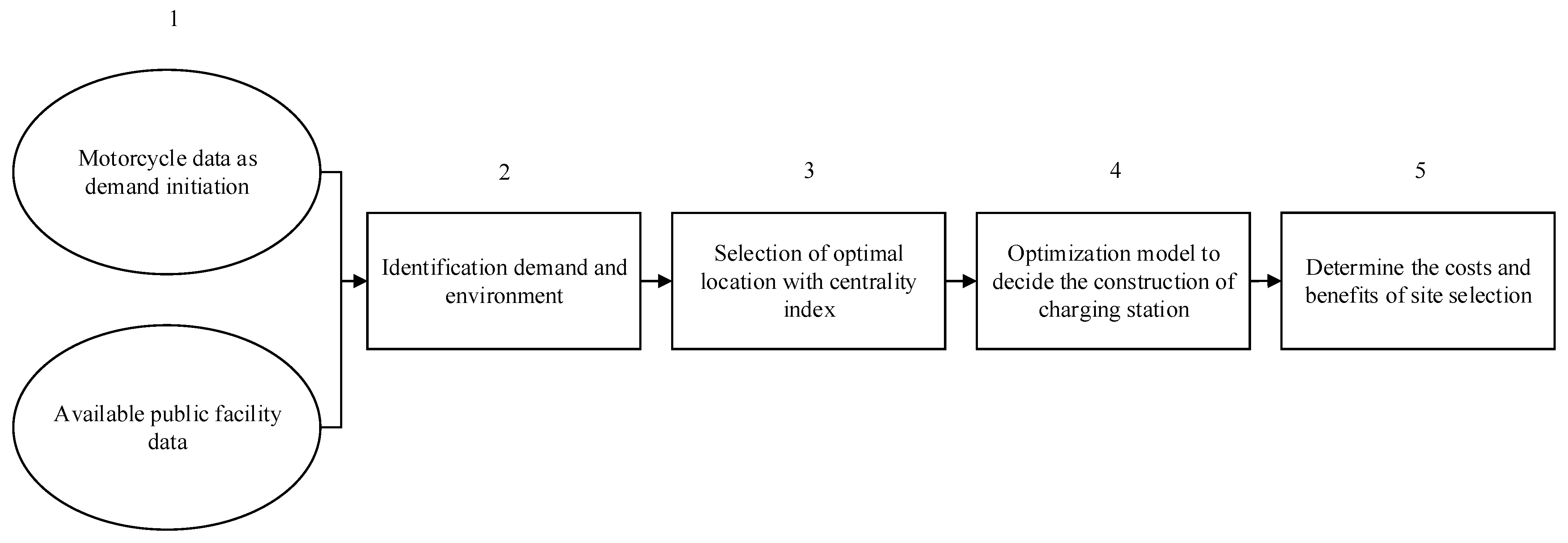
Many benefits follow from the use of Electric Vehicles (EVs) to replace fossil fuel-based vehicles (FVs), i.e., improved transportation energy efficiency, reduced carbon and noise emissions, and the mitigation of tailpipe emissions. However, replacing conventional FVs with EVs requires the establishment of a suitable charging infrastructure representing a commonplace detail that blends into the landscape and is available in various locations. This research focuses on the infrastructure of Electric Motorcycles (EM), constituting a relatively dense network of charging stations (CS), which is an essential factor in accelerating the commercialization of EM in Indonesia. In this case study, we propose a Charging Infrastructure Optimization approach for placing charging stations to meet the demand posed by motorcycles. This study uses motorcycle user data as the initiation data for electric motorcycle users. The selection of charging station development points uses the calculation methods of the centrality index and scalogram, which describe the density of community activities. After the charging station’s construction point is obtained, the point is validated with the optimization model that has been designed with respect to the Maximal Covering Location Problem. We also analyze the benefits and costs of constructing this charging station to determine its feasibility.
Keywords: electric motorcycle; charging infrastructure optimization; maximal covering location problem; centrality index; benefit–cost ratio electric motorcycle; charging infrastructure optimization; maximal covering location problem; centrality index; benefit–cost ratio