
IoT Applications and Challenges in Global Healthcare Systems: A Comprehensive Review



Abstract
1. Introduction
1.1. Overview of IoT in Healthcare
1.2. Motivation for IoT Adoption
1.3. Research Objectives and Scope
2. Deficiencies of IoT Usage in Health in Some Countries
3. Related Literature Review
4. Methodology
5. An Overview of HIE
5.1. Models and Frameworks for Information Exchange in the Health Sector
5.2. Challenges in HIE Adoption
- Technical Challenges are significant, particularly concerning interoperability. Different healthcare systems utilise diverse data formats and standards, such as HL7, FHIR, and DICOM, which complicates seamless data exchange. The absence of universally accepted protocols leads to compatibility issues among EHRs (EHRs). Additionally, data security and privacy concerns are paramount, as protecting patient information from cyber threats and unauthorised access is critical. Compliance with regulations like HIPAA in the USA and GDPR in Europe necessitates stringent data protection measures. Furthermore, data quality and accuracy are often compromised due to inconsistent or incomplete patient records, which can adversely affect diagnosis and treatment outcomes [88].
- Financial and Organisational Challenges also play a crucial role in HIE adoption. The high costs associated with the implementation and maintenance of HIE systems can be prohibitive, especially for small and rural healthcare providers. Resistance to change among healthcare professionals, who may prefer traditional record-keeping methods, further complicates the transition to electronic systems. Additionally, the lack of immediate financial or operational incentives for healthcare organisations to participate in HIE networks can deter adoption, particularly in regions without strong government support [89].
- Legal and Regulatory Challenges present another layer of complexity. The varying regulations governing health data exchange across different countries and regions make it difficult to create a unified HIE system. Compliance with laws such as HIPAA and GDPR complicates cross-border health information sharing. Moreover, the debate over data ownership—whether it belongs to healthcare providers, insurance companies, or patients, adds to the challenges, as does the variability in patient consent mechanisms for data sharing [75].
- Infrastructure and Access Challenges are particularly pronounced in low- and middle-income countries and rural areas, where limited IT infrastructure can impede HIE implementation. The costs associated with upgrading legacy systems to modern HIE-compatible platforms can be prohibitive. Additionally, large-scale HIE systems may face issues related to scalability, data processing speeds, and system performance, which are critical for real-time healthcare scenarios [90].
6. An Overview of IoT
6.1. IoT Application in Healthcare
6.2. Comparative Analysis of IoT Healthcare Applications
6.3. HIoT Applications and Devices Features
6.4. IoT Process Implementation
6.5. Scenario of IoT in Healthcare
6.6. Open Issues on in IoT Healthcare
- a.
- Interoperability and standardisation issues further complicate the deployment of IoT in healthcare, as devices from various manufacturers often utilise incompatible communication protocols. This leads to data silos and challenges in compliance with diverse regulatory frameworks. Solutions include adopting global standards such as FHIR and HL7, developing middleware for seamless integration, and encouraging the use of open-source IoT platforms [1].
- b.
- High implementation costs pose another barrier, with significant investments needed for infrastructure, AI, and cybersecurity. The expense of smart hospital systems and maintenance, coupled with limited funding in low- and middle-income nations, exacerbates the issue. Solutions could involve government funding and incentives for IoT healthcare deployment, promoting open-source solutions, and employing AI-driven predictive maintenance to lower operational costs [74].
- c.
- Power consumption and scalability issues arise from the continuous power requirements of IoT devices, particularly in remote areas with poor infrastructure. Solutions include developing low-power devices, adopting edge computing to alleviate network load, and utilising solar-powered or energy-harvesting devices for remote healthcare applications [106].
- d.
- Lastly, ethical and security issues in IoT-based healthcare regarding data ownership, informed consent, and AI decision-making in healthcare necessitate clear regulations [133]. The integration of IoT in healthcare has various advantages, including real-time patient monitoring, better clinical decision-making, and increased operational efficiency. However, the widespread implementation raises ethical and security concerns that must be addressed to ensure responsible and equitable use of technology in healthcare. Data ownership, AI bias, and the possible exploitation of patient information are all significant ethical concerns. Data ownership is a critical problem in IoT-enabled healthcare since IoT devices gather, analyse, and send massive volumes of medical data without explicitly giving patients a choice over its use. This creates possible ethical and legal issues, as well as implicit permission in many IoT healthcare systems [105]. Addressing this dilemma requires informed consent systems, clear data-sharing policies, and regulatory frameworks that prioritise patient autonomy. AI bias in AI-powered healthcare applications may worsen inequities, resulting in misdiagnoses, inequitable treatment recommendations, and decreased confidence in healthcare AI systems. To reduce these dangers, it is critical to create fair, transparent, and continually monitored AI models that go through rigorous bias detection and correction procedures [134]. Another important ethical challenge in healthcare that relies on the IoT is the possible abuse of patient data. Unauthorised access or unethical data sharing methods may lead to patient analysis, discrimination, and exploitation. Insurance firms may utilise IoT-generated patient data to change rates or refuse coverage based on health risk assessments, prompting worries about data privacy and fairness. Implementing tight data governance standards, encryption mechanisms, and regulatory supervision may assist in avoiding unauthorised data exploitation and protect patient confidentiality [135].
7. Future Directions
- a.
- The incorporation of 5G technology is a game-changer since it provides ultra-low latency and high bandwidth, which in turn allows for seamless connection for wearable devices, real-time remote operations, and immediate patient monitoring. This innovation will transform the delivery of healthcare, especially in emergency scenarios.
- b.
- AI and machine learning are poised to revolutionise IoT healthcare applications. AI-driven IoT solutions will improve diagnoses, automate hospital functions, and provide predictive analytics. Potential future uses may include AI-enhanced wearables capable of predicting health hazards, personalised medication customised by IoT health data, and robotic operations supervised in real-time through IoT.
- c.
- In addition, by processing data closer to the source, edge and fog computing will reduce latency and improve efficiency, addressing the constraints of conventional IoT systems. This transition will facilitate expedited emergency responses, reduce data congestion on cloud networks, and improve security by locally maintaining critical patient information.
- d.
- Blockchain technology is expected to enhance IoT security by creating immutable health records. This may enable decentralised health records, automated healthcare payments via smart contracts, and enhanced medication tracking.
- e.
- The advancement of wearable and implantable IoT devices is significant, with technologies like smart tattoos, biochips, brain–computer interfaces, and smart contact lenses that perpetually monitor vital indicators.
- f.
- Ultimately, IoT technologies are anticipated to be crucial in pandemic response and crisis management, including applications such as automated temperature inspections and AI-driven epidemiological models for epidemic tracking.
8. Conclusions
Author Contributions
Funding
Data Availability Statement
Conflicts of Interest
References
- Darem, A.; Alhashmi, A.A.; Jemal, H.A. Cybersecurity Threats and Countermeasures of the Smart Home Ecosystem. IJCSNS Int. J. Comput. Sci. Netw. Secur. 2022, 22, 303. [Google Scholar] [CrossRef]
- Toghuj, W.; Turab, N. A Survey on Security Threats in the Internet of Medical Things (IoMT). J. Theor. Appl. Inf. Technol. 2022, 100, 3361–3371. [Google Scholar]
- Healthcare, A.I.; Awan, K.A.; Din, I.U.; Almogren, A.; Khattak, H.A.; Rodrigues, J.J.P.C. EdgeTrust: A Lightweight Data-Centric Trust Management. Electronics 2023, 12, 140. [Google Scholar]
- Mishra, N.; Pandya, S. Internet of Things Applications, Security Challenges, Attacks, Intrusion Detection, and Future Visions: A Systematic Review. IEEE Access 2021, 9, 59353–59377. [Google Scholar] [CrossRef]
- Chakkaravarthy, S.S.; Sangeetha, D.; Cruz, M.V.; Vaidehi, V.; Raman, B. Design of Intrusion Detection Honeypot Using Social Leopard Algorithm to Detect IoT Ransomware Attacks. IEEE Access 2020, 8, 169944–169956. [Google Scholar] [CrossRef]
- Zhang, Q.; Jin, T.; Cai, J.; Xu, L.; He, T.; Wang, T.; Tian, Y.; Li, L.; Peng, Y.; Lee, C. Wearable Triboelectric Sensors Enabled Gait Analysis and Waist Motion Capture for IoT-Based Smart Healthcare Applications. Adv. Sci. 2022, 9, 2103694. [Google Scholar] [CrossRef] [PubMed]
- Patil, V.K.; Pawar, V.R.; Kulkarni, S.P.; Mehta, T.A.; Khare, N.R. Real Time Emotion Recognition with AD8232 ECG Sensor for Classwise Performance Evaluation of Machine Learning Methods. Int. J. Eng. Trans. C Asp. 2023, 36, 1040–1047. [Google Scholar] [CrossRef]
- Maghrabi, L.A.; Shabanah, S.; Althaqafi, T.; Alsalman, D.; Algarni, S.; Al-Ghamdi, A.A.-M.; Ragab, M. Enhancing Cybersecurity in the Internet of Things Environment Using Bald Eagle Search Optimization With Hybrid Deep Learning. IEEE Access 2024, 12, 8337–8345. [Google Scholar] [CrossRef]
- Al Janabi, S.M.; Kurnaz, S. A new localization mechanism in IoT using grasshopper optimization algorithm and DVHOP algorithm. Wirel. Networks 2023, 30, 5465–5485. [Google Scholar] [CrossRef]
- Sun, Z.; An, G.; Yang, Y.; Liu, Y. Optimized machine learning enabled intrusion detection 2 system for internet of medical things. Franklin Open 2024, 6, 100056. [Google Scholar] [CrossRef]
- Li, X.; Liu, S.; Kumari, S.; Chen, C.M. PSAP-WSN: A Provably Secure Authentication Protocol for 5G-Based Wireless Sensor Networks. C.-Comput. Model. Eng. Sci. 2023, 135, 711–732. [Google Scholar] [CrossRef]
- Deif, D.S.; Gadallah, Y. An Ant Colony Optimization Approach for the Deployment of Reliable Wireless Sensor Networks. IEEE Access 2017, 5, 10744–10756. [Google Scholar] [CrossRef]
- Santos, L.; Gonçalves, R.; Rabadão, C.; Martins, J. A flow-based intrusion detection framework for Internet of Things networks. Cluster Comput. 2023, 26, 37–57. [Google Scholar] [CrossRef]
- Sun, B.; Gui, C.; Song, Y.; Chen, H. A novel network coding and multi-path routing approach for wireless sensor networks. Wirel. Pers. Commun. 2014, 77, 87–99. [Google Scholar] [CrossRef]
- D’Agostino, M.J.; Elias, N.M. Gender Equity Commission Priorities: An Archival Study and Prospects for the Future. State Local Gov. Rev. 2022, 54, 102–119. [Google Scholar] [CrossRef]
- Savage, N. Better medicine through machine learning. Commun. ACM 2012, 55, 17–19. [Google Scholar] [CrossRef]
- Abdullahi, M.; Baashar, Y.; Alhussian, H.; Alwadain, A.; Aziz, N.; Capretz, L.F.; Abdulkadir, S.J. Detecting Cybersecurity Attacks in Internet of Things Using Artificial Intelligence Methods: A Systematic Literature Review. Electronics 2022, 11, 198. [Google Scholar] [CrossRef]
- Sood; Sharma, R. Blockchain-empowered IoT for smart healthcare. Inf. Process. Healthc. 2024, 21, 100243. [Google Scholar]
- Zaman, U.; Imran Mehmood, F.; Iqbal, N.; Kim, J.; Ibrahim, M. Towards Secure and Intelligent Internet of Health Things: A Survey of Enabling Technologies and Applications. Electronics 2022, 11, 1893. [Google Scholar] [CrossRef]
- Man, M.M.K.; Yang, L.R. The Future Prospect of Digital Marketing in the Malaysian Context. Int. Bus. Res. 2021, 15, 72. [Google Scholar] [CrossRef]
- Martin, S.N.; Kang, D.Y. Rethinking approaches to research: The importance of considering contextually mitigating factors in promoting equitable practices in science education research. Cult. Stud. Sci. Educ. 2020, 15, 569–582. [Google Scholar] [CrossRef]
- Forster, E.; Taylor, I. Asking the fox to guard the chicken coop: In defense of minimalism in the ethics of war and peace. J. Int. Polit. Theory 2022, 18, 91–109. [Google Scholar] [CrossRef]
- Bouvain, P.; Baumann, C.; Lundmark, E. Corporate social responsibility in financial services. Int. J. Bank Mark. 2022, 31, 420–439. [Google Scholar] [CrossRef]
- Nugroho, S.D.P.; Rahayu, M.; Hapsari, R.D.V. The impacts of social media influencer’s credibility attributes on gen Z purchase intention with brand image as mediation. Int. J. Res. Bus. Soc. Sci. 2022, 11, 18–32. [Google Scholar] [CrossRef]
- Shan, X. A BIM-based visualization and warning system for fire rescue. Adv. Eng. Inform. 2018, 37, 42–53. [Google Scholar] [CrossRef]
- Cheng, J.C.; Lee, N.Y.; Chi, C.; Chen, Y.H. Blockchain and smart contract for digital certificate. In Proceedings of the 2018 IEEE International Conference on Applied System Invention (ICASI), Chiba, Japan, 13–17 April 2018; pp. 1046–1051. [Google Scholar] [CrossRef]
- Chen, J.H.; Ha, N.T.T.; Tai, H.W.; Chang, C.A. The willingness to adopt the internet of things (IoT) conception in Taiwan’s construction industry. J. Civ. Eng. Manag. 2020, 26, 534–550. [Google Scholar] [CrossRef]
- Zhang, N. How does CSR of food company affect customer loyalty in the context of COVID-19: A moderated mediation model. Int. J. Corp. Soc. Responsib. 2022, 7, 1. [Google Scholar] [CrossRef]
- Khan, S.A.R.; Yu, Z.; Sarwat, S.; Godil, D.I.; Amin, S.; Shujaat, S. The role of blockchain technology in circular economy practices to improve organisational performance. Int. J. Logist. Res. Appl. 2022, 25, 605–622. [Google Scholar] [CrossRef]
- Gamil, Y.; Abdullah, M.A.; Rahman, I.A.; Asad, M.M. Internet of things in construction industry revolution 4.0: Recent trends and challenges in the Malaysian context. J. Eng. Des. Technol. 2020, 18, 1091–1102. [Google Scholar] [CrossRef]
- Adeyemi, I.A.; Rahman, M.S.A.; Adeyemi, A. Maintenance Analytics for Building Decision-Making: A Literature Review. J. Inf. Syst. Technol. Manag. 2022, 7, 127–138. [Google Scholar] [CrossRef]
- Sidek, N.; Ali, N.; Alkawsi, G. An Integrated Success Model of Internet of Things (IoT)-Based Services in Facilities Management for Public Sector. Sensors 2022, 22, 3207. [Google Scholar] [CrossRef]
- Lee, K.L.; Romzi, P.N.; Hanaysha, J.R.; Alzoubi, H.M.; Alshurideh, M. Investigating the impact of benefits and challenges of IOT adoption on supply chain performance and organizational performance: An empirical study in Malaysia. Uncertain Supply Chain Manag. 2022, 10, 537–550. [Google Scholar] [CrossRef]
- Balgasem, S.S.; Zakaria, L.Q. A Hybrid Method Of Rule-Based Approach And Statistical Measures For Recognizing Narrators Name In Hadith. In Proceedings of the 2017 6th International Conference on Electrical Engineering and Informatics (ICEEI), Langkawi, Malaysia, 25–27 November 2017; pp. 2–6. [Google Scholar]
- Aljobaly, O.; Banawi, A. Evaluation of the Saudi Construction Industry for Adoption of Building Information Modelling; Springer International Publishing: Berlin/Heidelberg, Germany, 2020; Volume 965. [Google Scholar] [CrossRef]
- Ismail, E.D.; Said, S.Y.; Jalil, M.K.A.; Ismail, N.A.A. Benefits and Challenges of Heritage Building Information Modelling Application in Malaysia. Environ. Proc. J. 2021, 6, 179–184. [Google Scholar] [CrossRef]
- Karji, A.; Woldesenbet, A.; Khanzadi, M.; Tafazzoli, M. Assessment of Social Sustainability Indicators in Mass Housing Construction: A Case Study of Mehr Housing Project. Sustain. Cities Soc. 2019, 50, 101697. [Google Scholar] [CrossRef]
- Dana, L.P.; Salamzadeh, A.; Mortazavi, S.; Hadizadeh, M. Investigating the Impact of International Markets and New Digital Technologies on Business Innovation in Emerging Markets. Sustainability 2022, 14, 983. [Google Scholar] [CrossRef]
- Mokhtarzadeh, N.G.; Mahdiraji, H.A.; Jafarpanah, I.; Cao, D. Examining the Influence of Environmental Turbulence on Firm Innovation Performance in Emerging Markets: Using an Environment-Strategy-Performance Framework. Int. J. Innov. Manag. 2022, 26, 2250028. [Google Scholar] [CrossRef]
- Zhang, Z.; Wen, F.; Sun, Z.; Guo, X.; He, T.; Lee, C. Artificial Intelligence-Enabled Sensing Technologies in the 5G/Internet of Things Era: From Virtual Reality/Augmented Reality to the Digital Twin. Adv. Intell. Syst. 2022, 4, 2100228. [Google Scholar] [CrossRef]
- Iyer, V.R.; Babu, K.; Guruswamy, V.R. Cyber Security Frameworks through the Lens of Foreign Direct Investment (FDI): A Systematic Literature Review. Int. J. Intell. Syst. Appl. Eng. 2024, 12, 279–291. [Google Scholar]
- Meri, A.; Hasan, M.; Danaee, M.; Jaber, M.; Jarrar, M.; Safei, N.; Dauwed, M.; Abd, S.K.; Al-Bsheish, M. Modelling the utilization of cloud health information systems in the Iraqi public healthcare sector. Telemat. Inform. 2019, 36, 132–146. [Google Scholar] [CrossRef]
- Shah, S.; Khan, M.; Almogren, A. Erratum: Security Measurement in Industrial IoT with Cloud Computing Perspective: Taxonomy, Issues, and Future Directions. Sci. Program. 2020, 2020, 25. [Google Scholar] [CrossRef]
- Li, J.; Lyu, L.; Liu, X.; Zhang, X.; Lyu, X. FLEAM: A Federated Learning Empowered Architecture to Mitigate DDoS in Industrial IoT. IEEE Trans. Ind. Inform. 2022, 18, 4059–4068. [Google Scholar] [CrossRef]
- Azrour, M.; Mabrouki, J.; Guezzaz, A.; Kanwal, A. Internet of Things Security: Challenges and Key Issues. Secur. Commun. Networks 2021, 2021, 5533843. [Google Scholar] [CrossRef]
- Saraswathi, P.; Rao, P.M. Intelligent Transport System using IoT-V2X: Communication Technologies, Security Issues, Challenges and Countermeasures. IoT 2022, 4, 1–19. [Google Scholar]
- Fadele, A.A.; Othman, M.; Hashem, I.A.T.; Alotaibi, F. Internet of Things Security: A Survey. J. Netw. Comput. Appl. 2017, 88, 10–28. [Google Scholar] [CrossRef]
- Alaba, F.A.; Amina, M.; Ibrahim, U.; Sulaimon, H.A.; Aliyu, A.Z. Exploring the Role of the Internet of Things (IoT) on Economic Growth in Nigeria: Challenges and Opportunities. Eng. Technol. Trends 2024, 2, 40–56. [Google Scholar] [CrossRef]
- Alaba, F.A.; Sulaimon, H.A.; Marisa, M.I.; Najeem, O. Smart Contracts Security Application and Challenges: A Review. Cloud Comput. Data Sci. 2023, 5, 15–41. [Google Scholar] [CrossRef]
- Fadele, A.A.; Othman, M.; Hashem, I.A.T.; Yaqoob, I.; Imran, M.; Shoaib, M. A novel countermeasure technique for reactive jamming attack in Internet of Things. Multimed. Tools Appl. 2018, 23, 23–41. [Google Scholar] [CrossRef]
- Assimakopoulos, F.; Vassilakis, C.; Margaris, D.; Kotis, K.; Spiliotopoulos, D. The Implementation of “Smart” Technologies in the Agricultural Sector: A Review. Information 2024, 15, 466. [Google Scholar] [CrossRef]
- Developing a Common Health Information Exchange Platform to Implement a Nationwide Health Information Network in South Korea. Healthc. Inform. Res. 2015, 21, 21–29. [CrossRef] [PubMed]
- Azgar, A.; Rana, S.; Hossain, S.; Ferdous, M.J. Testing Challenges for Mobile Applications: An evaluation and comparative analysis of different testing approaches. Int. J. Res. Innov. Appl. Sci. 2022, 7, 7–13. [Google Scholar] [CrossRef]
- Sharmin, F.; Sultan, M.T.; Badulescu, D.; Badulescu, A.; Borma, A.; Li, B. Sustainable destination marketing ecosystem through smartphone-based social media: The consumers’ acceptance perspective. Sustainability 2021, 13, 2308. [Google Scholar] [CrossRef]
- Amini, M.; Javid, N.J. A Multi-Perspective Framework Established on Diffusion of Innovation (DOI) Theory and Technology, Organization and Environment (TOE) Framework Toward Supply Chain Management System Based on Cloud Computing Technology for Small and Medium Enterprises. Int. J. Inf. Technol. Innov. Adopt. 2023, 11, 1217–1234. [Google Scholar]
- Jlassi, W.; Haddad, R.; Bouallegue, R.; Shubair, R. A Novel Dynamic Authentication Method for Sybil Attack Detection and Prevention in Wireless Sensor Networks. Lect. Notes Netw. Syst. 2021, 225, 531–541. [Google Scholar] [CrossRef]
- Saini, S.; Panjwani, D.; Saxena, N. Mobile Mental Health Apps: Alternative Intervention or Intrusion? In Proceedings of the 2022 19th Annual International Conference on Privacy, Security & Trust (PST), Fredericton, NB, Canada, 22–24 August 2022. [Google Scholar]
- Kürtünlüoğlu, P.; Akdik, B.; Karaarslan, E. Security of Virtual Reality Authentication Methods in Metaverse: An Overview. arXiv 2022, arXiv:2209.06447. [Google Scholar] [CrossRef]
- Steffen, S.; Bichsel, B.; Vechev, M. Zapper: Smart Contracts with Data and Identity Privacy. In Proceedings of the CCS’22: 2022 ACM SIGSAC Conference on Computer and Communications Security, Los Angeles, CA, USA, 7–11 November 2022. [Google Scholar] [CrossRef]
- Levacher, J.; Spinath, F.M.; Becker, N.; Hahn, E. How did the beginnings of the global COVID-19 pandemic affect mental well-being? PLoS ONE 2023, 18, e0279753. [Google Scholar] [CrossRef]
- Yusuf, S.; Musa, M.A.; Diugwu, I.; Adindu, C.; Afeez, B. A Systematic Literature Review Approach on the Role of Digitalization in Construction Infrastructure and Sustainable City Development in Developing Countries. ZEMCH Int. Conf. 2021, 2, 1075–1093. [Google Scholar]
- Wetzel, P.; Hofmann, E. Supply chain finance, financial constraints and corporate performance: An explorative network analysis and future research agenda. Int. J. Prod. Econ. 2019, 216, 364–383. [Google Scholar] [CrossRef]
- Öztürk, C.; Yildizbaşi, A. Barriers to implementation of blockchain into supply chain management using an integrated multi-criteria decision-making method: A numerical example. Soft Comput. 2020, 24, 14771–14789. [Google Scholar] [CrossRef]
- Ji, Y.; Wang, W.; Zheng, M.; Chen, S. Real Time Building Evacuation Modeling with an Improved Cellular Automata Method and Corresponding IoT System Implementation. Buildings 2022, 12, 718. [Google Scholar] [CrossRef]
- Vargas, V.B.; De Oliveira Gomes, J.; Fernandes, P.C.; Vallejos, R.V.; De Carvalho, J.V. Influential Factors for Hospital Management Maturity Models in a post-COVID-19 scenario—Systematic Literature Review. J. Inf. Syst. Eng. Manag. 2023, 8, 19556. [Google Scholar] [CrossRef]
- Adetiba, A.; Msindo, E. Chiefs and Rural Health Services in South-Western Nigeria, c. 1920–c. 1950s. Soc. Hist. Med. 2022, 35, 589–611. [Google Scholar] [CrossRef]
- Apruzzese, G.; Pajola, L.; Conti, M. The Cross-evaluation of Machine Learning-based Network Intrusion Detection Systems. IEEE Trans. Netw. Serv. Manag. 2022, 19, 5152–5169. [Google Scholar] [CrossRef]
- Younas, M.I.; Iqbal, M.J.; Aziz, A.; Sodhro, A.H. Toward QoS Monitoring in IoT Edge Devices Driven Healthcare—A Systematic Literature Review. Sensors 2023, 23, 8885. [Google Scholar] [CrossRef]
- Georgescu, T.M.; Iancu, B.; Zurini, M. Named-entity-recognition-based automated system for diagnosing cybersecurity situations in IoT networks. Sensors 2019, 19, 3380. [Google Scholar] [CrossRef] [PubMed]
- Dada, E.G.; Oyewola, D.O.; Yakubu, J.H.; Fadele, A.A. Predicting protein secondary structure based on ensemble Neural Network. ITEGAM-J. Eng. Technol. Ind. Appl. 2021, 7, 49–56. [Google Scholar] [CrossRef]
- Stute, M.; Sardesai, S.; Parlings, M.; Senna, P.P.; Fornasiero, R.; Balech, S. Technology Scouting to Accelerate Innovation in Supply Chain. In Next Generation Supply Chains: A Roadmap for Research and Innovation; Springer: Berlin/Heidelberg, Germany, 2021. [Google Scholar] [CrossRef]
- Arora, N.; Mishra, M.R.; Goswami, V.; Chakraborty, J.; Barik, L.; Patra, S.S. Blockchain-based Qinsurancechain: Role of Smart Contracts in Fast and Secure Healthcare Insurance Claim. In Proceedings of the 2022 3rd International Conference on Electronics and Sustainable Communication Systems (ICESC), Coimbatore, India, 17–19 August 2022; pp. 635–641. [Google Scholar] [CrossRef]
- Hu, T.; Liu, X.; Chen, T.; Zhang, X.; Huang, X. Transaction-based classification and detection approach for Ethereum smart contract. Inf. Process. Manag. 2021, 58, 2–19. [Google Scholar] [CrossRef]
- Wang, J.; Paschalidis, I.C. Botnet Detection Based on Anomaly and Community Detection. IEEE Trans. Control. Netw. Syst. 2017, 4, 392–404. [Google Scholar] [CrossRef]
- Pérez-Díez, I.; Pérez-Moraga, R.; López-Cerdán, A.; Salinas-Serrano, J.M.; de la Iglesia-Vayá, M. De-identifying Spanish medical texts—Named entity recognition applied to radiology reports. J. Biomed. Semantics 2021, 12, 6. [Google Scholar] [CrossRef]
- Eldin, H.G.; Abdulrazek, M.; Abdelshafi, M.; Sahlol, A.T. Med-Flair: Medical named entity recognition for diseases and medications based on Flair embedding. Procedia Comput. Sci. 2021, 189, 67–75. [Google Scholar] [CrossRef]
- Radanliev, P.; De Roure, D.; Page, K.; Van Kleek, M.; Santos, O.; Maddox, L.; Burnap, P.; Anthi, E.; Maple, C. Design of a Dynamic and Self-Adapting System, Supported with Artificial Intelligence, Machine Learning and Real-Time Intelligence for Predictive Cyber Risk Analytics in Extreme Environments—Cyber Risk in the Colonisation of Mars. SSRN Electron. J. 2021, 2, 219–230. [Google Scholar] [CrossRef]
- Maghrabi, L.A. Automated Network Intrusion Detection for Internet of Things: Security Enhancements. IEEE Access 2024, 12, 30839–30851. [Google Scholar] [CrossRef]
- Al-sarray, N.H.S. Detection of DDoS attacks in SDN with Siberian Tiger Optimization algorithm and deep learning. Res. Sq. 2024, 4, 1–31. [Google Scholar]
- Singh, A.; Kaur, P.; Singh, G. Ad Hoc Networks SecureFlow: Knowledge and data-driven ensemble for intrusion detection and dynamic rule configuration in software-defined IoT environment. Ad Hoc Netw. 2024, 156, 103404. [Google Scholar] [CrossRef]
- Khan, A.A.; Wagan, A.A.; Laghari, A.A.; Gilal, A.R.; Aziz, I.A.; Talpur, B.A. BIoMT: A State-of-the-Art Consortium Serverless Network Architecture for Healthcare System Using Blockchain Smart Contracts. IEEE Access 2022, 10, 78887–78898. [Google Scholar] [CrossRef]
- Umer, S.; Afzal, M.; Hussain, M.; Latif, K.; Ahmad, H.F. Autonomous mapping of HL7 RIM and relational database schema. Inf. Syst. Front. 2012, 14, 5–18. [Google Scholar] [CrossRef]
- Juyal, S.; Sharma, S.; Harbola, A.; Shukla, A.S. Privacy and Security of IoT-based Skin Monitoring System using Blockchain Approach. In Proceedings of the CONECCT 2020—6th IEEE International Conference on Electronics, Computing and Communication Technologies, Bangalore, India, 2–4 July 2020. [Google Scholar] [CrossRef]
- Kloda, L.A.; Boruff, J.T.; Cavalcante, A.S. A comparison of patient, intervention, comparison, outcome (PICO) to a new, alternative clinical question framework for search skills, search results, and self-efficacy: A randomized controlled trial. J. Med. Libr. Assoc. 2020, 108, 185–194. [Google Scholar] [CrossRef] [PubMed]
- Sengupta, J.; Ruj, S.; Bit, S.D. A Comprehensive Survey on Attacks, Security Issues and Blockchain Solutions for IoT and IIoT. J. Netw. Comput. Appl. 2020, 149, 102–115. [Google Scholar] [CrossRef]
- Kalita, B.C.; Kalita, B. Comprehensive Analysis On Effectiveness Of Inventory Management Practices On The Performance Of Wholesale Drug Dealers. J. Posit. Sch. Psychol. 2022, 6, 8750–8762. [Google Scholar]
- Al Rawajbeh, M.; Alzyadat, W.; Kaabneh, K.; Afaneh, S.; Alrwashdeh, D.F.; Albayaydah, H.S.; AlHadid, S.H. A new model for security analysis of network anomalies for IoT devices. Int. J. Data Netw. Sci. 2023, 7, 1241–1248. [Google Scholar] [CrossRef]
- Alimova, I.; Tutubalina, E. Multiple features for clinical relation extraction: A machine learning approach. J. Biomed. Inform. 2020, 103, 103382. [Google Scholar] [CrossRef]
- Li, H.; Odeyemi, Y.E.M.B.; Weister, T.J.; Liu, C.; Chalmers, S.J.; Lal, A.M.; Song, X.; Gajic, O.; Kashyap, R.M. Rule-Based Cohort Definitions for Acute Respiratory Distress Syndrome: A Computable Phenotyping Strategy Based on the Berlin Definition. Crit. Care Explor. 2021, 3, e0451. [Google Scholar] [CrossRef]
- Jonnagaddala, J.; Chen, A.; Batongbacal, S.; Nekkantti, C. The OpenDeID corpus for patient de-identification. Sci. Rep. 2021, 11, 19973. [Google Scholar] [CrossRef] [PubMed]
- Muheidat, F.; Patel, D.; Tammisetty, S.; Tawalbeh, L.A.; Tawalbeh, M. Emerging Concepts Using Blockchain and Big Data. Procedia Comput. Sci. 2021, 198, 15–22. [Google Scholar] [CrossRef]
- De-Lima-Santos, M.-F.; Mesquita, L.; Peixoto, J.G.d.M.; Camargo, I. Digital News Business Models in the Age of Industry 4.0 Digital Brazilian News Players Find in Technology New Ways to Bring Revenue and Competitive Advantage. Digit. Journal. 2022, 12, 1304–1328. [Google Scholar] [CrossRef]
- Kor, M.; Yitmen, I.; Alizadehsalehi, S. An investigation for integration of deep learning and digital twins towards Construction 4.0. Smart Sustain. Built Environ. 2022, 12, 461–487. [Google Scholar] [CrossRef]
- Pise, A.A.; Almuzaini, K.K.; Ahanger, T.A.; Farouk, A.; Pant, K.; Pareek, P.K.; Nuagah, S.J. Enabling Artificial Intelligence of Things (AIoT) Healthcare Architectures and Listing Security Issues. Comput. Intell. Neurosci. 2022, 2022, 1–14. [Google Scholar] [CrossRef]
- Ritwatthanavanich, N.; Benjawan, K.; Pavapanunkul, S. Performance of the innovation-passion model for post COVID-19 entrepreneurs. Utopía Prax. Latinoam. 2021, 26, 123–136. [Google Scholar]
- Kadambala, D.K.; Subramanian, N.; Tiwari, M.K.; Abdulrahman, M.; Liu, C. Closed loop supply chain networks: Designs for energy and time value efficiency. Int. J. Prod. Econ. 2017, 183, 382–393. [Google Scholar] [CrossRef]
- Madanian, S.; Chinbat, T.; Subasinghage, M.; Airehrour, D.; Hassandoust, F.; Yongchareon, S. Health IoT Threats: Survey of Risks and Vulnerabilities. Future Internet 2024, 16, 389. [Google Scholar] [CrossRef]
- Gong, S.; Lee, C. BLOCIS: Blockchain-based cyber threat intelligence sharing framework for sybil-resistance. Electronics 2020, 9, 521. [Google Scholar] [CrossRef]
- Kalsoom, N.; Ahmad, I.; Alroobaea, R.; Raza, M.A.; Khalid, S.; Ahmed, Z.; Ali, I. Architecture for Resource Allocation in the Internet of Vehicles for Cooperating Driving System. J. Adv. Transp. 2021, 2021, 1–11. [Google Scholar] [CrossRef]
- Rey, V.; Sánchez, P.M.S.; Celdrán, A.H.; Bovet, G. Federated learning for malware detection in IoT devices. Comput. Netw. 2022, 204, 20–35. [Google Scholar] [CrossRef]
- Bilal, M. A Review of Internet of Things Architecture, Technologies and Analysis Smartphone-based Attacks Against 3D printers. arXiv 2017, arXiv:1708.04560. [Google Scholar] [CrossRef]
- Jutila, M. An Adaptive Edge Router Enabling Internet of Things. IEEE Internet Things J. 2016, 3, 1061–1069. [Google Scholar] [CrossRef]
- Odonkor, B.; Kaggwa, S.; Uwaoma, P.U.; Hassan, A.O.; Farayola, O.A. The impact of AI on accounting practices: A review: Exploring how artificial intelligence is transforming traditional accounting methods and financial reporting. World J. Adv. Res. Rev. 2024, 21, 172–188. [Google Scholar] [CrossRef]
- Gill, M.S.; Fay, A. Utilisation of semantic technologies for the realisation of data-driven process improvements in the maintenance, repair and overhaul of aircraft components. CEAS Aeronaut. J. 2024, 15, 459–480. [Google Scholar] [CrossRef]
- Dave, T.; Athaluri, S.A.; Singh, S. ChatGPT in medicine: An overview of its applications, advantages, limitations, future prospects, and ethical considerations. Front. Artif. Intell. 2023, 6, 1169595. [Google Scholar] [CrossRef] [PubMed]
- Heyat BBin Adhikari, D.; Akhtar, F.; Parveen, S.; Zeeshan, H.M.; Ullah, H.; Chen, Y.; Wang, L.; Sawan, M. Intelligent Internet of Medical Things for Depression: Current Advancements, Challenges, and Trends. Int. J. Intell. Syst. 2025, 2025, 6801530. [Google Scholar] [CrossRef]
- Wang, C.; Liu, S.; Yang, H.; Guo, J.; Wu, Y.; Liu, J. Ethical Considerations of Using ChatGPT in Health Care. J. Med. Internet Res. 2023, 25, e48009. [Google Scholar] [CrossRef]
- Ravikumar, J.; Kumar, P.R. Machine learning model for clinical named entity recognition. Int. J. Electr. Comput. Eng. 2021, 11, 1689–1696. [Google Scholar] [CrossRef]
- Boikanyo, K.; Zungeru, A.M.; Sigweni, B.; Yahya, A.; Lebekwe, C. Remote patient monitoring systems: Applications, architecture, and challenges. Sci. Afr. 2023, 20, e01638. [Google Scholar] [CrossRef]
- Mrabet, H.; Belguith, S.; Alhomoud, A.; Jemai, A. A Survey of IoT Security Based on a Layered. Sensors 2020, 20, 3625. [Google Scholar] [CrossRef]
- Khader, R.; Eleyan, D. Survey of DoS/DDoS attacks in IoT. Sustain. Eng. Innov. 2021, 3, 23–28. [Google Scholar] [CrossRef]
- Dai, D.; Li, R.; Tang, J.; Davanian, A.; Yin, H. Parallel space traveling: A security analysis of app-level virtualization in android. In Proceedings of the SACMAT’20: The 25th ACM Symposium on Access Control Models and Technologies, Barcelona, Spain, 10–12 June 2020; pp. 25–32. [Google Scholar] [CrossRef]
- Chatziamanetoglou, D.; Rantos, K. Cyber Threat Intelligence on Blockchain: A Systematic Literature Review. Computers 2024, 13, 60. [Google Scholar] [CrossRef]
- Álvarez, A.P.; Ordieres-Meré, J.; Loreiro, Á.P.; de Marcos, L. Opportunities in airport pavement management: Integration of BIM, the IoT and DLT. J. Air Transp. Manag. 2021, 90, 101941. [Google Scholar] [CrossRef]
- Krishnamoorthy, S.; Dua, A.; Gupta, S. Role of emerging technologies in future IoT-driven Healthcare 4.0 technologies: A survey, current challenges and future directions. J. Ambient. Intell. Human Comput. 2023, 14, 361–407. [Google Scholar] [CrossRef]
- Adibi, S.; Rajabifard, A.; Shojaei, D.; Wickramasinghe, N. Enhancing Healthcare through Sensor-Enabled Digital Twins in Smart Environments: A Comprehensive Analysis. Sensors 2024, 24, 2793. [Google Scholar] [CrossRef]
- Hmidah, N.A.; Haron, N.A.; Alias, A.H.; Law, T.H.; Altohami, A.B.A.; Effendi, R.A.A.R.A. The Role of the Interface and Interface Management in the Optimization of BIM Multi-Model Applications: A Review. Sustainability 2022, 14, 1869. [Google Scholar] [CrossRef]
- Galchynsky, L.; Graivoronskyi, M.; Dmytrenko, O. Evaluation of Machine Learning Methods to Detect DoS/DDoS Attacks on IoT. CEUR Workshop Proc. 2021, 3241, 225–236. [Google Scholar]
- Riad, A.B.M.K.; Islam, M.S.; Shahriar, H.; Zhang, C.; Valero, M.; Sneha, S.; Ahamed, S. Plugin-Based Tool for Teaching Secure Mobile Application Development. Inf. Syst. Educ. J. 2021, 19, 25–34. [Google Scholar]
- Karahoca, A.; Karahoca, D.; Aksöz, M. Examining intention to adopt to internet of things in healthcare technology products. Kybernetes 2018, 47, 742–770. [Google Scholar] [CrossRef]
- Gonzalez-Amarillo, C.; Cardenas-Garcia, C.; Mendoza-Moreno, M.; Ramirez-Gonzalez, G.; Corrales, J.C. Blockchain-iot sensor (Biots): A solution to iot-ecosystems security issues. Sensors 2021, 21, 4388. [Google Scholar] [CrossRef]
- De Cicco, L.; Mascolo, S.; Palmisano, V.; Ribezzo, G. Reducing the network bandwidth requirements for 360 ∘ immersive video streaming. Internet Technol. Lett. 2019, 2, e118. [Google Scholar] [CrossRef]
- Marques, I.C.P.; Ferreira, J.J.M. Digital transformation in the area of health: Systematic review of 45 years of evolution. Health Technol. 2020, 10, 575–586. [Google Scholar] [CrossRef]
- Sokkalingam, S.; Ramakrishnan, R. An intelligent intrusion detection system for distributed denial of service attacks: A support vector machine with hybrid optimization algorithm based approach. Concurr. Comput. Pract. Exp. 2022, 34, e7334. [Google Scholar] [CrossRef]
- Islam, U.; Al-Atawi, A.; Alwageed, H.S.; Ahsan, M.; Awwad, F.A.; Abonazel, M.R. Real-Time Detection Schemes for Memory DoS (M-DoS) Attacks on Cloud Computing Applications. IEEE Access 2023, 11, 74641–74656. [Google Scholar] [CrossRef]
- Sharma, A.; Goyal, T.; Pilli, E.S.; Mazumdar, A.P.; Govil, M.C.; Joshi, R.C. A Secure Hybrid Cloud Enabled architecture for Internet of Things. In Proceedings of the 2015 IEEE 2nd World Forum on Internet of Things (WF-IoT), Milan, Italy, 14–16 December 2015; pp. 274–279. [Google Scholar] [CrossRef]
- Safarov, F.; Basak, M.; Nasimov, R.; Abdusalomov, A.; Cho, Y.I. Explainable Lightweight Block Attention Module Framework for Network-Based IoT Attack Detection. Future Internet 2023, 15, 297. [Google Scholar] [CrossRef]
- Khan, F.; Rehman, A.U.; Yahya, A.; Jan, M.A.; Chuma, J.; Tan, Z.; Hussain, K. A quality of service-aware secured communication scheme for internet of things-based networks. Sensors 2019, 19, 4321. [Google Scholar] [CrossRef]
- Obaidat, M.A.; Rawashdeh, M.; Alja’afreh, M.; Abouali, M.; Thakur, K.; Karime, A. Exploring IoT and Blockchain: A Comprehensive Survey on Security, Integration Strategies, Applications and Future Research Directions. Big Data Cogn. Comput. 2024, 8, 174. [Google Scholar] [CrossRef]
- Zimba, A. A Bayesian Attack-Network Modeling Approach to Mitigating Malware-Based Banking Cyberattacks. Int. J. Comput. Netw. Inf. Secur. 2022, 14, 25–39. [Google Scholar] [CrossRef]
- Bukhowah, R.; Aljughaiman, A.; Rahman, M.M.H. Detection of DoS Attacks for IoT in Information-Centric Networks Using Machine Learning: Opportunities, Challenges, and Future Research Directions. Electronics 2024, 13, 1031. [Google Scholar] [CrossRef]
- Bures, M.; Blazek, P.; Nema, J.; Schvach, H. Factors Impacting Resilience of Internet of Things Systems in Critical Infrastructure. IEEE Access 2022, 21, 2–6. [Google Scholar] [CrossRef]
- Abdel-Basset, M.; Gamal, A.; Manogaran, G.; Son, L.H.; Long, H.V. A novel group decision making model based on neutrosophic sets for heart disease diagnosis. Multimed. Tools Appl. 2020, 79, 9977–10002. [Google Scholar] [CrossRef]
- Yin, L.; Luo, X.; Zhu, C.; Wang, L.; Xu, Z.; Lu, H. ConnSpoiler: Disrupting C&C Communication of IoT-Based Botnet through Fast Detection of Anomalous Domain Queries. IEEE Trans. Ind. Inform. 2020, 16, 1373–1384. [Google Scholar] [CrossRef]
- Fawzy, D.; Moussa, S.M.; Badr, N.L. The Internet of Things and Architectures of Big Data Analytics: Challenges of Intersection at Different Domains. IEEE Access 2022, 10, 4969–4992. [Google Scholar] [CrossRef]
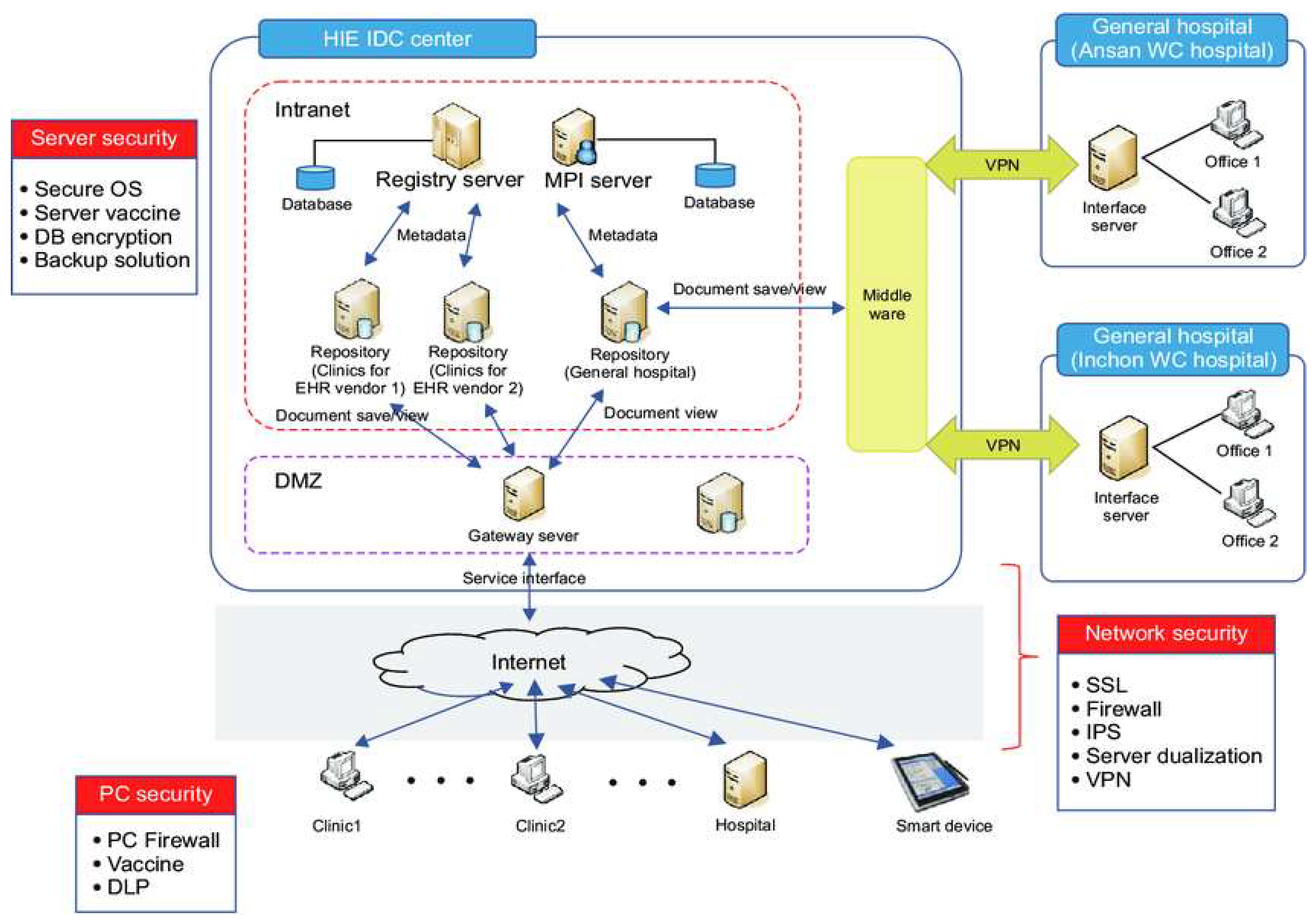
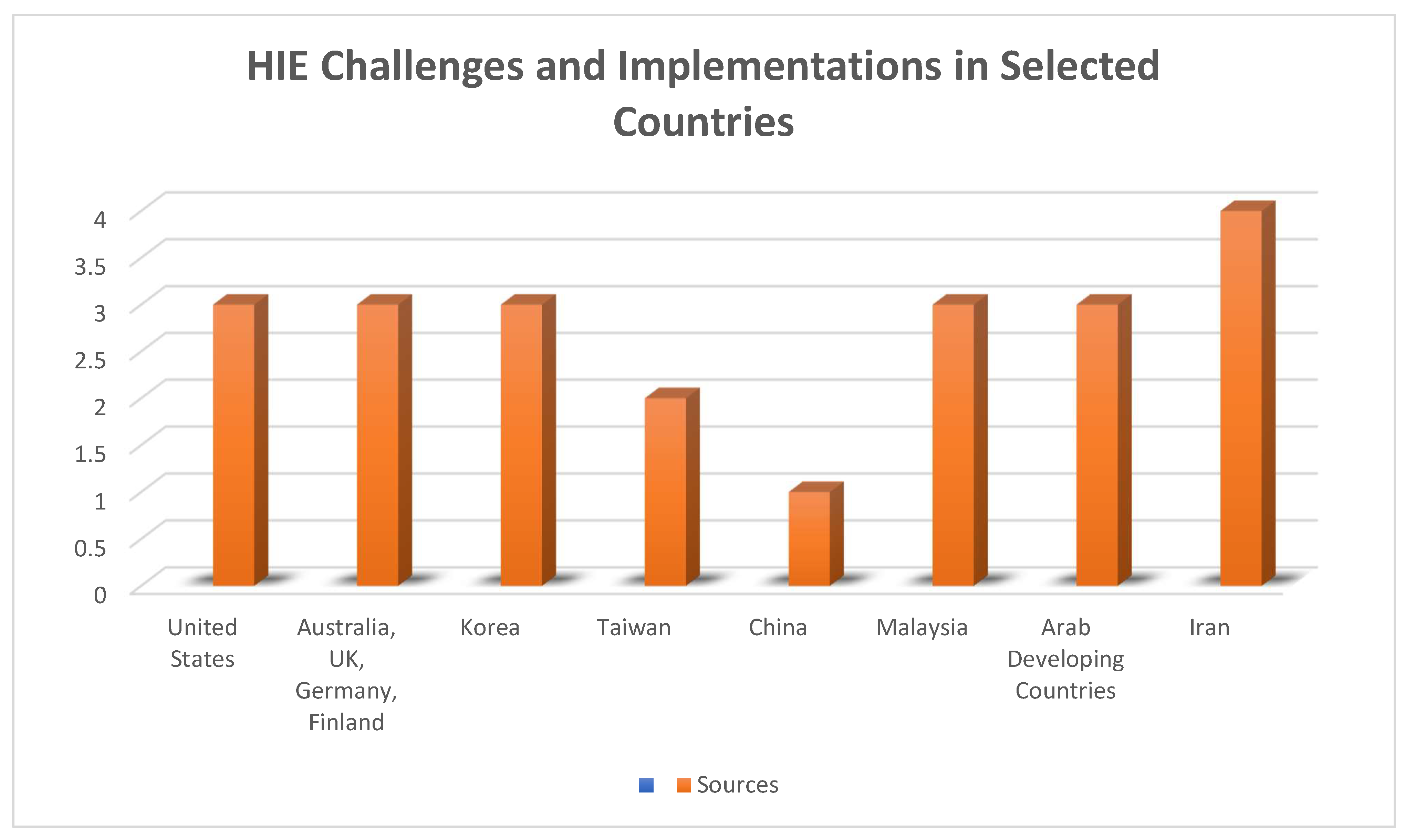


| Case Study | Sources | Limitation Overview |
|---|---|---|
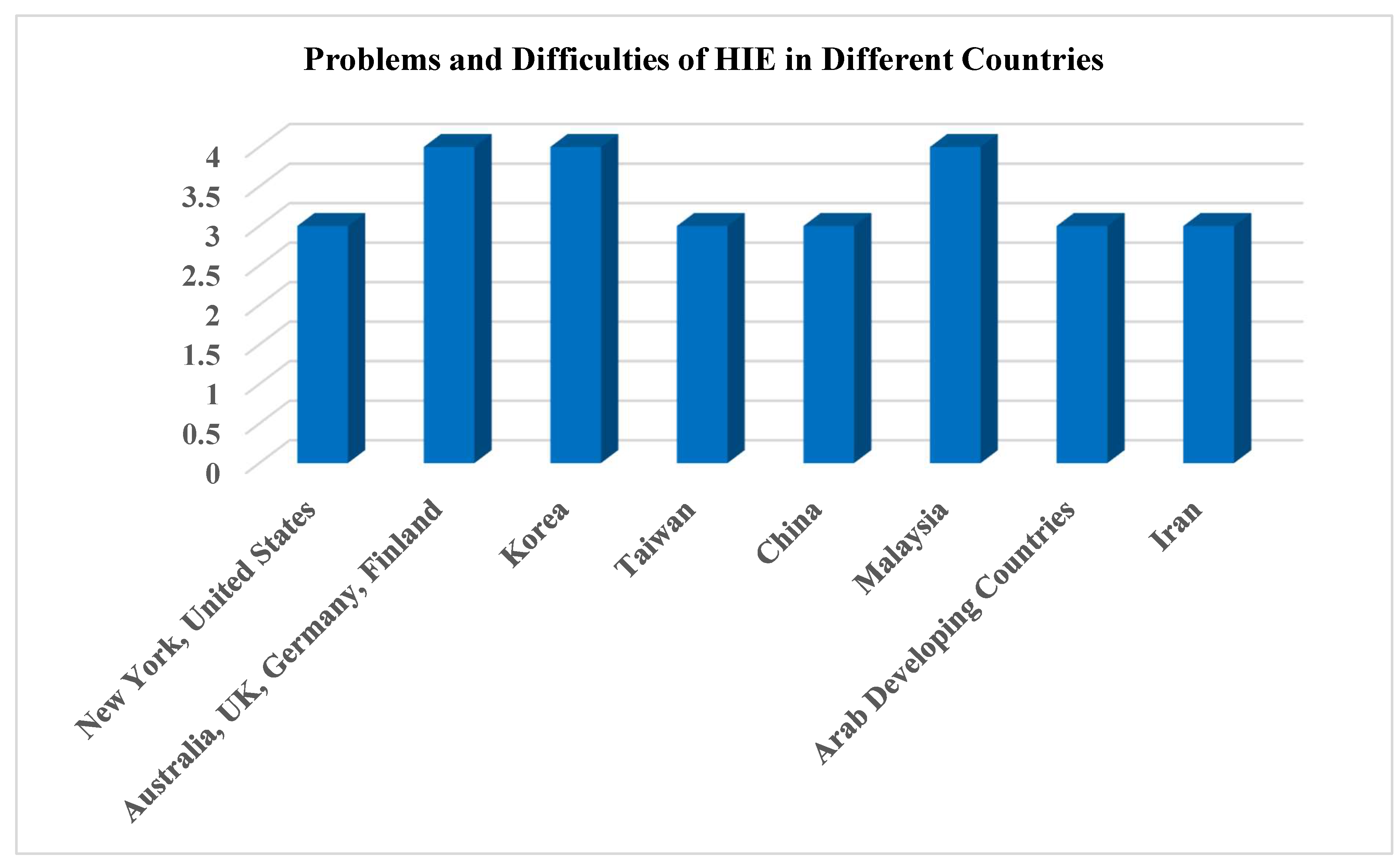
| New York, United States | [14,15,16] | Challenges include patient consent issues, lack of information exchange between primary and secondary healthcare providers, disrupted workflows, user-unfriendly systems, difficulty in finding qualified staff, and low engagement with HIE technologies. |
| Australia, UK, Germany, Finland | [17,18,19,20] | Difficulties in obtaining historical patient information, varying information needs among providers, and inconsistent access to HIE systems across organisations. |
| Korea | [21,22,23,24] | Challenges include integrating diverse healthcare systems and ensuring data privacy and security. |
| Taiwan | [25,26,27] | Issues with standardising data formats and achieving interoperability among different healthcare providers. |
| China | [19,28,29] | Barriers include regional disparities in healthcare IT infrastructure and concerns over data sharing policies. |
| Malaysia | [30,31,32,33] | Limitations involve insufficient funding for HIE initiatives and a lack of trained IT personnel in healthcare. |
| Arab Low- and Middle-Income Countries | [34,35,36] | Obstacles encompass cultural resistance to data sharing and limited technological infrastructure. |
| Iran | [37,38,39] | Challenges include bureaucratic hurdles, a lack of standardised protocols, and concerns over data security. |
| No. of Participants | Intention to Use | Trust | Workflow | Cost Effectiveness | Security& | Privacy | Training | Ubiquitous Connectivity | Compatibility | Network Capacity | Accessibility | Usefulness | Cooperation |
|---|---|---|---|---|---|---|---|---|---|---|---|---|---|
| 1 | ✓ | ✓ | ✗ | ✓ | ✓ | ✓ | ✓ | ✓ | ✓ | ✓ | ✓ | ✓ | ✓ |
| 2 | ✓ | ✗ | ✓ | ✓ | ✓ | ✓ | ✓ | ✓ | ✓ | ✓ | ✓ | ✗ | ✗ |
| 3 | ✓ | ✓ | ✓ | ✓ | ✗ | ✗ | ✓ | ✓ | ✗ | ✓ | ✓ | ✓ | ✓ |
| 4 | ✓ | ✓ | ✓ | ✓ | ✓ | ✓ | ✓ | ✓ | ✓ | ✓ | ✓ | ✓ | ✓ |
| 5 | ✓ | ✓ | ✓ | ✓ | ✓ | ✓ | ✓ | ✓ | ✓ | ✓ | ✓ | ✓ | ✓ |
| 6 | ✗ | ✓ | ✓ | ✓ | ✓ | ✓ | ✓ | ✗ | ✓ | ✓ | ✓ | ✗ | ✗ |
| 7 | ✗ | ✓ | ✓ | ✓ | ✓ | ✓ | ✓ | ✓ | ✓ | ✓ | ✓ | ✓ | ✓ |
| 8 | ✗ | ✗ | ✗ | ✓ | ✓ | ✓ | ✓ | ✓ | ✓ | ✓ | ✓ | ✓ | ✓ |
| 9 | ✓ | ✓ | ✓ | ✓ | ✓ | ✓ | ✓ | ✓ | ✓ | ✓ | ✓ | ✓ | ✓ |
| 10 | ✓ | ✓ | ✓ | ✓ | ✓ | ✓ | ✓ | ✓ | ✓ | ✓ | ✓ | ✓ | ✓ |
| 11 | ✓ | ✓ | ✓ | ✓ | ✓ | ✓ | ✓ | ✓ | ✓ | ✓ | ✓ | ✓ | ✓ |
| 12 | ✓ | ✓ | ✓ | ✓ | ✓ | ✓ | ✓ | ✓ | ✓ | ✓ | ✓ | ✓ | ✓ |
| 13 | ✓ | ✓ | ✓ | ✓ | ✓ | ✓ | ✓ | ✓ | ✓ | ✓ | ✓ | ✓ | ✓ |
| 14 | ✓ | ✓ | ✓ | ✓ | ✓ | ✓ | ✓ | ✓ | ✓ | ✓ | ✓ | ✓ | ✓ |
| 15 | ✓ | ✓ | ✓ | ✓ | ✓ | ✓ | ✓ | ✓ | ✓ | ✓ | ✓ | ✓ | ✓ |
| 16 | ✓ | ✓ | ✓ | ✓ | ✓ | ✓ | ✓ | ✓ | ✓ | ✓ | ✓ | ✓ | ✗ |
| 17 | ✓ | ✓ | ✓ | ✓ | ✓ | ✓ | ✓ | ✓ | ✓ | ✓ | ✓ | ✓ | ✓ |
| 18 | ✓ | ✓ | ✓ | ✓ | ✓ | ✓ | ✓ | ✓ | ✓ | ✓ | ✓ | ✓ | ✓ |
| 19 | ✓ | ✓ | ✓ | ✓ | ✓ | ✓ | ✓ | ✓ | ✓ | ✓ | ✓ | ✓ | ✓ |
| 20 | ✓ | ✓ | ✓ | ✓ | ✓ | ✓ | ✓ | ✓ | ✓ | ✓ | ✓ | ✓ | ✓ |
| 21 | ✓ | ✓ | ✓ | ✓ | ✓ | ✓ | ✓ | ✓ | ✓ | ✓ | ✓ | ✓ | ✓ |
| 22 | ✓ | ✓ | ✓ | ✓ | ✓ | ✓ | ✓ | ✓ | ✓ | ✓ | ✓ | ✓ | ✓ |
| 23 | ✓ | ✓ | ✓ | ✓ | ✓ | ✓ | ✓ | ✓ | ✓ | ✓ | ✓ | ✓ | ✓ |
| 24 | ✓ | ✗ | ✓ | ✓ | ✓ | ✓ | ✓ | ✓ | ✓ | ✓ | ✓ | ✗ | ✓ |
| 25 | ✗ | ✓ | ✓ | ✓ | ✓ | ✓ | ✓ | ✓ | ✓ | ✓ | ✓ | ✓ | ✓ |
| 26 | ✓ | ✓ | ✓ | ✓ | ✓ | ✓ | ✓ | ✓ | ✓ | ✓ | ✓ | ✓ | ✓ |
| 27 | ✓ | ✓ | ✗ | ✓ | ✓ | ✓ | ✓ | ✗ | ✓ | ✓ | ✓ | ✓ | ✓ |
| 28 | ✓ | ✗ | ✓ | ✓ | ✓ | ✓ | ✓ | ✓ | ✓ | ✓ | ✓ | ✓ | ✓ |
| 29 | ✓ | ✓ | ✓ | ✓ | ✓ | ✓ | ✓ | ✓ | ✓ | ✓ | ✓ | ✓ | ✓ |
| Country/Region | Challenges in HIE Implementation | Sources |
|---|---|---|
| United States | Patient consent, interoperability issues, lack of standardisation, data security concerns, and clinician resistance. | [55,56,57] |
| Australia, UK, Germany, Finland | Lack of historical patient information, inconsistent data access, and different provider needs. | [58,59,60] |
| Korea | Adoption challenges due to financial constraints and low engagement from healthcare professionals. | [61,62,63] |
| Taiwan | Difficulty in integrating existing hospital systems and ensuring patient data privacy. | [64,65] |
| China | Regulatory and privacy concerns, along with a fragmented healthcare system. | [66] |
| Malaysia | Limited infrastructure, data security risks, and low adoption by smaller clinics. | [67,68,69] |
| Arab Low- and Middle-Income Countries | Lack of resources, low digital literacy, and weak regulatory frameworks. | [47,48,70] |
| Iran | Challenges in policy implementation, interoperability, and resistance from healthcare providers. | [10,71,72] |
| Source | Context | Study in | System/Model Name | Kind of Technology Used |
|---|---|---|---|---|
| [51] | Regional HIE (HIE) | USA | Centralised HIE Model | Centralised database, interoperability standards (HL7, FHIR) |
| [81] | Federated HIE | USA | Federated (Decentralised) HIE Model | Secure access mechanisms, point-to-point data sharing |
| [82] | National Interoperability for Healthcare Systems | USA | Hybrid HIE Model | A combination of a centralised repository and decentralised access |
| [83] | Patient-Controlled HIE | USA | Consumer-Mediated Exchange Model | Personal Health Records (PHR), Mobile and Web-based portals |
| [84] | Nationwide Health Information Network (NHIN) | USA | NHIN Framework | Internet-based exchange, security protocols, HL7 |
| [85] | Healthcare Interoperability Standards | Global | HL7 Fast Healthcare Interoperability Resources (FHIR) | API-based exchange, JSON/XML data formats |
| [86] | Cross-Border Health Data Exchange | EU | European Interoperability Framework for eHealth | Semantic, organisational, and legal interoperability standards |
| [6] | Secure Direct Messaging for Small Healthcare Providers | USA | The Direct Project | Encrypted email-based communication, XDR/XDM protocols |
| [13] | HIE Implementation in Low-Resource Settings | Global | OpenHIE Framework | Open-source health information architecture, HL7, OpenMRS integration |
| [85] | Blockchain for Health Data Exchange | Global | Blockchain-based HIE | Distributed ledger, smart contracts, encryption |
| Country | Major IoT Applications | Notable Implementations | Key Challenges |
|---|---|---|---|
| USA | RPM, AI diagnostics, Smart hospitals | Fitbit, Teladoc, IBM Watson Health | Data privacy (HIPAA), cybersecurity, cost |
| UK | NHS Smart Hospitals, IoT elderly care | NHS Digital, Withings, Telemedicine platforms | Data interoperability, budget constraints |
| Germany | Telemedicine, robotic surgery, AI imaging | Siemens Healthineers, TeleClinic, Asset tracking | GDPR compliance, high infrastructure costs |
| China | 5G smart hospitals, AI-powered diagnostics | Peking University Hospital, Xiaomi wearables, Alibaba ET Healthcare Brain | Data privacy, rural access |
| India | mHealth, AI-driven diagnostics, rural healthcare | Apollo TeleHealth, Niramai, Ayu Devices | Infrastructure gaps, affordability, regulation |
| Japan | Robotic-assisted surgeries, elderly care | Paro Robot, Fujifilm AI imaging, Smart health tracking | High costs, regulatory approvals |
| Source | Context | System, Model, or Framework Name | Purpose |
|---|---|---|---|
| WHO | Global eHealth strategy | Global Digital Health Strategy Framework | Guides IoT adoption for healthcare delivery in developing nations |
| National Institute of Standards and Technology (NIST) | Cybersecurity | NIST Cybersecurity Framework for IoT | Enhances security and risk management in IoT healthcare networks |
| European Union GDPR | Data Privacy | GDPR Compliance Framework for IoT | Regulates data privacy and protection for HIoT applications |
| IBM Watson Health | AI-powered IoT | Watson Health AI IoT Platform | Provides AI-driven analytics for disease prediction and personalised treatment |
| Google Cloud Healthcare | Cloud-based IoT | Google Cloud IoT Healthcare API | Enables secure storage and analysis of real-time patient data |
| Microsoft Asure IoT | Cloud Healthcare Solutions | Asure IoT for Healthcare | Supports remote patient monitoring, predictive analytics, and smart hospitals |
| Philips HealthSuite | Connected Health | Philips HealthSuite IoT Platform | Integrates IoT devices for chronic disease management |
| Apple HealthKit | Wearable IoT | Apple HealthKit IoT Framework | Synchronises health data from IoT-enabled devices like smartwatches |
| Fitbit | Fitness and Chronic Disease Monitoring | Fitbit IoT Ecosystem | Tracks real-time health metrics such as heart rate and oxygen levels |
| GE Healthcare | Medical Imaging | GE Edison AI IoT Platform | Enhances diagnostics using IoT-connected imaging devices |
| Siemens Healthineers | Smart Hospitals | Siemens Smart Hospital IoT Framework | Enables automation and predictive maintenance in hospitals |
| Medtronic | Remote Patient Monitoring | Medtronic CareLink IoT System | Provides real-time monitoring of pacemakers and other implanted devices |
| Teladoc Health | Telemedicine IoT | Teladoc Virtual Care IoT Network | Connects patients and doctors via IoT-driven remote consultations |
| Alibaba Cloud | AI and Big Data in Healthcare | Alibaba ET Healthcare Brain | Uses AI and IoT for real-time disease diagnostics and hospital automation |
| Samsung Digital Health | IoT Wearables | Samsung S Health IoT Framework | Tracks health parameters through smart IoT devices |
| Blockchain in Healthcare | Data Security | Blockchain IoT Healthcare Framework | Enhances security and transparency of medical data across IoT systems |
Disclaimer/Publisher’s Note: The statements, opinions and data contained in all publications are solely those of the individual author(s) and contributor(s) and not of MDPI and/or the editor(s). MDPI and/or the editor(s) disclaim responsibility for any injury to people or property resulting from any ideas, methods, instructions or products referred to in the content. |
© 2025 by the authors. Licensee MDPI, Basel, Switzerland. This article is an open access article distributed under the terms and conditions of the Creative Commons Attribution (CC BY) license (https://creativecommons.org/licenses/by/4.0/).
Share and Cite
Alaba, F.A.; Rocha, A.; Sulaimon, H.A.; Najeem, O. IoT Applications and Challenges in Global Healthcare Systems: A Comprehensive Review. Future Internet 2025, 17, 549. https://doi.org/10.3390/fi17120549
Alaba FA, Rocha A, Sulaimon HA, Najeem O. IoT Applications and Challenges in Global Healthcare Systems: A Comprehensive Review. Future Internet. 2025; 17(12):549. https://doi.org/10.3390/fi17120549
Chicago/Turabian StyleAlaba, Fadele Ayotunde, Alvaro Rocha, Hakeem Adewale Sulaimon, and Owamoyo Najeem. 2025. "IoT Applications and Challenges in Global Healthcare Systems: A Comprehensive Review" Future Internet 17, no. 12: 549. https://doi.org/10.3390/fi17120549
APA StyleAlaba, F. A., Rocha, A., Sulaimon, H. A., & Najeem, O. (2025). IoT Applications and Challenges in Global Healthcare Systems: A Comprehensive Review. Future Internet, 17(12), 549. https://doi.org/10.3390/fi17120549