The Effect of Fluctuating Incubation Temperatures on West Nile Virus Infection in Culex Mosquitoes


Abstract
1. Introduction
2. Materials and Methods
2.1. Study Insects
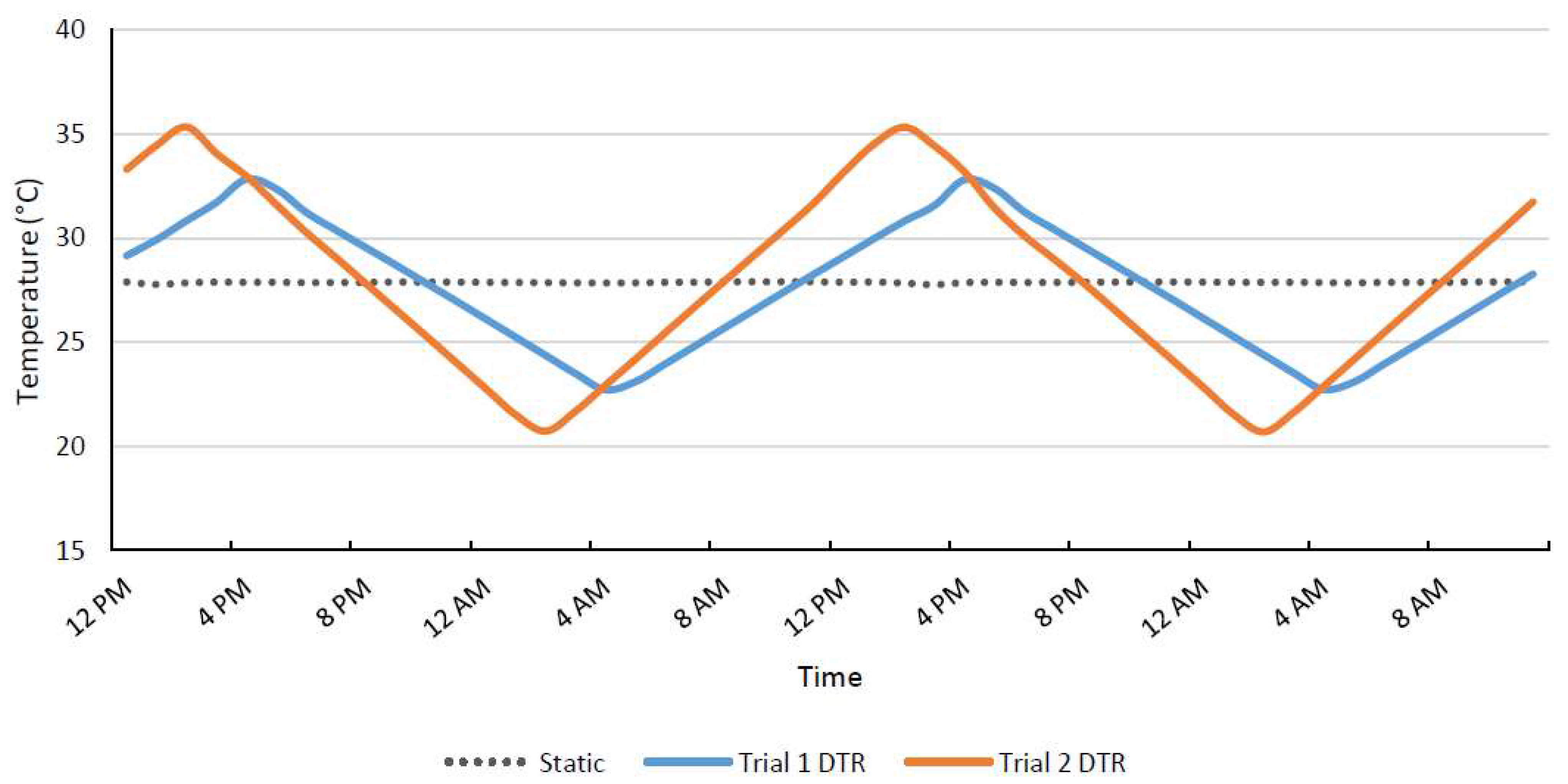
2.2. Fluctuating DTR Conditions
2.3. Infection Trials
2.4. Sample Testing
2.5. Statistical Analyses
3. Results
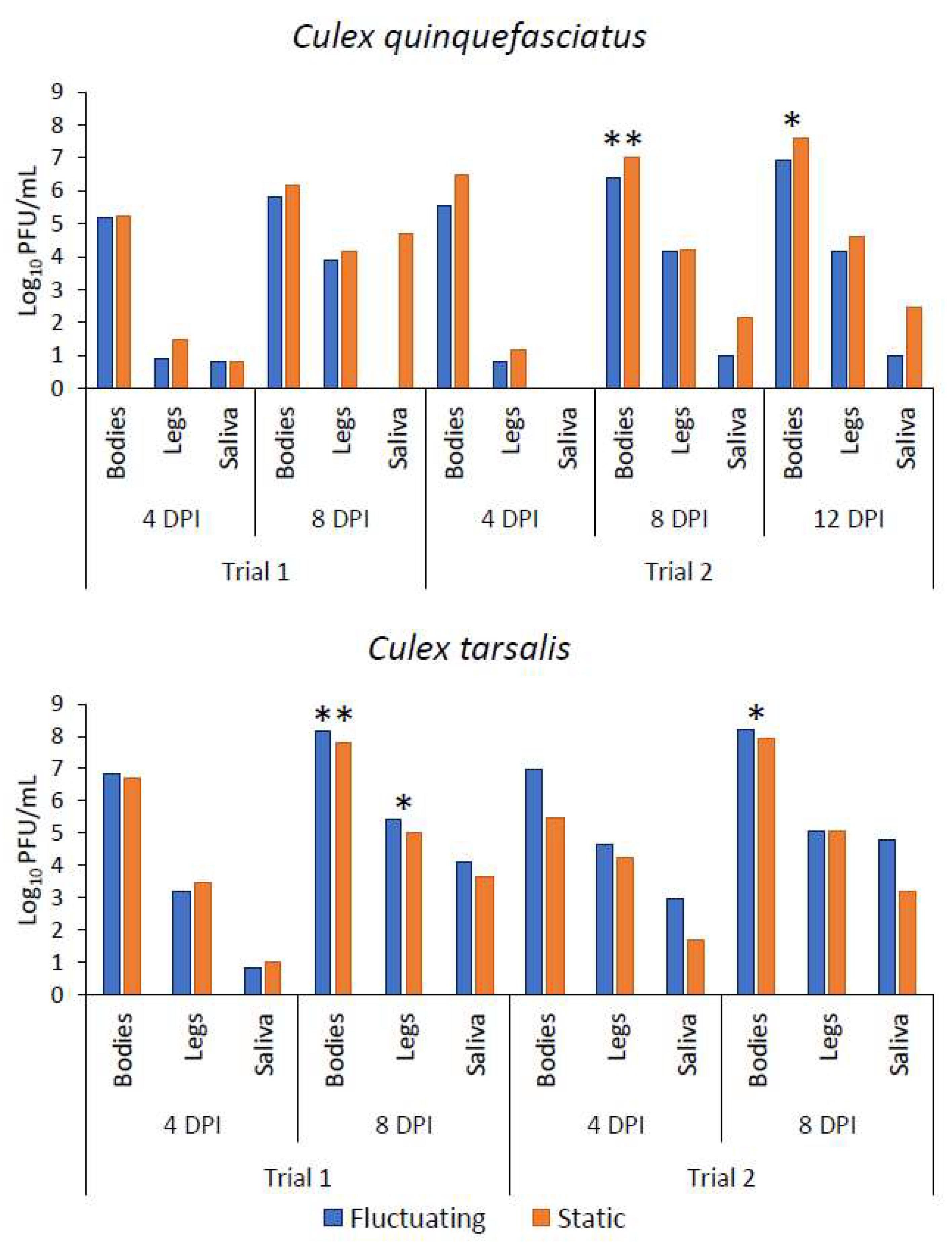
3.1. Trial 1: 11 °C DTR
3.2. Trial 2: 15 °C DTR
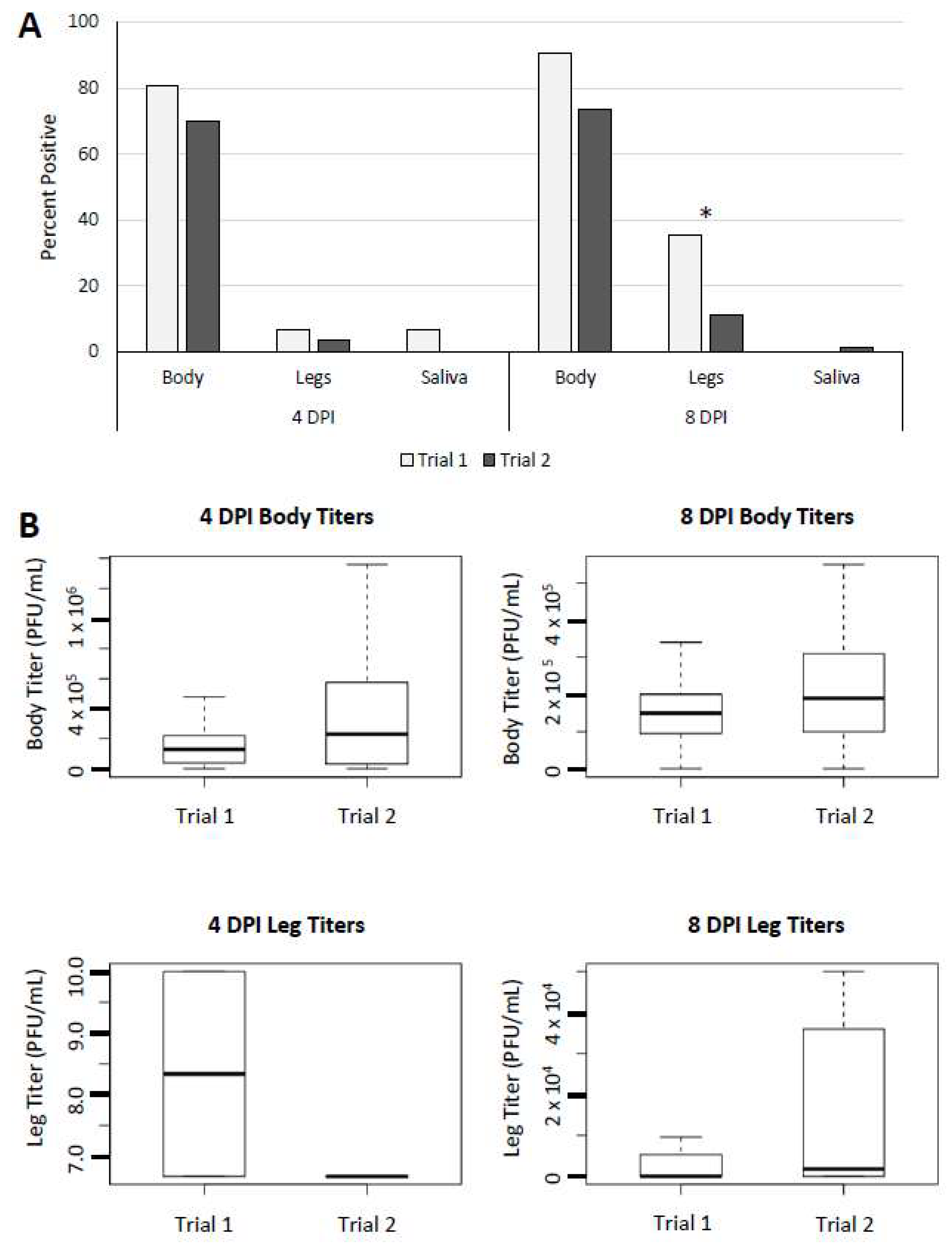
3.3. Trial Comparison—Culex quinquefasciatus
4. Discussion
5. Conclusions
Author Contributions
Funding
Institutional Review Board Statement
Informed Consent Statement
Data Availability Statement
Acknowledgments
Conflicts of Interest
References
- Mordecai, E.A.; Caldwell, J.M.; Grossman, M.K.; Lippi, C.A.; Johnson, L.R.; Neira, M.; Rohr, J.R.; Ryan, S.J.; Savage, V.; Shocket, M.S.; et al. Thermal biology of mosquito-borne disease. Ecol. Lett. 2019, 22, 1690–1708. [Google Scholar] [CrossRef] [Scilit]
- Kramer, L.D.; Ciota, A.T. Dissecting vectorial capacity for mosquito-borne viruses. Current. Opin. Virol. 2015, 15, 112–118. [Google Scholar] [CrossRef] [Scilit]
- Kamiya, T.; Greischar, M.A.; Wadhawan, K.; Gilbert, B.; Paaijmans, K.; Mideo, N. Temperature-dependent variation in the extrinsic incubation period elevates the risk of vector-borne disease emergence. Epidemics 2019, 30, 100382. [Google Scholar] [CrossRef] [Scilit]
- Shelton, R.M. The effect of temperatures on development of eight mosquito species. Mosq. News 1973, 33, 1–12. [Google Scholar]
- Rueda, L.M.; Patel, K.J.; Axtell, R.C.; Stinner, R.E. Temperature-dependent development and survival rates of Culex quinquefasciatus and Aedes aegypti (Diptera: Culicidae). J. Med. Entomol. 1990, 27, 892–898. [Google Scholar] [CrossRef] [Scilit]
- Mohammed, A.; Chadee, D.D. Effects of different temperature regimens on the development of Aedes aegypti (L.) (Diptera: Culicidae) mosquitoes. Acta Tropica 2011, 119, 38–43. [Google Scholar] [CrossRef] [Scilit] [PubMed]
- Reiskind, M.H.; Zarrabi, A.A. Is bigger really bigger? Differential responses to temperature in measures of body size of the mosquito, Aedes albopictus. J. Insect Physiol. 2012, 58, 911–917. [Google Scholar] [CrossRef] [Scilit]
- Ciota, A.T.; Matacchiero, A.C.; Kilpatrick, A.M.; Kramer, L.D. The effect of temperature on life history traits of Culex mosquitoes. J. Med. Entomol. 2014, 51, 55–62. [Google Scholar] [CrossRef] [Scilit]
- Rund, S.S.; Hou, T.Y.; Ward, S.M.; Collins, F.H.; Duffield, G.E. Genome-wide profiling of diel and circadian gene expression in the malaria vector Anopheles gambiae. Proc. Natl. Acad. Sci. USA 2011, 108, E421–E430. [Google Scholar] [CrossRef] [Scilit]
- Rivas, G.B.S.; Teles-de-Freitas, R.; Pavan, M.G.; Lima, J.B.P.; Peixoto, A.A.; Bruno, R.V. Effects of Light and Temperature on Daily Activity and Clock Gene Expression in Two Mosquito Disease Vectors. J. Biol. Rhythm. 2018, 33, 272–288. [Google Scholar] [CrossRef] [Scilit]
- Reeves, W.C.; Hardy, J.L.; Reisen, W.K.; Milby, M.M. Potential effect of global warming on mosquito-borne arboviruses. J. Med. Entomol. 1994, 31, 323–332. [Google Scholar] [CrossRef] [Scilit]
- Sternberg, E.D.; Thomas, M.B. Local adaptation to temperature and the implications for vector-borne diseases. Trends Parasitol. 2014, 30, 115–122. [Google Scholar] [CrossRef] [Scilit]
- Elbers, A.R.W.; Koenraadt, C.J.M.; Meiswinkel, R. Mosquitoes and Culicoides biting midges: Vector range and the influence of climate change. Rev. Sci. Tech. Off. Int. Epiz. 2015, 34, 123–137. [Google Scholar] [CrossRef] [Scilit] [PubMed]
- Brand, S.P.; Keeling, M.J. The impact of temperature changes on vector-borne disease transmission: Culicoides midges and bluetongue virus. J. R. Soc. Interface 2017, 14, 20160481. [Google Scholar] [CrossRef] [Scilit] [PubMed]
- Turell, M.J.; O’Guinn, M.L.; Dohm, D.J.; Jones, J.W. Vector competence of North American mosquitoes (Diptera: Culicidae) for West Nile virus. J. Med. Entomol. 2001, 38, 130–134. [Google Scholar] [CrossRef] [Scilit]
- Anderson, S.L.; Richards, S.L.; Tabachnick, W.J.; Smartt, C.T. Effects of West Nile virus dose and extrinsic incubation temperature on temporal progression of vector competence in Culex pipiens quinquefasciatus. J. Am. Mosq. Control. Assoc. 2010, 26, 103–107. [Google Scholar] [CrossRef] [Scilit]
- Vogels, C.B.; Goertz, G.P.; Pijlman, G.P.; Koenraadt, C.J. Vector competence of European mosquitoes for West Nile virus. Emerg. Microbes Infect. 2017, 6, e96. [Google Scholar] [CrossRef] [Scilit]
- Heitmann, A.; Jansen, S.; Luhken, R.; Helms, M.; Pluskota, B.; Becker, N.; Kuhn, C.; Schmidt-Chanasit, J.; Tannich, E. Experimental risk assessment for chikungunya virus transmission based on vector competence, distribution and temperature suitability in Europe, 2018. Eurosurveillance 2018, 23, 1800033. [Google Scholar] [CrossRef] [Scilit]
- Souza-Neto, J.A.; Powell, J.R.; Bonizzoni, M. Aedes aegypti vector competence studies: A review. Infect. Genet. Evol. 2019, 67, 191–209. [Google Scholar] [CrossRef] [Scilit]
- Meyer, R.P.; Hardy, J.L.; Reisen, W.K. Diel changes in adult mosquito microhabitat temperatures and their relationship to the extrinsic incubation of arboviruses in mosquitoes in Kern County, California. J. Med. Entomol. 1990, 27, 607–614. [Google Scholar] [CrossRef] [Scilit]
- Alto, B.W.; Wiggins, K.; Eastmond, B.; Ortiz, S.; Zirbel, K.; Lounibos, L.P. Diurnal Temperature Range and Chikungunya Virus Infection in Invasive Mosquito Vectors. J. Med. Entomol. 2018, 55, 217–224. [Google Scholar] [CrossRef] [Scilit] [PubMed]
- Lambrechts, L.; Paaijmans, K.P.; Fansiri, T.; Carrington, L.B.; Kramer, L.D.; Thomas, M.B.; Scott, T.W. Impact of daily temperature fluctuations on dengue virus transmission by Aedes aegypti. Proc. Natl. Acad. Sci. USA 2011, 108, 7460–7465. [Google Scholar] [CrossRef] [Scilit]
- Carrington, L.B.; Seifert, S.N.; Armijos, M.V.; Lambrechts, L.; Scott, T.W. Reduction of Aedes aegypti vector competence for dengue virus under large temperature fluctuations. Am. J. Trop. Med. Hyg. 2013, 88, 689–697. [Google Scholar] [CrossRef] [Scilit] [PubMed]
- Paaijmans, K.P.; Blanford, S.; Bell, A.S.; Blanford, J.I.; Read, A.F.; Thomas, M.B. Influence of climate on malaria transmission depends on daily temperature variation. Proc. Natl. Acad. Sci. USA 2010, 107, 15135–15139. [Google Scholar] [CrossRef] [Scilit] [PubMed]
- Centers for Disease Control and Prevention. West Nile Virus-Final Cumulative Maps & Data for 1999–2019. Available online: https://www.cdc.gov/westnile/statsmaps/cumMapsData.html (accessed on 23 March 2021).
- U.S. Climate Data. Available online: https://www.usclimatedata.com/climate/united-states/us (accessed on 18 October 2019).
- Shocket, M.S.; Verwillow, A.B.; Numazu, M.G.; Slamani, H.; Cohen, J.M.; El Moustaid, F.; Rohr, J.; Johnson, L.R.; Mordecai, E.A. Transmission of West Nile and five other temperate mosquito-borne viruses peaks at temperatures between 23 degrees C and 26 degrees C. Elife 2020, 9, e58511. [Google Scholar] [CrossRef] [Scilit]
- Anderson, S.L.; Richards, S.L.; Smartt, C.T. A simple method for determining arbovirus transmission in mosquitoes. J. Am. Mosq. Control. Assoc. 2010, 26, 108–111. [Google Scholar] [CrossRef] [Scilit]
- McGregor, B.L.; Connelly, C.R.; Kenney, J.L. Infection, Dissemination, and Transmission Potential of North American Culex quinquefasciatus, Culex tarsalis, and Culicoides sonorensis for Oropouche Virus. Viruses 2021, 13, 226. [Google Scholar] [CrossRef] [Scilit]
- Girard, Y.A.; Klingler, K.A.; Higgs, S. West Nile virus dissemination and tissue tropisms in orally infected Culex pipiens quinquefasciatus. Vector-Borne Zoonotic Dis. 2004, 4, 109–122. [Google Scholar] [CrossRef] [Scilit]
- Goddard, L.B.; Roth, A.E.; Reisen, W.K.; Scott, T.W. Vector competence of California mosquitoes for West Nile virus. Emerg. Infect. Dis. 2002, 8, 1385–1391. [Google Scholar] [CrossRef] [Scilit] [PubMed]
- Reisen, W.K.; Fang, Y.; Martinez, V.M. Effects of temperature on the transmission of West Nile virus by Culex tarsalis (Diptera: Culicidae). J. Med. Entomol. 2014, 43, 309–317. [Google Scholar] [CrossRef] [Scilit]
- Cornel, A.J.; Jupp, P.G.; Blackburn, N.K. Environmental temperature on the vector competence of Culex univittatus (Diptera: Culicidae) for West Nile Virus. J. Med. Entomol. 1993, 30, 449–456. [Google Scholar] [CrossRef] [Scilit]
- Kramer, L.D.; Hardy, J.L.; Presser, S.B. Effect of temperature of extrinsic incubation on the vector competence of Culex tarsalis for Western equine encephalomyelitis virus. Am. J. Trop. Med. Hyg. 1983, 32, 1130–1139. [Google Scholar] [CrossRef] [Scilit]
- Paz, S. Climate change impacts on West Nile virus transmission in a global context. Philos. Trans. R. Soc. B 2015, 370, 20130561. [Google Scholar] [CrossRef] [Scilit]
- Braganza, K.; Karoly, D.J.; Arblaster, J.M. Diurnal temperature range as an index of global climate change during the twentieth century. Geophys. Res. Lett. 2004, 31, 1–4. [Google Scholar] [CrossRef] [Scilit]
- Lobell, D.B.; Bonfils, C.; Duffy, P.B. Climate change uncertainty for daily minimum and maximum temperatures: A model inter-comparison. Geophys. Res. Lett. 2007, 34. [Google Scholar] [CrossRef] [Scilit]
- Yee, W.L.; Foster, W.A. Diel sugar-feeding and host-seeking rhythms in mosquitoes (Diptera: Culicidae) under laboratory conditions. J. Med. Entomol. 1992, 29, 784–791. [Google Scholar] [CrossRef] [Scilit]
- Reisen, W.K.; Lothrop, H.D.; Meyer, R.P. Time of host-seeking by Culex tarsalis (Diptera: Culicidae) in California. J. Med. Entomol. 1997, 34, 430–437. [Google Scholar] [CrossRef] [Scilit]
- Godsey, M.S.G., Jr.; Burkhalter, K.; Delorey, M.; Savage, H.M. Seasonality and time of host-seeking activity of Culex tarsalis and floodwater Aedes in northern Colorado, 2006–2007. J. Am. Mosq. Control. Assoc. 2010, 26, 148–159. [Google Scholar]
- Savage, H.M.; Anderson, M.; Gordon, E.; McMillen, L.; Colton, L.; Delorey, M.; Sutherland, G.; Aspen, S.; Charnetzky, D.; Burkhalter, K.; et al. Host-seeking heights, host-seeking activity patterns, and West Nile virus infection rates for members of the Culex pipiens complex at different habitat types within the Hybrid Zone, Shelby County, TN, 2002 (Diptera: Culicidae). J. Med. Entomol. 2008, 45, 276–288. [Google Scholar] [CrossRef] [Scilit] [PubMed]


| Culex Species | Trial | Time (DPI) | Treatment | Bodies † | Bodies p | Legs † | Legs p | Saliva † | Saliva p |
|---|---|---|---|---|---|---|---|---|---|
| quinquefasciatus | 1 | 4 | Static | 29/31 | 0.255 | 2/29 | 1 | 1/2 | 1 |
| Fluctuating | 25/31 | 2/25 | 2/2 | ||||||
| 8 | Static | 28/32 | 1 | 9/28 | 0.781 | 1/9 | 0.450 | ||
| Fluctuating | 28/31 | 11/28 | 0/11 | ||||||
| 2 | 4 | Static | 69/89 | 0.319 | 4/69 | 1 | 0/4 | 1 | |
| Fluctuating | 63/90 | 3/63 | 0/3 | ||||||
| 8 | Static | 62/90 | 0.622 | 10/62 | 0.622 | 2/10 | 1 | ||
| Fluctuating | 66/90 | 10/66 | 1/10 | ||||||
| 12 | Static | 76/113 | 0.241 | 39/76 | 1 | 10/39 | 0.219 | ||
| Fluctuating | 51/87 | 25/51 | 2/25 | ||||||
| tarsalis | 1 | 4 | Static | 19/23 | 0.109 | 11/19 | 0.213 | 4/11 | 0.338 |
| Fluctuating | 23/23 | 8/23 | 1/8 | ||||||
| 8 | Static | 24/25 | 1 | 22/24 | 0.489 | 20/22 | 0.223 | ||
| Fluctuating | 24/26 | 24/24 | 24/24 | ||||||
| 2 | 4 | Static | 42/63 | 0.714 | 7/42 | 0.757 | 1/7 | 1 | |
| Fluctuating | 41/65 | 5/41 | 1/5 | ||||||
| 8 | Static | 19/41 | 0.691 | 15/19 | 0.456 | 10/15 | 0.716 | ||
| Fluctuating | 28/68 | 25/28 | 19/25 |
| Culex Species | Trial | Time (DPI) | Treatment | Body Titer | Body p | Leg Titer | Leg p | Saliva Titer | Saliva p |
|---|---|---|---|---|---|---|---|---|---|
| quinquefasciatus | 1 | 4 | Static | 5.24 | 0.574 | 1.48 | 0.333 | 0.82 | n/a |
| Fluctuating | 5.20 | 0.92 | 0.82 | ||||||
| 8 | Static | 6.18 | 0.054 | 4.17 | 0.619 | 4.69 | n/a | ||
| Fluctuating | 5.82 | 3.90 | n/a | ||||||
| 2 | 4 | Static | 6.49 | 0.421 | 1.18 | 0.270 | n/a | n/a | |
| Fluctuating | 5.55 | 0.82 | n/a | ||||||
| 8 | Static | 7.02 | <0.001 | 4.20 | 0.791 | 2.15 | 0.667 | ||
| Fluctuating | 6.39 | 4.17 | 1.00 | ||||||
| 12 | Static | 7.62 | 0.007 | 4.60 | 0.821 | 2.49 | 0.075 | ||
| Fluctuating | 6.92 | 4.18 | 1.00 | ||||||
| tarsalis | 1 | 4 | Static | 6.71 | 0.062 | 3.47 | 0.342 | 1.00 | n/a |
| Fluctuating | 6.84 | 3.19 | 0.82 | ||||||
| 8 | Static | 7.81 | <0.001 | 5.01 | 0.008 | 3.67 | 0.191 | ||
| Fluctuating | 8.15 | 5.44 | 4.11 | ||||||
| 2 | 4 | Static | 5.46 | 0.068 | 4.25 | 0.222 | 1.70 | n/a | |
| Fluctuating | 6.97 | 4.66 | 2.99 | ||||||
| 8 | Static | 7.95 | 0.025 | 5.07 | 0.665 | 3.18 | 0.854 | ||
| Fluctuating | 8.23 | 5.06 | 4.79 |
Publisher’s Note: MDPI stays neutral with regard to jurisdictional claims in published maps and institutional affiliations. |
© 2021 by the authors. Licensee MDPI, Basel, Switzerland. This article is an open access article distributed under the terms and conditions of the Creative Commons Attribution (CC BY) license (https://creativecommons.org/licenses/by/4.0/).
Share and Cite
McGregor, B.L.; Kenney, J.L.; Connelly, C.R. The Effect of Fluctuating Incubation Temperatures on West Nile Virus Infection in Culex Mosquitoes. Viruses 2021, 13, 1822. https://doi.org/10.3390/v13091822
McGregor BL, Kenney JL, Connelly CR. The Effect of Fluctuating Incubation Temperatures on West Nile Virus Infection in Culex Mosquitoes. Viruses. 2021; 13(9):1822. https://doi.org/10.3390/v13091822
Chicago/Turabian StyleMcGregor, Bethany L., Joan L. Kenney, and C. Roxanne Connelly. 2021. "The Effect of Fluctuating Incubation Temperatures on West Nile Virus Infection in Culex Mosquitoes" Viruses 13, no. 9: 1822. https://doi.org/10.3390/v13091822
APA StyleMcGregor, B. L., Kenney, J. L., & Connelly, C. R. (2021). The Effect of Fluctuating Incubation Temperatures on West Nile Virus Infection in Culex Mosquitoes. Viruses, 13(9), 1822. https://doi.org/10.3390/v13091822