Article

Interactive Effects of Soil Compaction Intensity and Soil Texture on Morphological Traits, Biomass Accumulation, and Allocation Patterns of Persian Honeylocust (Gleditsia caspica Desf.) Seedlings

1
Department of Forestry and Forest Economics, Faculty of Natural Resources, University of Tehran, Alborz, Karaj 999067, Iran
2
Department of Agricolture and Forest Science, University of Tuscia, 01100 Viterbo, Italy
*
Author to whom correspondence should be addressed.
Forests 2026, 17(8), 969; https://doi.org/10.3390/f17080969
Submission received: 20 July 2026 / Revised: 9 August 2026 / Accepted: 13 August 2026 / Published: 15 August 2026
(This article belongs to the Special Issue The Influence of Mechanized Timber Harvesting on Soils and Stands)

Abstract

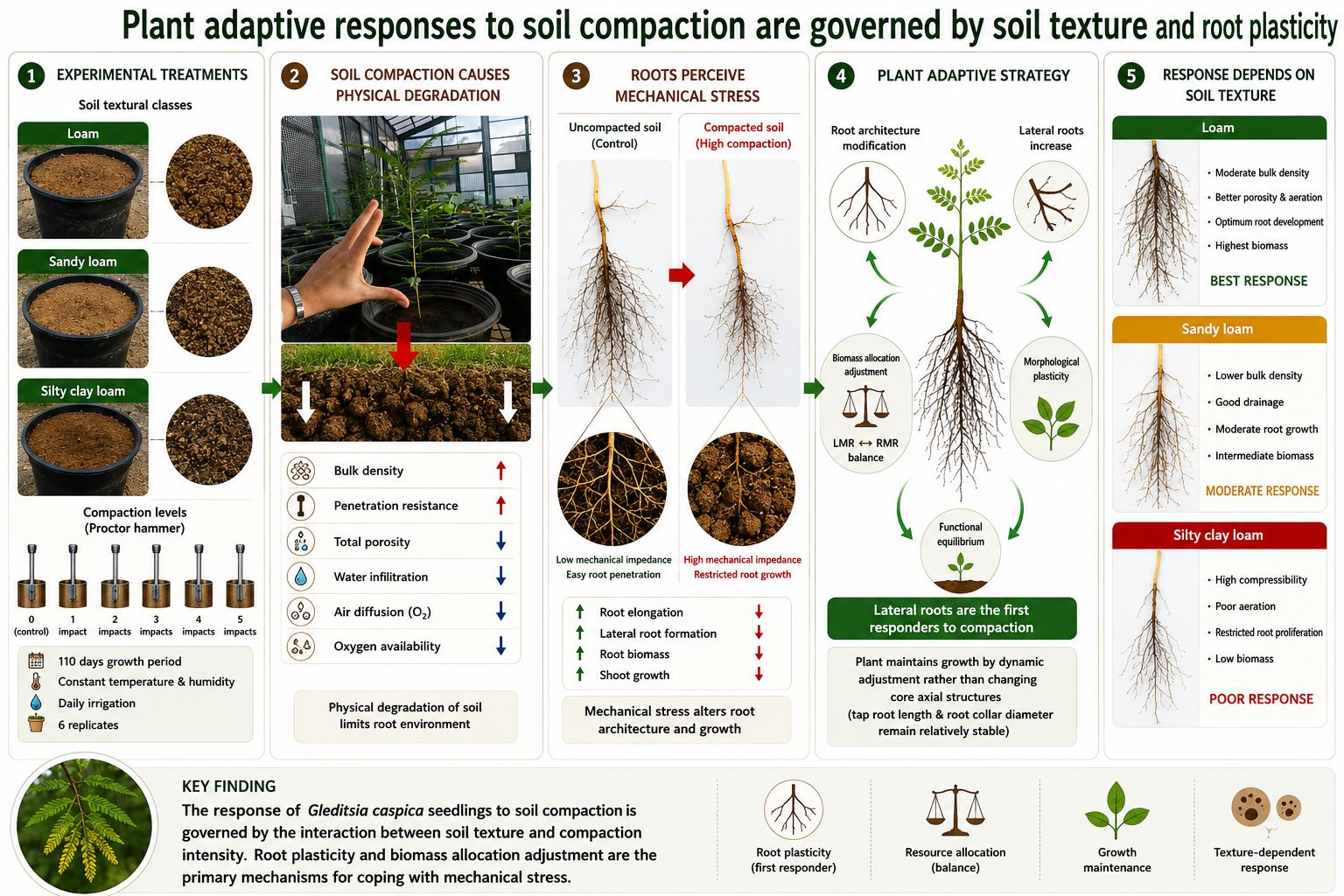
Ground-based logging operations cause soil compaction that constrains natural regeneration in the Hyrcanian forests of northern Iran, yet how soil textural properties modulate these effects on endemic tree species remains poorly understood. This study assessed the interactive effects of soil texture and compaction intensity on seedling growth and biomass allocation of Persian honeylocust (Gleditsia caspica Desf.) under controlled conditions. A factorial greenhouse experiment with three soil textures (loam, sandy loam, and silty clay loam) and six compaction levels (0–5 Proctor impacts) was conducted. After a 110-day growing period, morphological traits and biomass partitioning were analyzed using two-way ANOVA. Significant soil texture × compaction interactions (p < 0.05) were found for lateral root length, primary and lateral root dry biomass, stem biomass, total biomass, leaf mass ratio, root mass ratio, and the lateral-to-primary root length ratio. In sandy loam, mild compaction (Level 1) increased total biomass by 39% (2.15 g) and lateral root length by 34% (448.5 cm) relative to the controls, indicating a beneficial compaction window. Loam soils exhibited an initial reduction in growth at low compaction levels, followed by recovery at moderate levels, suggesting physiological acclimation. Silty clay loam, with its high compressibility, suppressed root proliferation and aboveground growth across most compaction treatments. Axial traits, including stem length, primary root length, and root collar diameter, remained stable irrespective of treatment, highlighting a conservative developmental strategy. These results reveal that G. caspica employs a hierarchical adaptive strategy involving dynamic modulation of lateral root development and whole-plant carbon partitioning while preserving core axial architecture. The strong texture dependence of these responses highlights the need for texture-specific forest management. For restoration in degraded Hyrcanian landscapes, soil compaction thresholds should be calibrated to the dominant textural class to avoid exceeding the species’ ecological plasticity.

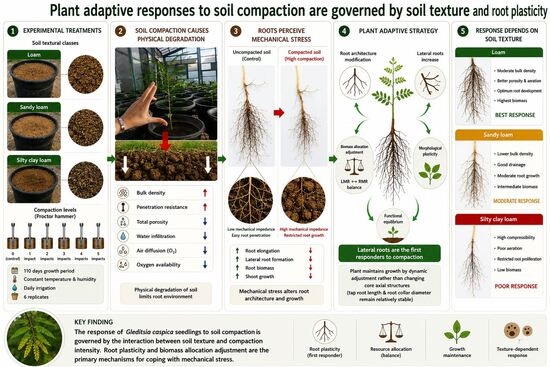
Graphical Abstract

1. Introduction

Forest soil structure is highly sensitive to certain management practices, such as the use of heavy logging machinery [1,2,3] and trampling by humans and animals [4,5]. Soil compaction compresses or destroys soil pores, rearranges soil particles, and increases bulk density [2,6,7,8]. Consequently, substantial changes can occur in nutrient cycling, water infiltration, gas exchange, energy fluxes, and biological activity, potentially negatively affecting ecosystem productivity and biodiversity [3,9,10,11].
Soil compaction imposes a range of adverse effects on plant physiology and morphology. It impedes primary root elongation, diminishes water uptake, increases leaf water deficits, impairs nutrient absorption, decreases photosynthetic rates, and suppresses overall growth [6,12,13,14,15]. Elevated soil strength generally restricts root development by increasing mechanical resistance [1,16,17], and as penetration resistance rises, root elongation and proliferation in seedlings decline, leading to water and nutrient deficiencies [7,18,19]. Consequently, plants allocate a greater proportion of their energy budget to root elongation, which can significantly constrain seedling growth rates and overall productivity [15]. Because roots must exert sufficient force to penetrate pores smaller than the root tip, and compaction simultaneously increases mechanical strength and reduces macropore abundance, both elongation rate and ultimate root length decline exponentially as soil strength increases [15,19,20]. Severe compaction not only results in shorter, thicker roots but may also alter root branching architecture [1,6,7,12] and generally suppress the uptake of essential mineral nutrients [13,14,15,21]. For most plant species, a nonlinear inverse relationship governs the association between root elongation rate and soil penetration resistance [6,12,13,14,15,16,17,18,19,20,21,22,23].
Extensive experimental literature has documented the effects of soil compaction on the growth and morphology of woody plants [7,13,14,15,21,22,23,24,25,26]. Environmental variables modulate the structural development of leaves, stems, and roots [12,14,15,21,22,26,27,28,29,30,31,32]. Both total tree height and periodic annual height increment have been shown to correlate negatively with increasing soil bulk density [33]. Under maximum compaction, primary root length can be reduced to approximately one-half of that recorded at lower compaction intensities [15]. Bassett et al. [25] demonstrated that soil compaction adversely affected both stem and root growth. However, responses are not uniformly negative; Alameda and Villar [13] reported that certain species exhibit greater total biomass under moderate soil compaction due to enhanced root–soil contact. Previous controlled pot studies have also examined these dynamics [34,35], and Brais [36] further found that, on coarse-textured soils, the severity of interspecific competition along skid trails diminished with increasing numbers of skidding cycles, ultimately resulting in significant increases in tree growth. Brais [36] also reported that spruce and pine growth responded differently to macroporosity and microporosity, suggesting that water-retention capacity may be the primary limiting factor on such soils.
Soil compaction can impose physiological stress comparable in severity to major abiotic stresses [15] and can impede forest succession following harvesting operations [30]. It affects root systems directly through mechanical impedance [31] and indirectly by reducing soil matric potential [3,6,8], diminishing water permeability and plant-available water [7], elevating bulk density [1,6], lowering saturated hydraulic conductivity [15], disrupting gaseous exchange [12], and exacerbating drought stress [14]. As soil porosity declines, soil strength and penetration resistance increase [15,31], constraining root growth [19] and ultimately causing changes in forest species composition [32] by hindering seedling establishment and natural regeneration [22]. Overall, soil compaction ranks among the principal factors reducing biomass accumulation across woody species [26]. Root systems may exhibit morphological adaptation to compacted conditions, notably through a reduction in the length-to-biomass ratio [28]. Although root length is a functionally significant trait linked to growth performance and ecological strategy [29], few investigations have specifically addressed the influence of soil strength and bulk density on root system development [30].
Despite extensive research on herbaceous species under compaction [30], detailed investigations into the effects of compaction on seedling morphology, root architecture, growth, and biomass allocation in woody species remain comparatively scarce. Several studies have assessed the effects of compaction on tree seedlings under controlled greenhouse conditions using polyvinyl chloride (PVC) pots [22,32,34,35,36,37,38]. Moreover, the existing literature has predominantly focused on agricultural systems and herbaceous vegetation, with research specifically addressing woody forest species being much less frequent. This knowledge gap is particularly evident in mountain forests such as those in Iran, where mechanized harvesting operations are relatively infrequent; instead, timber is typically extracted via ground skidding, a practice that can cause substantial soil compaction. The principal agents of forest soil compaction include the passage of machinery (tractors and skidders, including the effects of tire pressure) and trampling by humans and animals [6,12,13,22,23,39,40].
Soil texture constitutes one of the most fundamental and inherently stable physical properties of soil and is defined by the relative proportions of sand, silt, and clay. These specific ratios determine soil textural class and exert a decisive influence on nearly all soil behaviors and responses [41]. Fine clay particles, due to their exceptionally high specific surface area and propensity to form densely packed microstructures, tend to exhibit elevated bulk density even in the absence of externally applied pressure. Soils with higher clay content possess greater compressibility; in the presence of moisture, fine clay particles facilitate the formation of weak interparticle bonds and a concomitant reduction in pore volume, making the soil matrix highly susceptible to compaction under applied loads [42]. Consequently, the response of seedlings to soil compaction stress is likely to be profoundly modulated by soil texture, given that different textural classes exhibit marked variation in both compressibility and the mechanical impedance they present to root penetration.
The Hyrcanian forests of northern Iran constitute a globally significant ecosystem, forming a distinctive green arc stretching approximately 850 km along the southern coast of the Caspian Sea. These forests represent an extraordinary relic of Arcto-Tertiary broad-leaved woodlands that later retreated during Quaternary glaciations and subsequently re-expanded from these ancient refugia. In recognition of their exceptional natural values, a serial property was inscribed on the UNESCO World Heritage List in 2019. The focal species of this study, Persian honeylocust (Gleditsia caspica Desf.), is a light-demanding, fast-growing tree endemic to these forests, having persisted since the Pleistocene glaciations [43]. G. caspica is widely favored for afforestation and the restoration of degraded forest stands across the Caspian region, owing principally to its capacity for symbiotic nitrogen fixation. This species holds considerable promise for the rehabilitation of the Hyrcanian forest ecosystem, where soil disturbance and compaction resulting from ground-based skidding operations pose significant impediments to natural forest regeneration. Given that the interactive effects of soil texture and soil penetration resistance on seedling growth variables have yet to be systematically examined, this study investigated the response of G. caspica seedlings to experimentally imposed soil compaction across three contrasting soil textural classes—loam, sandy loam, and silty clay loam—under controlled greenhouse conditions. We hypothesized that soil compaction intensity and soil texture would exert significant main and interactive effects on the morphological characteristics, total biomass, and biomass partitioning patterns of G. caspica seedlings, and that the magnitude and direction of growth responses would vary as a function of soil texture.

2. Materials and Methods

2.1. Study Method

Seeds of Persian honeylocust (Gleditsia caspica Desf.) with the best morphological characteristics were chosen from the National Botanical Garden of Iran and transported to the seed laboratory at the Natural Resources Faculty in Karaj for sorting. The seeds were then preserved in a refrigerator at 4 °C. To break physical seed dormancy imposed by the hard, impermeable seed coat, seeds were immersed in sulfuric acid (H2SO4, 98%) for 60 min, as described by Fazli et al. [43], and subsequently washed with distilled water. For neutralization, seeds were placed in a 5% (w/v) sodium bicarbonate (baking soda) solution for 30 min, followed by soaking in water for 24 h. Seeds were then stratified in sterile moist sand for 24–48 h. For disinfection, seeds were treated with 10% sodium hypochlorite solution for 5 min. Germination tests were conducted using four replicates of 50 seeds each (200 seeds in total), placed on two layers of sterile Whatman No. 1 filter paper in 9 cm-diameter glass Petri dishes. Each dish was moistened with 5 mL of distilled water and maintained in a climate-controlled germinator at 24 °C and 80% relative humidity under a 12 h photoperiod. Seeds were monitored daily, and radicle emergence (≥2 mm) was scored as germination over a 21-day period. Distilled water was added as needed to keep the filter paper consistently moist.
The soils of the study area, typical of the Hyrcanian forest region, are classified as Brown Forest Soils (Cambisols according to the FAO World Reference Base) and have developed predominantly on limestone and dolomitic parent materials. These soils are characterized by high organic matter content in the surface horizon, loam to silty clay loam textures, and a well-developed granular structure under undisturbed forest conditions. Three soil types with different physical properties were selected for this experiment. The three soil textural classes (loam, sandy loam, and silty clay loam) were deliberately selected to represent the predominant range of soil textures encountered along skid trails in the Kheyrud Educational and Research Forest, where ground-based logging operations occur. These textures span a wide gradient in clay content (approximately 10% in sandy loam, 20% in loam, and 35% in silty clay loam) and consequently encompass a broad spectrum of compressibility, mechanical impedance, and water-holding capacity. This selection allowed for a systematic evaluation of how soil physical properties mediate seedling responses to compaction. Soils were collected from a depth of 0–30 cm along skid trails in the Kheyrud Educational and Research Forest, Nowshahr, Iran (36°36′31.0″ N, 51°33′56.3″ E). Soil texture was determined and confirmed using the hydrometer method. The proportions of sand, silt, and clay for each soil texture were 45%, 35%, and 20% for loam; 65%, 25%, and 10% for sandy loam; and 20%, 45%, and 35% for silty clay loam, corresponding to USDA textural classes of loam, sandy loam, and silty clay loam, respectively. According to soil engineering principles, soils with higher clay content have greater compressibility because fine clay particles fill the spaces between larger particles and compact easily under pressure.
The experiment was conducted in a completely randomized factorial design with two factors: soil texture at three levels (loam, sandy loam, and silty clay loam) and compaction intensity at six levels (0, 1, 2, 3, 4, and 5 blows). Six replicates were used per treatment, resulting in a total of 108 pots.
Plastic pots (20 cm in diameter and 30 cm in height) were filled with the prepared soils. A modified Proctor hammer (mass, 2.49 kg; drop height, 30 cm) was used to apply six soil compaction treatments following a procedure adapted from the standard Proctor test (ASTM D698 [44]). For each pot, the soil was added in three equal layers. Each layer received the designated number of hammer blows (0, 1, 2, 3, 4, or 5), distributed uniformly across the soil surface by moving the hammer in a circular pattern. The blows were delivered by freely dropping the hammer vertically from the specified height. After all layers had been compacted, the soil surface was carefully leveled. The six resulting compaction levels were designated as follows: 0 blows (control, Level 0), 1 blow (very low, Level 1), 2 blows (low, Level 2), 3 blows (medium, Level 3), 4 blows (high, Level 4), and 5 blows (highest, Level 5). This incremental compaction method using a Proctor-type hammer has been commonly employed in studies investigating the growth responses of woody species to soil compaction [13,25,38].
Soil bulk density was measured to assess compaction levels. Samples were collected from the pots using steel cylinders (5 cm diameter, 10 cm height), oven-dried at 105 °C for 24 h, and weighed. Bulk density was calculated as the ratio of dry soil weight to total soil volume.
Seeds were first germinated on sterile filter paper in Petri dishes as described in the germination test above. Once the radicles had emerged (≥2 mm), three uniformly germinated seeds were carefully transplanted into each pot at a depth of 1–3 mm immediately after the compaction treatments had been applied. After seedling establishment, they were thinned to one seedling per pot. Pots were kept under controlled greenhouse conditions at a temperature of 24 ± 2 °C, a relative humidity of 65 ± 5%, and a 12 h light/12 h dark photoperiod, with constant soil moisture maintained and no fertilizer applied, to avoid any possible confounding effects of different soil water regimes [45]. Pots were irrigated every day for 110 days in a greenhouse at the College of Agriculture and Natural Resources, University of Tehran, Karaj (35°48′14.6″ N, 51°00′03.9″ E) (Figure 1).
Prior to the experiment, representative subsamples of each soil textural class were analyzed for key physical and chemical properties. Soil pH was measured in a 1:2.5 soil–water suspension using a calibrated pH meter, electrical conductivity (EC) was determined in a 1:5 soil–water extract, and total nitrogen, available phosphorus, and exchangeable potassium were quantified following standard methods [38]. These baseline characteristics were used to confirm that the soils differed primarily in texture rather than in chemical fertility, thereby minimizing potential confounding effects on seedling growth. Seedlings were carefully harvested from the pots after 110 days. To ensure complete and intact recovery of the root systems, the pots were first fully saturated with water to soften the soil matrix. While the soil remained saturated, the roots were gently washed with a low-pressure stream of water, which gradually removed soil particles without damaging fine root structures. This procedure was applied uniformly to all pots, irrespective of soil texture. Morphological characteristics including stem length, primary root length, lateral root length, and collar diameter were measured using a scaled ruler and a digital caliper. Leaves, stems, and roots (separated into primary and lateral roots) were then oven-dried at 70 °C for 48 h to determine their biomass. The following variables were measured or calculated: (1) morphological characteristics, including stem length, primary root length, lateral root length, and collar diameter; (2) biomass characteristics, including leaf dry weight, stem dry weight, primary root dry weight, lateral root dry weight, shoot dry weight, total root dry weight, and total dry weight; and (3) biomass allocation and architectural characteristics. In this study, stem refers to the aboveground axis of the seedling excluding leaves, whereas shoot refers to the entire aboveground portion of the seedling (stem + leaves). The biomass allocation and architectural variables included the root-to-shoot ratio, leaf mass ratio (LMR), root mass ratio (RMR), stem mass ratio (SMR), lateral root biomass ratio, lateral-to-primary root length ratio, specific root length (SRL), specific stem length (SSL), and relative growth rate (RGR) based on both total dry biomass and stem height [46]. The definitions, equations, and units of all calculated variables are provided in Table 1.

2.2. Data Analysis

The experiment was conducted in a completely randomized factorial design with two factors: soil texture at three levels and compaction intensity at six levels. The control treatment provided a baseline to assess the effects of soil compaction by maintaining natural soil structure without applied pressure. Prior to analysis, data normality was verified using the Kolmogorov–Smirnov test, and homogeneity of variances was assessed using Levene’s test. Once variance homogeneity was confirmed, a two-way analysis of variance (ANOVA) was conducted to evaluate the significance of the main effects of compaction intensity and soil texture, as well as their interaction, on seedling characteristics. Where the two-way ANOVA revealed statistically significant effects, Tukey’s honestly significant difference (HSD) post hoc test was applied to compare and separate the treatment groups. All statistical analyses were performed using SPSS Statistics version 18.0 (SPSS Inc., Chicago, IL, USA), and graphical representations were generated using Microsoft Excel 2016 (Microsoft Corporation, Redmond, WA, USA).

3. Results

3.1. Soil Bulk Density

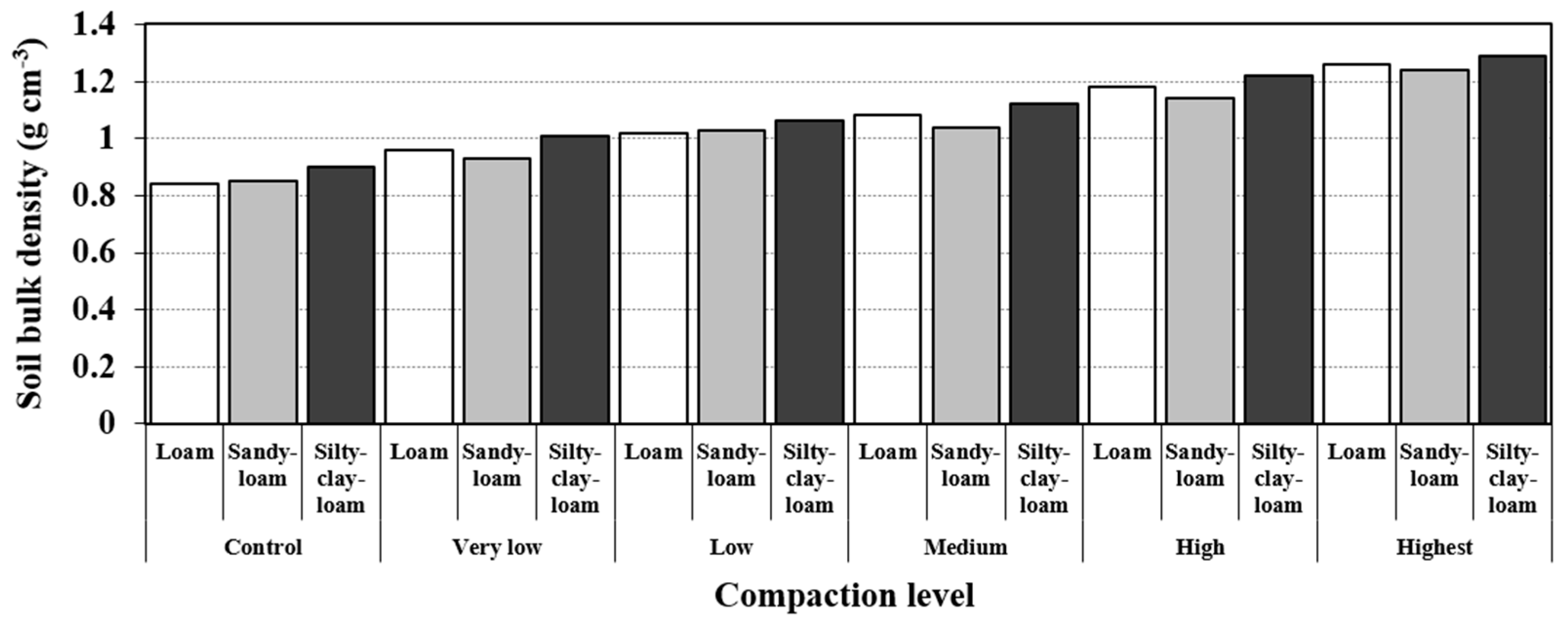
Soil bulk density was significantly affected by both soil texture and compaction intensity (p ≤ 0.01; Figure 2). Across all textural classes, bulk density increased progressively with compaction level, rising from mean control values of 0.84–0.90 g cm−3 to maximum values of 1.24–1.29 g cm−3 at the highest compaction level. The overall pattern was similar among textural classes, with silty clay loam consistently exhibiting the highest bulk density at each compaction level.

3.2. Relative Growth Rate

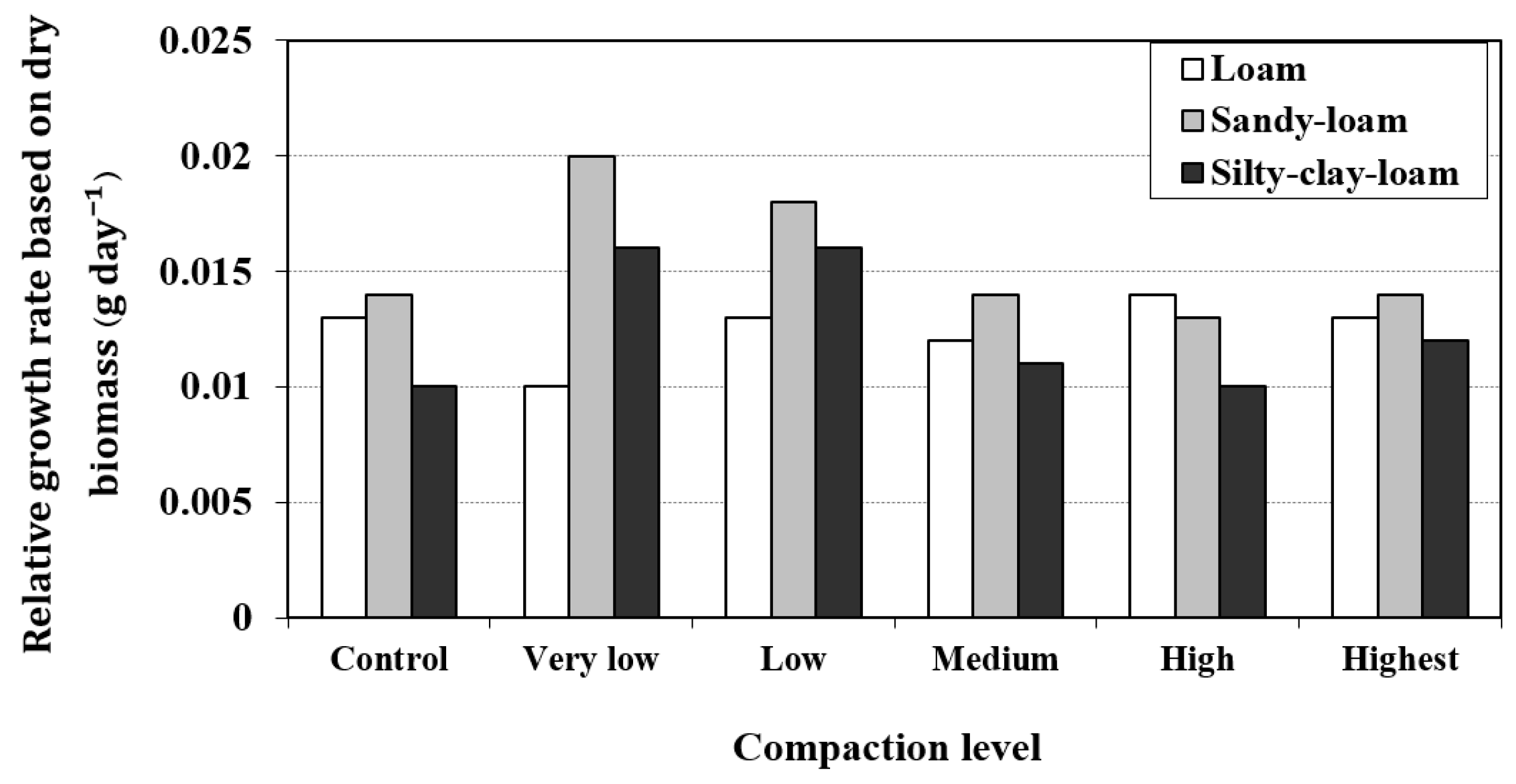
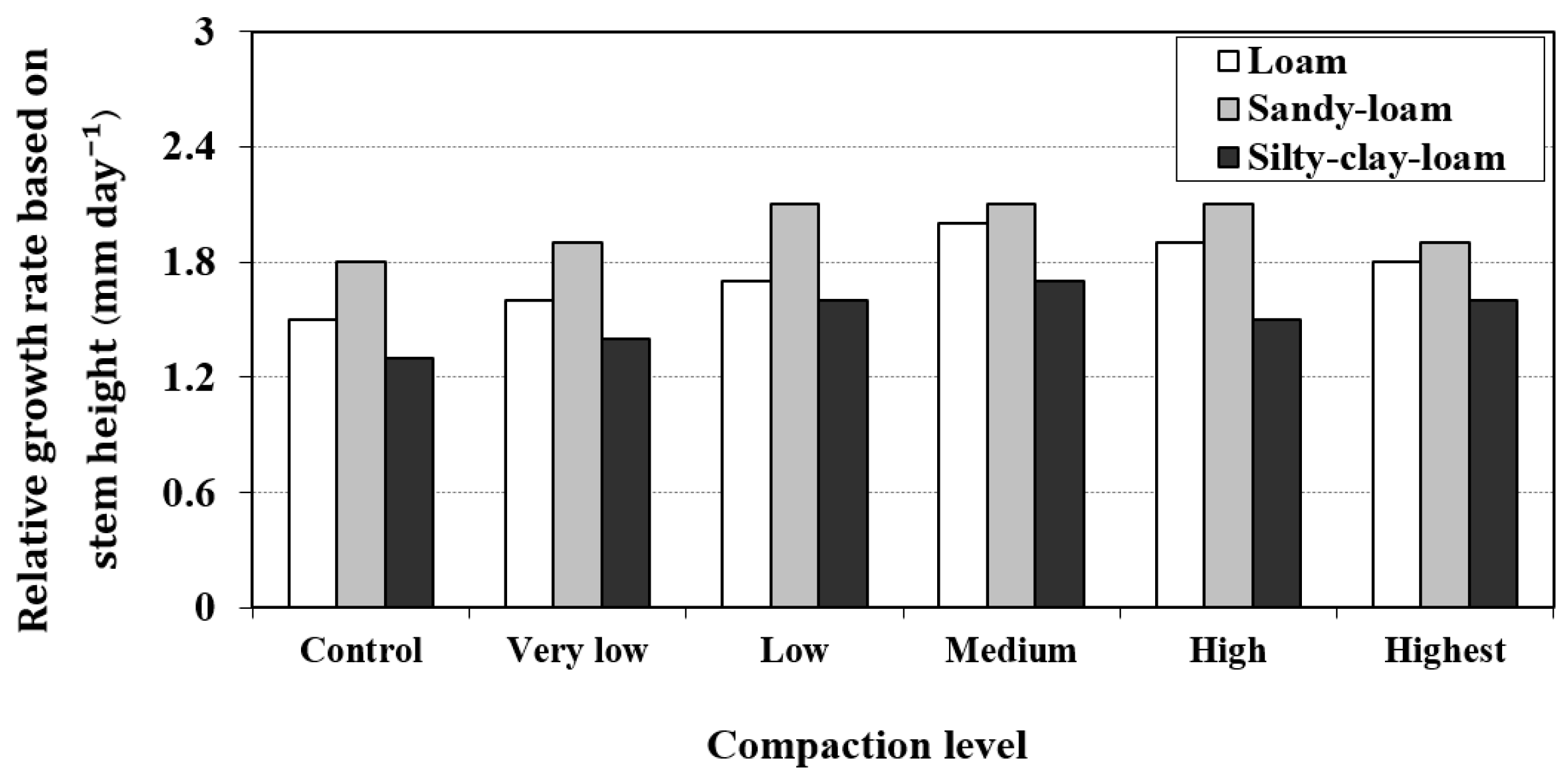
Relative growth rates based on dry biomass and stem height both exhibited nonlinear, texture-dependent responses to soil compaction (Figure 3 and Figure 4). In sandy loam, mild compaction (Level 1) increased biomass-based RGR by 43% and maintained a high height-based RGR across a broad range of compaction levels, indicating high tolerance. In silty clay loam, biomass-based RGR increased by 60% at Level 1 but declined sharply at higher compaction levels, whereas in loam, biomass-based RGR showed an initial decrease followed by gradual recovery and modest enhancement at moderate compaction levels. Height-based RGR followed a quadratic trend across all textural classes, with peak values at intermediate compaction levels (Levels 2–3) followed by a subsequent decline under severe compaction. Overall, mild compaction tended to promote growth rates in both coarse- and fine-textured soils, whereas loam exhibited an initial lag followed by compensatory responses.

3.3. Interaction Effects of Soil Texture and Compaction Intensity

Significant soil texture × compaction interactions were observed for lateral root length (p < 0.01), total root dry biomass (p < 0.01), leaf mass ratio (p < 0.01), and primary root dry biomass, lateral root dry biomass, stem dry biomass, total dry biomass, root mass ratio, and the lateral-to-primary root length ratio of G. caspica seedlings (all p < 0.05; Table 2). No significant interactions were detected for axial traits (stem length, primary root length, and collar diameter), leaf or shoot dry biomass, root-to-shoot ratio, SMR, lateral root biomass ratio, SSL, or SRL (all p > 0.05). These results indicate that the interactions were primarily confined to root architecture and biomass allocation ratios, whereas aboveground morphology remained stable across soil textures.

3.4. Morphological Characteristics

Stem length, primary root length, and collar diameter of G. caspica seedlings were not significantly affected by the soil texture × compaction interaction (p > 0.05; Table 3), indicating the relative stability of these axial traits. Lateral root length, however, showed a significant interaction (p < 0.01). In sandy loam, mild compaction (Level 1) increased lateral root length to a maximum of 448.5 cm (34% above the control), followed by a sharp decline at higher compaction levels. In loam, lateral root length increased progressively with compaction, peaking at Level 4, whereas in silty clay loam, the response was limited, with no significant differences among most treatments. These patterns indicate that lateral root proliferation is a highly plastic morphological trait and is strongly modulated by soil texture.

3.5. Biomass Characteristics

Significant soil texture × compaction interactions were detected for primary root dry biomass, lateral root dry biomass, stem dry biomass, total root dry biomass, and total dry biomass of G. caspica seedlings (p < 0.01–0.05; Table 2 and Table 4). Leaf dry biomass was not significantly affected by the interaction (p > 0.05). In sandy loam, mild compaction (Level 1) elicited a coordinated increase across all biomass components, raising total dry biomass by 39% above the control. In loam, biomass typically declined at Level 1 and then recovered or exceeded the control at moderate compaction levels, whereas silty clay loam showed peak values at Levels 1–2 followed by subsequent declines. Overall, the results indicate that biomass accumulation is strongly modulated by the texture-dependent balance between stimulatory and inhibitory effects of compaction.

3.6. Allocation Ratios and Architectural Characteristics

Significant soil texture × compaction interactions were found for leaf mass ratio (LMR; p < 0.01), root mass ratio (RMR; p < 0.05), and the lateral-to-primary root length ratio of G. caspica seedlings (p < 0.05; Table 2 and Table 5). The root-to-shoot ratio, SMR, lateral root biomass ratio, SRL, and SSL were not significantly affected by the interaction (p > 0.05). LMR and RMR exhibited contrasting, texture-specific patterns: in loam, mild compaction increased LMR while decreasing RMR, suggesting a transient shift toward shoot investment, whereas in silty clay loam, LMR was consistently low and RMR high, indicating persistent allocation to roots. The lateral-to-primary root length ratio increased markedly under mild compaction in silty clay loam, reaching the highest value across all treatments and indicating a rapid shift toward lateral root exploration in fine-textured soils. Sandy loam showed relatively stable LMR and RMR values, with a moderate increase in the length ratio under compaction.

4. Discussion

4.1. Soil Physical Properties and Compaction Effects

Soil bulk density and penetration resistance responded predictably to both compaction intensity and soil texture. After two to three hammer impacts, bulk density exceeded 1.1 g cm−3, a threshold known to constrain root elongation and impair aeration and water permeability [20,47,48]. Forest soils, naturally characterized by low bulk density due to their high organic matter content, are particularly susceptible to compaction from machinery traffic [9,49,50], which disrupts gas and water transport and reduces hydraulic conductivity [51,52], thereby increasing erosion risk [9,48]. Even light operations can shift bulk density from optimal levels (<0.9 g cm−3) to restrictive levels (>1.0 g cm−3), with compaction effects concentrating along skid trails and persisting for decades [3,53]. The passage of machinery, often affecting 10%–70% of harvested areas [48], can elevate soil strength beyond the bearing capacity of the soil matrix, especially when heavy modern equipment is used [3], leading to rutting, soil displacement, and reduced infiltration [52] that ultimately degrade soil quality [40,53,54]. These alterations can force root systems to adopt adaptive strategies, as observed in the present study, in which G. caspica modulated lateral root development and biomass allocation rather than primary-axis elongation.

4.2. Growth and Morphological Responses

No uniform growth response to compaction emerged; instead, the effect was mediated by soil texture. In sandy loam, mild compaction (a single impact) increased total biomass by 39% and lateral root length by 34%, consistent with findings that moderate compaction can improve root–soil contact and water retention in coarse-textured soils [13,55,56,57]. In loam, an initial growth reduction was followed by recovery, suggesting physiological acclimation. In silty clay loam, however, growth was suppressed across most compaction levels, likely owing to high compressibility and restricted aeration [10,38,58,59]. These divergent trajectories underscore that compaction effects are texture-dependent and can be stimulatory, neutral, or inhibitory, depending on the interplay between mechanical stress and soil physical properties [13,32,60,61].
Although soil compaction generally impedes root elongation and reduces water and nutrient uptake [6,12,13,14,15,62,63,64], the stability of stem length, primary root length, and root collar diameter in G. caspica across all treatments indicates a conservative developmental program for axial structures. This finding aligns with the concept that primary roots and stems are less plastic than lateral roots under mechanical impedance [12,30,61,65]. In contrast, lateral root length exhibited significant plasticity, representing the primary morphological response to compaction. Such differential sensitivity reflects a resource-allocation hierarchy in which the plant preserves essential transport and support functions while redirecting growth toward lateral roots for soil exploration [29,66]. The nonlinear, often quadratic, relationship between compaction intensity and growth traits further supports the idea that mild compaction may be perceived not as a terminal stress but as a biophysical signal that temporarily reallocates resources to aboveground organs, potentially enhancing light interception under competition [38].
The observed stability of primary root length across compaction levels is noteworthy, as rooting depth and seedling height are among the traits most susceptible to compaction in other tree species [25,47,67,68,69]. Compaction commonly reduces root elongation and promotes radial thickening [70]; however, under less severe conditions, roots may preferentially expand horizontally to avoid zones of high impedance [61,65]. A meta-analysis by Mariotti et al. [71] reported mean reductions in rooting depth and height exceeding 20% relative to controls, and such negative effects can persist for at least the first two growing seasons [37]. In our experiment, the preservation of primary root length suggests that G. caspica possesses a deeply conserved developmental program that safeguards the primary axis, even as lateral roots respond dynamically. The constancy of root collar diameter further implies that vascular continuity and mechanical support are maintained, thereby ensuring efficient transport between shoot and root [6].

4.3. Biomass Growth

Significant soil texture × compaction interactions were detected for primary and lateral root dry biomass, stem biomass, total biomass, and biomass allocation ratios (LMR and RMR). In sandy loam, mild compaction simultaneously increased primary root biomass (from 0.83 to 1.08 g, a 30% increase) and lateral root biomass, indicating coordinated reinforcement of the root system when mechanical impedance remains moderate. In loam, primary root biomass initially declined while lateral root biomass increased, suggesting a transient reallocation of carbon from the primary axis to absorptive surfaces, followed by renewed investment under more severe compaction. Silty clay loam exhibited the most constrained response, with both components reduced under high compaction, demonstrating that physical limitations in fine-textured soils can override plastic adjustments [20,59].
The stability of leaf dry biomass across treatments indicates that aboveground biomass production was maintained, potentially through adjustments in water-use efficiency and stomatal regulation. Compaction is known to reduce root hydraulic conductivity [72,73], and stomatal closure has been observed in Quercus robur seedlings under compacted conditions following drought [47], as well as in Lithocarpus edulis [4]. Stomatal closure restricts CO2 diffusion [7], potentially increasing reactive oxygen species production and causing secondary damage to the photosynthetic apparatus [73], which can be detected through reductions in chlorophyll fluorescence [74,75]. The fact that leaf biomass remained unchanged in our study suggests that G. caspica may effectively buffer its photosynthetic machinery against such stress, possibly through enhanced root–soil contact [75] and sustained water uptake under mild to moderate compaction. Nevertheless, the documented foreshortening of primary roots under severe compaction could diminish access to deeper soil moisture, thereby exacerbating drought vulnerability under field conditions [6].
Aboveground total biomass did not show a significant interaction effect, despite changes in stem biomass. This pattern implies internal compensatory shifts, whereby resources were repartitioned between stems and leaves to maintain total shoot biomass. Total root biomass increased in sandy loam under mild compaction, driven primarily by lateral root proliferation, whereas in silty clay loam, no net gain was observed, highlighting the overriding role of soil physical constraints. In coarse-textured soils, moderate compaction can enhance plant-available water [57] and prolong water availability, whereas in clay-rich soils, reduced macroporosity and aeration become limiting [76]. These patterns align with studies showing that compaction effects on root biomass and depth are generally less severe in arenaceous soils than in silty or clayey substrates [59], although species-specific responses are well documented [77,78], with conifers and broadleaved trees often showing similar responses.

4.4. Seedling Architecture and Allocation Ratios

Leaf mass ratio (LMR) and root mass ratio (RMR) responded in opposite directions depending on soil texture, indicating that carbon partitioning between photosynthetic and absorptive organs is context-dependent. For instance, identical mild compaction (a single impact) increased LMR in loam but decreased it in silty clay loam, revealing that the same mechanical force can elicit divergent allocation responses depending on soil texture. Despite these shifts, stem mass ratio (SMR) and the lateral-to-total root biomass ratio remained stable, indicating that fundamental architectural patterns were preserved. The constancy of internal root system proportions, even as absolute biomass changed, suggests that G. caspica possesses a relatively conservative structural template that is quantitatively modulated by soil texture [28,66]. This finding partially supports functional equilibrium theory [79,80], while adding nuance: the equilibrium may represent not a fixed point but a bounded range within which the plant can dynamically allocate carbon while maintaining core architecture.
At the level of individual traits, only lateral root length and the lateral-to-primary root length ratio exhibited significant interaction effects, reinforcing the role of lateral roots as a highly plastic component of the root system. Specific root length (SRL) and specific stem length (SSL) were not significantly affected, consistent with the variable and often species-specific nature of these traits reported in the literature [14,15]. Overall, G. caspica appears to employ a hierarchical strategy in which lateral roots respond rapidly to soil physical conditions, axial structures remain relatively stable, and total shoot biomass is maintained. This multilevel response represents a potentially effective adaptive strategy for growth under physically restrictive conditions.

4.5. Management Implications and Practical Recommendations

In sandy loam soils, where mild compaction can stimulate growth, careful traffic management is nevertheless critical because this substrate degrades rapidly under repeated passes [3,53,81]; confining heavy machinery to permanently designated corridors and conducting light tillage during the wet season prior to planting can facilitate root establishment. In loam, the initial growth reduction under mild compaction warrants protective buffer zones around young seedlings to restrict access during the early years. In silty clay loam, any off-trail traffic should be avoided, and pre-planting soil amelioration such as organic matter incorporation is recommended to improve porosity and reduce compressibility [9,49,60]. Monitoring sensitive traits such as lateral root length and the LMR and RMR ratios could serve as an early warning system for compaction stress, enabling adaptive management [38,71]. Adherence to fundamental soil conservation principles, the establishment of permanent skid trails, the use of low-ground-pressure equipment, and the avoidance of operations on saturated soils are essential across all sites [6,9,53].

4.6. Limitations and Future Directions

This greenhouse study maintained non-limiting soil moisture, thereby excluding the interactive effects of drought that often accompany field compaction. Future experiments should combine compaction gradients with water-deficit treatments and incorporate measurements of photosynthesis, stomatal conductance, root hydraulic conductivity, and stress hormones [47,73,74]. Long-term field trials are needed to validate critical thresholds beyond the seedling stage, as compaction effects can persist and interact with ontogenetic shifts [37,71]. Furthermore, because container-based studies may exaggerate aeration limitations [82], field validation is essential. Finally, investigating intraspecific variation among provenances of G. caspica could guide the selection of genetic material best suited to specific soil and disturbance regimes, thereby enhancing restoration success in degraded Hyrcanian landscapes [6,61,64,83].

5. Conclusions

This study reveals that the response of G. caspica seedlings to soil compaction is strongly modulated by soil texture, reflecting a context-dependent adaptive strategy rather than a uniform growth response. The species appears to employ a hierarchical resource-allocation framework in which lateral roots function as highly plastic components, dynamically adjusting their length and biomass in response to soil physical conditions, while axial structures, including the stem, primary root, and root collar, remain relatively stable, thereby preserving core structural functions. Significant interactive effects on leaf mass ratio and root mass ratio further indicate that whole-plant biomass allocation is flexibly adjusted to the prevailing soil environment. These findings extend the application of classical functional equilibrium theory by demonstrating that, under compaction stress, G. caspica does not exhibit a simple shoot–root trade-off but instead displays a multilevel, organ-specific response. The practical significance of these findings lies in their implications for restoration management. Successful restoration plantings with G. caspica require texture-specific strategies. In sandy loam soils, although mild compaction enhanced seedling growth under the experimental conditions, heavy machinery should be confined to permanent corridors to prevent structural degradation. In loam soils, protective buffers during early establishment may help minimize compaction impacts, whereas in silty clay loam soils, off-trail traffic should be avoided and pre-planting soil amelioration should be considered where appropriate. Monitoring lateral root development and biomass allocation ratios could provide an early-warning indicator of compaction stress and support adaptive management. This study was conducted under controlled greenhouse conditions with non-limiting soil moisture, which may not fully reflect field responses, where drought and compaction often co-occur. The relatively short experimental duration also precludes assessment of long-term acclimation and recovery. Future field-based experiments integrating water-deficit treatments, physiological measurements, and provenance-level variation are therefore essential to validate critical compaction thresholds and optimize site-specific restoration practices for degraded Hyrcanian forests.

Author Contributions

Conceptualization, S.A. and M.J.; methodology, S.A., M.J., V.E., E.A., R.V., A.L.M. and R.P.; validation, S.A., M.J., V.E. and E.A.; formal analysis, S.A., M.J., V.E. and E.A.; investigation, S.A., M.J., V.E. and E.A.; resources, M.J. and A.L.M.; data curation, S.A., M.J., V.E., E.A., R.V., A.L.M. and R.P.; writing—original draft preparation, S.A., M.J., V.E. and E.A.; writing—review and editing, M.J., R.V., A.L.M. and R.P.; visualization, R.V., A.L.M. and R.P.; supervision, M.J.; project administration, M.J.; funding acquisition, M.J., A.L.M. and R.P. All authors have read and agreed to the published version of the manuscript.

Funding

This research received no external funding.

Data Availability Statement

The datasets generated and analyzed during the current study are available from Prof. Meghdad Jourgholami upon reasonable request. The data are not publicly available because they are part of an ongoing collaborative research project and are subject to institutional data management policies until completion of the associated research activities.

Acknowledgments

The research was carried out within the framework of the Ministry of University and Research (MUR) initiative “Departments of Excellence” (Law 232/2016) DAFNE Project 2023–27 “Digital, Intelligent, Green and Sustainable (acronym: D.I.Ver.So)”.

Conflicts of Interest

The authors declare no conflicts of interest.

References

  1. Ampoorter, E.; Goris, R.; Cornelis, W.; Verheyen, K. Impact of mechanized logging on compaction status of sandy forest soils. For. Ecol. Manag. 2007, 241, 162–174. [Google Scholar] [CrossRef] [Scilit]
  2. Lucas-Borja, M.E.; Heydari, M.; Miralles, I.; Zema, D.A.; Manso, R. Effects of Skidding Operations after Tree Harvesting and Soil Scarification by Felled Trees on Initial Seedling Emergence of Spanish Black Pine (Pinus nigra Arn. ssp. salzmannii). Forests 2020, 11, 767. [Google Scholar] [CrossRef] [Scilit]
  3. Cambi, M.; Certini, G.; Neri, F.; Marchi, E. The impact of heavy traffic on forest soils: A review. For. Ecol. Manag. 2015, 338, 124–138. [Google Scholar] [CrossRef] [Scilit]
  4. Komatsu, H.; Katayama, A.; Hirose, S.; Kume, A.; Higashi, N.; Ogawa, S.; Otsuki, K. Reduction in soil water availability and tree transpiration in a forest with pedestrian trampling. Agric. For. Meteorol. 2007, 146, 107–114. [Google Scholar] [CrossRef] [Scilit]
  5. Meyer, G.A.; Leroux, S.J. A theory for context-dependent effects of mammalian trampling on ecosystem nitrogen cycling. J. Anim. Ecol. 2024, 93, 583–598. [Google Scholar] [CrossRef] [Scilit] [PubMed]
  6. Kozlowski, T.T. Soil compaction and growth of woody plants. Scand. J. For. Res. 1999, 14, 596–619. [Google Scholar] [CrossRef]
  7. Gomez, A.; Powers, R.F.; Singer, M.J.; Horwath, W.R. Soil compaction effects on growth of young ponderosa pine following litter removal in California’s Sierra Nevada. Soil Sci. Soc. Am. J. 2002, 6, 1334–1343. [Google Scholar] [CrossRef] [Scilit]
  8. Ampoorter, E.; De Frenne, P.; Hermy, M.; Verheyen, K. Effects of soil compaction on growth and survival of tree saplings: A meta-analysis. Basic Appl. Ecol. 2011, 12, 394–402. [Google Scholar] [CrossRef] [Scilit]
  9. Dalir, P.; Naghdi, R.; Jafari, S.; Tsioras, P.A. Comparative Assessment of Woody Species for Runoff and Soil Erosion Control on Forest Road Slopes in Harvested Sites of the Hyrcanian Forests, Northern Iran. Forests 2025, 16, 1013. [Google Scholar] [CrossRef] [Scilit]
  10. Picchio, R.; Tavankar, F.; Nikooy, M.; Pignatti, G.; Venanzi, R.; Lo Monaco, A. Morphology, Growth and Architecture Response of Beech (Fagus orientalis Lipsky) and Maple Tree (Acer velutinum Boiss.) Seedlings to Soil Compaction Stress Caused by Mechanized Logging Operations. Forests 2019, 10, 771. [Google Scholar] [CrossRef] [Scilit]
  11. Latterini, F.; Camarretta, N.; Janiszewska-Latterini, D.; Pasquini, D.; Moss, J.; Watt, M.S. Soil trafficability maps: A geospatial tool for reducing soil damage and supporting sustainable forest management in New Zealand. Land Degrad. Dev. 2025, 36, 5602–5612. [Google Scholar] [CrossRef] [Scilit]
  12. Misra, R.K.; Gibbons, A.K. Growth and morphology of eucalypt seedling roots in relation to soil strength arising from compaction. Plant Soil 1996, 182, 1–11. [Google Scholar] [CrossRef] [Scilit]
  13. Alameda, D.; Villar, R. Moderate soil compaction: Implications on growth and architecture in seedlings of 17 woody plant species. Soil Tillage Res. 2009, 103, 325–331. [Google Scholar] [CrossRef] [Scilit]
  14. Alameda, D.; Villar, R. Linking root traits to plant physiology and growth in Fraxinus angustifolia Vahl. seedlings under soil compaction conditions. Environ. Exp. Bot. 2012, 79, 49–57. [Google Scholar] [CrossRef] [Scilit]
  15. Bejarano, M.D.; Villar, R.; Murillo, A.M.; Quero, J.L. Effects of soil compaction and light on growth of Quercus pyrenaica Willd. (Fagaceae) seedlings. Soil Tillage Res. 2010, 110, 108–114. [Google Scholar] [CrossRef] [Scilit]
  16. Acácio, V.; Holmgren, M.; Jansen, P.A.; Schrotter, O. Multiple recruitment limitation causes arrested succession in Mediterranean cork oak systems. Ecosystems 2007, 10, 1220–1230. [Google Scholar] [CrossRef] [Scilit]
  17. Kolb, E.; Legué, V.; Bogeat-Triboulot, M.-B. Physical root–soil interactions. Phys. Biol. 2017, 14, 065004. [Google Scholar] [CrossRef] [Scilit] [PubMed]
  18. Correa, J.; Postma, J.A.; Watt, M.; Wojciechowski, T. Root system architectural plasticity and soil compaction. J. Ex. Bot. 2019, 70, 6019–6034. [Google Scholar] [CrossRef] [Scilit] [PubMed]
  19. Greacen, E.L.; Sands, R. Compaction of forest soils. A review. Aust. J. Soil Res. 1980, 18, 163–189. [Google Scholar] [CrossRef] [Scilit]
  20. Latterini, F.; Dyderski, M.K.; Horodecki, P.; Rawlik, M.; Stefanoni, W.; Högbom, L.; Venanzi, R.; Picchio, R.; Jagodzinski, A.M. A meta-analysis of the effects of ground-based extraction technologies on fine roots in forest soils. Land Degrad. Dev. 2024, 35, 9–21. [Google Scholar] [CrossRef] [Scilit]
  21. Perez-Ramos, I.M.; Gomez-Aparicio, L.; Villar, R.; Garcia, L.V.; Marañón, T. Seedling growth and morphology of three oak species along field resource gradients and seed mass variation: A seedling age-dependent response. J. Veg. Sci. 2010, 21, 419–437. [Google Scholar] [CrossRef] [Scilit]
  22. Siegel-Issem, C.M.; Burger, J.A.; Powers, R.F.; Ponder, F.; Patterson, S.C. Seedling root growth as a function of soil density and water content. Soil Sci. Soc. Am. J. 2005, 69, 215–226. [Google Scholar] [CrossRef] [Scilit]
  23. Fleming, R.L.; Powers, R.F.; Foster, N.W.; Kranabetter, J.M.; Scott, D.A.; Ponder, F., Jr.; Berch, S.; Chapman, W.K.; Kabzems, R.D.; Ludovici, K.H.; et al. Effects of organic matter removal, soil compaction, and vegetation control on 5-year seedling performance: A regional comparison of Long-Term Soil Productivity sites. Can. J. For. Res. 2006, 36, 529–550. [Google Scholar] [CrossRef] [Scilit]
  24. Tubeileh, A.; Groleau-Renaud, V.; Plantureux, S.; Guckert, A. Effect of soil compaction on photosynthesis and carbon partitioning within a maize–soil system. Soil Tillage Res. 2003, 71, 151–161. [Google Scholar] [CrossRef] [Scilit]
  25. Bassett, I.E.; Simcock, R.C.; Mitchell, N.D. Consequences of soil compaction for seedling establishment: Implications for natural regeneration and restoration. Austral Ecol. 2005, 30, 827–833. [Google Scholar] [CrossRef] [Scilit]
  26. Bulmer, C.E.; Simpson, D.G. Soil compaction and water content as factors affecting the growth of lodgepole pine seedlings on sandy clay loam soil. Can. J. Soil Sci. 2005, 85, 667–679. [Google Scholar] [CrossRef] [Scilit]
  27. Zou, C.; Penfold, C.; Sands, R.; Misra, R.K.; Hudson, I. Effects of soil air-filled porosity, soil matric potential and soil strength on primary root growth of radiata pine seedlings. Plant Soil 2001, 236, 105–115. [Google Scholar] [CrossRef] [Scilit]
  28. Kabzems, R.; Haeussler, S. Soil properties, aspen and white spruce responses five years after organic matter removal and compaction treatments. Can. J. For. Res. 2005, 35, 2045–2055. [Google Scholar] [CrossRef] [Scilit]
  29. Skinner, A.K.; Lunt, I.D.; Spooner, P.; McIntyre, S. The effect of soil compaction on germination and early growth of Eucalyptus albens and an exotic annual grass. Austral Ecol. 2009, 34, 698–704. [Google Scholar] [CrossRef] [Scilit]
  30. Tracy, S.R.; Black, C.R.; Roberts, J.A.; Mooney, S.J. Exploring the interacting effect of soil texture and bulk density on root system development in tomato (Solanum lycopersicum L.). Environ. Exp. Bot. 2012, 91, 38–47. [Google Scholar] [CrossRef] [Scilit]
  31. Kormanek, M.; Banach, J.; Leńczuk, D. Influence of soil compaction on the growth of silver fir (Abies alba Mill.) under a forest canopy. Ecol. Quest. 2015, 22, 47–54. [Google Scholar] [CrossRef] [Scilit]
  32. Blouin, V.M.; Schmidt, M.G.; Bulmer, C.E.; Krzic, M. Effects of compaction and water content on lodgepole pine seedling growth. For. Ecol. Manag. 2008, 255, 2444–2452. [Google Scholar] [CrossRef] [Scilit]
  33. Cochran, P.H.; Brock, T. Soil Compaction and Initial Height Growth of Ponderosa Pine; USDA Forest Service Research Note, PNW-RN-434; Pacific Northwest Research Station: Portland, OR, USA, 1985. [Google Scholar]
  34. Conlin, D. Soil Compaction and Its Effects on the Growth of Lodgepole Pine Seedlings in a Controlled Environment. Master’s Thesis, University of British Columbia, Vancouver, BC, Canada, 1996. [Google Scholar]
  35. Mosena, M.; Dillenburg, L.R. Early growth of Brazilian pine (Araucaria angustifolia) seedlings as affected by soil compaction and fertilization. Braz. J. Plant Physiol. 2004, 16, 161–168. [Google Scholar]
  36. Brais, S. Persistence of soil compaction and effects on seedling growth in Northwestern Quebec. Soil Sci. Soc. Am. J. 2001, 65, 1263–1271. [Google Scholar] [CrossRef] [Scilit]
  37. Kormanek, M.; Głąb, T.; Banach, J.; Szewczyk, G. Effects of soil bulk density on sessile oak Quercus petraea Liebl. seedlings. Eur. J. For. Res. 2015, 134, 969–979. [Google Scholar] [CrossRef] [Scilit]
  38. Jourgholami, M.; Khoramizadeh, A.; Zenner, E.K. Effects of soil compaction on seedling morphology, growth, and architecture of chestnut-leaved oak (Quercus castaneifolia). iForest-Biogeosci. For. 2016, 10, 145–153. [Google Scholar] [CrossRef] [Scilit]
  39. Jourgholami, M. Effects of soil compaction on growth variables in Cappadocian maple (Acer cappadocicum) seedlings. J. For. Res. 2018, 29, 601–610. [Google Scholar] [CrossRef] [Scilit]
  40. Jourgholami, M.; Ahmadi, M.M.; Tavankar, F.; Picchio, R. Effectiveness of three post-harvest rehabilitation treatments for runoff and sediment reduction on skid trails in the Hyrcanian forests. Croat. J. For. Eng. 2020, 41, 309–324. [Google Scholar] [CrossRef] [Scilit]
  41. Baveye, P.C.; Otten, W.; Kravchenko, A.; Balseiro-Romero, M.; Beckers, É.; Chalhoub, M.; Darnault, C.; Eickhorst, T.; Garnier, P.; Hapca, S.; et al. Emergent properties of microbial activity in heterogeneous soil microenvironments: Different research approaches are slowly converging, yet major challenges remain. Front. Microbiol. 2018, 9, 1929. [Google Scholar] [CrossRef] [Scilit] [PubMed]
  42. Schaetzl, R.J.; Anderson, S. Soils: Genesis and Geomorphology, 2nd ed.; Cambridge University Press: Cambridge, UK, 2020. [Google Scholar]
  43. Fazli, H.; Akbarinia, M.; Hosseini, S.M.; Tabari, M. The effect of scarification treatments on seed germination of Persian honey locust. Iran. J. For. 2020, 12, 305–315. [Google Scholar]
  44. ASTM D698; Standard Test Methods for Laboratory Compaction Characteristics of Soil Using Standard Effort (12400 ft-lbf/ft3 (600 kN-m/m3)). ASTM International: West Conshohocken, PA, USA, 2021.
  45. Souch, C.A.; Martin, P.J.; Stephens, W.; Spoor, G. Effects of soil compaction and mechanical damage at harvest on growth and biomass production of short rotation coppice willow. Plant Soil 2004, 263, 173–182. [Google Scholar] [CrossRef] [Scilit]
  46. Hunt, R. Basic Growth Analysis: Plant Growth Analysis for Beginners; Unwin Hyman: London, UK, 1990. [Google Scholar]
  47. Nazari, M.; Arthur, E.; Lamandé, M.; Keller, T.; Bilyera, N.; Bickel, S. A Meta-analysis of Soil Susceptibility to Machinery-Induced Compaction in Forest Ecosystems Across Global Climatic Zones. Curr. For. Rep. 2023, 9, 370–381. [Google Scholar] [CrossRef] [Scilit]
  48. Jourgholami, M.; Fathi, K.; Labelle, E.R. Effects of litter and straw mulch amendments on compacted soil properties and Caucasian alder (Alnus subcordata) growth. New For. 2020, 51, 349–365. [Google Scholar] [CrossRef] [Scilit]
  49. Nazari, M.; Eteghadipour, M.; Zarebanadkouki, M.; Ghorbani, M.; Dippold, M.A.; Bilyera, N.; Zamanian, K. Impacts of logging-associated compaction on forest soils: A meta-analysis. Front. For. Glob. Change 2021, 4, 780074. [Google Scholar] [CrossRef] [Scilit]
  50. Chen, J.; Zhu, J.; Wang, Z.; Xing, C.; Chen, B.; Wang, X.; Wei, C.; Liu, J.; He, Z.; Xu, D. Canopy Gaps Control Litter Decomposition and Nutrient Release in Subtropical Forests. Forests 2023, 14, 673. [Google Scholar] [CrossRef] [Scilit]
  51. Osipov, A.F.; Startsev, V.V.; Dymov, A.A. Increasing the number of forest machinery passes and removing the organic layer reduces soil respiration on skid trails within clearcuts of boreal coniferous-deciduous stands. Soil Tillage Res. 2026, 256, 106867. [Google Scholar] [CrossRef] [Scilit]
  52. Rab, M.A. Soil physical and hydrological properties following logging and slash burning in the Eucalyptus regnans forest of Southeastern Australia. For. Ecol. Manag. 1996, 84, 159–176. [Google Scholar] [CrossRef] [Scilit]
  53. Zenner, E.K.; Fauskee, J.T.; Berger, A.L.; Puettmann, K.J. Impacts of skidding traffic intensity on soil disturbance, soil recovery, and aspen regeneration in North-Central Minnesota. North. J. Appl. For. 2007, 24, 177–183. [Google Scholar] [CrossRef] [Scilit]
  54. Kiumarsi, F.; Jourgholami, M.; Jafari, M.; Lo Monaco, A.; Venanzi, R.; Picchio, R. Restoring soil properties in the Hyrcanian forests from machine induced compaction: Reforestation of N2-fixing black alder (Alnus glutinosa (L.) Gaertn.). Land Degrad. Dev. 2024, 35, 2084–2096. [Google Scholar] [CrossRef] [Scilit]
  55. Veen, B.W.; Van Noordwijk, M.; De Willigen, P.; Boone, F.R.; Kooistra, M.J. Root-soil contact of maize, as measured by a thin-section technique. III. Effects on shoot growth, nitrate and water uptake efficiency. Plant Soil 1992, 139, 131–138. [Google Scholar] [CrossRef] [Scilit]
  56. Arvidsson, J. Nutrient uptake and growth of barley as affected by soil compaction. Plant Soil 1999, 208, 9–19. [Google Scholar] [CrossRef] [Scilit]
  57. Jakobsen, B.F.; Greacen, E.L. Compaction of sandy forest soils by forwarder operations. Soil Tillage Res. 1985, 5, 55–70. [Google Scholar] [CrossRef] [Scilit]
  58. Pinard, M.; Barker, M.; Tay, J. Soil disturbance and post-logging forest recovery on bulldozer paths in Sabah, Malaysia. For. Ecol. Manag. 2000, 130, 213–225. [Google Scholar] [CrossRef] [Scilit]
  59. Foth, H.D. Fundamentals of Soil Science, 8th ed.; John Wiley & Sons: New York, NY, USA, 1990. [Google Scholar]
  60. Norris, C.E.; Hogg, K.E.; Maynard, D.G.; Curran, M.P. Stumping trials in British Columbia—Organic matter removal and compaction effects on tree growth from seedlings to midrotation stands. Can. J. For. Res. 2014, 44, 1402–1418. [Google Scholar] [CrossRef] [Scilit]
  61. Cambi, M.; Mariotti, B.; Fabiano, F.; Maltoni, A.; Tani, A.; Foderi, C.; Laschi, A.; Marchi, E. Early response of Quercus robur seedlings to soil compaction following germination. Land Degrad. Dev. 2018, 29, 916–925. [Google Scholar] [CrossRef] [Scilit]
  62. Chirino, E.; Vilagrosa, A.; Hernández, E.I.; Matos, A.; Vallejo, V.R. Effects of a deep container on morpho-functional characteristics and root colonization in Quercus suber L. seedlings for reforestation in Mediterranean climate. For. Ecol. Manag. 2008, 256, 779–785. [Google Scholar] [CrossRef] [Scilit]
  63. Frey, B.; Kremer, J.; Rüdt, A.; Sciacca, S.; Matthies, D.; Lüscher, P. Compaction of forest soils with heavy logging machinery affects soil bacterial community structure. Eur. J. Soil Biol. 2009, 45, 312–320. [Google Scholar] [CrossRef] [Scilit]
  64. Hartmann, M.; Niklaus, P.A.; Zimmermann, S.; Schmutz, S.; Kremer, J.; Abarenkov, K.; Lüscher, P.; Widmer, F.; Frey, B. Resistance and resilience of the forest soil microbiome to logging-associated compaction. ISME J. 2014, 8, 226–244. [Google Scholar] [CrossRef] [Scilit] [PubMed]
  65. Merotto, J.R.; Mundstock, C.M. Wheat root growth as affected by soil strength. Rev. Bras. Ciênc. Solo 1999, 23, 197–202. [Google Scholar]
  66. Poorter, H.; Niklas, K.J.; Reich, P.B.; Oleksyn, J.; Poot, P.; Mommer, L. Biomass allocation to leaves, stems and roots: Meta-analyses of interspecific variation and environmental control. New Phytol. 2012, 193, 30–50. [Google Scholar] [CrossRef] [Scilit] [PubMed]
  67. Smith, K.D.; May, P.B.; Moore, G.M. The influence of compaction and soil strength on the establishment of four Australian landscape trees. Arboric. Urban For. 2001, 27, 1–7. [Google Scholar] [CrossRef] [Scilit]
  68. DeArmond, D.; Ferraz, J.B.S.; Higuchi, N. Natural recovery of skid trails: A review. Can. J. For. Res. 2021, 51, 948–961. [Google Scholar] [CrossRef] [Scilit]
  69. Youngberg, C.T. The influence of soil conditions, following tractor logging, on the growth of planted Douglas-fir seedlings. Soil Sci. Soc. Am. J. 1959, 23, 76–78. [Google Scholar] [CrossRef] [Scilit]
  70. Nadezhdina, N.; Prax, A.; Čermák, J.; Nadezhdin, V.; Ulrich, R.; Neruda, J.; Schlaghamersky, A. Spruce roots under heavy machinery loading in two different soil types. For. Ecol. Manag. 2012, 282, 46–52. [Google Scholar] [CrossRef] [Scilit]
  71. Mariotti, B.; Hoshika, Y.; Cambi, M.; Marra, E.; Feng, Z.; Paoletti, E.; Marchi, E. Vehicle-induced compaction of forest soil affects plant morphological and physiological attributes: A meta-analysis. For. Ecol. Manag. 2020, 462, 118004. [Google Scholar] [CrossRef] [Scilit]
  72. Brussaard, L.; Van Faassen, H.G. Effects of compaction on soil biota and soil biological processes. In Soil Compaction in Crop Production; Soane, B.D., van Ouwerkerk, C., Eds.; Elsevier Science: Amsterdam, The Netherlands, 1994; pp. 215–235. [Google Scholar] [CrossRef] [Scilit]
  73. Calvo-Polanco, M.; Zwiazek, J.J.; Voicu, M.C. Responses of ectomycorrhizal American elm (Ulmus americana) seedlings to salinity and soil compaction. Plant Soil 2008, 308, 189–200. [Google Scholar] [CrossRef] [Scilit]
  74. Cambi, M.; Hoshika, Y.; Mariotti, B.; Paoletti, E.; Picchio, R.; Venanzi, R.; Marchi, E. Compaction by a forest machine affects soil quality and Quercus robur L. seedling performance in an experimental field. For. Ecol. Manag. 2017, 384, 406–414. [Google Scholar] [CrossRef] [Scilit]
  75. Philip, E.; Azlin, Y.N. Measurement of soil compaction tolerance of Lagestromia speciosa (L.) Pers. using chlorophyll fluorescence. Urban For. Urban Green. 2005, 3, 203–208. [Google Scholar] [CrossRef] [Scilit]
  76. Froehlich, H.A.; McNabb, D.S. Minimizing soil compaction in Pacific Northwest forest. In Proceedings of the 6th North American Forest Soil Conference, Knoxville, TN, USA, 18–23 June 1983; Stone, E.L., Ed.; University of Tennessee: Knoxville, TN, USA, 1984; pp. 159–172. [Google Scholar]
  77. Liang, J.; Zhan, J.; Chan, G.Y.; Wong, M.H. Can differences in root responses to soil drying and compaction explain differences in performance of trees growing on landfill sites? Tree Physiol. 1999, 19, 619–624. [Google Scholar] [CrossRef] [Scilit] [PubMed]
  78. Allen, H.L.; Dougherty, P.M.; Campbell, R.G. Manipulation of water and nutrients—Practice and opportunity in Southern U.S. pine forests. For. Ecol. Manag. 1990, 30, 437–453. [Google Scholar] [CrossRef] [Scilit]
  79. Brouwer, R. Some Aspects of the Equilibrium Between Overground and Underground Plant Parts; Instituut voor Biologisch en Scheikundig Onderzoek van Landbouwgewassen: Wageningen, The Netherlands, 1963; pp. 31–39. [Google Scholar]
  80. Iwasa, Y.; Roughgarden, J. Shoot/root balance of plants: Optimal growth of a system with many vegetative organs. Theor. Popul. Biol. 1984, 25, 78–105. [Google Scholar] [CrossRef] [Scilit]
  81. Bengough, A.G.; Mullins, C.E. Penetrometer resistance, root penetration resistance and root elongation rate in two sandy loam soils. Plant Soil 1991, 131, 59–66. [Google Scholar] [CrossRef] [Scilit]
  82. Stepniewski, W.; Gliński, J.; Ball, B.C. Effects of compaction on soil aeration properties. In Soil Compaction in Crop Production; Soane, B.D., van Ouwerkerk, C., Eds.; Elsevier: Amsterdam, The Netherlands, 1994; pp. 167–189. [Google Scholar] [CrossRef] [Scilit]
  83. Rab, M.A. Recovery of soil physical properties from compaction and soil profile disturbance caused by logging of native forest in Victorian Central Highlands, Australia. For. Ecol. Manag. 2004, 191, 329–340. [Google Scholar] [CrossRef] [Scilit]
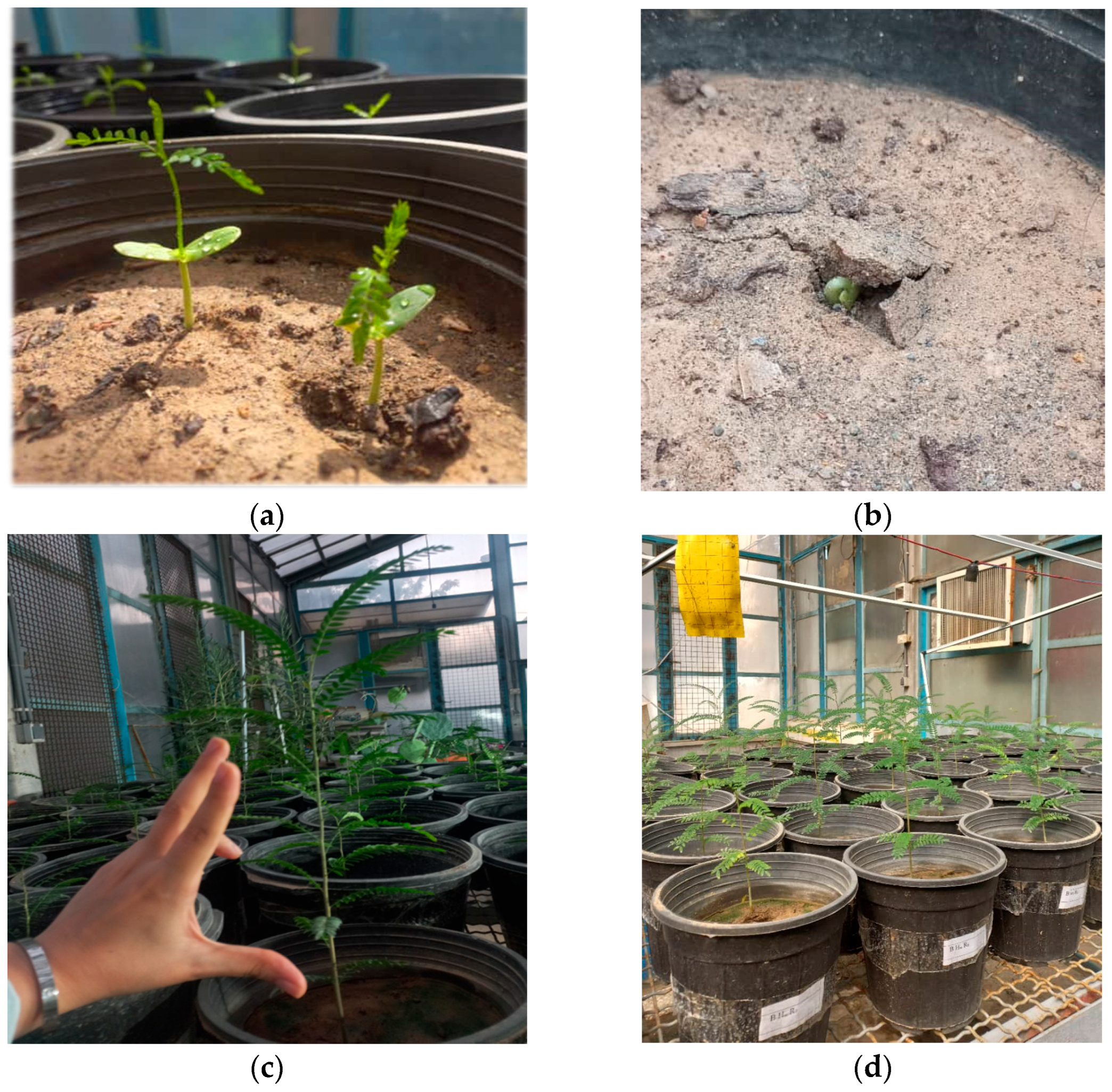
Figure 1. Establishment of germinated seeds in experimental pots (a,b) and Gleditsia caspica seedlings during the active growing season (c,d).
Forests 17 00969 g001
Figure 2. Soil bulk density under different compaction levels and soil textures for the Gleditsia caspica.
Forests 17 00969 g002
Figure 3. Relative growth rate based on dry biomass under different compaction levels and soil textures for Gleditsia caspica.
Forests 17 00969 g003
Figure 4. Relative growth rate based on stem height under different compaction levels and soil textures for Gleditsia caspica.
Forests 17 00969 g004
Table 1. Definitions, equations, and units of the derived biomass allocation, architectural, and growth variables used in this study *.
VariableEquation
Root-to-shoot ratioTotal root dry weight (g)/Shoot dry weight (g)
LMRLeaf dry weight (g)/Total dry weight (g)
RMRTotal root dry weight (g)/Total dry weight (g)
SMRStem dry weight (g)/Total dry weight (g)
Lateral root biomass ratioLateral root dry weight (g)/Total root dry weight (g)
Lateral-to-primary root length ratioLateral root length (cm)/Primary root length (cm)
SRLTotal root length (cm)/Total root dry weight (g)
SSLStem length (cm)/Stem dry weight (g)
RGR (biomass)(ln W2 − ln W1)/(t2 − t1), where W1 and W2 are total dry biomass (g) at the start (t1) and end (t2) of the measurement period (days)
RGR (height)(ln H2 − ln H1)/(t2 − t1), where H1 and H2 are stem heights (mm) at the start (t1) and end (t2) of the measurement period (days)
* Abbreviations: LMR, leaf mass ratio; RMR root mass ratio; SMR, stem mass ratio; SRL, specific root length; SSL, specific stem length; RGR, relative growth rate.
Table 2. Two-way ANOVA for the interaction effects of soil texture and compaction intensity on morphological and biomass characteristics of Gleditsia caspica seedlings.
TraitSSdfMSFp Value
Stem length30.48103.050.380.95 ns
Lateral root length16,1980.501016,198.052.830.003 **
Primary root length357.091035.711.490.16 ns
Collar diameter2.17100.220.840.59 ns
Leaf dry biomass0.12100.010.650.77 ns
Primary root dry biomass0.43100.042.620.012 *
Lateral root dry biomass0.35100.032.260.024 *
Stem dry biomass0.49100.052.310.021 *
Shoot dry biomass0.57100.060.990.46 ns
Total dry biomass3.32100.332.190.031 *
Total root dry biomass1.45100.143.790.001 **
Root-to-shoot ratio1.70100.171.410.19 ns
LMR0.19100.024.030.001 **
RMR0.10100.012.030.044 *
SMR0.03100.001.070.40 ns
Lateral root biomass ratio0.68100.070.680.74 ns
SSL12,599.48101,259.951.810.07 ns
SRL213,361.571021,336.161.660.10 ns
Lateral-to-primary root length ratio1,120.0810112.012.180.035 *
Note: ns = non-significant; * p < 0.05; ** p < 0.01. Abbreviations: LMR, leaf mass ratio; RMR, root mass ratio; SMR, stem mass ratio; SRL, specific root length; SSL, specific stem length.
Table 3. Mean comparison of morphological characteristics of Gleditsia caspica seedlings under different soil textures and compaction levels (mean ± SD).
Soil TextureCompaction LevelStem Length (cm)Lateral Root Length (cm)Primary Root Length (cm)Collar Diameter (mm)
LoamControl20.16 ± 3.71 a274.0 d ± 97.7 e5.42 ± 23.3 a0.63 ± 3.73 a
117.61 ± 2.92 a215.8 ± 47.3 cde3.79 ± 22.5 a0.41 ± 3.13 a
218.77 ± 3.65 a303.8 ± 81.1 bcd4.93 ± 20.6 a0.50 ± 3.40 a
321.52 ± 3.38 a299.7 ± 66.8 abc4.81 ± 17.7 a0.39 ± 3.42 a
420.30 ± 3.44 a309.5 ± 54.6 cd4.28 ± 19.3 a0.46 ± 3.32 a
519.62 ± 3.55 a298.3 ± 74.7 bcd6.45 ± 19.5 a0.61 ± 3.49 a
Sandy loamControl19.78 ± 1.66 a334.3 ± 65.5 cd6.04 ± 20.4 a0.65 ± 3.84 a
120.83 ± 2.31 a448.5 ± 81.9 bc5.44 ± 19.5 a0.55 ± 3.62 a
222.40 ± 2.40 a423.3 ± 79.7 ab6.41 ± 18.7 a0.37 ± 3.64 a
323.31 ± 2.86 a312.0 ± 90.5 a6.13 ± 18.0 a0.34 ± 3.29 a
422.43 ± 2.75 a258.8 ± 85.5 ab5.02 ± 14.7 a0.50 ± 3.63 a
520.95 ± 2.22 a310.3 ± 84.9 bc4.29 ± 13.3 a0.43 ± 3.75 a
Silty clay loamControl14.57 ± 3.01 a286.8 ± 97.5 e3.90 ± 13.1 a0.72 ± 2.64 a
115.10 ± 2.12 a365.2 ± 59.9 de3.37 ± 12.7 a0.42 ± 2.84 a
218.04 ± 2.89 a339.7 ± 79.1 bcd4.75 ± 15.6 a0.52 ± 2.82 a
317.92 ± 2.72 a288.5 ± 58.8 bcd3.76 ± 15.6 a0.35 ± 2.88 a
416.45 ± 1.78 a293.3 ± 88.5 de3.78 ± 17.1a0.50 ± 3.13 a
517.12 ± 2.65 a273.0 ± 68.6 cde3.74 ± 15.5a0.56 ± 2.93 a
Different letters indicate significant differences among means at p < 0.05 according to Tukey’s test.
Table 4. Mean comparison of biomass traits of Gleditsia caspica seedlings under different soil textures and compaction levels (mean ± SD).
Soil TextureCompaction LevelStem Length (cm)Lateral Root Length (cm)Primary Root Length (cm)Collar Diameter (mm)
LoamControl20.16 ± 3.71 a274.0 ± 97.7 de5.42 ± 23.3 a0.63 ± 3.73 a
117.61 ± 2.92 a215.8 ± 47.3 cde3.79 ± 22.5 a0.41 ± 3.13 a
218.77 ± 3.65 a303.8 ± 81.1 bcd4.93 ± 20.6 a0.50 ± 3.40 a
321.52 ± 3.38 a299.7 ± 66.8 abc4.81 ± 17.7 a0.39 ± 3.42 a
420.30 ± 3.44 a309.5 ± 54.6 cd4.28 ± 19.3 a0.46 ± 3.32 a
519.62 ± 3.55 a298.3 ± 74.7 bcd6.45 ± 19.5 a0.61 ± 3.49 a
Sandy loamControl19.78 ± 1.66 a334.3 ± 65.5 cd6.04 ± 20.4 a0.65 ± 3.84 a
120.83 ± 2.31 a448.5 ± 81.9 bc5.44 ± 19.5 a0.55 ± 3.62 a
222.40 ± 2.40 a423.3 ± 79.7 ab6.41 ± 18.7 a0.37 ± 3.64 a
323.31 ± 2.86 a312.0 ± 90.5 a6.13 ± 18.0 a0.34 ± 3.29 a
422.43 ± 2.75 a258.8 ± 85.5 ab5.02 ± 14.7 a0.50 ± 3.63 a
520.95 ± 2.22 a310.3 ± 84.9 bc4.29 ± 13.3 a0.43 ± 3.75 a
Silty clay loamControl14.57 ± 3.01 a286.8 ± 97.5 e3.90 ± 13.1 a0.72 ± 2.64 a
115.10 ± 2.12 a365.2 ± 59.9 de3.37 ± 12.7 a0.42 ± 2.84 a
218.04 ± 2.89 a339.7 ± 79.1 bcd4.75 ± 15.6 a0.52 ± 2.82 a
317.92 ± 2.72 a288.5 ± 58.8 bcd3.76 ± 15.6 a0.35 ± 2.88 a
416.45 ± 1.78 a293.3 ± 88.5 de3.78 ± 17.1 a0.50 ± 3.13 a
517.12 ± 2.65 a273.0 ± 68.6 cde3.74 ± 15.5 a0.56 ± 2.93 a
Different letters indicate significant differences among means at p < 0.05 according to Tukey’s test.
Table 5. Mean comparison of allocation ratios and architectural characteristics of Gleditsia caspica seedlings under different soil textures and compaction levels (mean ± SD).
Soil TextureCompaction LevelR/S RatioLMRRMRSMRLateral Root Biomass RatioLateral/Primary Root Length RatioSRL (cm g−1)SSL (cm g−1)
LoamControl1.06 ± 0.17 a0.20 ± 0.04 bcd0.51 ± 0.04 bcde0.29 ± 0.01 a0.41 ± 0.09 a12.11 ± 3.41 bc454.17 ± 81.81 a46.03 ± 14.96 a
10.65 ± 0.22 a0.39 ± 0.12 a0.38 ± 0.09 e0.23 ± 0.05 a0.45 ± 0.10 a9.77 ± 2.53 c599.40 ± 133.01 a75.07 ± 28.2 5a
20.72 ± 0.21 a0.35 ± 0.14 ab0.41 ± 0.07 de0.24 ± 0.07 a0.37 ± 0.06 a15.38 ± 4.70 abc616.97 ± 206.71 a63.46 ± 27.08 a
31.03 ± 0.13 a0.21 ± 0.03 bcd0.50 ± 0.03 bcde0.29 ± 0.04 a0.42 ± 0.17 a18.05 ± 6.60 abc493.37 ± 135.75 a60.08 ± 15.65 a
40.83 ± 0.21 a0.26 ± 0.07 bc0.45 ± 0.06 cde0.29 ± 0.04 a0.47 ± 0.16 a16.60 ± 4.05 abc499.93 ± 72.48 a48.34 ± 11.13 a
51.10 ± 0.13 a0.21 ± 0.02 bcd0.52 ± 0.03 bcde0.27 ± 0.04 a0.38 ± 0.11 a15.69 ± 2.17 abc433.13 ± 59.00 a56.63 ± 20.00 a
Sandy loamControl1.23 ± 0.42 a0.26 ± 0.08 bc0.54 ± 0.08 bcd0.20 ± 0.08 a0.81 ± 0.52 a18.14 ± 7.82 abc432.82 ± 95.53 a73.88 ± 28.08 a
11.03 ± 0.30 a0.24 ± 0.06 bcd0.50 ± 0.07 bcde0.27 ± 0.07 a0.84 ± 0.42 a24.19 ± 6.82 abc438.77 ± 33.45 a41.40 ± 20.45 a
21.14 ± 0.31 a0.24 ± 0.05 bcd0.52 ± 0.07 bcde0.23 ± 0.04 a1.04 ± 0.45 a25.04 ± 10.12 ab434.70 ± 61.74 a51.82 ± 17.48 a
31.24 ± 0.30 a0.22 ± 0.05 bcd0.55 ± 0.06 bcd0.23 ± 0.04 a0.73 ± 0.43 a18.08 ± 4.33 abc389.92 ± 58.29 a69.48 ± 27.51 a
41.15 ± 0.49 a0.27 ± 0.12 bc0.51 ± 0.10 bcde0.22 ± 0.05 a0.55 ± 0.24 a19.20 ± 8.44 abc399.90 ± 152.35 a79.60 ± 28.19 a
50.90 ± 0.26 a0.33 ± 0.07 bc0.47 ± 0.07 cde0.21 ± 0.04 a0.66 ± 0.17 a25.04 ± 9.79 ab463.95 ± 77.52 a76.43 ± 41.34 a
Silty clay loamControl1.80 ± 0.63 a0.15 ± 0.05 d0.63 ± 0.09 a0.22 ± 0.05 a0.82 ± 0.53 a24.66 ± 12.91 ab461.88 ± 154.74 a64.54 ± 21.71 a
11.52 ± 0.48 a0.17 ± 0.04 d0.59 ± 0.06 ab0.24 ± 0.07 a0.90 ± 0.28 a30.15 ± 8.24 a385.00 ± 88.24 a41.80 ± 19.79 a
21.26 ± 0.40 a0.21 ± 0.04 bcd0.55 ± 0.07 bcd0.24 ± 0.04 a0.81 ± 0.33 a23.62 ± 8.65 abc396.90 ± 125.99 a46.78 ± 13.18 a
31.39 ± 0.36 a0.21 ± 0.03 bcd0.57 ± 0.08 bc0.22 ± 0.09 a0.66 ± 0.30 a19.47 ± 5.64 abc461.13 ± 105.82 a81.60 ± 39.84 a
41.50 ± 0.51 a0.19 ± 0.02 cd0.59 ± 0.07 bc0.23 ± 0.06 a0.74 ± 0.28 a18.04 ± 8.15 abc476.68 ± 116.19 a71.88 ± 33.38 a
51.15 ± 0.26 a0.24 ± 0.05 bcd0.53 ± 0.05 bcd0.23 ± 0.08 a0.67 ± 0.38 a17.96 ± 4.07 abc429.50 ± 133.97 a67.34 ± 38.48 a
Different letters within each column indicate significant differences among means at p < 0.05.
Disclaimer/Publisher’s Note: The statements, opinions and data contained in all publications are solely those of the individual author(s) and contributor(s) and not of MDPI and/or the editor(s). MDPI and/or the editor(s) disclaim responsibility for any injury to people or property resulting from any ideas, methods, instructions or products referred to in the content.