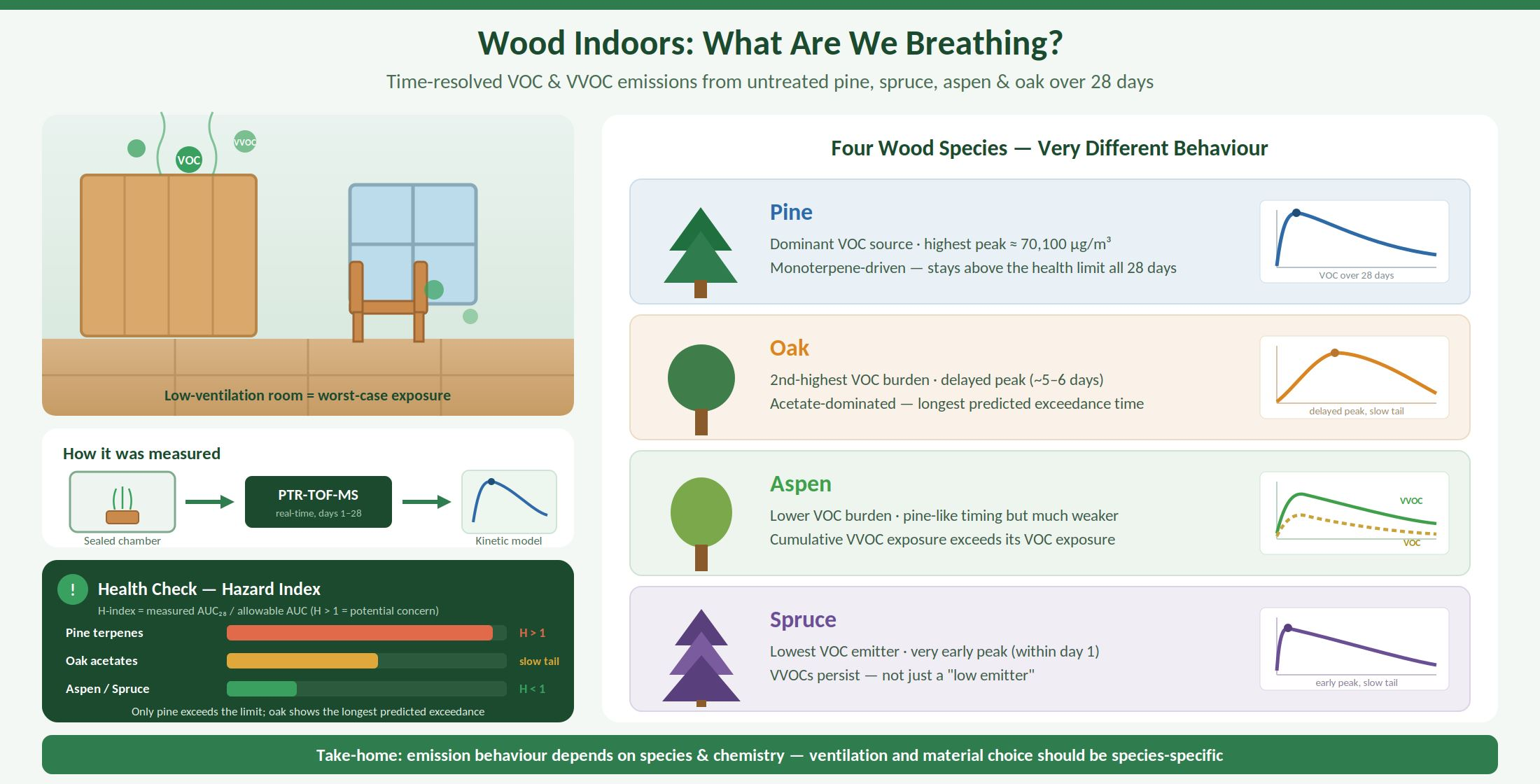
A Time-Resolved Analysis of VOCs and VVOCs from Interior Wood Materials in Low-Ventilation Environments

 , , , , and
Abstract
1. Introduction
2. Materials and Methods
2.1. PTR-TOF-MS and Ion Fragmentation Correction Protocol
2.2. Data Analyses
3. Results and Discussion
3.1. VOC Concentration Across Wood Samples
3.2. VVOC Concentration Behaviour Across Wood Samples
3.3. Comparison of VOC vs. VVOC Emissions in Each Sample
4. Limitations
5. Conclusions
Author Contributions
Funding
Institutional Review Board Statement
Data Availability Statement
Acknowledgments
Conflicts of Interest
Abbreviations
| ACGIH | American Conference of Governmental Industrial Hygienists |
| ACTRIS | Aerosol, Clouds and Trace Gases Research Infrastructure |
| AUC | Area under the concentration–time curve |
| AUC28 | Area under the concentration–time curve over 28 days |
| CV | Coefficient of variation |
| Da | Dalton |
| E/N | Ratio of electric field strength to drift-gas number density |
| EN | European Standard |
| GC-MS | Gas Chromatography–Mass Spectrometry |
| GC-PTR-MS | Gas Chromatography–Proton Transfer Reaction Mass Spectrometry |
| GLOVOCS | Master compound assignment guide for PTR-MS users |
| H-index | Hazard index |
| IAQ | Indoor air quality |
| IF | Empirical yield factor |
| ISO | International Organization for Standardization |
| LCI | Lowest Concentration of Interest |
| LCU | Liquid Calibration Unit |
| m/z | Mass-to-charge ratio |
| PTR-MS | Proton Transfer Reaction Mass Spectrometry |
| PTR-TOF-MS | Proton Transfer Reaction–Time-of-Flight Mass Spectrometry |
| QA/QC | Quality assurance/quality control |
| RH | Relative humidity |
| RRID | Research Resource Identifier |
| TI | Tentative identification |
| TLV | Threshold Limit Value |
| TLV-TWA | Threshold Limit Value–Time-Weighted Average |
| TVOC | Total volatile organic compounds |
| TVVOC | Total very volatile organic compounds |
| UiA | University of Agder |
| VOC(s) | Volatile organic compound(s) |
| VVOC(s) | Very volatile organic compound(s) |
References
- Bastien, D.; Winther-Gaasvig, M.; Zhang Andersson, J.; Xiao, Z.; Ge, H. Hygrothermal Performance of Natural Building Materials: Simulations and Field Monitoring of a Case Study Home Made of Wood Fiber Insulation and Clay. J. Build. Phys. 2023, 47, 249–283. [Google Scholar] [CrossRef]
- Lee, J.-H.; Kim, J.; Kim, S.; Kim, J.T. Thermal Extractor Analysis of VOCs Emitted from Building Materials and Evaluation of the Reduction Performance of Exfoliated Graphite Nanoplatelets. Indoor Built Environ. 2013, 22, 68–76. [Google Scholar]
- Shao, H.; Guo, Z.; Li, W.; Fang, L.; Qin, M.; Cai, H.; Zhang, Y.; Guan, B.; Wu, C.; Liu, J. Three-Dimensional Geometry, Pore Parameter, and Fractal Characteristic Analyses of Medium-Density Fiberboard by X-Ray Tomography, Coupling with Scanning Electron Microscopy and Mercury Intrusion Porosimetry. J. Build. Phys. 2021, 44, 364–382. [Google Scholar]
- Lee, C.-S.; Haghighat, F.; Ghaly, W. Conjugate Mass Transfer Modeling for VOC Source and Sink Behavior of Porous Building Materials: When to Apply It? J. Build. Phys. 2006, 30, 91–111. [Google Scholar] [CrossRef]
- United States Environmental Protection Agency. Indoor Air Quality (IAQ). Available online: https://www.epa.gov/indoor-air-quality-iaq (accessed on 12 April 2026).
- Tsai, W.-T. An Overview of Health Hazards of Volatile Organic Compounds Regulated as Indoor Air Pollutants. Rev. Environ. Health 2019, 34, 81–89. [Google Scholar] [PubMed]
- Rumchev, K.; Spickett, J.; Bulsara, M.; Phillips, M.; Stick, S. Association of Domestic Exposure to Volatile Organic Compounds with Asthma in Young Children. Thorax 2004, 59, 746–751. [Google Scholar] [CrossRef] [PubMed]
- Kotzias, D. Built Environment and Indoor Air Quality: The Case of Volatile Organic Compounds. AIMS Environ. Sci. 2021, 8, 135–147. [Google Scholar] [CrossRef]
- Pye, H.; Appel, K.; Seltzer, K.; Ward-Caviness, C.; Murphy, B. Human-Health Impacts of Controlling Secondary Air Pollution Precursors. Environ. Sci. Technol. Lett. 2022, 9, 96–101. [Google Scholar] [CrossRef] [PubMed]
- Dong, Z.; Jiang, Y.; Wang, S.; Xing, J.; Ding, D.; Zheng, H.; Wang, H.; Huang, C.; Yin, D.; Song, Q.; et al. Spatially and Temporally Differentiated NOx and VOCs Emission Abatement Could Effectively Gain O3-Related Health Benefits. Environ. Sci. Technol. 2024, 58, 19372–19383. [Google Scholar] [CrossRef]
- Arata, C.; Misztal, P.; Tian, Y.; Lunderberg, D.; Kristensen, K.; Novoselac, A.; Vance, M.; Farmer, D.; Nazaroff, W.; Goldstein, A. Volatile Organic Compound Emissions during HOMEChem. Indoor Air 2021, 31, 2099–2117. [Google Scholar] [CrossRef] [PubMed]
- Davis, A.Y.; Zhang, Q.; Wong, J.P.S.; Weber, R.J.; Black, M.S. Characterization of Volatile Organic Compound Emissions from Consumer Level Material Extrusion 3D Printers. Build. Environ. 2019, 160, 106209. [Google Scholar] [CrossRef]
- Sollinger, S.; Levsen, K.; Wünsch, G. Indoor Pollution by Organic Emissions from Textile Floor Coverings: Climate Test Chamber Studies under Static Conditions. Atmos. Environ. 1994, 28, 2369–2378. [Google Scholar] [CrossRef]
- Fujitani, Y.; Sato, K.; Tanabe, K.; Morino, Y.; Takahashi, K.; Hoshi, J. Characteristics of Different Volatility Classes of Organic Compounds Emitted by a Municipal Solid Waste Incineration Plant. Atmos. Environ. X 2023, 20, 100225. [Google Scholar]
- Pohleven, J.; Burnard, M.D.; Kutnar, A. Volatile Organic Compounds Emitted from Untreated and Thermally Modified Wood—A Review. Wood Fiber Sci. 2019, 51, 231–254. [Google Scholar] [CrossRef]
- Czajka, M.; Fabisiak, B.; Fabisiak, E. Emission of Volatile Organic Compounds from Heartwood and Sapwood of Selected Coniferous Species. Forests 2020, 11, 92. [Google Scholar] [CrossRef]
- Adamová, T.; Hradecký, J.; Pánek, M. Volatile Organic Compounds (VOCs) from Wood and Wood-Based Panels: Methods for Evaluation, Potential Health Risks, and Mitigation. Polymers 2020, 12, 2289. [Google Scholar] [CrossRef] [PubMed]
- Junge, K.M.; Buchenauer, L.; Elter, E.; Butter, K.; Kohajda, T.; Herberth, G.; Röder, S.; Borte, M.; Kiess, W.; von Bergen, M.; et al. Wood Emissions and Asthma Development: Results from an Experimental Mouse Model and a Prospective Cohort Study. Environ. Int. 2021, 151, 106449. [Google Scholar] [CrossRef] [PubMed]
- Alapieti, T.; Castagnoli, E.; Salo, L.; Mikkola, R.; Pasanen, P.; Salonen, H. The Effects of Paints and Moisture Content on the Indoor Air Emissions from Pinewood (Pinus sylvestris) Boards. Indoor Air 2021, 31, 1563–1576. [Google Scholar] [CrossRef] [PubMed]
- Wojnowski, W.; Kalinowska, K.; Majchrzak, T.; Zabiegała, B. Real-Time Monitoring of the Emission of Volatile Organic Compounds from Polylactide 3D Printing Filaments. Sci. Total Environ. 2021, 805, 150181. [Google Scholar] [PubMed]
- Kwok, N.-H.; Lee, S.-C.; Guo, H.; Hung, W.-T. Substrate Effects on VOC Emissions from an Interior Finishing Varnish. Build. Environ. 2003, 38, 1019–1026. [Google Scholar] [CrossRef]
- Ghaffari Jabbari, S.; Fermoso Domínguez, J.; Rodríguez Sufuentes, S.; Nyberg, S.O.; Sandnes Vehus, T.; Kofoed Nielsen, H. VOC Emission from Commercial Wood Panels by Proton Transfer Reaction—Analysis for Indoor Air Quality. Front. Built Environ. 2025, 11, 1545306. [Google Scholar] [CrossRef]
- EN 16516; Construction Products: Assessment of Release of Dangerous Substances—Determination of Emissions into Indoor Air. European Committee for Standardization: Brussels, Belgium, 2020.
- Cappellin, L.; Biasioli, F.; Granitto, P.M.; Schuhfried, E.; Soukoulis, C.; Costa, F.; Märk, T.D.; Gasperi, F. On Data Analysis in PTR-TOF-MS: From Raw Spectra to Data Mining. Sens. Actuators B Chem. 2011, 155, 183–190. [Google Scholar] [CrossRef]
- Jensen, A.R.; Koss, A.R.; Hales, R.B.; de Gouw, J.A. Measurements of Volatile Organic Compounds in Ambient Air by Gas-Chromatography and Real-Time Vocus PTR-TOF-MS: Calibrations, Instrument Background Corrections, and Introducing a PTR Data Toolkit. Atmos. Meas. Tech. 2023, 16, 5261–5285. [Google Scholar] [CrossRef]
- Müller, M.; Mikoviny, T.; Jud, W.; D’Anna, B.; Wisthaler, A. A New Software Tool for the Analysis of High Resolution PTR-TOF Mass Spectra. Chemom. Intell. Lab. Syst. 2013, 127, 158–165. [Google Scholar] [CrossRef]
- Cappellin, L.; Biasioli, F.; Schuhfried, E.; Soukoulis, C.; Märk, T.D.; Gasperi, F. Extending the dynamic range of proton transfer reaction time-of-flight mass spectrometers by a novel dead time correction. Rapid Commun. Mass Spectrom. 2011, 25, 179. [Google Scholar] [PubMed]
- Yáñez-Serrano, A.M.; Filella, I.; Llusià, J.; Gargallo-Garriga, A.; Granda, V.; Bourtsoukidis, E.; Williams, J.; Seco, R.; Cappellin, L.; Werner, C.; et al. GLOVOCS—Master Compound Assignment Guide for Proton Transfer Reaction Mass Spectrometry Users. Atmos. Environ. 2021, 244, 117929. [Google Scholar] [CrossRef]
- Taiti, C.; Costa, C.; Menesatti, P.; Comparini, D.; Bazihizina, N.; Azzarello, E.; Masi, E.; Mancuso, S. Class-Modeling Approach to PTR-TOFMS Data: A Peppers Case Study. J. Sci. Food Agric. 2015, 95, 1757–1763. [Google Scholar] [PubMed]
- Dusanter, S.; Holzinger, R.; Klein, F.; Salameh, T.; Jamar, M. Measurement Guidelines for VOC Analysis by PTR-MS; IMT Nord Europe, Institut Mines Télécom: Lille, France, 2025. [Google Scholar]
- Holzinger, R.; Acton, W.J.F.; Bloss, W.J.; Breitenlechner, M.; Crilley, L.R.; Dusanter, S.; Gonin, M.; Gros, V.; Keutsch, F.N.; Kiendler-Scharr, A.; et al. Validity and Limitations of Simple Reaction Kinetics to Calculate Concentrations of Organic Compounds from Ion Counts in PTR-MS. Atmos. Meas. Tech. 2019, 12, 6193–6208. [Google Scholar] [CrossRef]
- Coggon, M.M.; Stockwell, C.E.; Claflin, M.S.; Pfannerstill, E.Y.; Xu, L.; Gilman, J.B.; Marcantonio, J.; Cao, C.; Bates, K.; Gkatzelis, G.I.; et al. Identifying and Correcting Interferences to PTR-TOF-MS Measurements of Isoprene and Other Urban Volatile Organic Compounds. Atmos. Meas. Tech. 2024, 17, 801–825. [Google Scholar] [CrossRef]
- De Gouw, J.; Warneke, C. Measurements of Volatile Organic Compounds in the Earth’s Atmosphere Using Proton-Transfer-Reaction Mass Spectrometry. Mass Spectrom. Rev. 2007, 26, 223–257. [Google Scholar] [PubMed]
- Ruuskanen, T.M.; Kolari, P.; Bäck, J.; Kulmala, M.; Rinne, J.; Hakola, H.; Taipale, R.; Raivonen, M.; Altimir, N.; Hari, P. On-Line Field Measurements of Monoterpene Emissions from Scots Pine by Proton-Transfer-Reaction Mass Spectrometry. Boreal Environ. Res. 2005, 10, 553–567. [Google Scholar]
- Tani, A.; Hayward, S.; Hewitt, C.N. Measurement of Monoterpenes and Related Compounds by Proton Transfer Reaction-Mass Spectrometry (PTR-MS). Int. J. Mass Spectrom. 2003, 223, 561–578. [Google Scholar] [CrossRef]
- Warneke, C.; de Gouw, J.A.; Kuster, W.C.; Goldan, P.D.; Fall, R. Validation of Atmospheric VOC Measurements by Proton-Transfer-Reaction Mass Spectrometry Using a Gas-Chromatographic Preseparation Method. Environ. Sci. Technol. 2003, 37, 2494–2501. [Google Scholar] [CrossRef] [PubMed]
- Li, F.; Huang, D.D.; Tian, L.; Yuan, B.; Tan, W.; Zhu, L.; Ye, P.; Worsnop, D.; Hoi, K.I.; Mok, K.M.; et al. Response of Protonated, Adduct, and Fragmented Ions in Vocus Proton-Transfer-Reaction Time-of-Flight Mass Spectrometer (PTR-TOF-MS). Atmos. Meas. Tech. 2024, 17, 2415–2427. [Google Scholar] [CrossRef]
- ISO 16000-6:2021; Indoor Air—Part 6: Determination of Volatile Organic Compounds in Indoor and Test Chamber Air by Active Sampling on Tenax TA Sorbent, Thermal Desorption and Gas Chromatography Using MSD/FID. ISO: Geneva, Switzerland, 2021.
- Ambrose, J.L.; Haase, K.; Russo, R.; Zhou, Y.; White, M.; Frinak, E.; Jordan, C.; Mayne, H.R.; Talbot, R.; Sive, B.C. A comparison of GC-FID and PTR-MS toluene measurements in ambient air under conditions of enhanced monoterpene loading. Atmos. Meas. Tech. 2010, 3, 959–980. [Google Scholar] [CrossRef]
- Ghaffari Jabbari, S.; Fermoso Domínguez, J.; Rodríguez Sufuentes, S. Dynamic Emission Profile of VOCs and VVOCs [Data Set]; Zenodo: Geneva, Switzerland, 2026. [Google Scholar]
- Python Software Foundation. Python Language Reference, Version 3.11; Python Software Foundation: Beaverton, OR, USA, 2022. Available online: https://www.python.org (accessed on 1 May 2026).
- Guo, H.; Murray, F.; Lee, S.-C. Emissions of Total Volatile Organic Compounds from Pressed Wood Products in an Environmental Chamber. Build. Environ. 2002, 37, 1117–1126. [Google Scholar] [CrossRef]
- Lee, C.; Yang, W.; Parr, R.G. Development of the Colle-Salvetti Correlation-Energy Formula into a Functional of the Electron Density. Phys. Rev. B 1988, 37, 785–789. [Google Scholar] [CrossRef]
- Colombo, A.; De Bortoli, M.; Pecchio, E.; Schauenburg, H.; Schlitt, H.; Vissers, H. Chamber Testing of Organic Emission from Building and Furnishing Materials. Sci. Total Environ. 1990, 91, 237–249. [Google Scholar] [CrossRef] [PubMed]
- American Conference of Governmental Industrial Hygienists (ACGIH). TLVs and BEIs: Threshold Limit Values for Chemical Substances and Physical Agents & Biological Exposure Indices; ACGIH: Cincinnati, OH, USA, 2023. [Google Scholar]
- Canadian Centre for Occupational Health and Safety. Occupational Hygiene—Occupational Exposure Limits. Available online: https://www.ccohs.ca/oshanswers/hsprograms/occ_hygiene/occ_exposure_limits.html (accessed on 7 August 2025).
- Gaylor, D.W. The Use of Haber’s Law in Standard Setting and Risk Assessment. Toxicology 2000, 149, 17–19. [Google Scholar] [CrossRef] [PubMed]
- Risholm-Sundman, M.; Lundgren, M.; Vestin, E.; Herder, P. Emissions of Acetic Acid and Other Volatile Organic Compounds from Different Species of Solid Wood. Holz Roh Werkst. 1998, 56, 125–129. [Google Scholar] [CrossRef]
- Hyttinen, M.; Masalin-Weijo, M.; Kalliokoski, P.; Pasanen, P. Comparison of VOC Emissions between Air-Dried and Heat-Treated Norway Spruce (Picea abies), Scots Pine (Pinus sylvestris) and European Aspen (Populus tremula) Wood. Atmos. Environ. 2010, 44, 5028–5033. [Google Scholar] [CrossRef]
- Lee, C.-S.; Haghighat, F.; Ghaly, W. A study on VOC source and sink behavior in porous building materials–analytical model development and assessment. Indoor Air 2005, 15, 183–196. [Google Scholar] [CrossRef] [PubMed]
- Jørgensen, R.B.; Dokka, T.H.; Bjørseth, O. Introduction of a sink-diffusion model to describe the interaction between volatile organic compounds (VOCs) and material surfaces. Indoor Air 2000, 10, 27–38. [Google Scholar] [CrossRef] [PubMed]
- Yang, X.; Chen, Q.; Zhang, J.; An, Y.; Zeng, J.; Shaw, C. A mass transfer model for simulating VOC sorption on building materials. Atmos. Environ. 2001, 35, 1291–1299. [Google Scholar] [CrossRef]
- Gibson, L.T.; Watt, C.M. Acetic and Formic Acids Emitted from Wood Samples and Their Effect on Selected Materials in Museum Environments. Corros. Sci. 2010, 52, 172–178. [Google Scholar] [CrossRef]
- Tani, A. Fragmentation and reaction rate constants of terpenoids determined by proton transfer reaction-mass spectrometry. Environ. Control Biol. 2013, 51, 23–29. [Google Scholar] [CrossRef]
- Gonçalves, F.D.; Carvalho, L.H.; Rodrigues, J.A.; Ramos, R.M. Wood-Based Panels and Volatile Organic Compounds (VOCs): An Overview on Production, Emission Sources and Analysis. Molecules 2025, 30, 3195. [Google Scholar] [CrossRef] [PubMed]
- Blake, R.; Monks, P.; Ellis, A. Proton-Transfer Reaction Mass Spectrometry. Chem. Rev. 2009, 109, 861–896. [Google Scholar] [CrossRef] [PubMed]
- Ditto, J.C.; Huynh, H.N.; Yu, J.; Link, M.F.; Poppendieck, D.; Claflin, M.S.; Vance, M.E.; Farmer, D.K.; Chan, A.W.H.; Abbatt, J.P.D. Speciating Volatile Organic Compounds in Indoor Air: Using in Situ GC to Interpret Real-Time PTR-MS Signals. Environ. Sci. Process. Impacts 2025, 27, 1671–1687. [Google Scholar] [CrossRef]
- Salthammer, T. Very Volatile Organic Compounds: An Understudied Class of Indoor Air Pollutants. Indoor Air 2016, 26, 25–38. [Google Scholar] [PubMed]
- Janson, R.; de Serves, C. Acetone and Monoterpene Emissions from the Boreal Forest in Northern Europe. Atmos. Environ. 2001, 35, 4629–4637. [Google Scholar] [CrossRef]
- Filella, I.; Wilkinson, M.J.; Llusia, J.; Hewitt, C.N.; Peñuelas, J. Volatile Organic Compounds Emissions in Norway Spruce (Picea abies) in Response to Temperature Changes. Physiol. Plant. 2007, 130, 58–66. [Google Scholar] [CrossRef]
- Baasandorj, M.; Millet, D.B.; Hu, L.; Mitroo, D.; Williams, B.J. Measuring Acetic and Formic Acid by Proton-Transfer-Reaction Mass Spectrometry: Sensitivity, Humidity Dependence, and Quantifying Interferences. Atmos. Meas. Tech. 2015, 8, 1303–1321. [Google Scholar] [CrossRef]
- Dorokhov, Y.L.; Sheshukova, E.V.; Komarova, T.V. Methanol in Plant Life. Front. Plant Sci. 2018, 9, 1623. [Google Scholar] [CrossRef] [PubMed]
- Sassoli, M.; Taiti, C.; Guidi Nissim, W.; Costa, C.; Mancuso, S.; Menesatti, P.; Fioravanti, M. Characterization of VOC Emission Profile of Different Wood Species during Moisture Cycles. iForest 2017, 10, 576–584. [Google Scholar] [CrossRef]
- Salthammer, T. Acetaldehyde in the Indoor Environment. Environ. Sci. Atmos. 2023, 3, 474–493. [Google Scholar] [CrossRef]
- Xiong, J.; Liu, C.; Zhang, Y. A General Analytical Model for Formaldehyde and VOC Emission/Sorption in Single-Layer Building Materials and Its Application in Determining the Characteristic Parameters. Atmos. Environ. 2012, 47, 288–294. [Google Scholar] [CrossRef]
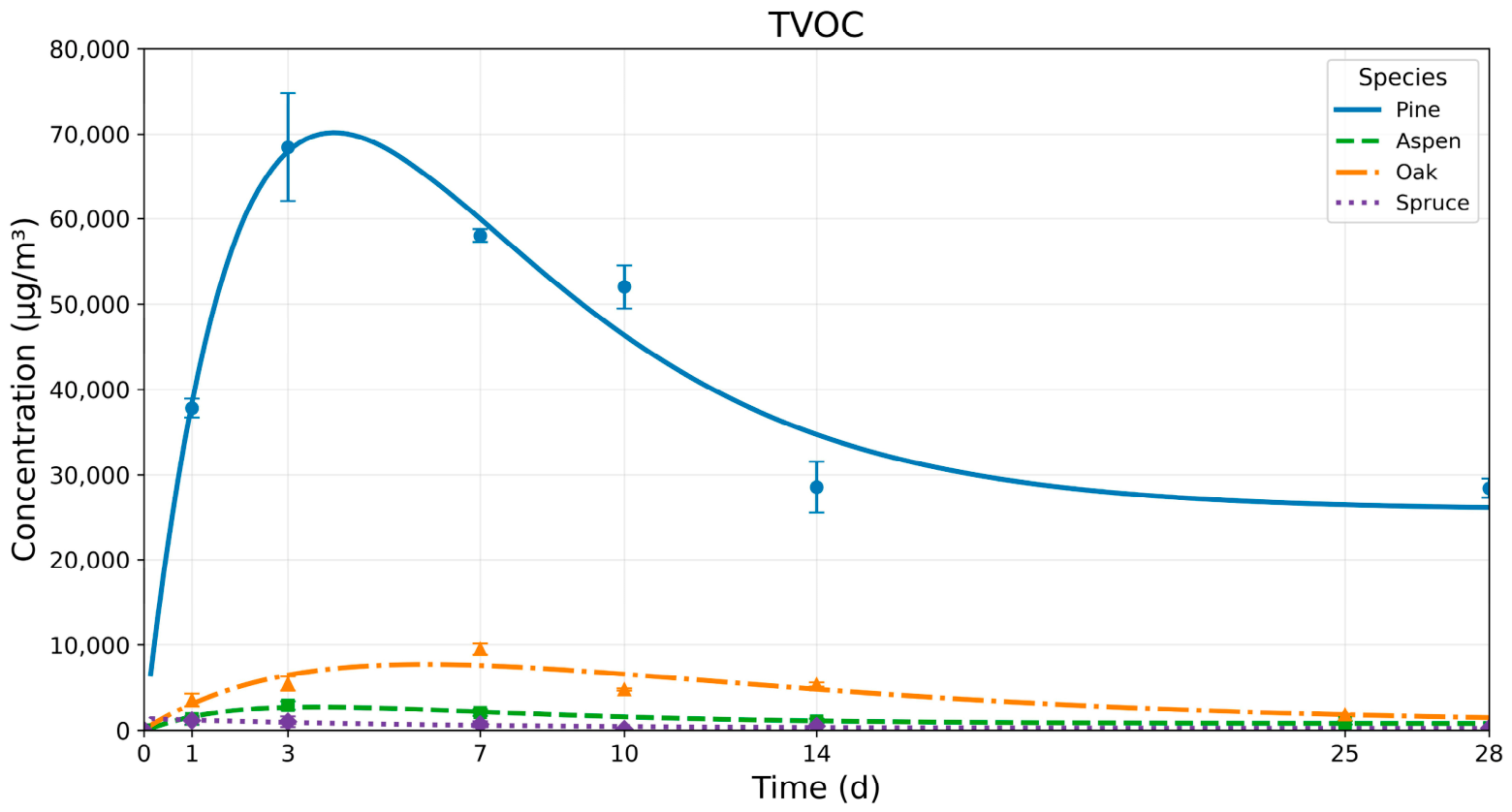
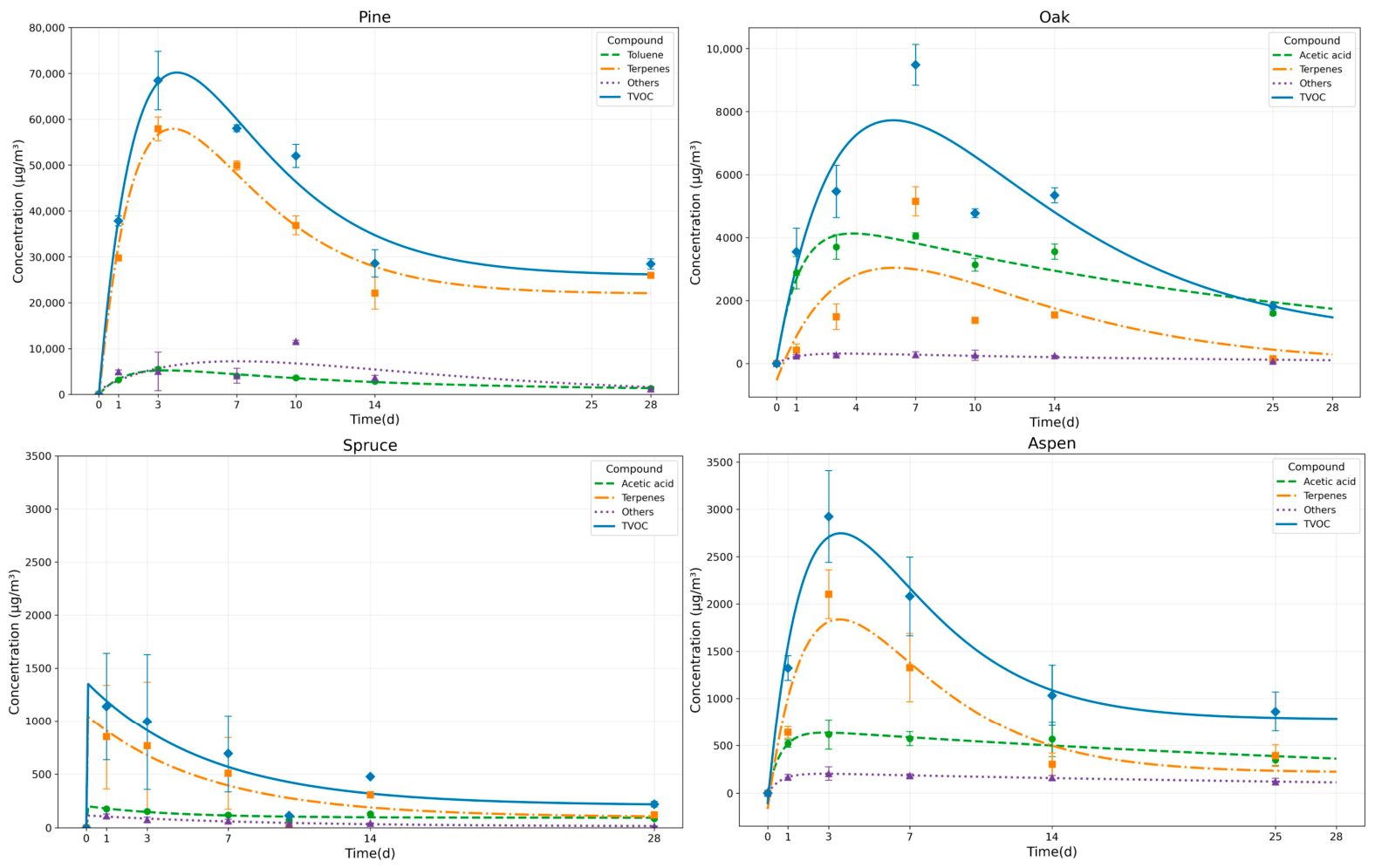
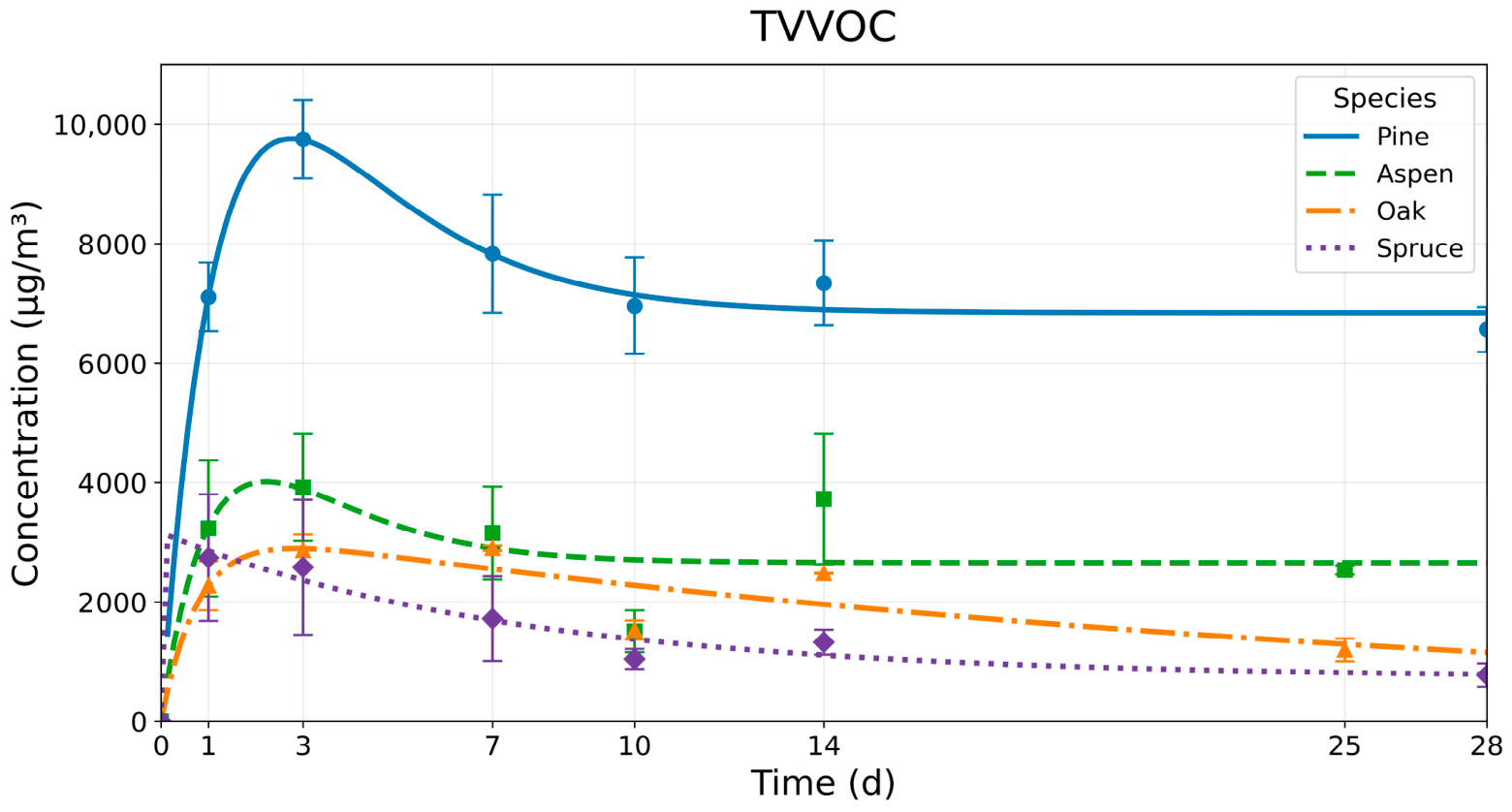
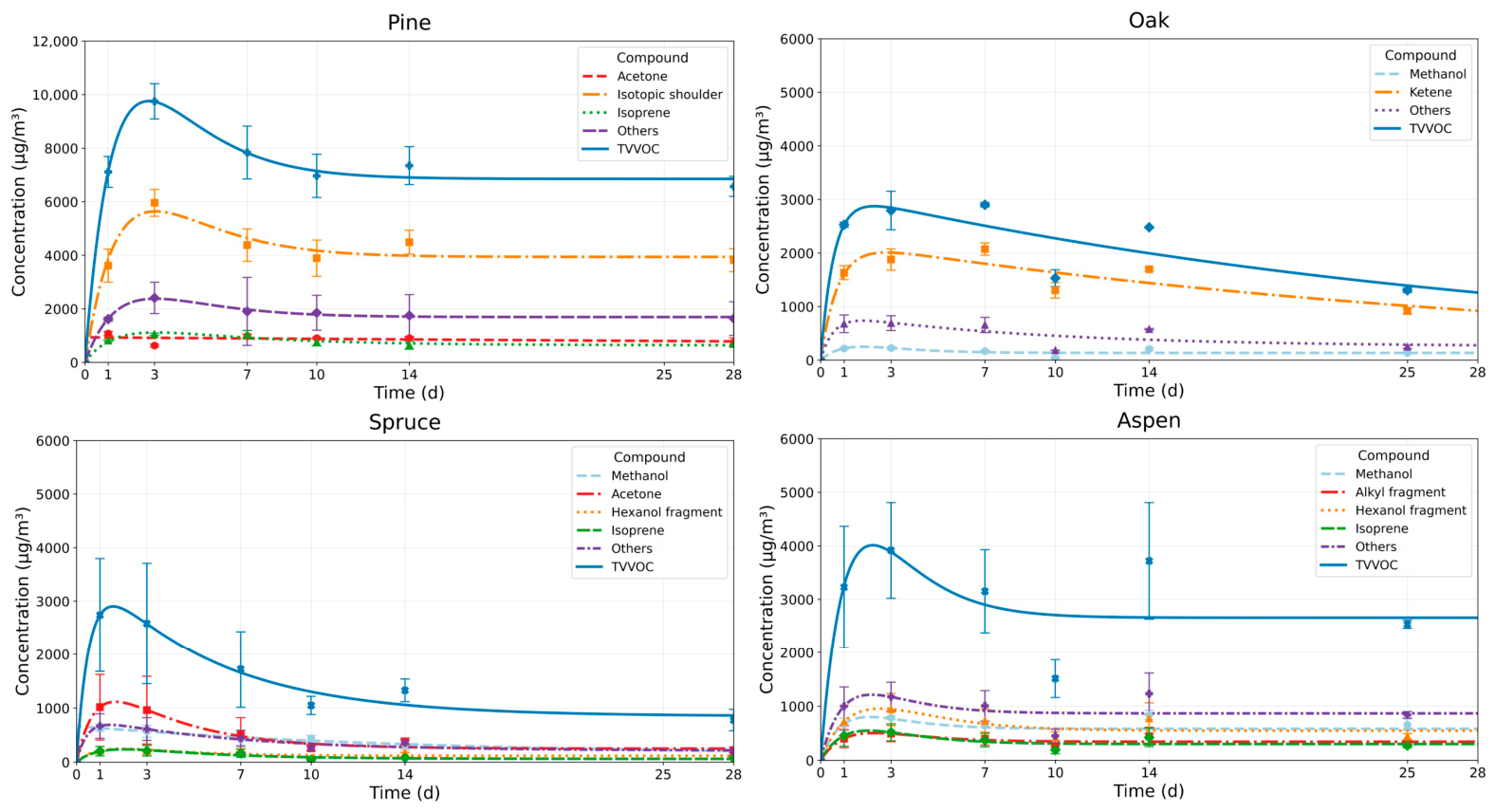

| Species | C [µg/m3] | Half-Time [d] | Peak Time [d] | Peak Value [µg/m3] | a [d−1] | R2 | |
|---|---|---|---|---|---|---|---|
| VOC | Pine | 25,800 ± 1590 (CV = 6%) | 2.3 ± 0.02 | 3.9 ± 0.01 | 70,100 ± 3500 (CV = 5%) | 0.3 ± 0.04 (CV = 12%) | 0.97 |
| Aspen | 778 ± 215 (CV = 27%) | 2.2 ± 0.08 | 3.6 ± 0.1 | 2747 ± 450 (CV = 16%) | 0.3 ± 0.01 (CV = 3%) | 0.97 | |
| Spruce | 207 ± 114 (CV = 55%) | 4.1 ± 1.9 | <1 | 1360 ± 625 (CV = 44%) | 0.15 ± 0.03 (CV = 20%) | 0.87 | |
| Oak | 781 ± 426 (CV = 56%) | 3.9 ± 0.38 | 5.8 ± 0.4 | 7700 ± 730 (CV = 9.5%) | 0.17 ± 0.02 (CV = 9%) | 0.85 | |
| VVOC | Pine | 6850.1 ± 451 (CV = 7%) | 1.5 ± 0.09 | 2.8 ± 0.01 | 9756.1 ± 681 (CV = 7%) | 0.45 ± 0.01 (CV = 51%) | 0.99 |
| Aspen | 2657.2 ± 548 (CV = 21%) | 1.1 ± 0.01 | 2.2 ± 0.01 | 4011.5 ± 1127 (CV = 28%) | 0.65 ± 0.02 (CV = 6%) | 0.81 | |
| Oak | 0.0 (CV = NA) | 18.4 ± 3 | 2.9 ± 1 | 2894.6 ± 214 (CV = 7%) | 0.03 (CV = 20%) | 0.91 | |
| Spruce | 731.3 ± 92 (CV = 13%) | 5.2 ± 0.01 | <1 | 3156.1 ± 1369 (CV = 43%) | 0.13 ± 0.01 (CV = 5%) | 0.99 |
| Gas Type | Wood Type | Total AUC28 [mg × d/m3] | Main Compounds | AUC28 [mg × d/m3] | % of Total AUC | 8-h TWA [mg × h/m3] | Allowable AUC [mg × d/m3] | H-Index |
|---|---|---|---|---|---|---|---|---|
| VOCs | Pine | 1119.7 ± 58 (CV = 5.2%) | Terpenes (C10H16) | 914.7 ± 39 (CV = 4.3%) | 82 | 111.3 | 742.0 | 1.2 |
| Toluene (C7H8) | 81.5 ± 1.7 (CV = 2.1%) | 7 | 75.3 | 502.0 | 0.16 | |||
| Aspen | 38.4 ± 8.6 (CV = 22%) | Terpenes (C10H16) | 20.5 ± 4.9 (CV = 24%) | 53 | 111.3 | 662.5 | 0.03 | |
| Acetic acid (C2H4O2) | 13.7 ± 3 (CV = 22%) | 35 | 24.5 | 145.8 | 0.1 | |||
| Spruce | 12.7 ± 3.7 (CV = 29%) | Terpenes (C10H16) | 8.4 ± 3.7 (CV = 43%) | 66.2 | 111.3 | 742.0 | 0.01 | |
| Acetic acid (C2H4O2) | 3.1 ± 0.1 (CV = 4.3%) | 24.3 | 24.5 | 163.3 | 0.01 | |||
| Oak | 124 ± 8.4 (CV = 6.8%) | Terpenes (C10H16) | 44.1 ± 3.6 (CV = 8.3%) | 35 | 111.3 | 662.5 | 0.06 | |
| Acetic acid (C2H4O2) | 80.6 ± 5.4 (CV = 6.7%) | 65 | 24.5 | 145.8 | 0.55 | |||
| VVOCs | Pine | 203.7 ± 18 (CV = 9%) | Isotopic shoulder (13C-C6H8) | 117.7 ± 15 (CV = 13%) | 57.8 | - | - | - |
| Acetone (C3H8) | 24.0 ± 2 (CV = 8%) | 11.8 | 593.9 | 3959.1 | 0.006 | |||
| Isoprene (C5H8) | 21.5 ± 1 (CV = 3%) | 10.5 | 5.6 | 37.1 | 0.3 | |||
| Aspen | 79.2 ± 17 (CV = 22%) | Hexanol fragment (C6H10) | 17.2 ± 5 (CV = 28%) | 21.8 | - | - | - | |
| Methanol (CH4O) | 16.9 ± 0 (CV = 1%) | 21.4 | 262.0 | 1559.3 | 0.01 | |||
| Isoprene (C5H8) | 9.4 ± 3 (CV = 32%) | 11.9 | 5.6 | 33.1 | 0.3 | |||
| Alkyl fragment (C5H4) | 10.2 ± 3 (CV = 28%) | 12.9 | - | - | - | |||
| Spruce | 37.6 ± 11 (CV = 29%) | Acetone (C3H6O) | 11.5 ± 5 (CV = 39%) | 30.6 | 593.9 | 3534.9 | 0.003 | |
| Methanol (CH4O) | 10.2 ± 2 (CV = 22%) | 27.2 | 262.0 | 1746.5 | 0.005 | |||
| Isoprene (C5H8) | 2.8 ± 1 (CV = 34%) | 7.4 | 5.6 | 37.1 | 0.07 | |||
| Hexanol fragment (C6H10) | 3.9 ± 1 (CV = 14%) | 10.4 | - | - | - | |||
| Oak | 56.0 ± 2 (CV = 4%) | Ketene (C2H2O) | 40.0 ± 1 (CV = 2%) | 71.4 | 0.9 | 5.7 | 7.01 | |
| Methanol (CH4O) | 4.2 ± 0.1 (CV = 10%) | 7.5 | 262.0 | 1746.5 | 0.002 |
| Gas Type | Wood Type | Main Compounds | C(n) [µg/m3] | Max. C(n) [µg/m3] | LCI Value [µg/m3] | Tmax [d] | C(n)/LCI Value | Cmax/LCI Value |
|---|---|---|---|---|---|---|---|---|
| VOCs | Pine | Terpenes (C10H16) | 22,000 ± 1700 (CV = 7.9%) | 57,000 ± 1090 (CV = 1.9%) | 2500 | 3.7 | 8.7 | 22.8 |
| Toluene (C7H8) | 936.7 ± 201 (CV = 22%) | 5237 ± 252 (CV = 4.8%) | 2900 | 3.4 | 0.3 | 1.8 | ||
| Aspen | Terpenes (C10H16) | 217 ± 79.9 (CV = 37%) | 1836.6 ± 284 (CV = 15%) | 2500 | 3.5 | 0.08 | 0.7 | |
| Acetic acid (C2H4O2) | 0.0 (CV = NA) | 633.4 ± 133 (CV = 21%) | 1200 | 2.8 | 0.0 | 0.5 | ||
| Spruce | Terpenes (C10H16) | 97.4 ± 84 (CV = 89%) | 1049 ± 622 (CV = 57%) | 2500 | <1 | 0.03 | 0.4 | |
| Acetic acid (C2H4O2) | 93.7 ± 14 (CV = 15%) | 200 ± 13.8 (CV = 6.8%) | 1200 | <1 | 0.07 | 0.2 | ||
| Oak | Terpenes (C10H16) | 0.0 (CV = NA) | 3040.9 ± 378.1 (CV = 12.4%) | 2500 | 3.1 | 0.0 | 1.2 | |
| Acetic acid (C2H4O2) | 0.0 (CV = NA) | 4129.9 ± 277.4 (CV = 6.7%) | 1200 | 3.8 | 0.0 | 3.4 | ||
| VVOCs | Pine | Isotopic shoulder (13C-C6H8) | 3935.9 ± 519 (CV = 13%) | 5640.9 ± 645 (CV = 11%) | - | 3.1 | - | - |
| Acetone (C3H8) | 0.0 (CV = NA) | 934.2 ± 25 (CV = 3%) | 120,000 | <1 | 0.0 | 0.007 | ||
| Isoprene (C5H8) | 639.2 ± 10 (CV = 2%) | 1116.8 ± 63 (CV = 6%) | - | 3.1 | - | - | ||
| Aspen | Hexanol fragment (C6H10) | 546.6 ± 108 (CV = 21%) | 955.2 ± 301 (CV = 32%) | - | 2.6 | - | - | |
| Methanol (CH4O) | 582.3 ± 3 (CV = 1%) | 800.9 ± 79 (CV = 10%) | - | 2.1 | - | - | ||
| Isoprene (C5H8) | 302.0 ± 98 (CV = 32%) | 547.6 ± 197 (CV = 36%) | - | 2 | - | - | ||
| Alkyl fragment (C5H4) | 343.4 ± 90 (CV = 26%) | 503.7 ± 174 (CV = 34%) | - | 2.3 | - | - | ||
| Spruce | Acetone (C3H6O) | 249.5 ± 3 (CV = 1%) | 1115.1 ± 693 (CV = 62%) | 120,000 | 1.7 | 0.002 | 0.009 | |
| Methanol (CH4O) | 129.4 ± 71 (CV = 51%) | 661.0 ± 59 (CV = 9%) | - | <1 | - | - | ||
| Isoprene (C5H8) | 60.6 ± 10 (CV = 16%) | 236.4 ± 111 (CV = 47%) | - | 2 | - | - | ||
| Hexanol fragment (C6H10) | 117.9 ± 7 (CV = 6%) | 248.9 ± 88 (CV = 35%) | - | 1.9 | - | - | ||
| Oak | Ketene (C2H2O) | 0 (CV = NA) | 2008.2 ± 61 (CV = 3%) | - | 2.8 | - | - | |
| Methanol (CH4O) | 134.9 ± 14 (CV = 10%) | 249.0 ± 21 (CV = 8%) | - | 1.8 | - | - |
Disclaimer/Publisher’s Note: The statements, opinions and data contained in all publications are solely those of the individual author(s) and contributor(s) and not of MDPI and/or the editor(s). MDPI and/or the editor(s) disclaim responsibility for any injury to people or property resulting from any ideas, methods, instructions or products referred to in the content. |
© 2026 by the authors. Licensee MDPI, Basel, Switzerland. This article is an open access article distributed under the terms and conditions of the Creative Commons Attribution (CC BY) license.
Share and Cite
Jabbari, S.G.; Domínguez, J.F.; Sufuentes, S.R.; Nyberg, S.O.; Vehus, T.S.; Nielsen, H.K. A Time-Resolved Analysis of VOCs and VVOCs from Interior Wood Materials in Low-Ventilation Environments. Forests 2026, 17, 884. https://doi.org/10.3390/f17080884
Jabbari SG, Domínguez JF, Sufuentes SR, Nyberg SO, Vehus TS, Nielsen HK. A Time-Resolved Analysis of VOCs and VVOCs from Interior Wood Materials in Low-Ventilation Environments. Forests. 2026; 17(8):884. https://doi.org/10.3390/f17080884
Chicago/Turabian StyleJabbari, Shahla Ghaffari, Jose Fermoso Domínguez, Sandra Rodríguez Sufuentes, Svein Olav Nyberg, Tore Sandnes Vehus, and Henrik Kofoed Nielsen. 2026. "A Time-Resolved Analysis of VOCs and VVOCs from Interior Wood Materials in Low-Ventilation Environments" Forests 17, no. 8: 884. https://doi.org/10.3390/f17080884
APA StyleJabbari, S. G., Domínguez, J. F., Sufuentes, S. R., Nyberg, S. O., Vehus, T. S., & Nielsen, H. K. (2026). A Time-Resolved Analysis of VOCs and VVOCs from Interior Wood Materials in Low-Ventilation Environments. Forests, 17(8), 884. https://doi.org/10.3390/f17080884