Article

Urban Forest Walkway Landscape Types and Psychological Restoration Among Older Adults: Evidence from Three Representative Walkways in Fuzhou, China

1
College of Design and Innovation, Fujian Jiangxia University, Fuzhou 350108, China
2
College of Architecture and Urban Planning (CAUP), Tongji University, Shanghai 200092, China
3
Shanghai Research Institute for Intelligent Autonomous Systems, Tongji University, Shanghai 200092, China
*
Author to whom correspondence should be addressed.
Forests 2026, 17(8), 872; https://doi.org/10.3390/f17080872
Submission received: 30 June 2026 / Revised: 21 July 2026 / Accepted: 24 July 2026 / Published: 26 July 2026

Abstract

Urban forest walkways provide accessible forest recreation opportunities within cities, but little is known about how different walkway landscape environments are associated with older adults’ perceived psychological restoration. This study examined three representative urban forest walkways in Fuzhou, China, by integrating image-based landscape classification with photo-elicitation questionnaires. A total of 1188 field photographs were collected, of which 963 valid images were used for landscape analysis. A SegNet-based semantic segmentation model was used to extract major landscape elements, and the images were subsequently classified into four landscape environment types. Questionnaire data were obtained from 415 older walkway users, generating 4980 respondent–image evaluation records. The SegNet model achieved a mean IoU of 79.4%. The high-naturalness canopy-immersive type received the highest scores for tranquillity, refuge, naturalness, landscape preference, and perceived psychological restoration, whereas the semi-open viewing-platform type showed the highest spaciousness and prospect scores. Landscape preference was positively associated with perceived psychological restoration in the mixed-effects model and partially mediated the associations between selected perceived landscape attributes and perceived psychological restoration. These findings suggest that age-friendly urban forest walkway design should maintain canopy immersion, provide semi-open viewing nodes, improve resting and interaction spaces, and refine forest-edge urban-interface sections.

1. Introduction

Population ageing has increased the need for everyday environments that support health, autonomy, and well-being among older adults. Beyond formal healthcare settings, accessible outdoor environments can provide opportunities for walking, resting, social contact, and emotional regulation in daily life [1,2,3]. Green and walkable surroundings have been associated with older adults’ well-being, social participation, and long-term health outcomes, particularly when they are close to residential areas and easy to use [4,5,6,7,8]. For older users, environmental support is therefore not limited to physical activity; it also involves comfort, perceived safety, spatial legibility, opportunities for short stays, and contact with nature [1,5,9]. In the Chinese legal context, people aged 60 years or older are formally defined as older persons, and this threshold was adopted in the present study [10]. Recent reviews further indicate that accessible and inclusive public spaces can support autonomy, meaningful activities, social relationships, and quality of life in later life [11,12].
Forests and urban forests provide a specific form of health-supportive environment because they combine vegetation structure, shade, sensory richness, and a sense of distance from ordinary urban stressors. Reviews and field studies have reported that exposure to natural and forest environments can be associated with stress relief, physiological relaxation, and improved subjective well-being [13,14,15]. Forest bathing and nature therapy studies further suggest that forest environments may support restorative responses through calm sensory conditions, vegetation continuity, and immersive natural experience [16,17,18]. Psychological restoration refers to the recovery of attentional capacity and stress-related psychological states through environmental experience. In the present study, this concept is examined as perceived psychological restoration, namely, the subjective evaluation of an environment’s capacity to support such recovery. These effects are also consistent with restorative environment theories, which emphasize being away, fascination, extent, compatibility, and stress recovery as key pathways through which natural settings can support restoration [19,20,21,22,23]. Recent studies have further examined perceived restorativeness, landscape preference, and prospect-refuge-related perceptual qualities in explaining restorative responses to natural and urban green environments [24,25].
Urban forest walkways can be understood as a particular type of forest recreation infrastructure within cities. Unlike ordinary urban parks or isolated green spaces, they are linear and sequential environments that connect forest patches, slopes, elevated boardwalks, viewing platforms, resting nodes, and urban interfaces along continuous walking routes [26,27]. Previous studies on greenways and urban trails have shown that route continuity, perceived safety, accessibility, environmental quality, and facility conditions influence recreational use and user experience [28,29,30]. Recent research on age-friendly outdoor environments similarly identifies accessibility, walking comfort, safety, resting opportunities, supportive facilities, and social participation as important qualities of public green spaces for older adults [11,12,31]. In urban forest walkways, these factors are experienced through changing landscape sequences, such as canopy immersion, semi-open views, forest-edge transitions, and resting or interaction nodes. This spatial sequence suggests that older adults’ restorative responses may differ across walkway landscape types, rather than being explained only by overall greenness or park availability.
The restorative relevance of these landscape sequences can be understood through the relationships among physical composition, perceived qualities, and evaluative responses. Visual and functional elements—including canopy cover, understory vegetation, walkway structures, open views, facilities, and human activity—provide the environmental basis for perceptions of naturalness, tranquillity, refuge, spaciousness, prospect, sociability, and cultural character. These perceived qualities may in turn shape both landscape preference and perceived psychological restoration. Landscape preference represents an overall positive appraisal of a setting, whereas perceived psychological restoration concerns its perceived capacity to support mental recovery; the two constructs are related but conceptually distinct [20,32,33]. Landscape preference may therefore constitute a partial pathway through which selected perceived attributes are associated with restoration, while other attributes may also show direct relationships with restorative evaluation.
Despite growing evidence on green space, forests, and restorative environments, several gaps remain in relation to urban forest walkways and older adults. First, many studies have examined parks, neighbourhood green spaces, forests, or greenways, but urban forest walkways as linear forest recreation environments with elevated sections, viewing nodes, and sequential landscape experiences have received less specific attention [23,24,30,34,35]. Second, research on older adults has emphasized access to green space, outdoor activity, and well-being, yet less is known about how older users perceive different landscape types within forest walkway systems [3,5,9]. Third, existing studies often rely on overall greenness, general environmental quality, or subjective landscape classification, while fewer studies combine image-based landscape element extraction, photo-based evaluation, and statistical modelling to examine restorative differences among specific walkway landscape types [32,33,36,37,38,39]. Recent advances in deep-learning-based semantic segmentation and eye-level image analysis have expanded the capacity to quantify urban greenery and other visible environmental elements at fine spatial resolution [40,41,42]. However, machine-derived landscape composition and human perceptual evaluation remain distinct levels of analysis, and their integration remains limited in research comparing older adults’ restorative evaluations across specific urban forest walkway types.
To address these gaps, this study examined how urban forest walkway landscape types and perceived landscape attributes were associated with older adults’ landscape preference and perceived psychological restoration in Fuzhou, China. Based on restorative environment theory and related empirical research, the study was guided by three broad expectations: (1) different walkway landscape types would show distinct profiles of perceived landscape attributes, landscape preference, and perceived psychological restoration; (2) higher perceived naturalness, tranquillity, refuge, and prospect would generally be associated with higher landscape preference and perceived psychological restoration; and (3) landscape preference might partially account for the relationships between selected perceived landscape attributes and perceived psychological restoration. The study had three objectives:
  • First, it used image semantic segmentation and landscape element quantification to classify typical landscape environment types in three representative urban forest walkways;
  • Second, it compared older adults’ perceived landscape attributes, landscape preference, and perceived psychological restoration across different landscape types;
  • Third, it analysed the relationships among perceived landscape attributes, landscape preference, and perceived psychological restoration, including the potential mediating role of landscape preference, and translated the findings into planning and design implications for age-friendly forest recreation.
This study makes three empirical contributions. It provides an image-based and perception-oriented framework for studying urban forest walkways as a specific form of forest recreation infrastructure. By combining semantic segmentation, landscape type classification, and older adults’ photo-based evaluations, the framework connects quantified visual composition with perceptual and restorative responses. It identifies how different walkway landscape types are associated with different perceived restorative evaluations among older adults. It also offers evidence-informed implications for age-friendly urban forest walkway planning, with attention to canopy immersion, semi-open viewing nodes, resting and interaction spaces, and forest-edge urban-interface sections.

2. Materials and Methods

2.1. Study Area

The study was conducted in Fuzhou, Fujian Province, southeastern China. Fuzhou is a typical subtropical mountain–water city, where urban development is closely interwoven with low mountains, hills, forest patches, and linear green corridors. In recent years, a series of urban forest walkways have been constructed in the city to improve public access to mountain landscapes and urban forests. These walkways provide continuous pedestrian routes, elevated boardwalk sections, viewing platforms, shaded forest paths, and resting nodes [43,44]. Compared with conventional urban parks or neighborhood green spaces, urban forest walkways have a more pronounced linear structure and a stronger sequence of changing visual experiences, which makes them suitable for examining the relationship between landscape environments and psychological restoration among older adults.
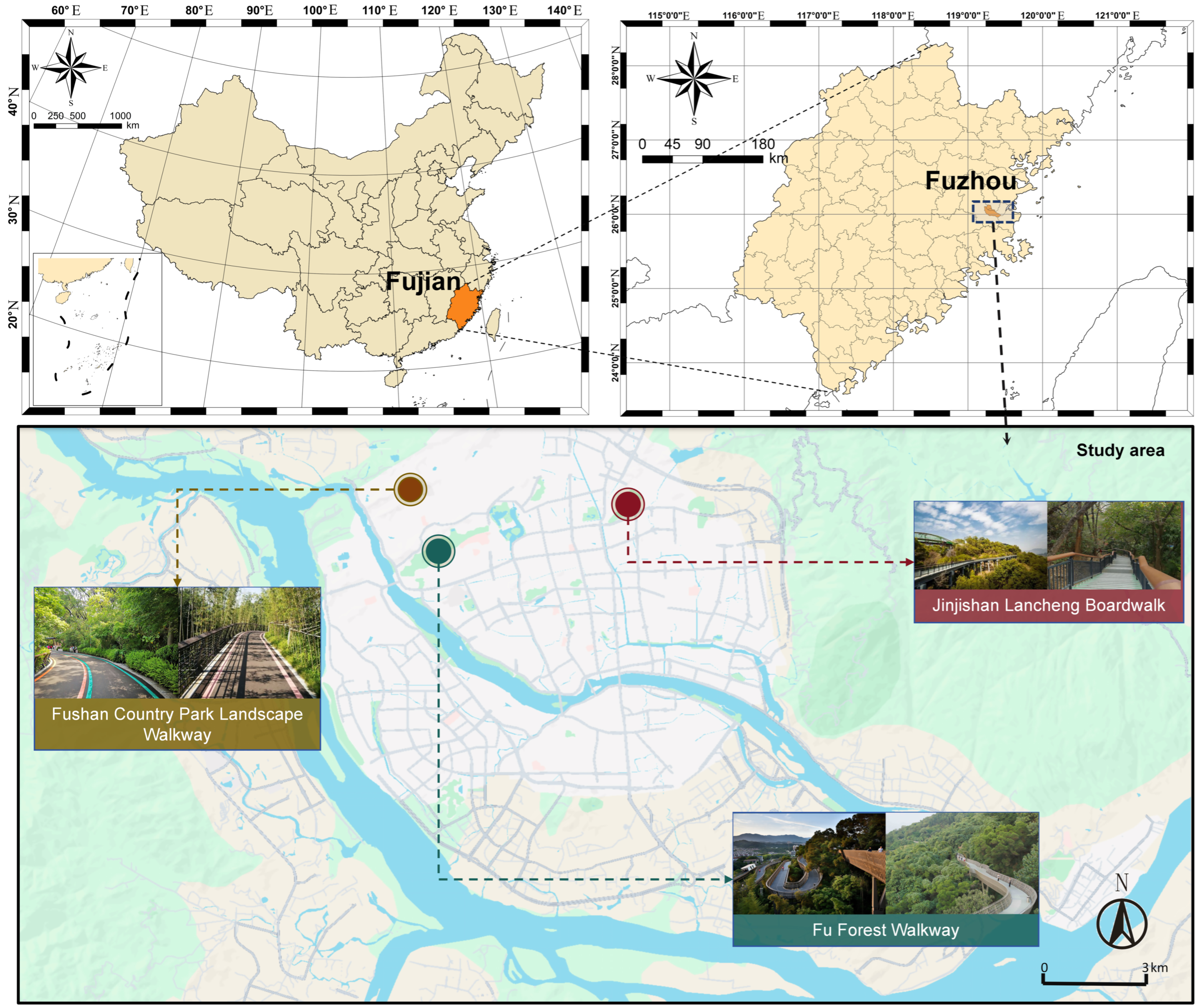
Three representative urban forest walkways in Fuzhou were selected as the study sites: Fu Forest Walkway (Jinniu Mountain), Jinjishan Lancheng Boardwalk, and Fushan Country Park Landscape Walkway (Figure 1). These three sites represent the main spatial conditions of urban forest walkways in Fuzhou. Fu Forest Walkway is characterized by continuous elevated walking routes, dense canopy cover, and alternating views between forest interiors and urban surroundings. Jinjishan Lancheng Boardwalk is located in an urban mountain setting and contains forested path sections, viewing platforms, and transitional interfaces between mountain vegetation and the built environment. Fushan Country Park Landscape Walkway is situated in a country-park context and includes relatively natural forest sections, resting spaces, and recreational nodes.
The target population consisted of older walkway users aged 60 years or older. The age threshold of 60 years was adopted in accordance with the legal definition of older persons in the Chinese context [10]. Participants were included when they met the following criteria: they were at least 60 years old, they had used or stayed in one of the selected walkways on the survey day, and they were able to understand the questionnaire items and complete the interview-based survey with the assistance of trained investigators. The three selected walkways provided a suitable empirical basis for comparing different landscape environment types within the same city while reducing the influence of broad inter-city differences in climate, culture, and urban development background.

2.2. Research Framework

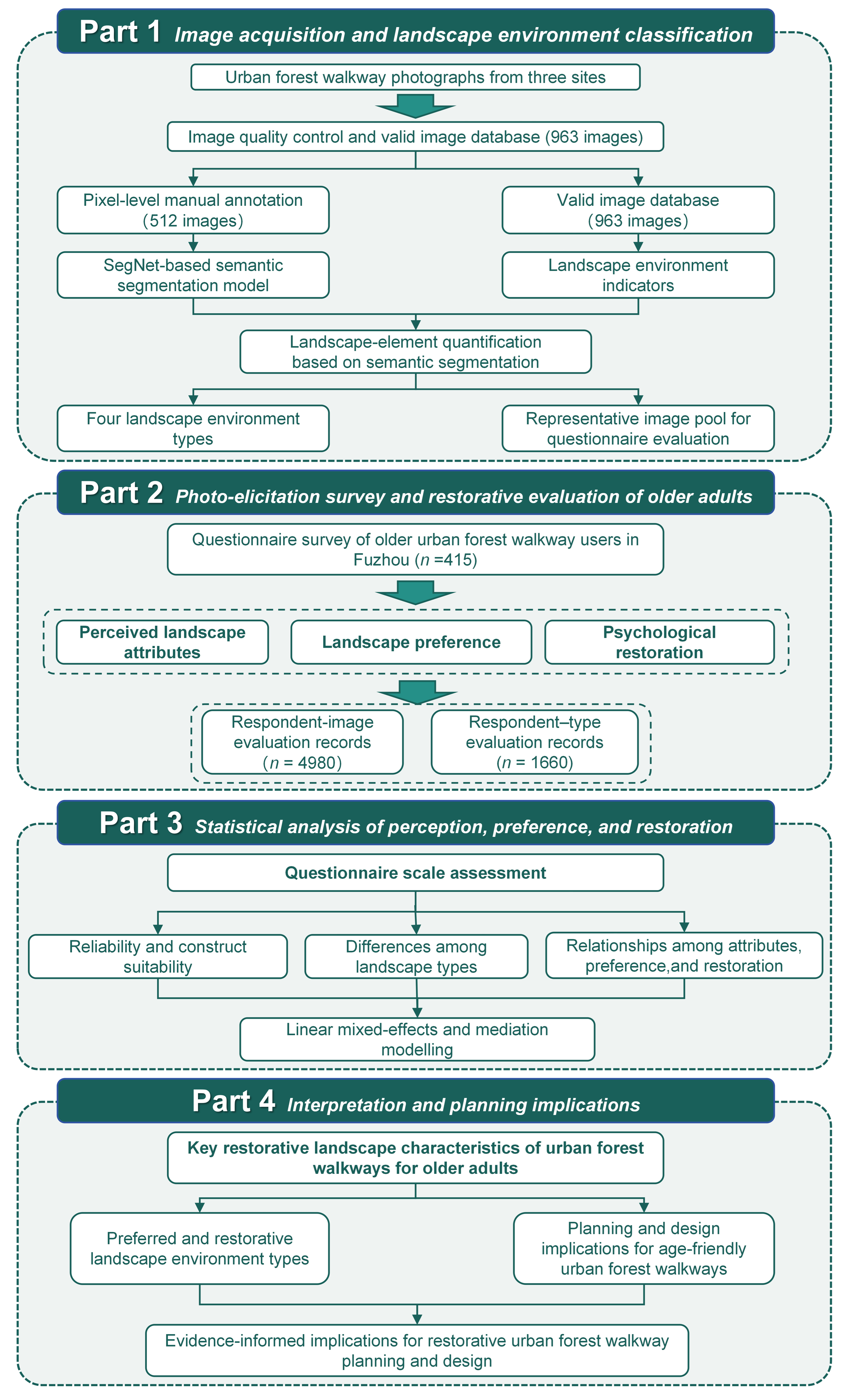
The study followed an integrated framework linking landscape image analysis, landscape type classification, photo-based questionnaire evaluation, and statistical modelling (Figure 2). The framework was designed to examine how different types of urban forest walkway landscapes were associated with older adults’ perceived landscape attributes, landscape preference, and perceived psychological restoration.
The research procedure included four main stages. First, field photographs of the three selected urban forest walkways were collected and screened to establish an image database of walkway landscape environments. The photographs covered typical visual scenes along the walkways, including forest canopy sections, viewing platforms, transitional forest–urban interfaces, and resting or social interaction nodes. Second, a SegNet-based semantic segmentation model was used to identify major landscape elements in the images. The segmented elements included tree canopy and tall vegetation, shrubs and groundcover, walkway pavement, railings and boardwalk structures, sky and distant open views, resting and guidance facilities, and human activity elements. Based on the proportional composition of these elements and additional visual indicators, the walkway landscapes were classified into four landscape environment types: high-naturalness canopy-immersive type, semi-open viewing-platform type, forest-edge urban-interface type, and cultural resting and interaction-node type.
Third, a photo-elicitation questionnaire survey was conducted among older adults using a structured set of representative landscape photographs. The questionnaire recorded participants’ demographic characteristics, walkway use patterns, perceived landscape attributes, landscape preference, and perceived psychological restoration. The perceived landscape attributes included tranquillity, refuge, naturalness, perceived species richness, sociability, spaciousness, prospect, and cultural character. Psychological restoration was measured using items adapted from the perceived restorativeness scale, covering the main dimensions of being away, fascination, extent, and compatibility. The selection of these perceptual and restorative variables was informed by restorative environment theory and related landscape-preference research, while landscape preference was examined as a potential pathway linking selected perceived attributes with perceived psychological restoration.
Fourth, statistical analyses were conducted to examine differences among landscape types and the relationships among perceived landscape attributes, landscape preference, and perceived psychological restoration. Descriptive statistics were first used to summarize the characteristics of respondents and major variables. Reliability and construct-suitability assessments were then performed for the questionnaire scales. Differences among landscape types were examined using analysis of variance and multiple comparisons. Correlation analysis was used to test the associations among perceived landscape attributes, landscape preference, and perceived psychological restoration. Finally, linear mixed-effects models and mediation analysis were used to estimate the associations of perceived landscape attributes and landscape preference with perceived psychological restoration, including the potential indirect pathway through landscape preference, while accounting for the repeated evaluations made by the same respondents and the shared influence of image stimuli.

2.3. Image Acquisition and Landscape Classification

Field photographs were collected from Fu Forest Walkway, Jinjishan Lancheng Boardwalk, and Fushan Country Park Landscape Walkway using a standardized ground-level photographic protocol. To reflect the visual experience of older walkway users, photographs were taken from the pedestrian perspective at an approximate eye height of 1.5–1.6 m. Sampling points were distributed along the main walking routes, elevated boardwalk sections, viewing platforms, resting nodes, and transitional interfaces between forested areas and built surroundings. Photographs with severe blur, overexposure, underexposure, strong occlusion, repeated composition, or weak scene representativeness were removed during the screening process.
A total of 1188 original photographs were collected, including 486 from Fu Forest Walkway, 337 from Jinjishan Lancheng Boardwalk, and 365 from Fushan Country Park Landscape Walkway. After quality screening, 963 valid photographs were retained for image-based landscape analysis, including 402 from Fu Forest Walkway, 276 from Jinjishan Lancheng Boardwalk, and 285 from Fushan Country Park Landscape Walkway. These photographs formed the basic image database for semantic segmentation, landscape element quantification, landscape classification, and subsequent photo-based questionnaire evaluation.
Among the 963 valid photographs, 512 images were selected for pixel-level manual annotation. The annotated dataset was divided into a training set, validation set, and test set, containing 360, 76, and 76 images, respectively. A SegNet-based semantic segmentation model was used to identify the main landscape elements in the walkway images. The encoder part of the SegNet model was initialized using ImageNet-pretrained VGG16 weights, and the model was then fine-tuned using the manually annotated walkway-image dataset. The model was applied as a domain-specific tool for quantifying major landscape elements in urban forest walkway scenes. The segmentation categories included seven classes: tree canopy and tall vegetation, shrubs and groundcover, walkway pavement, railings and boardwalk structures, sky and distant open views, resting/guidance/cultural facilities, and human activity elements.
All annotated images were resized to a uniform resolution before model fine-tuning. Data augmentation, including horizontal flipping, slight rotation, brightness adjustment, and random cropping, was applied to improve model robustness under different viewing and lighting conditions. The SegNet model was fine-tuned under a supervised learning procedure, with manually labelled segmentation masks as reference data. Model performance was evaluated on the independent test set using pixel accuracy, mean pixel accuracy, mean intersection over union, frequency-weighted intersection over union, precision, recall, and F1-score.
Based on the semantic segmentation results, the proportional area of each landscape element in each image was calculated as follows:
P i c = A i c A i
where P i c denotes the proportional area of landscape element class c in image i , A i c denotes the number of pixels classified as class c in image i , and A i denotes the total number of pixels in image i .
The mean intersection over union was used as the main indicator for evaluating the segmentation accuracy of the model:
m I o U = 1 C c = 1 C T P c T P c + F P c + F N c
where C denotes the total number of segmentation classes, and T P c , F P c , and F N c denote the true positive, false positive, and false negative pixels for class c, respectively.
Nine landscape environment indicators were then extracted from the segmented images, including tree canopy proportion, shrub and groundcover proportion, walkway pavement proportion, railing and boardwalk structure proportion, sky and distant open-view proportion, resting and guidance facility proportion, human activity element proportion, visual openness, and composite artificial element proportion. These indicators described both the material composition and the visual structure of the walkway scenes.
Before clustering, all landscape environment indicators were standardized to remove the influence of different measurement scales. K-means clustering was then applied to classify the 963 valid photographs into landscape environment types by minimizing the within-cluster sum of squared distances:
min { C k } k = 1 K k = 1 K i C k z i μ k 2 2
where K denotes the number of clusters, C k denotes the set of images assigned to cluster k , z i denotes the standardized landscape indicator vector of image i , and μ k denotes the centroid vector of cluster k .
The four-cluster solution was used as the landscape classification scheme for the subsequent questionnaire survey. The interpretation and naming of the clusters were based on the centroid profiles of the landscape environment indicators, together with expert review of representative images within each cluster. The four landscape environment types were labelled as high-naturalness canopy-immersive type, semi-open viewing-platform type, forest-edge urban-interface type, and cultural resting and interaction-node type. These types were used to organize the representative photograph set and to support subsequent comparisons of older adults’ perceived landscape attributes, landscape preference, and psychological restoration across different walkway environments.

2.4. Questionnaire Design

A photo-elicitation questionnaire was designed to measure older adults’ perceived landscape attributes, landscape preference, and perceived psychological restoration in response to different urban forest walkway environments. The final questionnaire consisted of four sections: demographic characteristics, walkway use behaviour, photo-based landscape evaluation, and perceived psychological restoration.
The first section recorded respondents’ demographic and health-related characteristics, including gender, age, education level, living arrangement, self-rated health status, mobility condition, and chronic disease status. The second section recorded walkway use behaviour, including visit frequency, travel mode, travel time to the walkway, duration of stay, main activity type, and companionship during walkway use. These variables were recorded to characterize respondents’ walkway-use patterns. Age and self-rated health status were included as respondent-level covariates in the mixed-effects and mediation models.
The third section used a structured photo-elicitation procedure. A total of 32 representative photographs were selected from the classified image database, with eight photographs representing each of the four landscape environment types. To reduce response burden while maintaining balanced exposure to different landscape types, each respondent evaluated 12 photographs, including three photographs from each landscape type. The photographs were assigned using a balanced block design, and the presentation order was randomized for each respondent.
For each photograph, respondents evaluated eight perceived landscape attributes: tranquillity, refuge, naturalness, perceived species richness, sociability, spaciousness, prospect, and cultural character. Landscape preference was measured using one overall preference item for each photograph. Perceived psychological restoration was measured using a short-form perceived restorativeness scale, covering four dimensions: being away, fascination, extent, and compatibility. All perceptual and restorative items were measured using a 7-point Likert scale, where 1 indicated the lowest level of agreement or preference, and 7 indicated the highest level.
The score of each dimension was calculated as the arithmetic mean of its corresponding items:
S i q = 1 n q r = 1 n q x i r
where S i q denotes the score of respondent i for dimension q , n q denotes the number of items included in dimension q , and x i r denotes the score given by respondent i to item r . Higher scores indicated stronger perceived landscape attributes, higher landscape preference, or greater perceived psychological restoration.
All questionnaires were administered through face-to-face interviews by trained investigators. The items were read aloud when necessary, and respondents were allowed to ask for clarification of item meanings. Questionnaires were excluded from the valid dataset when the respondent did not meet the age criterion, when more than 20% of the core rating items were missing, or when the response pattern showed clear invalidity, such as the same score being selected for all photo-based evaluation items. Before the interview, all respondents were informed of the purpose of the survey, the voluntary nature of participation, and the anonymous use of the data. Verbal informed consent was obtained from each respondent before the questionnaire began. The study was conducted in accordance with the Declaration of Helsinki and was approved in January 2024 by the Academic Ethics Committee of the College of Design and Innovation, Fujian Jiangxia University, China (approval code: FJX_CDI_20240109).

2.5. Sample Size Calculation

The required sample size was calculated using G*Power version 3.1.9.7. The test family was set as F tests, and the statistical test was set as multiple linear regression: fixed model, R2 deviation from zero. The significance level was set at α = 0.05 , the statistical power was set at 1 β = 0.90 , the effect size was set at Cohen’s f 2 = 0.065 , and the number of predictors was set at 18. Under these parameters, the minimum required sample size was 402 [45,46,47].
The final survey contacted 515 older walkway users, of whom 470 completed the questionnaire. After data screening, 415 valid questionnaires were retained for analysis. The valid sample exceeded the minimum sample size required by the G*Power calculation. Among the 415 valid respondents, 158 were surveyed at Fu Forest Walkway, 126 at Jinjishan Lancheng Boardwalk, and 131 at Fushan Country Park Landscape Walkway.
Because each respondent evaluated 12 photographs, the questionnaire generated 4980 respondent–image evaluation records. In addition, because the 12 photographs covered four landscape environment types, with three photographs for each type, the dataset also generated 1660 respondent–type evaluation records. The respondent-level sample was used for demographic and walkway use analyses, the respondent–type dataset was used for comparing perceived attributes, preference, and restoration among landscape types, and the respondent–image dataset was used for mixed-effects modelling and robustness analysis.

2.6. Statistical Analysis

The statistical analysis was conducted in six steps. First, descriptive statistics were used to summarize respondents’ demographic characteristics, walkway use behaviour, and the distribution of major variables. Continuous variables were reported using means and standard deviations, while categorical variables were reported using frequencies and percentages.
Second, the reliability and construct suitability of the questionnaire scales were examined. Cronbach’s alpha was calculated for the psychological restoration scale and the core photo-evaluation scale. The eight perceived landscape attributes were treated as heterogeneous single-item indicators rather than interchangeable items of a single latent scale; therefore, Cronbach’s alpha was not calculated for these attributes. The Kaiser–Meyer–Olkin statistic and Bartlett’s test of sphericity were used to assess the inter-correlation structure and construct suitability of the items.
Third, differences among the four landscape environment types were examined. For respondent–type aggregated data, repeated-measures analysis of variance was used to compare perceived landscape attributes, landscape preference, and psychological restoration across landscape types. When the sphericity assumption was not met, the Greenhouse–Geisser correction was applied. Bonferroni-adjusted pairwise comparisons were used to identify differences between specific landscape types.
Fourth, Pearson correlation analysis was used to examine the bivariate associations among perceived landscape attributes, landscape preference, and psychological restoration. This step provided an initial assessment of the relationships among the main variables before multivariable modelling.
Fifth, linear mixed-effects models were used to estimate the associations of perceived landscape attributes and landscape preference with perceived psychological restoration. This modelling strategy was adopted because each respondent evaluated multiple photographs, and each photograph was evaluated by multiple respondents. The model included respondent and image as random intercepts to account for repeated measurements and shared image-level effects. The fixed-effect terms included the eight perceived landscape attributes, landscape preference, landscape type, age, and self-rated health status. The core model was specified as follows:
R i j k = β 0 + m = 1 8 β m P A m i j k + β 9 P r e f i j k + γ T y p e k + δ X i + u i + v j + ε i j k
where R i j k denotes the perceived psychological restoration score given by the respondent i to image j belonging to landscape type k ; P A m i j k denotes the score of the m -th perceived landscape attribute; P r e f i j k denotes the landscape preference score; T y p e k denotes the landscape type dummy variables; X i denotes the respondent-level covariates of age and self-rated health status; u i denotes the random intercept for respondent i ; v j denotes the random intercept for image j ; and ε i j k denotes the residual error term.
Sixth, mediation analysis was conducted to examine whether landscape preference constituted an indirect pathway in the associations between perceived landscape attributes and perceived psychological restoration. The mediation model was estimated using two regression equations:
P r e f i j k = a 0 + m = 1 8 a m P A m i j k + γ 1 T y p e k + δ 1 X i + u i + v j + ε 1 i j k
R i j k = b 0 + m = 1 8 c m P A m i j k + b P r e f i j k + γ 2 T y p e k + δ 2 X i + u i + v j + ε 2 i j k
where a m represents the association between the m -th perceived landscape attribute on landscape preference, b represents the association between landscape preference and perceived psychological restoration after controlling for perceived landscape attributes, and cm represents the direct association between the m -th perceived landscape attribute and perceived psychological restoration. The indirect effect of each perceived landscape attribute through landscape preference was calculated as:
I E m = a m × b
The significance of the indirect effects was tested using 5000 bootstrap resamples. An indirect effect was considered statistically significant when its 95% bootstrap confidence interval did not include zero.
All statistical analyses were performed in Python 3.13.5 (Anaconda distribution) in PyCharm 2025.1.1.1. Image data processing and matrix operations were conducted using OpenCV 4.10.0.84, NumPy 2.1.3, and pandas 2.2.3. Clustering analysis and standardization were conducted using scikit-learn 1.6.1. Reliability analysis, analysis of variance, correlation analysis, mixed-effects modelling, and mediation analysis were conducted using SciPy 1.15.3, statsmodels 0.14.4. Statistical significance was set at p < 0.05.

3. Results

3.1. Image Segmentation and Landscape Classification

The SegNet-based semantic segmentation model provided a basis for extracting major landscape elements from the urban forest walkway images. The overall pixel accuracy was 88.7%, the mean pixel accuracy was 84.6%, the mean IoU was 79.4%, the frequency-weighted IoU was 83.2%, and the mean F1-score was 88.4% (Table 1 and Table 2). At the class level, tree canopy and tall vegetation, walkway pavement, and sky or distant open views showed relatively high segmentation performance, with IoU values of 86.3%, 84.6%, and 83.5%, respectively. Railings and boardwalk structures, shrubs and groundcover, and resting, guidance, or cultural facilities also showed acceptable performance. Human activity elements had the lowest IoU value, at 69.4%, indicating that small and variable scene elements were more difficult to segment than large and stable landscape components.
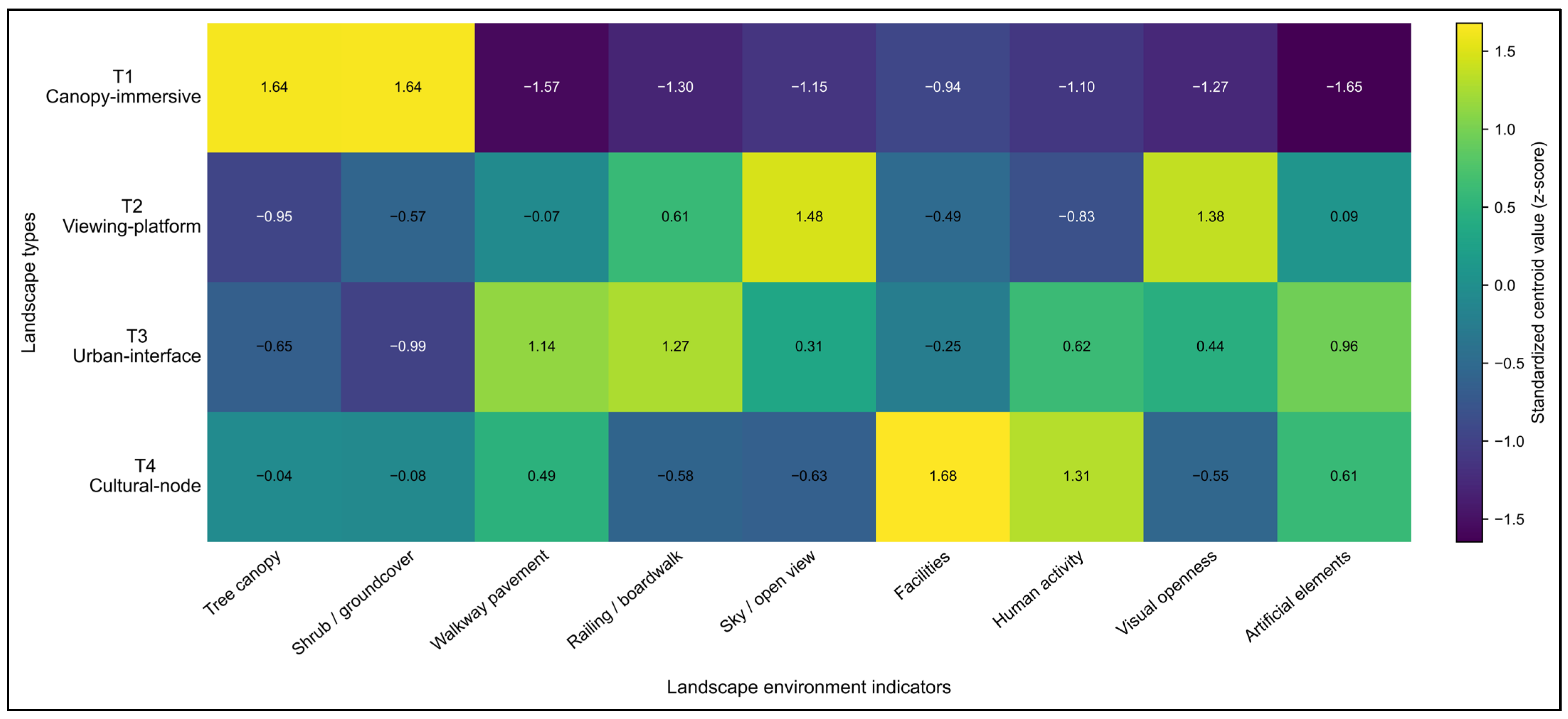
Based on the extracted landscape environment indicators, the 963 valid photographs were classified into four landscape environment types (Table 3). T1, the high-naturalness canopy-immersive type, contained 312 images, accounting for 32.4% of the image database. This type was characterized by the highest tree canopy proportion and relatively low sky or open-view proportion, visual openness, artificial elements, facilities, and human activity. T2, the semi-open viewing-platform type, contained 204 images, accounting for 21.2%. It had the highest sky or open-view proportion and visual openness, indicating scenes with broader visual exposure and viewing-platform characteristics. T3, the forest-edge urban-interface type, contained 238 images, accounting for 24.7%. This type showed relatively high artificial element proportion and human activity, reflecting the transitional condition between forested walkway spaces and urban surroundings. T4, the cultural resting and interaction-node type, contained 209 images, accounting for 21.7%. It was distinguished by the highest proportions of facilities and human activity, corresponding to resting, guidance, cultural, and social interaction nodes along the walkways.
The standardized centroid profiles further clarified the differences among the four landscape environment types (Figure 3). T1 was mainly separated by canopy dominance and low openness; T2 by visual openness and distant views; T3 by stronger urban-interface and artificial-element characteristics; and T4 by facility-related and human-activity features. These results indicate that the four-cluster solution captured distinct visual and functional conditions of the urban forest walkways and provided the classification basis for the subsequent photo-based questionnaire evaluation.

3.2. Respondent Characteristics and Walkway Use Patterns

A total of 415 valid questionnaires were retained for analysis. Among the respondents, 158 were surveyed at Fu Forest Walkway, 126 at Jinjishan Lancheng Boardwalk, and 131 at Fushan Country Park Landscape Walkway. The sample included 185 men and 230 women. Most respondents were between 60 and 74 years old, accounting for 83.9% of the total sample. In terms of educational background, junior middle school and senior high or technical school were the two largest groups.
The respondents generally represented regular older users of the selected walkways. Most respondents reported fair or good self-rated health, while 70.4% reported at least one chronic condition. Regarding walkway use patterns, 87.2% of respondents visited the walkways at least once per week. Walking exercise was the most frequently reported activity, followed by resting or viewing and social interaction. These characteristics provided an appropriate basis for examining older adults’ perceptual and restorative responses to different urban forest walkway environments.

3.3. Reliability and Construct Suitability of Questionnaire Scales

The reliability and construct suitability results are shown in Table 4. The perceived psychological restoration scale showed acceptable internal consistency, with a Cronbach’s α of 0.852. The KMO value for the perceived psychological restoration items was 0.902, and Bartlett’s test was significant, indicating that the item structure was suitable for further construct assessment. The core photo-evaluation scale, which included perceived landscape attributes, landscape preference, and perceived psychological restoration items, also showed acceptable internal consistency and construct suitability, with a Cronbach’s α of 0.709 and a KMO value of 0.920.
The perceived landscape attributes had a KMO value of 0.757, and Bartlett’s test was significant. Cronbach’s α was not calculated for the perceived landscape attributes because these eight attributes were treated as heterogeneous single-item indicators rather than interchangeable items of a single latent scale.

3.4. Differences Among Landscape Types

Repeated-measures ANOVA showed significant differences among the four landscape environment types in all perceived landscape attributes, landscape preference, and perceived psychological restoration (Table 5). The results indicate that older adults’ evaluations varied across different visual and functional conditions of the urban forest walkways.
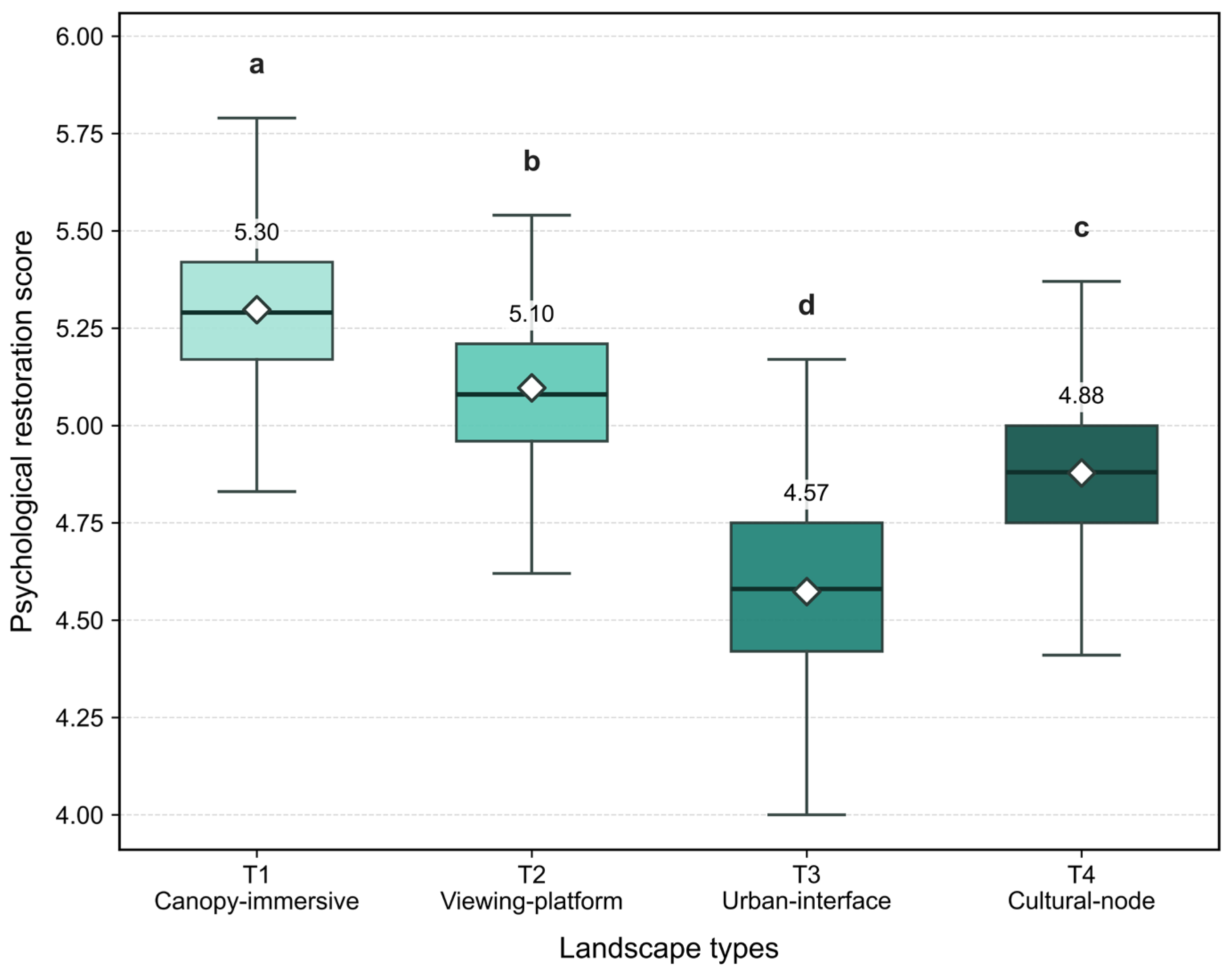
T1, the high-naturalness canopy-immersive type, received the highest scores for tranquillity, refuge, naturalness, perceived species richness, landscape preference, and perceived psychological restoration. Its mean perceived psychological restoration score was 5.30 ± 0.20. T2, the semi-open viewing-platform type, had the highest scores for spaciousness and prospect, and also showed a relatively high level of landscape preference and perceived psychological restoration. T4, the cultural resting and interaction-node type, received the highest scores for sociability and cultural character, reflecting its facility-related and interaction-oriented features. In contrast, T3, the forest-edge urban-interface type, showed lower scores for landscape preference and perceived psychological restoration than the other types, with a mean perceived psychological restoration score of 4.57 ± 0.24.
Figure 4 further illustrates the distribution of perceived psychological restoration scores across the four landscape types. The mean perceived psychological restoration score was highest for T1, followed by T2 and T4, and lowest for T3. These results suggest that canopy-immersive and semi-open viewing environments were generally associated with higher perceived restorative evaluations, while forest-edge urban-interface scenes were associated with lower perceived restorative evaluations in this sample.

3.5. Relationships Among Perceived Landscape Attributes, Landscape Preference, and Perceived Psychological Restoration

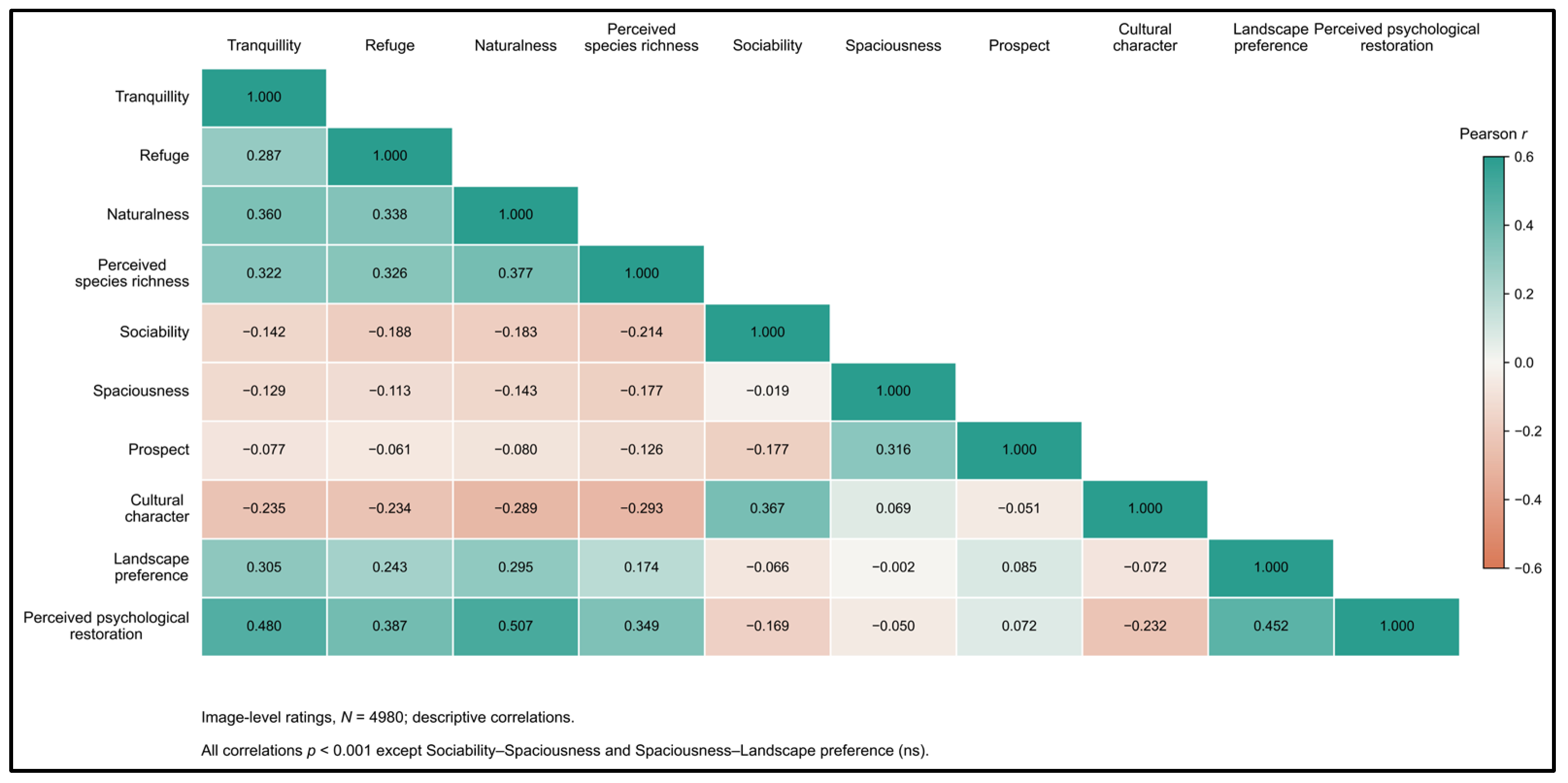
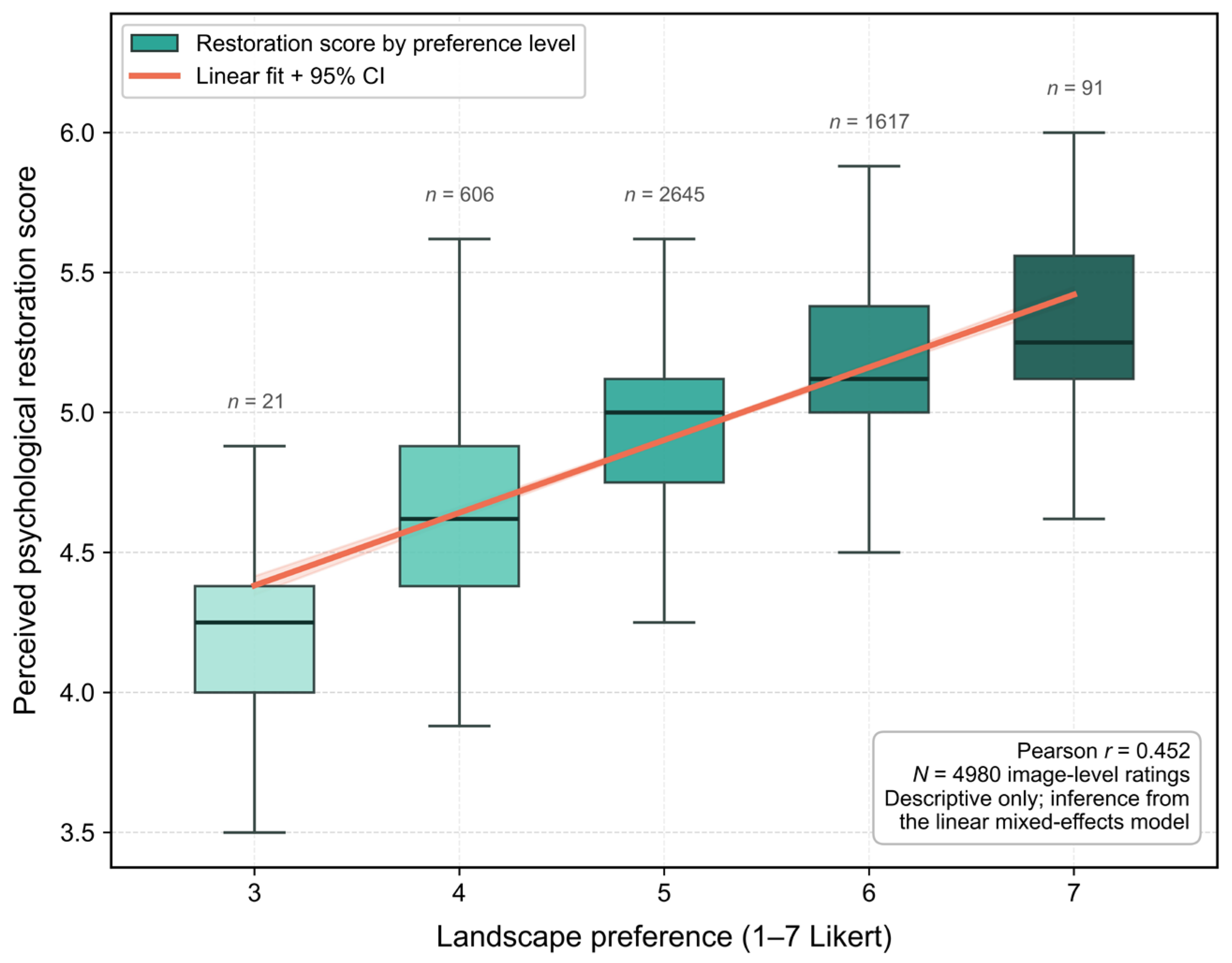
Figure 5 shows the distribution of perceived psychological restoration scores across observed landscape preference levels at the respondent–image level. Perceived psychological restoration scores generally increased with higher landscape preference scores. The Pearson correlation coefficient between landscape preference and perceived psychological restoration was 0.452, based on 4980 image-level ratings. This result indicates a moderate positive association between preference and perceived psychological restoration in the photo-based evaluations.
To further examine the bivariate relationships among the main perceptual variables, Figure 6 presents an image-level Pearson correlation matrix including the eight perceived landscape attributes, landscape preference, and perceived psychological restoration. Perceived psychological restoration was positively correlated with naturalness, tranquillity, landscape preference, refuge, and perceived species richness, with the strongest correlations observed for naturalness and tranquillity. Landscape preference was positively correlated with tranquillity, naturalness, refuge, and perceived species richness, whereas its associations with spaciousness, sociability, prospect, and cultural character were weak. These descriptive correlations suggest that the perceived restorative evaluation of walkway images was more closely related to perceived naturalness, tranquillity, refuge, and preference than to social, cultural, or openness-related attributes alone.
Because these records included repeated evaluations from the same respondents and shared image stimuli, the correlations reported in Figure 5 and Figure 6 were treated as descriptive. Formal inference regarding the associations among perceived landscape attributes, landscape preference, and perceived psychological restoration was further examined using the linear mixed-effects and mediation models reported in Section 3.6.

3.6. Mixed-Effects and Mediation Modelling Results

The linear mixed-effects model was used to examine the associations between perceived landscape attributes, landscape preference, and perceived psychological restoration while accounting for repeated respondent evaluations and shared image-level effects (Table 6 and Table 7). Landscape preference was positively associated with perceived psychological restoration after adjusting for perceived landscape attributes, landscape type, and respondent-level covariates (Estimate = 0.109, p < 0.001). Among the perceived landscape attributes, tranquillity, refuge, naturalness, and prospect were positively associated with perceived psychological restoration. Tranquillity had an estimate of 0.068, naturalness had an estimate of 0.061, prospect had an estimate of 0.040, and refuge had an estimate of 0.029. Perceived species richness, sociability, spaciousness, and cultural character were not significantly associated with perceived psychological restoration in the adjusted model. Age, entered as a continuous respondent-level covariate, was not significantly associated with perceived psychological restoration (Estimate = 0.000, p = 0.780). Good or very good self-rated health was also not significantly associated with the outcome (Estimate = 0.001, p = 0.910).
The mediation results showed that several perceived landscape attributes were indirectly associated with perceived psychological restoration through landscape preference. Significant indirect effects were observed for tranquillity, refuge, naturalness, prospect, and cultural character. The largest indirect effect was found for tranquillity, followed by naturalness, refuge, and prospect. Cultural character also showed a smaller but significant indirect effect through landscape preference. In contrast, the indirect effects of perceived species richness, sociability, and spaciousness were not significant.
Taken together, the modelling results suggest that landscape preference was a relevant pathway linking selected perceived landscape attributes to perceived psychological restoration. Tranquillity, naturalness, refuge, and prospect showed relatively consistent associations with perceived psychological restoration, either directly in the mixed-effects model or indirectly through landscape preference. These findings help clarify how perceived landscape qualities and landscape preference jointly relate to restorative evaluations across different urban forest walkway environments.

4. Discussion

4.1. Landscape Types and Restorative Differences in Urban Forest Walkway Environments

The four landscape environment types were associated with different patterns of perceived landscape attributes, landscape preference, and perceived psychological restoration. Taken together, these patterns support a conceptual sequence in which the visual and functional composition of walkway scenes is reflected in perceived landscape qualities, which are subsequently associated with landscape preference and perceived psychological restoration. This pattern is consistent with the view that restorative experiences in forest-related environments depend not only on the presence of vegetation, but also on the specific visual and functional composition of the landscape. Earlier work on restorative environments and forest exposure has linked natural settings to stress recovery, attention restoration, and perceived well-being, while noting that these effects vary across environmental forms and landscape qualities [16,18,48,49]. The present results extend this evidence to urban forest walkways, where users encounter a sequence of canopy-covered sections, open viewing points, forest–urban interfaces, and resting or interaction nodes rather than a single homogeneous forest scene.
The high-naturalness canopy-immersive type received the highest scores for tranquillity, refuge, naturalness, perceived species richness, landscape preference, and perceived psychological restoration. Canopy-dominated settings provide a relatively enclosed and coherent visual field, with reduced hardscape exposure and stronger vegetation continuity—conditions broadly consistent with the restorative components of being away, fascination, extent, and compatibility [21,23,50]. The higher tranquillity and naturalness scores of T1 suggest that canopy immersion was perceived not merely as a greener condition, but as a visually and psychologically distinct walkway environment.
Refuge may also help explain the relatively high perceived psychological restoration score of this type. In environmental preference and restorative environment research, refuge is associated with shelter, enclosure, and a sense of psychological safety, whereas prospect refers to outward visibility and spatial understanding [51]. For older adults, a moderate sense of enclosure may be particularly relevant, since restorative walking and resting often require both comfort and perceived safety. The T1 environment, with high canopy cover and relatively low openness, appeared to offer a sheltered setting suited to slow walking and short rests. This does not imply that greater enclosure is always preferable; overly enclosed sections may reduce visibility, orientation, or perceived safety, so canopy immersion may support perceived restoration most effectively when combined with adequate path clarity, maintenance, and resting opportunities [29].
The semi-open viewing-platform type also showed relatively high perceived psychological restoration, although it was characterized by a different perceptual profile. T2 received the highest scores for spaciousness and prospect, indicating that open views and elevated viewing conditions were especially salient. This accords with research relating openness, visual access, and spatial legibility to landscape preference and positive appraisal [52,53,54]. Within a linear walkway, viewing platforms function less as scenic additions than as spatial pauses: they allow older users to stop, recover, observe the surrounding forest and city, and reorient within the route, and may support fascination and extent by linking immediate forest experience with broader visual depth [21,55].
Taken together, the contrast between T1 and T2 suggests that perceived restorative quality does not depend on a single ideal degree of enclosure or openness, but can emerge from different combinations of immersion and prospect. T1 offered stronger canopy enclosure, tranquillity, and naturalness, whereas T2 offered stronger openness and spatial extension; both received higher perceived psychological restoration scores than the forest-edge urban-interface type, but were associated with different perceptual profiles rather than an identical restorative configuration. This is consistent with visual landscape studies in which naturalness, openness, coherence, and complexity jointly shape evaluation rather than acting in isolation [36,37,53]. In practical terms, alternating enclosed canopy sections with semi-open viewing nodes may help provide both quietness and orientation along the route.
The cultural resting and interaction-node type received the highest scores for sociability and cultural character, but lower perceived psychological restoration scores than T1 and T2. This indicates that restorative experience in urban forest walkways is not limited to naturalness but also involves the social and functional affordances of the setting. Resting facilities, guidance elements, and small gathering spaces may make the environment more legible, usable, and socially meaningful [27,28,56,57]. The mediation results add nuance to this interpretation: cultural character was not directly associated with perceived psychological restoration in the adjusted mixed-effects model, but it showed a small indirect association through landscape preference. This suggests that cultural and facility-related qualities may contribute to restorative evaluation when they support a positive overall appraisal of the setting, although they are not equivalent to restoration itself. At the same time, the T4 results point to a possible trade-off: facilities and human activity can increase usability for older adults, yet a high concentration of facilities or social activity may also reduce tranquillity and weaken the sense of being away [48,58]. This suggests that interaction-node design should integrate facilities into the forest setting rather than simply increasing their number.
The forest-edge urban-interface type received the lowest landscape preference and perceived psychological restoration scores. This does not imply limited planning value, as interface sections are often necessary for access, connection, and transition. It does suggest, however, that such transitional zones may be more vulnerable to reduced restorative quality: T3 was characterized by relatively higher artificial elements and stronger interface conditions, which may weaken perceived naturalness, tranquillity, and refuge [22,59,60]. The perceived restorative quality of these sections may therefore depend more strongly on visual buffering, vegetation layering, and the reduction in hardscape dominance.
Across the full set of image evaluations, landscape preference was positively associated with perceived psychological restoration, but the two constructs were not interchangeable. The mediation results indicated that preference partly accounted for the associations between selected perceived landscape attributes and perceived psychological restoration, while tranquillity, refuge, naturalness, and prospect retained direct associations in the adjusted model. This pattern is consistent with partial rather than complete mediation: positive appraisal represents one pathway through which perceived landscape qualities relate to restoration, but it does not provide the sole explanation for restorative evaluation.
Overall, the differences among the four types suggest that urban forest walkways are better understood as sequential forest recreation environments than as uniform green corridors. Canopy-immersive sections, semi-open viewing platforms, cultural resting nodes, and forest-edge interfaces each offer distinct perceptual conditions and perceived restorative potentials. By distinguishing these landscape types within the same urban forest walkway system, the study provides type-specific evidence beyond the broader comparison of natural and urban environments or green and non-green settings. Canopy immersion, prospect, social-functional nodes, and urban interfaces can therefore be understood as complementary components of a varied walking sequence rather than interchangeable design solutions. This supports a type-based interpretation of restorative walkway environments that remains consistent with restorative environment theory, forest health research, and visual landscape preference studies [21,37,61,62].

4.2. Implications for Age-Friendly Forest Recreation and Walkway Design

4.2.1. Maintain Canopy Continuity and Quiet Immersive Walking Experiences

The higher perceived restorative evaluation of the canopy-immersive type suggests that continuous canopy cover and a relatively calm walking atmosphere are useful design resources in urban forest walkways. For older adults, forest recreation is often linked to slow walking, short rests, shaded movement, and low-intensity contact with nature rather than vigorous activity alone; supportive outdoor environments for this group are accordingly expected to provide comfort, accessibility, and safety [1,4,5]. Recent studies of age-friendly public spaces similarly emphasize that accessibility, walking comfort, perceived safety, resting opportunities, and supportive facilities jointly shape older adults’ outdoor experience [11,12,31]. Canopy continuity can therefore be treated not only as a vegetation or aesthetic feature, but as part of an age-friendly recreation condition that helps maintain thermal comfort, visual softness, and a degree of separation from more intensive urban surroundings.
At the same time, canopy-dominated sections may benefit from attention to balance. Higher naturalness, tranquillity, and refuge were associated with stronger perceived restorative evaluations, consistent with restorative environment theory [21,62], but refuge need not translate into excessive enclosure: shaded, immersive sections still require clear sightlines, legible paths, stable surfaces, and adequate resting opportunities. Trail and greenway studies have linked perceived safety, maintenance, and path quality to recreational use and experience [34,63,64], which suggests that such sections should retain vegetation continuity while avoiding overly dark or visually blocked conditions.
From a planning perspective, a reasonable priority is to strengthen tree-canopy and multi-layered vegetation continuity where the walkway already has strong forest character, while using low-impact measures—shaded walking sequences, understory retained where it does not obstruct visibility, age-friendly seating at intervals, and reduced hardscape exposure—to improve comfort and safety. The aim is not to maximize vegetation density, but to maintain a calm, coherent, and usable forest walking environment for older users [65].

4.2.2. Create Semi-Open Viewing Nodes Within Forest Walking Sequences

The semi-open viewing-platform type received the highest scores for spaciousness and prospect, alongside relatively high perceived psychological restoration, which suggests that open views and viewing nodes may contribute to the restorative experience of urban forest walkways. Visual openness has been associated with landscape preference and positive appraisal across settings [51,52,53,66], and in a forest walkway such openness is particularly useful because it interrupts long walking sequences and provides a spatial contrast to canopy-covered sections.
Viewing nodes need not be read only as scenic points; they can also serve as resting, orientation, and transition spaces within a linear route. Greenway and trail studies have related route quality not only to continuity and access but also to the distribution of facilities, perceived safety, and environmental quality [34,67]. A semi-open platform can thus support several functions at once—pausing after walking, looking outward to the surrounding forest or city, and reorienting within the route—functions that may be especially relevant for older users, whose walking rhythm and resting needs can differ from those of younger visitors [1,6].
A practical implication is to embed viewing nodes into the walking sequence rather than treating them as isolated structures. Semi-open platforms work best when they combine prospect with comfort and safety—stable surfaces, protective railings, shaded seating, and clear edge definition—while avoiding excessive hard paving that could weaken the surrounding forest atmosphere. Alternating canopy-immersive sections with semi-open nodes may create a legible spatial rhythm in which enclosed sections offer shade, quiet, and refuge, and viewing nodes offer prospect, orientation, and visual extension, in keeping with the character of urban forest walkways as linear forest recreation infrastructure.

4.2.3. Improve Resting and Interaction Nodes Without Weakening Restorative Atmosphere

The cultural resting and interaction-node type received the highest scores for sociability and cultural character, which indicates that resting facilities, guidance elements, and small social spaces are meaningful components of age-friendly forest walkway environments. For older adults, a walkway serves not only as a route for movement but also as a setting for pausing, observing, and maintaining everyday social contact; outdoor environments can support well-being through social integration and informal interaction as well as physical activity [5,68,69]. Recent age-friendly public-space research similarly regards opportunities for rest, supported use, and everyday social participation as integral components of inclusive outdoor environments rather than as optional amenities [11,12]. On this reading, resting and interaction nodes are better seen as integral parts of forest recreation infrastructure than as secondary facilities.
The design of these nodes can respond to the physical rhythm and social needs of older users. Seating placed at appropriate intervals—particularly near slopes, viewing areas, intersections, and longer continuous sections—and equipped where possible with backrests, armrests, shade, and clear sightlines, supports both short recovery stops and longer social stays, in line with evidence that age-friendly settings depend on small-scale comfort, perceived safety, and ease of use [1,4,64,70]. These provisions are particularly relevant along linear walking routes, where gradients and long uninterrupted sections may increase older users’ need for predictable and comfortable places to pause [31].
The T4 results also point to a trade-off. Despite its high sociability and cultural character, this type received a lower perceived psychological restoration score than the canopy-immersive and semi-open viewing types, suggesting that social and facility functions should be integrated without weakening tranquillity and the surrounding forest atmosphere. Facilities, signs, interpretation panels, and lighting may therefore work best when modest in scale, visually coordinated with the forest setting, and arranged to limit crowding or visual disturbance, since perceived calmness can be affected by both visual and non-visual factors [58].

4.2.4. Buffer and Renaturalize Forest-Edge Urban-Interface Sections

The forest-edge urban-interface type showed the lowest landscape preference and perceived psychological restoration scores. This need not be read as a failed landscape condition, since interface sections are often necessary for access, connection, and route continuity. The lower evaluation does suggest, however, that these sections warrant more careful design attention, particularly where forested stretches meet roads, buildings, elevated structures, or other hard urban edges, and where connectivity, safety, and environmental quality must be balanced [34,35,67].
One implication is to use vegetation and spatial buffering to reduce the visual dominance of hard urban elements. Layered planting can soften exposed edges, improve perceived naturalness, and smooth the transition between forest and city, consistent with evidence that naturalness, openness, coherence, and artificial elements shape landscape preference and perceived quality [36,37,71]. Such buffering should nonetheless keep interface sections legible and safe: planting need not conceal the city entirely, but rather reduce abrupt visual contrast while preserving essential sightlines and wayfinding.
Material and facility design also matters here. Railings, paving, lighting, and signs are often unavoidable in elevated or sloped sections, but when visually dominant or inconsistent with the forest setting, they may reinforce a sense of artificiality. Modest refinements—restrained materials and colours, reduced hardscape exposure, improved path-edge treatment, and safety infrastructure coordinated with planting—may help interface sections function less as purely transitional spaces and more as comfortable parts of the walkway system, maintaining accessibility and safety while strengthening continuity of the forest experience.

4.3. Limitations and Future Research

Several limitations should be acknowledged. First, the photo-elicitation approach offered a controlled way to compare visual landscape types, but the resulting scores represented responses to standardized visual stimuli rather than the full multisensory and embodied experience of walking in urban forest environments. Photographs cannot reproduce dynamic conditions such as sound, thermal comfort, air movement, odour, slope, physical fatigue, crowding, route continuity, and real-time perceptions of safety. Similarly, the image-based semantic segmentation mainly described visible landscape composition, leaving aspects such as vegetation quality, maintenance, acoustic environment, and microclimate less well represented [72,73,74,75]. Accordingly, the findings should be interpreted as perceived restorative evaluations of visual landscape conditions rather than as evidence of long-term health effects arising from actual nature exposure. Future studies could combine standardized image evaluation with on-site behavioural observation, environmental and soundscape measurements, wearable or physiological indicators, and repeated in situ assessments.
Second, participants were recruited among users of the three walkways, and the questionnaire recorded their general visit frequency, duration of stay, and companionship during walkway use. However, recognition of and familiarity with each specific photographed location were not separately assessed, and the study did not examine whether the observed relationships varied according to familiarity, exposure duration, or solitary versus accompanied visits. These dimensions may shape how users interpret and experience natural settings; research on multi-day forest immersion and nature-based social interventions indicates that duration and social context are relevant characteristics of nature experience [76,77]. Future research could therefore compare familiar and unfamiliar settings, short and extended visits, and solitary and accompanied use through field-based or repeated-measures designs.
Third, the study examined perceived psychological restoration among older users of three urban forest walkways in Fuzhou. The within-city design supported comparisons among landscape types under a broadly shared climatic, cultural, and urban context, but it also limits the extent to which the results can be transferred to other cities, climatic regions, cultural settings, forest structures, or trail systems. In addition, the cross-sectional questionnaire and mediation analyses support the interpretation of statistical associations and potential indirect pathways, but do not establish causal effects or long-term changes in psychological health. The findings are therefore most directly applicable to the study setting and may be particularly relevant to comparable subtropical and hilly urban contexts. Cross-city replication, seasonal and cross-cultural comparisons, field experiments, and longitudinal or before–after studies could help evaluate the transferability and temporal stability of the observed relationships [23,50,78].

5. Conclusions

This study examined how different urban forest walkway landscape environments were associated with older adults’ perceived landscape attributes, landscape preference, and perceived psychological restoration. By integrating SegNet-based semantic segmentation, landscape-element quantification, landscape type classification, photo-elicitation evaluation, and statistical modelling, the study connected visible landscape composition with older adults’ perceptual and restorative evaluations. Four landscape environment types were identified across three representative walkways in Fuzhou: the high-naturalness canopy-immersive type, semi-open viewing-platform type, forest-edge urban-interface type, and cultural resting and interaction-node type.
The four types differed in their perceived and restorative profiles. The canopy-immersive type received the highest perceived psychological restoration score and was characterized by higher tranquillity, refuge, naturalness, and perceived species richness. The semi-open viewing-platform type, characterized by greater spaciousness and prospect, also received relatively high perceived psychological restoration scores. The cultural resting and interaction-node type was distinguished by higher sociability and cultural character, whereas the forest-edge urban-interface type received lower landscape preference and perceived psychological restoration scores. The mixed-effects and mediation analyses further indicated that landscape preference was a relevant partial pathway linking selected perceived landscape attributes with perceived psychological restoration, while tranquillity, refuge, naturalness, and prospect also retained direct associations in the adjusted model.
Taken together, these findings provide empirical support for a type-based approach to the planning and design of age-friendly urban forest walkways. Rather than treating such walkways as uniform green corridors, planning can recognize the complementary roles of canopy-immersive sections, semi-open viewing nodes, resting and interaction spaces, and forest-edge interfaces. Maintaining canopy continuity, providing comfortable and legible viewing and resting nodes, integrating social facilities without weakening tranquillity, and buffering visually dominant urban interfaces may help support the perceived restorative quality and usability of urban forest walkways for older adults. These implications are grounded in photo-based perceptual evaluations and should be understood as evidence for environment-sensitive planning and design rather than as evidence of long-term or clinical health effects.


Author Contributions

Conceptualization, Y.L. and Y.K.; methodology, Y.L. and Y.K.; software, Y.K. and X.J.; validation, Y.L., Y.K. and X.J.; formal analysis, Y.L. and Y.K.; investigation, Y.L., Y.K., S.C. (Shulin Chen) and S.C. (Shuangjiao Cai); resources, Y.L.; data curation, Y.K. and X.J.; writing—original draft preparation, Y.K.; writing—review and editing, Y.L. and Y.K.; visualization, Y.K.; supervision, Y.L.; project administration, Y.L.; funding acquisition, Y.L. All authors have read and agreed to the published version of the manuscript.

Funding

This research was funded by the Fujian Provincial Social Science Foundation Youth Project, grant number FJ2024C164; the University Research Base of Humanities and Social Sciences in Fujian Province-Project of Research Center of Cross-media Design, grant number 16KPSS03; the Fujian Jiangxia University Research Project (National Fund Cultivation Program), grant number JXS2024012; and the Fuzhou Social Science Planning Project, grant number 2025FZC071. The APC was funded by the University Research Base of Humanities and Social Sciences in Fujian Province-Project of Research Center of Cross-media Design, grant number 16KPSS03.

Institutional Review Board Statement

The study was conducted in accordance with the Declaration of Helsinki and approved by the Academic Ethics Committee of the College of Design and Innovation, Fujian Jiangxia University, China (approval code: FJX_CDI_20240109).

Data Availability Statement

The raw data supporting the findings of this study are not publicly available due to privacy and ethical considerations related to older participants’ questionnaire responses. Anonymized data may be made available from the corresponding author upon reasonable request.

Conflicts of Interest

The authors declare no conflicts of interest. The funders had no role in the design of the study; in the collection, analyses, or interpretation of data; in the writing of the manuscript; or in the decision to publish the results.

References

  1. Sugiyama, T.; Thompson, C.W. Outdoor Environments, Activity and the Well-Being of Older People: Conceptualising Environmental Support. Environ. Plan. A 2007, 39, 1943–1960. [Google Scholar] [CrossRef] [Scilit]
  2. Cerin, E.; Nathan, A.; Van Cauwenberg, J.; Barnett, D.W.; Barnett, A. The Neighbourhood Physical Environment and Active Travel in Older Adults: A Systematic Review and Meta-Analysis. Int. J. Behav. Nutr. Phys. Act. 2017, 14, 15. [Google Scholar] [CrossRef] [Scilit] [PubMed]
  3. Finlay, J.; Franke, T.; McKay, H.; Sims-Gould, J. Therapeutic Landscapes and Wellbeing in Later Life: Impacts of Blue and Green Spaces for Older Adults. Health Place 2015, 34, 97–106. [Google Scholar] [CrossRef] [Scilit] [PubMed]
  4. Padeiro, M.; De São José, J.; Amado, C.; Sousa, L.; Roma Oliveira, C.; Esteves, A.; McGarrigle, J. Neighborhood Attributes and Well-Being Among Older Adults in Urban Areas: A Mixed-Methods Systematic Review. Res. Aging 2022, 44, 351–368. [Google Scholar] [CrossRef] [Scilit] [PubMed]
  5. Xu, T.; Nordin, N.A.; Aini, A.M. Urban Green Space and Subjective Well-Being of Older People: A Systematic Literature Review. Int. J. Environ. Res. Public Health 2022, 19, 14227. [Google Scholar] [CrossRef] [Scilit] [PubMed]
  6. Takano, T.; Nakamura, K.; Watanabe, M. Urban Residential Environments and Senior Citizens’ Longevity in Megacity Areas: The Importance of Walkable Green Spaces. J. Epidemiol. Community Health 2002, 56, 913–918. [Google Scholar] [CrossRef] [Scilit] [PubMed]
  7. Labib, S.M.; Lindley, S.; Huck, J.J. Spatial Dimensions of the Influence of Urban Green-Blue Spaces on Human Health: A Systematic Review. Environ. Res. 2020, 180, 108869. [Google Scholar] [CrossRef] [Scilit] [PubMed]
  8. Yao, X.; Yu, Z.; Ma, W.; Xiong, J.; Yang, G. Quantifying Threshold Effects of Physiological Health Benefits in Greenspace Exposure. Landsc. Urban Plan. 2024, 241, 104917. [Google Scholar] [CrossRef] [Scilit]
  9. Macintyre, V.G.; Cotterill, S.; Anderson, J.; Phillipson, C.; Benton, J.S.; French, D.P. “I Would Never Come Here Because I’ve Got My Own Garden”: Older Adults’ Perceptions of Small Urban Green Spaces. Int. J. Environ. Res. Public Health 2019, 16, 1994. [Google Scholar] [CrossRef] [Scilit] [PubMed]
  10. Standing Committee of the National People’ s Congress of the People’ s Republic of China. Law of the People’ s Republic of China on the Protection of the Rights and Interests of Older Persons (2018 Amendment). Beijing, China; 2018. Available online: https://www.gjxfj.gov.cn/2021-05/19/c_139956004.htm (accessed on 20 July 2026).
  11. E, J.; Xia, B.; Chen, Q.; Buys, L.; Susilawati, C.; Drogemuller, R. Impact of the Built Environment on Ageing in Place: A Systematic Overview of Reviews. Buildings 2024, 14, 2355. [Google Scholar] [CrossRef] [Scilit]
  12. Younes, S.R.; Marques, B.; McIntosh, J. Public Spaces for Older People: A Review of the Relationship between Public Space to Quality of Life. Sustainability 2024, 16, 4583. [Google Scholar] [CrossRef] [Scilit]
  13. Kotera, Y.; Richardson, M.; Sheffield, D. Effects of Shinrin-Yoku (Forest Bathing) and Nature Therapy on Mental Health: A Systematic Review and Meta-Analysis. Int. J. Ment. Health Addctn. 2022, 20, 337–361. [Google Scholar] [CrossRef] [Scilit]
  14. Hansen, M.M.; Jones, R.; Tocchini, K. Shinrin-Yoku (Forest Bathing) and Nature Therapy: A State-of-the-Art Review. Int. J. Environ. Res. Public Health 2017, 14, 851. [Google Scholar] [CrossRef] [Scilit] [PubMed]
  15. Oh, B.; Lee, K.J.; Zaslawski, C.; Yeung, A.; Rosenthal, D.; Larkey, L.; Back, M. Health and Well-Being Benefits of Spending Time in Forests: Systematic Review. Environ. Health Prev. Med. 2017, 22, 71. [Google Scholar] [CrossRef] [Scilit] [PubMed]
  16. Park, B.J.; Tsunetsugu, Y.; Kasetani, T.; Kagawa, T.; Miyazaki, Y. The Physiological Effects of Shinrin-Yoku (Taking in the Forest Atmosphere or Forest Bathing): Evidence from Field Experiments in 24 Forests across Japan. Environ. Health Prev. Med. 2010, 15, 18–26. [Google Scholar] [CrossRef] [Scilit] [PubMed]
  17. Li, Q. Effect of Forest Bathing Trips on Human Immune Function. Environ. Health Prev. Med. 2010, 15, 9–17. [Google Scholar] [CrossRef] [Scilit] [PubMed]
  18. Song, C.; Ikei, H.; Miyazaki, Y. Physiological Effects of Nature Therapy: A Review of the Research in Japan. Int. J. Environ. Res. Public Health 2016, 13, 781. [Google Scholar] [CrossRef] [Scilit] [PubMed]
  19. Zhao, J.; Wang, X. Effects of Landscape Types and Complexity Along Path on Mental Restoration. HERD 2022, 15, 391–407. [Google Scholar] [CrossRef] [Scilit] [PubMed]
  20. Qiu, L.; Chen, Q.; Gao, T. The Effects of Urban Natural Environments on Preference and Self-Reported Psychological Restoration of the Elderly. Int. J. Environ. Res. Public Health 2021, 18, 509. [Google Scholar] [CrossRef] [Scilit] [PubMed]
  21. Kaplan, S. The Restorative Benefits of Nature: Toward an Integrative Framework. J. Environ. Psychol. 1995, 15, 169–182. [Google Scholar] [CrossRef] [Scilit]
  22. Ulrich, R.S.; Simons, R.F.; Losito, B.D.; Fiorito, E.; Miles, M.A.; Zelson, M. Stress Recovery during Exposure to Natural and Urban Environments. J. Environ. Psychol. 1991, 11, 201–230. [Google Scholar] [CrossRef] [Scilit]
  23. Hartig, T.; Korpela, K.; Evans, G.W.; Gärling, T. A Measure of Restorative Quality in Environments. Scand. Hous. Plan. Res. 1997, 14, 175–194. [Google Scholar] [CrossRef] [Scilit]
  24. Akcelik, G.N.; Choe, K.W.; Rosenberg, M.D.; Schertz, K.E.; Meidenbauer, K.L.; Zhang, T.; Rim, N.; Tucker, R.; Talen, E.; Berman, M.G. Quantifying Urban Environments: Aesthetic Preference through the Lens of Prospect-Refuge Theory. J. Environ. Psychol. 2024, 97, 102344. [Google Scholar] [CrossRef] [Scilit]
  25. Wang, H.; Liu, Y.; Zhang, M.-J.; Wang, X. Measuring Restoration Quality in Urban Forest Greenways: Insights for Planning and Management. Front. Psychol. 2025, 16, 1596154. [Google Scholar] [CrossRef] [Scilit] [PubMed]
  26. Han, B.; Li, D.; Chang, P.-J. The Effect of Place Attachment and Greenway Attributes on Well-Being among Older Adults in Taiwan. Urban For. Urban Green. 2021, 65, 127306. [Google Scholar] [CrossRef] [Scilit]
  27. Ottoni, C.A.; Sims-Gould, J.; Winters, M. Safety Perceptions of Older Adults on an Urban Greenway: Interplay of the Social and Built Environment. Health Place 2021, 70, 102605. [Google Scholar] [CrossRef] [Scilit] [PubMed]
  28. Audate, P.P.; Romaric Da, S.M.A.; Diallo, T. Understanding the Barriers and Facilitators of Urban Greenway Use among Older and Disadvantaged Adults: A Mixed-Methods Study in Québec City. Health Place 2024, 89, 103340. [Google Scholar] [CrossRef] [Scilit] [PubMed]
  29. Cao, S.; Song, C.; Jiang, S.; Luo, H.; Zhang, P.; Huang, Y.; Yu, J.; Li, K.; Li, N.; Guo, B.; et al. Effects of Urban Greenway Environmental Types and Landscape Characteristics on Physical and Mental Health Restoration. Forests 2024, 15, 679. [Google Scholar] [CrossRef] [Scilit]
  30. Qi, Z.; Jin, X.; Liang, X.; Han, B.; Zhou, Y. A New Framework for Dynamic Visual Landscape Quality Evaluation of Greenways Based on Perceived Sensory Dimensions: A Case Study of Chengdu Urban Greenway. J. Environ. Manag. 2024, 370, 122950. [Google Scholar] [CrossRef] [Scilit] [PubMed]
  31. Xiang, L.; Mei, T. Developing the Age-Friendly Community Parks Survey for Older Adults: Assessing Aging Environment. Urban For. Urban Green. 2024, 99, 128424. [Google Scholar] [CrossRef] [Scilit]
  32. Hung, S.-H.; Chang, C.-Y. Designing for Harmony in Urban Green Space: Linking the Concepts of Biophilic Design, Environmental Qi, Restorative Environment, and Landscape Preference. J. Environ. Psychol. 2024, 96, 102294. [Google Scholar] [CrossRef] [Scilit]
  33. Li, W.; Liu, Y. The Influence of Visual and Auditory Environments in Parks on Visitors’ Landscape Preference, Emotional State, and Perceived Restorativeness. Humanit. Soc. Sci. Commun. 2024, 11, 1491. [Google Scholar] [CrossRef] [Scilit]
  34. Gobster, P.H.; Westphal, L.M. The Human Dimensions of Urban Greenways: Planning for Recreation and Related Experiences. Landsc. Urban Plan. 2004, 68, 147–165. [Google Scholar] [CrossRef] [Scilit]
  35. Horte, O.; Eisenman, T. Urban Greenways: A Systematic Review and Typology. Land 2020, 9, 40. [Google Scholar] [CrossRef] [Scilit]
  36. Tveit, M.; Ode, Å.; Fry, G. Key Concepts in a Framework for Analysing Visual Landscape Character. Landsc. Res. 2006, 31, 229–255. [Google Scholar] [CrossRef] [Scilit]
  37. Ode, Å.; Tveit, M.S.; Fry, G. Capturing Landscape Visual Character Using Indicators: Touching Base with Landscape Aesthetic Theory. Landsc. Res. 2008, 33, 89–117. [Google Scholar] [CrossRef] [Scilit]
  38. Zhang, X.; Lin, E.S.; Tan, P.Y.; Qi, J.; Waykool, R. Assessment of Visual Landscape Quality of Urban Green Spaces Using Image-Based Metrics Derived from Perceived Sensory Dimensions. Environ. Impact Assess. Rev. 2023, 102, 107200. [Google Scholar] [CrossRef] [Scilit]
  39. Shen, H.; He, X.; He, J.; Li, D.; Liang, M.; Xie, X. Back to the Village: Assessing the Effects of Naturalness, Landscape Types, and Landscape Elements on the Restorative Potential of Rural Landscapes. Land 2024, 13, 910. [Google Scholar] [CrossRef] [Scilit]
  40. Lee, D.H.; Park, H.Y.; Lee, J. A Review on Recent Deep Learning-Based Semantic Segmentation for Urban Greenness Measurement. Sensors 2024, 24, 2245. [Google Scholar] [CrossRef] [Scilit] [PubMed]
  41. Suppakittpaisarn, P.; Lu, Y.; Jiang, B.; Slavenas, M. How Do Computers See Landscapes? Comparisons of Eye-Level Greenery Assessments between Computer and Human Perceptions. Landsc. Urban Plan. 2022, 227, 104547. [Google Scholar] [CrossRef] [Scilit]
  42. Ki, D.; Lee, S. Analyzing the Effects of Green View Index of Neighborhood Streets on Walking Time Using Google Street View and Deep Learning. Landsc. Urban Plan. 2021, 205, 103920. [Google Scholar] [CrossRef] [Scilit]
  43. Ke, Y.; Lin, Y.; Liu, J.; Chen, Q.; Shen, B.; Guan, X.; Lin, B. Merging Architectural Structures with Forest Walkways: A Comprehensive Review of Treetop Walkways and the Fu Forest Trail of China. Forests 2021, 12, 1343. [Google Scholar] [CrossRef] [Scilit]
  44. Lin, Y.; Ke, Y.; Ji, X.; Qiu, H.; Chen, S.; Cai, S. Evidence-Based Thresholds for Harmonizing Vertical Growth and Mountain Preservation in Urban Skylines: A Case Study of Fuzhou, China. J. Asian Archit. Build. Eng. 2025, 1–21. [Google Scholar] [CrossRef] [Scilit]
  45. Faul, F.; Erdfelder, E.; Lang, A.-G.; Buchner, A. G*Power 3: A Flexible Statistical Power Analysis Program for the Social, Behavioral, and Biomedical Sciences. Behav. Res. Methods 2007, 39, 175–191. [Google Scholar] [CrossRef] [Scilit] [PubMed]
  46. Cohen, J. Statistical Power Analysis for the Behavioral Sciences, 2nd ed.; Reprint; Psychology Press: New York, NY, USA, 2009. [Google Scholar] [CrossRef] [Scilit]
  47. Faul, F.; Erdfelder, E.; Buchner, A.; Lang, A.-G. Statistical Power Analyses Using G*Power 3.1: Tests for Correlation and Regression Analyses. Behav. Res. Methods 2009, 41, 1149–1160. [Google Scholar] [CrossRef] [Scilit] [PubMed]
  48. Tyrväinen, L.; Ojala, A.; Korpela, K.; Lanki, T.; Tsunetsugu, Y.; Kagawa, T. The Influence of Urban Green Environments on Stress Relief Measures: A Field Experiment. J. Environ. Psychol. 2014, 38, 1–9. [Google Scholar] [CrossRef] [Scilit]
  49. Zhai, Y.; Fan, B.; Yu, J.; Gong, R.; Yin, J. Effects of Spatial Type and Scale of Small Urban Open Spaces on Perceived Restoration: An Online Survey-Based Experiment. Land 2024, 13, 1370. [Google Scholar] [CrossRef] [Scilit]
  50. Laumann, K.; Gärling, T.; Stormark, K.M. Rating Scale Measures of Restorative Components of Environments. J. Environ. Psychol. 2001, 21, 31–44. [Google Scholar] [CrossRef] [Scilit]
  51. Dosen, A.S.; Ostwald, M.J. Evidence for Prospect-Refuge Theory: A Meta-Analysis of the Findings of Environmental Preference Research. City Territ. Archit. 2016, 3, 4. [Google Scholar] [CrossRef] [Scilit]
  52. Franěk, M. Landscape Preference: The Role of Attractiveness and Spatial Openness of the Environment. Behav. Sci. 2023, 13, 666. [Google Scholar] [CrossRef] [Scilit] [PubMed]
  53. Li, K.; Zhai, Y.; Dou, L.; Liu, J. A Preliminary Exploration of Landscape Preferences Based on Naturalness and Visual Openness for College Students With Different Moods. Front. Psychol. 2021, 12, 629650. [Google Scholar] [CrossRef] [Scilit] [PubMed]
  54. Zeng, Y.; Deal, B.; Ask, S.; Huang, T. The Landscape of Tranquility in Sweden: Lessons for Urban Design from Crowdsourced Data and Deep Learning. Land 2024, 13, 501. [Google Scholar] [CrossRef] [Scilit]
  55. Kaplan, R.; Kaplan, S. The Experience of Nature: A Psychological Perspective; Cambridge University Press: New York, NY, USA, 1989; Available online: https://www.cambridge.org/us/universitypress/subjects/psychology/social-psychology/experience-nature-psychological-perspective (accessed on 1 May 2026).
  56. Korpela, K.; Hartig, T. Restorative Qualities of Favorite Places. J. Environ. Psychol. 1996, 16, 221–233. [Google Scholar] [CrossRef] [Scilit]
  57. Zhu, C.; Li, J.; Luo, J.; Li, X.; Li, T.; Wang, W.; Fu, S.; Zeng, W. An Investigation of the Restorative Benefits of Different Spaces in an Urban Riverside Greenway for College Students—A Simple Autumn Outdoor Experiment. Sustainability 2024, 16, 7968. [Google Scholar] [CrossRef] [Scilit]
  58. Pheasant, R.; Horoshenkov, K.; Watts, G.; Barrett, B. The Acoustic and Visual Factors Influencing the Construction of Tranquil Space in Urban and Rural Environments: Tranquil Spaces-Quiet Places? J. Acoust. Soc. Am. 2008, 123, 1446–1457. [Google Scholar] [CrossRef] [Scilit] [PubMed]
  59. Hartig, T.; Evans, G.W.; Jamner, L.D.; Davis, D.S.; Gärling, T. Tracking Restoration in Natural and Urban Field Settings. J. Environ. Psychol. 2003, 23, 109–123. [Google Scholar] [CrossRef] [Scilit]
  60. Menardo, E.; Brondino, M.; Hall, R.; Pasini, M. Restorativeness in Natural and Urban Environments: A Meta-Analysis. Psychol. Rep. 2021, 124, 417–437. [Google Scholar] [CrossRef] [Scilit] [PubMed]
  61. Simkin, J.; Ojala, A.; Tyrväinen, L. Restorative Effects of Mature and Young Commercial Forests, Pristine Old-Growth Forest and Urban Recreation Forest—A Field Experiment. Urban For. Urban Green. 2020, 48, 126567. [Google Scholar] [CrossRef] [Scilit]
  62. Carrus, G.; Lafortezza, R.; Colangelo, G.; Dentamaro, I.; Scopelliti, M.; Sanesi, G. Relations between Naturalness and Perceived Restorativeness of Different Urban Green Spaces. PsyEcology Biling. J. Environ. Psychol. 2013, 4, 227–244. [Google Scholar] [CrossRef] [Scilit]
  63. Wolch, J.R.; Tatalovich, Z.; Spruijt-Metz, D.; Byrne, J.; Jerrett, M.; Chou, C.-P.; Weaver, S.; Wang, L.; Fulton, W.; Reynolds, K. Proximity and Perceived Safety as Determinants of Urban Trail Use: Findings from a Three-City Study. Environ. Plan. A 2010, 42, 57–79. [Google Scholar] [CrossRef] [Scilit]
  64. Reynolds, K.D.; Wolch, J.; Byrne, J.; Chou, C.-P.; Feng, G.; Weaver, S.; Jerrett, M. Trail Characteristics as Correlates of Urban Trail Use. Am. J. Health Promot. 2007, 21, 335–345. [Google Scholar] [CrossRef] [Scilit] [PubMed]
  65. Vatanparast, E.; Shataee Joibari, S.; Salmanmahiny, A.; Hansen, R. Urban Greenway Planning: Identifying Optimal Locations for Active Travel Corridors through Individual Mobility Assessment. Urban For. Urban Green. 2024, 101, 128464. [Google Scholar] [CrossRef] [Scilit]
  66. Yin, Y.; Shao, Y.; Meng, Y.; Hao, Y. The Effects of the Natural Visual-Aural Attributes of Urban Green Spaces on Human Behavior and Emotional Response. Front. Psychol. 2023, 14, 1186806. [Google Scholar] [CrossRef] [Scilit] [PubMed]
  67. Gobster, P.H. Perception and Use of a Metropolitan Greenway System for Recreation. Landsc. Urban Plan. 1995, 33, 401–413. [Google Scholar] [CrossRef] [Scilit]
  68. Kemperman, A.; Timmermans, H. Green Spaces in the Direct Living Environment and Social Contacts of the Aging Population. Landsc. Urban Plan. 2014, 129, 44–54. [Google Scholar] [CrossRef] [Scilit]
  69. Kweon, B.-S.; Sullivan, W.C.; Wiley, A.R. Green Common Spaces and the Social Integration of Inner-City Older Adults. Environ. Behav. 1998, 30, 832–858. [Google Scholar] [CrossRef] [Scilit]
  70. Bedimo-Rung, A.L.; Mowen, A.J.; Cohen, D.A. The Significance of Parks to Physical Activity and Public Health. Am. J. Prev. Med. 2005, 28, 159–168. [Google Scholar] [CrossRef] [Scilit] [PubMed]
  71. Sevenant, M.; Antrop, M. Cognitive Attributes and Aesthetic Preferences in Assessment and Differentiation of Landscapes. J. Environ. Manag. 2009, 90, 2889–2899. [Google Scholar] [CrossRef] [Scilit] [PubMed]
  72. Yamashita, S. Perception and Evaluation of Water in Landscape: Use of Photo-Projective Method to Compare Child and Adult Residents’ Perceptions of a Japanese River Environment. Landsc. Urban Plan. 2002, 62, 3–17. [Google Scholar] [CrossRef] [Scilit]
  73. Harper, D. Talking about Pictures: A Case for Photo Elicitation. Vis. Stud. 2002, 17, 13–26. [Google Scholar] [CrossRef] [Scilit]
  74. Jiang, J.; Xu, H.; Ma, R.; Chen, S.; Wang, H.; Zheng, Z. What Is the Perceived Environmental Restorative Potential of Informal Green Spaces? An Empirical Study Based on Visitor-Employed Photography. Land 2024, 13, 1768. [Google Scholar] [CrossRef] [Scilit]
  75. Badrinarayanan, V.; Kendall, A.; Cipolla, R. SegNet: A Deep Convolutional Encoder-Decoder Architecture for Image Segmentation. IEEE Trans. Pattern Anal. Mach. Intell. 2017, 39, 2481–2495. [Google Scholar] [CrossRef] [Scilit] [PubMed]
  76. Guardini, B.; Secco, L.; Moè, A.; Pazzaglia, F.; De Mas, G.; Vegetti, M.; Perrone, R.; Tilman, A.; Renzi, M.; Rapisarda, S. A Three-Day Forest-Bathing Retreat Enhances Positive Affect, Vitality, Optimism, and Gratitude: An Option for Green-Care Tourism in Italy? Forests 2023, 14, 1423. [Google Scholar] [CrossRef] [Scilit]
  77. Litt, J.S.; Coll-Planas, L.; Sachs, A.L.; Rochau, U.; Jansson, A.; Dostálová, V.; Daher, C.; Beacom, A.; Bachinski, K.; García Vélez, G.E.; et al. Nature-Based Social Interventions for People Experiencing Loneliness: The Rationale and Overview of the RECETAS Project. Cities Health 2024, 8, 418–431. [Google Scholar] [CrossRef] [Scilit]
  78. Negrín, F.; Hernández-Fernaud, E.; Hess, S.; Hernández, B. Discrimination of Urban Spaces with Different Level of Restorativeness Based on the Original and on a Shorter Version of Hartig et al.’s Perceived Restorativeness Scale. Front. Psychol. 2017, 8, 1735. [Google Scholar] [CrossRef] [Scilit] [PubMed]
Figure 1. Location of the research site.
Forests 17 00872 g001
Figure 2. Research framework of this study.
Forests 17 00872 g002
Figure 3. Standardized centroid heatmap of the four landscape types across nine landscape environment indicators.
Forests 17 00872 g003
Figure 4. Psychological restoration scores across the four landscape types (n = 415 per type). Boxes represent the interquartile range, the horizontal line within each box denotes the median, and the whiskers with horizontal end caps indicate the lower and upper non-outlier ranges. The white diamond and the value above each box denote the mean. Different shades of green are used only to distinguish the four landscape types and do not represent an additional quantitative scale. Different letters indicate significant pairwise differences (repeated-measures ANOVA with Bonferroni correction, p < 0.05).
Forests 17 00872 g004
Figure 5. Association between landscape preference and perceived psychological restoration (image-level ratings, N = 4980). Boxes represent the interquartile range, the horizontal line within each box denotes the median, and the whiskers with horizontal end caps indicate the lower and upper non-outlier ranges. The values above the boxes indicate the number of image-level ratings at each preference level. Different shades of green distinguish the landscape preference levels and do not represent an additional quantitative scale. The coral line represents the linear fit, and the shaded band represents its 95% confidence interval. Pearson’s r is reported descriptively; formal inference was based on the linear mixed-effects model.
Forests 17 00872 g005
Figure 6. Image-level Pearson correlation matrix among perceived landscape attributes, landscape preference, and perceived psychological restoration (N = 4980).
Forests 17 00872 g006
Table 1. Class-level semantic segmentation performance of the SegNet model.
Segmentation ClassPrecision (%)Recall (%)IoU (%)F1-Score (%)
Tree canopy/tall vegetation92.193.286.392.6
Shrubs/groundcover87.688.878.988.2
Walkway pavement91.491.984.691.7
Railings/boardwalk structures88.589.580.289.0
Sky/distant open views90.691.483.591.0
Resting/guidance/cultural facilities82.985.872.984.3
Human activity elements80.783.269.481.9
Table 2. Overall semantic segmentation performance of the SegNet model.
MetricValue (%)
Pixel Accuracy88.7
Mean Pixel Accuracy84.6
Mean IoU79.4
Frequency Weighted IoU83.2
Mean F1-score88.4
Table 3. Centroid profiles of the four landscape environment types.
Landscape TypeImages, n (%)Tree Canopy (%)Sky/Open View (%)Visual Openness (%)Artificial Elements (%)Facilities (%)Human Activity (%)
T1, High-naturalness canopy-immersive type312 (32.4)55.67.713.219.32.53.6
T2, Semi-open viewing-platform type204 (21.2)31.727.334.229.13.64.0
T3, Forest-edge urban-interface type238 (24.7)34.518.626.834.14.26.2
T4, Cultural resting and interaction-node type209 (21.7)40.011.619.032.19.17.2
Total963 (100.0)
Table 4. Cronbach’s α, KMO, and Bartlett’s test results for the questionnaire scales.
Scale/ConstructItems/IndicatorsCronbach’s αKMOBartlett’s Test
Perceived landscape attributes8 single-item indicators0.757p < 0.001
Perceived psychological restoration8 PRS items0.8520.902p < 0.001
Core photo-evaluation scale17 items0.7090.920p < 0.001
Note: Cronbach’s α was not calculated for perceived landscape attributes because the eight attributes were treated as heterogeneous single-item indicators rather than interchangeable items of one latent scale.
Table 5. Differences in perceived landscape attributes, landscape preference, and perceived psychological restoration among landscape types.
VariableT1T2T3T4FpPartial η2
Tranquillity5.84 ± 0.415.18 ± 0.494.55 ± 0.564.97 ± 0.49506.83<0.0010.550
Refuge5.52 ± 0.484.81 ± 0.524.34 ± 0.554.53 ± 0.56403.64<0.0010.494
Naturalness5.92 ± 0.414.99 ± 0.554.28 ± 0.594.69 ± 0.55703.29<0.0010.629
Perceived species richness5.63 ± 0.474.53 ± 0.544.13 ± 0.574.30 ± 0.53696.73<0.0010.627
Sociability4.18 ± 0.544.38 ± 0.504.55 ± 0.495.54 ± 0.44635.78<0.0010.606
Spaciousness4.61 ± 0.505.81 ± 0.395.12 ± 0.514.96 ± 0.52473.45<0.0010.533
Prospect4.72 ± 0.496.06 ± 0.415.15 ± 0.484.69 ± 0.54741.78<0.0010.642
Cultural character4.06 ± 0.544.67 ± 0.504.78 ± 0.445.55 ± 0.46660.08<0.0010.615
Landscape preference5.50 ± 0.475.41 ± 0.464.83 ± 0.485.18 ± 0.44184.34<0.0010.308
Perceived psychological restoration5.30 ± 0.205.10 ± 0.204.57 ± 0.244.88 ± 0.22921.99<0.0010.690
Note: Species richness refers to perceived species richness rated by respondents, not field-measured plant species richness. Values for T1–T4 are mean ± SD. T1 = high-naturalness canopy-immersive type; T2 = semi-open viewing-platform type; T3 = forest-edge urban-interface type; T4 = cultural resting and interaction-node type. N = 415 for respondent–type comparisons.
Table 6. Linear mixed-effects model for perceived psychological restoration.
TermEstimateSEStatistic95% CIp
Intercept3.1400.09931.80[2.947, 3.334]<0.001
Tranquillity0.0680.00612.03[0.057, 0.079]<0.001
Refuge0.0290.0055.49[0.019, 0.040]<0.001
Naturalness0.0610.00511.40[0.050, 0.071]<0.001
Perceived species richness−0.0020.005−0.30[−0.012, 0.009]0.762
Sociability−0.0040.006−0.64[−0.015, 0.007]0.522
Spaciousness0.0050.0060.93[−0.006, 0.017]0.355
Prospect0.0400.0066.83[0.028, 0.051]<0.001
Cultural character−0.0040.006−0.68[−0.015, 0.007]0.494
Landscape preference0.1090.00617.67[0.097, 0.121]<0.001
Age0.0000.0010.28[−0.002, 0.002]0.780
Good or very good self-rated health0.0010.0110.11[−0.019, 0.022]0.910
Note: N = 4980 respondent–image evaluation records. The model was adjusted for landscape type (T3 as the reference category), age, and self-rated health status. Landscape-type coefficients were included as adjustment terms but are not shown because they were not the primary focus of the analysis. Respondent and image were specified as random intercepts. Statistical significance was assessed at p < 0.05.
Table 7. Indirect effects of perceived landscape attributes on perceived psychological restoration through landscape preference.
Perceived AttributeIndirect Effect95% CIp
Tranquillity0.015[0.012, 0.019]<0.001
Refuge0.009[0.007, 0.012]<0.001
Naturalness0.012[0.009, 0.014]<0.001
Perceived species richness−0.000[−0.003, 0.002]0.947
Sociability0.001[−0.002, 0.004]0.382
Spaciousness0.001[−0.002, 0.004]0.684
Prospect0.009[0.006, 0.012]<0.001
Cultural character0.005[0.002, 0.008]0.002
Note: N = 4980 respondent–image evaluation records. The mediation models were adjusted for landscape type (T3 as the reference category), age, and self-rated health status, with respondent and image specified as random intercepts. Indirect effects were tested using 5000 bootstrap resamples. Statistical significance was assessed at p < 0.05.
Disclaimer/Publisher’s Note: The statements, opinions and data contained in all publications are solely those of the individual author(s) and contributor(s) and not of MDPI and/or the editor(s). MDPI and/or the editor(s) disclaim responsibility for any injury to people or property resulting from any ideas, methods, instructions or products referred to in the content.