Article

First Molecular Cytogenetic Characterization of Ceratonia siliqua and Assessment of Its Genome Size Across the Mediterranean Basin

by
Zemouri Zohra
1,
Bou Dagher-Kharrat Magda
2,3 and
Siljak-Yakovlev Sonja
4,*
1
Laboratoire de Productions, Valorisations, Végétales et Microbiennes, Université des Sciences et de la Technologie d’Oran Mohamed Boudiaf, Oran 31000, Algeria
2
European Forest Institute, Mediterranean, San Antonio Maria Claret, 08038 Barcelona, Spain
3
Laboratoire Biodiversité et Génomique Fonctionnelle, Faculté des Sciences, Université Saint-Joseph, Beirut 1104 2020, Lebanon
4
Écologie Société et Évolution, CNRS, AgroParisTech, Université Paris-Saclay, 91190 Gif-sur-Yvette, France
*
Author to whom correspondence should be addressed.
Forests 2026, 17(7), 847; https://doi.org/10.3390/f17070847
Submission received: 5 June 2026 / Revised: 15 July 2026 / Accepted: 15 July 2026 / Published: 17 July 2026

Abstract

The carob tree (Ceratonia siliqua L., Fabaceae) is an ecologically and economically significant species of the Mediterranean basin, yet its cytogenetic and genomic organisation have remained largely uncharacterised. Here we present the first comprehensive molecular cytogenetic characterisation of C. siliqua, combining conventional karyotyping, fluorochrome banding, fluorescence in situ hybridisation (FISH), and flow cytometric genome size estimation across 29 accessions spanning the Mediterranean basin. A uniform diploid chromosome number of 2n = 24 was confirmed across all 14 populations examined, including Algerian, French, and Lebanese accessions, with no karyotypic variation detected regardless of geographic origin, altitude, or cultivation status. Karyotype analysis revealed a bimodal chromosome set comprising two large metacentric pairs and ten smaller pairs, with an intermediate asymmetry class (AsI = 60.09; R = 2.71). Physical mapping of ribosomal RNA gene families by FISH identified three chromosome pairs bearing 35S rDNA loci, all co-localising with GC-rich CMA3-positive heterochromatin at satellite regions, and a single 5S rDNA locus at the telomeric region of a distinct chromosome pair, corresponding to the S-type arrangement. DAPI staining revealed an additional class of AT-rich constitutive heterochromatin at centromeric positions, compositionally and positionally independent of the rDNA arrays. Genome size was strikingly conserved across all 23 accessions assessed (2C = 1.10–1.23 pg; overall mean 1.14 ± 0.03 pg), with no significant variation attributable to geographic origin, altitude along an Algerian gradient (162–950 m a.s.l.), cultivation status, or sex. The near-identical genome sizes recorded in female and male individuals provide no cytometric evidence for heteromorphic sex chromosomes in this dioecious species. These results establish a stable genomic and cytogenetic baseline for C. siliqua across its Mediterranean range and provide a reference framework for future comparative cytogenetics, molecular marker development, and breeding programmes targeting this increasingly valued climate-resilient crop.

1. Introduction

Ceratonia siliqua L. (Fabaceae), commonly known as the carob tree, is an evergreen predominantly dioecious tree that constitutes one of the most characteristic and ecologically significant woody species of the Mediterranean basin. Occupying the low-altitude, warm-weather vegetation belt from the Levant to the Iberian Peninsula, it is a conspicuous constituent of the thermophilous sclerophyllous maquis and garigue communities, growing on diverse substrates where it associates with Pistacia lentiscus L., Olea europaea L., Myrtus communis L., and other thermophilous elements [1,2]. The species is adapted to drought through deep root systems and water-conserving physiological traits, tolerates poor soils, and can attain longevity exceeding several centuries [3].
Although archaeobotanical records from the eastern Mediterranean attest the presence of C. siliqua in the Levant since at least 40,000 BCE [1], this eastern bias reflects the history of excavation rather than the true centre of origin. Fossil evidence confirms that Ceratonia was already part of the palaeo-Mediterranean flora tens of millions of years before agriculture [4], and genome-wide phylogeographic analyses have since placed the ancestral refugium in south-west Morocco, from which a west-to-east colonisation of the Mediterranean basin proceeded [5,6]. Multiple independent domestication events from locally adapted wild genotypes are now favoured, with long-distance dispersal of selected cultivars by Greeks, Romans, and Arabs superimposed on this autochthonous background [2,6]. The domestication of C. siliqua represents a relatively late event in the history of Mediterranean fruit crops, intimately linked to the advent of scion-grafting techniques. Because the carob does not propagate readily by cuttings or suckers, clonal multiplication—the only means to reliably fix superior, highly heterozygous genotypes bearing large, fleshy, and sweet pods—had to await the introduction of budding and grafting into the Mediterranean basin, whose earliest indications appear in Hellenistic and Roman times [1].
Economically, C. siliqua has been cultivated primarily for its elongated dark-brown pods, whose mesocarp is rich in soluble sugars (up to 50% dry weight in superior cultivars), dietary fibres, and bioactive phytochemicals, making it a valuable resource for both human nutrition and livestock feed [7]. The seeds, representing approximately 10% of pod weight, yield galactomannan (locust bean gum, additive E-410), a high-viscosity polysaccharide used as a stabiliser and thickener in the food industry, whose industrial valorisation has been a major driver of renewed interest in carob cultivation since the 1990s [8]. Contemporary applications have further expanded to include bioethanol production and nutraceutical food products [9]. Production is concentrated principally in Spain, Portugal, Italy, Greece, and Cyprus (over 70% of world output), with Morocco, Turkey, Algeria, and Tunisia accounting for most of the remainder; the species has also been successfully introduced to California, Australia, South Africa, and other regions with a Mediterranean climate [8]. Despite this global reach, world production experienced a sharp and sustained decline from the 1940s onward, driven by land abandonment, orchard ageing, and the absence of systematic renewal and breeding programmes, with cultivated area in the Mediterranean shrinking by an estimated 65% over the 21st century alone [2,10]. Today, however, C. siliqua is attracting renewed scientific and agronomic interest as a climate-resilient crop: its tolerance of drought, poor soils, and low-input conditions positions it as a promising species for sustainable agriculture under the arid and semi-arid conditions projected to expand across the Mediterranean, and its carbon sequestration potential adds further value in the context of climate change mitigation [10].
Despite its ecological and agricultural importance, the cytogenetic and genomic architecture of C. siliqua remains poorly characterised. The chromosome number 2n = 24 has been reported by several authors [11,12,13,14], and isolated flow-cytometric estimates have placed the 2C DNA content in the range of ca. 1.20–1.30 pg in Tunisian populations [15], with occasional polyploid individuals also reported [14]. Given that whole-genome duplication is widespread among domesticated plant lineages and is often associated with agriculturally favourable traits such as increased fruit and seed size [16], ploidy variation represented a plausible source of genome size heterogeneity to test for in a long-domesticated, clonally propagated species such as carob. However, no comprehensive study covering populations sampled across the full Mediterranean distributional range has so far been undertaken, and the organisation of constitutive heterochromatin and ribosomal RNA gene families—which provide powerful landmarks for karyotype identification and comparative cytogenetics—has never been investigated.
Genome size is a fundamental parameter linked to cell size, cell-cycle duration, and a range of ecological and life-history traits; its stability or variation across a species’ range informs our understanding of population differentiation, adaptation, and breeding potential [17]. Knowledge of ribosomal gene (35S and 5S rDNA) locus number, position, and associated heterochromatin is indispensable for chromosome identification and for reconstructing karyotype evolution within the Fabaceae, a family remarkable for its cytogenetic diversity. Moreover, in the context of the complex domestication history of C. siliqua, involving multiple independent domestication events from locally adapted wild populations scattered across the Mediterranean, followed by secondary long-distance dispersal, documenting the stability or variability of the genome at the chromosomal level across populations differing in ecological conditions, geographic origin, altitude, morphology and domestication status provides a complementary layer of information to purely molecular genetic approaches.
The present study addresses these gaps by providing the first comprehensive cytogenetic and genomic characterisation of Ceratonia siliqua. Specifically, our objectives were (1) to determine the chromosome number and delineate the karyotype of C. siliqua using classical karyological methods; (2) to explore potential karyological differences among populations of C. siliqua; (3) to achieve molecular cytogenetic characterisation of the karyotype through the physical mapping of ribosomal genes (35S rDNA and 5S rDNA) using fluorescence in situ hybridisation (FISH); (4) to investigate the distribution and organisation of constitutive heterochromatin through fluorochrome banding (chromomycin A3 for GC-rich regions; DAPI after FISH for AT-rich regions); and (5) to evaluate genome size across 29 accessions from throughout the Mediterranean basin, including populations sampled along an altitudinal gradient in Algeria, in order to determine whether genome size varies with geographic origin, altitude, or reproductive biology (sex).

2. Material and Methods

2.1. Plant Material

A total of 29 accessions of wild or planted C. siliqua were sampled from across the Mediterranean basin for this study (Table 1), encompassing populations from Algeria, Cyprus, France, Lebanon, and Spain. Depending on the analyses performed, each accession contributed leaf material, pod material, or both.
Leaf material was collected from 23 accessions for genome size estimation by flow cytometry. Leaves were immediately desiccated in silica gel and stored at room temperature until analysis. Among these, five Algerian accessions were selected along an altitudinal gradient (162–950 m a.s.l.) to assess potential variation in genome size with altitude. For five Algerian populations, the sex of some sampled individuals had been determined by flower observation in the field; this sex-typed subset was used to investigate potential differences in genome size between sexes.
Pod material was collected from 14 populations for karyological studies: 11 Algerian populations, one French population (Côte d’Azur), and two Lebanese populations (Sin el Fil and Hamat). Pods were harvested at maturity between September and November and stored at 18–25 °C until use. Seeds were extracted and subjected to scarification and germination treatments to obtain root meristems for chromosome preparations.
Full geographical data for all collection sites, together with the analyses performed for each accession, are summarised in Table 1.

2.2. Karyotype Analysis

2.2.1. Seed Germination and Root Meristem Preparation

Seeds of C. siliqua exhibit tegumental dormancy characteristic of many Fabaceae species [18]. They were chemically scarified in concentrated sulphuric acid (96%) for 2 h, then rinsed thoroughly with tap water and germinated in Petri dishes at 25 °C in the dark. Germination occurred within 2–4 days. Root meristems were harvested from roots of 2–3 cm in length (at least one week old) and pre-treated in 0.002 M 8-hydroxyquinoline at 16 °C for 3 h to accumulate metaphase plates. Meristems were fixed for 24–48 h at 4 °C in a freshly prepared ethanol–chloroform–glacial acetic acid mixture (6:3:1 v/v/v) and stored in 70% ethanol at −20 °C until use.

2.2.2. Conventional Chromosome Staining and Karyotype Analysis

Root meristems were hydrolysed in 1 N HCl at 60 °C for 14–16 min, stained with Schiff’s reagent, and squashed in a drop of 1% acetic orcein. For each of the ten Algerian populations, 10–30 well-spread metaphase plates from at least five individuals were examined to determine number and morphology of chromosomes. Centromere position and chromosome type were characterised using the centromeric index and arm ratio (r = l/s) following Levan et al. (1964) [19].

2.3. Fluorochrome Banding and Fluorescence In Situ Hybridisation (FISH)

2.3.1. Preparation of Slides for Chromomycin Banding and FISH

Pretreated and fixed root meristems were washed in 0.01 M citrate buffer (pH 4.6) for 15 min, then subjected to enzymatic cell wall digestion for 40–45 min at 37 °C in citrate buffer (pH 4.6) containing 4% cellulase ‘Onozuka’ RS (Yakult Honsha, Tokyo, Japan), 1% pectolyase Y-23 (Seishin, Tokyo, Japan), and 4% hemicellulase (Sigma, St. Louis, Mo, USA). Digested meristems were squashed in a drop of 45% acetic acid, and slides were screened under a phase-contrast microscope. Selected slides were frozen at −80 °C overnight or briefly in liquid nitrogen, after which coverslips were removed. Slides were rinsed with absolute ethanol and air-dried.

2.3.2. Fluorochrome Banding

GC-rich chromatin regions were detected by staining with chromomycin A3 (CMA3) at 0.2 mg/mL for 60 min following Schweizer (1976) [20] with modifications described in Siljak-Yakovlev et al. (2002) [21]. Slides were mounted in Citifluor AF2 antifading glycerol/PBS solution (Agar Scientific, Stanstead, UK) for observation. The best slides were subsequently destained in a 3:1 ethanol–acetic acid solution, dehydrated through a graded ethanol series (70%, 90%, 100%), and air-dried for at least 12 h at room temperature before FISH.

2.3.3. Fluorescence In Situ Hybridisation (FISH)

Physical mapping of the 35S (18S–5.8S–26S) and 5S ribosomal RNA gene families was performed by FISH following Heslop-Harrison et al. (1991) [22] with minor modifications [21]. Chromosomal proteins were digested with pepsin (0.1 mg/mL in 0.01 N HCl, 70 µL) for 30 min at 37 °C, and chromosomal DNA was denatured in 70% formamide in 2× SSC for 10 min at 70 °C. Fluorescence signals were detected and analysed using a sensitive CCD camera (Retiga 200R; Princeton Instruments, Évry, France) and image analysis software (MetaVue, Évry, France).

2.4. Nuclear DNA Content Estimation by Flow Cytometry

Total nuclear DNA content was estimated by flow cytometry following the protocols of Marie and Brown (1993) and Bourge et al. (2018) [23,24]. Nuclei were co-isolated from young leaves of Ceratonia seedlings and from leaves of tomato (Solanum lycopersicum L. cv. ‘Montfavet 63-5’, 2C = 1.99 pg, 40.0% GC) used as an internal standard [23]. Approximately 0.5 cm2 of fresh young leaf tissue from both the sample and standard were simultaneously chopped with a razor blade in a Petri dish containing 600 µL of cold Gif nuclear isolation buffer [24] composed of 45 mM MgCl2, 30 mM sodium citrate, 60 mM 4-morpholinepropane sulphonate (pH 7.0), 0.1% (w/v) Triton X-100, 1% polyvinylpyrrolidone (~10,000 Mr; Sigma P6755), and 5 mM sodium metabisulphite. The nuclear suspension was filtered through a 50 µm nylon mesh (CellTrics, Partec, Munster, Germany), then supplemented with propidium iodide (50 µg/mL; Sigma) and RNase (10 µg/mL; Roche, Vienna, Austria). All samples were measured on the same day under identical conditions using an Elite ESP flow cytometer (Beckman-Coulter, Villepinte, France) with 488 nm laser excitation. A minimum of 5000 nuclei were analysed per run. The 2C DNA content was calculated from fluorescence ratios relative to the standard according to:
2C DNA content (pg) = (Sample 2C peak mean × Standard 2C DNA)/Standard 2C peak mean
Mean 2C values and standard deviations were calculated from at least five individuals per accession. The monoploid genome size (1Cx value), representing the DNA content of a genome with the base chromosome number x, was obtained by dividing the 2C value by the ploidy level [25].

3. Results

3.1. Chromosome Number and Karyotype Feature

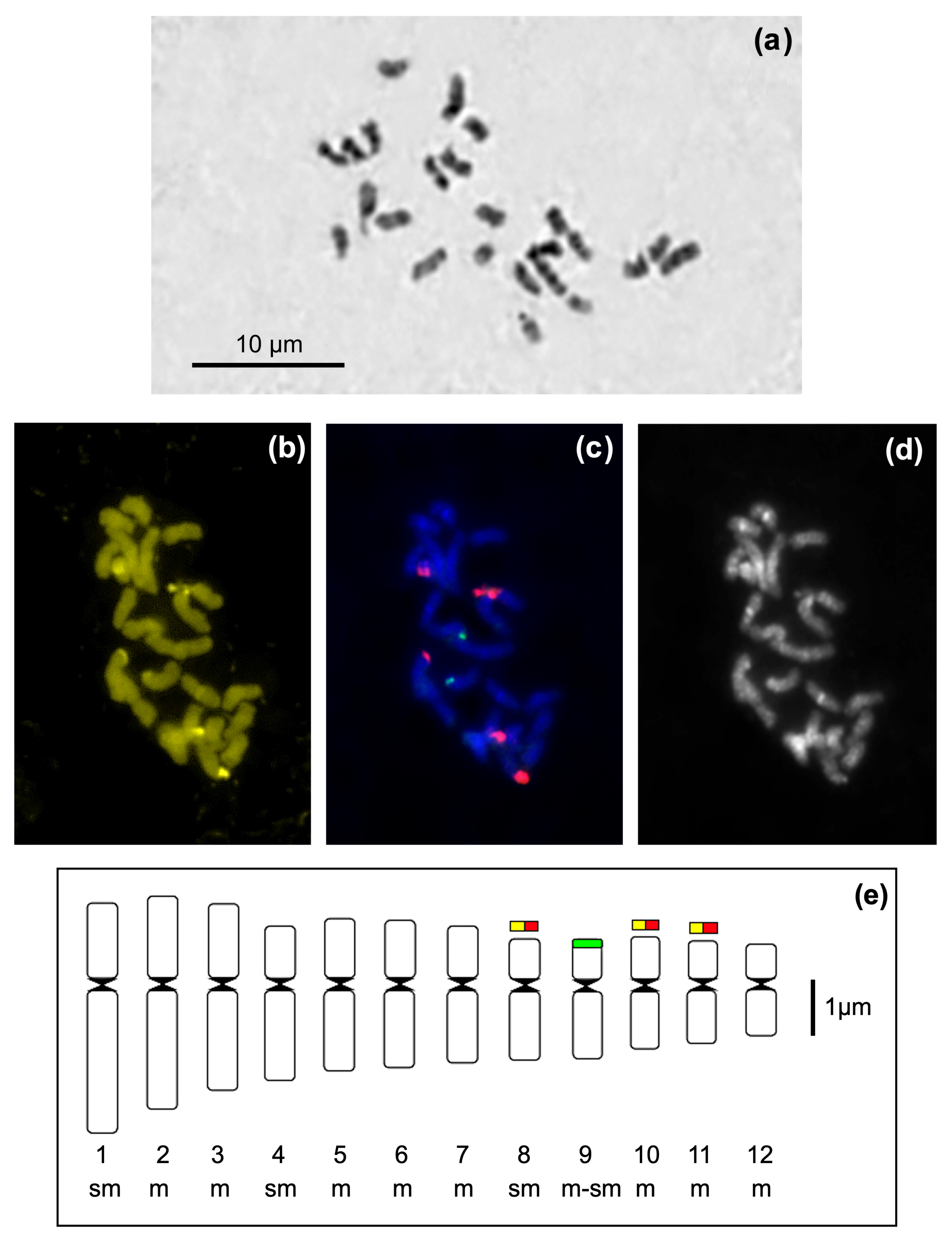
A uniform somatic chromosome number of 2n = 24 was recorded in all C. siliqua individuals examined, across all Algerian populations studied as well as the French (Côte d’Azur) and Lebanese (Hamat, Sin el Fil) populations for which root meristems were available (Table 1; Figure 1a). No variation in chromosome number was detected among populations, regardless of geographic origin or cultivation status.
Karyotype analysis was based on total chromosome length (TL), relative total length (RTL), arm ratio (r = long arm/short arm), centromeric index (CI), and asymmetry index (AsI). Twelve chromosome pairs were identified and assigned to three morphological classes: eight metacentric pairs, two of which bear satellites; one metacentric–submetacentric pair; and three submetacentric pairs, one of which bears satellites (Table 2, Figure 1e). Total chromosome length ranged from 1.40 to 3.79 µm, with the two largest pairs measuring 3.79 and 3.03 µm. The karyotype of C. siliqua is therefore of the bimodal type, with a discrete group of large chromosomes and ten smaller pairs ranging from 1.40 to 1.89 µm (Table 2). The asymmetry index (AsI = 60.09) and the ratio between the longest and shortest pairs (R = 2.71) indicate that the karyotype is relatively symmetric with respect to centromere position but asymmetric regarding chromosome size, following Stebbins (1971) [26] and Siljak-Yakovlev (1996) [27] respectively.

3.2. Heterochromatin Distribution and rDNA Loci Mapping

3.2.1. CMA3 Fluorochrome Banding

CMA3 staining revealed prominent GC-rich heterochromatin bands on three chromosome pairs (pairs 8, 10, and 11), all corresponding to the satellite-bearing chromosomes identified in the conventional karyotype (Figure 1b,e). The CMA3-positive signals were localised specifically to the satellite regions of these pairs. A small number of additional chromosomes displayed weak CMA3 bands at centromeric positions.

3.2.2. FISH Mapping of 35S and 5S rDNA Loci

FISH with a 35S (18S–5.8S–26S) rDNA probe detected six signals in total, one on each chromosome of the three satellite-bearing pairs (pairs 8, 10, and 11), all precisely co-localising with the CMA3-positive satellite regions identified by fluorochrome banding (Figure 1c,e). This co-localisation confirms the GC-rich nature of the ribosomal DNA arrays at these loci. Hybridisation with a 5S rDNA probe revealed a single locus, located at the telomeric region of chromosome pair 9, physically distinct from all 35S rDNA sites (Figure 1c,e).

3.2.3. DAPI Banding

DAPI staining performed after FISH revealed intensely stained bands in the centromeric regions of at least three chromosome pairs (Figure 1d). These DAPI-positive, AT-rich bands did not coincide with any CMA3-positive region, nor with the 35S or 5S rDNA signals, indicating the presence of a distinct class of AT-rich constitutive heterochromatin at centromeric positions that is compositionally and positionally independent of the ribosomal gene arrays.

3.3. Genome Size Estimation

Nuclear DNA content was estimated for 23 accessions of C. siliqua distributed across the Mediterranean basin, including populations from Algeria, Cyprus, France, Lebanon, and Spain. Genome size was remarkably conserved across the entire dataset. The mean 2C DNA value ranged from 1.10 to 1.23 pg across all accessions, with an overall mean of 1.14 ± 0.03 pg (Table 1). The monoploid genome size (1Cx value) was equal to a 1C DNA value.

3.3.1. Planted vs. Wild Populations

No significant difference in genome size was detected between planted and wild populations. Planted populations with available data (Bir El Djir, 1.11 pg; Saïda and Sin el Fil, 1.12 pg) fell entirely within the range recorded for wild populations (1.10–1.23 pg).

3.3.2. Altitudinal Gradient

Among the five Algerian populations sampled along an altitudinal gradient ranging from 162 to 950 m a.s.l., no significant variation in genome size was detected with increasing altitude (Table 1). Mean 2C DNA values were highly stable across the gradient: 1.111 ± 0.006 pg at Bir El Djir (162 m), 1.115 ± 0.004 pg at Misserghine (500 m), 1.116 ± 0.010 pg at Sidi Bel Abès (787 m), 1.120 ± 0.014 pg at Saïda (840 m), and 1.110 ± 0.012 pg at Tlemcen (950 m). Coefficients of variation remained below 1.28% across all five sites (Table S1), confirming the absence of genome size variation along the altitudinal gradient.

3.3.3. Sex Comparison

From the 11 Algerian populations sampled, 12 female and 8 male individuals were identified. Hermaphroditic flowers were observed in only one wild population (Misserghine, Oran), while all individuals in the remaining populations were strictly dioecious. Genome size did not differ significantly between sexes (Table 3). Mean 2C DNA values were 1.147 ± 0.014 pg in females (n = 12, range 1.127–1.181 pg, CV = 1.21%) and 1.154 ± 0.017 pg in males (n = 8, range 1.131–1.176 pg, CV = 1.50%). The near-identical genome sizes between male and female individuals provide no cytometric evidence for the existence of heteromorphic sex chromosomes of substantially different size in C. siliqua.

4. Discussion

4.1. Chromosome Number

A uniform diploid chromosome number of 2n = 24 was recorded across all populations examined, consistent with all previous reports for the species [11,12,13,14] and with the 12 pseudomolecules of the reference genome assembly [28]. The only exceptions in the literature are the triploid and tetraploid individuals reported by Bureš et al. (2004) [14] from Israel, which were not encountered in our sample, suggesting that polyploidy is rare and geographically restricted in this species.
The chromosome number of C. siliqua (2n = 24, x = 12) fits within the broader context of legume karyotype evolution. Stai et al. (2019) [29] conducted a comprehensive phylogenomic and chromosome count analysis across 477 legume genera and demonstrated that the ancestral legume progenitor likely had x = 7 chromosomes, as retained by Cercis, the earliest-diverging and apparently non-polyploid legume genus. All other legume subfamilies, including the Caesalpinioideae to which Ceratonia belongs, show evidence of independent whole-genome duplications (WGDs) from this ancestral base, with predominant counts of x = 12–14 in early-diverging Caesalpinioideae taxa [29,30]. The basic chromosome number of x = 12 in C. siliqua is fully congruent with a single ancient WGD from the ancestral x = 7 progenitor, followed by moderate chromosome fusion leading to descending dysploidy, a pattern documented across the Caesalpinioideae [29]. The bimodal karyotype we describe, with two large chromosome pairs markedly larger than the remaining ten, may reflect the retention of ancestral large chromosomes from the pre-duplication genome, a pattern consistent with the incomplete diploidisation that characterises several Caesalpinioideae genera [29,31].

4.2. Karyotype Morphology and Asymmetry

The karyotype of C. siliqua, with its clearly bimodal size distribution—two large pairs and ten smaller pairs—and its asymmetry index and chromosome size ratio, places C. siliqua in an intermediate asymmetry class: relatively symmetric with respect to centromere position but considerably asymmetric in chromosome size, following Stebbins (1971) [26] and Siljak-Yakovlev (1996) [27]. This bimodal karyotype is a recurrent feature in Caesalpinioideae and is interpreted as the cytological signature of an ancient WGD followed by differential size evolution between homeologous chromosome sets [31,32]. This interpretation is supported by the chromosome-scale genome assembly of Bibi et al. (2026) [28]: scaffold_1 (59.88 Mb) and scaffold_2 (61.40 Mb) are markedly larger than the remaining ten scaffolds (30.1–44.2 Mb), a size hierarchy that directly corresponds to the bimodal karyotype we describe cytologically. Comparative karyotyping with the sister species C. oreothauma (diverged ~6.4 Mya [5]) would be particularly informative for reconstructing chromosome evolution within Ceratonia.

4.3. Sexual System and Dioecy

Among the eleven populations examined, hermaphroditic flowers were observed in only one wild population (Misserghine, Oran), while all individuals in the remaining populations were strictly dioecious. This confirms the predominance of dioecy in C. siliqua and is consistent with observations by Konaté (2007) [33] in Moroccan populations and with the broader literature establishing dioecy as the ancestral and most widespread reproductive system in the genus [1]. The rarity of hermaphroditic individuals in wild populations contrasts with their occurrence and deliberate selection in cultivation: as only female and hermaphroditic trees bear fruit, traditional agronomic practice has favoured female clones selected for pod dimensions, pulp weight, and sugar content, with a minority of hermaphroditic cultivars valued for their self-sufficiency as pollen donors [8].
The question of whether sex determination in C. siliqua has a chromosomal basis remains unresolved. In many dioecious angiosperms, sex is controlled by heteromorphic sex chromosomes [34,35], but in others, including several Fabaceae, sex determination involves autosomal loci without visible chromosomal differentiation [36]. Our cytogenetic data reveal no morphologically differentiated chromosome pair in the conventional karyotype. Critically, the recently published chromosome-scale genome assembly of C. siliqua [28] spanning 501.39 Mb organised into 12 pseudomolecules, perfectly concordant with the 2n = 24 chromosome number confirmed in our study, does not report any evidence of heteromorphic sex chromosomes at the sequence level either. This genomic resource, generated from a female individual, evaluated the genome size at 501.39 Mb, consistent with the flow-cytometric 2C values obtained in our study (1.10–1.23 pg, equivalent to approximately 537–601 Mbp using the conversion factor of 1 pg = 978 Mb [37]), confirming the reliability of our cytometric estimates across independent methodological approaches. Together, cytometric and genomic evidence suggest that if sex-determining loci exist in C. siliqua, they are either cryptic at both the chromosomal and whole-genome level, or they reside in a small, homomorphic region not yet characterised. Comparative re-sequencing of male, female, and hermaphroditic individuals using the Bibi et al. (2026) [28] assembly as a reference would be the most direct route to identifying putative sex-determining regions.

4.4. Heterochromatin Distribution and rDNA Organisation

All three 35S rDNA loci co-localised precisely with CMA3-positive bands on the satellite chromosomes (pairs 8, 10, and 11), confirming the GC-rich nature of the ribosomal gene arrays. This co-localisation is widespread in plants and has been reported across diverse families including Asteraceae, Fabaceae, Orchidaceae, and Pinaceae [38,39]. While GC-rich heterochromatin can also co-localise with 5S rDNA loci in some taxa—as reported in Lupinus [38], among others—in C. siliqua CMA3 positivity was observed exclusively at the 35S rDNA sites.
The single 5S rDNA locus, located at the telomeric region of chromosome pair 9 and physically separated from all 35S sites, showed no CMA3 signal, consistent with the AT-rich flanking sequences typically associated with 5S rDNA arrays [40] and with the overall low GC content of the C. siliqua genome (33.33%) [28], which is among the lowest reported for Fabaceae. This spatial separation of the two rDNA families corresponds to the S-type arrangement defined by Garcia et al. (2012) [41], and both loci can now be anchored to specific scaffold positions in the Bibi et al. (2026) [28] chromosome-scale assembly, providing a molecular coordinate system for the cytogenetic landmarks identified here.
DAPI staining revealed AT-rich centromeric bands on at least three chromosome pairs, compositionally and positionally distinct from both rDNA arrays. In the context of the Bibi et al. (2026) [28] assembly, these bands likely correspond to pericentromeric accumulations of Gypsy and Copia Long Terminal Repeat retrotransposons, which represent the most abundant repetitive element class in the carob genome (27.09%) [28]. Gypsy elements in particular tend to accumulate in pericentromeric heterochromatin in plants [42], a pattern visible in the Circos plot of the C. siliqua genome where transposable element density is highest in regions of lowest gene density, precisely where our DAPI bands localise.

4.5. Genome Size

Genome size was highly conserved across our dataset (2C = 1.10–1.23 pg), with no significant variation attributable to geographic origin, altitude, cultivation status, or sex. These values are slightly lower than the 1.20–1.30 pg reported for Tunisian populations [15], a discrepancy likely reflecting methodological differences rather than genuine biological variation. The 2C range observed in our study corresponds to a haploid genome size of approximately 537–601 Mbp, which is somewhat larger than the 501.39 Mbp assembly of Bibi et al. (2026) [28]. This slight discrepancy is expected and well within the normal range of variation between flow-cytometric estimates and sequence-based assembly sizes, which routinely differ by 5–15% owing to unassembled heterochromatic and repetitive regions. Indeed, Bibi et al. (2026) [28] report that repetitive elements account for 52.23% of the assembled genome, dominated by Long Terminal Repeat retrotransposons of the Gypsy and Copia families (27.09% of the genome). This substantial transposable element content is consistent with the moderate genome size expansion observed in C. siliqua relative to the ancestral Cercis genome (~367 Mbp) [29].
The absence of genome size variation along the Algerian altitudinal gradient (162–950 m a.s.l.) is noteworthy. In some species, intraspecific genome size variation correlates with altitude, latitude, or climatic variables, potentially reflecting local adaptation through changes in transposable element content or heterochromatin [43,44]. The stability observed here suggests that such mechanisms are not operating in C. siliqua and may reflect a broader pattern of slow molecular evolution characteristic of long-lived outcrossing legume trees [29].
The absence of correlation between morphological variability in pods, seeds and genome size in Algerian populations further suggests that phenotypic variation in this species is driven primarily by edaphoclimatic factors rather than genomic changes, as reported for other Mediterranean species with similarly stable genomes [45,46].

5. Conclusions

This study presents the first comprehensive molecular cytogenetic characterisation of Ceratonia siliqua, combining conventional karyotyping, CMA3/DAPI fluorochrome banding, and dual-probe FISH mapping of 35S and 5S rDNA with genome size estimation across 23 Mediterranean accessions. A consistent diploid chromosome number of 2n = 24 was confirmed across all populations examined, with no variation in karyotype, heterochromatin distribution, or rDNA organisation detected among populations differing in geographic origin, altitude, cultivation status, or sex. Our results lead to the unambiguous identification of six out of twelve chromosome pairs and are fully concordant with the recently published chromosome-scale genome assembly [28], providing a physical anchor for genomic features onto individual chromosomes.
Genome size was equally stable, with no significant variation along the Algerian altitudinal gradient, between planted and wild populations, or between male and female individuals. These results collectively point to a remarkably stable genomic framework in C. siliqua across its Mediterranean range, consistent with the slow molecular evolutionary rate documented for long-lived legume trees [29] and reflecting the deep ecological adaptation of this species to its native environment.
The cytogenetic baseline established here, combined with the recently available reference genome [28], provides an essential framework for comparative cytogenetics within Ceratonia and Caesalpinioideae, for the development of molecular markers targeting sex determination and fruit quality, and for future breeding programmes. Sustained investment in the genetics and genomics of this species is both scientifically justified by its complex evolutionary history and urgently needed to fully unlock its bioeconomic potential as a climate-adapted crop for the Mediterranean region and beyond.

Supplementary Materials

The following supporting information can be downloaded at: https://www.mdpi.com/article/10.3390/f17070847/s1, Table S1: 2C DNA values for five C. siliqua populations along an altitudinal gradient (* planted and ** wild populations).

Author Contributions

Conceptualization, S.-Y.S.; Methodology, Z.Z., S.-Y.S., and B.D.-K.M.; Data Analyses, S.-Y.S., Z.Z., and B.D.-K.M.; Writing—Original Draft Preparation, S.-Y.S.; Writing—Review and Editing, S.-Y.S., Z.Z., and B.D.-K.M.; Supervision, S.-Y.S. All authors have read and agreed to the published version of the manuscript.

Funding

The analyses were supported by the CNRS (Paris Saclay, France) and Université Saint-Joseph, Beirut, Lebanon.

Data Availability Statement

The data supporting the findings of this study are available within the article and its accompanying Supplementary Materials.

Acknowledgments

Fieldwork sampling in Algeria was made possible through the invaluable assistance of Djabeur Abderrazak. Sampling in other countries was conducted within the framework of the DYNAMIC project, funded by the French National Agency of Research (ANR-14-CE02-0016). The authors also thank Mickael Bourge and Nicolas Valentin for their expert technical support in flow cytometry at the Institute of Integrative Biology of the Cell (I2BC), Plateforme de Cytométrie, CEA, CNRS, Université Paris-Saclay, 91198 Gif-sur-Yvette, France.

Conflicts of Interest

The authors declare no conflicts of interest.

References

  1. Zohary, D. Domestication of the Carob (Ceratonia siliqua L.). Isr. J. Plant Sci. 2002, 50, 141–145. [Google Scholar] [CrossRef]
  2. Mahdad, Y.M.; Gaouar, S.B.S. Origin, Distribution and Domestication of the Carob Tree (Ceratonia siliqua L.). Turk. J. Bot. 2023, 47, 89–96. [Google Scholar] [CrossRef]
  3. Lo Gullo, M.A.; Salleo, S. Different Strategies of Drought Resistance in Three Mediterranean Sclerophyllous Trees Growing in the Same Environmental Conditions. New Phytol. 1988, 108, 267–276. [Google Scholar] [CrossRef] [PubMed]
  4. Palamarev, E. Paleobotanical Evidence of the Tertiary History and Origin of the Mediterranean Sclerophyll Dendroflora. Plant Syst. Evol. 1989, 162, 93–107. [Google Scholar] [CrossRef]
  5. Viruel, J.; Le Galliot, N.; Pironon, S.; Nieto Feliner, G.; Suc, J.; Lakhal-Mirleau, F.; Juin, M.; Selva, M.; Bou Dagher Kharrat, M.; Ouahmane, L.; et al. A Strong East–West Mediterranean Divergence Supports a New Phylogeographic History of the Carob Tree (Ceratonia siliqua, Leguminosae) and Multiple Domestications from Native Populations. J. Biogeogr. 2020, 47, 460–471. [Google Scholar]
  6. Baumel, A.; Nieto Feliner, G.; Médail, F.; La Malfa, S.; Di Guardo, M.; Bou Dagher Kharrat, M.; Lakhal-Mirleau, F.; Frelon, V.; Ouahmane, L.; Diadema, K.; et al. Genome-Wide Footprints in the Carob Tree (Ceratonia siliqua) Unveil a New Domestication Pattern of a Fruit Tree in the Mediterranean. Mol. Ecol. 2022, 31, 4095–4111. [Google Scholar] [CrossRef] [PubMed]
  7. Biner, B.; Gubbuk, H.; Karhan, M.; Aksu, M.; Pekmezci, M. Sugar Profiles of the Pods of Cultivated and Wild Types of Carob Bean (Ceratonia siliqua L.) in Turkey. Food Chem. 2007, 100, 1453–1455. [Google Scholar] [CrossRef]
  8. Batlle, I.; Tous, J. Carob Tree: Ceratonia siliqua L. Promoting the Conservation and Use of Underutilized and Neglected Crops 17; International Plant Genetic Resources Institute: Rome, Italy, 1997; 92p. [Google Scholar]
  9. Brassesco, M.E.; Brandão, T.R.S.; Silva, C.L.M.; Pintado, M. Carob Bean (Ceratonia siliqua L.): A New Perspective for Functional Food. Trends Food Sci. Technol. 2021, 114, 310–322. [Google Scholar] [CrossRef]
  10. Correia, S.; Correia, P.J.; Romano, A.; Martins-Loução, M.A. Carob: A Mediterranean Resource for the Future. Plants 2024, 13, 1188. [Google Scholar] [CrossRef]
  11. Frahm-Leliveld, J.A. Observations Cytologiques sur Quelques Légumineuses Tropicales et Subtropicales. Rev. Cytol. Biol. Vég. 1957, 18, 273–287. [Google Scholar]
  12. Goldblatt, P. Chromosome Numbers in Legumes II. Ann. Mo. Bot. Gard. 1981, 68, 551–557. [Google Scholar] [CrossRef]
  13. Arista, M.; Talavera, S. Números Cromosómicos para la Flora Española 620–629. Lagascalia 1990, 16, 323–328. [Google Scholar]
  14. Bureš, P.; Pavlíček, T.; Horová, L.; Nevo, E. Microgeographic Genome Size Differentiation of the Carob Tree (Ceratonia siliqua) at ‘Evolution Canyon’, Israel. Ann. Bot. 2004, 93, 529–535. [Google Scholar] [CrossRef] [PubMed]
  15. El Ferchichi Ouarda, H.; Naghmouchi, S.; Walker, D.J.; Correal, E.; Boussaïd, M.; Larbi Khouja, M. Variability in the Pod and Seed Parameters and Nuclear DNA Content of Tunisian Populations of Ceratonia siliqua L. Agrofor. Syst. 2008, 74, 73–81. [Google Scholar] [CrossRef]
  16. Salman-Minkov, A.; Sabath, N.; Mayrose, I. Whole-Genome Duplication as a Key Factor in Crop Domestication. Nat. Plants 2016, 2, 16115. [Google Scholar] [CrossRef] [PubMed]
  17. Beaulieu, J.M.; Leitch, I.J.; Patel, S.; Pendharkar, A.; Knight, C.A. Genome Size Is a Strong Predictor of Cell Size and Stomatal Density in Angiosperms. New Phytol. 2008, 179, 975–986. [Google Scholar] [CrossRef] [PubMed]
  18. Côme, D. Les Obstacles à la Germination; Masson et Cie: Paris, France, 1970; 160p. [Google Scholar]
  19. Levan, A.; Fredga, K.; Sandberg, A.A. Nomenclature for Centromeric Position on Chromosomes. Hereditas 1964, 52, 201–220. [Google Scholar] [CrossRef]
  20. Schweizer, D. Reverse Fluorescent Chromosome Banding with Chromomycin and DAPI. Chromosoma 1976, 58, 307–324. [Google Scholar] [CrossRef] [PubMed]
  21. Siljak-Yakovlev, S.; Cerbah, M.; Coulaud, J.; Stoian, V.; Brown, S.C.; Jelenic, S.; Papes, D. Nuclear DNA Content, Base Composition, Heterochromatin and rDNA in Picea omorika and Picea abies. Theor. Appl. Genet. 2002, 104, 505–512. [Google Scholar] [CrossRef] [PubMed]
  22. Heslop-Harrison, J.S.; Schwarzacher, T.; Anamthawat-Jonsson, K.; Leitch, I.J. In Situ Hybridization with Automated Chromosome Denaturation. Tech. J. Methods Cell Mol. Biol. 1991, 3, 109–115. [Google Scholar]
  23. Marie, D.; Brown, S.C. A Cytometric Exercise in Plant DNA Histograms with 2C Values for 70 Species. Biol. Cell 1993, 78, 41–51. [Google Scholar] [CrossRef] [PubMed]
  24. Bourge, M.; Brown, S.C.; Siljak-Yakovlev, S. Flow Cytometry as Tool in Plant Sciences, with Emphasis on Genome Size and Ploidy Level Assessment. Genet. Appl. 2018, 2, 1–12. [Google Scholar] [CrossRef]
  25. Greilhuber, J.; Doležel, J.; Lysak, M.A.; Bennett, M.D. The Origin, Evolution and Proposed Stabilization of the Terms ‘Genome Size’ and ‘C-Value’ to Describe Nuclear DNA Contents. Ann. Bot. 2005, 95, 255–260. [Google Scholar] [CrossRef] [PubMed]
  26. Stebbins, G.L. Chromosomal Evolution in Higher Plants; Edward Arnold: London, UK, 1971; 216p. [Google Scholar]
  27. Siljak-Yakovlev, S. La dysploïdie et l’évolution du caryotype. Bocconea 1996, 5, 210–220. [Google Scholar]
  28. Bibi, A.C.; Ioannidis, P.; Spilianakis, C.; Vasilarou, M.; Bazakos, C.; Pavlidis, P.; Kalantidis, K. High-Quality Genome Assembly and Annotation of Ceratonia siliqua Provide Insights Into the Secondary Loss of Symbiotic Nitrogen Fixation. Physiol. Plant. 2026, 178, e70803. [Google Scholar] [CrossRef] [PubMed]
  29. Stai, J.S.; Yadav, A.; Sinou, C.; Bruneau, A.; Doyle, J.J.; Fernández-Baca, D.; Cannon, S.B. Cercis: A Non-Polyploid Genomic Relic Within the Generally Polyploid Legume Family. Front. Plant Sci. 2019, 10, 345. [Google Scholar] [CrossRef] [PubMed]
  30. Cannon, S.B.; McKain, M.R.; Harkess, A.; Nelson, M.N.; Dash, S.; Deyholos, M.K.; Peng, Y.; Joyce, B.; Stewart, C.N., Jr.; Rolf, M.; et al. Multiple Polyploidy Events in the Early Radiation of Nodulating and Nonnodulating Legumes. Mol. Biol. Evol. 2015, 32, 193–210. [Google Scholar] [PubMed]
  31. Schubert, I.; Lysak, M.A. Interpretation of Karyotype Evolution Should Consider Chromosome Structural Constraints. Trends Genet. 2011, 27, 207–216. [Google Scholar] [CrossRef] [PubMed]
  32. Marques, A.; Banaei-Moghaddam, A.M.; Klemme, S.; Blattner, F.R.; Niwa, K.; Guerra, M.; Houben, A. Normal and Pathological Holocentric Chromosomes Generate Segments of Distinct Identity on the Mitotic Spindle. Proc. Natl. Acad. Sci. USA 2016, 113, 4958–4963. [Google Scholar]
  33. Konaté, I. Diversité Phénotypique et Moléculaire du Caroubier (Ceratonia siliqua L.) et des Bactéries Endophytes qui lui sont Associées. Ph.D. Thesis, Université Mohammed V, Agdal, Morocco, 2007; 196p. [Google Scholar]
  34. Charlesworth, D. Plant Sex Chromosomes. Annu. Rev. Plant Biol. 2016, 67, 397–420. [Google Scholar] [CrossRef] [PubMed]
  35. Renner, S.S. The Relative and Absolute Frequencies of Angiosperm Sexual Systems: Dioecy, Monoecy, Gynodioecy, and an Updated Online Database. Am. J. Bot. 2014, 101, 1588–1596. [Google Scholar] [CrossRef] [PubMed]
  36. Ming, R.; Bendahmane, A.; Renner, S.S. Sex Chromosomes in Land Plants. Annu. Rev. Plant Biol. 2011, 62, 485–514. [Google Scholar] [CrossRef] [PubMed]
  37. Doležel, J.; Bartoš, J.; Voglmayr, H.; Greilhuber, J. Nuclear DNA Content and Genome Size of Trout and Human. Cytometry A 2003, 51, 127–128. [Google Scholar] [PubMed]
  38. Hajdera, I.; Siwinska, D.; Hasterok, R.; Maluszynska, J. Molecular cytogenetic analysis of genome structure in Lupinus angustifolius and Lupinus cosentinii. Theor. Appl. Genet. 2003, 107, 988–996. [Google Scholar] [CrossRef] [PubMed]
  39. Cabral, J.S.; Felix, L.P.; Guerra, M. Heterochromatin diversity and its co-localization with 5S and 45S rDNA sites in chromosomes of four Maxillaria species (Orchidaceae). Genet. Mol. Biol. 2006, 29, 659–664. [Google Scholar] [CrossRef]
  40. Leitch, I.J.; Leitch, A.R. Genome Size Diversity and Evolution in Land Plants. In Plant Genome Diversity; Greilhuber, J., Dolezel, J., Wendel, J., Eds.; Springer: Vienna, Austria, 2013; Volume 2, pp. 307–322. [Google Scholar]
  41. Garcia, S.; Crhák, K.L.; Kovařík, A. Expression of 5S rRNA Genes Linked to 35S rDNA in Plants, Their Epigenetic Modification and Regulatory Element Divergence. BMC Plant Biol. 2012, 12, 95. [Google Scholar] [CrossRef] [PubMed]
  42. Heslop-Harrison, J.S.; Schwarzacher, T. Organisation of the Plant Genome in Chromosomes. Plant J. 2011, 66, 18–33. [Google Scholar] [CrossRef] [PubMed]
  43. Knight, C.A.; Molinari, N.A.; Petrov, D.A. The Large Genome Constraint Hypothesis: Evolution, Ecology and Phenotype. Ann. Bot. 2005, 95, 177–190. [Google Scholar] [CrossRef] [PubMed]
  44. Šmarda, P.; Bureš, P. Understanding Intraspecific Variation in Genome Size in Plants. Preslia 2012, 84, 451–468. [Google Scholar]
  45. Price, H.J.; Chambers, K.L.; Bachman, K.; Riggs, J. Patterns of Mean Nuclear DNA Content in Microseris douglasii (Asteraceae). Bot. Gaz. 1986, 147, 496–507. [Google Scholar] [CrossRef]
  46. Turpeinen, T.; Kulmala, J.; Nevo, E. Genome Size Variation in Hordeum spontaneum Populations. Genome 1999, 42, 1094–1099. [Google Scholar] [CrossRef] [PubMed]
Figure 1. (a) Orcein-stained metaphase chromosome plate of Ceratonia siliqua, 2n = 24, (b) Chromomycin A3 (CMA3) staining showing six signals of GC-rich heterochromatin on three satellite chromosome pairs, (c) FISH experiment on the same metaphase plate showing six 35S rDNA signals (red) and two 5S rDNA signals (green), (d) DAPI staining after FISH showing AT-rich centromeric heterochromatin (bright signals), (e) Idiogram of Ceratonia siliqua showing 12 chromosome pairs of which three are with 35S rDNA loci (red) colocalized with CMA+ bands (yellow) and one pair with 5S rDNA locus (green). Scale bar = 10 µm.
Forests 17 00847 g001
Table 1. Geographical and altitudinal data for the localities where C. siliqua samples were collected, and chromosome number (2n) and 2C DNA-values for populations studied. (* planted and ** wild populations; SD = standard deviation; N = number of individuals).
Population NameCountryGPS LocationsAltitude
m a.s.l.
2n2C DNA
in pg
SDN
Béjaïa **Algeria36°45′21″ N
5°05′03″ E
10624---
Bir El Djir-Oran *Algeria35°41′27″ N
0°38′30″ W
162241.110.015
Boumerdès **Algeria36°46′0″ N
3°28′38″ E
7124---
Mascara **Algeria35°23′47″ N
0°08′24″ E
59024---
Misserghine-Oran **Algeria35°36′42″ N
0°44′27″ W
500241.120.005
Tafraoui-Oran *Algeria35°28′59″ N
0°31′38″ W
17124---
Saïda *Algeria34°49′49″ N
0°09′06″ E
840241.120.015
Sidi Bel Abès **Algeria35°11′23″ N
0°37′51″ W
787241.120.015
Sig *Algeria35°31′60″ N
0°10′60″ W
10724---
Tizi Ouzou **Algeria36°42′42″ N
4°02′45″ E
22924---
Tlemcen **Algeria34°52′41″ N
1°18′53″ W
950241.110.015
Paphos **Cyprus34°47′29″ N
32°27′8″ E
164-1.200.037
Cote d’Azur **France43°15′7″ N
6°35′31″ E
60241.150.012
Toulon **France43°9′12″ N
5°55′36″ E
308-1.170.0312
Amchit **Lebanon34°8′48″ N
35°38′4″ E
74-1.130.024
Aramoune **Lebanon33°45′38″ N
35°31′21″ E
450-1.140.034
Baskinta **Lebanon33°56′14″ N
35°47′18″ E
1041-1.200.024
Bentael **Lebanon34°8′44″ N
35°41′44″ E
496-1.130.015
Byblos **Lebanon34°7′9″ N
35°39′48″ E
150-1.140.005
Ebl el Saki **Lebanon33°21′14″ N
35°37′24″ E
647-1.100.014
Edde **Lebanon34°8′42″ N
35°39′58″ E
242-1.140.035
Hamat **Lebanon34°18′2″ N
35°41′24″ E
172241.140.013
Jabal Moussa **Lebanon34°3′23″ N
35°44′32″ E
780-1.140.015
Kaytoul **Lebanon33°32′8″ N
35°32′35″ E
754-1.130.002
Mansourieh **Lebanon33°51′38″ N
35°34′11″ E
215-1.150.068
Nabay **Lebanon33°53′47″ N
35°39′5″ E
409-1.130.0211
Nahr Ibrahim **Lebanon34°4′3″ N
35°38′53″ E
66-1.130.0310
Sin el Fil *Lebanon33°52′34″ N
35°32′5″ E
67241.120.028
Cabre **Spain37°28′24″ N
4°26′34″ W
450-1.230.035
Table 2. Morphometric data of C. siliqua karyotype.
Chrom.
Pair
SA in µm
(SD)
LA in µm
(SD)
TL in µm
(SD)
CI r RTL Chrom.
Type
1 1.314 ± 0.3702.484 ± 0.281 3.798 ± 0.277 34.59 1.890 13.458 sm
21.428 ± 0.4642.084 ± 0.125 3.512 ± 0.459 40.66 1.459 12.445 m
31.288 ± 0.4281.742 ± 0.212 3.03 ± 0.435 42.50 1.352 10.737 m
40.912 ± 0.2941.57 ± 0.14 2.482 ± 0.407 36.74 1.721 8.795 sm
51.028 ± 0.1531.398 ± 0.255 2.426 ± 0.245 42.37 1.359 8.596 m
61.0 ± 0.1971.34 ± 0.239 2.34 ± 0.310 42.73 1.340 8.291 m
70.9 ± 0.1381.254 ± 0.254 2.154 ± 0.269 41.78 1.393 7.632 m
80.698 ± 0.1911.198 ± 0.129 1.896 ± 0.187 36.81 1.716 6.718 sm Sat
90.698 ± 0.1281.17 ± 0.157 1.868 ± 0.204 37.36 1.676 6.619 m-sm
100.744 ± 0.1581 ± 0.130 1.744 ± 0.148 42.66 1.344 6.180 m Sat
110.656 ± 0.1290.916 ± 0.125 1.572 ± 0.142 41.73 1.396 5.570 m Sat
120.598 ± 0.0620.802 ± 0.129 1.40 ± 0.157 42.71 1.341 4.961 m
SA = Short arm; LA = Long arm; TL = Total length; SD = Standard deviation; r = report LA/SA; RTL = Relative total longueur; m = metacentric; sm = sub-metacentric; Sat: satellite.
Table 3. Mean, minimum and maximum 2C DNA values in pg and 1C DNA in Mbp for 12 female and 8 male individuals. CV = coefficient of variation; N = number of individuals.
Sexe2C DNA
in pg (sd)
2C DNA
(Min–Max)
1C DNA
(Mbp)
CV %N
Female 1.147 ± 0.0141.127–1.181560.941.21112
Male1.154 ± 0.0171.131–1.176564.421.4998
Disclaimer/Publisher’s Note: The statements, opinions and data contained in all publications are solely those of the individual author(s) and contributor(s) and not of MDPI and/or the editor(s). MDPI and/or the editor(s) disclaim responsibility for any injury to people or property resulting from any ideas, methods, instructions or products referred to in the content.