Article

The Fate of a Wild White Fringetree (Chionanthus virginicus) Population in Ohio 10 Years After Invasion by Emerald Ash Borer (Agrilus planipennis)


1
Department of Biological Sciences, Wright State University, Dayton, OH 45435, USA
2
Department of Biology, Wilmington College, Wilmington, OH 45177, USA
*
Author to whom correspondence should be addressed.
Forests 2026, 17(6), 712; https://doi.org/10.3390/f17060712
Submission received: 16 February 2026 / Revised: 11 June 2026 / Accepted: 15 June 2026 / Published: 18 June 2026
(This article belongs to the Section Forest Biodiversity)

Abstract

Emerald ash borer (EAB) is an invasive Asian wood borer that has killed hundreds of millions of ash trees across North America. White fringetree is a secondary host of EAB in North America that is generally more resistant and resilient than ash. Past studies have mostly focused on ornamentally planted and managed trees over short time scales; the long-term fate of this species in the wild is uncertain. We revisited an unmanaged wild population of white fringetree in Ohio ten years after it was first studied, measuring tree size and health, evidence of EAB attack, and woodpecker activity. We hypothesized that EAB attack would have greater negative effects on this population than previously observed in managed populations. In 2024, 68% of trees showed signs of previous attack by EAB with declining health and 15% had evidence of current-year attack. Thirty percent of trees in the study had died. White fringetrees in managed populations have generally fared well in the aftermath of EAB, but trees in this wild population showed substantial attack and damage, some continuing to host EAB for several years. Wild white fringetrees may meet the same fate as ash trees in the face of EAB, but over longer time scales.

1. Introduction

The long-term outcome of the interaction of native trees with invasive pests relies on several factors. The degree of resistance to the pest expressed by trees is an important factor in predicting tree resilience. In cases where little host resistance has been observed, such as in the interaction of American chestnut, Castanea dentata (Marshall) Borkh, with chestnut blight, Cryphonectria parasitica (Murr.) Barr, devastating consequences for the long-term survival of host species can be expected [1]. In cases where at least moderate resistance has been observed, such as in the interaction of hardwood trees and spotted lanternfly, Lycorma delicatula (White), invasive pests are likely to have fewer immediate impacts, but chronic long-term impacts may be expected [2].
Emerald ash borer (EAB, Agrilus planipennis Fairmaire, Bupresitidae) is an Asian woodboring insect that specializes in ash trees (Fraxinus spp., Oleaceae). Its larvae feed on phloem and outer xylem tissues and can girdle and kill trees. In its native range in northeastern Asia, EAB uses species including Manchurian ash (Fraxinus mandshurica Rupr.) and Chinese ash (Fraxinus chinensis Roxb.) as hosts, where it is mostly a secondary pest of stressed trees [3]. There, widespread mortality of its primary hosts is rare, but outbreaks have occurred after more susceptible North American ash species were introduced. After its discovery in Michigan in the U.S. in 2002, EAB has devastated ash populations across North America, including important hardwood and landscape species like white (F. americana L.), green (F. pennsylvanica Marshall) and black ash (F. nigra Marshall) [4]. All North American ash species that have been studied are susceptible to EAB [3,5], but blue ash (F. quadrangulata Michx.) is surviving at higher rates than other species in EAB-aftermath forests [4,6]. Emerald ash borer was found in Oregon in the U.S. in 2022, where it attacks native Oregon ash (F. latifolia Benth.) [6], which is highly susceptible, along with other planted ash trees not native to the region.
Cipollini [7] discovered attack by EAB on white fringetree (Chionanthus virginicus L., Oleaceae) in the field in Ohio in 2014, which was the first documented case of this specialist beetle using a non-ash host. White fringetree is a small multi-stemmed tree native to the southeastern U.S. that is planted ornamentally in the eastern U.S. The native range of white fringetree extends slightly into southern Ohio with a disjunct record from northeast Ohio [8]. After the initial observations, attack on this species has been observed across much of the invasive range of EAB in the eastern U.S., although studies and observations have found it to be less susceptible and more tolerant to EAB than most North American ash species, e.g., [9,10,11]. Emerald ash borer larvae grow more slowly on white fringetree than on native ash species, like white, blue, green, and Oregon ash [12,13], and can have a later emergence time from white fringetree [11]. Tolerance is also due, in part, to its multi-stemmed habit and tendency to resprout vigorously from the tree base upon injury to major stems. Infestation rates of individual trees can be highly variable among and within locations, but infested trees have been found across the eastern U.S. in both managed and natural landscapes. Factors such as tree size (e.g., larger) and tree canopy health (e.g., poorer) were associated with EAB attack on this tree [14]. Adult EAB can reach sexual maturity feeding onwhite fringetree leaves [15]. Observations of attack dynamics in managed plantings have revealed that white fringetrees become infested at nearly the same time as neighboring ashes [16], suggesting that they are readily identifiable by adults as a host [14,17]. While significant attack and impacts can be observed, white fringetrees planted at low densities show decreasing infestation rates and increasing health once beetle populations decline due to the loss of neighboring ash hosts [18]. The fact that they can host EAB yet tend to survive at higher rates than most ash species suggests that white fringetree may serve as a refugium for EAB in the event of the loss of susceptible ash species in an area. A novel host species may also have implications for the efficacy of wasps introduced for biocontrol if the novel host serves as a refugium for EAB where biocontrol agents cannot detect it. EAB larvae grown in cut white fringetree stems in the laboratory show lower parasitism rates by Tetrastichus planipennisi Yang than EAB growing in ash species [12,19]. However, eggs are parasitized by Oobius agrili Zhang and Huang [20] and larvae by Spathius agrili Yang and Spathius galinae Belokobylskij and Strazanac [13] at the same rates on white fringetree stems as on ash stems.
Most of our information about attack rates and impacts of EAB on white fringetree has come from plantings of ornamental trees in managed landscapes [7,9,15,17,18]. Trees in such situations are often growing at low density in mowed lawns or mulched beds with an open canopy and are exposed to active management (e.g., pruning of infested or stressed stems, fertilization, possible pesticide use). These growing conditions may assist white fringetree in resisting and tolerating EAB attack. Trees in wild populations are often growing at higher density with competition from overstory and neighboring trees and in otherwise suboptimal resource conditions with no active management. As is the case for ash trees, once white fringetrees start to get attacked, bark wounding enhances EAB success and predisposes trees to further attack [21,22]. As a result of growing in suboptimal and often stressful conditions, higher attack rates by EAB and more severe impacts might be predicted in wild populations. In addition to a lack of studies of wild populations, most of our information about the interactions of these species has also come from retrospective observations after EAB had long contacted white fringetree, e.g., [15]. Thus, predictors of attack, attack dynamics, and outcomes were difficult to assess given the lack of knowledge of tree condition prior to the appearance of EAB in an area.
In 2015, a five-year annual monitoring study of two wild populations of white fringetree in Ohio was established at the very onset of the appearance of EAB in the populations [23] and is the only study to date of the interaction of EAB with wild populations of white fringetree. In one of the populations studied at Vinton Furnace State Experimental Forest, white fringetrees began to be attacked shortly after nearby ash trees were attacked. Thirty percent of the white fringetrees in the study were attacked at some point over the five-year period, and attacked trees showed signs of stress with no mortality. All of the mature white ash trees monitored in the study were killed by EAB during the course of the five-year study, but smaller white ash trees more comparable in size to the white fringetrees in the study had comparable attack rates and impacts of EAB.
We revisited this population in 2024 to measure the survival, size, infestation status, and health of white fringetrees in this population, five years after it was last examined, to assess the long-term dynamics between EAB and white fringetree in a wild population. We predicted that white fringetrees would experience generally higher attack rates and impacts of EAB in this wild population relative to those observed in managed landscapes. In particular, we predicted higher attack rates of trees, overall health declines, and higher mortality than those last observed in this population in 2019. We predicted an increasing probability of mortality with increasing tree size and greater health impacts in more heavily attacked trees.

2. Materials and Methods

2.1. Study Site

In Ohio, white fringetree is found growing wild in only a few southern counties where it exists in small populations or as widely scattered individuals and is classified as “Potentially Threatened” at the state level [24]. This study was conducted in a population of white fringetrees consisting of approximately 100 trees occupying 0.5 acre of forest understory growing in Vinton Furnace State Experimental Forest in Vinton County, Ohio (39.203667, −82.391782). Because of the rarity of this tree in Ohio, this population is likely one of the largest wild populations of this species in the state. Major tree species growing in the vicinity of this population include northern red oak (Quercus rubra L.), white oak (Quercus alba L.), shagbark hickory (Carya ovata (Mill.) K. Koch) and red maple (Acer rubrum L.). Mature white ash was common in this forest prior to the appearance of EAB in the area. The full history of the white fringetree population at this location is unknown, but it was first noted in floral surveys of this forest in 1958 [25].

2.2. Methodology

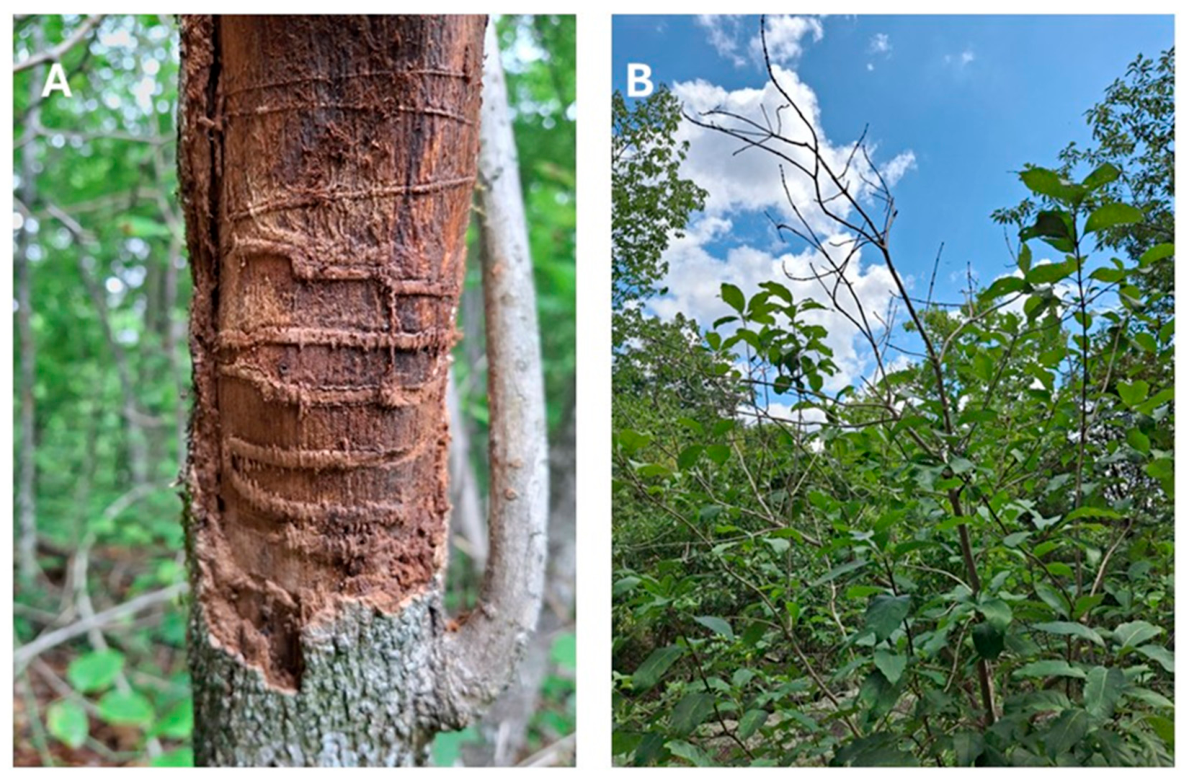
Initial establishment of this study occurred in September 2015, when 33 white fringetrees, nine mature white ash trees, and five young white ash trees were identified, marked, and assessed [23]. The other wild population in the original study was on private property and became inaccessible in the intervening time. All white fringetrees and young ash trees in the current study met a criterion of 2.5 cm in basal diameter when first marked in 2015 and all displayed good canopy health. At that time, no trees of either species displayed any outward signs and symptoms of attack by EAB, but some of the mature ash trees showed signs, including adult exit holes, by the following year. Thus, EAB had to be present as larvae in some trees in 2015 but had not impacted trees to a visible extent. The population was then assessed annually for five years until 2019 and the results were reported in [23]. In the current study, we revisited this population on 13 July 2024 and examined all trees that were originally marked in the study [23]. All nine mature ash trees died during the course of the original five-year study. From each white fringetree and young ash tree that was located in 2024, we first determined whether the tree was dead or alive and then measured the basal diameter of the largest stem (10 cm from the ground) to the nearest 0.1 cm using a tree diameter tape (Stevens Wyteface, Kueffel and Esser Co., Ltd., New York, NY, USA). We then examined trees for the presence of current (made in the current year, Figure 1A) and old (produced during 2023 or earlier, Figure 1B) EAB galleries via minor debarking of suspected attack sites with a wood chisel, as described in Peterson and Cipollini [23]. We also examined trees for the presence or absence of EAB adult exit holes (Figure 1C) and recent woodpecker activity (Figure 1D). Woodpeckers forage readily on EAB larvae, and signs of woodpecker foraging on the trees are a good indicator of their presence [26] Finally, we assessed tree canopy health as a function of fullness of the canopy on a standard scale of 1–5, with 1 = 0%–12% dieback; 2 = 13%–37% dieback; 3 = 38%–62% dieback; 4 = 63%–87% dieback; and 5 = 88%–100% dieback [4]. If a tree was dead, we assigned it a canopy health rank of 5 and assessed it for old galleries, but did not assess it for current EAB galleries, as larvae cannot survive and feed in dead trees. Two white fringetrees could not be relocated, so they were excluded from analysis.

2.3. Statistical Analyses

We compared frequencies of each categorical variable observed in 2024 between trees that died and those that were alive using Chi-square analysis [27]. We calculated the change in canopy health rank between 2019 and 2024 for each tree and compared the frequencies of trees displaying each observed change in rank between those that died and those that were alive in 2024 using Chi-square analysis. Finally, we examined whether basal stem diameter predicted whether trees were alive or dead in 2024 using logistic regression [27]. Basal stem diameter was log-transformed to improve normality. Alpha-levels for all tests were set at 0.05. Statistical analyses were performed using JASP (JASP Team 2022, Version 0.16.2, Amsterdam, The Netherlands). Only four young ash trees were measured in the study and the data derived from them were used only for illustrative purposes.

3. Results

Of the 33 white fringetrees marked in 2015, two could not be relocated in 2024 due to loss of tags. Of the remaining 31 trees, 9 were dead in 2024 (29%) and 22 were alive (71%). All nine dead trees showed declines in canopy health between 2019 and 2024, while 12 of the 22 trees (55%) that were alive in 2024 stayed the same or improved slightly over this period and 10 declined (45%) (Table 1A, Χ25,25 = 23.3, p < 0.001). In 2024, live trees displayed significant variation in frequency of canopy health ranks, while all dead trees had a canopy rank of 5, as defined in the methods (Table 1B, Χ24,26 = 31.0, p < 0.001). A significantly higher frequency of dead trees displayed evidence of old infestation (Table 1C, Χ21,29 = 6.04, p = 0.014), exit holes (Table 1D, Χ21,29 = 13.5, p < 0.001), and woodpecker activity (Table 1E, Χ21,29 = 5.45, p = 0.020) than trees that were alive in 2024. Five of the 22 trees alive in 2024 (23%) had evidence of current infestation. The white fringetrees monitored in this study were all relatively small (mean 4.4 ± 1.5 cm in basal diameter, range 2.6–9.0 cm), and logistic regression revealed no relationship between tree basal diameter and the likelihood of being alive in 2024 (Χ21,29 = 0.384, p = 0.535).
The four young white ash trees monitored in the study were alive in 2024. They had an average canopy score of 2.3 and all showed signs of old EAB attack. Two of the four showed exit holes and evidence of current attack.

4. Discussion

Through the invasion wave of EAB in the eastern and midwestern U.S., attack by EAB on white fringetrees has generally shown a similar dynamic as that on ash trees [4,16,18,21,23]. Because white fringetrees are less likely to be attacked and more resilient in the face of EAB attack, however, they appeared to avoid or withstand attack and recover better than ash trees after the wave of peak beetle densities passes with the loss of large ash tree hosts, especially in low-density managed landscapes [15]. Here, we show that white fringetrees in a wild unmanaged population continued to be attacked by EAB throughout a ten-year period and suffered higher attack rates and more significant impacts than those previously observed in managed populations.
A large majority of the white fringetrees had been attacked by EAB at some point across the course of this study and 30% of them died because of it. Mortality has been observed rarely in managed landscapes, but it can happen, and sometimes attacked trees are heavily pruned or removed while still alive due to aesthetics [28]. Trees that died had a higher incidence of old EAB galleries, adult exit holes, and woodpecker activity, suggesting that extensive damage by EAB is required to kill white fringetrees. No relationship between stem diameters and mortality due to EAB attack was found. However, the white fringetrees were all relatively small in diameter and likely did not vary enough in size to matter to EAB. In managed landscapes, where a much greater range in sizes and some large trees with stem diameters over 50 cm can be observed, larger trees tended to have higher attack rates than smaller trees. About 25% of the living trees still had current attack and most trees had declined in canopy health in the last five years, even those that were not yet heavily impacted by EAB. This indicates that trees large enough to be attacked will continue to decline in health and be reduced in number unless attack by EAB ceases. The density of EAB in the area is presumably significantly lower than it was 7–8 years ago, owing to the loss of large ash trees [4], but it is not clear if EAB will disappear from the local area. The competitive conditions of a forest understory may make health recovery, like that observed in managed populations [18], more difficult even if EAB densities decline to a low level. On the other hand, there were several white fringetrees in this population in good health that showed no evidence of ever being attacked. This kind of variation in attraction or resistance to EAB in white fringetree has also been seen in managed landscapes, where unattacked trees can sometimes be located right next to heavily attacked and impacted trees [14,18]. While the source of this variation is currently unclear, individual trees that remain unattractive to adults and/or continue to resist larvae may help sustain the white fringetree population.
While the population of white fringetrees studied here has continued to host EAB throughout the entire study, not many adult beetles are produced in this small population of relatively small trees. Young trees too small to have been included in the study are present in the population that will grow into vulnerable sizes that may help sustain the EAB population. There are also young ash trees roughly comparable in size to the white fringetrees in the study growing in the vicinity of the population. Those monitored in this study all had signs of attack at some point. One of the five originally marked in 2015 was dead and two others had evidence of current-year attack. Presumably, these and other young ash trees in the area will continue to host EAB and will likely be killed once they grow to sizes where they host a significant number of beetles, given observations from across the invasive range of EAB [4]. At that point, the white fringetrees nearby may experience another wave of attack as beetle densities rise.
Findings from our study of a single wild white fringetree population are meaningful, but should be interpreted with caution until further research is done. However, this population has been assessed six times over a ten-year period, from just before EAB had contacted the trees through ten years later. This kind of study, albeit small, is extremely important to understand the long-term impacts of EAB on white fringetree and includes data that is as yet lacking on this system. Long-term studies of ten or more years are invaluable in ecological studies [29]. Additionally, sharing observational data is important in advancing science with long-term impacts [30] such as invasion ecology.
Larger populations deeper in the native range of white fringetree may experience different dynamics, with impacts that vary from our observations. However, observations of white fringetrees in other natural landscapes, including in the Chattahoochee National Forest in Georgia (Figure 2A) and at Great Falls Park in Virginia (Figure 2B) have generally supported the notion that wild white fringetrees in natural landscapes will suffer higher attack rates and be more severely impacted by EAB than trees in managed landscapes [28], in concordance with our results here. In addition, white fringetrees that get infested by EAB, but survive, could serve as reservoirs for EAB as susceptible ash trees decline in number. Even though trees in managed landscapes have fared relatively well in the aftermath of EAB, some trees in managed landscapes continue to be attacked and sometimes killed even long after EAB densities have peaked in an area [28], but active management including pruning of infested stems and pesticide treatment can help such trees to persist. Many trees in managed landscapes that were not found to be attacked in previous surveys have also remained that way.
While white fringetree, which is classified as threatened in several U.S. states along the edge of its range (e.g., 22), is under increased threat due to EAB, the fate of a close relative, pygmy fringetree, Chionanthus pygmaeus Small, may be of even greater concern. This species is found in only a few counties in the sandhills of central Florida and is classified as state and federally endangered [31,32]. Its range overlaps with that of white fringetree in Florida, and it is thought that the two species can hybridize. Emerald ash borer has not yet been detected in Florida, but it is present in ~50 counties in the northern half of Georgia [33]. We have shown pygmy fringetree to be similar to white fringetree in susceptibility to EAB in laboratory tests with cut stems [34], so if EAB attacks it in nature it may be threatened with extinction. It is smaller than white fringetree, so its size may help it escape attack, but it can reach adult sizes comparable to that of white fringetree in some cases [31], at which point it would become increasingly vulnerable.

5. Conclusions

Despite early indications from managed landscapes, white fringetrees in wild populations can suffer significant attack and impacts of EAB infestation, including mortality. These impacts may take longer to appear than for susceptible ash tree populations, and may not be as extensive, but they are concerning for long-term population dynamics, especially for small populations at the edge of their native range. More research is needed in wild populations of white fringetree deeper in the native range of this species. There, studies on larger populations of white fringetrees exhibiting a greater range of sizes may better represent the long-term impact of EAB on white fringetree.

Author Contributions

Conceptualization, D.C.; methodology, D.C.; software, D.C.; formal analysis, D.C.; investigation, D.C.; resources, D.C.; data curation, D.C.; writing—original draft preparation, D.C.; writing—review and editing, D.C. and K.C.; visualization, D.C. and K.C.; project administration, D.C. All authors have read and agreed to the published version of the manuscript.

Funding

This research received no external funding.

Data Availability Statement

Data supporting the conclusions of this article will be made available by the authors on request.

Conflicts of Interest

The authors declare no conflicts of interest.

Abbreviations

The following abbreviations are used in this manuscript:
EABEmerald Ash Borer
U.S.United States

References

  1. Paillet, F.L. Chestnut: History and ecology of a transformed species. J. Biogeogr. 2002, 29, 1517–1530. [Google Scholar] [CrossRef]
  2. Hoover, K.; Iavorivska, L.; Lavely, E.K.; Uyi, O.; Walsh, B.; Swackhamer, E.; Johnson, A.; Eissenstat, D.M. Effects of long-term feeding by spotted lanternfly (Hemiptera: Fulgoridae) on ecophysiology of common hardwood host trees. Environ. Entomol. 2023, 52, 888–899. [Google Scholar] [CrossRef]
  3. Herms, D.A.; McCullough, D.G. Emerald ash borer invasion of North America: History, biology, ecology, impacts, and management. Annu. Rev. Entomol. 2014, 59, 13–30. [Google Scholar] [CrossRef]
  4. Knight, K.S.; Flower, C.E.; Kilgore, J.S.; Royo, A.A.; Fox, T.D.; Kappler, R.H.; Hoven, B.M.; Wigal, J.S.; Bernard, J.D.; Long, R.P. Ash tree decline and mortality in Ohio and the Allegheny National Forest in Pennsylvania. In Forest Health Monitoring: National Status, Trends, and Analysis; Potter, K.M., Conkling, B.L., Eds.; U.S. Department of Agriculture, Forest Service, Southern Research Station: Asheville, NC, USA, 2022; pp. 139–147. [Google Scholar] [CrossRef]
  5. Anulewicz, A.C.; McCullough, D.G.; Cappaert, D.L.; Poland, T.M. Host range of the emerald ash borer (Agrilus planipennis Fairmaire) (Coleoptera: Buprestidae) in North America: Results of multiple-choice field experiments. Environ. Entomol. 2008, 37, 230–241. [Google Scholar] [CrossRef]
  6. Emerald Ash Borer Resources. Available online: https://extension.oregonstate.edu/collection/emerald-ash-borer-resources (accessed on 2 January 2026).
  7. Cipollini, D. White fringetree as a novel larval host for emerald ash borer. J. Econ. Entomol. 2015, 108, 370–375. [Google Scholar] [CrossRef]
  8. Bosci, T.; Allen, J.M.; Bellmare, J.; Kartesz, J.; Nishino, M.; Bradley, B.A. Plants’ native distributions do not reflect climatic tolerance. Divers. Distrib. 2016, 22, 615–624. [Google Scholar] [CrossRef]
  9. Cipollini, D.; Rigsby, C.M. Incidence of infestation and larval success of emerald ash borer (Agrilus planipennis) on white fringetree (Chionanthus virginicus), Chinese fringetree (Chionanthus retusus), and devilwood (Osmanthus americanus). Environ. Entomol. 2015, 44, 1375–1383. [Google Scholar] [CrossRef] [PubMed]
  10. Rutledge, C.E.; Arango-Velez, A. Larval survival and growth of emerald ash borer (Coleoptera: Buprestidae) on white ash and white fringetree saplings under well-watered and water-deficit conditions. Environ. Entomol. 2017, 46, 243–250. [Google Scholar] [CrossRef] [PubMed]
  11. Callahan, H.L.; Duan, J.J.; Tallamy, D.W. Larval development and parasitism of emerald ash borer in Chionanthus virginicus (Oleaceae): Implications for biological control. Environ. Entomol. 2025, 54, 1096–1106. [Google Scholar] [CrossRef]
  12. Olson, D.G.; Rieske, L.K. Host range expansion may provide enemy free space for the highly invasive emerald ash borer. Biol. Invasions 2019, 21, 625–635. [Google Scholar] [CrossRef]
  13. Ragozzino, M.; Duan, J.J.; Salom, S. Responses of two introduced larval parasitoids to the invasive emerald ash borer (Coleoptera: Buprestidae) infesting a novel host plant, white fringe tree: Implication for biological control. Biol. Control 2021, 160, 104672. [Google Scholar] [CrossRef]
  14. Peterson, D.L.; Cipollini, D. Distribution, predictors, and impacts of emerald ash borer (Agrilus planipennis) (Coleoptera: Buprestidae) infestation of white fringetree (Chionanthus virginicus). Environ. Entomol. 2017, 46, 50–57. [Google Scholar] [CrossRef]
  15. Peterson, D.L.; Slager, B.; Anulewicz, A.C.; Cipollini, D. Feeding, survival, and fecundity of adult emerald ash borer (Coleoptera: Buprestidae) on foliage of two novel hosts and implications for host range expansion. Environ. Entomol. 2020, 49, 709–716. [Google Scholar] [CrossRef]
  16. Thiemann, D.; Lopez, V.; Ray, A.M.; Cipollini, D. The history of attack and success of emerald ash borer (Coleoptera: Buprestidae) on white fringetree in Southwestern Ohio. Environ. Entomol. 2016, 45, 961–966. [Google Scholar] [CrossRef]
  17. Cipollini, D.; Peterson, D.L. The potential for host switching via ecological fitting in the emerald ash borer-host plant system. Oecologia 2018, 187, 507–519. [Google Scholar] [CrossRef]
  18. Ellison, E.A.; Peterson, D.L.; Cipollini, D. The fate of ornamental white fringetree through the invasion wave of emerald ash borer and implications for novel host use by this beetle. Environ. Entomol. 2020, 49, 489–495. [Google Scholar] [CrossRef]
  19. Hoban, J.N.; Duan, J.J.; Shrewsbury, P.M. Host utilization and fitness of the larval parasitoid Tetrastichus planipennisi are influenced by emerald ash borer’s food plants: Implications for biological control. Biol. Control 2018, 127, 85–93. [Google Scholar] [CrossRef]
  20. Quinn, N.F.; Duan, J.J.; Elkinton, J. Monitoring the impact of introduced emerald ash borer parasitoids: Factors affecting Oobius agrili dispersal and parasitization of sentinel host eggs. BioControl 2022, 67, 387–394. [Google Scholar] [CrossRef]
  21. Peterson, D.L.; Cipollini, D. Larval performance of a major forest pest on novel hosts and the effect of stressors. Environ. Entomol. 2020, 49, 482–488. [Google Scholar] [CrossRef]
  22. McCullough, D.G.; Poland, T.M.; Anulewicz, A.C.; Cappaert, D. Emerald ash borer (Coleoptera: Buprestidae) attraction to stressed or baited ash trees. Environ. Entomol. 2009, 38, 1668–1679. [Google Scholar] [CrossRef] [PubMed]
  23. Peterson, D.L.; Cipollini, D. Attack dynamics and impacts of emerald ash borer on wild white fringetree populations. Biol. Invasions 2022, 24, 9–15. [Google Scholar] [CrossRef]
  24. Rare Plants of Ohio: Chionanthus virginicus L. Available online: http://naturepreserves.ohiodnr.gov/rareplants (accessed on 12 February 2026).
  25. Hall, G.W. The vascular flora of the Vinton Furnace Experimental Forest. Ohio J. Sci. 1958, 58, 357–365. [Google Scholar]
  26. Lindell, C.A.; McCullough, D.G.; Cappaert, D.; Apostolou, N.M.; Roth, M.B. Factors influencing woodpecker predation on emerald ash borer. Am. Midl. Nat. 2008, 159, 434–444. [Google Scholar] [CrossRef]
  27. Sokal, R.R.; Rohlf, F.J. Biometry: The Principles and Practice of Statistics in Biological Research, 4th ed.; W.H. Freeman and Company: New York, NY, USA, 2013; pp. 1–915. [Google Scholar]
  28. Cipollini, D.F. (Wright State University, Dayton, OH, USA). Personal observation, 2022.
  29. Lindenmayer, D.B.; Likens, G.E.; Andersen, A.; Bowman, D.; Bull, M.; Burns, E.; Dickman, C.R.; Hoffman, A.A.; Keith, D.A.; Liddell, M.J.; et al. Value of long-term ecological studies. Austral Ecol. 2012, 37, 745–775. [Google Scholar] [CrossRef]
  30. Shin, N.; Hideaki, S.; Takeshi, O.; Takehisa, Y.; Nakamura, M.; Kenta, T. Toward more data publication of long-term ecological observations. Ecol. Res. 2018, 35, 700–707. [Google Scholar] [CrossRef]
  31. Pygmy Fringetree, Chionanthus pygmaeus 5-Year Status Review: Summary and Evaluation. Available online: https://ecosphere-documents-production-public.s3.amazonaws.com/sams/public_docs/species_nonpublish/26313.pdf (accessed on 13 February 2026).
  32. Martin, D. Endangered and threatened wildlife and plants; Determination of endangered or threatened status for seven Florida scrub plants. Fed. Reg. 1987, 52, 2227–2234. [Google Scholar]
  33. Emerald Ash Borer in Georgia. Available online: https://bugwoodcloud.org/resource/files/27704.pdf (accessed on 13 February 2026).
  34. Cipollini, D. The potential risk posed by emerald ash borer to cultivated and wild olive trees. Forests 2025, 16, 357. [Google Scholar] [CrossRef]
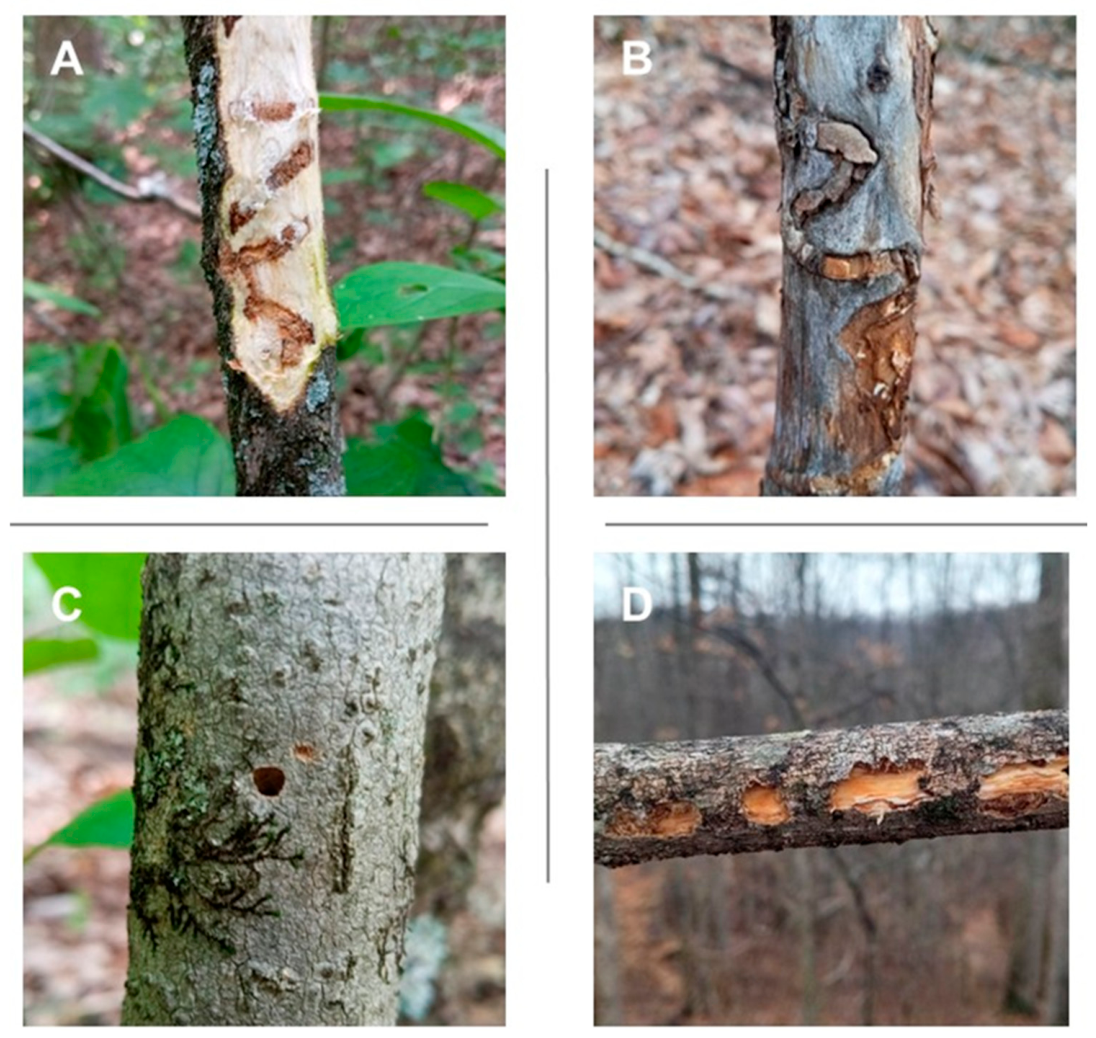
Figure 1. Example signs of emerald ash borer (EAB; Agrilus planipennis Fairmaire) attack on white fringetrees (Chionanthus virginicus L.) at Vinton Furnace State Experimental Forest. (A) Current-year EAB feeding gallery from 2024 on a live stem. (B) Old EAB feeding gallery from 2023 or earlier on a dead stem. (C) Exit hole made by an EAB adult in 2024 on a live stem. (D) Sign of a woodpecker foraging on EAB larvae on a live stem. Pictures in panels (AC) were taken in July 2024, and the picture in panel (D) was taken in January 2024 for illustrative purposes.
Forests 17 00712 g001
Figure 2. Signs and symptoms of attack by emerald ash borer (EAB; Agrilus planipennis Fairmaire) on white fringetree (Chionanthus virginicus L.) in other natural areas. (A) Old EAB gallery in a dead stem of a white fringetree in the Chattahoochee National Forest in north–central Georgia. (B) Stem dieback on an EAB-attacked white fringetree at Great Falls Park in southwestern Maryland.
Forests 17 00712 g002
Table 1. Distribution of (A) change in canopy health rank from 2019 to 2024, (B) canopy health ranks in 2024, (C) numbers of white fringetrees displaying evidence of infestation at some point during the ten-year period of the study, (D) numbers of white fringetrees displaying adult exit holes, and (E) numbers of white fringetrees displaying evidence of woodpecker foraging among white fringetrees in this study, separated by trees that were dead or alive in 2024.
AChange in Canopy Health Rank
  −4−3−2−101Total
Fringetree Status in 2024Dead2502009
Alive00289322
 Total252109331
BCanopy Health Rank
  12345Total
Fringetree Status in 2024Dead000099
Alive8464022
 Total8464931
CEvidence of EAB Infestation
  NoYesTotal
Fringetree Status in 2024Dead099
Alive101222
 Total102131
DPresence of Adult EAB Exit Holes
  NoYesTotal
Fringetree Status in 2024Dead099
Alive16622
 Total161531
EEvidence of Woodpecker Foraging
  NoYesTotal
Fringetree Status in 2024Dead279
Alive15722
 Total171431
Disclaimer/Publisher’s Note: The statements, opinions and data contained in all publications are solely those of the individual author(s) and contributor(s) and not of MDPI and/or the editor(s). MDPI and/or the editor(s) disclaim responsibility for any injury to people or property resulting from any ideas, methods, instructions or products referred to in the content.