1. Introduction
With increasing global carbon neutrality targets and growing demand for fine-scale ecosystem management, carbon stock-change monitoring is shifting from coarse, large-scale accounting to more detailed and dynamic assessments. As the fundamental unit of plant carbon cycling, individual plants exhibit marked variations in traits, growth, and physiological dynamics. This variability influences carbon stock-change estimation at plot and regional scales. Compared with stand-level averaging approaches, individual-plant observations better capture species-specific differences, competitive interactions, and microenvironmental responses, thereby providing a more mechanistic basis for understanding plant-level carbon stock change and reducing biases associated with spatial averaging.
Repeatable multi-temporal monitoring at the individual-plant scale is particularly important for applications such as plantation management, agroforestry optimization, and high-frequency ecological monitoring, where plant-level carbon dynamics directly inform management decisions. In managed plantations, individual plants often exhibit considerable variation in growth rates and carbon allocation strategies. Individual-based monitoring supports precision silviculture, including targeted thinning, density regulation, and selective harvesting to enhance carbon accumulation efficiency. In agroforestry systems, carbon balance results from both competition and complementarity between crops and trees in their use of light, water, and nutrients. Time-series observations at the individual-plant scale can optimize spatial configuration and species composition to improve system-level carbon outcomes. Under Measurement, Reporting, and Verification (MRV) frameworks, multi-temporal measurements at the individual-plant scale provide an empirical basis for cross-validation between carbon dioxide (CO2) exchange and carbon stocks, thereby reducing systematic bias associated with spatial averaging and improving the traceability of carbon accounting.
In this review, “individual-plant carbon monitoring” refers specifically to the estimation of multi-temporal plant carbon stock change (ΔC). It encompasses both biomass accumulation assessed through stock-based methods (defined in
Appendix A) and the exchange processes that regulate it. In practice, the flux-based methods (defined in
Appendix A) discussed here primarily refer to CO
2 exchange associated with photosynthesis and respiration, rather than all ecosystem-level carbon exchange pathways.
Nevertheless, the practical implementation of individual-based monitoring remains constrained by measurement complexity and data integration challenges. Although previous reviews have summarized flux-based, stock-based, and sensing-based approaches, they have largely focused on individual methodologies in isolation. As a result, inconsistencies in spatial support, temporal resolution, and uncertainty structures remain insufficiently addressed, limiting the reliability of multi-temporal ΔC estimation at the individual-plant scale. This limitation motivates an integrative perspective that explicitly links structural observations, functional signals, and scale-dependent constraints for multi-temporal ΔC estimation.
Methodological development for individual-plant carbon monitoring remains fragmented across disciplinary and technical domains. Flux-based methods primarily quantify CO
2 exchange associated with photosynthesis and respiration and thus provide mechanistic insights into plant carbon dynamics. Eddy covariance (EC), as a representative technique for measuring ecosystem-scale CO
2 exchange, has established a mature measurement and data processing framework [
1], and long-term networks such as FLUXNET have further standardized quality-control and integration workflows [
2]. At finer spatial scales, chamber-based systems applied to leaves, branches, stems, or whole plants enable direct observation of CO
2 exchange dynamics. However, these CO
2-focused flux approaches remain limited by spatial representativeness and scaling uncertainty when translating measurements into individual-plant carbon budgets. This limitation highlights a fundamental challenge in reconciling high-temporal-resolution flux observations with individual-scale carbon accounting.
In contrast, stock-based methods estimate biomass accumulation over time using forest inventory, dendrochronological analysis, and allometric modeling. By linking structural parameters to biomass and carbon content, these approaches quantify carbon stock change over defined intervals and provide a direct pathway for estimating ΔC. Nevertheless, their reliability depends on measurement precision, model transferability, and assumptions regarding carbon content and allocation. These assumptions introduce structural biases that are difficult to quantify, particularly in heterogeneous or mixed-species systems.
Meanwhile, advances in remote sensing and three-dimensional (3D) structural reconstruction technologies—including terrestrial and airborne LiDAR, structure-from-motion (SfM) photogrammetry, and multispectral or hyperspectral retrievals—have greatly expanded the capacity for spatially explicit characterization of vegetation structure and function [
3]. These approaches enable repeated observations across large areas with minimal disturbance, providing structural and physiological proxies relevant to carbon dynamics. However, remote sensing-derived indicators typically infer carbon pools or fluxes indirectly and are subject to saturation effects, canopy occlusion, scale inconsistency, and temporal inconsistency. As a result, the reliability of remote sensing-based ΔC estimation is strongly dependent on model assumptions and cross-scale consistency.
From a methodological perspective, existing approaches can be grouped into three pathways: process-oriented flux observation, state-oriented carbon stock estimation, and proxy-based structural or spectral sensing. These pathways differ in observational logic, spatial support, temporal resolution, and uncertainty structure. Flux measurements generally provide high-frequency process information but limited spatial representativeness; stock-based approaches directly estimate biomass accumulation but are typically episodic; and sensing-based approaches improve repeatability and spatial coverage but rely on indirect proxies and model-based interpretation. As a result, achieving consistent multi-temporal ΔC estimation at the individual-plant scale remains difficult. Although these approaches provide complementary information, a key gap remains in the lack of an integrative framework that can reconcile differences in spatial support, temporal resolution, and uncertainty structure across methods. This limitation is particularly critical for individual-plant ΔC estimation, where small temporal changes may be obscured by scale mismatch, boundary inconsistency, and error propagation.
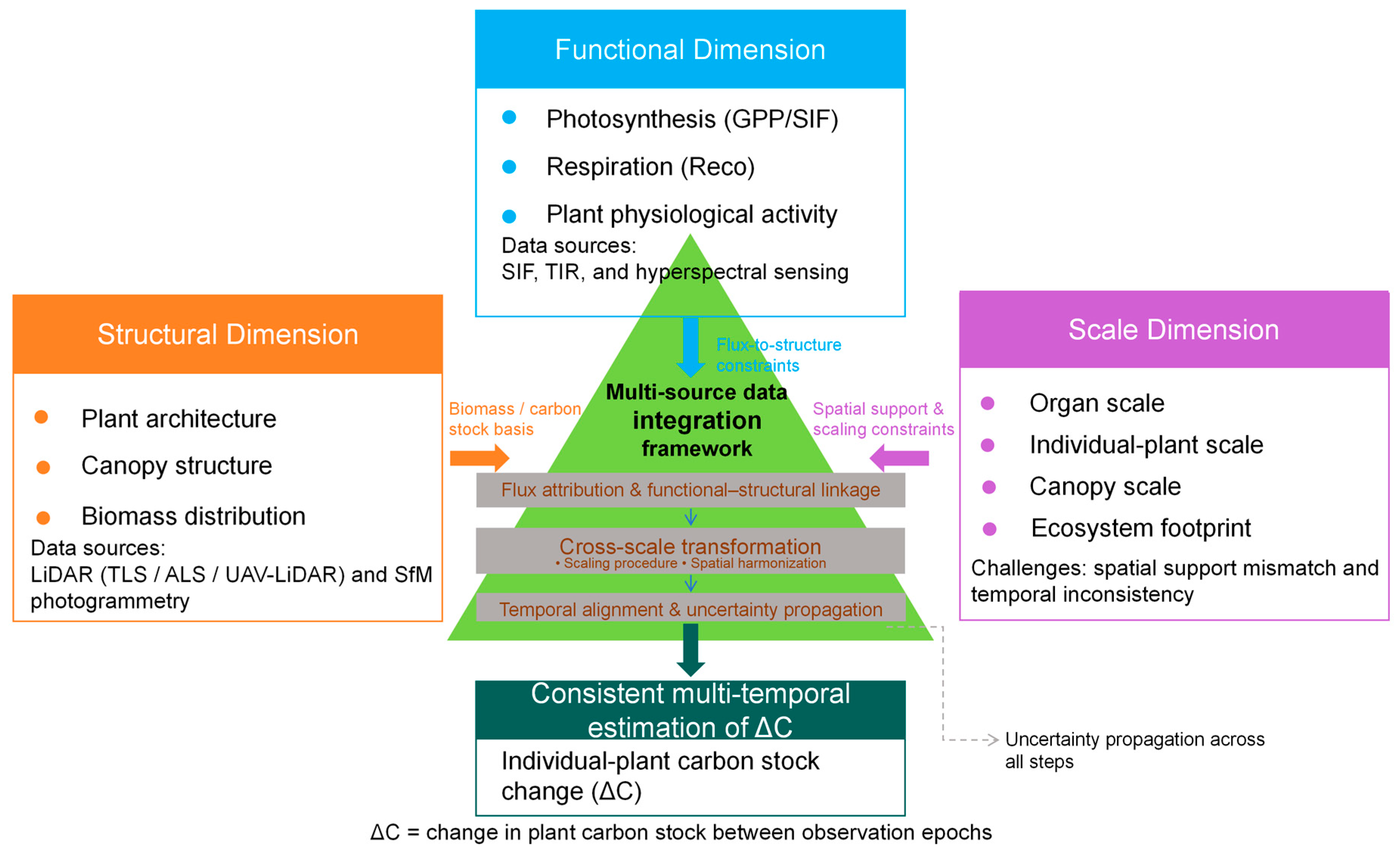
To address these limitations, this study proposes a structure–function–scale framework as its main conceptual contribution. The framework is designed to integrate process-based, state-based, and proxy-based observations into a unified perspective for multi-temporal ΔC estimation.
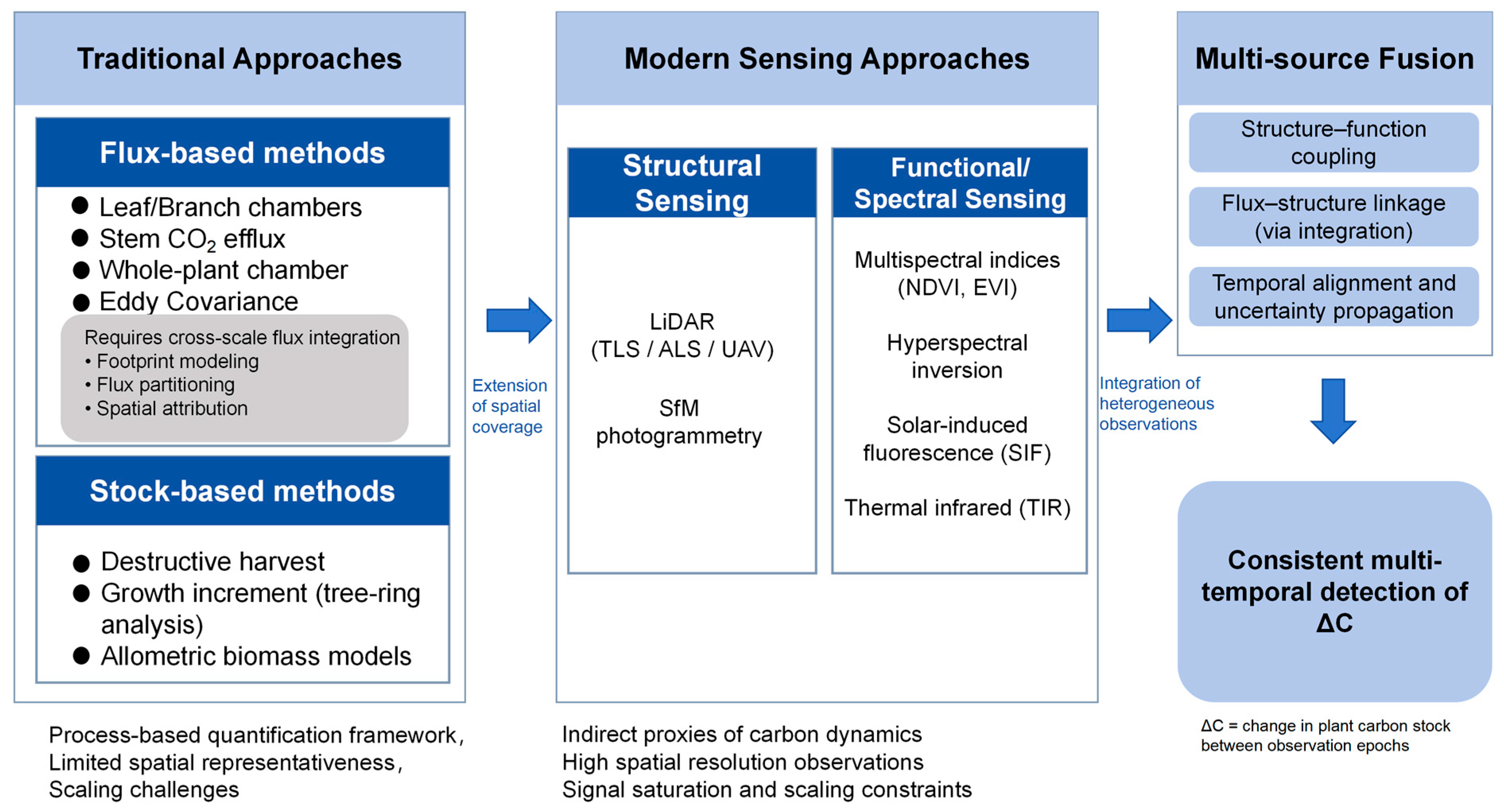
Figure 1 presents the overall methodological framework, linking traditional flux-based and stock-based methods with modern remote sensing techniques and multi-source data fusion. Structural observations, functional signals, and scale-dependent information are explicitly connected, while segmentation, co-registration, scaling, temporal alignment, and uncertainty propagation are emphasized as key requirements for integration. Rather than merely comparing methods descriptively, this framework highlights cross-scale consistency as a prerequisite for reliable individual-plant ΔC estimation.
Within this integrated framework, flux-based and stock-based methods define the fundamental pathways for quantifying plant carbon dynamics, while remote sensing approaches provide structural and functional proxies that extend spatial coverage and enhance temporal resolution. Multi-source data fusion functions as the key integrative layer, linking heterogeneous observations through segmentation, co-registration, cross-scale harmonization, temporal alignment, and uncertainty propagation. By explicitly addressing differences in spatial support and temporal resolution, the framework provides a coherent basis for the consistent detection of multi-temporal changes in individual-plant ΔC.
This perspective highlights that reliable ΔC estimation depends not only on measurement accuracy, but also on the consistency and integration of observations across spatial and temporal scales. The following sections therefore systematically examine individual methodological approaches, their limitations, and their roles within the proposed framework for ΔC monitoring.
2. Traditional Quantification Logic at the Individual-Plant Scale
As illustrated in
Figure 1, traditional approaches form the foundational layer of individual-plant carbon stock-change quantification. These approaches define the primary accounting logic through process-based CO
2 exchange measurements and state-based carbon stock estimation. Although these approaches are based on different measurement principles, they both aim to quantify carbon exchange and accumulation at biologically meaningful scales and thus provide the mechanistic basis for subsequent remote sensing approaches and integration strategies. However, their methodological separation also contributes to the fragmentation of carbon monitoring at the individual-plant scale.
Building on the framework presented in
Figure 1,
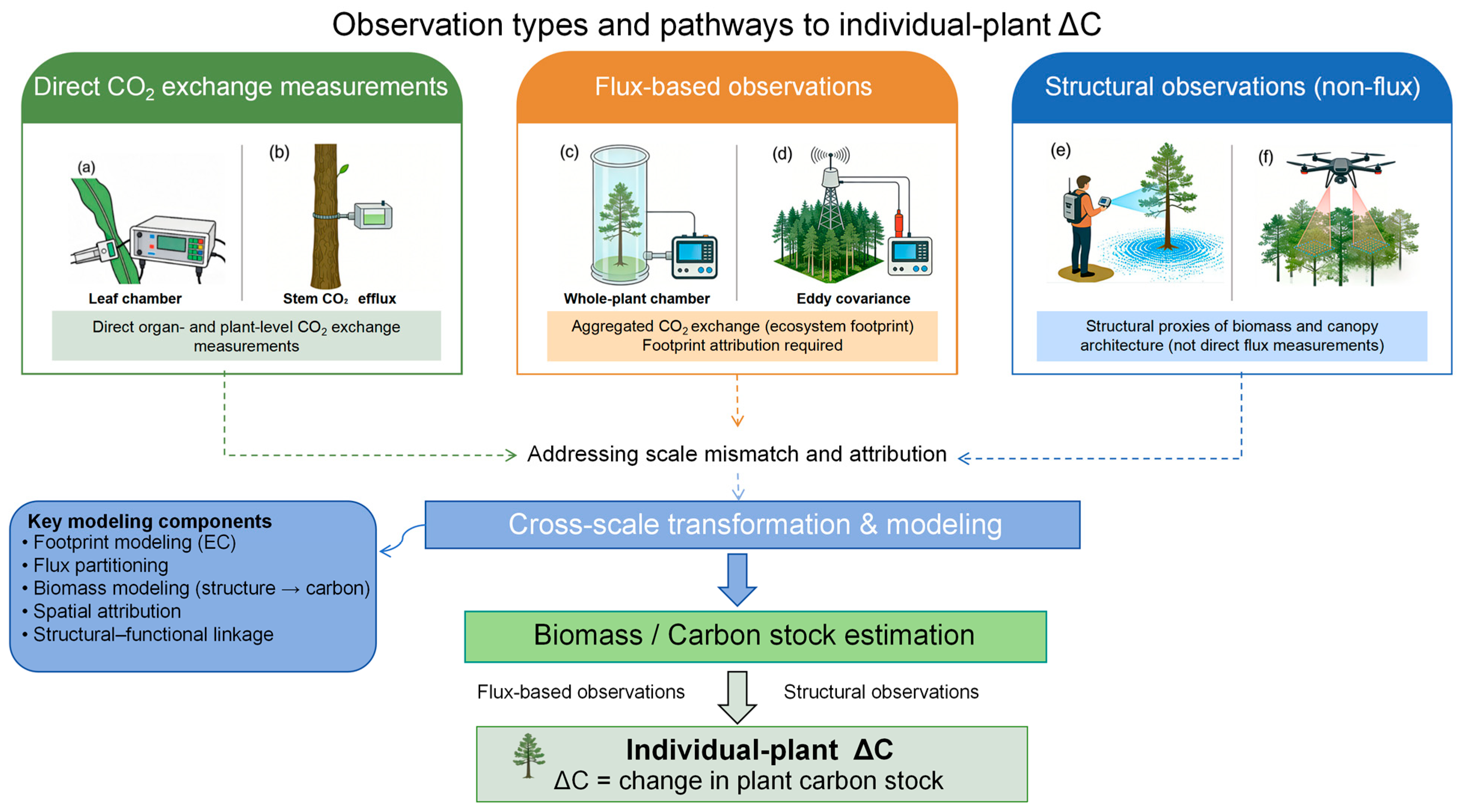
Figure 2 presents representative measurement systems used for individual-plant carbon monitoring, highlighting the diversity of measurement platforms, observation boundaries, and sensing modalities involved in ΔC estimation. This diversity reflects the wide range of spatial supports and measurement assumptions underlying different methodological pathways.
Figure 2 illustrates three major types of observations contributing to the estimation of individual-plant ΔC, including direct plant-level measurements, flux-based observations across scales, and structural observations. These observation types correspond to two fundamentally distinct yet theoretically connected pathways for estimating ΔC. ΔC can be estimated most directly from biomass differences, while flux-based observations can provide theoretical and temporal constraints on carbon stock change under idealized assumptions of system closure, allocation, and turnover. In the latter case, changes in carbon storage reflect the difference between carbon inputs (GPP) and outputs (respiration and other losses), and can be approximated by integrating net carbon balance over time.
In the stock-based pathway, plant carbon stock is inferred from structural attributes by first estimating biomass through empirically derived allometric relationships. These relationships link measurable plant traits (e.g., diameter and height) to biomass. This relationship can be generically expressed as:
where
B denotes plant biomass, and
DBH,
H, and
WD represent diameter at breast height, tree height, and wood density, respectively [
4].
Carbon stock is then derived from biomass based on the carbon content of plant tissues:
where
C denotes plant carbon stock and
CF denotes the carbon fraction of biomass, which is often assumed to be constant [
5].
Accordingly, the change in carbon stock between two observation times can be written in its general form as:
If the carbon fraction is assumed to remain constant between observation times, Equation (3) can be simplified to:
In contrast, the flux-based pathway describes carbon dynamics from a process perspective, in which changes in carbon storage arise from the balance between carbon inputs and outputs. Specifically, carbon is gained through photosynthesis and lost through respiration and other pathways such as litterfall or export [
5]. This balance can be expressed as:
where
C denotes carbon stock within a specified system boundary,
GPP is gross primary productivity,
R represents total ecosystem respiration (including autotrophic and heterotrophic components), and
L denotes other carbon losses such as litterfall, harvest, export, or disturbance [
1]. In this formulation, these variables are typically defined at the ecosystem scale rather than directly at the individual-plant scale.
Under ideal conditions with complete system closure and full accounting of all relevant carbon exchange terms, carbon stock change can be approximated by the temporal integration of net carbon balance:
where the approximation reflects potential imbalances arising from measurement uncertainty, incomplete flux accounting, and carbon allocation and turnover processes [
6].
It should be noted that integrated net CO2 exchange does not directly translate into structural biomass growth, because assimilated carbon can be allocated to respiration, storage, reproduction, exudation, and other non-structural pools within the plant system.
In practice, incomplete flux measurement, boundary mismatch, and unaccounted carbon pathways introduce deviations from this theoretical equivalence, and full closure of the carbon budget is rarely achieved. Therefore, although stock-based and flux-based pathways can be regarded as theoretically consistent representations of carbon dynamics under ideal conditions, they differ fundamentally in their observational basis and spatial scale. Stock-based approaches rely on discrete structural measurements at the plant level, whereas flux-based approaches characterize continuous carbon exchange processes that are often measured at larger spatial scales, such as the ecosystem level. These differences create the need for explicit cross-scale transformation and integration in individual-plant ΔC estimation.
Bridging these two pathways for individual-plant ΔC estimation requires explicit cross-scale transformation and intermediate modeling, including footprint modeling, flux partitioning, biomass modeling, and spatial attribution. In practice, structural observations provide the primary operational pathway for ΔC estimation through biomass reconstruction, whereas flux-based measurements provide dynamic constraints on carbon exchange processes and their temporal variability.
It is important to recognize that these observation types represent fundamentally different classes of information, including direct measurements (e.g., chamber-based CO2 exchange), proxy observations (e.g., spectral sensing), and model-derived estimates (e.g., flux inversion). Their integration therefore requires explicit procedures for scaling, attribution, and uncertainty propagation.
Flux-based approaches focus on the direct observation of CO
2 exchange processes across leaf, stem, whole-plant, and ecosystem scales, thereby emphasizing process-level interpretability. However, as illustrated in
Figure 1, their spatial representativeness is inherently limited, and scaling flux measurements from organ-level observations to the whole-plant level introduces bias and scale inconsistency across spatial supports. This limitation constrains their direct applicability for estimating individual-plant ΔC.
In contrast, stock-based approaches estimate carbon stock change, expressed as biomass carbon accumulation, over defined time intervals. Using destructive harvesting, tree-ring analysis, or allometric biomass modeling, these approaches infer carbon accumulation from structural attributes. Because they are directly linked to repeated estimates of biomass and carbon stock, stock-based approaches provide a more direct pathway for ΔC estimation. Nevertheless, their accuracy depends on measurement precision, model transferability, and assumptions regarding carbon content and allocation, all of which may introduce systematic bias into multi-temporal ΔC estimates.
Together, these pathways define the fundamental quantification logic of individual-plant carbon monitoring. However, their respective limitations in spatial coverage, temporal continuity, and cross-scale consistency highlight the need for complementary sensing technologies and integrative strategies, which are discussed in the following sections. Addressing these inconsistencies is essential for advancing robust, scalable, and multi-temporally consistent frameworks for individual-plant ΔC monitoring.
2.1. Flux-Based CO2 Exchange Framework
In this review, flux-based approaches refer to process-oriented methods that quantify plant carbon exchange dynamics and that, in practice, are primarily implemented through measurements of CO2 exchange associated with photosynthesis and respiration. Accordingly, the flux-based approaches discussed here estimate carbon dynamics at the individual-plant scale through direct observation of CO2 exchange within explicitly defined system boundaries.
These approaches emphasize process-level interpretation of photosynthesis and respiration and provide high-temporal-resolution insights into diel, seasonal, and disturbance-driven variability. However, as illustrated in
Figure 1, their applicability for estimating individual-plant ΔC depends critically on spatial representativeness, boundary definition, and scaling assumptions. In particular, the inconsistency between measurement boundaries and the spatial extent of individual plants introduces a fundamental limitation in translating flux measurements into consistent ΔC estimates.
2.1.1. Leaf- and Branch-Level Chamber Measurements
Leaf and branch chamber techniques represent one of the most mechanistically explicit pathways for observing carbon assimilation at the organ scale. Their theoretical basis is grounded in the biochemical photosynthesis model, which links net CO
2 assimilation to Rubisco carboxylation, electron transport, and triose phosphate utilization [
7]. Standardized infrared gas analyzer (IRGA)-based gas-exchange protocols enable the estimation of photosynthetic rate, stomatal conductance, and transpiration under controlled environmental conditions [
8], while A–Ci curve analysis enables the inversion of key biochemical parameters such as maximum carboxylation rate of Rubisco (Vcmax) and maximum electron transport rate (Jmax) [
9]. These approaches enable direct coupling between observed fluxes and underlying physiological mechanisms.
Branch-level chamber measurements partially extend the spatial scope of observations beyond individual leaves [
10,
11], providing constraints for scaling leaf-level assimilation to larger structural units. Nevertheless, organ-level chamber measurements remain sensitive to boundary-layer resistance, chamber-induced disturbances, and internal CO
2 gradients [
12,
13]. Integration with chlorophyll fluorescence measurements can improve the physiological interpretation of electron transport processes [
14], and automated chamber systems enhance temporal continuity for multi-temporal monitoring.
Despite their mechanistic strengths, leaf and branch chamber measurements exhibit inherently limited spatial representativeness and require additional scaling assumptions to infer whole-plant carbon balance. More fundamentally, the measurement boundaries defined by chamber systems rarely correspond to the spatial extent of the entire plant, leading to structural inconsistencies when extrapolating flux measurements to ΔC. Consequently, these approaches are best positioned as tools for parameter calibration, mechanistic validation, and short-term flux characterization, rather than as standalone approaches for robust ΔC quantification. Their relationship to ΔC is therefore primarily indirect, as they inform the physiological basis of carbon assimilation but do not directly measure cumulative carbon stock change at the whole-plant level.
2.1.2. Stem CO2 Efflux Measurements
Stem CO
2 efflux measurements provide insight into autotrophic respiration processes in woody tissues and constitute an important component of carbon loss at the individual-plant scale. However, surface CO
2 efflux does not directly correspond to in situ respiration rates. Dissolution of CO
2 in xylem sap and its subsequent transport via sap flow can spatially and temporally decouple CO
2 production from efflux [
15]. Conceptual frameworks therefore emphasize that stem CO
2 efflux reflects the integrated outcome of respiration, internal storage, and transport processes [
16].
Empirical observations demonstrate pronounced diel variability and frequent midday depression of stem CO
2 efflux, patterns that cannot be explained solely by temperature-driven respiration and are strongly influenced by plant water status and sap flow dynamics [
17]. Mass-balance analyses further indicate that reliance on surface efflux alone may underestimate true woody tissue respiration due to transient internal CO
2 storage [
18]. In addition, CO
2 derived from root respiration and transported upward via the transpiration stream can contribute to stem surface efflux [
19], further complicating interpretation.
These processes indicate that stem CO2 efflux represents a composite signal rather than a direct measure of respiration, reflecting the coupled effects of production, transport, and storage within the plant system. Consequently, while stem CO2 efflux measurements are valuable for quantifying respiratory carbon loss, they cannot independently resolve individual-plant ΔC without integration with assimilation measurements and structural growth information.
2.1.3. Whole-Plant Chamber Measurements
Whole-plant chamber systems provide one of the most direct approaches for quantifying net CO
2 exchange at the whole-plant scale by enclosing the entire plant or canopy within a controlled chamber environment and monitoring gas concentration dynamics [
20]. By integrating photosynthesis and respiration within a defined enclosure, these systems capture net carbon exchange at the organism level and serve as a methodological bridge between organ-scale flux measurements and individual-plant carbon budgets.
Chamber configurations generally include static (closed), dynamic (flow-through), and automated systems. Static chambers estimate fluxes from temporal CO
2 accumulation within enclosed volumes, but nonlinear concentration dynamics under high-flux conditions can introduce estimation bias [
21,
22]. Dynamic chambers mitigate accumulation effects through continuous airflow renewal [
23], improving temporal stability and measurement accuracy under variable conditions [
24]. Automated chamber systems enable long-term, high-frequency monitoring through multiplexed sampling and integrated sensor control [
25,
26,
27,
28], with demonstrated consistency in temporal patterns relative to EC measurements [
29,
30]. However, system complexity, chamber-induced microclimate alteration [
26,
27], and quality control requirements [
31,
32,
33] limit their scalability. More importantly, the artificial enclosure environment alters energy balance, gas diffusion, and plant physiological responses, such that measured fluxes may deviate from natural conditions.
Although whole-plant chamber systems preserve plant physiological integrity and provide relatively direct estimates of net CO
2 exchange, their spatial representativeness remains inherently limited, and scaling beyond enclosed individuals requires additional structural or modeling constraints [
34]. Consequently, while these approaches provide an integrated measure of plant-level CO
2 exchange, they do not directly resolve long-term ΔC, which depends on cumulative carbon allocation and biomass growth processes.
Thus, whole-plant chamber systems should be regarded as an intermediate bridge between organ-scale flux measurements and plant-level carbon budgets, rather than as a standalone method for robust long-term ΔC estimation.
2.1.4. EC Method
The EC method quantifies CO
2 exchange at the forest–atmosphere interface based on the covariance between high-frequency fluctuations in vertical wind velocity and gas concentration [
35]. As the core technique in long-term flux monitoring networks [
36], EC provides continuous measurements of net ecosystem exchange (NEE), integrating canopy photosynthesis and ecosystem respiration (Reco) at the system level [
37].
EC effectively characterizes diel, seasonal, and interannual variability in CO
2 exchange at the ecosystem scale [
38]. However, its inherent spatial integration, defined by the flux footprint, limits the attribution of measured fluxes to individual plants [
39]. Even within structurally homogeneous stands, EC observations represent spatially aggregated canopy-scale signals rather than discrete plant-level processes.
Long-term EC datasets are subject to systematic uncertainties, particularly the underestimation of nocturnal fluxes under low-turbulence conditions [
40]. Such biases may propagate through temporal integration and affect long-term carbon balance estimates. More fundamentally, the spatial footprint of EC measurements is typically orders of magnitude larger than individual plants, creating a fundamental scale inconsistency for individual-plant-based estimation.
Within individual-plant carbon monitoring frameworks, EC is best interpreted as a system-scale boundary constraint and a reference for temporal dynamics rather than as a direct estimator of plant-level ΔC. When integrated with organ- and plant-scale observations, EC data provide macro-scale consistency constraints for validating individual-plant carbon budgets.
2.1.5. Linking Flux Measurements to ΔC
Flux-based approaches provide direct information on instantaneous CO2 exchange, but they do not directly quantify individual-plant ΔC. The central limitation is conceptual as well as methodological: flux measurements describe net exchange within defined temporal and spatial boundaries, whereas ΔC represents cumulative change in carbon stock over time. Linking the two therefore requires temporal integration, spatial attribution, and explicit assumptions about carbon allocation and turnover.
At the ecosystem scale, EC-derived NEE can be partitioned into GPP and Reco and integrated to estimate NEP. However, translating ecosystem-scale NEP into individual-plant ΔC remains difficult because additional assumptions are required regarding footprint attribution, carbon allocation, turnover, and non-structural carbon pools. At the plant scale, chamber-based observations can be integrated to estimate net carbon gain, but only part of that gain is converted into structural biomass. A substantial fraction may instead be consumed by respiration or allocated to storage, reproduction, exudation, and other pathways. For this reason, flux observations are best treated as dynamic constraints on ΔC estimation rather than as direct estimators of carbon stock change.
Several modeling frameworks have been developed to bridge these processes. Light use efficiency (LUE) and process-based photosynthesis models convert absorbed radiation and physiological parameters into estimates of gross carbon assimilation, while carbon allocation models distribute assimilated carbon among plant organs and growth pools. Functional–structural plant models (FSPMs) further integrate canopy architecture with physiological processes, providing a mechanistic pathway for linking flux dynamics with structural biomass accumulation [
41]. Fundamentally, flux measurements capture carbon exchange processes, whereas ΔC reflects cumulative biomass formation governed by allocation and turnover, thereby creating an inherent conceptual gap between flux measurements and stock-change estimations.
Despite these advances, uncertainties remain substantial due to incomplete understanding of allocation dynamics, variability in respiration and storage fluxes, and scale inconsistencies between flux observations and structural measurements. Therefore, flux-based approaches are most effectively applied in combination with stock-based measurements and structural sensing (defined in
Appendix A) data. Within integrated monitoring frameworks, flux observations primarily serve as dynamic constraints that help validate the temporal consistency of multi-temporal ΔC estimates derived from structural or stock-based approaches. Accordingly, flux-based approaches are better treated as temporal and mechanistic constraints than as direct estimators of individual-plant ΔC, because their main limitations lie in boundary mismatch, scaling uncertainty, and the conceptual gap between instantaneous carbon exchange and cumulative biomass accumulation. Within the structure–function–scale framework, flux-based approaches primarily function as dynamic constraints on carbon exchange processes rather than direct estimators of ΔC, due to their limited spatial attribution at the individual-plant scale.
2.2. Carbon Stock Change-Based Estimation Framework
Carbon stock change-based approaches estimate individual-plant ΔC by quantifying biomass accumulation over defined time intervals and deriving carbon stock change from repeated measurements. In contrast to flux-based approaches, which capture instantaneous exchange processes, these approaches directly represent net carbon accumulation and therefore provide an outcome-oriented pathway for multi-temporal carbon assessment. This direct linkage to biomass accumulation makes stock-based approaches the most conceptually aligned with ΔC estimation at the individual-plant scale. However, their accuracy depends critically on the precision of structural parameter measurements and the transferability of biomass models across species and environmental conditions. In practice, uncertainties in structural measurements and model assumptions can propagate through temporal differencing, particularly when ΔC signals are small.
2.2.1. Harvest-Based Measurements
Harvest-based measurements constitute the empirical foundation of forest biomass estimation. In the context of individual-plant carbon assessment, these approaches include destructive harvesting and dendrochronological or growth increment methods, corresponding to absolute quantification of carbon stock and temporal reconstruction of carbon accumulation, respectively.
Destructive harvesting is widely regarded as the reference standard for biomass estimation. By directly measuring fresh and oven-dry mass of plant components, it provides the most direct and robust constraint on individual-plant biomass and carbon pools. These datasets underpin the development and calibration of allometric equations, and their representativeness critically influences model performance [
4,
42]. Previous methodological syntheses have identified destructive harvest data as the primary validation benchmark for inventory- and remote sensing-based biomass estimates [
43]. However, due to its irreversible nature and associated ecological disturbance, destructive harvesting is unsuitable for repeated measurements and long-term monitoring [
44,
45]. Consequently, its role is primarily that of a reference baseline for calibration and validation rather than an operational approach for multi-temporal ΔC monitoring.
Dendrochronological and growth increment approaches estimate biomass accumulation based on radial growth measurements and subsequent conversion using allometric relationships [
46,
47]. Tree-ring records provide annual temporal resolution and enable reconstruction of multi-decadal carbon dynamics [
48,
49]. Compared with one-time harvest measurements, increment-based methods support repeated observations and long-term ΔC estimation at the individual-plant scale. Nevertheless, these approaches remain indirectly dependent on allometric relationships and primarily capture stem growth dynamics, providing limited representation of foliage, branch, and belowground biomass components [
47]. Upscaling from individuals to larger spatial domains further introduces additional statistical uncertainty.
Collectively, harvest-based approaches establish a dual-constraint system: destructive harvesting provides absolute biomass reference anchors [
42,
43], while growth increment methods supply temporal dynamics for ΔC reconstruction [
46,
47,
48]. Within integrated monitoring frameworks, these ground-based measurements serve as essential calibration and validation layers that support model development and cross-scale consistency [
47,
48].
2.2.2. Biomass Model-Based Estimation Methods
Biomass model-based estimation represents one of the most widely implemented approaches for operational carbon accounting. Allometric models remain the foundational method for individual-tree biomass estimation, while recent advances have extended non-destructive approaches by integrating field-calibrated allometry with terrestrial laser scanning (TLS) and UAV-based laser scanning, thereby improving predictions of individual-tree aboveground biomass (AGB) [
50].
The general workflow—structural measurement, allometric estimation of AGB, carbon conversion, and temporal differencing—provides a systematic pathway to translate physical growth into changes in carbon pools. Comparative analyses indicate that model selection can significantly influence biomass estimates, particularly in structurally complex systems such as tropical forests [
4]. Improved pan-tropical models incorporating variables such as plant height and wood density improve biological realism and cross-regional applicability [
51], but also increase sensitivity to measurement error and trait variability.
Uncertainty in biomass model-based estimation arises primarily from measurement error, sampling variability, and model parameterization. Variability in height–diameter relationships and species-specific traits can lead to substantial variation in biomass estimates for individuals with identical DBH values [
52]. These errors directly affect ΔC estimation because ΔC is often derived from the difference between repeated biomass estimates; when temporal changes are small, even modest measurement errors can obscure real growth signals or produce spurious changes. As estimates are scaled from individuals to stands or regions, these errors propagate and accumulate. Explicit uncertainty quantification and Monte Carlo-based error propagation have therefore become essential components of ΔC assessment frameworks, particularly when ΔC signals are small or remeasurement intervals are short [
53].
Overall, biomass model-based approaches provide strong scalability and compatibility with repeated surveys, making them a central component of long-term individual-plant ΔC monitoring. However, their reliability depends critically on high-quality structural measurements, appropriate model calibration and validation, and consistency across spatial domains. Without site-specific validation, systematic bias can accumulate during temporal differencing and cross-regional application [
51], particularly where large-scale allometric models are unavailable or insufficiently validated. Within the structure–function–scale framework, biomass models function primarily as a conversion layer that links structural observations to carbon stock estimates, rather than as independent measurement systems.
2.2.3. Destructive Sampling and Model Integration
Rapid assessment approaches integrate limited destructive sampling with biomass modeling to balance estimation accuracy and operational feasibility. By harvesting representative subsamples or selected individuals and extrapolating total biomass using empirical relationships, these approaches reduce ecological disturbance while maintaining relatively high estimation accuracy [
54].
Three commonly applied strategies include semi-destructive subsampling, biomass expansion factor (BEF)-based conversion, and allometric equation-based prediction using easily measurable structural variables [
55]. Because these approaches avoid complete harvesting, they support periodic remeasurement and are therefore well suited for multi-temporal monitoring programs, such as permanent plots and national forest inventories [
43]. Standardized field protocols have demonstrated strong repeatability in plantation and managed forest systems [
56], and integration with established allometric models can provide robust regional biomass estimates when calibrated with limited local samples [
57].
Nevertheless, rapid assessment approaches remain strongly dependent on model assumptions and parameter applicability. Variability in species composition, site conditions, and conversion factors can introduce systematic bias. In particular, reliance on partial sampling and model extrapolation can amplify uncertainty when applied across heterogeneous stands. While these approaches are well suited for large-scale operational ΔC monitoring, they are best regarded as scalable estimation tools rather than absolute reference standards.
2.2.4. Stock-Based Estimation Pathways
Stock-based approaches directly quantify carbon accumulation through structural growth and therefore provide the most direct and conceptually explicit pathway for estimating individual-plant ΔC. Destructive harvesting establishes absolute biomass reference anchors, growth increment analysis provides temporal resolution, and biomass model-based approaches enable scalable multi-temporal monitoring. Together, these approaches form a hierarchical estimation system that links reference measurements, temporal reconstruction, and scalable prediction within a unified ΔC assessment framework.
However, their reliability is contingent upon structural measurement accuracy, model transferability, and rigorous error propagation across scales. Within the structure–function–scale framework (
Figure 1), stock-based methods form the primary ΔC estimation layer, while ground-based reference datasets support calibration and validation across remote sensing and flux-based pathways. This central role positions these approaches as the benchmark against which other methodological pathways are interpreted and constrained. More importantly, stock-based estimation provides the reference basis for integrating structural sensing outputs and flux-derived process information, thereby forming the key transition from ground-based quantification to the multi-source fusion strategies discussed in subsequent sections.
3. Modern Sensing Approaches: Structural and Functional Proxies
In contrast to flux- and stock-based methods, which directly measure carbon exchange or biomass accumulation, remote sensing approaches infer carbon-related variables from 3D structural attributes, spectral responses, or energy balance signals. These approaches expand spatial coverage and enable repeated observations with reduced disturbance. However, their outputs represent proxy-based indicators of carbon pools or fluxes and therefore require model-based linkage to ΔC.
Sensing pathways can be broadly divided into structural sensing and functional sensing. Structural sensing focuses on the geometric characterization of plant architecture and growth increments, providing constraints on biomass estimation and carbon storage. Functional sensing captures physiological and biochemical signals associated with photosynthetic activity and stress responses, thereby providing insight into carbon assimilation dynamics. These sensing approaches complement the flux- and stock-based pathways by providing proxy-based constraints on carbon dynamics, thereby forming an integrated structure–function–scale observation system.
Although these pathways provide complementary information, both are subject to scale-dependent uncertainties and limitations associated with indirect inference. Importantly, functional sensing approaches generally do not directly estimate ΔC; rather, they act as physiological constraints on carbon dynamics and therefore require integration with structural observations and allocation-related interpretation. Within the structure–function–scale framework, functional sensing contributes indirect constraints by capturing physiological and biochemical processes that regulate carbon accumulation, rather than directly resolving ΔC. Recent advances in sensing technologies have substantially expanded the capacity for individual-plant monitoring, thereby motivating the detailed discussion presented in this section.
Sensing-based approaches constitute the structural and functional proxy layer within the individual-plant carbon monitoring framework (
Figure 1).
Figure 3 presents a structure–function–scale integration framework, illustrating how these approaches contribute to ΔC estimation across structural, functional, and scale dimensions.
Figure 3 illustrates how remote sensing-based approaches differ in their contributions to constraining individual-plant ΔC within the structure–function–scale framework. Structural sensing primarily captures geometric changes associated with biomass accumulation, whereas functional sensing provides indirect constraints on carbon dynamics through physiological indicators such as spectral reflectance and canopy temperature. Because functional sensing does not directly resolve cumulative carbon stock change, robust ΔC estimation requires its integration with structural information and, where appropriate, allocation-related models. This integration requires explicit flux attribution, cross-scale scaling procedures, and uncertainty propagation to ensure consistency between functional signals and structural carbon stock changes. Together, these approaches provide complementary constraints that underpin integrated structure–function monitoring strategies within a multi-source data integration framework.
3.1. 3D Structural Methods for Plant Structural Characterization
3D structural information provides a direct physical basis for detecting biomass accumulation and ΔC at the individual-plant scale, as changes in carbon pools ultimately manifest through measurable variations in height, crown expansion, and volumetric development. Compared with two-dimensional spectral indicators, structural metrics are generally less susceptible to saturation effects and background mixing, making them particularly suitable for quantifying geometric attributes and supporting multi-temporal differencing analyses.
Two principal approaches are commonly used to acquire 3D structural information: active LiDAR sensing (TLS/UAV-based LiDAR) and image-based SfM reconstruction. LiDAR systems generate range-based point clouds with strong canopy penetration and high geometric accuracy, whereas SfM provides a cost-effective approach for reconstructing surface structure from multi-view imagery. Differences in point density, canopy penetration, and temporal consistency introduce distinct sources of uncertainty, which are discussed in the following subsections.
3.1.1. LiDAR-Based Structural Characterization of Individual Plants
LiDAR (Light Detection and Ranging) provides high-density 3D point clouds through active laser emission and return signal detection, enabling detailed characterization of individual plant structure. Structural metrics derived from LiDAR data, including plant height, crown diameter, and canopy vertical distribution, are widely used for biomass estimation and carbon pool assessment at the individual-plant scale [
58].
Crown structural attributes are typically derived through a series of preprocessing steps, including noise filtering, ground separation, and individual-plant segmentation, followed by geometric reconstruction using methods such as voxel modeling or convex hull approaches to estimate crown volume and other structural metrics [
59]. These metrics provide a structural basis for biomass modeling and support multi-temporal differencing analyses for detecting ΔC.
However, LiDAR-based carbon estimation is influenced by multiple error sources. In structurally complex canopies, crown overlap and occlusion introduce segmentation errors that propagate to crown volume estimation and biomass modeling [
60]. Differences among LiDAR platforms further affect structural consistency: TLS provides high point density suitable for fine-scale modeling, whereas airborne and UAV-based LiDAR systems offer broader spatial coverage but differ in scanning geometry and spatial resolution [
61,
62,
63].
In multi-temporal analyses, co-registration errors and variations in acquisition geometry can obscure subtle structural growth signals, particularly when growth increments are small relative to measurement error [
64]. In addition, the conversion from LiDAR-derived structural metrics to carbon stock typically relies on empirical biomass models and species-specific parameters, introducing additional sources of uncertainty.
Overall, while LiDAR provides a robust structural basis for ΔC detection, its reliability depends on accurate segmentation, cross-temporal alignment, and explicit uncertainty quantification.
3.1.2. SfM-Based Structural Representation
SfM is a photogrammetric reconstruction technique that generates 3D point clouds from multi-view imagery through feature matching and bundle adjustment, and its methodological framework and environmental applications have been extensively reviewed [
65]. With the rapid development of UAV platforms, SfM is increasingly used for structural characterization of forest and agricultural canopies. Digital surface models (DSMs) and canopy height models (CHMs) derived from high-resolution imagery enable the extraction of plant height, crown width, and canopy volume, which serve as structural proxies for biomass estimation. Under appropriate acquisition conditions, SfM-derived structural metrics show strong agreement with LiDAR measurements [
66], and the integration of structural and spectral information can further enhance biomass estimation in agricultural systems [
67].
However, SfM reconstruction remains sensitive to acquisition geometry, image overlap, surface texture, and ground control configuration, introducing elevation bias and reconstruction instability [
68,
69]. Unlike active LiDAR systems, SfM relies on surface-visible texture and lacks canopy penetration capability, which limits its applicability in structurally complex or multi-layered forest stands [
70].
Multi-temporal ΔC detection requires consistent acquisition geometry across observation dates. Variations in flight altitude, illumination conditions, and georeferencing precision introduce co-registration errors that can obscure subtle structural growth signals [
71]. Platform instability and radiometric variability can further affect image quality and reconstruction robustness under field conditions [
72].
Consequently, although SfM provides a cost-effective and operationally flexible approach for 3D structural reconstruction, its application to precise multi-temporal ΔC estimation remains constrained by occlusion effects, reconstruction completeness, and cross-temporal consistency. Structural sensing methods provide a semi-direct pathway for ΔC estimation by capturing changes in plant geometry that can be translated into biomass and carbon stock through modeling.
3.2. Canopy Spectral Characteristics-Based Parameter Retrieval Methods
In contrast to 3D structural sensing approaches, remote sensing approaches based on optical signals characterize vegetation through spectral reflectance responses to incoming solar radiation. These spectral signals contain information on canopy biochemical properties, physiological status, and phenological dynamics, and are widely used to infer photosynthetic activity and vegetation condition. However, spectral features represent indirect proxies of carbon-related processes or carbon stocks and therefore require model-based interpretation to link these observations to individual-plant ΔC.
Beyond satellite and airborne platforms, proximal sensing systems and high-throughput phenotyping platforms extend spectral monitoring to near-field and individual-plant scales, enabling higher temporal resolution and more controlled acquisition geometry. Nevertheless, spectral retrieval accuracy remains sensitive to spatial resolution, illumination conditions, and canopy structural complexity, which can affect the consistency of ΔC inference across scales.
3.2.1. Multispectral Vegetation Indices and Constraints on ΔC
Multispectral remote sensing remains one of the most widely used remote sensing-based approaches for retrieving canopy spectral parameters. Vegetation indices (VIs), particularly the normalized difference vegetation index (NDVI), enhance the contrast between near-infrared and red reflectance and provide robust indicators of vegetation greenness and canopy density [
73]. The enhanced vegetation index (EVI) incorporates additional correction terms to reduce atmospheric and background effects, thereby improving sensitivity under moderate to high biomass conditions [
74].
In addition to spectral indices, texture features derived from gray-level co-occurrence matrix (GLCM) analysis capture spatial heterogeneity within canopy imagery and partially compensate for the limited structural sensitivity of purely spectral metrics [
75]. Multi-temporal vegetation index time series derived from sensors such as Landsat, MODIS, and Sentinel are widely used to monitor phenological dynamics and growth stage transitions [
76], providing temporal context for ΔC inference.
However, multispectral approaches exhibit inherent limitations in high-biomass or structurally complex environments. Optical saturation under high leaf area index (LAI) conditions reduces the sensitivity of VIs to biomass variation [
77]. Background mixing and shadow effects can obscure individual-plant signals and introduce scale-dependent uncertainty [
78]. To mitigate these limitations, proximal high-throughput platforms are increasingly used to acquire individual-level structural traits for calibrating and validating canopy-scale spectral models [
79,
80,
81], thereby improving the reliability of ΔC inference.
In multi-temporal analyses, radiometric consistency and atmospheric correction are essential for reliable spectral differencing. Inadequate normalization can introduce systematic bias in vegetation change detection and trend analysis [
82].
Overall, while multispectral VIs provide efficient large-scale monitoring capabilities, their proxy-based relationship to carbon pools and susceptibility to saturation and scale effects limit their standalone applicability for precise estimation of individual-plant ΔC.
3.2.2. Hyperspectral Inversion and Physiological Constraints on ΔC
Compared with multispectral sensing, hyperspectral remote sensing provides continuous narrow-band reflectance information, enabling more detailed retrieval of vegetation biochemical and physiological parameters, including chlorophyll content, LAI, canopy water content, and nitrogen concentration. These variables are closely linked to photosynthetic capacity and carbon assimilation processes.
Red-edge-based hyperspectral indices show strong sensitivity to chlorophyll variation and reduced saturation effects under high biomass conditions [
83]. However, empirical index-based approaches often exhibit limited transferability across species, canopy structures, and environmental backgrounds, constraining their applicability for robust ΔC inference.
Physically based inversion frameworks grounded in radiative transfer theory provide a more mechanistic interpretation of vegetation optical signals. The PROSPECT + SAIL radiative transfer (PROSAIL) model, which couples leaf-level and canopy-level radiative transfer processes, is widely used to retrieve chlorophyll content, LAI, and water-related parameters [
84]. While physically based models improve theoretical generality, their performance remains dependent on input parameterization, model assumptions, and inversion strategy, introducing additional sources of uncertainty in ΔC inference.
Integration of high-frequency structural observations with FSPMs further supports the coupling between canopy architecture and physiological processes [
85]. However, spectral indices reflect the combined influences of biochemical traits and canopy structural characteristics [
86], which can increase uncertainty under structurally complex conditions and propagate to ΔC inference.
In multi-temporal ΔC assessment, hyperspectral retrieval remains linked to ΔC through physiological processes because it primarily reflects physiological status rather than cumulative carbon pools. Data quality, atmospheric correction consistency, and cross-temporal normalization strongly influence trend stability.
Overall, while hyperspectral sensing provides improved sensitivity to physiological variation and reduced saturation effects, reliable estimation of ΔC requires integration with structural metrics and explicit uncertainty propagation frameworks.
3.2.3. Solar-Induced Chlorophyll Fluorescence (SIF) and Functional Constraints on ΔC
SIF originates from energy re-emission within Photosystem II during photosynthesis and is closely linked to photochemical and non-photochemical quenching processes [
87]. It is therefore widely regarded as a near-direct proxy for photosynthetic activity. Satellite retrievals of SIF show strong spatial correspondence with terrestrial productivity patterns [
88], and robust relationships between SIF and GPP have been reported, particularly at seasonal timescales [
89]. In addition, SIF is sensitive to short-term environmental stress and extreme climatic events, complementing traditional VIs that may saturate under high biomass conditions [
90].
Despite its strong physiological relevance, SIF does not directly measure carbon stocks or cumulative carbon stock change. Instead, it primarily reflects instantaneous photosynthetic activity and carbon assimilation potential. Quantitative carbon stock-change assessment therefore requires model-based integration, typically through LUE frameworks that relate absorbed radiation to GPP [
91]. Within such models, SIF acts as a constraint on photosynthetic efficiency rather than directly estimating ΔC.
Several methodological challenges constrain fine-scale applications. SIF signals are inherently weak and sensitive to atmospheric effects, observation geometry, and sensor characteristics, limiting spatial resolution and signal-to-noise performance. Most SIF products are derived from satellite platforms with coarse footprints, which restricts their applicability for individual-plant analysis. In multi-temporal contexts, cross-sensor calibration and radiometric consistency are essential to avoid spurious trends, thereby affecting the reliability of ΔC inference.
Overall, SIF provides a physiologically grounded indicator of carbon assimilation dynamics and enhances the functional interpretation of vegetation productivity. However, for individual-plant ΔC estimation, it remains a physiological constraint rather than a direct estimator and must be integrated with structural measurements and carbon stock-based or allocation-related frameworks.
3.2.4. Thermal Infrared Sensing and Energy-Balance Constraints on ΔC
Thermal infrared (TIR) remote sensing retrieves canopy surface temperature and provides indirect insight into plant energy balance and transpiration dynamics. As canopy temperature reflects the partitioning of absorbed radiation between sensible and latent heat fluxes, it is closely linked to stomatal conductance and plant water status. The crop water stress index (CWSI), developed to normalize canopy temperature against theoretical dry and wet reference conditions, provides a quantitative framework for diagnosing vegetation water stress [
92].
Infrared thermometry can serve as a proxy for stomatal regulation and transpiration variation [
93]; however, canopy temperature is not governed solely by physiological processes. Instead, it reflects the integrated outcome of surface energy balance, influenced by radiation load, wind speed, boundary-layer resistance, and canopy structure [
94]. As a result, TIR-derived indicators primarily represent functional status rather than direct carbon accumulation, limiting their direct applicability for ΔC estimation. However, the relationship between canopy temperature and transpiration is indirect and strongly influenced by environmental factors such as radiation, wind, and boundary layer conditions, which can decouple temperature from stomatal conductance. As a result, TIR-based indices (e.g., CWSI) introduce considerable uncertainty and remain limited in their applicability for quantitative CO
2 exchange constraints or ΔC estimation without additional constraints or independent validation.
In carbon quantification frameworks, TIR observations are often incorporated into LUE-based productivity models, where temperature and water-stress indicators constrain photosynthetic efficiency and GPP [
95]. As TIR captures instantaneous functional conditions rather than cumulative biomass change, its relationship to individual-plant ΔC remains indirect.
Multi-temporal application requires careful cross-sensor calibration and radiometric stability control to avoid spurious trends. Variability in acquisition geometry and environmental conditions can introduce bias in temperature-based differencing.
Overall, while TIR sensing provides useful constraints on physiological regulation and stress-driven CO2 exchange variability, it does not directly estimate ΔC. Reliable ΔC estimation therefore depends on its integration with structural metrics and stock-based or allocation-related assessment pathways.
3.3. Comparative Synthesis of Methodological Limitations and Monitoring Strategies
Quantitative syntheses of published studies indicate that the uncertainty in individual-tree AGB estimation varies substantially across methods. Allometric models are often reported as a major contributor to total uncertainty, with errors strongly influenced by model generality and parameterization [
39,
49]. LiDAR-based methods generally achieve relatively low uncertainty under optimal conditions, with errors typically reported to be lower than those of traditional allometric approaches in validation studies [
58,
61]. In contrast, SfM photogrammetry tends to exhibit higher uncertainty due to canopy occlusion and reconstruction limitations, often exceeding that of LiDAR-based methods [
63,
68]. These patterns should be interpreted as indicative rather than definitive, as uncertainties vary across study conditions and methodologies. To provide a comprehensive and structured synthesis of existing monitoring approaches,
Table 1 summarizes the main methodological categories and their fundamental characteristics, including data sources, spatial coverage, temporal resolution, as well as their respective advantages and limitations. These methods can be systematically categorized according to their degree of directness in estimating ΔC. Building upon this overview,
Table 2 further evaluates the practical constraints and applicability of these approaches under varying environmental conditions.
Table 1 highlights that the main differences among these approaches lie not only in the type of observable measured, but also in how directly each method relates to ΔC. Flux-based methods provide insight into carbon exchange processes, but they remain indirect indicators of carbon stock change. In contrast, stock-based measurements are more directly linked to ΔC through observed biomass accumulation. Sensing-based approaches improve spatial coverage, but their interpretation depends on model-based conversion from structural or spectral information to carbon stock dynamics.
More importantly, these approaches exhibit clear trade-offs under different monitoring scenarios. Flux-based methods are more suitable for capturing short-term physiological dynamics, whereas stock-based approaches provide more robust estimates of long-term ΔC. Remote sensing methods offer scalability but rely on indirect inference, making their performance strongly dependent on model calibration and cross-scale consistency.
As shown in
Table 2, the detectability of individual-plant ΔC strongly depends on the observation interval and measurement precision. Effective monitoring strategies therefore require combinations of structural baselines, functional indicators, and repeated measurements tailored to specific temporal scales.
The comparison presented in
Table 1 and
Table 2 reveals that the differences among monitoring approaches are not only reflected in the type of observable or proxy, but also in their temporal suitability and their degree of direct relevance to ΔC. Flux-based and functional sensing methods are generally more sensitive to short-term physiological dynamics, making them suitable for high-frequency monitoring, yet they remain indirect indicators of carbon stock change. In contrast, stock-based and structural sensing approaches provide more direct or semi-direct estimates of biomass accumulation, which are better suited for capturing long-term or cumulative changes, although they are often limited by temporal resolution and operational constraints.
This trade-off between temporal sensitivity and structural representativeness highlights a fundamental limitation of individual methods. In practice, it remains challenging for a single approach to simultaneously achieve high temporal continuity, spatial representativeness, and direct linkage to ΔC. Consequently, relying on a single data source is often insufficient for accurately characterizing carbon stock dynamics across scales. Multi-source data fusion is therefore not merely advantageous but essential for reliable ΔC estimation, because it enables complementary constraints from structural, functional, and flux-related observations to be combined within a consistent monitoring framework.
While
Table 1 summarizes methodological characteristics,
Table 3 further provides a role-based evaluation of each approach within the ΔC estimation framework.
From a critical synthesis perspective, the reviewed approaches can be ranked according to their direct relevance to individual-plant ΔC. Stock-based approaches provide the most direct pathway because they quantify biomass accumulation and carbon stock change over defined time intervals. Structural sensing methods, especially repeated LiDAR-based measurements, provide a semi-direct and operationally scalable pathway by detecting geometric changes that can be converted into biomass and carbon stock through calibrated models. In contrast, flux-based methods and functional sensing approaches provide valuable information on CO2 exchange, photosynthetic activity, physiological stress, and temporal variability, but they do not directly measure cumulative carbon stock change. Therefore, these approaches should be interpreted primarily as dynamic, physiological, or validation constraints rather than as standalone estimators of ΔC.
This comparison indicates that method selection should depend on the monitoring objective and temporal scale. For annual or multi-year ΔC estimation, repeated structural measurements combined with biomass models should be prioritized. For short-term physiological interpretation, flux chambers, SIF, TIR, and spectral indicators are more useful as explanatory constraints. Therefore, a robust monitoring strategy should not treat all data sources as equivalent, but should define stock-based and structural observations as the primary estimation pathway and use functional or flux-based observations to improve interpretation, validation, and uncertainty control.
3.4. Operational Workflow for Multi-Temporal ΔC Estimation Under the Structure–Function–Scale Framework
The preceding sections highlight that different methodological approaches vary substantially in their spatial support, temporal resolution, and relationship to ΔC. No single method can independently resolve ΔC at the individual-plant scale. Stock-based and structural approaches often serve as the primary estimation pathways, while flux-based and functional sensing methods contribute complementary constraints. This inherent complementarity motivates the need for multi-source data integration to achieve robust and consistent ΔC estimation.
For clarity, several key terms are briefly introduced here; full definitions are provided in
Appendix A. “Cross-scale consistency” refers to the requirement that observations and derived variables remain coherent across spatial and temporal scales. “Consistency-constrained fusion” denotes integration approaches that explicitly enforce biophysical or mass-balance relationships. In this review, “structural sensing” refers to geometry- and biomass-related observations, whereas “functional sensing” refers to observations of physiological and biochemical processes related to carbon assimilation and stress responses.
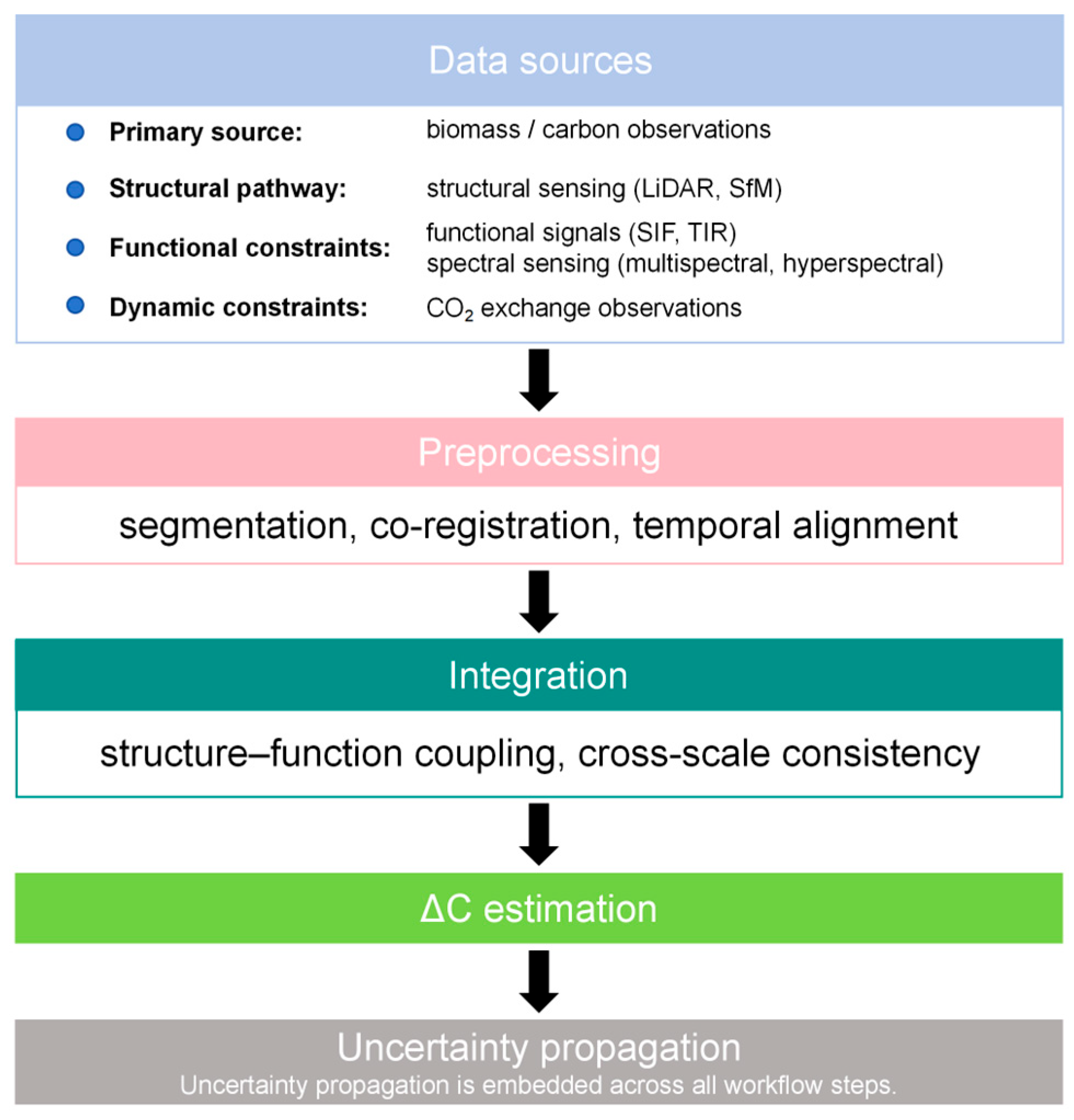
The implementation of the structure–function–scale framework can be formalized as a six-step operational workflow for multi-temporal ΔC estimation at the individual-plant scale: (1) multi-source data acquisition, (2) spatial delineation and alignment, (3) variable transformation and intermediate modeling, (4) cross-scale integration and consistency assessment, (5) multi-temporal ΔC estimation, and (6) uncertainty propagation and interpretation.
While the structure–function–scale framework provides a conceptual basis for integrating heterogeneous observations, its practical implementation requires a clearly defined operational workflow. In this context, ΔC estimation at the individual-plant scale can be understood as a multi-step process that links observations of structure, function, and carbon exchange through spatial alignment, variable transformation, and cross-scale integration.
The workflow begins with multi-source data acquisition, in which complementary observations are collected across different domains. Structural data, derived from LiDAR or SfM photogrammetry, provide 3D representations of plant architecture and serve as the primary basis for detecting biomass-related changes. Functional observations, including multispectral or hyperspectral reflectance, SIF, and TIR measurements, capture physiological and biochemical dynamics associated with carbon assimilation and stress responses. Flux-based measurements, obtained from chamber systems or EC, provide high-temporal-resolution information on CO2 exchange processes and carbon balance dynamics. These data sources differ fundamentally in spatial support, temporal resolution, and observational variables, and therefore require explicit harmonization before integration.
The second step involves spatial delineation and alignment of observations. Structural data are used to define the spatial boundaries of individual plants through segmentation and object-based identification. Multi-temporal datasets must be co-registered to ensure geometric consistency across observation dates, as even small misalignments can obscure subtle growth signals. For flux-based observations, additional spatial attribution is required. Organ-scale measurements can be directly associated with specific plant components, whereas ecosystem-scale fluxes, such as EC measurements, require footprint modeling to determine their spatial representativeness and cannot be directly attributed to individual plants without further assumptions.
The third step consists of variable transformation and intermediate modeling. Structural observations are converted into biomass estimates using allometric relationships, geometric reconstruction, or voxel-based modeling, and subsequently translated into carbon stock estimates through species-specific carbon conversion factors. Flux-based observations are temporally integrated to derive cumulative carbon exchange over defined intervals, but this integration alone does not yield ΔC as it does not account for carbon allocation and turnover processes. Functional observations are interpreted as proxies for physiological activity and are typically linked to carbon assimilation through models such as LUE frameworks or radiative transfer models. At this stage, each data source contributes a distinct type of information: structural data provide semi-direct estimates of carbon stock, flux data constrain carbon exchange dynamics, and functional data inform the physiological drivers of carbon accumulation. These distinctions clarify that structural data provide the primary estimation pathway for ΔC, whereas flux and functional observations serve as dynamic and physiological constraints, respectively.
The fourth step involves cross-scale integration and consistency assessment. Because observations originate from different spatial and temporal domains, their interpretations must be mutually consistent. Structural estimates of biomass increment should be compatible with the magnitude and temporal patterns of flux-derived carbon exchange, while functional indicators should reflect corresponding changes in physiological activity. Two complementary integration strategies can be distinguished. Empirical fusion combines structural and spectral features to improve predictive performance of biomass or carbon models, whereas consistency-constrained fusion explicitly incorporates biophysical or mass-balance relationships to ensure coherence between carbon inputs, outputs, and storage. In the latter approach, flux-derived carbon budgets provide boundary constraints that can be used to validate or adjust structural ΔC estimates. In practice, empirical fusion is more suitable for predictive modeling under data-rich conditions, whereas consistency-constrained fusion is particularly important for ensuring physically meaningful ΔC estimates when integrating heterogeneous observations across scales. This distinction provides a practical guideline for selecting appropriate fusion strategies depending on data availability, modeling objectives, and the requirement for physical consistency. More specifically, structural approaches are generally more robust for detecting long-term ΔC due to their direct linkage to biomass change, whereas functional and flux-based methods are more effective in capturing short-term variability but remain insufficient for standalone ΔC estimation.
The fifth step is the estimation of multi-temporal ΔC. At the individual-plant scale, ΔC is typically derived from repeated estimates of carbon stock, obtained either directly from structural measurements or indirectly through model-based inference. Structural differencing approaches quantify geometric changes between observation dates and translate these changes into biomass increments. When combined with functional and flux-based constraints, these estimates can be refined to account for temporal variability in carbon assimilation and allocation. However, it is important to recognize that ΔC estimation is fundamentally sensitive to the magnitude of measurement error relative to the true change signal, particularly over short time intervals. Among these approaches, structural differencing combined with biomass modeling remains the most robust pathway for ΔC estimation, while other data sources primarily contribute to reducing uncertainty and improving temporal consistency.
The final step involves uncertainty propagation and interpretation. Uncertainty arises from multiple sources, including measurement error, model parameterization, spatial scaling, and temporal differencing. More specifically, uncertainty sources can be categorized into three main types: (i) measurement uncertainty, arising from sensor precision and observation conditions; (ii) model uncertainty, associated with biomass models, radiative transfer inversion, and carbon allocation assumptions; and (iii) scaling uncertainty, resulting from mismatches in spatial and temporal support among data sources. These uncertainty components interact and propagate through the ΔC estimation process, highlighting the need for integrated uncertainty frameworks rather than isolated error assessments.
Because ΔC is often calculated as the difference between two estimates, error propagation can amplify uncertainty and obscure real changes. Therefore, uncertainty should be explicitly quantified and propagated throughout the workflow as an intrinsic component of ΔC estimation, rather than treated as a post hoc analysis. Approaches such as Monte Carlo simulation, error decomposition, and probabilistic modeling can be used to assess confidence intervals and determine the minimum detectable change.
Although these methods provide quantitative tools for propagating uncertainty, the relative importance of different uncertainty sources varies across the ΔC estimation workflow. For operational individual-plant monitoring, some errors directly affect the primary stock-change estimate, whereas others mainly influence physiological interpretation or cross-scale validation. Therefore, identifying the dominant uncertainty sources is necessary for prioritizing quality-control procedures and improving the reliability of multi-temporal ΔC estimation.
Table 4 summarizes the major uncertainty sources, their affected workflow steps, and their relative importance.
As summarized in
Table 4, the dominant uncertainties in operational individual-plant ΔC monitoring generally arise from segmentation, co-registration, and biomass model transferability. These uncertainties directly affect the primary stock-change estimate because ΔC is calculated from repeated carbon stock estimates. By contrast, uncertainties associated with SIF, TIR, spectral indices, and chamber-based measurements mainly influence the physiological interpretation, validation, and temporal constraint of ΔC rather than the primary stock-change calculation. Therefore, uncertainty control should first prioritize plant boundary consistency, cross-temporal alignment, and biomass model calibration before incorporating additional functional or flux-based constraints.
For instance, Monte Carlo simulation can propagate errors from allometric model parameters and LiDAR-derived height measurements through the biomass estimation step, while first-order Taylor series expansion can decompose uncertainty into contributions from measurement error, model parameterization, and scaling mismatch. Within the structure–function–scale framework, uncertainty is not treated as a secondary consideration but as an integral component of ΔC estimation. This is particularly critical because ΔC signals are often small relative to measurement uncertainty, making reliable change detection highly sensitive to error propagation. In practice, a minimum implementation of this workflow can rely primarily on multi-temporal structural observations for ΔC estimation, while functional and flux-based data, when available, are incorporated to constrain temporal consistency and reduce uncertainty.
Overall, this operational workflow clarifies how heterogeneous observations can be systematically combined to support robust estimation of individual-plant ΔC. By explicitly defining data inputs, transformation steps, integration mechanisms, and uncertainty pathways, the structure–function–scale framework is transformed from a conceptual model into a practical methodological tool for multi-temporal carbon monitoring.
For example, in a plantation monitoring scenario, annual UAV-LiDAR or UAV-SfM surveys can first be conducted to acquire multi-temporal three-dimensional structural data. Individual crowns are then segmented and co-registered across observation dates to ensure that the same plant boundary is compared over time. Structural metrics, including tree height, crown diameter, crown volume, and canopy density, are extracted for each individual plant and converted into aboveground biomass using locally calibrated allometric models. Carbon stock is then calculated using an appropriate carbon fraction, and individual-plant ΔC is obtained by temporal differencing between two observation dates.
Functional and flux-related observations can then be incorporated as complementary constraints. Seasonal multispectral or hyperspectral data can be used to characterize canopy greenness, pigment status, and phenological variability. SIF observations can provide information on photosynthetic activity, while TIR observations can indicate water stress and stomatal regulation. Limited chamber-based CO2 exchange measurements or plot-level EC observations can be used to validate temporal patterns and constrain physiological interpretation. However, these functional and flux-based data should not be treated as direct substitutes for stock-based ΔC estimation. Instead, they help explain why some individuals show higher or lower carbon stock increments under similar structural conditions.
The final outputs of this workflow include individual-plant ΔC estimates, uncertainty ranges, minimum detectable change, and spatial maps of carbon accumulation heterogeneity. In practical terms, such outputs can support precision plantation management by identifying trees or zones with low carbon accumulation efficiency, abnormal growth patterns, or strong physiological stress. This example demonstrates that the proposed framework can be implemented even when all data sources are not available simultaneously: repeated structural observations provide the minimum operational basis, while functional and flux-based measurements strengthen interpretation, validation, and uncertainty reduction.
3.5. Multi-Source Fusion and Cross-Scale Consistency in ΔC Estimation
Multi-source sensor fusion provides a critical pathway for translating heterogeneous structural and functional proxies into robust estimates of individual-plant ΔC. By integrating 3D structural metrics, spectral indicators, and CO2 exchange observations, fusion frameworks aim not only to combine heterogeneous data streams, but also to achieve cross-scale consistency across spatial and temporal dimensions.
A key challenge arises from cross-scale inconsistencies among structural observations, spectral signals, and flux measurements. These data sources often differ in spatial support, temporal resolution, and error characteristics, making direct integration difficult in multi-temporal carbon monitoring frameworks. This inconsistency constitutes a fundamental obstacle to achieving consistent ΔC estimation across observation domains.
Figure 4 shows that effective multi-source integration requires explicit consideration of scale inconsistencies, temporal alignment, and uncertainty propagation. Uncertainty in ΔC estimation arises from three main sources: (1) measurement error in structural and CO
2 exchange observations, (2) model uncertainty in biomass estimation and proxy inversion, and (3) scale mismatch across observation domains. These uncertainties propagate through temporal differencing and multi-source integration, and should be explicitly quantified using Monte Carlo simulation or probabilistic frameworks to ensure robust ΔC estimation. Within the proposed structure–function–scale framework, these factors are treated not as secondary technical issues but as core requirements for interpreting heterogeneous observations consistently. By integrating structural measurements, functional proxies, and environmental constraints within a unified workflow, multi-source fusion can substantially enhance the robustness of individual-plant ΔC monitoring.
Consistent with the operational workflow described in
Section 3.4, multi-source fusion can be implemented by establishing structural baselines, incorporating functional and CO
2 exchange constraints, and enforcing cross-scale consistency through uncertainty propagation.
Structural–spectral fusion is one of the most commonly used strategies for biomass and carbon stock estimation [
96,
97,
98]. Structural metrics help mitigate spectral saturation effects in dense canopies, while spectral features provide sensitivity to biochemical variation, thereby offering complementary constraints on biomass and productivity estimates. Such integration improves model robustness but still depends on accurate co-registration and cross-platform consistency.
Functional fusion further incorporates SIF and TIR indicators to constrain photosynthetic efficiency and water-stress regulation [
99,
100,
101]. By jointly analyzing biochemical and energy-balance signals, it becomes possible to distinguish structural growth limitations from physiological stress responses. However, these signals primarily reflect instantaneous assimilation dynamics and need to be integrated with structural measurements to inform ΔC estimation.
Heterogeneous fusion involving flux measurements introduces an additional consistency layer. Organ-scale chamber observations [
102,
103] and ecosystem-scale EC data [
1] provide dynamic constraints on CO
2 exchange processes. Comparing flux-derived CO
2-based carbon budgets with multi-temporal structural biomass increments enables mass-balance-based validation of ΔC estimates. In this review, CO
2-based carbon budgets are treated as the dominant component of carbon exchange in terrestrial vegetation systems, while non-CO
2 fluxes such as CH
4 are not explicitly considered. However, differences in temporal frequency between high-frequency flux measurements and lower-frequency structural surveys make direct reconciliation challenging. Together, these fusion strategies demonstrate that different data sources provide complementary constraints on ΔC estimation; however, their effective integration critically depends on achieving consistency across scales and observation domains.
Despite advances in multimodal modeling [
103,
104,
105], challenges remain in aligning heterogeneous data formats, spatial supports, and temporal resolutions. Structural point clouds, spectral imagery, and flux time series differ fundamentally in scale and error characteristics. Cross-temporal co-registration, species-specific variability, and model transferability further constrain reliable ΔC detection at the individual-plant scale.
Future development of individual-plant carbon monitoring systems should emphasize integrated structure–function–environment frameworks that explicitly address scale consistency, uncertainty propagation, and temporal alignment. Within the structure–function–scale paradigm (
Figure 1), multi-source fusion functions not only as a data integration process, but also as a mechanism for ensuring cross-scale consistency between proxy observations and measurable carbon stock change. This workflow highlights how heterogeneous observations can be combined to support robust ΔC estimation.
In this context, two complementary fusion paradigms can be distinguished. The first is empirical or statistical fusion, in which structural and spectral features are combined to improve the predictive performance of biomass or productivity models. This paradigm is primarily performance-oriented and is most suitable when prediction accuracy is the main objective and sufficiently representative training data are available. The second is consistency-constrained fusion, in which heterogeneous observations are integrated under explicit biophysical, mass-balance, or scale-consistency constraints so that flux-derived carbon budgets and structurally derived stock changes remain mutually interpretable within the same ΔC estimation framework. This paradigm is primarily interpretation-oriented and is most suitable when physically defensible ΔC estimates and cross-scale consistency are required. In practice, empirical fusion is preferable for data-rich predictive applications, whereas consistency-constrained fusion is preferable when explanatory coherence, uncertainty control, and physically meaningful integration across scales are the primary goals.
Such consistency-oriented approaches are particularly important for multi-temporal ΔC monitoring, as they help reduce bias accumulation across heterogeneous observations. More broadly, the proposed structure–function–scale framework provides the conceptual basis for identifying, propagating, and interpreting uncertainty across observation domains, thereby highlighting why multi-source data integration is essential for robust and defensible ΔC estimation.
The practical implementation of this fusion logic is further illustrated in the operational workflow described in
Section 3.4, where repeated structural observations provide the primary ΔC estimate and functional or flux-based data provide complementary constraints.
3.6. Integration of Structural and Functional Sensing Approaches
Modern remote sensing and proximal sensing approaches collectively provide complementary structural and functional information for individual-plant carbon monitoring, including both biomass-based ΔC estimation and flux-based carbon exchange assessment, yet each pathway remains insufficient when used alone. Structural sensing techniques, such as LiDAR and SfM, enable semi-direct detection of biomass increments through geometric characterization and multi-temporal differencing, and therefore serve as the primary remote proxy for individual-plant ΔC. By contrast, spectral and functional approaches—including multispectral indices, hyperspectral inversion, SIF, and TIR sensing—primarily capture physiological processes and short-term assimilation dynamics, offering insight into the functional drivers of carbon accumulation.
However, neither structural nor functional sensing alone can fully resolve cumulative carbon stock change. Structural observations are effective in quantifying growth-related changes but may overlook physiological variability, while functional indicators capture instantaneous processes without directly resolving carbon stock dynamics. Relying on a single sensing pathway may therefore result in incomplete or biased interpretation of ΔC.
Multi-source integration provides a critical mechanism for linking structural growth, physiological regulation, and carbon exchange dynamics across temporal scales. By combining geometric measurements with spectral and thermal indicators, it becomes possible to jointly constrain both biomass accumulation and physiological processes, which improves the interpretability and robustness of ΔC estimation.
Within the structure–function–scale framework (
Figure 1), sensing approaches function as an intermediate layer linking observable proxies to measurable carbon stock change. Their effectiveness depends on cross-scale consistency, accurate temporal alignment, and explicit handling of uncertainty. Because structural and functional sensing provide complementary rather than interchangeable constraints, their integration is essential for advancing reliable multi-temporal monitoring of individual-plant carbon dynamics and robust ΔC estimation.
4. Conclusions
This review provides a comprehensive synthesis of methodological approaches for monitoring multi-temporal ΔC at the individual-plant scale, integrating flux-based, stock-based, and sensing-based pathways within a unified structure–function–scale framework. Compared with existing reviews, the main contribution of this study lies in explicitly formalizing cross-scale consistency as a prerequisite for ΔC estimation and providing an operational workflow for integrating heterogeneous observations. Unlike previous reviews that primarily describe individual methods, this study explicitly addresses the fundamental challenge that ΔC estimation is constrained by inconsistencies in spatial support, temporal resolution, and uncertainty structures across observational approaches.
A central contribution of this work is the formalization of the structure–function–scale framework as an integrative perspective for ΔC monitoring. Within this framework, stock-based approaches define the primary estimation pathway for ΔC, structural sensing provides semi-direct constraints on biomass dynamics, and flux-based and functional sensing methods act as complementary constraints on carbon exchange processes. More importantly, the framework highlights that reliable ΔC estimation depends not only on measurement accuracy, but on the consistency of observations across spatial and temporal scales, which must be explicitly enforced through segmentation, co-registration, scaling, temporal alignment, and uncertainty propagation.
The synthesis demonstrates that no single method can simultaneously achieve high temporal continuity, spatial representativeness, and direct linkage to ΔC. Flux-based methods capture high-frequency physiological dynamics but suffer from spatial attribution limitations; stock-based approaches provide direct estimates of carbon accumulation but are constrained by temporal resolution and model uncertainty; and sensing-based approaches improve scalability but rely on indirect inference. These inherent trade-offs indicate that multi-source data fusion is not optional but essential for robust ΔC estimation. In this context, the proposed framework serves as a conceptual and methodological bridge, enabling the integration of heterogeneous observations into a consistent carbon monitoring system.
Importantly, this review emphasizes that uncertainty is not merely a secondary issue but a defining constraint in ΔC estimation, particularly when temporal changes are small relative to measurement error. Uncertainty arises from multiple sources, including measurement precision, model parameterization, scaling assumptions, and cross-temporal inconsistency. Addressing these uncertainties requires explicit propagation strategies and consistency-constrained integration across data sources, rather than relying on isolated improvements in individual methods.
From an application perspective, the structure–function–scale framework provides a basis for advancing carbon monitoring, reporting, and verification (MRV) systems by improving the traceability, consistency, and interpretability of ΔC estimates. By linking structural observations with functional constraints and cross-scale integration strategies, the framework supports the development of monitoring systems that are both operationally scalable and scientifically robust. Future work should focus on developing standardized workflows for integrating structural, functional, and flux observations, enabling reproducible and uncertainty-aware ΔC estimation across scales.
Based on the above synthesis, several practical recommendations can be proposed for future individual-plant ΔC monitoring. First, repeated stock-based or structural measurements should be used as the primary pathway for ΔC estimation, because they are most directly linked to biomass accumulation and carbon stock change. Second, flux-based and functional sensing observations should be used mainly as temporal, physiological, or validation constraints rather than as direct estimators of ΔC. Third, the spatial support of each data source should be explicitly reported, including whether the observation represents an organ, individual plant, crown, plot, canopy, or ecosystem footprint. Fourth, individual-plant segmentation and cross-temporal co-registration should be treated as core quality-control steps before calculating ΔC. Fifth, uncertainty should be propagated through the full workflow, including structural measurement, biomass model selection, carbon fraction assumptions, and temporal differencing. Sixth, when possible, local destructive or semi-destructive samples should be used to calibrate biomass models and reduce systematic bias. Finally, future studies should clearly distinguish among biomass, carbon stock, carbon stock change, CO2 exchange, and flux-derived productivity to avoid conceptual ambiguity.
In summary, this study moves beyond descriptive comparison toward a more integrative understanding of ΔC monitoring by (i) clarifying the roles and limitations of existing methods, (ii) identifying cross-scale consistency as a key requirement, and (iii) proposing a unified framework for multi-source data integration. Future progress will depend on further operationalizing this framework through explicit integration workflows, improved uncertainty quantification, and validation across diverse ecosystems. In particular, future studies should test whether integrating repeated structural observations with functional and flux-based constraints can improve estimation accuracy, temporal consistency, and interpretability of individual-plant ΔC estimates relative to structure-only approaches. Such developments are essential for enabling reliable, fine-scale carbon monitoring in support of global carbon neutrality goals.
Looking ahead, further advances in multi-temporal monitoring of individual-plant ΔC will depend on continued progress in both methodological integration and operational scalability. Building upon the proposed structure–function–scale framework, several key directions can be identified to guide future research and improve the robustness of ΔC estimation across observation domains.
First, strengthening multi-source data integration within the structure–function–scale framework remains essential. Future efforts should explicitly develop unified frameworks that couple structural, functional, and flux-based observations across spatial and temporal scales, enabling coherent interpretation of carbon dynamics. In particular, consistency-constrained fusion approaches that incorporate biophysical or mass-balance principles offer promising pathways for reducing bias and improving the robustness of ΔC estimation.
Second, improving cross-scale consistency and temporal alignment is critical within the structure–function–scale paradigm. Differences in spatial support, temporal resolution, and observation geometry among data sources continue to limit the reliability of ΔC detection. Future research should prioritize standardized protocols for co-registration, scaling, and temporal normalization to ensure consistent interpretation of carbon dynamics across observation domains. In particular, attention should be given to how structural, functional, and flux observations can be consistently aligned across scales, ensuring that proxy signals remain comparable and interpretable within a unified ΔC estimation framework.
Third, advancing uncertainty quantification and error propagation analysis is necessary for robust carbon monitoring within integrated structure–function–scale frameworks. Given that ΔC is often derived from small differences between repeated measurements, even minor errors can accumulate and significantly affect estimation accuracy. Developing explicit uncertainty propagation frameworks, as well as integrating probabilistic and Monte Carlo-based approaches, will be important for improving confidence in ΔC estimates. Future work should explicitly link uncertainty sources across structural measurements, functional proxies, and flux observations, thereby enabling consistent uncertainty propagation across observation domains.
Fourth, the integration of emerging technologies, including machine learning, high-throughput phenotyping, and automated sensing systems, provides new opportunities for improving monitoring efficiency and scalability. Data-driven models, when combined with physically based and structure–function constraints, may enhance predictive performance while maintaining interpretability and consistency with underlying carbon processes.
Finally, the development of standardized and operational monitoring systems is crucial for bridging research and practical applications. Future monitoring frameworks should aim to support large-scale deployment, automation, and interoperability with existing carbon accounting and verification systems, particularly within MRV frameworks, where consistent, transparent, and scalable ΔC estimation is required. In this context, the proposed framework can support the development of operational monitoring systems that bridge fine-scale observations with large-scale carbon accounting and verification requirements.
By shifting the paradigm from comparing isolated techniques to enforcing cross-scale consistency, this framework provides the necessary blueprint for building the next generation of operational, MRV-ready carbon monitoring systems that are essential for achieving global carbon neutrality goals.
Author Contributions
Conceptualization, R.R. and L.Q.; methodology, R.R. and L.Q.; formal analysis, R.R., L.Q., K.Z. and C.Z.; investigation, R.R., M.Z., W.X. and M.L.; visualization, R.R., K.Z., C.Z. and M.L.; writing—original draft preparation, R.R., K.Z. and L.Q.; writing—review and editing, R.R., L.Q., M.Z., W.X. and M.L.; supervision, L.Q.; funding acquisition, L.Q., M.Z. and W.X. All authors have read and agreed to the published version of the manuscript.
Funding
We express our heartfelt thanks to the following funding sources: Jiangsu Agriculture Science and Technology Innovation Fund (CX (23) 1027), Maocheng Zhao. Jinpu Research Institute Research Special Funds Project (NLJP0005), Liang Qi. National Natural Science Foundation of China (NSFC), 32402209, Weijun Xie. Jiangsu Innovation and Entrepreneurship Training Program for College Students [No.202410298131Y], Liang Qi. Metasequoia Faculty Research Initiation Fee Project [No.163040193], Liang Qi.
Data Availability Statement
Data are contained within the article.
Acknowledgments
The authors would like to thank Tang Hao, Meng He, Hongqian Zhuo and Xingming Wu for their support of this work at Jiangsu Xuzhou Changrong Agricultural Development, China.
Conflicts of Interest
The authors declare no conflicts of interest.
Abbreviations
ΔC, Carbon stock change; 3D, Three-dimensional; AGB, aboveground biomass; BEF, biomass expansion factor; CHM, canopy height model; CO2, carbon dioxide; CWSI, crop water stress index; DBH, diameter at breast height; DSM, digital surface model; EC, eddy covariance; EVI, enhanced vegetation index; FLUXNET, Flux Network; FSPMs, functional–structural plant models; GHG, greenhouse gas; GLCM, gray-level co-occurrence matrix; GPP, gross primary productivity; IRGA, infrared gas analyzer; Jmax, maximum electron transport rate; LAI, leaf area index; LiDAR, light detection and ranging; LUE, light use efficiency; MRV, measurement, reporting, and verification; NDVI, normalized difference vegetation index; NEE, net ecosystem exchange; NEP, net ecosystem productivity; PROSAIL, PROSPECT + SAIL radiative transfer; Reco, ecosystem respiration; SfM, structure-from-motion; SIF, solar-induced chlorophyll fluorescence; TIR, thermal infrared; TLS, terrestrial laser scanning; UAV, unmanned aerial vehicle; VIs, vegetation indices; Vcmax, maximum carboxylation rate of Rubisco; WD, wood density.
Appendix A. Glossary of Key Terms
This glossary provides definitions for key terms used throughout the paper to aid in understanding the technical concepts and terminology associated with carbon estimation.
| Terms | Definition |
| stock-based methods | Methods that estimate carbon stock change by quantifying biomass or carbon storage over time through repeated structural measurements or biomass reconstruction. These methods often rely on inventory measurements, tree-ring analysis, allometric models, or structurally derived biomass estimates to calculate carbon storage and its temporal change. |
| flux-based methods | Methods that estimate carbon exchange dynamics by measuring CO2 exchange associated with photosynthesis and respiration. These methods often rely on chamber-based observations or eddy covariance data to characterize carbon uptake and release and subsequently provide process-based constraints for carbon stock-change estimation. Unless otherwise noted, “flux-based” in this review refers specifically to CO2 exchange associated with photosynthesis and respiration, rather than all ecosystem-level carbon exchange pathways. |
| ΔC estimation | The process of estimating changes in plant carbon stock over time. In this review, ΔC estimation primarily relies on repeated biomass or carbon stock assessment, while flux-based and functional observations provide complementary constraints on interpretation, temporal consistency, and uncertainty reduction. |
| remote sensing-based ΔC estimation | Methods that estimate carbon stock change (ΔC) indirectly from remotely sensed structural or functional signals. These methods often rely on empirical models or process-based interpretation to relate remotely sensed observations to biomass dynamics and subsequently infer carbon stock change. |
| cross-scale consistency | The requirement that observations and derived variables remain physically and logically coherent across spatial or temporal scales. This concept often relies on scaling and harmonization procedures to ensure that integrated observations remain comparable and interpretable. |
| uncertainty propagation | The process by which uncertainty in input data, models, or measurements is carried through calculations or models to affect final estimates. It involves determining how errors or variability in individual components contribute to overall uncertainty in the final output, especially in complex systems where multiple variables interact. |
| structural sensing | Measurements that capture plant geometry and biomass-related properties. These methods often rely on LiDAR or photogrammetric data to characterize structural attributes and subsequently support biomass and carbon stock estimation. |
| functional sensing | Measurements that capture physiological and biochemical processes associated with carbon assimilation and stress responses. These methods often rely on spectral, fluorescence, or thermal observations to characterize plant functional status and subsequently provide indirect constraints on carbon dynamics. |
| multi-source data integration | The process of combining structural, functional, flux-based, and other complementary observations to improve estimation accuracy and reliability of ΔC estimation. This integrated approach helps achieve consistency across spatial and temporal scales in carbon monitoring. |
| consistency-constrained fusion | Data integration approaches that explicitly enforce biophysical or mass-balance relationships among heterogeneous observations. These approaches often rely on multiple data sources to ensure coherence among carbon inputs, outputs, and storage during ΔC estimation. |
References
- Baldocchi, D.D. Assessing the eddy covariance technique for evaluating carbon dioxide exchange rates of ecosystems: Past, present and future. Glob. Change Biol. 2003, 9, 479–492. [Google Scholar] [CrossRef] [Scilit]
- Pastorello, G.; Trotta, C.; Canfora, E.; Chu, H.; Christianson, D.; Cheah, Y.-W.; Poindexter, C.; Chen, J.; Elbashandy, A.; Humphrey, M.; et al. The FLUXNET2015 dataset and the ONEFlux processing pipeline for eddy covariance data. Sci. Data 2020, 7, 225. [Google Scholar] [CrossRef] [Scilit] [PubMed]
- Asner, G.P.; Mascaro, J. Mapping tropical forest carbon: Calibrating plot estimates to a simple LiDAR metric. Remote Sens. Environ. 2014, 140, 614–624. [Google Scholar] [CrossRef] [Scilit]
- Chave, J.; Andalo, C.; Brown, S.; Cairns, M.A.; Chambers, J.Q.; Eamus, D.; Fölster, H.; Fromard, F.; Higuchi, N.; Kira, T.; et al. Tree allometry and carbon stock estimation in tropical forests. Oecologia 2005, 145, 87–99. [Google Scholar] [CrossRef] [Scilit] [PubMed]
- IPCC. 2006 IPCC Guidelines for National Greenhouse Gas Inventories; Volume 4: Agriculture, Forestry and Other Land Use; IGES: Hayama, Japan, 2006; Available online: https://www.ipcc-nggip.iges.or.jp/public/2006gl/ (accessed on 18 April 2026).
- Luyssaert, S.; Schulze, E.-D.; Börner, A.; Knohl, A.; Hessenmöller, D.; Law, B.; Ciais, P.; Grace, J. Old-growth forests as global carbon sinks. Nature 2008, 455, 213–215. [Google Scholar] [CrossRef] [Scilit]
- Farquhar, G.D.; von Caemmerer, S.; Berry, J.A. A biochemical model of photosynthetic CO2 assimilation in leaves of C3 species. Planta 1980, 149, 78–90. [Google Scholar] [CrossRef] [Scilit]
- Long, S.P.; Bernacchi, C.J. Gas exchange measurements: What can they tell us about the underlying limitations to photosynthesis? Procedures and sources of error. J. Exp. Bot. 2003, 54, 2393–2401. [Google Scholar] [CrossRef] [Scilit]
- Sharkey, T.D.; Bernacchi, C.J.; Farquhar, G.D.; Singsaas, E.L. Fitting photosynthetic carbon dioxide response curves for C3 leaves. Plant Cell Environ. 2007, 30, 1035–1040. [Google Scholar] [CrossRef] [Scilit]
- Damesin, C.; Ceschia, E.; Le Goff, N.; Ottorini, J.M.; Dufrêne, E. Stem and branch respiration of beech: From plant measurements to estimations at the stand level. New Phytol. 2002, 153, 159–172. [Google Scholar] [CrossRef] [Scilit]
- Ryan, M.G.; Hubbard, R.M.; Clark, D.A.; Sanford, R.L., Jr. Woody-tissue respiration for Simarouba amara and Minquartia guianensis, two tropical wet forest trees. Oecologia 1994, 100, 213–220. [Google Scholar] [CrossRef] [Scilit] [PubMed]
- von Caemmerer, S.; Evans, J.R. Enhancing C3 photosynthesis. Plant Physiol. 2010, 154, 589–592. [Google Scholar] [CrossRef] [Scilit]
- Pons, T.L.; Welschen, R.A.M. Overestimation of respiration rates in commercially available clamp-on leaf chambers: Complications with measurement of net photosynthesis. Plant Cell Environ. 2002, 25, 1367–1372. [Google Scholar] [CrossRef] [Scilit]
- Flexas, J.; Ribas-Carbó, M.; Diaz-Espejo, A.; Galmés, J.; Medrano, H. Mesophyll conductance to CO2: Current knowledge and future prospects. Plant Cell Environ. 2008, 31, 602–621. [Google Scholar] [CrossRef] [Scilit]
- Teskey, R.O.; McGuire, M.A. Carbon dioxide transport in xylem causes errors in estimation of rates of respiration in stems and branches of trees. Plant Cell Environ. 2002, 25, 1571–1577. [Google Scholar] [CrossRef] [Scilit]
- Hölttä, T.; Kolari, P. Interpretation of stem CO2 efflux measurements. Tree Physiol. 2009, 29, 1447–1456. [Google Scholar] [CrossRef] [Scilit] [PubMed]
- Saveyn, A.; Steppe, K.; Lemeur, R. Daytime depression in plant stem CO2 efflux rates: Is it caused by low stem turgor pressure? Ann. Bot. 2007, 99, 477–485. [Google Scholar] [CrossRef] [Scilit]
- McGuire, M.A.; Teskey, R.O. Estimating stem respiration in trees by a mass balance approach that accounts for internal and external fluxes of CO2. Tree Physiol. 2004, 24, 571–578. [Google Scholar] [CrossRef] [Scilit]
- Bloemen, J.; McGuire, M.A.; Aubrey, D.P.; Teskey, R.O.; Steppe, K. Transport of root-respired CO2 via the transpiration stream affects aboveground carbon assimilation and CO2 efflux in trees. New Phytol. 2013, 197, 555–565. [Google Scholar] [CrossRef] [Scilit] [PubMed]
- Barton, C.V.; Ellsworth, D.S.; Medlyn, B.E.; Duursma, R.A.; Tissue, D.T.; Adams, M.A.; Eamus, D.; Conroy, J.P.; McMurtrie, R.E.; Parsby, J.; et al. Whole-tree chambers for elevated atmospheric CO2 experimentation and tree-scale flux measurements. Agric. For. Meteorol. 2010, 150, 941–951. [Google Scholar] [CrossRef] [Scilit]
- Pavelka, M.; Acosta, M.; Kiese, R.; Altimir, N.; Brümmer, C.; Crill, P.; Darenova, E.; Fuß, R.; Gielen, B.; Graf, A.; et al. Standardisation of chamber technique for CO2, N2O and CH4 flux measurements from terrestrial ecosystems. Int. Agrophysics 2018, 32, 569–587. [Google Scholar] [CrossRef] [Scilit]
- Kutzbach, L.; Schneider, J.; Sachs, T.; Giebels, M.; Nykänen, H.; Shurpali, N.J.; Martikainen, P.J.; Alm, J.; Wilmking, M. CO2 flux determination by closed-chamber methods can be biased by inappropriate regression. Biogeosciences 2007, 4, 1005–1025. [Google Scholar] [CrossRef] [Scilit]
- Breuninger, C.; Oswald, R.; Kesselmeier, J.; Meixner, F.X. The dynamic chamber method: Trace gas exchange fluxes between plants and the atmosphere in the laboratory and in the field. Atmos. Meas. Tech. 2012, 5, 955–989. [Google Scholar] [CrossRef] [Scilit]
- Mu, J.; Qi, J.; Yu, H.; Hu, C.; Mu, Y.; Qu, J. Dynamic chamber as a more reliable technique for measuring methane emissions from aquatic ecosystems. Sci. Total Environ. 2022, 851, 158147. [Google Scholar] [CrossRef] [Scilit]
- Steduto, P.; Çetinkökü, Ö.; Albrizio, R.; Kanber, R. Automated closed-system canopy chamber for continuous field-crop monitoring of CO2 and H2O fluxes. Agric. For. Meteorol. 2002, 111, 171–186. [Google Scholar] [CrossRef] [Scilit]
- Guidolotti, G.; De Dato, G.; Liberati, D.; De Angelis, P. Canopy chamber: A useful tool to monitor the CO2 exchange dynamics of shrubland. iForest 2017, 10, 597–603. [Google Scholar] [CrossRef] [Scilit]
- Riederer, M.; Serafimovich, A.; Foken, T. Net ecosystem CO2 exchange measurements by the closed chamber method and the eddy covariance technique and their dependence on atmosphere conditions. Atmos. Meas. Tech. 2014, 7, 1057–1064. [Google Scholar] [CrossRef] [Scilit]
- Salvatori, N.; Giorgio, A.; Muller, O.; Rascher, U.; Peressotti, A. A low-cost automated growth chamber system for continuous measurements of gas exchange. Plant Methods 2021, 17, 69. [Google Scholar] [CrossRef] [Scilit]
- Boonman, J.; Buzacott, A.J.; van den Berg, M.; van Huissteden, C.; van der Velde, Y. Transparent automated CO2 flux chambers reveal spatial and temporal patterns of net from managed peatlands. Ecol. Indic. 2024, 164, 112121. [Google Scholar] [CrossRef] [Scilit]
- Wang, K.; Liu, C.; Zheng, X.; Pihlatie, M.; Li, B.; Haapanala, S.; Vesala, T.; Liu, H.; Wang, Y.; Liu, G.; et al. Comparison between eddy covariance and automatic chamber techniques. Biogeosciences 2013, 10, 6865–6877. [Google Scholar] [CrossRef] [Scilit]
- Koskinen, M.; Minkkinen, K.; Ojanen, P.; Kämäräinen, M.; Laurila, T.; Lohila, A. Measurements of CO2 exchange with an automated chamber system throughout the year. Biogeosciences 2014, 11, 347–363. [Google Scholar] [CrossRef] [Scilit]
- Shin, T.; Xue, W.; Ko, J. Construction of a new LED chamber to measure net ecosystem exchange. Sci. Rep. 2023, 13, 11850. [Google Scholar] [CrossRef] [Scilit]
- Al Hamwi, W.; Dubbert, M.; Schaller, J.; Lück, M.; Schmidt, M.; Hoffmann, M. A low-cost enclosure system to investigate CO2 flux dynamics. Biogeosciences 2024, 21, 5639–5651. [Google Scholar] [CrossRef] [Scilit]
- Burgess, A.J.; Retkute, R.; Pound, M.P.; Foulkes, J.; Preston, S.P.; Jensen, O.E.; Pridmore, T.P.; Murchie, E.H. High-resolution 3D structural data quantify carbon gain in wheat canopies. Plant Physiol. 2015, 169, 1192–1204. [Google Scholar] [CrossRef] [Scilit]
- Baldocchi, D.D.; Hincks, B.B.; Meyers, T.P. Measuring biosphere–atmosphere exchanges using micrometeorological methods. Ecology 1988, 69, 1331–1340. [Google Scholar] [CrossRef] [Scilit]
- Aubinet, M.; Vesala, T.; Papale, D. Eddy Covariance: A Practical Guide to Measurement and Data Analysis; Springer: Dordrecht, The Netherlands, 2012. [Google Scholar] [CrossRef] [Scilit]
- Reichstein, M.; Falge, E.; Baldocchi, D.; Papale, D.; Aubinet, M.; Berbigier, P.; Bernhofer, C.; Buchmann, N.; Gilmanov, T.; Granier, A.; et al. On the separation of net ecosystem exchange into assimilation and respirationand ecosystem respiration: Review and improved algorithm. Glob. Change Biol. 2005, 11, 1424–1439. [Google Scholar] [CrossRef] [Scilit]
- Hollinger, D.Y.; Aber, J.; Dail, B.; Davidson, E.A.; Goltz, S.M.; Hughes, H.; Leclerc, M.Y.; Lee, J.T.; Richardson, A.D.; Rodrigues, C.; et al. Spatial and temporal variability in forest–atmosphere CO2 exchange. Glob. Change Biol. 2004, 10, 1689–1706. [Google Scholar] [CrossRef] [Scilit]
- Rannik, Ü.; Sogachev, A.; Foken, T.; Göckede, M.; Kljun, N.; Leclerc, M.Y.; Vesala, T. Footprint analysis. In Eddy Covariance; Springer: Dordrecht, The Netherlands, 2011; pp. 211–261. [Google Scholar] [CrossRef] [Scilit]
- Aubinet, M. Eddy covariance CO2 flux measurements in nocturnal conditions. Ecol. Appl. 2008, 18, 1368–1378. [Google Scholar] [CrossRef] [Scilit] [PubMed]
- Monteith, J.L. Solar radiation and productivity in tropical ecosystems. J. Appl. Ecol. 1972, 9, 747–766. [Google Scholar] [CrossRef] [Scilit]
- Ketterings, Q.M.; Coe, R.; van Noordwijk, M.; Palm, C.A. Reducing uncertainty in allometric biomass equations. For. Ecol. Manag. 2001, 146, 199–209. [Google Scholar] [CrossRef] [Scilit]
- Picard, N.; Saint-André, L.; Henry, M. Manual for Building Tree Volume and Biomass Allometric Equations; FAO: Rome, Italy, 2012; Available online: http://foris.fao.org/static/allometric/Manual_EN_WEB.pdf (accessed on 30 March 2026).
- Brown, S. Estimating Biomass and Biomass Change of Tropical Forests: A Primer; FAO: Rome, Italy, 1997; Available online: https://www.fao.org/4/w4095e/w4095e00.htm (accessed on 30 March 2026).
- Clark, D.B.; Clark, D.A. Landscape-scale variation in forest structure and biomass. For. Ecol. Manag. 2000, 137, 185–198. [Google Scholar] [CrossRef] [Scilit]
- Speer, J.H. Fundamentals of Tree-Ring Research; University of Arizona Press: Tucson, AZ, USA, 2010. [Google Scholar]
- Pretzsch, H. Forest Dynamics, Growth and Yield; Springer: Berlin, Germany, 2009. [Google Scholar] [CrossRef] [Scilit]
- Fritts, H.C. Tree Rings and Climate; Academic Press: London, UK, 1976. [Google Scholar] [CrossRef] [Scilit]
- Babst, F.; Poulter, B.; Trouet, V.; Tan, K.; Neuwirth, B.; Wilson, R.; Carrer, M.; Grabner, M.; Tegel, W.; Levanic, T.; et al. Site- and species-specific responses of forest growth to climate. Glob. Ecol. Biogeogr. 2013, 22, 706–717. [Google Scholar] [CrossRef] [Scilit]
- Brede, B.; Terryn, L.; Barbier, N.; Bartholomeus, H.M.; Bartolo, R.; Calders, K.; Derroire, G.; Moorthy, S.M.K.; Lau, A.; Levick, S.R.; et al. Non-destructive estimation of individual tree biomass. Remote Sens. Environ. 2022, 280, 113180. [Google Scholar] [CrossRef] [Scilit]
- Chave, J.; Réjou-Méchain, M.; Búrquez, A.; Chidumayo, E.; Colgan, M.S.; Delitti, W.B.; Duque, A.; Eid, T.; Fearnside, P.M.; Goodman, R.C.; et al. Improved allometric models to estimate aboveground biomass of tropical trees. Glob. Change Biol. 2014, 20, 3177–3190. [Google Scholar] [CrossRef] [Scilit]
- Carle, H.; Neeman, T.; Murphy, H.; Bauman, D.; Binks, O.; Coughlin, I.; Ford, A.; Nicotra, A.; Meir, P. Contributions of height allometry and within-species trait variation to uncertainty in estimates of tropical forest carbon stocks. Forestry 2025, cpaf084. [Google Scholar] [CrossRef] [Scilit]
- Holdaway, R.J.; McNeill, S.J.; Mason, N.W.; Carswell, F.E. Propagating Uncertainty in Plot-based Estimates of Forest Carbon Stock and Carbon Stock Change. Ecosystems 2014, 17, 627–640. [Google Scholar] [CrossRef] [Scilit]
- Catchpole, W.R.; Wheeler, C.J. Estimating plant biomass: A review of techniques. Aust. J. Ecol. 1992, 17, 121–131. [Google Scholar] [CrossRef] [Scilit]
- Pearson, T.; Walker, S.; Brown, S. Sourcebook for Land Use, Land-Use Change and Forestry Projects; World Bank: Washington, DC, USA, 2005; Available online: https://documents.worldbank.org/en/publication/documents-reports/documentdetail/285391468335978463/sourcebook-for-land-use-land-use-change-and-forestry-projects (accessed on 30 March 2026).
- Huynh, T.; Lee, D.J.; Applegate, G.; Lewis, T. Field methods for above and belowground biomass estimation in plantation forests. MethodsX 2021, 8, 101192. [Google Scholar] [CrossRef] [Scilit]
- Henry, M.; Picard, N.; Trotta, C.; Manlay, R.J.; Valentini, R.; Bernoux, M.; Saint-André, L. Estimating tree biomass of sub-Saharan African forests: A review of available allometric equations. Silva Fenn. 2011, 45, 477–569. [Google Scholar] [CrossRef] [Scilit]
- Lefsky, M.A.; Cohen, W.B.; Parker, G.G.; Harding, D.J. Lidar remote sensing for ecosystem studies: Lidar, an emerging remote sensing technology that directly measures the three-dimensional distribution of plant canopies, can accurately estimate vegetation structural attributes and should be of particular interest to forest, landscape, and global ecologists. BioScience 2002, 52, 19–30. [Google Scholar] [CrossRef] [Scilit]
- Hosoi, F.; Omasa, K. Voxel-based 3-D modeling of individual trees for estimating leaf area density using high-resolution portable scanning lidar. IEEE Trans. Geosci. Remote Sens. 2006, 44, 3610–3618. [Google Scholar] [CrossRef] [Scilit]
- Wilkes, P.; Lau, A.; Disney, M.; Calders, K.; Burt, A.; de Tanago, J.G.; Bartholomeus, H.; Brede, B.; Herold, M. Data acquisition considerations for terrestrial laser scanning. Remote Sens. Environ. 2017, 196, 140–153. [Google Scholar] [CrossRef] [Scilit]
- Calders, K.; Newnham, G.; Burt, A.; Murphy, S.; Raumonen, P.; Herold, M.; Culvenor, D.; Avitabile, V.; Disney, M.; Armston, J.; et al. Nondestructive estimates of above-ground biomass using terrestrial laser scanning. Methods Ecol. Evol. 2015, 6, 198–208. [Google Scholar] [CrossRef] [Scilit]
- Wallace, L.; Lucieer, A.; Malenovský, Z.; Turner, D.; Vopěnka, P. Assessment of forest structure using two UAV techniques: A comparison of airborne laser scanning and structure from motion (SfM) point clouds. Forests 2016, 7, 62. [Google Scholar] [CrossRef] [Scilit]
- Calders, K.; Adams, J.; Armston, J.; Bartholomeus, H.; Bauwens, S.; Bentley, L.P.; Chave, J.; Danson, F.M.; Demol, M.; Disney, M.; et al. Terrestrial laser scanning in forest ecology: Expanding the horizon. Remote Sens. Environ. 2020, 251, 112102. [Google Scholar] [CrossRef] [Scilit]
- Disney, M. Terrestrial LiDAR: A three-dimensional revolution in how we look at trees. New Phytol. 2019, 222, 1736–1741. [Google Scholar] [CrossRef] [Scilit]
- Westoby, M.J.; Brasington, J.; Glasser, N.F.; Hambrey, M.J.; Reynolds, J.M. ‘Structure-from-Motion’ photogrammetry: A low-cost, effective tool for geoscience applications. Geomorphology 2012, 179, 300–314. [Google Scholar] [CrossRef] [Scilit]
- Dandois, J.P.; Ellis, E.C. High spatial resolution three-dimensional mapping of vegetation spectral dynamics using computer vision. Remote Sens. Environ. 2013, 136, 259–276. [Google Scholar] [CrossRef] [Scilit]
- Bendig, J.; Yu, K.; Aasen, H.; Bolten, A.; Bennertz, S.; Broscheit, J.; Bareth, G. Combining UAV-based plant height from crop surface models and vegetation indices for biomass monitoring in barley. Int. J. Appl. Earth Obs. Geoinf. 2015, 39, 79–87. [Google Scholar] [CrossRef] [Scilit]
- James, M.R.; Robson, S. Straightforward reconstruction of 3D surfaces and topography with a camera: Accuracy and geoscience application. J. Geophys. Res. Earth Surf. 2012, 117, F03012. [Google Scholar] [CrossRef] [Scilit]
- Fonstad, M.A.; Dietrich, J.T.; Courville, B.C.; Jensen, J.L.; Carbonneau, P.E. Topographic structure from motion: A new development in photogrammetric measurement. Earth Surf. Process. Landf. 2013, 38, 421–430. [Google Scholar] [CrossRef] [Scilit]
- Iglhaut, J.; Cabo, C.; Puliti, S.; Piermattei, L.; O’Connor, J.; Rosette, J. Structure from motion photogrammetry in forestry: A review. Curr. For. Rep. 2019, 5, 155–168. [Google Scholar] [CrossRef] [Scilit]
- James, M.R.; Robson, S.; Smith, M.W. 3-D uncertainty-based topographic change detection with structure-from-motion photogrammetry. Earth Surf. Process. Landf. 2017, 42, 1769–1788. [Google Scholar] [CrossRef] [Scilit]
- Berni, J.A.J.; Zarco-Tejada, P.J.; Suárez, L.; González-Dugo, V.; Fereres, E. Remote sensing of vegetation from UAV platforms using lightweight multispectral and thermal imaging sensors. Int. Arch. Photogramm. Remote Sens. Spat. Inform. Sci. 2009, 38, 6. [Google Scholar]
- Tucker, C.J. Red and photographic infrared linear combinations for monitoring vegetation. Remote Sens. Environ. 1979, 8, 127–150. [Google Scholar] [CrossRef] [Scilit]
- Huete, A.; Didan, K.; Miura, T.; Rodriguez, E.P.; Gao, X.; Ferreira, L.G. Overview of the radiometric and biophysical performance of the MODIS vegetation indices. Remote Sens. Environ. 2002, 83, 195–213. [Google Scholar] [CrossRef] [Scilit]
- Haralick, R.M.; Shanmugam, K.; Dinstein, I.H. Textural features for image classification. IEEE Trans. Syst. Man. Cybern. 1973, SMC-3, 610–621. [Google Scholar] [CrossRef] [Scilit]
- Zhang, X.; Friedl, M.A.; Schaaf, C.B.; Strahler, A.H.; Hodges, J.C.; Gao, F.; Huete, A. Monitoring vegetation phenology using MODIS. Remote Sens. Environ. 2003, 84, 471–475. [Google Scholar] [CrossRef] [Scilit]
- Myneni, R.B.; Maggion, S.; Iaquinta, J.; Privette, J.L.; Gobron, N.; Pinty, B.; Williams, D.L. Optical remote sensing of vegetation: Modeling, caveats, and algorithms. Remote Sens. Environ. 1995, 51, 169–188. [Google Scholar] [CrossRef] [Scilit]
- Atkinson, P.M.; Tate, N.J. Spatial scale problems and geostatistical solutions: A review. Prof. Geogr. 2000, 52, 607–623. [Google Scholar] [CrossRef] [Scilit]
- Furbank, R.T.; Tester, M. Phenomics—Technologies to relieve the phenotyping bottleneck. Trends Plant Sci. 2011, 16, 635–644. [Google Scholar] [CrossRef] [Scilit] [PubMed]
- Tardieu, F.; Cabrera-Bosquet, L.; Pridmore, T.; Bennett, M. Plant phenomics, from sensors to knowledge. Curr. Biol. 2017, 27, R770–R783. [Google Scholar] [CrossRef] [Scilit] [PubMed]
- Virlet, N.; Sabermanesh, K.; Sadeghi-Tehran, P.; Hawkesford, M.J. Field Scanalyzer: An automated robotic field phenotyping platform. Funct. Plant Biol. 2016, 44, 143–153. [Google Scholar] [CrossRef] [Scilit]
- Liang, S.; Fang, H.; Chen, M. Atmospheric correction of Landsat ETM+ land surface imagery: Methods. IEEE Trans. Geosci. Remote Sens. 2002, 39, 2490–2498. [Google Scholar] [CrossRef] [Scilit]
- Gitelson, A.A.; Viña, A.; Ciganda, V.; Rundquist, D.C.; Arkebauer, T.J. Remote estimation of canopy chlorophyll content in crops. Geophys. Res. Lett. 2005, 32, L08403. [Google Scholar] [CrossRef] [Scilit]
- Jacquemoud, S.; Verhoef, W.; Baret, F.; Bacour, C.; Zarco-Tejada, P.J.; Asner, G.P.; Ustin, S.L. PROSPECT+SAIL models: A review of use for vegetation characterization. Remote Sens. Environ. 2009, 113, S56–S66. [Google Scholar] [CrossRef] [Scilit]
- Vos, J.; Evers, J.B.; Buck-Sorlin, G.H.; Andrieu, B.; Chelle, M.; De Visser, P.H. Functional–structural plant modelling: A versatile tool in crop science. J. Exp. Bot. 2010, 61, 2101–2115. [Google Scholar] [CrossRef] [Scilit]
- Myneni, R.B.; Hall, F.G.; Sellers, P.J.; Marshak, A.L. The interpretation of spectral vegetation indexes. IEEE Trans. Geosci. Remote Sens. 1995, 33, 481–486. [Google Scholar] [CrossRef] [Scilit]
- Porcar-Castell, A.; Tyystjärvi, E.; Atherton, J.; Van der Tol, C.; Flexas, J.; Pfündel, E.E.; Berry, J.A. Linking chlorophyll fluorescence to photosynthesis for remote sensing applications: Mechanisms and challenges. J. Exp. Bot. 2014, 65, 4065–4095. [Google Scholar] [CrossRef] [Scilit]
- Frankenberg, C.; O’Dell, C.; Guanter, L.; McDuffie, J. Remote sensing of near-infrared chlorophyll fluorescence from space in scattering atmospheres: Implications for its retrieval and interferences with atmospheric CO2 retrievals. Atmos. Meas. Tech. 2012, 5, 2081–2094. [Google Scholar] [CrossRef] [Scilit]
- Guanter, L.; Zhang, Y.; Jung, M.; Joiner, J.; Voigt, M.; Berry, J.A.; Griffis, T.J. Global and time-resolved monitoring of crop photosynthesis with chlorophyll fluorescence. Proc. Natl. Acad. Sci. USA 2014, 111, E1327–E1333. [Google Scholar] [CrossRef] [Scilit] [PubMed]
- Köhler, P.; Frankenberg, C.; Magney, T.S.; Guanter, L.; Joiner, J.; Landgraf, J. Global retrievals of solar-induced chlorophyll fluorescence with TROPOMI: First results and intersensor comparison to OCO-2. Geophys. Res. Lett. 2018, 45, 10456–10463. [Google Scholar] [CrossRef] [Scilit]
- Yang, X.; Tang, J.; Mustard, J.F.; Lee, J.E.; Rossini, M.; Joiner, J.; Richardson, A.D. Solar-induced chlorophyll fluorescence that correlates with canopy photosynthesis on diurnal and seasonal scales in a temperate deciduous forest. Geophys. Res. Lett. 2015, 42, 2977–2987. [Google Scholar] [CrossRef] [Scilit]
- Jackson, R.D.; Idso, S.B.; Reginato, R.J.; Pinter, P.J. Canopy temperature as a crop water stress indicator. Water Resour. Res. 1981, 17, 1133–1138. [Google Scholar] [CrossRef] [Scilit]
- Jones, H.G. Use of infrared thermometry for estimation of stomatal conductance. Agric. For. Meteorol. 1999, 95, 139–149. [Google Scholar] [CrossRef] [Scilit]
- Jones, H.G. Application of thermal imaging and infrared sensing in plant physiology. Adv. Bot. Res. 2004, 41, 107–163. [Google Scholar] [CrossRef] [Scilit]
- Beer, C.; Reichstein, M.; Tomelleri, E.; Ciais, P.; Jung, M.; Carvalhais, N.; Papale, D. Terrestrial gross carbon dioxide uptake: Global distribution and covariation with climate. Science 2010, 329, 834–838. [Google Scholar] [CrossRef] [Scilit]
- Liang, X.; Kankare, V.; Hyyppä, J.; Wang, Y.; Kukko, A.; Haggrén, H.; Vastaranta, M. Terrestrial laser scanning in forest inventories. ISPRS J. Photogramm. Remote Sens. 2016, 115, 63–77. [Google Scholar] [CrossRef] [Scilit]
- Coomes, D.A.; Dalponte, M.; Jucker, T.; Asner, G.P.; Banin, L.F.; Burslem, D.F.R.P.; Qie, L. Area-based vs. tree-centric approaches to mapping forest carbon in Southeast Asian forests from airborne laser scanning data. Remote Sens. Environ. 2017, 194, 77–88. [Google Scholar] [CrossRef] [Scilit]
- Asner, G.P.; Powell, G.V.N.; Mascaro, J.; Knapp, D.E.; Clark, J.K.; Jacobson, J.; Hughes, R.F. High-resolution forest carbon stocks and emissions in the Amazon. Proc. Natl. Acad. Sci. USA 2010, 107, 16738–16742. [Google Scholar] [CrossRef] [Scilit] [PubMed]
- Joiner, J.; Guanter, L.; Lindstrot, R.; Voigt, M.; Vasilkov, A.P.; Middleton, E.M.; Frankenberg, C. Global monitoring of terrestrial chlorophyll fluorescence from moderate spectral resolution near-infrared satellite measurements: Methodology, simulations, and application to GOME-2. Atmos. Meas. Tech. 2013, 6, 3883–3930. [Google Scholar] [CrossRef] [Scilit]
- Sun, Y.; Frankenberg, C.; Wood, J.D.; Schimel, D.S.; Jung, M.; Guanter, L.; Yuen, K. OCO-2 advances photosynthesis observation from space via solar-induced chlorophyll fluorescence. Science 2017, 358, eaam5747. [Google Scholar] [CrossRef] [Scilit]
- Pineda, M.; Barón, M.; Pérez-Bueno, M.L. Thermal imaging for plant stress detection and phenotyping. Remote Sens. 2020, 13, 68. [Google Scholar] [CrossRef] [Scilit]
- Long, S.P.; Farage, P.K.; Garcia, R.L. Measurement of leaf and canopy photosynthetic CO2 exchange in the field. J. Exp. Bot. 1996, 47, 1629–1642. [Google Scholar] [CrossRef] [Scilit]
- Saveyn, A.; Steppe, K.; Lemeur, R. Report on non-temperature related variations in CO2 efflux rates from young tree stems in the dormant season. Trees 2008, 22, 165–174. [Google Scholar] [CrossRef] [Scilit]
- Tian, X.; Li, J.; Zhang, F.; Zhang, H.; Jiang, M. Forest aboveground biomass estimation using multisource remote sensing and deep learning algorithms: A case study over Hangzhou area in China. Remote Sens. 2024, 16, 1074. [Google Scholar] [CrossRef] [Scilit]
- Zhang, L.; Shao, Z.; Liu, J.; Cheng, Q. Deep learning based retrieval of forest aboveground biomass from combined LiDAR and Landsat data. Remote Sens. 2019, 11, 1459. [Google Scholar] [CrossRef] [Scilit]
Figure 1.
Methodological framework for multi-temporal monitoring of individual-plant ΔC, integrating traditional flux- and stock-based approaches, modern remote sensing techniques, and multi-source fusion. The structure–function–scale framework links heterogeneous observations through segmentation, co-registration, scaling, and uncertainty propagation. To explicitly address cross-scale flux integration, additional steps such as footprint modeling, flux partitioning, and spatial attribution are required when linking ecosystem-scale CO2 exchange (e.g., EC) to individual-plant ΔC. Emerging approaches, such as unmanned aerial vehicle (UAV)-based flux inversion from atmospheric Greenhouse Gas (GHG) concentration measurements, may further help bridge this scale gap. Flux-based observations provide dynamic constraints on ΔC but require integration with structural information for direct estimation.
Figure 1.
Methodological framework for multi-temporal monitoring of individual-plant ΔC, integrating traditional flux- and stock-based approaches, modern remote sensing techniques, and multi-source fusion. The structure–function–scale framework links heterogeneous observations through segmentation, co-registration, scaling, and uncertainty propagation. To explicitly address cross-scale flux integration, additional steps such as footprint modeling, flux partitioning, and spatial attribution are required when linking ecosystem-scale CO2 exchange (e.g., EC) to individual-plant ΔC. Emerging approaches, such as unmanned aerial vehicle (UAV)-based flux inversion from atmospheric Greenhouse Gas (GHG) concentration measurements, may further help bridge this scale gap. Flux-based observations provide dynamic constraints on ΔC but require integration with structural information for direct estimation.
Figure 2.
Observation types and pathways for estimating individual-plant ΔC. Different measurement approaches capture heterogeneous variables across spatial scales, including direct plant-level measurements, flux-based observations across scales, and structural observations. These observation types illustrate the diversity of platforms, observation boundaries, and sensing modalities involved in individual-plant carbon monitoring. (a) Leaf-level gas-exchange measurement using a clamp-on leaf chamber system; (b) stem respiration chamber; (c) whole-plant chamber system; (d) EC tower; (e) terrestrial LiDAR scanning using handheld or backpack LiDAR systems; (f) UAV-based SfM photogrammetry using optical imagery. Solid arrows indicate the primary workflow from cross-scale transformation and modeling to biomass/carbon stock estimation and individual-plant ΔC, whereas dashed arrows indicate auxiliary linkages and inputs from different observation types, including scale-mismatch and attribution-related connections.
Figure 2.
Observation types and pathways for estimating individual-plant ΔC. Different measurement approaches capture heterogeneous variables across spatial scales, including direct plant-level measurements, flux-based observations across scales, and structural observations. These observation types illustrate the diversity of platforms, observation boundaries, and sensing modalities involved in individual-plant carbon monitoring. (a) Leaf-level gas-exchange measurement using a clamp-on leaf chamber system; (b) stem respiration chamber; (c) whole-plant chamber system; (d) EC tower; (e) terrestrial LiDAR scanning using handheld or backpack LiDAR systems; (f) UAV-based SfM photogrammetry using optical imagery. Solid arrows indicate the primary workflow from cross-scale transformation and modeling to biomass/carbon stock estimation and individual-plant ΔC, whereas dashed arrows indicate auxiliary linkages and inputs from different observation types, including scale-mismatch and attribution-related connections.

Figure 3.
Structure–function–scale framework for estimating individual-plant ΔC through multi-source data integration. The framework explicitly links structural observations and functional or CO2 exchange constraints through key processes including flux attribution, cross-scale scaling procedures, spatial harmonization, temporal alignment, and uncertainty propagation. Solid arrows indicate the main structural–functional data flows and modeling processes toward ΔC estimation, whereas dashed arrows indicate uncertainty propagation and auxiliary cross-scale linkages across different integration steps.
Figure 3.
Structure–function–scale framework for estimating individual-plant ΔC through multi-source data integration. The framework explicitly links structural observations and functional or CO2 exchange constraints through key processes including flux attribution, cross-scale scaling procedures, spatial harmonization, temporal alignment, and uncertainty propagation. Solid arrows indicate the main structural–functional data flows and modeling processes toward ΔC estimation, whereas dashed arrows indicate uncertainty propagation and auxiliary cross-scale linkages across different integration steps.
Figure 4.
Schematic workflow of multi-source data fusion and uncertainty propagation for estimating individual-plant ΔC.
Figure 4.
Schematic workflow of multi-source data fusion and uncertainty propagation for estimating individual-plant ΔC.
Table 1.
Comparative evaluation of methodological approaches for individual-plant ΔC estimation.
Table 1.
Comparative evaluation of methodological approaches for individual-plant ΔC estimation.
| Method Category | Technique | Relation to ΔC | Representative Uncertainty Information | Temporal Resolution | Spatial Scale | Key Limitations |
|---|
| Flux-based | Leaf chamber | Indirect | Measurement-sensitive; affected by chamber conditions and scaling from organ to plant | Minutes–hours | Organ | Limited representativeness, scaling required |
| Stem CO2 efflux | Indirect | Influenced by internal transport, storage, and decoupling from actual respiration | Hourly–daily | Organ | Efflux ≠ true respiration |
| Whole-plant chamber | Indirect | Sensitive to enclosure effects and microclimate alteration | Hourly–daily | Individual plant | Artificial conditions may bias flux |
| EC | Indirect | Variable; substantial uncertainty under low turbulence and nocturnal conditions | Continuous | Ecosystem | Large footprint, no plant-level attribution |
| Stock-based | Field inventory | Direct | Dependent on measurement protocol and remeasurement interval | Annual–multi-year | Individual plant–plot | Low temporal resolution |
| Tree-ring analysis | Direct | Partial biomass representation; uncertainty arises from conversion of radial growth to whole-plant biomass/carbon | Annual | Individual tree | Does not capture whole-plant carbon dynamics |
| Allometric biomass models | Direct | Major contributor to total uncertainty, dependent on species and model selection | Episodic | Individual–plot | Model transferability |
| Structural sensing | LiDAR (TLS/UAV) | Semi-direct | Generally robust for structural characterization; uncertainty arises from processing steps | Seasonal–annual | Individual–stand | Data processing complexity |
| SfM photogrammetry | Semi-direct | Condition-dependent; influenced by occlusion and reconstruction instability | Seasonal | Individual–stand | Sensitive to acquisition geometry |
| Functional sensing | Multispectral indices | Indirect | Saturation effects and background interference limit performance in high biomass conditions | High-frequency | Canopy | Weak sensitivity at high LAI |
| Hyperspectral sensing | Indirect | Model-dependent; uncertainty from inversion and parameter retrieval | High-frequency | Canopy | Requires calibration and validation |
| SIF | Indirect | Proxy for photosynthesis; affected by coarse resolution and variable SIF–GPP relationship | Sub-daily to seasonal (platform-dependent) | Large footprint | Not directly linked to ΔC |
| TIR | Indirect | Highly sensitive to environmental conditions and canopy structure | High-frequency | Canopy | Indirect and environment-dependent |
Table 2.
Multi-temporal monitoring strategies for individual-plant ΔC.
Table 2.
Multi-temporal monitoring strategies for individual-plant ΔC.
| Monitoring Objective | Time Scale | Primary Observations | Sensitivity to ΔC | Recommended Strategy |
|---|
| Short-term physiology | Hourly–daily | SIF/TIR/flux chambers | Low | Combine with structural baseline measurements. |
| Seasonal growth | Monthly–seasonal | Multispectral indices/SfM | Moderate | Integration with biomass models. |
| Annual increment | Annual | LiDAR / inventory | High | Multi-temporal structural differencing. |
| Long-term accumulation | Multi-year | LiDAR + biomass models + inventory | High | Uncertainty propagation and long-term consistency analysis. |
Table 3.
Roles of different methodological approaches within the structure–function–scale framework for ΔC estimation.
Table 3.
Roles of different methodological approaches within the structure–function–scale framework for ΔC estimation.
| | Method | Directness | Primary Function | Integration Role | Key Limitation | Relative Role |
|---|
| Flux-based | Leaf chamber | Indirect | Photosynthetic parameter estimation | Physiological constraint | Cannot resolve cumulative ΔC | Constraint |
| Stem CO2 efflux | Indirect | Respiration characterization | Respiratory constraint | Cannot resolve cumulative ΔC | Constraint |
| Whole-plant chamber | Indirect | Net carbon exchange observation | Dynamic constraint | Cannot resolve cumulative ΔC | Constraint |
| EC | Indirect | Ecosystem-scale carbon exchange | Boundary constraint | Scale mismatch; requires attribution | Constraint |
| Stock-based | Inventory | Direct | Biomass measurement | Baseline pathway | Low temporal resolution | Primary pathway |
| Tree-ring | Direct | Historical growth reconstruction | Temporal pathway | Limited to woody biomass | Primary pathway |
| Allometric models | Direct | Biomass estimation from structure | Core estimation pathway | Model uncertainty; species dependence | Primary pathway |
| Structural sensing | LiDAR | Semi-direct | 3D structural measurement | Structural detection | Model dependence | Operational pathway |
| SfM | Semi-direct | Structural reconstruction | Structural proxy | Sensitivity to canopy complexity | Operational pathway |
| Functional sensing | Multispectral | Indirect | Vegetation index retrieval | Phenological constraint | Weak linkage to biomass | Auxiliary |
| Hyperspectral | Indirect | Biochemical trait retrieval | Trait-based constraint | Requires inversion models | Auxiliary |
| SIF | Indirect | Photosynthetic activity proxy | Assimilation constraint | Does not represent biomass change | Constraint |
| TIR | Indirect | Canopy temperature / stress detection | Stress-related constraint | Indirect relation to CO2 exchange | Auxiliary |
Table 4.
Relative importance of major uncertainty sources in individual-plant ΔC estimation.
Table 4.
Relative importance of major uncertainty sources in individual-plant ΔC estimation.
| Uncertainty Source | Main Affected Step | Relative Importance | Practical Implication |
|---|
| Individual-plant segmentation error | Crown or plant boundary definition | High | Especially important in dense or overlapping canopies |
| Co-registration error | Multi-temporal structural differencing | High | May obscure small growth increments and produce false ΔC signals |
| Biomass model selection | Biomass and carbon stock estimation | High | Often dominates uncertainty in stock-based ΔC estimation |
| Structural measurement error | Height, DBH, crown volume, canopy density | Medium–High | Depends on sensor type, point density, and canopy complexity |
| Carbon fraction assumption | Biomass-to-carbon conversion | Medium | Usually less variable than biomass model uncertainty but still affects final ΔC |
| Radiometric inconsistency | Spectral, SIF, and TIR time-series interpretation | Medium | May introduce spurious physiological trends |
| Flux footprint attribution | Linking EC or large-footprint fluxes to individual plants | High | Critical when ecosystem-scale CO2 exchange is used as a constraint |
| Chamber disturbance effects | Organ- or plant-level CO2 exchange measurement | Medium | Mainly affects physiological interpretation rather than direct ΔC estimation |
| Temporal mismatch among data sources | Fusion of structural, functional, and flux observations | Medium–High | Can weaken cross-scale consistency and reduce interpretability |
| Disclaimer/Publisher’s Note: The statements, opinions and data contained in all publications are solely those of the individual author(s) and contributor(s) and not of MDPI and/or the editor(s). MDPI and/or the editor(s) disclaim responsibility for any injury to people or property resulting from any ideas, methods, instructions or products referred to in the content. |




 ,
,