Article

Primary Succession Shifts Fine-Root Nutrient Acquisition from Morphological Capture to Rhizosphere-Mediated Biochemical Mobilization


1
Key Laboratory of Mountain Surface Processes and Ecological Regulation, Institute of Mountain Hazards and Environment, Chinese Academy of Sciences, Chengdu 610041, China
2
University of Chinese Academy of Sciences, Beijing 101408, China
3
School of Life Sciences and Agriforestry, Southwest University of Science and Technology, Mianyang 621010, China
*
Authors to whom correspondence should be addressed.
Forests 2026, 17(5), 555; https://doi.org/10.3390/f17050555
Submission received: 18 March 2026 / Revised: 25 April 2026 / Accepted: 29 April 2026 / Published: 30 April 2026
(This article belongs to the Section Forest Soil)

Abstract

Primary succession following glacier retreat provides a natural system for testing whether soil development simply shifts fine roots along a single acquisitive–conservative axis orinstead changes the nutrient-acquisition pathway that dominates at the community level. We hypothesized a stage-dependent sequence, from substrate-limited exploration, to transient morphological capture, and finally to rhizosphere-mediated biochemical mobilization. To test this idea, we quantified fine-root morphology, absorptive-transport partitioning, anatomy, phosphatase activity, exudation, community-scale belowground structure, and soil and rhizosphere properties across woody communities representing approximately 20, 40, and 90 years since deglaciation in the Hailuogou Glacier foreland. Across succession stages, bulk density and pH declined, whereas field capacity, soil carbon, and soil nitrogen increased, indicating rapid development of the belowground resource environment. Fine-root strategies did not fall along a single acquisitive–conservative continuum. Instead, morphological nutrient capture peaked at intermediate succession: the 40-year stage had the highest specific root length, specific root area, absorptive-to-transport root length ratio, and root nitrogen concentration. In contrast, the 90-year stage showed lower specific root length but higher dry matter content, thicker cortex, greater standing fine-root biomass, larger rhizosphere volume, higher phosphatase activity, and greater area-based carbon exudation. This late-successional syndrome coincided with stronger extracellular enzyme activity, larger dissolved organic carbon and nitrogen pools, and higher microbial biomass, despite negative net nitrogen mineralization. Species-level analyses showed that biochemical-input traits were jointly shaped by successional stage, species identity, and their interaction. Together, these results show that primary succession did not simply increase or decrease root acquisitiveness. Instead, as soils developed, it changed the nutrient-acquisition pathway that dominated, with direct implications for nutrient cycling and vegetation dynamics in rapidly developing glacier-foreland ecosystems.

1. Introduction

Glacier forelands are natural laboratories for studying soil development, microbial assembly, and community dynamics across steep environmental gradients [1,2,3,4,5]. Primary succession after glacier retreat therefore offers a unique system for asking not only how ecosystems develop, but also how the main route of belowground nutrient acquisition changes during that development [3,4,5,6,7,8,9]. To date, the process of changes in belowground nutrient acquisition strategies remains unclear [4], including the following question: as soils develop after deglaciation, do fine roots move mainly along a single acquisitive–conservative axis, or does succession change which nutrient-acquisition pathway dominates at the community level?
In the Hailuogou Glacier foreland, pedogenesis is rapid: bulk density declines, acidity increases, and ecosystem C and N pools accumulate strongly with soil age, while vegetation shifts from pioneer communities to closed woody stands within about a century [1,10,11]. The basin lies on the eastern slope of Minya Konka within China’s monsoonal temperate glacier region, where the glacier tongue descends into the forest zone near 3000 m a.s.l., mean annual air temperature near the glacier tongue is about 4 °C, and monsoonal precipitation is high [12]. The three stages analyzed here occupy progressively developed forest soils derived from glacial till within the same foreland, making Hailuogou well-suited for testing whether soil development changes the dominant nutrient-acquisition pathway at the community level rather than merely shifting traits along one-dimensional root economics spectrum.
The recent root economics space framework suggests that fine-root variation is better described as a multi-dimensional economics space shaped by morphological, symbiotic, and physiological traits than as a simple belowground analog of the leaf economics spectrum [13,14,15,16,17,18,19,20,21,22,23,24]. That framework is highly relevant here, but it does not by itself resolve the successional question. A multi-dimensional trait space can still be interpreted in two ways: as gradual movement along one dominant continuum, or as stage-dependent reweighting among alternative acquisition pathways as soils develop.
This distinction is especially important in successional systems, where morphology alone may not capture the diverse pathways of belowground nutrient acquisition. Physiological traits such as root phosphatase activity and root-derived carbon inputs may become increasingly important when nutrients are retained in less accessible or microbially mediated pools [25,26,27,28,29]. The ecological meaning of root traits also depends strongly on sampling design, functional classification, and the scale of interpretation, particularly in woody systems with strong order-based heterogeneity [13,23,24,30].
Across soil chronosequences, root traits often change with soil age and nutrient availability, and fine-root traits have been correlated with community dynamics [11,31,32]. Recent work in the Hailuogou Glacier foreland has further shown that nutrient-acquisition strategies can contribute to species replacement during early pedogenesis [11]. However, most previous studies have focused on dominant species or on aboveground organs, leaving unresolved whether community-level root syndromes are reorganized mainly through morphological deployment, through rhizosphere-mediated biochemical investment, or through a stage-dependent rebalancing of both.
Here, we adopt an explicitly community-level perspective and integrate fine-root morphology, absorptive-transport partitioning, anatomy, phosphatase activity, exudation, community-scale belowground structure, and soil and rhizosphere properties across woody communities about 20, 40, and 90 years after deglaciation. Our guiding question is not whether succession makes roots uniformly more acquisitive or more conservative, but whether it changes the pathway through which nutrients are predominantly accessed. We therefore hypothesized a stage-dependent sequence from substrate-limited exploration in early succession, to transient morphological capture at intermediate succession, and finally to rhizosphere-mediated biochemical mobilization in late succession. Framed this way, this study tests pathway reorganization at the community level rather than simply documenting directional change in individual trait values [15,19,24,33,34].

2. Materials and Methods

2.1. Study Area and Successional Stages

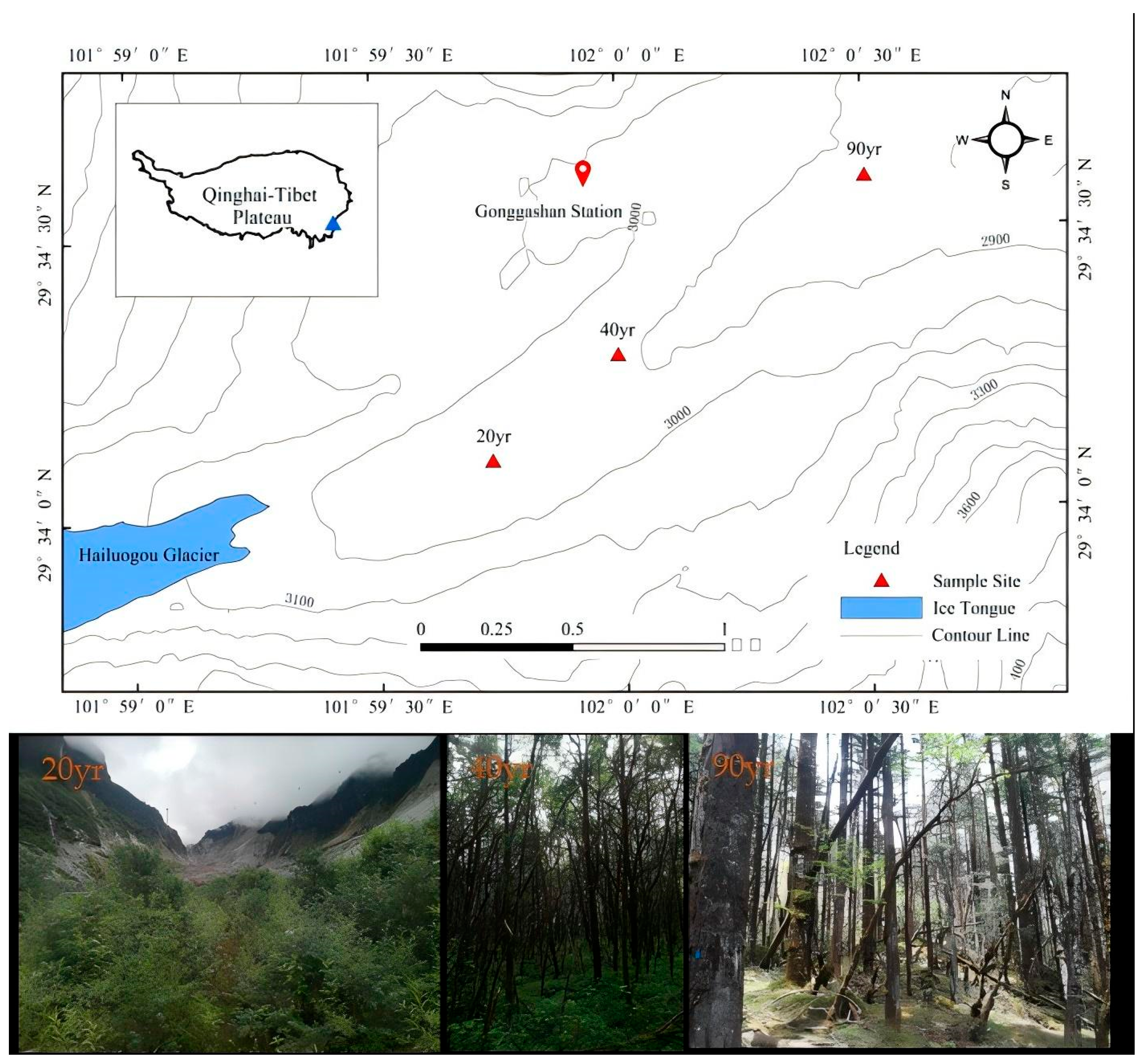
This study was conducted in the Hailuogou Glacier foreland on the eastern slope of Minya Konka, southeastern edge of the Qinghai–Tibet Plateau (Figure 1). The Hailuogou basin covers about 80.5 km2 and belongs to a monsoonal temperate glacier system in which the glacier tongue descends into the forest zone at about 3000 m a.s.l.; the regional climate is strongly influenced by southwest and southeast monsoons, annual precipitation is high, and mean annual air temperature near the glacier tongue is about 4 °C [12]. Following the established Hailuogou chronosequence framework, we focused on three woody successional stages representing about 20, 40, and 90 years since deglaciation (Figure 1) [1,11,12]. These stages developed on progressively weathered glacial deposits within the same foreland. The dominant species in the 20-year and 40-year stage communities are Populus purdomii, Salix rehderiana, and Hippophae rhamnoides, while the dominant species in the 90-year stage community are Abies fabri and Betula utilis. Because this manuscript synthesizes a compiled trait dataset rather than reporting a stand-alone pedological survey, we describe the environmental gradient using measured soil properties and established chronosequence age classes rather than assigning new soil-taxonomic labels that were not part of the original sampling design.

2.2. Field Sampling and Sample Processing

Field sampling followed the published plot-based Hailuogou chronosequence framework [11,12]. Compared to Li et al. [11], the compiled dataset is anchored to three woody successional stages, but the analytical unit differs among trait modules: some variables are stage-level community summaries, whereas others are species × stage observations. Roots were sampled from the standard plants of the dominant species within established stage plots using the root tracing method, and 10 cm thick surface soil samples were randomly collected from each sample plot for the root-associated measurements using the auger method. Because this study integrates several measurement modules rather than a single uniform assay campaign, reproducibility depends mainly on making the observational level and protocol explicit for each module, rather than forcing one nominal sample size across all analyses.
Fine roots (<2 mm) were washed, sorted by species, and separated into functional fractions, including the overall fine-root pool, absorptive roots, and transport roots. Subsamples were then assigned to analyses of morphology, dry matter content, anatomy, phosphatase activity, exudation, and chemistry. In parallel, soil samples were sieved and partitioned for fresh biochemical assays, extraction-based measurements, and bulk-soil property determination.
Different trait modules were not always measured on the same root samples or soil aliquots, and not every species was represented in every module. We therefore retained the original module-specific data structure, analyzed each module at its native observational level, and avoided creating an artificial complete-case matrix that would either discard valid observations or imply a uniform replication scheme that did not exist. This approach is methodologically conservative: it preserves the evidence available for each trait while avoiding overstatement of cross-module comparability.

2.3. Fine-Root Morphology, Anatomy and Community-Scale Belowground Structure

Fresh roots were scanned and analyzed using WinRHIZO Pro 2019 (Regent Instruments Inc., Quebec, QC, Canada) following the protocol established in the Hailuogou Glacier foreland reference study [11]. From digitized images, we quantified root length, surface area, and mean diameter and then calculated specific root length (SRL, m g−1) and specific root area (SRA, cm2 g−1). Root dry matter content (DMC, mg g−1) was calculated as the ratio of oven-dry mass to fresh mass. Anatomy traits of the transverse sections of fine roots were measured using the free-hand slicing method and included stele diameter, cortex thickness, stele-to-root diameter ratio, and stele area ratio (the percentage of root cross-sectional area occupied by the stele) [35]. Where the dataset distinguished absorptive and transport fractions, we calculated length-, area-, and biomass-based ratios between these pools to characterize within-root-system resource allocation. The functional classification of absorptive and transport pools followed order-based frameworks [13,36]. Community-level metrics were derived from soil-core samples and included root length density (cm cm−3), standing root biomass (g), root biomass density (g cm−3), and fine-root turnover (year−1). These traits were used as integrative indicators of belowground structural investment and ecosystem-level carbon allocation.

2.4. Soil Resource Supply and Rhizosphere Biogeochemical Variables

Soil variables were grouped into four complementary categories that describe the edaphic resource environment. Soil development indices included bulk density, field capacity, pH, total C, total N, and C:N, which together reflect pedogenic development and habitat quality. Field capacity was expressed gravimetrically relative to oven-dry soil mass rather than as volumetric water content; values can therefore exceed 100% in organic-rich late-successional soils and should be interpreted as water retained per unit dry soil mass. Nitrogen availability was assessed using inorganic N (ammonium and nitrate) and potentially available N pools. Microbial activity and nutrient cycling were indexed by extracellular enzyme activities: β-1,4-glucosidase (BG, C acquisition), L-leucine aminopeptidase (LAP, protein-N acquisition), and β-N-acetylglucosaminidase (NAG, chitin-N acquisition). These enzymes are widely used to characterize microbial investment in C and N acquisition [37,38,39,40,41,42]. Microbial biomass and dissolved pools included microbial biomass C and N, and dissolved organic C and N.
Together, these soil variables define the resource environment against which root nutrient-acquisition strategies were evaluated. This framework distinguishes among inherent soil properties (development indices), nutrient supply rate (N availability and enzyme activities), and active microbial pools, allowing us to assess how roots respond to different dimensions of belowground resource heterogeneity.

2.5. Root Phosphatase Activity, Exudation and Root Chemistry

Root phosphatase activity was measured with a colorimetric p-nitrophenyl phosphate (pNPP) assay on fresh fine-root subsamples, following widely used root phosphomonoesterase protocols. Fresh roots were incubated in acetate buffer (pH 5.0) containing pNPP as substrate, whereas control incubations received buffer without substrate to correct for non-enzymatic background. After incubation, the reaction was stopped under alkaline conditions, and released p-nitrophenol was quantified spectrophotometrically at 410 nm. Root phosphatase activity was calculated from p-nitrophenol production per unit incubation time and standardized by root mass; values reported in the main text are expressed as μg g−1 h−1 [43,44].
Root exudates were collected from freshly excavated, intact terminal fine-root systems using the culture-based cuvette method of Yin et al. [45]. Fine roots connected to living plants were excavated from the topsoil (0–10 cm), gently rinsed with purified water to remove adhering soil, and inserted into glass-bead-filled cuvettes in the field. After a 2-day equilibration period, the cuvettes were flushed with fresh nutrient solution (0.1 mM KH2PO4, 0.2 mM MgSO4, 0.2 mM K2SO4, 0.3 mM CaCl2), and trap solutions were collected after 24 h with a vacuum pump. The solutions were filtered (0.22 μm), exudate C was quantified with a TOC analyzer (Vario TOC, Elementar, Langenselbold, Germany), and bead-only controls were used to correct for non-root carbon contamination. Exudation was expressed on mass-, length-, or area-specific bases as appropriate for downstream analyses; because area-based exudation aligned most directly with the strategy-transition synthesis, that metric was retained in the main-text synthesis figures and ordination.
Additional root chemistry measurements included root C concentration, root N concentration measured with an elemental analyzer (Vario Macro cube, Elementar, Hanau, Germany), and calculated root C:N.

2.6. Statistical Analysis

All statistical analyses were designed to match the structure of the compiled dataset and were implemented in R 4.1.2 using standard ANOVA and ordination workflows. Given the compiled and partly unbalanced dataset, the goal was comparative inference rather than predictive model fitting. Community-level traits measured at the stage level were compared among the 20-, 40-, and 90-year stages with one-way ANOVA, followed by Tukey’s HSD tests when the overall stage effect was significant. Species-resolved traits were analyzed with two-way ANOVA models including successional stage, species identity, and their interaction. For each fitted model, residual normality and homogeneity of variance were evaluated by Q-Q inspection and residual-versus-fitted diagnostics before formal inference. These checks were used to judge whether each model was adequate for comparative interpretation, not to imply that all trait modules shared a common error structure. Partial eta squared (partial η2) was then calculated to summarize the relative importance of stage, species, and stage × species terms within each trait module. Because replication differed among modules, these outputs were interpreted as module-specific comparative summaries rather than as directly interchangeable effect sizes across the full compiled dataset, and no omnibus cross-module model was fitted. To visualize strategy transition, species × stage mean values of representative root traits were standardized and analyzed by principal component analysis (PCA). Stage centroids and composite indices were then derived from the standardized variables to illustrate the shift from morphological capture to rhizosphere-mediated biochemical acquisition. Soil and rhizosphere variables were projected onto the ordination as environmental vectors to assess alignment between trait syndromes and the broader environmental gradient. Because environmental blocks were not matched one-to-one with every root measurement, the ordination was treated explicitly as an exploratory synthesis of coordinated covariation and stage separation rather than as formal causal inference, predictive validation, or model-performance assessment. Analytical robustness was therefore judged from concordance among univariate patterns, multivariate separation, and effect-size summaries rather than from any single model output. Unless otherwise stated, values are reported as means ± SE, and significance was assessed at p < 0.05.

3. Results

3.1. Soil Development and Rhizosphere Context Changed in Parallel with Succession

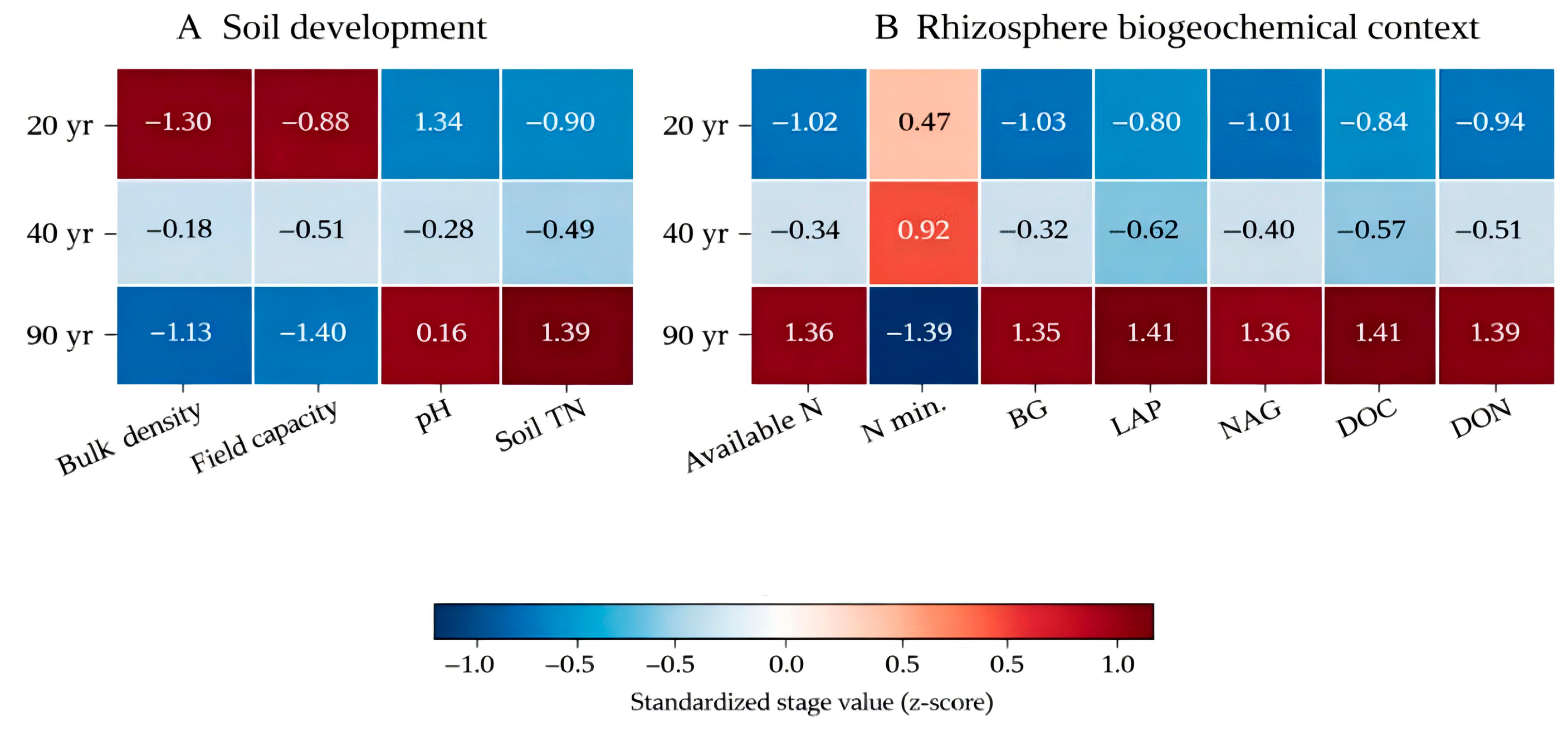
Primary succession was accompanied by marked changes in both soil development and rhizosphere biogeochemical context (Figure 2). Across the 20-, 40-, and 90-year stages, bulk density declined from 1.38 to 0.15 g cm−3, field capacity increased sharply on a dry-mass basis, and pH decreased from 8.67 to 5.67. Soil C and soil N also rose strongly, from 36.61 to 245.57 mg C g−1 soil and from 0.48 to 17.03 mg N g−1 soil, respectively, whereas soil C:N declined from 78.98 to 14.42. Together, these values indicate a progressive shift from a compact, weakly developed substrate to a more organic-rich, moisture-buffered soil environment, which provides the edaphic context for the inferred pathway shift.
Extracellular enzyme activities and available N increased across succession, whereas net N mineralization peaked at 40 years and became negative at 90 years (Figure 2B). DOC, DON, and microbial C and N pools also changed across succession, with the oldest stage showing the largest dissolved and microbial resource pools. Together, these variables define the environmental setting in which strategy change occurred: the 90-year stage combined larger resource pools with stronger rhizosphere processing, although the environmental data alone do not assign causal weight to any single process underlying the associated shift in root strategy.

3.2. Intermediate Morphological Capture and Late Biochemical Mobilization Defined the Transition

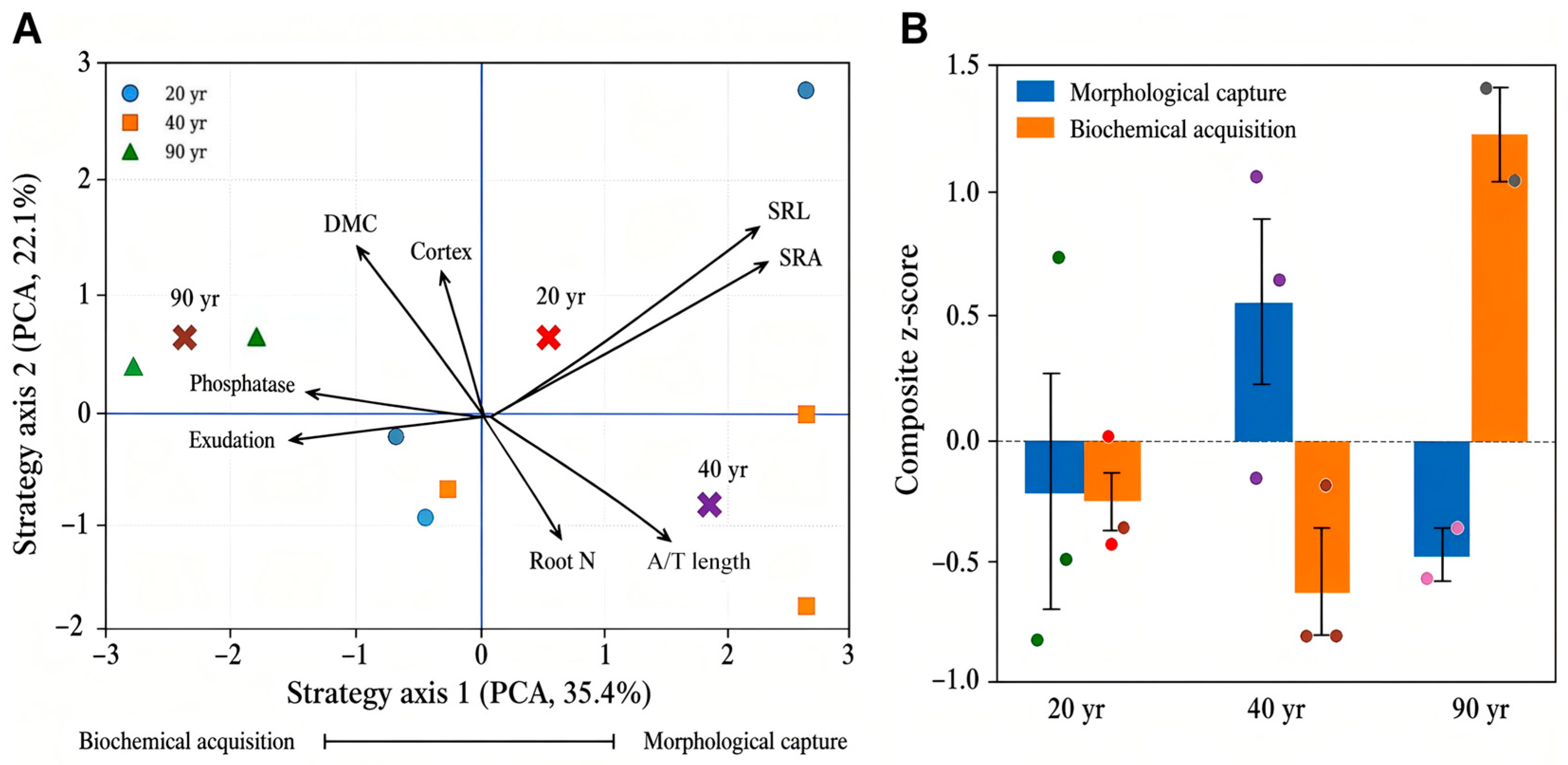
A strategy-transition synthesis, built from concordant representative traits rather than any single trait, showed that nutrient-acquisition strategies changed nonlinearly across succession (Figure 3). In the strategy space, the 40-year stage occupied the morphological-capture end of the trajectory, whereas the 90-year stage shifted toward rhizosphere-mediated biochemical acquisition. Stage-level composite indices likewise showed that morphological capture peaked at 40 years, whereas biochemical acquisition peaked at 90 years. Because this synthesis integrates several coordinated traits, it is presented as a descriptive summary of directionally consistent evidence rather than as a stand-alone inferential layer separate from the underlying trait results.

3.3. Structural Reorganization Reinforced the Pathway Shift

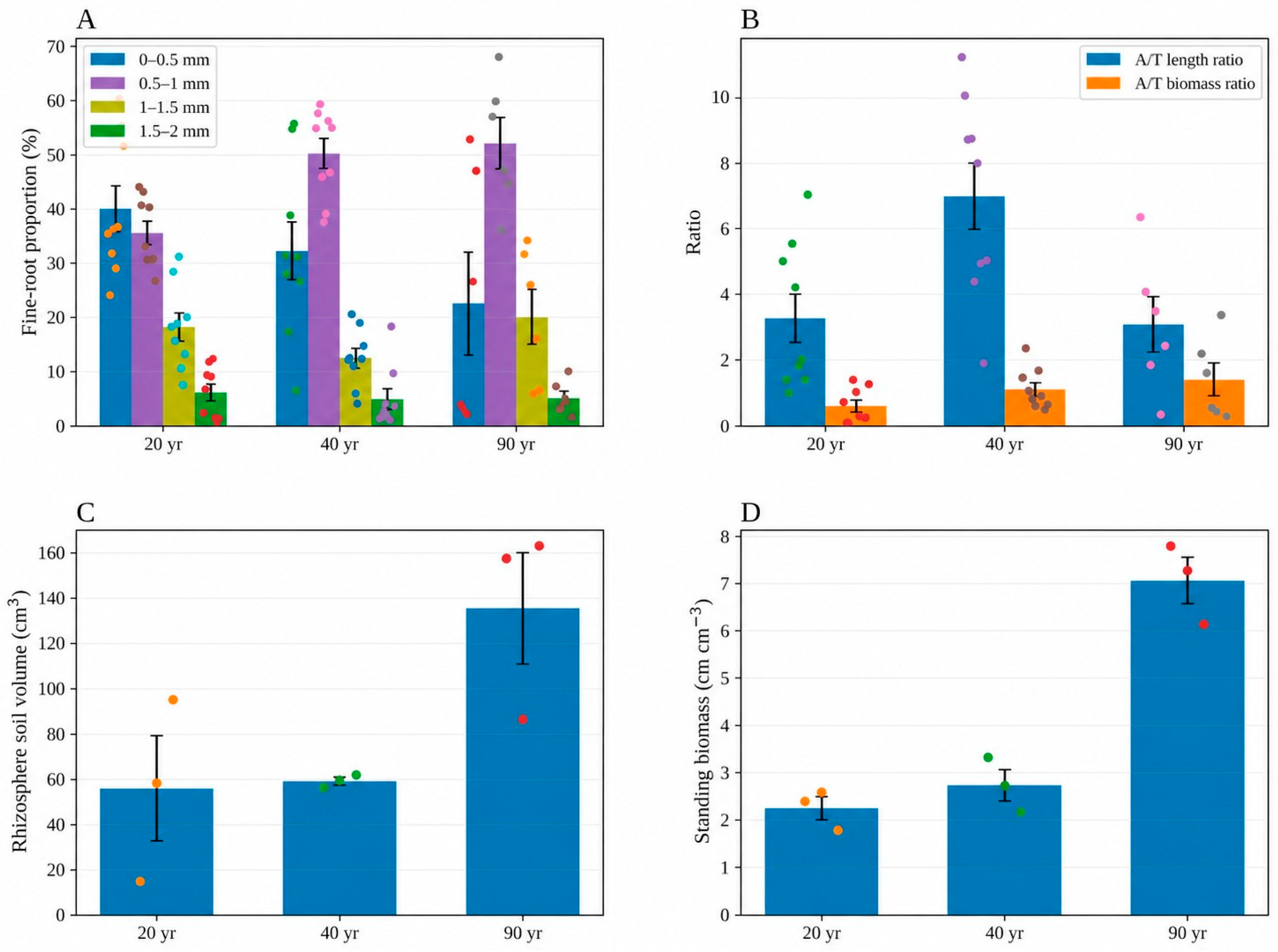
This shift in acquisition mode was accompanied by structural reorganization of the root system, including redistribution across diameter classes, changes in absorptive-transport partitioning, expansion of rhizosphere soil volume, and maintenance of standing biomass (Figure 4). Along the successional sequence from 20 to 90 years, the length proportion of the finest roots (0–0.5 mm) declined, whereas the 0.5–1.0 mm class increased (Figure 4A).
The 40-year stage had the highest absorptive-to-transport root length ratio, whereas the 90-year stage showed the largest rhizosphere soil volume and the greatest standing fine-root biomass (Figure 4B–D).

3.4. Stage and Species Jointly Shaped the Expression of Biochemical-Input Traits

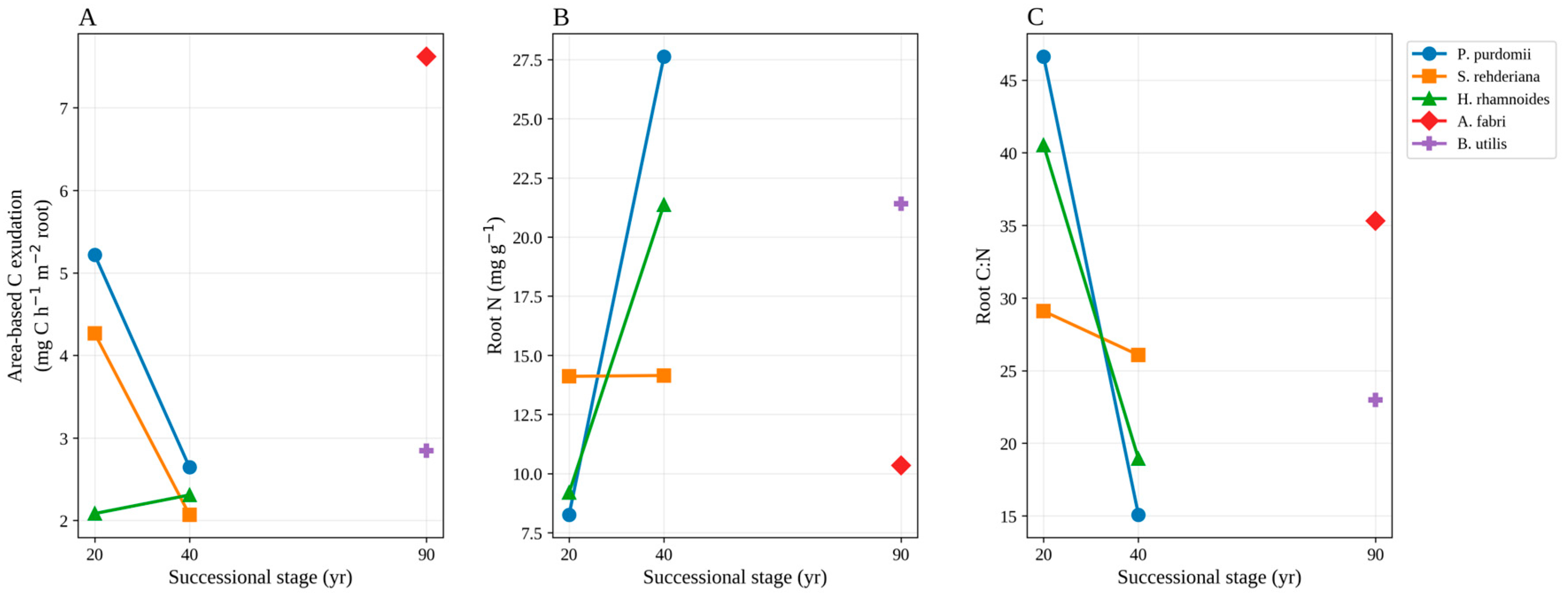
Area-based C exudation showed significant effects of stage, species, and their interaction, whereas root N concentration varied with stage and root C:N varied with both stage and the stage × species interaction (Figure 5). This pattern indicates more than statistical heterogeneity: succession set the broad direction of pathway change, but species identity and stage-specific species responses influenced how strongly biochemical-input traits were expressed within each stage. In other words, stage organized the community-level shift, whereas species contingency shaped its specific expression.

3.5. Strategy–Environment Alignment Was Concentrated Along One Dominant Gradient

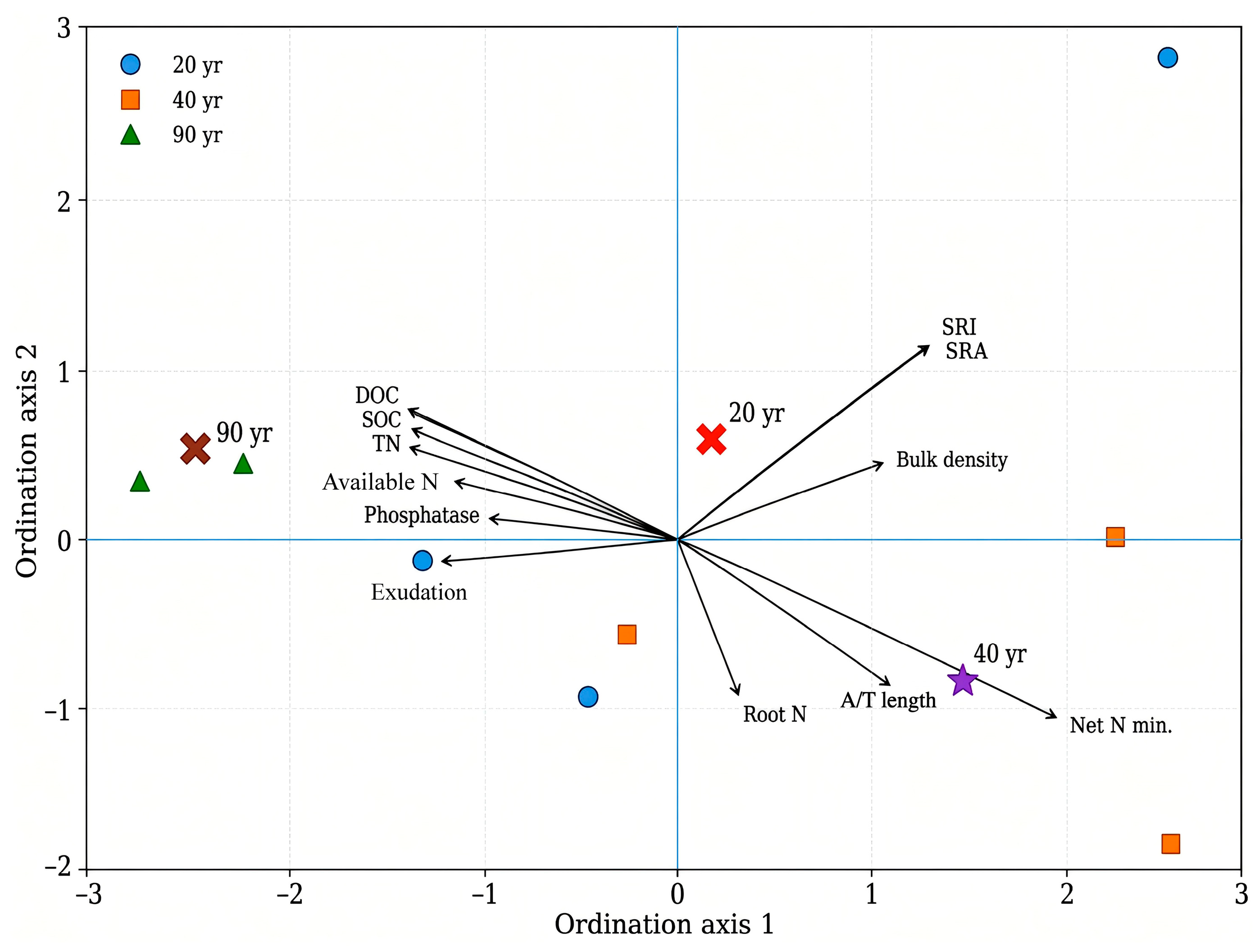
An exploratory coupling ordination showed that fine-root nutrient-acquisition strategies were aligned with a major environmental gradient across succession (Figure 6). Most stage separation occurred along ordination axis 1, so interpretation is centered on that dominant contrast rather than on finer secondary dispersion. Along this main axis, high SRL, high SRA, and a high absorptive-to-transport root length ratio were opposed to high dry matter content, greater cortex thickness, stronger phosphatase activity, and higher area-based C exudation. Species × stage observations from the 40-year stage clustered on the morphological side of the axis, whereas those from the 90-year stage clustered on the biochemical side. We therefore treat the ordination as convergent but subordinate support for the pathway-shift interpretation because the environmental and trait datasets were not fully matched sample by sample.

3.6. Broad Pathway Change Was Stage-Driven, Whereas Trait Expression Remained Species Contingent

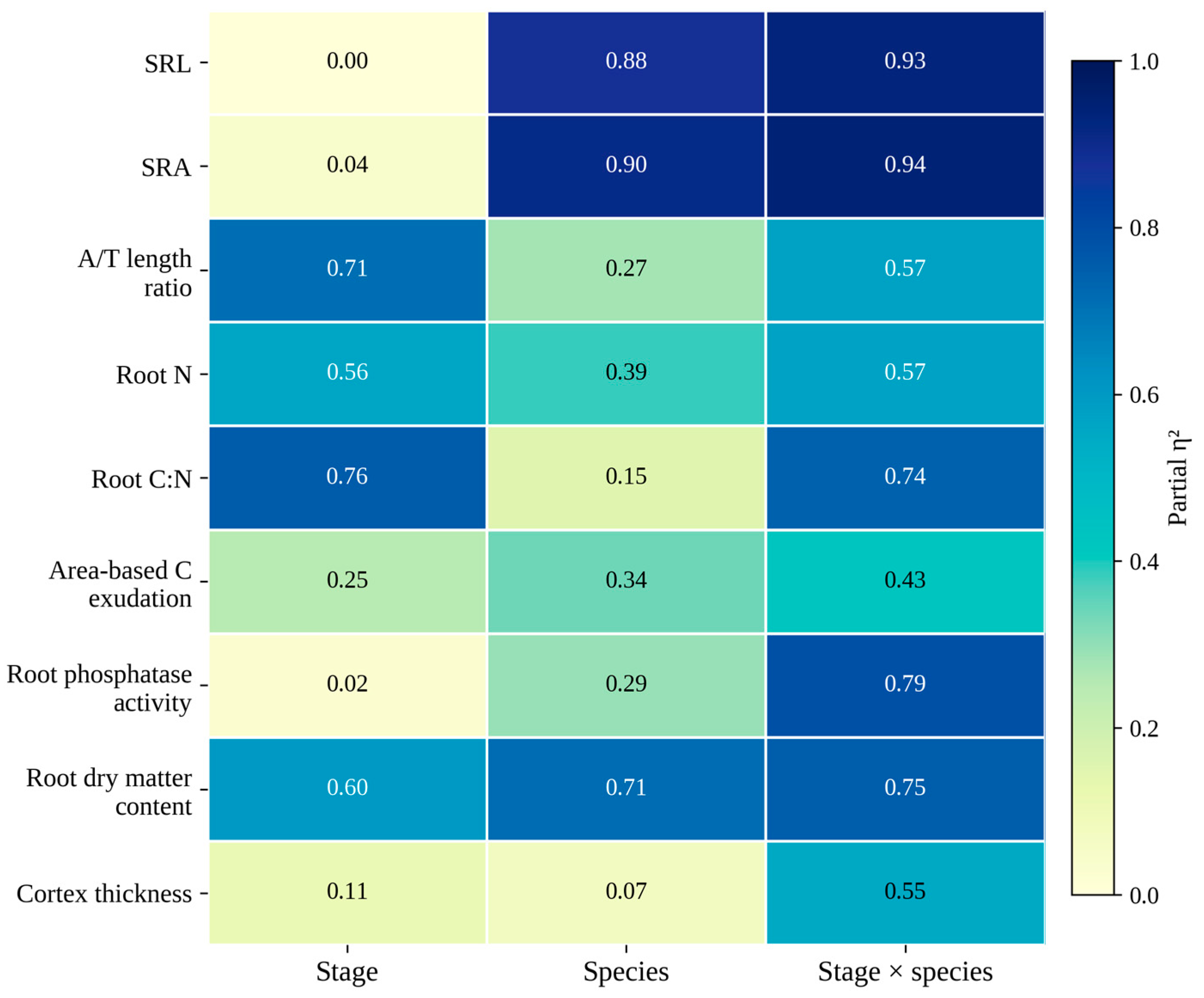
Partial η2 synthesis showed that the relative contributions of successional stage, species identity, and their interaction varied among traits (Figure 7). Ecologically, this means that the overall direction of pathway change was strongly structured by stage, whereas the expression of several biochemical and chemical traits remained contingent on species identity and stage × species responses. The pathway shift is therefore best interpreted as stage-structured at the community level but species-contingent in the strength of particular trait responses.

4. Discussion

4.1. Primary Succession Changed Pathway Dominance Rather than Simply Trait Intensity

Our central result is not simply that roots differed among the three stages. Rather, primary succession changed which nutrient-acquisition pathway dominated community function. The 20-year stage was characterized by strong substrate limitation, the 40-year stage by a temporary increase in morphological nutrient capture, and the 90-year stage by stronger rhizosphere-mediated biochemical mobilization. This stage-dependent rebalancing is more consistent with a multi-dimensional root economics space framework than with a one-dimensional acquisitive–conservative continuum [13,14,15,16,17,18,19,20,21,22,23,24].
Morphology and biochemical-input traits did not vary in parallel; instead, their relative importance changed as soil development restructured the belowground resource environment. The most defensible reading of the dataset is therefore a shift in the dominant community-level pathway under changing edaphic conditions, not a simple rise or fall in overall root acquisitiveness.
A one-dimensional model would predict directional selection toward either thinner, elongated, highly acquisitive roots or denser, more conservative roots throughout succession. Our data instead indicate stage-dependent reweighting among acquisition modes: roots temporarily emphasized morphological exploration at intermediate succession but later strengthened biochemical access to nutrients without further increasing soil-occupation capacity. Primary succession therefore appears to reorganize nutrient acquisition by changing which pathway yields the greatest return under a given set of belowground conditions.

4.2. Intermediate Succession Created the Strongest Return on Morphological Deployment

The intermediate stage appears to represent a temporary ecological window in which morphological deployment yielded the highest return on investment [24]. By about 40 years after glacier retreat, physical constraints had eased relative to the 20-year stage, as indicated by lower bulk density, lower pH, and higher water-holding capacity, while net N mineralization was strongly positive. Under these conditions, greater absorptive-root length and surface area per unit biomass likely provided an efficient route to nutrient uptake. This interpretation is supported by the 40-year trait syndrome, which combined the highest specific root length, specific root area, absorptive-to-transport root length ratio, and root N concentration. Earlier studies have shown that species- and community-level root traits can shift predictably with soil development and resource availability [30,31,32], but our results add that in this glacier foreland the strongest morphological capture did not occur at the youngest stage. Instead, it peaked after severe substrate limitation had eased, but before nutrient access became increasingly mediated by rhizosphere processes.

4.3. Late Succession Favored Biochemical Mobilization, but Not Through a Single Demonstrated Mechanism

The late-successional stage differed clearly from the intermediate-stage pattern of greater morphological deployment. Instead, it combined lower specific root length with higher dry matter content, thicker cortex, greater standing fine-root biomass, larger rhizosphere soil volume, stronger phosphatase activity, and higher area-based carbon exudation. Taken together, these observations support a syndrome-level interpretation in which nutrient access relied less on extending absorptive surface area alone and more on stronger biochemical mobilization in the rhizosphere. We do not interpret this pattern as evidence for a single exclusive mechanism; rather, the dataset supports a coordinated late-stage shift toward a more rhizosphere-mediated mode of nutrient access. The edaphic context at 90 years strengthens that interpretation. Despite negative net N mineralization, the oldest stage showed larger soil C and N pools, stronger extracellular enzyme activity, and higher dissolved and microbial resource pools. This combination is consistent with a belowground environment in which nutrient transformations are increasingly governed by microbial processing and local retention of organic resource pools, rather than by the direct exploitation of relatively unprocessed substrate. This inference is broadly consistent with evidence that environmental history can reshape both soil microbial communities and their associated nutrient-cycling functions [46]. The pathway claim is therefore anchored not to exudation or phosphatase activity alone, but to the convergence among trait syndromes, rhizosphere biogeochemical conditions, and the broader soil resource context.
This interpretation should nevertheless remain mechanistically plural rather than singular. The late-stage shift could reflect at least three non-exclusive processes: within-species physiological adjustment, stronger plant–microbial coupling that increases microbial mediation of nutrient release, and changes in species composition that alter which nutrient-acquisition route dominates at the community scale. Our dataset is consistent with all three possibilities at different levels—through increases in exudation and phosphatase activity, through stage and stage × species effects for several traits, and through parallel increases in microbial biomass and enzyme activity—but it does not partition their relative causal contributions. The cautious conclusion is therefore not that one mechanism has been demonstrated, but that late succession increasingly favored a biochemical-access syndrome assembled from several compatible processes. In that sense, biochemical-input traits are not auxiliary additions to root strategy; they are integral components of root economics space when nutrients are increasingly retained in chemically protected or microbially regulated pools [25,26,27,28,29].

4.4. Succession Changed Community Strategy Through Both Species Turnover and Trait Adjustment

The community-level shift in nutrient-acquisition strategy was not simply an artifact of averaging across changing species assemblages. It emerged from the combined effects of species turnover, species identity, and within-species adjustment, as reflected by the stage, species, and stage × species effects detected for several traits. Figure 7 clarifies the ecological meaning of this result: successional stage structured the broad direction of pathway change, whereas species identity and stage-specific species responses helped determine how strongly particular biochemical-input traits were expressed within each stage. Ecologically, that distinction matters because community function can change through both replacement and plastic reweighting of traits, even when some dominant taxa persist across stages.
Some species followed divergent trajectories, with some emphasizing greater morphological deployment and others showing stronger increases in biochemical-input traits such as exudation or phosphatase activity. This heterogeneity helps explain why different acquisition dimensions were controlled unevenly in the variance-partitioning synthesis. In other words, succession filtered communities through more than one functional route.
Our results therefore extend earlier work on species replacement in glacier forelands. In Hailuogou, nutrient-acquisition strategies have already been linked to species replacement during early pedogenesis [11]. The present analysis adds that the community-level pattern cannot be reduced to replacement alone: species turnover and intraspecific plasticity both contributed to the observed pathway shift, and their relative importance differed among trait dimensions.

4.5. Trait–Environment Coupling Supports the Pathway-Shift Interpretation Within Clear Inferential Limits

The exploratory ordination supports the view that community trait shifts tracked coordinated changes in the belowground environment rather than random trait turnover. Morphological-capture traits clustered opposite to exudation, phosphatase activity, DOC, DON, and microbial-resource variables, and stage centroids separated accordingly along the dominant transition axis. This convergence among univariate patterns, stage-level syntheses, and multivariate structure strengthens the pathway-shift interpretation because several independent summaries point in the same direction. At the same time, the ordination should not be overinterpreted as definitive causal evidence. The analysis integrates trait and environmental blocks that were not measured as a single matched matrix, so it cannot by itself demonstrate this mechanism. More broadly, the chronosequence design supports the inference of stage-associated syndromes rather than literal temporal trajectories of the same stands, and it cannot fully exclude spatially structured site differences that covary with stage. The compiled dataset also introduces unavoidable heterogeneity in replication among modules. These limitations are structural rather than incidental, and they are precisely why this study argues for pathway dominance rather than mechanistic closure: we can defend coordinated, stage-dependent reorganization of nutrient-acquisition strategy but not a fully validated mechanistic model of how each component process changes through time [23,24,36]. Accordingly, we use the ordination as corroborative evidence of coordinated reweighting among trait dimensions under changing environmental conditions, not as a validated predictive model. Even under that conservative interpretation, the convergence among stage-specific trait syndromes, soil developmental trajectories, and rhizosphere biogeochemical patterns supports the central inference that primary succession changed pathway dominance in nutrient acquisition.

4.6. Implications for Multi-Dimensional Root Economics Space in Primary Succession

Our findings indicate that root economics in developing soils are better understood as dynamic reweighting among alternative acquisition pathways than as movement along a single acquisitive–conservative axis. Primary succession did not simply push roots toward greater acquisitiveness or greater conservation. Instead, it sequentially favored different modes: early succession remained constrained by severe substrate limitation, intermediate succession temporarily maximized morphological nutrient capture, and late succession increasingly favored rhizosphere-mediated biochemical mobilization. A practical implication follows directly: conceptual syntheses or predictive models that rely only on morphological traits are likely to misread strategy change once soil development begins to favor biochemical investment.
Rather than claiming direct generality beyond this system, our results generate a testable expectation for other rapidly developing soils: an intermediate stage may provide a temporary optimum for morphological investment, whereas later stages may increasingly favor biochemical mobilization as organic matter accumulates, microbial activity intensifies, and competition for accessible nutrient pools increases [32]. That expectation should still be evaluated cautiously because chronosequence studies rely on imperfect space-for-time substitution and because site-specific topography, dispersal context, and biotic interactions can modify successional trajectories [4]. Even so, the present results highlight why trait-based analyses of ecosystem development and global change should integrate rhizosphere-process traits together with morphology when predicting nutrient cycling and vegetation reorganization in newly developing soils. More broadly, these results underscore the need to integrate morphology traits, anatomy traits, and rhizosphere processes when assessing fine-root function across successional gradients. This is especially important where nutrients become increasingly entrained in microbially regulated or chemically protected pools, because the dominant route of nutrient acquisition may shift even as conventional acquisitive traits decline. Our study therefore links root-trait ecology to nutrient cycling and vegetation dynamics in glacier forelands and points to a clear next step: repeated, multi-site studies that directly pair root traits with microbial dynamics and biogeochemical fluxes.

4.7. Study Limitations

This study was based on an imperfect space-for-time chronosequence in which the 20-, 40-, and 90-year stages differed not only in soil development but also in dominant species composition. The 20- and 40-year stages were dominated by Populus purdomii, Salix rehderiana, and Hippophae rhamnoides, whereas the 90-year stage was dominated by Abies fabri and Betula utilis. Accordingly, part of the observed shift in nutrient-acquisition strategy may reflect species turnover, within-species adjustment, and their joint effects, rather than successional age alone. Although our analyses explicitly considered stage, species identity, and stage × species effects, the present dataset cannot fully separate the contribution of species replacement from that of environmental change. This limitation does not alter the main inference that pathway dominance changed across the chronosequence, but it does mean that the results should be interpreted as stage-associated community syndromes rather than as pure age effects of the same species assemblage through time. Future work should test this pattern with repeated measurements within species across stages and with designs that more directly pair root traits, microbial dynamics, and biogeochemical fluxes.

5. Conclusions

Within the inferential limits of a glacier-foreland chronosequence, primary succession in the Hailuogou Glacier foreland did not move fine roots monotonically along a single acquisitive–conservative spectrum. Instead, it changed which nutrient-acquisition pathway predominated at the community level: the youngest stage was constrained by severe substrate limitation, the intermediate stage showed the strongest morphological nutrient capture, and the oldest stage showed the clearest biochemical-access syndrome. This sequence tracked coordinated changes in soil development, rhizosphere processing, and community trait expression. The main contribution of this study is therefore a pathway-based interpretation of root strategy during primary succession. The next test is whether the same sequence recurs across glacier forelands when repeated root measurements are directly paired with microbial dynamics and biogeochemical fluxes.

Author Contributions

Q.G., X.L. and B.D. conceived the study. Q.G., G.X., Y.H. and M.L. conducted field sampling and laboratory analyses. Q.G. analyzed the data and drafted the manuscript. X.L. and B.D. supervised the study and revised the manuscript. All authors have read and agreed to the published version of the manuscript.

Funding

This research was supported by the National Science Foundation of China (No. 32571770).

Data Availability Statement

The datasets used in the main analyses are available from the corresponding author upon reasonable request.

Conflicts of Interest

The authors declare no conflicts of interest.

Abbreviations

A/T length, absorptive-to-transport root length ratio; Available N, available nitrogen; BG, β-1,4-glucosidase; Cortex, cortex thickness; DMC, dry matter content; DOC, dissolved organic carbon; DON, dissolved organic nitrogen; Exudation, area-based carbon exudation; LAP, L-leucine aminopeptidase; NAG, β-N-acetylglucosaminidase; N min., net nitrogen mineralization; Phosphatase, root phosphatase activity; pNPP, p-nitrophenyl phosphate, Root C:N, root carbon:root nitrogen; Root N, root nitrogen concentration; SRL, specific root length; SRA, specific root area; TC, total carbon; TN, total nitrogen.

References

  1. He, L.; Tang, Y. Soil development along primary succession sequences on moraines of Hailuogou Glacier, Gongga Mountain, Sichuan, China. Catena 2008, 72, 259–269. [Google Scholar] [CrossRef]
  2. Bosson, J.B.; Huss, M.; Cauvy-Fraunié, S.; Clément, J.C.; Costes, G.; Fischer, M.; Poulenard, J.; Arthaud, F. Future emergence of new ecosystems caused by glacial retreat. Nature 2023, 620, 562–569. [Google Scholar] [CrossRef]
  3. Cantera, I.; Carteron, A.; Guerrieri, A.; Marta, S.; Bonin, A.; Ambrosini, R.; Anthelme, F.; Azzoni, R.S.; Almond, P.; Gazitúa, P.A.; et al. The importance of species addition ‘versus’ replacement varies over succession in plant communities after glacier retreat. Nat. Plants 2024, 10, 256–267. [Google Scholar] [CrossRef]
  4. Ficetola, G.F.; Marta, S.; Guerrieri, A.; Gobbi, M.; Ambrosini, R.; Fontaneto, D.; Zerboni, A.; Poulenard, J.; Caccianiga, M.; Thuiller, W. Dynamics of ecological communities following current retreat of glaciers. Annu. Rev. Ecol. Evol. Syst. 2021, 52, 405–426. [Google Scholar] [CrossRef]
  5. Ficetola, G.F.; Marta, S.; Guerrieri, A.; Cantera, I.; Bonin, A.; Cauvy-Fraunié, S.; Ambrosini, R.; Caccianiga, M.; Anthelme, F.; Azzoni, R.S.; et al. The development of terrestrial ecosystems emerging after glacier retreat. Nature 2024, 632, 336–342. [Google Scholar] [CrossRef]
  6. Johnson, E.A.; Miyanishi, K. Testing the assumptions of chronosequences in succession. Ecol. Lett. 2008, 11, 419–431. [Google Scholar] [CrossRef] [PubMed]
  7. Fickert, T.; Grüninger, F. High-speed colonization of bare ground—Permanent plot studies on primary succession of plants in recently deglaciated glacier forelands. Land Degrad. Dev. 2018, 29, 2668–2680. [Google Scholar] [CrossRef]
  8. Buma, B.; Bisbing, S.M.; Wiles, G.; Bidlack, A.L. 100 yr of primary succession highlights stochasticity and competition driving community establishment and stability. Ecology 2019, 100, e02885. [Google Scholar] [CrossRef] [PubMed]
  9. de Vries, F.T.; Thion, C.; Bahn, M.; Bergk Pinto, B.; Cécillon, S.; Frey, B.; Grant, H.; Nicol, G.W.; Wanek, W.; Prosser, J.I.; et al. Glacier forelands reveal fundamental plant and microbial controls on short-term ecosystem nitrogen retention. J. Ecol. 2021, 109, 3710–3723. [Google Scholar] [CrossRef]
  10. Yang, D.L.; Luo, J.; Peng, P.H.; Li, W.; Shi, W.B.; Jia, L.Y.; He, Y.M. Dynamics of nitrogen and phosphorus accumulation and their stoichiometry along a chronosequence of forest primary succession in the Hailuogou Glacier retreat area, eastern Tibetan Plateau. PLoS ONE 2021, 16, e0246433. [Google Scholar] [CrossRef] [PubMed]
  11. Li, X.L.; Zhou, J.; Du, H.Q.; Peng, F.; Zhong, H.T.; Wu, Y.H.; Luo, J.; Sun, S.Q.; Ming, Y.X.; Sun, H.Y.; et al. Plant nutrient-acquisition strategies contribute to species replacement during primary succession. J. Ecol. 2025, 113, 988–1003. [Google Scholar] [CrossRef]
  12. Li, Z.X.; He, Y.Q.; Yang, X.M.; Theakstone, W.H.; Jia, W.X.; Pu, T.; Liu, Q.; He, X.; Song, B.; Zhang, N.; et al. Changes of the Hailuogou glacier, Mt. Gongga, China, against the background of climate change during the Holocene. Quat. Int. 2010, 218, 166–175. [Google Scholar] [CrossRef]
  13. McCormack, M.L.; Dickie, I.A.; Eissenstat, D.M.; Fahey, T.J.; Fernandez, C.W.; Guo, D.L.; Helmisaari, H.; Hobbie, E.A.; Iversen, C.M.; Jackson, R.B.; et al. Redefining fine roots improves understanding of below-ground contributions to terrestrial biosphere processes. New Phytol. 2015, 207, 505–518. [Google Scholar] [CrossRef]
  14. Weemstra, M.; Mommer, L.; Visser, E.J.W.; van Ruijven, J.; Kuyper, T.W.; Mohren, G.M.J.; Sterck, F.J. Towards a multidimensional root trait framework: A tree root review. New Phytol. 2016, 211, 1159–1169. [Google Scholar] [CrossRef]
  15. Bergmann, J.; Weigelt, A.; van der Plas, F.; Laughlin, D.C.; Kuyper, T.W.; Guerrero-Ramirez, N.R.; Valverde-Barrantes, O.J.; Bruelheide, H.; Freschet, G.T.; Iversen, C.M.; et al. The fungal collaboration gradient dominates the root economics space in plants. Sci. Adv. 2020, 6, eaba3756. [Google Scholar] [CrossRef]
  16. Ding, J.X.; Kong, D.L.; Zhang, Z.L.; Cai, Q.; Xiao, J.; Liu, Q.; Yin, H.J. Climate and soil nutrients differentially drive multidimensional fine root traits in ectomycorrhizal-dominated alpine coniferous forests. J. Ecol. 2020, 108, 2544–2556. [Google Scholar] [CrossRef]
  17. Laughlin, D.C.; Mommer, L.; Sabatini, F.M.; Bruelheide, H.; Kuyper, T.W.; McCormack, M.L.; Bergmann, J.; Freschet, G.T.; Guerrero-Ramírez, N.R.; Iversen, C.M.; et al. Root traits explain plant species distributions along climatic gradients yet challenge the nature of ecological trade-offs. Nat. Ecol. Evol. 2021, 5, 1123–1134. [Google Scholar] [CrossRef]
  18. Weigelt, A.; Mommer, L.; Andraczek, K.; Iversen, C.M.; Bergmann, J.; Bruelheide, H.; Fan, Y.; Freschet, G.T.; Guerrero-Ramírez, N.R.; Kattge, J.; et al. An integrated framework of plant form and function: The belowground perspective. New Phytol. 2021, 232, 42–59. [Google Scholar] [CrossRef]
  19. Carmona, C.P.; Bueno, C.G.; Toussaint, A.; Träger, S.; Díaz, S.; Moora, M.; Munson, A.D.; Pärtel, M.; Zobel, M.; Tamme, R. Fine-root traits in the global spectrum of plant form and function. Nature 2021, 597, 683–687. [Google Scholar] [CrossRef] [PubMed]
  20. Zhao, J.B.; Guo, B.L.; Hou, Y.S.; Yang, Q.P.; Feng, Z.P.; Zhao, Y.; Yang, X.T.; Fan, G.Q.; Kong, D.L. Multi-dimensionality in plant root traits: Progress and challenges. J. Plant Ecol. 2024, 17, rtae043. [Google Scholar] [CrossRef]
  21. Kou, L.; Zuo, W.Y.; Freschet, G.T.; Zheng, J.J.; Ma, N.; Lambers, H.; Li, S.G.; Wang, H.M. Toward refining and contextualizing the root economics space. Trends Ecol. Evol. 2026, in press. [Google Scholar] [CrossRef]
  22. Wang, R.L.; Kong, D.L.; Han, M.X.; Sack, L.; Lambers, H.; Cornelissen, J.H.C.; Li, Q.; Zhang, S.X.; Wang, X.; Wang, Z.B.; et al. Root quantity traits: A leading dimension in root trait space. New Phytol. 2026, 250, 2136–2148. [Google Scholar] [CrossRef]
  23. Freschet, G.T.; Roumet, C. Sampling roots to capture plant and soil functions. Funct. Ecol. 2017, 31, 1506–1518. [Google Scholar] [CrossRef]
  24. Freschet, G.T.; Roumet, C.; Comas, L.H.; Weemstra, M.; Bengough, A.G.; Rewald, B.; Bardgett, R.D.; De Deyn, G.B.; Johnson, D.; Klimešová, J.; et al. Root traits as drivers of plant and ecosystem functioning: Current understanding, pitfalls and future research needs. New Phytol. 2021, 232, 1123–1158. [Google Scholar] [CrossRef]
  25. Sun, L.J.; Ataka, M.; Han, M.G.; Han, Y.F.; Gan, D.Y.; Xu, T.L.; Guo, Y.P.; Zhu, B. Root exudation as a major competitive fine-root functional trait of 18 coexisting species in a subtropical forest. New Phytol. 2021, 229, 259–271. [Google Scholar] [CrossRef] [PubMed]
  26. Wen, Z.H.; White, P.J.; Shen, J.B.; Lambers, H. Linking root exudation to belowground economic traits for resource acquisition. New Phytol. 2022, 233, 1620–1635. [Google Scholar] [CrossRef]
  27. Wang, G.R.; Lin, G.G.; Zhang, Y.S.; Zheng, L.L.; Zeng, D.H.; Lambers, H. Shifts from an extensive to an intensive root nutrient-acquisition mode with stand development of three Pinus species. J. Ecol. 2024, 112, 886–900. [Google Scholar] [CrossRef]
  28. Han, M.G.; Chen, Y.; Li, R.; Yu, M.; Fu, L.C.; Li, S.F.; Su, J.R.; Zhu, B. Root phosphatase activity aligns with the collaboration gradient of the root economics space. New Phytol. 2022, 234, 837–849. [Google Scholar] [CrossRef] [PubMed]
  29. Yaffar, D.; Cabugao, K.G.; Meier, I.C. Representing root physiological traits in the root economic space framework. New Phytol. 2022, 234, 773–775. [Google Scholar] [CrossRef]
  30. Wang, X.; Liu, X.R.; Mo, W.Y.; Chen, K.X.; Chen, H.X.; Gao, H.R.; Zhang, M.; Yuan, Y.Q.; Wang, R.L.; Zhang, S.X. Do phylogenetic and environmental factors drive the altitudinal variation in absorptive root traits at the species and community levels? Plant Soil 2024, 494, 203–215. [Google Scholar] [CrossRef]
  31. Holdaway, R.J.; Richardson, S.J.; Dickie, I.A.; Peltzer, D.A.; Coomes, D.A. Species- and community-level patterns in fine root traits along a 120 000-year soil chronosequence in temperate rain forest. J. Ecol. 2011, 99, 954–963. [Google Scholar] [CrossRef]
  32. Caplan, J.S.; Meiners, S.J.; Flores-Moreno, H.; McCormack, M.L. Fine-root traits are linked to species dynamics in a successional plant community. Ecology 2019, 100, e02588. [Google Scholar] [CrossRef]
  33. McCormack, M.L.; Iversen, C.M. Physical and functional constraints on viable belowground acquisition strategies. Front. Plant Sci. 2019, 10, 1215. [Google Scholar] [CrossRef]
  34. Liao, Y.C.; Fan, H.B.; Wei, X.H.; Wang, H.M.; Shen, F.F.; Hu, L.; Li, Y.Y.; Fang, H.Y.; Huang, R.Z. Shifting of the first-order root foraging strategies of Chinese fir (Cunninghamia lanceolata) under varied environmental conditions. Trees 2023, 37, 921–932. [Google Scholar] [CrossRef]
  35. Hassan, M.O.; Jafari, N.H.; Rovai, A.S.; Twilley, R.R. Biomechanical trade-offs between root tensile strength and porosity in coastal marshes. J. Geophys. Res. Biogeosci. 2026, 131, e2025JG0009414. [Google Scholar] [CrossRef]
  36. McCormack, M.L.; Guo, D.L.; Iversen, C.M.; Chen, W.L.; Eissenstat, D.M.; Fernandez, C.W.; Li, L.; Ma, C.; Ma, Z.; Poorter, H.; et al. Building a better foundation: Improving root-trait measurements to understand and model plant and ecosystem processes. New Phytol. 2017, 215, 27–37. [Google Scholar] [CrossRef]
  37. Sinsabaugh, R.L.; Lauber, C.L.; Weintraub, M.N.; Ahmed, B.; Allison, S.D.; Crenshaw, C.; Contosta, A.R.; Cusack, D.; Frey, S.; Gallo, M.E.; et al. Stoichiometry of soil enzyme activity at global scale. Ecol. Lett. 2008, 11, 1252–1264. [Google Scholar] [CrossRef] [PubMed]
  38. Zhu, X.M.; Liu, M.; Kou, Y.P.; Liu, D.Y.; Liu, Q.; Zhang, Z.L.; Jiang, Z.; Yin, H.J. Differential effects of N addition on the stoichiometry of microbes and extracellular enzymes in the rhizosphere and bulk soils of an alpine shrubland. Plant Soil 2020, 449, 285–301. [Google Scholar] [CrossRef]
  39. Mori, T. Does ecoenzymatic stoichiometry really determine microbial nutrient limitations? Soil Biol. Biochem. 2020, 146, 107816. [Google Scholar] [CrossRef]
  40. Li, Q.W.; Liu, Y.; Gu, Y.F.; Guo, L.; Huang, Y.Y.; Zhang, J.; Xu, Z.; Tan, B.; Zhang, L.; Chen, L.; et al. Ecoenzymatic stoichiometry and microbial nutrient limitations in rhizosphere soil along the Hailuogou Glacier forefield chronosequence. Sci. Total Environ. 2020, 704, 135413. [Google Scholar] [CrossRef] [PubMed]
  41. Moorhead, D.L.; Sinsabaugh, R.L.; Hill, B.H.; Weintraub, M.N. Vector analysis of ecoenzyme activities reveal constraints on coupled C, N and P dynamics. Soil Biol. Biochem. 2016, 93, 1–7. [Google Scholar] [CrossRef]
  42. Wang, J.P.; Wu, Y.H.; Li, J.J.; He, Q.Q.; Bing, H.J. Soil enzyme stoichiometry is tightly linked to microbial community composition in successional ecosystems after glacier retreat. Soil Biol. Biochem. 2021, 162, 108429. [Google Scholar] [CrossRef]
  43. Fujita, Y.; Robroek, B.J.M.; de Ruiter, P.C.; Heil, G.W.; Wassen, M.J. Increased N affects P uptake of eight grassland species: The role of root surface phosphatase activity. Oikos 2010, 119, 1665–1673. [Google Scholar] [CrossRef]
  44. Png, G.K.; Turner, B.L.; Albornoz, F.E.; Hayes, P.E.; Lambers, H.; Laliberté, E. Greater root phosphatase activity in nitrogen-fixing rhizobial but not actinorhizal plants with declining phosphorus availability. J. Ecol. 2017, 105, 1246–1255. [Google Scholar] [CrossRef]
  45. Yin, H.J.; Li, Y.F.; Xiao, J.; Xu, Z.F.; Cheng, X.Y.; Liu, Q. Enhanced root exudation stimulates soil nitrogen transformations in a subalpine coniferous forest under experimental warming. Glob. Change Biol. 2013, 19, 2158–2167. [Google Scholar] [CrossRef] [PubMed]
  46. Arunrat, N.; Mhuantong, W.; Sereenonchai, S. Land-use legacies shape soil microbial communities and nutrient cycling functions in rotational shifting cultivation fields of Northern Thailand. Microb. Ecol. 2025, 88, 102. [Google Scholar] [CrossRef] [PubMed]
Figure 1. Location of study sites: 20 yr: small-tree community; 40 yr: middle-tree community; 90 yr: big-tree community.
Forests 17 00555 g001
Figure 2. Environmental template across primary succession. Panel (A) summarizes stage-level soil development variables, including bulk density, field capacity, pH, and soil total N. Panel (B) summarizes stage-level resource-supply and rhizosphere biogeochemical variables, including available N, net N mineralization, extracellular enzyme activities, dissolved organic C and N, and microbial biomass C and N. Cell color indicates the relative magnitude of each variable after column-wise standardization; overlaid numbers show stage z-scores.
Forests 17 00555 g002
Figure 3. Strategy transition across primary succession. (A) Species × stage positions in the fine-root strategy space, with bold stage centroids connected by arrows from 20 to 40 to 90 years. The horizontal axis represents the main transition from morphological capture (high SRL; high SRA; high absorptive-to-transport root length ratio; and high root N concentration) to biochemical acquisition (high dry matter content, thicker cortex, stronger phosphatase activity, and higher area-based C exudation). (B) Stage-level composite indices for the two main acquisition dimensions, shown as means ± SE with individual species × stage values overlaid. Colored dots in panel (B) indicate individual dominant-species values within each successional stage, with colors distinguishing stages. The figure is intended as an integrative summary of concordant trait signals across stages; it is a descriptive synthesis rather than a stand-alone test of pathway identity.
Forests 17 00555 g003
Figure 4. Structural reorganization of the root system across succession. (A) Fine-root diameter-class distribution expressed as the proportion of fine-root length across the 20-, 40-, and 90-year stages, shown as means ± SE with raw replicate values overlaid. The WinRHIZO Pro diameter boundaries are downward inclusive; thus, 0–0.5 and 0.5–1.0 mm correspond to 0 < d ≤ 0.5 and 0.5 < d ≤ 1.0 mm, respectively. Colored dots in panel (A) indicate dominant-species values within each stage, with colors distinguishing successional stages. (B) Absorptive-to-transport (A/T) root length ratio and biomass ratio across succession. Colored dots in panel (B) indicate dominant-species values within each stage, with colors distinguishing successional stages. (C) Rhizosphere soil volume across succession. Colored dots in panel (C) indicate stage-level observations, with colors distinguishing successional stages. (D) Standing fine-root biomass across succession. Colored dots in panel (D) indicate stage-level observations, with colors distinguishing successional stages.
Forests 17 00555 g004
Figure 5. Stage × species patterns in biochemical-input traits. (A) Area-based C exudation across successional stages for individual species. (B) Root N concentration across successional stages for individual species. (C) Root C:N across successional stages for individual species. The figure highlights that biochemical-input traits were jointly shaped by stage, species, and stage × species structure rather than by any single source of variation.
Forests 17 00555 g005
Figure 6. Exploratory coupling ordination linking fine-root nutrient-acquisition strategies to environmental gradients across primary succession. The root strategy space was constructed by PCA using species × stage means derived from original replicate measurements of SRL, SRA, absorptive-to-transport root length ratio, root N concentration, dry matter content, cortex thickness, phosphatase activity, and area-based C exudation. Soil development and rhizosphere-process variables were then projected as environmental vectors. The displayed axes summarize the main standardized multivariate contrast and secondary dispersion in trait space; environmental vectors indicate directional correspondence with that contrast and help interpret stage-associated syndromes, but they are not fitted causal effects.
Forests 17 00555 g006
Figure 7. Relative contributions of stage, species, and their interaction across key nutrient-acquisition traits. The heat map shows partial η2 values from two-way ANOVA models for representative morphological, biochemical, and anatomical traits, summarizing the relative importance of successional filtering, species identity, and stage × species interactions. These values should be interpreted within each trait module, not as absolute effect sizes that are directly comparable across datasets with different replications.
Forests 17 00555 g007
Disclaimer/Publisher’s Note: The statements, opinions and data contained in all publications are solely those of the individual author(s) and contributor(s) and not of MDPI and/or the editor(s). MDPI and/or the editor(s) disclaim responsibility for any injury to people or property resulting from any ideas, methods, instructions or products referred to in the content.