Article

Spatio-Temporal Dynamics and Future Projection of Land Use for the Sustainable Restoration of Forest Landscapes in the Central Plains of Togo

1
Forest Research Laboratory, Climate Change Research Center (CRCC), University of Lomé, Lome 01 BP 1515, Togo
2
Institute for Environment and Human Security UNU-EHS, United Nations University, Platz der Vereinten Nationen 1, 53113 Bonn, Germany
*
Author to whom correspondence should be addressed.
Forests 2026, 17(5), 556; https://doi.org/10.3390/f17050556
Submission received: 11 March 2026 / Revised: 23 April 2026 / Accepted: 28 April 2026 / Published: 30 April 2026

Abstract

The degradation of forest landscapes in West Africa, particularly in Togo, threatens ecological and socio-economic sustainability. This study analyzes the spatio-temporal dynamics of land use in the central plains of Togo between 1991 and 2022, and projects its evolution for 2030 and 2050 to guide restoration strategies. The methodology integrates the interpretation of Landsat images (1991, 2005, 2022) and the analysis of indicators, including conversion rates and the anthropization index. Prospective modeling (Markov chains and neural networks) follows a trend scenario. The results reveal a sharp decline in natural forest formations: dense semi-deciduous and dense dry forests (−50.55%) and woodlands (−62.06%), converted mainly to cropland, plantations, and built-up areas. Shrub/tree savannas, the dominant class, represent a transitional stage resulting from forest degradation. The average annual deforestation rate is 0.75%. The ecological disturbance index increased from 0.24 (1991) to 0.45 (2005), and then to 0.56 (2022), reflecting increased human impact and fragmentation. Projections indicate that these trends will continue, highlighting the growing vulnerability of ecosystems and the need to integrate this dynamic into sustainable management and restoration policies.

1. Introduction

Forest ecosystems are reservoirs of biodiversity and play a crucial role in climate and water regulation, soil protection, and supporting the livelihoods of local communities [1,2,3]. Despite their crucial role, the latest Forest Resources Assessment (FRA) report by the Food and Agriculture Organization of the United Nations found that nearly 2.96 million hectares (ha) of forest disappeared each year in Africa between 2015 and 2025 [4]. Approximately 65% of the land is already degraded, especially in Sub-Saharan Africa [5]. Forest loss and degradation stem from a combination of natural factors (increased climate variability) and growing anthropogenic pressures, such as agricultural expansion, unsustainable timber exploitation, charcoal production, bush fires, overgrazing, and rapid urbanization, which compromise the ecological resilience of forest landscapes [6,7,8]. In view of this alarming situation, the restoration of forest landscapes appears to be a strategic opportunity and an important lever for sustainable development [9]. It takes place in a context marked by high socio-ecological vulnerability, increased climate variability, and persistent land use conflicts, requiring integrated and ambitious responses at the territorial level [10].
In Togo, the loss of forest cover remains severe. Between 1990 and 2025, forest area decreased from approximately 1.3 million ha to 1.23 million ha. The central plains of the Guinean zone are a hotspot of deforestation [11]. Historically characterized by Guinean savannas interspersed with semi-deciduous and dense dry forests, the area is currently under intense pressure from agriculture, population growth, charcoal production, grazing, transhumance, urban expansion, and quarrying [11,12,13]. These activities lead to the fragmentation of natural habitats, soil degradation, and progressive alteration of essential ecosystem services, such as the provision of food, fodder, and energy resources for local communities [14,15]. As a result, forest degradation is altering landscape structure and accelerating transitions between land-use and land-cover (LULC) classes [16,17,18,19].
To address these challenges, it is essential to analyze the dynamics of forest landscape transformation in the central plains to understand and quantify the spatio-temporal trajectories of landscape change. The progressive loss of ecological connectivity and the decline of ecosystem services require rigorous and spatially explicit analyses to inform effective planning and management strategies for forest landscape restoration (FLR).
Despite initiatives implemented at various levels in Togo, knowledge about the dynamics of forest landscapes in the central plains remains limited. Existing studies have mainly focused on descriptive analyses of land use/land cover (LULC) and have insufficiently addressed structural landscape changes and their implications for guiding effective restoration interventions [15,20]. Furthermore, the available information on spatial dynamics remains fragmented, with limited understanding of land-use changes and a lack of forward-looking analyses of future trends, thereby limiting policymakers’ ability to anticipate landscape transformations and design appropriate, sustainable restoration strategies. In this context, land-use change over time is a fundamental component of landscape management, and forest landscape restoration requires in-depth prospective analysis [21,22,23,24,25]. Sustainable natural resource management and restoration interventions, therefore, rely on a detailed understanding of past and present land use dynamics and their ecological impacts [26,27,28].
Furthermore, recent advances in remote sensing, geographic information systems (GIS), and spatial modeling provide robust tools for analyzing and projecting landscape dynamics. In particular, integrating machine learning approaches, such as the multilayer perceptron (MLP), with Markov chain analysis enables the simulation of LULC changes by combining transition probabilities and spatial suitability [29,30,31,32]. These approaches enable the reconstruction of past dynamics and the projection of future scenarios, supporting the evaluation of forest management strategies, restoration impacts, and land-use planning. In this perspective, the present study aims to address these gaps by providing an integrated analysis of forest landscape change in the central plains of Togo. Specifically, the objectives are: (i) to analyze the spatio-temporal dynamics of forest landscapes between 1991 and 2022; and (ii) to simulate future land-use scenarios for 2030 and 2050 using an integrated MLP–Markov approach.

2. Materials and Methods

2.1. Study Area

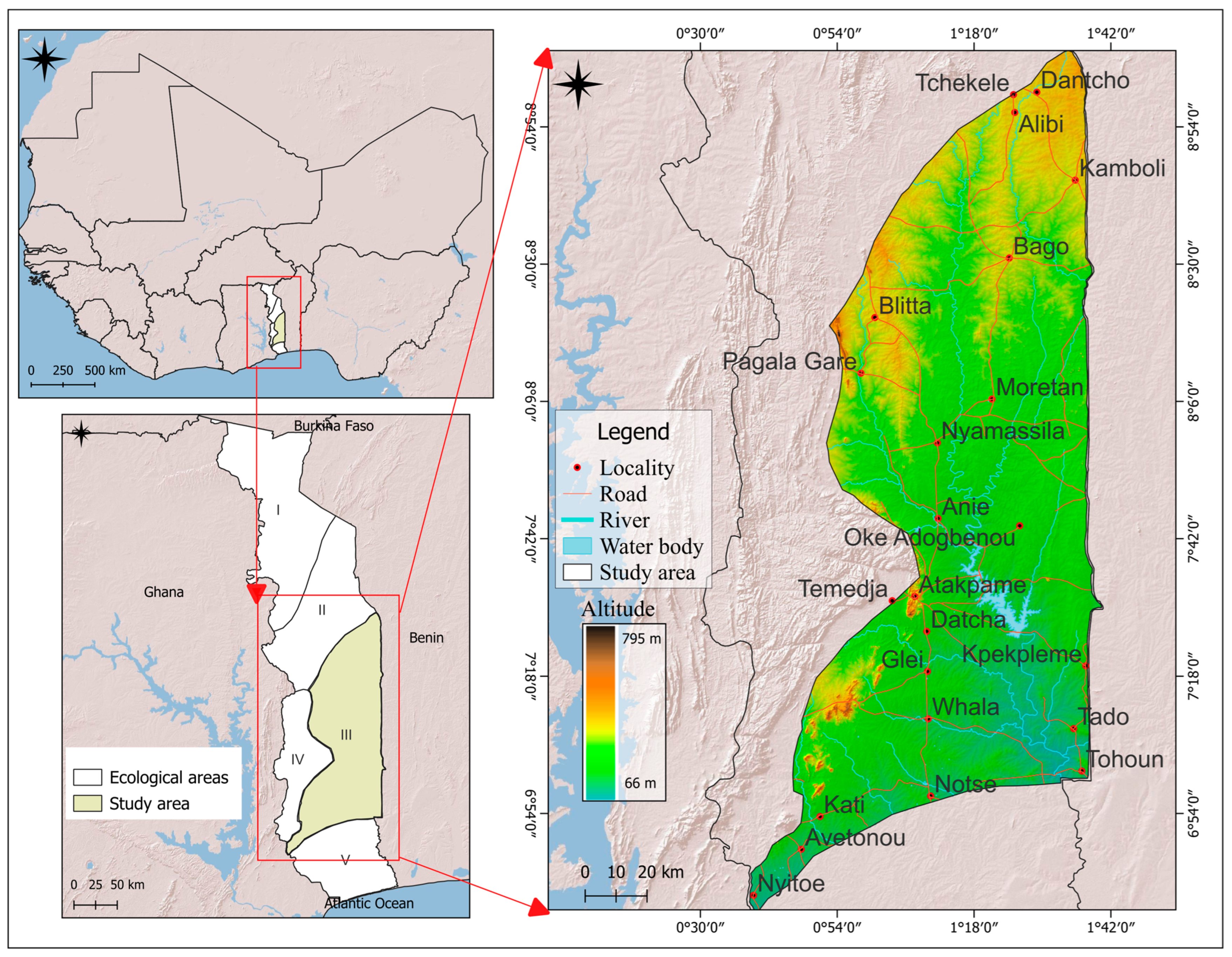
Togo comprises five ecological zones [11]. This study focuses on the central plains (ecological zone III), which cover approximately 17,051.59 km2 (Figure 1). The area mainly encompasses the Mono Basin, with small portions of the Zio and Volta basins. Soils include four types: ferralitic, ferruginous, poorly developed, and mineral hydromorphic (gley or pseudogley) soils, particularly in the valleys of major rivers such as the Anié, Amou, Wahala, and Mono [33]. The study area is in the Benin–Togo plain, east of the Atakora mountain range, and the climate is characterized by a Guinean lowland climate. Vegetation is dominated by Guinean savanna, interspersed with extensive dry forests of Anogeissus leiocarpa, with a diverse flora of Combretaceae and Poaceae, as well as patches of semi-deciduous forests and gallery forests [34,35,36]. Agriculture, including cotton, maize, soybean, yams, rice, beans, and voandzou, is the main livelihood of local communities. Livestock farming, practiced either sedentarily or through transhumance by Fulani pastoralists and agro-pastoralists, is also significant [34,37]. Cashew-based agroforestry systems are present in the northeastern study area [38,39,40].

2.2. Data Collection Methods and Techniques

The study adopts a transversal framework combining both analytical and diachronic perspectives. We used remote sensing data (Section 2.2.1) and complementary data (Section 2.2.2).

2.2.1. Satellite Data

The satellite data used in this study are from the Landsat program for three reference years: 1991, 2005, and 2022. These dates, corresponding to intervals of approximately 14 years (1991–2005) and 17 years (2005–2022), were selected based on both methodological and contextual criteria. From a methodological standpoint, three main criteria guided the selection of these years: (i) the availability of Landsat images with satisfactory radiometric and atmospheric quality for the selected periods; (ii) the need for sufficiently long time intervals to capture major landscape transformation trends; and (iii) the continuity of the Landsat archive, which represents one of the few multispectral image series providing homogeneous coverage and a consistent spatial resolution of 30 m over more than three decades.
For each reference year, four Landsat scenes were mosaicked to ensure complete coverage of the study area. Only images showing no or minimal cloud cover were selected. All scenes were acquired during the dry season (January–February), when cloud cover is typically low (≤10%). This seasonal consistency minimizes spectral variability related to vegetation phenology and improves the reliability of diachronic comparisons [31].
The images were uploaded using the USGS Global Visualization Viewer portal (https://glovis.usgs.gov/). The products selected are level 2 (Surface Reflectance) data, previously corrected for atmospheric and geometric effects. The use of these pre-treated products is recommended for land-use change analyses, as it ensures better temporal comparability and reduced artifacts, especially for historical forest cover monitoring [41,42]. The characteristics of the images used in this study are summarized in Table 1.

2.2.2. Additional Data

The auxiliary data used in this study include both raster and vector datasets, harmonized for integration with Landsat imagery. The raster file of the digital elevation model (DEM) with a 90 m × 90 m spatial resolution was obtained from the USGS portal. Data on roads, the hydrographic network, and built-up areas were obtained from the OpenStreetMap (OSM) platform. Other variables, such as soil types and administrative boundaries (at regional, prefectural, and communal levels), were primarily acquired in vector format [43]. To ensure compatibility with Landsat data (30 m spatial resolution), we preprocessed the datasets in several steps. First, all datasets were reprojected into a common coordinate system (UTM, WGS 84, corresponding to the study area) to ensure spatial consistency. Next, raster data were resampled to a uniform spatial resolution of 30 m × 30 m using the nearest neighbor method for categorical variables to preserve class integrity. Vector data were reprojected and rasterized to match the spatial resolution and extent of the Landsat imagery. All data were integrated into a GIS environment to improve classification accuracy, spatial interpretation, and landscape change analysis.

2.2.3. Data Processing Methods

Satellite Image Processing
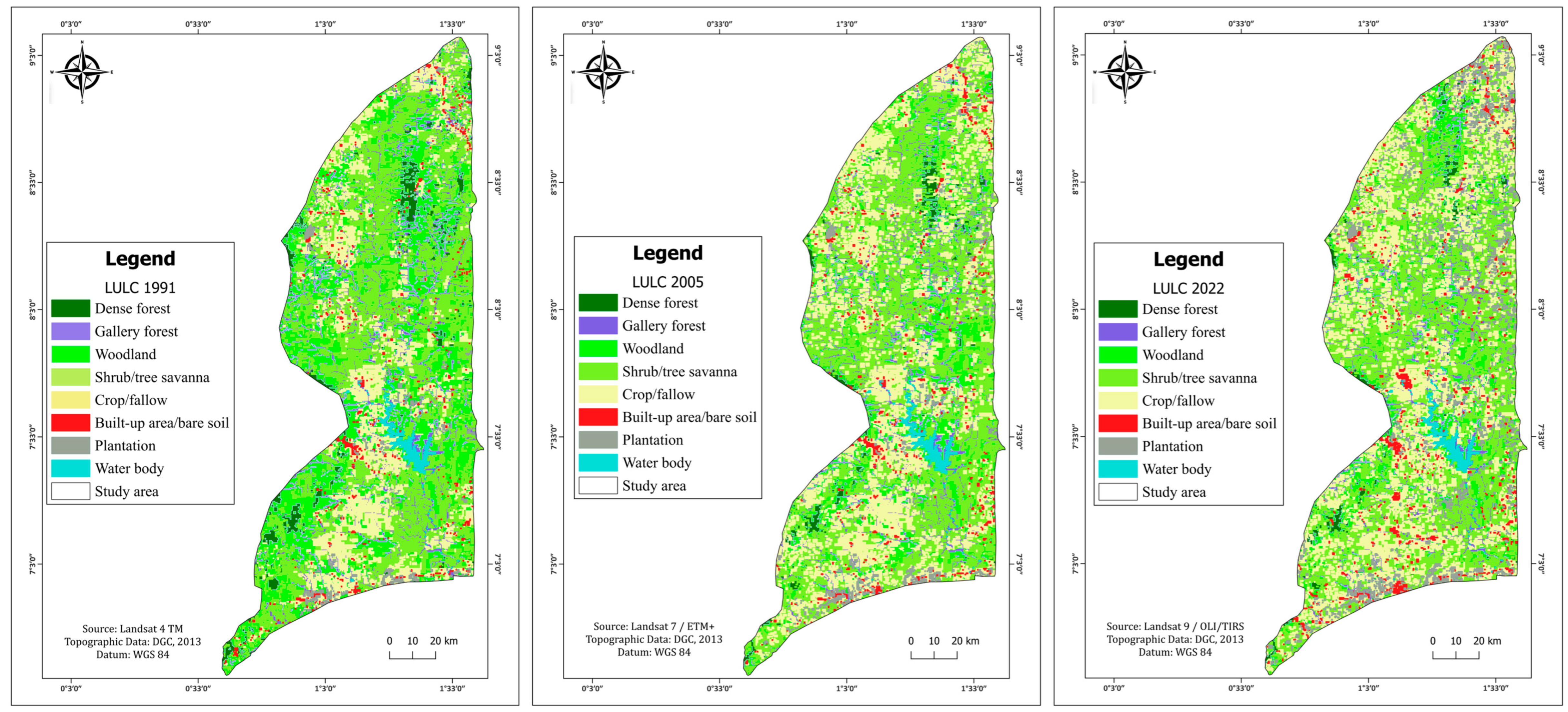
The uploaded images were preprocessed through mosaicking and clipping to ensure complete spatial coverage of the study area (Figure 2). LULC mapping for 1991, 2005, and 2022 followed a consistent and rigorous methodological framework. Two main approaches are commonly used in LULC mapping: automated classification and visual interpretation. Although automated methods are efficient for large datasets, they are often limited by spectral variability and class confusion [44]. Therefore, a visual interpretation approach, recognized for its higher reliability, was adopted [45]. Classification was performed using the Rapid Land Cover Mapper (RLCM) tool, an Esri ArcGIS Desktop (version 10.8) add-in developed by the US Geological Survey EROS [46]. This tool integrates a hybrid vector–raster system and generates systematic point grids to support visual photo-interpretation [46]. The mapping procedure included: (i) satellite image selection; (ii) overlay of a systematic point grid; (iii) visual interpretation and class attribution; and (iv) generation of final LULC maps. A total of 68,212 interpretation points were generated using a systematic sampling strategy based on a regular grid covering the entire study area. The points were evenly spaced at 500 m intervals, ensuring a homogeneous spatial distribution and adequate representation of the spatial variability of land-use classes. This sampling intensity provided comprehensive spatial coverage while balancing classification accuracy and interpretive effort. To minimize potential spatial autocorrelation effects, the relatively wide spacing between points (500 m) helped reduce spatial dependence among neighboring observations. In addition, each point was interpreted independently based on its visual characteristics, thereby limiting biases associated with spatial proximity and improving the robustness of the classification results. A cascading classification strategy was applied. The most recent year (2022) was interpreted first, and the classification was subsequently backdated to 2005 and 1991. This approach ensured temporal consistency and facilitated the identification of land cover transitions across the three periods. The classification scheme was based on the Yangambi classification system [47] and adapted to Togo’s national standards in accordance with the First National Forest Inventory [48]. Eight LULC classes were defined: dense forest, gallery forest, woodland, tree and shrub savanna, cropland/fallow, plantation, built-up area/bare land, and water body.
The accuracy of land use and land cover (LULC) classifications was assessed using confusion matrices based on comparisons between the classes derived from the classification and reference data. The selected indicators include Overall Accuracy, the Kappa coefficient, and the Producer’s and User’s accuracies, which allow evaluation of omission and commission errors, respectively [49,50]. For each LULC map (1991, 2005, and 2022), validation points were generated through stratified random sampling, supplemented by available field data, to ensure balanced representation of the different classes [51]. A total of 336, 359, and 336 points were used for the three years, respectively. These points were converted to KML format and overlaid in Google Earth Pro with high-resolution imagery, enabling visual interpretation of historical data.
The reference points were compared with the classification results to populate the confusion matrices and calculate accuracy indicators for each year [49]. Overall accuracy corresponds to the proportion of correctly classified pixels, while the Kappa coefficient measures the level of agreement by accounting for the portion attributable to chance [52]. Its value ranges between 0 and 1, and its interpretation follows the scale proposed by Landis and Koch [53]: poor (≤0), slight (0.00–0.20), moderate (0.21–0.60), substantial (0.61–0.80), and almost perfect (0.81–1.00).
User’s accuracy (UA) and Producer’s accuracy (PA) were calculated for each class and each year, enabling a detailed evaluation of classification performance, including for underrepresented classes (Table 2). Following validation, classified raster datasets were vectorized and exported to QGIS (v. 3.34.8, QGIS Development Team). Class areas were then calculated to ensure a comparative analysis of landscape spatio-temporal dynamics.
Annual average rate of spatial expansion (Ta)
To assess LULC dynamics, the Annual Average Rate of Spatial Expansion (Ta) was calculated based on the initial and final areas of each land cover class. This indicator expresses the annual proportion of change affecting each land use unit over a given period [54,55]. It is calculated using the following formula and has been applied by several authors [56,57].
T a = l n S 2 l n S 1 t 2 t 1 × l n e × 100
S1 and S2 are the areas of a landscape unit at date t1 and t2, respectively; t2 − t1 is the number of years of evolution; ln is the natural logarithm, e is the base of the natural logarithm (e = 2.71828)
Conversion rate (Tc)
The conversion rate of a land cover class (Tc) corresponds to the degree of transformation undergone by one class into other classes. Tc is the amount of change observed at the level of a land use unit between the dates 1991−2005, 2005–2022, and 1991–2022 [58,59,60,61]. The results of the calculation of the rate of change in land cover will include either a minus (−) or a plus (+) sign to indicate a regressive or a progressive dynamic, respectively [57,62]. Tc is obtained from the transition matrix following the formula:
T c = ( S 2 S 1 ) S 1 × 100
Deforestation rate
The annual rate of deforestation (R) was estimated using the formula below [63,64].
R = 1 t 2 t 1 × ln A 2 A 1 × 100
With t2 − t1, the time interval in which we want to calculate changes in land use. A1 and A2 represent the sum of the proportion of land use in the initial and final year, respectively.
Level of anthropization
To determine the level of anthropization in the central plains area, the ecological disturbance index (U) was used [55,65,66]. This index allows the level of ecological disturbance to be assessed over 31 years. It corresponds to the ratio between the areas of anthropized zones, such as fields, fallow land, bare soil, built-up areas, and plantations, and those of natural or slightly transformed zones, such as dense forest, gallery forest, woodland, and shrub/tree savanna [67,68].
The formula is therefore as follows:
U   =   A a A n × 100
Aa represents the total area of anthropized land cover classes,
An represents the total area of natural or semi-natural land cover classes.
Prospective Modeling of Land Cover Dynamics for 2030 and 2050
The land cover prediction model we have utilized during the study for the 2030 and 2050 time horizons is the Land Change Modeler (LCM), delivered in IDRISI Selva 17.0 software [69,70]. The model is generated by analyzing past and present land cover dynamics to predict future changes. Several factors affecting land cover change are integrated, and these transitions can be modeled; the impacts of change on biological diversity can be investigated, and the evolution of forest cover can be estimated for the future, taking into account relative transition potentials [69,71]. Our modeling was based on reviewing historical dynamics, generating transition probabilities, and a spatial allocation in a consolidated approach. The first thing the analysis addressed was the spatiotemporal evolution of land cover between 2005 and 2022, which was analyzed using a multi-criteria evaluation (MCA). The identified independent variables (distance to roads, altitude, and slope) were determined based on the literature, which has identified them as the primary drivers of land cover change in tropical climates [72,73,74]. Distance to roads indicates the accessibility and anthropogenic pressure on roads, which have increased agricultural areas and built-up land [75,76]. Altitude affects biophysical features and accessibility, whereas slope is a physical boundary that restricts change on mountain slopes [77,78,79]. A logistic regression analysis was performed to establish the impact of these independent variables. This regression demonstrates a positive impact from altitude (β = 0.0197) and distance to roads (β = 2.14 × 10⁻⁴), whereas slope has a minimal impact. Moderate fit is demonstrated for the model (Pseudo R2 = 0.0584), as is typical in rare transition modeling [80,81]. Transition probabilities were then projected from (i) the changes observed between 2005 and 2022, and (ii) transition matrices prepared to represent the forecasting for future scenarios.
The Markov chain model allowed modeling the temporal dynamics of land cover systems based on class change probabilities [57,69,82]. The MLP’s performance was evaluated based on the accuracy of its predictions of transition probabilities. The performance of the logistic regression model was assessed using the chi-square test (χ2) to assess the statistical significance of the relationships between the explanatory variables and the observed transitions, and using the ROC curve to evaluate its discriminatory power. The results indicate a statistically significant overall fit (χ2 = 59.50; df = 3), while the ROC value (70%) reflects acceptable predictive performance. Transition probabilities were spatially allocated and integrated into a multilayer perceptron (MLP) neural network, allowing the combination of temporal dynamics and spatial constraints [32,83,84]. This model was trained using a supervised learning approach, with the explanatory variables and observed transitions as outputs, employing a two-hidden-layer architecture (10 and 5 neurons) optimized via backpropagation with a sigmoid activation function. In this study, the future projections follow a trend-based scenario (“Business As Usual,” BAU), which assumes the continuation of the dynamics observed between 2005 and 2022 in the absence of major new economic or environmental policies [61,85]. Under this scenario, future changes in land use follow past trends, in line with recent socio-economic dynamics such as population growth and increased demand for agricultural land and energy resources. Demand for cropland and wood energy follows trajectories similar to those during the reference period. This widely used approach enables thethe projection of future land-use trajectories through 2030 and 2050 and provides decision-support information for the sustainable management of forest landscapes.

3. Results

3.1. Land Use in the Central Plains of Togo in 1991, 2005, and 2022

The overall accuracy and Kappa index values indicate that classifications from Landsat images in 1991, 2005, and 2022 are of good quality and reliable for analyzing land-use dynamics (Table 2). They enabled distinguishing the main land-use classes in the central plains (Figure 2).
The overall accuracy of land-use classifications decreased in 2022 (80%) compared to 1991 (86.2%) and especially to 2005 (91%), mainly due to the confusion between certain classes, which was linked to the growing landscape heterogeneity. Class-specific accuracy indicators remain generally satisfactory but also show a decline in 2022. Forest formations exhibit a notable decrease, with high values in 1991 and 2005 (>90%) dropping in 2022 (dense forests: UA = 83%, PA = 81.5%; gallery forests: 76%–78%; woodlands: 72%–74%). Savanna classes, cropland/fallow areas, plantations, built-up areas, and bare soils followed a similar pattern, with accuracies generally ranging between 69% and 78% in 2022, owing to their high heterogeneity and spectral proximity. In contrast, water bodies maintained high accuracy across all periods (>85%, reaching up to 100%) owing to their stable and well-differentiated spectral signatures.

3.2. Spatio-Temporal Dynamics of Land Use from 1991 to 2022

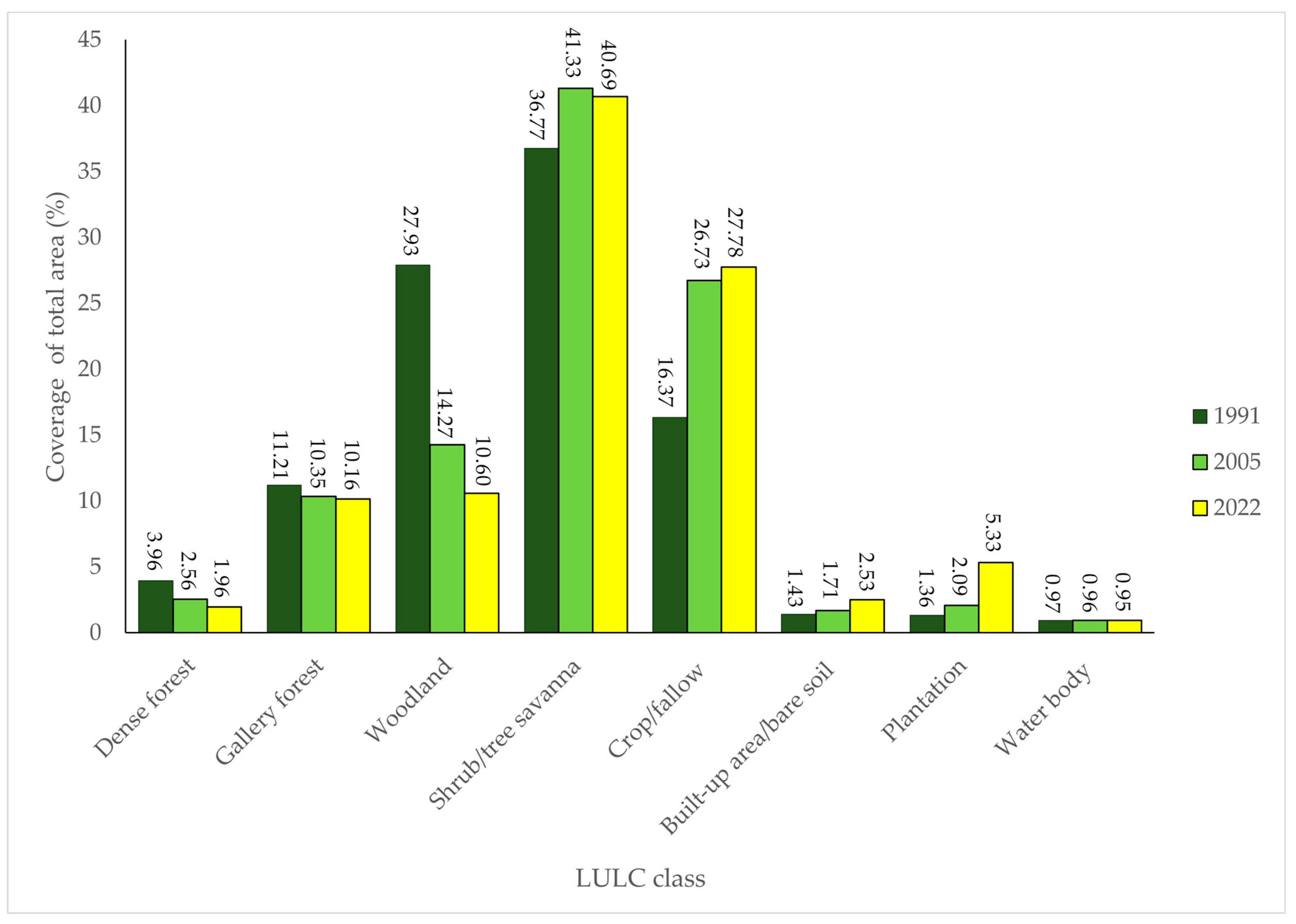
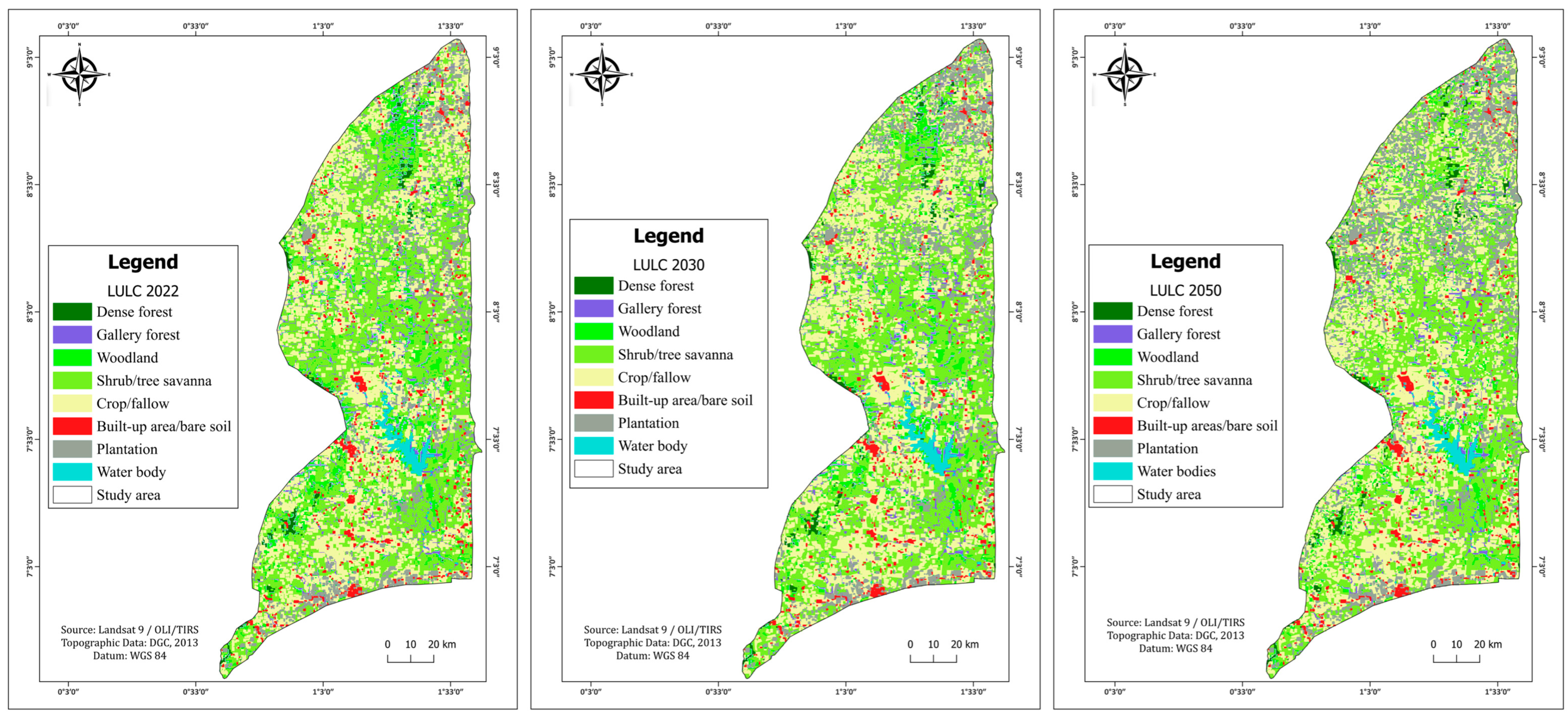
The spatio-temporal dynamics reveal the evolution of land use in the central plains. In 1991, shrub/tree savanna dominated the landscape (6270.57 km2; 36.77%), followed by woodland (4761.83 km2; 27.93%) and crops/fallow land (2792.13 km2; 16.37%). In 2005, shrub/tree savanna remained dominant (7047.43 km2; 41.33%), cropland/fallow land increased (4557.55 km2; 26.73%), and forest formations declined (dense forest: 435.98 km2; 2.56%, woodland: 2433.56 km2; 14.27%). In 2022, shrub/tree savanna remained the dominant class (6938.32 km2; 40.69%), followed by cropland/fallow land (4736.42 km2; 27.78%) and rapidly expanding plantations (909.47 km2; 5.33%), while dense forests and gallery forests continued to decline (Figure 3). These changes reflect gradual savannization and growing human pressure of forest landscapes.
Analysis of average annual spatial expansion rates (Ta) and conversion rates (Tc) between the periods 1991–2005, 2005–2022, and 1991–2022 reveals that, of the eight classes identified, four have declined while the other four are expanding. Natural forest formations, particularly dense forests (dense dry and semi-deciduous forests), gallery forests, and woodland, show negative average annual rates over all the periods analyzed, reflecting a persistent trend of decline. This trend is particularly marked for the woodland forests class, which recorded an average annual rate (Ta) of −3.13% over the period 1991–2022 and a cumulative conversion rate (Tc) of −62.06% (Table 3). The dense forest class also shows a significant loss, with an overall conversion rate of –50.55%, confirming the continued degradation of forest cover in the study area. Furthermore, anthropogenically dominated classes are experiencing significant growth, particularly plantation, which has the highest expansion rate (Ta = 4.40% over 1991–2022) and a very high cumulative conversion rate (+291.41%). This trend demonstrates a process of conversion or gradual degradation of closed forest formations towards more open formations.
Plantation classes and built-up/bare soil areas also show a trend of progression. Crops/fallow land show a more contrasting trend, with a slight decline between 2005 and 2022, but an overall positive balance over the entire period, indicating spatial readjustments linked to agricultural production systems.
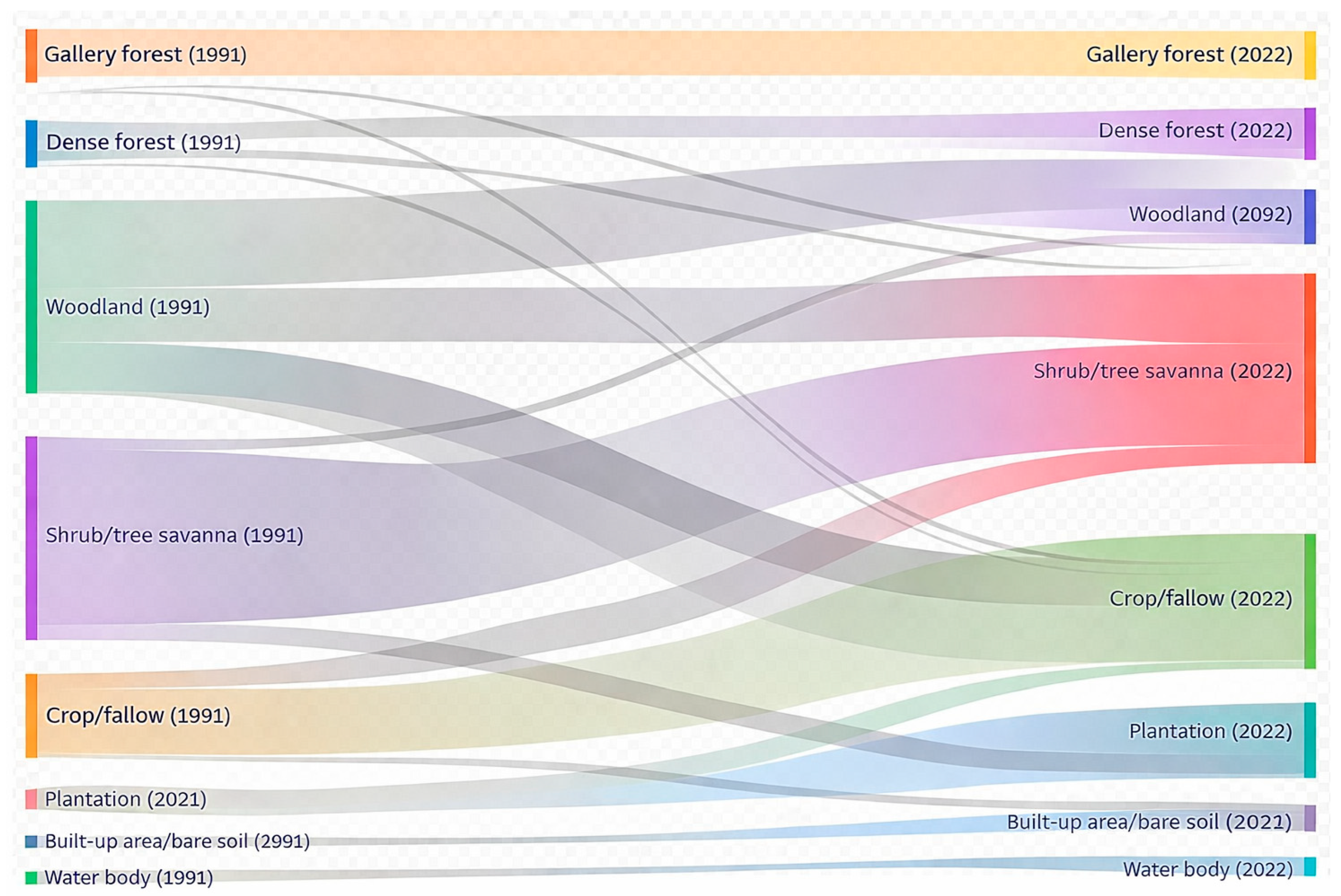
Analysis of the land-use conversion matrix from 1991 to 2022 reveals significant changes in the Central Plains (Table 4 and Figure 4). These changes mainly affect natural formations. The dense forest class has lost a significant portion of its area to shrub/tree savannas (149.11 km2), crops/fallow land (119.15 km2), and plantations (21.94 km2). Similarly, woodland has been largely converted to shrub/tree savanna (1744.77 km2), crops/fallow land (1162.14 km2), and plantations (202.57 km2).
The massive conversions to shrub/tree savanna, particularly from woodland (169.07 km2) and gallery forest (131.32 km2), reflect a gradual degradation of natural formations. On the other hand, plantations have expanded rapidly, mainly at the expense of shrub savanna (284.28 km2) and crops/fallow land (161.33 km2). Built-up/bare land has also increased, with 206.01 km2 coming from various categories, including fallow land and savannah. These results confirm a growing trend towards anthropization and urbanization, marked by increased pressure on forest ecosystems and a shift in land use toward agriculture, plantations, and built-up areas.

3.3. Ecological Disturbance of Forest Landscapes in the Central Plains of Togo

The results show that between 1991 and 2022, the average annual rate of deforestation and degradation of natural formations (dense forests, gallery forests, woodlands, and shrub/tree savanna) in the central plains of Togo was 0.75%, representing a loss of approximately 127.01 km2 per year. The deforestation and forest degradation trend is consistent with the rate of anthropization. This is reflected by the ecological disturbance index, which increased from 0.24 in 1991 to 0.45 in 2005 and 0.56 in 2022. This represents an overall increase of more than 130% over the 31 years.

3.4. Land Cover Projections for 2030 and 2050

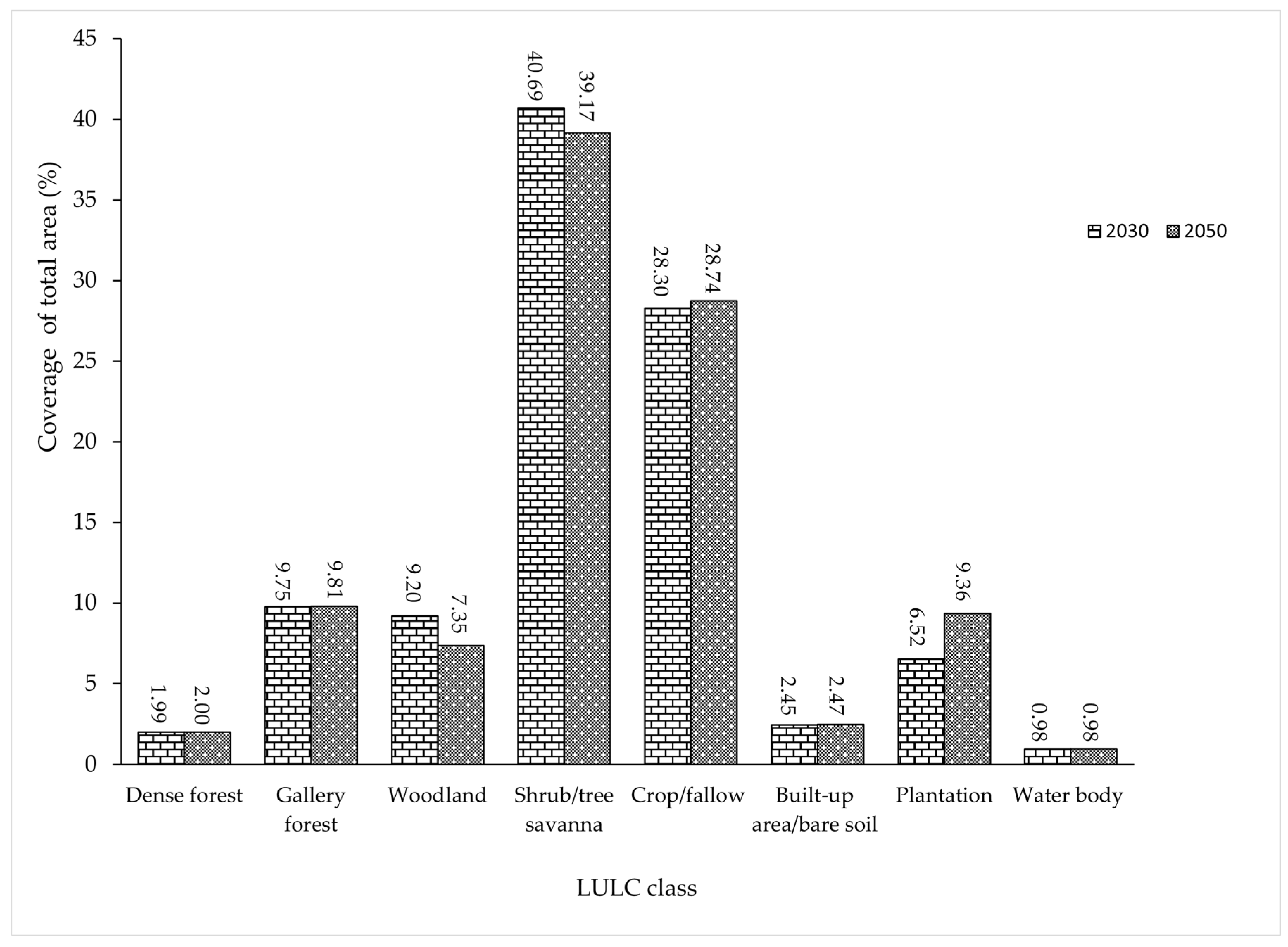
By 2030, shrub/tree savanna areas will remain the dominant land cover type, accounting for 40.47% of the total area, with no significant change compared to the reference year 2022. This is followed by crop/fallow areas, which will see a slight increase to 28.40%. On the other hand, gallery forest and woodland cover will decrease to 9.68% and 9.15%, respectively (Table 5). Plantations will see a notable increase, reaching 6.65%. By 2050, shrub/tree savanna areas will remain the dominant class, decreasing slightly to 39.01%. Meanwhile, crops/fallow land and plantations will continue to expand, reaching 28.77% and 9.31% respectively. Gallery forests will see a slight recovery to 9.69%, while woodlands will experience a sharp decline to 7.45% (Figure 5 and Figure 6).
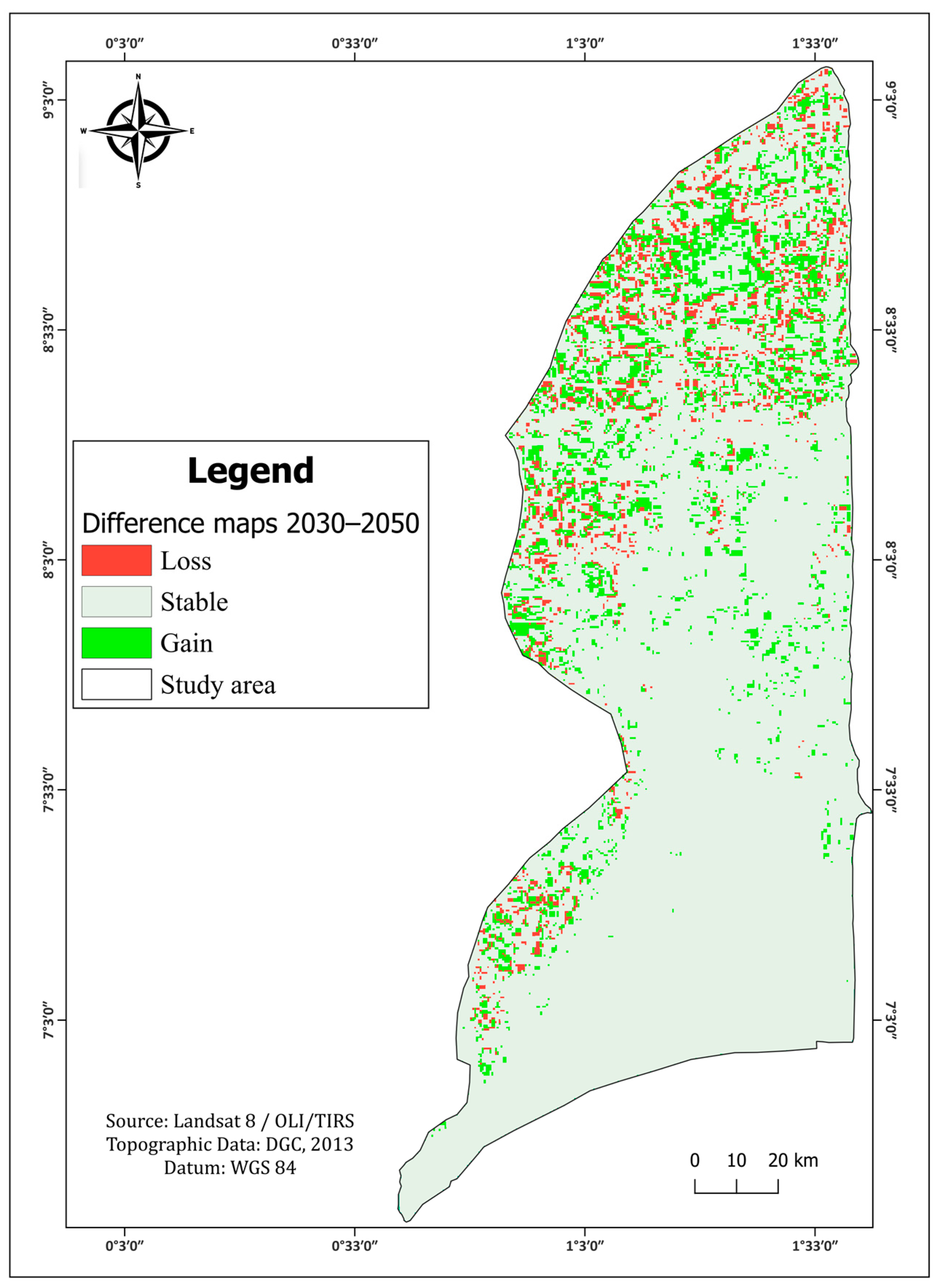
These changes are reflected by the analysis of the average annual spatial expansion rates (Ta) and conversion rates (Tc) for 2030 and 2050. The results indicate a strong increase in plantation areas (Tc = +74.47%), accompanied by the expansion of croplands and built-up areas. In contrast, natural formations, particularly woodland, are projected to lose approximately 30% of their area (Table 5). In addition, the 2030 and 2050 projections reveal a predominance of stable areas, covering 14,674.92 km2, or 86.11% of the total area (Figure 7). These are mainly composed of shrub/tree savannah and water bodies. Areas in decline (losses) account for 722.58 km2 (4.24%), primarily affecting woodland. Conversely, areas of projected gain extend over 1644.56 km2 (9.65%) and primarily comprise plantations and cropland/fallow areas.

4. Discussion

4.1. Patterns of Forest Degradation and Land Cover Transformation

The results of this study reveal a gradual yet profound transformation of the for-est landscapes of Togo’s central plains over the past three decades. In line with land-use analysis approaches, this study goes beyond quantifying changes to also elucidate the complex interactions between biophysical processes, ecological dynamics, and socio-economic factors shaping landscape evolution [86].
The spatio-temporal analysis reveals a trajectory dominated by the continuous decline of natural formations in favor of more open vegetation types and anthropogenic land uses. The marked regression of dense forests (−50.55%) and woodlands (−62.06%) observed in the study area is consistent with trends documented in other Sudanian and Guinean landscapes, particularly in northern Benin [68] and across several West African regions [59,87,88,89,90]. These patterns confirm a broader regional dynamic of vegetation degradation largely driven by agricultural expansion and demographic pressure [91,92,93].
The conversion of dense forests and woodlands into shrub/tree savannas reflects a gradual, cumulative, and non-linear degradation process rather than abrupt deforestation, aligning with observations reported in other West African contexts [93,94]. The high vulnerability of woodland plays a central role in this dynamic. Their intermediate ecological position between closed forest formations and agricultural lands makes them particularly susceptible to successive disturbances and conversions. Frequent transitions towards shrub savannas, which exhibit the highest expansion rates, suggest progressive degradation in which these open formations represent transitional states rather than stable ecological systems [67,95]. However, the present study does not explicitly incorporate time-series-derived fragmentation metrics (patch density, edge density), which limits the ability to confirm the transitional nature of these formations, despite their recognized importance in recent landscape ecology research [96,97].
These structural landscape transformations also present methodological challenges for the accurate understanding of land cover and land use change. The reduction in overall classification accuracy observed in 2022 (80.0%) compared to previous years (86.2% in 1991 and 91.0% in 2005) reflects the increasing complexity of the landscape under anthropogenic pressure. This decrease in performance is primarily explained by confusion among land cover classes, particularly between woodland, tree/shrub savanna, cropland/fallow, and plantations, owing to their high spectral similarity [98,99]. Increasing landscape heterogeneity also reduces classification performance [100,101,102], directly impacting biodiversity and ecosystem functioning [103]. Despite these uncertainties, classification accuracy remains acceptable for analysis at the scale of our study area and does not compromise the major land cover change trends identified here.
These results support the hypothesis of nonlinear landscape trajectories in tropical landscape ecology, whereby incremental changes may push ecosystems beyond critical thresholds that are difficult to reverse [67]. The increase in the ecological disturbance index from 0.24 in 1991 to 0.56 in 2022 reflects not only a reduction in natural areas but also intensifying fragmentation and anthropogenic heterogeneity within the landscape. Similar dynamics have been widely documented in regional studies conducted in Benin [104], Mali [87], the Democratic Republic of Congo [105], and Côte d’Ivoire [106], all of which highlight the growing influence of anthropization on forest landscape structure. Such fragmentation compromises functional connectivity between forest remnants, limiting biological flows, species dispersal, and natural regeneration processes [107,108]. In the central plains, gallery forests, although spatially limited, play a major ecological role as biological corridors and hydrological regulators. Their decline signals accelerated biodiversity loss and increasing instability of ecosystem services [109,110].
The expansion of cropland and plantations reflects intensifying agriculture and economic dependence on land-based production systems. While contributing to short-term livelihood security, this expansion often accelerates soil fertility loss, biomass depletion, and long-term land degradation when sustainable management practices are lacking [74]. The observed land cover transitions, therefore, illustrate the combined pressures of demographic growth and market-oriented agriculture, which progressively transform multifunctional forest–savanna mosaics into simplified agro-production systems. These findings are consistent with the forest transition framework, which suggests that the early stages of economic development are typically accompanied by rapid forest decline, followed by potential stabilization under improved governance and land-use regulation [111,112]. However, in the absence of proactive restoration policies and effective land-use planning, the continuation of current trends points toward increasing ecological homogenization and further loss of ecosystem services. Beyond biophysical processes, these landscape changes are strongly influenced by socio-economic drivers.

4.2. Anthropization of the Landscape and Socio-Economic Pressures

The transformation of forest landscapes in the central plains is also characterized by a significant increase in human impact. Built-up areas, bare land, croplands, fallow areas, and plantations are expanding rapidly. This reflects growing pressure on natural ecosystems. It also indicates a shift in how landscapes function and are used for production. Cropland and fallow areas are increasing overall, despite some fluctuations. These results corroborate numerous diachronic studies in Togo and West Africa reporting continuous decline of forest and savanna formations in favor of agricultural land, bare areas, urban zones, and plantations [34,113,114,115]
The drivers of these changes are both socio-economic and biophysical. The expansion of extensive agriculture, particularly the establishment of new soybean and maize fields, growing demand for arable land, fuelwood and charcoal production, recurrent vegetation fires, and urban expansion constitute the principal factors behind forest and savanna degradation [61,116,117]. This agricultural expansion, largely driven by food and economic needs associated with population growth, accelerates the direct conversion of natural formations and contributes to the estimated annual deforestation rate of 0.75% and the rise in the anthropization index [118]. Additionally, artisanal extraction of sand, gravel, and gold, especially gold panning, is a significant source of degradation, particularly along rivers and in gallery forests, where it leads to the destruction of riparian vegetation and destabilization of riverbanks [119]. These anthropogenic pressures are exacerbated by biophysical constraints, including the fragility of ferruginous and ferralitic soils, interannual variability in rainfall, and increased susceptibility to water erosion, which amplify degradation processes in already disturbed areas [120].
In the Guinean and Sudanian zones, shifting cultivation, shortened fallow cycles, and the expansion of permanent cropping systems progressively reduce vegetation cover and soil regenerative capacity [121]. The patterns observed in the central plains are aligned with this intensification trend. They are particularly reflected in the conversion of natural formations such as wooded savannas, open forests, and gallery forests into cropland, as well as in the gradual transformation of traditional agro-ecological mosaics, including fallow land and shrub savannas, into more permanent, spatially extensive agricultural systems. Market integration and the development of cash crops further reinforce land conversion processes. The expansion of plantations, particularly teak and cashew, reflects a growing orientation toward commercial production. Although plantations can contribute to economic growth and employment, they often simplify vegetation structure and reduce biodiversity compared with natural or semi-natural formations [122].
Energy demand constitutes another major pressure factor. In many rural areas of Togo, wood biomass remains the primary source of household energy. The exploitation of wood energy, through fuelwood collection and charcoal production, leads to a progressive reduction in canopy density and promotes the degradation of forest ecosystems, particularly in areas close to human settlements and transportation corridors. Similar patterns have been documented in northern Ghana and Burkina Faso, where wood extraction for energy plays a significant role in forest structure simplification [123]. These pressures do not necessarily result in immediate large-scale deforestation but instead generate cumulative structural degradation that gradually shifts ecosystems toward shrub-dominated states.
Apart from the pressures associated with timber harvesting, infrastructure development, and improved spatial accessibility are key factors influencing the dynamics of anthropization. According to land system theory, enhanced accessibility through roads and market linkages reduces transportation costs and stimulates agricultural expansion [124]. Even moderate improvements in rural infrastructure can trigger substantial landscape transformations, particularly in contexts where land tenure systems are weakly regulated. In the central plains, the expansion of built-up areas likely acts as a catalyst for intensified resource extraction, thereby accelerating fragmentation in adjacent forest patches. Institutional and governance factors also play a decisive role in shaping these dynamics. In particular, inadequate enforcement of land-use regulations, limited monitoring capacity, and the coexistence of customary and legal systems can contribute to uncontrolled land-use expansion [72]. Under such conditions, land conversion often occurs incrementally and diffusely, resulting in a mosaic of anthropogenic land uses interspersed with remnant natural formations. The increasing ecological disturbance index thus reflects not only physical land cover change but also governance shortcomings in sustainable land management.
Although anthropization can enhance livelihoods and food security, its ecological consequences become problematic when expansion occurs without appropriate safeguards. Unregulated land conversion leads to landscape homogenization, reduced provision of ecosystem services, and increased vulnerability to climate variability [125]. In forest–savanna transition zones such as the central plains, excessive land conversion may reduce carbon stocks, alter hydrological regimes, and intensify soil erosion, thereby undermining long-term socio-economic resilience. The observed trajectory suggests that the study area is undergoing a transition from a semi-natural mosaic to a predominantly human-dominated agro-production matrix. Without integrated land-use planning and restoration measures, continued anthropization may push the system beyond recovery thresholds towards ecological simplification. To mitigate irreversible damage, these results suggest integrating FLR strategies within broader territorial development frameworks that reconcile agricultural productivity, biodiversity conservation, land degradation neutrality, and climate change adaptation objectives [126]. These observed trends have important implications for future land management and restoration strategies.

4.3. Forward-Looking Implications for Sustainable Forest Landscape Restoration

The prospective modeling results for 2030–2050 under the BAU scenario indicate a continued decline in natural forests, further expansion of cropland and plantations, and progressive structural simplification of the landscape. These findings are consistent with other prospective studies conducted in Togo [14,61,127] and across West Africa [31,128], illustrating the utility of spatial modeling tools for anticipating land-use changes in regions under high anthropogenic pressure. However, the observed increase in plantations, often interpreted as a positive indicator of restoration, should be considered cautiously. The predominance of fast-growing exotic species such as Anacardium occidentale, Gmelina arborea, and Tectona grandis limits long-term ecological benefits in terms of biodiversity, soil fertility, and overall ecosystem resilience. If these trajectories persist, the central plains risk transitioning toward a largely anthropogenic agro-production matrix with reduced ecological resilience and diminished ecosystem services provision, underscoring the urgency of integrating forward-looking spatial planning into sustainable development strategies.
The study also highlights limitations in current restoration practices, which frequently overlook spatial for spatial heterogeneity and varying degrees of landscape degradation. Such an approach compromises both the sustainability and effectiveness of restoration efforts [129,130]. Incorporating spatio-temporal landscape change into restoration strategies is therefore essential to better define sustainable management and intervention options. The use of degradation maps, spatial analysis tools, and prospective scenarios allows for improved prioritization of intervention areas, adaptation of restoration techniques to local contexts, and strengthening of ecological connectivity, which is crucial for maintaining ecological resilience, biodiversity, and ecosystem services over the long term [131,132,133,134].
FLR offers a strategic framework that reconciles ecological recovery with socio-economic development. Unlike conventional reforestation approaches focused solely on tree planting, FLR emphasizes the restoration of ecological functionality at the landscape scale while enhancing human well-being [5,130]. However, implementing forest landscape restoration (FLR) often involves trade-offs between carbon sequestration goals and biodiversity conservation outcomes, particularly in plantation-based approaches. The expansion of such plantations highlights significant ecological trade-offs, with direct implications for forest landscape restoration [135,136]. Although plantations contribute to carbon sequestration, they may, in certain contexts, compromise biodiversity, particularly when they rely on monocultures or exotic species [122,129,137]. Furthermore, the spatial and functional priorities of carbon do not necessarily align with those of biodiversity, meaning that strategies focused exclusively on carbon can lead to significant biodiversity losses [138,139]. This tension underscores the need to explicitly address trade-offs through integrated, context-specific approaches that balance climate goals with the preservation of ecological integrity within the framework of forest land restoration strategies [140]. In the central plains, restoration should prioritize connectivity between remnant forest patches, protection and rehabilitation of gallery forests, and the promotion of agroforestry systems that integrate production with ecological functions. The projections further emphasize the need for spatially explicit land-use governance. Prospective modeling provides decision-makers with anticipatory tools to identify high-risk areas and prioritize intervention. Integrating these modeling outputs into territorial planning instruments, including regional development plans and land-use zoning frameworks, can support evidence-based policy formulation [124]. Without proactive governance, continued expansion of cropland and plantations may reduce restoration opportunities and increase long-term restoration costs.
Although the analytical framework is robust and the findings are relevant, the use of higher-resolution imagery would significantly improve land use and land cover (LULC) classification accuracy by reducing attribution errors and more finely representing landscape heterogeneity [141]. Furthermore, the projection model used relies on a limited number of explanatory variables (distance to roads, elevation, and slope), which limits its ability to explicitly incorporate other key factors such as wildfires, logging, socio-economic pressures, or the effects of climate change factors recognized as major drivers of land-use changes [72,73,142]. Furthermore, the adopted “business-as-usual” scenario assumes past trends will continue, which may not reflect potential disruptions arising from public policies, economic transformations, or global environmental dynamics. From this perspective, a more robust approach would involve integrating spatially explicit socio-economic data and alternative scenarios, particularly the Shared Socio-economic Pathways (SSPs), to better represent uncertainties and explore a range of possible futures [143].

5. Conclusions

In a context marked by intensifying global change, this study highlights the importance of analyzing landscape evolution trajectories to support sustainable FLR strategies. The combined use of remote sensing and spatial modeling tools reveals a rapid and profound transformation of the forest landscapes of Togo’s central plains between 1991 and 2022. This dynamic is characterized by a marked decline in natural formations, especially woodlands and gallery forests, in favor of anthropogenic land covers, including agricultural areas, plantations, and built-up zones. The results revealed increased landscape fragmentation, reduced ecological connectivity, and heightened vulnerability of forest ecosystems, thereby compromising their capacity to sustainably provide essential ecosystem services. Projections for 2030 and 2050 indicate that, without a significant reversal of current trends, these degradation processes will continue to permanently affect the ecological resilience of landscapes and the livelihoods of local communities. These findings confirm that land-use changes must be understood as complex, nonlinear processes closely intertwined with interactions among socioeconomic dynamics, biophysical constraints, and territorial governance arrangements. These results provide a valuable foundation for public policymakers, NGOs, and the scientific community involved in natural resource management, particularly in land-use planning and forest cover monitoring. In light of these results, five strategic directions appear essential for enhancing the effectiveness of land management and forest landscape restoration policies, namely: the systematic integration of the spatiotemporal dynamics of land use into spatial planning through the regular use of remote sensing, predictive modeling, and degradation mapping; the implementation of differentiated restoration strategies, adapted to local ecological contexts and levels of degradation; the promotion of diversified restoration approaches favoring local species and mixed agroforestry systems rather than monospecific plantations of exotic species; strengthening ecological connectivity through the protection and restoration of gallery forests, as well as the establishment of ecological corridors to limit landscape fragmentation; and improving land governance by strengthening the involvement of local communities while developing sustainable energy alternatives to reduce pressure on forest resources. The consistent implementation of these guidelines would help slow the degradation of forest landscapes and strengthen countries’ commitments to land restoration, climate change adaptation, and sustainable development.

Author Contributions

Conceptualization, K.K.A., K.K. and K.A.; Methodology, K.K.A.; Software, K.K.A.; Validation, K.A., K.K. and A.K.D.H.; Formal Analysis, K.A.; Investigation, K.K.A., K.K., K.N.S. and K.A.; Data Curation, K.A. and A.K.D.H.; Writing—Original Draft Preparation, K.K.A.; Writing—Review and Editing, K.K., K.A., K.N.S., J.B., S.J., V.P. and Y.W.; Visualization, K.K.A.; Supervision, K.A. and K.K. All authors have read and agreed to the published version of the manuscript.

Funding

This publication is part of the project “EbA4UNgoals—Strategic EbA to address multiple goals of the UN: The example of forest and landscape restoration in Togo”, supported by the IUCN, UNEP, and the German Ministry of Environment, Climate Action, Nature Conservation and Nuclear Safety’s International Climate Initiative (BMU-IKI) (Grant number AVUS-00151).

Data Availability Statement

Data sources are contained within the article.

Conflicts of Interest

The authors declare that the research was conducted in the absence of any commercial or financial relationships that could be construed as potential conflicts of interest.

References

  1. Ola, O.; Benjamin, E. Preserving Biodiversity and Ecosystem Services in West African Forest, Watersheds, and Wetlands: A Review of Incentives. Forests 2019, 10, 479. [Google Scholar] [CrossRef]
  2. Ola, A. Multifunctional Roles of Forest Ecosystem Services in Environmental Sustainability and Climate Regulation. For. Res. Open Access 2025, 14, 1–2. [Google Scholar] [CrossRef]
  3. Bakari, S.A.; Bashige, V.C.; Mutombo, C.S.; Kahumba, J.B. Ecosystem Functions and Services. In Resilience and Sustainability in the Congo Basin; Springer: Cham, Switzerland, 2026; pp. 1–22. ISBN 978-3-032-02023-9. [Google Scholar]
  4. FAO. Évaluation des Ressources Forestières Mondiales 2025; FAO: Rome, Italy, 2025; ISBN 978-92-5-140109-5. [Google Scholar]
  5. Mansourian, S. Overview of Forest Restoration Strategies and Terms. In Forest Restoration in Landscapes; Springer: New York, NY, USA, 2005; pp. 8–13. ISBN 978-0-387-25525-5. [Google Scholar]
  6. Birhanu, B.Z.; Desta, G.; Cofie, O.; Tilahun, S.A.; Mabhaudhi, T. Restoring Degraded Landscapes and Sustaining Livelihoods: Sustainability Assessment (Cum-Review) of Integrated Landscape Management in Sub-Saharan Africa. Front. Clim. 2024, 6, 1338259. [Google Scholar] [CrossRef]
  7. Nzabarinda, V.; Bao, A.; Tie, L.; Uwamahoro, S.; Kayiranga, A.; Ochege, F.U.; Muhirwa, F.; Bao, J. Expanding Forest Carbon Sinks to Mitigate Climate Change in Africa. Renew. Sustain. Energy Rev. 2025, 207, 114849. [Google Scholar] [CrossRef]
  8. Forzieri, G.; Dakos, V.; McDowell, N.G.; Ramdane, A.; Cescatti, A. Emerging Signals of Declining Forest Resilience under Climate Change. Nature 2022, 608, 534–539. [Google Scholar] [CrossRef] [PubMed]
  9. Djenontin, I.N.S.; Zulu, L.C.; Etongo, D. Ultimately, What Is Forest Landscape Restoration in Practice? Embodiments in Sub-Saharan Africa and Implications for Future Design. Environ. Manag. 2021, 68, 619–641. [Google Scholar] [CrossRef]
  10. Gomis, D.C. Dynamiques Spatio-Temporelles Des Formes d’occupation Du Sol Dans Le Bassin de La Moyenne Casamance Au Prisme Des Changements Climatiques. Afr. Sci. J. 2025, 3, 1178. [Google Scholar] [CrossRef]
  11. Ern, H. Die Vegetation Togos. Gliederung, Gefährdung, Erhaltung. Willdenowia 1979, 9, 295–312. [Google Scholar]
  12. Koumoi, Z.; Alassane, A.; Djangbedja, M.; Boukpessi, T.; Kouya, A.-E. Dynamique Spatio-Temporelle de l’occupation Du Sol Dans Le Centre-Togo. AHOHO-Rev. Géographie LARDYMES 2013, 7, 163–172. [Google Scholar]
  13. Tebonou, M. Diversité et Importance Des Services Écosystémiques de La Réserve de Faune d’Abdoulaye (Centre-Togo): Enjeux et Conflits Liés. Ph.D. Thesis, Universities of Tours, Tours, France, 2024. [Google Scholar]
  14. Kombate, B.; Atakpama, W.; Egbelou, H.; Ahuide, K.; Dourma, M.; Folega, F.; Batawila, K.; Akpagana, K. Dynamique de l’occupation de Sol et Modélisation Du Carbone de La Forêt Communautaire d’Alibi-I. Ann. Rech. For. Algérie 2023, 13, 13–26. [Google Scholar]
  15. Moluh Njoya, H.; Hounkpati, K.; Adjonou, K.; Kokou, K.; Sieber, S.; Löhr, K. Socioeconomic Analysis of Deforestation and Economically Sustainable Farming Systems to Foster Forest Landscape Restoration in Central Togo. Front. Sustain. Food Syst. 2024, 8, 1466008. [Google Scholar] [CrossRef]
  16. Akakpo, K.M.; Quensière, J.; Gadal, S.; Kossi, A.; Kokou, K. Caractérisation et Dynamique Spatiale de La Couverture Végétale Dans Les Aires Protégées Du Togo: Étude Par Télédétection Satellitaire de La Forêt Classée de Missahoé Dans La Région Des Plateaux. Rev. Int. Géomatique Aménagement Gest. Ressour. 2017, 1, 181–194. [Google Scholar]
  17. Akodéwou, A.; Oszwald, J.; Akpavi, S.; Gazull, L.; Akpagana, K.; Gond, V. Problématique Des Plantes Envahissantes Au Sud Du Togo (Afrique de l’Ouest): Apport de l’analyse Systémique Paysagère et de La Télédétection. Biotechnol. Agron. Société Environ./Biotechnol. Agron. Soc. Environ. 2019, 23, 88–103. [Google Scholar] [CrossRef]
  18. Matyukira, C.; Mhangara, P. Land Cover and Landscape Structural Changes Using Extreme Gradient Boosting Random Forest and Fragmentation Analysis. Remote Sens. 2023, 15, 5520. [Google Scholar] [CrossRef]
  19. Obateru, R.O.; Okhimamhe, A.A.; Fashae, O.A.; Schürmann, A.; Teucher, M.; Conrad, C. Insights into Landscape Structure Change in Urbanising Rainforest and Guinea Savanna Ecological Regions of Nigeria. Environ. Manag. 2025, 75, 1216–1238. [Google Scholar] [CrossRef]
  20. Koumoi, Z.; Boukpessi, T.; Kpedenou, K.D. Principaux Facteurs Explicatifs de La Dynamique de l’occupation Du Sol Dans Le Centre-Togo: Apport Des SIG et Des Statistiques Spatiales. Rev. Ivoirienne Géographie Savanes (RIGES) 2017, 3, 252–273. [Google Scholar]
  21. Li, H.; Sun, H.; Sun, S.; Wang, S. Spatiotemporal Non-Stationarity and Driving Mechanisms of Ecological Risk in the Three Gorges Reservoir Area: Integrating Land Use Patterns and Terrain Positioning Into Multi-Scale Geospatial Modeling. Land Degrad. Dev. 2025, 137, 5. [Google Scholar] [CrossRef]
  22. Bi, M.; Zhong, Y.; Xiao, Z.; Feng, X.; Ma, H. Spatial and Temporal Change of Habitat Quality of Poyang Lake Basin in China at Small Watershed Scale and Its Multidimensional Response to Landscape Pattern. Chin. Geogr. Sci. 2023, 33, 565–582. [Google Scholar] [CrossRef]
  23. Zhang, P.; Liu, X.; Zhu, W.; Li, C.; Jin, R.; Yan, H.; Gu, C.; Wang, J. Spatio-Temporal Changes in Water Conservation Ecosystem Service During 1990–2019 in the Tumen River Basin, Northeast China. Chin. Geogr. Sci. 2023, 33, 102–115. [Google Scholar] [CrossRef]
  24. Yang, Q.; Liu, G.; Casazza, M.; Dumontet, S.; Yang, Z. Ecosystem Restoration Programs Challenges under Climate and Land Use Change. Sci. Total Environ. 2022, 807, 150527. [Google Scholar] [CrossRef]
  25. Hua, F.; Liu, M.; Wang, Z. Integrating Forest Restoration into Land-Use Planning at Large Spatial Scales. Curr. Biol. 2024, 34, R452–R472. [Google Scholar] [CrossRef]
  26. Vivier, A.; Buisson, E.; Carré, A.; Germain, L.; Gallet, S.; Jaunatre, R.; Morard, N.; Auscher, F.; Bougon, N.; Chiffard-Carricaburu, J. Éléments de Cadrage Sur La Restauration Écologique et La Restauration Des Écosystèmes. Ph.D. Thesis, OFB, Office Français de la Biodiversité, Vincennes, France, 2025. [Google Scholar]
  27. Nghonda, D.-D.N. Savoirs Locaux et Restauration Du Miombo: Vers Une Compréhension Intégrée Des Pressions Anthropiques et Réponses Écologiques Dans La Région de Lubumbashi, En République Démocratique Du Congo. Ph.D. Thesis, Universite de Liege (Belgium), Luik, Belgium, 2025. [Google Scholar]
  28. Khoji Muteya, H. Déforestation et Dégradation Du Miombo Dans l’écorégion Zambézienne: Dynamique Spatio-Temporelle et Impacts Des Pressions Anthropiques Dans Le Bassin de Production de Charbon de Bois de Lubumbashi (Haut-Katanga, RD Congo). Ph.D. Thesis, Universite de Liege (Belgium), Luik, Belgium, 2025. [Google Scholar]
  29. Rapinel, S. Contribution de la Télédétection à L’évaluation des Fonctions des Zones Humides: De L’observation à la Modélisation Prospective. Ph.D. Thesis, Université Rennes 2, Rennes, France, 2012. [Google Scholar]
  30. Jahel, C. Analyse des Dynamiques des Agroécosystèmes par Modélisation Spatialisée et Utilisation D’images Satellitaires, Cas D’étude de L’ouest du Burkina Faso. Ph.D. Thesis, AgroParisTech, Paris, France, 2016. [Google Scholar]
  31. Thierry, A.; Paegelow, M.; Ismaïla, T.I.; Brice, T. Modélisation Des Changements d’occupation Des Terres En Région Soudanienne Au Nord-Ouest Du Benin. Eur. Sci. J. 2018, 14, 248–266. [Google Scholar] [CrossRef]
  32. Alshari, E.A.; Gawali, B.W. Modeling Land Use Change in Sana’a City of Yemen with MOLUSCE. J. Sens. 2022, 2022, 7419031. [Google Scholar] [CrossRef]
  33. Lamouroux, M. Notice Explicative No. 34. Cart. Pédologique Togo 1979, 1, 1000000. [Google Scholar]
  34. Amegnaglo, K.B.; Dourma, M.; Akpavi, S.; Akodewou, A.; Wala, K.; Diwediga, B.; Atakpama, W.; Agbodan, K.M.L.; Batawila, K.; Akpagana, K. Caractérisation Des Formations Végétales Pâturées de La Zone Guinéenne Du Togo: Typologie, Évaluation de La Biomasse, Diversité, Valeur Fourragère et Régénération. Int. J. Biol. Chem. Sci. 2018, 12, 2065–2084. [Google Scholar] [CrossRef]
  35. Amoudji, Y.Z.; Alayi, G.; Da Costa, Y.D.; Padaro, E.; Zondokpo, K.; Tairou, M.S. Caractérisation Sédimentologique et Géochimique Des Grès de Tohoun et de Tado, Sud-Est Togo. Afr. Sci. 2023, 23, 17–34. [Google Scholar]
  36. Abalo, M.; Badabate, D.; Fousseni, F.; Kpérkouma, W.; Koffi, A. Landscape-Based Analysis of Wetlands Patterns in the Ogou River Basin in Togo (West Africa). Environ. Chall. 2021, 2, 100013. [Google Scholar] [CrossRef]
  37. Agboka, K.-M.J.; Soro, D.; Agboka, K. Carbon Sequestration Potential of Cashew (Anacardium occidentale L.) Plantations across Climatic Gradients in Togo. Int. J. Environ. Clim. Change 2025, 15, 39–54. [Google Scholar] [CrossRef]
  38. Amen, N.Y.; Alèdi, A. Response of Cashew (Anacardium occidentale L.) to Pruning Systems for Yield Attributes and Nut Quality in Tchamba District, Togo. Int. J. Plant Soil Sci. 2022, 34, 90–98. [Google Scholar] [CrossRef]
  39. Assih, A.; Nenonene, A.Y. Etat de Fertilité Des Sols Des Vergers d’anacardiers (Anacardium occidentale L.) et Ses Effets Sur La Productivité En Noix d’anacarde Au Togo: Soil Fertility Status of Cashew (Anacardium occidentale L.) Orchards and Its Effects on Cashew Nut Productivity in Togo. Int. J. Biol. Chem. Sci. 2022, 16, 1448–1458. [Google Scholar]
  40. Agboka, K.-M.J.; Soro, D.; Agboka, K.; Okorie, B.C.; Amankwah, A.A.; Mendy, P.A. Identification of Potential Future Areas for Sustainable Cashew (Anacardium occidentale L.) Nut Production in Togo Using the Maxent Model. J. Geogr. Environ. Earth Sci. Int. 2024, 28, 116–127. [Google Scholar] [CrossRef]
  41. Alassane, I.; Agassounon, M.B.; Wedjangnon, A.A.; Akin, Y.Y.; Ouinsavi, C. Dynamiques de l’occupation Du Sol Des Forêts Classées et Forêts Sacrées de La Commune de Djougou Au Nord-Ouest Du Bénin de 2002 à 2022. Mars 2023, 33, 85–102. [Google Scholar]
  42. Rifai, N.; Khattabi, A.; Moukrim, S.; Arahou, M.; Rhazi, L. Évaluation de La Dynamique de l’occupation Du Sol Dans La Zone Humide Ramsar de Tahaddart (Nord-Ouest Du Maroc). Rev. D’écologie 2018, 73, 142–152. [Google Scholar] [CrossRef]
  43. INSEED. Résultats Finaux Du 5e Recensement Général de La Population et de l’Habitat (RGPH-5) de Novembre 2022; INSEED: Austin, TX, USA, 2023. [Google Scholar]
  44. Lillesand, T.; Kiefer, R.W.; Chipman, J. Remote Sensing and Image Interpretation; John Wiley & Sons: Hoboken, NJ, USA, 2015. [Google Scholar]
  45. Tappan, G.; Cotillon, S. Mapping Conservation Practices and Tree Cover in the Sahel; U.S. Geological Survey: Reston, VA, USA, 2015.
  46. Cotillon, S.E. West Africa Land Use and Land Cover Time Series; U.S. Geological Survey: Reston, VA, USA, 2017.
  47. Aubréville, A. Accord à Yangambi Sur La Nomenclature Des Types Africains de Végétation. BOIS For. Trop. 1957, 51, 23–27. [Google Scholar]
  48. MERF/GIZ. Rapport D’inventaire Forestier; Ministère de L’environnement et des Ressources Forestières: Lomé, Togo, 2016.
  49. Olofsson, P.; Foody, G.M.; Herold, M.; Stehman, S.V.; Woodcock, C.E.; Wulder, M.A. Good Practices for Estimating Area and Assessing Accuracy of Land Change. Remote Sens. Environ. 2014, 148, 42–57. [Google Scholar] [CrossRef]
  50. Mas, J.-F.; Lemoine-Rodríguez, R.; González-López, R.; López-Sánchez, J.; Piña-Garduño, A.; Herrera-Flores, E. Land Use/Land Cover Change Detection Combining Automatic Processing and Visual Interpretation. Eur. J. Remote Sens. 2017, 50, 626–635. [Google Scholar] [CrossRef]
  51. Wondimu, A.; Dananto, M.; Mulatu, Y.; Mathewos, M.; Ketema, A. GIS-Based Analysis of Land Use and Land Cover Change Dynamics in Boricha Catchment, Central Main Rift Valley Lakes Basin of Ethiopia. Ethiop. J. Eng. Technol. 2023, 3, 149–159. [Google Scholar]
  52. Congalton, R.G. Accuracy Assessment and Validation of Remotely Sensed and Other Spatial Information. Int. J. Wildland Fire 2001, 10, 321–328. [Google Scholar] [CrossRef]
  53. Landis, J.R.; Koch, G.G. The Measurement of Observer Agreement for Categorical Data. Biometrics 1977, 33, 159–174. [Google Scholar] [CrossRef]
  54. Kpedenou, K.D.; Boukpessi, T.; Tchamie, T.T.K. Quantification Des Changements de l’occupation Du Sol Dans La Préfecture de Yoto (Sud-Est Togo) à l’aide de l’imagerie Satellitaire Landsat. Rev. Sci. L’environnement 2016, 13, 137–156. [Google Scholar]
  55. Kamble, N.; Dramani, R.; Mulondi, K.; Muhindo, S.; Biaou, S.S.H.; Natta, K.A. Dynamique Spatio-Temporelle de l’occupation Du Sol et Du Couvert Forestier Dans Les Hautes Terres Fraîches de Lubero (RD Congo). Geo-Eco-Trop 2021, 45, 641–658. [Google Scholar]
  56. Kougbo, M.D.; Toure, S.G.; Kouadio, R.K.; Konan, A.S.; Coulibaly, B.; Malan, D.F. Spatio-Temporal Analysis of Vegetation Dynamics in New Protected Areas: Exploring the Partial Nature Reserve of Aghien (Southern Côte d’Ivoire). World J. Adv. Res. Rev. 2024, 24, 742–752. [Google Scholar] [CrossRef]
  57. Azaria, D.; Moksia, F.; Tchobsala; Pierre, K.; Tezore Bakary, P. Dynamic of Land Use and Vegetation Change in the Eastern Bank of Bénoué (North Cameroon). Bot. Stud. 2024, 65, 9. [Google Scholar] [CrossRef]
  58. Kpedenou, K.D.; Drabo, O.; Ouoba, A.P.; Da, D.C.E.; Tchamie, T.T.K. Analyse de l’Occupation Du Sol Pour Le Suivi de l’Evolution Du Paysage Du Territoire Ouatchi Au Sud-Est Togo Entre 1958 et 2015. Cah. Cerleshs 2017, 31, 203–228. [Google Scholar]
  59. Barmo, S.; Amani, A.; Idrissa, A.; Bachir, M.M.; Mahamane, A. Cartographie et dynamique spatio-temporelle des formations végétales de la forêt protégée de Baban Rafi (Niger). Rev. Marocaine Sci. Agron. Vétérinaires 2021. Available online: https://agrimaroc.org/index.php/Actes_IAVH2/article/view/906 (accessed on 3 January 2025).
  60. Idrissa, A.; Abdou, A.; Soukaradji, B.; Biga, I.; Mahamane, A. Analyse Spatiotemporelle de l’occupation Du Sol Dans La Commune de Kirtachi Au Sud-Ouest Du Niger. Int. J. Biol. Chem. Sci. 2023, 17, 1033–1047. [Google Scholar] [CrossRef]
  61. Hounkpati, K.; Adjonou, K.; Moluh Njoya, H.; Hlovor, A.K.D.; Kipkulei, H.K.; Sieber, S.; Löhr, K.; Kokou, K. Strengthening Forest Landscape Restoration through Understanding Land Use Dynamics: Case Study of Tchamba Prefecture (Togo). J. Indian Soc. Remote. Sens. 2024, 52, 1117–1134. [Google Scholar] [CrossRef]
  62. Souleymane, O.; Sanou, L.; Baba, O.; Kiema, S. Effet de l’amélioration du pâturage naturel par l’introduction de Chamaecrista rotundifolia sur les propriétés chimiques du sol, la structure du pâturage, la production de biomasse et le stock semencier du sol. Rev. Marocaine Sci. Agron. Vétérinaires 2023, 11, 204–209. [Google Scholar]
  63. Rakotomala, F.A. Estimation de La Déforestation Des Forêts Humides à Madagascar Utilisant Une Classification Multidate d’images Landsat Entre 2005, 2010 et 2013. Rev. Française Photogrammétrie Télédétection 2015, 1, 11–23. [Google Scholar] [CrossRef]
  64. Puyravaud, J.-P. Standardizing the Calculation of the Annual Rate of Deforestation. For. Ecol. Manag. 2003, 177, 593–596. [Google Scholar] [CrossRef]
  65. Millogo, A.M.D.; Tankoano, B.; Neya, O.; Folega, F.; Wala, K.; Hackman, K.O.; Namoano, B.; Batawila, K. Spatiotemporal Analysis of Land Use and Land Cover Dynamics of Dinderesso and Peni Forests in Burkina Faso. Geomatics 2024, 4, 362–381. [Google Scholar] [CrossRef]
  66. O’Neill, R.V.; Krummel, J.R.; Gardner, R.H.; Sugihara, G.; Jackson, B.; DeAngelis, D.L.; Milne, B.T.; Turner, M.G.; Zygmunt, B.; Christensen, S.W.; et al. Indices of Landscape Pattern. Landsc. Ecol. 1988, 1, 153–162. [Google Scholar] [CrossRef]
  67. Bogaert, J.; Colinet, G.; Mahy, G. Anthropisation Des Paysages Katangais; Presses Agronomiques de Gembloux: Gembloux, Belgium, 2018. [Google Scholar]
  68. Mama, A.; Bamba, I.; Sinsin, B.; Bogaert, J.; De Cannière, C. Déforestation, Savanisation et Développement Agricole Des Paysages de Savanes-Forêts Dans La Zone Soudano-Guinéenne Du Bénin. Bois Forêts Trop. 2014, 322, 66–75. [Google Scholar] [CrossRef]
  69. Eastman, J. IDRISI Selva Manual, Clark Labs-Clark University. Worcester 2012, 45, 51–63. [Google Scholar]
  70. Beroho, M.; Briak, H.; Cherif, E.K.; Boulahfa, I.; Ouallali, A.; Mrabet, R.; Kebede, F.; Bernardino, A.; Aboumaria, K. Future Scenarios of Land Use/Land Cover (LULC) Based on a CA-Markov Simulation Model: Case of a Mediterranean Watershed in Morocco. Remote Sens. 2023, 15, 1162. [Google Scholar] [CrossRef]
  71. Pontius, R.G.; Shusas, E.; McEachern, M. Detecting Important Categorical Land Changes While Accounting for Persistence. Agric. Ecosyst. Environ. 2004, 101, 251–268. [Google Scholar] [CrossRef]
  72. Lambin, E.F.; Geist, H.J.; Lepers, E. Dynamics of Land-Use and Land-Cover Change in Tropical Regions. Annu. Rev. Environ. Resour. 2003, 28, 205–241. [Google Scholar] [CrossRef]
  73. Verburg, P.H.; Schot, P.P.; Dijst, M.J.; Veldkamp, A. Land Use Change Modelling: Current Practice and Research Priorities. GeoJournal 2004, 61, 309–324. [Google Scholar] [CrossRef]
  74. Lambin, E.F.; Geist, H.J. Land-Use and Land-Cover Change: Local Processes and Global Impacts; Springer Science & Business Media: Berlin/Heidelberg, Germany, 2008. [Google Scholar]
  75. Girma, R.; Moges, A.; Fürst, C. Integrated Modeling of Land Degradation Dynamics and Insights on the Possible Future Management Alternatives in the Gidabo River Basin, Ethiopian Rift Valley. Land 2023, 12, 1809. [Google Scholar] [CrossRef]
  76. Bashyal, S.; Gautam, J.; Poudel, P.; Subedi, B. Land Use Land Cover Change Prediction of Tansen Municipality Using Multi-Layer Perceptron-Markov Chain (MLP-MC) Model. For. J. Inst. For. Nepal 2024, 21, 66–82. [Google Scholar] [CrossRef]
  77. Ozturk, D. Urban Growth Simulation of Atakum (Samsun, Turkey) Using Cellular Automata-Markov Chain and Multi-Layer Perceptron-Markov Chain Models. Remote Sens. 2015, 7, 5918–5950. [Google Scholar] [CrossRef]
  78. Regasa, M.S.; Nones, M. Past and Future Land Use/Land Cover Changes in the Ethiopian Fincha Sub-Basin. Land 2022, 11, 1239. [Google Scholar] [CrossRef]
  79. Asif, M.; Kazmi, J.H.; Tariq, A.; Zhao, N.; Guluzade, R.; Soufan, W.; Almutairi, K.F.; Sabagh, A.E.; Aslam, M. Modelling of Land Use and Land Cover Changes and Prediction Using CA-Markov and Random Forest. Geocarto Int. 2023, 38, 2210532. [Google Scholar] [CrossRef]
  80. Pontius, R.G., Jr.; Schneider, L.C. Land-Cover Change Model Validation by an ROC Method for the Ipswich Watershed, Massachusetts, USA. Agric. Ecosyst. Environ. 2001, 85, 239–248. [Google Scholar] [CrossRef]
  81. Mas, J.-F.; Kolb, M.; Paegelow, M.; Olmedo, M.T.C.; Houet, T. Inductive Pattern-Based Land Use/Cover Change Models: A Comparison of Four Software Packages. Environ. Model. Softw. 2014, 51, 94–111. [Google Scholar] [CrossRef]
  82. Pontius, R.G. Quantification Error versus Location Error in Comparison of Categorical Maps. Photogramm. Eng. Remote Sens. 2000, 66, 1011–1016. [Google Scholar]
  83. Paegelow, M.; Villa, N.; Cornez, L.; Ferraty, F.; Ferré, L.; Sarda, P. Modélisations Prospectives de l’occupation Du Sol. Le Cas d’une Montagne Méditerranéenne. Cybergeo Eur. J. Geogr. 2004, 295, 15. [Google Scholar]
  84. Paegelow, M.; Olmedo, M.T.C. (Eds.) Modelling Environmental Dynamics: Advances in Geomatic Solutions; Environmental Science and Engineering; Springer: Berlin/Heidelberg, Germany, 2008; ISBN 978-3-540-68489-3. [Google Scholar]
  85. Agbanou, B.T. Dynamique de l’occupation Du Sol Dans Le Secteur Natitingou-Boukombé (Nord-Ouest Bénin): De l’analyse Diachronique à Une Modélisation Prospective. Doctoral Dissertation, Université Toulouse le Mirail—Toulouse II, Université d’Abomey-Calavi UAC (Bénin), Abomey-Calavi, Benin, 2018. [Google Scholar]
  86. Davranche, A.; Taïbi, A.N. Les Changements d’occupation et d’usage Du Sol, Des Processus Multidimensionnels Complexes Qui Affectent La Biodiversité. In Pour Une Géographie de la Conservation; Editions L’Harmattan: Paris, France, 2015. [Google Scholar]
  87. Diallo, H.; Bamba, I.; Barima, Y.S.S.; Visser, M.; Ballo, A.; Mama, A.; Vranken, I.; Maiga, M.; Bogaert, J. Effets Combinés Du Climat et Des Pressions Anthropiques Sur La Dynamique Évolutive de La Végétation d’une Zone Protégée Du Mali (Réserve de Fina, Boucle Du Baoulé). Sci. Change Plan. 2011, 22, 97–107. [Google Scholar]
  88. Sylla, D.; Ba, T.; Diallo, M.D.; Mbaye, T.; Diallo, A.; Peiry, J.L.; Guissé, A. Dynamique de l’occupation Du Sol de La Commune de Téssékéré de 1984 à 2015 (Ferlo Nord, Sénégal). J. Anim. Plant Sci. 2019, 40, 6674–6689. [Google Scholar] [CrossRef]
  89. Adamou, S.N.; Daoudi, L.; Touré, A.A. Dynamique d’occupation Des Sols et Perception Paysanne Au Sud-Ouest Du Niger: Cas Du Bassin Versant Du Kori Ouallam. ESI Prepr. (Eur. Sci. J. ESJ) 2024, 20, 163. [Google Scholar] [CrossRef]
  90. Akodabi, E.; Kezie, A.G.; Aleme, A.; Soussou, T.; Boukpessi, T. Dynamique spatio-temporelle du Parc National Oti-Keran (PNOK) et impacts sur la disponibilité des services écosystémiques. Afr. J. Land Policy Geospat. Sci. 2025, 8, 716–736. [Google Scholar] [CrossRef]
  91. Adhikari, A.; Hansen, A.J. Land Use Change and Habitat Fragmentation of Wildland Ecosystems of the North Central United States. Landsc. Urban Plan. 2018, 177, 196–216. [Google Scholar] [CrossRef]
  92. Mezrag, M. Dynamique Environnementale Des Zones Steppiques à Djelfa (Algérie): Caractérisation Par Télédétection Des Changements Du Couvert Végétal et Des Processus d’ensablement. Ph.D. Thesis, Université de Lyon, Lyon, France, 2018. [Google Scholar]
  93. Zoungrana, B.J.; Conrad, C.; Thiel, M.; Amekudzi, L.K.; Da, E.D. MODIS NDVI Trends and Fractional Land Cover Change for Improved Assessments of Vegetation Degradation in Burkina Faso, West Africa. J. Arid. Environ. 2018, 153, 66–75. [Google Scholar] [CrossRef]
  94. Mertens, B.; Lambin, E.F. Land-Cover-Change Trajectories in Southern Cameroon. Ann. Assoc. Am. Geogr. 2000, 90, 467–494. [Google Scholar] [CrossRef]
  95. Oliveras, I.; Malhi, Y. Many Shades of Green: The Dynamic Tropical Forest–Savannah Transition Zones. Philos. Trans. R. Soc. Lond. B Biol. Sci. 2016, 371, 20150308. [Google Scholar] [CrossRef]
  96. Uuemaa, E.; Mander, Ü.; Marja, R. Trends in the Use of Landscape Spatial Metrics as Landscape Indicators: A Review. Ecol. Indic. 2013, 28, 100–106. [Google Scholar] [CrossRef]
  97. Hargis, C.D.; Bissonette, J.A.; David, J.L. The Behavior of Landscape Metrics Commonly Used in the Study of Habitat Fragmentation. Landsc. Ecol. 1998, 13, 167–186. [Google Scholar] [CrossRef]
  98. Foody, G.M. Status of Land Cover Classification Accuracy Assessment. Remote Sens. Environ. 2002, 80, 185–201. [Google Scholar] [CrossRef]
  99. Congalton, R.G.; Green, K. Assessing the Accuracy of Remotely Sensed Data: Principles and Practices; CRC Press: Boca Raton, FL, USA, 2019. [Google Scholar]
  100. Lechner, A.M.; Sprod, D.; Carter, O.; Lefroy, E.C. Characterising Landscape Connectivity for Conservation Planning Using a Dispersal Guild Approach. Landsc. Ecol. 2017, 32, 99–113. [Google Scholar] [CrossRef]
  101. Li, R.; Gao, X.; Shi, F.; Zhang, H. Scale Effect of Land Cover Classification from Multi-Resolution Satellite Remote Sensing Data. Sensors 2023, 23, 6136. [Google Scholar] [CrossRef]
  102. Smith, J.H.; Wickham, J.D.; Stehman, S.V.; Yang, L. Impacts of patch size and land-cover heterogeneity on thematic image classification accuracy. Photogramm. Eng. Remote Sens. 2002, 68, 65–70. [Google Scholar]
  103. Haddad, N.M.; Brudvig, L.A.; Clobert, J.; Davies, K.F.; Gonzalez, A.; Holt, R.D.; Lovejoy, T.E.; Sexton, J.O.; Austin, M.P.; Collins, C.D.; et al. Habitat Fragmentation and Its Lasting Impact on Earth’s Ecosystems. Sci. Adv. 2015, 1, e1500052. [Google Scholar] [CrossRef] [PubMed]
  104. Biaou, S.; Houeto, F.; Gouwakinnou, G.; Biaou, S.S.H.; Awessou, B.; Tovihessi, S.; Tete, R. Dynamique Spatio-Temporelle de l’occupation Du Sol de La Forêt Classée de Ouénou-Bénou Au Nord Bénin. In Proceedings of the Actes de la Conférence OSFACO: Des Images Satellites Pour la Gestion Durable des Territoires en Afrique; Benoit, M., Vincent, O., Eds.; OSFACO: Cotonou, Benin, 2019. [Google Scholar]
  105. Bamba, I.; Mama, A.; Neuba, D.F.; Koffi, K.J.; Traore, D.; Visser, M.; Sinsin, B.; Lejoly, J.; Bogaert, J. Influence Des Actions Anthropiques Sur La Dynamique Spatio-Temporelle de L\backslash’occupation Du Sol Dans La Province Du Bas-Congo (RD Congo). Sci. Nat. 2008, 5, 49–60. [Google Scholar]
  106. N’Guessan, A.E.; Akpa, Y.L.; Yao, N.O.; Kassi, J.N. Cartographie de La Dynamique Du Couvert Vegetal de La Foret Classee d’Agbo 1 Cote d’Ivoire. Agron. Afr. 2019, 31, 88–99. [Google Scholar]
  107. Clauzel, C. Réseaux Écologiques et Connectivité Du Paysage. Ph.D. Thesis, Université Paris 1-Panthéon Sorbonne, Paris, France, 2021. [Google Scholar]
  108. Morin, É. Repenser La Conception Des Corridors Écologiques à Travers l’espace et Le Temps: L’apport de La Télédétection à Très Haute Résolution Spatiale. Ph.D. Thesis, Université de Poitiers, Poitiers, France, 2022. [Google Scholar]
  109. Imorou, I.T.; Arouna, O.; Zakari, S.; Djaouga, M.; Thomas, O.; Kinmadon, G. Évaluation de La Déforestation et de La Dégradation Des Forêts Dans Les Aires Protégées et Terroirs Villageois Du Bassin Cotonnier Du Bénin. In Proceedings of the Conférence OSFACO: Des Images Satellites Pour la Gestion Durable des Territoires en Afrique; OSFACO: Cotonou, Benin, 2019. [Google Scholar]
  110. Joseph, C. La Télédétection Mise Au Service Des Écosystèmes Forestiers En Haïti: Tentative de Restauration de l’environnement et de La Biodiversité. Ph.D. Thesis, Université des Antilles, Pointe-à-Pitre, Guadeloupe, 2022. [Google Scholar]
  111. Mather, A.S. The Forest Transition. Area 1992, 24, 367–379. [Google Scholar]
  112. Rudel, T.K.; Coomes, O.T.; Moran, E.; Achard, F.; Angelsen, A.; Xu, J.; Lambin, E. Forest Transitions: Towards a Global Understanding of Land Use Change. Glob. Environ. Change 2005, 15, 23–31. [Google Scholar] [CrossRef]
  113. Kombate, A.; Folega, F.; Atakpama, W.; Dourma, M.; Wala, K.; Goïta, K. Characterization of Land-Cover Changes and Forest-Cover Dynamics in Togo between 1985 and 2020 from Landsat Images Using Google Earth Engine. Land 2022, 11, 1889. [Google Scholar] [CrossRef]
  114. Akodéwou, A.; Oszwald, J.; Saïdi, S.; Gazull, L.; Akpavi, S.; Akpagana, K.; Gond, V. Land Use and Land Cover Dynamics Analysis of the Togodo Protected Area and Its Surroundings in Southeastern Togo, West Africa. Sustainability 2020, 12, 5439. [Google Scholar] [CrossRef]
  115. Parkoo, E.N.; Adjonou, K.; Hlovor, A.K.D.; Christèle, A.A.; Attiogbé, A.G.E.; Kokou, K. Assessment of Land-Use Land Cover Change and Its Drivers in the Upper Mono Basin Valley in Togo. Afr. J. Environ. Sci. Technol. 2025, 19, 353–365. [Google Scholar] [CrossRef]
  116. Akakpo, K.M.; Quensière, J.; Gadal, S. Proposition d’une Méthode Pour Le Suivi Du Recul Du Couvert Forestier Au Togo: Analyse à Partir d’images MODIS et LANDSAT Sur La Période 2001–2015. In Proceedings of the ThéoQuant 2015: Nouvelles approches en Géographie Théorique et Quantitative, Besançon, France, 20–22 May 2015. [Google Scholar]
  117. Moluh Njoya, H.; Hounkpati, K.; Adjonou, K.; Kokou, K.; Sieber, S.; Löhr, K. Institutional Design of Forest Landscape Restoration in Central Togo: Informing Policy-Making through Q Methodology Analysis. Environ. Manag. 2025, 75, 1239–1256. [Google Scholar] [CrossRef] [PubMed]
  118. Avakoudjo, J.; Mama, A.; Toko, I.; Kindomihou, V.; Sinsin, B. Dynamique de l’occupation Du Sol Dans Le Parc National Du W et Sa Périphérie Au Nord-Ouest Du Bénin. Int. J. Biol. Chem. Sci. 2014, 8, 2608–2625. [Google Scholar] [CrossRef]
  119. PAR. Plan d’Action Régional (PAR) Actualisé de Restauration Du Paysage Forestier de La Region Centrale (2025–2035); GIZ/DFS/Forests4Future: Tchamba, Togo, 2025. [Google Scholar]
  120. Gambella, F.; Quaranta, G.; Morrow, N.; Vcelakova, R.; Salvati, L.; Morera, A.G.; Rodrigo-Comino, J. Soil Degradation and Socioeconomic Systems’ Complexity: Uncovering the Latent Nexus. Land 2020, 10, 30. [Google Scholar] [CrossRef]
  121. Angelsen, A.; Kaimowitz, D. Rethinking the Causes of Deforestation: Lessons from Economic Models. World Bank Res. Obs. 1999, 14, 73–98. [Google Scholar] [CrossRef]
  122. Brockerhoff, E.G.; Jactel, H.; Parrotta, J.A.; Quine, C.P.; Sayer, J. Plantation Forests and Biodiversity: Oxymoron or Opportunity? Biodivers. Conserv. 2008, 17, 925–951. [Google Scholar] [CrossRef]
  123. Hosonuma, N.; Herold, M.; De Sy, V.; De Fries, R.S.; Brockhaus, M.; Verchot, L.; Angelsen, A.; Romijn, E. An Assessment of Deforestation and Forest Degradation Drivers in Developing Countries. Environ. Res. Lett. 2012, 7, 044009. [Google Scholar] [CrossRef]
  124. Verburg, P.H.; Erb, K.-H.; Mertz, O.; Espindola, G. Land System Science: Between Global Challenges and Local Realities. Curr. Opin. Environ. Sustain. 2013, 5, 433–437. [Google Scholar] [CrossRef]
  125. Foley, J.A.; DeFries, R.; Asner, G.P.; Barford, C.; Bonan, G.; Carpenter, S.R.; Chapin, F.S.; Coe, M.T.; Daily, G.C.; Gibbs, H.K.; et al. Global Consequences of Land Use. Science 2005, 309, 570–574. [Google Scholar] [CrossRef]
  126. Stanturf, J.A. Forest Landscape Restoration: Building on the Past for Future Success. Restor. Ecol. 2021, 29, e13349. [Google Scholar] [CrossRef]
  127. Hlovor, A.K.D.; Adjonou, K.; Segla, K.; Akoete, K.K.; Kokou, K. Dynamique Spatio-Temporelle Du Couvert Forestier Dans Le Bassin de Kara Au Nord Togo (Afrique de l’Ouest). ESI Prepr. (Eur. Sci. J. ESJ) 2024, 20, 137. [Google Scholar] [CrossRef]
  128. Doumbia, Y.; Hlovor, A.D.; Diomande, B.I.; Kouami, K. Dynamics and forecasting of land-use change in the Haute Dodo agroforest (southwestern Côte d’Ivoire). Int. J. Innov. Appl. Stud. 2024, 43, 918–931. [Google Scholar]
  129. Brancalion, P.H.S.; Chazdon, R.L. Beyond Hectares: Four Principles to Guide Reforestation in the Context of Tropical Forest and Landscape Restoration. Restor. Ecol. 2017, 25, 491–496. [Google Scholar] [CrossRef]
  130. Chazdon, R.L.; Brancalion, P.H.S.; Lamb, D.; Laestadius, L.; Calmon, M.; Kumar, C. A Policy-Driven Knowledge Agenda for Global Forest and Landscape Restoration. Conserv. Lett. 2017, 10, 125–132. [Google Scholar] [CrossRef]
  131. Beltrão, M.G.; Gonçalves, C.F.; Brancalion, P.H.S.; Carmignotto, A.P.; Silveira, L.F.; Galetti, P.M.; Galetti, M. Priority Areas and Implementation of Ecological Corridor through Forest Restoration to Safeguard Biodiversity. Sci. Rep. 2024, 14, 30837. [Google Scholar] [CrossRef]
  132. Lamb, D.; Erskine, P.D.; Parrotta, J.A. Restoration of Degraded Tropical Forest Landscapes. Science 2005, 310, 1628–1632. [Google Scholar] [CrossRef] [PubMed]
  133. Salviano, I.R.; Gardon, F.R.; Dos Santos, R.F. Ecological Corridors and Landscape Planning: A Model to Select Priority Areas for Connectivity Maintenance. Landsc. Ecol. 2021, 36, 3311–3328. [Google Scholar] [CrossRef]
  134. Wilson, S.J.; Cagalanan, D. Governing Restoration: Strategies, Adaptations and Innovations for Tomorrow’s Forest Landscapes. World Dev. Perspect. 2016, 4, 11–15. [Google Scholar] [CrossRef]
  135. Di Sacco, A.; Hardwick, K.A.; Blakesley, D.; Brancalion, P.H.S.; Breman, E.; Cecilio Rebola, L.; Chomba, S.; Dixon, K.; Elliott, S.; Ruyonga, G.; et al. Ten Golden Rules for Reforestation to Optimize Carbon Sequestration, Biodiversity Recovery and Livelihood Benefits. Glob. Change Biol. 2021, 27, 1328–1348. [Google Scholar] [CrossRef] [PubMed]
  136. di Cristofaro, M.; Moresi, F.V.; Maesano, M.; Salvati, R.; Cimini, D.; Cecca, D.; Bonella, G.; Scarascia-Mugnozza, G. From Tree Loss to Climate Gains: Rethinking Carbon Flows, Payoffs, and Trade-Offs of Forest Landscape Restoration. Sci. Total Environ. 2026, 1014, 181369. [Google Scholar] [CrossRef]
  137. Wang, X.; Hua, F.; Wang, L.; Wilcove, D.S.; Yu, D.W. The Biodiversity Benefit of Native Forests and Mixed-species Plantations over Monoculture Plantations. Divers. Distrib. 2019, 25, 1721–1735. [Google Scholar] [CrossRef]
  138. Di Marco, M.; Watson, J.E.M.; Possingham, H.P.; Venter, O. Limitations and Trade-offs in the Use of Species Distribution Maps for Protected Area Planning. J. Appl. Ecol. 2017, 54, 402–411. [Google Scholar] [CrossRef]
  139. Strassburg, B.B.; Iribarrem, A.; Beyer, H.L.; Cordeiro, C.L.; Crouzeilles, R.; Jakovac, C.C.; Braga Junqueira, A.; Lacerda, E.; Latawiec, A.E.; Balmford, A. Global Priority Areas for Ecosystem Restoration. Nature 2020, 586, 724–729. [Google Scholar] [CrossRef] [PubMed]
  140. Griscom, B.W.; Adams, J.; Ellis, P.W.; Houghton, R.A.; Lomax, G.; Miteva, D.A.; Schlesinger, W.H.; Shoch, D.; Siikamäki, J.V.; Smith, P.; et al. Natural Climate Solutions. Proc. Natl. Acad. Sci. USA 2017, 114, 11645–11650. [Google Scholar] [CrossRef]
  141. Phiri, D.; Simwanda, M.; Salekin, S.; Nyirenda, V.R.; Murayama, Y.; Ranagalage, M. Sentinel-2 Data for Land Cover/Use Mapping: A Review. Remote Sens. 2020, 12, 2291. [Google Scholar] [CrossRef]
  142. Geist, H.J.; Lambin, E.F. Proximate Causes and Underlying Driving Forces of Tropical Deforestation: Tropical Forests Are Disappearing as the Result of Many Pressures, Both Local and Regional, Acting in Various Combinations in Different Geographical Locations. BioScience 2002, 52, 143–150. [Google Scholar] [CrossRef]
  143. Popp, A.; Calvin, K.; Fujimori, S.; Havlik, P.; Humpenöder, F.; Stehfest, E.; Bodirsky, B.L.; Dietrich, J.P.; Doelmann, J.C.; Gusti, M.; et al. Land-use futures in the shared socio-economic pathways. Glob. Environ. Change 2017, 42, 331–345. [Google Scholar] [CrossRef]
Figure 1. Location of the Central Plain of Togo. I: Northern Plains Savannas. II: Northern Mountains. III: Central Plains. IV: Southwestern Mountains. V: Coastal Plain
Forests 17 00556 g001
Figure 2. LULC of the central plains in 1991, 2005, and 2022.
Forests 17 00556 g002
Figure 3. LULC trends in the Central Plains for 1991, 2005, and 2022.
Forests 17 00556 g003
Figure 4. Sankey diagram illustrating LULC changes and transitions (1991–2022). Legend: Dense forest (Df), Gallery forest (Gf), Woodland (W), Shrub/tree savannah (Sh/Sav), Crop/fallow (C/F), Built-up area/bare soil (Bu/Bs), Plantation (Pl), and Water body (Wb).
Forests 17 00556 g004
Figure 5. Projected land use of the central plains of Togo in 2030 and 2050.
Forests 17 00556 g005
Figure 6. Simulated land cover of the central plains of Togo by 2030 and 2050.
Forests 17 00556 g006
Figure 7. LULC Change Detection Map between 2030 and 2050.
Forests 17 00556 g007
Table 1. Characteristics of the acquired satellite images.
YearAcquisition DateSensorPath/Row
19913 January 1991Landsat 4/TM192/54
19913 January 1991Landsat 4/TM192/55
199110 January 1991Landsat 4/TM193/54
199110 January 1991Landsat 4/TM193/55
20051 February 2005Landsat 7/ETM+ (SLC-off)193/55
20051 February 2005Landsat 7/ETM+ (SLC-off)193/54
20059 January 2005Landsat 7/ETM+ (SLC-off)192/55
20059 January 2005Landsat 7/ETM+ (SLC-off)192/54
202231 January 2022Landsat 9/OLI-TIRS193/55
202224 January 2022Landsat 9/OLI-TIRS192/55
20222 January 2022Landsat 8/OLI-TIRS192/54
202216 February 2022Landsat 9/OLI-TIRS193/54
OLI = Operational Land Imager, SLC = Scan Line Corrector, TM = Thematic Mapper, ETM+ = Enhanced Thematic Mapper.
Table 2. Assessment of the accuracy of the 1991, 2005, and 2022 image classifications.
Land Use Class199120052022
UA (%)PA (%)K (%)UA (%)PA (%)K (%)UA (%)PA (%)K (%)
Dense forest92.9092.9081.0096.7096.7088.0083.0081.5072.00
Gallery forest90.5090.595.5095.5076.2078.00
Woodland88.0088.0094.3092.6074.5071.70
Shrub/tree savanna85.1087.0092.0093.9069.4069.40
Cropland/Fallow88.9087.3094.7093.1075.0072.40
Plantation90.9088.2097.2097.2072.7072.70
Built-up/Bare Land90.3093.3097.00100.0071.0078.60
Water Body95.7095.70100.00100.0085.7090
Overall accuracy (%)86.2091.0080.00
UA = User’s accuracy, PA = Producer’s accuracy, K = Kappa coefficient.
Table 3. Changes in land use categories between 1991, 2005, and 2022.
LULC ClassAverage Annual Rate of Space Expansion (%)Conversion Rate (%)Nature
1991–20052005–20221991–20221991–20052005–20221991–2022
Df−3.12−1.58−2.27−35.36−23.50−50.55Regression
Gf−0.57−0.11−0.32−7.70−1.85−9.40Regression
W−4.79−1.75−3.13−48.89−25.76−62.06Regression
Sh/Sav0.83−0.090.3312.39−1.5510.65Progress
C/F3.500.231.7063.233.9269.63Progress
Bu/Bs1.282.311.8419.6048.0877.11Progress
Pl3.045.524.4053.12155.62291.41Progress
Wb−0.04−0.05−0.05−0.59−0.92−1.51Regression
Legend: Dense forest (Df), Gallery forest (Gf), Woodland (W), Shrub/tree savanna (Sh/Sav), Crop/fallow (C/F), Built-up area/bare soil (Bu/Bs), Plantation (Pl), Water body (Wb).
Table 4. LULC conversion matrix for 1991–2022.
1991LULC Class (km2)2022
DfGfWSh/SavC/FBu/BsPlWbTotal 1991
Df290.3122.2762.95149.11119.158.9021.940.00674.63
Gf11.641579.5615.84131.32118.3412.6643.170.001912.53
W12.3864.001525.491744.771162.1450.09202.570.004761.44
Sh/Sav14.0445.51169.074589.421101.4864.15284.280.006267.94
C/F4.9617.0032.20293.582200.9681.98161.330.002792.01
Bu/Bs0.261.841.2713.8512.69206.017.600.00243.52
Pl0.002.140.0014.2420.377.01188.630.00232.39
Wb0.000.000.000.731.030.490.24162.73165.23
Total 2022333.601732.311806.826937.034736.15431.29909.75162.7317,049.69
Legend: Dense forest (Df), Gallery forest (Gf), Woodland (W), Shrub/tree savanna (Sh/Sav), Crop/fallow (C/F), Built-up area/bare soil (Bu/Bs), Plantation (Pl), Water body (Wb).
Table 5. Projected land cover changes in the Central Plains for 2030 and 2050.
LULC Class202220302050Ta (%)Tc (%)
Area (km2)Area (km2)Share of LULC (%)Area (km2)Share of LULC (%)2022–20302022–20502022–20302022–2050
Df333.54341.062.00340.001.990.280.072.261.94
Gf1731.761650.009.681653.009.69−0.60−0.17−4.72−4.55
W1806.611560.159.151270.797.45−1.83−1.26−13.64−29.66
Sh/Sav6938.326900.0740.476651.8039.01−0.07−0.15−0.55−4.13
C/F4736.424842.0128.404904.8328.770.280.122.233.56
Bu/Bs431.21457.972.69458.272.690.750.226.216.28
Pl909.471134.136.651586.729.312.761.9924.774.47
Wb162.74165.000.97165.000.970.170.051.391.39
Legend: Average annual rate of spatial expansion (Ta) Conversion rate (Tc), Dense Forest (Df), Gallery Forest (Gf), Woodland (W), Shrub/tree savannah (Sh/Sav), Crop/fallow (C/F), Built-up area/bare soil (Bu/Bs), Plantation (Pl) and Water body (Wb).
Disclaimer/Publisher’s Note: The statements, opinions and data contained in all publications are solely those of the individual author(s) and contributor(s) and not of MDPI and/or the editor(s). MDPI and/or the editor(s) disclaim responsibility for any injury to people or property resulting from any ideas, methods, instructions or products referred to in the content.