Article

Bamboo Milling Process Parameters’ Influence on Sound Level and Surface Performance via Response Surface Methodology


1
Co-Innovation Center of Efficient Processing and Utilization of Forest Resources, Nanjing Forestry University, Nanjing 210037, China
2
College of Materials Science and Engineering, Nanjing Forestry University, Nanjing 210037, China; dingjw@njfu.edu.cn
3
Wood Science and Engineering, Luleå University of Technology, 931 87 Skellefteå, Sweden
*
Author to whom correspondence should be addressed.
These authors contributed equally to this work.
Forests 2026, 17(5), 521; https://doi.org/10.3390/f17050521
Submission received: 20 March 2026 / Revised: 16 April 2026 / Accepted: 22 April 2026 / Published: 24 April 2026

Abstract

This study investigates how key milling parameters influence both cutting noise and surface quality during the machining of laminated bamboo lumber. Using a multifactorial optimal response surface methodology, the effects of fibre orientation (0–135°), spindle speed (7000–10,000 r/min), feed rate (0.5–2.0 m/min) and milling depth (0.5–2.0 mm) were quantified through 25 experimental runs. Cutting noise, measured as peak sound pressure level (SPL), ranged from 86.8 to 95.2 dB, increasing markedly with fibre angle, feed rate, and milling depth, but exhibiting a non-linear response to spindle speed. Surface roughness (Sa) varied from 2.6 to 11.7 µm and was most strongly governed by milling depth, followed by fibre orientation and feed rate, with a significant interaction between fibre orientation and spindle speed. Quadratic regression models demonstrated strong predictive performance (R2 = 0.97 for SPL; R2 = 0.85 for Sa). Based on the response surfaces, optimal low-noise, high-quality machining was achieved at moderate spindle speeds, low feed rates, and shallow milling depths. These findings provide a mechanistic basis for understanding noise–roughness coupling in bamboo machining and offer practical guidance for computer numerical control processing, tool selection, and industrial noise reduction strategies in bamboo manufacturing.

1. Introduction

Bamboo is a fast-growing and renewable biomass material with broad application potential in construction, furniture, interior decoration, and composite materials, owing to its favourable mechanical properties, distinctive texture, and environmental sustainability [1,2,3]. Its strength, toughness, and renewable nature make bamboo a promising green alternative to traditional materials such as wood, metals, and plastics. Use of bamboo in these applications, therefore, aligns with the growing societal demand for resource conservation and ecological protection [4,5]. Milling is the core material removal process used in industrial bamboo manufacturing. Its performance directly determines three key pillars of industrial adoption, including: machining noise emission, machined surface quality, and processing stability. Optimising milling processes to achieve low-noise operation and high surface quality is thus a core prerequisite for the high-value industrialisation of bamboo [6].
With the increasing industrialisation of bamboo utilisation, machinability in cutting processes has emerged as a factor in ensuring product quality and production efficiency [7,8]. Machining-induced noise pollution is pronounced and adversely affects the working environment and surrounding communities, including neighbouring industrial activities, offices, and residential areas. This constrains its industrial integration in populated regions and hinders public perception of the industry as sustainable [9,10]. In addition, machining quality often lacks stability, with defects such as surface damage, burr formation, and tear-out occurring frequently, reducing product precision and added value [11].
Existing studies on bamboo machining have primarily focused on cutting force, surface roughness, power consumption during cutting, and tool wear. These investigations have examined the effects of tool geometry, cutting strategies, and process parameters on machining performance [12,13,14]. Such works have preliminarily revealed the unique cutting mechanisms of bamboo, which stem from its inherent orthotropic structure, layered fibrous microstructure, and relatively high hardness. These material-specific properties are the cause of the core challenges inherent to bamboo machining. They lead to direction-dependent cutting failure, easy fibre tear-out, delamination and burr defects, as well as intensified cutting vibration and noise, which create fundamental barriers to stable, high-quality machining [15]. Thus, challenges remain in contemporary bamboo machining practices, particularly in the transition towards low-consumption, high-quality manufacturing [16].
The key limitation of current parameter selection is that industrial practices mostly inherit parameter strategies from conventional wood machining, which fail to account for bamboo’s unique material properties, resulting in severe parameter mismatch. In actual milling, fibre orientation, spindle speed, feed rate and milling depth do not act independently; instead, they exert coupled effects on cutting noise and surface quality. The parameter mismatch limits coordinated optimisation to reduce peak sound pressure level (SPL) and improve machining quality. Besides machining parameters, tool properties greatly affect milling noise and surface roughness of bamboo and wood composites. Helical and spiral cutters improve stability and reduce vibration noise. Tools with more blades enhance surface finish but may increase aerodynamic noise. Thin blades reduce fibre tear, and segmented cutters suppress resonance noise [17].
The aim of this study was to address challenges related to machining noise in relation to surface quality in bamboo processing. These challenges arise from parameter mismatch, leading to unstable machining performance. Therefore, this study concerns the patterns of influence and underlying mechanisms of key process parameters in bamboo cutting in relation to cutting noise and machining quality. Parameters include bamboo fibre orientation, spindle speed, feed rate, and milling depth. The objective was to determine the multi-objective optimisation relationship governing SPL relative to surface roughness during bamboo milling.

2. Materials and Methods

2.1. Workpiece and Cutting Tools

For this study, test specimens, each measuring 120 mm × 100 mm × 12 mm, were prepared from laminated bamboo lumber (Pinzhuo Bamboo and Wood Company, Fujian, China) manufactured from moso bamboo (Phyllostachys pubescens). Owing to their high strength, high stiffness, and excellent dimensional stability, these boards effectively address the limitations of natural bamboo, which is prone to cracking and deformation. Consequently, they are widely applied in construction, furniture manufacturing, and flooring, and the specimens were selected to be highly representative of materials commonly used in these applications [15]. The principal physical parameters of the specimens are listed in Table 1. To examine more closely the influence of fibre orientation on cutting behaviour, specimens with four fibre orientations (0°, 45°, 90°, and 135°) were prepared. Schematics of these workpieces are provided in Figure 1.
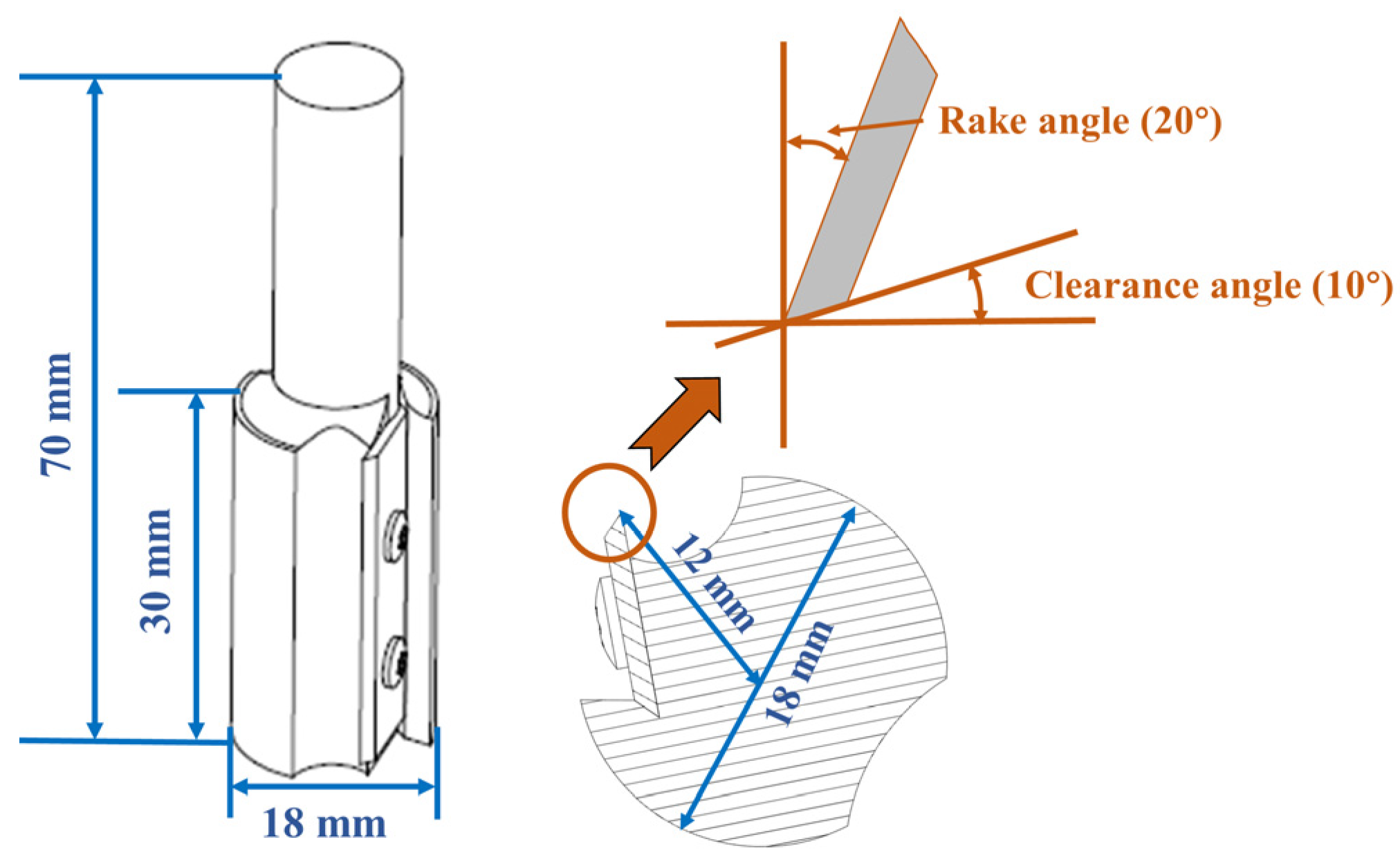
According to the work by Dong et al. (2026) [11], the cutting tool used in this study was a single-tooth carbide end mill (Leitz, Tool System Co., Ltd., Nanjing, China), and its geometric characteristics are illustrated in Figure 2. Carbide end mills were selected as cutting tools for the experiments because they exhibit suitable wear resistance, thermal stability, and sharp cutting edges. These properties help minimise tool wear and maintain machining accuracy and surface quality, requirements for high-speed, high-efficiency machining of bamboo materials [14].
Milling parameters were determined according to the relevant literature and practical machining experience. According to Wang et al. (2018) [18], fibre orientation was selected to account for material anisotropy in composite machining. According to Emrah and Dundar (2021) [19], spindle speed was determined based on its influence on bamboo surface quality. According to Yanhe et al. (2021) [14], feed rate and milling depth were selected based on response surface methodology studies on bamboo machining parameters. The specific parameter values are presented in Table 2.

2.2. Experimental Equipment

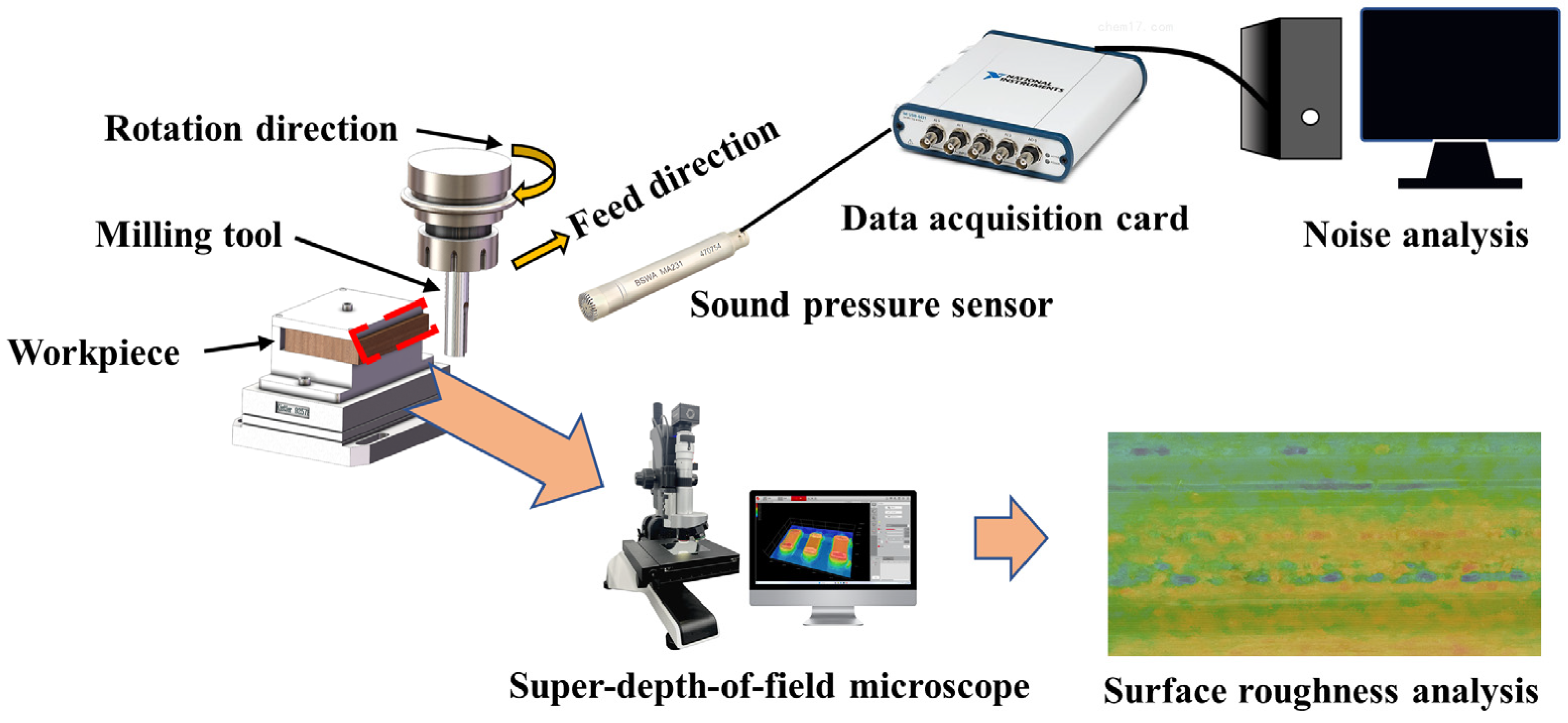
In this work, an acoustic pressure measurement system (Beijing Shengwang Shengdian Technology Co., Ltd., Beijing, China) operating at a sampling frequency of 20 kHz was installed near the computer numerical control (CNC) machine (Nanxing Machinery Co., Ltd., Dongguan, China) (Figure 3). The system records variations in acoustic pressure during machining and comprises an acoustic pressure sensor (MPA231), a data acquisition card (USB-4431), and a data processing unit.
The arrangement of the acoustic sensor followed the standard GB/T 3767-2016 [20], with the sensor positioned in the same horizontal plane as the workpiece and at a distance of 0.5 m from the sound source. The acquired acoustic signals were further corrected according to HJ 706-2014 [21] to minimise the influence of background environmental noise.
The acoustic signals were processed over a fixed time window of 2 s corresponding to the steady-state cutting stage, excluding tool entry and exit to avoid transient effects. A-weighting was applied to all measurements in accordance with standard acoustic evaluation practices, and the reported values are expressed as A-weighted sound pressure levels. The noise level was primarily characterised by the equivalent continuous sound pressure level (Leq) over the selected time window. The sampling frequency of the acoustic signal was set to 44.1 kHz.
Prior to the experiments, the acoustic measurement system was verified to ensure stable sensitivity and consistent response under identical operating conditions. Repeated measurements under the same cutting conditions demonstrated good repeatability, confirming the reliability of the recorded SPL data.
In this study, the peak sound pressure level (SPL) was adopted as the noise evaluation index. SPL captures the most intense transient acoustic events occurring during the cutting process, including the impact sound generated at tool entry, the sudden high-frequency emissions associated with brittle fracture, and the peak pressure spikes induced by abrupt changes in cutting force [10]. SPL was calculated using Equation (1):
SPL = 10 log 10 1 T p 0 2 0 T p 2 ( t ) d t
where p(t) is the measured sound pressure, p0 = 20 μPa is the reference sound pressure, respectively.
Surface roughness Sa was measured using a super-depth-of-field microscope (VHX-7000) (KEYENCE, Co., Ltd., Shanghai, China). Sa represents the overall microscopic undulation of a surface and is defined as the arithmetic mean of the absolute height deviations of all measured points within the sampling area relative to the reference surface [11]. Sa thus provides a comprehensive quantitative characterisation of the machined surface’s overall roughness.
Surface roughness measurements were conducted at the central region of each specimen using a five-point sampling method. For each sample, five measurement areas of 2 mm × 2 mm were selected, and the final Sa value was obtained by averaging these measurements. The observation direction was defined perpendicular to the machined surface to ensure consistent surface acquisition. The three-dimensional surface topography was reconstructed from a stack of 30 two-dimensional images acquired along the vertical direction using the depth synthesis function of the microscope with automatic focusing.
Prior to roughness evaluation, the measured surface data were levelled to remove form and tilt. All Sa values were calculated based on the processed three-dimensional surface data.

2.3. Response Surface Methodology

This study applied response surface methodology (RSM), and the experimental plan was developed using an Optimal design [22]. According to Merhar et al. (2026) [23], RSM is widely used for modelling and analysing the influence of process parameters in machining systems, providing an efficient framework for establishing empirical relationships between input factors and response variables. Compared with traditional schemes such as the central composite design (CCD) and the Box–Behnken design, the Optimal design offers greater flexibility and efficiency for handling irregular factor ranges, infeasible factor combinations, and experimental scenarios with specific constraints [24]. In an Optimal design, experimental points are selected through numerical optimisation algorithms, with the primary objective of maximising the statistical information available for model estimation within a predefined set of candidate points. Standard evaluation criteria include D-optimality and I-optimality.
D-optimal designs maximise the determinant of the information matrix (XTX), thereby minimising the covariance matrix of the regression coefficient estimates (XTX)−1. The objective function is shown in Equation (2):
m a x   d e t ( X T X )
I-Optimal designs minimise the average prediction variance across the design region:
min D Var [ y ^ ( x ) ] d x
where D denotes the experimental domain.
A response surface methodology (RSM)-based design of experiments (DOE) was adopted to efficiently study the effects of multiple process parameters and their interactions. In this study, an optimal design was generated based on predefined factor ranges, the set of candidate points, and practical operational constraints. The software automatically selected the experimental runs based on the specified optimality criteria, thereby ensuring robust design and accurate model estimation. The detailed design results are presented in Table 3. Meanwhile, based on the gold-standard guideline for RSM design [25], each parameter combination was tested five times.
The collected experimental data were used to fit a standard quadratic response surface model, which can be expressed mathematically as follows:
y = β 0 + i = 1 k β i x i + i = 1 k β i i x i 2 + i < j β i j x i x j + ε
where y is the response variable, xi represents the ii-th (normalised) factor, β0, βi, βii, and βij are the intercept, linear, quadratic, and interaction coefficients, respectively, and ε is the experimental error.
By examining the fitted response surfaces and contour plots, the interaction effects among the factors can be further analysed and the optimal parameter region identified. For this study, the customised Optimal RSM design achieved an appropriate balance among statistical efficiency, model accuracy, and experimental cost while satisfying practical process constraints.

3. Results and Discussion

3.1. Regression Models for Cutting Noise and Machining Quality

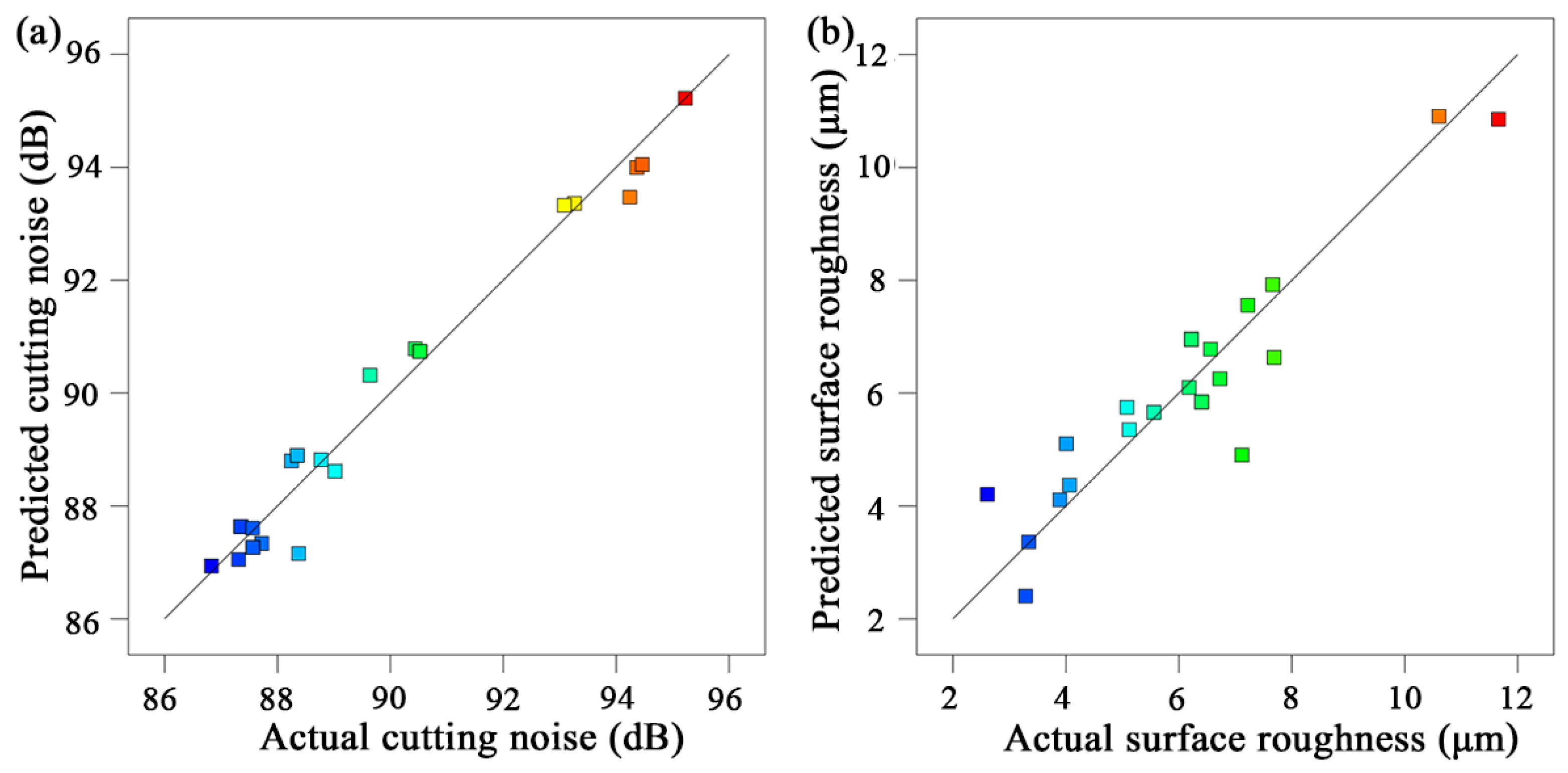
The evaluation metrics for cutting noise peak sound pressure level (SPL) and machined surface roughness (Sa) are defined in Equations (5) and (6), respectively. Regression models were subsequently developed based on these response variables. Based on the fit statistics (Table 4) and correlation analysis (Figure 4), both models demonstrate satisfactory statistical performance and are suitable for predictive analysis. As shown in Figure 4, the color of the data points varies from red to blue, where colors closer to red indicate higher values, while colors closer to blue represent lower values. In addition, the closer the data points are to the fitted line, the better the predictive performance of the model.
The SPL model exhibits a high goodness of fit, with a coefficient of determination (R2) of 0.97 and an adjusted R2 of 0.93, indicating that the model explains most of the variability in the experimental data. The coefficient of variation (CV = 0.77%) and adequate precision value of 15.42 further indicate stable model behaviour within the experimental domain.
Similarly, the Sa model achieves an R2 of 0.85, reflecting acceptable explanatory capability. The adequate precision value of 12.08 indicates a sufficient signal-to-noise ratio, ensuring reasonable prediction performance. As shown in Figure 4, the predicted values are in good agreement with the experimental results for both SPL and Sa, with data points closely following the regression trends. Overall, both models satisfy the statistical criteria required for reliable prediction within the studied parameter range.
SPL = 143.91740 + 1.073982 θ 0.971410 n 0.931505 a p 2.67081566 θ U + 0.000254 θ a p + 1.000175 n a p 0.176823 U a p + 0.971000 θ 2 + 0.987007 n 2 + 2.63978 a p 2 + 1.65362 U 2
S a = 5.38924 + 0.069826 θ 0.000199 n + 3.49884 U 4.20079 a p 8.76702102 θ n + 0.012158 θ U + 0.004992 θ a p 0.000514 n U + 0.000557 n a p + 0.729232 U a p
The regression coefficients in Equations (5) and (6) provide a concise indication of factor effects. In Equation (5), the negative coefficient of spindle speed (n, −0.97141) indicates a decreasing trend of SPL with increasing n, while the relatively large constant term (143.91740) suggests that SPL is dominated by the baseline cutting noise, and the influence of process parameters is comparatively limited. In contrast, the larger absolute coefficient of the fibre-related variable (U, −2.67081566) implies a more pronounced effect on SPL. For Equation (6), the relatively large coefficient of cutting depth (ap, −4.20079) indicates that ap plays a dominant role in determining surface roughness. Overall, the sign and magnitude of the coefficients reflect the direction and relative importance of each factor, while higher-order terms account for non-linear and interaction effects.

3.2. Analysis of Variance for Cutting Noise and Machining Quality

Analysis of variance (ANOVA) results for the SPL model (Table 5) indicate that the model is significant overall at the 95% confidence level (p < 0.0001) and effectively explains the variation in the response variable. The main effects of all four primary parameters of fibre angle (θ), spindle speed (n), feed rate (U), and milling depth (h) are highly significant (p < 0.01), confirming their substantial individual influence on noise. Furthermore, four interaction terms, namely, θ * U, n * U, n * h, and U * h, also show significance, suggesting non-negligible synergistic effects between these factors. In contrast, the interaction terms θ * n and θ * h, as well as the quadratic terms θ2 and h2, are not significant, indicating their relatively minor impact. The non-significant lack of fit further supports the adequacy and reliability of the proposed quadratic model.
Based on the result of ANOVA for Sa (Table 6), the established model is statistically significant (p = 0.0003), explaining approximately 85% of the total variation in surface roughness Sa. Among the main factors, milling depth (h) exhibits the most pronounced effect, followed by fibre angle (θ), spindle speed (n), and feed rate (U), all of which are significant at p < 0.05. Furthermore, the interaction between fibre angle and spindle speed (θ * U) is also significant, suggesting that their combination influences Sa. No other two-factor interactions show statistical significance.

3.3. Effect of Milling Parameters on Cutting Noise and Machining Quality

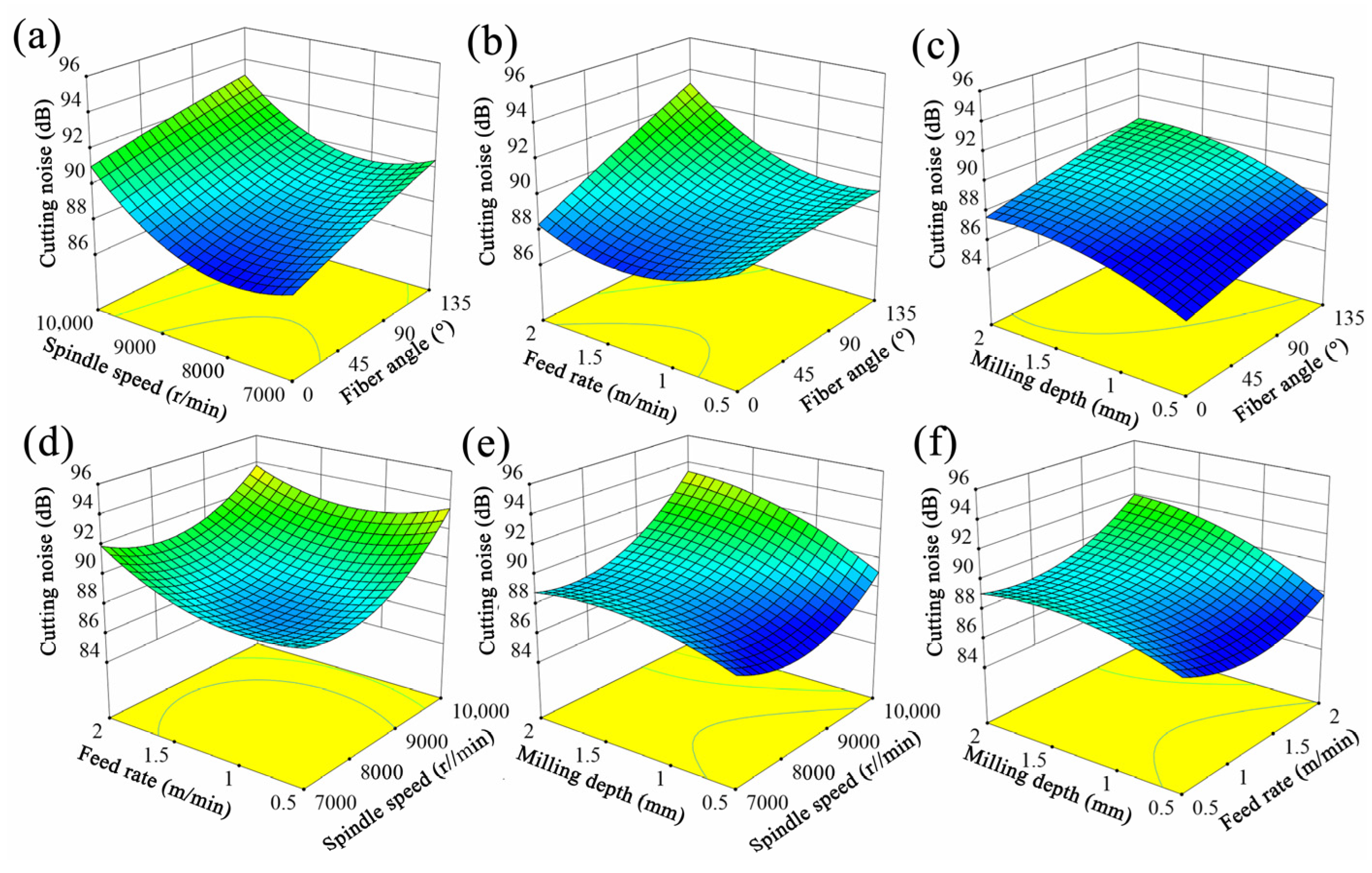
Experimental results presented in Figure 5 demonstrate clear correlations between cutting noise SPL and milling parameters, which are closely related to the material structure. As shown in Figure 5, the color varies from yellow to blue, where blue indicates higher values and yellow indicates lower values. In addition, the lines on the top view represent contour lines.
As the fibre angle increases, the cutting noise level correspondingly rises. This is primarily attributed to the unique cellular structure of bamboo, which exhibits pronounced anisotropy, leading to variations in relative material strength. Within the fibre angle range of 0–90°, corresponding to cutting along the fibre direction, the fibres are compressed and completely severed by the tool during milling [26]. As the fibre angle increases, the relative material strength increases, resulting in a higher sound pressure intensity released during material fracture. In contrast, within the fibre angle range of 90–180°, corresponding to cutting against the fibre direction, the material is peeled off under tool extrusion during milling [27]. With increasing fibre angle, both the extent and severity of fibre cell delamination intensify, leading to a higher sound pressure intensity [11].
As spindle speed and feed rate increase, the milling cutting speed correspondingly rises, resulting in a greater instantaneous impact force when the tool engages the material. This enhances the sound pressure intensity generated during material failure [28]; therefore, the cutting noise level increases with increasing spindle speed and feed rate [29].
With increasing milling depth, the material removal per tooth increases, leading to higher cutting resistance during the machining process. Consequently, the sound pressure intensity generated during material fracture also increases, resulting in a higher cutting noise level as milling depth increases [30].
In summary, during the milling of laminated bamboo, selecting materials with lower fibre angles, reducing spindle speed and feed rate, and minimising milling depth can effectively decrease the sound pressure intensity released during material removal, thereby reducing the cutting noise level [31].
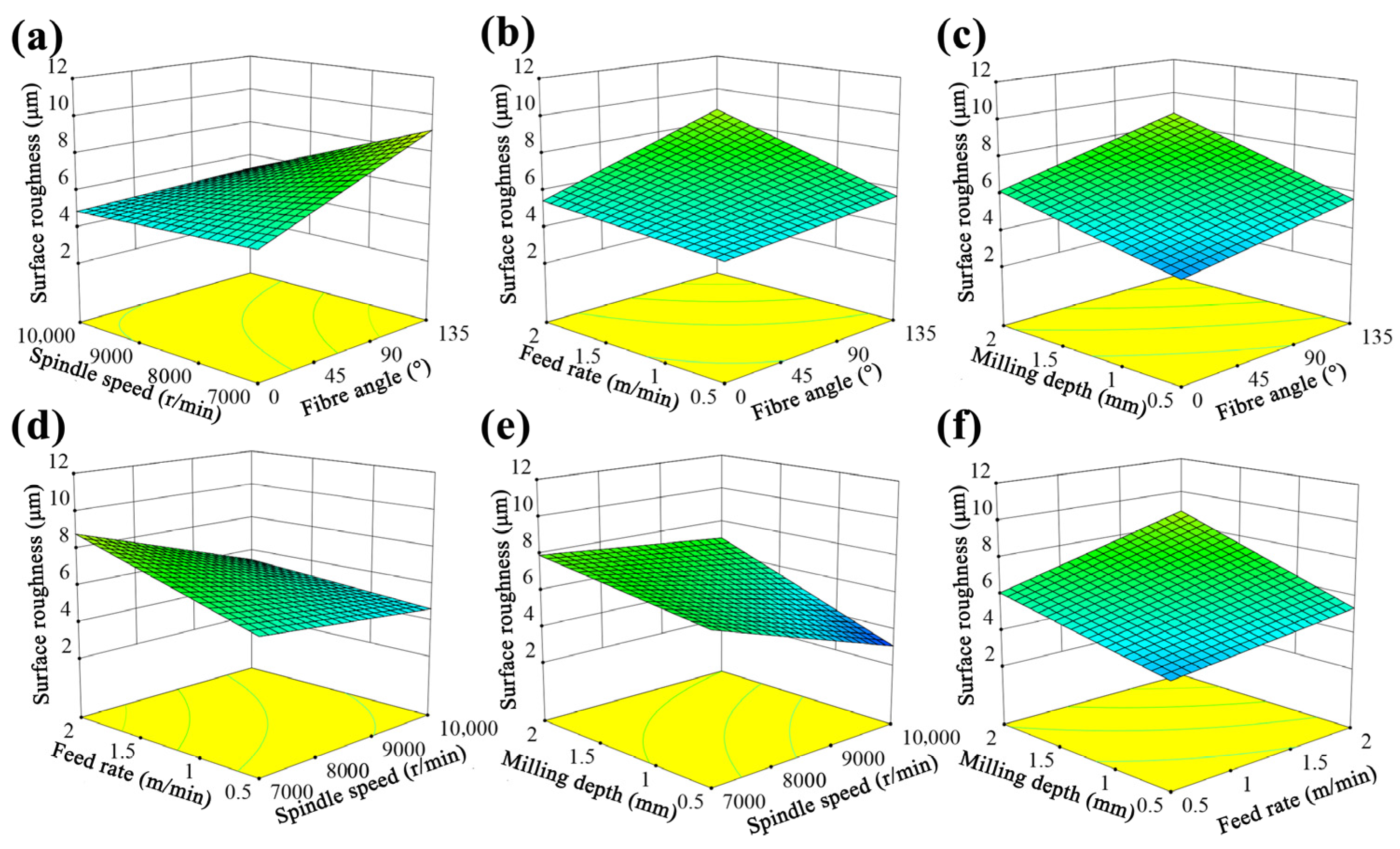
Surface roughness Sa is influenced by the milling parameters, as shown in Figure 6, with milling depth exhibiting the most significant effect. As shown in Figure 6, the color varies from yellow to blue, where blue indicates higher values and yellow indicates lower values. In addition, the lines on the top view represent contour lines.
As milling depth increases, the material removal per tooth correspondingly rises, leading to higher cutting resistance and an elevated level of energy release during material failure. This results in a greater amount of residual fibre cell debris remaining on the machined surface, thereby increasing surface roughness [32].
Surface roughness increases with increasing fibre angle. For fibre angles in the range of 0–90° (cutting along the fibre direction), the relative material strength increases with fibre angle, leading to higher energy release during material failure. Consequently, more residual fibre cell debris remains on the machined surface, resulting in higher surface roughness [26]. In contrast, for fibre angles in the range of 90–180° (cutting against the fibre direction), the material is peeled off under tool extrusion [27]. As the fibre angle increases, both the extent and severity of fibre delamination increase, enlarging the area of residual fibre cell debris on the machined surface and thereby increasing surface roughness [11].
With increasing spindle speed, the material removal mechanism gradually transitions from plastic deformation at low speeds to brittle fracture at higher speeds. Compared with the prolonged plastic deformation process, brittle fracture produces smoother shear surfaces in bamboo cells [33]; therefore, surface roughness decreases as spindle speed increases [34].
Feed rate is positively correlated with surface roughness. As the feed rate increases, the material removal per tooth also increases, enlarging the area of periodic tool marks and grooves on the machined surface [35]. Meanwhile, cutting resistance and the energy release during material failure increase, resulting in more residual fibre cell debris on the surface. Consequently, surface roughness increases with increasing feed rate [20].
In summary, to achieve low surface roughness in bamboo milling, it is essential to strictly control milling depth and fibre orientation, while synergistically optimising spindle speed and feed rate, with particular attention to the combined effect of fibre orientation and spindle speed.
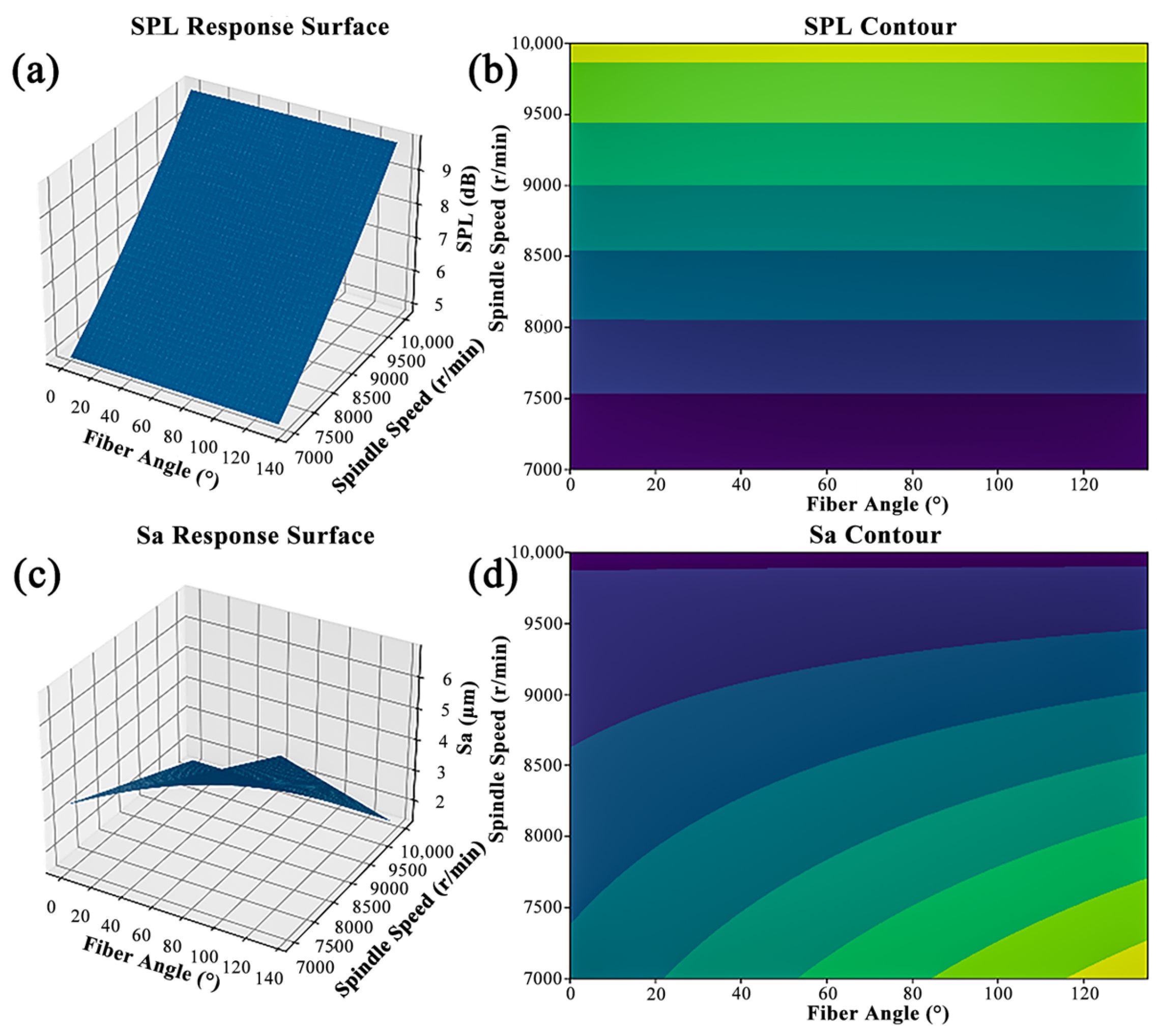
In addition, the interaction effects between fibre angle and spindle speed are further visualised through response surface and contour plots (Figure 7), which provide deeper insight into the combined influence of these two factors. As shown in Figure 7, yellow indicates higher Z-axis values and blue indicates lower Z-axis values; the Z-axis represents cutting noise in Figure 7b and surface roughness in Figure 7d. As shown in Figure 7a,b, cutting noise SPL exhibits a slightly non-linear dependence on spindle speed, while showing a slight increasing tendency with fibre angle. The response surface is consistent with the significant quadratic effect of spindle speed identified in the regression model.
For surface roughness, Figure 7c,d show that Sa shows a general increasing tendency with fibre angle, whereas the effect of spindle speed depends on fibre orientation. At small fibre angles, higher spindle speeds tend to reduce Sa by promoting smoother shearing. This behaviour is consistent with the statistically significant interaction between fibre angle and spindle speed reported in the ANOVA results.

3.4. Optimisation and Validation of Cutting Noise and Machining Quality

Optimising cutting noise and surface quality in bamboo machining is valuable for advancing its industrial application as a sustainable and high-performance material. Excessive noise not only degrades the working environment and affects occupational and surrounding conditions but also reflects inefficient energy dissipation and unstable cutting dynamics [36]. Poor surface quality, commonly manifested as fibre tear-out, burr formation, and increased roughness, compromises the structural integrity, aesthetic quality, and functional performance of bamboo products, thereby restricting their use in precision applications such as furniture, flooring, and engineered composites [20].
Accordingly, achieving an appropriate balance between low-noise operation and superior surface finish through systematic process parameter optimisation is essential [37]. Such optimisation not only facilitates compliance with environmental and occupational standards, but also enhances product competitiveness and promotes resource-efficient manufacturing [38].
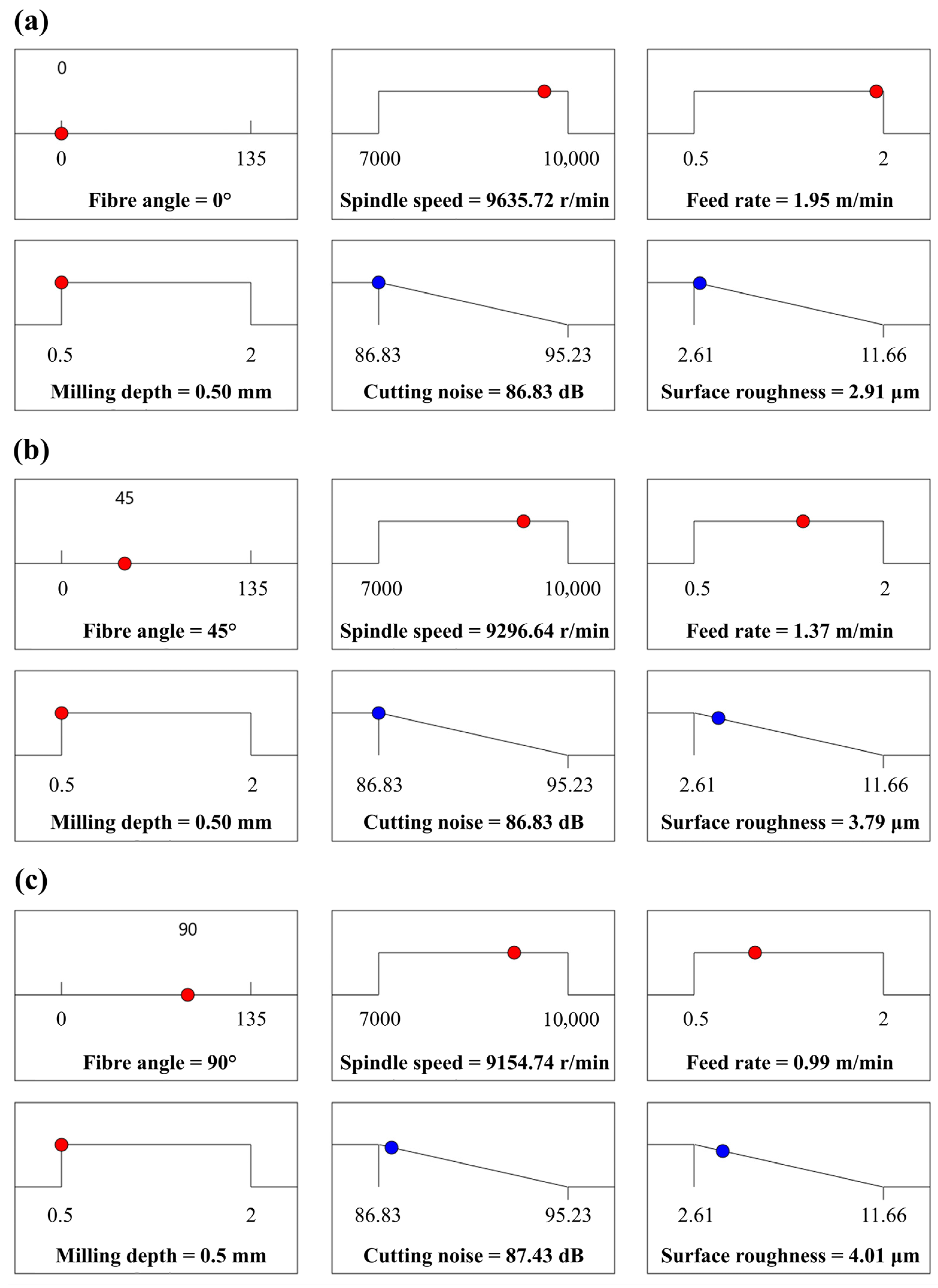
According to Natesh et al. (2025) [39], the model validation approach adopted in this study. In accordance with the prediction models presented in this study for milling noise SPL and surface roughness Sa, milling parameters corresponding to different fibre angles 0°, 45°, and 90° were determined, including spindle speed, feed rate, and milling depth, as shown in Figure 8 and Table 7. The target was to analyse SPL and Sa performance under different fibre angle conditions to verify model reliability. As shown in Figure 8, red horizontal lines represent independent variables, blue inclined lines represent dependent variables, and the positions of the data points indicate their relative locations within the overall parameter range.
With these fibre angle and milling parameter combinations, the predicted SPL and Sa values were obtained: for the 0° fibre angle, the predicted SPL and Sa were 86.83 and 2.91; for the 45° fibre angle, the predicted SPL and Sa were 86.83 and 3.79; and for the 90° fibre angle, the predicted SPL and Sa were 87.43 and 4.01. To verify the feasibility of the models under different fibre angle conditions, verification tests were conducted, and the actual SPL and Sa values were measured: for the 0° fibre angle, the actual SPL and Sa were 82.38 and 3.41; for the 45° fibre angle, the actual SPL and Sa were 83.46 and 3.98; and for the 90° fibre angle, the actual SPL and Sa were 92.11 and 4.52. The error rates of SPL and Sa were calculated, respectively: for 0° the fibre angle, the error rates of SPL and Sa were 4.45% and −14.66%; for the 45° fibre angle, the error rates were 3.37% and 14.77%; and for the 90° fibre angle, the error rates were −4.68% and −11.28%. All error rates were within a reasonable range. Thus, it can be concluded that the established SPL and Sa prediction models are reliable.
The influence of fibre angle on milling performance and the corresponding parameters are as follows: (1) When the fibre angle is 0°, the corresponding milling parameters are spindle speed of 9636 r/min, feed rate of 2.0 m/min, and milling depth of 0.5 mm; under this condition, the actual SPL is 82.38 and the actual Sa is 3.41, showing relatively low milling noise but average surface roughness performance. (2) When the fibre angle is 45°, the corresponding milling parameters are spindle speed of 9297 r/min, feed rate of 1.4 m/min, and milling depth of 0.5 mm; under this condition, the actual SPL is 83.46 and the actual Sa is 3.31, achieving the optimal comprehensive performance in terms of milling noise and surface roughness. (3) When the fibre angle is 90°, the corresponding milling parameters are spindle speed of 9155 r/min, feed rate of 1.0 m/min, and milling depth of 0.5 mm; under this condition, the actual SPL is 92.11 and the actual Sa is 4.52, resulting in the worst milling noise and surface quality.
The dual prediction model of cutting noise and surface quality established in this study can accurately predict the machining performance under different parameter combinations. The optimal parameter matching law under different fibre orientations obtained through multi-objective optimisation can be applied to provide guidance for the CNC machining optimisation and cutting tool design for industrial applications, including flooring, furniture, and laminated bamboo panels.
The validation conducted in this study is based on confirmation experiments under optimised parameter conditions. The good agreement between predicted and measured values indicates that the developed models are reliable within the investigated parameter range. However, it should be noted that no independent validation dataset or cross-validation procedure was employed. Therefore, the predictive capability of the model is primarily limited to the defined experimental domain.

4. Conclusions

This work addresses noise pollution and unstable surface quality in the bamboo cutting process. It systematically investigates the influence of key process parameters on cutting noise and surface quality, including fibre orientation of 0–135°, spindle speed of 7000–10,000 r/min, feed rate of 0.5–2.0 m/min, and milling depth of 0.5–2.0 mm. The main conclusions are given as follows:
(1)
A high-precision dual-response quadratic regression prediction model for cutting noise peak sound pressure level (SPL) and machined surface roughness (Sa) was established. The model exhibited excellent predictive performance, with a coefficient of determination R2 of 0.97 for SPL and 0.85 for Sa, which is suitable for machining performance prediction and parameter optimisation in bamboo machining.
(2)
Noise levels increase with fibre angle, feed rate, and milling depth, and show a non-linear relationship with spindle speed. Surface roughness worsens with increasing milling depth and fibre angle, and higher feed rates also exacerbate surface non-uniformity.
(3)
Fibre orientation, spindle speed, feed rate, and milling depth all significantly affect cutting noise and surface quality. Among these, milling depth is the most influential factor affecting surface roughness, while the interaction between fibre orientation and spindle speed plays an important role in determining surface quality.
(4)
The comprehensive optimal parameter combination that balances low-noise and high-quality machining was obtained through multi-objective optimisation: for 45° fibre orientation, the optimal parameters are spindle speed of 9297 r/min, feed rate of 1.4 m/min, and milling depth of 0.5 mm, with the measured SPL of 83.46 dB and Sa of 3.98 μm. For 0° fibre orientation, the optimal parameters are spindle speed of 9636 r/min, feed rate of 2.0 m/min, and milling depth of 0.5 mm, achieving the lowest SPL of 82.38 dB and Sa of 3.41 μm. For 90° perpendicular-to-fibre cutting, the optimised parameters are a spindle speed of 9155 r/min, a feed rate of 1.0 m/min, and a milling depth of 0.5 mm, which yielded the highest SPL of 92.11 dB and the highest Sa of 4.52 μm among the three typical fibre orientations.
(5)
Future research will focus on multi-knife cutter heads, helical cutters, tool wear, and coating adhesion. In particular, future studies will extend the current work to more industrially representative tool configurations, such as multi-edge and helical milling cutters, to improve the applicability of the findings under practical machining conditions. Comprehensive characterisation, including cutting force, temperature, and chip deformation, will be conducted, with tool material, structure, and advanced cutting methods taken into account. In addition, more advanced modelling approaches beyond quadratic response surface methodology (RSM), such as higher-order non-linear or data-driven methods, will be explored to better capture complex cutting mechanisms over a wider parameter space.

Author Contributions

Conceptualisation, H.C., D.B. and Z.Z.; Methodology, D.B. and Z.Z.; Software, H.C., D.B. and Z.Z.; Investigation, H.C. and J.D.; Validation, D.B.; Formal Analysis, H.C., D.B. and Z.Z.; Writing—Original Draft Preparation, H.C., D.B. and Z.Z.; Writing—Review and Editing, H.C., D.B., J.D., X.G. and Z.Z.; Visualisation, H.C., D.B. and Z.Z.; Supervision, D.B. and Z.Z.; Resources, X.G. and Z.Z. All authors have read and agreed to the published version of the manuscript.

Funding

This research received no external funding.

Data Availability Statement

Data are available within the article.

Acknowledgments

The authors gratefully acknowledge the support of CT WOOD at Luleå University of Technology.

Conflicts of Interest

The authors declare no conflicts of interest.

References

  1. Chen, F.; Cheng, A.; Xiang, J.; Wang, X.; Guan, L.; Lin, X.; Tu, D. Extraction of bamboo sap by high-efficiency hot pressing: A method for high value and sustainable use of the bamboo material. ACS Omega 2025, 10, 7362–7370. [Google Scholar] [CrossRef] [PubMed]
  2. Lei, W.; Wang, S.; Wang, X.; Yang, Y.; Qi, Y.; Zhang, Y.; Yu, W. Influence of longitudinal parts of bamboo on the properties of bamboo scrimber. Ind. Crops Prod. 2025, 232, 121322. [Google Scholar] [CrossRef]
  3. Khodabakhshi, N.; Chu, S.K.; Mouka, T.; Kum, K.H.; Dimitrakopoulos, E.G. Stiffness characterization of bolted multi-culm bamboo members. J. Build. Eng. 2025, 103, 19. [Google Scholar] [CrossRef]
  4. Li, W.; Xie, G.; Ma, H.; Li, Y.; Li, X.; Li, L. Resistance of bamboo scrimber modified with furfuryl alcohol against decay fungi and termites. Wood Mater. Sci. Eng. 2025, 8, 1081–1088. [Google Scholar] [CrossRef]
  5. Franco, J.; Urdaneta, F.; Cordoba, Y.; Meza, L.; Urdaneta, I.; Jameel, H.; Gonzalez, R.W. Assessing bleached bamboo fibers as a hardwood replacement via kraft co-cooking for paperboard applications. Ind. Crops Prod. 2025, 232, 121252. [Google Scholar] [CrossRef]
  6. Hong, M.; Buck, D.; Yuan, Z.; Xu, C.; Zhu, Z. Multi-Factor Analysis of Cutting Parameters for Bamboo Milling. Coatings 2025, 15, 1148. [Google Scholar] [CrossRef]
  7. Li, R.; Ekevad, M.; Guo, X.; Cao, P.; Wang, J.; Chen, Q.; Xue, H. Pressure, feed rate, and abrasive mass flow rate influence on surface roughness for recombinant bamboo abrasive water jet cutting. Bioresources 2015, 10, 1998–2008. [Google Scholar] [CrossRef]
  8. Liu, Y.; Wang, Y.; Wang, C.; Zhou, T.; Hu, J.; Wu, Z. Carbon footprint accounting and analysis of Chinese furniture enterprises’ panel cabinets. Sustainability 2025, 17, 9267. [Google Scholar] [CrossRef]
  9. Wang, J.; Wu, Z.; Yang, L.; Hu, W.; Song, C.; Zhu, Z.; Guo, X.; Cao, P. Investigation on distributed rescheduling with cutting tool maintenance based on NSGA-III in large-scale panel furniture intelligent manufacturing. J. Manuf. Process. 2024, 112, 214–224. [Google Scholar] [CrossRef]
  10. Pangestu, K.T.P.; Nandika, D.; Wahyudi, I.; Usuki, H.; Darmawan, W. Innovation of helical cutting tool edge for eco-friendly milling of wood-based materials. Wood Mater. Sci. Eng. 2022, 17, 607–616. [Google Scholar] [CrossRef]
  11. Dong, W.; Wu, Z.; Zhang, F.; Wang, J.; Li, R.; Guo, X. Investigation of the effects of fibre orientation on microstructural damage mechanisms during the milling of laminated bamboo lumber. Biomass Bioenerg. 2026, 205, 108554. [Google Scholar] [CrossRef]
  12. Li, R.; Guo, X.; Cao, P.; Wang, X. Optimization of laser cutting parameters for recombinant bamboo based on response surface methodology. Wood Res. 2016, 61, 275–285. [Google Scholar]
  13. Zhang, L.; Wang, C.; Zhu, D.; Li, W.; Wang, Y. Effects of cutting parameters and material selection on power consumption and surface quality in long narrow groove machining of Qiong bamboo. Wood Mater. Sci. Eng. 2025, 11, 1–11. [Google Scholar] [CrossRef]
  14. Liu, Y.; Zhou, J.; Fu, W.; Zhang, B.; Chang, F.; Jiang, P. Study on the effect of cutting parameters on bamboo surface quality using response surface methodology. Measurement 2021, 174, 109002. [Google Scholar] [CrossRef]
  15. Zhu, J.; Peng, H.; Lyu, J.; Zhang, T. Evaluation of orthotropic elasticity of gradient-structured bamboo by microtensile testing combined with digital image correlation technique. Ind. Crops Prod. 2023, 203, 117097. [Google Scholar] [CrossRef]
  16. Huang, B.; Chen, L.; Wang, X.; Ma, X.; Liu, H.; Zhang, X.; Sun, F.; Fei, B.; Fang, C. Eco-friendly, high-utilization, and easy-manufacturing bamboo units for engineered bamboo products: Processing and mechanical characterization. Compos. Part B Eng. 2023, 267, 111073. [Google Scholar] [CrossRef]
  17. Li, R.; Yang, F.; Wang, X. Modeling and predicting the machined surface roughness and milling power in Scot’s pine helical milling process. Machines 2022, 10, 331. [Google Scholar] [CrossRef]
  18. Wang, C.; Wen, L.; Ming, W.; An, Q.; Chen, M. Experimental study on effects of fiber cutting angle in milling of high-strength unidirectional carbon fiber–reinforced polymer laminates. Proc. Inst. Mech. Eng. Part B J. Eng. Manuf. 2018, 232, 1813–1824. [Google Scholar] [CrossRef]
  19. Aykac, E.; Sofuoglu, S.D. Investigation of the Effect of Machining Parameters on Surface Quality in Bamboo. Teh. Vjesn. 2021, 28, 684–688. [Google Scholar] [CrossRef]
  20. GB/T 3767-2016; Acoustics—Determination of Sound Power Levels and Sound Energy Levels of Noise Sources Using Sound Pressure—Engineering Methods for an Essentially Free Field over a Reflecting Plane. Standardization Administration of China: Beijing, China, 2016.
  21. HJ 706-2014; Technical Specification for Environmental Noise Monitoring. Ministry of Environmental Protection of the People’s Republic of China: Beijing, China, 2014.
  22. Wang, J.; Wu, Z.; Zhang, F.; Song, C.; Hu, W.; Zhu, Z.; Guo, X.; Cao, P. Research on the end-milling surface quality of Paulownia based on response surface model in terms of force and chip morphology. Forests 2024, 15, 325. [Google Scholar] [CrossRef]
  23. Merhar, M.; Hodžić, D.; Hasanagić, R.; Hurem, N.; Hodžić, A. Cutting Power Model Determination for Solid Wood Processing Using Response Surface Methodology. Forests 2026, 17, 195. [Google Scholar] [CrossRef]
  24. Li, R.; Xu, W.; Wang, C.; Zhang, S.; Song, W. Optimization for the liquefaction of moso bamboo in phenol using response surface methodology. Wood Fiber Sci. 2018, 50, 220–227. [Google Scholar] [CrossRef]
  25. Montgomery, D.C. Response Surface Methodology: Process and Product Optimization Using Designed Experiments, 5th ed.; John Wiley & Sons: Hoboken, NJ, USA, 2019. [Google Scholar]
  26. Wang, F.; Yin, J.; Ma, J.; Jia, Z.; Yang, F.; Niu, B. Effects of cutting edge radius and fiber cutting angle on the cutting-induced surface damage in machining of unidirectional CFRP composite laminates. Int. J. Adv. Manuf. Technol. 2017, 91, 3107–3120. [Google Scholar] [CrossRef]
  27. Voss, R.; Seeholzer, L.; Kuster, F.; Wegener, K. Influence of fibre orientation, tool geometry and process parameters on surface quality in milling of CFRP. CIRP J. Manuf. Sci. Technol. 2017, 18, 75–91. [Google Scholar] [CrossRef]
  28. Karanjkar, V.A.; Pathan, S.S. Modeling and Simulation of Noise and Vibration in Sawing Operations: Impact of Machining Parameters and Material Properties. J. Vib. Eng. Technol. 2026, 14, 125. [Google Scholar] [CrossRef]
  29. Kang, J.; Zhang, J.; Sun, D.; Song, W. Experimental investigation of cutting performance for circular saw blade body modification by resin layers toward green manufacturing. Int. J. Adv. Manuf. Technol. 2023, 128, 3105–3121. [Google Scholar] [CrossRef]
  30. Chen, C.; Hsu, S. Optimizing cutting parameters with industrial IoT system for automated continuous dry milling. Internet Things 2025, 31, 101569. [Google Scholar] [CrossRef]
  31. Rech, J.; Dumont, F.; Le Bot, A.; Arrazola, P.J. Reduction of noise during milling operations. CIRP J. Manuf. Sci. Technol. 2017, 18, 39–44. [Google Scholar] [CrossRef]
  32. Dong, W.; Tian, X.; Jiang, J.; Wang, J.; Guo, X.; Zhou, Z. Integrated modelling and multi-objective optimisation of cutting force, roughness and noise in bamboo end-grain milling. Biomass Bioenergy 2026, 210, 109034. [Google Scholar] [CrossRef]
  33. Zhang, L.; Zhang, X. Effect of cooling and lubrication conditions on the variable angle milling of unidirectional CFRP with PCD tools. J. Mater. Process. Technol. 2023, 319, 118073. [Google Scholar] [CrossRef]
  34. Wang, J.; Cao, P.; Guo, X.; Hong, X.; Jia, G.; Wang, B. Effect of process parameters on cutting forces and surface roughness during peripheral up milling of bamboo scrimber. Bioresources 2015, 10, 8414–8425. [Google Scholar] [CrossRef]
  35. Wang, Y.; Chao, S.; Bao, Y.; Wang, E.; Kang, R.; Dong, Z.; Sun, J. Experimental study of surface quality and damage in grinding CFRP circular honeycomb cell with diamond saw blade. J. Mater. Res. Technol. 2025, 38, 4150–4169. [Google Scholar] [CrossRef]
  36. Gul, O.; Korkmaz, M. Measurement and optimization of wood dust and noise levels in table saw operations using response surface methodology. Bioresources 2025, 20, 8848. [Google Scholar] [CrossRef]
  37. Darmawan, W.; Tanaka, C. Discrimination of coated carbide tools wear by the features extracted from parallel force and noise level. Ann. For. Sci. 2004, 61, 731–736. [Google Scholar] [CrossRef]
  38. Zhang, L.; Zhang, B.; Bao, H.; Huang, H. Optimization of cutting parameters for minimizing environmental impact: Considering energy efficiency, noise emission and economic dimension. Int. J. Precis. Eng. Manuf. 2018, 19, 613–624. [Google Scholar] [CrossRef]
  39. Natesh, C.P.; Siddeshkumar, N.G.; Srinivasa, G.; Shivaramakrishna, A.; Pruthvi, H.M.; Prasad, C.D.; Shashidhara, Y.M.; Amarendra, H.J.; Tiwari, A.; Aden, A.A. Multi-objective optimization of surface roughness and MRR in AISI 316L stainless steel processed by MQL end milling using taguchi, RSM, ANN, and RFR methods. Sci. Rep. 2025, 15, 36583. [Google Scholar] [CrossRef]
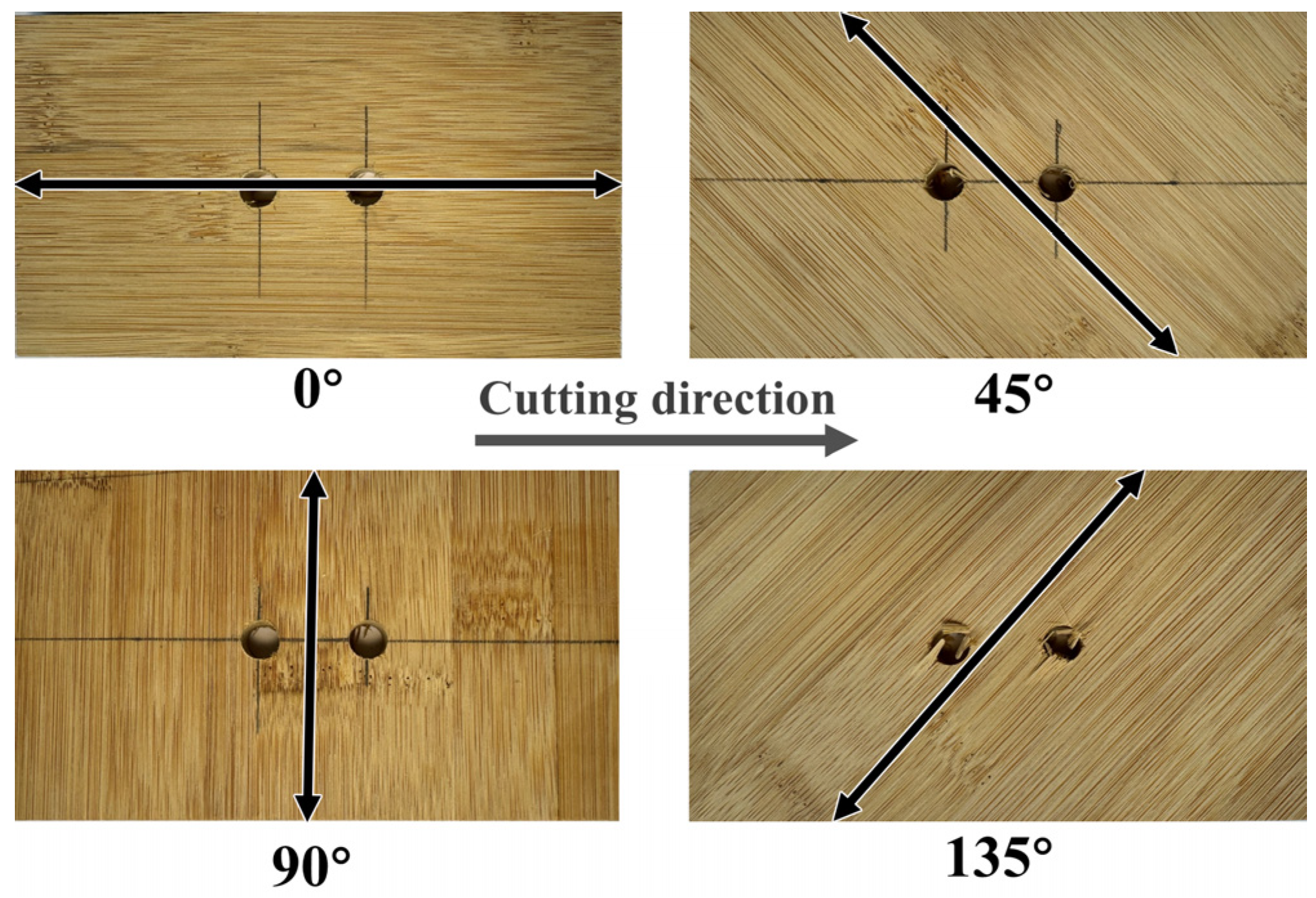
Figure 1. Workpieces prepared with different fibre angles of 0°, 45°, 90°, and 135°.
Forests 17 00521 g001
Figure 2. Geometric characteristics of cutting tools.
Forests 17 00521 g002
Figure 3. Experimental setup for milling noise analysis. Cutting configuration, acoustic signal acquisition chain, and surface roughness characterisation using a super-depth-of-field microscope.
Forests 17 00521 g003
Figure 4. Correlation between actual and predicted values of (a) cutting noise and (b) surface roughness.
Forests 17 00521 g004
Figure 5. Effects of (a) spindle speed and fibre angle, (b) feed rate and fibre angle, (c) milling depth and feed angle, (d) feed rate and spindle speed, (e) milling depth and spindle speed, (f) milling depth and feed rate on cutting noise SPL.
Forests 17 00521 g005
Figure 6. Effects of (a) spindle speed and fibre angle, (b) feed rate and fibre angle, (c) milling depth and feed angle, (d) feed rate and spindle speed, (e) milling depth and spindle speed, (f) milling depth and feed rate on machining quality (Sa).
Forests 17 00521 g006
Figure 7. Response surface and contour plots showing the interaction between fibre angle and spindle speed on (a,b) cutting noise SPL and (c,d) surface roughness Sa (U = 1.2 m/min, ap = 0.5 mm).
Forests 17 00521 g007
Figure 8. Milling conditions optimised by RSM at different fibre angles: 0° (a), 45° (b), and 90° (c).
Forests 17 00521 g008
Table 1. Material properties of laminated bamboo specimens.
Density (g/cm3)Moisture Content (%)Modulus of Rupture (MPa)Modulus of Elasticity (GPa)Internal Bonding Strength
(MPa)
0.547.22140.4411.253.69
Table 2. Milling parameters.
Milling ParametersDescription
Fibre angle θ (°)0, 45, 90, 135
Spindle speed n (r/min)7000, 8000, 9000, 10,000
Feed speed U (m/min)0.5, 1.0, 1.5, 2.0
Milling depth ap (mm)0.5, 1.0, 1.5, 2.0
Table 3. Experimental design results, including factor combinations and corresponding measured responses for milling noise and surface roughness.
No.Factor 1
θ (°)
Factor 2
n (r/min)
Factor 3
U (m/min)
Factor 4
ap (mm)
Response 1
SPL (dB)
Response 2
Sa (μm)
1010,00010.588.253.34
213580000.50.587.724.01
39090001.51.590.526.22
49070002293.2611.66
5080000.50.587.313.89
613570002194.3710.61
790900010.588.382.61
813510,0000.50.590.443.29
913570000.5289.027.22
100700020.586.835.12
119090001.51.590.526.22
129010,0002194.247.12
1313510,0001.5295.237.66
149090001.51.590.526.22
15135900020.589.645.08
1690700010.587.357.69
17080001.51.587.565.56
189080000.51.588.356.40
1990700010.587.357.69
20080001.51.587.565.56
214510,0000.5294.466.73
22010,0002293.086.56
239080000.51.588.356.40
24090001288.776.18
25070000.5287.564.06
Table 5. Analysis of variance for SPL.
SourceSum of SquaresdfMean SquareF-Valuep-ValueSignificance
Model168.321412.0224.97<0.0001Significant
A—fibre angle21.06121.0643.73<0.0001Significant
B—spindle speed31.80131.8066.04<0.0001Significant
C—feed rate7.3117.3115.180.0030Significant
D—milling depth28.58128.5859.35<0.0001Significant
AB0.633110.63311.310.2782Not significant
AC11.97111.9724.860.0005Significant
AD0.087410.08740.18160.6791Not significant
BC3.8913.898.090.0174Significant
BD5.0915.0910.580.0087Significant
CD3.8913.898.080.0175Significant
A20.029210.02920.06070.8104Not significant
B212.32112.3225.590.0005Significant
C28.2018.2017.020.0021Significant
D22.1112.114.380.0627Not significant
Residual4.81100.4815
Lack of Fit4.8150.9630
Pure Error0.000050.0000
Cor Total173.1324
Table 6. Analysis of variance for Sa.
SourceSum of SquaresdfMean SquareF-Valuep-ValueSignificance
Model89.73108.977.960.0003Significant
A—fibre angle16.49116.4914.640.0019Significant
B—spindle speed15.63115.6313.870.0023Significant
C—feed rate13.38113.3811.870.0039Significant
D—milling depth26.13126.1323.190.0003Significant
AB6.9416.946.160.0264Significant
AC3.5213.523.130.0988Not significant
AD0.730910.73090.64870.4340Not significant
BC3.1413.142.790.1172Not significant
BD4.3514.353.860.0697Not significant
CD1.5911.591.410.2542Not significant
Residual15.77141.13
Lack of Fit15.7791.75
Pure Error0.000050.0000
Cor Total105.5124
Table 7. Optimisation and validation results.
No.Fibre Angle (°)Spindle Speed
(r/min)
Feed Rate
(m/min)
Milling Depth
(mm)
Actual SPLPredicted SPLError of SPLActual SaPredicted SaError of Sa
1096362.00.582.3886.834.45%3.412.91−14.66%
24592971.40.583.4686.833.37%3.983.794.77%
39091551.00.592.1187.43−4.68%4.524.01−11.28%
Table 4. Fit statistics of SPL of cutting noise and Sa of machine surface.
Std. Dev.CV%R2Adj-R2Adeq Precision
SPL0.690.770.970.9315.42
Sa1.0617.340.850.7412.08
Disclaimer/Publisher’s Note: The statements, opinions and data contained in all publications are solely those of the individual author(s) and contributor(s) and not of MDPI and/or the editor(s). MDPI and/or the editor(s) disclaim responsibility for any injury to people or property resulting from any ideas, methods, instructions or products referred to in the content.