Factors Supporting a High Level of Understorey Plant Diversity in Ravine Forests (EU Priority Habitat Type)


Abstract
1. Introduction
2. Materials and Methods
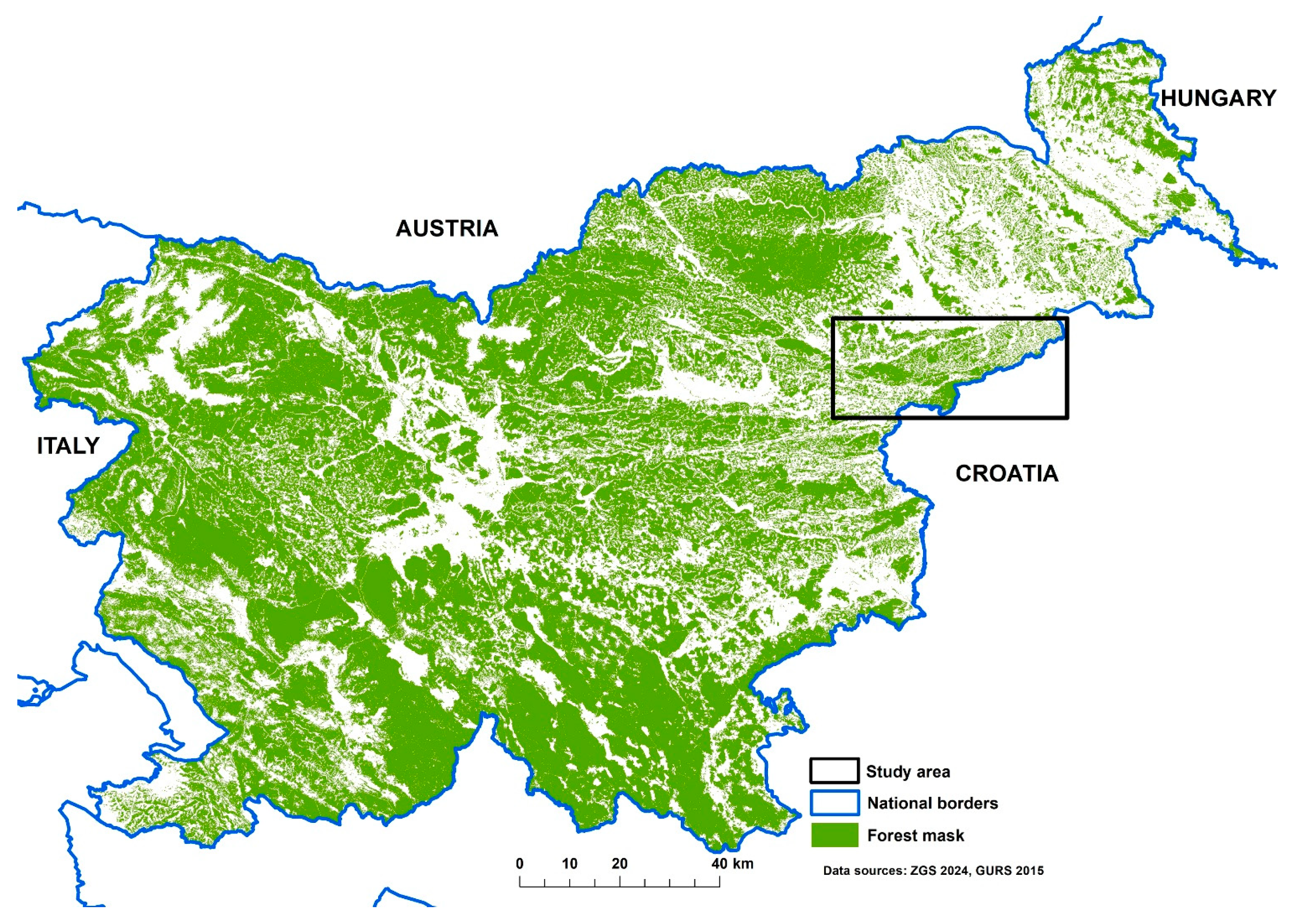
2.1. Study Area
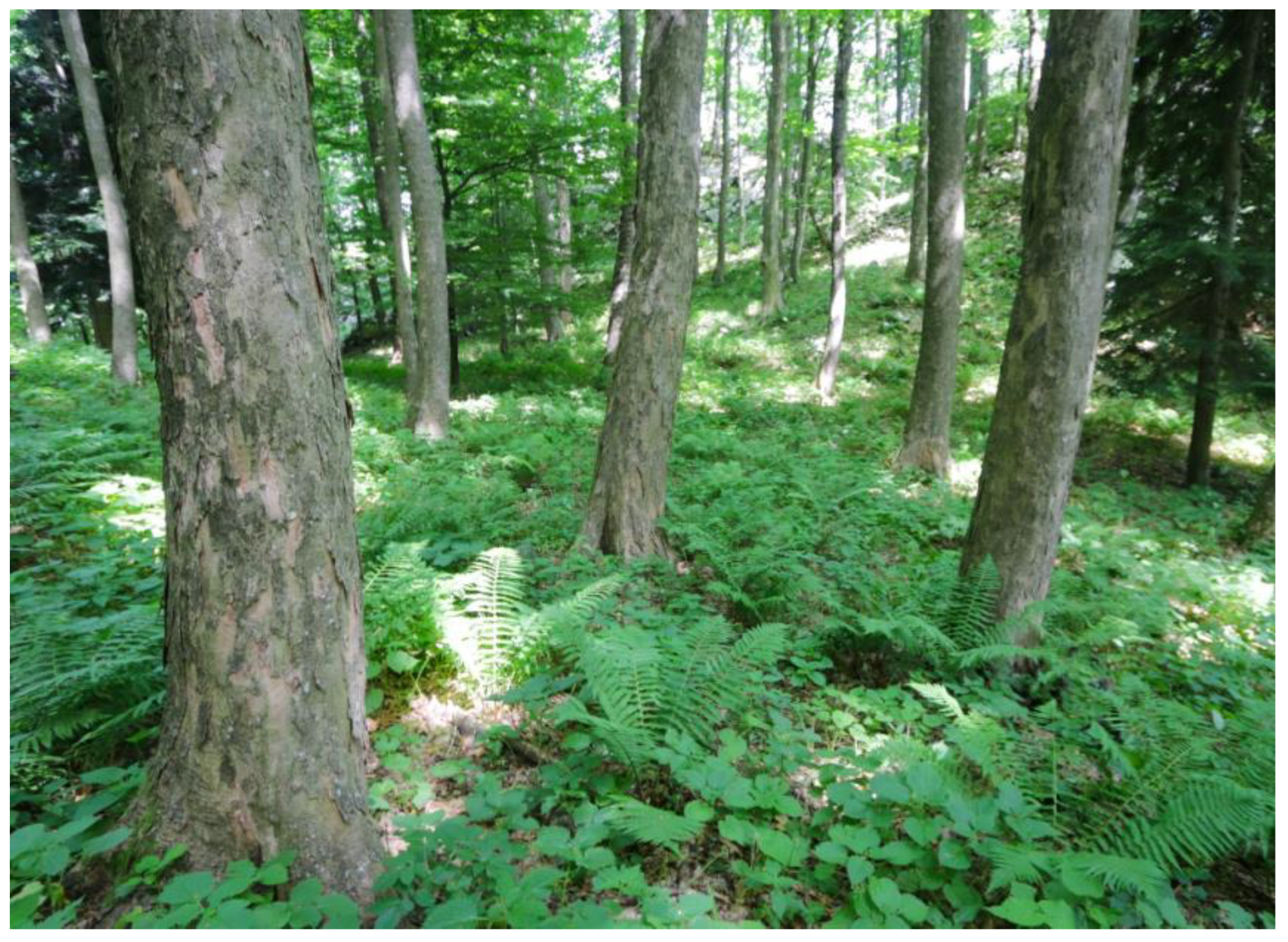
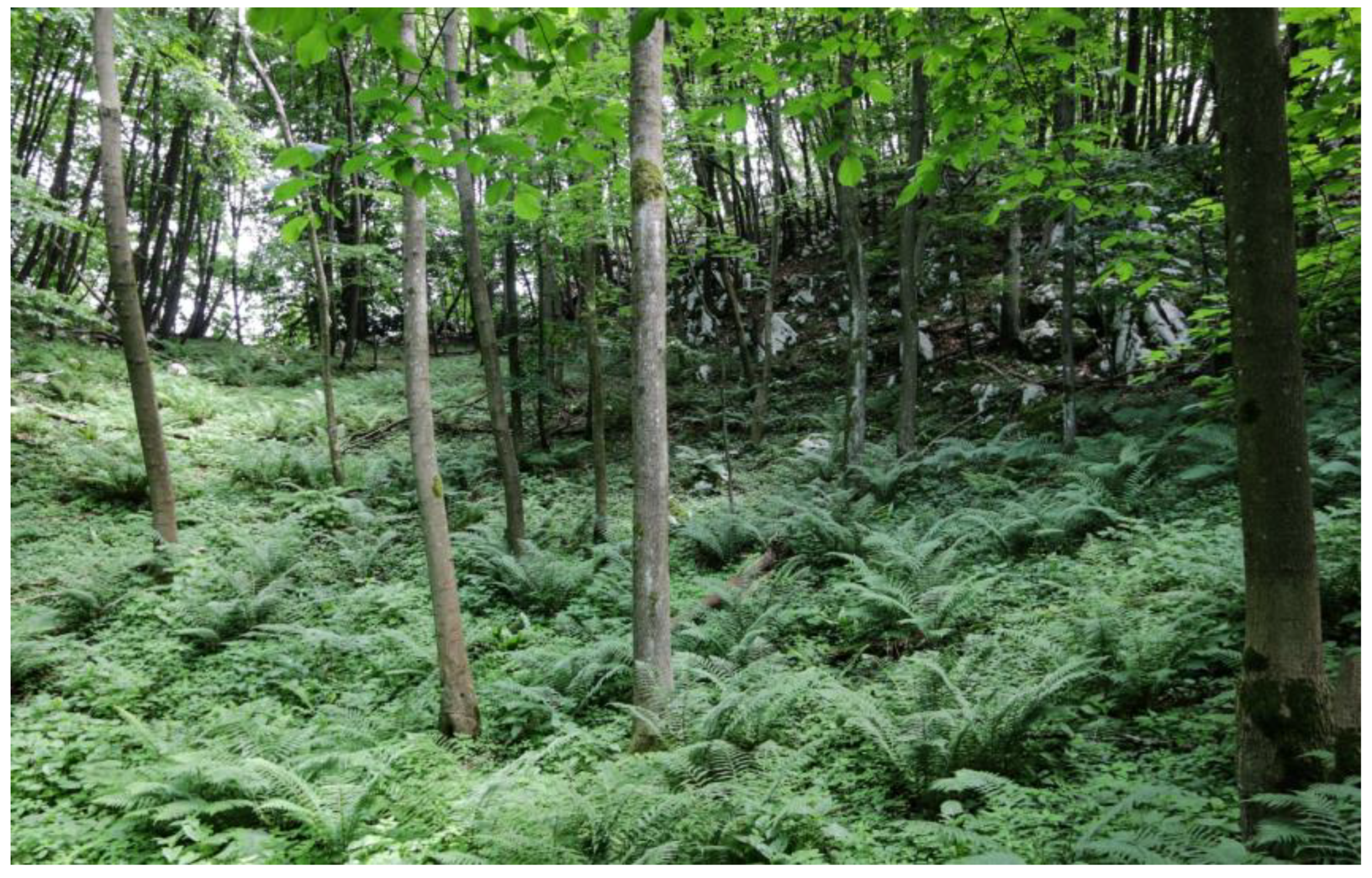
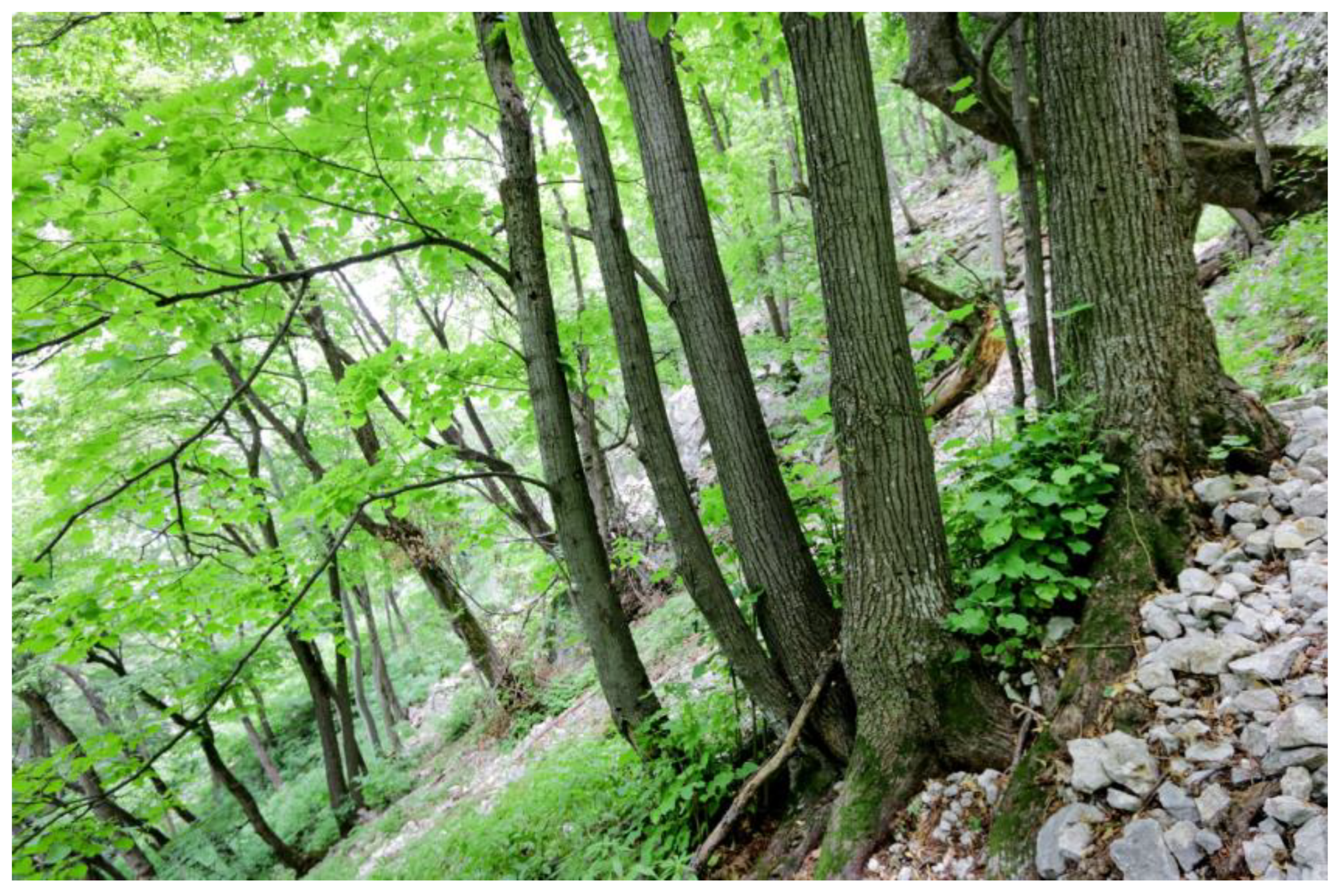
2.2. Description of the Studied Ravine Forests
2.3. Data Collection
2.3.1. Vegetation Survey
2.3.2. Topographic and Stand Variable Measurements
2.3.3. Soil Sampling and Analysis

| Variable | Description of Variables | Group of Variables |
|---|---|---|
| Altitude | Height above sea level (in m) | Topographic/site |
| Rockiness | Cover of outcropping rock and rock fragments (in % of plot surface) | Topographic/site |
| HLI | Heat load index (HLI) calculated with Equation (1) published in ref. [40] | Topographic/site |
| T_COVER | Tree layer cover (%) [29] | Forest stand |
| Tree_N | Number of different tree species in the overstorey [31,48] | Forest stand |
| Height | Mean height of overstorey trees (m) [49] | Forest stand |
| DBH | Mean diameter at breast height (cm) of the five largest trees [50] | Forest stand |
| GS | Total growing stock (volume) of all trees (m3/ha) [31] | Forest stand |
| Acer | Total growing stock (volume) of Acer pseudoplatanus and Acer platanoides (m3/ha) [31] | Forest stand |
| Fraxinus | Growing stock (volume) of Fraxinus excelsior (m3/ha) [31] | Forest stand |
| Tilia | Total growing stock (volume) of Tilia cordata and Tilia platyphyllos (m3/ha) [31] | Forest stand |
| Ulmus | Growing stock (volume) of Ulmus glabra (m3/ha) [31] | Forest stand |
| Castanea | Growing stock (volume) of Castanea sativa (m3/ha) [31] | Forest stand |
| Ostrya | Growing stock (volume) of Ostrya carpinifolia (m3/ha) [31] | Forest stand |
| Carpinus | Growing stock (volume) of Carpinus betulus (m3/ha) [31] | Forest stand |
| Tot_N | Total number of living trees per hectare [51] | Forest stand |
| CE | Clark and Evans aggregation index was calculated as follows: , where and where is the Euclidean distance between the i-th tree and its nearest neighbour, is the plot area and is the number of trees on the plot [52] | Forest stand |
| DWD_V | Total volume of deadwood biomass (m3/ha) | Forest stand |
| DLR | Dead-to-living tree growing stock volume ratio [48] | Forest stand |
| pH | Soil reaction (pH) measured in 0.01 M CaCl2 in the 0–10 cm mineral soil layer | Soil |
| C/N | Ratio between carbon (C) and total nitrogen content (N) in the 0–10 cm mineral soil layer | Soil |
| CEC | Cation exchange capacity (cmol(+)/kg) in the 0–10 cm mineral soil layer | Soil |
| BS | Base saturation (%) is calculated as follows: BS = (sum of exchangeable base cations/CEC) × 100 in the 0–10 cm mineral soil layer | Soil |
2.4. Data Analysis
3. Results
3.1. Species Richness
3.2. Species Composition
4. Discussion
4.1. Factors Associated with Species Richness
4.2. Factors Associated with Species Composition
5. Conclusions
Author Contributions
Funding
Data Availability Statement
Acknowledgments
Conflicts of Interest
References
- Sabatini, F.M.; Jiménez-Alfaro, B.; Burrascano, S.; Blasi, C. Drivers of herb-layer species diversity in two unmanaged temperate forest in northern Spain. Community Ecol. 2014, 15, 147–157. [Google Scholar] [CrossRef]
- Maes, S.L.; Perring, M.P.; Depauw, L.; Bernhardt-Römermann, M.; Blondeel, H.; Brūmelis, G.; Brunet, J.; Decocq, G.; den Ouden, J.; Govaert, S.; et al. Plant functional trait response to environmental drivers across European temperate forest understorey communities. Plant Biol. 2020, 22, 410–424. [Google Scholar] [CrossRef]
- Kermavnar, J.; Kutnar, L.; Marinšek, A. Disentangling the ecological determinants of species and functional trait diversity in herb-layer plant communities in European temperate forests. Forests 2021, 12, 552. [Google Scholar] [CrossRef]
- Vanneste, T.; Valdés, A.; Verheyen, K.; Perring, M.P.; Bernhardt-Römermann, M.; Andrieu, E.; Brunet, J.; Cousins, S.A.O.; Deconchat, M.; De Smedt, P.; et al. Functional trait variation of forest understory plant communities across Europe. Basic Appl. Ecol. 2019, 34, 1–14. [Google Scholar] [CrossRef]
- Barbier, S.; Gosselin, F.; Balandier, P. Influence of tree species on understory vegetation diversity and mechanisms involved—A critical review for temperate and boreal forests. For. Ecol. Manag. 2008, 254, 1–15. [Google Scholar] [CrossRef]
- Petersson, L.; Holmström, E.; Lindbladh, M.; Felton, A. Tree species impact on understory vegetation: Vascular plant communities of Scots pine and Norway spruce managed stands in northern Europe. For. Ecol. Manag. 2019, 448, 330–345. [Google Scholar] [CrossRef]
- Weigel, R.; Gilles, J.; Klisz, M.; Manthey, M.; Kreyling, J. Forest understory vegetation is more related to soil than to climate towards the cold distribution margin of European beech. J. Veg. Sci. 2019, 30, 746–755. [Google Scholar] [CrossRef]
- Catorci, A.; Tardella, F.M.; Cutini, M.; Luchetti, L.; Paura, B.; Vitanzi, A. Reproductive traits variation in the herb layer of a submediterranean deciduous forest landscape. Plant Ecol. 2013, 214, 737–749. [Google Scholar] [CrossRef]
- Tardella, F.M.; Postiglione, N.; Bricca, A.; Cutini, M.; Catorci, A. Altitude and aspect filter the herb layer functional structure of sub-Mediterranean forests. Phytocoenologia 2019, 49, 185–198. [Google Scholar] [CrossRef]
- Leuschner, C.; Lendzion, J. Air humidity, soil moisture and soil chemistry as determinants of the herb layer composition in European beech forests. J. Veg. Sci. 2009, 20, 288–298. [Google Scholar] [CrossRef]
- Macek, M.; Kopecký, M.; Wild, J. Maximum air temperature controlled by landscape topography affects plant species composition in temperate forests. Landsc. Ecol. 2019, 34, 2541–2556. [Google Scholar] [CrossRef]
- Su, X.; Wang, M.; Huang, Z.; Fu, S.; Chen, H.Y.H. Forest understory vegetation: Colonization and the availability and heterogeneity of resources. Forests 2019, 10, 944. [Google Scholar] [CrossRef]
- Vockenhuber, E.A.; Scherber, C.; Lagenbruch, C.; Meißner, M.; Seidel, D.; Tscharntke, T. Tree diversity and environmental context predict herb species richness and cover in Germany’s largest connected deciduous forest. Perspect. Plant Ecol. 2011, 13, 111–119. [Google Scholar] [CrossRef]
- Maes, S.L.; Blondeel, H.; Perring, M.P.; Depauw, L.; Brūmelis, G.; Brunet, J.; Decocq, G.; den Ouden, J.; Härdtle, W.; Hédl, R.; et al. Litter quality, land-use history, and nitrogen deposition effects on topsoil conditions across European temperate deciduous forests. For. Ecol. Manag. 2019, 433, 405–418. [Google Scholar] [CrossRef]
- Tinya, F.; Márialigeti, S.; Király, I.; Németh, B.; Ódor, P. The effect of light conditions on herbs, bryophytes and seedlings of temperate mixed forests in Őrség, Western Hungary. Plant Ecol. 2009, 204, 69–81. [Google Scholar] [CrossRef]
- Depauw, L.; Perring, M.P.; Landuyt, D.; Maes, S.L.; Blondeel, H.; De Lombaerde, E.; Brūmelis, G.; Brunet, J.; Closset-Kopp, D.; Czerepko, J.; et al. Light availability and land-use history drive biodiversity and functional changes in forest herb layer communities. J. Ecol. 2020, 108, 1411–1425. [Google Scholar] [CrossRef]
- Mölder, A.; Streit, M.; Schmidt, W. When beech strikes back: How strict nature conservation reduces herb-layer diversity and productivity in Central European deciduous forests. For. Ecol. Manag. 2014, 319, 51–61. [Google Scholar] [CrossRef]
- Tinya, F.; Kovács, B.; Bidló, A.; Dima, B.; Király, I.; Kutszegi, G.; Lakatos, F.; Mag, Z.; Márialigeti, S.; Nascimbene, J.; et al. Environmental drivers of forest biodiversity in temperate mixed forests—A multi-taxon approach. Sci. Total Environ. 2021, 795, 148720. [Google Scholar] [CrossRef]
- EC. Interpretation Manual of European Union Habitats—EUR28; European Commission, DG Environment: Brussels, Belgium, 2013. [Google Scholar]
- EEA. Tilio–Acerion Forests of Slopes, Screes and Ravines: Habitats Directive Annex I Code 9180; European Environment Agency, Biodiversity, Information System for Europe: Copenhagen, Denmark, 2025. [Google Scholar]
- Kutnar, L.; Kermavnar, J.; Pintar, A.M. Structural and compositional indicators of the conservation status of forest habitats: A case study of ravine forests—EU priority habitat type Tilio–Acerion. Ecol. Indic. 2025, 179, 114079. [Google Scholar] [CrossRef]
- Košir, P.; Čarni, A.; Di Pietro, R. Classification and phytosociological differentiation of broad-leaved ravine forests in southeastern Europe. J. Veg. Sci. 2008, 19, 331–342. [Google Scholar] [CrossRef]
- Kermavnar, J.; Kozamernik, E.; Kutnar, L. Assessing the heterogeneity and conservation status of the Natura 2000 priority forest habitat type Tilio–Acerion (9180*) based on field mapping. Forests 2023, 14, 232. [Google Scholar] [CrossRef]
- Karlo, T.; Senegačnik, A. Analiza in Ocena Stanja Projektnega Območja Boč-Haloze-Donačka Gora (Report of Detailed Analysis of Situation on Nature Conservation Measures for Natura 2000 Sites Boč-Haloze-Donačka Gora); Institute of the Republic of Slovenia for Nature Conservation: Ljubljana, Slovenia, 2020; 55p. [Google Scholar]
- Steinacker, C.; Beierkuhnlein, C.; Jaeschke, A. Assessing the exposure of forest habitat types to projected climate change—Implications for Bavarian protected areas. Ecol. Evol. 2019, 9, 14417–14429. [Google Scholar] [CrossRef]
- Dakskobler, I.; Košir, P.; Kutnar, L. Gozdovi Plemenitih Listavcev v Sloveniji (Broad-Leaved Ravine Forests in Slovenia); Silva Slovenica: Ljubljana, Slovenia; Gozdarski inštitut Slovenije: Ljubljana, Slovenia, 2013; 75p. [Google Scholar]
- Kutnar, L.; Matijašić, D.; Pisek, R. Conservation status and potential threats to Natura 2000 forest habitats in Slovenia. Šumar. List 2011, 5–6, 215–231. [Google Scholar]
- Kutnar, L.; Pintar, A.M.; Marinšek, A.; Kermavnar, J. Dataset on the Topography, Soil, Vegetation and Stand Characteristics of Tilio–Acerion Forests (Boč, Slovenia); Gozdarski inštitut Slovenije: Ljubljana, Slovenia, 2026. [Google Scholar] [CrossRef]
- Canullo, R.; Starlinger, F.; Granke, O.; Fischer, R.; Aamlid, D.; Neville, P. ICP Forests Manual on Methods and Criteria for Harmonized Sampling, Assessment, Monitoring and Analysis of the Effects of Air Pollution on Forests; Part VII.1: Assessment of Ground Vegetation; UNECE ICP Forests Programme Coordinating Centre: Hamburg, Germany, 2016; p. 19. [Google Scholar]
- Skudnik, M.; Grah, A.; Guček, M.; Kovač, M.; Kušar, G.; Pintar, A.M.; Pisek, R.; Poljanec, A.; Žlogar, J. Nacionalna Gozdna Inventura: Interna Navodila za Terensko Delo (2020–2024): (Ver. 02/2022); Gozdarski inštitut Slovenije: Ljubljana, Slovenia, 2022; 76p. [Google Scholar]
- Pintar, A.; Ferreira, A.; Krajnc, L.; Kušar, G.; Skudnik, M. Pestrost in pojavljanje domačih in tujerodnih drevesnih in grmovnih vrst na ploskvah Nacionalne gozdne inventure v Sloveniji. Acta Silv. Lign. 2024, 134, 11–26. [Google Scholar] [CrossRef]
- Barkman, J.J.; Doing, H.S.; Segal, S. Kritische Bemerkungen und Vorschläge zur quantitativen Vegetationsanalyse. Acta Bot. Neerl. 1964, 13, 394–419. [Google Scholar] [CrossRef]
- Tutin, T.G.; Heywood, V.H.; Burges, N.A.; Moore, D.M.; Valentine, D.H.; Walters, S.M.; Webb, D.A. Flora Europaea; Cambridge University Press: Cambridge, UK, 1964; Volume 1. [Google Scholar]
- Tutin, T.G.; Heywood, V.H.; Burges, N.A.; Moore, D.M.; Valentine, D.H.; Walters, S.M.; Webb, D.A. Flora Europaea; Cambridge University Press: Cambridge, UK, 1968; Volume 2. [Google Scholar]
- Tutin, T.G.; Heywood, V.H.; Burges, N.A.; Moore, D.M.; Valentine, D.H.; Walters, S.M.; Webb, D.A. Flora Europaea; Cambridge University Press: Cambridge, UK, 1972; Volume 3. [Google Scholar]
- Tutin, T.G.; Heywood, V.H.; Burges, N.A.; Moore, D.M.; Valentine, D.H.; Walters, S.M.; Webb, D.A. Flora Europaea; Cambridge University Press: Cambridge, UK, 1976; Volume 4. [Google Scholar]
- Tutin, T.G.; Heywood, V.H.; Burges, N.A.; Moore, D.M.; Valentine, D.H.; Walters, S.M.; Webb, D.A. Flora Europaea; Cambridge University Press: Cambridge, UK, 1980; Volume 5. [Google Scholar]
- Tutin, T.G.; Burges, N.A.; Chater, A.O.; Edmondson, J.R.; Heywood, V.H.; Moore, D.M.; Valentine, D.H.; Walters, S.M.; Webb, D.A. Flora Europaea, 2nd ed.; Cambridge University Press: Cambridge, UK, 1993. [Google Scholar]
- Martinčič, A.; Wraber, T.; Jogan, N.; Podobnik, A.; Turk, B.; Vreš, B.; Ravnik, V.; Frajman, B.; Strgulc Krajšek, S.; Trčak, B.; et al. Mala Flora Slovenije: Ključ za Določanje Praprotnic in Semenk; Tehniška založba Slovenije: Ljubljana, Slovenia, 2007; 967p. [Google Scholar]
- McCune, B.; Keon, D. Equations for potential annual direct incident radiation and heat load. J. Veg. Sci. 2002, 13, 603–606. [Google Scholar] [CrossRef]
- ISO 10390; Soil Quality—Determination of pH. ISO: Geneva, Switzerland, 2005.
- ISO 10693; Soil Quality—Determination of Carbonate Content—Volumetric Method. ISO: Geneva, Switzerland, 1995.
- ISO 10694; Soil Quality—Determination of Organic and Total Carbon After Dry Combustion (Elementary Analysis). ISO: Geneva, Switzerland, 1995.
- ISO 11277; Soil Quality—Determination of Particle Size Distribution in Mineral Soil Material—Method by Sieving and Sedimentation. ISO: Geneva, Switzerland, 2009.
- ISO 11464; Soil Quality—Pre-Treatment of Samples for Physico-Chemical Analysis. ISO: Geneva, Switzerland, 2006.
- ISO 11465; Soil Quality—Determination of Dry Matter and Water Content on a Mass Basis—Gravimetric Method. ISO: Geneva, Switzerland, 1993.
- ISO 13878; Soil Quality—Determination of Total Nitrogen Content by Dry Combustion (“Elemental Analysis”). ISO: Geneva, Switzerland, 1998.
- Borghi, C.; Francini, S.; Mcroberts, R.E.; Parisi, F.; Lombardi, F.; Nocentini, S.; Maltoni, A.; Travaglini, D.; Chirici, G. Country-wide assessment of biodiversity, naturalness and old-growth status using national forest inventory data. Eur. J. For. Res. 2024, 143, 271–303. [Google Scholar] [CrossRef]
- Tarmu, T.; Laarmann, D.; Kiviste, A. Mean height or dominant height—What to prefer for modelling the site index of Estonian forests? For. Stud. 2020, 72, 121–138. [Google Scholar] [CrossRef]
- Smyčková, M.; Koutecký, T.; Ujházyová, M.; Ujházy, K.; Verheyen, K.; Volařík, D.; Šebesta, J.; Friedl, M.; Máliš, F.; Hofmeister, J. Herb layer species richness declines with heterogeneity of the forest structure in primary beech-dominated forests while proportion of forest specialists increases. For. Ecol. Manag. 2024, 556, 121728. [Google Scholar] [CrossRef]
- Rybar, J.; Bosela, M.; Marcis, P.; Ujházyová, M.; Polťák, D.; Hederová, L.; Ujházy, K. Effects of tree canopy on herbaceous understorey throughout the developmental cycle of a temperate mountain primary forest. For. Ecol. Manag. 2023, 546, 121353. [Google Scholar] [CrossRef]
- Clark, P.J.; Evans, F.C. Distance to Nearest Neighbor as a Measure of Spatial Relationships in Populations. Ecology 1954, 35, 445–453. [Google Scholar] [CrossRef]
- R Core Team. R: A Language and Environment for Statistical Computing; R Foundation for Statistical Computing: Vienna, Austria, 2023. [Google Scholar]
- Zuur, A.F.; Ieno, E.N.; Elphick, C.S. A protocol for data exploration to avoid common statistical problems. Methods Ecol. Evol. 2010, 1, 3–14. [Google Scholar] [CrossRef]
- Lüdecke, D.; Ben-Shachar, M.S.; Patil, I.; Waggoner, P.; Makowski, D. Performance: An R Package for Assessment, Comparison and Testing of Statistical Models. J. Open Sour Softw. 2021, 6, 3139. [Google Scholar] [CrossRef]
- Johnson, J.B.; Omland, K.S. Model selection in ecology and evolution. Trends Ecol. Evol. 2004, 19, 101–108. [Google Scholar] [CrossRef]
- Venables, W.N.; Ripley, B.D. Modern Applied Statistics with S, 4th ed.; Springer: New York, NY, USA, 2002; ISBN 0-387-95457-0. [Google Scholar]
- Hartig, F. DHARMa: Residual Diagnostics for Hierarchical (Multi-Level/Mixed) Regression Models, R package version 0.4.7; CRAN: Vienna, Austria, 2024.
- Bustos Navarrete, C.; Coutinho Soares, F. Dominanceanalysis: Dominance Analysis, R package version 2.1.1; CRAN: Vienna, Austria, 2025.
- Oksanen, J.; Simpson, G.; Blanchet, F.; Kindt, R.; Legendre, P.; Minchin, P.; O’Hara, R.; Solymos, P.; Stevens, M.; Szoecs, E.; et al. Vegan: Community Ecology Package, R package version 2.6-4; CRAN: Vienna, Austria, 2022.
- Legendre, P.; Gallagher, E.D. Ecologically meaningful transformations for ordination of species data. Oecologia 2001, 129, 271–280. [Google Scholar] [CrossRef]
- Dray, S.; Bauman, D.; Blanchet, G.; Borcard, D.; Clappe, S.; Guénard, G.; Jombart, T.; Larocque, G.; Legendre, P.; Madi, N.; et al. Adespatial: Multivariate Multiscale Spatial Analysis, R package version 0.3-23; CRAN: Vienna, Austria, 2023.
- Dittrich, S.; Jacob, M.; Bade, C.; Leuschner, C.; Hauck, M. The significance of deadwood for total bryophyte, lichen, and vascular plant diversity in an old-growth spruce forest. Plant Ecol. 2014, 215, 1123–1137. [Google Scholar] [CrossRef]
- Kušar, G.; Neumann, M. Patterns of deadwood volume and dynamics in Slovenian forests. Acta Silv. Lign. 2024, 133, 1–12. [Google Scholar] [CrossRef]
- Fojcik, B.; Wierzgoń, M.; Chmura, D. Response of bryophytes to disturbances in managed forests. A case study from a Polish forest. Cryptogam. Bryol. 2019, 40, 105–118. [Google Scholar] [CrossRef]
- Müller, J.; Boch, S.; Prati, D.; Socher, S.A.; Pommer, U.; Hessenmöller, D.; Schall, P.; Schulz, E.D.; Fischer, M. Effects of forest management on bryophyte species richness in Central European forests. For. Ecol. Manag. 2019, 432, 850–859. [Google Scholar] [CrossRef]
- Kutnar, L.; Kermavnar, J.; Sabovljević, M.S. Bryophyte diversity, composition and functional traits in relation to bedrock and tree species composition in close-to-nature managed forests. Eur. J. For. Res. 2023, 142, 865–882. [Google Scholar] [CrossRef]
- Staniaszek-Kik, M.; Żarnowiec, J.; Chmura, D. Colonization patterns of vascular plant species on decaying logs of Fagus sylvatica L in a lower mountain forest belt: A case study of the Sudeten mountains. Appl. Ecol. Env. Res. 2014, 12, 601–613. [Google Scholar] [CrossRef]
- Unar, P.; Daněk, P.; Adam, D.; Paločková, L.; Holík, J. Can deadwood be preferred to soil? Vascular plants on decaying logs in different forest types in Central Europe. Eur. J. For. Res. 2024, 143, 379–391. [Google Scholar] [CrossRef]
- Chećko, E.; Jaroszewicz, B.; Olejniczak, K.; Kwiatkowska-Falińska, A.J. The importance of coarse woody debris for vascular plants in temperate mixed deciduous forests. Can. J. For. Res. 2015, 45, 1154–1163. [Google Scholar] [CrossRef]
- Khanina, L.; Bobrovsky, M. Value of large Quercus robur fallen logs in enhancing the species diversity of vascular plants in an old-growth mesic broad-leaved forest in the Central Russian upland. For. Ecol. Manag. 2021, 491, 119172. [Google Scholar] [CrossRef]
- Chelli, S.; Bricca, A.; Cutini, M.; Campetella, G.; Cervellini, M.; Tsakalos, J.L.; Canullo, R. Large standard trees and deadwood promote functional divergence in the understory of beech coppice forests. For. Ecol. Manag. 2021, 494, 119324. [Google Scholar] [CrossRef]
- Ogris, N.; Hauptman, T.; Jurc, D. Chalara fraxinea causing common ash dieback newly reported in Slovenia. Plant Pathol. 2009, 58, 1173. [Google Scholar] [CrossRef]
- Pautasso, M.; Aas, G.; Queloz, V.; Holdenrieder, O. European ash (Fraxinus excelsior) dieback—A conservation biology challenge. Biol. Conserv. 2013, 158, 37–49. [Google Scholar] [CrossRef]
- Kermavnar, J.; Eler, K.; Marinšek, A.; Kutnar, L. Initial understory vegetation responses following different forest management intensities in Illyrian beech forests. Appl. Veg. Sci. 2019, 22, 48–60. [Google Scholar] [CrossRef]
- Dormann, C.F.; Bagnara, M.; Boch, S.; Hinderling, J.; Janeiro-Otero, A.; Schäfer, D.; Schall, P.; Hartig, F. Plant species richness increases with light availability, but not variability, in temperate forests understorey. BMC Ecol. 2020, 20, 43. [Google Scholar] [CrossRef]
- Hrivnák, R.; Gömöry, D.; Slezák, M.; Ujházy, K.; Hédl, R.; Jarčuška, B.; Ujházyová, M. Species richness pattern along altitudinal gradient in central European beech forests. Folia Geobot. 2014, 49, 425–441. [Google Scholar] [CrossRef]
- Aggemyr, E.; Auffret, A.G.; Jädergård, L.; Cousins, S.A.O. Species richness and composition differ in response to landscape and biogeography. Landsc. Ecol. 2018, 33, 2273–2284. [Google Scholar] [CrossRef]
- Baran, J.; Pielech, R.; Kauzal, P.; Kukla, W.; Bodziarczyk, J. Influence of forest management on stand structure in ravine forests. For. Ecol. Manag. 2020, 463, 118018. [Google Scholar] [CrossRef]
- Tyler, G. Interacting effects of soil acidity and canopy cover on the species composition of field-layer vegetation in oak/hornbeam forests. For. Ecol. Manag. 1989, 28, 101–114. [Google Scholar] [CrossRef]
- Kutnar, L.; Kermavnar, J.; Pintar, A.M. Climate change and disturbances will shape future temperate forests in the transition zone between Central and SE Europe. Ann. For. Res. 2021, 54, 67–86. [Google Scholar] [CrossRef]


| Variable | Z-Value | Pseudo R2 (%) | Sig. |
|---|---|---|---|
| DWD_V | 5.702 | 30.7 | *** |
| T_COVER | −4.987 | 23.5 | *** |
| Altitude | 4.825 | 23.5 | *** |
| Height | −4.430 | 19.4 | *** |
| DLR | 4.568 | 18.7 | *** |
| Acer | −3.850 | 15.0 | *** |
| Tilia | 3.868 | 13.7 | *** |
| Ostrya | 3.388 | 10.7 | *** |
| DBH | −3.160 | 9.8 | ** |
| Tot_N | 2.596 | 6.5 | ** |
| CEC | 2.425 | 5.7 | * |
| Castanea | −2.008 | 4.3 | * |
| Ulmus | −1.968 | 4.0 | * |
| GS | −1.126 | 1.3 | ns |
| Rock | 1.110 | 1.2 | ns |
| pH | −1.075 | 1.1 | ns |
| Tree_N | −0.941 | 0.9 | ns |
| HLI | −0.816 | 0.7 | ns |
| CE | −0.728 | 0.5 | ns |
| Fraxinus | 0.446 | 0.2 | ns |
| BS | 0.287 | 0.1 | ns |
| Carpinus | −0.246 | 0.1 | ns |
| C/N | −0.235 | 0.1 | ns |
| Variable | Estimate (Coefficient) | Relative Importance (%) | p-Value |
|---|---|---|---|
| DWD_V | 0.04957 | 34.0 | *** |
| Height | −0.10857 | 12.5 | * |
| Altitude | 0.12254 | 9.5 | * |
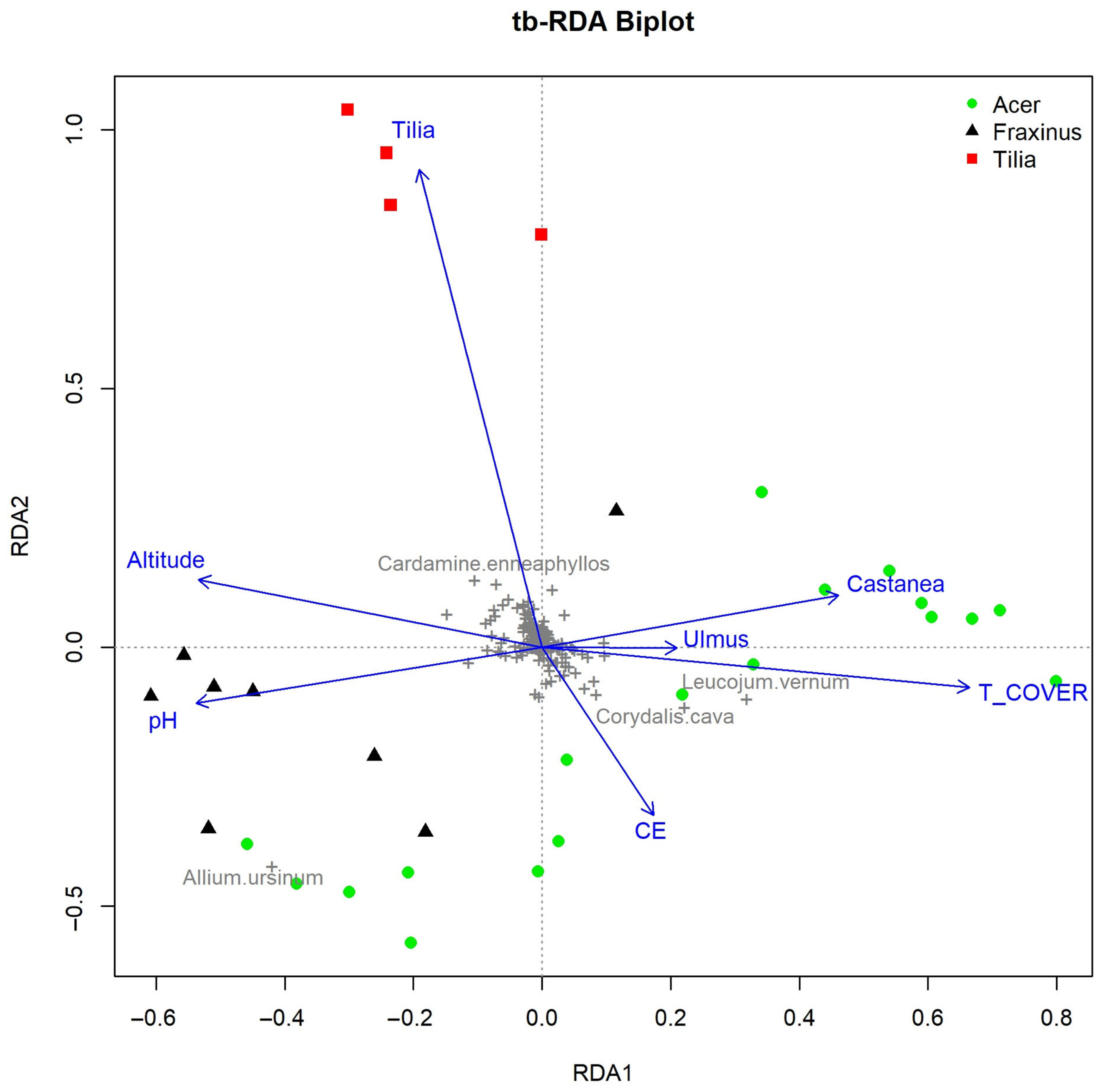
| Variable | Contribution (R2) in % | p-Value |
|---|---|---|
| Tilia | 11.2 | *** |
| pH | 8.8 | ** |
| T_COVER | 8.5 | *** |
| Castanea | 6.7 | ** |
| CE | 5.0 | ** |
| Ulmus | 4.5 | * |
| Altitude | 4.4 | * |
Disclaimer/Publisher’s Note: The statements, opinions and data contained in all publications are solely those of the individual author(s) and contributor(s) and not of MDPI and/or the editor(s). MDPI and/or the editor(s) disclaim responsibility for any injury to people or property resulting from any ideas, methods, instructions or products referred to in the content. |
© 2026 by the authors. Licensee MDPI, Basel, Switzerland. This article is an open access article distributed under the terms and conditions of the Creative Commons Attribution (CC BY) license.
Share and Cite
Kutnar, L.; Pintar, A.M.; Marinšek, A.; Kermavnar, J. Factors Supporting a High Level of Understorey Plant Diversity in Ravine Forests (EU Priority Habitat Type). Forests 2026, 17, 370. https://doi.org/10.3390/f17030370
Kutnar L, Pintar AM, Marinšek A, Kermavnar J. Factors Supporting a High Level of Understorey Plant Diversity in Ravine Forests (EU Priority Habitat Type). Forests. 2026; 17(3):370. https://doi.org/10.3390/f17030370
Chicago/Turabian StyleKutnar, Lado, Anže Martin Pintar, Aleksander Marinšek, and Janez Kermavnar. 2026. "Factors Supporting a High Level of Understorey Plant Diversity in Ravine Forests (EU Priority Habitat Type)" Forests 17, no. 3: 370. https://doi.org/10.3390/f17030370
APA StyleKutnar, L., Pintar, A. M., Marinšek, A., & Kermavnar, J. (2026). Factors Supporting a High Level of Understorey Plant Diversity in Ravine Forests (EU Priority Habitat Type). Forests, 17(3), 370. https://doi.org/10.3390/f17030370