Article

Shoot Vigour, Leaf Water Status and Physiological Traits of Mature Castanea sativa Mill. Trees Along the Canopy Vertical Gradient

Department of Agriculture, Food, Environment and Forestry, University of Florence, 50121 Florence, Italy
*
Author to whom correspondence should be addressed.
Forests 2026, 17(2), 173; https://doi.org/10.3390/f17020173
Submission received: 29 December 2025 / Revised: 22 January 2026 / Accepted: 26 January 2026 / Published: 28 January 2026

Abstract

Climate change is increasingly exposing sweet chestnut (Castanea sativa Mill.) to more frequent and prolonged drought events, which can compromise growth and nut production, particularly in Mediterranean environments. Understanding how trees respond physiologically to ecological and environmental constraints requires a detailed analysis of their architectures. The aim of this study was to investigate how the shoot vigour and leaf water status of mature chestnut trees vary with height within the canopy. Three mature chestnut trees with distinct crown architectures were selected in a traditional chestnut orchard in Central Italy; the differences in crown structure reflected individual tree development under comparable pruning practices. Morphological traits, leaf water status, and physiological parameters related to chlorophyll were measured directly within the canopy by professional tree climbers, allowing access to both lower and upper shoots during the growing season of 2020. One tree, called “Tree 1,” characterised by low bifurcation, with all epicormic shoot cluster (complexes) located on the two main branches and none on the main stem, showed partial vertical differences, mainly in water status and chlorophyll traits. “Tree 2”, characterised by high bifurcation and shoots running along the main stem, exhibited clear vertical gradients: lower-canopy shoots had larger leaf areas and more dry mass, higher relative water content, and better photosynthetic performance index e values than upper shoots. At the end, “Tree 3”, with the same architecture as Tree 1, displayed no consistent vertical trends. These findings indicate that individual tree architecture modulates hydraulic constraints and shoot vigour, even in hydraulically efficient epicormic branches. Although canopy access constraints limited the number of trees and measurements, this study—among the few to conduct in-canopy measurements on large, mature trees—provides valuable guidance for pruning and crown management, suggesting that lowering and simplifying the crown can enhance water-use efficiency, shoot vigour, and drought resilience in traditional and low-input chestnut orchards.

1. Introduction

Castanea sativa Mill., commonly known as sweet chestnut, is widespread throughout Europe and Western Asia and has historically been valued for its use in both timber and nut production [1]. The species has a long history of active cultivation, which has led to its current establishment on sites characterised by a minimum rainfall that ranges between 600 and 800 mm and a mean annual temperature range of 8–15 °C across Central Europe [2]. In Europe, more than 2.5 million hectares are covered by chestnut forests, existing in natural, semi-natural, and managed stands—including orchards and plantations—where appropriate silvicultural practices are applied to sustain high levels of wood and fruit production. The Mediterranean basin represents the core cultivation area in Europe, with 89% of the distribution area concentrated in France and Italy, followed by Spain, Portugal, and Switzerland [2]. In Italy, chestnut forests occupy 778.475 ha [3] and have historically served as an essential economic resource for rural communities in the Apennine regions, where chestnut cultivation aimed at wood or nut production is deeply rooted in local tradition [4]. However, in recent years and with increasing frequency, field experience has shown numerous chestnut trees exhibiting desiccation in the upper branches of the canopy. In fact, recent studies have shown that climate change is increasingly exposing chestnut trees, growing in mountainous and hilly areas, to more frequent and prolonged drought events, whereas water availability was rarely a limiting factor in the past century [5,6,7]. Rising summer temperatures, reduced annual precipitation, and altered rainfall distribution are now negatively affecting the productivity of traditional rainfed chestnut orchards [5]. In particular, rainfall reduction during the summer and autumn has become a major constraint for chestnut growth and nut production, leading to significant economic losses for producers [8,9]. Overall, there is accumulating evidence indicating that chestnut is highly sensitive to summer droughts, which have become some of the primary threats causing substantial and often unexpected production losses in arid and semi-arid areas, including the Mediterranean region [10,11]. The vulnerability of Mediterranean systems to water scarcity is predicted to increase in the near future as a consequence of greater inter-annual rainfall variability and a greater frequency and intensity of extreme events such as droughts and heat waves [12,13]. In this context, the identification and implementation of adaptation aimed at enhancing the resilience of chestnut trees to water scarcity should be a key priority to maintain both the quality and quantity of production and protect water resources [13]. For these reasons and to increase production to answer the rising demand for sweet chestnut in Europe, some management practices are becoming essential [10]. These practices include fertilization, irrigation, and pruning [14]. While pruning has always been practised, today, it is complemented by mineral fertilisation and irrigation, mainly in more intensive systems to improve tree performance and nut quality [15,16,17]. However, traditionally managed chestnut orchards are an open forest habitat of anthropogenic origin characterised by a low-intensity management regime [18]. In fact, in the Mediterranean climate, spring precipitation is highly irregular, which makes it difficult to establish a fertilization program for chestnut orchards and, in particular, determine the best time to apply fertilizers [16]. In addition, irrigation is still barely employed in chestnut orchards due to many difficulties, like shortages of water (e.g., from artificial lakes or water reservoirs) for irrigation in typical chestnut cultivation areas (i.e., mountain-hills areas) [15]. Given these emerging constraints, it is therefore necessary to reconsider pruning strategies and canopy management techniques in chestnut orchards to improve water-use efficiency and enhance the trees’ resilience to drought stress. Understanding how trees respond physiologically to ecological and environmental constraints requires a detailed analysis of their structural properties. As known from the literature, as a tree’s height increases, its vertical structure imposes critical challenges for hydraulic functioning, as water must be transported over long xylem pathways to supply leaves at different heights [19,20]. According to the “hydraulic limitation hypothesis,” increasing tree height increases hydraulic resistance, potentially reducing leaf-specific hydraulic conductance, stomatal conductance, and photosynthetic rates in upper-canopy leaves relative to those in lower canopy positions [21].
In this study, using tree architectures, we investigated how shoot vigour, leaf moisture, and chlorophyll traits of mature chestnut trees vary with height within the canopy using direct canopy access via tree climbing, an approach rarely applied to large, mature fruit trees. We hypothesised that lower and upper shoots differentiate such traits due to their positions within the canopy and, consequently, different exposure to environmental constraints. Specifically, under comparable light conditions, we expected lower shoots to display more favourable water statuses than those positioned in the upper canopy due to reduced hydraulic path length and lower tension along the soil–plant–atmosphere continuum.

2. Materials and Methods

2.1. Experimental Site

The experimental site is in an area in the upper valley of the Serchio river called Garfagnana, situated in north-west Tuscany in the province of Lucca in Central Italy. It is enclosed by two mountain ranges, which are significantly different from each other: the Apuan Alps in the West, facing the Tyrrhenian coast, and the Apennines in the east. The natural landscape of the valley is dominated primarily by chestnut (Castanea sativa Mill.) at up to approximately 1000 m a.s.l. Within this lower zone, Turkey oak (Quercus cerris L.) occurs sporadically, and hornbeam stands (Ostrya carpinifolia Scop. and Carpinus betulus L.) are occasionally present. In some places, there are large patches of invasive Robinia pseudoacacia L. At higher elevations, beech forests (Fagus sylvatica L.) predominate, extending up to about 1600 m a.s.l. On the western side of the valley, the proximity to the sea supports an Apuan flora that includes both alpine and Mediterranean elements. In this study, the chestnut orchard in Gello (Media Valle, right side of the Serchio Valley) (43°57′57.66″ N, 10°27′0.03″ E) was selected. It is a chestnut orchard that was recently restored after a period of abandonment in a flat area. The mean annual temperature in the area ranges from −4.4 to 20.9 °C, and the mean annual precipitation ranges from 481.6 to 2449.0 mm. During the summer in which the study was conducted, the Standardized Precipitation-Evapotranspiration Index (SPEI) was estimated to be 0.1 (https://climatedt.org/), indicating wet conditions and the absence of drought conditions. Soils vary from tropical red soils with low organic matter content to brown soils with high organic matter content. The chestnut orchard has a density of 120–130 trees/ha. All the trees were grafted at a young stage using the same local cultivar, “Carpinese,” and are estimated to be between 80 and 150 years old, with diameters ranging from 50 to 90 cm and heights of 15 to 20 m.

2.2. Experimental Design, Sampling and Measurement

The investigation was conducted on three healthy mature trees, i.e., those that did not show symptoms of disease or pest attacks during the growing season. On each tree, all the measurements were performed on a variable number of epicormic complexes. In this study, the term epicormic complex refers to a cluster of orthotropic shoots originating from dormant buds that were activated following moderate/severe pruning [22]. Each complex consisted of two or more vertically oriented 1-year-old shoots emerging from the same trunk zone as a direct response to the same pruning intervention. Shoots had the same origin; they were characterised by ontogenetic juvenility and showed no variability in terms of physiological status. For this reason, epicormic complexes (hereafter referred to as “complexes”) were used as consistent and comparable sampling units for assessing differences between canopy levels. Tree 1, Tree 2, and Tree 3 were individuals representing the two most common architectural types in the area. Trees 1 and 3 exhibited low bifurcation, with all complexes located on the two main branches and none on the main stem. In contrast, Tree 2 displayed high bifurcation and additional complexes along the main stem. Specifically, Tree 1 consisted of two branches, each bearing four complexes; Tree 2 had two branches plus complexes on the main stem; and Tree 3 had two branches, each with three complexes (Table 1).
Complexes were characterised according to height, namely, the distance from the ground. For each tree, complexes were classified as either “upper” or “lower” based on this measurement. Specifically, upper complexes were those located above 10 m from the ground, whereas lower complexes were those positioned below 10 m. The length of each shoot in each complex was measured at DOY 218, when shoot elongation was completed (Table 1). A total of 91 shoots were taken into account and measured. Then, the leaves of the complexes were characterised in terms of morphology, leaf moisture, and chlorophyll traits. The performance at the complex level was monitored from June to September 2020, from Day of Year (DOY) 176 to DOY 260 for each tree. As the trees were tall (20–25 m), all the field measurements described were carried out by a tree climber.

2.2.1. Leaf Morphology

Three fully expanded leaves were randomly selected in each complex using destructive harvest during the survey at the beginning and end of the investigation period on DOY 176 and DOY 260. Leaf area was measured by selecting three leaves of different sizes (large, medium, and small) from a single complex at both time points. Immediately after being harvested, the leaves were weighed to prevent water loss and obtain the fresh mass (FM). Subsequently, leaves were immersed in water for 48 h to determine the fresh mass at full turgor (TM). After that, leaves were placed in an oven at a temperature of 75 °C until a constant dry mass (DM) was achieved. The leaf area (LA cm2) was determined using Im [23]. Finally, the sclerophyll indices were calculated:
Specific Leaf Area (SLA) = LA/DM
Leaf tissue density (D) = (DM/FM) × 1000

2.2.2. Leaf Moisture Indices

The leaf moisture indices were calculated using the same leaves and on the same date:
Relative water content (RWC) = (FM − DM)/(TM − DM) × 100
Succulence (S) = (FM − DM)/LA
Water content at saturation (WCS) = (TM − FM)/DM
Water saturation deficit (WSD) = (TM − FM)/TM − DM) × 100

2.2.3. Chlorophyll Traits

The total leaf chlorophyll content was estimated and chlorophyll fluorescence was measured on one fully expanded and exposed sun leaf from each shoot in each complex on the trees at DOY 176, 199, 218, 238, and 260. The chlorophyll content was estimated by using the SPAD (The Soil Plant Analysis Development) meter (Minolta-502), a hand-held chlorophyll meter that absorbs light wavelengths of 430–750 nm as it passes through leaves. Chlorophyll fluorescence was measured with a Hansatech Handy Plant Efficiency Analyzer (Handy PEA, Hansatech Instruments, King’s Lynn, Norfolk, UK). Chlorophyll fluorescence was determined per complex on three leaves placed in the dark for 40 min using a clasp.

2.2.4. Statistical Analysis

Descriptive statistics, including means and standard errors, were calculated for all measured parameters. The normality of the data distribution was assessed using the Shapiro–Wilk test, and homogeneity of variances was evaluated with Levene’s test. One-way ANOVA was conducted to examine the effects of shoot complexes height on leaf morphology, water-related indices, and physiological traits. When significant differences were detected, pairwise comparisons were performed using Tukey’s post hoc test at a significance level of 0.05. All statistical analyses were carried out using OriginPro 8 (OriginLab Corporation, Northampton, UK).

3. Results

3.1. Leaf Morphology

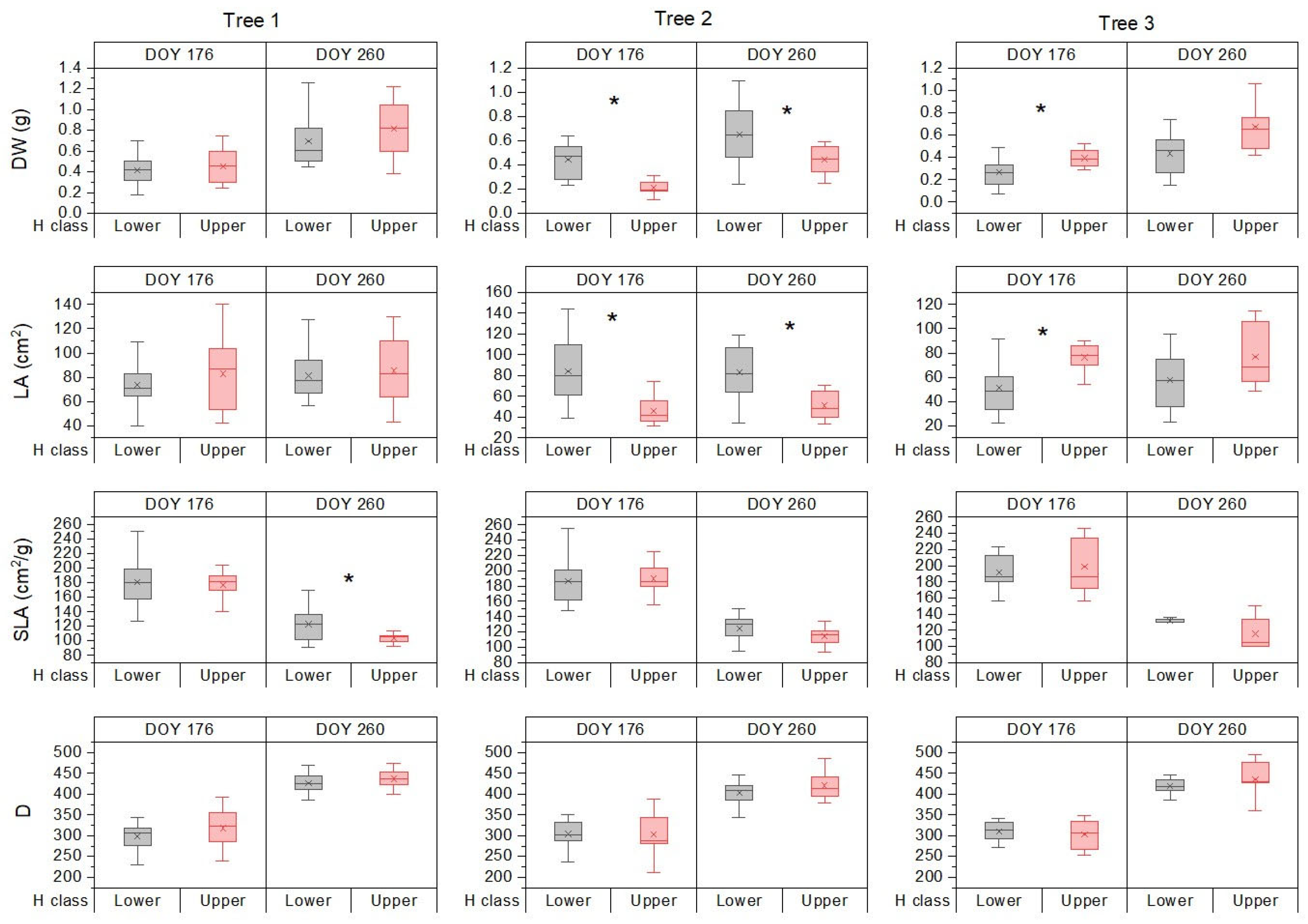
The three trees showed distinct patterns in relation to height (Figure 1). Tree 1 displayed significant differences in SLA between the upper and lower complexes on DOY 260, with higher values in the lower complexes than in the upper ones. Tree 2 showed greater DM and LA in the lower complexes compared to the upper ones. Conversely, Tree 3 had greater DM and LA in the upper complexes than in the lower ones.

3.2. Leaf Moisture Indices

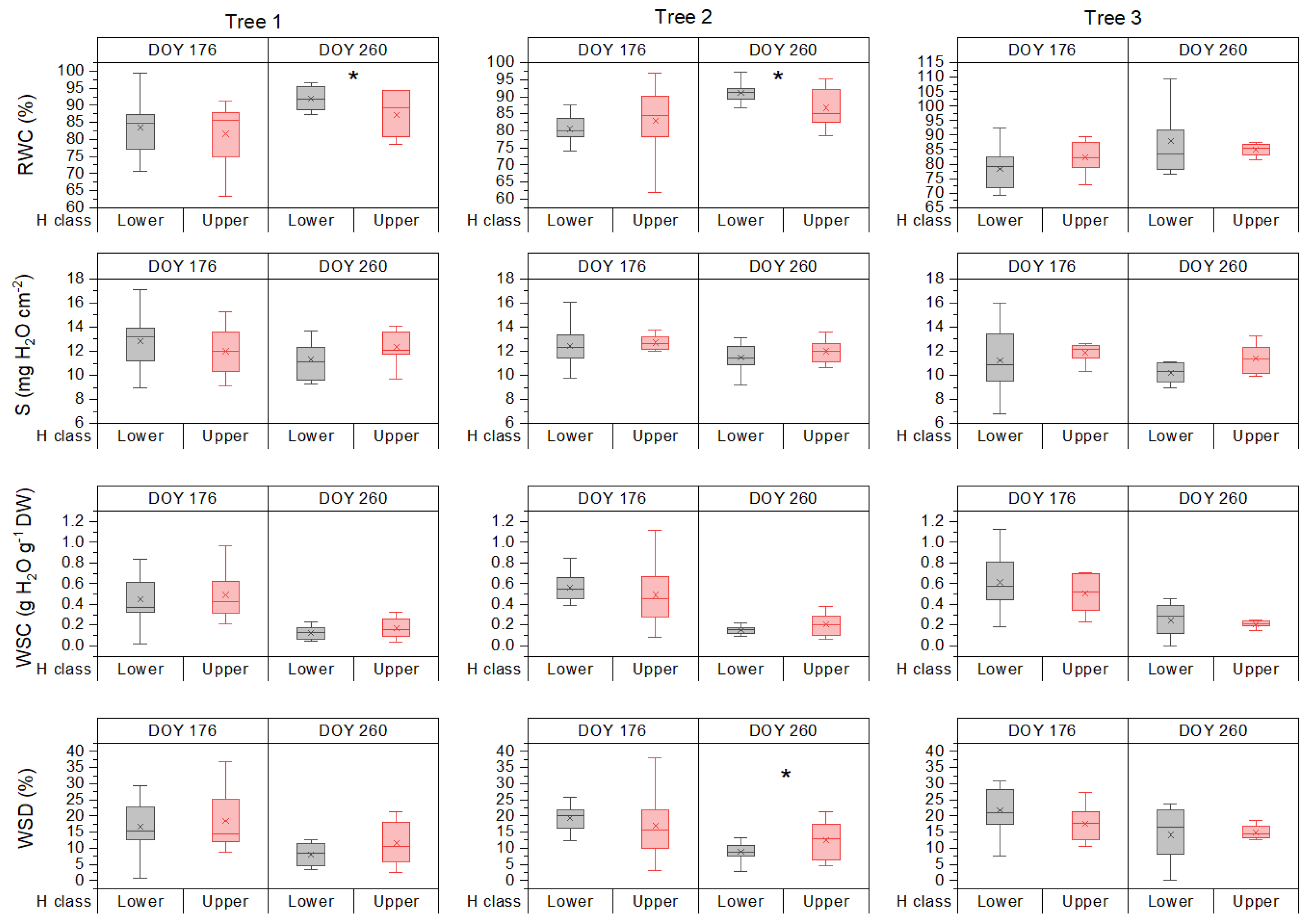
Regarding the leaf moisture indices, Tree 1 and Tree 2 showed higher RWC in the lower complexes than in the upper ones on DOY 260. On the same date, Tree 2 exhibited higher WSD values in the upper complexes than in the lower ones. No significant differences between lower and upper complexes were observed for Tree 3 (Figure 2).

3.3. Chlorophyll Traits

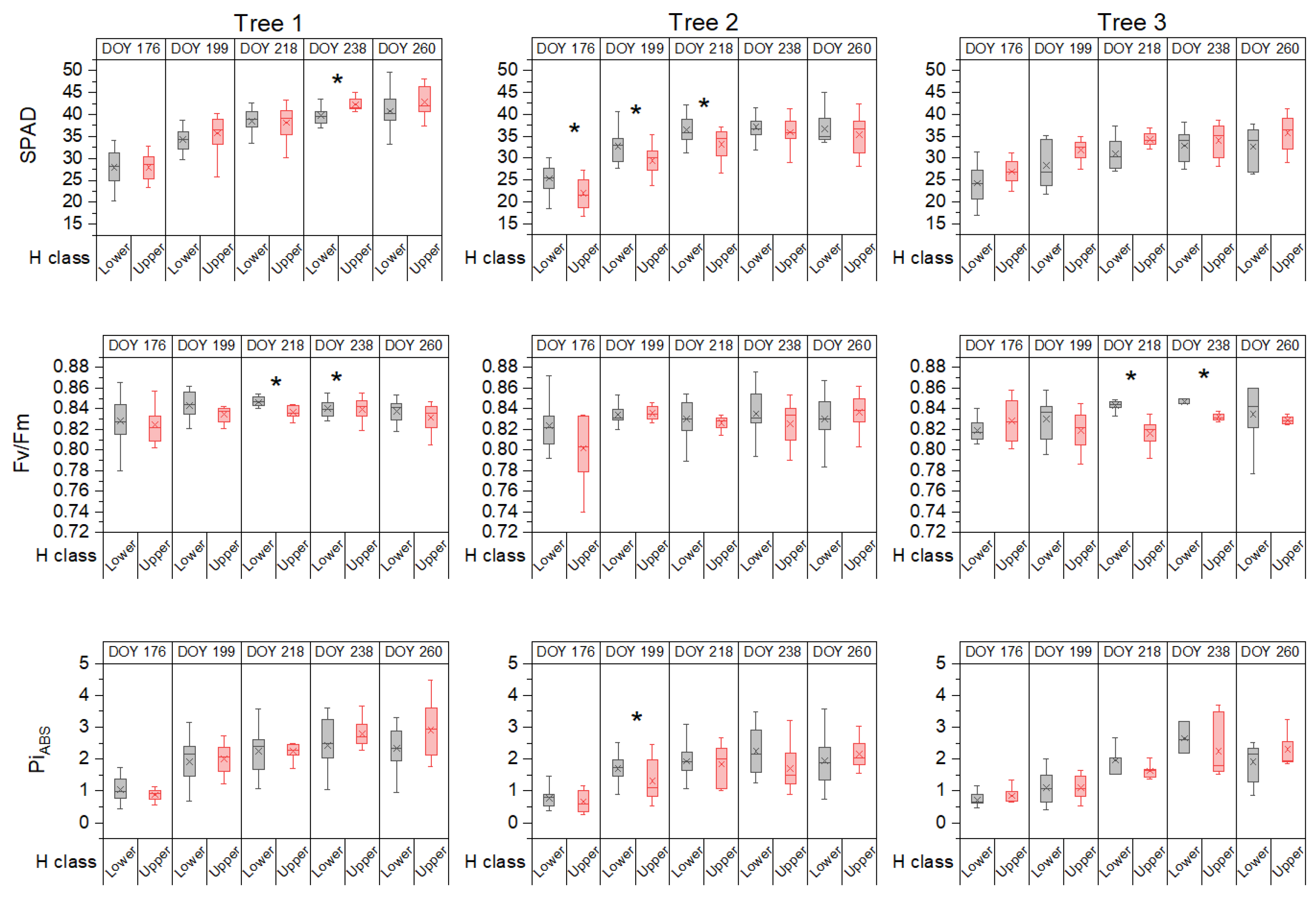
SPAD values were higher in the upper complexes on DOY 218 in Tree 1, whereas Fv/Fm was higher in the lower complexes on DOY 218 and 238 for Tree1 and Tree 3 (Figure 3). Tree 2 showed higher SPAD values in the lower complexes from DOY 176 to DOY 218, as well as a higher PiABS on DOY 199, at the same canopy level (Figure 3).

4. Discussion

To our knowledge, this is the first study in which detailed morphological and physiological measurements of large, mature chestnut trees were performed directly within the canopy—made possible only through professional tree climbing—providing height-specific, in-canopy data that can offer practical, evidence-based guidance for pruning and crown management for traditional fruit orchards. The insights derived from this work are intended to provide practical, concrete, and applicable guidance for chestnut forest managers and pruning specialists. Overall, the measured morphological and physiological parameters did not reveal signs of stress in any of the investigated trees, as all values fell within ranges commonly associated with non-stressed conditions; this was expected given the climatic conditions in the study area during the year of investigation. The results indicated that the initial hypothesis was supported by Tree 2, partially supported by Tree 1, and not supported by Tree 3, highlighting the critical role of individual crown architecture in modulating hydraulic and physiological responses [24]. However, these results refer to non-stress environmental conditions and may differ under arid or drought-stress conditions. Tree 2, characterised by high bifurcation and the presence of lower clusters of replacement shoots along the main stem, showed a clear vertical gradient consistent across morphologies, water relations, and physiological traits. Lower-canopy epicormic shoots exhibited larger leaf area (LA) values, greater dry mass (DM), higher relative water content (RWC), and lower water saturation deficit (WSD), while upper-canopy shoots experienced hydraulic limitation and reduced physiological performance. Under drier or drought-stress conditions, the vertical gradient observed in Tree 2 may become more pronounced. Reduced soil water availability and increased evaporative demand could further exacerbate height-related hydraulic constraints, leading to stronger reductions in water status and physiological performance. Conversely, lower shoots, with shorter hydraulic pathways and closer connections to the main stem, may maintain comparatively better hydration and function. Such conditions are expected to reinforce the vertical differentiation observed under non-stress conditions. Tree 1, with low bifurcation and complexes restricted to the main branches, showed weaker vertical differentiation, with limited morphological differences (SLA) and a moderate advantage in water status (RWC) and photochemical efficiency (Fv/Fm) for lower-canopy shoots. This indicates a more homogeneous hydraulic architecture, in which height-related constraints are partially buffered. These results align with the concept that epicormic shoots may maintain relatively high hydraulic conductivity by connecting directly to lower-order axes with higher conductive capacity, such as the main stem, thereby shortening the length of the hydraulic path to the leaves [25]. However, our findings suggest there are different hydraulic strategies along the vertical profile of the tree: for Tree 2, shoot height from the ground clearly influenced shoot vigour. Increasing height still imposes hydraulic constraints, limiting leaf morphology, RWC, and chlorophyll traits, despite architectural compensation mechanisms. Tree 3, despite a similar degree of low bifurcation, did not show consistent vertical patterns in terms of morphology, water relations, or physiology, indicating an even more uniform water distribution within the crown, possibly due to differences in branch arrangement or hydraulic integration.
Therefore, if lower complexes show improved water relations, this will provide a strong rationale for developing pruning strategies aimed at lowering and re-structuring tree crowns to enhance tree vigour, improve canopy architecture, maximise fruit production, and increase chestnut trees’ resilience to climate-change-induced drought. Overall, these initial results suggest that parties implementing pruning and canopy management strategies in chestnut orchards should consider tree-specific architectures: for trees resembling Tree 2, lowering the crown could enhance water relations and physiological performance, improving vigour and fruit production.

5. Conclusions

The investigation of morphological, physiological, and water-related traits of mature chestnut trees at different heights within the canopy necessarily requires the use of professional tree climbers. This methodological constraint inevitably limits both the number of measurements that can be performed and the number of individual trees that can be included, due to time and economic considerations. Therefore, in this study, the sample size of plant replicates was relatively small, constraining the extent to which the observed vertical patterns can be generalised or linked to specific architectural types. The observed patterns should be interpreted with caution when extrapolating them to broader populations or different environmental contexts. Therefore, the results should be regarded as exploratory and indicative of potential relationships between individual tree architectures and hydraulic or physiological function rather than as definitive evidence. Further investigations involving a larger number of trees within each architectural configuration and conducted across contrasting environmental conditions will be necessary to validate and extend these findings. Nevertheless, despite these constraints, the results provide valuable insights into within-canopy variability in adult sweet chestnut trees, a level of detail that can hardly be achieved in field studies of mature orchard systems. From a practical point of view, the observed height-related differences in hydraulic and physiological performance, particularly in relation to individual tree architecture, provide important insights regarding pruning strategies and canopy management in extensive chestnut orchards. Therefore, this study highlights that vertical variation in leaf morphology, water relations, and physiology is tree-specific, largely modulated by architectural traits, and provides a scientific rationale for adaptive pruning and canopy management strategies aimed at enhancing drought resilience and sustaining chestnut productivity under Mediterranean conditions.

Author Contributions

Conceptualization, C.C. and A.M.; methodology, C.C. and A.M.; formal analysis, investigation, and data curation, C.C., L.M., B.M. and A.M.; writing—original draft preparation, C.C. and L.M.; writing—review and editing, C.C., L.M., B.M. and A.M. All authors have read and agreed to the published version of the manuscript.

Funding

This research received no external funding.

Data Availability Statement

The data can be made available by the authors upon request.

Acknowledgments

The authors thank Fausto Palmerini (tree climber) for the field measurements.

Conflicts of Interest

The authors declare no conflicts of interest.

References

  1. Chiriacò, M.V.; Samad, N.; Magnani, F.; Vianello, G.; Vittori-Antisari, L.; Mazzoli, I.; Ranieri, R.; Valentini, R. Ecophysiology of Mediterranean Chestnut (Castanea sativa Mill.) Forests: Effects of Pruning Studied through an Advanced IoT System. Forests 2024, 15, 1579. [Google Scholar] [CrossRef]
  2. Conedera, M.; Tinner, W.; Krebs, P.; De Rigo, D.; Caudullo, G. Castanea sativa in Europe: Distribution, habitat, usage and threats. Eur. Atlas For. Tree Species 2016, 78, 79. [Google Scholar]
  3. Gasparini, P.; Di Cosmo, L.; Floris, A.; De Laurentis, D. Italian National Forest Inventory—Methods and Results of the Third Survey: Inventario Nazionale Delle Foreste e dei Serbatoi Forestali di Carbonio—Metodi e Risultati Della Terza Indagine; Springer Nature: Cham, Switzerland, 2022. [Google Scholar]
  4. Conedera, M.; Manetti, M.C.; Giudici, F.; Amorini, E. Distribution and Economic Potential of the Sweet Chestnut (Castanea Sativa Mill.) in Europe. Ecol. Mediterr. 2004, 30, 179–193. [Google Scholar] [CrossRef]
  5. Perulli, G.D.; Boini, A.; Bresilla, K.; Morandi, B.; Grappadelli, L.C.; Manfrini, L. Growth Analysis of Sweet Chestnut Burr in Two Seasons with Differing Weather Conditions. Italus Hortus 2020, 27, 31–39. [Google Scholar] [CrossRef]
  6. Freitas, T.R.; Santos, J.A.; Silva, A.P.; Fraga, H. Influence of Climate Change on Chestnut Trees: A Review. Plants 2021, 10, 1463, Correction in Plants 2022, 11, 1518. https://doi.org/10.3390/plants11111518. [Google Scholar] [CrossRef] [PubMed]
  7. Conedera, M.; Krebs, P.; Gehring, E.; Wunder, J.; Hülsmann, L.; Abegg, M.; Maringer, J. How Future-Proof Is Sweet Chestnut (Castanea sativa) in a Global Change Context? For. Ecol. Manag. 2021, 494, 119320. [Google Scholar] [CrossRef]
  8. Weise, K.; van der Maaten-Theunissen, M.; Seitz, G.; Keller, T.; van der Maaten, E. Future Suitability of Sweet Chestnut (Castanea sativa Mill.) Is Limited by Susceptibility to Drought. Dendrochronologia 2025, 90, 126299. [Google Scholar] [CrossRef]
  9. Menéndez-Miguélez, M.; Álvarez-Álvarez, P.; Majada, J.; Canga, E. Effects of Soil Nutrients and Environmental Factors on Site Productivity in Castanea sativa Mill. Coppice Stands in NW Spain. New For. 2015, 46, 217–233. [Google Scholar] [CrossRef]
  10. Zhang, C.; Moutinho-Pereira, J.M.; Correia, C.; Coutinho, J.; Gonçalves, A.; Guedes, A.; Gomes-Laranjo, J. Foliar Application of Sili-K® Increases Chestnut (Castanea Spp.) Growth and Photosynthesis, Simultaneously Increasing Susceptibility to Water Deficit. Plant Soil 2013, 365, 211–225. [Google Scholar] [CrossRef]
  11. Conedera, M.; Barthold, F.; Torriani, D.; Pezzatti, G.B. Drought Sensitivity of Castanea sativa: Case Study of Summer 2003 in the Southern Alps. In I Europeand Congress on Chestnut-Castanea; Bounous, G., Beccaro, G.L., Eds.; ISHS: Brussels, Belgium, 2009. [Google Scholar]
  12. Intergovernmental Panel on Climate Change (IPCC). Climate Change 2022—Impacts, Adaptation and Vulnerability; Cambridge University Press: Cambridge, UK, 2023. [Google Scholar] [CrossRef]
  13. Tagliaferri, G.; Di Lonardo, S. Chestnut Management Practice as Tool for Natural and Cultural Landscaping. In Biocultural Diversity in Europe; Agnoletti, M., Emanueli, F., Eds.; Springer International Publishing: Cham, Switzerland, 2016; pp. 353–367. [Google Scholar] [CrossRef]
  14. Martins, A.; Raimundo, F.; Borges, O.; Linhares, I.; Sousa, V.; Coutinho, J.P.; Gomes-Laranjo, J.; Madeira, M. Effects of Soil Management Practices and Irrigation on Plant Water Relations and Productivity of Chestnut Stands under Mediterranean Conditions. Plant Soil. 2010, 327, 57–70. [Google Scholar] [CrossRef][Green Version]
  15. Perulli, G.D.; Boini, A.; Morandi, B.; Grappadelli, L.C.; Manfrini, L. Irrigation Improves Tree Physiological Performances and Nut Quality in Sweet Chestnut. Italus Hortus 2022, 29, 156–169. [Google Scholar] [CrossRef]
  16. Rodrigues, M.Â.; Grade, V.; Barroso, V.; Pereira, A.; Cassol, L.C.; Arrobas, M. Chestnut Response to Organo-Mineral and Controlled-Release Fertilizers in Rainfed Growing Conditions. J. Soil. Sci. Plant Nutr. 2020, 20, 380–391. [Google Scholar] [CrossRef]
  17. Marques, T.; Ferreira-Pinto, A.; Fevereiro, P.; Pinto, T.; Gomes-Laranjo, J. Current Biological Insights of Castanea sativa Mill. to Improve Crop Sustainability to Climate Change. Plants 2025, 14, 335. [Google Scholar] [CrossRef] [PubMed]
  18. Pezzi, G.; Buldrini, F.; Conedera, M.; Maresi, G.; Marzocchi, G.; Ferretti, F. Perception and Management of the Understorey Vegetation by Chestnut Growers: The Study Case of the Chestnut Orchards in the Bologna and Modena Apennines (Italy). Rend. Lincei 2025, 36, 697–712. [Google Scholar] [CrossRef]
  19. Ryan, M.G.; Yoder, B.J. Hydraulic Limits to Tree Height and Tree Growth. Bioscience 1997, 47, 235–242. [Google Scholar] [CrossRef]
  20. Cruiziat, P.; Cochard, H.; Améglio, T. Hydraulic Architecture of Trees: Main Concepts and Results. Ann. For. Sci. 2002, 59, 723–752. [Google Scholar] [CrossRef]
  21. Becker, P.; Meinzer, F.C.; Wullschleger, S.D. Hydraulic Limitation of Tree Height: A Critique. Funct. Ecol. 2000, 14, 4–11. [Google Scholar] [CrossRef]
  22. Fink, S. Pathological and Regenerative Plant Anatomy; Borntraeger: Sulzbach an der Murr, Germany, 1999. [Google Scholar]
  23. Schneider, C.A.; Rasband, W.S.; Eliceiri, K.W. NIH Image to ImageJ: 25 Years of Image Analysis. Nat. Methods 2012, 9, 671–675. [Google Scholar] [CrossRef] [PubMed]
  24. Gehring, E.; Pezzatti, G.B.; Krebs, P.; Mazzoleni, S.; Conedera, M. On the Applicability of the Pipe Model Theory on the Chestnut Tree (Castanea sativa Mill.). Trees Struct. Funct. 2015, 29, 321–332. [Google Scholar] [CrossRef]
  25. Ishii, H.T.; Ford, E.D.; Kennedy, M.C. Physiological and Ecological Implications of Adaptive Reiteration as a Mechanism for Crown Maintenance and Longevity. Tree Physiol. 2007, 27, 455–462. [Google Scholar] [CrossRef] [PubMed]
Figure 1. Box plots of dry mass (DM, g), leaf area (LA, cm2), specific leaf area (SLA, cm2/g), and leaf tissue density (D) for each tree on DOY 176 and DOY 260. Grey boxes indicate the lower complexes, and red boxes indicate the upper complexes. The box represents the interquartile range, containing the middle 50% of the data between the first and third quartiles; the whiskers show the minimum and maximum values that fall within 1.5 times the interquartile range from the quartiles; the horizontal line inside the box indicates the median (50th percentile) of the data; and the “x” symbol represents the mean value of the dataset. The effect of height was assessed using one-way ANOVA. Significance level of p < 0.05 (*) was used.
Forests 17 00173 g001
Figure 2. Effects of height class (lower vs. upper) on leaf moisture indices of three trees measured at two time points (DOY 176 and DOY 260). Boxplots represent relative water content (RWC%), succulence (S mg H2O cm2), water content at saturation (WCS g H2O g−1 DM), and water saturation deficit (WSD %) for each tree. Grey boxes indicate the lower complexes, and red boxes indicate the upper complexes. The box represents the interquartile range, containing the middle 50% of the data between the first and third quartiles; the whiskers show the minimum and maximum values that fall within 1.5 times the interquartile range from the quartiles; the horizontal line inside the box indicates the median (50th percentile) of the data; and the “x” symbol represents the mean value of the dataset. The effect of height was assessed using one-way ANOVA. Significance was set at p < 0.05 (*).
Forests 17 00173 g002
Figure 3. Effects of height class (lower vs. upper) on leaf physiology of three trees measured at five time points (DOY 176, 199, 218, 238, and 260). Boxplots represent chlorophyll index (SPAD), the ratio of the variable to maximum fluorescence (Fv/FM), and the performance index for photosynthesis (PiABS) for each tree. Grey boxes indicate the lower complexes, and red boxes indicate the upper complexes. The box represents the interquartile range, containing the middle 50% of the data between the first and third quartiles; the whiskers show the minimum and maximum values that fall within 1.5 times the interquartile range from the quartiles; the horizontal line inside the box indicates the median (50th percentile) of the data; and the “x” symbol represents the mean value of the dataset. The effect of height was assessed via one-way ANOVA. Significance level of p < 0.05 (*) was used.
Forests 17 00173 g003
Table 1. Architectures of the investigated trees, detailing the number of branches and of the complex within each branch, the height of the complex, and the length of the shoot.
TreeBranchComplexComplex Height (m)Shoot Length
(cm)
Mean st. er
11110.1752.83±13.70
28.6044.50±2.76
36.5342.17±10.45
46.2344.50±8.92
2511.1344.75±8.61
610.5741.00±5.01
77.3057.44±7.83
85.7256.25±11.75
2 1 112.2525.50±1.87
211.9468.20±11.81
2310.4818.25±5.29
49.4137.60±6.03
3
(main stem)
57.8455.33±3.92
64.8858.67±7.06
73.9755.50±5.92
82.5774.50±20.58
31 111.1034.17±9.47
27.8364.00±9.10
35.0144.00±11.02
2 411.1633.50±6.34
56.5539.50±2.84
66.2163.00±8.90
Disclaimer/Publisher’s Note: The statements, opinions and data contained in all publications are solely those of the individual author(s) and contributor(s) and not of MDPI and/or the editor(s). MDPI and/or the editor(s) disclaim responsibility for any injury to people or property resulting from any ideas, methods, instructions or products referred to in the content.