1. Introduction
Operational forestry is increasingly shaped by the idea of smart forestry [
1,
2], which integrates emerging technologies [
3,
4], digitalization [
5,
6,
7], integration between people and machines [
8], and mechanization to enhance efficiency and sustainability [
9,
10], as well as real-time big data sharing and data-driven approaches [
11,
12,
13]. Smart forestry solutions offer the potential for integrating AI into all aspects of forest science and forest management as part of digital transformation and the promise of improved data sharing mechanisms [
14,
15], increased connectivity and operational efficiency [
16,
17], as well as improved occupational safety [
18].
The forestry sector faces unique challenges in adopting modern technologies due to the challenges of working in rural, forested areas. A lack of reliable internet connectivity coupled with canopy obstruction creates an added challenge in utilizing new technologies that are important for digital transformation [
19,
20]. The complexity and challenging conditions of remote forest environments often impede digitalization and networking [
21]. Positioning methods like GNSS paired with radio (GNSS-RF) [
20,
22,
23], Ultra-Wideband (UWB), Radio frequency identification transmitters (RFID), Inertial Navigation Systems (INS), and tethered drones as radio relays [
24] have all been evaluated as possible positioning methods to facilitate accurate, location-based analytics in forests [
3]. Use of GNSS is common, but forest canopy, specifically metrics like SDI and LAI, affects both horizontal and vertical accuracy [
20,
22,
25,
26]. These technologies often fall short in delivering the accuracy needed for safety applications and the mechanisms for precise machine navigation that have been common in agricultural equipment for decades [
3,
20,
27]. In addition to challenges with accurate positioning of mobile equipment and human resources working in forests, the remote location of most operational forestry activities also means that cellular communication networks are often unavailable. This lack of connectivity is an impediment to advancing future forestry methods as it makes real-time utilization of lidar-derived forest inventory data, equipment onboard computer information, and other high-throughput data sharing methods infeasible [
3,
18].
Signal attenuation and radio wave propagation of Wireless Sensor Networks (WSN) in forested areas and plantations have previously been explored. WSN devices are often smaller battery-powered devices that transmit low-power radio waves [
28]. Studies have found that signal attenuation is impacted by tree density, foliage type, and canopy structure [
29].
The emergence of Low Earth Orbit (LEO) satellite constellations presents a promising solution to the connectivity challenges faced by the forestry industry and may also make it possible to use different kinds of positioning (e.g., RTK GNSS) more easily on the fly. In recent years, multiple corporations have launched their own LEO communication satellite constellations, including Starlink, Iridium, and OneWeb. SpaceX’s Starlink offers high-speed, low-latency [
29,
30,
31] internet access in remote locations [
32]. LEO satellites operate at a much closer distance than the traditional geostationary satellite distance of 35,780 km [
33], with one of the five LEO satellite orbital shells being only 550 km away. This proximity allows for reduced signal travel time, resulting in lower latency and faster internet speeds [
34,
35]. Moreover, the constellation design of LEO satellite networks ensures consistent coverage across the globe [
33], making them particularly well-suited for use in remote forested areas. Because Starlink has more than 2500 satellites in orbit, the overall capacity of the network is high. For these reasons, LEO satellites have the potential to help bridge the digital divide in rural and forested areas.
While LEO satellites for smart forestry applications have potential, there is a gap in the scientific literature regarding their use in forested environments. Dense canopy cover and varying stand densities in forests of the Western United States pose unique challenges for satellite signal reception. Many of the same interference issues that have traditionally reduced the accuracy of GNSS-based positioning could also impact LEO satellite connectivity, as well as the quality of subsequent Wi-Fi networks established once connection to the LEO constellation is achieved. Understanding how these factors impact the range and effectiveness of LEO satellite receivers and the connectivity of LEO-based internet networks in a range of forest structures is crucial for understanding their potential integration into smart forestry operations.
We designed an experiment to quantify the connectivity, speed (Mbps) and range (meters) of a LEO satellite 5 GHz network transmitting data under different stand densities in the University of Idaho Experimental Forest (UIEF). Specifically, we sought to assess whether common forestry stand metrics including stand density index (SDI), leaf area index (LAI), rumple index (RI), and vegetation cover (VC) impact the connectivity, range and Wi-Fi speed of a Starlink LEO satellite receiver and Wavlink router broadcasting local internet. SDI measures the number of trees per unit area adjusted for tree size and reflects overall stand crowding, with higher values indicating denser forests that may physically obstruct signals. LAI quantifies total leaf area per unit ground area and captures canopy foliage density, which can attenuate wireless and satellite signals. RI represents canopy surface complexity, describing vertical heterogeneity that can create variability in signal strength as signals pass through uneven foliage. Vegetation cover indicates the proportion of ground area obscured by vegetation, including canopy closure, and provides a general measure of potential obstruction to line-of-sight transmissions. We hypothesize that as SDI and transmission distance increased, the connectivity and speed of the LEO satellite Wi-Fi network would decrease due to obstructions. An obstructed or partially obstructed view of the satellite receiver dish will reduce the number of satellites in range, therefore reducing the connection capacity of the receiver.
Our research questions were as follows: (1) Do stand density index, leaf area index, rumple index, and vegetation cover affect the probability of connection between the Starlink receiver and LEO satellite constellation in a range of forest stand conditions in mixed conifer forest types in the Inland Northwest? (2) Do stand density index, leaf area index, rumple index, and vegetation cover affect the time it takes for a Starlink receiver to connect to the LEO satellite constellation in a range of conditions in mixed conifer forests? (3) Do distance from Starlink dish, stand density index, leaf area index, rumple index, and vegetation cover affect download and upload speeds of Starlink LEO satellite internet in a range of stand conditions?
By evaluating the relationship between stand metrics, distance from transmitter, and LEO satellite internet connection probability, connection time, and speed, this study could help managers quantify when and where Starlink and other LEO satellite data networks can be deployed in operational forestry and support development of best practices for implementing LEO satellite internet for smart forestry applications. This in turn could contribute to more efficient, sustainable, and connected forest management practices that leverage digital transformation and AI in the future.
2. Materials and Methods
2.1. Field Experiment
The study took place at the UIEF, northeast of Moscow, Idaho. The UIEF is a mixed conifer forest that covers 3400 hectares on the Palouse Range. The UIEF has slopes ranging from 0 to 75% and diverse, mixed-species stands comprising Douglas-fir (Pseudotsuga menziesii), Grand fir (Abies grandis), Western white pine (Pinus monticola), Western larch (Larix occidentalis), Western red cedar (Thuja plicata), lodgepole pine (Pinus contorta), ponderosa pine (Pinus ponderosa), and Engelmann spruce (Picea engelmanii). The UIEF is an actively managed operational research forest with a variety of silvicultural systems including uneven-aged and even-aged management and includes several Special Management Areas (SMA) prioritized to conserve unique forest habitat types for research and teaching. Because of complex management history, SDI varies widely and provides an excellent opportunity for evaluating vegetation impacts on satellite-based network connectivity and network speed.
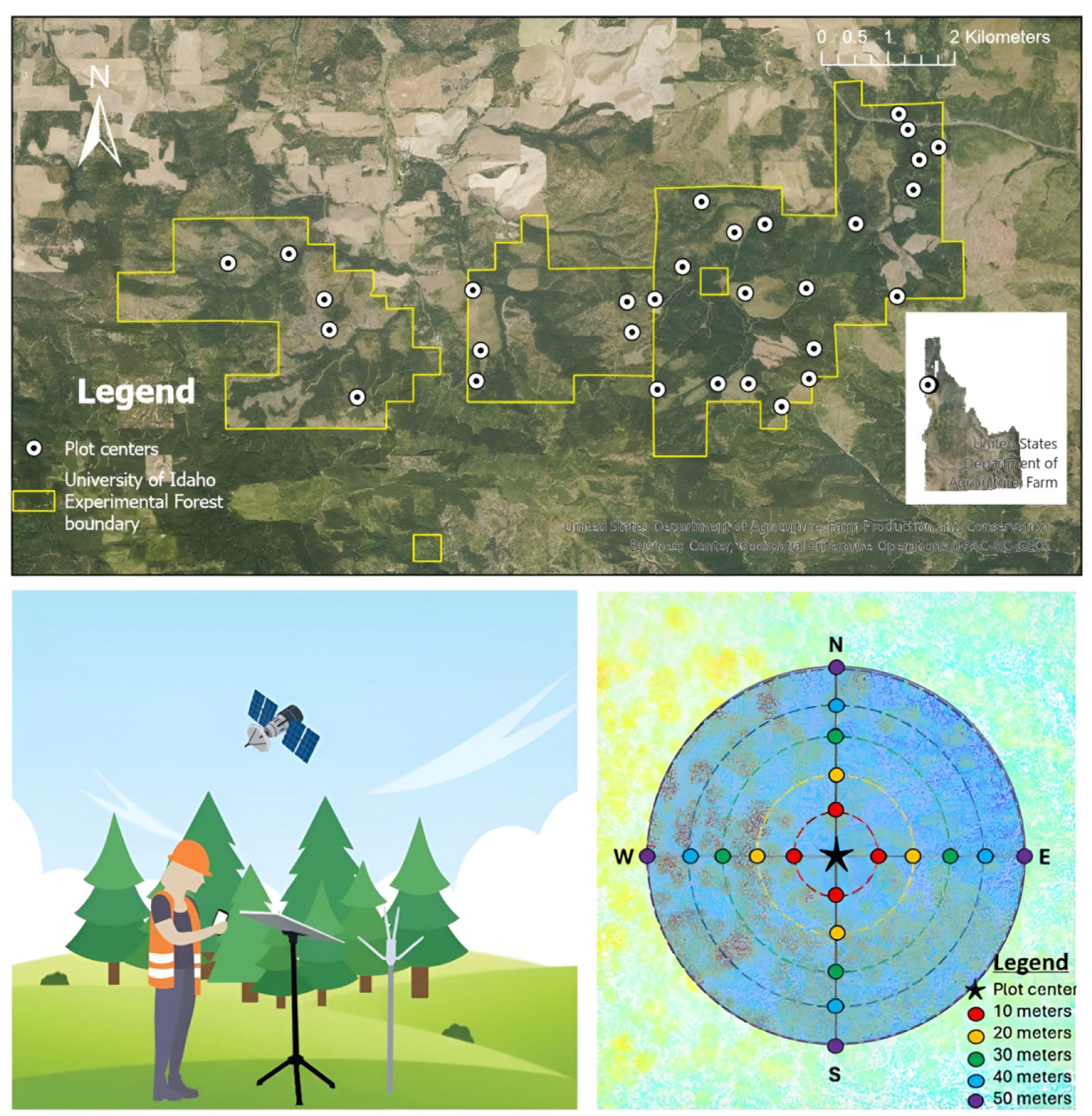
Thirty (30) plots were selected from a network of 154 previously established single tree inventory (STI) permanent plots on the UIEF using simple random sampling (
Figure 1). The STI permanent plot network was established in 2024 to advance development and evaluation of sensor network technologies to support digital transformation in forestry. The original plot locations were laid on a semi grid-like pattern and adjusted so that none were on the same longitude or latitude. To reduce potential effects of slope on LEO satellite connectivity and isolate forest vegetation effects, plots with slopes greater than 10% were excluded. Plots less than 60 m from a road were also excluded and replaced with new randomly selected plots. Each plot center is monumented with a 1.5 m metal conduit pipe secured in a concrete base. The plots have manual, terrestrial, and airborne lidar scans occurring annually.
A Wavlink WING 12M AC1200 Dual Band High-Power Outdoor Router/AP/Extender (Wavlink, Shenzhen, China) was used for the study. The Wavlink router was used instead of the standard Starlink router, because it is designed to withstand outdoor conditions and has a built-in lightning arrester. Because the Wavlink router is better suited for the outdoors, we put the Starlink router and power bank in “bypass mode”. Bypass mode is a configuration in which the Starlink router disables its routing functions and passes the public IP address directly to a second router, allowing the Wavlink router to handle all network management and device connections. The Wavlink router also has four omni-directional 7dBi antennas, eliminating Wi-Fi dead zones. A generation 3 standard Starlink satellite receiver dish (app version 2026.02.2) and roam unlimited plan were used for the study. The Starlink and router produce a 2.4 GHz and a 5 GHz network, but only the 5 GHz network was used in the study. This is because the dual band 5 GHz network has a maximum speed of up to 867 Mbps whereas the 2.4 GHz network has a maximum speed of 300 Mbps.
At the plot center, the router was fastened onto the top of the conduit pipe using a strap. The Starlink receiver dish was placed on a 5-ft tripod pole mount, adjacent to the plot center on the flattest ground. While the position of the tripod may vary slightly due to uneven forest floor, the dish was consistently oriented to magnetic north before sampling.
2.1.1. Connection Probability and Connection Time
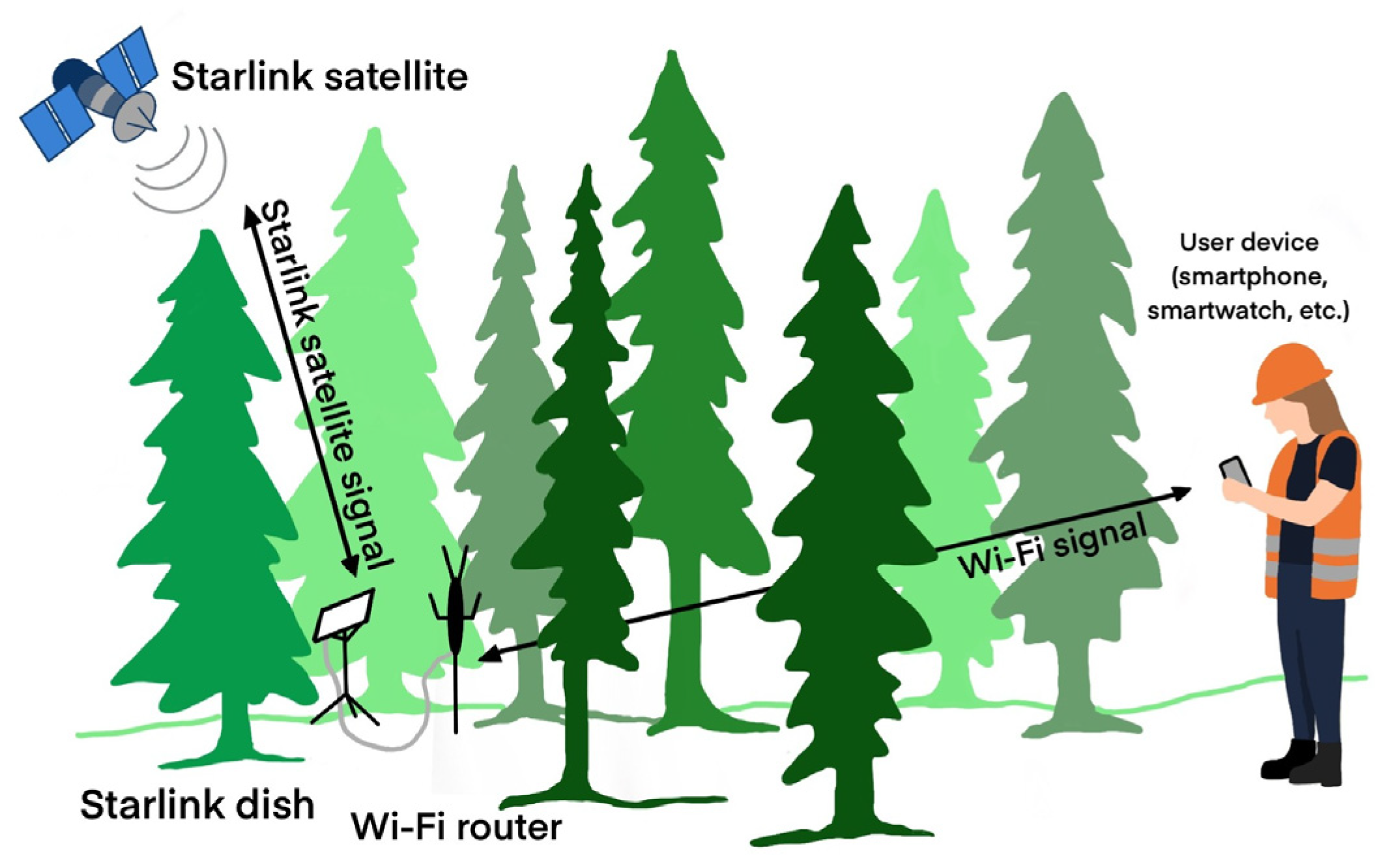
The Starlink dish and router were connected to a power bank. When the power bank was turned on, the researcher started a timer to determine connection time. The researcher recorded the amount of time it took for the Starlink receiver dish to connect to the LEO constellation, indicated by the lights on the router. Successful connection and Wi-Fi network establishment was indicated by all lights remaining illuminated on the router, and a speed test executed at the plot center. In this study, successful connection relied on both satellite acquisition and Wi-Fi signal transmission between a router and target device (
Figure 2). The researcher waited a maximum of 90 min for the Starlink to connect at each plot center location. If the Starlink did not connect in 90 min, the researchers moved to another plot. If the Starlink dish connected within 90 min but failed to produce a speed test, it was not considered connected.
2.1.2. Internet Speed
A 50 m tape was pulled from the plot center to magnetic north, then east, south, and west. A speed test was run at the plot center facing north, then at 10 m intervals (0–50 m). This was repeated in all four cardinal directions. In total, 21 speed tests were run after successful connection, with one speed test at the center and five tests run along each of the four transects (
Figure 1). Cellular LTE roaming was turned off, and all other applications on the phone were closed before running the test. Using an iPhone 14, the researcher recorded download and upload speeds (Mbps) with the Ookla speed test app, version 6.5.1. This speed app was chosen because it is a commonly used and accepted internet speed metric. If the speed test failed or produced an incomplete speed test, missing data were counted as NA values. Before speed tests were run, the researcher verified that the same test server was used consistently. A complete speed test consisted of a recorded upload speed and download speed. Speed tests at each distance were performed only after a successful connection at the plot center, and the researcher waited about 10 s between repeated tests to avoid back-to-back measurement artifacts. Obstructions were not flagged by the Starlink or Ookla speed test apps.
2.2. Data Processing
Stand density index (SDI), leaf area index (LAI), and rumple index (RI) for each 50 m plot were estimated using an individual tree segmentation algorithm, and predicted single tree attributes were derived from 2022 ALS lidar point clouds. SDI is a size-standardized measure of stand stocking that quantifies tree density relative to a reference tree size, typically 10-inch (25 cm) quadratic mean diameter, based on the self-thinning relationship between tree size and number of trees per unit area. Higher SDI values indicate denser stands. LAI is the ratio of one-sided leaf area to ground area beneath the canopy, representing canopy foliage density. Higher LAI values indicate greater leaf surface area and therefore denser canopy. RI is a measure of canopy structural complexity represented by the ratio of canopy surface area to the ground area it covers. Higher RI values indicate a more uneven or vertically heterogenous canopy.
A model was created in ArcGIS Pro to extract the point cloud content in a 50 m buffer surrounding each plot center. Individual tree segmentation and stand metrics were calculated in R 4.5.2 using functions in the lidR [
36], lidaRtRee [
37], terra [
38], and sf [
39,
40] packages. Using the watershed segmentation algorithm, canopy height models were created from the point clouds. Tree-level attributes were derived from the canopy height model using regional allometric equations relating tree height to diameter at breast height. Individual tree polygons identified from the canopy height model were assigned estimated heights, and diameter at breast height was predicted using height-to-diameter relationships. Stand-level metrics such as SDI, LAI, and RI were calculated by aggregating predicted single-tree attributes within each 50 m plot.
VC (%) was estimated with terrestrial lidar scans (TLS) recorded at the plot centers in 2024. TLSs were used for the cover metric because TLS data were collected below-canopy and generally captured understory vegetation in greater detail. VC 0.2 m to 5 m above the ground was quantified using the lidR package version 4.2.2 by calculating the proportion of returns within this height range relative to the total ground area of the plot. All data manipulation, visualization, and statistical analyses were conducted in R using the packages
dplyr [
41],
tidyr [
42],
forcats [
43],
ggplot2 [
44],
lme4 [
45],
lmerTest [
46],
logistf [
47],
kableExtra [
48], and
gridExtra [
49].
2.3. Modeling and Analysis
Data collected from the speed test evaluation included download speed (Mbps) and upload speed (Mbps), which were averaged for each distance interval and plot. Principal Component Analysis (PCA) and survival analysis were used to analyze whether stand conditions affected the probability of establishing a connection within 90 min and to evaluate which stand characteristics most influenced the likelihood of connectivity. Simple linear regression was used to examine the relationship between connection time and stand characteristics of SDI, LAI, RI, and VC. In addition to a full model containing all stand characteristics as predictors, single-predictor models using each stand characteristic individually were used to evaluate connection time. ANOVA was also used to validate the linear model results for connection time. Linear mixed-effects models were then used to evaluate the effects of distance, SDI, LAI, RI, and VC as fixed effects on upload and download speeds, with plot number included as a random effect, allowing both the intercept and the slope for distance to vary by plot to account for differences in baseline speeds and how speed changes with distance across plots. To assess spatial patterns, we compared and validated internet speed among the four cardinal transects (north, south, east, west) using a Kruskal–Wallis test. Variables were scaled for the linear mixed-effects models. Distance, SDI, LAI, RI, and VC were standardized (z-scored) prior to modeling effects of distance and directionality on network speed. For each variable, the mean was subtracted and the result divided by the standard deviation. This scaling allowed the fixed effect estimates from the linear mixed-effects model to represent the change in speed associated with a one standard deviation increase in predictor values. This allows for easier comparison of effect sizes across predictors with different units.
3. Results
3.1. Probability of Connection
To assess the relationship between canopy structure and connection probability, PC1 and PC2 were included as predictors in a Cox proportional hazards model. PC1 and PC2 are weighted combinations of all four canopy metrics (SDI, LAI, RI, VC); however, PC1 is primarily accounted for by SDI, LAI, and RI, whereas PC2 is primarily vegetation cover with much smaller contributions from the other three variables. The model results (
Table 1) indicate that only PC1 was a significant predictor of connection probability (coef = −0.577, SE = 0.203, exp(coef) = 0.561, 95% CI [0.377, 0.837],
p = 0.0045), while PC2 was not significant (coef = −0.459, SE = 0.297, exp(coef) = 0.632, 95% CI [0.353, 1.132],
p = 0.123). The negative coefficient for PC1 indicates that plots with higher values of PC1 experienced lower connection probability.
Only the first two principal components were included in the survival analysis, and among them, PC1 was the only significant predictor of connection probability. The loadings for PC1 indicate that a mixture of correlated canopy metrics (SDI, LAI, and RI) is the primary driver of canopy structure effects on LEO satellite connectivity, with vegetation cover contributing less. This analysis clarifies the relationship between forest structure and connection performance while reducing multicollinearity among canopy metrics.
3.2. Connection Time
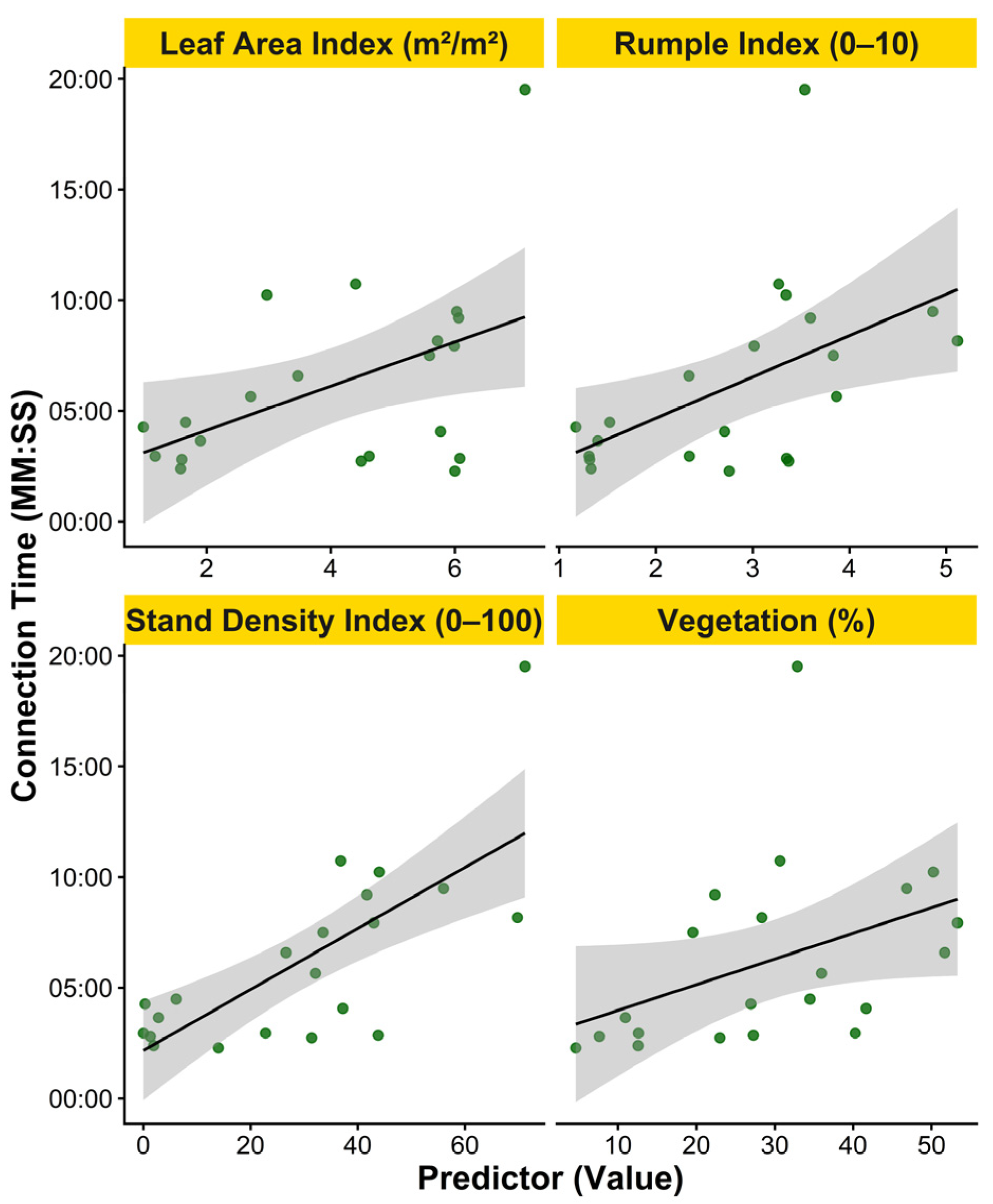
Linear regression analysis was performed to examine the relationship between connection time and stand characteristics SDI, LAI, RI, and VC. The full model explained significant variation in connection time (p < 0.001; F (4,17) = 10.22; adjusted R2; 0.5721; R2 = 0.6577). Among the predictors, SDI had a positive effect on connection time (p < 0.001). This corresponds to longer connection times in stands with higher density.
Results of the linear model for connection time were validated using an Analysis of Variance (ANOVA), where SDI was the only significant predictor (F (1,17) = 33.39,
p < 0.001). RI (F (1,17) = 3.95,
p = 0.063), LAI (F (1,17) = 2.56,
p = 0.128), and VC (F (1,17) = 0.52,
p = 0.480) did not significantly affect connection time (
Figure 3). Among the variables tested, SDI had the strongest influence on connection time. In single-predictor models, SDI explained 53.7% of the variance in connection time, while LAI, RI, and VC explained 23.3%, 27.6%, and 16.9%, respectively. For every 100-unit increase in SDI, connection time increased by 19.6 s, indicating slower connection in denser stands.
3.3. Internet Speed
Linear mixed-effects models were used to examine the influence of distance, LAI, SDI, RI, and VC on internet speeds. To evaluate whether allowing the effect of distance to vary among plots improved model fit, we compared models with a random intercept for plot to models that also included a random slope for distance using likelihood ratio tests. For both download and upload speeds, the random slope models provided a significantly better fit than random intercept-only models (download: χ2 = 148.6, df = 2, p < 2.2 × 10⁻¹⁶; upload: χ2 = 51.52, df = 2, p = 6.51 × 10⁻¹²). Accordingly, all final models included both random intercepts and random slopes for distance.
For the download speed linear mixed-effects model, distance had a strong negative effect (
p < 0.001), indicating that download speeds decreased with increasing distance from the plot center (
Table 2). Distance was standardized prior to modeling; one standard deviation in distance corresponds to approximately 14.2 m on the ground. All other predictors including LAI (
p = 0.591), SDI (
p = 0.258), RI (
p = 0.230), and VC (
p = 0.322) did not have an impact on download speed (
Table 2). For upload speed, distance also showed a significant effect (
p < 0.001), while the effects of LAI (
p = 0.182), SDI (
p = 0.263), RI (
p = 0.378), and VC (
p = 0.656) were not significant (
Table 2). These results indicate that, after accounting for variation among plots in both baseline speed and distance effects, distance was the primary driver of both upload and download speed, with other site characteristics having minimal influence.
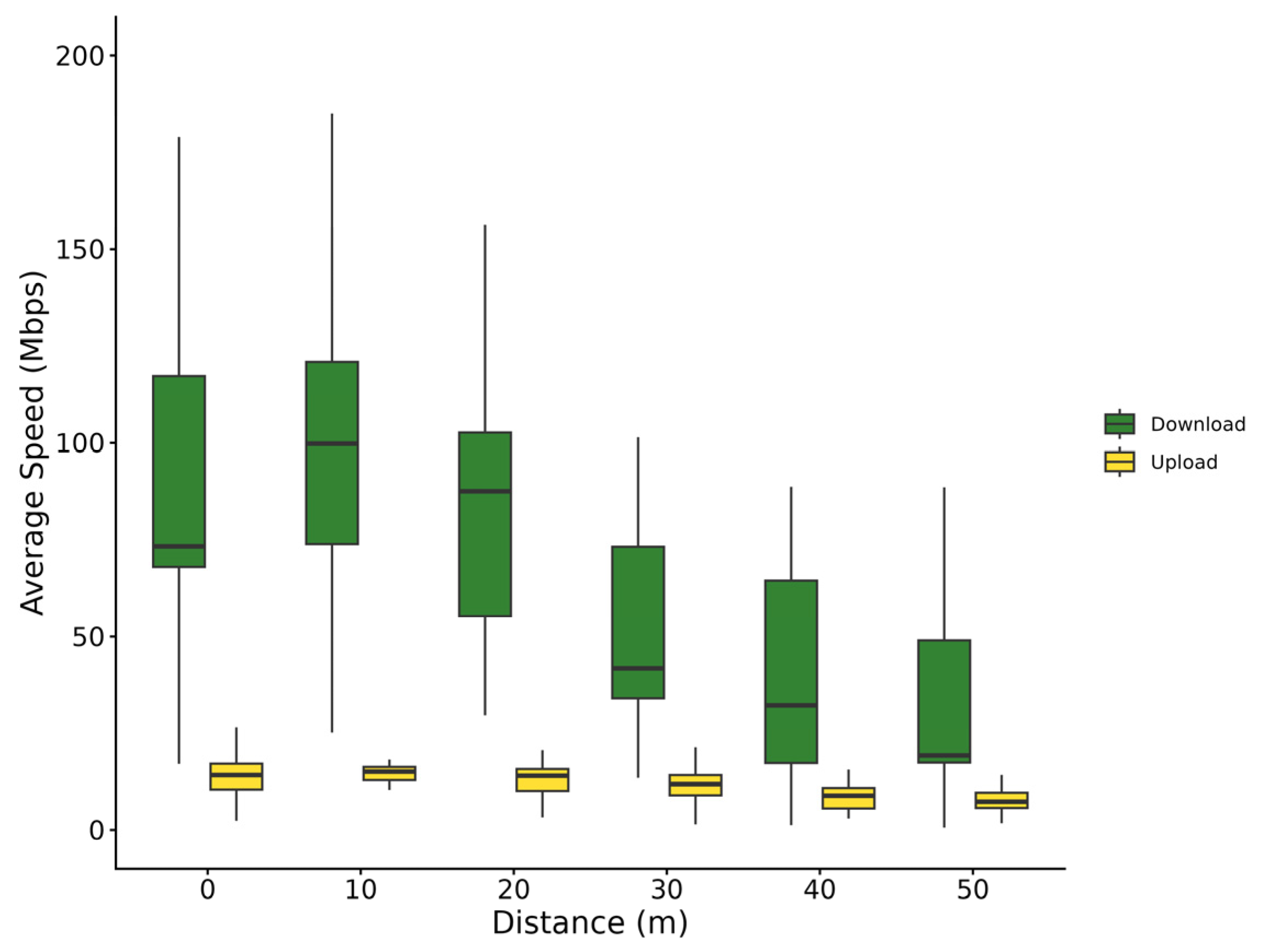
Download and upload speeds were stable at the plot center and declined with increasing distance. Internet speeds fell below 50% of the maximum observed at approximately 40 m from the plot center (
Figure 4). Average speeds declined beyond 40 m from the plot center, indicating a distance-dependent constraint on Wi-Fi strength, likely due to canopy obstruction. For each one-unit increase in scaled distance (14.2 m), the model predicted a decrease of approximately 29.6 Mbps in download speed and 3.5 Mbps in upload speed (
Table 2).
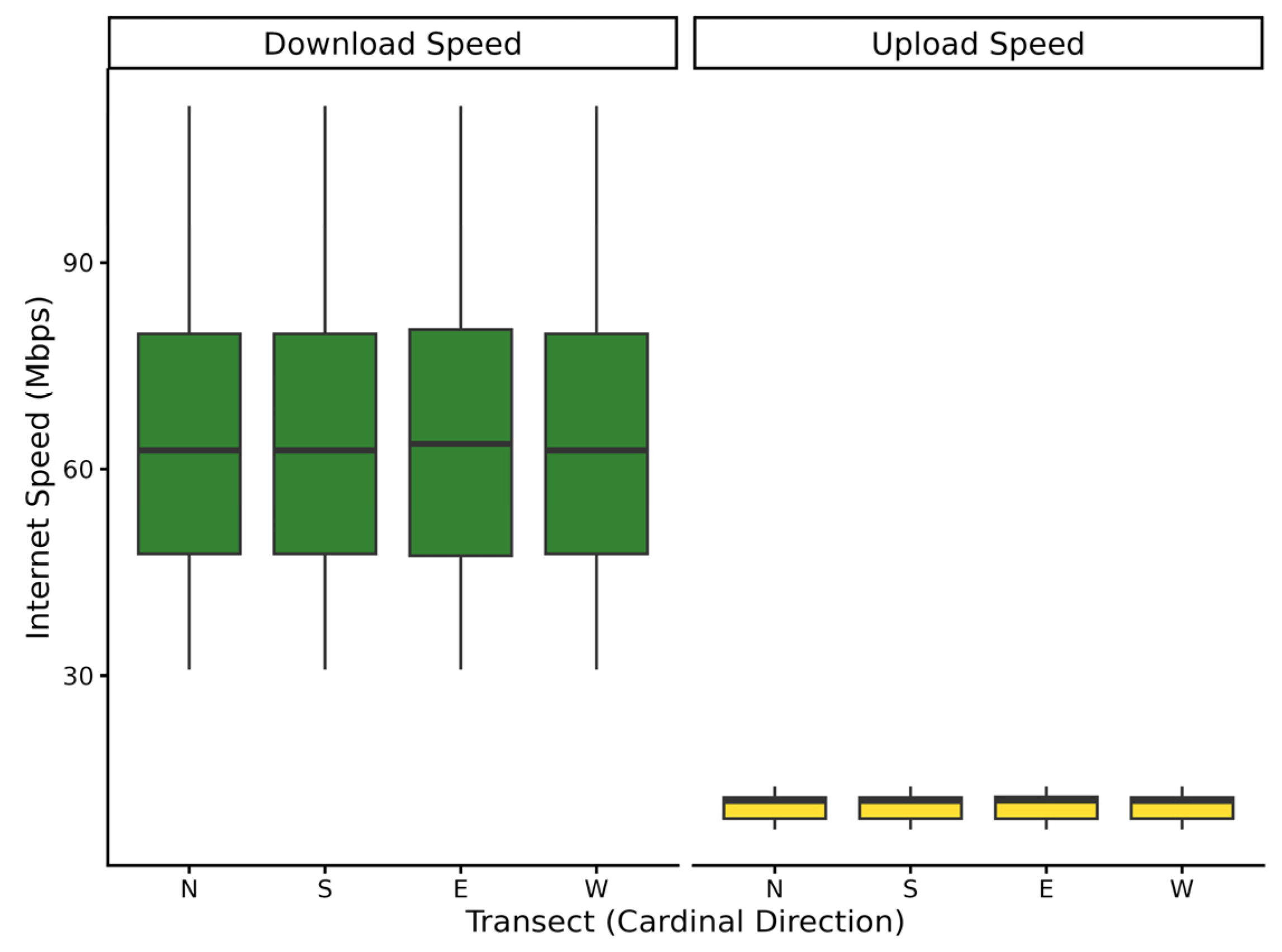
Average download and upload speeds were compared among cardinal directions (N, S, E, W). Median values for both upload and download speeds were consistent across directions. This was further supported with a Kruskal–Wallis rank sum test which found no statistically significant differences among directions for either download speed (χ
2 = 0.0041,
df = 3,
p = 0.999) or upload speed (χ
2 = 0.0041,
df = 3,
p = 0.999). Across all transects, upload speeds were consistently lower than download speeds, regardless of direction (
Figure 5).
4. Discussion
We hypothesized that both SDI and LAI would affect the probability of connection between the Starlink receiver dish and the satellite constellation as well as connection time. Our results showed that PC1 affected the probability of connection, although SDI was the only stand metric that affected connection time with denser stands reducing connection time or inhibiting connectivity. PC1 was driven primarily by a mixture of correlated canopy metrics (SDI, LAI, and RI), and to a lesser extent, VC. The highest SDI where successful connection occurred was 62.4, while the lowest SDI at which connection failed was 26.6. While this study included a relatively small sample of SDI values, this suggests these values may represent approximate descriptive bounds on connection time, at least with current Starlink hardware and similar conditions in mixed conifer forests in the Inland Northwest. It is important to note SDI was one of multiple predictors incorporated in PC1 in the PCA. Nevertheless, our findings are consistent with expectations that canopy could obscure satellite connectivity and Wi-Fi performance in dense forest vegetation, similar to effects observed with GNSS satellites in prior studies. It is unclear why LAI and RI, also measures of forest canopy density, did not impact connection time. This could be due to the fact that leafy vegetation tended to be either high or low altitude (e.g., tall trees or dense understory shrub layer) with similar LAI and RI. Whole trees or branches between the user device and the Wi-Fi router may interrupt the signal, whereas foliage is less likely to cause obstructions. It is also important to note that broadcasting Wi-Fi at different wavelengths such as 2.4 GHz vs. 5 GHz, could also impact horizontal connectivity.
Distance from the router affected LEO Wi-Fi internet speed, particularly beyond 40 m where speeds dropped below 50% of the maximum observed. This suggests that spatial constraints such as canopy gaps and physical obstructions between the user and the Wi-Fi router location play a critical role in Starlink Wi-Fi performance in forested environments. Cardinal direction did not impact internet speeds in this study.
Overall, our study results are consistent with those of prior GNSS and RF attenuation experiments, which have shown that increasing canopy structure, foliage density, and line-of-sight obstruction reduce signal quality and reliability. Those studies primarily emphasized generalized canopy cover and foliage density as influential metrics; our results extend this work by showing that SDI, LAI, RI, and VC, standard silvicultural metrics, provide practical proxies for canopy-induced attenuation in LEO satellite internet systems.
Ndzi et al. [
28] found that inhomogeneous density of vegetation introduces variations in signal strength from one position to the next. Because vegetation is uneven in some plots, as indicated by high rumple index, signal strength may change unpredictably as the signal passes through varying foliage density. This variability can make it harder for a model to fit the data cleanly, causing noise in the data.
Upload speeds were consistently slower than download speeds. This is as expected, as Starlink systems are designed to prioritize download traffic. Typical users consume more data than they transmit. Uplink connections require greater error correction, power, and timing precision. In the smart forestry systems of the future with many interconnected devices and machines, this characteristic of LEO satellite internet has important implications. The limitations on upload speed suggest that the sharing of big data collected on sensor-heavy forestry equipment, drones and other field devices will be highly constrained compared to downloaded information. While Starlink appears well-suited for supporting downstream access to previously collected lidar, other remotely sensed data, and information from mills, its slower upload speed may pose challenges for smart and digital forestry workflows seeking to transmit data with high throughput in real time. For example, remote equipment operation or equipment automation monitoring by remote staff may struggle to transmit 3D sensor data and multiple video feeds used for navigation.
An important consideration is that vegetation cover percentages derived from TLS could be limited due to the orientation of the TLS at the plot center and occlusion beyond tree stems. The TLS only scans as far as lidar returns can travel without obstruction. The shortest total scan distance observed was 34.02 m, and the longest scan distance was 46.70 m. Another important consideration is that our measurements were collected in a single forest type, with one hardware configuration and without controlling for weather or satellite visibility. Therefore, these results are site- and setup-specific. In this paper, we assumed that the Wi-Fi router coming online, as evident by both the router lights and a successful speed test, indicated successful satellite link establishment. We recognize it is possible that there may be an intermediate step between satellite acquisition and Wi-Fi being established that was not independently observed in this study.
Our results show that both distance and forest stand density index strongly influence the performance of LEO satellite-based internet in mixed conifer forests. While Starlink provides stable speeds at plot centers with lower SDI, operational use in dense forests should consider the observed decline in performance around approximately 40 m distance from the router and at higher SDI values. These findings provide a quantitative basis for integrating LEO satellite connectivity into smart forestry applications including real-time data sharing, interconnectivity between people and machines at the jobsite, and teleoperated and autonomous equipment use. Similarly to prior results with GNSS-RF systems for real-time location sharing, the utility of LEO satellite internet in smart and digital forestry may depend on which operational task is being completed. For example, skidding of logs or loading and processing in the landing may be processes that have excellent internet strength after the canopy has been removed in industrial operations. On the other hand, it may be difficult to have strong data networking for feller–buncher or harvester operations when these machines are working under a dense canopy. This is important, as the mechanized felling step is one of the most critical areas for linking AI-assisted operations with existing, previously mapped single tree inventory data that is now becoming common in operational forestry.
In one recent study, the use of LEO satellites under forested canopies was evaluated by mounting satellite receivers onto stationary and moving logging equipment. Stationary test results had a higher rate of disconnection than mobile tests [
50]. This could be due to a clearer view of the sky along the skid trail used in this study, since there were few trees and minimal canopy cover, as well as high antenna placement. The moving test results showed short offline intervals that highlight the potential of LEO satellite internet capabilities while mounted on mobile forest machinery.
Future studies at the University of Idaho Experimental Forest will evaluate Starlink satellite internet connectivity and speed mounted on heavy equipment working in a range of stand conditions. As of 2026, Starlink Wi-Fi is now being offered as an option in common heavy equipment (grapple skidders) available from at least one major forestry equipment manufacturer in the U.S. Realization of reliable internet connectivity in the woods is critical for leveraging these systems for semi-autonomous and fully autonomous equipment operations. Testing the capabilities of the Starlink satellite receiver was the first step in achieving this goal and also informs the use of LEO satellite networks for a variety of other smart forestry applications. Future studies should explore LEO satellite performance in different weather conditions and times of day and with different Wi-Fi router and repeater configurations. Comparing stationary and mobile measurements may further help to identify solutions for successfully establishing consistent internet under forest canopies.
This research is a key step helping to show the potential of LEO satellites, but also shows its limitations. Understanding the relationship between forest stand characteristics and LEO satellite network connectivity and performance is critical as we work to develop more connected, efficient and intelligent forest operations and management, embracing digital transformation and AI-supported smart forestry.
5. Conclusions
This study showed that LEO satellite internet performance in forested environments is influenced primarily by stand density index (SDI) and distance from the router. Rumple index (RI), leaf area index (LAI), and SDI (PC1) affected the probability of connection, and SDI affected connection time. Denser stands had slower or failed connections. Where connection did occur, internet speed declined beyond 40 m from the router, indicating a distance threshold for reliable Wi-Fi transmission under western mixed-conifer forests. LAI, RI, and vegetation cover (VC) did not affect connection time, suggesting that overall stand density rather than leaf area per unit ground area has a greater impact on signal obstruction. These findings provide quantitative evidence that forest structure reduces LEO satellite network performance. Understanding these limitations supports the future development of improved LEO satellite Wi-Fi networks for smart forestry applications below full or partial canopy. As LEO satellite technologies advance, improved connectivity could enable real-time data sharing and accelerate digital transformation in the forestry sector.