


Abstract
Military–civilian interface zones (MCIZs) adjacent to the Korean Demilitarized Zone (DMZ) represent complex wildfire environments shaped by restricted access, intensive military activities, and adjacent civilian land use. This study develops a spatially explicit wildfire ignition risk assessment framework for the DMZ and Civilian Control Zone (CCZ) in Paju, South Korea, employing Random Forest (RF), Generalized Additive Models (GAM), and Geographically Weighted Regression (GWR) in a complementary analytical design. A dataset of 318 wildfire ignition events (2001–2024), including 78 associated with military activities, was analyzed. The RF model achieved high predictive accuracy (AUC = 0.81), identifying proximity to military training zones, relative humidity, wind speed, and proximity to built infrastructure as dominant ignition drivers. GAM revealed narrow nonlinear thresholds—relative humidity at 13.8%–14.0% and wind speed at 13.5–14.0 m/s—corresponding to peak ignition probabilities. GWR demonstrated pronounced spatial heterogeneity, with military proximity exerting a stronger influence in the eastern and northern sectors, while the meteorological effects varied geographically. Based on these outputs, a unified analytical framework was established in which RF-derived ignition probabilities were interpreted alongside GAM- and GWR-based explanatory layers to provide spatially explicit ignition susceptibility assessments without numerical map fusion. The proposed approach provides a scientifically rigorous and operationally applicable method for quantifying ignition risk in politically sensitive, access-restricted landscapes, offering valuable insights for adaptive wildfire prevention and spatially informed governance of transboundary fire risk.
1. Introduction
Wildfires have increasingly emerged as a critical global threat, exacerbated by the intersection of climate change, Land use transformations, and the expansion of human activity into fire-prone landscapes [1,2]. While substantial advances have been made in wildfire modeling and mitigation, much of the research has focused on either densely populated wildland–urban interface (WUI) zones or remote forested regions [3,4]. Transitional areas such as military–civilian interface zones (MCIZs), however, remain substantially underexamined, despite their distinct geographies of risk, which are shaped by restricted access, concentrated military activity, and adjacent civilian development [5].
This research gap is particularly pronounced in Republic of Korea (“Korea”), especially within the western Demilitarized Zone (DMZ) and Civilian Control Zone (CCZ), where live-fire military exercises, agricultural residue burning, and climate-sensitive vegetation dynamics converge to elevate the wildfire ignition risk [6]. From 2001 to 2024, national fire statistics and data from the Fire Information for Resource Management System (FIRMS) indicate that over 95.65% of wildfires in these regions are attributed to anthropogenic ignition sources, with military activities (56.52%) and civilian open burning (20.29%) representing the primary causes [7,8]. Nevertheless, systematic spatial modeling of wildfire risk and rigorous evaluation of mitigations remain limited for these sensitive zones [9].
Recent advancements in data science and spatial analysis, including machine learning, spatial regression, and geospatial modeling, provide promising avenues to capture the multidimensional and spatially heterogeneous nature of wildfire ignition risk [10,11,12]. Random Forest (RF) models have demonstrated strong performance in ignition risk prediction and variable selection [13], Generalized Additive Models (GAM) facilitate robust exploration of nonlinear thresholds and ignition probabilities [14], and Geographically Weighted Regression (GWR) enables the assessment of spatial heterogeneity across complex landscapes [15]. A growing body of literature has combined machine learning with spatial regression or geographically weighted models to enhance predictive accuracy and spatial realism [16,17,18]; however, such hybrid approaches often conflate prediction, interpretation, and spatial heterogeneity within a single modeling step, limiting transparency and interpretability [19,20]. In contrast, the present study adopts a modular RF–GAM–GWR framework, in which each method serves a distinct analytical role: RF is used for probabilistic prediction and variable importance ranking, GAM for elucidating nonlinear relationships and threshold effects, and GWR for capturing spatial heterogeneity in predictor influence. This explicit separation enables both robust ignition probability mapping and transparent interpretation, particularly in complex and access-restricted MCIZs.
To address these gaps, this study proposes a spatially explicit wildfire ignition risk assessment framework that is specifically tailored to MCIZs. By employing RF, GAM, and GWR in a complementary analytical framework, the study systematically identifies key climatic, topographic, anthropogenic, and military drivers of ignition, quantifies their nonlinear thresholds, and examines their spatial heterogeneity across the DMZ–CCZ landscape. The resulting workflow enables probabilistic ignition mapping to be interpreted alongside threshold diagnostics and spatially varying coefficient analysis without numerically combining model outputs into a single composite surface. The research is guided by three key questions: (1) which factors exert the strongest influence on wildfire ignition in MCIZs; (2) under what threshold conditions does ignition risk sharply increase; and (3) how do these effects vary geographically, revealing spatial patterns of ignition vulnerability.
2. Study Area
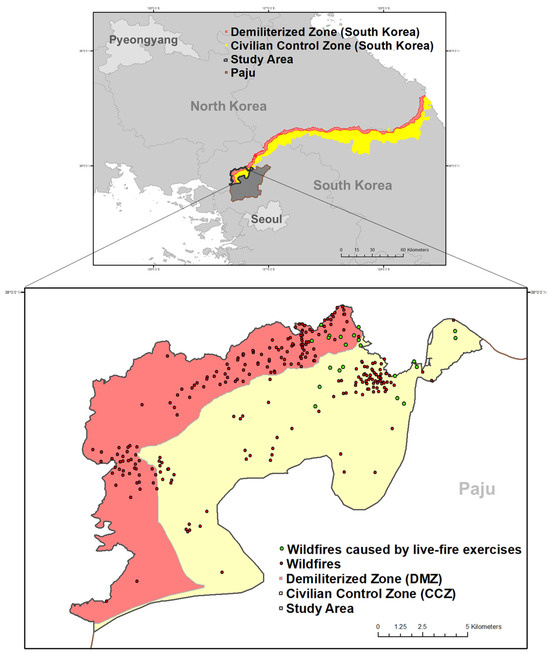
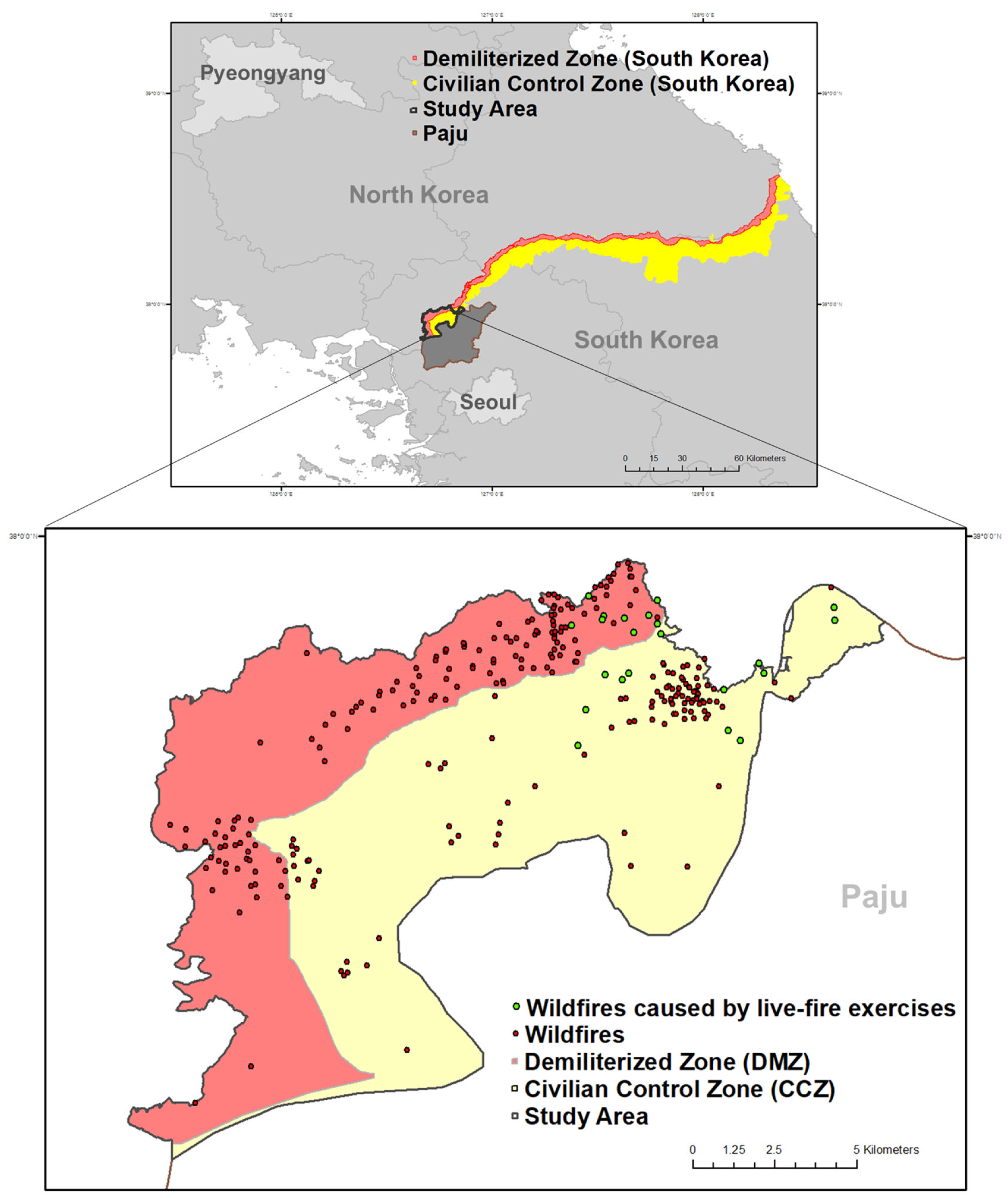
The present study focuses on the northern region of Paju City, Korea, which is characterized by its direct proximity to the DMZ and the CCZ (Figure 1). This locale constitutes a complex socio-ecological frontier, where zones of military activity—including installations, live-fire training grounds, and restricted buffer strips—converge with areas dedicated to civilian settlements, agriculture, and transportation infrastructure. Following the Korean Armistice Agreement of 1953, the DMZ has remained under stringent military supervision with civilian access strictly prohibited, while the adjacent CCZ has permitted limited agricultural activity and residential development, resulting in divergent land use practices across relatively short distances [21]. Although Figure 1 illustrates the spatial distribution of all recorded wildfire and non-fire locations in the study area, the modeling dataset was constructed using a balanced sampling strategy, as described in Section 3.1.
Figure 1.
Location of the study area and spatial distribution of wildfires (2001–2024).
The western sector of Paju’s CCZ, contiguous with the DMZ, exemplifies the dynamic interface between the military infrastructure and rural livelihoods. The land use mosaic in this sector includes ginseng cultivation, traditional irrigation ponds (dumbeong), and critical habitats for migratory bird species along the Imjingang River [9]. Recent ecological assessments have documented that, within the DMZ, historical coniferous forests damaged during the Korean War have gradually transitioned to mature deciduous woodlands due to uninterrupted natural succession processes. In contrast, significant portions of the CCZ have been converted into agricultural or infrastructural developments due to ongoing human intervention [6]. As a consequence, the DMZ is predominantly covered by deciduous forest stands with continuous litter and woody fuels, whereas the CCZ is dominated by croplands, herbaceous vegetation, shrublands, and forest edges that generate fine, discontinuous, and highly ignitable fuels [7].
From 2001 to 2024, a comprehensive geospatial analysis identified 318 wildfire ignition points within the study area. Of these, 78 incidents were directly attributed to military live-fire exercises, according to data compiled from the Korea Forest Service and the NASA FIRMS archives [7,8]. The high frequency and spatial clustering of these military-origin ignitions within both the DMZ and CCZ underscore the heightened risk of transboundary wildfires in heavily militarized border zones [9].
Demographic trends throughout the 2020s reveal rapid population growth in Paju, fueled by expansion from the Seoul metropolitan fringe and government-driven regional development initiatives [5]. This urbanization has intensified the exposure of communities situated along the wildland–urban interface to wildfire hazards. Against this backdrop, the study area offers a salient case for examining wildfire risk in the context of intersecting military and civilian land uses, within a region that is simultaneously politically sensitive and ecologically significant [22].
3. Methods
3.1. Study Framework
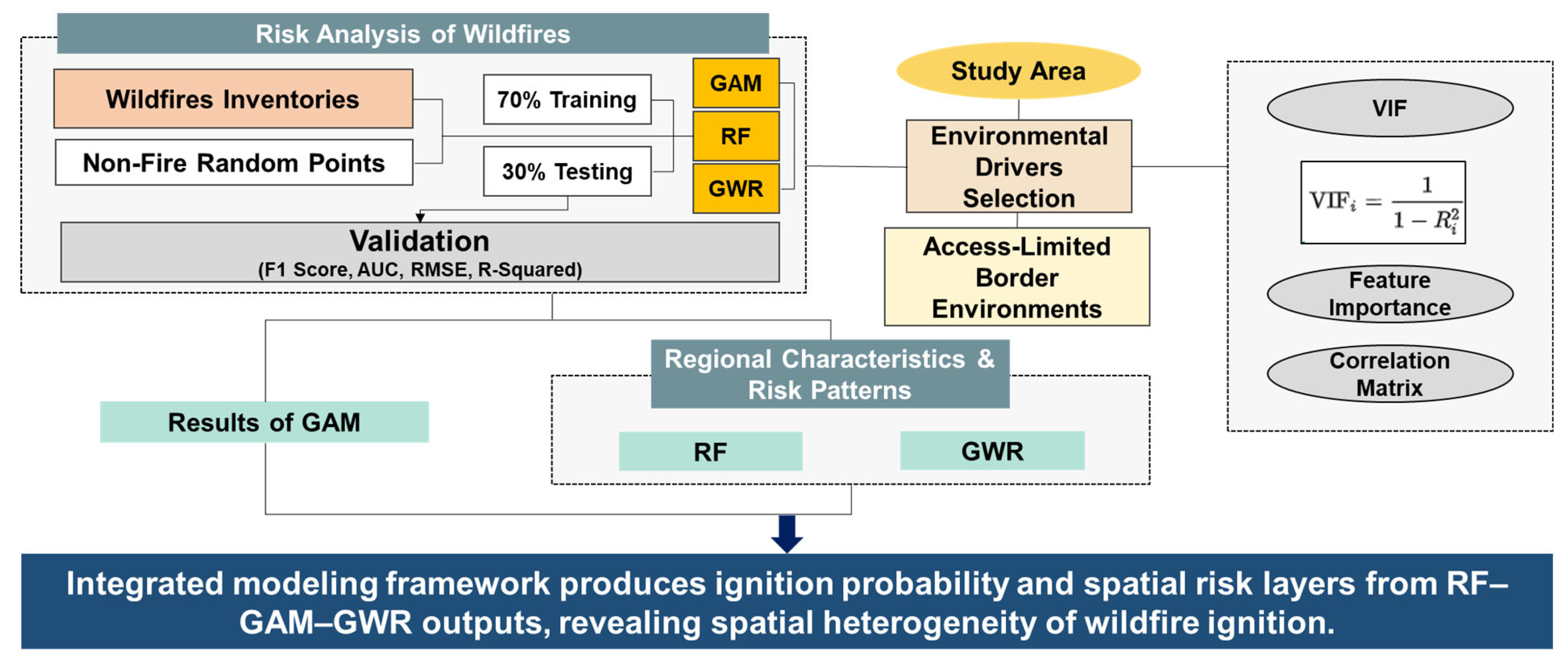
This study introduces a spatially explicit framework for wildfire ignition risk assessment, specifically designed for MCIZs situated in restricted border areas. The framework employs advanced machine learning and spatial regression approaches in a complementary manner to examine the interplay among climatic, topographic, anthropogenic, and institutional determinants of wildfire ignition in politically and ecologically sensitive contexts (see Figure 2). Although the present analysis focuses on ignition risk under critical fire-weather conditions, the framework is inherently dynamic, allowing for ignition probabilities to be recalculated by updating key climatic inputs, thereby supporting inter-seasonal or scenario-based fire danger assessments without modification of the underlying model structure.
Figure 2.
Schematic overview of the study framework. RF provides the ignition probability surface, whereas GAM and GWR provide interpretative layers used for diagnosis and explanation, rather than for map fusion.
Wildfire occurrence and its underlying drivers were modeled using three complementary analytical techniques. First, the RF model was trained as a binary classifier, using wildfire presence–absence data to learn nonlinear relationships between ignition occurrence and environmental predictors. Because wildfire ignition events are rare, relative to non-fire conditions, the original dataset exhibited a strong class imbalance; therefore, non-fire (absence) samples were randomly generated and selected at a fixed ratio, relative to wildfire ignition points, to ensure balanced class representation during model training. The fitted RF model produces class membership probabilities, which were interpreted as ignition probabilities, and the balanced dataset was subsequently split into training and testing subsets using a 70:30 ratio. After training and validation, the RF classifier was applied to spatially continuous predictor layers to generate wall-to-wall ignition probability maps across the study area. Second, the GAM was applied to investigate nonlinear relationships and threshold effects among key covariates such as relative humidity, wind speed, and vegetation indices. Third, the GWR approach was used to assess spatial heterogeneity in predictor influence, enabling localized interpretation of ignition drivers across the DMZ–CCZ landscape. Variable selection was guided by Variance Inflation Factor (VIF) diagnostics, correlation matrices, and RF-derived feature importance metrics to ensure statistical rigor and model parsimony. RF, GAM, and GWR are employed within a common analytical framework; however, their outputs are not mathematically combined into a single composite susceptibility index. RF serves as the sole probabilistic prediction model for generating ignition probability maps, whereas GAM and GWR are applied independently to interpret nonlinear thresholds and spatial heterogeneity, respectively. Accordingly, the three modeling components operate in parallel and provide complementary insights, rather than being fused into a numerically synthesized surface.
Key outputs of the framework include RF-based wildfire ignition probability maps and complementary spatial diagnostic layers derived from GAM and GWR analyses. Together, these outputs provide high-resolution, spatially differentiated insights into ignition dynamics and support data-driven wildfire risk assessment and spatial decision-making in sensitive borderland environments. Spatial analysis and map visualization were conducted using ArcGIS 10.4.1.
3.2. Variable Selection and Screening
To assess the wildfire ignition risk in the DMZ-adjacent landscape of Paju, 11 key environmental drivers were selected, based on theoretical relevance, regional context, and data availability (Figure A1; Table 1). The variables were grouped into four categories—climatic, topographic, land use/vegetation, and anthropogenic (civilian and military)—to represent both biophysical and human-induced ignition controls.
All predictors were harmonized to a common 10 m × 10 m spatial resolution and aligned with the wildfire inventory period (2001–2024). Although source datasets differed in native resolution, resampling ensured spatial consistency while preserving the fine-scale heterogeneity that is typical of MCIZs. Predictor variables were treated according to temporal characteristics: meteorological variables (minimum relative humidity, maximum wind speed) and EVI were modeled as time-varying covariates, whereas land use, topography, and proximity-based anthropogenic and military variables were treated as quasi-static, due to the relative structural stability of infrastructure and terrain in the DMZ–CCZ region.
Climatic controls were represented by minimum relative humidity (RH) and maximum wind speed (WS), selected as parsimonious and physically interpretable proxies of fine-fuel moisture and ignition sensitivity. These variables are widely recognized as principal determinants of wildfire activity in fire-prone landscapes [23,24], and historical evidence from the DMZ indicates that low humidity combined with episodic gusts has repeatedly triggered rapidly spreading fires, particularly when interacting with military ordnance [25]. Other climatic variables (e.g., temperature, precipitation, radiation) were excluded due to strong collinearity with RH and limited additional explanatory value at the temporal resolution considered. Missing values and outliers were addressed through standardized preprocessing. Implausible meteorological records were removed, and short gaps were linearly interpolated. Remote sensing-derived covariates (e.g., EVI and LULC) were quality-filtered using cloud masks and percentile-based screening to remove extreme artifacts prior to model implementation.
Topographic variables—including elevation, slope degree, slope aspect, and the topographic wetness index (TWI)—were derived from the SRTM 1 Arc-Second DEM dataset to represent terrain-mediated controls on solar exposure, moisture redistribution, and fire behavior [14,26,27].
Land use patterns were obtained from Sentinel-2 imagery acquired in 2024, and vegetation structure was characterized using Landsat 8–derived EVI covering 2001–2024, selected over NDVI due to reduced saturation and improved canopy sensitivity. EVI served as a proxy for fuel continuity and vegetation density across heterogeneous landscapes, enabling differentiation between sparsely vegetated surfaces, intermediate fuel-dominated mosaics, and dense forest canopies.
Anthropogenic predictors included distance to roads, buildings, and live-fire military training zones, derived from national infrastructure datasets and Korea Forest Service geospatial layers. Proximity to civilian infrastructure has been associated with ignition sources such as agricultural burning and recreational activities [28,29], while military training areas have been documented as major ignition drivers in the study region, accounting for approximately 24.5% of wildfire incidents (78 of 318 events) [6,10,30].
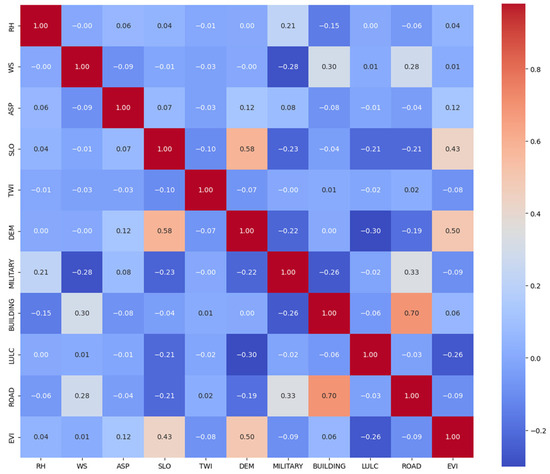
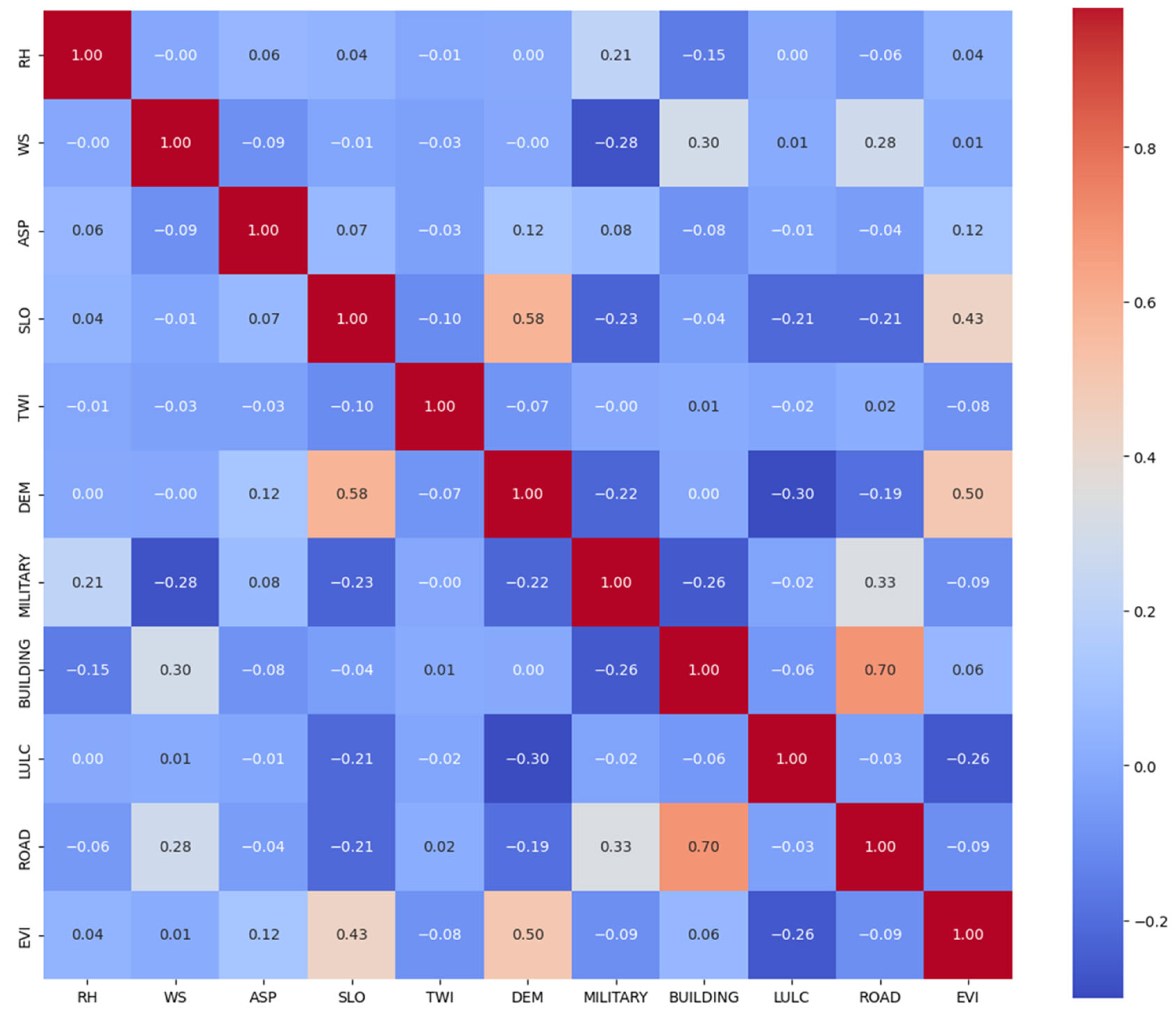
To mitigate multicollinearity, all predictors underwent Variance Inflation Factor (VIF) and Pearson correlation screening (Figure 3; Table 2). Variables with VIF < 5 were retained, and no severe interdependencies were observed (maximum r = 0.60), supporting statistical validity and model parsimony.
Figure 3.
Final set of 11 variables selected for wildfire risk modeling. (RH: min. relative humidity; WS: max. wind speed, ASP: slope aspect, SLO: slope degree, TWI: topographic wetness index, DEM: digital elevation model, Military: distance to live-fire exercises, BUILDING: distance to building infrastructure, LULC: land use and land cover, ROAD: distance to road, and EVI: enhanced vegetation index).
Table 1.
Selected list of environmental drivers, data sources, period, and references used for fire risk modeling.
Table 2.
Results of VIF analysis for 11 targeted variables.
3.3. Modeling Approaches
To characterize wildfire ignition risk in the DMZ-adjacent region of Paju, a multi-model analytical framework was implemented, combining GAM, RF, and GWR to capture nonlinear responses, predictive interactions, and spatial heterogeneity, respectively. Each method addresses a distinct dimension of ignition dynamics within a militarized and access-restricted landscape.
The GAM provides a semi-parametric regression framework for modeling nonlinear associations between wildfire occurrence and predictor variables. Smooth functions were fitted using penalized thin-plate regression splines to detect ecological thresholds and non-monotonic responses [40,41]. The basis dimension of each smooth term was specified to balance flexibility and overfitting, and smoothing parameters were estimated using generalized cross-validation (GCV). In this study, GAM was used to identify ignition-relevant nonlinear thresholds for key drivers such as relative humidity, wind speed, vegetation condition, and military proximity.
The GWR approach accounts for spatial non-stationarity by allowing for regression coefficients to vary locally [42,43]. An adaptive kernel was employed to accommodate spatially uneven data density, with bandwidth optimized using the corrected Akaike Information Criterion (AICc). This configuration enabled spatially explicit estimation of local parameter effects across the DMZ–CCZ landscape, revealing geographically varying ignition patterns.
The RF algorithm is an ensemble-based classifier that aggregates decision trees built on bootstrapped samples [14]. Its robustness to multicollinearity, noisy inputs, and class imbalance makes it well-suited for rare-event ignition modeling. The RF model was implemented with 500 trees to ensure stable probability estimates, with the number of variables considered at each split (mtry) tuned using out-of-bag (OOB) error minimization. The tree depth was unconstrained to capture higher-order interactions. To strengthen robustness beyond a single random split, a stratified fivefold cross-validation was additionally applied, with performance evaluated using ROC-AUC and PR-AUC metrics derived from out-of-fold predictions. Ignition probability was obtained directly from the ensemble voting structure, as the proportion of trees predicting wildfire occurrence.
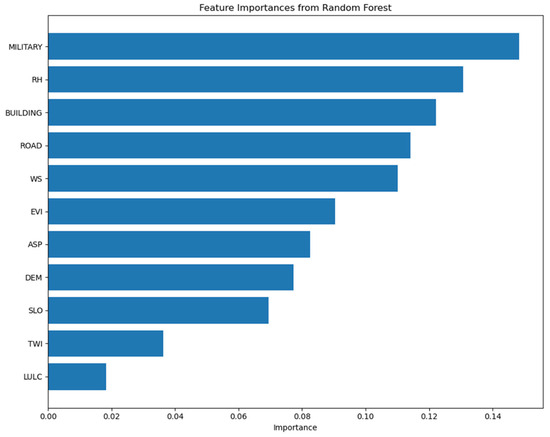
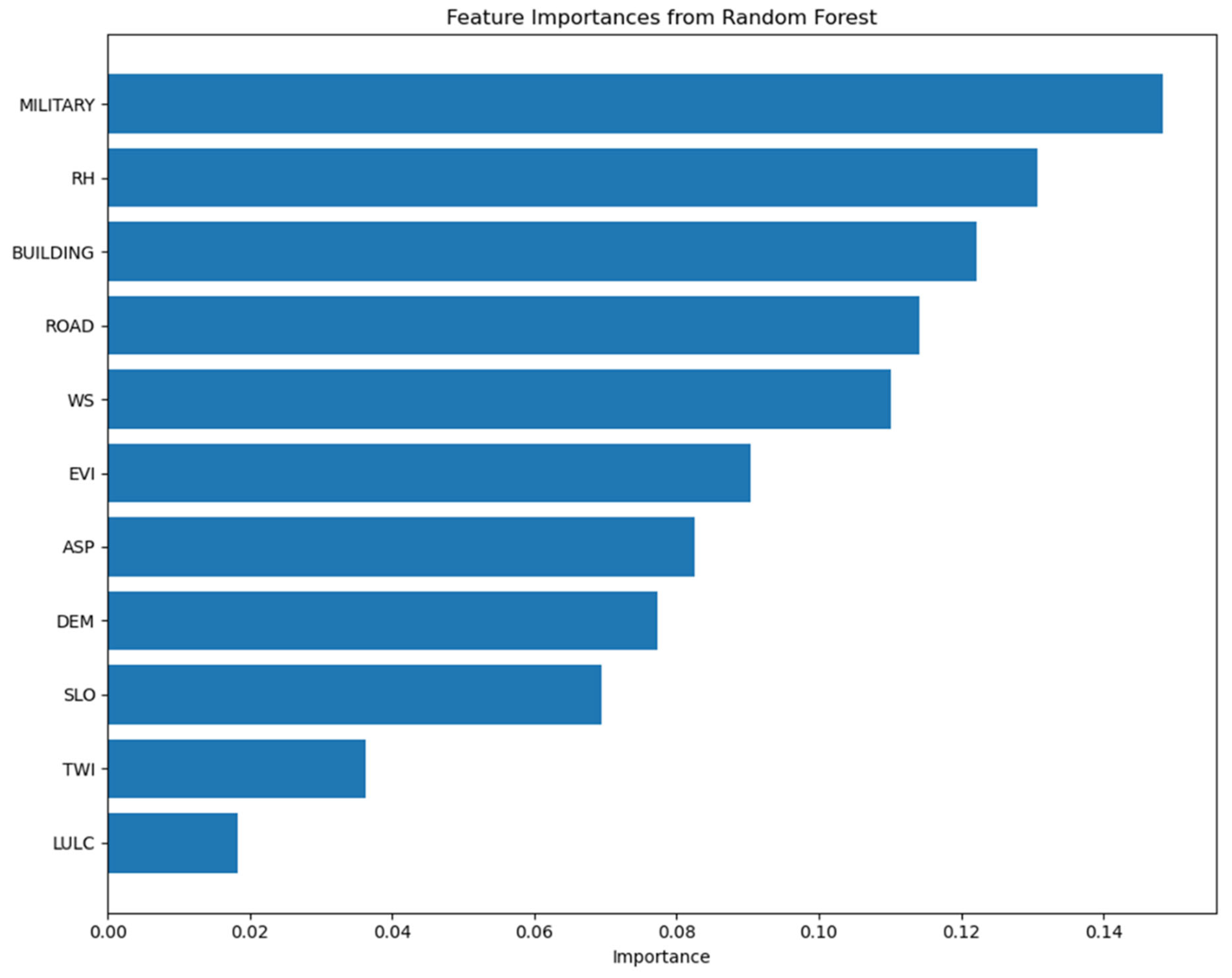
While GAM and GWR provide interpretative insights into nonlinear thresholds and spatial heterogeneity [36,42], RF serves as the primary probabilistic prediction model for ignition probability mapping. RF-derived feature importance results (Figure 4) identified proximity to military live-fire zones, relative humidity, and distance to built-up areas as being among the most influential predictors.
Figure 4.
Gini feature importance ranked by mean AUC drop. (RH: min. relative humidity; WS: max. wind speed, ASP: slope aspect, SLO: slope degree, TWI: topographic wetness index, DEM: digital elevation model, MILITARY: distance to live-fire exercises, BUILDING: distance to building infrastructure, LULC: land use and land cover, ROAD: distance to road, and EVI: enhanced vegetation index).
All models were trained on the pre-screened variables described in Section 3.2. Model performance was evaluated using F1-score, area under the ROC curve (AUC), and root mean squared error (RMSE), consistent with the established wildfire risk modeling practices [24,39].
4. Results
4.1. Model Validation and Performance Assessment
Model performance was evaluated using a 70:30 training–testing split to ensure independent validation of the predictive accuracy. The predictive performance of the RF, GAM, and GWR approaches was assessed using a comprehensive set of classification and regression metrics (Table 3), including the overall accuracy, AUC, and RMSE, as well as class-specific precision, recall, and F1-score statistics.
Table 3.
RF, GAM and GWR model performance metrics for wildfire occurrence prediction.
Both RF and GWR models achieved the highest overall accuracy (0.86), while GAM registered a value of 0.82. RF and GWR also shared the highest AUC values (0.91), indicating strong discriminatory power between wildfire and non-wildfire events, whereas GAM yielded an AUC of 0.86. Class-specific performance for wildfire occurrence (Class 1) showed the highest F1-score for RF (0.67), followed by GWR (0.57) and GAM (0.44). Predictions for the non-fire class (Class 0) were robust across all models, with F1-scores exceeding 0.90 and the highest value achieved by GWR (0.92).
To further examine the robustness of RF performance beyond a single data split, a k-fold cross-validation analysis was conducted (Table A2). ROC-AUC values across individual folds ranged from 0.77 to 0.84, with an overall out-of-fold ROC-AUC of 0.81, confirming stable discriminatory capacity across repeated partitions. PR-AUC values were low, reflecting the extreme class imbalance (fire occurrence rate ≈ 0.1%), but remained within the expected range for rare-event prediction. These results indicate that the reported RF performance is not driven by a favorable partition and can be interpreted as an upper-bound yet stable estimate of model discrimination.
These validation results indicate that all three modeling approaches performed satisfactorily, with RF and GWR exhibiting consistently strong performance across both classification- and regression-based evaluation metrics.
4.2. Nonlinear Effects of Environmental Drivers
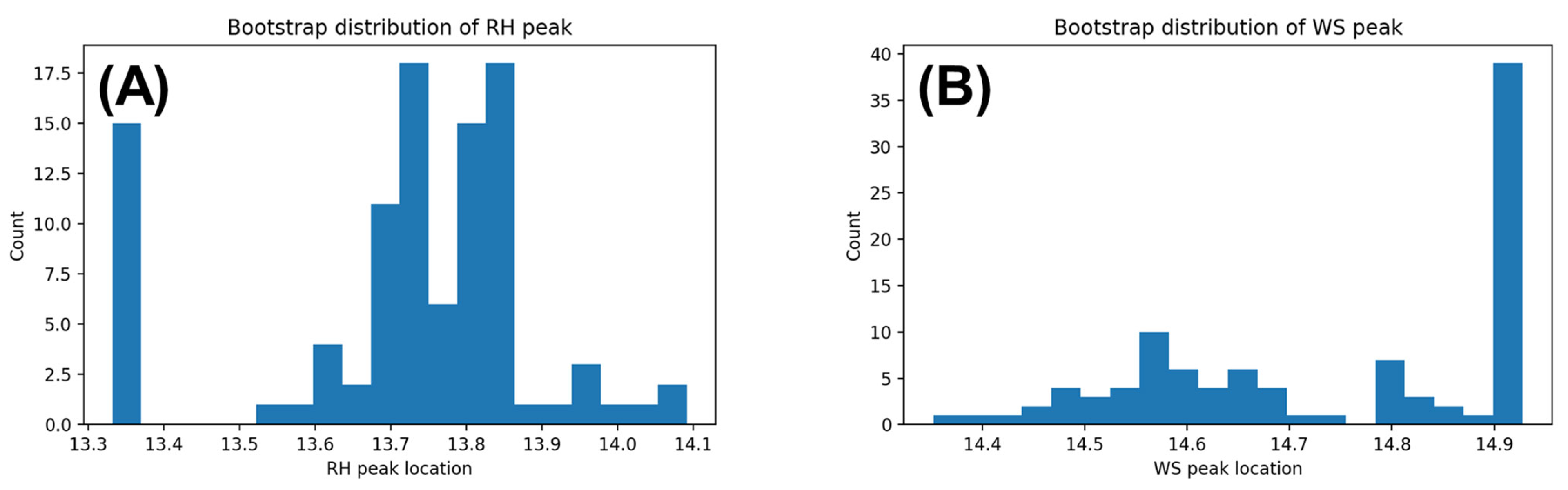
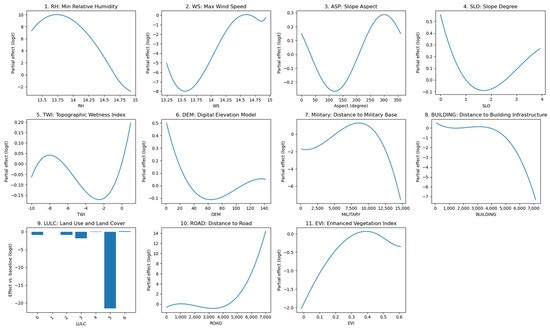
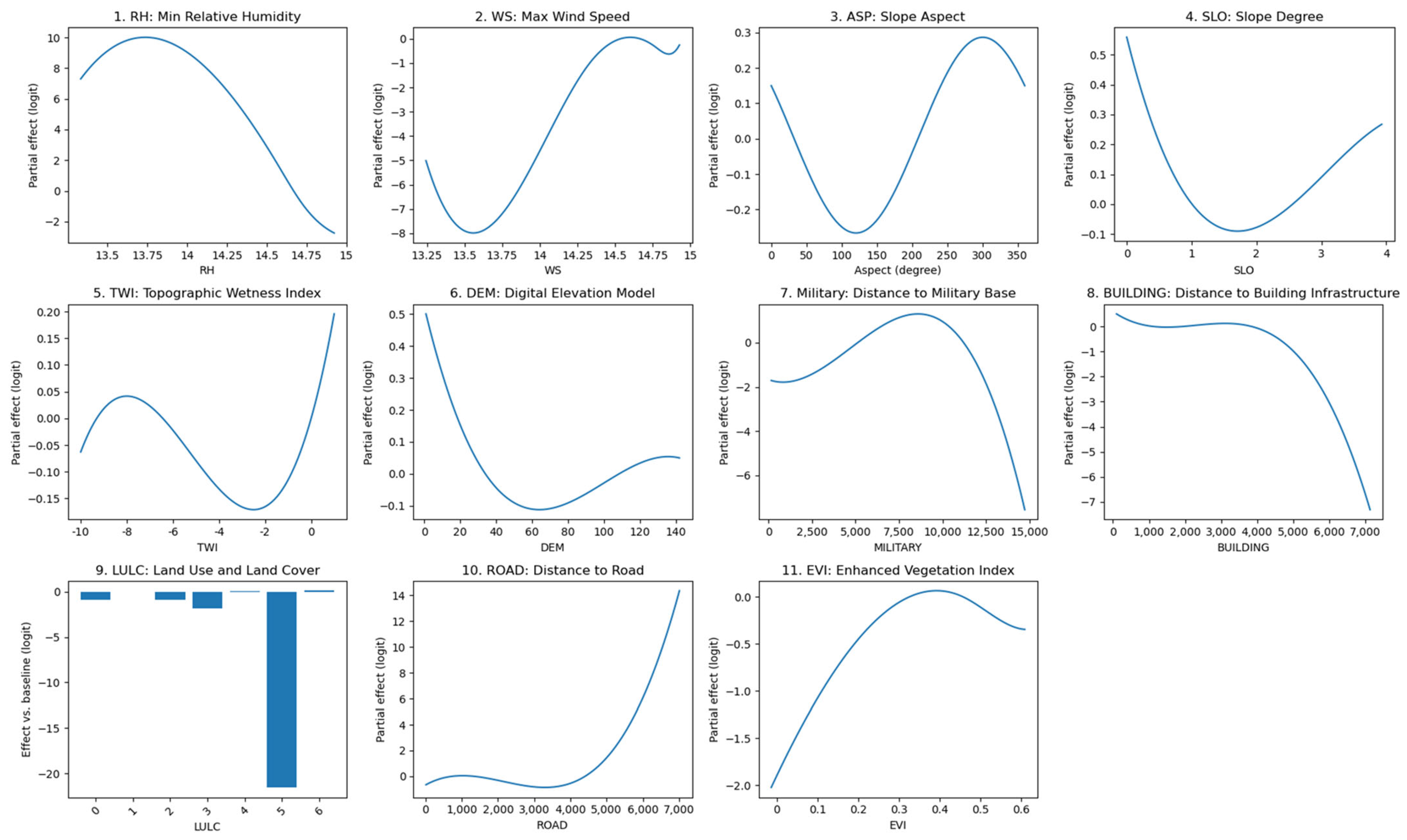
The GAM identified minimum relative humidity (RH) and maximum wind speed (WS) as the most influential predictors of wildfire occurrence (p < 0.05), with both variables displaying statistically significant nonlinear effects (Figure 5). The partial dependence plot for RH exhibited a bell-shaped relationship, with the peak modeled fire probability between approximately 13.8% and 14.0%. This threshold corresponds to critically dry atmospheric conditions under which fine fuels rapidly lose moisture, thereby substantially increasing the ignition likelihood, particularly during the spring fire season. A bootstrap resampling analysis further confirmed the stability of this RH threshold, with peak locations consistently clustered within a narrow range of approximately 13.7%–13.9% across repeated model refits (Appendix A, Table A3; Figure A2).
Figure 5.
Partial dependence plots of selected environmental drivers affecting wildfire occurrence, as estimated by GAM. (RH: min. relative humidity; WS: max. wind speed, ASP: slope aspect, SLO: slope degree, TWI: topographic wetness index, DEM: digital elevation model, Military: distance to live-fire exercises, BUILDING: distance to building infrastructure, LULC: land use and land cover, ROAD: distance to road, and EVI: enhanced vegetation index).
WS demonstrated a non-monotonic association, with wildfire probability increasing up to around 13.5–14.0 m/s before decreasing at higher values. The bootstrap results indicated a similarly concentrated distribution of WS peak locations, predominantly within the 14.5–14.9 m s−1 range, suggesting that the identified wind-speed threshold represents a robust feature of the modeled ignition response, rather than a model-specific artifact. The slope aspect (ASP) showed modest variation, with amplified fire probabilities on west- to northwest-facing slopes, while the slope degree (SLO) displayed a U-shaped relationship, with elevated probabilities at both low (<5°) and steep (>30°) gradients. The TWI exhibited a double-peak pattern, with increased probabilities in both low-TWI (approximately –8) and high-TWI areas (above –2), and reduced probabilities in the intermediate range. Elevation (DEM) indicated a higher fire probability in low-lying terrain (<100 m), with a secondary increase above approximately 1000 m.
Among anthropogenic proximity variables, distance to military live-fire exercises (MILITARY) followed an inverted-U pattern, peaking at intermediate distances of approximately 7–8 km and decreasing at shorter and longer distances. Distance to buildings (BUILDING) showed elevated probabilities within 0–2 km, declining steadily with increasing distance, while distance to roads (ROAD) exhibited a generally increasing trend, with a marked rise beyond 6 km. Among the environmental variables, LULC was highly significant (p < 0.001), with greater wildfire probabilities associated with rangeland, bare ground, and cropland, and lower probabilities for water bodies and flooded vegetation. EVI exhibited a clear nonlinear relationship with wildfire probability, reaching a maximum at intermediate values (approximately 0.3–0.4). These intermediate EVI values correspond to landscapes dominated by grasslands, shrublands, forest edges, and mixed agricultural–forest mosaics, which are characterized by discontinuous but highly ignitable fine fuel structures. In contrast, lower EVI values (<0.2) represent sparsely vegetated or non-fuel surfaces, while higher EVI values (>0.6) are associated with closed-canopy forests that generally retain higher fuel moisture and exhibit reduced ignition susceptibility.
4.3. Spatial Wildfire Risk Prediction
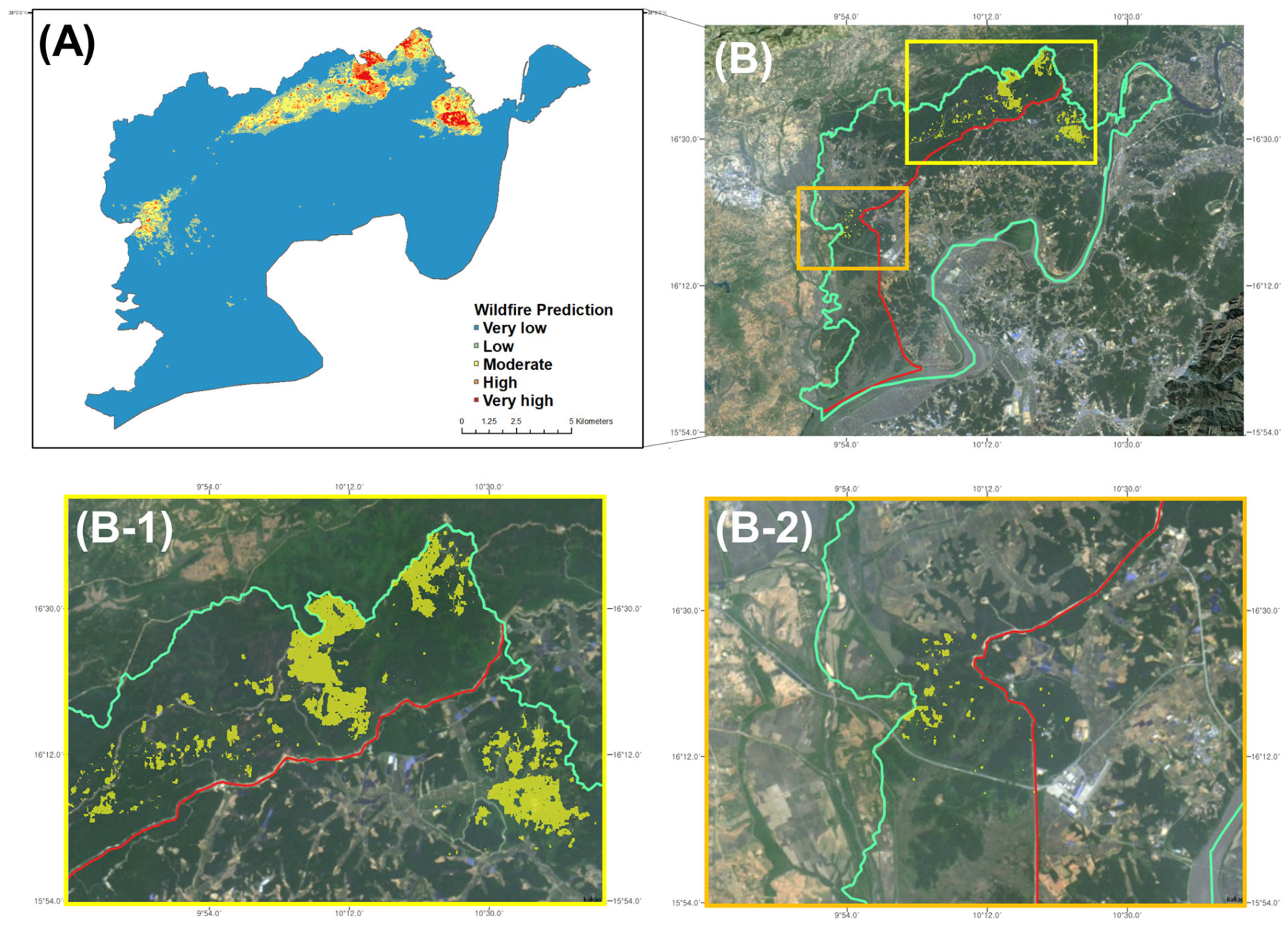
The RF model demonstrated a robust predictive capacity for wildfire ignition probability across the study area, revealing clear spatial patterns in risk distribution (Figure 6A). Continuous RF-derived probabilities were classified into five ordinal risk categories, using the Natural Jenks method: very low (0–0.05), low (0.05–0.17), moderate (0.17–0.32), high (0.32–0.51), and very high (0.51–1.00). The mapping of these classes indicated that wildfire risk is predominantly concentrated along the region’s western and northern margins, notably in zones adjacent to urban interfaces and major road infrastructure. The wildfire risk map shown in Figure 6 represents the ignition probability under baseline critical fire-weather conditions; while the spatial pattern primarily reflects relatively stable structural drivers such as land use and proximity to military activities, the probability values are sensitive to climatic inputs and can be dynamically updated under alternative weather scenarios. Area statistics (Table A1) showed that approximately 88.88% of the region was assigned to the very low-risk category, while high and very high-risk areas comprised 1.61% and 0.73% of the total area, respectively. These statistics correspond to ignition risk levels derived under baseline climatic conditions and should therefore be interpreted as conditional, rather than static representations of fire danger. Despite their limited spatial extent, the higher-risk zones corresponded closely with areas of intensified human–environmental interactions. To visualize these priority areas, Figure 6B highlights the aggregated high and very high-risk zones, and Figure 6(B-1,B-2) provide detailed views of representative hotspots.
Figure 6.
Spatial distribution of wildfire risk prediction and localized high-risk zones, based on RF model. (A) Predicted wildfire probability map across the study area using RF model, classified into five risk levels using the Natural Jenks method: very low, low, moderate, high, and very high. (B) Delineation of high-risk (high + very high) zones extracted from the full probability map. (B-1) Zoomed-in view of a high-risk area in the northern region. (B-2) Zoomed-in view of a high-risk area near the central-southern boundary.
4.4. Spatial Heterogeneity of Wildfire Risk Drivers
The GWR model was employed to characterize the spatial variability in the effects of 11 key wildfire risk drivers. Summary statistics of the local coefficient estimates are presented in Table 4, and their geographic distributions are visualized in Figure 7.
Table 4.
Summary of GWR parameter estimate. (RH: min. relative humidity; WS: max. wind speed, ASP: slope aspect, SLO: slope degree, TWI: topographic wetness index, DEM: digital elevation model, MILITARY: distance to live-fire exercises, BUILDING: distance to building infrastructure, LULC: land use and land cover, ROAD: distance to road, and EVI: enhanced vegetation index).
Figure 7.
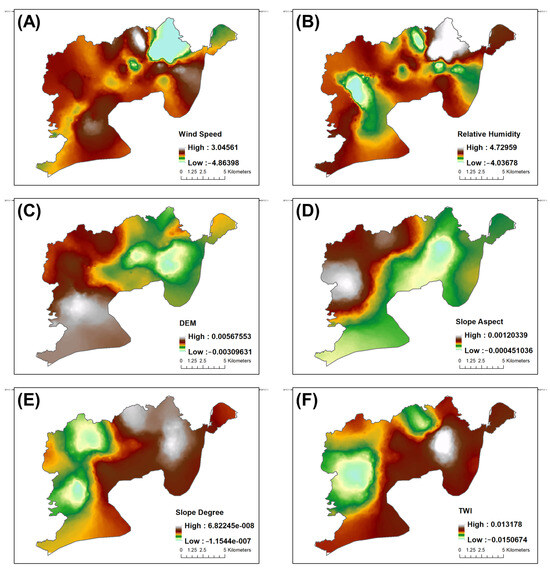
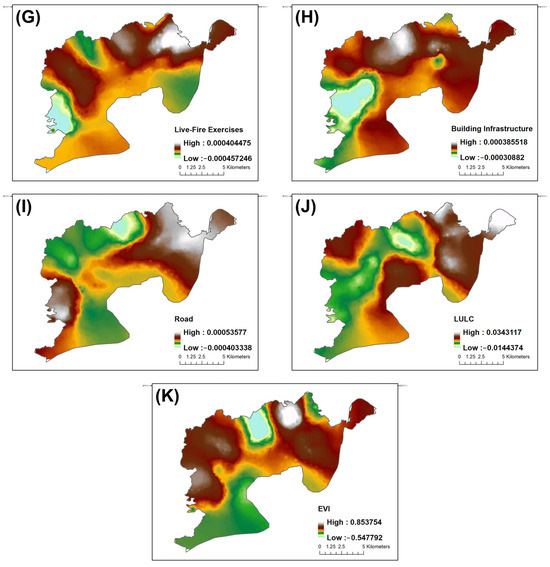
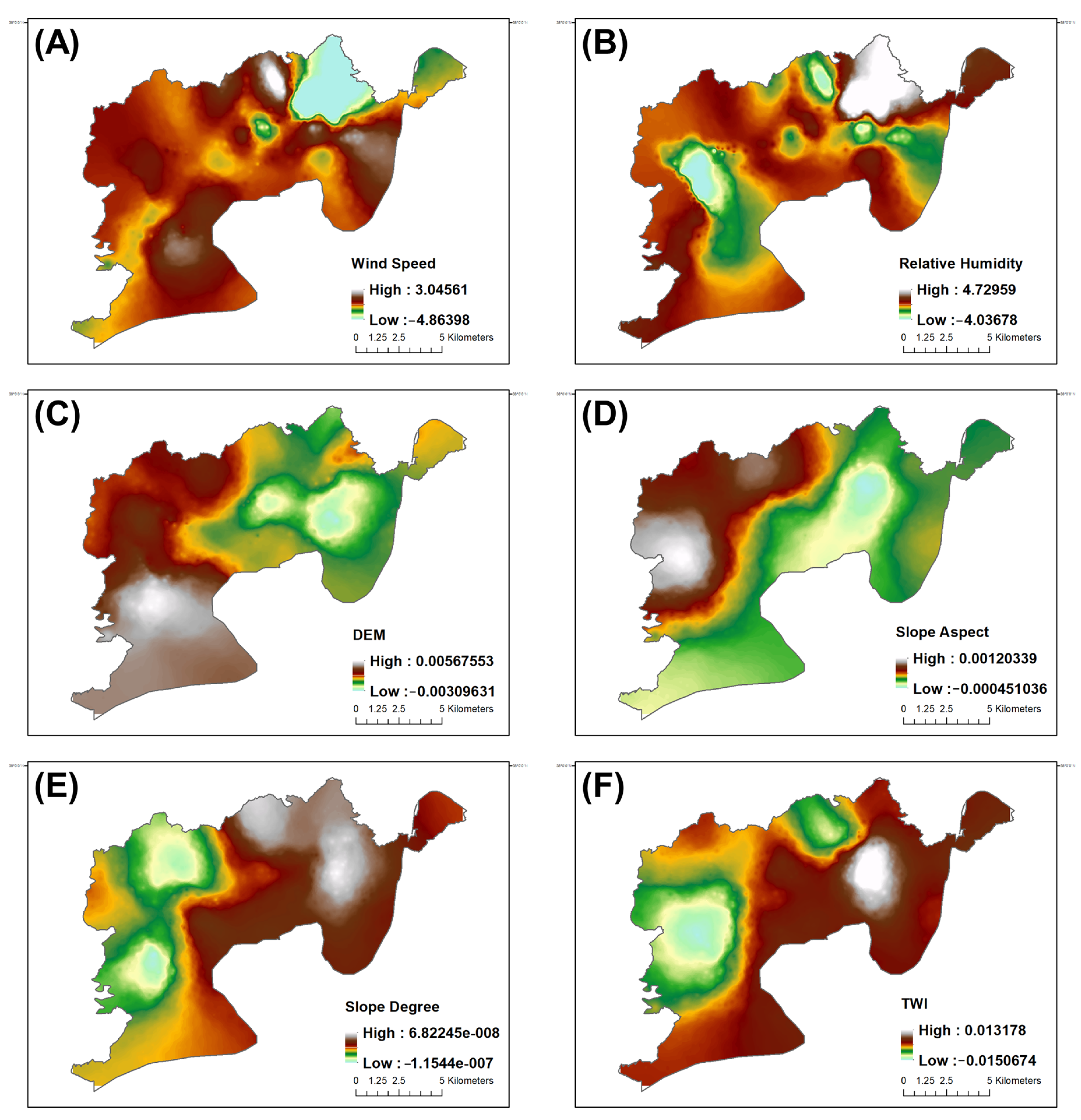
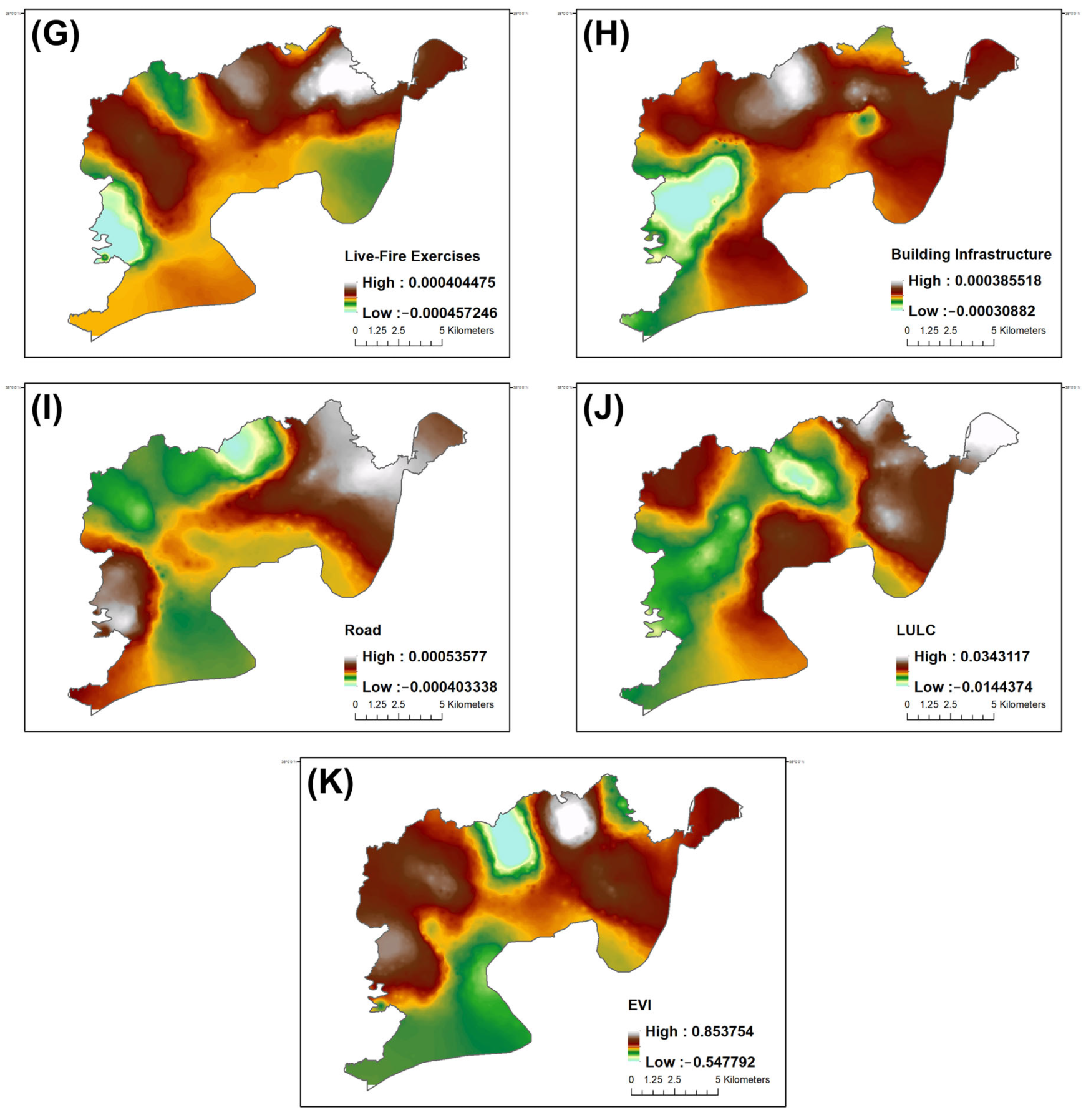
Spatial distribution of local coefficients, estimated by the GWR model for key wildfire predictors. Coefficient values are expressed on the logit scale and represent the change in ignition log-odds per unit increase in each predictor. Positive coefficients indicate an increased ignition probability, whereas negative coefficients indicate a reduced probability. (A) Wind speed; (B) Relative humidity; (C) DEM; (D) Slope aspect; (E) Slope degree; (F) TWI; (G) Live-fire exercises; (H) Building infrastructure; (I) Road; (J) LULC; and (K) EVI.
WS was associated with greater spatial variation in the effect (range: −4.87 to 3.05; mean = 0.02), although the mean effect was close to zero. Positive WS associations were prevalent in the northern and northeastern regions (Figure 7A).
Analysis of the GWR outputs indicated pronounced spatial heterogeneity in the influence of both climatic and anthropogenic variables. RH exhibited the greatest spatial variability among all predictors, with local coefficients ranging from −4.04 to 4.74 (mean = −0.21). The majority of the study area—particularly in central and northern sectors—displayed a negative association between RH and fire occurrence, indicating increased ignition probability under low-humidity conditions (Figure 7B).
The topographic factors, including the slope degree and aspect, showed relatively minor and stable coefficients near zero, suggesting a minimal explanatory contribution to spatial ignition variation in this context. The TWI revealed consistently negative coefficients overall (mean = −0.003), with the strongest effects observed in the southeastern region, aligning with areas of drier terrain (Figure 7F).
Anthropogenic features such as distance to live-fire exercises, buildings, and roads exhibited modest mean effects (mean coefficients: ~0.00005 to 0.0001). Notable spatial variation was evident near urban and semi-urban boundaries, especially in the northeast and central zones, where the relationship between human proximity and wildfire occurrence was stronger (Figure 7G–I).
Vegetation and land cover variables demonstrated greater spatial influence. The EVI showed a positive association with wildfire probability across most of the study area (mean = 0.17; peak up to 0.85) (Figure 7K). Similarly, LULC had moderate positive coefficients (mean = 0.007), with prominent effects along forest–agriculture transitions in the southern and central boundary regions (Figure 7J).
5. Discussion
5.1. Primary Drivers and Their Spatial Variation
The RF and GWR models exhibited strong predictive performance (AUC = 0.91), highlighting proximity to military installations, low RH, elevated WS, and built infrastructure as the primary determinants of wildfire ignition. These findings corroborate previous research indicating that military training activities and urban–rural anthropogenic factors jointly influence wildfire ignition across DMZ–CCZ regions [44,45]. The GAM analysis elucidated nonlinear hazard thresholds: RH demonstrated the peak ignition probability within a narrow 13.8%–14.0% window, a condition likely optimizing fuel dryness and ignition success, while WS showed a similar peak at 13.5–14.0 m/s, after which increased turbulence may suppress ignition stability [46]. Analysis of spatial proximity revealed that the ignition risk for military training zones followed an inverted-U shape, peaking at 7–8 km—closely aligned with typical operational training radii and potentially linked to detection or suppression response delays. Roads and buildings showed increased risk at 0–2 km, reflecting human-caused ignition patterns observed in peri-urban settings [45]. The GWR results further underscored spatial heterogeneity; military proximity had the strongest effect in the eastern and northern sectors, alongside meteorological effects that varied considerably across the study area, indicating localized operational contexts and environmental conditions drive ignition patterns [6,47]. The AUC values obtained in this study (0.86–0.91 across models) are comparable to those reported in wildfire ignition modeling studies [48,49] at similar spatial scales, which commonly range from approximately 0.80 to 0.90, supporting the robustness of the proposed framework for rare-event prediction in complex, access-restricted landscapes.
5.2. Multi-Model Analytical Insights for Spatial Decision Support
This study employs RF, GAM, and GWR in a complementary analytical framework to address the limitations of single-model approaches, particularly in regions that are characterized by restricted data access and complex socio-political conditions. Rather than combining model outputs into a single composite surface, each method serves a distinct role within the workflow. RF was instrumental in providing robust variable ranking and generating spatially explicit ignition probability maps, GAM quantified critical nonlinear ignition thresholds for predictive interpretation, and GWR revealed micro-scale geographic variations that are essential for spatially precise wildfire risk assessment [50,51].
To ensure that GAM-derived thresholds are not artifacts of a single model realization, an additional bootstrap analysis was conducted (Appendix A, Table A3; Figure A2), showing limited variability in peak locations for relative humidity and wind speed and reinforcing the physical interpretability of the identified nonlinear responses. In addition, stratified k-fold cross-validation of the RF model confirmed the stability of ignition probability estimates across repeated data partitions, while highlighting the inherent limitations of recall-based metrics under extreme class imbalance. From an operational standpoint, this supports the use of continuous probabilistic outputs combined with flexible, percentile- or cost-based thresholds, rather than fixed probability cutoffs, when prioritizing patrol zones, surveillance efforts, or preventive interventions.
Together, these complementary outputs enhance the practical applicability of predictive modeling for geographically adaptive wildfire prevention and management in access-restricted environments, aligning with the priorities emphasized in the international disaster risk-reduction literature [52]. Importantly, RF-derived ignition probability maps are maintained as the sole predictive surface, while GAM and GWR outputs function as explanatory and diagnostic layers, thereby preserving analytical transparency and avoiding subjective weighting or spatial normalization procedures.
5.3. Implications and Limitations
In comparison with previous wildfire risk assessments [53,54], the principal contribution of this study lies in its multi-model analytical framework and its dedicated focus on the underexamined MCIZ context—landscapes characterized by elevated ignition potential and complex governance constraints [21,25,55]. By combining probabilistic prediction, nonlinear threshold detection, and spatial heterogeneity analysis, the framework provides a more comprehensive understanding of ignition risk than single-model approaches.
The findings underscore the importance of differentiated wildfire prevention strategies that account for spatial and environmental variability in ignition drivers. Meteorological variables, particularly relative humidity and wind speed, exhibited pronounced nonlinear thresholds associated with peak ignition probabilities, indicating that risk escalates abruptly under specific atmospheric conditions, rather than increasing gradually. These threshold behaviors are directly relevant for the fire danger rating and localized early warning systems, as they define critical conditions under which preventive measures should be intensified. The RF-based ignition probability maps further function as spatial decision-support tools for both civilian and military authorities: high-risk zones can inform patrol prioritization, surveillance deployment, access control, and, in military contexts, the scheduling or restriction of live-fire exercises. The separation of probabilistic prediction (RF) from interpretative analyses (GAM and GWR) preserves analytical transparency and avoids subjective weighting, allowing practitioners to flexibly align outputs with operational objectives. Moreover, the capacity to update ignition probabilities using revised meteorological inputs enhances their applicability for near-real-time preparedness planning in access-restricted environments.
Several limitations warrant consideration. Inter-seasonal variability driven by precipitation and heat supply was not modeled explicitly as a time-series process; instead, longer-term moisture and vegetation conditions were represented indirectly through land use and vegetation indices, while short-term sensitivity was captured via humidity and wind speed. The results should therefore be interpreted as event-conditioned ignition susceptibility, rather than seasonally averaged fire danger. The use of late-period static covariates to represent ignition events spanning multiple decades may introduce temporal smoothing and underrepresent historical land use change [56], although this effect is partially mitigated by the relative structural stability of the DMZ–CCZ region. In addition, reliance on a random training–testing split does not fully address the spatial and temporal dependence, and the reported performance metrics should be viewed as upper-bound estimates. Future applications should incorporate spatial or out-of-time validation schemes to better evaluate their operational generalizability.
Although RF, GAM, and GWR are employed within a unified analytical workflow, their outputs are not mathematically combined into a single composite susceptibility index. RF functions as the sole probabilistic prediction model for generating ignition probability maps, whereas GAM and GWR are applied independently to examine nonlinear thresholds and spatial heterogeneity, respectively. Accordingly, the models are used in a complementary and interpretative manner, rather than through numerical map fusion.
6. Conclusions
This study advances wildfire ignition risk assessment in the Korean DMZ and adjacent MCIZs by employing RF, GAM, and GWR within a complementary analytical workflow. This multi-model approach identified the principal ignition drivers while capturing nonlinear threshold behavior and spatial heterogeneity, thereby enhancing predictive reliability in access-restricted environments. By linking high-resolution probabilistic prediction with complementary nonlinear and spatial diagnostics, the study provides a scientifically rigorous and practically applicable approach for wildfire risk assessment in politically sensitive border regions and offers a transferable foundation for similar assessments in other restricted or data-scarce landscapes worldwide.
Author Contributions
Conceptualization, S.H.; methodology, S.H. and S.H.H.; software, M.H.; validation, S.H., S.H.H. and S.C.; formal analysis, S.H., M.N.J., H.K. and M.H.; investigation, S.H.; resources, S.H., S.H.H., S.C., M.N.J., H.K., S.C.J., M.H. and J.K.; data curation, S.H., S.C., M.N.J., H.K., M.H. and J.K.; writing—original draft preparation, S.H.; writing—review and editing, S.A. and S.C.J.; visualization, S.H.; supervision, S.A.; project administration, S.A. and S.C.J.; funding acquisition, S.A. and S.C.J. All authors have read and agreed to the published version of the manuscript.
Funding
This research was supported by the National Institute of Forest Science (Project No. FE0500-2025-02-2025).
Institutional Review Board Statement
This study does not involve human participants or animals and therefore did not require ethical approval. All data used were publicly available and secondary in nature.
Data Availability Statement
All data and codes used in this study are freely and publicly available via the Zenodo data repository at https://doi.org/10.5281/zenodo.18626804.
Conflicts of Interest
The authors declare that there are no conflicts of interest regarding the publication of this manuscript.
Appendix A
Figure A1.
Selected environmental drivers map. (A) Max wind speed; (B) Min relative humidity; (C) DEM; (D) Slope aspect; (E) Slope degree; (F) TWI; (G) Distance to live-fire exercises; (H) Distance to building infrastructure; (I) Distance to road; (J) LULC; and (K) EVI.
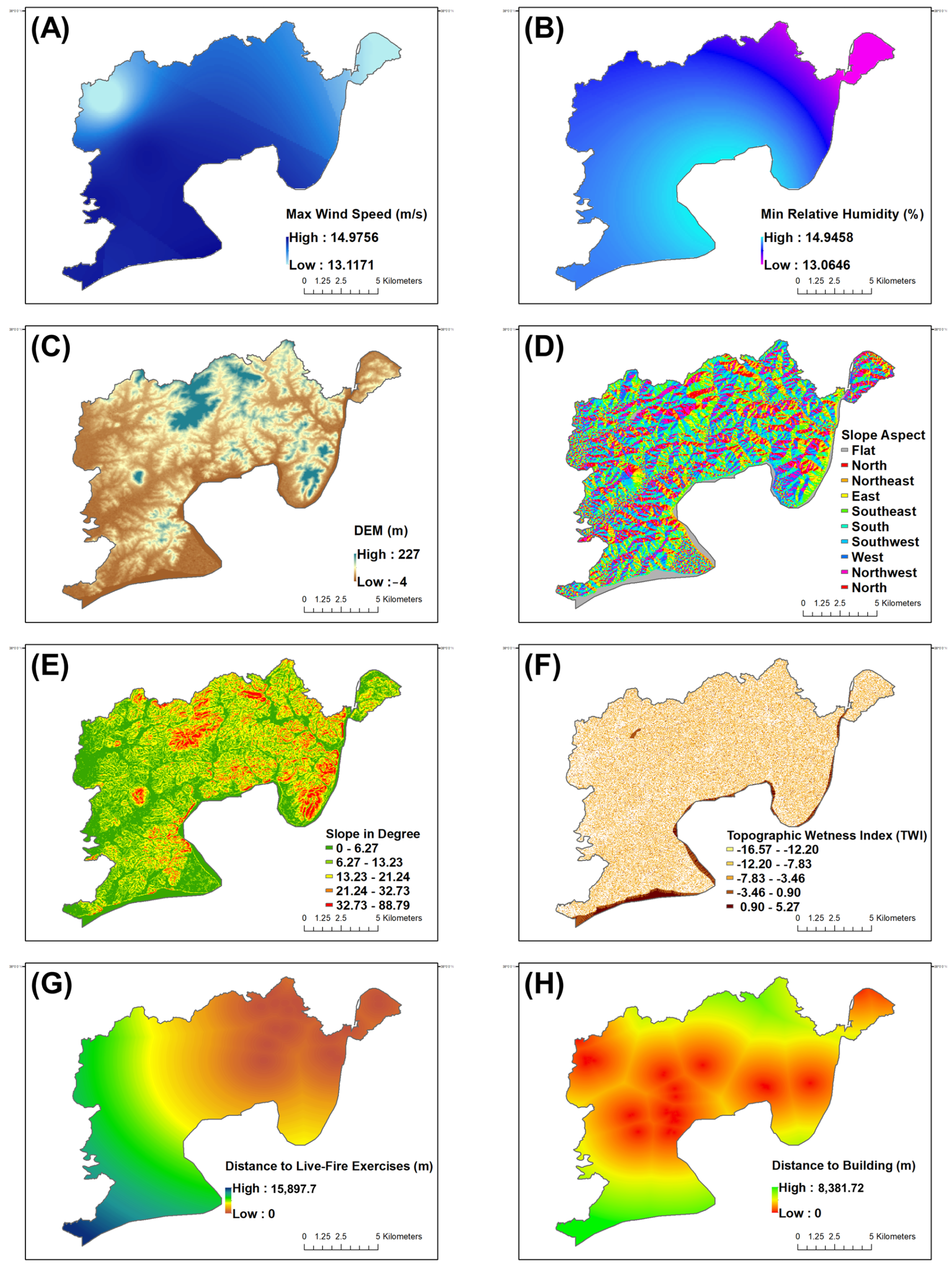
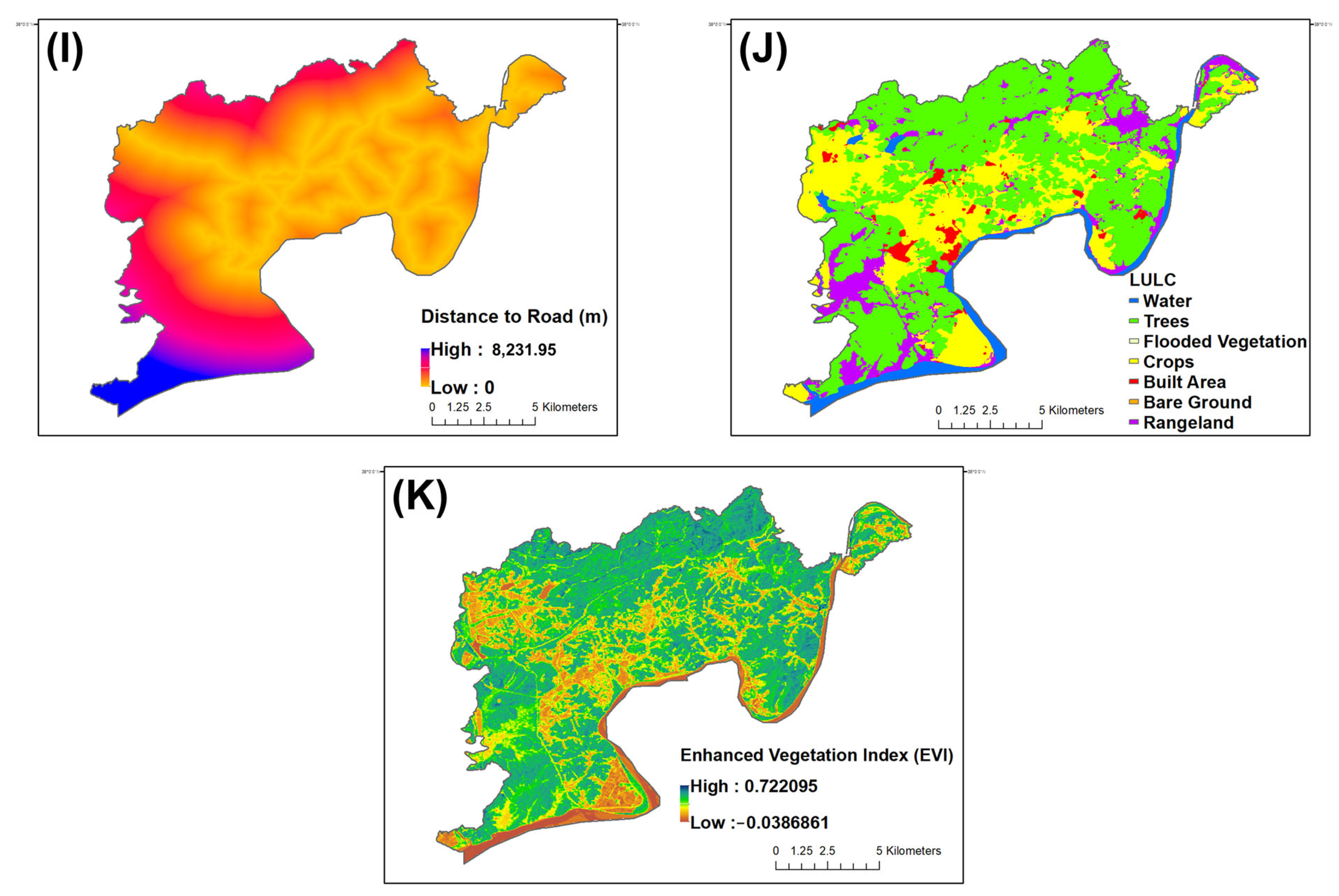
Table A1.
Area statistics by wildfire risk level, based on Natural Jenks classification of RF-predicted probability.
Table A2.
RF k-fold cross-validation performance.
Table A3.
Bootstrap stability of GAM-derived thresholds.
Figure A2.
Bootstrap distribution of (A) Relative Humidity (RH) and (B) Wind Speed (WS) peak.
References
- Bowman, D.M.; Williamson, G.J.; Abatzoglou, J.T.; Kolden, C.A.; Cochrane, M.A.; Smith, A.M. Human exposure and sensitivity to globally extreme wildfire events. Nat. Ecol. Evol. 2017, 1, 0058. [Google Scholar] [CrossRef] [Scilit] [PubMed]
- Moreira, F.; Ascoli, D.; Safford, H.; Adams, M.A.; Moreno, J.M.; Pereira, J.C.; Catry, F.X.; Armesto, J.; Bond, W.J.; E González, M.; et al. Wildfire management in Mediterranean-type regions: Paradigm change needed. Environ. Res. Lett. 2020, 15, 011001. [Google Scholar] [CrossRef] [Scilit]
- Murray, A.T.; Baik, J.; Figueroa, V.E.; Rini, D.; Moritz, M.A.; Roberts, D.A.; Sweeney, S.H.; Carvalho, L.M.; Jones, C. Developing effective wildfire risk mitigation plans for the wildland urban interface. Int. J. Appl. Earth Obs. Geoinf. 2023, 124, 103531. [Google Scholar] [CrossRef] [Scilit]
- Chen, B.; Wu, S.; Jin, Y.; Song, Y.; Wu, C.; Venevsky, S.; Xu, B.; Webster, C.; Gong, P. Wildfire risk for global wildland–urban interface areas. Nat. Sustain. 2024, 7, 474–484. [Google Scholar] [CrossRef] [Scilit]
- Kim, J.H.; Park, S.; Kim, S.H.; Lee, E.J. Long-Term Land Cover Changes in the Western Part of the Korean Demilitarized Zone. Land 2021, 10, 708. [Google Scholar] [CrossRef] [Scilit]
- Kim, J.; Lee, S.O. Fragmented, Materialized, Militarized Geopolitics of Wildfires in the Inter-Korean Border. Geoforum 2024, 155, 104077. [Google Scholar] [CrossRef] [Scilit]
- Bak, G.P.; Kim, S.J.; Lee, A.Y.; Kim, D.H.; Yu, S.B. Classification of the Damaged Areas in the DMZ (Demilitarized zone) by Location Environments. J. Korean Soc. Environ. Restor. Technol. 2021, 24, 71–84. [Google Scholar]
- Korea Forest Service. 2025. Available online: https://www.forest.go.kr/kfsweb/kfi/kfs/frfr/selectFrfrStatsArea.do (accessed on 24 November 2025).
- FIRMS. Fire Information for Resource Management System. 2025. Available online: https://firms.modaps.eosdis.nasa.gov/ (accessed on 16 December 2025).
- Lee, S.; Song, J.S.; Lee, C.W.; Ko, B. The Study of DMZ Wildfire Damage Area Detection Method Using Sentinel-2 Satellite Images. Korean J. Remote Sens. 2022, 38, 545–557. [Google Scholar]
- Marcos, B.; Gonçalves, J.; Alcaraz-Segura, D.; Cunha, M.; Honrado, J.P. A framework for multi-dimensional assessment of wildfire disturbance severity from remotely sensed ecosystem functioning attributes. Remote Sens. 2021, 13, 780. [Google Scholar] [CrossRef] [Scilit]
- Bisenic, N. A Scenario Based Fire Susceptibility Approach for Remote Sensing Platform Comparison: Los Angeles County Area. Doctoral Dissertation, University of Southern California, Southern California, CA, USA, 2022. [Google Scholar]
- Andrianarivony, H.S.; Akhloufi, M.A. Machine learning and deep learning for wildfire spread prediction: A review. Fire 2024, 7, 482. [Google Scholar] [CrossRef] [Scilit]
- Heo, S.; Park, S.; Lee, D.K. Multi-hazard exposure mapping under climate crisis using random forest algorithm for the Kalimantan Islands, Indonesia. Sci. Rep. 2023, 13, 13472. [Google Scholar] [CrossRef] [Scilit]
- Detmer, A.R.; Ward, E.J.; Hunsicker, M.E.; Andrews, K.S.; Conrad, M.; Ferriss, B.E.; Hazen, E.L.; Holsman, K.K.; Indivero, J.; Large, S.I.; et al. Evaluating the robustness of generalized additive models as a tool for threshold detection in variable environments. Ecosphere 2025, 16, e70117. [Google Scholar] [CrossRef] [Scilit]
- Punzo, G.; Castellano, R.; Bruno, E. Using geographically weighted regressions to explore spatial heterogeneity of land use influencing factors in Campania (Southern Italy). Land Use Policy 2022, 112, 105853. [Google Scholar] [CrossRef] [Scilit]
- Yang, W.; Deng, M.; Tang, J.; Luo, L. Geographically weighted regression with the integration of machine learning for spatial prediction. J. Geogr. Syst. 2023, 25, 213–236. [Google Scholar] [CrossRef] [Scilit]
- Wang, L.; Yang, J.; Wu, S.; Hu, L.; Ge, Y.; Du, Z. Enhancing mineral prospectivity mapping with geospatial artificial intelligence: A geographically neural network-weighted logistic regression approach. Int. J. Appl. Earth Obs. Geoinf. 2024, 128, 103746. [Google Scholar] [CrossRef] [Scilit]
- Masrur, A.; Yu, M.; Mitra, P.; Peuquet, D.; Taylor, A. Interpretable machine learning for analysing heterogeneous drivers of geographic events in space-time. Int. J. Geogr. Inf. Sci. 2022, 36, 692–719. [Google Scholar] [CrossRef] [Scilit]
- Ferry, J.; Laberge, G.; Aïvodji, U. Learning hybrid interpretable models: Theory, taxonomy, and methods. arXiv 2023, arXiv:2303.04437. [Google Scholar] [CrossRef] [Scilit]
- Brady, L.M. From war zone to biosphere reserve: The Korean DMZ as a Scientific Landscape. Notes Rec. 2021, 75, 189–205. [Google Scholar] [CrossRef] [Scilit]
- Kim, H.; Seo, H.; Kim, S.; Kim, H.; Ko, M. Fish diversity and ichthyofauna of areas adjacent to the Demilitarized Zone in South Korea. Diversity 2022, 14, 1011. [Google Scholar] [CrossRef] [Scilit]
- Ying, L.; Cheng, H.; Shen, Z.; Guan, P.; Luo, C.; Peng, X. Relative humidity and agricultural activities dominate wildfire ignitions in Yunnan, Southwest China: Patterns, thresholds, and implications. Agric. For. Meteorol. 2021, 307, 108540. [Google Scholar] [CrossRef] [Scilit]
- Sutherland, D.; Rashid, M.A.; Hilton, J.E.; Moinuddin, K.A. Implementation of spatially-varying wind adjustment factor for wildfire simulations. Environ. Model. Softw. 2023, 163, 105660. [Google Scholar] [CrossRef] [Scilit]
- Park, J.; Sim, W.; Park, J.; Lee, J. Object-based Land Cover Change Detection and Landscape Structure Analysis of Demilitarized Zone in Korea. Sens. Mater. 2019, 31, 3733–3748. [Google Scholar] [CrossRef] [Scilit]
- Malik, A.; Rao, M.R.; Puppala, N.; Koouri, P.; Thota, V.A.K.; Liu, Q.; Chiao, S.; Gao, J. Data-driven wildfire risk prediction in northern California. Atmosphere 2021, 12, 109. [Google Scholar] [CrossRef] [Scilit]
- Abbate, A.; Longoni, L.; Ivanov, V.I.; Papini, M. Wildfire impacts on slope stability triggering in mountain areas. Geosciences 2019, 9, 417. [Google Scholar] [CrossRef] [Scilit]
- Heo, S.; Lee, D.K. Assessing disasters in East Kalimantan: Machine learning approaches for sustainable urban development. Environ. Res. Lett. 2025, 20, 104003. [Google Scholar] [CrossRef] [Scilit]
- Ángel Javaloyes, M.; Pendás-Recondo, E.; Sánchez, M. A general model for wildfire propagation with wind and slope. SIAM J. Appl. Algebra Geom. 2023, 7, 414–439. [Google Scholar] [CrossRef] [Scilit]
- Salavati, G.; Saniei, E.; Ghaderpour, E.; Hassan, Q.K. Wildfire risk forecasting using weights of evidence and statistical index models. Sustainability 2022, 14, 3881. [Google Scholar] [CrossRef] [Scilit]
- Asori, M.; Emmanuel, D.; Dumedah, G. Wildfire hazard and risk modelling in the northern regions of Ghana using GIS-based multi-criteria decision making analysis. J. Environ. Earth Sci. 2020, 10, 11–28. [Google Scholar]
- Fang, L.; Yang, J.; White, M.; Liu, Z. Predicting potential fire severity using vegetation, topography and surface moisture availability in a Eurasian boreal forest landscape. Forests 2018, 9, 130. [Google Scholar] [CrossRef] [Scilit]
- Nasiri, V.; Sadeghi, S.M.M.; Bagherabadi, R.; Moradi, F.; Deljouei, A.; Borz, S.A. Modeling wildfire risk in western Iran based on the integration of AHP and GIS. Environ. Monit. Assess. 2022, 194, 644. [Google Scholar] [CrossRef] [Scilit]
- Donovan, V.M.; Wonkka, C.L.; Wedin, D.A.; Twidwell, D. Land-use type as a driver of large wildfire occurrence in the US Great Plains. Remote Sens. 2020, 12, 1869. [Google Scholar] [CrossRef] [Scilit]
- Costa-Saura, J.M.; Bacciu, V.; Ribotta, C.; Spano, D.; Massaiu, A.; Sirca, C. Predicting and mapping potential fire severity for risk analysis at regional level using Google Earth engine. Remote Sens. 2022, 14, 4812. [Google Scholar] [CrossRef] [Scilit]
- Cao, Q. Exploring Spatially Varying Relationships Between Forest Fire and Environmental Factors in Fujian, China. Doctoral Dissertation, State University of New York College of Environmental Science and Forestry, Syracuse, NY, USA, 2020. [Google Scholar]
- Heo, S.; Ahn, S. Predicting wildfires triggered by human-caused ignition: A spatial framework integrating AI models. Ecol. Inform. 2026, 94, 103640. [Google Scholar] [CrossRef] [Scilit]
- Naser, M.Z.; Kodur, V. Vulnerability of structures and infrastructure to wildfires: A perspective into assessment and mitigation strategies. Nat. Hazards 2025, 121, 9995–10015. [Google Scholar] [CrossRef] [Scilit]
- Papathoma-Köhle, M.; Schlögl, M.; Garlichs, C.; Diakakis, M.; Mavroulis, S.; Fuchs, S. A wildfire vulnerability index for buildings. Sci. Rep. 2022, 12, 6378. [Google Scholar] [CrossRef] [Scilit] [PubMed]
- Sagrario, M.d.L.Á.G.; Musazzi, S.; Córdoba, F.E.; Mendiolar, M.; Lami, A. Inferring the occurrence of regime shifts in a shallow lake during the last 250 years based on multiple indicators. Ecol. Indic. 2020, 117, 106536. [Google Scholar] [CrossRef] [Scilit]
- Ye, T.; Liu, W.; Mu, Q.; Zong, S.; Li, Y.; Shi, P. Quantifying livestock vulnerability to snow disasters in the Tibetan Plateau: Comparing different modeling techniques for prediction. Int. J. Disaster Risk Reduct. 2020, 48, 101578. [Google Scholar] [CrossRef] [Scilit]
- Pahlavani, P.; Raei, A.; Bigdeli, B.; Ghorbanzadeh, O. Identifying influential spatial drivers of forest fires through geographically and temporally weighted regression coupled with a continuous invasive weed optimization algorithm. Fire 2024, 7, 33. [Google Scholar] [CrossRef] [Scilit]
- Schag, G.M.; Stow, D.A.; Riggan, P.J.; Nara, A. Spatial-statistical analysis of landscape-level wildfire rate of spread. Remote Sens. 2022, 14, 3980. [Google Scholar] [CrossRef] [Scilit]
- Anton, C.E.; Lawrence, C. Does place attachment predict wildfire mitigation and preparedness? A comparison of wildland–urban interface and rural communities. Environ. Manag. 2016, 57, 148–162. [Google Scholar] [CrossRef] [Scilit]
- Laushman, K.M.; Munson, S.M.; Villarreal, M.L. Wildfire risk and hazardous fuel reduction treatments along the US-Mexico border: A review of the science (1986–2019). Air Soil Water Res. 2020, 13, 1178622120950272. [Google Scholar] [CrossRef] [Scilit]
- Richardson, D.; Black, A.S.; Irving, D.; Matear, R.J.; Monselesan, D.P.; Risbey, J.S.; Squire, D.T.; Tozer, C.R. Global increase in wildfire potential from compound fire weather and drought. npj Clim. Atmos. Sci. 2022, 5, 23. [Google Scholar] [CrossRef] [Scilit]
- Coutaz, G. South Korea: Vulnerability and Adaptation to Natural Disasters. In Coping with Disaster Risk Management in Northeast Asia: Economic and Financial Preparedness in China, Taiwan, Japan and South Korea; Emerald Publishing Limited: Leeds, UK, 2018; pp. 111–132. [Google Scholar]
- Shmuel, A.; Lazebnik, T.; Heifetz, E.; Glickman, O.; Price, C. Fire weather indices tailored to regional patterns outperform global models. npj Nat. Hazards 2025, 2, 74. [Google Scholar] [CrossRef] [Scilit]
- Lorenț, A.; Petrila, M.; Apostol, B.; Capalb, F.; Chivulescu, Ș.; Șamșodan, C.; Marcu, C.; Badea, O. Assessing and Mapping Forest Fire Vulnerability in Romania Using Maximum Entropy and eXtreme Gradient Boosting. Forests 2025, 16, 1156. [Google Scholar] [CrossRef] [Scilit]
- Rodrigues, M.; de la Riva, J. The large forest fires in Aragón: Brief analysis and retrospective in the context of the 2022 summer. Pirineos 2024, 179, not005. [Google Scholar] [CrossRef] [Scilit]
- Wu, Z.; He, H.S.; Fang, L.; Liang, Y.; Parsons, R.A. Wind speed and relative humidity influence spatial patterns of burn severity in boreal forests of northeastern China. Ann. For. Sci. 2018, 75, 66. [Google Scholar] [CrossRef] [Scilit]
- Mastrorillo, M.; Scartozzi, C.M.; Pacillo, G.; Menza, G.; Desai, B.; Maviza, G.; Jaskolski, M.; Schapendonk, F.; Meddings, G.; Carneiro, B.; et al. Towards a Common Vision for Climate Change, Security and Migration in the Mediterranean; Bioversity International and International Center for Tropical Agriculture: Rome, Italy, 2024. [Google Scholar]
- Li, C.; Su, Z.; Ni, R.; Wang, G.; Ouyang, Y.; Zeng, A.; Guo, F. Integrated spatial generalized additive modeling for forest fire prediction: A case study in Fujian Province, China. J. For. Res. 2025, 36, 30. [Google Scholar] [CrossRef] [Scilit]
- Zhang, Z.; Yang, S.; Wang, G.; Wang, W.; Xia, H.; Sun, S.; Guo, F. Evaluation of geographically weighted logistic model and mixed effect model in forest fire prediction in northeast China. Front. For. Glob. Change 2022, 5, 1040408. [Google Scholar] [CrossRef] [Scilit]
- Murillo-Sandoval, P.J.; Hilker, T.; Krawchuk, M.A.; Van Den Hoek, J. Detecting and attributing drivers of forest disturbance in the Colombian andes using landsat time-series. Forests 2018, 9, 269. [Google Scholar] [CrossRef] [Scilit]
- Sweeney, L. The Impact of Climate, Vegetation and Land-Use Changes on Fire Regimes During the Holocene. Doctoral Dissertation, University of Reading, Reading, UK, 2025. [Google Scholar]

Disclaimer/Publisher’s Note: The statements, opinions and data contained in all publications are solely those of the individual author(s) and contributor(s) and not of MDPI and/or the editor(s). MDPI and/or the editor(s) disclaim responsibility for any injury to people or property resulting from any ideas, methods, instructions or products referred to in the content. |
© 2026 by the authors. Licensee MDPI, Basel, Switzerland. This article is an open access article distributed under the terms and conditions of the Creative Commons Attribution (CC BY) license.