Human Activities and Climate Jointly Shape the Old-Tree Diversity in Human-Dominated Landscapes of the Yellow River Basin, China


Abstract
1. Introduction
2. Materials and Methods
2.1. Old Trees Collection
2.2. Explanatory Variables
2.3. Response Variables
2.4. Statistical Analysis
3. Results
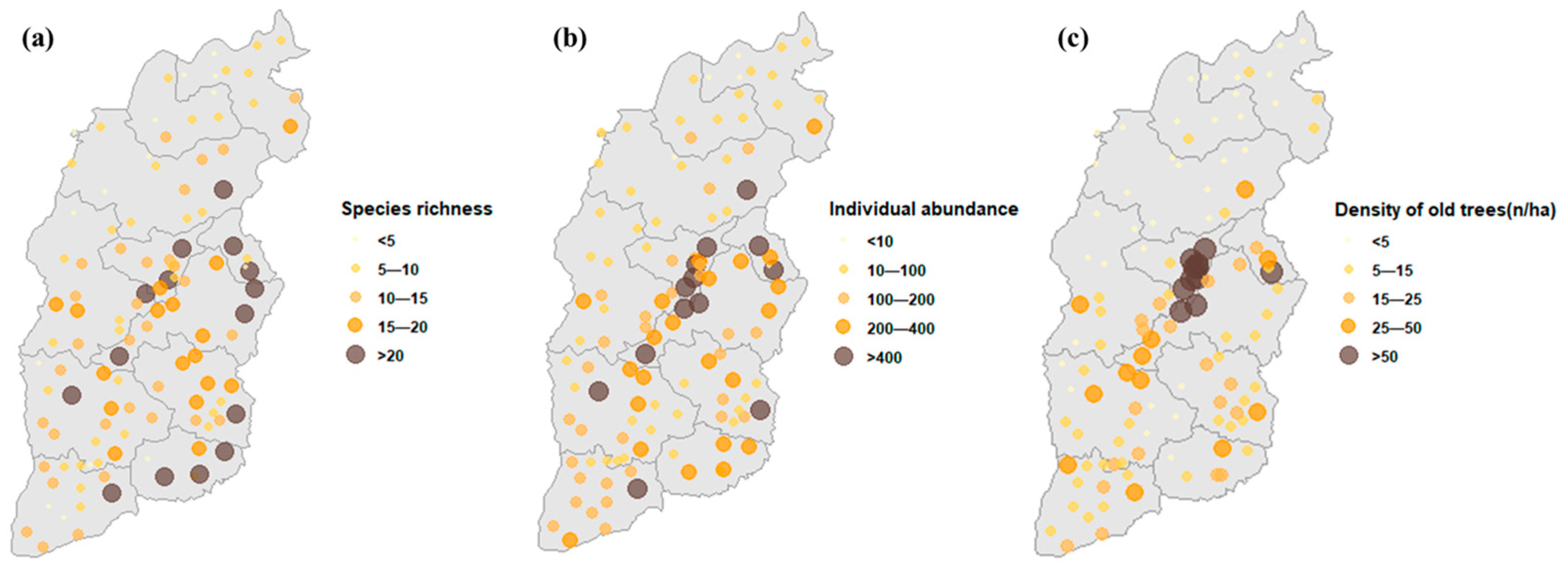
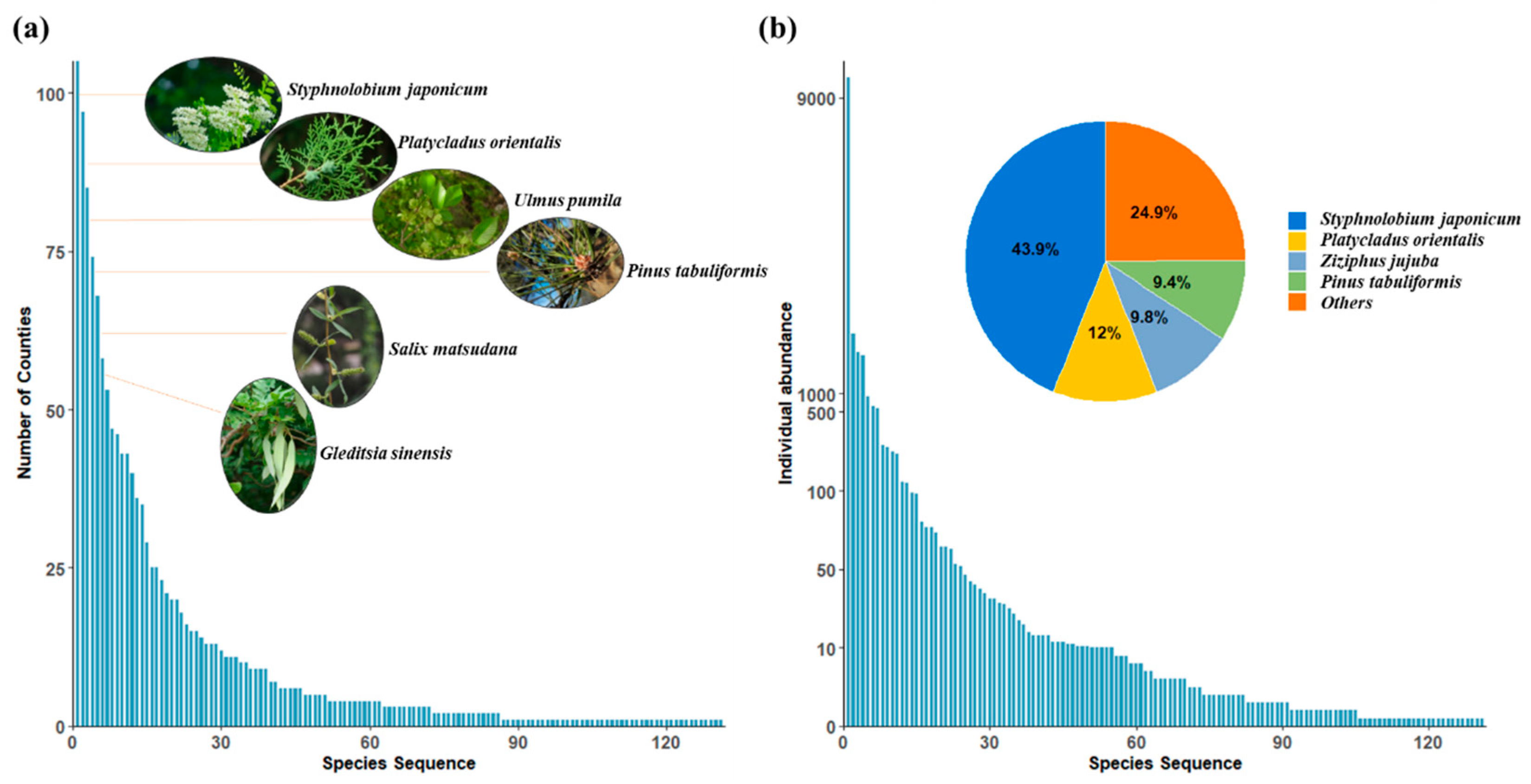
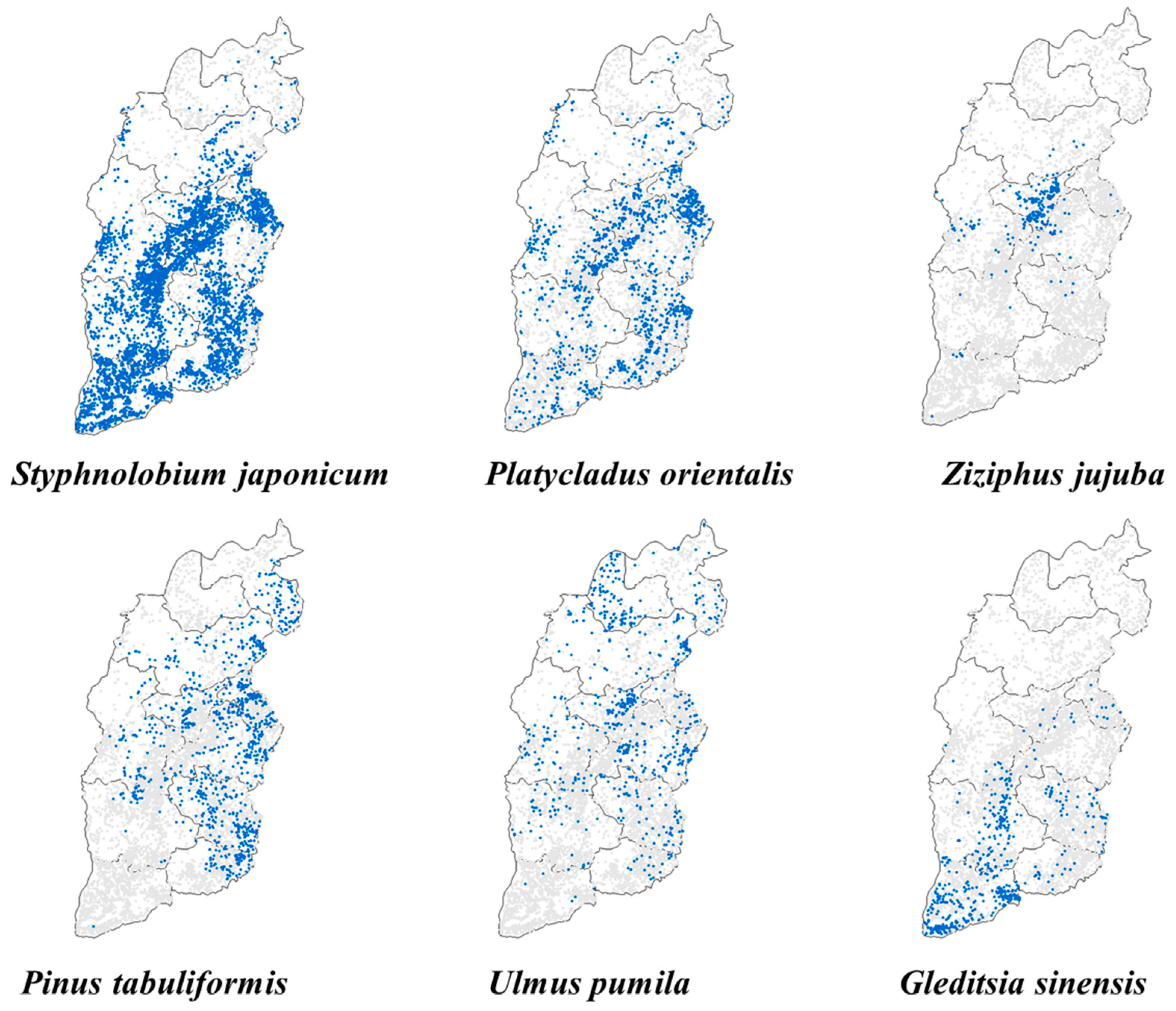
3.1. Diversity Distribution Patterns of Old Trees
3.2. Factors Influencing the Density of Old Trees
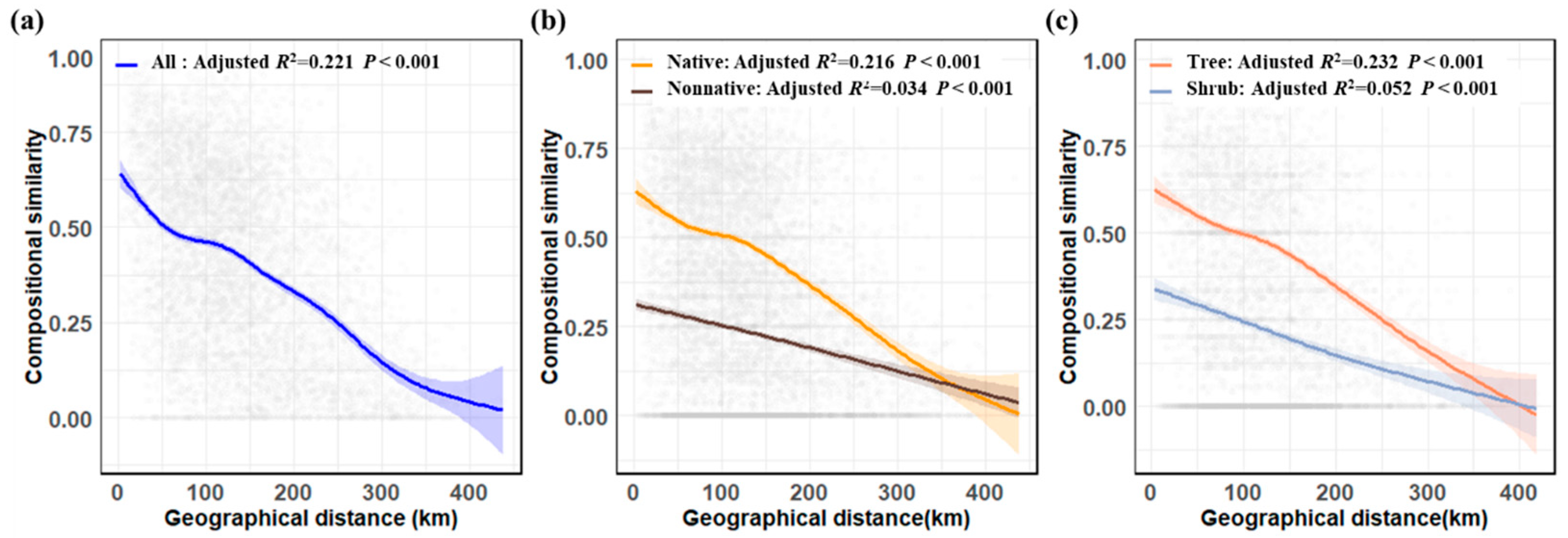
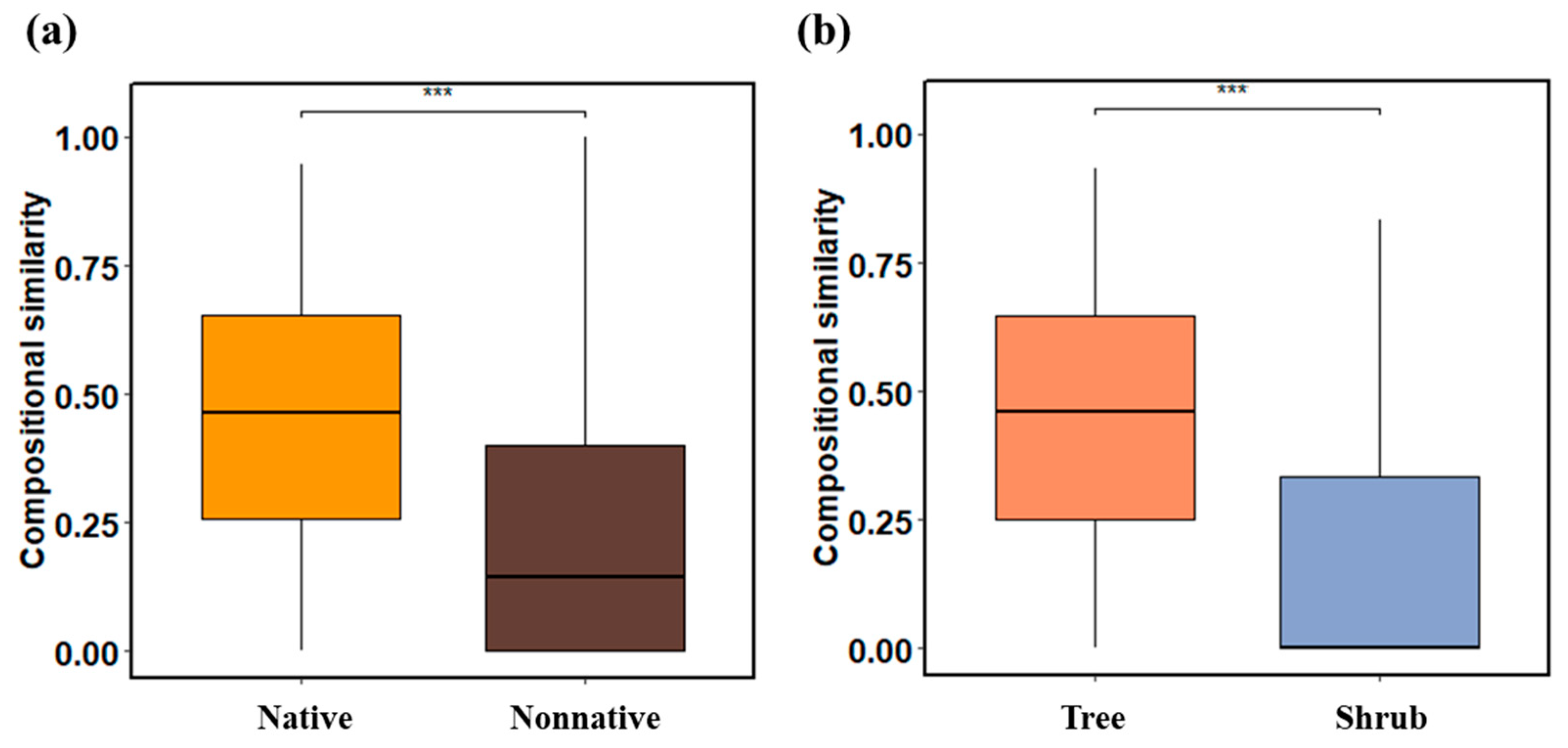
3.3. Compositional Similarity of Old Trees Among Counties
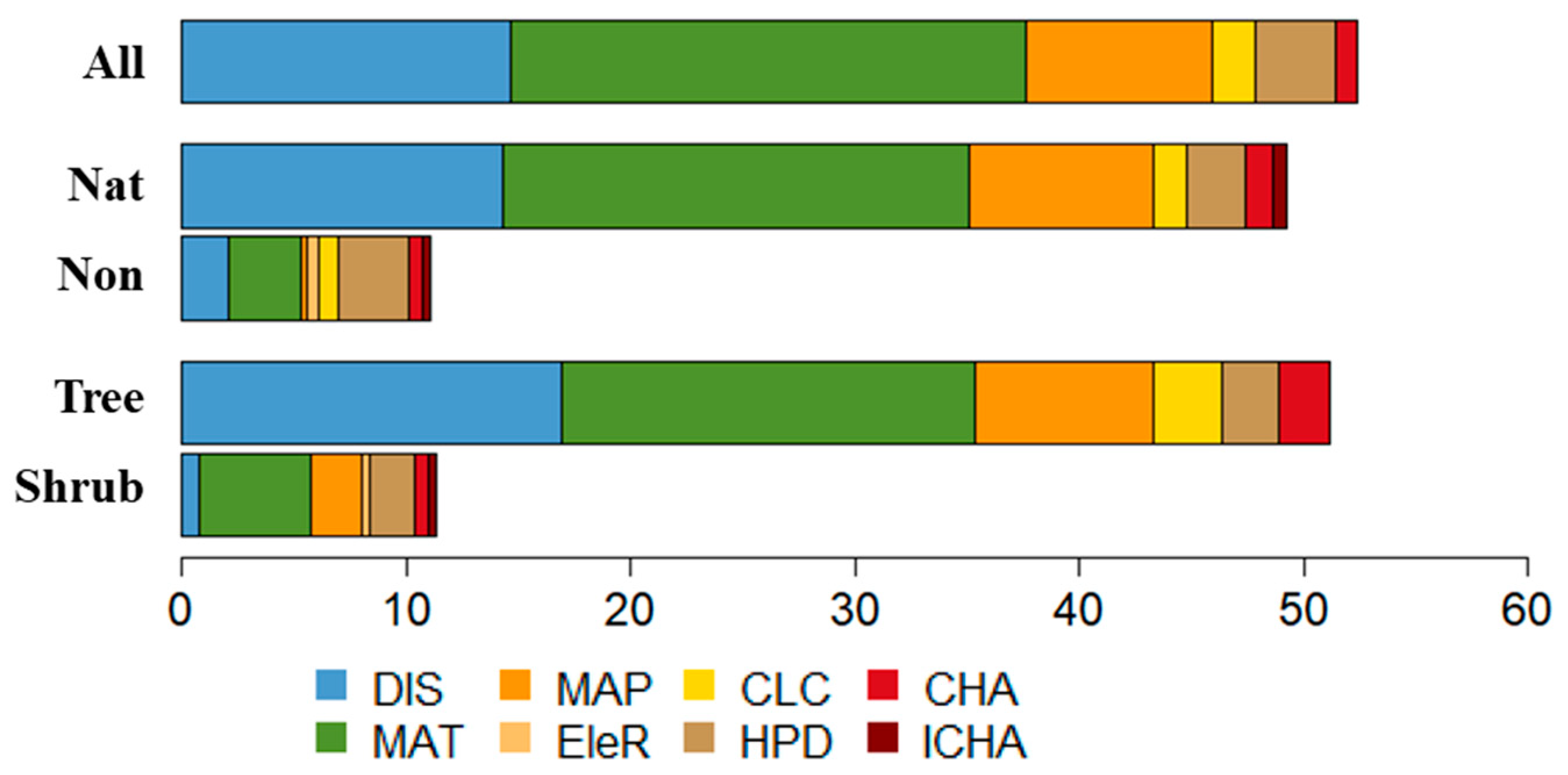
3.4. Drivers of Species Compositional Patterns
4. Discussion
4.1. Dominance Structure of Old Tree Diversity
4.2. Environmental and Anthropogenic Controls on Old Tree Density
4.3. Drivers of Compositional Dissimilarity Across Species Groups
4.4. Implications and Limitations
5. Conclusions
Author Contributions
Funding
Data Availability Statement
Acknowledgments
Conflicts of Interest
Appendix A


| Variables | All | Nat | Non | Tree | Shrub |
|---|---|---|---|---|---|
| DIS | 14.634 | 14.295 | 2.083 | 16.927 | 0.765 |
| MAT | 22.983 | 20.786 | 3.272 | 18.426 | 5.018 |
| MAP | 8.321 | 8.195 | 0.223 | 8.000 | 2.241 |
| EleR | 0.509 | 0.310 | |||
| CLC | 1.873 | 1.525 | 0.915 | 3.025 | |
| HPD | 3.598 | 2.641 | 3.127 | 2.552 | 2.050 |
| CHA | 1.004 | 1.200 | 0.561 | 2.242 | 0.655 |
| ICHA | 0.572 | 0.368 | 0.281 | ||
| Percent deviance explained | 52.413 | 49.215 | 11.059 | 51.172 | 11.320 |

References
- Lindenmayer, D.B.; Laurance, W.F. The ecology, distribution, conservation and management of large old trees. Biol. Rev. 2017, 92, 1434–1458. [Google Scholar] [CrossRef]
- Cannon, C.H.; Piovesan, G.; Munné-Bosch, S. Old and ancient trees are life history lottery winners and vital evolutionary resources for long-term adaptive capacity. Nat. Plants 2022, 8, 136–145. [Google Scholar] [CrossRef]
- Slik, J.W.F.; Paoli, G.; McGuire, K.; Amaral, I.; Barroso, J.; Bastian, M.; Blanc, L.; Bongers, F.; Boundja, P.; Clark, C.; et al. Large trees drive forest aboveground biomass variation in moist lowland forests across the tropics. Glob. Ecol. Biogeogr. 2013, 22, 1261–1271. [Google Scholar] [CrossRef]
- Piovesan, G.; Cannon, C.H.; Liu, J.; Munné-Bosch, S. Ancient trees: Irreplaceable conservation resource for ecosystem restoration. Trends Ecol. Evol. 2022, 37, 1025–1028. [Google Scholar] [CrossRef]
- Blicharska, M.; Mikusiński, G. Incorporating social and cultural significance of large old trees in conservation policy. Conserv. Biol. 2014, 28, 1558–1567. [Google Scholar] [CrossRef] [PubMed]
- Turner, N.J.; Ari, Y.; Berkes, F.; Davidson-Hunt, I.; Ertug, Z.F.; Miller, A. Cultural Management of Living Trees: An International Perspective. J. Ethnobiol. 2023, 29, 237–270. [Google Scholar] [CrossRef]
- Ogwu, M.C.; Osawaru, M.E. Traditional Methods of Plant Conservation for Sustainable Utilization and Development. In Biodiversity in Africa: Potentials, Threats and Conservation; Izah, S.C., Ed.; Sustainable Development and Biodiversity; Springer: Singapore, 2022; Volume 29, pp. 451–472. [Google Scholar] [CrossRef]
- Kandari, L.S.; Bisht, V.K.; Bhardwaj, M.; Thakur, A.K. Conservation and management of sacred groves, myths and beliefs of tribal communities: A case study from north-India. Environ. Syst. Res. 2014, 3, 16. [Google Scholar] [CrossRef]
- Zapponi, L.; Mazza, G.; Farina, A.; Fedrigoli, L.; Mazzocchi, F.; Roversi, P.F.; Peverieri, G.S.; Mason, F. The role of monumental trees for the preservation of saproxylic biodiversity: Re-thinking their management in cultural landscapes. Nat. Conserv. 2017, 19, 231–243. [Google Scholar] [CrossRef]
- Alders, W.; Lim, J.S.; Brunner, L. Detecting baobab trees (Adansonia digitata) in drone imagery and evaluating their anthropogenic legacy in eastern Africa. J. Archaeol. Sci. 2025, 180, 106280. [Google Scholar] [CrossRef]
- Rashford, J. A Historically Contextualized Account of the Baobab Trees (Adansonia digitata L.) of Tobago. Econ. Bot. 2022, 76, 127–157. [Google Scholar] [CrossRef]
- Lindenmayer, D.B.; Laurance, W.F.; Franklin, J.F. Global decline in large old trees. Science 2012, 338, 1305–1306. [Google Scholar] [CrossRef]
- Gibbons, P.; Lindenmayer, D.B.; Fischer, J.; Manning, A.D.; Weinberg, A.; Seddon, J.; Ryan, P.; Barrett, G. The future of scattered trees in agricultural landscapes. Conserv. Biol. 2008, 22, 1309–1319. [Google Scholar] [CrossRef]
- Vargas-Gaete, R.; Salas-Eljatib, C.; Fernández-Urrutia, C.; Fuentes-Ramírez, A.; Almonacid, L. Heritage trees: Getting to know the oldest inhabitants of a city in southern Chile. Urban For. Urban Green. 2025, 112, 128916. [Google Scholar] [CrossRef]
- Liu, S.; Xu, H.; Wang, G.; Jin, B.; Cao, F.; Wang, L. Tree longevity: Multifaceted genetic strategies and beyond. Plant Cell Environ. 2025, 48, 244–259. [Google Scholar] [CrossRef]
- Bennett, A.C.; McDowell, N.G.; Allen, C.D.; Anderson-Teixeira, K.J. Larger trees suffer most during drought in forests worldwide. Nat. Plants 2015, 1, 15139. [Google Scholar] [CrossRef]
- Piovesan, G.; Biondi, F.; Baliva, M.; Dinella, A.; Di Fiore, L.; Marchiano, V.; Presutti Saba, E.; De Vivo, G.; Schettino, A.; Di Filippo, A. Tree growth patterns associated with extreme longevity: Implications for the ecology and conservation of primeval trees in Mediterranean mountains. Anthropocene 2019, 26, 100199. [Google Scholar] [CrossRef]
- Poulsen, J.R.; Medjibe, V.P.; White, L.J.T.; Miao, Z.; Banak-Ngok, L.; Beirne, C.; Clark, C.J.; Cuni-Sanchez, A.; Disney, M.; Doucet, J.-L.; et al. Old growth Afrotropical forests critical for maintaining forest carbon. Glob. Ecol. Biogeogr. 2020, 29, 1785–1798. [Google Scholar] [CrossRef]
- Liu, J.; Yang, B.; Lindenmayer, D.B. The oldest trees in China and where to find them. Front. Ecol. Environ. 2019, 17, 319–322. [Google Scholar] [CrossRef]
- Jönsson, M.T.; Fraver, S.; Jonsson, B.G. Forest history and the development of old-growth characteristics in fragmented boreal forests. J. Veg. Sci. 2009, 20, 91–106. [Google Scholar] [CrossRef]
- Takács, M.; Szénási, Á.; Malatinszky, Á. Polypores, Agrobacterium and ivy damage on Hungarian ancient trees. Nat. Conserv. 2020, 40, 1–38. [Google Scholar] [CrossRef]
- Nolan, V.; Reader, T.; Gilbert, F.; Atkinson, N. The Ancient Tree Inventory: A summary of the results of a 15 year citizen science project recording ancient, veteran and notable trees across the UK. Biodivers. Conserv. 2020, 29, 3103–3129. [Google Scholar] [CrossRef]
- Wonglangka, W.; Han, F. Green heritage and Lanna urban identity: A study of temples in Chiang Mai Old City. Sustainability 2024, 16, 6574. [Google Scholar] [CrossRef]
- Huang, L.; Tian, L.; Huang, L.; Jin, C.; Hu, S.; Zhang, Z.; Yan, E.; Jim, C.Y.; Yang, Y.; Lindenmayer, D.B.; et al. Religious temples are long-term refuges for old trees in human-dominated landscapes in China. Curr. Biol. 2025, 35, 2994–3000.e3. [Google Scholar] [CrossRef]
- Bridgewater, P.; Rotherham, I.D. A critical perspective on the concept of biocultural diversity and its emerging role in nature and heritage conservation. People Nat. 2019, 1, 291–304. [Google Scholar] [CrossRef]
- Cheng, Z.; Lu, X.; Fan, Y.; Cui, Q.; Hu, X.; Long, C. Traditional knowledge promotes the protection of large old trees: A case from China’s richest biocultural diversity area. People Nat. 2025, 7, 2700–2713. [Google Scholar] [CrossRef]
- Huang, L.; Tian, L.; Zhou, L.; Jin, C.; Qian, S.; Jim, C.Y.; Lin, D.; Zhao, L.; Minor, J.; Coggins, C.; et al. Local cultural beliefs and practices promote conservation of large old trees in an ethnic minority region in southwestern China. Urban For. Urban Green. 2020, 49, 126584. [Google Scholar] [CrossRef]
- Zhang, A.; Grose, M.J. Where to find large old trees in China?—Temples as the refuge for large old trees in Chinese cities. Arboric. J. 2025, 47, 250–269. [Google Scholar] [CrossRef]
- Jin, C.; Zheng, M.; Huang, L.; Qian, S.; Jim, C.Y.; Lin, D.; Zhao, L.; Minor, J.; Coggins, C.; Chen, B.; et al. Co-existence between humans and nature: Heritage trees in China’s yangtze River region. Urban For. Urban Green. 2020, 54, 126748. [Google Scholar] [CrossRef]
- Vilà, M.; Espinar, J.L.; Hejda, M.; Hulme, P.E.; Jarošík, V.; Maron, J.L.; Pergl, J.; Schaffner, U.; Sun, Y.; Pyšek, P. Ecological impacts of invasive alien plants: A meta-analysis of their effects on species, communities and ecosystems. Ecol. Lett. 2011, 14, 702–708. [Google Scholar] [CrossRef] [PubMed]
- Díaz, S.; Kattge, J.; Cornelissen, J.H.C.; Wright, I.J.; Lavorel, S.; Dray, S.; Reu, B.; Kleyer, M.; Wirth, C.; Colin Prentice, I.; et al. The global spectrum of plant form and function. Nature 2016, 529, 167–171. [Google Scholar] [CrossRef]
- Zhang, J.T. A study on relations of vegetation, climate and soils in Shanxi province, China. Plant Ecol. 2002, 162, 23–31. [Google Scholar] [CrossRef]
- Pan, Y.; Wang, S.; Xie, C.; Jim, C.Y. Species diversity and spatial pattern of heritage trees in Taiyuan. Sci. Rep. 2025, 15, 17584. [Google Scholar] [CrossRef]
- Huang, L.; Jin, C.; Pan, Y.; Zhou, L.; Hu, S.; Guo, Y.; Meng, Y.; Song, K.; Pang, M.; Li, H.; et al. Human activities and species biological traits drive the long-term persistence of old trees in human-dominated landscapes. Nat. Plants 2023, 9, 898–907. [Google Scholar] [CrossRef]
- Wang, X.; Svenning, J.-C.; Liu, J.; Zhao, Z.; Zhang, Z.; Feng, G.; Si, X.; Zhang, J. Regional effects of plant diversity and biotic homogenization in urban greenspace—The case of university campuses across China. Urban For. Urban Green. 2021, 62, 127170. [Google Scholar] [CrossRef]
- Liu, J.; Lindenmayer, D.B.; Yang, W.; Ren, Y.; Campbell, M.J.; Wu, C.; Luo, Y.; Zhong, L.; Yu, M. Diversity and density patterns of large old trees in China. Sci. Total Environ. 2019, 655, 255–262. [Google Scholar] [CrossRef]
- Freiberg, M.; Winter, M.; Gentile, A.; Zizka, A.; Muellner-Riehl, A.N.; Weigelt, A.; Wirth, C. LCVP, The Leipzig catalogue of vascular plants, a new taxonomic reference list for all known vascular plants. Sci. Data 2020, 7, 416. [Google Scholar] [CrossRef]
- Padullés Cubino, J.; Cavender-Bares, J.; Hobbie, S.E.; Hall, S.J.; Trammell, T.L.E.; Neill, C.; Avolio, M.L.; Darling, L.E.; Groffman, P.M. Contribution of non-native plants to the phylogenetic homogenization of U.S. yard floras. Ecosphere 2019, 10, e02638. [Google Scholar] [CrossRef]
- Robinson, N.; Regetz, J.; Guralnick, R.P. EarthEnv-DEM90: A nearly-global, void-free, multi-scale smoothed, 90m digital elevation model from fused ASTER and SRTM data. ISPRS J. Photogramm. Remote Sens. 2014, 87, 57–67. [Google Scholar] [CrossRef]
- Yang, W.; Ma, K.; Kreft, H. Environmental and socio-economic factors shaping the geography of floristic collections in China. Glob. Ecol. Biogeogr. 2014, 23, 1284–1292. [Google Scholar] [CrossRef]
- Shanxi Provincial Bureau of Statistics; Survey Office of the National Bureau of Statistics in Shanxi. Shanxi Statistical Yearbook 2018; China Statistics Press: Beijing, China, 2018.
- Dormann, C.F.; Elith, J.; Bacher, S.; Buchmann, C.; Carl, G.; Carré, G.; Marquéz, J.R.G.; Gruber, B.; Lafourcade, B.; Leitão, P.J.; et al. Collinearity: A review of methods to deal with it and a simulation study evaluating their performance. Ecography 2013, 36, 27–46. [Google Scholar] [CrossRef]
- Oksanen, J.; Blanchet, F.G.; Kindt, R.; Legendre, P.; Minchin, P.R.; O’Hara, R.B.; Simpson, G.L.; Solymos, P.; Stevens, M.H.H.; Wagner, H. Vegan: Community Ecology Package. R Package Version 2.2-0. 2014. Available online: https://CRAN.R-project.org/package=vegan (accessed on 10 November 2025).
- Kissling, W.D.; Carl, G. Spatial autocorrelation and the selection of simultaneous autoregressive models. Glob. Ecol. Biogeogr. 2008, 17, 59–71. [Google Scholar] [CrossRef]
- Rangel, T.F.; Diniz-Filho, J.A.F.; Bini, L.M. SAM: A comprehensive application for Spatial Analysis in Macroecology. Ecography 2010, 33, 46–50. [Google Scholar] [CrossRef]
- Zhang, J.; Kissling, W.D.; He, F. Local forest structure, climate and human disturbance determine regional distribution of boreal bird species richness in Alberta, Canada. J. Biogeogr. 2013, 40, 1131–1142. [Google Scholar] [CrossRef]
- Cavanaugh, J.E.; Neath, A.A. The Akaike information criterion: Background, derivation, properties, application, interpretation, and refinements. WIREs Comput. Stat. 2019, 11, e1460. [Google Scholar] [CrossRef]
- Wood, S. Package ‘mgcv’. The R Project for Statistical Computing. 2025. Available online: https://CRAN.R-project.org/package=mgcv (accessed on 14 November 2025).
- Capinha, C.; Essl, F.; Seebens, H.; Moser, D.; Pereira, H.M. The dispersal of alien species redefines biogeography in the Anthropocene. Science 2015, 348, 1248–1251. [Google Scholar] [CrossRef]
- Ferrier, S.; Manion, G.; Elith, J.; Richardson, K. Using generalized dissimilarity modelling to analyse and predict patterns of beta diversity in regional biodiversity assessment. Divers. Distrib. 2007, 13, 252–264. [Google Scholar] [CrossRef]
- Fitzpatrick, M.; Mokany, K.; Manion, G.; Nieto-Lugilde, D.; Ferrier, S. gdm: Generalized Dissimilarity Modeling 2024. R package version 1.6. Available online: https://github.com/fitzlab-al/gdm (accessed on 1 December 2025).
- König, C.; Weigelt, P.; Kreft, H. Dissecting global turnover in vascular plants. Glob. Ecol. Biogeogr. 2017, 26, 228–242. [Google Scholar] [CrossRef]
- R Core Team. R: A Language and Environment for Statistical Computing. R Foundation for Statistical Computing: Vienna, Austria. 2025. Available online: https://www.R-project.org/ (accessed on 10 September 2025).
- Shanxi Forest Editorial Committee. Forests of Shanxi; China Forestry Publishing House: Beijing, China, 1993. [Google Scholar]
- Gu, W.; Lan, Y.; Sun, C. Research advances and utilization development of Gleditsia sinensis in world. Sci. Silvae Sin. 2003, 39, 127–133. (In Chinese) [Google Scholar]
- Xie, J.; Wang, Z.; Li, Y. Stomatal opening ratio mediates trait coordinating network adaptation to environmental gradients. New Phytol. 2022, 235, 907–922. [Google Scholar] [CrossRef]
- Yue, H.; Jiang, S.; Yang, J. The evolution of Sophora japonica–based moralized landscapes in traditional Chinese gardens. Chin. Landsc. Archit. 2024, 40, 126–132. (In Chinese) [Google Scholar]
- Zhao, S.Y. Ancestral memory, homeland symbolism, and ethnic history: An analysis of the Hongtong “Big Locust Tree” legend in Shanxi, China. Hist. Res. 2006, 1, 1–16. (In Chinese) [Google Scholar]
- Teng, S.N.; Xu, C.; Teng, L.; Svenning, J.-C. Long-term effects of cultural filtering on megafauna species distributions across China. Proc. Natl. Acad. Sci. USA 2020, 117, 486–493. [Google Scholar] [CrossRef] [PubMed]
- Zhang, M.-J.; Chen, B.; Xu, C. Cultural tree preference and its influence on tree biodiversity in urban public spaces in Nanjing city, China. Urban For. Urban Green. 2020, 48, 126568. [Google Scholar] [CrossRef]
- Xu, W.-B.; Svenning, J.-C.; Chen, G.-K.; Zhang, M.-G.; Huang, J.-H.; Chen, B.; Ordonez, A.; Ma, K.-P. Human activities have opposing effects on distributions of narrow-ranged and widespread plant species in China. Proc. Natl. Acad. Sci. USA 2019, 116, 26674–26681. [Google Scholar] [CrossRef] [PubMed]
- Lowney, C.A.; Graham, B.D.; Spetich, M.A.; Shifley, S.R.; Saunders, M.R.; Jenkins, M.A. Two decades of compositional and structural change in deciduous old-growth forests of Indiana, USA. J. Plant Ecol. 2015, 9, 256–271. [Google Scholar] [CrossRef]
- Elsy, A.D.; Pfeifer, M.; Jones, I.L.; DeWalt, S.J.; Lopez, O.R.; Dent, D.H. Incomplete recovery of tree community composition and rare species after 120 years of tropical forest succession in Panama. Biotropica 2024, 56, 36–49. [Google Scholar] [CrossRef]
- Cholewińska, O.; Keczyński, A.; Kusińska, B.; Jaroszewicz, B. Species identity of large trees affects the composition and the spatial structure of adjacent trees. Forests 2021, 12, 1162. [Google Scholar] [CrossRef]
- Coggins, C.; Minor, J. Fengshui forests as a socio-natural reservoir in the face of climate change and environmental transformation. Asia Pac. Perspect. 2018, 15, 4–29. [Google Scholar]
- Xie, C.; Yan, J.; Liu, D.; Jim, C.Y. Diversity and abundance of large old trees in Hainan Island: Spatial analysis and environmental correlations. Biotropica 2024, 56, e13391. [Google Scholar] [CrossRef]
- Brandt, M.; Gominski, D.; Reiner, F.; Kariryaa, A.; Guthula, V.B.; Ciais, P.; Tong, X.; Zhang, W.; Govindarajulu, D.; Ortiz-Gonzalo, D.; et al. Severe decline in large farmland trees in India over the past decade. Nat. Sustain. 2024, 7, 860–868. [Google Scholar] [CrossRef]
- Bauhus, J.; Puettmann, K.; Messier, C. Silviculture for old-growth attributes. For. Ecol. Manag. 2009, 258, 525–537. [Google Scholar] [CrossRef]
- Franklin, J.F.; Spies, T.A.; Van Pelt, R.; Carey, A.B.; Thornburgh, D.A.; Berg, D.R.; Chen, J. Disturbances and structural development of natural forest ecosystems with silvicultural implications, using Douglas-fir forests as an example. For. Ecol. Manag. 2002, 155, 399–423. [Google Scholar] [CrossRef]
- Caetano-Andrade, V.L.; Clement, C.R.; Weigel, D.; Trumbore, S.; Boivin, N.; Schöngart, J.; Roberts, P. Tropical trees as time capsules of anthropogenic activity. Trends Plant Sci. 2020, 25, 369–380. [Google Scholar] [CrossRef] [PubMed]
- Locosselli, G.M.; Brienen, R.J.W.; Leite, M.d.S.; Gloor, M.; Krottenthaler, S.; Oliveira, A.A.d.; Barichivich, J.; Anhuf, D.; Ceccantini, G.; Schöngart, J.; et al. Global tree-ring analysis reveals rapid decrease in tropical tree longevity with temperature. Proc. Natl. Acad. Sci. USA 2020, 117, 33358–33364. [Google Scholar] [CrossRef]
- Gao, J.; Fang, K.; Chen, J.M.; Li, J.; Rossi, S.; Chen, D.; Linderholm, H.W.; Camarero, J.J.; Esper, J.; Davi, N.K.; et al. Climate-driven patterns of global tree longevity. Commun. Earth Environ. 2025, 6, 610. [Google Scholar] [CrossRef]
- Searcy, C.A.; Howell, H.J.; David, A.S.; Rumelt, R.B.; Clements, S.L. Patterns of non-native species introduction, spread, and ecological impact in South Florida, the world’s most invaded continental ecoregion. Annu. Rev. Ecol. Evol. Syst. 2023, 54, 195–218. [Google Scholar] [CrossRef]
- Marini, L.; Battisti, A.; Bona, E.; Federici, G.; Martini, F.; Pautasso, M.; Hulme, P.E. Alien and native plant life-forms respond differently to human and climate pressures. Glob. Ecol. Biogeogr. 2012, 21, 534–544. [Google Scholar] [CrossRef]
- Daru, B.H.; Davies, T.J.; Willis, C.G.; Meineke, E.K.; Ronk, A.; Zobel, M.; Pärtel, M.; Antonelli, A.; Davis, C.C. Widespread homogenization of plant communities in the Anthropocene. Nat. Commun. 2021, 12, 6983. [Google Scholar] [CrossRef]
- Chen, Y.; Myers, J.A.; Ordonez, A.; Yu, J.; Ye, J.; Lin, F.; Fang, S.; Mao, Z.; Wang, X. Multiple processes jointly determine ecological uniqueness across forest plant life-forms in Northeast China. J. Biogeogr. 2024, 51, 1133–1147. [Google Scholar] [CrossRef]
- Qian, H.; Qian, S.; Kessler, M. Spatial and climatic drivers of β-diversity in assemblages of angiosperm genera across the world. J. Ecol. 2024, 112, 2876–2886. [Google Scholar] [CrossRef]
- Asefa, M.; Wen, H.-D.; Cao, M.; Hu, Y.-H. Key Community Assembly Processes Switch between Scales in Shaping Beta Diversity in Two Primary Forests, Southwest China. Forests 2020, 11, 1106. [Google Scholar] [CrossRef]
- Sandor, M.E.; Chazdon, R.L. Remnant Trees Affect Species Composition but Not Structure of Tropical Second-Growth Forest. PLoS ONE 2014, 9, e83284. [Google Scholar] [CrossRef] [PubMed]
- Meyer, C.; Weigelt, P.; Kreft, H. Multidimensional biases, gaps and uncertainties in global plant occurrence information. Ecol. Lett. 2016, 19, 992–1006. [Google Scholar] [CrossRef] [PubMed]


| Density | All | Origins | Growth Forms | |||||||
|---|---|---|---|---|---|---|---|---|---|---|
| 4 Variables | Native | Nonnative | Trees | Shrubs | ||||||
| 1 coef. | 2 w | coef. | w | coef. | w | coef. | w | coef. | w | |
| MAT | 0.299 * | 0.669 | 0.716 *** | 0.996 | 0.464 *** | 0.980 | 0.438 ** | 0.912 | 0.301 ** | 0.904 |
| MAP | 0.287 | −0.334 ** | 0.670 | −0.490 *** | 0.988 | −0.271 * | 0.535 | 0.363 | ||
| EleR | 0.393 | 0.301 | 0.380 | 0.276 | 0.333 | |||||
| CLC | −0.158 * | 0.549 | −0.430 *** | 0.987 | −0.650 *** | 1.000 | −0.389 *** | 0.980 | −0.215 * | 0.801 |
| HPD | 0.250 *** | 0.975 | 0.633 | 0.300 | 0.426 *** | 0.997 | 0.447 *** | 0.970 | ||
| CHA | 0.152 * | 0.636 | 0.190 * | 0.696 | 0.346 *** | 0.989 | 0.255 * | 0.656 | 0.403 | |
| ICHA | 0.391 | 0.184 * | 0.644 | 0.169 | 0.588 | 0.316 | 0.294 | |||
| 3 Pseudo r2 | 0.642 | 0.554 | 0.452 | 0.596 | 0.382 | |||||
Disclaimer/Publisher’s Note: The statements, opinions and data contained in all publications are solely those of the individual author(s) and contributor(s) and not of MDPI and/or the editor(s). MDPI and/or the editor(s) disclaim responsibility for any injury to people or property resulting from any ideas, methods, instructions or products referred to in the content. |
© 2026 by the authors. Licensee MDPI, Basel, Switzerland. This article is an open access article distributed under the terms and conditions of the Creative Commons Attribution (CC BY) license.
Share and Cite
Wang, X.; Han, J.; Liu, P.; Guo, D.; Jiang, M. Human Activities and Climate Jointly Shape the Old-Tree Diversity in Human-Dominated Landscapes of the Yellow River Basin, China. Forests 2026, 17, 261. https://doi.org/10.3390/f17020261
Wang X, Han J, Liu P, Guo D, Jiang M. Human Activities and Climate Jointly Shape the Old-Tree Diversity in Human-Dominated Landscapes of the Yellow River Basin, China. Forests. 2026; 17(2):261. https://doi.org/10.3390/f17020261
Chicago/Turabian StyleWang, Xin, Jinfen Han, Pengcheng Liu, Donggang Guo, and Meichen Jiang. 2026. "Human Activities and Climate Jointly Shape the Old-Tree Diversity in Human-Dominated Landscapes of the Yellow River Basin, China" Forests 17, no. 2: 261. https://doi.org/10.3390/f17020261
APA StyleWang, X., Han, J., Liu, P., Guo, D., & Jiang, M. (2026). Human Activities and Climate Jointly Shape the Old-Tree Diversity in Human-Dominated Landscapes of the Yellow River Basin, China. Forests, 17(2), 261. https://doi.org/10.3390/f17020261