Article

Optimization of Planting Trees Can Improve Thermal Comfort in Historic Districts

College of Landscape Architecture, Nanjing Forestry University, Nanjing 210037, China
*
Author to whom correspondence should be addressed.
Forests 2026, 17(2), 260; https://doi.org/10.3390/f17020260
Submission received: 19 December 2025 / Revised: 20 January 2026 / Accepted: 9 February 2026 / Published: 15 February 2026

Abstract

Under the dual pressures of global climate change and rapid urbanization, historic districts face the challenge of improving livability and adapting to climate conditions while preserving their historical fabric. While street greening is recognized as a key mitigation strategy, the lack of quantitative, spatially explicit guidelines often leads to indiscriminate planting and inefficient resource use in practice. Taking the historic districts of Nanjing—a representative city in China’s hot-summer and cold-winter region—as a case study, we systematically explored the comprehensive impacts of street orientation, height-to-width ratios (H/W), and spacing of street trees on the microclimate of the districts through empirical analysis and ENVI-met simulation. Then we constructed a typical street canyon model to simulate winter and summer conditions, and regression models were established to identify suitable SVF ranges for different street orientations. Results indicate that the recommended SVF ranges vary by street orientation: 0.3–0.5 for S–N, SE–NW, and NE–SW streets, and 0.4–0.6 for E–W streets. Crucially, denser planting does not always improve comfort. These evidence-based thresholds were applied to the renewal of Yongyuan Road. The study delivers spatially explicit guidelines in the form of quantitative planting thresholds to support climate-resilient street tree planning in historic districts, helping to enhance planting precision and resource efficiency.

1. Introduction

The main line of urban construction has changed from incremental expansion to the stage of stock improvement, and urban renewal has become an inevitable choice for future urban development [1]. This transition aligns with the pressing need to move beyond mere economic growth toward enhancing environmental quality and climate resilience. In this context, the renewal of historic districts emerges as a distinct typology of urban intervention, presenting the dual imperative of preserving irreplaceable cultural heritage while improving the living conditions of their inhabitants.
Urban residential historic districts are defined by their dual function as both living spaces and heritage sites. This combination creates unique challenges. Their building layout is compact and lacks open space; hot air cannot be diffused, and urban thermal environmental problems directly affect the comprehensive environment of the historical and cultural districts, which, in turn, will cause irreversible damage to the historical and cultural heritage. Furthermore, as residential land often constitutes about 80% of these districts [2], outdoor environmental quality is directly linked to resident health and well-being [3]. Strict regulations aimed at preserving historical authenticity severely limit the range of permissible physical interventions, making conventional environmental upgrades difficult. Therefore, finding ways to improve the microclimate within these strict constraints is a key problem for historic districts planning and conservation.
The regulation of microclimate at the district scale has received growing attention. According to the urban canopy theory proposed by Oke [4], optimizing physical factors related to solar illumination at the district level and incorporating climate adaptation into urban planning and design will contribute to sustainable urban development. Research on improving outdoor comfort can be broadly divided into three categories: district wind environment research [5,6], district thermal environment research [7,8,9,10], and district light environment research [11,12,13,14]. The outdoor thermal environment of a historic district is a collection of microclimatic elements such as air temperature, humidity, wind speed and solar radiation, which is closely related to the spatial pattern of the district. The degree of influence of each microclimatic element on the outdoor thermal environment varies, and for historic districts, in the absence of effective shading, the intensity of solar radiation has a stronger effect on the outdoor thermal environment than air temperature, and under shaded conditions, the outdoor thermal environment is most sensitive to air temperature [15]. The spatial morphology of a historic district mainly includes the district layout, street orientation, street height-to-width ratios (H/W), and sky view factor (SVF) [16,17]. Under the condition of respecting the district texture and not changing the existing built environment and underlay material, the influence of greening and street orientation on the outdoor comfort of historic districts is particularly critical [18,19,20,21], and their rational planning and layout are important for alleviating the urban heat island effect, enhancing the living comfort of the districts and promoting the protection of history and culture.
Urban greening is a fundamental strategy for improving microclimates, providing cooling, humidity regulation, and wind modulation [22]. Tree planting is the most common approach at the district level. Trees cool the environment and improve pedestrian comfort mainly through shading and transpiration [23], with shading being a particularly key mechanism [7]. Research shows the impact of vegetation varies by scale. For individual trees, factors like species, height, leaf area index (LAI), leaf area density (LAD), and canopy structure determine cooling effectiveness [24,25,26,27]. For groups of trees, their spacing, layout, and configuration control the overall shading and cooling effects, making these design choices a major research focus [28].
Street orientation is another critical factor. Studies show that in street canyons, the thermal environment is shaped by both vegetation and urban form. For example, east–west streets usually receive more direct sunlight. The cooling benefit of trees is also influenced by street orientation and the H/W ratio [28]. Research on tree layout indicates that arrangements like double rows can be more effective than single rows, and that calm wind conditions are more favorable for vegetation to improve comfort [29].
A central practical question is how to quantify the effect of specific design choices, like tree spacing, in these constrained settings. The sky view factor (SVF) is a valuable metric here. It measures the openness of the sky from a given Point, effectively summarizing the shading effects of both buildings and trees. In historic districts with fixed buildings, adjusting tree spacing is a primary way to modify SVF. While closer spacing can increase shade and block the sun, too much density can lead to overcrowding, poor tree health, and reduced long-term shading [30]. Therefore, establishing clear links between practical design parameters like spacing and the resulting SVF and comfort is essential for effective, evidence-based greening in historic areas.
Based on this understanding, this study takes the historic districts in Nanjing, a historical and cultural city in China, as a case. Specifically, the study aims to: (1) analyze the spatial characteristics of the thermal environment of residential historic districts in Nanjing through empirical measurements; (2) use street tree spacing as a regulatory variable, ENVI-met simulations are employed to examine how microclimatic elements and thermal comfort interact under different combinations of season, spacing, and street orientation; (3) by modeling various street tree layouts, the study further applies the sky view factor (SVF) as a quantitative measure of shading to identify the optimal annual shading strategy.

2. Materials and Methods

2.1. Overview of Research Subjects

According to the latest study of China’s Köppen Climate Classification 2020 [31], Nanjing belongs to the hot-summer-without-dry-season temperate climate class (Cfa), which is a hot-summer–cold-winter region in the building climate zoning classification.
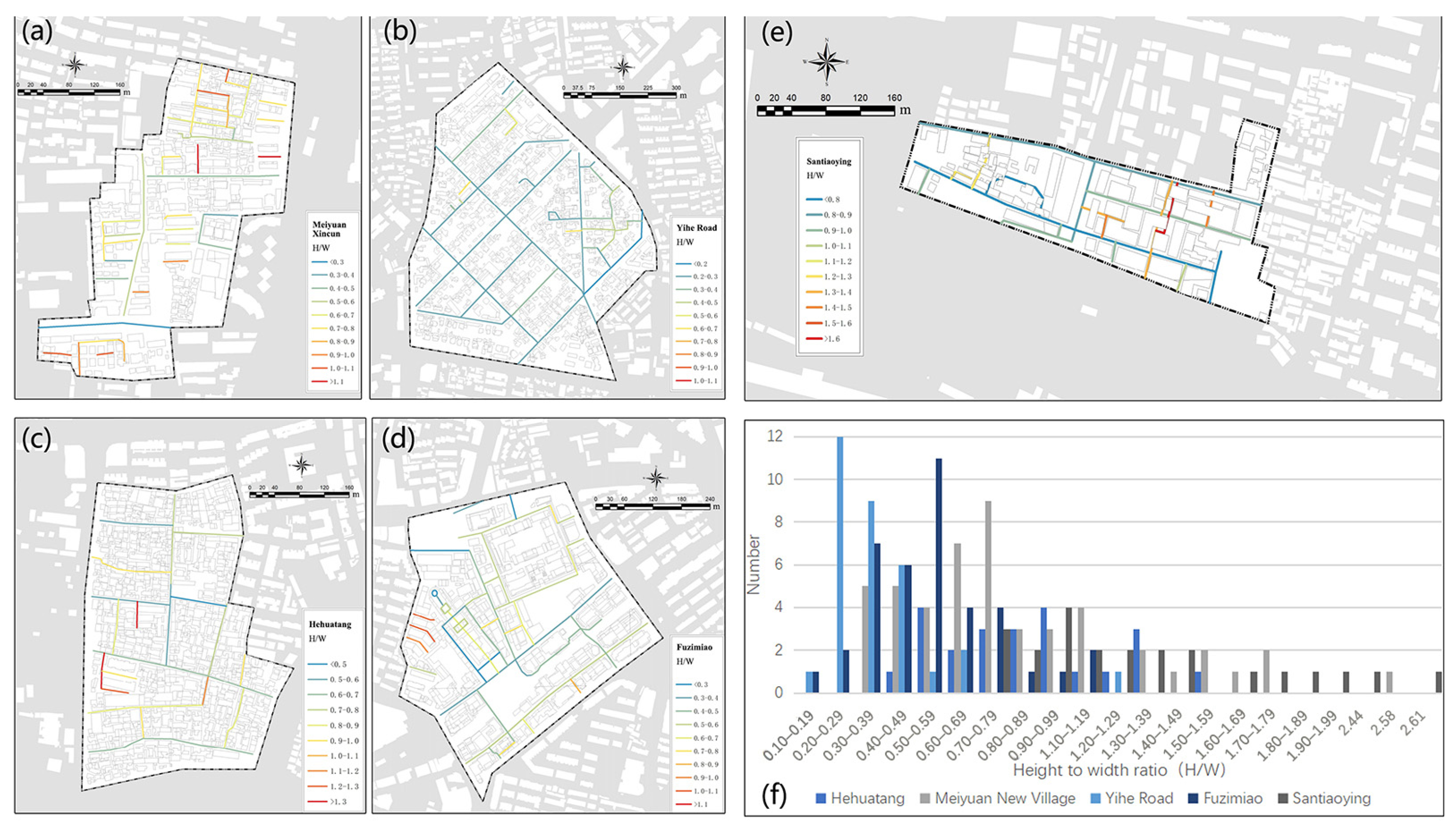
There are 11 historical and cultural districts in Nanjing, and five districts, namely, Yihelu Historical District, Meiyuanxincun Historical District, Hehuatang Historical District, Confucius Temple Historical District and Santiaoying Historical District, were selected after statistical analysis, and the H/W of the five districts were counted by ArcGIS 10.8 (Esri, Redlands, CA, USA), and there were a total of 166 streets included in the counting, and the results of the counting are shown in Figure 1. The street H/W of Nanjing’s various historic and cultural districts are located between 0 and 2.61, of which the H/W of 0.4–1.09 are the most, accounting for 61.4% of the street data. Meanwhile, after the research, it is known that there are four main directions of streets in the historical districts in the main city of Nanjing: north–south (S–N) direction, east–west (E–W) direction, southeast–northwest (SE–NW) direction, and northeast–southwest (NE–SW) direction.
The building outlines and heights of block spaces in Nanjing’s main urban area used for statistics are derived from CSDN open-source data. The street data are self-drawn after verification against Baidu Maps 2021, adopting a projected coordinate system. Based on Nanjing’s geographical location, the WGS 1984 UTM ZONE 50 N zone is selected.
The specific calculation process is as follows: Generate buffer zones using street centerlines, with buffer distances set between 5 and 30 m according to the specific conditions of each block to ensure the buffer zones intersect with most buildings on both sides of the street without excessively exceeding the original street scale. Calculate the average height H of the intersecting buildings through field calculations, and link the intersection data into tables using the same serial numbers. Subtract the area of the part intersecting with buildings from the area of the buffer zone, divide this area by the street length to obtain the average street width W, and divide H by W to get the street aspect ratio H/W [32].

2.2. Data Collection and Analysis

2.2.1. Microclimate Field Measurements

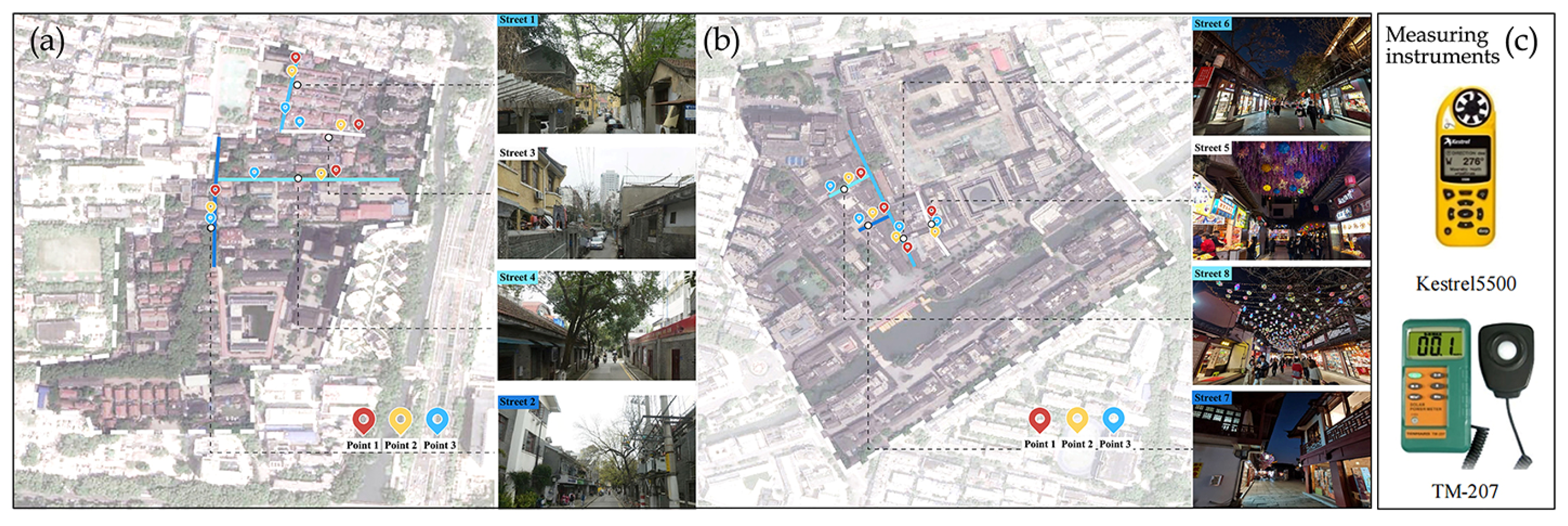
In this paper, streets with H/W ranging from 0.4 to 1.09, two each in the S–N direction, E–W direction, SE–NW direction, and NE–SW direction, labeled Street 1, Street 2, Street 3, Street 4, Street 5, Street 6, Street 7, and Street 8, for a total of eight streets, were selected for the study as the actual test subjects. The first four streets are in Meiyuanxincun, and the last four streets are in Confucius Temple. Measurements were made using a Kestrel 5500 weather station, TM–207 solar power meter, and other instruments. Three measuring Points with different SVFs, labeled a, b, and c, were selected in each of the eight streets, totaling 24 measuring Points (Figure 2). For example, the measurement Points in street 1 are 1–a, 1–b, and 1–c, and so on for the other measurement Points. Field measurements were taken on two days, 10 September and 11 September, and air temperature (Ta), relative humidity (RH), wind speed, and solar radiation (Tmrt) were recorded hourly at a pedestrian height of 1.5 m.

2.2.2. SVF Measurement and Calculation

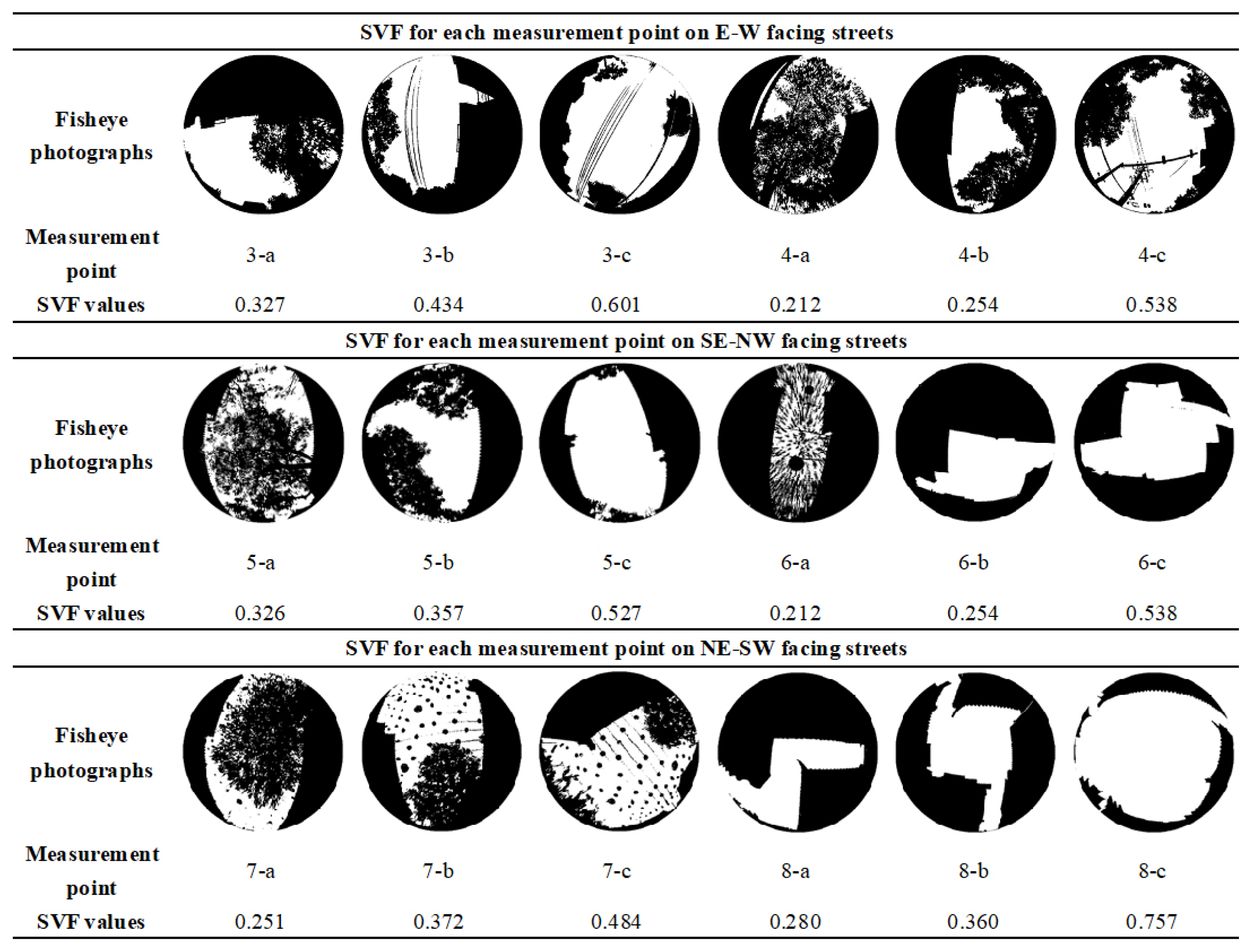
Using a fisheye lens in the street, within the determination of fixed-point shooting, later through the GIS to binarize the photo, and finally, after the calculation to get the SVF value of each measurement Point of the street, the collation of the results is shown. in (Figure 3).

2.2.3. Correlation Analysis of SVF with Microclimate Factors

The measured mean values of climate at each measurement Point are shown in Table 1, and SVF was correlated with each element to obtain the overall correlation analysis graph (shown in Table 2). From a comprehensive point of view, the Pearson correlation between SVF and air temperature and solar radiation is greater than 0.5, which is a strong correlation; the p-value is less than 0.001, which is highly statistically significant, and there is also a strong correlation between solar radiation and air temperature. The Pearson correlation of relative humidity with air temperature and wind speed is greater than 0.5, with medium correlation and a p-value less than 0.05, which is significant. SVF does not have significant linear correlation with wind speed and relative humidity, but there may be different situations between streets in different directions, which need to be further analyzed for different streets.

2.3. Microclimate Simulation

ENVI-met is a three-dimensional fluid non-hydrostatic model simulation software based on Computational Fluid Dynamics (CFD), developed by Professor Micheal Bruse and Professor Heribert Fleer of the University of Mainz, Germany, in 1998 [33], with a relatively complete library of building and plant materials. It is able to simulate air pollution and calculate outdoor thermal comfort, which is convenient and efficient, and the software is also robust [34]. In this paper, “Street 4” Yongyuan Road, which is in the E–W direction in Meiyuanxincun district, is selected for numerical simulation.

2.3.1. Model Validation

Validation of the ENVI-met version 5.0 (ENVI-met GmbH, Essen, Germany). software was conducted through correlation analysis and root mean square error (RMSE) testing. The correlation coefficient is a measure of the degree of association between two variables, with higher values indicating a stronger relationship between the variables. RMSE testing calculates the square root of the ratio of the sum of squared deviations between predicted and actual values to the number of observations, reflecting the deviation between predicted and actual values and thereby assessing the accuracy of the predictions. A smaller RMSE value indicates smaller errors between the predicted and actual values.
In this study, three measurement Points from the field measurements were selected for numerical simulation. It should be noted that in cases with numerous model variables and a limited sample size, caution is required when interpreting correlation coefficients due to the risk of overfitting. Additionally, repeated testing across multiple meteorological elements or scenarios may increase the probability of spurious orrelation. Therefore, in interpreting the results, this study will make comprehensive judgments based on the actual error levels.
Due to the numerous factors influencing instantaneous wind speed during field measurements, ENVI-met simulations exhibit significant deviations in wind speed. Previous validations have rarely included wind speed, so this validation focuses on air temperature and relative humidity.
Accordingly, based on the field measurement results, comprehensive correlation analysis and RMSE testing were performed to validate air temperature and relative humidity.
The correlation coefficient r calculation formula is as follows:
r X , Y = C o v X , Y s q r t V a r X V a r Y
The RMSE calculation formula is as follows:
R M S E = s q r t i = 1 n X o b s , i X m o d e l , i 2 n
The average values of the true air temperature and simulated air temperature at the measurement Points of Street 4 are shown in (Table 3). The minimum difference between the true air temperature and the average simulated air temperature is 0.02 °C, and the maximum difference is 0.39 °C. The minimum difference between the true relative humidity and the average simulated relative humidity is 0.51%, and the maximum difference is 11.81%. Considering that the discontinuity of factors such as wind speed, pedestrian flow, and vehicle flow in the test environment will interfere with the experimental data, as well as the error of the experimental instrument for air temperature being ±0.5 °C and for relative humidity being ±2%, the overall variation trend of the software simulation is consistent with the true values.
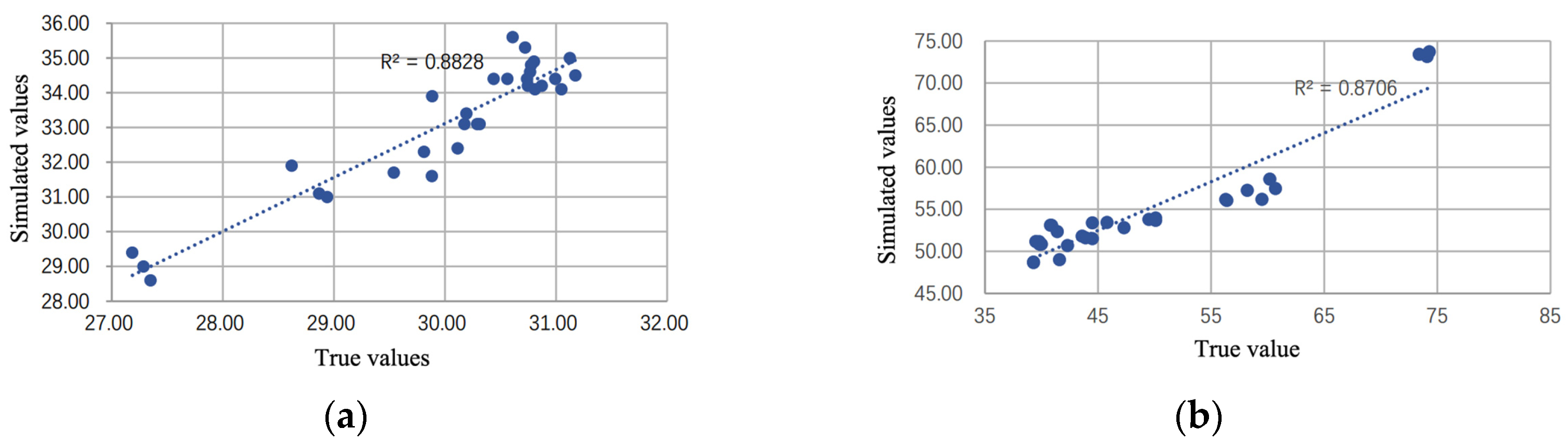
In the correlation analysis (Table 4), the Pearson’s correlation r between the true value of air temperature and the simulated value is 0.980, which is a highly positive correlation, with a significance (p-value) of less than 0.001, which is very statistically significant, and the Pearson’s correlation r between the true value of relative humidity and the simulated value is 0.933, which is a highly positive correlation, with a significance (p-value) of less than 0.01, which is also very statistically significant. The R2 of measured temperature to simulated temperature was 0.883, and the R2 of measured humidity to simulated humidity was 0.871, both greater than 0.8, a good fit and a linear significant positive correlation (Figure 4); in the RMSE test, the RMSE of air temperature in street 4 was 0.25 °C, and the relative humidity was 7.33%, with an error within a reasonable range. In conclusion, the ENVI-met software simulation has validity.

2.3.2. ENVI-met Ideal Modeling and Parameter Settings

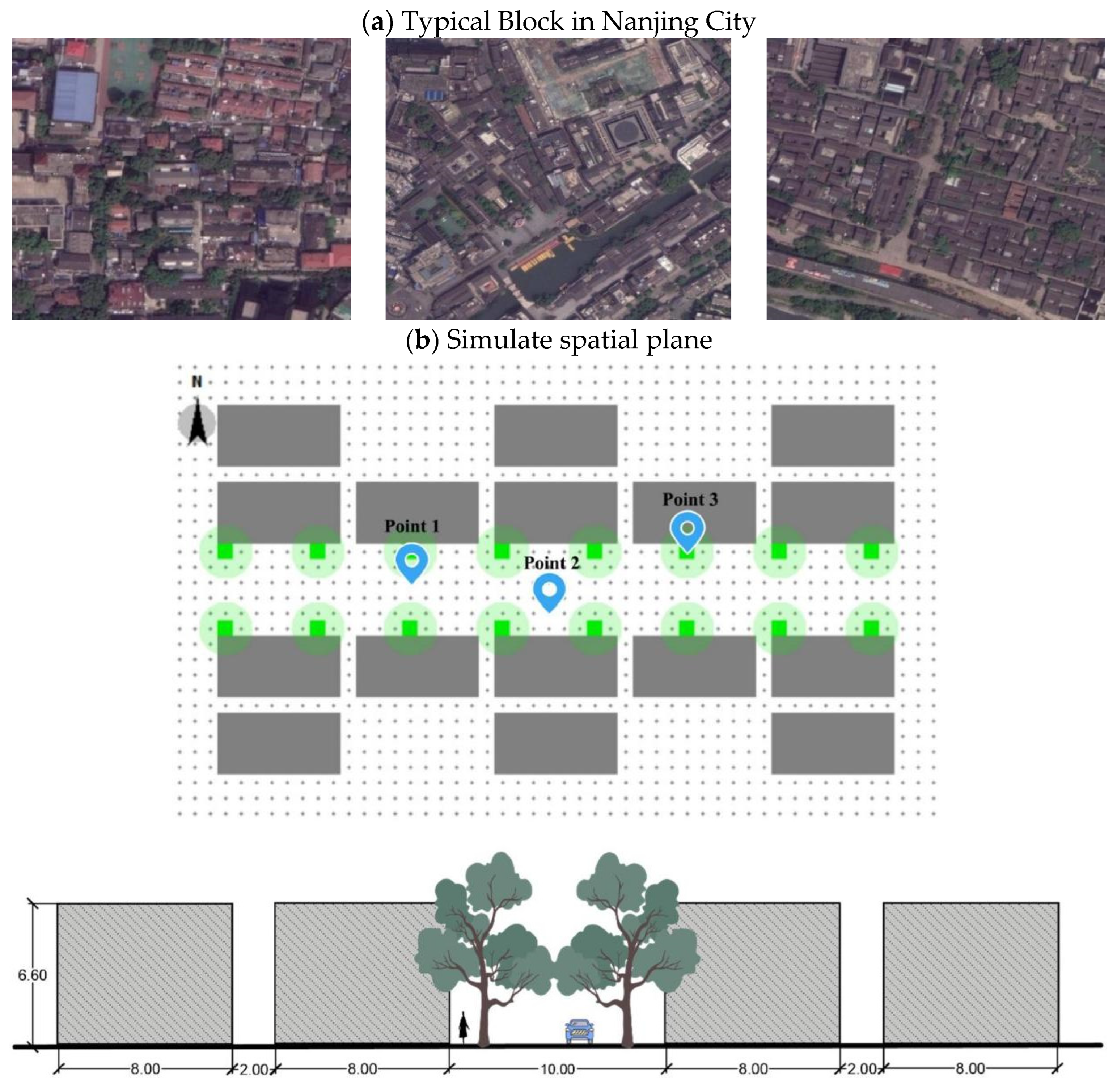
A group of buildings with size 50 m × 30 m × 30 m, resolution 2 m, 8 m × 16 m, 2 floors, height 6.6 m, building spacing 2 m wide, street width 10 m, street H/W 0.66 and sidewalk width 2 m are constructed in Space as simulation space (Table 4). Three observation Points with different SVF are set in the street space.
In selecting the underlying surface materials, based on field survey conditions, asphalt material was chosen for roads, granite material for sidewalks, and the default loamy soil material was used for the remaining areas. The main characteristics of the materials are shown in (Table 5).
According to the survey findings, the main tree species measured along the streets in the study area are primarily London plane, maple, and camphor tree, with heights ranging approximately from 8 to 15 m. In Albero, tree specifications can be selected as young, middle, or old, corresponding to different tree heights. Based on actual conditions, this study selects the middle type for simulation. In Albero, Platanus acerifolia is chosen to represent the London plane, Acer campestre is selected to represent the maple, and a species with high leaf area density (LAD), a rounded canopy, a medium trunk, and medium height is chosen to represent the camphor tree. In the adjustment panel, the “no seasons” option is selected to set it as an evergreen species. The parameters for each tree species are presented in (Table 6).
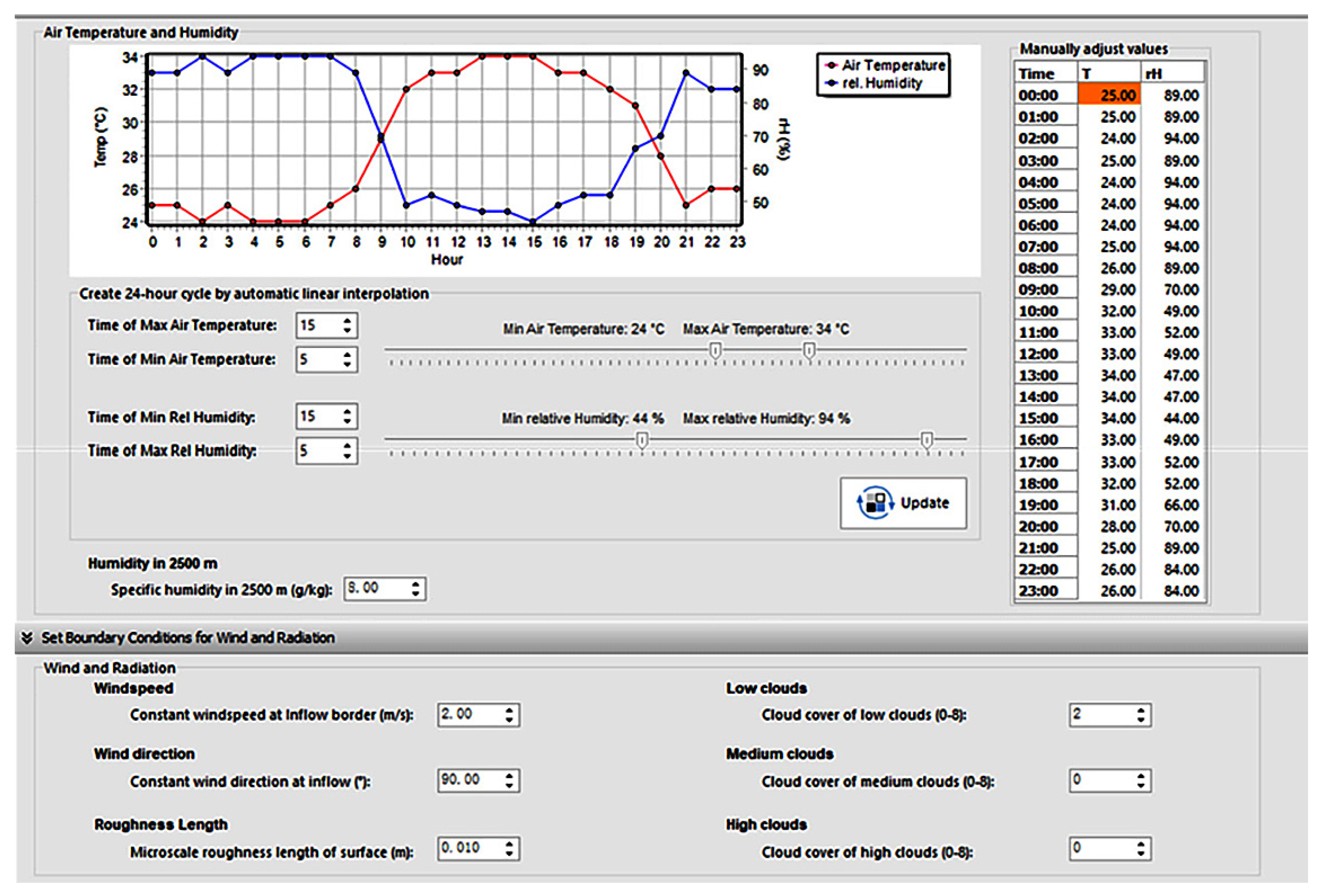
Boundary condition setting: After screening, and the simulation time is 31 July, select Simple forcing in ENVI-guide of ENVI-met; input the weather conditions according to the conditions hour by hour; select 2 m/s for wind speed; select 90° for wind direction (easterly wind), 0 for cloudiness; simulate the simulation time for ten hours starting from 8:00 a.m.; and set up the simulation file according to the different directions of the streets, and then the simulation was carried out in ENVI-core (Data from https://rp5.ru, Nanjing Airport site, accessed on 12 September 2021) (Figure 5 and Figure 6).

2.3.3. Thermal Comfort Indicators

The Universal Thermal Climate Index (UTCI) [35] is a new type of thermal climate indicator applicable to all climatic conditions. It can be expressed as
UTCL = Ta + Offect(Ta,Tmrt,Va,Vd)
= f(Ta,Tmrt,Va,Vd)
The UTCI has a consistent range of thermal sensation levels in different geographic areas, and the UTCI has been proven to have a wide applicability under the study of Blazejczyk et al. [36]. Therefore, in this paper, UTCI is chosen as an evaluation index of thermal comfort in districts.

2.3.4. Simulation Experiment Design

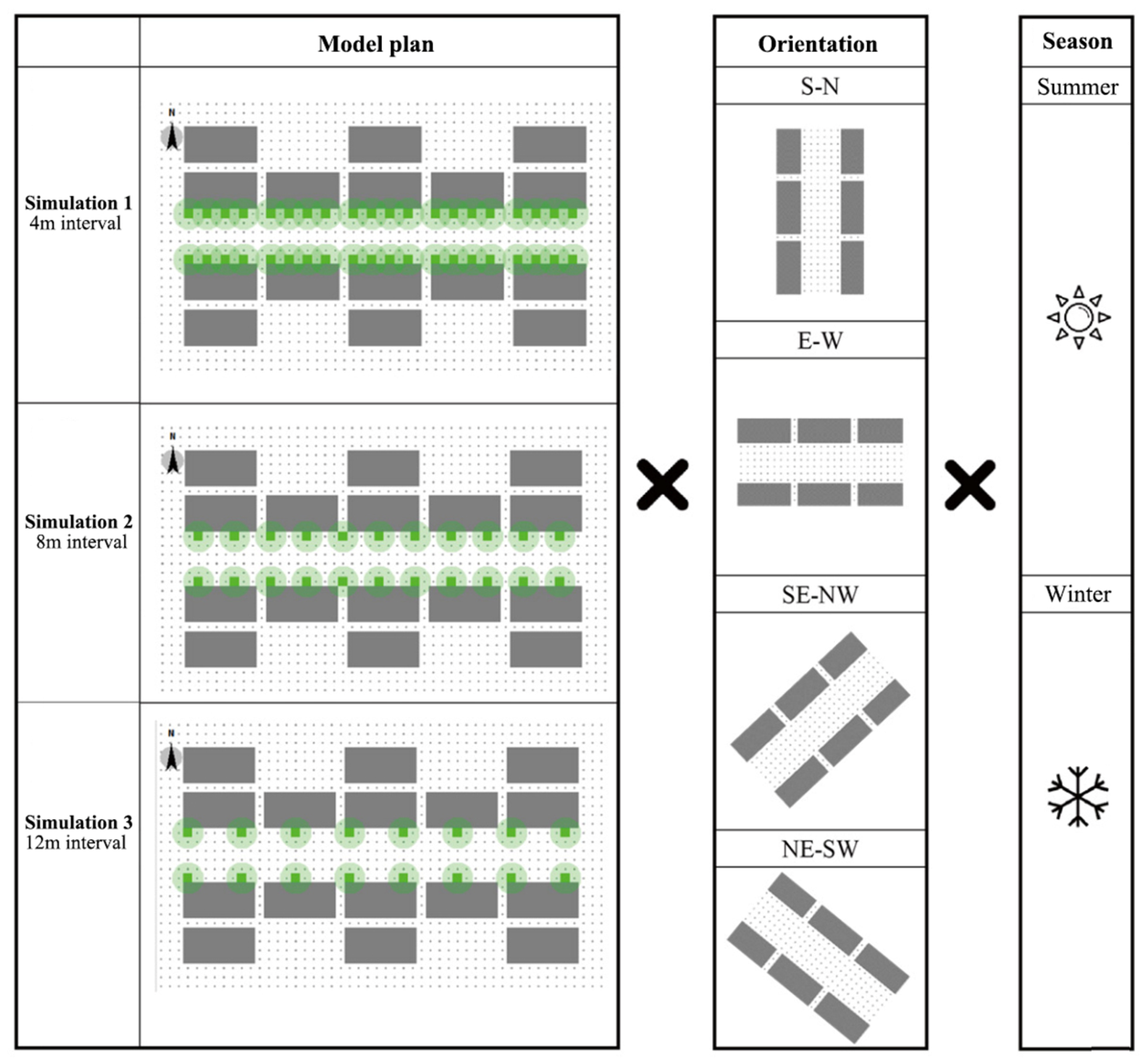
In this paper, street tree spacing is used to vary the SVF values at the measurement Points in order to investigate the effect of SVF on the street microclimate. The street space with planting spacing of 4 m, 8 m, and 12 m will be constructed, respectively; the streets in four directions, S–N, E–W, SE–NW, and NE–SW, will be superimposed, and three monitoring Points with different SVF will be set in each street (Figure 7). Eight results will be obtained for each direction of streets, totaling 24 monitoring Points. The measurement Point at a is 4-a when naming the street tree planting spacing of 4 m, and all the rest of the measurement Points.
According to the research, the main measured street tree species in the site are Fagus sylvatica, maple, and camphor, with a height of 8~15 m; the tree specifications in Albero can be selected young, middle, or old, corresponding to different tree heights. According to the actual situation, this paper selects the middle type for the simulation, Platanusacerifolia was selected to replace Fagus sylvatica, Acercampestre was selected to replace maple, LAD high, round, medium trunk, medium height trees were selected as balsam fir, and no seasons was selected in the adjustment panel to adjust it to evergreen, while SVF for winter and summer seasons at each measurement Point were exported, and the specific results are shown in Table 7.

3. Results

3.1. Summer Simulation Results—Characterization of the Thermal Environment for Different Scenarios

(1)
Air temperature
SVF at street monitoring sites a, b, and c for the typical summer day control group were 0.571, 0.67, and 0.706, and the air temperatures at each monitoring Point showed a trend of increasing and then decreasing with time, and the simulation group showed the same trend (Table 8). The average peak temperatures all appeared at 16:00, with the control group at 32.885 °C. The highest temperatures of the simulated groups were all higher than those of the control group. The highest temperature of the S–N street was 32.997 °C. The highest temperature of the E–W street was 33.135 °C. The highest temperature of the SE–NW street was 32.962 °C. The highest temperature of the NE–SW street was 32.941 °C. This is different from what is traditionally perceived, but should be due to the fact that the overall SVF of the modeled spaces is all lower, and the denser environment affects air flow.
Under the influence of different planting spacings, the air temperature of S–N streets was lower at a planting spacing of 12 m, and the air temperature at Point A was lower at all the measurement Points, and Point C was higher at all the measurement Points; the air temperature of E–W streets was lower at a planting spacing of 8 m, the air temperature at Point A was lower at all the monitoring Points at a planting spacing of 4 m and 8 m, and the air temperature at Point C was lower at all the monitoring Points only at a planting spacing of 12 m; the air temperature of SE–NW streets was lower at a planting spacing of 12 m, and air temperature was higher at Point A and lower at Point C at all monitoring Points; air temperature at NE–SW streets was lower at a planting spacing of 8 m, lower at Point B at planting spacings of 4 m and 8 m, and lower at Point C at a planting spacing of 12 m.
(2)
Relative humidity
The change trend of each street is basically the same; the control group and the simulation group both show the trend of decreasing first and then increasing with time (Table 8). From 9:00 to 18:00, all of them are decreasing first and then increasing, the minimum value of the relative humidity all appeared at 16:00, which coincides with the time of the maximum value of the temperature, and the minimum value of the control group is 51.256%, and the relative humidity of simulated groups are all decreasing compared with that of the control group, with 51.108% for the S–N streets, 51.069% for the E–W streets, 51.366% for the SE–NW streets and 51.239% for the NE–SW streets.
Under the influence of different planting spacings, the relative humidity is lower when the planting spacing of S–N streets is 12 m, and the relative humidity at Point B of each monitoring Point is lower; the difference in relative humidity between E–W streets under different planting spacings is very small, and the relative humidity is smaller when the planting spacing is 12 m; the humidity in NE–SW and SE–NW streets is basically the same, and the relative humidity is lower when the planting spacing is 12 m, and the relative humidity at Point C of the monitoring Point is lower.
(3)
Average radiation temperature
Typical summer day street Tmrt control and simulated time-by-time plots are shown in (Table 8), and the relative humidity at each monitoring Point in the control group shows a trend of decreasing, then increasing, and then decreasing with time, and the overall is relatively stable after 9:00, and the lowest value of the Tmrt average is 22.777 °C at 12:00. The trend of the simulation group is basically the same as that of the control group, but the lowest value occurs at 10:00, with 26.312 °C in the S–N streets, 26.605 °C in the E–W streets, 26.489 °C in the SE–NW streets, and 26.459 °C in the NE–SW streets, which is an overall increase compared to that of the control group, and the increase in SE–NW streets is the most, with a maximum increase of 3.543 °C.
Under the influence of different planting spacings, the lowest mean Tmrt value was found at 12 m planting spacing in the S–N streets; the lowest mean Tmrt value was found at 8 m spacing in the E–W streets, with the lowest Tmrt value at Point A; the lowest mean Tmrt value was found at 12 m planting spacing in the SE–NW streets, with the lowest Tmrt at Point B, and the lowest Tmrt value was found at Point A at planting spacing of 4 and 8 m; Tmrt was lowest at planting spacing of 8 m in the NE–SW streets.
(4)
UTCI
The control and simulated time-by-time plots of street UTCI on a typical day in summer are shown in (Table 8), and the UTCI at each monitoring Point in the control group showed an overall trend of decreasing, then increasing, and then decreasing over time, with the minimum value of the average UTCI value appearing at 13:00 during the overall simulation. The trend of UTCI change for each street in the simulation group was basically the same, experiencing three decreases and two increases from 8:00 to 17:00. Except for the minimum value of UTCI for the E–W-oriented street, which appeared at 12:00, and was 31.328 °C, the minimum values for the rest of the streets appeared at 13:00, with 31.415 °C for the S–N-oriented streets, 31.405 °C for the SE–NW-oriented streets, and 31.477 °C for the NE–SW-oriented streets. According to the comfort classification of UTCI, 32–38 °C belongs to the hot zone and 26–32 °C belongs to the warm zone, and the E–W-oriented streets, which have the lowest UTCI among the streets, are the most comfortable with a mean value of 31.895 °C.
Under the influence of different planting spacings, the mean value of UTCI for all four alignments of streets was taken to be the lowest at a planting spacing of 12 m. At this Point, the UTCI was the lowest at Point B among all the measurement Points.

3.2. Summer Correlation Analysis and Discussion

From the above study, it is clear that SVF has a relationship with air temperature, relative humidity, mean radiant temperature, and UTCI, and in order to explore the specific relationship between them, regression analyses were conducted to analyze the SVF with each influencing factor in terms of seasons and streets.
(1)
SVF and air temperature
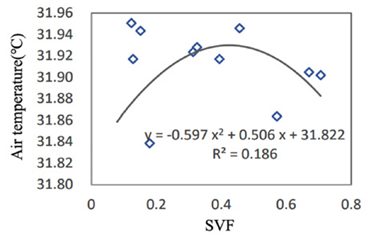
As can be seen from Table 9, the R2 of the fitted curve of air temperature and SVF in summer is only greater than 0.3 for streets in the SE–NW-oriented streets, and the p-value of all streets is greater than 0.05, which is not statistically significant, and the difference is not statistically significant; in terms of sub-direction, there is no obvious relationship between the SVF and the air temperature of each street. This is the same as the results of Li Jingjin et al. [37]. It shows that the streets of Nanjing historical and cultural districts in the summer is not simply the more shaded space, the lower the radiation value, the lower the temperature, SVF can not directly affect the air temperature, or maybe the simulation space is more ideal than the actual space, the actual street interface of the various changes produced by the climate of the space is more complex.
(2)
SVF and relative humidity
The linear R2 in the fitted curves is higher than the quadratic curves, so the linear relationship is used for the description. As can be seen from Table 9, the linear fit of relative humidity in summer has some significance; R2 is greater than 0.3, the fit is more meaningful, the p-value is less than 0.05, and the difference is more significant. SE–NW-oriented streets have a higher fit, and the difference in the data is also higher compared to the other directions. The overall trend is that the relative humidity decreases as the SVF increases, and the S–N-oriented streets have the fastest decreasing speed, with the mean relative humidity decreasing by −0.104% for every 0.1 increase in SVF; the E–W-oriented streets have the slowest decreasing speed, with the mean relative humidity decreasing by −0.039% for every 0.1 increase in SVF.
(3)
SVF and average radiation temperature
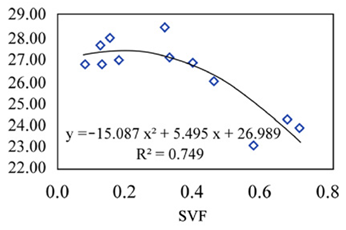
As can be seen from Table 9, the curve fit of Tmrt in summer is higher; R2 is greater than 0.6, the fit is significant, p-values are less than 0.05, and the difference is significant. S–N-oriented street has a higher fit, and the variability of the data is also higher compared to the other directions. The overall trend is that Tmrt increases and then decreases as SVF increases. The mean values of Tmrt for the S–N-, SE–NW-, and NE–SW-oriented streets all obtain their maximum values when SVF is less than 0.2, and the E–W-oriented street obtains its maximum value near the SVF of 0.1, which is the largest among the four streets, and the S–N-oriented street is the lowest.
(4)
SVF and UTCI
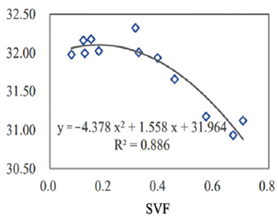
As shown in Table 9, the curve fits of summer UTCI are very high, with R2 greater than 0.7, which is a significant fit, and the p-values are less than 0.001, except for the SE–NW-oriented street, which is a significant difference. The overall trend is that the mean value of UTCI increases and then decreases with the increase in SVF, and the mean value of UTCI in the E–W-, SE–NW-, and NE–SW-oriented streets obtains the maximum value when the SVF is less than 0.2, and the maximum value of UTCI in the S–N-oriented street is near 0.1. Therefore, when designing small-scale streetscapes, one should try to avoid overly confined spaces, which can lead to reduced comfort.

3.3. Winter Simulation Results—Characterization of the Thermal Environment for Different Scenarios

(1)
Air temperature
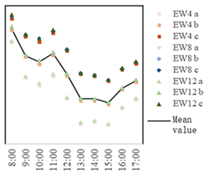
The SVF corresponding to street monitoring Points A, B, and C were 0.571, 0.67, and 0.706 for the typical winter day control group. And the air temperatures of the monitoring Points in the control group showed a trend of increasing and then decreasing, while the trend of the air temperature in the simulation group was the same as that of the control group, and the peaks of the mean temperatures all appeared at 15:00. The peak temperature of the S–N street was 0.25 °C. The peak temperature of the E–W street was 0.45 °C. The peak temperature of the SE–NW street was 0.343 °C. The peak temperature of the NE–SW street was 0.272 °C. All of these were higher than that of the control group, with the NE–SW street increasing the most, by 0.21 °C. Overall, E–W streets still had the highest average temperature of −0.559 °C, and NE–SW streets had the lowest average temperature of −0.658 °C.
Under the influence of different planting spacings, the air temperature across all four street orientations tended to be higher at the 4 m planting spacing, with Point A typically recording higher temperatures and Point C lower at each monitoring Point, except for S–N streets, where Point B was lower, and NE–SW streets, where Point B was higher.
(2)
Relative humidity
The trend of change was basically the same for all streets, with two increases and two decreases from 9:00 to 18:00. The minimum value of relative humidity appeared at 15:00, which coincided with the time of the maximum value of temperature, which was 56.42% for the S–N street, 52.391% for the E–W street, 54.712% for the SE–NW street, and 55.871% for the NE–SW street; relative humidity decreased from the control except for E–W street, with SE–NW street experiencing the greatest decrease of 0.92%. Overall, the highest RH was 61.874% in the S–N street, and the lowest was 57.523% in the E–W street.
Under the influence of different planting spacing, relative humidity tended to be lower at narrower planting spacings (4 m or 8 m) for most streets, with the specific measurement Point (A, B, or C) showing the lowest humidity varying by orientation. In general, except for the S–N street, the difference in relative humidity between the same measurement Points in each direction is not significant.
(3)
Average radiation temperature
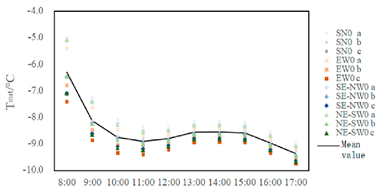
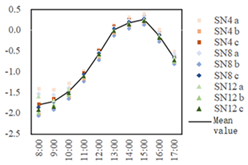
The trend of Tmrt changes in each street is basically the same; from 9:00 to 18:00, all of them are decreasing, then increasing and then decreasing, and the larger value of Tmrt in the simulation process occurs at 14:00. On the whole, the Tmrt of the S–N street was the highest at −3.614 °C, and the Tmrt of the E–W street was the lowest at −4.371 °C. The highest mean Tmrt values were generally found at 4 m planting spacing across orientations, with Point B often recording the highest Tmrt values.
(4)
UTCI
The minimum mean UTCI values were −0.75 °C for S–N-oriented streets, −4.902 °C for E–W-oriented streets, −3.735 °C for SE–NW-oriented streets, and −3.521 °C for NE–SW-oriented streets. Compared to the control group, the UTCI increased in all streets. The largest increase in the S–N street was 3.282 °C. According to UTCI Comfort Classification, −13 to 0 °C belongs to the cold zone, and 0 to 9 °C is the cool zone. The highest mean UTCI value of −0.219 °C was recorded for S–N-oriented streets. The cool zone is 4 h and is overall significantly more comfortable than the rest of the street. E–W-oriented street UTCI average is the lowest at −4.326 °C, all in the cold range.
Under the influence of different planting spacings, the highest mean UTCI was found at 4 m planting spacing in the S–N-oriented street with 5 h in the cool zone. Point A was the highest among the measured Points, with 8 h in the cool zone. 12 m planting spacing in the E–W street had the highest mean UTCI values, all of which were cool intervals, with Point a being the highest among the measured Points. For the SE–NW street, the highest mean UTCI values were found at 4 m planting spacing, all in the cold range, and Point B was the highest among the measured Points. The highest mean UTCI values were found at 12 m spacing between street plantings in the NE–SW street, all in the cold zone, with Point a being the highest among the measurement Points.

3.4. Winter Correlation Analysis

(1)
SVF and air temperature
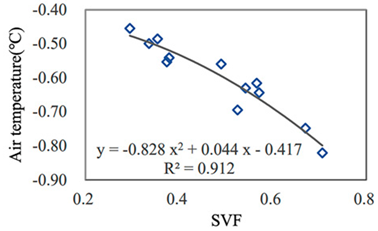
The curve fits for winter air temperatures were very good (R2 > 0.5, p < 0.05), indicating a significant fit. E–W, S–N, and NE–SW streets exhibited a general trend of air temperature first increasing and then decreasing with rising SVF, while SE–NW streets showed a decreasing trend. The average values of air temperatures in the E–W streets have maximum values near SVF 0, S–N streets have maximum values near SVF 0.26, and NE–SW streets have maximum values near SVF 0.4. The minimum value of the SE–NW direction has its minimum value when SVF > 1, but SVF > 1 does not have practical significance, and so it does not have a minimum value. Initial air temperatures are highest toward streets SE–NW and lowest toward streets NE–SW. NE–SW street air temperature maxima are the lowest among the streets, and E–W streets are the highest.
(2)
SVF and relative humidity
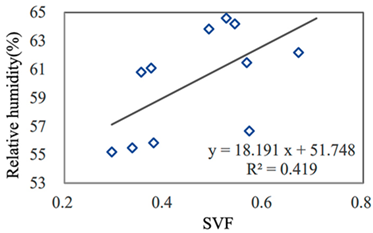
The linear fits for SE–NW and NE–SW street relative humidity in winter were meaningful (R2 > 0.3, p < 0.05). In contrast, the fits for E–W and S–N streets were not statistically significant (p > 0.05), suggesting SVF does not directly affect relative humidity in these orientations during winter. For SE–NW and NE–SW streets, relative humidity generally increased with SVF. The SE–NW streets showed a faster increase rate, with mean relative humidity rising by 1.819% for every 0.1 increase in SVF (Figure 4), and exceeding that of NE–SW streets when SVF > 0.6.
(3)
SVF and average radiation temperature
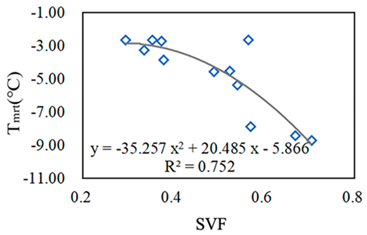
The curve fit for winter Tmrt was high (R2 > 0.6, p < 0.05), indicating a very significant relationship. In general, the Tmrt of each street shows a trend of increasing and then decreasing with the increase in SVF (Figure 4). The average values of Tmrt of S–N and NE–SW streets are maximized around SVF 0.3, the maximum values of E–W and SE–NW streets are maximized around SVF 0.1, and the maximum value of the E–W street is the largest among the four, which is consistent with the summer. Tmrt maxima are lowest for NE–SW-oriented streets. Tmrt initial values are highest for SE–NW-oriented streets and lowest for S–N-oriented streets, again as in summer.
(4)
SVF and UTCI
The curve fits for winter UTCI were very good (R2 > 0.7, p < 0.05), showing a significant relationship. In general, the mean UTCI values tended to increase and then decrease with increasing SVF (Figure 4). According to the UTCI thermal sensory temperature range, the simulated mean UTCI for this day is in the cool range except for the S–N street SVF of 0~0.4, where the UTCI is > 0 °C. The rest of the time is in the −13~0 °C range, which is in the cool range. The average S–N street UTCI value maximizes around the SVF of 0.1. The E–W street maximizes around the SVF of 0.4. SE–NW and NE–SW streets are maximized around SVF 0.3. The S–N street had the highest mean maximum UTCI value, indicating it was the most comfortable orientation, while the E–W street had the lowest, indicating the least comfort. This pattern of initial UTCI values was also consistent with summer findings.

4. Discussion

4.1. Microclimate Status of the Study Sample Sites

Combining the above analyses, typical parcels were selected from the five districts studied to analyze their problems and optimize their design.
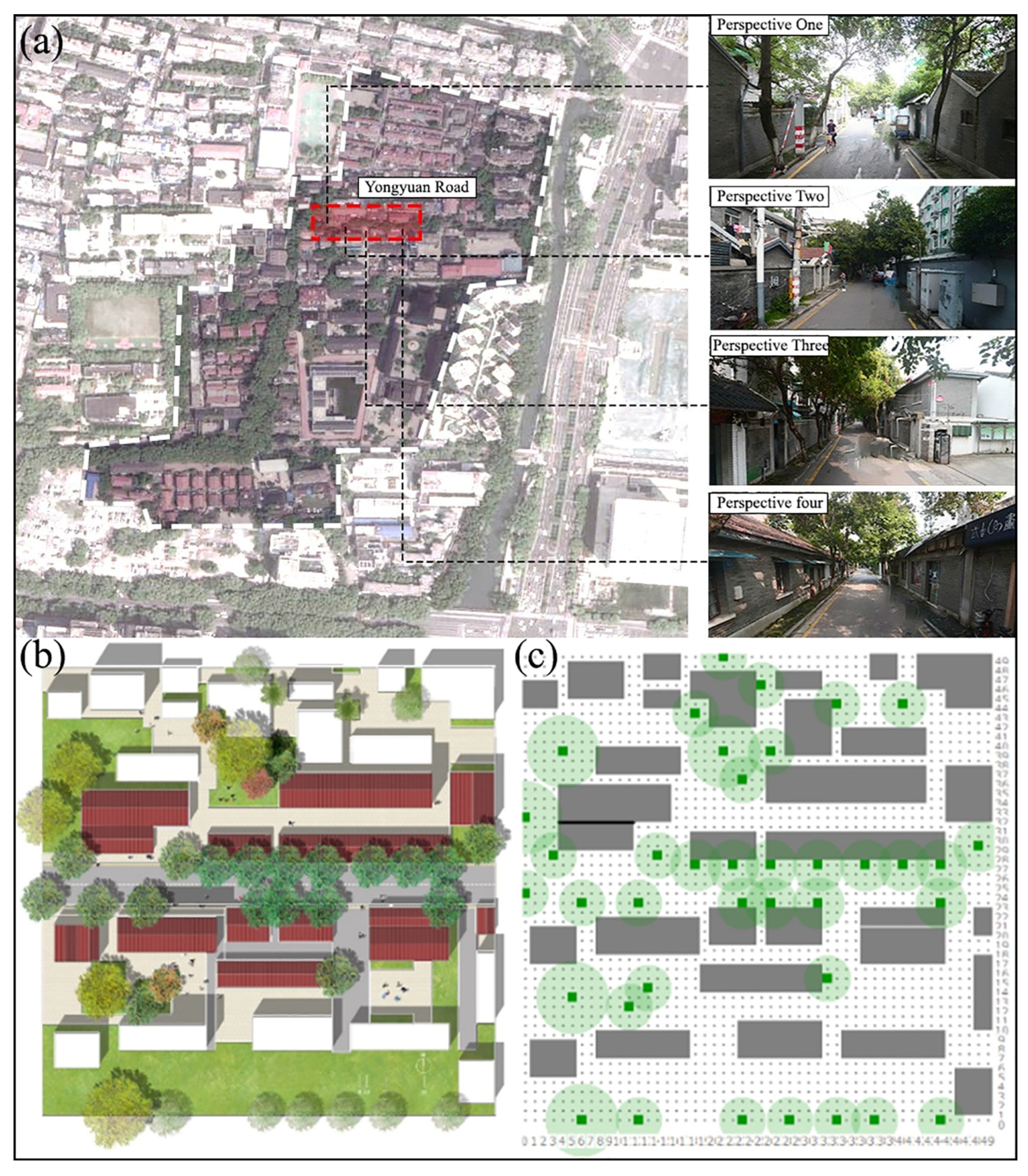
Meiyuanxincun is located in Xuanwu District, Nanjing. Yongyuan Road is located in the middle of Meiyuanxincun, E–W direction, with both sides being Republic of China buildings. The number of floors is between one and three, and the width of the road is about 10 m. Most of the street trees are evergreen camphor trees with a height of about 12 m, and some pentagonal maple trees of about 15 m on both sides (Figure 8a). The color map of Yongyuan Road is shown in Figure 8b, and the model plan is shown in Figure 8c. Trees are planted densely in the street, especially on the north side of the middle of Yongyuan Road, with the narrowest planting spacing of 3.6 m. There are relatively fewer trees on the south side, which is also due to the narrowness of the street, and the street trees are planted close to the buildings, and there are also sporadic shrubs in the street. On the whole, the buildings in the district are not tall; the buildings along the south side of Yongyuan Road are taller, between 1~3 floors. The buildings along the street on the north side are between 1~2 floors, which is relatively low.
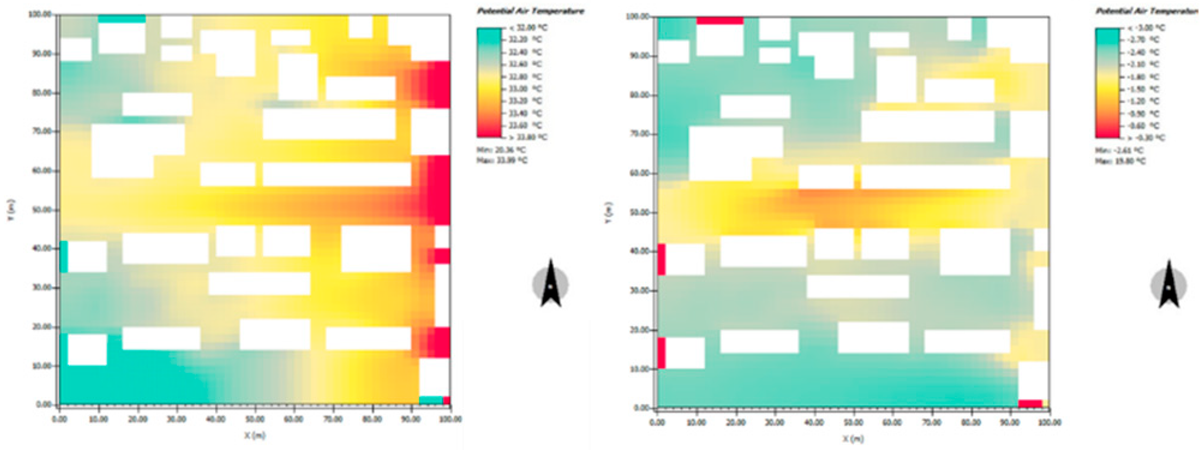
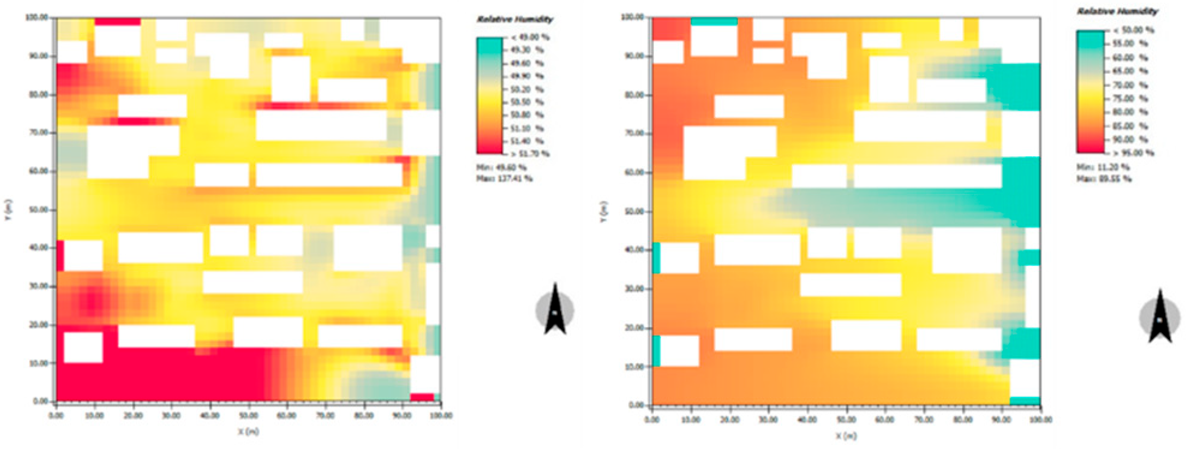
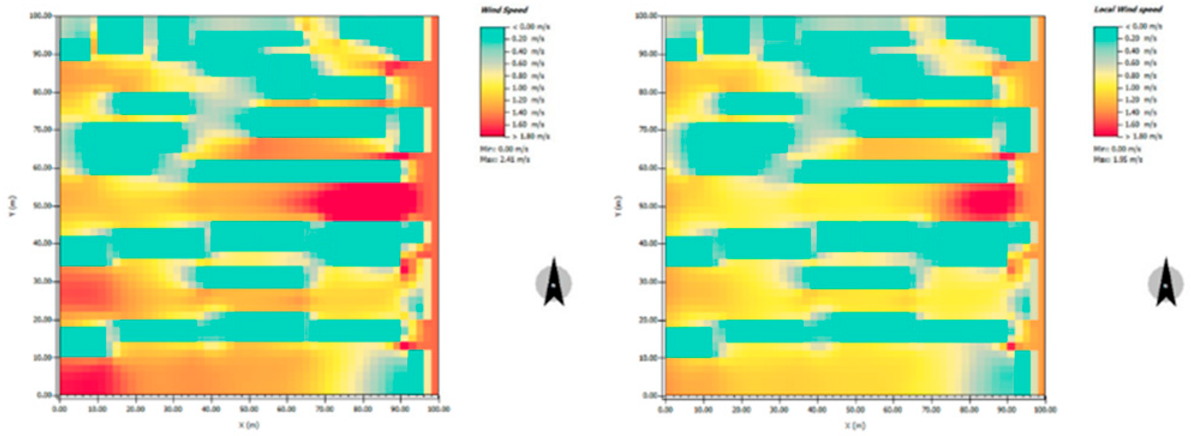
Through the simulation of the current situation of the site in ENVI-met software, it is found that the SVF of the whole street is concentrated between 0 and 0.6. In summer, the SVF of the central part of Yongyuan Road is concentrated between 0 and 0.2, the SVF of the east side is concentrated between 0.2 and 0.5, and the SVF of the west side is concentrated between 0.4 and 0.6. The street is more open on the west side, too dense in the center, and denser on the east side. Through the observation of the whole daytime Point on a typical summer day, the highest summer UTCI value and the worst comfort level were observed at 16:00, so the slice with k = 3 (1.4 m) pedestrian height at 16:00 was selected for analysis. The thermal environment characteristics of the research sample site in summer are as follows (Table 7): the current situation air temperature generally shows a gradual decrease from east to west, and the temperature of the location with trees locally rises. Yongyuan Road belongs to the higher temperature location in the whole simulation area, and the overall temperature range mainly focuses on the range of 32.8–33.6 °C. The eastern location is higher, and the western is lower, with a difference of 1 °C. There is no obvious relationship with the SVF. That is to say, it is not that the more trees, the lower the temperature, which is more consistent with the simulation. The current humidity shows that the sample site is concentrated at about 50%, and the southwest corner has a higher relative humidity. The wind speed in the middle of Yongyuan Road and the southwest corner of the area is higher, while the wind speed between the buildings and the location of the atrium is lower. It is decreasing step by step from the east to the west in the street, and the wind speed of the downwind location in the middle of the more dense trees is obviously weakened. The reason for this is that the middle part of Yongyuan Road is due to the excessive density of trees, which leads to local warming, and the Tmrt value increases. The mean radiant temperature of tree-lined streets is higher than that of treeless streets mainly because the addition of trees—especially when the distance between buildings and trees is relatively small—impedes air circulation in the area. The reduced wind speed leads to an increase in temperature. Furthermore, in the absence of tree canopies, the enhanced long-wave radiation exchange with the sky background also contributes to the rise in mean radiant temperature [38]. The UTCI thermal map of the current situation of Yongyuan Road in summer is shown in Table 10. On the whole, the Points with higher UTCI in the simulation image are planting areas with trees, which again verifies the conclusions in the simulation process. Yongyuan Road is the area with a high UTCI in the simulated area, which is a relatively uncomfortable area. Among them, the center is the most uncomfortable, followed by the west side. Part of the east side performs better, which is also consistent with the above analysis of SVF. The reason for this is that the middle part of Yongyuan Road is due to the excessive density of trees, which leads to local warming, and the Tmrt value increases. Although the air temperature is lower on the west side, the wind speed in the downwind direction is lower, and the humidity is accumulating, so the comfort level is reduced, but the overall temperature is better than that in the middle. Although the air temperature on the east side is high, due to the influence of the throttling effect, the opening position of the street section is small, the wind pressure decreases, the pressure difference between the vertical plane occurs, the wind speed increases, the Bernoulli effect is formed, and the convection is intensified, resulting in the wind entering the street accumulating at the opening of the entrance and building section and the humidity is reduced. The dense trees also block the sun’s short-wave radiation, making it a comfortable area for the whole street.

4.2. Optimized Design for Street Microclimate Adaptation in Historic Districts

4.2.1. Microclimate Adaptation Measures

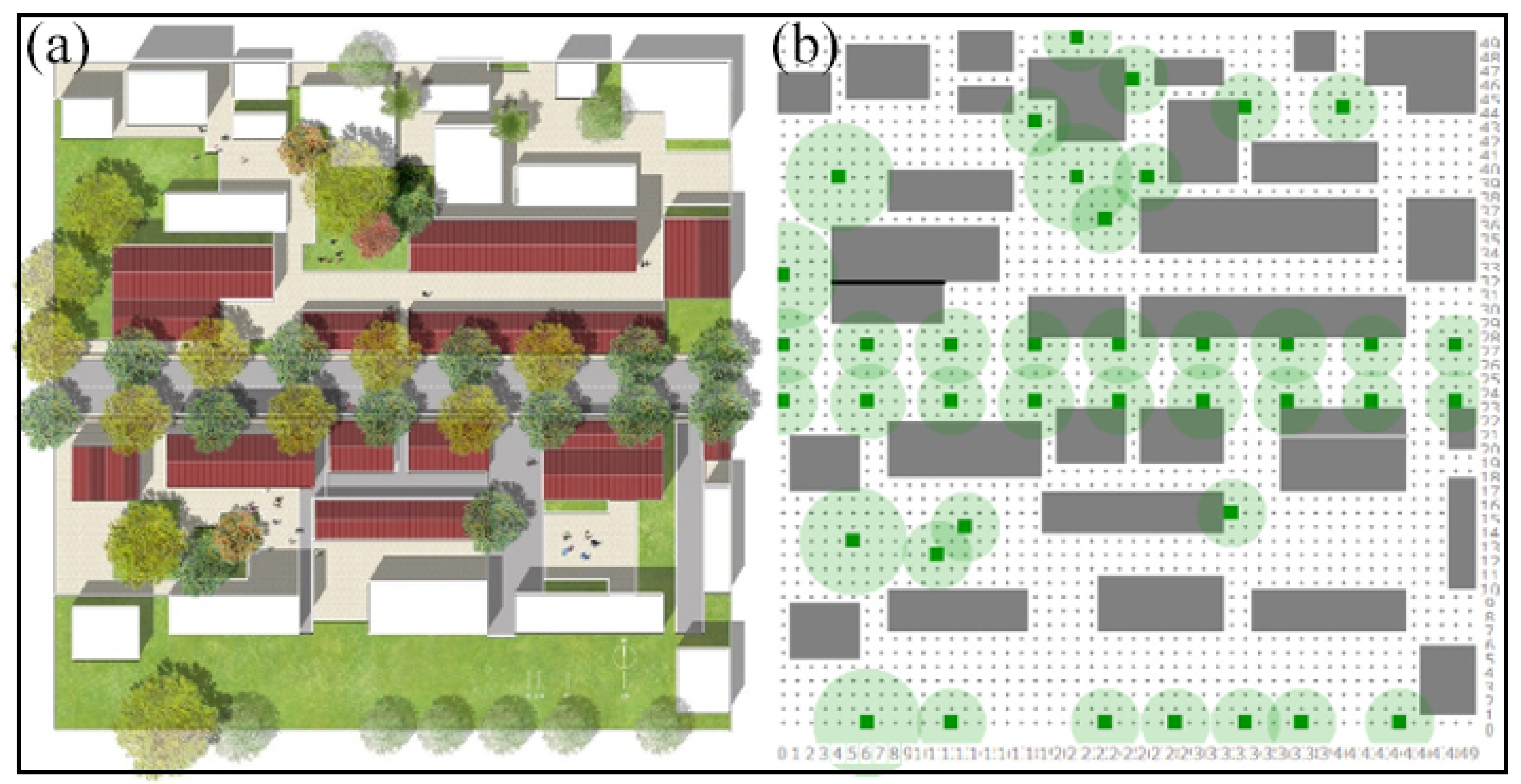
Through the analysis of the current situation of Yongyuan Road, it can be seen that the E–W street of Yongyuan Road performs better in all directions in summer, and has better basic conditions, but there is also a phenomenon of warming caused by over-density of trees in some areas of the interior of the street in summer, which not only fails to achieve the comfortable effect, but also wastes the resources. Our findings have shown that trees planted without proper planning will reduce airflow movement and adversely affect outdoor thermal comfort. Therefore, this paper optimizes the microclimate of the sample site through the following two aspects: the color plan and the model space plan after the renovation are shown in Figure 9:
(1)
Tree spacing adjustment
Most of the streets on the original site are planted with evergreen trees, and the proportion of streets with relatively narrow canopy areas is too large. Trees spaced too close together are more likely to lead to a decrease in SVF, so the SVF value of the site is mainly increased by increasing the spacing of street trees. Based on the previous simulations (Table 11), the 12 m spacing performed better in E–W streets. This indicates that in such smaller-scale blocks, a larger planting spacing is more appropriate. The density of the existing site is obvious; the middle part is too dense, and the west side is sparse. Therefore, a planting spacing of 12 m was chosen to evenly distribute the SVF of the street to improve the microclimate environment.
(2)
Tree species selection
The middle of the street of the original site is mostly evergreen trees. There was a significant difference in the distribution of SVF values in the streets. Therefore, in order to obtain the SVF value between 0.3~0.6, the selection of evergreen tree species will be reduced, and the deciduous tree species will be increased. Deciduous species should also be selected with a medium leaf area density (LAD). Species with an excessively high LAD will have a low SVF. The evergreen trees used in the current site have a higher LAD, and the SVF tends to be close to 0; excessive density will lead to an increase in temperature. Therefore, in this paper, the broad-leaved deciduous tree species plane was selected and planted alternately with Field Maple to replace the evergreen species in the field and reduce the SVF.

4.2.2. Optimization Comparative Analysis

The comparison before and after optimization is shown in (Table 12):
The SVF heat map of a typical summer day (Table 12) shows that the SVF of Yongyuan Road is between 0.2~0.5 in the average summer day. Due to the increase in the spacing of street trees, the SVF value decreased significantly after replanting trees in the original sparse area on the west side, which decreased by about 0.1. The SVF on the east side has also increased by about 0.1 from the previous low level. The heat map of relative humidity after summer renovation in the simulation diagram (Table 12) shows that the relative humidity in Yongyuan Road is concentrated in about 49.6%~50.5%. Compared to before the transformation, the overall relative humidity has decreased significantly by about 0.6%. There was more decline in the west, and there was also a decline in the center. There is a partial increase in the east, which is probably due to the addition of evergreen shrubs on the east side. Evergreen shrubs increase water vapor near the shrubs by transpiration, and the relative humidity partially increases. The wind speed heat map after the renovation shows that, compared with before the transformation, the wind speed of Yongyuan Road after the renovation is concentrated in 1~2 m/s. The area with higher wind speed on the west side was significantly reduced, and the wind-blocking effect of evergreen shrubs is obvious. Evergreen shrubs reduce wind speed by 1 m/s. The slight increase in wind speed on the east side is mainly due to the more regular location of the street trees and the replacement of small tree species, which reduces the wind-blocking effect. The Tmrt heatmap after the renovation shows that the Tmrt as a whole has become more uniform, as the overall position of the street trees has become more uniform compared to before the retrofit. At the same time, the overall Tmrt increased due to the replanting of trees, and the Tmrt in some locations increased by about 1 °C. Although the air temperature and relative humidity have decreased, the UTCI still has a local increase. The UTCI value after the renovation is more evenly distributed in the street, and the overall performance is more consistent with the Tmrt performance. In terms of segments, the central UTCI after the renovation is about the same as it was before the transformation. The area of UTCI value between 31.8~32.1 °C on the west side increased, and the area of 32.4 °C and above decreased. On the east side, due to the intervention of evergreen shrubs, the UTCI value has increased. In other words, the comfort of the UTCI on the west side has been partially improved in summer. Although the comfort level in the middle is the same, the wider planting spacing saves tree resources.

5. Conclusions

This study contributes to incorporating considerations of microclimate comfort into the design of street spaces in historical districts of hot-summer and cold-winter regions, such as Nanjing, in the future, making the design more scientific and providing a reference for future planning decisions. It is important to acknowledge that the field campaign was conducted on eight streets over two days in early September, and the detailed winter analysis and SVF thresholds are based solely on ENVI-met simulations, as no winter field measurements were available. The main findings of this paper are as follows.
(1) It was found that SVF was correlated with air temperature, relative humidity and solar radiation.
(2) Based on simulations of typical street spaces within the historical districts of Nanjing, this study examines the thermal comfort characteristics of streets with different orientations under identical environmental conditions. The results reveal the following patterns.
① On a typical summer day, E–W-oriented streets exhibit lower mean UTCI values than streets in other directions, indicating the highest level of thermal comfort, while S–N-oriented streets perform the worst.
② On a typical winter day, the mean UTCI values of S–N-oriented streets are higher than those of other orientations, suggesting superior thermal comfort in winter, whereas E–W-oriented streets demonstrate the poorest performance.
③ Considering both seasonal scenarios, SE–NW- and NE–SW-oriented streets maintain moderate and relatively balanced thermal comfort throughout the year. Therefore, urban design and planning in historical districts should prioritize these two orientations when configuring pedestrian routes and spatial nodes. In addition, design interventions should focus on enhancing winter comfort along E–W streets and mitigating excessive summer UTCI values along S–N streets.
(3) There is a difference in the performance of each street in different planting spacing, specifically in the S–N and SE–NW streets; street tree planting spacing of 8 m can be achieved with a more comfortable feeling, while in the E–W and NE–SW streets, street tree planting spacing of 12 m can be achieved with a more comfortable feeling in the summer. It shows that in the summer of Nanjing, the street space of the historic district is not the denser the trees, the lower the SVF, the higher the comfort, but the overly dense space will lead to the accumulation of humidity and the increase in air temperature.
(4) Through the regression model of SVF and microclimate factors and comfort, the following results are obtained.
① The SVF of S–N-oriented streets should be maintained at 0.3 to 0.5 in the summer, so that it is appropriate to plant trees with higher LAD and higher branches, thus ensuring the formation of ventilation corridors in the summer.
② E–W-oriented streets should avoid the vicinity of 0.2 SVF in the summer, and it is more reasonable that SVF should remain near 0.4 to 0.6, with broadleaf deciduous trees recommended.
③ SE–NW-oriented streets should avoid the vicinity of 0.2 SVF in the summer, and NE–SW-oriented streets are about the same as SE–NW-oriented streets, so it makes more sense that the SVF should remain near 0.3 to 0.5.
④ SVF was highly correlated with UTCI in all streets, and the R2 of the fitted curves of SVF with UTCI toward streets S–N, E–W, SE–NW, and NE–SW in summer were 0.832, 0.783, 0.746, and 0.886.
Overall, it is reasonable to control the SVF value of streets in Nanjing’s historic districts at 0.3~0.6. Too open or too closed will reduce the comfort of the district microclimate environment.
(5) Insights into microclimate optimization in historic districts
Regarding the renovation of Yongyuan Road, the following key optimization insights are mainly obtained for the planning of urban historical districts in hot-summer and cold-winter regions:
① Planning for reasonable planting spacing
Reasonable planting spacing can, on the one hand, obtain suitable SVF values and, on the other hand, save unnecessary waste of plant resources.
② Choosing the right tree species
When planting street trees, consider the crown width, seasonal characteristics, and height under the branches on the one hand, and the LAD value of the trees on the other hand.
③ Considering a variety of top masking options
In the above simulation, the interference of trees and shrubs as SVF is taken into account, and the traditional methods, such as awnings, arcades, and cold alleys along the street in real life, are all active adaptations to the environment.
④ Vertical greening
On the one hand, vertical greening can save the footprint of greening and improve the utilization of land resources, and on the other hand, the effect of vertical greening on the improvement of microclimate has also been confirmed by early studies.


Author Contributions

Conceptualization, S.G.; methodology, S.G., Y.L., and M.F.; software, Y.L. and M.F.; formal analysis, S.G., Y.L., and M.F.; investigation, Y.L., M.H., and X.Z.; data curation, S.G.; writing—original draft preparation, S.G. and M.F.; writing—review and editing, S.G. and Y.L.; visualization, S.G., M.H., and X.Z.; supervision, S.G.; funding acquisition, S.G. All authors have read and agreed to the published version of the manuscript.

Funding

This research received no external funding.

Data Availability Statement

Data is contained within the article.

Conflicts of Interest

The authors declare no conflicts of interest.

References

  1. Zuo, L.; Zeng, X.X. Study on the Conservation and Renewal Mode of New York’s Historic Districts from the Perspective of Urban Renewal—Taking Greenwich Village Historic District as an Example. West. Habitat J. 2024, 39, 91–97. [Google Scholar]
  2. Feng, J.Y.; Wu, X.H. Current Situation, Renewal Dilemma and Countermeasures of Residential Historic Neighborhoods. Shanghai Real Estate 2024, 4, 19–21. [Google Scholar]
  3. Walker, W.E. Policy Analysis: A Systematic Approach to Supporting Policymaking in the Public Sector. J. Multi-Criteria Decis. Anal. 2000, 9, 11–27. [Google Scholar] [CrossRef]
  4. Oke, T.R. The distinction between canopy and boundary-layer urban heat islands. Atmosphere 1976, 14, 268–277. [Google Scholar] [CrossRef]
  5. Ahmed, K.S. Comfort in urban spaces: Defining the boundaries of outdoor thermal comfort for the tropical urban environments. Energy Build. 2003, 35, 103–110. [Google Scholar] [CrossRef]
  6. Dimoudi, A.; Kantzioura, A.; Zoras, S.; Pallas, C.; Kosmopoulos, P. Investigation of urban microclimate parameters in an urban center. Energy Build. 2013, 64, 1–9. [Google Scholar] [CrossRef]
  7. Shashua-Bar, L.; Hoffman, M. Vegetation as a climatic component in the design of an urban street: An empirical model for predicting the cooling effect of urban green areas with trees. Energy Build. 2000, 31, 221–235. [Google Scholar] [CrossRef]
  8. Srivanit, M.; Hokao, K. Evaluating the cooling effects of greening for improving the outdoor thermal environment at an institutional campus in the summer. Build. Environ. 2013, 66, 158–172. [Google Scholar] [CrossRef]
  9. Zhao, D.; Lei, Q.; Shi, Y.; Wang, M.; Chen, S.; Shah, K.; Ji, W. Role of species and planting configuration on transpiration and microclimate for urban trees. Forests 2020, 11, 825. [Google Scholar] [CrossRef]
  10. Oke, T.R. Street design and urban canopy layer climate. Energy Build. 1988, 11, 103–113. [Google Scholar] [CrossRef]
  11. Johansson, E. Influence of urban geometry on outdoor thermal comfort in a hot dry climate: A study in Fez, Morocco. Build. Environ. 2006, 41, 1326–1338. [Google Scholar] [CrossRef]
  12. Shashua-Bar, L.; Hoffman, M.E. Quantitative evaluation of passive cooling of the UCL microclimate in hot regions in summer, case study: Urban streets and courtyards with trees. Build. Environ. 2004, 39, 1087–1099. [Google Scholar] [CrossRef]
  13. Pearlmutter, D.; Berliner, P.; Shaviv, E. Integrated modeling of pedestrian energy exchange and thermal comfort in urban street canyons. Build. Environ. 2007, 42, 2396–2409. [Google Scholar] [CrossRef]
  14. Zaki, S.A.; Toh, H.J.; Yakub, F.; Mohd Saudi, A.S.; Ardila-Rey, J.A.; Muhammad-Sukki, F. Effects of roadside trees and road orientation on thermal environment in a tropical city. Sustainability 2020, 12, 1053. [Google Scholar] [CrossRef]
  15. Li, L.; Chen, W.; Sun, J.; Wang, W.; Zhou, X. Testing and analysis of outdoor thermal environment in summer on Guangzhou University campus. J. Guangzhou Univ. (Nat. Sci. Ed.) 2015, 14, 48–54. [Google Scholar]
  16. Allegrini, J.; Dorer, V.; Carmeliet, J. Influence of Morphologies on the Microclimate in Urban Neighbourhoods. J. Wind Eng. Ind. Aerodyn. 2015, 144, 108–117. [Google Scholar] [CrossRef]
  17. Allegrini, J.; Carmeliet, J. Simulations of Local Heat Islands in Zürich with Coupled CFD and Building Energy Models. Urban Clim. 2018, 24, 340–359. [Google Scholar] [CrossRef]
  18. Bourbia, F.; Boucheriba, F. Impact of street design on urban microclimate for semi arid climate (Constantine). Renew. Energy 2010, 35, 343–347. [Google Scholar] [CrossRef]
  19. Lin, P.; Gou, Z.; Lau, S.S.Y.; Qin, H. The Impact of Urban Design Descriptors on Outdoor Thermal Environment: A Literature Review. Energies 2017, 10, 2151. [Google Scholar] [CrossRef]
  20. Jamei, E.; Rajagopalan, P.; Seyedmahmoudian, M.; Jamei, Y. Review on the impact of urban geometry and pedestrian level greening on outdoor thermal comfort. Renew. Sustain. Energy Rev. 2016, 54, 1002–1017. [Google Scholar] [CrossRef]
  21. Yilmaz, S.; Mutlu, E.; Yilmaz, H. Quantification of thermal comfort based on different street orientation in winter months of urban city Dadaskent. Acta Hortic. 2018, 1215, 67–72. [Google Scholar] [CrossRef]
  22. Crum, S.M.; Shiflett, S.A.; Jenerette, G.D. The influence of vegetation, mesoclimate and meteorology on urban atmospheric microclimates across a coastal to desert climate gradient. J. Environ. Manag. 2017, 200, 295–303. [Google Scholar] [CrossRef] [PubMed]
  23. Oke, T.R.; Crowther, J.; McNaughton, K.; Monteith, J.; Gardiner, B. The micrometeorology of the urban forest [and discussion]. Philos. Trans. R. Soc. Lond. B 1989, 324, 335–349. [Google Scholar] [CrossRef]
  24. Martini, A.; Biondi, D.; Batista, A.C. Thermal comfort provided by street trees in cities. Arboric. J. 2020, 42, 153–164. [Google Scholar] [CrossRef]
  25. Morakinyo, T.E.; Kong, L.; Lau, K.K.-L.; Yuan, C.; Ng, E. A study on the impact of shadow-cast and tree species on in-canyon and neighborhood’s thermal comfort. Build. Environ. 2017, 115, 1–17. [Google Scholar] [CrossRef]
  26. Kong, L.; Lau, K.K.-L.; Yuan, C.; Chen, Y.; Xu, Y.; Ren, C.; Ng, E. Regulation of outdoor thermal comfort by trees in Hong Kong. Sustain. Cities Soc. 2017, 31, 12–25. [Google Scholar] [CrossRef]
  27. Milošević, D.D.; Bajšanski, I.V.; Savić, S.M. Influence of changing trees locations on thermal comfort on street parking lot and footways. Urban For. Urban Green. 2017, 23, 113–124. [Google Scholar] [CrossRef]
  28. Morakinyo, T.E.; Lam, Y.F. Simulation study on the impact of tree-configuration, planting pattern and wind condition on street-canyon’s micro-climate and thermal comfort. Build. Environ. 2016, 103, 262–275. [Google Scholar] [CrossRef]
  29. Chen, X.; Xue, P.N.; Liu, L.; Gao, L.; Liu, J. Outdoor thermal comfort and adaptation in severe cold area: A longitudinal survey in Harbin, China. Build. Environ. 2018, 143, 548–560. [Google Scholar] [CrossRef]
  30. Tang, M.F.; Zhang, H.K.; Li, J.T. Investigation and analysis of sun shading on pedestrian walkways in Chongqing. In Proceedings of the 10th National Building Physics Conference, Guanghzou, China, 7 November–10 November 2008; pp. 394–397. [Google Scholar]
  31. Wang, T.; Zhou, D.W.; Shin, X.J.; Fan, G.H.; Zhang, H. Climate classification of Köppen, China. Meteorol. Sci. 2020, 40, 752–760. [Google Scholar]
  32. Ren, Z.H. Simulation Study on Thermal Environment Optimization of Typical Street Canyons in Harbin Based on SVF. Ph.D. Thesis, Harbin Institute of Technology, Harbin, China, 2019. [Google Scholar]
  33. Bruse, M.; Fleer, H. Simulating Surface–Plant–Air Interactions inside Urban Environments with a Three Dimensional Numerical Model. Environ. Model. Softw. 1998, 13, 373–384. [Google Scholar] [CrossRef]
  34. Tsoka, S.; Tsikaloudaki, A.; Theodosiou, T. Analyzing the ENVI-Met Microclimate Model’s Performance and Assessing Cool Materials and Urban Vegetation Applications—A Review. Sustain. Cities Soc. 2018, 43, 55–76. [Google Scholar] [CrossRef]
  35. Jendritzky, G.; Maarouf, A.; Fiala, D.; Staiger, H. An update on the development of a Universal Thermal Climate Index. In Proceedings of the 15th Conf. on Biometeorology/Aerobiology and 16th International Congress of Biometeorology, Kansas City, MI, USA, 27 October–1 November 2002. [Google Scholar]
  36. Blazejczyk, K.; Epstein, Y.; Jendritzky, G.; Staiger, H.; Tinz, B. Comparison of UTCI to Selected Thermal Indices. Int. J. Biometeorol. 2012, 56, 515–535. [Google Scholar] [CrossRef] [PubMed]
  37. Li, J.J.; Wang, J.G.; Wong, N.H. Urban micro-climate research in high density cities: Case study in Nanjing. Procedia Eng. 2016, 169, 88–99. [Google Scholar] [CrossRef]
  38. Ren, Z.H. Simulation Research on Optimization of Spatial Thermal Environment of Typical Street Valley in Harbin Based on SVF. Ph.D. Thesis, Harbin Institute of Technology, Harbin, China, 2021. [Google Scholar]
Figure 1. Distribution of street aspect ratio. (a) Meiyuanxincun Historical District; (b) Yihelu Historical District; (c) Hehuatang Historical District; (d) Confucius Temple Historical District; (e) Santiaoying Historical District; and (f) H/W statistics for streets in the five historic districts of Nanjing’s Old Town.
Forests 17 00260 g001
Figure 2. (a) Schematic diagram of the location of measuring Points in Meiyuanxincun; (b) schematic diagram of the location of measuring Points in Confucius Temple; and (c) list of test instruments.
Forests 17 00260 g002
Figure 3. Fisheye photographs and SVF values at each measurement Point.
Forests 17 00260 g003
Figure 4. (a) Scatter plot of real and simulated values of air temperature; (b) scatter plot of relative humidity true value and simulated value.
Forests 17 00260 g004
Figure 5. Simulation space display.
Forests 17 00260 g005
Figure 6. Simple forcing settings.
Forests 17 00260 g006
Figure 7. Figure design diagram of the simulation scheme.
Forests 17 00260 g007
Figure 8. (a) Schematic diagram of the current situation of Yongyuan Road; (b) color plan of Yongyuan Road; and (c) plan of Yongyuan Road model space.
Forests 17 00260 g008
Figure 9. (a) Color plan of Yongyuan Road after renovation and (b) floor plan of the model space after the reconstruction of Yongyuan Road.
Forests 17 00260 g009
Table 1. Statistical table of the measured average value of the climate at each street Point.
ReceptorSVFTaRHVaTmrt
S–N1-a0.1132.8549.721.4131.01
1-b0.4233.3748.482.47433.74
1-c0.4433.5548.412.21269.87
2-a0.2333.2250.810.69121.44
2-b0.2933.1450.941.88283.06
2-c0.4333.2850.880.83408.50
E–W3-a0.3332.5750.051.5239.14
3-b0.4333.1749.281.35100.24
3-c0.6034.1849.092.27697.06
4-a0.2132.9848.862.58100.91
4-b0.2533.0549.130.7959.72
4-c0.5433.4249.711.04475.08
SE–NW5-a0.3332.1658.461.14276.94
5-b0.3631.9357.301.34158.65
5-c0.5332.6657.000.67420.89
6-a0.1931.9256.450.12153.11
6-b0.3032.2057.540.37145.41
6-c0.4632.3756.911.67259.08
NE–SW7-a0.2532.7056.122.1083.00
7-b0.3733.0955.461.25343.18
7-c0.4833.8455.230.94355.67
8-a0.2833.4155.730.26213.21
8-b0.3633.4654.551.06383.09
8-c0.7635.4552.141.53645.37
Table 2. Overall correlation analysis of street microclimate measured values.
SVFTaRHVaTmrt
SVFPearson correlation10.642 √√−0.0600.1730.842 √√
Sig. (2-tailed) 0.0010.7820.4200.000
Number of cases2424242424
TaPearson correlation0.642 √√1−0.474 0.2610.659 √√
Sig. (2-tailed)0.001 0.0190.2170.000
Number of cases2424242424
RHPearson correlation−0.060−0.474 1−0.493 −0.056
Sig. (2-tailed)0.7820.019 0.0140.795
Number of cases2424242424
VaPearson correlation0.1730.261−0.493 10.163
Sig. (2-tailed)0.4200.2170.014 0.445
Number of cases2424242424
TmrtPearson correlation0.842 √√0.659 √√−0.0560.1631
Sig. (2-tailed)0.0000.0000.7950.445
Number of cases2424242424
Note: √√—Correlation is significant at the 0.01 level (2-tailed). —Significant at the 0.05 level (2-tailed).
Table 3. Hourly comparison statistics of measured and simulated values of Street 4.
TimeTrue Air Temperature/°CSimulated Air Temperature/°CDifference/°CTrue Relative Humidity/%Simulated Relative Humidity/%Difference/%
8:0029.3329.000.3273.4273.93−0.51
9:0030.9431.33−0.3957.7659.70−1.94
10:0032.1831.870.3256.1357.40−1.28
11:0033.1633.130.0253.8149.903.91
12:0034.3634.230.1251.6444.007.64
13:0034.5334.60−0.0750.8539.9010.95
14:0034.8334.570.2648.8040.078.73
15:0034.8335.03−0.2150.9940.5310.46
16:0034.8634.530.3252.8441.0311.81
17:0033.3233.200.1253.2045.877.33
Table 4. Correlation statistics between true values and simulated values.
Air TemperatureRelative Humidity Correlation
Truth valuePredicted value Truth valuePredicted value
Truth
value
Pearson correlation10.940 **10.933 **
Sig. (2-tailed) 0.000 0.000
Number of cases30303030
Note: ** Correlation is significant at the 0.01 level (2-tailed).
Table 5. Material parameters.
MaterialIDRoughnessAlbedoSurface Emissivity
Loamy Soil0000000.01500.98
Asphalt Road0100ST0.010.20.9
Granite Pavement0100GS0.010.40.9
Table 6. Tree parameters.
Tree SpeciesParametersTree Model
London planeDeciduous tree species, height 18.58 m, crown width 12.86 m × 13.13 m.Forests 17 00260 i001
Five-lobed mapleDeciduous tree species, height 15.5 m, crown width 9.4 m × 9.96 m.Forests 17 00260 i002
Camphor treeEvergreen tree species, height 15 m, crown width 11 m × 11 m.Forests 17 00260 i003
Table 7. SVF values of each test Point in summer.
SVF Values at Different Planting Intervals and Measurement Points in Summer
4-a4-b4-c8-a8-b8-c12-a12-b12-c
Summer0.0790.1230.3250.1280.1510.3940.1790.4560.313
Table 8. Seasonal simulation of microclimate in streets facing different directions in summer.
NumberControl GroupSimulation Groups
S–NE–WSE–NWNE–SW
(a)Forests 17 00260 i004Forests 17 00260 i005
(b)Forests 17 00260 i006Forests 17 00260 i007
(c)Forests 17 00260 i008Forests 17 00260 i009
(d)Forests 17 00260 i010Forests 17 00260 i011
Table 9. Correlation analysis between microclimate factors and SVF in various streets during typical summer days.
Street OrientationsMicroclimate Factors
Air Temperature (°C)-SVFRealative Humidity (%)-SVFTmn (°C)-SVFUTCL (°C)-SVF
S–NForests 17 00260 i012Forests 17 00260 i013Forests 17 00260 i014Forests 17 00260 i015
E–WForests 17 00260 i016Forests 17 00260 i017Forests 17 00260 i018Forests 17 00260 i019
SE–NWForests 17 00260 i020Forests 17 00260 i021Forests 17 00260 i022Forests 17 00260 i023
NE–SWForests 17 00260 i024Forests 17 00260 i025Forests 17 00260 i026Forests 17 00260 i027
Table 10. Seasonal simulation of microclimate in streets facing different directions in winter.
Control GroupSimulation Groups
S–NE–WSE–NWNE–SW
(a)Forests 17 00260 i028Forests 17 00260 i029Forests 17 00260 i030Forests 17 00260 i031Forests 17 00260 i032
(b)Forests 17 00260 i033Forests 17 00260 i034Forests 17 00260 i035Forests 17 00260 i036Forests 17 00260 i037
(c)Forests 17 00260 i038Forests 17 00260 i039Forests 17 00260 i040Forests 17 00260 i041Forests 17 00260 i042
(d)Forests 17 00260 i043Forests 17 00260 i044Forests 17 00260 i045Forests 17 00260 i046Forests 17 00260 i047
Table 11. Correlation analysis between microclimate factors and SVF in various streets during typical winter days.
Street OrientationsMicroclimate Factors
Air Temperature (°C)-SVFRelative Humidity (%)-SVFTmrt (°C)-SVFUTCI (°C)-SVF
S–NForests 17 00260 i048Forests 17 00260 i049Forests 17 00260 i050Forests 17 00260 i051
E–WForests 17 00260 i052Forests 17 00260 i053Forests 17 00260 i054Forests 17 00260 i055
SE–NWForests 17 00260 i056Forests 17 00260 i057Forests 17 00260 i058Forests 17 00260 i059
NE–SWForests 17 00260 i060Forests 17 00260 i061Forests 17 00260 i062Forests 17 00260 i063
Table 12. Comparative analysis of Yongyuan Road Street before and after optimization.
Before Renovation (a)After Renovation (b)
SVFForests 17 00260 i064
Air temperatureForests 17 00260 i065
Relative humidityForests 17 00260 i066
Wind speedForests 17 00260 i067
TmrtForests 17 00260 i068
UTCIForests 17 00260 i069
Disclaimer/Publisher’s Note: The statements, opinions and data contained in all publications are solely those of the individual author(s) and contributor(s) and not of MDPI and/or the editor(s). MDPI and/or the editor(s) disclaim responsibility for any injury to people or property resulting from any ideas, methods, instructions or products referred to in the content.