
Skip to Content
ForestsForests
  • Article
  • Open Access

13 February 2026

Visitor Perceptions of Natural and Social Elements of the Tourist Experience—A Case of Two Landscapes of Outstanding Features
,
,
,
,
and
1
Faculty of Applied Ecology “Futura”, Metropolitan University, Požeška 83, 11030 Belgrade, Serbia
2
Faculty of Geography, University of Belgrade, Studentski Trg 3/III, 11000 Belgrade, Serbia
3
International Research Academy of Science and Art, Kašikovićeva 1a, 11010 Belgrade, Serbia
4
Department of Social and Communication Sciences, Transilvania University of Brașov, 500036 Brașov, Romania
This article belongs to the Special Issue Forest Recreation and Tourism

Abstract

Socio-cultural tourism factors include folk music, cuisine and gastronomic brands, domestic handicrafts, crafts, folk customs, events, local tourist culture and cultural–historical heritage, language, social life of residents, and other factors. Important natural factors are the geographical and tourist location, features of relief, hydrographic potential, types of climates, plant and animal species, and others. Socio-cultural factors, together with natural factors, can create the basic characteristics of a destination. This research used the two landscapes of outstanding features (LOFs) that are part of the wider area of Serbia’s capital city, Belgrade. The selected areas are the main excursion and tourist centers, which possess significant natural and cultural characteristics for the development of sustainable tourism (STO). The main characteristics of these LOFs are forest ecosystems, which have an impact on tourism and recreation. The article used a quantitative methodology, based on the survey technique, which was used to collect data. A total of 1120 respondents were surveyed. Respondents expressed their views on claims related to space factors, which can influence the development of tourism and recreation. By analyzing the results, it can be concluded that there is an impact of factors on satisfaction with STO.

1. Introduction

Sustainable tourism (STO) of protected natural assets is founded on several strategies and actions of the government and management, which may serve to encourage tourism in these delicate locations, with the main goal of improving ecological principles, satisfying visitors, and directing the growth of tourism to protect the environment and cultural values. According to the UNWTO (United Nations World Tourism Organization), STO is a form of tourism in different destinations that must basically take into account the economic, ecological, and socio-cultural interests of different parties (nature and environment, tourists, residents, managers, legislators, and government). Each party has an interest in development, including its own needs [1,2]. It is necessary to use ecological resources in an optimal way because they represent a key element in the development of tourism. The economic principles of sustainable tourism are based on the need to ensure long-term economic income, through the employment of the population of the local community and the development of the local economy [1,2,3]. Sustainable tourism may be monitored in local communities’ protected areas through an analysis at how it affects the key sustainability components. The environmental pillar of sustainability must be the main objective in these locations since nature is the primary resource [4,5,6].
The Avala Landscape of Outstanding Features is in Central Serbia, in the immediate vicinity of Belgrade [7,8]. The mountain is built of serpentinite as the oldest rocks. The most significant features are the Monument to the Unknown Hero (a cultural asset of exceptional importance) and the monument to Vasa Čarapić. The local population’s cultural legacy is extremely valuable in relation to this natural resource. In addition to cultural and historical heritage, there are numerous events, cultural institutions, traditions of local crafts and economy, and other cultural values [8,9]. The Ada Ciganlija Landscape of Outstanding Features is part of the urban area of Belgrade, and includes the peninsula on the Sava River and Lake Sava, which was created by damming the branch of the Sava River. The basic natural values identified in the landscape of the outstanding features area are water and wetland habitats, including forest complexes in the central part and buffer zone [10]. These rare and endangered habitats, especially in urban areas, in this area contain many species related to such habitats, which led to the development of a distinctly diverse forest ecosystem in the central part of the area, as well as a diverse fauna of fish, insects, amphibians, reptiles, and birds. Part of the area consists of the largest organized outdoor swimming area of Belgrade, which is open on a daily basis, visited by over 100,000 visitors per season [11].
In these landscapes of outstanding features (LOFs), the natural and socio-cultural assets can be an essential component of the tourism product. Alternative forms of tourism can be nature-based. These LOFs can play a significant role in sustainable leisure since they have considerable natural and social values [12].
The attitudes of tourists, particularly their degree of satisfaction with leisure and travel, were investigated to ascertain the role that specific elements of these LOFs may have in STO [13,14,15]. In addition, potential tourism that focuses on nature has been defined, which can be complementary to the characteristics of this area [16]. When establishing growth and control of tourism in these LOFs, the role of residents is important [17,18,19]. The tourism development (TOD) must be supported by the local population [20,21,22,23].
Assessing the state of STO in these LOFs is one of the research aims in the study, which focuses on the natural and socio-cultural characteristics that contribute to tourism. In the survey of respondents, a questionnaire was used, in which statements related to the state of two groups of factors that can be important for the improvement of tourism are defined. Examining individual factors for the growth of tourism and the impact on the satisfaction of respondents can indicate the state and possibilities of developing certain sustainable forms of tourism within these LOFs.
In this study, a quantitative methodology based on surveying was employed. This study included a questionnaire. The survey was conducted within the areas of the natural assets through personal contact with respondents, and online within thematic groups from social networks.
This study’s scientific contribution stems from the fact that the results can be used in examining STO in other destinations where there are negative impacts of TOD on the environment. The expected research results may indicate positive and negative impacts of tourism within the LOF. Such results can contribute to the creation of possible protection systems and models, as well as to the potential inclusion of these protected natural assets in the tourist offer. The tourism growth in these natural assets can be focused on the identification of natural and socio-cultural values, through nature protection and monitoring. Benefits from tourism can be enabled and directed toward improving the LOF as a tourist destination through proper STO development. STO in this landscape of outstanding features can be an important link with the potential development of the local economy [24,25]. This analysis leads to long-lasting effects that increase value and support growth in accordance with ESG principles. The main research gap in this study is the impossibility of examining financial investments in the development of these landscapes of outstanding features. Potential investors can be the state, managers, or private projects that provide funds. Therefore, future research should be directed towards gathering important information about the management and financing of these areas.
This study aims to discover how certain environmental and sociocultural elements affect tourism development and how STO influences visitors’ pleasure. Each of the factors under consideration may indicate a certain condition or potential for their assessment and improvement. It is possible to improve the conditions for the sustainable growth of tourism by making the environment more conducive. By analyzing the results from two protected natural assets, important information can be obtained about the importance of forest areas around urban zones for recreation and tourism. The research results can be useful for planning and strategic tourism documents. This would imply an analysis of all TOD potentials that must contribute to positive environmental changes and benefits for the natural assets [26,27,28].
The primary goal of the research was to determine whether natural and socio-cultural characteristics of destinations can influence the development of STO within protected natural assets. Also, the authors found that STO can affect the satisfaction of visitors, which was another important research question. The results of this study can be useful when investigating the role of managers, the state, or the private sector in the protection of other areas with different structures and degrees of protection, in relation to the development of opportunities for tourism and recreation. In addition to residents and visitors, the roles of these entities is certainly important for STO.

2. Literature Review

2.1. Theoretical Framework

The development of recreation and tourism in the landscape of outstanding features must be directed towards the planning and control of the development of nature-based forms of tourism, which should positively influence the improvement of natural values and the local economy [29]. During research tourism in the outstanding natural landscape, it is important to examine environmental and socio-cultural factors [30,31]. A variety of activities and safety precautions are the main emphasis of planning the growth of tourism in the protected assets [32,33]. The result of STO development must be the preservation and improvement of the value of the natural and social elements [34,35,36]. The condition of the exceptional natural landscape and its potential for recreational improvement are largely influenced by the distribution of flora and fauna [37], forest protection, the development of sustainable infrastructure, carrying capacity, zoning, attitudes and roles of the users of the space, social and cultural characteristics, and the level of development of the local economy, facilities, and others [38,39,40,41,42,43,44,45,46].
The use of space can significantly affect the forest ecosystem [47]. Such areas are exclusively visited for reasons of recreation and improvement of health. The construction of infrastructure and its impact on forest areas reduce the value of these destinations [48]. The flora and fauna, as a basic element of these destinations, play a significant part in the growth of recreational and tourism activities, and vice versa [49]. In addition to primary natural motives, socio-cultural motives can influence the reasons for visiting landscapes of outstanding features [50], and these motives are considered complementary. The growth of eco-friendly tourism within destinations with a forest ecosystem can represent a significant model for the protection of natural potential [51], because tourists are increasingly turning to activities aimed at improving and protecting natural and cultural values in the destination [52,53,54].
Within the framework of sustainability, the preservation of cultural heritage is important. This potential can be part of a tourism package, with the aim of introducing visitors to all cultural values [55,56]. Achieving economic, ecological, and socio-cultural results of TOD are an important aspect of sustainability [57]. For the effective promotion of locals’ cultural heritage, events and cultural tourism may be helpful as forms of tourism [58,59].
The purpose of the study by Vujić et al. [60] was to determine whether STO contributes to visitor satisfaction, as viewed through two dimensions of sustainability. The answers to the main research questions indicate that both dimensions contribute significantly to the current situation and development prospects. To a greater extent, environmental factors and management objectives are more important for visitors. This data can be linked to the fact that environmental factors are primary in tourism planning and directly affect the institutional dimension of sustainability: managers of protected natural resources, legislators, tourist guides and educational services and other entities. The results of the study show that STO had a significant impact on the satisfaction of the respondents [60]. Other studies have used the “Sustainability Prism” model to examine the impact of the WTO on two groups of respondents: local residents and tourists. The effect was measured using four pillars (dimensions) of sustainability: environmental, economic, socio-cultural, and institutional components. Respondents identified the protection of flora and fauna, the development of educational centers, the evolution of nature-based forms of tourism, the construction of infrastructure that does not negatively affect the environment, the involvement of local residents in tourism growth, the inclusion of events in the tourist offer, and the nurturing of socio-cultural values of the population as important activities [61,62,63].

2.2. Practical Basis

From the perspective of planning and development of STO in natural assets, the study by Lata et al. [64] indicates the significance of organizing and managing tourism growth in destinations on the UNESCO World Cultural Heritage list. The study was designed on a methodology based on the gathering of answers from participants in three localities. The data analysis included the PLS method to order to examine the satisfaction levels of the respondents across the four sustainability-related dimensions. The findings of this research indicate that the economic, socio-cultural, and institutional dimensions have a positive effect on the satisfaction of residents, while the environmental dimension had a considerably low level of influence on satisfaction. This study provides implications for residents, government, and private sector entities. These entities should focus on improving the ecological values of destinations.
The results of individual studies indicate that residents generally have positive attitudes about the economic and social impacts of tourism on their communities. It has been found that the local community tends to support tourism development when they believe it brings economic benefits, such as jobs and revenue from public services, despite acknowledging some of the negative consequences of tourism [65]. Certain studies point out that although tourism is promoted for local development, it often fails to deliver the promised benefits, causing negative, uneven impacts on communities. Key findings emphasize that sustainable tourism must prioritize community needs, ensuring the active participation of residents in decision-making to create equitable, long-term benefits [66,67].
Some studies indicate that, although tourism has the potential for economic growth, there is a significant mismatch in the relationship between stakeholders and development outcomes, constraints on use, and environmental concerns. Sustainable development requires participatory planning, because residents and visitors recognize positive impacts (income, employment) and negative impacts (waste, resource exploitation, and environmental degradation) differently. Sustainability is perceived by visitors as a key factor that can drive demand, especially if the cultural heritage and natural environment are well preserved. For them, economic results are certainly not the most important result of sustainable tourism [68,69,70].
Recently, several studies have examined indicators of sustainable tourism. In this way, tourism is observed through different segments. Because STO in the designated protected assets is assessed through a variety of criteria that are classified into specific dimensions, this study has important links to the analysis of indicators. Each of these factors may indicate the advantages or disadvantages of the development of tourism. This is analogous to implementing sustainable tourist development metrics to evaluate sustainability [71,72,73,74,75,76]. The objective of the development of the LOF is to highlight the significance of sustainability in modern tourism. It is founded on the idea of social components, environmental protection standards, and management with the growth of environmental, social, and governance (ESG) principles. The idea of environmental protection, social issues, and governance requirements, which aims to create a healthy environment, lies at the heart of these long-lasting effects on the region and on tourism in general [77].

2.3. Hypotheses Development

The analysis served as the basis for formulating the primary research questions in this paper. Additionally, these studies served as the basis for designing the research model. The role that the LOF can play in sustainability is the main topic of the study. The ecological and sociological aspects of sustainability that distinguish this study from others were used to explore the state and viewpoints of STO. Two landscapes of outstanding features were selected as research areas, in which the forests are the primary resource, and in which there are very diverse forms of recreation and tourism. There are assumptions that recreation and tourism have various effects on the environment and the local population. This study is based on examining STO in selected natural destinations, because it can be considered a tool for managing areas in which the aim is to eliminate negative impacts and strengthen positive impacts on the environment and the local community.
The previously mentioned research was important in defining the main and two auxiliary research hypotheses. The first auxiliary hypothesis H1.1: Natural tourism factors impact the sustainable tourism of landscapes of outstanding features. The second auxiliary hypothesis H1.2: Socio-cultural tourism factors impact the sustainable tourism of landscapes of outstanding features. The hypotheses were tested by measuring the impact of individual factors on two dimensions of sustainability. The measurement was carried out using the respondents’ perceived attitudes about different factors within two selected landscapes of exceptional characteristics, in which the forest is the primary natural resource, and in which there are certain cultural potentials. By analyzing the outcomes of STO on the respondents’ satisfaction, the main hypothesis H1 was formed: Sustainable tourism from two landscapes of exceptional characteristics influences respondents’ satisfaction with the visit experience.

3. Materials and Methods

3.1. Study Areas

The Avala Landscape of Outstanding Features is located in central Serbia, 15 km south of Belgrade. It covers an area of 489.13 ha [7,8,9]. A solid transportation link with every city in Serbia and the surrounding area is made possible by the advantageous geographic and tourism location [9]. The Ada Ciganlija Landscape of Outstanding Features is situated in the southwest region, the wider city area, about 6 km from the center of Belgrade. The landscape of outstanding features covers 471.48 ha in total [10,11].
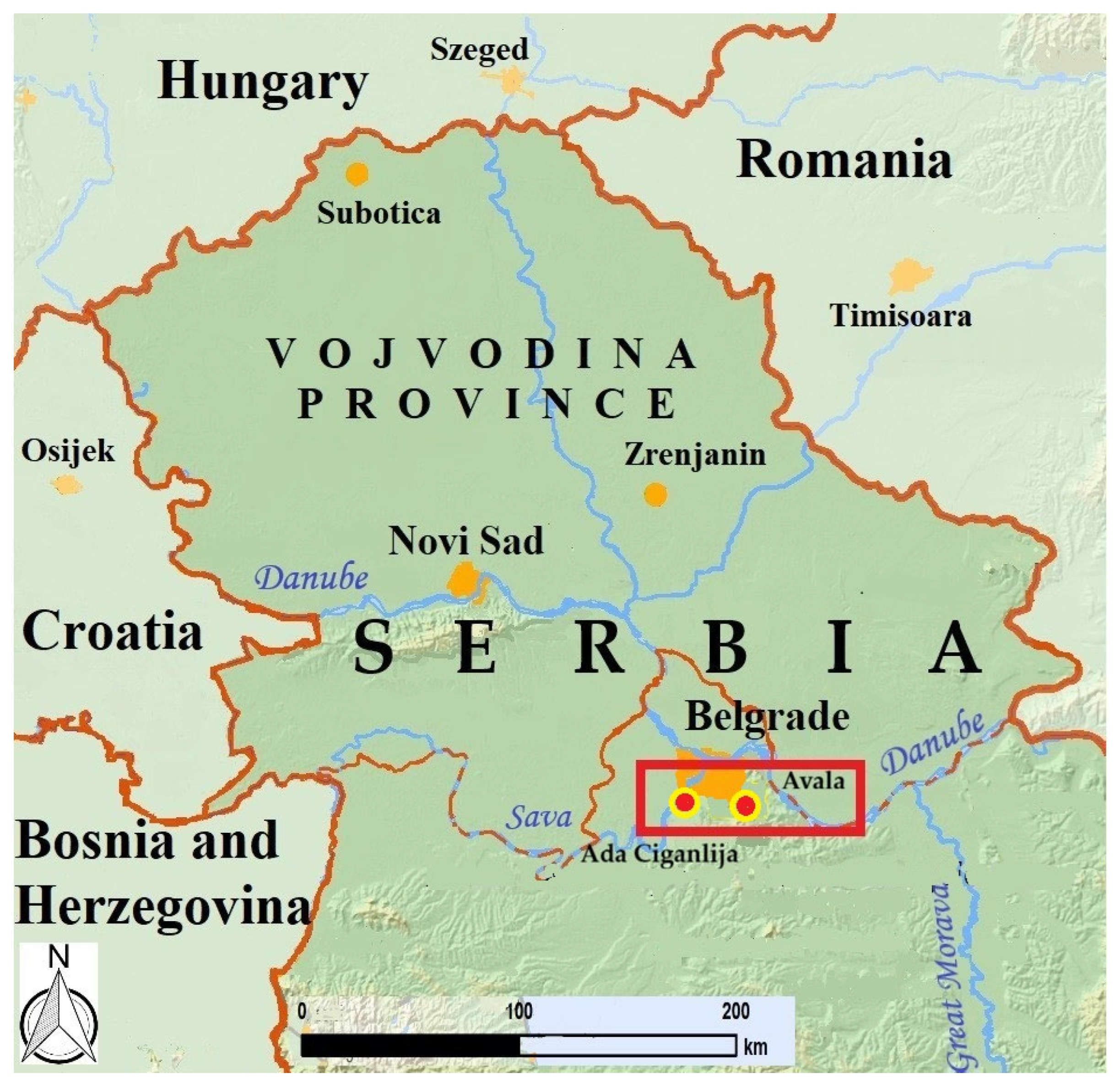
The locations of the landscapes of outstanding features can be seen in Figure 1.
Figure 1. Locations of Ada Ciganlija and Avala landscapes of outstanding features. Source: Trišić, I., author.

3.1.1. Natural Values

The Avala Landscape of Outstanding Features belongs to the III category of protection. The flora and fauna of Avala represent a very important natural assets. Numerous plant species prevail in the forest areas: Laburnum anagyroides, Lilium martagon L., Prunus laurocerasus L., Ilex aquifolium L., and other species, which are protected as natural rarities. There are plenty of medicinal species such as Ruscus acuelatus, Origanum vulgare, Orhis morio, Atropa belladonna, and others [7,8,9]. A total of 70% of the area is covered by forest. There are numerous species of birds in the forest area. Important ones are Falco tinnunculus, Strix aluco, Otus scops, Sitta europaea, Dryobates major, Buteo buteo, and other species [7].
The Ada Ciganlija Landscape of Outstanding Features is a protected area of II and III degrees. It belongs to the category of protected areas—Category V—Protected landscape/seascape (IUCN). Because the area is inhabited by many bird species, it is an IBA area. The forest complex contains habitats that have largely preserved the natural character of humid forests, with Quercus robur as the most common woody plant species [10,11]. The forest ecosystem consists of other important species [11]. There are diverse numbers of representatives of entomofauna, ichthyofauna, herpetofauna, ornithofauna, and mammalian fauna [10,11].

3.1.2. Social Values

The Avala Landscape of Outstanding Features area is characterized by very significant social potential. This area has cultural and historical significance because there are several protected cultural monuments. Some of them are related to the history of this area and the conquest campaigns of the armies that were present in the period from the 15th to and 19th centuries. The most famous cultural monuments are the Serbian medieval town of Žrnov and the Monument to the Unknown Hero [7,8,9].
The people who live in the vicinity of the Avala Landscape of Outstanding Features have strong socio-cultural values and a rich cultural history. The folklore of the local population, which includes the customs, cuisine, folk music, way of life, local economy, and events, can be an important, essential foundation for the growth of an environmentally friendly tourist sector which should be based on the promotion and improvement of the cultural values of the destination. Tourism should be based on sustainable development and promotion and improvement of the cultural values of the destination, and thus influence the possibility of including the ESG system in the evolution of the protected natural asset.
The cultural values of the exceptional characteristics of Ada Ciganlija are responsible for the existence of various sports and cultural events. These events are closely connected to the cultural life of Belgrade, but there are also traditional events that are held exclusively within this protected area. Musical and sports activities have been an integral part of the cultural life of Ada Ciganlija. Sports events are an integral part of this landscape of outstanding features. Among numerous significant sports activities on the water and in nature, rowing, ball sports, trekking, cycling, sailing, diving, swimming, bird watching, and other forms of tourism stand out. The expansion of tourism in forest and grassland areas has its focus on the natural world.
The Belgrade City Assembly oversees both protected areas. The city budget, which is primarily derived from tax and utility bills, provides funding for the management of these two areas. The administrative services that supervise the guarding of these locations, as well as the area’s protection and visitor control, are responsible for coordinating the management of these areas.

3.2. The Conceptual Model and Data Collection

This work is an extension of the research on STO in various types of protected areas. The authors intend to include as many protected national and international areas as possible in the focus of the research, and to conduct a comparative evaluation of them. The study applied the PoS (Prism of Sustainability) model to examine the function that the two dimensions of sustainability can have in creating the state and prospects of tourism in protected natural assets. The aim of the study is to examine, in addition to the state of STO, the impact of STO in these LOFs on the satisfaction of visitors. The research concept is based on the results of Rasoolimanesh et al. [74], Asmelash and Kumar [75], Khan et al. [76], and Vukadinović et al. [63]. These studies were conducted in different protected areas around the world. They aimed to examine the impact of protected assets on STO; respondents were visitors, residents, managers, legislators, companies, or the government. The studies used the PoS research model and helped design the questionnaire, research questions and research objective in this study. The PoS model makes it possible to examine the influence of selected factors on sustainable tourism by grouping the factors into dimensions. By measuring the value of individual factors and their group influence, more reliable results can be obtained. All measurement units are constituted or taken from the mentioned studies.
The authors used a quantitative research methodology that included a questionnaire as an instrument in this study. Visitors ranked their attitudes using a five-point scale. In terms of scale, a score of 1 represented complete disagreement with the items, while a score of 5 represented complete agreement with the items. The survey form was composed of items asking about the socio-demographic backgrounds of the respondents (the first part), followed by 22 items grouped into two categories (the second part of the questionnaire), and 4 items which helped with the examination of the satisfaction of the respondents (the third part). All items were arranged in the same order as the items presented in Table 1 and Table 2, and same questions were for all respondents. A random sampling approach was used to choose participants. Filling out the form was done in the framework of personal contact with visitors and using thematic social media. For electronic–internet surveys, survey forms were posted within social media and thematic groups. These are groups formed by fans and users of protected areas, within social media. Every adult member of the group, if they visited the protected area at least once, could fill out the questionnaire. In personal contact, a paper questionnaire was used. Respondents voluntarily approached the surveyors. The survey was carried out in the framework of info centers, which normally had the task of promoting the tourist potential of protected areas.
Table 1. Structure of respondents.
Table 2. Respondent perceptions of tourism attributes (n = 1120).
They shared their opinions on the natural elements influencing tourism’s sustainability: the threat to flora and fauna, the location of landscapes of outstanding features, the building of infrastructure, pollution, and other factors. The socio-cultural factors on which the respondents spoke were space users’ contribution to the tourism growth, intensification of socio-cultural characteristics, the production of local products, events, cultural heritage traditions, and other factors.
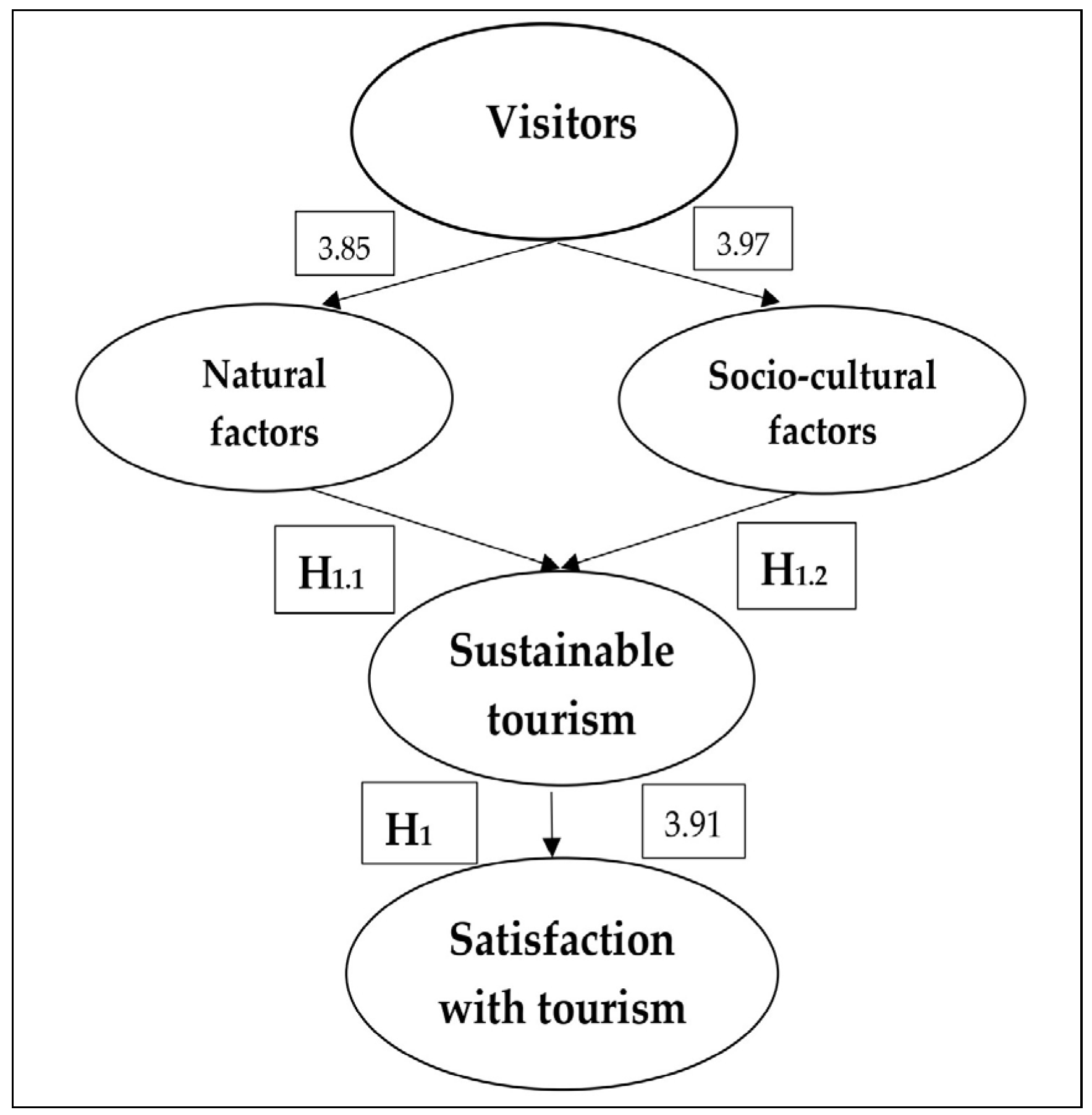
The authors focused the research model on examining two main dimensions of sustainability in two selected protected areas. In this way, the value of each factor can be examined separately and in detail. Using this concept, the effects of STO on respondent satisfaction can be researched, which is the main hypothesis in this study. The conceptual model is displayed in Figure 2.
Figure 2. The conceptual model.
From the conceptual model, the order of measurement of dependent and independent variables can be deduced. Respondents evaluated the statements related to the values of natural and socio-cultural factors on a Likert scale. Each examined factor has its average value, which affects sustainable tourism—the effects of individual factors on STO (hypotheses H1.1 and H1.2). The values of both factors form a single average value of the Sustainable Tourism variable. The mutual relationship between these variables was determined using multiple regression analysis, the Kolmogorov–Smirnov test, and non-parametric Spearman’s rank correlation. The relationship between the variables, sustainable tourism, and visitor satisfaction, was examined using multiple regression analysis and represents the main hypothesis, H1.
The validity of the completed question sheet was checked in person. An assessment of the reliability of the responses given, the average values for each item, and the level of satisfaction was performed (Cronbach’s alpha). For statistical analysis, any value of α ≥ 0.60 can be regarded as trustworthy [78,79,80]. Hypothesis testing was performed using simple and multiple regression analysis, which also included correlation between the relevant variables. First, the normality of the distribution was checked using the Kolmogorov–Smirnov test. Due to the different distributions, Spearman’s rank correlation was used to examine the relationship between them. To monitor and compare the mean values of the analyzed variables and determine the significance of their differences, testing was performed using the paired t-test. The analysis used a probability value p < 0.01. This value is regarded as typical and is most frequently utilized in data analysis and statistical processing across nearly all scientific fields.
Data collection was carried out from April 2025 to January 2026.

4. Results

A total of 1174 respondents were surveyed for the study. Out of that number, a total of 54 questionnaires were not validly filled in, which was determined by a detailed control. A total of 1120 respondents (640 visitors to the Avala Landscape of Outstanding Character and 480 visitors to the Ada Ciganlija Landscape of Outstanding Character) validly completed their questionnaires. A total of 48.09% of visitors were personally surveyed.
Of the total number of surveyed visitors to these LOFs, 64% were domestic and 36% were international. The international visitors came from North Macedonia, Hungary, Switzerland, Montenegro, Bosnia and Herzegovina, Macedonia, Bulgaria, Austria, Croatia, and other countries.
The majority of respondents were female (54% in total). Most respondents (for both areas) completed secondary school (65%), followed by primary school (10%), high school or higher education (16%), and a master’s or Ph.D. (9%).
The socio-demographic characteristics of the respondents can be seen in Table 1.
The data’s statistical analysis included checking the reliability of the scales [81]. The acquired values are displayed in Table 2, for both groups of factors.
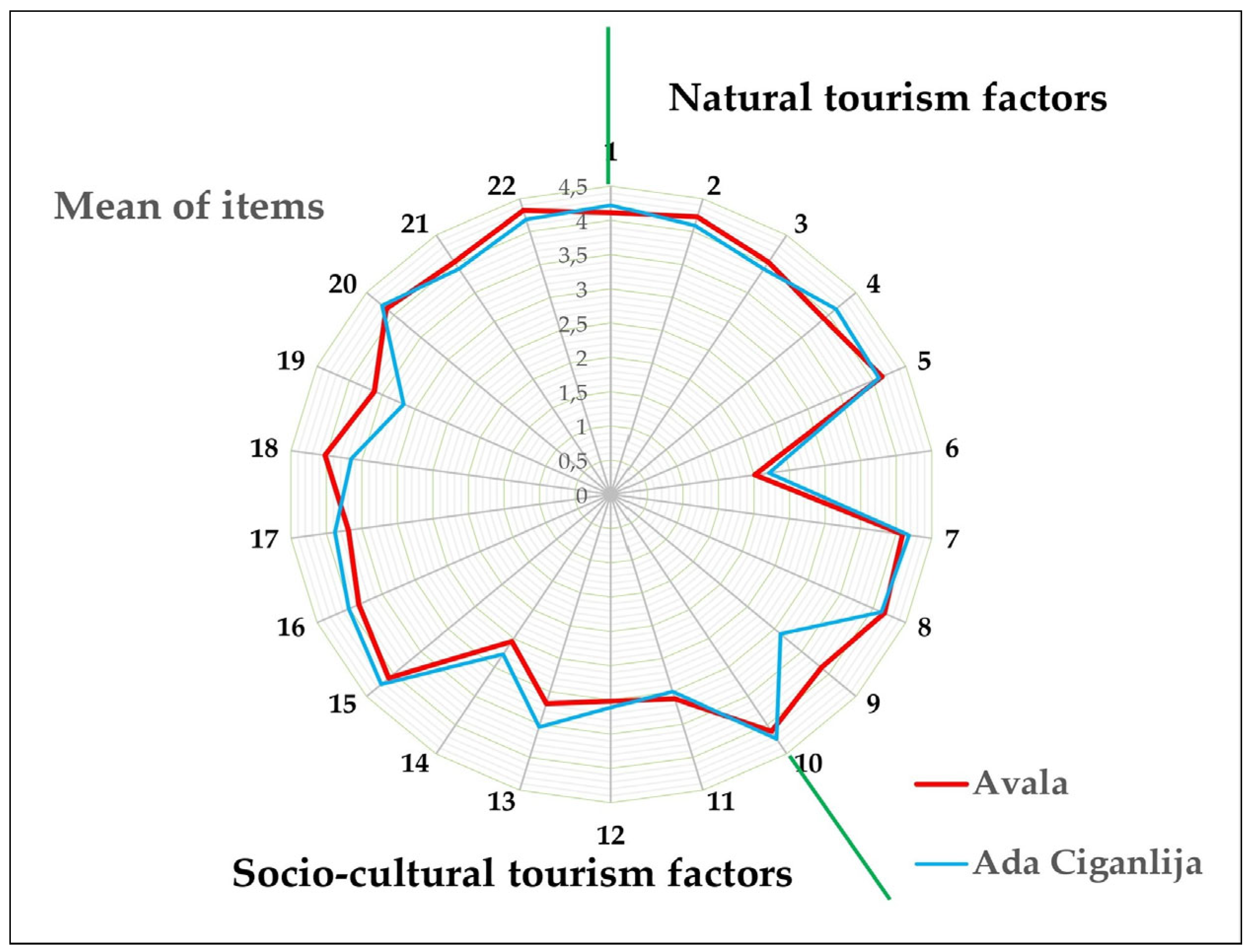
Individual average values for the tourism factors analyzed for both protected areas can be seen in Figure 3.
Figure 3. Average values for the examined tourism factors. Points from 1 to 22 represent items from the questionnaire and Table 2.
Natural tourism elements have somewhat lower average values (3.83 and 3.87) than socio-cultural tourism factors, according to an analysis of the average values of the factors under consideration (3.97 of both areas). In both LOFs, the respondents’ answers are almost identical, that is, all factors have relatively the same values. The lowest rated statements within natural factors are those related to the existence of a tourist center (2.01 and 2.21), and the existence of tourist activities of nature protection (3.11 and 3.86), in both areas. Other natural factors were rated above average.
Visitors singled out items about teaching tourists the value of preserving these regions (2.55 and 2.77), establishing contact between residents and visitors (3.00 and 3.11), and the existence of local products (3.02 and 3.11) as the least rated socio-cultural factors. Other factors have values above average. The obtained data indicate the need to plan and develop recreation and tourism in both LOFs, through enhancing the local population’s role, mainly in teaching tourists the value of preserving these forest regions and creating STO. This can be achieved by implementing workshops and educational centers in the development of tourism. Additionally, education in nature can play a crucial role in strengthening the interaction between residents and visitors. The development of events can ensure the incorporating regional goods into the tourist offer, which can initiate the growth of the local economy.
As part of natural factors, respondents awarded the best ratings to the items that there is a pristine forest (4.22) and that there are no environmental pollutants (4.24). Factors that have been singled out as significant include the presence of opportunities for recreation and tourism within the protected area (4.14) and the accessibility of cultural institutions and historical sites (4.23).
Within the socio-cultural factors, the visitors gave the highest marks to the items that there are opportunities for recreation and tourism in the protected area (4.14) and that cultural institutions and historical sites are available (4.23). Also, the items that there is local cuisine (4.32) and that there are opportunities for recreation and tourism in the protected area (4.21) have high ratings.
Table 3 shows the average values of the influence of STO on respondents’ contentment.
Table 3. Satisfaction index.
The results of the paired t-test showed that there is a statistically significant difference in the arithmetic means of natural tourism factors from both protected areas (M = 3.85) and sustainable tourism (M = 3.91; p = 0.000 < 0.01). Spearman’s correlation coefficient shows that these two variables’ correlation is positive, very strong, and significant (ρs = 0.849; p < 0.01), which leads to the conclusion of a strong connection between these two variables, Table 4.
Table 4. Presentation of the connection between natural tourism factors and sustainable tourism.
The result of the ANOVA test shows that the model has a significant F-value. The results of a simple regression analysis show that sustainable tourism is significantly and positively influenced by natural tourism factors (β = 0.849; p < 0.01), Table 5.
Table 5. Results of simple regression analysis (dependent variable: Sustainable tourism).
Based on the presented results, it can be concluded that natural tourism factors contribute to a large and significant extent to the sustainable tourism of both landscapes of outstanding features; therefore, hypothesis H1.1 is fully accepted.
The results of the paired t-test showed that there is a statistically significant difference in the arithmetic means of socio-cultural tourism factors from both landscapes of outstanding features (M = 3.97) and sustainable tourism (M = 3.91; p = 0.000 < 0.01). Spearman’s correlation coefficient shows that the correlation between these two variables is positive, very strong, and significant (ρs = 0.756; p < 0.01), which leads to the conclusion of a strong connection between these two variables, Table 6.
Table 6. Presentation of the connection between socio-cultural tourism factors and sustainable tourism.
The result of the ANOVA test shows that the model has a significant F-value. The results of a simple regression analysis show that sustainable tourism is significantly and positively influenced by natural tourism factors (β = 0.756; p < 0.01) (Table 7).
Table 7. Results of simple regression analysis (dependent variable: Sustainable tourism).
Based on the presented results, it can be concluded that socio-cultural tourism factors contribute to a large and significant extent to the sustainable tourism of both landscapes of outstanding features; therefore, hypothesis H1.2 is fully accepted.
Using regression analysis as part of data analysis, the effects of tourism factors on the sustainable development of tourism and the impact of STO on the satisfaction of respondents were examined [82,83,84,85]. The statistical assumption of satisfaction with STO was determined, a total of 31% for the Avala, and a total of 35% for the Ada Ciganlija (R12 = 0.308; R22 = 0.347) (Table 8).
Table 8. Regression analysis of satisfactions (n = 1120).
As there is a significant relationship between the examined factors of tourism and the satisfaction of the respondents, it can be concluded that the hypothesis H1 is fully fulfilled, that is, STO significantly contributes to the satisfaction of the respondents. The results of high average values and notable satisfaction with sustainable tourism are found in the survey of visitors’ satisfaction with sustainable tourism (4.17 and 4.16). The obtained values α1 = 0.794 and α2 = 0.842 indicate a significant reliability of visitors’ responses regarding the impact of sustainable tourism on their satisfaction (0.001 > p > 0.005). It can be inferred from the data analysis that the main research hypothesis H1 is fully confirmed, i.e., that STO has a significant impact on visitor satisfaction. Tourism development is equally important for both LOFs.

5. Discussion

5.1. General Findings

It may be inferred from the reported values that both landscapes of exceptional features have answers that are essentially the same. After statistical analysis, the results of the ten measured factors related to natural tourism have values α1 = 0.826 and α2 = 0.805. Socio-cultural tourism factors (12 items) have values α1 = 0.832 and α2 = 0.715. According to Cortina [78], Nunnally and Bernstein [79], and Stojanović et al. [80], every value that is higher than 0.60 (α ≥ 0.60) can be accepted for analysis as trustworthy if there are five or more items that were examined. The value of sustainable tourism is α = 0.911, which can be considered a very high value. The analysis shows that the values of the coefficient α are very significant and very reliable in both natural assets.
By exploring each item’s unique value, the average value of natural and socio-cultural tourism factors was determined. This indicates that for the preservation of forest landscapes within protected assets, the role of all subjects in the planning of recreation and tourism is very important. Preserved nature is singled out as the most important resource. Other activities must be harmonized with the principles of nature. As part of the method research in this article, three defined research hypotheses were examined. Using statistical tools, auxiliary hypothesis H1.1 was fully confirmed. It can be concluded that natural tourism factors significantly contribute to the state and development of sustainable tourism within both LOFs. Also, socio-cultural factors have a strong influence on the sustainability of tourism, which completely validates the auxiliary hypothesis H1.2. This study’s uniqueness arises from the idea that natural and socio-cultural elements can be included as an essential component of the offer for tourists when recreation and tourism are planned within forest protected areas. This offer must be coordinated with nature protection activities.

5.2. Theoretical Contributions

The participation of the local population is vital for the development of various forms of recreation and tourism within forest regions, according to an analysis of the acquired values of natural and socio-cultural elements for the STO. Apart from exploring and discovering the richness of the natural resources, the tourists conveyed their interest in the ethno-social values and cultural legacy of the people who lived there. The obtained socio-cultural values indicate that they can represent important complementary tourist motives. Such motifs, united with natural motifs from the LOF, can contribute to the creation of a significant local and national tourist offer.
For visitors of landscapes of outstanding features, good geographical location and traffic connections are especially important—as there are forest resources in the protected area, where the ecosystem is protected in a certain way—as well as the absence of wastewater and solid waste pollution, which can affect the ecology of both LOFs. The concluding considerations point to the fact that both LOFs have important values that can trigger the development of nature-based forms of tourism, which require appropriate tourism valorization. When organizing the LOF’s expansion of tourism, the need to improve the tourist infrastructure should be discussed. Constructed hiking and mountain routes can play a significant role in the growth of ecotourism, scientific tourism, educational travel, and bird-watching.
When organizing and creating some types of cultural and natural tourism, it is crucial to intensify those activities that aim to promote the protection of forest ecosystems [86]. Recreation and tourism can play an important role in the planning and development of tourism through the promotion of nature protection, environmental actions, culture, local products, customs, cuisine, and crafts [87].
Compared to the results of the studies that had an impact on the constitution of the research model in this study, these results can be analyzed as unique. In previous studies, sustainable tourism has been examined in protected areas where tourism and recreation are not the primary motive for visiting. Nature protection is important in these destinations, while tourist activities are very limited and controlled. In the destinations in this study, visitors have tourism and recreation as their motive for visiting. Since these are also protected areas, it was important to determine the relationship between visitors and sustainable tourism. Another peculiarity of this study is that the areas selected for the research are within the urban area, unlike previous studies, where these destinations are far from urban areas or are part of the wilderness [87,88,89]. Previous studies provided the basis to base the research model on the dimensions that comprise the investigated factors in the destination [90,91,92,93]. In this way, as part of the statistical analysis, the values of all dimensions can be examined in detail, as well as their impact on sustainable tourism. Previous studies indicate the importance of the economic aspect for the development of a sustainable destination, in addition to the ecological or natural aspects. The results of this study indicate that the natural and socio-cultural factors of the destination are significant for creating visitor satisfaction with the visit experience, although economic impacts are not part of the subject of investigation in this study.
The previous literature has described the importance of three sustainable pillars. These are environmental, economic, and socio-cultural sustainability. In addition, the importance of meeting the needs of all subjects in the development of tourism is emphasized. Those subjects are nature, tourists, stakeholders, and, of course, residents, whose role is very important. As mentioned above, the concept of this study is aimed at examining the natural and socio-cultural values of the destination.

5.3. Practical Implications and Research Gaps

The contributions of this study on sustainable tourism in protected areas are based on the fact that destinations where the protection of flora and fauna is not the primary activity, but tourism and recreation, were selected for the research areas. Due to the possession of rare flora and fauna, geological landforms, and monumental values, these areas are already protected, so ecosystem protection is a secondary activity. Another peculiarity of this study is that the selected areas are part of the urban city zone of the country’s capital, Belgrade, so they represent important picnic spots for both tourists and residents. Because of this, a higher frequency of visits is recorded during the year. This is expected to put more pressure on the environment. The research areas in other sustainable tourism studies are significantly away from urban areas and were wilderness areas. The primary activity there is the protection of flora and fauna, while the development of tourism and recreation is very limited. This study’s findings demonstrated the significance of sustainable tourism development for these frequently visited protected places and the importance of visitor-focused activities that enhance and preserve their many characteristics. These were the main reasons that visitors gave positive ratings about their experience and satisfaction. This data will be crucial for the strategy for the growth of sustainable tourism, as well as for the compilation of planning and development documents for local managers.
The inability to inquire into financial contributions made by the government, administration, or donors in the development of these locations is the main research gap in this study. The fact is that constant investments are needed, which is why it is necessary to create many of the projects. Also, there is a limitation in the absence of information on the availability of certain funds with the aim of investing in the development of tourism and recreation. Therefore, future research should be directed towards gathering important information about the management and financing of both LOFs. The results of this study can be useful when researching the role of managers, the state, or the private sector in the protection of other areas with different structures and degrees of protection, in relation to the growth of opportunities for tourism and recreation. In addition to residents and visitors, the role of these entities is certainly important for STO.
When the findings are examined and compared with those of earlier research, it is possible to conclude that forest-protected areas could both enhance nature and tourism. In the examined areas, there is a unique forest ecosystem, which is characteristic only of these protected areas. These areas should be conserved to preserve all the values because of their rarity and the avoidance of anthropogenic interference. In the study of circumstances for the growth of tourism, many tourist factors provide an important foundation [94].
Socio-cultural factors were also singled out as important in defining the function of these destinations in STO. These factors can represent an important complementary tourism potential. The socio-cultural values can make up the tourism offer. These can be customs, local products, folk music, cuisine, crafts and branded products, cultural and historical heritage, and other values [87,88,89].

6. Conclusions

The STO of the LOF was examined through two groups of factors, natural and socio-cultural. Examining the impact of these two dimensions on the state of STO was a research question which was answered using a research methodology. By analyzing the presented data, it can be confirmed that both groups of factors have a significant function in defining STO within LOFs. Also, STO within LOFs affects the satisfaction of visitors, thus establishing an answer to the main research question (H1).
Although both dimensions of sustainability do not have equal individual average values, each of the dimensions of sustainability has a significant share in sustainable tourism, which was proven by the analysis of the results. Analysis of the dimensions’ average values reveals that the responders singled out both factors as important for the sustainable tourism of these protected natural assets.
Results of the survey are very comparable to those from other protected regions when compared to studies that employed a nearly identical research approach. The responders in the earlier studies emphasized the significance of the ecological and socio-cultural aspects of sustainability. What sets this study apart from others? Even though tourism is still in its infancy, the survey’s participants indicated a high level of satisfaction with sustainable tourism in certain locations. After analyzing the data, it is possible to draw the conclusion that respondents are significantly satisfied with sustainable tourism and that the parameters under analysis were assessed similarly in both LOFs.
The conclusion follows from the above that the primary forms of tourism in both LOFs must be harmonized with the ecological principles of nature protection. Numerous aspects of destinations have an impact on the creation and growth of a tourist destination, environmental preservation, and STO progress. Because of that, and due to the various functions of these destinations, environmental factors must be primary.
Visitors can help promote sustainable and ethical practices in the LOF as a tourist destination by deliberately choosing and supporting organizations that place a high priority on ESG values such as:
  • Selecting eco-friendly activities and programs which promote environmental conservation and benefit communities in the area;
  • Responsible tourists lessening the environmental effect and assisting local communities by buying local goods and showing them respect;
  • Supporting the local way of local life and culture;
  • Giving further information about travel agencies that implement ESG practices [95].
Through advancements in resource management and enhanced stakeholder communication, we may anticipate an even deeper integration of ESG principles into the economic models of tourism destinations in the future.
The results of this research may have an implication in the tourism planning of different destinations with sensitive ecosystems. When natural assets are included in the tourist offer, STO’s contribution to respondents’ pleasure can be a major data point. The identification of these strengths, opportunities and limitations of specific dimensions of STO should serve as the basis for primary management objectives. The findings can be analyzed to determine the foundations for the growth of ethical and environmentally conscious travel.
The authors will focus future research on expanding the research area to include numerous protected natural assets in Europe. In this way, it is planned to obtain more significant and reliable data about the function that protected assets can have in STO.

Author Contributions

Conceptualization, N.B., I.T., S.Š., S.D.Ž.-R., F.N., and B.T.; methodology, N.B., I.T., S.Š., S.D.Ž.-R., F.N., and B.T.; software I.T., S.Š., S.D.Ž.-R., F.N., and B.T.; validation N.B., I.T., S.D.Ž.-R., F.N., and B.T.; formal analysis, N.B., I.T., S.Š., S.D.Ž.-R., and B.T.; investigation N.B., I.T., S.Š., F.N., and B.T.; resources, N.B., I.T., S.Š., S.D.Ž.-R., F.N., and B.T.; data curation, N.B., I.T., S.Š., S.D.Ž.-R., F.N., and B.T.; writing—original draft preparation, N.B., I.T., S.Š., S.D.Ž.-R., F.N., and B.T.; writing—review and editing, N.B., I.T., S.Š., S.D.Ž.-R., F.N., and B.T.; visualization, N.B., I.T., S.Š., S.D.Ž.-R., F.N., and B.T.; supervision, N.B., I.T., S.Š., S.D.Ž.-R., F.N., and B.T.; project administration, N.B., I.T., S.Š., S.D.Ž.-R., F.N., and B.T.; funding acquisition, N.B., I.T., S.Š., S.D.Ž.-R., F.N., and B.T. All authors have read and agreed to the published version of the manuscript.

Funding

This research received no external funding.

Institutional Review Board Statement

This article does not require ethical approval or an institutional review board (IRB) process. The Ethical Committee of IRASA has confirmed the exemption from the Ethical Committee.

Data Availability Statement

The data that support the findings of this study are available upon reasonable request from the authors.

Conflicts of Interest

The authors declare no conflict, of interest.

Abbreviations

ESGEnvironmental, Social, and Governance principles
IUCNThe International Union for Conservation of Nature
LOFLandscape of Outstanding Features
PoSPrism of Sustainability
STOSustainable Tourism
TODTourism Development

References

  1. Eagles, P.F.J.; McCool, S.F.; Haynes, C.D. Sustainable Tourism in Protected Areas, Guidelines for Planning and Management; IUCN: Gland, UK; Cambridge, UK, 2002. [Google Scholar]
  2. McCool, S.F. The changing meanings of sustainable tourism. In Reframing Sustainable Tourism, Environmental Challenges and Solutions; McCool, S.F., Bosak, K., Eds.; Springer: New York, NY, USA, 2016; Volume 2, pp. 13–32. [Google Scholar]
  3. Bosak, K.; McCool, S.F. A research agenda for sustainable tourism: Some ideas worth pursuing. In A Research Agenda for Sustainable Tourism; McCool, S.F., Bosak, K., Eds.; Edward Elgar Publishing: Cheltenham, UK; Northampton, MA, USA, 2019; pp. 239–246. [Google Scholar]
  4. Cerveny, L.K. Sustainable recreation and tourism: Making sense of diverse conceptualizations and management paradigms. J. Outdoor Recreat. Tour. 2022, 38, 100520. [Google Scholar] [CrossRef]
  5. Winter, P.L.; Selin, S.; Cerveny, L.; Bricker, K. Outdoor recreation, nature-based tourism, and sustainability. Sustainability 2020, 12, 81. [Google Scholar] [CrossRef]
  6. Leung, Y.F.; Spenceley, A.; Hvenegaard, G.; Buckley, R.; Groves, C. Tourism and Visitor Management in Protected Areas: Guidelines for Sustainability; IUCN: Gland, Switzerland, 2018; Volume 27. [Google Scholar]
  7. Javno Preduzeće za Gazdovanje Šumama “Srbijašume”. The Proposal Management Plan for the Avala Outstanding Natural Landscape; Javno Preduzeće za Gazdovanje Šumama “Srbijašume”: Belgrade, Serbia, 2020. (In Serbian) [Google Scholar]
  8. Borić, T. Avala: From a symbolic topos of Serbia to the monument of Yugoslavia. Facta Univ. 2017, 3, 73–88. [Google Scholar] [CrossRef]
  9. Đurđić, S.; Stojković, S.; Šabić, D. Nature conservation in urban conditions: A case study from Belgrade, Serbia. Maejo Int. J. Sci. Technol. 2011, 5, 129–145. [Google Scholar]
  10. Štetić, S.; Šimičević, D. Tourist Geography, 3rd ed.; College of Tourism: Belgrade, Serbia, 2015. (In Serbian) [Google Scholar]
  11. Javno Preduzeće “Ada Ciganlija”. The Proposal Management Plan for the Ada Ciganlija Outstanding Natural Landscape 2024–2033; Javno Preduzeće “Ada Ciganlija”: Belgrade, Serbia, 2023. (In Serbian) [Google Scholar]
  12. Trišić, I.; Privitera, D.; Ristić, V.; Štetić, S.; Stanić Jovanović, S.; Nechita, F. Measuring residents’ and visitors’ satisfaction with sustainable tourism—The case of “Rusanda” Nature Park, Vojvodina Province. Sustainability 2023, 15, 16243. [Google Scholar] [CrossRef]
  13. Cottrell, S.P.; Vaske, J.J.; Roemer, J.M. Resident satisfaction with sustainable tourism: The case of Frankenwald Nature Park, Germany. Tour. Manag. Perspect. 2013, 8, 42–48. [Google Scholar] [CrossRef]
  14. Gong, J.; Shapovalova, A.; Lan, W.; Knight, D.W. Resident support in China’s new national parks: An extension of the Prism of Sustainability. Curr. Issues Tour. 2023, 26, 1731–1747. [Google Scholar] [CrossRef]
  15. Cottrell, S.P.; Cutumisu, N. Sustainable tourism development strategy in WWF Pan Parks: Case of a Swedish and Romanian national park. Scand. J. Hosp. Tour. 2006, 6, 150–167. [Google Scholar] [CrossRef]
  16. Stojanović, V.; Đorđević, J.; Lazić, L.; Stamenković, I.; Pavluković, V. The principles of sustainable development of tourism in the special nature reserve “Gornje Podunavlje” and their impact on the local communities. Acta Geogr. Slov. 2014, 54, 391–400. [Google Scholar] [CrossRef]
  17. Eagles, P.F.J. Research priorities in park tourism. J. Sustain. Tour. 2014, 22, 528–549. [Google Scholar] [CrossRef]
  18. Rio, D.; Nunes, L.M. Monitoring and evaluation tool for tourism destinations. Tour. Manag. Perspect. 2012, 4, 64–66. [Google Scholar] [CrossRef]
  19. Mihalic, T. Sustainable-responsible tourism discourse—Towards ‘responsustable’ tourism. J. Clean. Prod. 2016, 111, 461–470. [Google Scholar] [CrossRef]
  20. McCool, S.F. Managing for visitor experiences in protected areas: Promising opportunities and fundamental challenges. Parks Int. J. Prot. Areas Manag. 2006, 16, 3–9. [Google Scholar]
  21. Buckley, R. Ecological indicators of tourist impacts in parks. J. Ecotour. 2003, 2, 54–66. [Google Scholar] [CrossRef]
  22. Higham, J.; Miller, G. Transforming societies and transforming tourism: Sustainable tourism in times of change. J. Sustain. Tour. 2018, 26, 1–8. [Google Scholar] [CrossRef]
  23. Queiroz, R.E.; Guerreiro, J.; Ventura, M.A. Demand of the tourists visiting protected areas in small oceanic islands: The Azores case-study (Portugal). Environ. Dev. Sustain. 2014, 16, 1119–1135. [Google Scholar] [CrossRef]
  24. Hall, C.M.; Gössling, S.; Scott, D. (Eds.) The evolution of sustainable development and sustainable tourism. In The Routledge Handbook of Tourism and Sustainability; Routledge: London, UK, 2015. [Google Scholar]
  25. Font, X.; Sanabria, R.; Skinner, E. Sustainable tourism and ecotourism certification: Raising standards and benefits. J. Ecotour. 2003, 2, 213–218. [Google Scholar] [CrossRef]
  26. Chen, C.F.; Chen, P.C. Resident attitudes toward heritage tourism development. Tour. Geogr. 2010, 12, 525–545. [Google Scholar] [CrossRef]
  27. Pearce, J.; Huang, S.S.; Dowling, R.K.; Smith, A.J. Effects of social and personal norms, and connectedness to nature, on pro-environmental behavior: A study of Western Australian protected area visitors. Tour. Manag. Perspect. 2022, 42, 100966. [Google Scholar] [CrossRef]
  28. Weaver, D.; Lawton, L. Tourism Management; John Wiley & Sons: Milton, Australia, 2014. [Google Scholar]
  29. He, C.; He, S.; Mu, E.; Peng, J. Environmental economic geography: Recent advances and innovative development. Geogr. Sustain. 2022, 3, 152–163. [Google Scholar] [CrossRef]
  30. Pachrová, S.; Hrdličková, A.; Včelák, M. Monitoring of visitors as a tool of protected areas management. Acad. Tur.—Tour. Innov. J. 2020, 13, 67–75. [Google Scholar] [CrossRef]
  31. Liburd, J.; Menke, B.; Tomej, K. Activating socio-cultural values for sustainable tourism development in natural protected areas. J. Sustain. Tour. 2024, 32, 1182–1200. [Google Scholar] [CrossRef]
  32. Nikolić, S. Turizam u Zaštićenim Prirodnim Dobrima Srbije (Tourism in Protected Natural Assets of Serbia); Institute for Nature Conservation of Serbia: Belgrade, Serbia, 2006. (In Serbian) [Google Scholar]
  33. Štetić, S.; Trišić, I.; Nedelcu, A. Natural potentials of significance for the sustainable tourism development—The focus on the special nature reserve. J. Geogr. Inst. Jovan Cvijić SASA 2019, 69, 279–287. [Google Scholar] [CrossRef]
  34. Sirakaya, E.; Teye, V.; Sonmez, S. Understanding residents’ support for tourism development in the Central region of Ghana. J. Travel Res. 2002, 41, 57–67. [Google Scholar] [CrossRef]
  35. Muñoz, L.; Hausner, V.; Brown, G.; Runge, C.; Fauchald, P. Identifying spatial overlap in the values of locals, domestic and international tourists to protected areas. Tour. Manag. 2019, 71, 259–271. [Google Scholar] [CrossRef]
  36. Baldacchino, G.; Helgadóttir, G.; Mykletun, R.J. Rural tourism: Insights from the North Atlantic. Scand. J. Hosp. Tour. 2015, 15, 1–7. [Google Scholar] [CrossRef]
  37. Lee, T.H.; Hsieh, H.P. Indicators of sustainable tourism: A case study from a Taiwan’s wetland. Ecol. Indic. 2016, 67, 779–787. [Google Scholar] [CrossRef]
  38. Aquino, R.S. Transforming travel: Realising the potential of sustainable tourism. J. Ecotour. 2019, 18, 193–195. [Google Scholar] [CrossRef]
  39. Buckley, B. Evaluating the net effects of ecotourism on the environment: A framework, first assessment and future research. J. Sustain. Tour. 2009, 17, 643–672. [Google Scholar] [CrossRef]
  40. Wang, W.; Chen, J.S.; Fan, L.; Lu, J. Tourist experience and wetland parks: A case of Zhejiang, China. Ann. Tour. Res. 2012, 39, 1763–1778. [Google Scholar] [CrossRef]
  41. Gong, J.; Yang, S. Residents’ perceptions of sustainable tourism impacts in Natural Heritage sites: A case study of Shennongjia. J. Cent. China Univ. For. Technol. 2017, 11, 54–60. [Google Scholar]
  42. Sanchez, M.L.; Cabrera, A.T.; Gomez del Pulgar, M.L. The potential role of cultural ecosystem services in heritage research through a set of indicators. Ecol. Indic. 2020, 117, 106670. [Google Scholar] [CrossRef]
  43. Frost, W.; Hall, C.M. (Eds.) Reinterpreting the creation myth: Yellowstone National Park. In Tourism and National Parks, International Perspectives on Development, Histories and Change, 1st ed.; Routledge, Taylor & Francis Group: London, UK; New York, NY, USA, 2009; pp. 16–29. [Google Scholar]
  44. Chin, C.L.M.; Moore, S.A.; Wallington, T.J.; Dowling, R. Ecotourism in Bako National Park, Borneo: Visitors’ perspectives on environmental impacts and their management. J. Sustain. Tour. 2000, 8, 20–35. [Google Scholar] [CrossRef][Green Version]
  45. McCool, S.F.; Moisey, R.N.; Nickerson, N.P. What should tourism sustain? The disconnect with industry perceptions of useful indicators. J. Travel Res. 2001, 40, 124–131. [Google Scholar] [CrossRef]
  46. Butler, R.W. The social implications of tourist developments. Ann. Tour. Res. 1974, 2, 100–111. [Google Scholar] [CrossRef]
  47. Choi, H.C.; Sirakaya, E. Sustainability indicators for managing community tourism. Tour. Manag. 2006, 27, 1274–1289. [Google Scholar] [CrossRef]
  48. Schianetz, K.; Kavanagh, L. Sustainability indicators for tourism destinations: A complex adaptive systems approach using systemic indicator systems. J. Sustain. Tour. 2008, 16, 601–628. [Google Scholar] [CrossRef]
  49. Chávez-Cortés, M.; Maya, J.A.A. Identifying and structuring values to guide the choice of sustainability indicators for tourism development. Sustainability 2010, 2, 3074–3099. [Google Scholar] [CrossRef]
  50. Tanguay, G.A.; Rajaonson, J.; Therrien, M.C. Sustainable tourism indicators: Selection criteria for policy implementation and scientific recognition. J. Sustain. Tour. 2013, 21, 862–879. [Google Scholar] [CrossRef]
  51. Sharpley, R. Host perceptions of tourism: A review of the research. Tour. Manag. 2014, 42, 37–49. [Google Scholar] [CrossRef]
  52. Bello, F.G.; Carr, N.; Lovelock, B. Community participation framework for protected area-based tourism planning. Tour. Plan. Dev. 2016, 13, 469–485. [Google Scholar] [CrossRef]
  53. Wang, X.; Zheng, J.; Han, Z.; Zhao, C. Beyond the Experience: How Lifestyle, Motivation, and Physical Condition Shape Forest Traveler Satisfaction. Forests 2025, 16, 1426. [Google Scholar] [CrossRef]
  54. Zhao, Y.; Yang, J.; Song, J.; Lu, Y. The Effects of Tourism Motivation and Perceived Value on Tourists’ Behavioral Intention Toward Forest Health Tourism: The Moderating Role of Attitude. Sustainability 2025, 17, 713. [Google Scholar] [CrossRef]
  55. Zhong, L.; Campbell, C.; Buckley, R.; Zhu, D.; Yu, H.; Chauvenet, A.; Cooper, M.A. Senses, emotions and wellbeing in forest recreation and tourism. Tour. Recreat. Res. 2025, 50, 688–700. [Google Scholar] [CrossRef]
  56. Holden, A. Environment and Tourism, 3rd ed.; Routledge: London, UK; New York, NY, USA, 2016. [Google Scholar]
  57. Moore, C.A.; Polley, A. Defining indicators and standards for tourism impacts in protected areas: Cape Range National Park, Australia. Environ. Manag. 2007, 39, 291–300. [Google Scholar] [CrossRef]
  58. Butowski, L. Nature tourist sustainability of destination as a measure of its development. Curr. Issues Tour. 2019, 22, 1043–1061. [Google Scholar] [CrossRef]
  59. Holden, A.; Sparrowhawk, J. Understanding the motivations of ecotourists: The case of trekkers in Annapurna, Nepal. Int. J. Tour. Res. 2002, 4, 435–446. [Google Scholar] [CrossRef]
  60. Vujić, A.; Trišić, I.; Štetić, S.; Skenderović, I.; Nechita, F.; Ujkanović, E.; Ćatović, A.; Ljajić, S. The impact of institutional and ecological sustainability systems on resident satisfaction using protected area management as an Example. Land 2025, 14, 544. [Google Scholar] [CrossRef]
  61. Maple, L.C.; Eagles, P.F.J.; Rolfe, H. Birdwatchers’ specialisation characteristics and national park tourism planning. J. Ecotour. 2010, 9, 219–238. [Google Scholar] [CrossRef]
  62. Spangenberg, J.H. Environmental space and the prism of sustainability: Frameworks for indicators measuring sustainable development. Ecol. Indic. 2002, 2, 295–309. [Google Scholar] [CrossRef]
  63. Vukadinović, L.; Trišić, I.; Ristić, V.; Candrea, A.N.; Štetić, S.; Apetrei, M. The Impact of sustainable tourism of forest ecosystems on the satisfaction of tourists and residents—An example of a protected area, Vojvodina Province (Northern Serbia). Forests 2025, 16, 909. [Google Scholar] [CrossRef]
  64. Lata, S.; Mathiyazhagan, K.; Jasrotia, A. Sustainable tourism and residents’ satisfaction: An empirical analysis of UNESCO World Heritage Sites in Delhi (India). J. Hosp. Appl. Res. 2023, 18, 70–97. [Google Scholar]
  65. Jeelani, P.; Shah, S.A.; Dar, S.N.; Rashid, H. Sustainability constructs of mountain tourism development: The evaluation of stakeholders’ perception using SUS-TAS. Environ. Dev. Sustain. 2023, 25, 8299–8317. [Google Scholar] [CrossRef] [PubMed]
  66. Zeng, Y.; Zhong, L.; Yu, H.; Deng, J.; Wang, L. Impact of protected area management on local communities: A perspective of recreational ecosystem services. Environ. Dev. 2023, 45, 100804. [Google Scholar] [CrossRef]
  67. Saarinen, J. Is being responsible sustainable in tourism? Connections and critical differences. Sustainability 2021, 13, 6599. [Google Scholar] [CrossRef]
  68. Andereck, K.L.; Valentine, K.M.; Knopf, R.C.; Vogt, C.A. Residents’ perceptions of community tourism impacts. Ann. Tour. Res. 2005, 32, 1056–1076. [Google Scholar] [CrossRef]
  69. Saarinen, J. Communities and sustainable tourism development: Community impacts and local benefit creation in tourism. In A Research Agenda for Sustainable Tourism; McCool, S.F., Bosak, K., Eds.; Edward Elgar Publishing: Cheltenham, UK; Northampton, MA, USA, 2019; pp. 206–222. [Google Scholar]
  70. Kim, K.; Uysal, M.; Sirgy, M.J. How does tourism in a community impact the quality of life of community residents? Tour. Manag. 2013, 36, 527–540. [Google Scholar] [CrossRef]
  71. Herrera, M.R.G.; Sasidharan, V.; Hernández, J.A.Á.; Herrera, L.D.A. Quality and sustainability of tourism development in Copper Canyon, Mexico: Perceptions of community stakeholders and visitors. Tour. Manag. Perspect. 2018, 27, 91–103. [Google Scholar] [CrossRef]
  72. Karsokiene, R.; Giedraitis, A.; Stasys, R. Visitor perceptions toward sustainable and resilient tourism destination: A quantitative assessment. Tour. Hosp. 2025, 6, 31. [Google Scholar] [CrossRef]
  73. Miller, G.; Torres-Delgado, A. Measuring sustainable tourism: A state of the art review of sustainable tourism indicators. J. Sustain. Tour. 2023, 31, 1483–1496. [Google Scholar] [CrossRef]
  74. Rasoolimanesh, S.M.; Ramakrishna, S.; Hall, C.M.; Esfandiar, K.; Seyfi, S. A systematic scoping review of sustainable tourism indicators in relation to the sustainable development goals. J. Sustain. Tour. 2023, 31, 1497–1517. [Google Scholar] [CrossRef]
  75. Asmelash, A.G.; Kumar, S. The structural relationship between tourist satisfaction and sustainable heritage tourism development in Tigrai, Ethiopia. Heliyon 2019, 5, E01335. [Google Scholar] [CrossRef] [PubMed]
  76. Khan, I.U.; Khan, S.U.; Khan, S. Residents’ satisfaction with sustainable tourism: The moderating role of environmental a wareness. Tour. Crit. Pract. Theory 2022, 3, 72–87. [Google Scholar] [CrossRef]
  77. Moreno, L. Towards an ESG framework for tourism businesses. In Proceedings of the 8th Meeting of the UN Committee of Experts on Business and Trade Statistics, Singapore, 24–26 June 2025. [Google Scholar]
  78. Cortina, J.M. What is coefficient alpha? An examination of theory and applications. J. Appl. Psychol. 1993, 78, 98–104. [Google Scholar] [CrossRef]
  79. Nunnally, J.C.; Bernstein, I.H. Psychometric Theory; McGraw-Hill: New York, NY, USA, 1994. [Google Scholar]
  80. Stojanović, T.; Trišić, I.; Brđanin, E.; Štetić, S.; Nechita, F.; Candrea, A.N. Natural and sociocultural values of a tourism destination in the function of sustainable tourism development—An example of a protected area. Sustainability 2024, 16, 759. [Google Scholar] [CrossRef]
  81. Huayhuaca, C.; Cottrell, S.; Raadik, J.; Gradl, S. Resident perceptions of sustainable tourism development: Frankenwald Nature Park, Germany. Int. J. Tour. Policy 2010, 3, 125–141. [Google Scholar] [CrossRef]
  82. Shen, F.; Cottrell, S.P. A sustainable tourism framework for monitoring residents’ satisfaction with agritourism in Chongdugou Village, China. Int. J. Tour. Policy 2008, 1, 368–375. [Google Scholar] [CrossRef]
  83. Cottrell, S.P.; Raadik, J. Socio-cultural benefits of PAN Parks at Bieszscady National Park, Poland. Matkailututkimus 2008, 1, 56–67. [Google Scholar]
  84. Butzmann, E.; Job, H. Developing a typology of sustainable protected area tourism products. J. Sustain. Tour. 2017, 25, 1736–1755. [Google Scholar] [CrossRef]
  85. Kruger, M.; Viljoen, A.; Saayman, M. Who visits the Kruger National Park and why? Identifying target markets. J. Travel Tour. Mark. 2017, 34, 312–340. [Google Scholar] [CrossRef]
  86. Buckley, R. Ecotourism: Principles and Practices; CABI: Wallingford, UK, 2009. [Google Scholar]
  87. Eagles, P.F.J.; Romagosab, F.; Buteau-Duitschaeverc, W.C.; Havitza, M.; Glovera, T.D.; McCutcheona, B. Good governance in protected areas: An evaluation of stakeholders’ perceptions in British Columbia and Ontario Provincial Parks. J. Sustain. Tour. 2013, 21, 60–79. [Google Scholar] [CrossRef]
  88. Wood, S.A.; Guerry, A.D.; Silver, J.M.; Lacayo, M. Using social media to quantify nature-based tourism and recreation. Sci. Rep. 2013, 3, 2976. [Google Scholar] [CrossRef]
  89. Spenceley, A. Nature-based tourism and environmental sustainability in South Africa. J. Sustain. Tour. 2005, 13, 136–170. [Google Scholar] [CrossRef]
  90. Bennett, N.J.; Whitty, T.S.; Finkbeiner, E.; Pittman, J.; Bassett, H.; Gelcich, S.; Allison, E.H. Environmental Stewardship: A Conceptual Review and Analytical Framework. Environ. Manag. 2018, 61, 597–614. [Google Scholar] [CrossRef]
  91. Franceschinis, C.; Swait, J.; Vij, A.; Thiene, M. Determinants of recreational activities choice in protected areas. Sustainability 2022, 14, 412. [Google Scholar] [CrossRef]
  92. Newsome, D.; Moore, S.A.; Dowling, R.K. Natural Area Tourism, Ecology, Impacts, and Management; Channel View Publications: Bristol, UK, 2013. [Google Scholar]
  93. Ristić, V.; Trišić, I.; Štetić, S.; Maksin, M.; Nechita, F.; Candrea, A.N.; Pavlović, M.; Hertanu, A. Institutional, ecological, economic, and socio-cultural sustainability—Evidence from Ponjavica Nature Park. Land 2024, 13, 669. [Google Scholar] [CrossRef]
  94. Kruger, M.; Viljoen, A.; Saayman, M. Who pays to view wildflowers in South Africa? J. Ecotour. 2013, 12, 146–164. [Google Scholar] [CrossRef]
  95. Dathe, T.; Helmold, M.; Dathe, R.; Dathe, I. Implementing Environmental, Social and Governance (ESG) Principles for Sustainable Businesses: A Practical Guide in Sustainability Management; Springer Nature: Cham, Switzerland, 2024. [Google Scholar]
Disclaimer/Publisher’s Note: The statements, opinions and data contained in all publications are solely those of the individual author(s) and contributor(s) and not of MDPI and/or the editor(s). MDPI and/or the editor(s) disclaim responsibility for any injury to people or property resulting from any ideas, methods, instructions or products referred to in the content.

Article Metrics

Citations

Article Access Statistics

Multiple requests from the same IP address are counted as one view.