Article

Integrating Non-Park Green Space into Urban Green Infrastructure: A Community-Scale Assessment of Ecological Supply–Demand Balance and Structural Performance


1
College of Landscape Architecture, Nanjing Forestry University, Nanjing 210037, China
2
School of Architecture and Civil Engineering, Anhui University of Science and Technology, Wuhu 241060, China
*
Author to whom correspondence should be addressed.
Forests 2026, 17(2), 239; https://doi.org/10.3390/f17020239
Submission received: 12 January 2026 / Revised: 4 February 2026 / Accepted: 4 February 2026 / Published: 10 February 2026
(This article belongs to the Special Issue Ecological Functions of Urban Green Spaces)

Abstract

Green spaces (GS) play a pivotal role in promoting ecological sustainability and enhancing public well-being. However, traditional park green spaces (PGS), characterized by centralized layouts, often fail to meet the spatially diverse needs of urban residents. Non-park green spaces (NPGS) have therefore emerged as important supplements to urban forest and green infrastructure systems, yet systematic evaluations of their performance contributions remain limited. Using a multidimensional Supply–Demand Ratio (SDR) framework, we compared park-only (PGS) and integrated (All_GS) scenarios across 609 communities in the central urban area of Nanjing, China, to quantify changes in urban forest service capacity, accessibility, and equity. Results show that integrating NPGS increased the mean SDR by 46.88%, with 59.28% of communities exhibiting improved green service performance. The Deviation Reduction Index (DRI) indicates a 13.67% reduction in deviation from the ideal service range, demonstrating improved overall balance and spatial equity. Community transition analysis further reveals that accessibility improvements are accounted as the key pathway to enhance overall performance, while capacity and quality displayed higher spatial heterogeneity. Overall, NPGS integration substantially enhances service equity and spatial balance in green provision, providing a robust analytical framework for integrated urban forest management and targeted optimization of urban green infrastructure.

1. Introduction

Urban green spaces (UGS), as core components of urban green infrastructure (UGI), are fundamental to sustainable urban development due to their multifunctional roles in ecological regulation, climate adaptation [1,2], public health promotion [3], and social cohesion [4,5,6]. Extensive evidence demonstrates that GS can mitigate the urban heat island effect, improve air quality [7,8,9], and enhance both physical and mental well-being [10,11,12]. As inclusive public resources, green spaces also provide accessible opportunities for recreation, interaction, and cultural engagement [13,14,15]. Consequently, ensuring equitable access to GS has become a central objective in global urban governance agendas such as the Sustainable Development Goals (SDG 11) [16] and the New Urban Agenda [17]. Against this policy backdrop, national- and urban-level indicators provide a baseline for understanding the scale of green resources and service provision. At the national level, China hosts about 220 million ha of forest area. At the urban level, the green coverage rate of built-up areas has reached 43.32%, with per capita park green space at 15.65 m2 [18,19]. However, pronounced disparities in green space provision persist across cities, resulting from spatial resource constraints, mismatches between green supply and population demand, and historical biases in planning investment [20,21,22]. These inequities are particularly acute in dense urban cores and rapidly urbanizing fringe areas, where residents face limited access to nearby green amenities [23,24,25]. Addressing these disparities and promoting spatial justice in green space provision has thus emerged as a pressing challenge for contemporary urban planning and policy.
In economics, “demand” and “supply” are linked through the notion of equilibrium, commonly understood as a state in which demand equals supply. In the context of urban green space, however, provision functions as a land-constrained public service system rather than as a price-clearing market, and the focus therefore shifts from market clearing to supply–demand balance in service provision. Here, supply refers to the community-accessible potential of green space services shaped by capacity, quality, and accessibility, whereas demand reflects community-level need and pressure driven by population and socioeconomic/land-use intensity. Within this study, “balance” is assessed as whether community-level green space provision falls within a realistic range relative to local demand; values outside this range indicate disequilibrium, which is common in real-world urban green space systems [26,27]. Accordingly, shortage refers to under-supply conditions where service provision falls short of local demand, whereas surplus refers to over-supply conditions where provision exceeds demand under the same criterion. This operationalization aligns with widely used ecosystem-service supply–demand frameworks that explicitly distinguish mismatch conditions and interpret them as under-supply versus over-supply states. In conventional UGI planning, formally designated park green spaces (PGS) have long served as the principal component responsible for ecological regulation and public service delivery. Yet, due to their centralized spatial distribution, long construction cycles, and limited adaptability, PGS often fail to meet the localized and dynamic needs of residents—especially within high-density neighborhoods and newly developed urban peripheries [28,29,30]. Traditional park-centered planning, which emphasizes hierarchical classification and administrative zoning, tends to undervalue micro-scale efficiency and spatial equity. In contrast, non-park green spaces (NPGS)—including street green belts, institutional green areas, residential courtyards, riparian vegetation, and marginal green parcels—have gained increasing attention as embedded, everyday forms of green infrastructure [31,32,33]. These multi-source urban forest patches are generally more evenly distributed, closer to residential clusters, and less costly to develop, making them an efficient means to complement existing green systems. Empirical studies have suggested that integrating NPGS can substantially improve spatial accessibility [32,33], ecological connectivity [34,35], and thermal comfort [36,37,38], particularly in land-constrained urban settings. Nevertheless, NPGS remain underrepresented in formal planning practice, largely due to the absence of standardized definitions, fragmented data sources, and the lack of robust, performance-based evaluation frameworks [37,39,40].
Recent scholarship has increasingly recognized the importance of expanding the scope of UGS research beyond traditional parks to encompass informal, small-scale, and fragmented green infrastructures [41,42,43]. Studies from diverse contexts—such as Europe [44,45], East Asia [46,47], and North America [48,49,50]—have underscored that non-park or residual green spaces can provide substantial ecological and social benefits, including biodiversity support, microclimate regulation, and psychological restoration. Moreover, community-scale analyses have shown that the presence of distributed urban forest elements (e.g., street greenery, roadside trees, courtyard vegetation) contributes significantly to perceived greenness and environmental justice [39,47,51].
However, despite this growing recognition, most existing studies remain limited in two aspects. First, the majority rely on static indicators such as green coverage rate, normalized difference vegetation index (NDVI), or land-use proportion, which fail to reflect the dynamic and functional performance of NPGS within the broader urban forest and green infrastructure system [52,53,54]. Second, current approaches to evaluating UGS equity—such as the two-step floating catchment area (2SFCA) method and its variants (E2SFCA, G2SFCA)—are primarily supply-oriented and emphasize distance decay rather than functional service delivery [55,56,57]. While these models effectively capture accessibility patterns at regional scales, they often overlook heterogeneity in population demand, over-supply phenomena, and service mismatches at finer spatial scales [58,59,60]. Moreover, few studies have incorporated a before-and-after comparative framework to dynamically assess the improvement in forest-based service performance resulting from NPGS integration. Existing research has also seldom decomposed internal performance structures (e.g., capacity, quality, accessibility), making it difficult to identify the specific mechanisms through which NPGS influence community-level outcomes. In light of these limitations, there is an urgent need for a comprehensive and dynamic evaluation framework that couples urban forest supply with population demand, quantifies service enhancement from NPGS inclusion, and reveals internal structural drivers of performance change.
To address these gaps, this study proposes a performance-oriented framework grounded in supply–demand coupling to assess the effects of incorporating NPGS into the broader urban forest system. By introducing the Supply–Demand Ratio (SDR) and a Deviation Reduction Index (DRI), the framework enables a spatially explicit comparison of community-level green service performance before and after NPGS integration. We explicitly hypothesize that: (1) the inclusion of multi-source NPGS significantly reduces the spatial mismatch between green supply and population demand; and (2) the resultant equity gains are not merely a product of area expansion but are driven by distinct structural trade-offs—specifically between capacity, quality, and accessibility—that vary across different urban functional zones.
Specifically, this study aims to move beyond a descriptive spatial account by employing a ternary structural analysis to disentangle the internal performance composition and heterogeneity across communities. The objectives are to: (1) quantify the impact of NPGS integration on community-scale green service performance using SDR and DRI metrics; (2) classify community transition types based on service level shifts; (3) reveal the underlying structural mechanisms—capacity, quality, and accessibility—that drive observed performance improvements; and (4) provide theoretical and practical insights for collaborative urban forest governance and equitable infrastructure planning.

2. Materials and Methods

2.1. Study Area

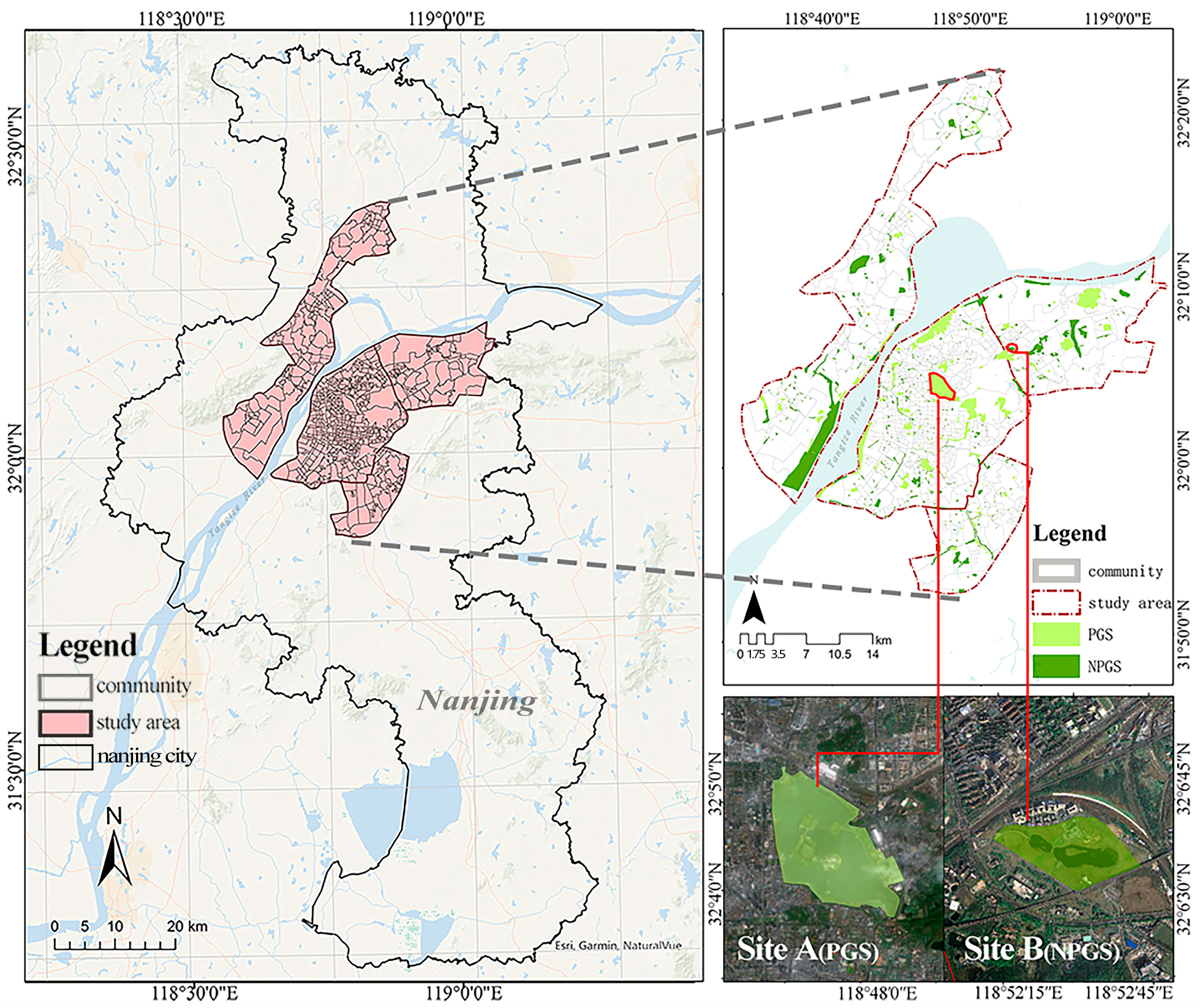
To contextualize the assessment framework, this study selects Nanjing as a representative rapidly urbanizing metropolis in eastern China. According to China’s official city-size classification, super-large cities have ≥10 million permanent residents and very large cities have 5–10 million; official statistics report 7 super-large cities and 14 very large cities nationwide, and Nanjing, with over 9 million permanent residents, is listed among the very large cities [61]. Nanjing, the capital of Jiangsu Province, is located in the central part of the Yangtze River Delta in eastern China (118°22′ E–119°14′ E, 31°14′ N–32°37′ N) and serves as a major node in the Yangtze River Economic Belt. The Yangtze and Qinhuai rivers traverse the city, forming a distinctive riverine landscape that not only defines Nanjing’s urban morphology but also provides the ecological foundation for its green space structure. Nanjing experiences a humid subtropical monsoon climate characterized by hot and humid summers and cold, moist winters. Under such climatic conditions, urban green spaces play a vital role in mitigating heat stress, regulating the microclimate, and providing accessible venues for recreation and health promotion [62,63,64]. Under the framework of the Sustainable Development Goals (SDGs), China has incorporated quantitative targets for forests and urban green space into national planning systems, including a forest coverage target of 24.1% by 2025 and urban planning standards requiring a minimum green coverage ratio of 35% and at least 14 m2 of park green space per capita [65,66]. This study focuses on the central urban area of Nanjing, covering approximately 846 km2, which concentrates the majority of the city’s population and economic activities. It comprises the main urban district, Jiangbei Sub-city, Dongshan Sub-city, and Xianlin Sub-city (Figure 1). Notably, pocket parks are categorized based on their administrative status rather than scale; those listed in the official park directory are classified as PGS, while unregistered small-scale greens are treated as NPGS. The area is characterized by high population density, intensive land use, and diverse urban functions [67,68,69]. A total of 609 community units were delineated as the basic analytical units based on administrative boundaries verified by the Nanjing Statistical Yearbook (2023) [70]. On average, these communities cover an area of 1.47 km2 and support a population of 8891 residents, representing a typical high-density urban fabric. Within these units, the distribution of green space elements shows significant structural variation. While formally designated parks (PGS) are relatively sparse, with a mean of 0.44 patches per community, non-park green spaces (NPGS) are considerably more pervasive, averaging 1.44 patches per community. This numerical dominance suggests that NPGS serves as a critical supplemental layer for increasing the frequency and granularity of green space exposure at the local level.
The study area encompasses both formally designated park green spaces (PGS) and diverse non-park green spaces (NPGS), including roadside greenbelts, riparian buffers, institutional green lots, and pocket parks (Figure 1). Specifically, Site A and Site B are highlighted in Figure 1 as representative prototypes of PGS and NPGS. These categories are defined by their inclusion in the official park directory rather than their scale, ensuring that all supplemental urban forest elements are captured. Guided by the Territorial Spatial Master Plan of Nanjing (2021–2035), recent planning efforts aim to construct a multi-scale, hierarchical green infrastructure network that enhances both ecological performance and service accessibility [70]. Nevertheless, substantial disparities in spatial distribution, connectivity, and accessibility persist—particularly in peripheral districts such as Jiangbei. This spatial heterogeneity makes the central urban area of Nanjing a representative case for evaluating the performance-enhancing potential of NPGS integration within urban green infrastructure systems [71,72,73].

2.2. Data Collection

The datasets used in this study are categorized into urban morphology, demographic and socioeconomic, and environmental attribute data, forming an integrated foundation for evaluating community-scale green space performance. Each category aligns with a key analytical dimension of the framework—supply capacity, spatial accessibility, and environmental quality—which jointly support the computation of the Supply–Demand Ratio (SDR), Deviation Reduction Index (DRI), and ternary structural indicators. Indicator selection was guided by three principles: (1) theoretical relevance to green space service performance; (2) data reliability, availability, and spatial consistency; and (3) representativeness in describing urban structure, population demand, and environmental context.
Specifically, the datasets include green space patches (PGS and NPGS), community boundaries, population data, road networks, public transit stations, surface water bodies, housing prices, points of interest (POIs), and land use classification data (Table 1). Population data were derived from the 2023 LandScan Global Population Database and spatially downscaled to the community level using area-weighted allocation. Road networks, transit stations, and POIs—covering major and secondary roads, bus stops, metro stations, and public service and commercial facilities—were obtained from the Amap Open Platform. Water bodies and land use data, sourced from the National Geospatial Data Cloud, were used to delineate built-up areas and assist in identifying NPGS boundaries. Housing price data were collected from Lianjia, representing average residential transaction prices in 2023, and spatially aggregated at the community level.
Formally designated PGS data were obtained from the Nanjing Municipal Bureau of Landscaping and Forestry (2021) [74], encompassing 134 parks with a total area of 3896 ha (4.61% of the study area) and an average size of 29 ha. NPGS were defined as vegetated areas not listed in the official park directory but still providing local green services [33,75]. NPGS identification followed a two-step approach: first, high-resolution remote sensing imagery (10 m) was used to extract NDVI for detecting vegetated areas [33,76,77]; second, all PGS patches were excluded, and the remaining vegetation areas were manually verified for coverage, accessibility [31,78] and public usability [35,79,80]. Consequently, strictly private spaces such as individual backyards and residential gardens were excluded to ensure the identified NPGS reflect communal green assets. Ultimately, 684 NPGS patches were identified within the study area, totaling 4038 ha (4.77% of the study area) with an average patch size of 5.9 ha (Table 2).

2.3. Methods

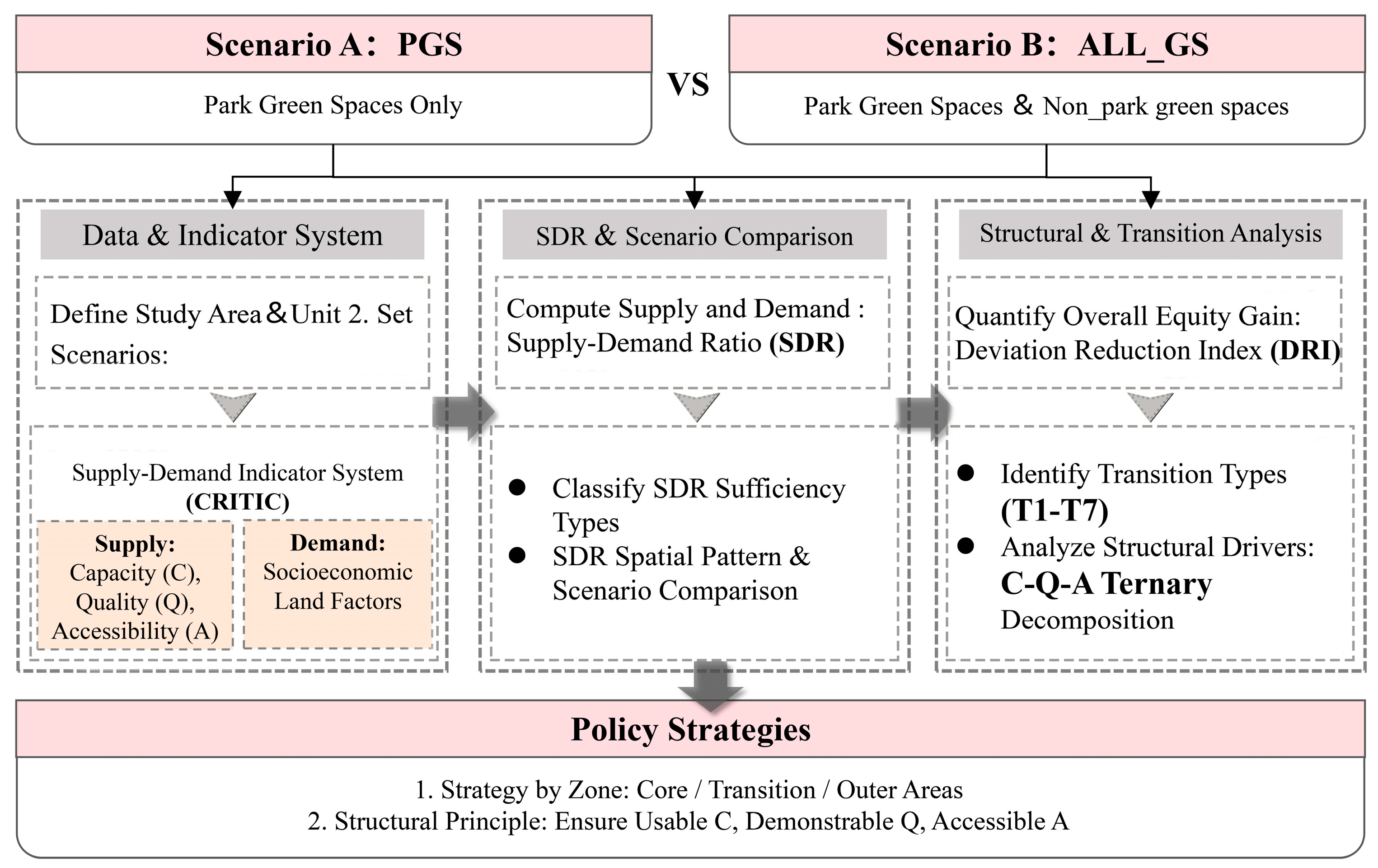
To systematically evaluate the impact of incorporating NPGS on urban green service performance, this study developed a community-scale comprehensive evaluation framework (CSDR-GS) based on the Supply–Demand Ratio (SDR) metric (Figure 2). The framework emphasizes the separate modeling of supply and demand components, making it well-suited for analyzing heterogeneous and multi-sourced urban green systems [81,82,83]. Unlike the conventional Gaussian two-step floating catchment area (2SFCA) method—which primarily captures spatial accessibility—the CSDR-GS framework integrates a multidimensional assessment of each green space unit through three core indicators: capacity, quality, and accessibility. This structure better captures the spatial and functional heterogeneity of urban green patches in terms of ecological and social service potential [84,85]. The SDR serves as the central evaluation indicator, allowing for explicit classification of community-level service adequacy and scenario-based comparison between PGS-only and All_GS (PGS + NPGS) systems [58,86,87]. In addition, the framework incorporates a structural decomposition analysis, which identifies the relative contributions of each dimension and reveals the differentiated improvement pathways of NPGS across communities [22,88,89]. Given heterogeneous demand and land-constrained provision, an exact demand–supply equilibrium is unlikely in practice. Therefore, this study explicitly identifies demand–supply disequilibrium as under-supply versus over-supply conditions using SDR and evaluates whether NPGS integration reduces such disequilibrium at the system level using DRI.
Building on the CSDR-GS framework, this study follows a sequential analytical workflow that mirrors the logic illustrated in Figure 2. The process begins with the construction of community-level supply and demand indicators, which are integrated to compute the Supply–Demand Ratio (SDR) as a baseline measure of green space service performance. Based on these baseline SDR values, a system-level evaluation is then conducted using the Deviation Reduction Index (DRI) to quantify the extent to which overall supply–demand mismatch is alleviated under different green space integration scenarios. Finally, changes in system performance are decomposed using ternary diagrams, through which the structural roles of non-park green spaces (NPGS) are examined in terms of capacity, quality, and accessibility adjustments. Together, these three stages form a continuous analytical chain linking indicator construction, equilibrium improvement, and mechanism interpretation, as depicted in Figure 2. To ensure the reproducibility of the study, the detailed mathematical definitions and calculation procedures for the underlying methods are provided in Appendix A.

2.3.1. Measurement of Supply–Demand Ratio

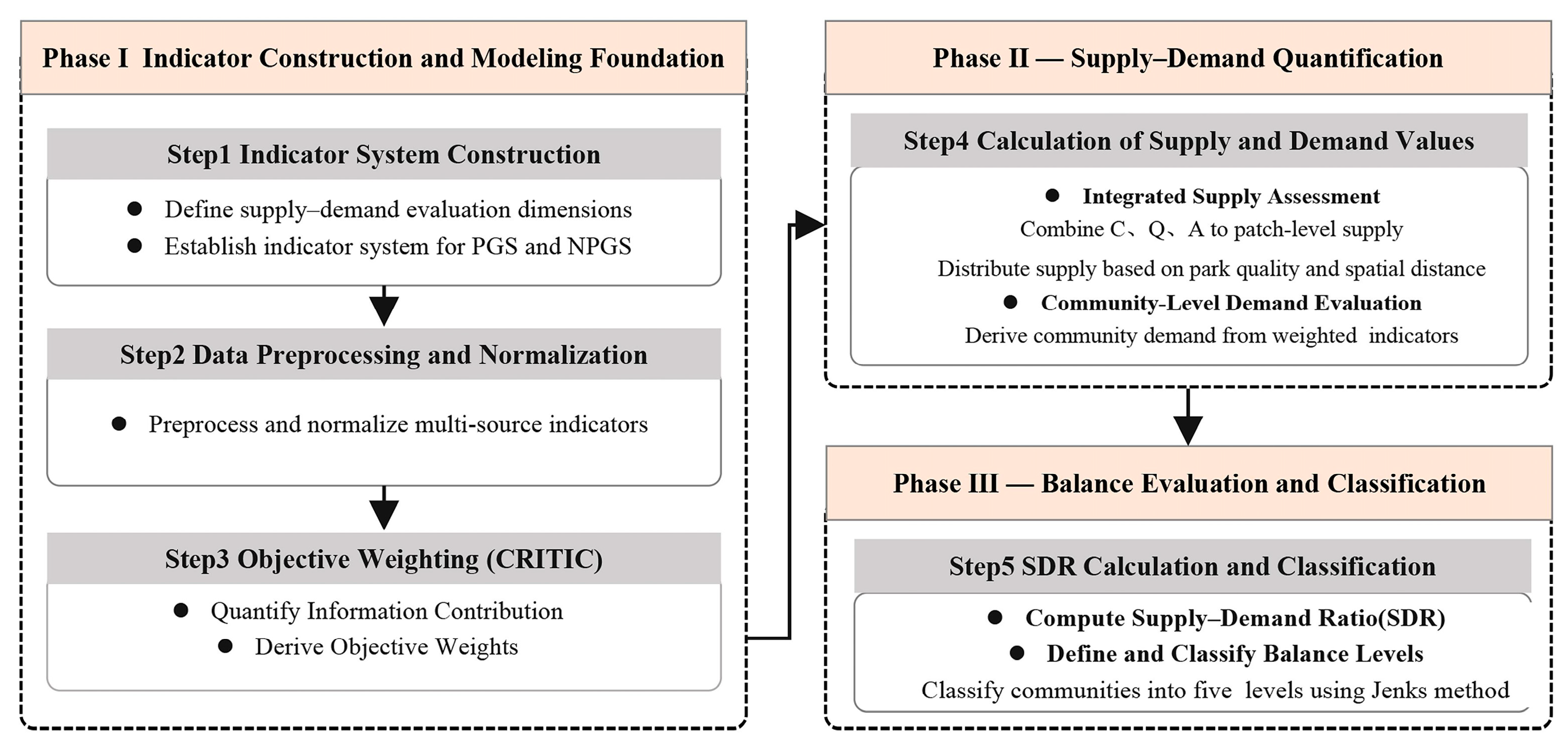
This study evaluates community-level green space provisioning performance using the Supply–Demand Ratio (SDR) [83,90,91]. To clarify the SDR evaluation, a three-phase, five-step workflow is adopted (Figure 3).
Phase I establishes the analytical foundation by (1) specifying a comprehensive supply–demand indicator system—organizing supply as capacity–quality–accessibility (C–Q–A) and demand as population–socioeconomic pressure (Table 3). (2) All variables were min–max normalized, with transformations applied to reduce skewness where necessary. (3) Deriving objective indicator weights using the CRITIC method (Table 4).
Phases II–III implement model computation and cross-scenario evaluation. Supply is first computed at the patch level by combining C, Q, and A sub-scores with the original weighted composite [98,101,105], yielding a patch supply score S i . Patch supply is then translated to community supply S j via a quality-graded service radius with distance-decay delivery [103,106,107] where Jenks-based quality classes and layered radii ( d 1 , d 2 , d 3 ) are applied. Demand D j aggregates normalized demand-side indicators with CRITIC weights. SDR denotes the ratio between the community’s supply value and its demand value [40,108,109]. To ensure cross-scenario comparability, five supply–demand categories are assigned using the Jenks breaks method applied to the pooled SDR values from both the PGS and All_GS scenarios: under-supply (U), approaching under-supply (AU), balance (B), approaching over-supply (AO), and over-supply (O). The Jenks breaks method was selected as it optimizes class groupings by minimizing intra-class variance and maximizing inter-class differences, thereby objectively capturing the natural thresholds and spatial heterogeneity of urban forest supply–demand patterns. All formulas, parameter values, and references follow the manuscript specifications, as calculated by Equations (1) and (2).
S i = C i · Q i · A i
S D R j = S j = i Ω j S i · f ( d i j ) · 1 { d i j r ( Q i ) } D j = k = 1 n w k x j k
Notes: d i j is the distance from patch i to community j; r ( Q i ) maps Jenks-classifiedquality to service radii; 1 { · } is an indicator function; f ( d ) is the chosen decay kernel; x j k are normalized demand indicators; w k are CRlTlC weights. Full normalization and weighting formulations, decay functions, and radius calibration are provided in Appendix A.
Furthermore, based on SDR change trajectories before and after NPGS integration, communities were categorized into seven transition types (T1–T7), reflecting diverse transformation pathways—from significant improvement to persistent deficiency (Table 5). This typology provides a diagnostic framework for understanding spatial heterogeneity in NPGS effects.

2.3.2. System-Level Performance Evaluation Using the Deviation Reduction Index

To quantify the overall improvement in green service performance after NPGS inclusion, the Deviation Reduction Index (DRI) was introduced. The D R I measures the degree to which spatial inequalities in SDR values are reduced across all communities [110,111,112]. Instead of presuming a fixed optimal SDR value, this study delineates an interval representing a reasonable range of balanced supply–demand performance.
The DRI is calculated using a range-based approach:
D R I = i = 1 n d i P G S i = 1 n d i A l l G S i = 1 n d i P G S
where d i represents the minimal deviation of the S D R value of community i from the defined ideal interval, computed as:
d i = { L S D R i , if   S D R i < L 0 , if   L S D R i U S D R i U , if   S D R i > U
Here, L and U represent the lower and upper bounds of the ideal S D R range.
Positive DRI values indicate performance enhancement, while negative values suggest deterioration. The DRI thus captures both the direction and magnitude of service change. At the system level, mean and variance statistics of DRI were used to evaluate whether NPGS integration promotes greater spatial equity in green space distribution.

2.3.3. Structural Role Analysis of NPGS via Ternary Diagrams

To further reveal the internal mechanisms of performance improvement, a ternary structural analysis was conducted to examine the relative contributions of the three performance dimensions—capacity, quality, and accessibility—to the observed SDR changes [88,113,114]. Each community’s standardized values for the three indicators were plotted within a ternary coordinate system, allowing visual interpretation of structural balance and dominant drivers.
C j = C j C j   +   Q j + A j   ×   100 , Q j = Q j C j   +   Q j + A j   ×   100 , A j = A j C j   +   Q j + A j   ×   100
To further examine the internal dynamics of each transition path, ternary plots were constructed for each of the seven identified types (T1–T7), which were classified based on SDR shifts between the PGS and All_GS scenarios. Integrating this SDR-based classification into the ternary framework enables the method to reveal how NPGS reshapes the internal structure of green space supply—whether by capacity, quality, or accessibility—and to explain spatial differentiation in performance responses.

3. Results

3.1. Spatial Patterns of Green Space Service Performance

3.1.1. SDR Distribution Under PGS and All_GS Scenarios

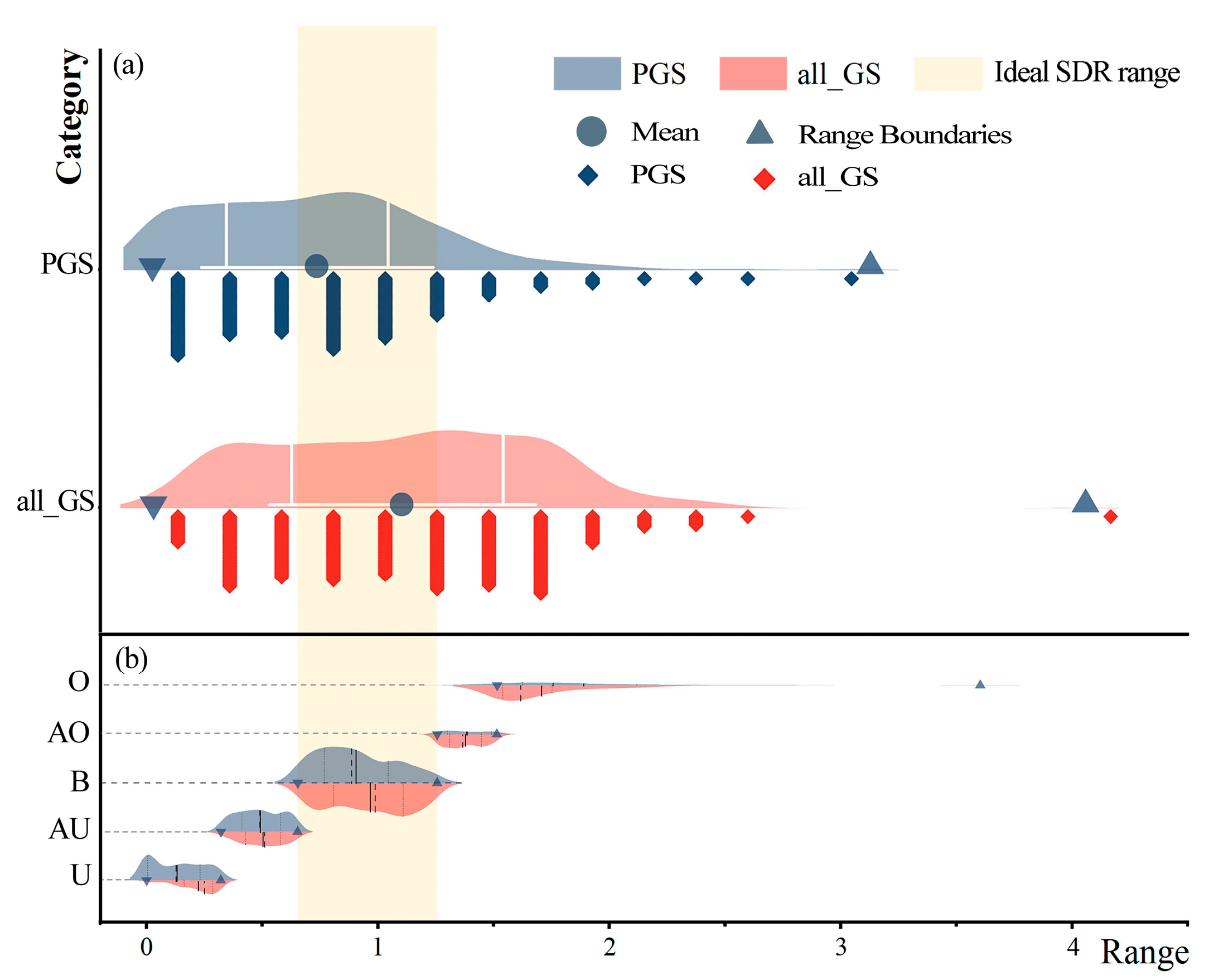
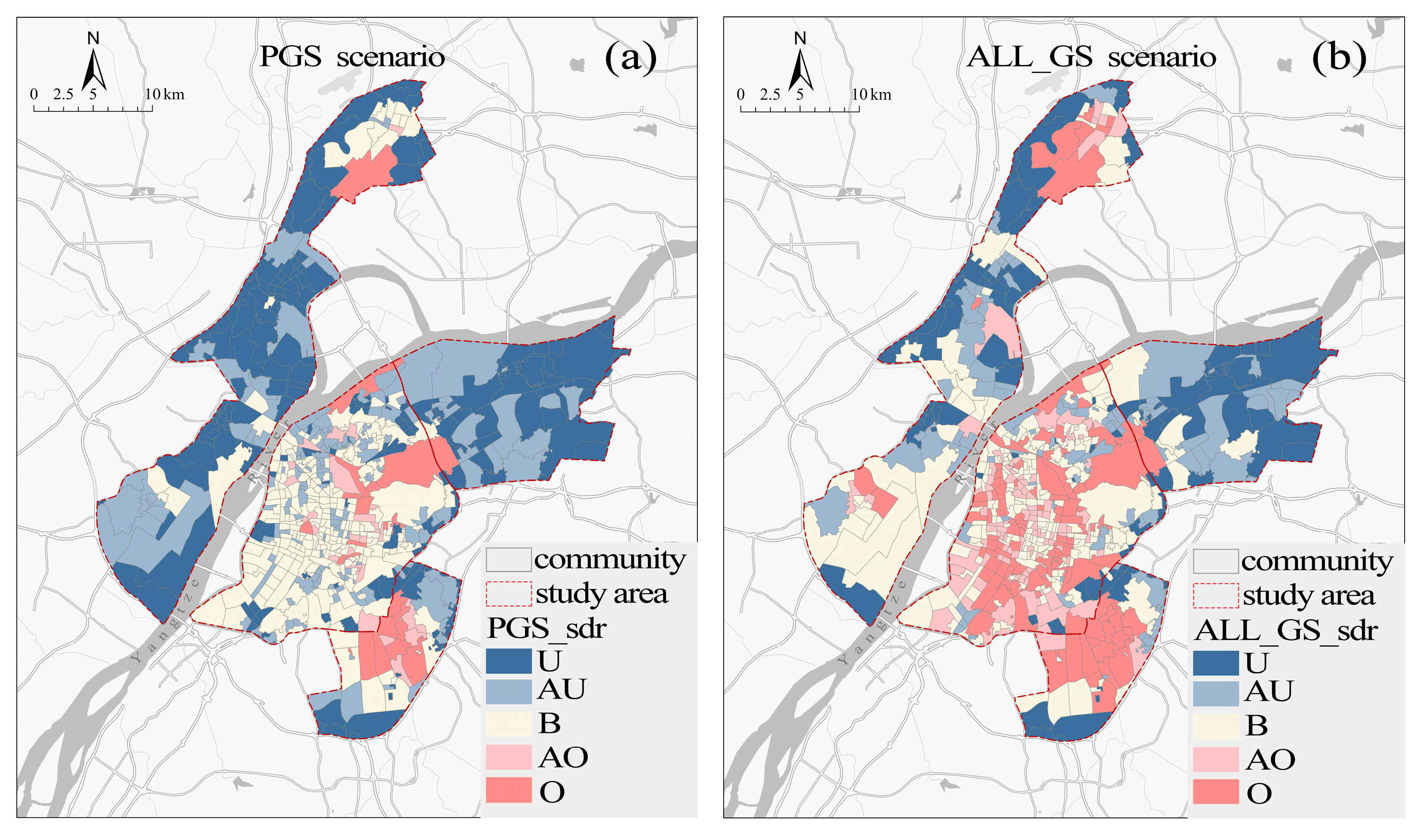
To ensure comparability, SDR classes (U/AU/B/AO/O) are defined using Jenks breaks fitted to the pooled SDRs from both scenarios, and the same thresholds are applied within each scenario; the shared ideal interval (B) is 0.6535–1.2568 (Table 6). Using this common scheme, the PGS (park green space only) scenario provides the baseline: the citywide mean SDR is 0.64—slightly below the lower bound of the balanced category—and the class composition is U (173), AU (147), B (245), AO (25), and O (19) (Table 6), indicating a left-tailed distribution with a substantial share of under- or near-under-supply communities, 52.5% of the total. After incorporating NPGS (All_GS), the distribution recenters toward the ideal interval (Figure 4a), where the triangle and circle symbols in the plot denote the extreme values and the mean values of the SDR distribution, respectively. The average SDR increased from 0.64 (PGS) to 0.94 (All_GS), representing a 46.9% improvement, of which NPGS contributed approximately 66.15%. Class-wise comparisons under the same thresholds further show a rightward shift in the under-supply side and a consolidation of middle-to-high classes (Figure 4b), evidencing a broad citywide movement toward higher SDR levels.

3.1.2. Spatial Differentiation Across Urban Subregions

Under the PGS scenario, spatial heterogeneity is pronounced across the central urban area (Figure 5a). Medium-to-high SDR levels (B–AO) cluster in the urban core, especially along the Xuanwu Lake–Zijin Mountain corridor and around the Jianye Olympic Sports Center. Proximity to large urban parks, scenic mountains, and waterfront green belts produces contiguous zones of strong service performance. In contrast, low-SDR pockets are concentrated in peripheral and rapidly developing subregions—including Jiangbei New Area, Pukou, southeastern Jiangning, southern Yuhuatai, and eastern Qixia—where limited park access and incomplete green-infrastructure networks indicate structural discontinuities and pronounced service inequities under PGS. With the inclusion of NPGS (All_GS scenario), the citywide pattern becomes more balanced and continuous (Figure 5b). Relative to PGS, the number and area of low-value patches decline markedly, while medium- and high-level clusters expand and coalesce. High-SDR zones remain anchored in the Xuanwu–Zijin corridor, the Jianye Olympic district, and the Yuhuatai Scenic Area, but now extend into adjacent communities, forming larger contiguous regions of high service capacity. Notably, new Balanced (B) zones emerge in central Pukou and mid-northern Jiangning, signaling effective optimization of local green space structures following NPGS integration. Nevertheless, several urban-fringe belts—such as northern Pukou, north-western Jiangbei, and the northern/southern edges of Dongshan—continue to exhibit U/AU conditions, typically in low-density or transitional areas with weak green foundations. All_GS redistributes benefits toward the periphery while preserving core advantages, narrowing sub-regional disparities and yielding a more continuous green-service landscape across the metropolitan structure.

3.2. Quantitative Evaluation of Systemic Improvement in Supply–Demand Balance

3.2.1. Quantitative Changes in SDR Classifications

Under the common thresholds, the transition matrix (Table 7) evidences a decisive upgrade bias after integrating NPGS; the supply-deficit communities decrease by about 40%, the high-supply tier expands from 44 to 194 communities, while the balanced class (B) declines moderately from 245 to 224, consistent with part of the balanced group upgrading into AO/O. These changes highlight several advantages of incorporating NPGS: (1) a large net flow out of U/AU and into B/AO/O, (2) a near-tripling of high-supply communities that lifts overall service capacity, and (3) reallocation that occurs without widespread downgrades under identical thresholds. Two caveats also emerge: (1) the balanced class declined by 3.4%, implying that some gains accrue by shifting communities beyond the balanced band, which may introduce local over-supply pockets (reflected in the rise in O from 19 to 102); and (2) a residual deficit persists, suggesting structural constraints that NPGS alone does not fully resolve (Figure 6).

3.2.2. Deviation Reduction Index Results

Quantitatively, the total SDR deviation across all communities declined from 129.43 (PGS) to 111.75 (All_GS), and the mean deviation dropped from 0.2125 to 0.1835 (Table 8). Under the fixed ideal band, these concurrent reductions indicate that community SDR values, on average, lie closer to the target range and are less dispersed under All_GS. The resulting DRI (0.1367) summarizes this improvement as a 13.67% average decrease in community-level shortfall relative to the ideal interval.
With the ideal interval and thresholds held constant, the reductions reported in Table 8 represent genuine performance gains rather than classification artifacts. Both central tendency and dispersion improve—mean deviation declines and the standard deviation contracts—indicating higher overall performance and greater stability of service levels citywide. Nonetheless, a residual deviation of 111.75 remains, showing that shortfalls are not fully eliminated and motivating the sub-regional diagnostics that follow. In sum, integrating NPGS reduces the average distance to the ideal and compresses variability at the community scale.

3.3. Community-Level Differentiation and Structural Transformation of Service Mechanisms

3.3.1. Community Transition Typology and Spatial Patterns

Balance is defined as SDR within the shared ideal interval (0.6535–1.2568). The study area does not achieve full demand–supply equilibrium in either scenario. In the PGS sce-nario, the citywide mean SDR is 0.64, and 52.55% of communities are under-supplied (U + AU), indicating an under-supply–dominant state. After integrating NPGS (All_GS), the mean SDR increases to 0.94, and the under-supply share decreases to 31.37%, suggesting a shift toward the ideal interval. Meanwhile, imbalance persists: the balanced class (B) ac-counts for 40.23% (PGS) and 36.78% (All_GS), and over-supply (AO + O) increases to 31.86% in All_GS. At the system level, total deviation decreases from 129.43 to 111.75, and the DRI is positive (0.1367), indicating reduced mismatch but not full equalization.
Using the common Jenks-based thresholds and a fixed scheme, communities reclassify from PGS to All_GS into seven transition types defined by class movements (T1–T7). Improvements dominate the outcome: together, the three improvement types constitute about three-fifths of all communities, led by T2 (Strong Upgrading), which is the single largest group and signals broad shifts into the high-supply tier. T1 (Stable Improvement) contributes a substantial share by lifting under- or near-under-supply communities into the balanced range, while T3 (Mild Improvement) reflects moderate gains within the deficit tier. Among stable outcomes, T4 (Balanced Stability) preserves a sizable balanced footprint across scenarios, and T5 (High-Level Stability) marks a small but persistent high-performance segment. By contrast, a residual underserved block remains in T6 (Persistently Underserved), indicating unmet need despite NPGS inclusion, and downgrades (T7) are rare, confirming that reclassification is overwhelmingly skewed toward higher service levels (Table 9).
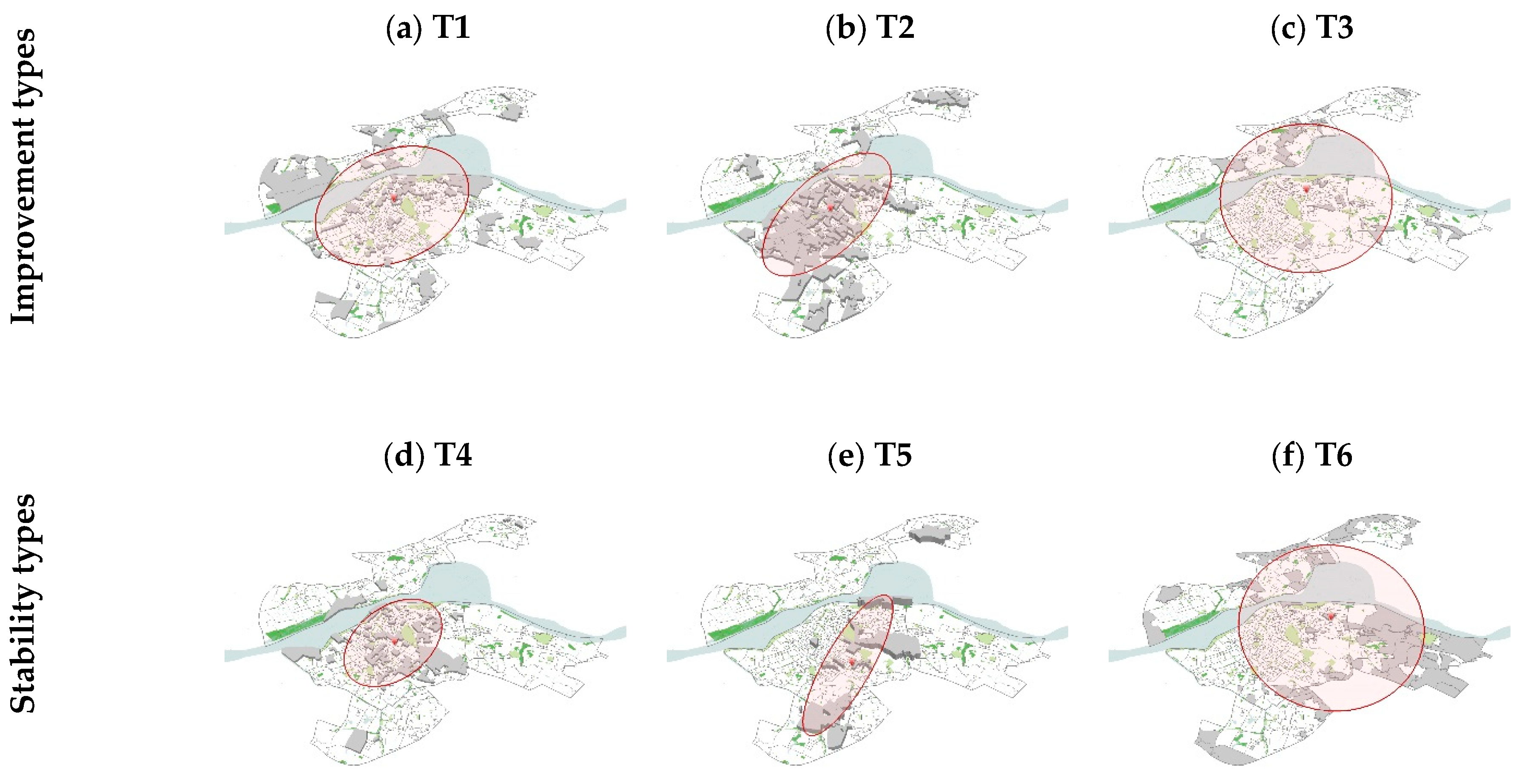
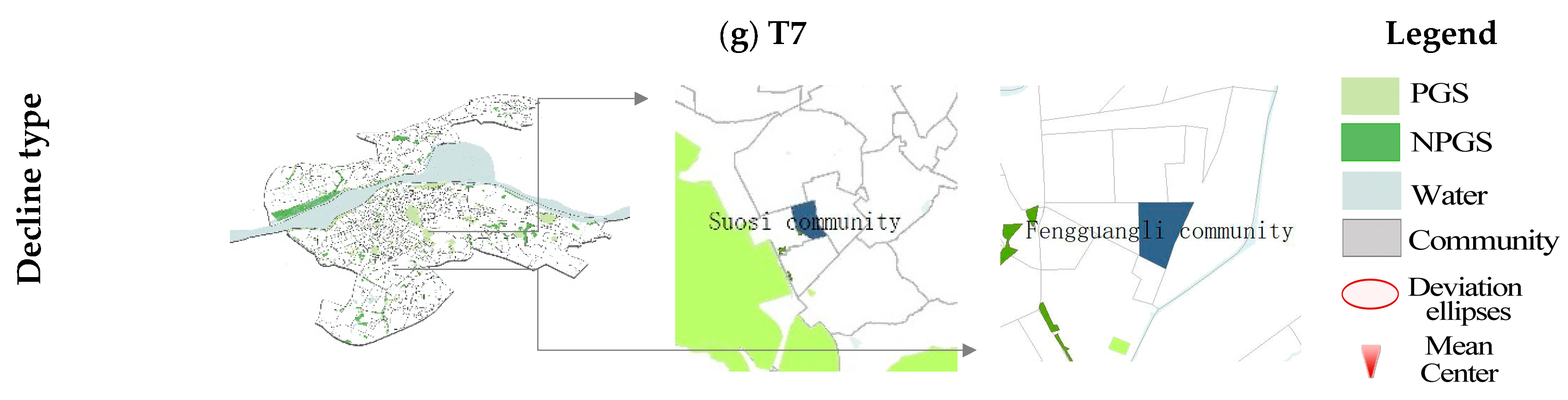
The seven transition types exhibit distinctive spatial patterns Figure 6a–g. Combined with standard deviation ellipses in Appendix A.4 and the spatial layout of PGS and NPGS patches, these maps reveal differentiated clustering and directional characteristics across Nanjing’s urban structure.
(1) Improvement types (T1–T3) extend from the urban core toward transitional and peripheral zones: T1 is mainly along the periphery of the central urban area and transitional zones of the main city; in Jiangbei, where PGS was historically limited, riverine ecological belts and shelter forests act as compensatory NPGS resources; in Gulou/Qinhuai and other dense inner districts, street greens and Qinhuai River riparian slopes supplement small, underserved communities; in Xianlin and Dongshan, university/institutional greens support shifts from under-served to balanced. T2 shows compact spatial clustering, mainly in the main urban core and Dongshan, with fewer scattered cases in Jiangbei; in mature areas, strategically located street and residential block greens extend service radii and create overlapping zones/partial redundancy; in Jiangbei’s new residential areas, large shelter belts and integrated green corridors generate temporary over-supply under low population density. T3 is dispersed citywide, forming a nearly circular standard-deviation ellipse with no dominant orientation, and concentrates in transitional belts of central/northern Nanjing; here residential greens, ecological restoration patches, and campus greens fill subtle service voids near edges of existing PGS coverage, indicating a supporting role in fine-tuning spatial equity rather than driving major structural change.
(2) Stability types (T4–T6) show contrasting footprints. T4 is densely concentrated in Gulou, Xuanwu, and Qinhuai, with a few cases in Jiangbei; these occur in mature core districts where PGS with institutional and courtyard greens are already integrated. T5 forms three major clusters—Liuhe (Siliu area, Jiangbei), the Zijin Mountain-Yueya Lake corridor, and Baijia Lake (Dongshan)—as localized concentrations adjacent to flagship parks, scenic corridors, or waterfront belts. T6 is widely scattered, delineated by a broad, weakly oriented ellipse, and occurs primarily along Jiangbei’s urban fringes, in Xianlin, and in the transition zones between the main city and Dongshan, where low-density settings, restricted-use institutional greens, or fragmented pocket parks limit effective coverage.
(3) The decline type T7 appears as two isolated cases without contiguous clustering. These areas were previously adjacent to major PGS resources and benefited from proximity-based advantages. However, after including NPGS, the redistribution of service coverage improved conditions in neighboring communities, thereby diluting the relative advantage of T7 communities. This rare pattern illustrates a rebalancing of service hierarchies following spatial redistribution of green space capacity.

3.3.2. Internal Shifts in Capacity–Quality–Accessibility Structure

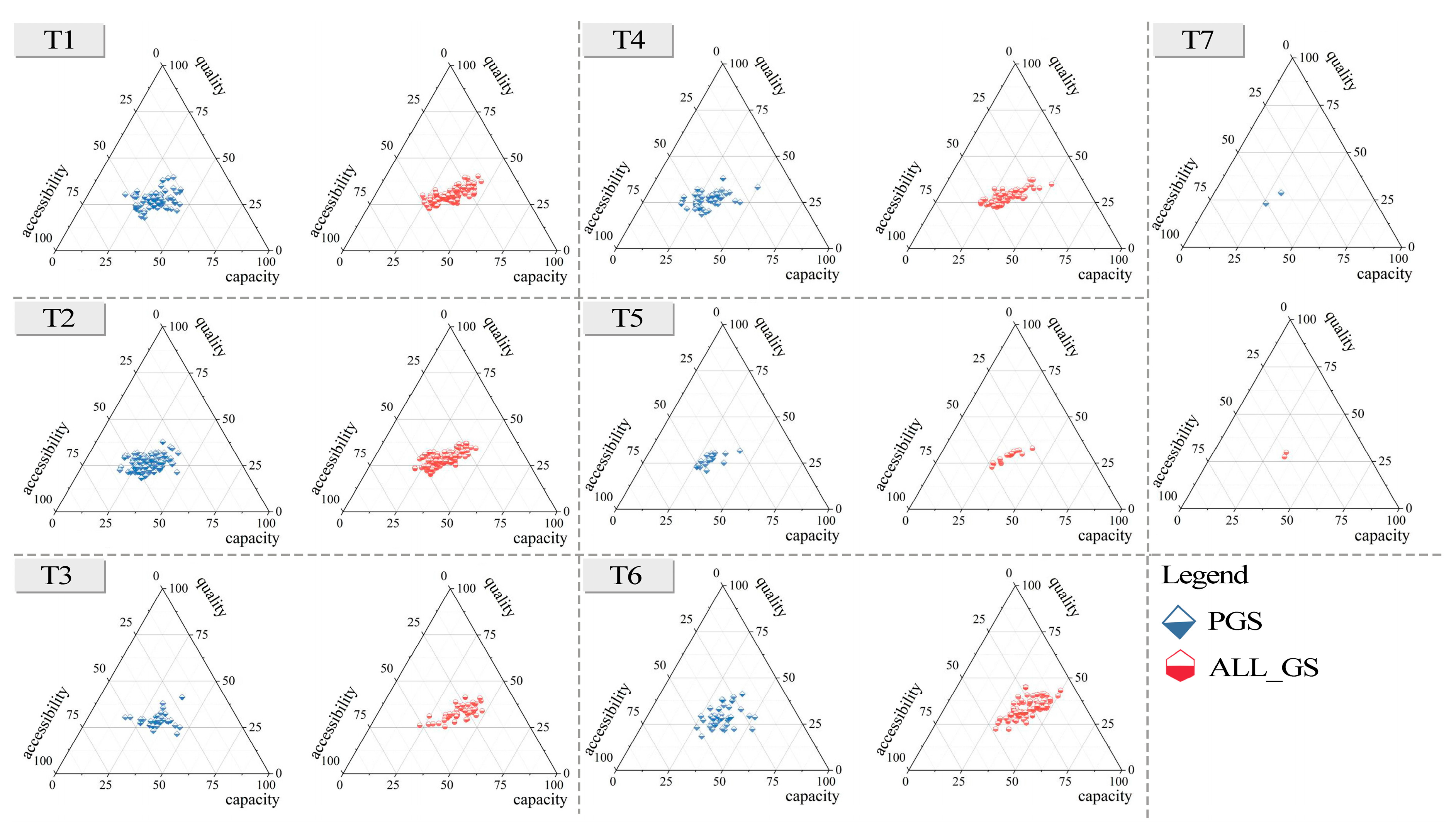
To reveal how NPGS contributes structurally to the improvement of green space performance across diverse community types, a ternary structural analysis was conducted based on the three core indicators: capacity, quality, and accessibility. Figure 7 depicts the comparative scatter distributions for both the PGS and All_GS scenarios.
(1) Growth-oriented communities (T1, T3):
T1 and T3 represent communities showing the greatest overall improvement. In T1, points under the All_GS scenario form a centralized linear cluster along the capacity–quality axis, indicating simultaneous gains in both dimensions. T3, however, shows a cluster closer to the quality corner, suggesting strong quality enhancement but persistent accessibility constraints.
(2) Over-supply oriented communities (T2, T5):
Both T2 and T5 communities moved into the oversupplied category following NPGS integration; in this All_GS scenario, both point clouds converge toward high-capacity/high-quality configurations with reduced accessibility spread, aligning predominantly along the capacity–quality edge. The T2 cloud shows a discernible upward-rightward centroid shift from the PGS baseline and a tighter, re-oriented band with contraction of variance perpendicular to the C-Q edge, a clearer alignment with the high C-Q domain under All_GS. By contrast, T5 remains an already compact cluster near the high C-Q corner, exhibiting minimal centroid movement and only slight additional tightening after NPGS is included. In short, NPGS is associated with migration and consolidation toward the high C-Q band in T2, and with high-level persistence with marginal tightening in T5.
(3) Persistently undersupplied communities (T6):
T6 communities remain undersupplied even after NPGS inclusion. Their scatter points show minimal clustering and only slight shifts toward the capacity–quality axis, while accessibility weakens further. This implies that increasing green capacity or quality alone cannot offset deficiencies in accessibility.
(4) Performance-declining communities (T7):
T7 communities exhibit a rare but crucial case where SDR values and overall service performance declined following NPGS integration. Under the PGS scenario, scatter points clustered along the capacity–quality axis, reflecting strong original supply and high-quality conditions. After integration, however, the distribution shifts toward the accessibility corner, accompanied by reductions in both quality and capacity. This suggests that newly incorporated NPGS-often vegetated slopes, buffers, or low-quality ecological patches-added physical area but not functional service. Moreover, as adjacent underperforming communities improved, the relative advantage of T7 diminished, resulting in downgraded SDR classifications.

4. Discussion

4.1. Structural Differentiation and Spatial Equity Mechanisms

In high-density metropolitan settings, urban forest re-balancing processes are often shaped less by uniform expansion and more by the spatial configuration, functional attributes, and accessibility of newly integrated forest-based green resources. Moving beyond a purely descriptive account of spatial patterns, this study reveals that under a fixed classification scheme and common ideal interval, the citywide re-balancing observed in Section 3.1, Section 3.2 and Section 3.3 arises primarily from where NPGS was added and what kinds of urban forest elements were incorporated, rather than from a uniform lift across all places. In the urban core (e.g., Gulou, Xuanwu, Qinhuai), dense networks of street trees, riverside vegetation along the Qinhuai River, and institutional/courtyard forest patches were layered onto an already mature PGS fabric. This produced high-level persistence or consolidation; communities remained at, or migrated into, strong performance states because incremental capacity and quality gains could be immediately realized within walkable catchments and continuous park–street interfaces [40,115]. These core clusters correspond to stable-high or upgraded types (notably T5 and a share of T2), and they help explain why over-supply oriented endpoints concentrate near major green assets without widespread downgrades.
Along transitional belts at the edge of the inner city and around major corridors (e.g., the Xuanwu Lake–Zijin Mountain corridor and the Jianye Olympic district), the addition of linear/patchy NPGS—street greens, riverfront slopes, small residential greens—most often translated into balanced or higher outcomes through joint gains in capacity and quality [32,116]. These areas exhibit the clearest movement out of deficit classes because dispersed, fine-grain NPGS fills gaps between large parks and residential blocks, smoothing short-range access and lifting environmental conditions. The resulting pattern—continuous or semi-continuous improvement belts—is characteristic of T1 (stable improvement) and portions of T2 (strong upgrading), and aligns with the observed contraction of low-value pockets in Section 3.1.2. In new-growth and peripheral districts, outcomes diverge with the type and openness of NPGS. In parts of Jiangbei and Dongshan, extensive shelter belts and integrated green corridors accumulate substantial capacity and quality, pushing many communities into the high tier (consistent with T2/T5 endpoints). Elsewhere—especially in Jiangbei’s urban fringes and Xianlin—a large share of NPGS takes the form of university/institutional greens or enclosed ecological buffers. These resources raise local quality and nominal capacity but remain weakly permeable; communities therefore show limited structural response and persistent shortfalls under the same thresholds (the hallmark of T6). In short, the periphery improves where NPGS is both present and publicly usable; it plateaus where NPGS is present but functionally restricted. A small set of decline cases appears where newly counted NPGS consists mainly of steep vegetated slopes, buffers, or low-function patches that add area without commensurate usability or quality. As neighboring deficit communities improve, the relative advantage of these locations erodes, yielding downgraded classifications (the rare T7). Such relative declines are not unique to the study area but reflect a broader risk in urban green accounting, whereby area-based inclusion without functional usability may inadvertently weaken perceived service performance.

4.2. Structural Role of NPGS in Urban Green Infrastructure Planning

The results indicate that expanding green coverage alone is insufficient for equitable performance; what matters is functional alignment—new green spaces must meet baseline standards of accessibility, environmental quality, and usable capacity. Where this alignment fails, system stability can deteriorate, as evidenced by the rare but policy-salient T7 cases. A practical implication, applicable to many cities facing constrained park expansion, is to establish entry-evaluation mechanisms for NPGS prior to integration, combining quantitative screens with qualitative criteria to prevent the addition of areas without function and to safeguard well-performing systems.
Positioning these findings within prior research, our citywide, before-and-after design under fixed thresholds corroborates the literature that emphasizes the primacy of capacity and quality in driving ecosystem service gains [92,117,118], yet it qualifies those claims by showing their spatial contingencies. In compact cores and mature corridors (e.g., Gulou-Xuanwu-Qinhuai; the Xuanwu-Zijin and Jianye corridors), layering fine-grain, publicly accessible NPGS onto integrated PGS primarily yields consolidation at high C-Q profiles (typical of T5 and a portion of T2). Along transitional belts, gap-filling NPGS—street greens and small residential patches-links neighborhoods to major parks, producing balanced and above outcomes (notably T1 and T2). In peripheral growth areas (parts of Jiangbei and Xianlin), the effect hinges on openness: where shelter belts and green corridors are accessible, profiles improve and cluster upward; where institutional or enclosed greens dominate, communities remain structurally underserved (T6) despite nominal capacity/quality gains-echoing accessibility constraints [104,119]. Finally, isolated sites that absorb non-functional patches exhibit C-Q dilution and relative decline (T7), extending the literature by documenting a negative pathway that area-based targets can inadvertently trigger [43,120].
Taken together, these location- and resource-specific pathways explain why the system becomes more balanced overall yet remains differential across sub-regions. We synthesize them as four mechanism channels for integrated urban forest management: (1) in cores and mature corridors, prioritize fine-grain, publicly accessible NPGS that consolidates advantage without destabilizing existing systems; (2) in transitional belts, deploy gap-filling NPGS to close last-mile connections to major parks; (3) in peripheral growth areas, pair capacity/quality additions with public availability, frontage permeability, and pedestrian-network continuity so that access ceases to be the binding margin; and (4) avoid integrating non-functional NPGS that adds area but not ecosystem service. By testing our explicit hypotheses through this framework, our study both reinforces capacity/quality-led improvement identified in earlier work and refines it by distinguishing consolidation from saturation in high-tier settings (T2 vs. T5) and by specifying where accessibility is the decisive lever (T3/T6). Policy should consequently tailor NPGS strategies to structural context—access-oriented linear greenery or rooftop solutions in compact cores; diversity and water-sensitive design to lift quality in suburbs—while instituting pre-integration audits that ensure each added green unit contributes usable capacity, demonstrable quality, and reachable access rather than nominal coverage. Although derived from a single-city case, these mechanism-based recommendations are relevant to a wide range of metropolitan regions where urban green infrastructure must evolve within limited land and complex governance conditions.

4.3. Governance Framework and Management Responsibility

The integration of NPGS into urban planning necessitates a clear definition of management responsibilities to address political and normative concerns. From the perspective of urban forest governance, recognizing the service potential of NPGS must not relieve municipal authorities of their primary obligation to provide inclusive public parks; it should be viewed as a strategic supplement to bridge the service gap in hyper-dense environments. To prevent maintenance pressure from shifting to citizens, we advocate for a category-specific collaborative governance model.
Specifically, government-led NPGS (street greenery, riparian buffers) should be integrated into formal municipal maintenance budgets through cross-departmental coordination between transportation, water, and landscaping bureaus to ensure standardized quality. For community-based NPGS (residential green patches), local authorities should provide technical guidance and financial subsidies to incentivize collective maintenance, rather than leaving it as a private burden. Furthermore, for quasi-public NPGS (green spaces in commercial or institutional lands), a public–private partnership (PPP) or incentive-based zoning could be implemented to ensure public accessibility in exchange for policy support [121,122]. Such a structured governance framework ensures that the urban forest remains a legally protected and equitably managed public good rather than an informal or neglected asset.

4.4. Spatially Adaptive Strategies and Future Research Directions

Under the governance framework described above, the physical implementation of NPGS must be spatially adaptive to ensure that the urban forest yields maximum social-ecological benefits. The findings demonstrate that the equity-enhancing effects of NPGS integration emerge primarily when newly incorporated spaces contribute functional value—by adding usable recreational capacity, improving environmental quality, and ensuring walkable access—rather than through spatial expansion alone. This extends existing arguments emphasizing capacity- and quality-driven benefits, while refining them in two ways. First, the results show that accessibility often remains the binding constraint, particularly in areas where capacity has reached consolidation or early saturation stages [95,102]. Second, the analysis differentiates between consolidation that enhances functional connectivity and saturation that produces redundant or low-use green parcels. These findings, therefore, extend beyond local planning practice and provide general guidance for spatially adaptive green infrastructure strategies in rapidly urbanizing cities.
These insights highlight the need for spatially adaptive planning strategies. In dense core areas, planners should prioritize consolidation that strengthens functional connectivity without creating redundant green patches. In transitional belts, where structural gaps persist, strategies should emphasize gap-filling corridors and network continuity. In peripheral zones, equity gains depend on coupling capacity and quality upgrades with improvements in pedestrian accessibility, rather than on mere expansion. Across all zones, planners should avoid classifying non-functional or low-quality patches as service-providing green space unless their usability is substantively improved [93,94,123].
Despite its contributions, the study has several limitations. The analysis is based on a single time period, which limits the ability to infer temporal evolution or detect long-term behavioral adjustments [96,100,124]. The reliance on community-scale zoning introduces potential MAUP (Modifiable Areal Unit Problem) effects [97,99], wherein the observed spatial patterns and statistical results may vary if the boundaries of the analysis units were redefined or aggregated at different scales. Furthermore, the use of fixed thresholds may oversimplify continuous accessibility and quality gradients. Crucially, this study treats NPGS as a homogeneous category without distinguishing between specific types, such as roadside greenery, vacant lots, or pocket parks. Similar to formal parks, different types of NPGS possess varying functional attributes and may not equally meet the localized and dynamic needs of residents. The before–after design, while informative for pattern identification, does not support causal inference [125,126].
Future research should therefore advance in several directions. First, incorporating temporal and behavioral data—such as multi-season or multi-year panels, mobile-sensing traces, and usage logs—would allow examination of dynamic service utilization. Second, the classification of NPGS types should be refined by integrating functional attributes and ecological contributions, such as microclimate regulation, noise mitigation, and biodiversity support, as well as socio-perceptual qualities like visual amenity and psychological restoration, enabling more nuanced assessment of how specific forms of green infrastructure contribute to equity. Third, methodological robustness could be strengthened by testing alternative spatial units and threshold schemes, supported by uncertainty analysis, in situ audits, and detailed pedestrian-network impedance measures. Causal relationships may be more rigorously identified through quasi-experimental frameworks or natural experiments. Finally, extending the analytical framework to multi-city comparative studies would enhance the scalability and policy relevance of the findings, while incorporating broader outcome metrics—such as health benefits, thermal comfort mitigation, biodiversity value, innovation performance [127,128], and distributional justice—would improve the understanding of the wider societal impacts of NPGS integration.

5. Conclusions

This study systematically evaluated the impact of integrating Non-Park Green Spaces (NPGS) into urban forest and infrastructure planning through a community-scale case study in the central urban area of Nanjing. By formulating and testing explicit research hypotheses using a multidimensional Supply–Demand Ratio (SDR) framework and comparative analysis of park-only (PGS) and integrated (All_GS) scenarios across 609 communities, we developed an evidence-based understanding of how NPGS contributes to community-scale green space provisioning performance.
The integration of NPGS into the urban green infrastructure framework substantially enhances both system efficiency and spatial equity, effectively mitigating community-scale green space deficits. The findings demonstrate that this integration leads to a significant reduction in the proportion of underserved areas, fostering a more balanced and equitable distribution of green space provision across the urban fabric. The results also confirm that the observed improvements are driven by the structural interplay of capacity, quality, and accessibility, rather than simple area expansion. Furthermore, the transition-type analysis underscores a widespread upward shift in service levels, while identifying that rare instances of degradation are typically associated with the inclusion of patches with suboptimal quality or limited accessibility. Spatial heterogeneity was also evident: core districts tended toward redundancy, transitional zones remained undersupplied, and new development areas faced premature over-supply, emphasizing the need for differentiated planning strategies.
Despite these robust findings, several limitations should be acknowledged. First, the study relied primarily on static spatial and socioeconomic datasets, which constrain the temporal dynamics of green space use. Second, the SDR-based evaluation focuses on potential service capacity rather than actual behavioral utilization; integrating high-resolution activity data (e.g., GPS trajectories or mobile-sensing data) could improve behavioral accuracy. Third, while the framework effectively captures community-scale variations, cross-city validation is needed to ensure generalizability across diverse urban contexts.
In conclusion, this study provides a transferable evaluation framework (CSDR-GS) for assessing the contribution of non-traditional green assets. While based on a case study in Nanjing, the structural mechanisms identified—capacity, quality, and accessibility—offer a universal template for urban forest management in other global contexts. This research advocates for a normative shift in urban planning: recognizing NPGS as a vital component of the urban green infrastructure to ensure inclusive and equitable access to nature for all urban residents.

Author Contributions

Conceptualization, Y.Z., S.Y., X.Z. and W.X.; methodology, Y.Z. and W.X.; software, Y.Z.; validation, Y.Z. and W.X.; formal analysis, Y.Z.; investigation, Y.Z.; resources, Y.Z. and J.L.; data curation, Y.Z. and J.L.; writing—original draft preparation, Y.Z.; writing—review and editing, Y.Z., S.Y. and W.X.; visualization, Y.Z.; supervision, S.Y. and W.X.; project administration, Y.Z. All authors have read and agreed to the published version of the manuscript.

Funding

This research was funded by the Postgraduate Research and Practice Innovation Program of Jiangsu Province, KYCX24_1362, KYCX25_1462 and the Postdoctoral Science Foundation of China, 2024M761428.

Data Availability Statement

Data available on request due to restrictions.

Conflicts of Interest

The authors declare no conflicts of interest.

Appendix A

Appendix A.1. Normalization and Transformations

Following these transformations, all indicators on both the supply and demand sides were normalized using the Min–Max normalization method. The normalization formula is expressed as follows:
x i j = x i j   -   min ( x j ) max ( x j )   -   min ( x j )
xij denotes the normalized value of sample i for indicator j, max(xj) and min(xj) are the maximum and minimum values of indicator j across all observations, and xij refers to the original or transformed value depending on the indicator.

Appendix A.2. CRITIC Information Content and Weights

The CRITIC method calculates weights based on each indicator’s variability and redundancy. Specifically, for each indicator j, its information content Cj is computed as:
C j = σ j k = 1 n ( 1 r j k )
σ j is the standard deviation of indicator j, and rjk is the Pearson correlation coefficient between indicators j and k. Final normalized weights are obtained as:
w j = C j j = 1 n C j

Appendix A.3. Distance-Decay Function

To account for the heterogeneous service capacities of various green spaces, the service radii were calibrated based on their quality scores Q . The quality score Q is a composite index derived from four empirical indicators: NDVI, trail density, water area ratio, and infrastructure density. Using the Jenks breaks optimization method, the quality of green space patches was classified into five distinct levels—ranging from low to high. Each level was subsequently mapped to a corresponding service distance threshold, as detailed in Table A1. This calibration ensures that the accessibility modeling reflects the varying provisioning potential inherent in patches of different ecological and structural qualities.
Table A1. The service distances (d3) of parks that have different qualities.
The Quality of a Park (Q)SupplyService Distance (m)
0 < Q ≤ 0.3Low1000
0.3 < Q ≤ 0.36Moderate low2000
0.36 < Q ≤ 0.42Moderate3000
0.42 < Q ≤ 0.48Moderate High4000
0.48 < Q ≤ 0.6High5000
The delivery kernel f ( d ) is specified as (example form used in computation; alternative kernels tested for robustness):
f ( d ) = { 1 , 0 d d 1 λ 2 , d 1 < d d 2 λ 3 , d 2 < d d 3 0 , d > d 3 ,
With   0   <   λ 3     λ 2     1 and   d 1   = 1 3 d 3 , d 2   = 2 3 d 3 . The step-wise form matches the layered-radius design in Table 6; parameter values follow the manuscript settings.

Appendix A.4. Standard Deviation Ellipse (SDE)

Standard deviation ellipse (SDE) analysis was adopted as a supplementary spatial statistical method to characterize the spatial distribution pattern and directional tendency of community-level green space service performance. The method summarizes the spatial dispersion and orientation of spatial units by calculating the mean center and the standard deviations along the major and minor axes.
S D E x = i = 1 n x i 2 n , S D E y = i = 1 n y i 2 n
σ x = 2 i = 1 n ( x ~ i cos θ y ~ i sin θ ) 2 n , σ y = 2 i = 1 n ( x ~ i sin θ + y ~ i cos θ ) 2 n
x i and y i are the coordinates for feature i , and n is the total number of features.
These parameters collectively describe the centrality, orientation, and dispersion of the service performance shifts between the PGS-only and All_GS scenarios.

References

  1. Wolch, J.R.; Byrne, J.; Newell, J.P. Urban green space, public health, and environmental justice: The challenge of making cities ‘just green enough’. Landsc. Urban Plan. 2014, 125, 234–244. [Google Scholar] [CrossRef]
  2. Wilson, B.; Neale, C.; Roe, J. Urban green space access, social cohesion, and mental health outcomes before and during COVID-19. Cities 2024, 152, 105173. [Google Scholar] [CrossRef]
  3. Sugiyama, T.; Carver, A.; Koohsari, M.J.; Veitch, J. Advantages of public green spaces in enhancing population health. Landsc. Urban Plan. 2018, 178, 12–17. [Google Scholar] [CrossRef]
  4. Korkou, M.; Tarigan, A.K.; Hanslin, H.M. The multifunctionality concept in urban green infrastructure planning: A systematic literature review. Urban For. Urban Green. 2023, 85, 127975. [Google Scholar] [CrossRef]
  5. Jennings, V.; Bamkole, O. The relationship between social cohesion and urban green space: An avenue for health promotion. Int. J. Environ. Res. Public Health 2019, 16, 452. [Google Scholar] [CrossRef] [PubMed]
  6. Dimitrova, D.; Tilov, B.; Dzhambov, A. Social cohesion mediates the association between urban greenspace and mental health in youth: Donka Dimitrova. Eur. J. Public Health 2017, 27, ckx189-123. [Google Scholar] [CrossRef]
  7. Marando, F.; Heris, M.P.; Zulian, G.; Udías, A.; Mentaschi, L.; Chrysoulakis, N.; Parastatidis, D.; Maes, J. Urban heat island mitigation by green infrastructure in European Functional Urban Areas. Sustain. Cities Soc. 2022, 77, 103564. [Google Scholar] [CrossRef]
  8. Lehberger, M.; Kleih, A.K.; Sparke, K. Self-reported well-being and the importance of green spaces—A comparison of garden owners and non-garden owners in times of COVID-19. Landsc. Urban Plan. 2021, 212, 104108. [Google Scholar] [CrossRef]
  9. Frost, S.; Kannis-Dymand, L.; Schaffer, V.; Millear, P.; Allen, A.; Stallman, H.; Mason, J.; Wood, A.; Atkinson-Nolte, J. Virtual immersion in nature and psychological well-being: A systematic literature review. J. Environ. Psychol. 2022, 80, 101765. [Google Scholar] [CrossRef]
  10. Vujcic, M.; Tomicevic-Dubljevic, J.; Zivojinovic, I.; Toskovic, O. Connection between urban green areas and visitors’ physical and mental well-being. Urban For. Urban Green. 2019, 40, 299–307. [Google Scholar] [CrossRef]
  11. Delgado-Serrano, M.M.; Melichová, K.; Mac Fadden, I.; Cruz-Piedrahita, C. Perception of green spaces’ role in enhancing mental health and mental well-being in small and medium-sized cities. Land Use Policy 2024, 139, 107087. [Google Scholar] [CrossRef]
  12. Douglas, O.; Lennon, M.; Scott, M. Green space benefits for health and well-being: A life-course approach for urban planning, design and management. Cities 2017, 66, 53–62. [Google Scholar] [CrossRef]
  13. Li, J.; Gao, J.; Zhang, Z.; Fu, J.; Shao, G.; Zhao, Z.; Yang, P. Insights into citizens’ experiences of cultural ecosystem services in urban green spaces based on social media analytics. Landsc. Urban Plan. 2024, 244, 104999. [Google Scholar] [CrossRef]
  14. Ghermandi, A.; Depietri, Y.; Sinclair, M. In the AI of the beholder: A comparative analysis of computer vision-assisted characterizations of human-nature interactions in urban green spaces. Landsc. Urban Plan. 2022, 217, 104261. [Google Scholar] [CrossRef]
  15. Li, Y.; Qi, J.; Wan, C.; Liu, X. The relationship between green land use and urban innovation: A multiscalar robustness check. Cities 2026, 171, 106737. [Google Scholar] [CrossRef]
  16. United Nations. Transforming Our World: The 2030 Agenda for Sustainable Development (A/RES/70/1). Available online: https://sdgs.un.org/2030agenda (accessed on 3 February 2026).
  17. United Nations Human Settlements Programme (UN-Habitat). New Urban Agenda. Available online: https://habitat3.org/the-new-urban-agenda/ (accessed on 3 February 2026).
  18. Food and Agriculture Organization of the United Nations (FAO). Global Forest Resources Assessment 2020: Main Report; FAO: Rome, Italy, 2020. [Google Scholar] [CrossRef]
  19. The State Council Information Office of the People’s Republic of China. China Plants 4.45 Million Hectares of Trees in 2024. Gov.cn. 2025. Available online: https://english.www.gov.cn/archive/statistics/202501/26/content_WS67963e49c6d0868f4e8ef319.html (accessed on 3 February 2026).
  20. Fusaro, L.; Nardella, L.; Manes, F.; Sebastiani, A.; Fares, S. Supply and demand mismatch analysis to improve regulating ecosystem services in Mediterranean urban areas: Insights from four Italian Municipalities. Ecol. Indic. 2023, 155, 110928. [Google Scholar] [CrossRef]
  21. Schirpke, U.; Vigl, L.E.; Tasser, E.; Tappeiner, U. Analyzing spatial congruencies and mismatches between supply, demand and flow of ecosystem services and sustainable development. Sustainability 2019, 11, 2227. [Google Scholar] [CrossRef]
  22. Liang, H.; Yan, Q.; Yan, Y.; Zhang, Q. Using an improved 3SFCA method to assess inequities associated with multimodal accessibility to green spaces based on mismatches between supply and demand in the metropolitan of Shanghai, China. Sustain. Cities Soc. 2023, 91, 104456. [Google Scholar] [CrossRef]
  23. Yazar, M.; York, A. Nature-based solutions through collective actions for spatial justice in urban green commons. Environ. Sci. Policy 2023, 145, 228–237. [Google Scholar] [CrossRef]
  24. Anguelovski, I. From toxic sites to parks as (green) LULUs? New challenges of inequity, privilege, gentrification, and exclusion for urban environmental justice. J. Plan. Lit. 2016, 31, 23–36. [Google Scholar] [CrossRef]
  25. Guan, J.; Wang, R.; Van Berkel, D.; Liang, Z. How spatial patterns affect urban green space equity at different equity levels: A Bayesian quantile regression approach. Landsc. Urban Plan. 2023, 233, 104709. [Google Scholar] [CrossRef]
  26. Burkhard, B.; Kroll, F.; Nedkov, S.; Müller, F. Mapping ecosystem service supply, demand and budgets. Ecol. Indicat. 2012, 21, 17–29. [Google Scholar] [CrossRef]
  27. Cortinovis, C.; Geneletti, D. A performance-based planning approach integrating supply and demand of urban ecosystem services. Landsc. Urban Plan. 2020, 201, 103842. [Google Scholar] [CrossRef]
  28. Joshi, N.; Wende, W. Physically apart but socially connected: Lessons in social resilience from community gardening during the COVID-19 pandemic. Landsc. Urban Plan. 2022, 223, 104418. [Google Scholar] [CrossRef]
  29. Žlender, V.; Ward Thompson, C. Accessibility and use of peri-urban green space for inner-city dwellers: A comparative study. Landsc. Urban Plan. 2017, 165, 193–205. [Google Scholar] [CrossRef]
  30. Haaland, C.; van Den Bosch, C.K. Challenges and strategies for urban green-space planning in cities undergoing densification: A review. Urban For. Urban Green. 2015, 14, 760–771. [Google Scholar] [CrossRef]
  31. Rupprecht, C.D.; Byrne, J.A. Informal urban greenspace: A typology and trilingual systematic review of its role for urban residents and trends in the literature. Urban For. Urban Green. 2014, 13, 597–611. [Google Scholar] [CrossRef]
  32. Sikorska, D.; Łaszkiewicz, E.; Krauze, K.; Sikorski, P. The role of informal green spaces in reducing inequalities in urban green space availability to children and seniors. Environ. Sci. Policy 2020, 108, 144–154. [Google Scholar] [CrossRef]
  33. Farahani, L.M.; Maller, C. Investigating the benefits of ‘leftover’places: Residents’ use and perceptions of an informal greenspace in Melbourne. Urban For. Urban Green. 2019, 41, 292–302. [Google Scholar] [CrossRef]
  34. Phillips, D.; Lindquist, M. Just weeds? Comparing assessed and perceived biodiversity of urban spontaneous vegetation in informal greenspaces in the context of two American legacy cities. Urban For. Urban Green. 2021, 62, 127151. [Google Scholar] [CrossRef]
  35. Sikorski, P.; Gawryszewska, B.; Sikorska, D.; Chormański, J.; Schwerk, A.; Jojczyk, A.; Ciężkowski, W.; Archiciński, P.; Łepkowski, M.; Dymitryszyn, I.; et al. The value of doing nothing–How informal green spaces can provide comparable ecosystem services to cultivated urban parks. Ecosyst. Serv. 2021, 50, 101339. [Google Scholar] [CrossRef]
  36. Knaus, M.; Haase, D. Green roof effects on daytime heat in a prefabricated residential neighbourhood in Berlin, Germany. Urban For. Urban Green. 2020, 53, 126738. [Google Scholar] [CrossRef]
  37. Stanford, H.R.; Garrard, G.E.; Kirk, H.; Hurley, J. A social-ecological framework for identifying and governing informal-green spaces in cities. Landsc. Urban Plan. 2022, 221, 104378. [Google Scholar] [CrossRef]
  38. Oraiopoulos, A.; Wieser, M.; Verdiere, M.; Lambert, R.; Fennell, P.; Ruyssevel, P. Improving habitability in informal settlements in the Global South: Exploring the impact of community urban green infrastructure on outdoor heat stress. Build. Environ. 2025, 287, 113787. [Google Scholar] [CrossRef]
  39. Ke, X.; Huang, D.; Zhou, T.; Men, H. Contribution of non-park green space to the equity of urban green space accessibility. Ecol. Indic. 2023, 146, 109855. [Google Scholar] [CrossRef]
  40. Liu, H.; Hamel, P.; Tardieu, L.; Remme, R.P.; Han, B.; Ren, H. A geospatial model of nature-based recreation for urban planning: Case study of Paris, France. Land Use Policy 2022, 117, 106107. [Google Scholar] [CrossRef]
  41. Derdouri, A.; Murayama, Y.; Morimoto, T.; Wang, R.; Aghasi, N.H.M. Urban green space in transition: A cross-continental perspective from eight Global North and South cities. Landsc. Urban Plan. 2025, 253, 105220. [Google Scholar] [CrossRef]
  42. Ta, D.T.; Wang, H.; Furuya, K. The Concept of Informal Green Space in Academic Research: A Comprehensive Literature Review on the Terminology Used. Land 2024, 14, 43. [Google Scholar] [CrossRef]
  43. Zou, Y.; Zhang, L.; Huang, W.; Chen, J. The Potential of Informal Green Space (IGS) in Enhancing Urban Green Space Accessibility and Optimization Strategies: A Case Study of Chengdu. Land 2025, 14, 1313. [Google Scholar] [CrossRef]
  44. Afrad, A.; Kawazoe, Y. Can interaction with informal urban green space reduce depression levels? An analysis of potted street gardens in Tangier, Morocco. Public Health 2020, 186, 83–86. [Google Scholar] [CrossRef]
  45. Herman, K.; Ciechanowski, L.; Przegalińska, A. Emotional well-being in urban wilderness: Assessing states of calmness and alertness in informal green spaces (IGSs) with muse—Portable EEG headband. Sustainability 2021, 13, 2212. [Google Scholar] [CrossRef]
  46. Chen, J.; Kinoshita, T.; Li, H.; Luo, S.; Su, D. Which green is more equitable? A study of urban green space equity based on morphological spatial patterns. Urban For. Urban Green. 2024, 91, 128178. [Google Scholar] [CrossRef]
  47. Kim, G. Reimaging Vacant Urban Land as Green Infrastructure: Assessing Vacant Urban Land Ecosystem Services and Planning Strategies for the City of Roanoke, Virginia. 2015. Available online: http://hdl.handle.net/10919/73237 (accessed on 3 February 2026).
  48. Rigolon, A.; Németh, J. Green gentrification or ‘just green enough’: Do park location, size and function affect whether a place gentrifies or not? Urban Stud. 2020, 57, 402–420. [Google Scholar] [CrossRef]
  49. Sivak, C.J.; Pearson, A.L.; Hurlburt, P. Effects of vacant lots on human health: A systematic review of the evidence. Landsc. Urban Plan. 2021, 208, 104020. [Google Scholar] [CrossRef]
  50. Stuhlmacher, M.; Kim, Y.; Kim, J.E. The role of green space in Chicago’s gentrification. Urban For. Urban Green. 2022, 71, 127569. [Google Scholar] [CrossRef]
  51. Halder, N.; Kumar, M.; Deepak, A.; Mandal, S.K.; Azmeer, A.; Mir, B.A.; Nurdiawati, A.; Al-Ghamdi, S.G. The role of urban greenery in enhancing thermal comfort: Systematic review insights. Sustainability 2025, 17, 2545. [Google Scholar] [CrossRef]
  52. Li, Z.; Fan, Z.; Song, Y.; Chai, Y. Assessing equity in park accessibility using a travel behavior-based G2SFCA method in Nanjing, China. J. Transp. Geogr. 2021, 96, 103179. [Google Scholar] [CrossRef]
  53. Li, X.; Ma, X.D.; Xue, X.T.; Khuong, M.H. Spatial supply-demand evaluation and layout optimization for urban green space: A case study of Xuzhou central district. Sci. Geogr. Sin. 2019, 39, 1771–1779. [Google Scholar] [CrossRef]
  54. Nguyen, P.Y.; Astell-Burt, T.; Rahimi-Ardabili, H.; Feng, X. Green space quality and health: A systematic review. Int. J. Environ. Res. Public Health 2021, 18, 11028. [Google Scholar] [CrossRef]
  55. Ji, S.; Kim, S.; Lee, J.; Seo, K. Quantitative Evaluation and Typology of Social Exposure Patterns to Urban Green Spaces: A Case Study of Seoul. Forests 2025, 16, 510. [Google Scholar] [CrossRef]
  56. Wu, W.; Zheng, T. Establishing a” dynamic two-step floating catchment area method” to assess the accessibility of urban green space in Shenyang based on dynamic population data and multiple modes of transportation. Urban For. Urban Green. 2023, 82, 127893. [Google Scholar] [CrossRef]
  57. Li, X.; Huang, Y.; Ma, X. Evaluation of the accessible urban public green space at the community-scale with the consideration of temporal accessibility and quality. Ecol. Indic. 2021, 131, 108231. [Google Scholar] [CrossRef]
  58. Qin, J.; Tong, S.; Wang, Q. Exploring the disparities in urban park accessibility from multiple demand perspectives: A case study in Beijing, China. Ecol. Indic. 2024, 163, 112124. [Google Scholar] [CrossRef]
  59. Tian, Y.; Van Leeuwen, E.; Tsendbazar, N.E.; Jing, C.; Herold, M. Urban green inequality and its mismatches with human demand across neighborhoods in New York, Amsterdam, and Beijing. Landsc. Ecol. 2024, 39, 60. [Google Scholar] [CrossRef]
  60. Zhang, J.; Cheng, Y.; Wei, W.; Zhao, B. Evaluating spatial disparity of access to public parks in gated and open communities with an improved G2SFCA model. Sustainability 2019, 11, 5910. [Google Scholar] [CrossRef]
  61. State Council of the People’s Republic of China. Notice on Adjusting the Criteria for City Size Classification; State Council of the People’s Republic of China: Beijing, China, 2014. Available online: https://www.gov.cn/zhengce/zhengceku/2014-11/20/content_9225.htm (accessed on 3 February 2026).
  62. Liu, H.; Zhang, J.; Wang, Z. Assessing and optimizing the potential for climate change mitigation and carbon sequestration in urban residential green spaces: Energizing sustainable cities. Front. Environ. Sci. 2025, 13, 1519297. [Google Scholar] [CrossRef]
  63. Arzberger, S.; Egerer, M.; Suda, M.; Annighöfer, P. Thermal regulation potential of urban green spaces in a changing climate: Winter insights. Urban For. Urban Green. 2024, 100, 128488. [Google Scholar] [CrossRef]
  64. Wang, H.; Gholami, S.; Xu, W.; Samavatekbatan, A.; Sleipness, O.; Tassinary, L.G. Where and how to invest in greenspace for optimal health benefits: A systematic review of greenspace morphology and human health relationships. Lancet Planet. Health 2024, 8, e574–e587. [Google Scholar] [CrossRef]
  65. United Nations. World Cities Report 2022: Envisaging the Future of Cities. UN-Habitat. 2022. Available online: https://unhabitat.org/wcr/ (accessed on 3 February 2026).
  66. National Forestry and Grassland Administration of China. 14th Five-Year Plan for Forestry and Grassland Protection and Development; National Forestry and Grassland Administration: Beijing, China, 2021.
  67. Xiong, W.; Wu, Q.; Qi, J.; Li, J.; Zhu, S.; Qiu, B. Spatiotemporal dynamics of land surface temperature and its drivers within the local climate zone framework. Sustain. Cities Soc. 2025, 133, 106859. [Google Scholar] [CrossRef]
  68. Yuan, Y.; Tang, S.; Guo, W.; Zhang, J. Spatiotemporal dynamics and driving factors of green-blue space in high-density cities: Evidence from central Nanjing. Ecol. Indic. 2024, 160, 111860. [Google Scholar] [CrossRef]
  69. Liu, W.; Li, H.; Xu, H.; Zhang, X.; Xie, Y. Spatiotemporal distribution and driving factors of regional green spaces during rapid urbanization in Nanjing metropolitan area, China. Ecol. Indic. 2023, 148, 110058. [Google Scholar] [CrossRef]
  70. Nanjing Municipal People’s Government. Territorial Spatial Master Plan of Nanjing (2021–2035). Available online: https://www.nanjing.gov.cn/zdgk/202410/P020241024653813381758.pdf (accessed on 3 February 2026).
  71. Xia, H.; Yin, R.; Xia, T.; Zhao, B.; Qiu, B. People-oriented: A framework for evaluating the level of green space provision in the life circle from a supply and demand perspective: A case study of Gulou District, Nanjing, China. Sustainability 2024, 16, 955. [Google Scholar] [CrossRef]
  72. Fan, Z.; Duan, J.; Lu, Y.; Zou, W.; Lan, W. A geographical detector study on factors influencing urban park use in Nanjing, China. Urban For. Urban Green. 2021, 59, 126996. [Google Scholar] [CrossRef]
  73. Song, P.; Qiu, B.; Li, M.; Wang, Z.; Zhang, J. Integrated evaluation of service efficacy of the urban open space system in Nanjing, China: A system structure perspective. Ecol. Indic. 2024, 166, 112561. [Google Scholar] [CrossRef]
  74. Nanjing Municipal Bureau of Gardens and Parks. Available online: https://ylj.nanjing.gov.cn/ (accessed on 3 February 2026).
  75. Huang, Y.; Hong, X.; Zheng, Y.; Zhang, Y.; Li, Z. Assessment and optimization of spatial equity for urban parks: A case study in Nanjing, China. Ecol. Indic. 2024, 166, 112449. [Google Scholar] [CrossRef]
  76. Zhou, Y.; von Lengerke, T.; Dreier, M. Comparing different data sources by examining the associations between surrounding greenspace and children’s weight status. Int. J. Health Geogr. 2021, 20, 24. [Google Scholar] [CrossRef]
  77. Nouri, H.; Beecham, S.; Anderson, S.; Nagler, P. High spatial resolution WorldView-2 imagery for mapping NDVI and its relationship to urban vegetation ET. Remote Sens. 2014, 6, 580–602. [Google Scholar] [CrossRef]
  78. Teeuwen, R.; Milias, V.; Bozzon, A.; Psyllidis, A. How well do NDVI and OpenStreetMap data capture people’s visual perceptions of urban greenspace? Landsc. Urban Plan. 2024, 245, 105009. [Google Scholar] [CrossRef]
  79. Biernacka, M.; Kronenberg, J.; Łaszkiewicz, E.; Czembrowski, P.; Parsa, V.A.; Sikorska, D. Beyond urban parks: Mapping informal green spaces in an urban–peri-urban gradient. Land Use Policy 2023, 131, 106746. [Google Scholar] [CrossRef]
  80. Ludwig, C.; Hecht, R.; Lautenbach, S.; Schorcht, M.; Zipf, A. Mapping public urban green spaces based on openstreetmap and sentinel-2 imagery using belief functions. ISPRS Int. J. Geo-Inf. 2021, 10, 251. [Google Scholar] [CrossRef]
  81. Wu, S.; Wang, D.; Wei, Y.; Wang, X.; Lou, R.; Duan, J. Bridging the key components of urban ecosystem services assessment: Links and feedbacks between “typology-multifunctionality-supply and demand”. Landsc. Ecol. 2025, 40, 67. [Google Scholar] [CrossRef]
  82. Zhang, J.; Tan, P.Y. Assessment of spatial equity of urban park distribution from the perspective of supply-demand interactions. Urban For. Urban Green. 2023, 80, 127827. [Google Scholar] [CrossRef]
  83. Pan, Z.; Wang, J. Spatially heterogeneity response of ecosystem services supply and demand to urbanization in China. Ecol. Eng. 2021, 169, 106303. [Google Scholar] [CrossRef]
  84. Chen, J.; Fu, Y.; Ma, S.; Chen, Q.; Zhang, W.; Huang, J. Research on the supply-demand balance evaluation and driving mechanism of community public service facilities. PLoS ONE 2025, 20, e0322109. [Google Scholar] [CrossRef]
  85. Xu, S.; Li, J.; Gao, X.; Zhao, H.; Hu, J.; Yuan, S. Framework for analyzing the relationship between supply, demand, and flow of recreational services in urban park green spaces. Ecol. Indic. 2024, 166, 112403. [Google Scholar] [CrossRef]
  86. Guo, S.; Song, C.; Pei, T.; Liu, Y.; Ma, T.; Du, Y.; Chen, J.; Fan, Z.; Tang, X.; Peng, Y. Accessibility to urban parks for elderly residents: Perspectives from mobile phone data. Landsc. Urban Plan. 2019, 191, 103642. [Google Scholar] [CrossRef]
  87. Chen, J.; Liu, B.; Li, S.; Jiang, B.; Wang, X.; Lu, W.; Hu, Y.; Wen, T.; Feng, Y. Actual supply-demand of the urban green space in a populous and highly developed city: Evidence based on mobile signal data in Guangzhou. Ecol. Indic. 2024, 169, 112839. [Google Scholar] [CrossRef]
  88. Liang, H.; Yan, Q.; Yan, Y. Evaluating green space provision development in Shanghai (2012–2021): A focus on accessibility and service efficiency. Sustain. Cities Soc. 2024, 103, 105269. [Google Scholar] [CrossRef]
  89. Zhang, L.; Tan, P.Y.; Diehl, J.A. A conceptual framework for studying urban green spaces effects on health. J. Urban Ecol. 2017, 3, jux015. [Google Scholar] [CrossRef]
  90. Kroll, F.; Müller, F.; Haase, D.; Fohrer, N. Rural–urban gradient analysis of ecosystem services supply and demand dynamics. Land Use Policy 2012, 29, 521–535. [Google Scholar] [CrossRef]
  91. Babí Almenar, J.; Rugani, B.; Geneletti, D.; Brewer, T. Integration of ecosystem services into a conceptual spatial planning framework based on a landscape ecology perspective. Landsc. Ecol. 2018, 33, 2047–2059. [Google Scholar] [CrossRef]
  92. Liu, H.; Remme, R.P.; Hamel, P.; Nong, H.; Ren, H. Supply and demand assessment of urban recreation service and its implication for greenspace planning-A case study on Guangzhou. Landsc. Urban Plan. 2020, 203, 103898. [Google Scholar] [CrossRef]
  93. Cao, H.; Li, P.; Song, W.; Chen, J.; Chen, C. Does supply match demand? Assessing the relationship between urban parks and residents from the perspective of equity and efficiency. Urban For. Urban Green. 2024, 99, 128469. [Google Scholar] [CrossRef]
  94. González-García, A.; Palomo, I.; González, J.A.; López, C.A.; Montes, C. Quantifying spatial supply-demand mismatches in ecosystem services provides insights for land-use planning. Land Use Policy 2020, 94, 104493. [Google Scholar] [CrossRef]
  95. Zhang, R.; Peng, S.; Sun, F.; Deng, L.; Che, Y. Assessing the social equity of urban parks: An improved index integrating multiple quality dimensions and service accessibility. Cities 2022, 129, 103839. [Google Scholar] [CrossRef]
  96. Guo, R.; Diehl, J.A.; Zhang, R.; Wang, H. Spatial equity of urban parks from the perspective of recreational opportunities and recreational environment quality: A case study in Singapore. Landsc. Urban Plan. 2024, 247, 105065. [Google Scholar] [CrossRef]
  97. Tang, Y.; Xie, Y.; Sun, B.; Hao, Z.; Pei, N. Greenway service supply and public demand in Guangzhou city, China. Urban For. Urban Green. 2022, 76, 127711. [Google Scholar] [CrossRef]
  98. Luo, C.; Yu, H.; Liu, Y.; Yang, W. Supply and demand assessment of physical activity services provided by urban green spaces: A case study of Chongqing, China. Urban For. Urban Green. 2024, 95, 128315. [Google Scholar] [CrossRef]
  99. Tardieu, L.; Tuffery, L. From supply to demand factors: What are the determinants of attractiveness for outdoor recreation? Ecol. Econ. 2019, 161, 163–175. [Google Scholar] [CrossRef]
  100. Hegetschweiler, K.T.; de Vries, S.; Arnberger, A.; Bell, S.; Brennan, M.; Siter, N.; Olafsson, A.S.; Voigt, A.; Hunziker, M. Linking demand and supply factors in identifying cultural ecosystem services of urban green infrastructures: A review of European studies. Urban For. Urban Green. 2017, 21, 48–59. [Google Scholar] [CrossRef]
  101. Liu, S.; Wang, X. Reexamine the value of urban pocket parks under the impact of the COVID-19. Urban For. Urban Green. 2021, 64, 127294. [Google Scholar] [CrossRef]
  102. Boulton, C.; Dedekorkut-Howes, A.; Byrne, J. Factors shaping urban greenspace provision: A systematic review of the literature. Landsc. Urban Plan. 2018, 178, 82–101. [Google Scholar] [CrossRef]
  103. Liu, Z.; Huang, Q.; Yang, H. Supply-demand spatial patterns of park cultural services in megalopolis area of Shenzhen, China. Ecol. Indic. 2021, 121, 107066. [Google Scholar] [CrossRef]
  104. Yang, J.; Zheng, S.; Wang, S.; Hao, R.; Fu, T.; He, K.; Yin, M.; Ma, W.; Xie, Q. Analysis of the impact of opening and sharing of affiliated green spaces on the accessibility and equal access of green spaces: A case study in Shanghai. Discov. Sustain. 2025, 6, 1162. [Google Scholar] [CrossRef]
  105. Ghasemi, M.; Charrahy, Z.; González-García, A. Mapping cultural ecosystem services provision: An integrated model of recreation and ecotourism opportunities. Land Use Policy 2023, 131, 106732. [Google Scholar] [CrossRef]
  106. Guo, S.; Yang, G.; Pei, T.; Ma, T.; Song, C.; Shu, H.; Du, Y.; Zhou, C. Analysis of factors affecting urban park service area in Beijing: Perspectives from multi-source geographic data. Landsc. Urban Plan. 2019, 181, 103–117. [Google Scholar] [CrossRef]
  107. Liu, W.; Chen, W.; Dong, C. Spatial decay of recreational services of urban parks: Characteristics and influencing factors. Urban For. Urban Green. 2017, 25, 130–138. [Google Scholar] [CrossRef]
  108. Ma, C.X.; Peng, F.L. Evaluation of spatial performance and supply-demand ratios of urban underground space based on POI data: A case study of Shanghai. Tunn. Undergr. Space Technol. 2023, 131, 104775. [Google Scholar] [CrossRef]
  109. Luo, Z.; Tian, J.; Zeng, J.; Pilla, F. Assessing the spatial pattern of supply-demand mismatches in ecosystem flood regulation service: A case study in Xiamen. Appl. Geogr. 2023, 160, 103113. [Google Scholar] [CrossRef]
  110. Effendie, A.R. A medoid-based deviation ratio index to determine the number of clusters in a dataset. MethodsX 2023, 10, 102084. [Google Scholar] [CrossRef]
  111. Chen, L.; Peng, P.; Zhu, E.; Wu, H.; Feng, D. Fairness of Urban Park Layout from the Perspective of Multidimensional Supply and Demand Relationship. Urban For. Urban Green. 2025, 113, 129016. [Google Scholar] [CrossRef]
  112. Fang, J.; Chan, C.; Owzar, K.; Wang, L.; Qin, D.; Li, Q.J.; Xie, J. Clustering Deviation Index (CDI): A robust and accurate internal measure for evaluating scRNA-seq data clustering. Genome Biol. 2022, 23, 269. [Google Scholar] [CrossRef] [PubMed]
  113. Shah, A.M.; Liu, G.; Nawab, A.; Li, H.; Xu, D.; Yeboah, F.K.; Yang, Q.; Zhang, L. Sustainability and resilience interface at typical urban green and blue infrastructures: Costs, benefits, and impacts assessment. Front. Sustain. Cities 2024, 6, 1453829. [Google Scholar] [CrossRef]
  114. Ricotta, C.; Podani, J.; Schmera, D.; Bacaro, G.; Maccherini, S.; Pavoine, S. The ternary diagram of functional diversity. Methods Ecol. Evol. 2023, 14, 1168–1174. [Google Scholar] [CrossRef]
  115. Włodarczyk-Marciniak, R.; Sikorska, D.; Krauze, K. Residents’ awareness of the role of informal green spaces in a post-industrial city, with a focus on regulating services and urban adaptation potential. Sustain. Cities Soc. 2020, 59, 102236. [Google Scholar] [CrossRef]
  116. Gavrilidis, A.A.; Zakerhaghighi, K.; Popa, A.-M.; Akbarian, S.Z.; Onose, D.-A.; Grădinaru, S.R.; Slave, R.-A. Perceptions of cultural ecosystem services provision by small public urban green spaces: Perspectives from different cultural backgrounds. Urban Ecosyst. 2024, 27, 699–716. [Google Scholar] [CrossRef]
  117. Egerer, M.; Annighöfer, P.; Arzberger, S.; Burger, S.; Hecher, Y.; Knill, V.; Probst, B.; Suda, M. Urban oases: The social-ecological importance of small urban green spaces. Ecosyst. People 2024, 20, 2315991. [Google Scholar] [CrossRef]
  118. Ismayilov, I.; Timpf, S. Identification of Green Corridors as a type of Urban Green Spaces. In Proceedings of the GISRUK 2024 Conference Proceedings, Leeds, UK, 9–12 April 2024. [Google Scholar] [CrossRef]
  119. Sit, K.Y.; Chen, W.Y.; Ng, K.Y.; Koh, K.; Zhang, H. Unveiling environmental inequalities in high-density Asian city: City-scaled comparative analysis of green space coverage within 10-minute walk from private, public, and rural housing. Landsc. Urban Plan. 2025, 253, 105225. [Google Scholar] [CrossRef]
  120. Csomós, G.; Farkas, Z.J.; Kolcsár, R.A.; Szilassi, P.; Kovács, Z. Measuring socio-economic disparities in green space availability in post-socialist cities. Habitat Int. 2021, 117, 102434. [Google Scholar] [CrossRef]
  121. Hodge, G.A.; Greve, C. On public–private partnership performance: A contemporary review. Public Works Manag. Policy 2017, 22, 55–78. [Google Scholar] [CrossRef]
  122. Owojori, O.M.; Erasmus, L.J. Public–private partnerships as catalysts for green infrastructure: A three-pronged analysis of economic, environmental, and institutional factors. Front. Sustain. Cities 2025, 7, 1591278. [Google Scholar] [CrossRef]
  123. Baró, F.; Palomo, I.; Zulian, G.; Vizcaino, P.; Haase, D.; Gómez-Baggethun, E. Mapping ecosystem service capacity, flow and demand for landscape and urban planning: A case study in the Barcelona metropolitan region. Land Use Policy 2016, 57, 405–417. [Google Scholar] [CrossRef]
  124. Schirpke, U.; Candiago, S.; Vigl, L.E.; Jäger, H.; Labadini, A.; Marsoner, T.; Meisch, C.; Tasser, E.; Tappeiner, U. Integrating supply, flow and demand to enhance the understanding of interactions among multiple ecosystem services. Sci. Total Environ. 2019, 651, 928–941. [Google Scholar] [CrossRef] [PubMed]
  125. Seo, J.; Kim, J. Exploring the influence of the private park on spatial equity in urban parks: A case study in Seoul, South Korea. Urban For. Urban Green. 2025, 104, 128663. [Google Scholar] [CrossRef]
  126. Jennings, V.; Baptiste, A.K.; Jelks, N.O.; Skeete, R. Urban green space and the pursuit of health equity in parts of the United States. Int. J. Environ. Res. Public Health 2017, 14, 1432. [Google Scholar] [CrossRef]
  127. Li, Y.; Ren, Z.; Tu, M. Urban innovation structures and economic productivity of Chinese cities. Reg. Stud. 2025, 59, 2579626. [Google Scholar] [CrossRef]
  128. Li, Y.; Phelps, N.A.; Derudder, B. Prometheus in the Periphery? The Extent, Drivers, and Nature of Innovation in the Urban Peripheries of Chinese Cities. Assoc. Am. Geogr. 2025, 115, 1424–1443. [Google Scholar] [CrossRef]
Figure 1. Location of the study area in Nanjing city, China, and typical PGS (Site A) and NPGS (Site B).
Forests 17 00239 g001
Figure 2. Research and technical framework.
Forests 17 00239 g002
Figure 3. Five-Step Technical Framework for the Measurement of SDR.
Forests 17 00239 g003
Figure 4. Comparison of community SDR distributions under PGS and All_GS scenarios. (a) Distribution of SDR values for PGS and All_GS categories; (b) Detailed breakdown of SDR distributions across different community types.
Forests 17 00239 g004
Figure 5. Spatial distribution of community SDR levels under two scenarios. (a) SDR distribution under the PGS scenario; (b) SDR distribution under the All_GS scenario.
Forests 17 00239 g005
Figure 6. Spatial distribution of seven community transition types.
Forests 17 00239 g006aForests 17 00239 g006b
Figure 7. Ternary analysis of green space performance dimensions across seven stability types under two scenarios.
Forests 17 00239 g007
Table 1. Data sources employed in the study.
CategoryDatasetYearDate Sources
Urban morphologyPark Green Space2021Nanjing Landscaping Bureau, Official Park Directory (2021)
https://ylj.nanjing.gov.cn
Non-park Green
Space
2023High resolution remote sensing images and manual verification (10 m spatial resolution)
https://earthengine.google.com
Land use2020National Geospatial Data Cloud (30 m raster)
http://www.geodata.cn
Demographic
& socioeconomic
Population2023LandScan Global (1 km × 1 km grid)
https://landscan.ornl.gov
Housing Price2023Lianjia.com
https://nj.lianjia.com
POI data 2023Amap Open Platform
https://lbs.amap.com
Environmental attributesNDVI2023Computed from high-res satellite imagery in Google Earth Engine (10 m spatial resolution)
https://earthengine.google.com
Road network
and Transit
2023Amap Open Platform
https://lbs.amap.com
Water bodies2020National Geospatial Data Cloud (30 m raster)
http://www.geodata.cn
Community
boundaries
2023Administrative divisions; verified with Nanjing Statistical Yearbook
Table 2. Statistics of PGS and NPGS in Nanjing in 2023 (Unit of area: ha).
Type of GSAmountTotal AreaAverage AreaMaximum AreaMinimum Area
PGS1343896.6229.08502.070.38
NPGS6844038.455.90676.790.05
Table 3. Integrated evaluation indicators.
CategoriesIndicatorsMeaningReference
Supply
CapacityGS sizeSize of individual GSLiu et al., 2020 [92]; Cao et al., 2024 [93]; González-García et al., 2020 [94]
EAAEffective activity area within each GSZhang et al., 2022 [95]; Guo et al., 2024 [96]; Tang et al., 2022 [97]
QualityNDVIThe average value of
NDVI in all GSs
Luo et al., 2024 [98]; Liu et al., 2020 [92]; Tardieu and Tuffery, 2019 [99]; Hegetschweiler et al., 2017 [100]
Trail densityDensity of walking paths within each GSTang et al., 2022 [97]; Guo et al., 2024 [96]; Cao et al., 2024 [93]
Water area ratioPercentage of water area in all GSsLuo et al., 2024 [98]; Liu et al., 2021 [101]
Infrastructure densityNumber of infrastructures per unit area within each green spaceZhang et al., 2022 [95]; Guo et al., 2024 [96]; Boulton et al., 2018 [102]
AccessibilityRoad densityLength of road per unit area within GS service areaTang et al., 2022 [97]; Zhang and Tan, 2023 [82]; Liu et al., 2021 [103]; Xu et al., 2024 [85]
Intersection density Number of intersections per unit area within GS service areaLuo et al., 2024 [98]; Boulton et al., 2018 [102]
Station densityNumber of public transport stops per unit area within the GS catchment areaLuo et al., 2024 [98]; Liu et al., 2021 [101]
Demand
Social and
economic
Population densityNumber of people per unit area in the communityChen et al., 2024 [87]; Liu et al., 2021 [101]; Yang et al., 2025 [104]; Zhang and Tan, 2023 [82]
Land priceAverage house price in the communityGuo et al., 2024 [96]; Chen et al., 2024 [87]; Qin et al., 2024 [58]
Business services densityDensity of commercial POIs in the communityLiu et al., 2021 [101]; Tang et al., 2022 [97]
Land useLand development degreePercentage of built-up area within the communityTang et al., 2022 [97]; Yang et al., 2025 [104]
Table 4. Indicator system and weights.
CategoriesIndicatorsWeight in PGSWeight in NPGS
Supply
CapacityGS size0.520.41
EAA0.480.59
QualityNDVI0.230.35
Trail density0.260.33
Water area ratio0.350.23
Infrastructure density0.160.09
AccessibilityRoad density0.240.23
Intersection density 0.390.53
Station density0.370.24
Demand Weight in a Community
Social and economicPopulation density0.24
Land price0.14
Business services density0.25
Land useLand development degree0.37
Table 5. Definitions of SDR transition types (T1–T7).
CodeCategory NameDescriptionSDR Transition Paths
T1Stable ImprovementCommunities improved from underperforming to balanced levelsAU→B, U→B
T2Strong UpgradingCommunities transitioned into high SDR levelsBAO, B→O, AO→O, AU→AO, AU→O
T3Mild ImprovementCommunities slightly improved but remained below the balance thresholdU→AU
T4Balanced StabilitySDR levels remained stable in the balance rangeB→B
T5High-Level stabilitySDR remained high (approaching or exceeding supply) in both scenariosAO→AO, O→O
T6Persistently UnderservedSDR remained consistently below balance, with no improvementU→U, AU→AU
T7Service DowngradeCommunities experienced a decline in SDR level after NPGS integrationAO→AU, O→AU
Table 6. Comparison of SDR Classification under PGS and All_GS scenarios.
SDR CategoryThreshold RangePGSALL_GS
USDR ≤ 0.3216173 (28.41%)94 (15.44%)
AU0.3216 < SDR ≤ 0.6535147 (24.14%)97 (15.93%)
B0.6535 < SDR ≤ 1.2568245 (40.23%)224 (36.78%)
AO1.2568 < SDR ≤ 1.514325 (4.11%)92 (15.11%)
OSDR > 1.514319 (3.12%)102 (16.75%)
Table 7. Mobility matrix of SDR categories in central Nanjing.
SDR CategoriesUAUBAOOALL_GS
U931---94
AU66301--97
B14107103--224
AO-8831-92
O-1582419102
PGS1731472452519609
Table 8. Summary of DRI computation and related indicators under PGS and All_GS scenarios.
IndicatorPGS ScenarioAll_GS Scenario
Number of communities609609
Ideal SDR interval0.6535–1.25680.6535–1.2568
Sum of deviation129.43111.75
Mean 0.21250.1835
Std.0.24870.2224
DRI 0.1367
Table 9. Statistical distribution of communities across the seven SDR transition types.
CodeCommunity CountShare (%)
T112119.87%
T217428.56%
T36610.84%
T410316.91%
T5203.29%
T612320.20%
T720.33%
Disclaimer/Publisher’s Note: The statements, opinions and data contained in all publications are solely those of the individual author(s) and contributor(s) and not of MDPI and/or the editor(s). MDPI and/or the editor(s) disclaim responsibility for any injury to people or property resulting from any ideas, methods, instructions or products referred to in the content.