Article

Leaf–Litter–Soil C:N:P Coupling Indicates Nitrogen and Phosphorus Limitation Across Subtropical Forest Types


1
College of Forestry and Biotechnology, Zhejiang A&F University, Hangzhou 311300, China
2
Kaihua County Forestry Bureau, Quzhou 324300, China
3
Kaihua County Forest Farm, Quzhou 324300, China
4
Zhejiang Forest Resources Monitoring Center, Hangzhou 310020, China
*
Authors to whom correspondence should be addressed.
These authors contributed equally to this work.
Forests 2026, 17(1), 68; https://doi.org/10.3390/f17010068
Submission received: 7 December 2025 / Revised: 31 December 2025 / Accepted: 1 January 2026 / Published: 4 January 2026
(This article belongs to the Special Issue Elemental Cycling in Forest Soils)

Abstract

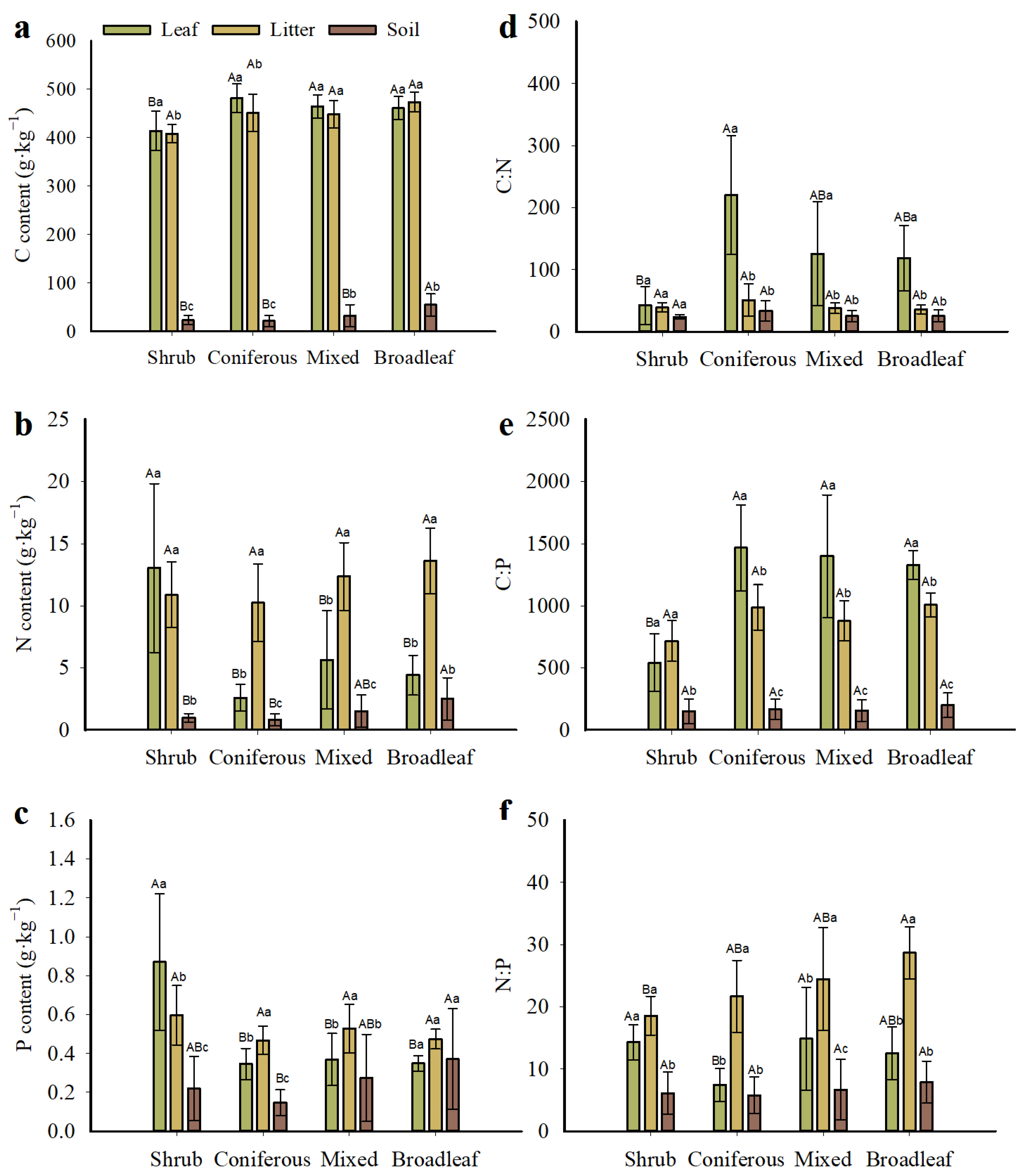
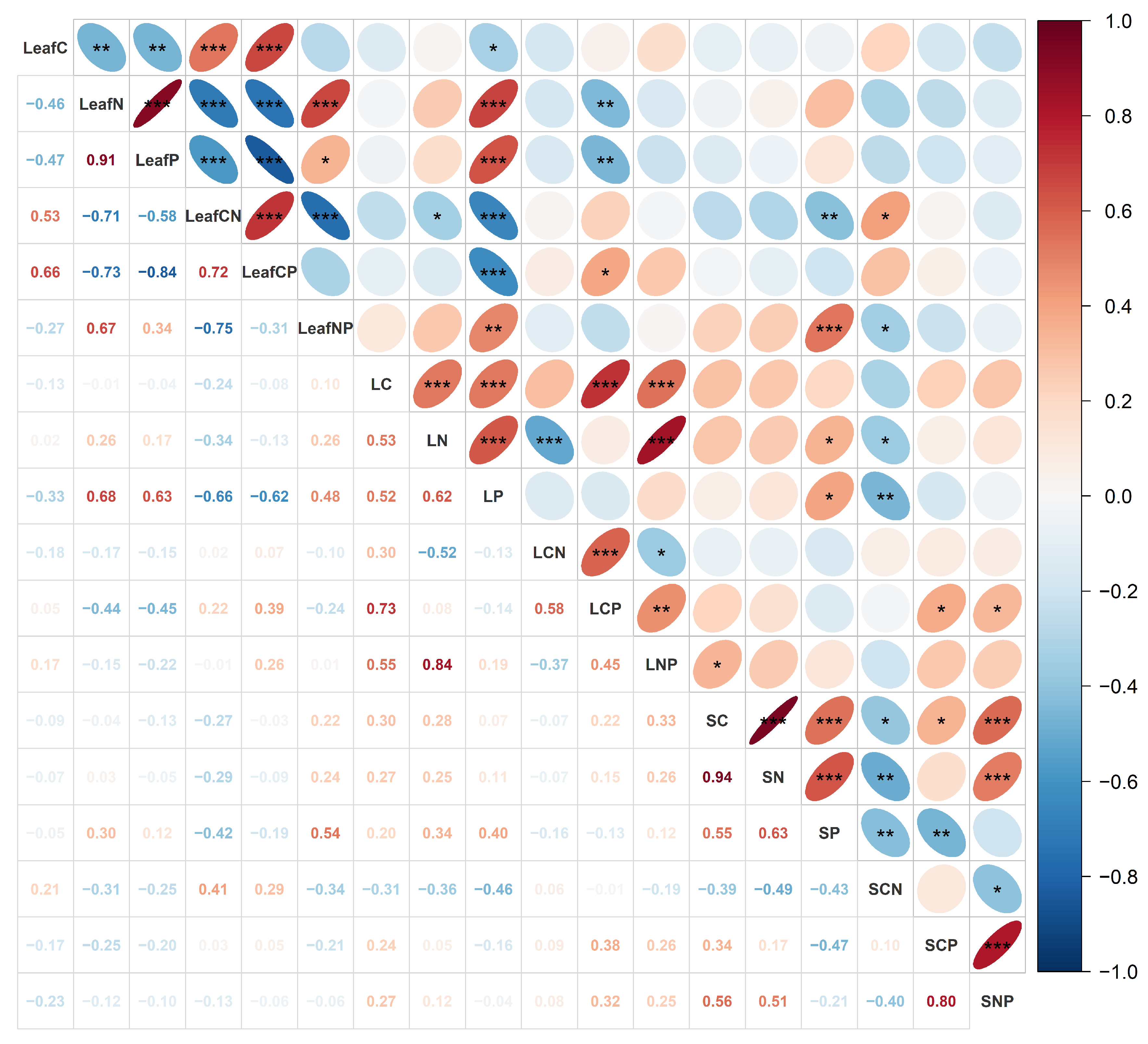
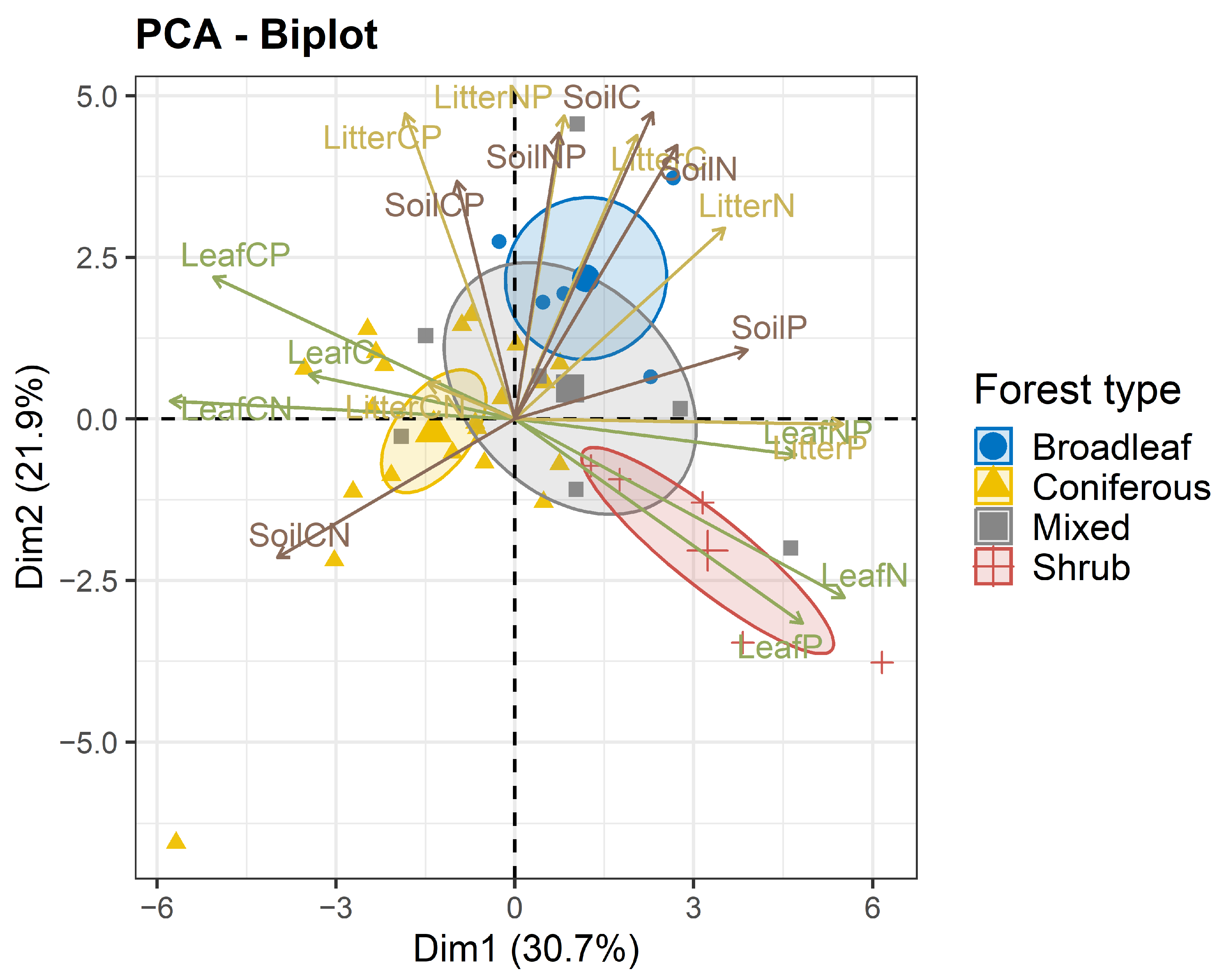
Ecological stoichiometry provides a useful lens for linking nutrient status to ecosystem functioning, but cross-compartment (green leaves, surface litter, and topsoil) evidence for subtropical secondary forests is still limited. In particular, it remains unclear how forest type regulates coupled carbon (C), nitrogen (N), and phosphorus (P) patterns in leaves, litter, and soils on P-retentive Acrisols and how these patterns can be used to infer nutrient limitations. We measured C, N, and P concentrations and stoichiometric ratios in leaves, surface litter, and topsoil (0–10 cm) from 38 plots representing four dominant forest types (shrub, coniferous, mixed coniferous–broadleaf, and broadleaf) in subtropical public welfare forests of eastern China. We compared elemental concentrations and ratios among forest types and compartments and examined cross-compartment associations. Forest-type differences in stoichiometric patterns were most pronounced for leaf and soil concentrations/ratios, whereas litter metrics were comparatively conservative. Coniferous stands had the highest leaf C concentration and the highest litter C:N and C:P ratios, together with relatively low soil N and P concentrations. Broadleaf stands had the highest soil C and N concentrations and the highest litter and soil N:P, suggesting a tendency toward P limitation under comparatively N-rich conditions. Shrub and mixed forests were intermediate, with shrubs exhibiting the lowest litter N:P. Leaf N:P averaged 7.5 in coniferous stands and 12.5–14.9 in mixed and broadleaf stands. Coherent correlations of C:P from leaves to litter and soils and a negative relationship between leaf N:P and soil C:N suggested coordinated stoichiometric linkages along the leaf–litter–soil continuum. Overall, the results show that forest type organizes plot-scale C:N:P coupling on Acrisols and that leaf–litter–soil stoichiometry can be used as a practical framework for identifying whether N- versus P-related constraints are more likely to dominate different subtropical forest types and for informing nutrient-aware restoration and management.
Keywords: ecological stoichiometry; nutrient limitation; leaf–litter–soil continuum; C:N:P ratios; subtropical secondary forest ecological stoichiometry; nutrient limitation; leaf–litter–soil continuum; C:N:P ratios; subtropical secondary forest