Article

Soil Carbon Storage in Forest and Grassland Ecosystems Along the Soil-Geographic Transect of the East European Plain: Relation to Soil Biological and Physico-Chemical Properties


1
Faculty of Soil Science, Lomonosov Moscow State University, Moscow 119234, Russia
2
Dokuchaev Institute of Soil Science, Moscow 119017, Russia
*
Authors to whom correspondence should be addressed.
Forests 2026, 17(1), 69; https://doi.org/10.3390/f17010069
Submission received: 27 November 2025 / Revised: 31 December 2025 / Accepted: 3 January 2026 / Published: 5 January 2026
(This article belongs to the Special Issue Soil Carbon Storage in Forests: Dynamics and Management)

Abstract

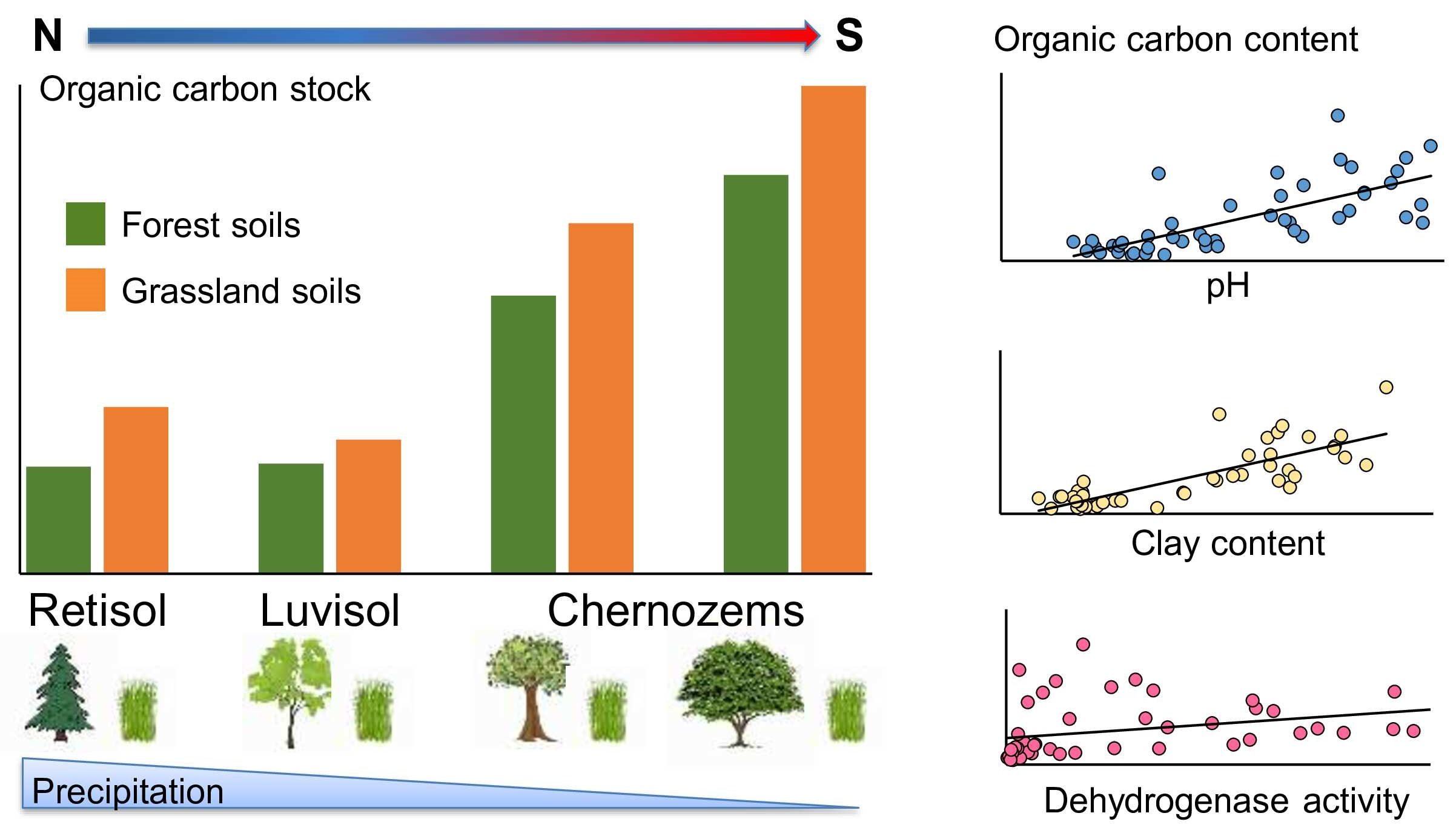
Soils represent the largest reservoir of organic carbon (OC) in terrestrial ecosystems, storing approximately 1500 Gt C. Forest and grassland ecosystems contribute 39% and 34% to global terrestrial carbon stocks, with soils holding about 44% and 89% of forest and grassland carbon, respectively. Land-use changes, such as the conversions between forest and grassland ecosystems, can strongly influence soil carbon accumulation, though the direction and magnitude remain uncertain. Comparative data from paired-plot studies of forest and grassland soils are still limited. In this study, we conducted pairwise comparisons of total OC and total nitrogen (TN) stocks in mature forest and climax grassland soils along a climatic and pedogenic gradient encompassing Retisols, Luvisols, and Chernozems. Relationships between OC and TN stocks (0–10 cm) and soil physicochemical properties—OC and TN contents, bulk density, pH, clay content, and humus fractional composition, as well as biological indicators—the abundance of culturable fungi and bacteria, microbial biomass carbon, potential metabolic activity, and activities of laccase and dehydrogenase, were evaluated. Strong positive correlations were found between OC and TN stocks and OC and TN contents (r = 0.62–0.99), pH (r = 0.79–0.81), clay content (r = 0.70–0.87), and the fraction of humic acids bound with calcium (r = 0.73). OC stocks also correlated strongly with dehydrogenase activity (r = 0.85–0.95). At 0–10 cm depth, OC stocks were higher in grassland soils than in forest soils by factors of 1.6–1.7 in Retisols and 1.4–1.5 in Chernozems. Similarly, TN stocks were 1.6–2.0 times greater in grasslands across all soil types. Community-level physiological profiling revealed higher potential metabolic activity in forest soils compared with grasslands, with the strongest differences in Retisols and Luvisols, while contrasts were attenuated in Chernozems. Overall, the results highlight the fundamental role of organo-mineral interactions and calcium binding in OC stabilization, as well as the likely involvement of dehydrogenase activity in the biogenic formation of calcium carbonates that contribute to this process.

1. Introduction

Soils are the largest reservoir of organic carbon (OC) in terrestrial ecosystems, holding about 1500 Gt OC to 1 m depth [1]. Therefore, changes in the soil OC budget profoundly affect the global carbon cycle [2]. According to current estimates, forests and grasslands contribute 39% and 34% to global terrestrial carbon sinks, with soils comprising about 44% and 89% of forest and grassland carbon, respectively [3,4]. The soil OC reservoir is not constant, resulting from gains and losses of carbon-containing material [5,6]. It is sensitive to environmental changes and land-use changes, which perturb existing ecosystem equilibria and thereby influence OC fluxes [5,6,7]. Deforestation–afforestation and conversions between grasslands and forests and vice versa may significantly affect soil carbon accumulation due to changes in physical and biological soil properties [8,9]. Therefore, increasing soil OC stocks via land management has been proposed as a promising measure to improve soil health and mitigate the consequences of climate change [10]. Afforestation and the establishment of grasslands on arable land are two main ways to increase the soil’s ability to store OC [7,11]. Despite many field studies, there remains considerable disagreement about the direction and magnitude of changes in soil OC stocks following land use change [12,13].
The type of vegetation influences the rate of input, the chemical structure of organic compounds entering the soil, and the relative magnitude of their accumulation pathways [14]. Mature forest ecosystems can store significant quantities of OC as stable soil organic matter, but this process may occur slowly (decades) both in cases of natural reforestation or artificial afforestation [15]. In addition, soil carbon accumulation in forest ecosystems largely depends on the woody vegetation type. On many temperate sites, large deciduous broadleaved species develop deep, extensive root systems that enhance organic matter inputs to the soil profile compared with some conifer stands [14]. Similarly, soils of mature grasslands can harbor large quantities of OC, but the process of its accumulation takes a long time [15]. As a result, data on soil carbon stocks in soils vary in both absolute values and comparative terms between different ecosystems. Nickels and Prescott reported that carbon stocks decreased in the order deciduous sites > grassland sites > coniferous sites (57.8, 52.7, and 43.7 Mg OC ha−1, respectively), indicating that vegetation type has important implications for soil carbon [14]. Poeplau et al., in a meta-analysis of 95 studies covering 322 temperate-zone sites, showed that grassland establishment on degraded soils increases soil OC stocks more than afforestation, and conversion from grasslands to forests often causes OC stocks to decline [16]. Several studies report increases in soil carbon stocks when converting grasslands to forests [9] or lower OC content in the grasslands [17]. In contrast, Deng et al. found no significant change in soil organic carbon stocks following grassland-to-forest conversion [12]. In a global meta-analysis of 385 studies on tropical land-use change exploring OC stock changes across major land-use change types, OC stocks decreased by 12% following forest-to-grassland conversion [18]. Overall, studies report contradictory findings regarding local patterns of organic carbon accumulation in forest and grassland ecosystems [17].
The main methodological challenge in assessing the impact of land use on OC stocks is the need for long-term observation. According to current estimates, significant changes in carbon stocks can be expected in at least a 10 [19] to 30 year period [7]. Another challenge is the need for comparative studies under similar climatic and soil-geographical conditions, as carbon fluxes are influenced by vegetation type and productivity [5,20]. Along with vegetation type, the direction and magnitude of OC accumulation are affected by multiple factors, such as temperature and water regimes, soil type and structure, soil macrofauna [14,21], organic matter biotransformation and organo-mineral interactions [22], soil acidity [10], and other inherent soil properties. Therefore, studies of OC stocks in climax ecosystems and paired plots help minimize differences due to climate, parent material, and short-term OC dynamics, enabling better assessments of vegetation type effects on OC stocks. However, only limited information is available from paired-plot studies directly comparing the properties of grassland and forest soils [23,24].
In this study, we conducted a pairwise comparative assessment of OC stocks in soils from mature natural forest and climax grassland ecosystems along a soil-geographical transect encompassing Retisols, Luvisols, and Chernozems. The ecosystems under investigation were at least 50 (forests) and 30 (grasslands) years old. By comparing OC stocks with the corresponding physicochemical and biological soil properties, we aimed to identify the key factors controlling carbon accumulation in these soils. Among physicochemical indices of OC stocks, we considered bulk density, pH, clay content, and organic carbon and nitrogen contents. Biological indices included microbial biomass carbon, abundance of culturable bacteria and microscopic fungi, assessment of the potential metabolic activity of soil microbial communities, and laccase and dehydrogenase activities. The latter are considered key biochemical drivers of OC turnover in soils. Because soil dehydrogenases are present in all living microbial cells, dehydrogenase activity is commonly used as an indicator of overall microbial functional activity in soils [25]. Dehydrogenase enzymes catalyze oxidation–reduction reactions that drive the breakdown of easily degradable organic substrates, thereby indicating microbial metabolism rates that influence soil organic matter turnover [25]. Laccases catalyze both the breakdown and polymerization of phenolic substrates such as lignin, humic substances, and low-molecular-weight phenolic compounds, contributing to both stabilization and degradation of phenolic matter in soil. Our hypothesis is that in mature forest and grassland ecosystems, carbon stocks are primarily controlled by biological processes regulating carbon turnover.

2. Materials and Methods

2.1. Study Area

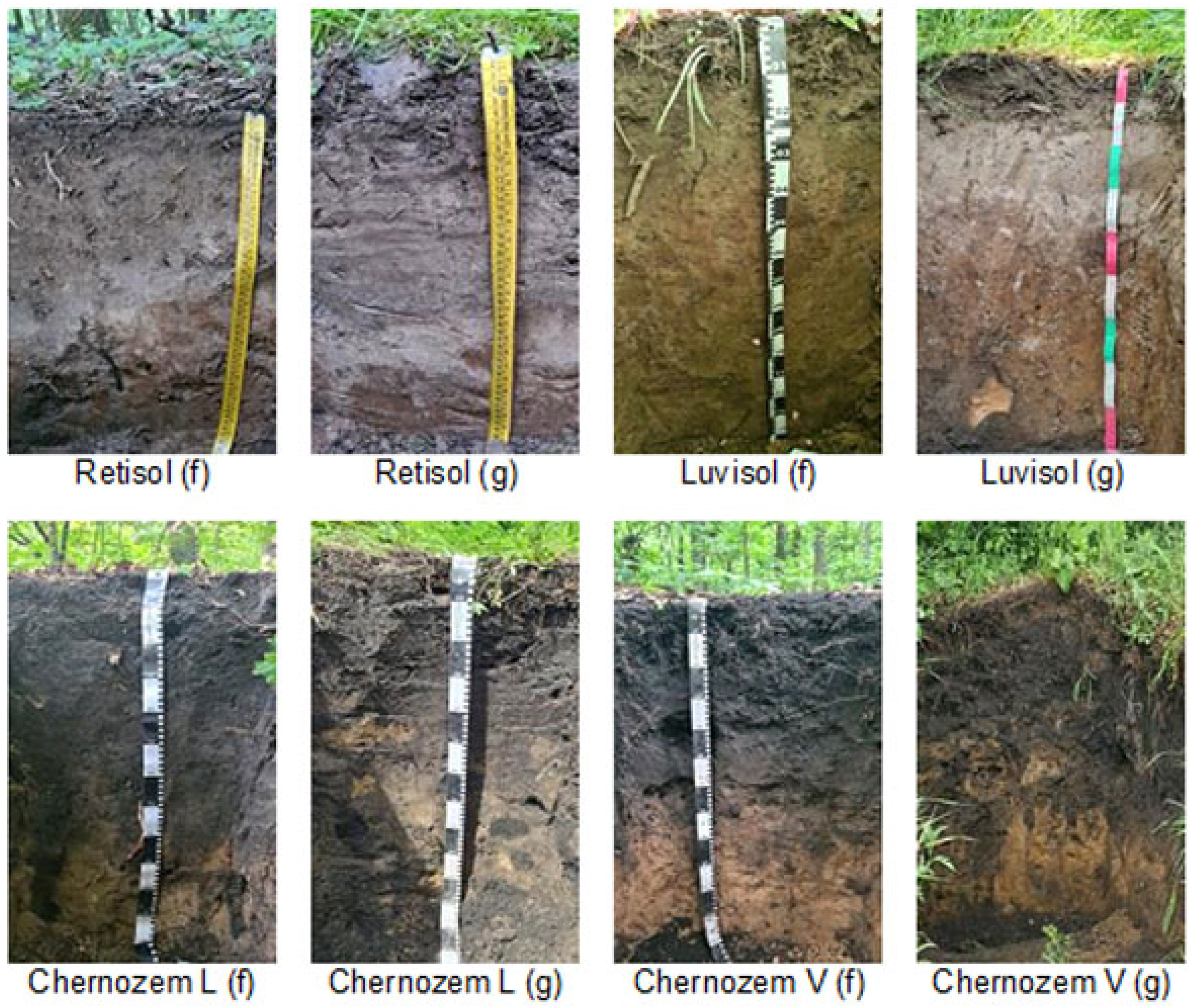
Soils formed under forest (f) and grassland (g) ecosystems along a soil-geographic transect from southern taiga to steppe ecosystems of European Russia were studied (Figure 1 and Figure 2; Table 1). Average annual temperature and precipitation at the collection sites were +3.5 °C to +5.8 °C and 500–700 mm in the southern taiga biome; +4.0 °C and 550–600 mm in the broadleaf forest biome; +4.5 °C and 450–500 mm in the forest–steppe biome; +5.7 °C and 470 mm in the steppe biome (Table 1). Climax mature forests were studied at all sites: natural forests up to 100 years old in southern taiga and broadleaf forest biomes, a 200-year-old park in the forest–steppe biome, and a 150-year-old forest belt in the steppe biome. Natural grasslands were at least 30 years old under no-till management. All sampling sites were situated in gently sloping support areas with slopes less than 1°. Parent materials consisted of cover loams underlain by moraine (Retisol), cover carbonate-free loess loams (Luvisol), and slightly carbonate loess loams (Chernozems). Altitude above sea level ranged from 145 to 205 m (Table 1).

2.2. Soil Samples Collection

The samples were collected once in June 2023. Soil sampling and preparation were carried out as described in [26]. Briefly, one profile per site was used, but topsoil was sampled using the envelope method from the depths 0–5, 5–10, and 10–20 cm across a 5 × 5 m area. The composite soil samples were collected from each soil depth from three walls of each profile. Samples were collected in sterile Kraft bags and stored in the shade until delivery to the laboratory. Samples for soil density determination were taken from each depth in triplicate using the ring method with a 100 cm3 stainless steel ring.

2.3. Sample Preparation

Soil samples for physicochemical characterization, humic substance (HS) content and composition, isolation of culturable bacteria and fungi, and dehydrogenase activity assays were air-dried, homogenized in a porcelain mortar with pestle, and sieved through a 1 mm mesh. Samples for total organic carbon (OC) and total nitrogen (TN) determination were homogenized to a powder in an agate mortar with a pestle after removal of fine roots and other visible organic debris. Samples for microbial biomass determination were used at natural moisture content, passed through a 2 mm mesh, and stored in polyethylene ziplock bags at 5 °C for no more than two weeks until analysis.

2.4. Soil Physico-Chemical Properties

Physicochemical characterization included measurement of bulk density (BD, g cm−3), moisture content, clay content, and pH (H2O). Water content was determined by drying soils at 105 °C to constant weight; pH was determined at a soil-to-water ratio of 1:2.5 using a Hanna H1230 electrode and 8314 pH meter (Hanna Instruments, Woonsocket, RI, USA). Bulk density was determined by sampling soil from each depth with a 100 cm3 steel cylinder and drying an aliquot of soil (10 g) at 105 °C to constant weight in an oven; the results are expressed as g soil per unit volume (g cm−3). The particle size distribution to determine clay content was analyzed using a Mastersizer 3000E laser diffraction particle size analyzer (Malvern Instruments Ltd., Malvern, Worcestershire, UK) as described in [27]. Samples were prepared with a dispersion energy of 450 J mL−1 using a Sonifier S-250D ultrasonic processor (Branson Ultrasonics, Danbury, CT, USA). All measurements were taken in triplicate.

2.5. Contents and Storage of Total Organic Carbon and Total Nitrogen

Total organic carbon (OC) and total nitrogen (TN) contents were determined by dry combustion using an ECS 8020 CHNS-O Elemental analyzer (NC Technologies, Milan, Italy). OC was measured by dry combustion at 1020 °C in an oxygen-rich atmosphere, with evolved gases carried by helium and quantified by a thermal conductivity detector. For Chernozems, carbonate-free samples were prepared by treating aliquots with excess 1 M HCl (Sigma-Aldrich, Steinheim, Germany) until effervescence ceased, followed by drying at 60 °C prior to analysis under the same combustion conditions.
Carbon and nitrogen stocks in the 1 cm thick layer over a 1 m2 area were calculated based on soil bulk density (BD) and OC and TN contents using Equations (1) and (2):
OC storage, kg m−2 = BD × 1 × OC × 0.1,
TN storage, kg m−2 = BD × 1 × TN × 0.1,
where BD is soil density (g cm−3), 1 is the layer thickness (cm), OC and TN are organic carbon and total nitrogen contents (%), respectively, and 0.1 converts g cm−2 to kg m−2 for a 1 cm layer.
Carbon and nitrogen stocks in 1 cm thick layers over a 1 m2 area were calculated for all horizons and later summed to determine stocks at depths of 0–5 cm, 0–10 cm, 0–20 cm, and 0–30 cm, accounting for the constituent horizons at each depth.
The choice of depths 0–5 cm and 0–10 cm focuses on the active soil layer most influenced by vegetation and land use changes [28]. The 0–20 and 0–30 cm depths are commonly used to study carbon stocks in humus horizons [29].

2.6. Humus Fractional Composition

Humus fractional composition was determined on composite samples from organic horizons, corresponding to the full humus layer in each soil: 0–10 cm in Retisols, 0–20 cm in Luvisols, and 0–30 cm in Chernozems. The analysis followed the procedure of Ponomareva and Plotnikova [30,31] with minor modifications. This method is based on sequential extraction of humic substances (HSs) with aqueous solutions and separates humic acids (HAs) and fulvic acids (FAs) according to their association with the mineral phase. The following fractions are obtained: the so-called “aggressive” fraction of FAs (FA1a); free and sesquioxide-bound FAs and HAs (FA1 and HA1); Ca-bound FAs and HAs (FA2 and HA2); and FAs and HAs strongly associated with clay minerals (FA3 and HA3). The non-extractable residue is designated as humin.
All extractions were carried out in duplicate on two parallel 1 g soil subsamples. In the first subsample, 1 g of soil was extracted with 200 mL of 0.1 M H2SO4 (Sigma-Aldrich, Steinheim, Germany) for 20 h; the supernatant was filtered to obtain the FA1a fraction. Filtration was performed using ashless cellulose FS-grade filter paper of medium porosity (approximate pore size 7–20 µm), “Belaya lenta” (Bashkhimservis LLC, Ufa, Russia). The solid residue on the filter was then washed back into the vessel with 200 mL of 0.1 M NaOH (1:20 w/v) (Sigma-Aldrich, Steinheim, Germany) and extracted for 20 h at room temperature to obtain the combined FA1 + FA2 + HA1 + HA2 extract. The remaining soil was subsequently extracted with 200 mL of 0.02 M NaOH for 6 h at 80 °C in a water bath to obtain the FA3 + HA3 fraction.
In the second subsample, 1 g of soil was extracted with 200 mL of 0.1 M NaOH for 20 h to obtain the FA1 + HA1 fraction. Aliquots (10–50 mL, depending on OC concentration) of each extract were evaporated to dryness in conical flasks on a water bath, and OC was determined by dichromate oxidation. The OC content of the FA2 + HA2 fraction was calculated as the difference between the OC in FA1 + FA2 + HA1 + HA2 and the OC in FA1 + HA1.
To separate HAs and FAs in each extract, HAs were precipitated by acidifying the extract with 0.5 M H2SO4, followed by filtration through paper filters. The HA precipitate was washed on the filter with 0.025 M H2SO4, redissolved in 0.1 M NaOH to a final volume of 100 mL, and aliquots were taken to determine HA carbon as described above. The carbon content of FAs was calculated as the difference between total OC in HSs and OC in HAs. A schematic representation of the fractionation procedure is provided in Figure S1, and a more detailed description of the method can be found elsewhere [32]. Analysis was performed in duplicate.

2.7. Isolation of Culturable Bacteria and Microscopic Fungi

Reasoner 2A (R2A) [33] and Czapek–Dox [34] media (Helicon, Moscow, Russia) were used for the isolation of culturable bacteria and microscopic fungi, respectively. Amphotericin B (50 mg L−1) (Sigma-Aldrich, Steinheim, Germany) was added to R2A medium, to suppress fungal growth, and chloramphenicol (500 mg L−1) (Sigma-Aldrich, Steinheim, Germany) was added to the Czapek–Dox medium, to suppress bacterial growth. These media were selected for isolation of bacteria and microscopic fungi, respectively, because their nutrient composition and concentrations are suitable for the isolation of the corresponding microorganisms. Soil samples were diluted 1:10 with sterile 0.01 M phosphate-buffered saline (pH 7.4, 0.137 M NaCl, 0.0027 M KCl) and vortexed for 15 min at 2000 rpm using Heidolph Multi Reax vortex (Schwabach, Germany). Tenfold dilution steps were plated on the solid nutrient media in three replicates for each dilution. Plates were incubated at 28 °C for 10 days (microscopic fungi) and 14 days (bacteria). After incubation, the colony numbers on each medium were counted and expressed as colony-forming units (CFU) per g dry soil.

2.8. Measurement of Soil Respiration and Determination of Microbial Biomass

Soil respiration and microbial biomass were determined according to [35]. The soil samples (1 g) at natural moisture were placed in 15 mL glass tubes, stoppered with rubber plugs, and incubated at 22.0 ± 0.5 °C overnight. The rate of CO2 production was measured using a Crystall 5000.2 gas chromatograph (Chromatek, Yoshkar-Ola, Russia) equipped with a 2 mm × 2 m packed column containing Hayesep N 80/100 mesh support (Hayes Separation Inc., Bandera, TX, USA) and a thermal conductivity detector under isometric conditions (inlet, column, and detector temperatures: 60 °C) with a helium carrier gas flow rate of 20 mL min−1. A 1 mL gas phase sample was taken from the tube through the rubber plug using a syringe. The CO2 in the sample (% v/v) was determined using a calibration curve obtained by absolute calibration. Emission of CO2 (mg CO2 g−1 h−1) was calculated considering the CO2 concentration in the air, the volume of the tube, incubation time, and gas density at normal pressure. Substrate-induced respiration was determined as described above in the presence of 10 mg of glucose during 4 h of incubation. Microbial biomass carbon (Cmic) was determined using the following equation [35]:
Cmic = (40.04 × y + 0.37) × 100,
where Cmic, is the microbial biomass carbon content of the soil (mg 100 g−1); y is the substrate-induced respiration rate of the soil (mL CO2 h−1 100 g soil−1); 40.04 is a regression slope relating respiration rate y to microbial biomass C, empirically derived from calibration against an independent biomass method; 0.37 is a regression intercept in the same calibration equation, representing the theoretical microbial biomass C at zero measured respiration; and 100 is a unit-conversion factor to transform from mg g−1 to mg 100 g−1.
All measurements were performed in triplicate.

2.9. Community-Level Physiological Profiling (CLPP-Assay)

To assess the potential metabolic activity of soil microbial communities, a CLPP assay was performed. Testing was carried out with 47 organic substrates [36], including alcohols, amino acids (AA), N-containing substances, polymers, salts of organic acids (hereinafter referred to as salts), and sugars (see Table S1 for the list of substrates in each group). The substrates for CLPP-assay were obtained from Sigma-Aldrich (Steinheim, Germany) or Thermo-Fisher Scientific (Waltham, MA, USA). All tests were performed in two replicates for each microbial community. Soil samples were diluted 1:100 in sterile phosphate saline buffer (pH 7.4) (Sigma-Aldrich, Steinheim, Germany) and vortexed for 15 min at 2000 rpm using Heidolph Multi Reax vortex (Schwabach, Germany) for cell desorption from soil particles. Mineral particles were precipitated by centrifugation (3000 rpm, 3 min) using a CM-6MT centrifuge (ELMI Ltd., Riga, Latvia). The hydrogenase activity indicator 2,3,5-triphenyltetrazolium chloride (TTC) (Sigma-Aldrich, Steinheim, Germany), was added to the supernatant; after mixing, 200 μL aliquots were added to each well of a 96-well plate containing the 47 test substrates in duplicate. The substrate consumption is associated with dehydrogenase activity. If the microbiome consumes the substrate under study, the TTC is reduced to red-colored formazan in proportion to the intensity of consumption. The plates were incubated at 28 °C for 72 h in a TS-1/80 SPU dry-air thermostat (Smolensk, Russia). After incubation, the optical density of the solutions was measured at 510 nm using a Sunrise plate photometer (Tecan, Menendov, Switzerland). The Shannon index (H), Pielou index (E) [37], and specific metabolic work (average consumption of consumed substrates) were calculated for each soil microbiome tested.

2.10. Laccase Activity

Total laccase activity (Lac) in grassland and forest soils was determined using a sodium azide (NaN3) inhibition-based assay with 2,2′-azino-bis(3-ethylbenzothiazoline-6-sulfonic acid) (ABTS) (Sigma-Aldrich, Steinheim, Germany) as the substrate [26]. Briefly, 50 mg of fresh soil was weighed into 2 mL microcentrifuge tubes and equilibrated for 10 min with 1 mL of 50 mM sodium acetate buffer (pH 4.5) either without or with 50 mM NaN3 (Sigma-Aldrich, Steinheim, Germany). Sodium azide was used to inhibit laccase activity and thereby to quantify the residual ABTS-oxidizing capacity of the soil, attributable mainly to inorganic components. After equilibration, the suspensions were centrifuged for 1 min at 18,000× g (CM-50 centrifuge, Elmi, Riga, Latvia); the supernatant was discarded, and replaced with 2 mM ABTS in 50 mM sodium acetate buffer (pH 4.5). Following a 4 min incubation, the formation of the colored ABTS∙+ cation radical was monitored by measuring absorbance at 420 nm on a Shimadzu UV-1800 spectrophotometer (Shimadzu, Kyoto, Japan). Laccase activity was calculated as the difference between total ABTS-oxidizing activity and the activity measured in the presence of 50 mM NaN3 and expressed as units per gram of dry soil (U g−1). One unit (U) of laccase activity was defined as the amount of laccase that catalyzed the oxidation of 1 μmol of ABTS at 420 nm per 1 min. All measurements were performed in triplicate.

2.11. Dehydrogenase Activity Assay

Dehydrogenase (DH) activity was measured using 2,3,5-triphenyltetrazolium chloride (TTC) assay as described elsewhere [38]. In brief, 0.5 g of sieved (<1 mm) soil was weighed into glass test tubes, followed by adding 50 mg CaCO3, 1 mL of 1% glucose, and 0.5 mL of 1% TTC. Each tube was shaken manually for a few seconds, placed into the glass container, vacuumed, and left for incubation at 30 °C ± 1 °C for 24 h in the dark. To extract the triphenylformazan (TPF) that formed, 12.5 mL of 96% ethanol was added, and then the tubes were shaken for 5 min under overhead mixing at 25 rpm (Intelli-Mixer, ELMI Ltd., Riga, Latvia). At the end of the extraction, tubes were centrifuged for 5 min at 1000× g (ELMI CM-6M Centrifuge, ELMI Ltd., Riga, Latvia), and the supernatants were transferred to quartz cuvettes for absorbance measurements at 485 nm using a Shimadzu UV-Vis 1800 spectrophotometer (Shimadzu, Kyoto, Japan). Dehydrogenase (DH) activity was expressed in mg of TPF per 10 g of soil in 24 h. Measurements were performed in triplicate.

2.12. Statistical Analyses

Data are expressed as mean ± standard deviation, with the number of replicates (n) indicated. Differences between samples were assessed using one-way analysis of variance (ANOVA) followed by post-hoc Fisher’s least significant difference (LSD) test. Paired t-tests were applied to compare carbon and nitrogen stocks across soil layers between forest and grassland sites. Relationships between variables were evaluated via Pearson correlation analysis. Classification and regression tree (CART) analysis was used to identify key drivers of soil carbon and nitrogen stocks. All analyses were performed using STATISTICA 8.0 (StatSoft Inc., Tulsa, OK, USA), with statistical significance set at p < 0.05.

3. Results

3.1. Soil Physico-Chemical Characteristics

Soil physicochemical properties are presented in Table 2. Soil moisture ranged from 22% to 50% in the 0–10 cm layer and from 12% to 32% along the soil profiles, generally decreasing with depth, except in the “dry” Chernozem L, which showed nearly uniform moisture (12%–17%) throughout the profile. Forest soils were overall wetter than grassland soils, particularly in the 0–5 cm layer, indicating a positive effect of forest vegetation on soil water retention.
The pH values ranged from acidic in Retisols (4.6–5.6) to slightly acidic to neutral in Luvisols (5.2–7.4) and near-neutral in Chernozems (Chernozem L:5.2–7.4; Chernozem V: 6.2–7.3) (Table 2). The topsoil (0–10 cm) of Retisol (f) exhibited the lowest pH (4.5–4.7) among the studied soils, reflecting the acidifying influence of needle litter. In general, pH values in grassland ecosystems developed on Retisol and Luvisol were higher than those in forest ecosystems, whereas this trend was not observed for Chernozems (Table 2).
Soil bulk density (BD) ranged from 0.7 to 1.6 g cm−3 (Table 2), increasing with depth. The BD in the 0–10 cm layer was generally higher in grassland soils than in forest soils, particularly in Retisols and Luvisols. In Chernozems, higher BD values under forest vegetation were detected only in the uppermost horizon (0–5 cm); at greater depths, differences between forest and grassland soils were negligible.
Clay content ranged from 8%–13% in Retisols and Luvisols to 14%–22% in Chernozems (Table 2). In Retisols and Luvisols, the increase in clay content down the soil profile was weakly expressed, and in several cases, differences between adjacent horizons were statistically insignificant (p > 0.05). In contrast, Chernozems showed significant differences (p < 0.05) in clay content between neighboring horizons, with values increasing with depth.
Overall, differences in physicochemical properties between forest and grassland soils were more pronounced in Retisols and Luvisols than in Chernozems. As these observations are based on individual profiles, further studies with larger datasets are needed to confirm the identified trends. The examined soil properties correspond well to those reported for similar soil types [27].

3.2. Total Organic Carbon, Total Nitrogen Content, and Storage

The total OC and TN contents showed typical profiles and soil type-related distributions, decreasing with soil depth and increasing along a soil-geographic transect from Retisols and Luvisols to Chernozem soils (Table 3, Figure S2).
The OC content was highest at 0–5 cm depth, ranging from 2.6%–3.8% in Retisols and Luvisols to 6.0%–7.0% in Chernozem L (forest–steppe biome) and 8.1%–9.7% in Chernozem V (steppe biome) and decreasing to 1.1%–1.5% (Retisol, Luvisol), 3.2%–4.0% (Chernozem L), and 4.0%–4.7% (Chernozem V) in the lower part of the organic horizons (Table 3). There was a trend of higher OC content at 0–5 cm depth in forests than in grasslands in Luvisol (1.5 times) and Chernozem L (1.2 times), which was possibly related to broadleaf litter inputs. TN content ranged from 0.1% to 1.1%, increasing from Retisol (f) topsoil (0.16% at 0–5 cm) to Chernozem V (f) (1.07% at 0–5 cm) (Table 3). In the upper 0–5 cm layer, TN content was 1.5–1.8 times higher in grassland soils than in forest soils, except for Chernozem V, which showed the opposite pattern (Figure S2, Table 3).
The C/N ratio, indicating the degree of nitrogen enrichment in soil organic matter, varied widely among soil types. It ranged from 16–22 (very low) in Retisol topsoils, 8–16 (medium to low) in Luvisols, 7–17 (medium to very low) in Chernozem L, and generally low (11–15) in Chernozem V (Table 3). In Retisols (f, g) and Luvisol (f), the C/N ratio decreased with depth, being 1.4–2.3 times lower in grassland topsoils than in those of forests, suggesting greater nitrogen enrichment in grassland A horizons. Chernozem L displayed an almost uniform distribution of C/N throughout the profile, whereas Chernozem V (f) showed marked nitrogen enrichment in the topsoil (C/N ≈ 8) relative to its grassland counterpart (C/N ≈ 23) (Table 3).
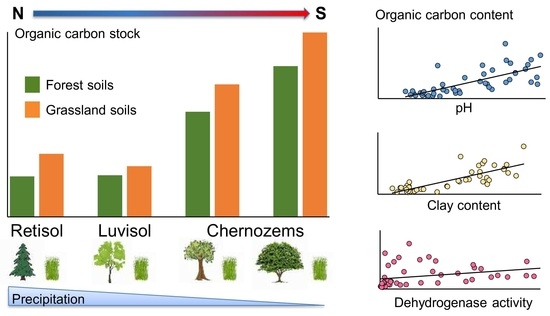
The OC and TN stocks increased from Retisols and Luvisols to Chernozems and varied significantly down the soil profiles (Figure 3) due to the uneven distribution of bulk density and contents of OC and TN (Table 2 and Table 3). Grassland topsoils (0–10 cm) showed higher OC stocks than forest topsoils, except for Chernozem V, where no difference occurred between ecosystems.
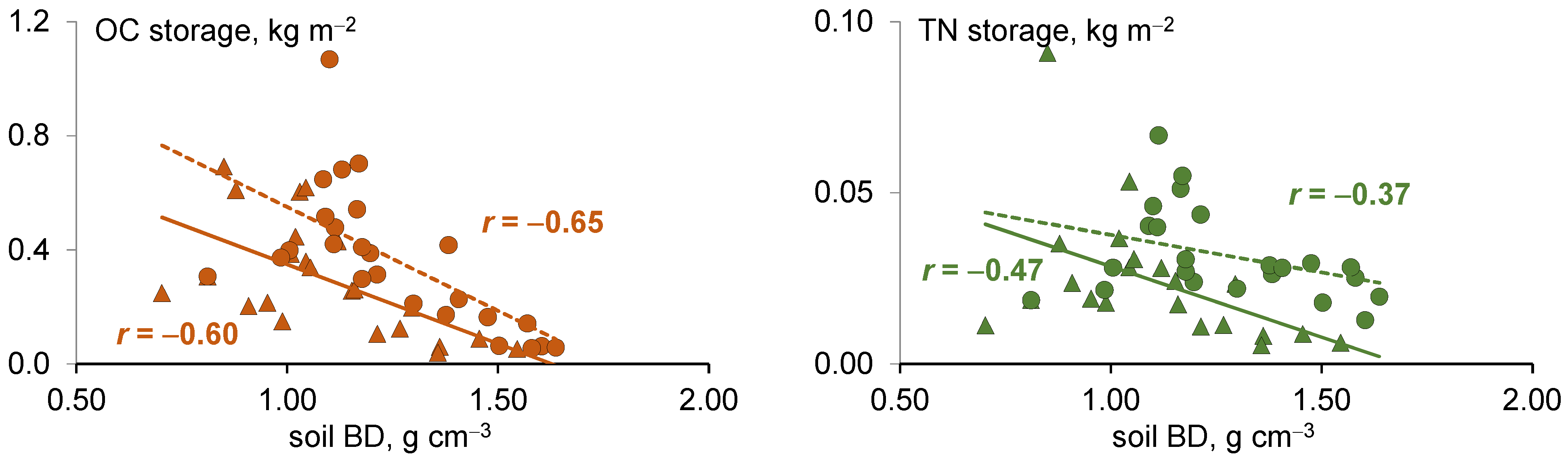
A relationship between OC or TN stocks and BD (Figure 3) showed no significant correlation for BD up to 1.1–1.2 g cm−3 (p < 0.05). The decrease in carbon and nitrogen stocks with increasing BD were observed only at higher BD values, corresponding to mineral horizons with low OC and TN contents.

3.3. Humus Fractional Composition

Analysis of the groups and fractions of soil humus provides quantitative indicators of humus type and degree of humification, as well as to assess the distribution of specific soil organic matter (SOM) components (HAs and FAs) according to the strength of their binding to mineral constituents (Table 4).
The humus content of the studied soils followed a distinct soil-geographic pattern, ranging from low values (2%–4%) in Retisols and Luvisols to high values (6%–10%) in Chernozems [27]. In Chernozems, humic substances (HSs) were predominantly composed of humic acids (HAs), whereas fulvic acids (FAs) prevailed in Retisols and Luvisols. Based on the CHA/CFA ratio, soil organic matter was classified as fulvate in Retisols (CHA/CFA = 0.35–0.4), humate–fulvate in Luvisols (0.6–0.9), humate in Chernozem L (f), and fulvate–humate in other Chernozem soils (1.4–2.0). The degree of humification varied from weak in Retisols to moderate in Luvisols and high in Chernozems (Table 4). No clear relationship was observed between ecosystem type and the CHA/CFA ratio. Differences were insignificant for Retisol (p < 0.05), whereas the ratio was higher in grassland soils for Luvisol and Chernozem V, and higher in forest soil for Chernozem L.
In Retisols and Luvisol (f), HAs were mainly represented by fraction HA1 and FA1+FA1a fractions (free and bound to mobile sesquioxides), accounting for 10%–15% and 15%–21% of total HSs, respectively, indicating a relatively labile humus composition (Table 4, Figure S3). Luvisol (g) and Chernozem soils contained higher proportions (18%–28%) of Ca-bound HAs (HA2), reflecting stronger stabilization of humus components by base cations. The contents of the “aggressive” FA1a fraction and FA2 were low in all soils, not exceeding 2% and 10%, respectively. The dominant FA fraction across all soils was FA3 (associated with clay minerals), reaching 19% in grassland Retisol.
From an ecosystem perspective, total humus content was generally higher in forest soils than in grassland soils. The fractions HA1, HA3, and FA3 also tended to be slightly higher in forest ecosystems, except in Retisol (f), whereas HA2 (Ca-bound) showed higher content in grassland soils.

3.4. Soil Biological Properties

3.4.1. Culturable Fungi and Bacteria and Microbial Biomass Content

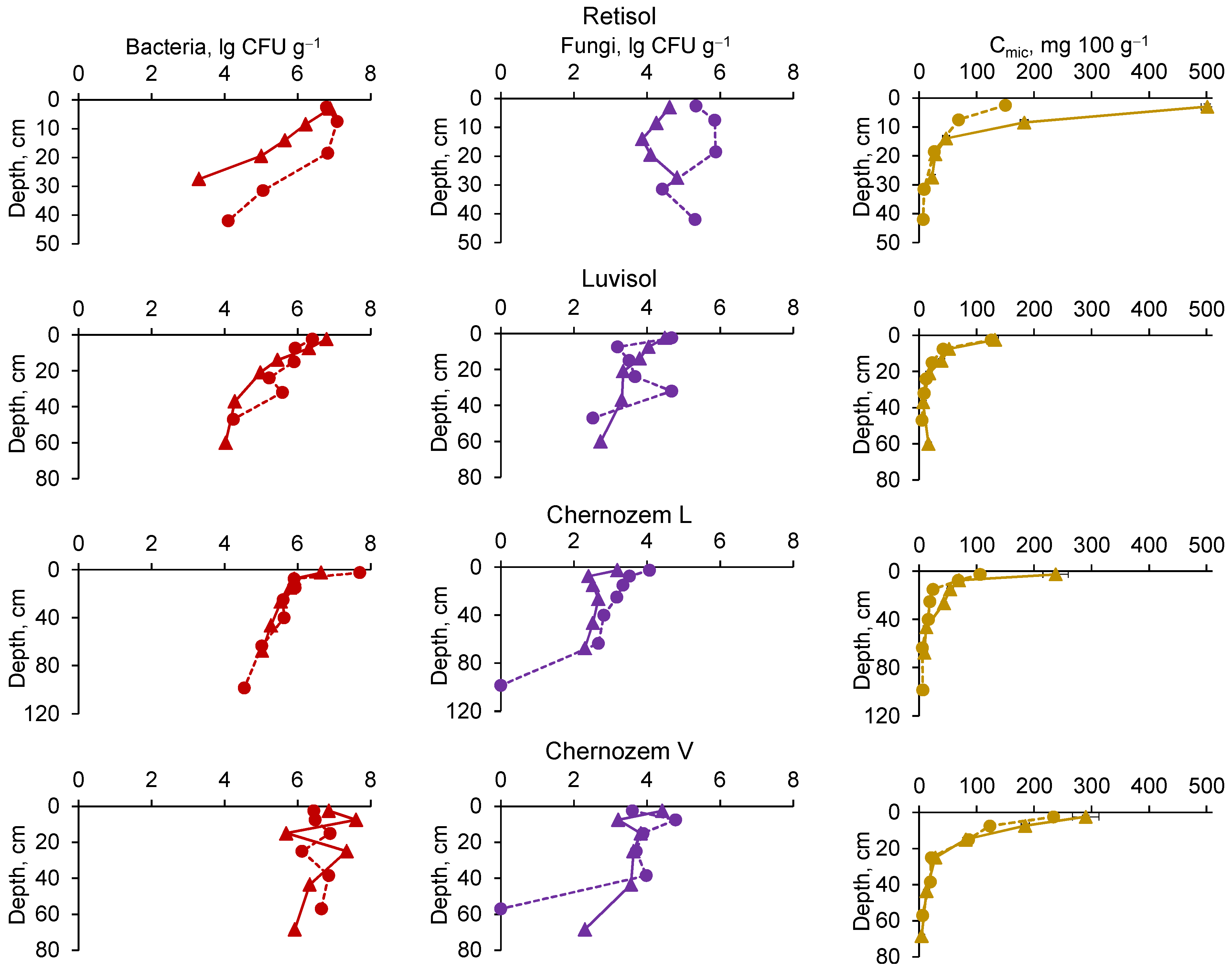
The number of culturable bacteria in the studied soils ranged from 103 to 108 CFU g−1 (Table S2). In Retisol, Luvisol, and Chernozem L soils, the highest number of culturable bacteria (107–108 CFU g−1) was found at 0–5 cm depth, exceeding several times the content at 5–10 cm depth and decreasing by 2–4 orders of magnitude in subsoil (Figure 4).
Chernozem V (g) exhibited a relatively uniform vertical distribution of culturable bacteria, whereas 1–2 order-of-magnitude variations with depth were observed in Chernozem (f). A general trend of increasing culturable bacterial abundance from Retisol and Luvisol to Chernozem V was noted, likely reflecting the rise in soil pH (Table S2). However, due to the high variability among replicates, significantly higher (p < 0.05) bacterial abundance was detected only in the upper (0–10 cm) layer of Chernozem L (g). No consistent statistically significant (p < 0.05) differences between forest and grassland soils were found, except for the Ap2 horizon of Retisol (g), where bacterial abundance was significantly higher than in the forest counterpart, and in Chernozem L (0–10), where grassland contained significantly more culturable bacteria.
Overall, the number of culturable microfungi was highest in acidic Retisol (104–106 CFU g−1), which ranged between 103 and 105 CFU g−1 in Luvisol and Chernozem V, and was lowest in Chernozem L (102–104 CFU g−1). Although microfungal abundance showed a slight general decrease with depth, this trend was weak and often inconsistent; counts remained relatively uniform to 40–50 cm depth, likely due to high variability, preventing clear ecosystem-type dependence. Significant (p < 0.05) differences were detected only in Retisol and Chernozem L upper horizons (higher in grasslands) and Chernozem V Ah horizon (higher in forest).
The microbial biomass carbon was highest at 0–5 cm depth (105–290 mg 100 g−1), decreasing 1.5–3 times at 5–10 cm depth and ranging from 5–22 mg 100 g−1 in the subsoil (Figure 4) following the distribution of OC content (Table 3, Figure S2).

3.4.2. Community-Level Physiological Profiling

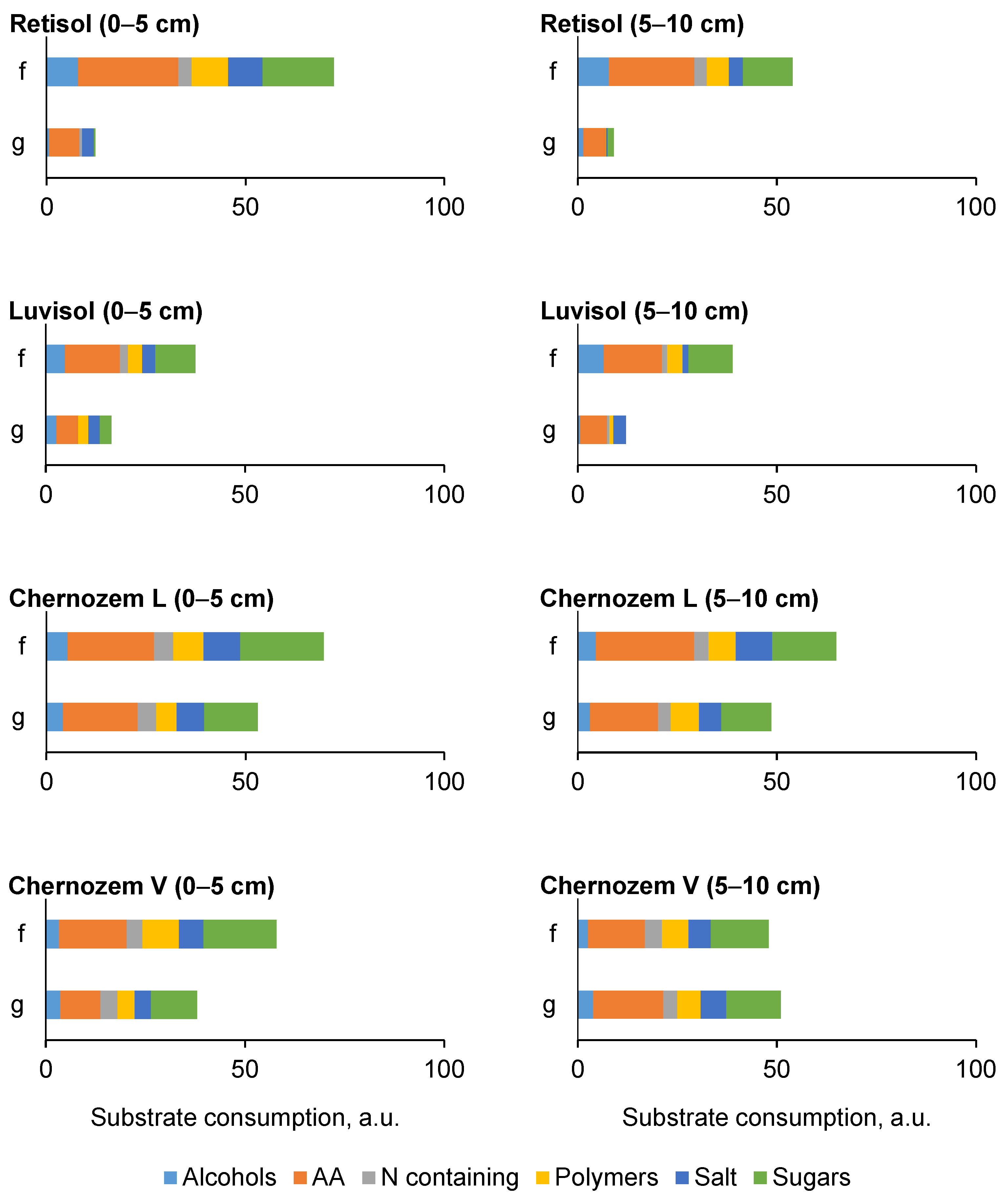
Substrate utilization patterns of microbial communities were assessed at 0–5 and 5–10 cm depths using the CLPP assay (Figure 5). The microbial communities in the studied soils showed intensive utilization of amino acids and sugars, the most accessible and energetically favorable substrates. In all soils, substrate utilization by forest microbiomes exceeded that of grassland microbiomes, except in Chernozem V at 5–10 cm depth. The highest potential metabolic activity was recorded in forest ecosystems of Retisol and Chernozem L. Among grassland soils, Chernozems exhibited markedly higher potential metabolic activity than Retisols and Luvisols. The slight decline in potential metabolic activity with depth likely reflects reduced availability and diversity of surface-derived nutrients influencing microbiome composition.
Microbial communities in most of the studied soils exhibited high potential metabolic activity, consuming at least 38 out of the 47 substrates tested. Microbial communities of grassland ecosystems in Retisol and Luvisol showed low potential metabolic activities, consuming 11–12 and 15–21 substrates, respectively (Table 5).
A slight decrease in the number of utilized substrates at 0–5 cm depth was also observed in the grassland variants of Chernozem L and Chernozem V compared to forest soils. The specific metabolic activity (W; average rate of substrate utilization) of the soil microbiomes ranged from 0.75 to 1.48, indicating a generally high intensity of metabolic processes. In most cases, W values were lower in microbiomes under grassland vegetation than under forest vegetation.
The Shannon index showed marked differences in the functional diversity of microbiomes between forest and grassland ecosystems for Retisol and Luvisol. Forest microbiomes had index values approaching 5, whereas grassland microbiomes had index values below 1. Evenness (E) values for most studied soils ranged from 0.80 to 0.97, indicating a relatively uniform representation of functional groups within microbiomes. However, Retisol and Luvisol microbiomes under grassland vegetation exhibited the lowest E values, reflecting the presence of dominant functional groups in these microbial communities.

3.4.3. Laccase and Dehydrogenase Activities

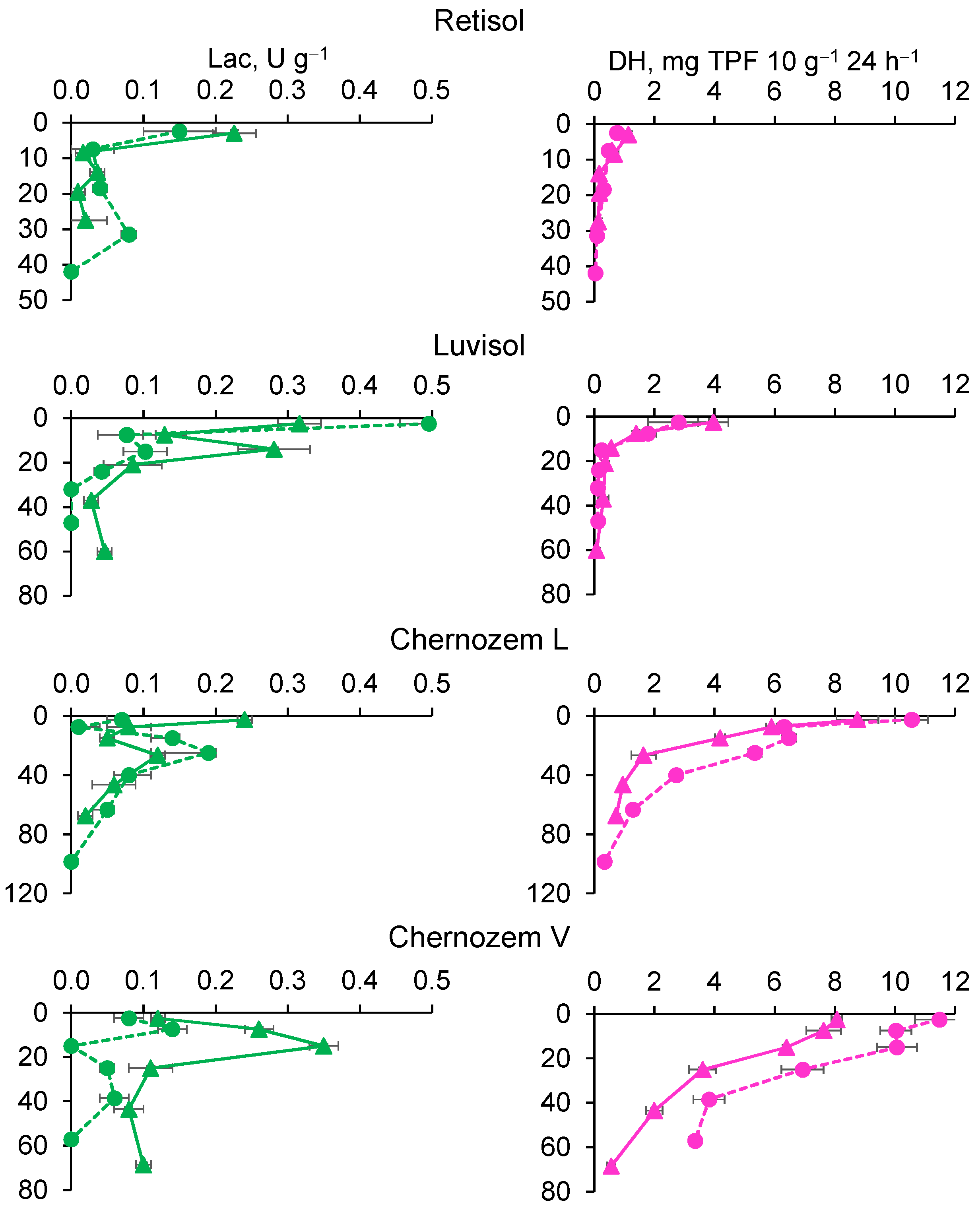
Laccases and dehydrogenases are two groups of oxidoreductases responsible for the oxidative turnover of SOM. Laccase activity was highest at 0–5 cm depth in all soils with the exception of the forest biome of Chernozem V (Figure 6). Maximal values of laccase activity ranged from 0.15 to 0.23 U g−1 in Retisol, 0.3–0.5 U g−1 in Luvisol, 0.2–0.25 U g−1 in Chernozem L, and 0.15–0.35 U g−1 in Chernozem V. Laccase activities were higher in forest ecosystems than in grasslands in Retisol and Chernozem L (0–5 cm), below 10 cm in Luvisol, andthroughout the profile of Chernozem V, presumably due to higher moisture contents in forest soils. No geographic trend was observed in laccase activity, whereas dehydrogenase (DH) activity increased along the soil-geographic transect from Retisol to Chernozem V following rising OC content (Figure 6 and Figure S2). Highest DH activities occurred at 0–5 cm depth with sharp decreases down the profile. Statistically significant differences (p < 0.05) between the forest–grassland soil pairs were observed only in Chernozems, where DH activity in the Ah horizon (0–5 cm) was higher under grassland than forest vegetation. Conversely, laccase activity in surface horizons (0–5 cm) was greater in forest soils than grassland counterparts, except in Luvisol; however, at the 5–10 cm depth, Luvisol followed this trend with higher laccase activity under forest vegetation (Table S2).

3.5. Relationships Between Organic Carbon and Total Nitrogen Storage and Soil Properties

The OC and TN stocks depend on the thickness of the horizons composing the stratum where they were estimated. Therefore, OC and TN contents and stocks were calculated for the 0–5, 0–10, 0–20, and 0–30 cm layers based on the 1 cm layer stock data (Table 6). The OC content and stocks increased along a soil-geographic transect from Retisols and Luvisols to Chernozems. Chernozems exhibited 2.3–2.5 times higher OC stocks at 0–5 and 0–10 cm depths than Retisols and Luvisols, due to 2–3 times higher OC content. TN content increased approximately 2–3 times from Retisols to Chernozems. At 0–5 and 0–10 cm depths, OC content was generally higher in forest soils than in grassland soils, whereas this trend was not observed below 10 cm. This pattern likely reflects the influence of low-OC mineral fractions in Retisol (f) and Luvisol (f), as well as higher average OC values at 0–20 and 0–30 cm depths in grassland soils compared to forest soils in both Chernozems.
Unlike OC contents, OC stocks were consistently higher in grasslands than in forests, especially in Retisol and Chernozem V soils (1.6–1.7 times and 1.4–1.5 times at 0–10 cm depth) (Table 6). Similarly, the TN stocks were 1.6–2 times higher in grasslands than in the forests in all soils except Chernozem V, which showed the opposite trend (Table 6).
To assess the significance of differences in OC and TN stocks between forest and grassland soils, the data from Table 6 were analyzed using a paired t-test. The results showed statistically significant mean differences for both indicators, with OC stocks (two-tailed p = 0.00009) and TN stocks (two-tailed p = 0.03930) greater in grassland soils than in forest soils (Table S3).
Taking into account that topsoil (0–10 cm) is most vulnerable to land use change, we performed a correlation analysis among OC and TN storage and physicochemical and biological soil properties (Table 7). Predictably, high Pearson’s correlation coefficients (r = 0.62–0.99) existed between carbon/nitrogen stocks and contents. The maximum values (r = 0.99), indicating the closest relationships, occurred for carbon content–stock and nitrogen content–stock in grassland soils. The minimum correlation (r = 0.55) was found for the nitrogen content–carbon stock across all samples; for forest soils, this increased to r = 0.83, and grassland soils showed no significant correlation (p < 0.05). The expected high values of r (0.70) linked carbon and nitrogen stocks to clay content, though forest soils correlated only for carbon stocks, and grasslands only for nitrogen stocks. Strong correlations (r = 0.79–0.91) existed between OC and TN stocks and soil pH (except for the pH–TN stock in grasslands), reflecting the OC stabilization effect of base cations, such as calcium. No correlation (p < 0.05) was observed between OC and TN stocks and bulk density (Table 7). To assess the possible role of humus composition in OC stabilization, we have calculated the correlation of carbon stocks with humus fractional composition (Table S4). OC stocks correlated positively with the HA2 (Ca-bound) fraction content (r = 0.73) and CHA/CFA ratio (r = 0.74) and negatively with total content of FAs (r = −0.84). Nitrogen stocks showed a negative correlation with HA1 (r = −0.75) (Table S4). These results indicate that Ca-bound HAs enhance OC stabilization, while higher FA contents reduce stocks.
Considering the effects of biological properties on OC and TN stocks, statistically significant (p < 0.05) relationships were found only for the Cmic–carbon stock pair in grassland soils (r = 0.76), and abundance of culturable fungi–TN stocks in forest soils (r = 0.84). This implies marked differences between forest and grassland soils. Strong positive correlations also existed between OC and TN stocks and dehydrogenase (DH) activity, but not laccase activity; DH related more closely to OC than TN stocks across all soils, as well as grassland and forest biomes separately. Given the limited sample size and correlation analysis’s inability to establish causal relationships, these results highlight the need for further research into the potential role of dehydrogenases in soil carbon formation and/or stabilization.
Correlation analysis between OC and TN stocks and CLPP data for the studied soils (Table 8) showed that alcohol consumption was inversely correlated with OC and TN content in forest soils, likely driven by nutrient deficiencies and the uneven distribution of incoming organic matter over time. A positive correlation between total carbon and consumption of nitrogen-containing compounds suggests a nitrogen limitation in the microbiomes of all studied soils. Correlation of OC and TN storage and CLPP indexes revealed a strong negative relationship for the OC stock–E pair for grassland soils (r = −0.78). On the contrary, the Shannon index positively correlated with both OC and TN stocks (r = 0.75 and 0.78, respectively), indicating that high carbon and nitrogen stocks can be expected when soil microbiomes exhibit high biodiversity with dominant functional groups in the communities.
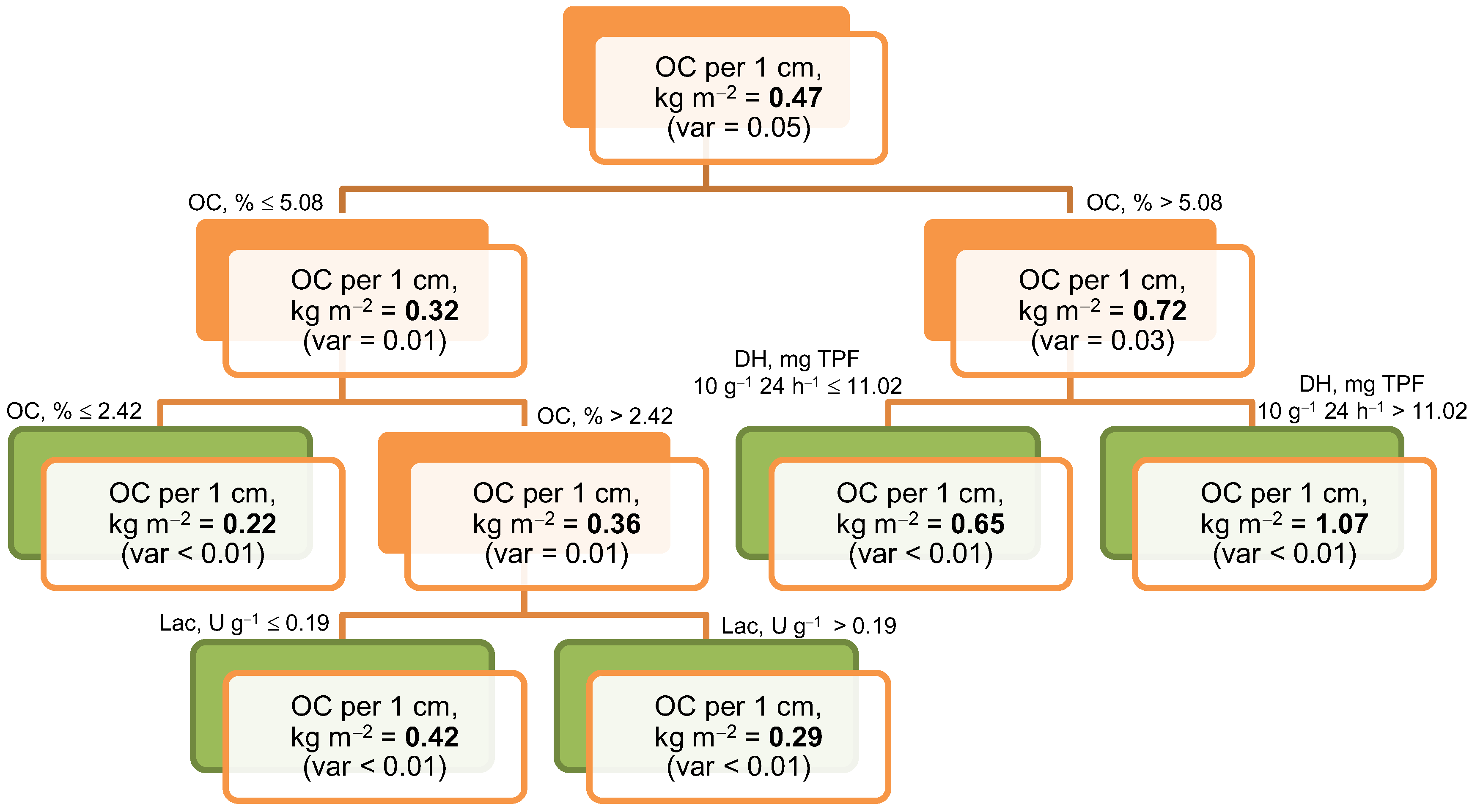
To determine the main factors driving OC stocks in soils, an algorithm for constructing classification and regression trees (CART) was used (Figure 7). The first split was set by the CART algorithm for the soil OC content of 5.08%, indicating OC content as the most important variable determining carbon stock in the topsoil. Below this threshold, average OC stocks did not exceed 0.32 kg m−2 per 1-cm layer, whereas above it, stocks increased to 0.72 kg m−2. The second split used dehydrogenase activity (at 10 mg 10 g−1 24 h−1), and again OC content (at 2.42%), i.e., these variables explained the largest part of the variance in OC stocks for each of the branches. The green end segments indicate mean OC stocks for parameter combinations in each branch of the CART. If OC content was above 5.08% and dehydrogenase activity exceeded 10 mg 10 g−1 24 h−1, average OC stocks reached their maximum of 1.07 kg m−2 per 1-cm layer; in contrast, stocks were lowest (0.22 kg m−2 per 1-cm layer) below 2.42% OC content. The third split, based on laccase activity, showed that for topsoil with OC content in the range of 2.42–5.08%, the most homogeneous groups were formed when laccase activity was above or below 0.19 U g−1.
The other variables applied for CART analysis (TN, pH, BD, Cmic, abundance of culturable bacteria and fungi, soil type, and soil biome) did not influence data classification. Thus, results indicate that for the studied set of samples, forest or grassland ecosystem was not the leading factor determining soil carbon stocks. The greater OC stocks in grassland than in forest soils (Table 6) highlight the need for comparative studies with larger sample sizes from both ecosystems.
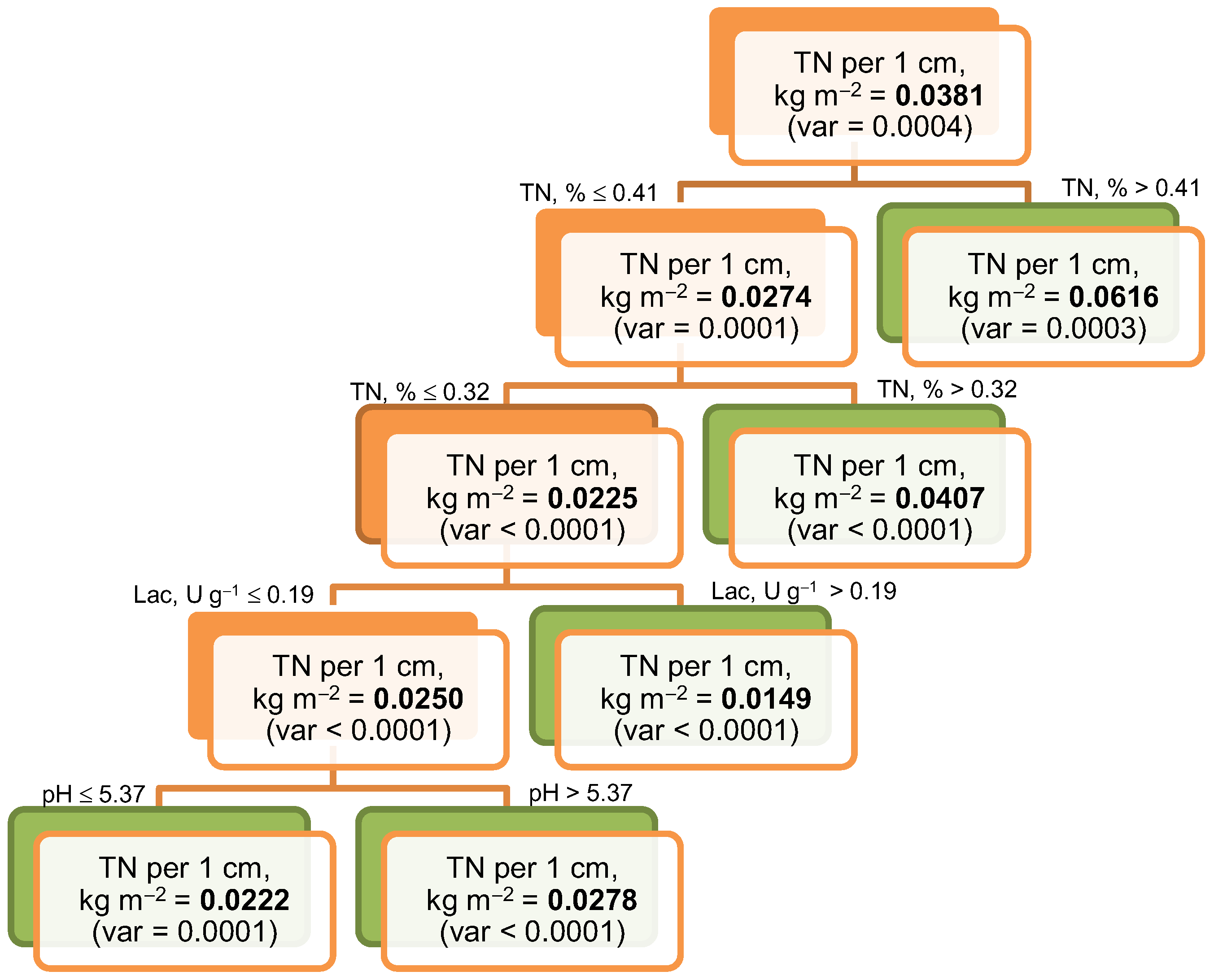
Similarly, for TN stocks, the first and second splits were determined by soil nitrogen content, indicating its great importance (Figure 8). Homogeneous groups were further divided by laccase activity (at 0.188 U g−1) and pH (at 5.37). The lowest TN stocks could be expected if TN and laccase activity were below 0.32% and 0.188 U g−1, respectively.
Calculated predictor importance (Table S5) showed that dehydrogenase (DH) activity was the second most important variable after OC and TN contents in determining OC and TN stocks, respectively. Soil geographic location was 4 and 7 times more important than ecosystem type for carbon and nitrogen stocks, respectively. Some discrepancy between the features selected for classification in the analysis and their importance rankings arises from the mutual correlation of many soil properties.
The limited influence of ecosystem type in the CART analysis likely stems from the method’s objective: partitioning the dataset into the most homogenous groups based on the target variable (in this case, carbon or nitrogen stocks). Consequently, the results show that differences in carbon and nitrogen stocks between forest–grassland soil pairs were substantially smaller than those between soils from the same ecosystem type but different biomes. Nevertheless, given the limited sample size, these findings should be regarded as preliminary and highlight the need for further studies with a larger set of soils.

4. Discussion

In general, our results show that climax grassland soils along a large-scale soil-geographic transect contain higher OC and TN stocks than mature forest soils. Despite the limited sample size and the resulting methodological constraints on the generalizing statistical conclusions, these results align well with previously published findings [14,16,24]. Notably, higher soil carbon and nitrogen stocks under grasslands compared to forests can also occur in relatively immature ecosystems. A meta-analysis of 103 studies across 160 sites in 29 countries found that soil carbon stocks increased significantly after converting farmland to grassland, whereas conversion to forest yielded no comparable effect [12]. However, the opposite trend may occur in younger ecosystems, for example, carbon and nitrogen stocks (0–40 cm depth) under 20–25-year-old forests exceeded those under 35-year-old grasslands, likely due to greater litter input and deeper rooting in maturing tree communities [11]. These findings indicate no universal pattern in the dynamics of soil carbon and nitrogen stocks following different land-use conversions.
We conducted correlation analysis to relate OC and TN stocks to physicochemical and biological properties of soils and identify factors responsible for OC and nitrogen accumulation. One could suggest that high OC and TN stocks in grasslands result from increased bulk density of soils (Table 6). However, we found no correlation between bulk density and OC or TN stocks, consistent with previously published data [5]. In our dataset, which included samples from various depths within soil profiles, increases in bulk density were consistently associated with decreases in carbon and nitrogen contents. This pattern highlights methodological limitations in the statistical analysis. To better elucidate the relationship between bulk density and carbon stocks, samples should be analyzed from comparable depths (e.g., only from the upper layer) across a larger number of soil profiles.
Among soil physicochemical properties influencing OC stocks across all soils and in both grassland and forest ecosystems, the clay content and pH showed the strongest correlations (Table 7). The relationships between OC and TN stocks and clay content are consistent with previous studies [22,39,40,41] and highlight the role of organo-mineral interactions in stabilizing soil organic matter [22,39]. Among minerals playing essential roles in this process, clay minerals with high surface reactivity (phyllosilicates, metal oxyhydroxides, and poorly crystalline aluminosilicates) are frequently cited [22,42]. Cations bridging between organic functional groups and divalent cations (primarily calcium) at mineral surfaces represent an important mechanism of OC stabilization at near-neutral pH [43]. In contrast, stabilization via sorption onto Al–Fe oxides generally predominates at low pH. This type of stabilization persists longer than occlusion within aggregates, potentially involving larger amounts of soil OC but for shorter durations [43]. The strong correlation between OC stocks and soil pH, except for the pH–TN stock pair in grassland soils (Table 7), likely reflects the predominance of calcium-mediated cation bridging over direct adsorption onto clay minerals. This is further supported by the significant positive correlation between OC stocks and calcium-bound humic acids (HA2) (Table S4). The proportion of calcium-associated humic acids varied from 0% in Retisols, which exhibited the lowest OC and TN stocks, to 28% in Chernozem V (g), characterized by the highest values of both parameters (Table 4). Conversely, OC stocks were inversely related to the fulvic acid (FA) content. Although FAs, with their higher abundance of oxygen-containing functional groups relative to humic acids, exhibit a stronger tendency for sorption onto clay minerals and complexation with calcium, their calcium salts often remain soluble, enhancing their mobility in the soil profile [44] and bioavailability [45].
Our results generally coincide with previous reports on the positive effect of soil biological activity on carbon and nitrogen accumulation in soils [5,19,22,46]. Among biological indicators, dehydrogenase activity showed the strongest correlations with OC and TN stocks (Table 7). Across the soil gradient from Retisols to Chernozems, increasing dehydrogenase activity coincided with carbon and nitrogen stocks. Dehydrogenases catalyze a wide range of oxidative reactions of soil organic matter by transferring hydrogen from substrates to acceptors; the activity is proportional to microbial biomass in soils (Figure 4 and Figure 5). Microorganisms accelerate SOM mineralization, releasing CO2 followed by CaCO3 precipitation in the presence of calcium ions. Thus, dehydrogenases may promote pedogenic carbonate formation [47], stabilizing SOM. Correlation analysis has shown that higher dehydrogenase activity was associated with an increase in the fraction of calcium-bound HAs (HA2) (Table S4). However, pairwise comparisons of forest–grassland ecosystems in the same geographic zones revealed that high dehydrogenase activities can reduce OC and TN stocks. For instance, dehydrogenase activity was higher in forests than grasslands in Retisols and Luvisols, where forest OC stocks were lower. The inverse relationship, i.e., an increase in OC stocks with an increase in dehydrogenase activity, was observed in Chernozems. Overall, these findings suggest a potentially fundamental role for dehydrogenase in soil carbon accumulation. Targeted experiments are needed to test whether dehydrogenase activity can stabilize carbon via pedogenic calcium carbonate formation.
Unlike dehydrogenase, high laccase activity (above 0.19 U g−1) corresponded to decreased carbon and nitrogen stocks in the studied soils. This highlights the potential ecological role of laccase in the degradation of recalcitrant organic matter [48]. Taken together, the effects of the studied soil enzymes, dehydrogenase, and laccase on OC and TN stocks suggest the dual role of microorganisms in both organic matter decomposition and carbon stabilization [49].
Large differences in biological activity between native grasslands and climax forest soils have been previously demonstrated using 29 pairwise comparisons [24]. The quality and quantity of aboveground litter and belowground roots supplied to soil microorganisms differ among land types, altering soil properties such as pH, bulk density, clay content, and nutrient availability, which significantly impact microbial communities [46]. In our study, more pronounced differences in physicochemical properties were observed in Retisols and Luvisols, whereas such contrasts were less evident in Chernozems. None of the soils showed a clear ecosystem-dependent pattern in the bacterial or microfungal abundance. However, metabolic profiling revealed certain trends, particularly higher metabolic potential in forest soil microbiomes. According to CLPP data, grassland soil microbiomes consumed fewer substrates and exhibited lower values of specific metabolic work (Table 4). The most marked difference between forest and grassland ecosystems was in OC stocks and the intensity of alcohol consumption by the microbiome. The correlation was negative in forests, but positive in grassland soils.
Carbon and nitrogen stocks in grassland soils increased with increasing biodiversity (the Shannon index), whereas no such relationship was observed in forest ecosystems (Table 8). In addition, OC stocks showed an inverse correlation with the Pielou index in grassland soils (Table 8). Forest ecosystems exhibited lower OC and TN stocks, likely due to more intensive transformation of C and N compounds by their microbiomes, as evidenced by high potential metabolic activity values. This interpretation aligns with the elevated C/N ratios in soils of forest ecosystems and higher C/N ratios in forest litter compared to grass litter. High C/N ratios typically reflect recalcitrant SOM compounds that resist decomposition [10].
Geographical location also plays an important role in OC and TN storage in forest and grassland biomes. Climatic parameters, as previously shown, critically affect organic carbon and nitrogen accumulation by influencing both vegetation type and soil microbial activity [50]. In terms of biological activity, there was a very sharp contrast between forest and grassland biomes of Retisols and Luvisols, but differences were less pronounced in Chernozems. For instance, Shannon indexes for forest soil microbiomes in Retisols and Luvisols were more than five times higher than in grasslands, indicating higher microbial biodiversity; this ratio decreased southward, approaching one in Chernozems and indicating similar microbial biodiversity in forest and grassland soils. Similarly, Pielou indices in northern grassland soils (Retisols and Luvisols) exceeded those in forest soils by 3.3–4.5 times but decreased to 0.1–1.0 in Chernozems. OC and TN stocks in forest–grassland pairs also showed smaller differences in the southernmost Chernozem. Given that the studied soils represent a climatic gradient from humid northern to semiarid southern conditions, the reduced contrast in carbon accumulation in forest and grassland ecosystems in Chernozems supports the hypothesis emphasizing the fundamental role of organo–mineral associations and calcium binding in OC stabilization, as well as the possible involvement of dehydrogenase activity in these stabilization processes. Furthermore, along the same north–south transect, the transition from coniferous to broad-leaved forests likely contributes to the observed variation in carbon storage patterns.
It should be acknowledged, however, that the set of soil samples used in this study does not account for spatial heterogeneity, which may have influenced the results obtained. Despite their statistical significance, increasing the sample size and modifying the sampling design may further refine the observed dependencies. Thus, future research should aim to expand the dataset and spatial coverage to confirm the trends identified in this study. Particular attention should be directed toward elucidating the role of dehydrogenase and other key soil enzymes in the stabilization and long-term persistence of soil organic carbon.

5. Conclusions

Assessment of OC stock relationships with physicochemical and biological properties of soils along the Retisols–Luvisols–Chernozems transect revealed strong positive correlations of OC stocks with OC/TN contents (r = 0.62–0.99), pH (r = 0.79–0.81), clay content (r = 0.70–0.87), Ca-bound humic acids (r = 0.73), and dehydrogenase activity (r = 0.85–0.95). These results highlight the fundamental role of organo-mineral interactions and calcium binding in OC stabilization, as well as the possible involvement of dehydrogenase via pedogenic calcium carbonate formation. The relationship between OC storage and microbiome diversity indices (Shannon and Pielou) was statistically significant only in grassland soils, suggesting that the biotransformation of organic matter and the nature of organo-mineral interactions are largely determined by ecosystem type. Under comparable climatic conditions, climax grassland soils generally accumulate greater amounts of OC and TN than mature forest soils, likely due to the more intensive transformation of C and N compounds by forest microbiomes, as evidenced by high potential metabolic activity values (CLPP assay data). The pattern of higher OC stocks in grasslands than in forests also appears to be linked to enhanced dehydrogenase activity, which promotes the pedogenic formation of calcium-containing compounds. In regions with pronounced leaching, such as those with Retisol and Luvisol soils, the contrast between forest and grassland ecosystems becomes more distinct due to calcium losses under forest vegetation. Conversely, in semiarid steppe environments (Chernozem soils), these differences tend to diminish.
It should be noted that, despite their statistical significance, these conclusions remain preliminary, as they are based on individual soil profiles representative of each ecosystem type and include samples from various depths within profiles. This approach highlights methodological limitations in the statistical analysis. Verification of the proposed mechanisms requires further targeted research with a larger, more diverse dataset, using samples from comparable depths (e.g., only the upper layer) across more soil profiles to account for spatial heterogeneity. Particular attention should focus on elucidating the role of dehydrogenase in stabilizing and ensuring the long-term persistence of soil organic carbon through pedogenic carbonate formation. Future studies should also assess the comparative stability of carbon stocks in forest and grassland soils to better understand their long-term carbon stabilization potential.

Supplementary Materials

The following supporting information can be downloaded at https://www.mdpi.com/article/10.3390/f17010069/s1: Figure S1: Ponomareva–Plotnikova scheme of soil humus fractionation. Figure S2: Depth distribution of carbon (OC) and nitrogen (TN) contents in soils of forests (triangles, solid lines) and grasslands (circles, dotted lines) along a soil-geographic transect: Retisol, Luvisol, Chernozem L, Chernozem V. Figure S3: Organic carbon distribution among different fractions of HA and FA of forest (F) and grassland (G) topsoil along a soil-geographic transect” Retisol, Luvisol, Chernozem L, Chernozem V. Table S1: Substrates used for community-level physiological profiling assay. Table S2: Abundance of bacteria, fungi, microbial biomass (Cmic), laccase (Lac), and dehydrogenase (DH) activity for different horizons of forest and grassland soils along a soil-geographic transect: Retisol, Luvisol, Chernozem L, Chernozem V. Data is presented as the mean ± standard deviation (n = 3). Table S3: Summary of a paired t-test for OC and TN storage in forest and grassland soils. Table S4: Pearson’s correlation coefficients between contents of different fractions of HAs and FAs in 0–10 cm topsoil layer (OC content in fraction, % of total OC) and soil properties. Statistically significant (p < 0.05) values are marked in bold. Correlation analysis was based on 8 pairs. Table S5: Predictor importance in CART analysis of OC and TN stocks in topsoil (0–10 cm).

Author Contributions

Conceptualization, A.Z. and N.K.; methodology, A.Z., A.B., N.K., V.D., M.R., P.P. and I.D.; validation, A.Z. and N.K.; formal analysis, A.Z., N.K. and A.B.; investigation, A.Z., N.K., A.B., V.D., P.P. and I.D.; resources, A.Z. and A.B.; data curation, A.Z., N.K. and A.B.; writing—original draft preparation, A.Z., N.K. and A.B.; writing—review and editing, A.Z., N.K. and A.B.; visualization, N.K.; project administration, A.Z.; funding acquisition, A.Z. All authors have read and agreed to the published version of the manuscript.

Funding

This research was funded by the Russian Science Foundation, grant number 23-14-00152.

Data Availability Statement

The original contributions presented in this study are included in the article and Supplementary Material. Further inquiries can be directed to the corresponding authors.

Acknowledgments

Humus fractional composition was studied in the framework of the state assignment of Lomonosov Moscow State University (121040800154-8).

Conflicts of Interest

The authors declare no conflicts of interest. The funders had no role in the design of the study; in the collection, analyses, or interpretation of data; in the writing of the manuscript; or in the decision to publish the results.

Abbreviations

The following abbreviations are used in this manuscript:
AAAmino acid
BDBulk density
DHDehydrogenase activity
FAsFulvic acids
HAsHumic acids
HSsHumic substances
LacLaccase activity
OCOrganic carbon
SOMSoil organic matter
TNTotal nitrogen
TTC2,3,5-triphenyltetrazolium chloride
CLPPCommunity-level physiological profiling assay
ABTS2,2′-azino-bis(3-ethylbenzothiazoline)-6-sulfonic acid
TBTTriphenyltetrazolium bromide
R2AReasoner 2A
TPFTriphenylformazan
CFUColony-forming unit
CARTClassification and Regression Tree

References

  1. Batjes, N.H. Total carbon and nitrogen in the soils of the world. Eur. J. Soil Sci. 2014, 65, 10–21. [Google Scholar] [CrossRef]
  2. Chen, X.; Chen, H.Y.; Chen, C.; Ma, Z.; Searle, E.B.; Yu, Z.; Huang, Z. Effects of plant diversity on soil carbon in diverse ecosystems: A global meta-analysis. Biol. Rev. 2020, 95, 167–183. [Google Scholar] [CrossRef] [PubMed]
  3. Lorenz, K.; Lal, R. Carbon Sequestration in Forest Ecosystems; Springer: Dordrecht, Germany, 2010; 289p. [Google Scholar]
  4. Eze, S.; Palmer, S.M.; Chapman, P.J. Soil organic carbon stock in grasslands: Effects of inorganic fertilizers, liming and grazing in different climate settings. J. Environ. Manag. 2018, 223, 74–84. [Google Scholar] [CrossRef] [PubMed]
  5. Schrumpf, M.; Schulze, E.D.; Kaiser, K.; Schumacher, J. How accurately can soil organic carbon stocks and stock changes be quantified by soil inventories? Biogeosciences 2011, 8, 1193–1212. [Google Scholar] [CrossRef]
  6. Ricard, M.F.; Viglizzo, E.F. Improving carbon sequestration estimation through accounting carbon stored in grassland soil. MethodsX 2020, 7, 100761. [Google Scholar] [CrossRef]
  7. Bárcena, T.G.; Kiær, L.P.; Vesterdal, L.; Stefánsdóttir, H.M.; Gundersen, P.; Sigurdsson, B.D. Soil carbon stock change following afforestation in Northern Europe: A meta-analysis. Glob. Change Biol. 2014, 20, 2393–2405. [Google Scholar] [CrossRef]
  8. Padbhushan, R.; Sharma, S.; Rana, D.S.; Kumar, U.; Kohli, A.; Kumar, R. Delineate soil characteristics and carbon pools in grassland compared to native forestland of India: A meta-analysis. Agronomy 2020, 10, 1969. [Google Scholar] [CrossRef]
  9. Sokołowska, J.; Józefowska, A.; Woźnica, K.; Zaleski, T. Succession from meadow to mature forest: Impacts on soil biological, chemical and physical properties—Evidence from the Pieniny Mountains, Poland. Catena 2020, 189, 104503. [Google Scholar] [CrossRef]
  10. Cheng, Y.; Wang, J.; Chang, S.X.; Cai, Z.; Mueller, C.; Zhang, J. Nitrogen deposition affects both net and gross soil nitrogen transformations in forest ecosystems: A review. Environ. Pollut. 2019, 244, 608–616. [Google Scholar] [CrossRef]
  11. Xie, M.; Yuan, J.; Liu, S.; Xu, G.; Lu, Y.; Yan, L.; Li, G. Soil carbon and nitrogen pools and their storage characteristics under different vegetation restoration types on the Loess Plateau of Longzhong, China. Forests 2024, 15, 173. [Google Scholar] [CrossRef]
  12. Deng, L.; Zhu, G.; Tang, Z.; Shangguan, Z. Global patterns of the effects of land-use changes on soil carbon stocks. Glob. Ecol. Conserv. 2016, 5, 127–138. [Google Scholar] [CrossRef]
  13. Kim, D.G.; Kirschbaum, M.U.; Eichler-Loebermann, B.; Gifford, R.M.; Liáng, L.L. The effect of land-use change on soil C, N, P, and their stoichiometries: A global synthesis. Agricult. Ecosyst. Environ. 2023, 348, 108402. [Google Scholar] [CrossRef]
  14. Nickels, M.C.L.; Prescott, C.E. Soil carbon stabilization under coniferous, deciduous and grass vegetation in post-mining reclaimed ecosystems. Front. For. Glob. Change 2021, 4, 689594. [Google Scholar] [CrossRef]
  15. Billings, S.A. Soil organic matter dynamics and land use change at a grassland/forest ecotone. Soil Biol. Biochem. 2006, 38, 2934–2943. [Google Scholar] [CrossRef]
  16. Poeplau, C.; Don, A.; Vesterdal, L.; Leifeld, J.; Van Wesemael, B.; Schumacher, J.; Gensior, A. Temporal dynamics of soil organic carbon after land-use change in the temperate zone—Carbon response functions as a model approach. Glob. Chang. Biol. 2011, 17, 2415–2427. [Google Scholar] [CrossRef]
  17. Wei, J.; Cheng, J.; Li, W.; Liu, W. Comparing the effect of naturally restored forest and grassland on carbon sequestration and its vertical distribution in the Chinese Loess Plateau. PLoS ONE 2012, 7, e40123. [Google Scholar] [CrossRef]
  18. Don, A.; Schumacher, J.; Freibauer, A. Impact of tropical land-use change on soil organic carbon stocks—A meta-analysis. Glob. Change Biol. 2011, 17, 1658–1670. [Google Scholar] [CrossRef]
  19. Dignac, M.F.; Derrien, D.; Barré, P.; Barot, S.; Cécillon, L.; Chenu, C.; Basile-Doelsch, I. Increasing soil carbon storage: Mechanisms, effects of agricultural practices and proxies. A review: Soil C storage: Mechanisms, practices and proxies. Agron. Sustain. Dev. 2017, 37, 14. [Google Scholar] [CrossRef]
  20. Berhongaray, G.; Alvarez, R. Soil carbon sequestration of Mollisols and Oxisols under grassland and tree plantations in South America-A review. Geoderma Regional 2019, 18, e00226. [Google Scholar] [CrossRef]
  21. Guidi, C.; Vesterdal, L.; Gianelle, D.; Rodeghiero, M. Changes in soil organic carbon and nitrogen following forest expansion on grassland in the Southern Alps. For. Ecol. Manag. 2014, 328, 103–116. [Google Scholar] [CrossRef]
  22. Basile-Doelsch, I.; Balesdent, J.; Pellerin, S. Reviews and syntheses: The mechanisms underlying carbon storage in soil. Biogeosciences 2020, 17, 5223–5242. [Google Scholar] [CrossRef]
  23. Saviozzi, A.; Levi-Minzi, R.; Cardelli, R.; Riffaldi, R. A comparison of soil quality in adjacent cultivated, forest and native grassland soils. Plant Soil 2001, 233, 251–259. [Google Scholar] [CrossRef]
  24. Paz-Ferreiro, J.; Trasar-Cepeda, C.; Leirós, M.C.; Seoane, S.; Gil-Sotres, F. Biochemical properties of acid soils under native grassland in a temperate humid zone. New Zealand J. Agricult. Res. 2007, 50, 537–548. [Google Scholar] [CrossRef]
  25. Bandyopadhyay, S.; Maiti, S.K. Different soil factors influencing dehydrogenase activity in mine degraded lands—State-of-art review. Water Air Soil Pollut. 2021, 232, 360. [Google Scholar] [CrossRef]
  26. Zavarzina, A.G.; Kulikova, N.A.; Trubitsina, L.I.; Belova, O.V.; Pyatova, M.I.; Danilin, I.V.; Pogozhev, P.E.; Kuzyakov, Y.; Lisov, A.V. Disentangling two and three domain laccases in soils: Contribution of fungi, bacteria and abiotic processes to oxidative activities. Soil Biol. Biochem. 2025, 208, 109861. [Google Scholar] [CrossRef]
  27. Filippova, O.I.; Kholodov, V.A.; Safronova, N.A.; Yudina, A.V.; Kulikova, N.A. Particle-size, microaggregate-size, and aggregate-size distributions in humus horizons of the zonal sequence of soils in european russia. Eurasian Soil Sci. 2019, 52, 300–312. [Google Scholar] [CrossRef]
  28. Burst, M.; Chauchard, S.; Dambrine, E.; Dupouey, J.L.; Amiaud, B. Distribution of soil properties along forest-grassland interfaces: Influence of permanent environmental factors or land-use after-effects? Agric. Ecosyst. Environ. 2020, 289, 106739. [Google Scholar] [CrossRef]
  29. Shi, S.; Zhang, W.; Zhang, P.; Yu, Y.; Ding, F. A synthesis of change in deep soil organic carbon stores with afforestation of agricultural soils. For. Ecol. Manag. 2013, 296, 53–63. [Google Scholar] [CrossRef]
  30. Orlov, D.S.; Grishina, L.A. Manual on Humus Chemistry; Moscow University Press: Moscow, Russia, 1981; 183p. [Google Scholar]
  31. Slepetiene, A.; Slepetys, J. Status of humus in soil under various long-term tillage systems. Geoderma 2005, 127, 207–215. [Google Scholar] [CrossRef]
  32. Slepetiene, A.; Butkute, B. Use of multichannel photometer (Multiskan MS) for determination of humic materials in soil after their dichromate oxidation. Anal. Bioanal. Chem. 2003, 375, 1260–1264. [Google Scholar] [CrossRef]
  33. Reasoner, D.J.; Geldreich, E. A new medium for the enumeration and subculture of bacteria from potable water. Appl. Environ. Microbiol. 1985, 49, 1–7. [Google Scholar] [CrossRef] [PubMed]
  34. Patil, M.P.; Patil, R.H.; Maheshwari, V.L. A novel and sensitive agar plug assay for screening of asparaginase-producing en-dophytic fungi from Aegle marmelos. Acta Biol. Szeged. 2012, 56, 175–177. [Google Scholar]
  35. Anderson, J.P.E.; Domsch, K.H. A physiological method for the quantitative measurement of microbial biomass in soils. Soil Biol. Biochem. 1978, 10, 215–221. [Google Scholar] [CrossRef]
  36. Cheptsov, V.S.; Vorobyova, E.A.; Osipov, G.A.; Manucharova, N.A.; Polyanskaya, L.M.; Gorlenko, M.V.; Pavlov, A.K.; Rosanova, M.S.; Lomasov, V.N. Microbial activity in Martian analog soils after ionizing radiation: Implications for the preserva-tion of subsurface life on Mars. AIMS Microbiol. 2018, 4, 541–562. [Google Scholar] [CrossRef]
  37. Fedor, P.; Zvaríková, M. Biodiversity indices. Encycl. Ecol. 2019, 2, 337–346. [Google Scholar]
  38. Casida, L.; Klein, D.; Santoro, T. Soil dehydrogenase activity. Soil Sci. 1964, 98, 371–376. [Google Scholar] [CrossRef]
  39. Błońska, E.; Lasota, J.; Gruba, P. Effect of temperate forest tree species on soil dehydrogenase and urease activities in relation to other properties of soil derived from loess and glaciofluvial sand. Ecol. Res. 2016, 31, 655–664. [Google Scholar] [CrossRef]
  40. Ma, T.; Dai, G.; Zhu, S.; Chen, D.; Chen, L.; Lü, X.; Feng, X. Vertical variations in plant-and microbial-derived carbon components in grassland soils. Plant Soil 2020, 446, 441–455. [Google Scholar] [CrossRef]
  41. Lăcătuşu, A.R.; Domnariu, H.; Paltineanu, C.; Dumitru, S.; Vrînceanu, A.; Moraru, I.; Marica, D. Influence of some environmental variables on organic carbon and nitrogen stocks in grassland mineral soils from various temperate-climate ecosystems. Environ. Exp. Botany 2024, 217, 105554. [Google Scholar] [CrossRef]
  42. Yu, M.; Hua, Y.; Sarwar, M.T.; Yang, H. Nanoscale interactions of humic acid and minerals reveal mechanisms of carbon protection in soil. Environ. Sci. Technol. 2022, 57, 286–296. [Google Scholar] [CrossRef]
  43. Rowley, M.C.; Grand, S.; Verrecchia, É.P. Calcium-mediated stabilisation of soil organic carbon. Biogeochemistry 2018, 137, 27–49. [Google Scholar] [CrossRef]
  44. Liu, J.; Hue, N.V. Ameliorating subsoil acidity by surface application of calcium fulvates derived from common organic materials. Biol. Fert. Soils 1996, 21, 264–270. [Google Scholar] [CrossRef]
  45. Wang, Z.; Yao, Y.; Yang, Y. Fulvic acid-like substance-Ca (II) complexes improved the utilization of calcium in rice: Chelating and absorption mechanism. Ecotoxicol. Environ. Saf. 2022, 237, 113502. [Google Scholar] [CrossRef]
  46. Wang, K.; Zhang, Y.; Tang, Z.; Shangguan, Z.; Chang, F.; Jia, F.A.; Deng, L. Effects of grassland afforestation on structure and function of soil bacterial and fungal communities. Sci. Total Environ. 2019, 676, 396–406. [Google Scholar] [CrossRef]
  47. Zhang, N.; He, X.; Gao, Y.; Li, Y.; Wang, H.; Ma, D.; Zhang, R.; Yang, S. Pedogenic carbonate and soil dehydrogenase activity in response to soil organic matter in Artemisia ordosica community. Pedosphere 2010, 20, 229–235. [Google Scholar] [CrossRef]
  48. Theuerl, S.; Buscot, F. Laccases: Toward disentangling their diversity and functions in relation to soil organic matter cycling. Biol. Fertil. Soils 2010, 46, 215–225. [Google Scholar] [CrossRef]
  49. Zhou, M.; Wang, S.; Zhuang, Q.; Yang, Z.; Gan, C.; Jin, X. Process-based modeling of forest soil carbon dynamics. Forests 2025, 16, 1579. [Google Scholar] [CrossRef]
  50. Wang, S.; Guan, Y.; Wang, Z.; Yang, Z.; Li, C.; Zhang, X.; Shi, D.; Zhang, M. Response of topsoil organic carbon in the forests of Northeast China under future climate scenarios. Forests 2024, 15, 2138. [Google Scholar] [CrossRef]
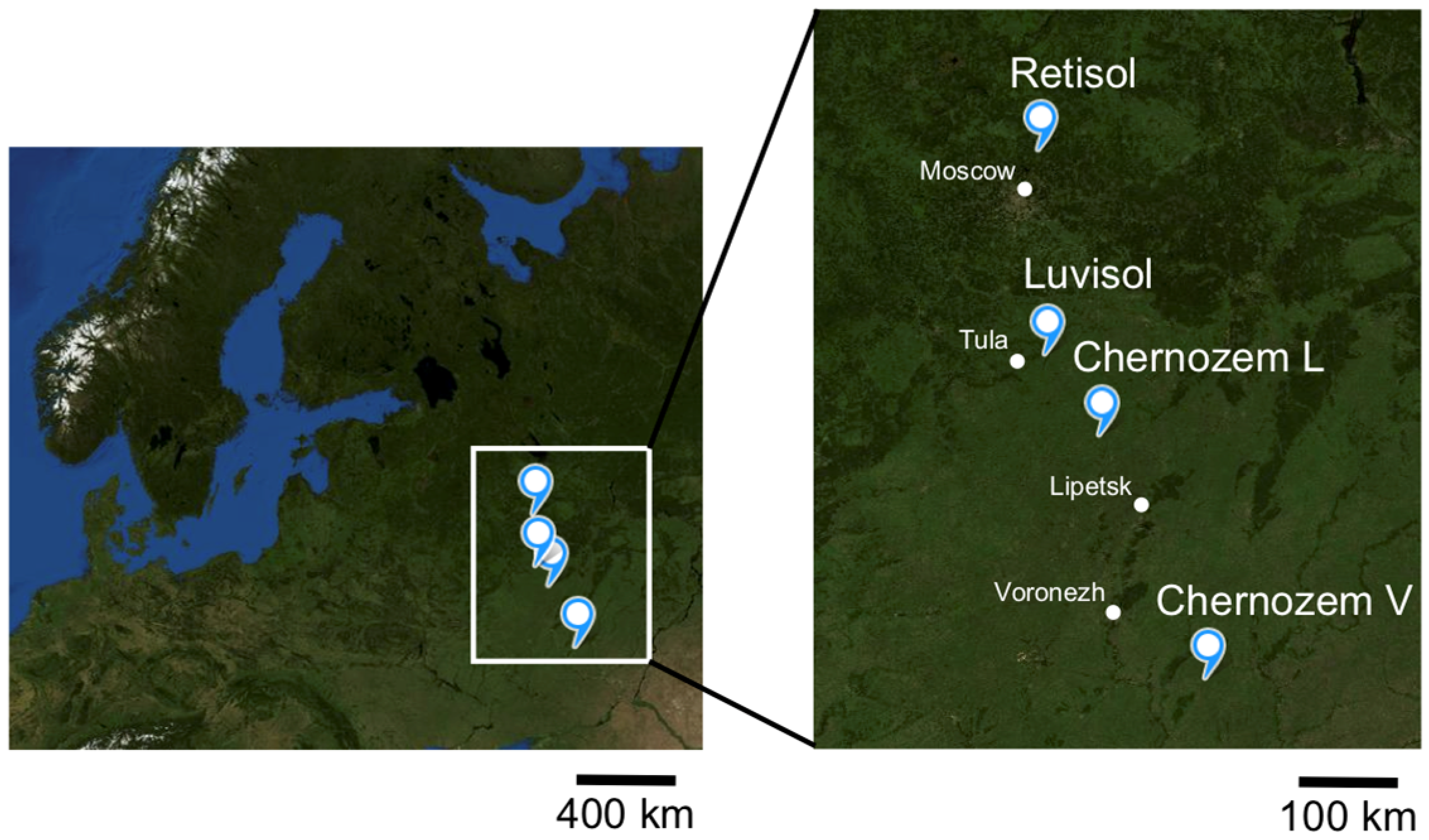
Figure 1. Study area and sampling sites.
Forests 17 00069 g001
Figure 2. Soil profiles under the study.
Forests 17 00069 g002
Figure 3. Relationship between storage of OC, TN per 1 cm layers, and soil BD for forest (triangles, solid line) and grassland (circles, dashed line). Value r relates to Pearson’s correlation coefficient. The critical values of Pearson’s correlation coefficient at p = 0.05 are 0.43 for forest soils (21 pairs) and 0.41 for grassland soils (23 pairs), respectively.
Forests 17 00069 g003
Figure 4. Depth distribution of bacteria, fungi, and microbial biomass in soils of forests (triangles, solid lines) and grasslands (circles, dotted lines) along a soil-geographic transect: Retisol, Luvisol, Chernozem L, Chernozem V. For microbial biomass, bars represent standard deviation (n = 3); in some cases, the bars are smaller than the size of symbols.
Forests 17 00069 g004
Figure 5. Substrate consumption spectra by microbial communities of forest (f) and grassland (g) topsoil along a soil-geographic transect: Retisol, Luvisol, Chernozem L, Chernozem V. a.u.—arbitrary units. Substrates used included alcohols (dulcite, glycerin, inositol, mannitol, sorbitol), AA (alanine, arginine, asparagine, glutamine, glycine, histidine, leucine, lysine, methionine, phenylalanine, proline, serine, tryptophan, valine), N-containing substances (creatine, deoxyguanosine, urea), polymers (dextran 500, gelatin, soluble starch, raffinose, Tween 20), salts of organic acids (acetate, aspartate, caprylate, citrate, GABA, lactate, maleinate, oxalate, pyruvate, succinate), and sugars (arabinose, cellobiose, fructose, glucose, lactose, maltose, ramnose, ribose, sucrose, xylose).
Forests 17 00069 g005
Figure 6. Depth distribution of laccase (Lac) and dehydrogenase (DH) activities in soils of forests (triangles, solid lines) and grasslands (circles, dotted lines) along a soil-geographic transect: Retisol, Luvisol, Chernozem L, Chernozem V. Bars represent standard deviation (n = 3); in some cases, the bars are smaller than the size of symbols.
Forests 17 00069 g006
Figure 7. CART analysis of OC storage in topsoil (0–10 cm). Considered variables were OC (%), TN (%), рН, BD (g cm−3), Cmic (mg 100 g−1), bacteria ability (CFU g−1), fungi ability (CFU g−1), DH (mg TPF 10 g−1 24 h−1), Lac (U g−1), soil reference group (WRB), and ecosystem; not all independent variables appear in the graph. Var denotes the variance of values in a group. Color coding of CART tree structure: brown blocks denote branching nodes, and green blocks denote leaf nodes (terminal outcomes).
Forests 17 00069 g007
Figure 8. CART analysis of TN storage in topsoil (0–10 cm). Considered variables were OC (%), TN (%), рН, BD (g cm−3), Cmic (mg 100 g−1), bacteria ability (CFU g−1), fungi ability (CFU g−1), DH (mg TPF 10 g−1 24 h−1), Lac (U g−1), soil reference group (WRB), and ecosystem; not all independent variables appear in the graph. Var denotes the variance of values in a group. Color coding of CART tree structure: brown blocks denote branching nodes, and green blocks denote leaf nodes (terminal outcomes).
Forests 17 00069 g008
Table 1. Description of the soils and sites under the study.
Biome,
Average
Annual Temperature and Precipitation
Soil IndexSoil Reference
Group
* WRB 2022
EcosystemDominant SpeciesGPS Coordinates, DD/
Altitude, m a.s.l.
Southern taiga

3.5–5.8 °C,
500–700 mm
Retisol (f)Retisol
(Loamic, Cutanic)
foresttrees: Picea abies (L.) H. Karst., Betula pendula Roth; herbs: Oxalis acetosella L., Aegopodium podagraria L., Asarum europaeum L.56.227922
37.953847/
205
Retisol (g)Retisol
(Loamic, Cutanic)
grasslandPoa pratensis L.56.228078
37.953366/
200
Broadleaf forest

+4.0 °C
550–600 mm
Luvisol (f)Albic Luvisol
(Loamic, Cutanic)
foresttrees: Tilia cordata Mill., Fraxinus excelsior L., Quercus robur L.; Corylus avellana L., Acer platanoides L.; herbs: Mercurialis perennis L.53.973211
37.181616/
180
Luvisol (g)Albic Luvisol
(Loamic Cutanic, Aric)
grasslandElytrigia repens (L.) Nevski, Poa palustris L., Poa pratensis L.53.93623
37.187284/
180
Forest–steppe

+4.5 °C
450–500 mm
Chernozem L (f)Luvic Calcic Chernozem (Loamic, Pachic)foresttrees: Acer platanoides L., Acer campestre L., Tilia cordata Mill.; shrubs: Prunus padus L.53.505994
38.978772/
145
Chernozem L (g)Vermic Hypocalcic Chernozem (Loamic, Hyperhumic)grasslandPoa angustifolia L.53.505994
38.979772/
145
Steppe

+5.7 °C
470 mm
Chernozem V (f)Vermic Luvic Endocalcic Chernozem (Clayic, Pachic)foresttrees: Acer campestre L., Quercus robur L.51.02908
40.72758/
150
Chernozem V (g)Vermic Calcic Chernozem (Loamic, Pachic)grasslandFestuca valesiaca Schleich. ex Gaudin.51.02900
40.72617/
150
Table 2. Physico-chemical properties of forest and grassland soils along a soil-geographic transect of Retisol, Luvisol, Chernozem L, and Chernozem V. Data is presented as the mean ± standard deviation (n = 3).
Soil IndexHorizonSoil Moisture, %pH (H2O)Density, g cm−3Clay Content, %
Retisol (f)Ah (0–6 cm)44.3 ± 4.14.57 ± 0.020.70 ± 0.189 ± 2
A (6–11 cm)29.8 ± 4.64.74 ± 0.030.95 ± 0.1910 ± 2
AE (11–17 cm)23.8 ± 0.94.88 ± 0.031.30 ± 0.1510 ± 4
E (17–22 cm)18.8 ± 2.15.03 ± 0.021.46 ± 0.179 ± 5
Ebtg (22–33 cm)18.9 ± 1.25.05 ± 0.031.54 ± 0.1612 ± 2
Retisol (g)Ap1 (0–5 cm)27.7 ± 4.35.16 ± 0.031.20 ± 0.248 ± 2
Ap2 (5–10 cm)24.5 ± 2.35.57 ± 0.021.38 ± 0.158 ± 1
Ap3 (10–27 cm)25.3 ± 1.05.35 ± 0.021.38 ± 0.138 ± 2
E (27–36 cm)20.0 ± 0.45.14 ± 0.031.60 ± 0.128 ± 2
Ebt (36–48 cm)19.6 ± 0.34.92 ± 0.031.58 ± 0.1813 ± 4
Luvisol (f)Ah (0–5 cm)29.5 ± 1.45.43 ± 0.010.81 ± 0.188 ± 2
A (5–10 cm)28.9 ± 2.25.16 ± 0.030.91 ± 0.129 ± 3
A (10–18 cm)32.2 ± 1.04.93 ± 0.020.99 ± 0.129 ± 4
AE (18–24 cm)23.9 ± 1.24.78 ± 0.011.21 ± 0.2010 ± 1
Ebt (24–50 cm)17.7 ± 0.44.72 ± 0.021.36 ± 0.1411 ± 4
Bt (50–70 cm)22.5 ± 0.14.67 ± 0.021.36 ± 0.1711 ± 4
Luvisol (g)Ah (0–5 cm)31.4 ± 2.25.69 ± 0.031.21 ± 0.198 ± 2
Ap (5–10 cm)21.9 ± 1.15.62 ± 0.021.41 ± 0.159 ± 2
Ap (10–20 cm)18.1 ± 0.45.61 ± 0.031.48 ± 0.1410 ± 2
Ap (20–28 cm)16.0 ± 1.55.71 ± 0.011.57 ± 0.1510 ± 2
AE (28–36 cm)15.5 ± 0.85.29 ± 0.071.64 ± 0.149 ± 3
Ebt (36–58 cm)16.2 ± 0.84.95 ± 0.031.50 ± 0.1410 ± 4
Chernozem L (f)Ah (0–5 cm)17.4 ± 0.96.28 ± 0.020.88 ± 0.1214 ± 3
Ah (5–10 cm)12.0 ± 0.66.38 ± 0.031.01 ± 0.1514 ± 1
Ah (10–20 cm)12.8 ± 0.76.13 ± 0.011.04 ± 0.1218 ± 2
Ah (20–33 cm)14.8 ± 0.65.81 ± 0.031.06 ± 0.1920 ± 1
Abh (33–60 cm)14.4 ± 0.25.24 ± 0.071.15 ± 0.2320 ± 4
Bt (60–75 cm)12.1 ± 0.35.36 ± 0.011.27 ± 0.1616 ± 3
Chernozem L (g)Ah (0–5 cm)15.9 ± 1.86.24 ± 0.021.09 ± 0.1216 ± 2
Ah (5–10 cm)15.6 ± 0.96.32 ± 0.011.11 ± 0.1620 ± 1
Ah (10–20 cm)14.6 ± 0.46.87 ± 0.031.17 ± 0.1819 ± 3
Ah (20–30 cm)14.7 ± 0.46.75 ±0.041.01 ± 0.2021 ± 1
Ah (30–50 cm)16.7 ± 0.46.77 ± 0.100.99 ± 0.1520 ± 1
Abh (50–77 cm)14.6 ± 0.36.68 ± 0.021.18 ± 0.1919 ± 2
Bk (77–120 cm)13.8 ± 0.37.39 ± 0.051.30 ± 0.13
Chernozem V (f)Ah (0–5 cm)50.7 ± 2.37.20 ± 0.030.85 ± 0.1615 ± 1
Ah (5–10 cm)36.1 ± 1.17.33 ± 0.031.03 ± 0.1417 ± 2
Ah (10–20 cm)26.8 ± 1.27.08 ± 0.021.04 ± 0.1521 ± 3
Ah (20–30 cm)22.5 ± 0.97.32 ± 0.041.02 ± 0.1223 ± 3
Abh (30–57 cm)16.4 ± 0.46.66 ± 0.031.12 ± 0.1323 ± 3
Bt (57–80 cm)12.1 ± 0.26.39 ± 0.041.16 ± 0.1522 ± 1
Chernozem V (g)Ah (0–5 cm)30.9 ± 1.36.87 ± 0.011.10 ± 0.1817 ± 2
Ah (5–10 cm)36.1 ± 1.26.67 ± 0.051.13 ± 0.1619 ± 2
Ah (10–20 cm)18.2 ± 0.56.18 ± 0.011.17 ± 0.2120 ± 1
Ah (20–30 cm)14.9 ± 0.76.21 ± 0.021.09 ± 0.1621 ± 1
Ah (30–47 cm)19.1 ± 0.67.13 ± 0.011.11 ± 0.1522 ± 1
Bk (47–67 cm)12.9 ± 0.57.20 ± 0.031.18 ± 0.1322 ± 3
LSD 0.05 * 3.50.160.081
* least significant difference at p < 0.05 (one-way ANOVA).
Table 3. The contents of organic carbon (OC) and total nitrogen (TN) for different horizons of forest and grassland soils along a soil-geographic transect: Retisol, Luvisol, Chernozem L, Chernozem V. Data is presented as the mean ± standard deviation (n = 3). Standard deviations for stocks could not be calculated because these indices were derived from the averaged values of BD, OC, and TN contents.
Soil IndexHorizon (Depth, cm)OCTNC/N
%kg m−2%kg m−2
Retisol (f)Ah (0–6)3.53 ± 0.011.490.16 ± 0.060.0722
A (6–11)2.25 ± 0.111.070.20 ± 0.020.1011
AE (11–17)1.52 ± 0.141.180.18 ± 0.010.148
E (17–22)0.61 ± 0.110.440.06 ± 0.020.0410
Ebtg (22–33)0.34 ± 0.010.570.04 ± 0.020.078
Retisol (g)Ap (10–5)3.25 ± 0.081.940.20 ± 0.020.1216
Ap2 (5–10)3.02 ± 0.112.090.19 ± 0.020.1316
Ap3 (10–27)1.26 ± 0.082.940.21 ± 0.010.496
E (27–36)0.39 ± 0.010.560.08 ± 0.010.125
Ebt (36–48)0.36 ± 0.040.670.16 ± 0.030.302
Luvisol (f)Ah (0–5)3.78 ± 0.011.530.23 ± 0.040.0916
A (5–10)2.23 ± 0.151.010.26 ± 0.040.129
A (10–18)1.51 ± 0.201.190.18 ± 0.040.148
AE (18–24)0.87 ± 0.080.630.09 ± 0.010.0710
Ebt (24–50)0.44 ± 0.071.560.06 ± 0.010.217
Bt (50–70)0.29 ± 0.010.770.04 ± 0.010.117
Luvisol (g)Ah (0–5)2.59 ± 0.061.570.36 ± 0.120.227
Ap (5–10)1.62 ± 0.061.140.20 ± 0.040.148
Ap (10–20)1.12 ± 0.011.640.20 ± 0.060.306
Ap (20–28)0.91 ± 0.061.140.18 ± 0.040.235
AE (28–36)0.35 ± 0.030.460.12 ± 0.050.163
Ebt (36–58)0.43 ± 0.031.420.12 ± 0.030.404
Chernozem L (f)Ah (0–5)6.93 ± 0.133.050.40 ± 0.010.1817
Ah (5–10)3.82 ± 0.161.930.29 ± 0.010.1413
Ah (10–20)3.44 ± 0.023.590.27 ± 0.040.2813
Ah (20–33)3.21 ± 0.064.400.29 ± 0.020.4011
Abh (33–60)2.23 ± 0.106.940.21 ± 0.010.6511
Bt (60–75)0.98 ± 0.061.860.09 ± 0.010.1711
Chernozem L (g)Ah (0–5)5.97 ± 0.033.240.40 ± 0.140.3315
Ah (5–10)4.30 ± 0.132.390.60 ± 0.050.337
Ah (10–20)4.65 ± 0.065.420.44 ± 0.050.5111
Ah (20–30)3.97 ± 0.183.990.28 ± 0.020.2814
Ah (30–50)3.79 ± 0.187.460.22 ± 0.030.4317
Abh (50–77)2.54 ± 0.088.060.23 ± 0.020.7311
Bk (77–120)1.64 ± 0.099.130.17 ± 0.020.9510
Chernozem V (f)Ah (0–5)8.14 ± 0.843.461.07 ± 0.320.458
Ah (5–10)5.86 ± 0.943.020.53 ± 0.010.2711
Ah (10–20)5.93 ± 0.356.190.51 ± 0.020.5312
Ah (20–30)4.37 ± 0.114.460.36 ± 0.010.3712
Abh (30–57)3.83 ± 0.2811.60.25 ± 0.010.7615
Bt (57–80)2.25 ± 0.186.000.15 ± 0.010.4015
Chernozem V (g)Ah (0–5)9.71 ± 0.555.340.42 ± 0.060.2323
Ah (5–10)6.04 ± 0.173.410.43 ± 0.010.2514
Ah (10–20)6.01 ± 0.197.030.47 ± 0.010.5513
Ah (20–30)4.74 ± 0.045.170.37 ± 0.010.4013
Ah (30–47)3.79 ± 0.167.150.36 ± 0.050.6811
Bk (47–67)3.48 ± 0.198.190.26 ± 0.010.6113
LSD 0.05 * 0.75 0.07
* least significant difference at p < 0.05 (one-way ANOVA).
Table 4. Humus content and OC distribution among different fractions of HAs and FAs of forest (f) and grassland (g) topsoil along a soil-geographic transect: Retisol, Luvisol, Chernozem L, Chernozem V. Data is presented as the mean ± standard deviation (n = 2).
ParameterRetisolLuvisolChernozem LChernozem VLSD 0.05 *
fgfgfgfg
Humus 1, %4.3 ± 0.13.7 ± 0.13.8 ± 0.11.6 ± 0.16.8 ± 0.16.3 ± 0.110.3 ± 0.37.9 ± 0.10.1
HA1, %15.5 ± 0.213.5 ± 0.410.2 ± 0.23.9 ± 0.210.3 ± 0.20.9 ± 0.21.6 ± 0.20.6 ± 0.20.2
HA2, %006.3 ± 0.819.5 ± 0.817.5 ± 0.719.0 ± 0.719.0 ± 0.828.3 ± 0.70.8
HA3, %0.9 ± 0.20.8 ± 0.25.5 ± 0.22.0 ± 0.29.6 ± 0.311.2 ± 0.25.3 ± 0.33.2 ± 0.20.3
ΣHA, %16.4 ± 0.314.3 ± 0.422.0 ± 0.425.4 ± 0.437.4 ± 0.431.0 ± 0.325.8 ± 0.332.2 ± 0.30.3
FA1, %16.1 ± 0.319.4 ± 0.313.3 ± 0.214.7 ± 0.12.0 ± 0.310.8 ± 0.28.8 ± 0.27.0 ± 0.20.3
FA1a, %1.6 ± 0.22.1 ± 0.22.4 ± 0.22.0 ± 0.20.8 ± 0.10.9 ± 0.10.9 ± 0.21.7 ± 0.10.3
FA2, %5.3 ± 0.20.5 ± 0.19.8 ± 0.22.0 ± 0.10.8 ± 0.17.8 ± 0.10.4 ± 0.11.0 ± 0.10.2
FA3, %15.0 ± 0.319.5 ± 0.312.2 ± 0.39.8 ± 0.311.5 ± 0.36.0 ± 0.28.4 ± 0.26.8 ± 0.20.4
ΣFA, %38.0 ± 1.041.4 ± 1.137.7 ± 1.128.3 ±0.915.1 ± 1.025.4 ± 1.218.6 ± 1.016.5 ± 1.01.2
CHA/CFA 20.43 ± 0.010.35 ± 0.010.58 ± 0.010.90 ± 0.022.47 ± 0.021.22 ± 0.021.39 ± 0.011.95 ± 0.010.09
Humin, %45.6 ± 0.344.3 ± 0.240.3 ± 0.246.3 ± 0.347.5 ± 0.443.6 ± 0.255.5 ± 0.251.3 ± 0.20.2
* least significant difference at p < 0.05 derived from one-way ANOVA. 1 calculated as OC × 1.724: <2 very low, 2–4 low, 4–6 medium, 6–10 high, >10 very high [30]; 2 humus type according to HA/FA ratio: humate (>2), fulvate–humate (1–2), humate–fulvate (0.5–1), fulvate (<0.5).
Table 5. CLPP indexes: a number of consumed substrates (n), specific metabolic work (W), Shannon index (H), and evenness (E, Pielou index) for microbial communities of forest and grassland topsoil along a soil-geographic transect: Retisol, Luvisol, Chernozem L, Chernozem V.
Soil IndexDepth, cmnWHE
Retisol (f)0–5451.65.190.94
5–10441.235.010.92
Retisol (g)0–5111.120.900.11
5–10120.750.850.25
Luvisol (f)0–5410.924.930.92
5–10381.024.800.91
Luvisol (g)0–5210.780.940.61
5–10150.80.930.65
Chernozem L (f)0–5471.483.630.79
5–10471.385.220.94
Chernozem L (g)0–5441.215.270.97
5–10451.085.150.94
Chernozem V (f)0–5471.235.180.93
5–10441.095.190.95
Chernozem V (g)0–5400.955.030.95
5–10461.115.270.95
Table 6. Calculated average bulk density (BD), the calculated contents and storages of total organic carbon (OC) and total nitrogen (TN) at different depths of forest and grassland soils along a soil-geographic transect: Retisol, Luvisol, Chernozem L, Chernozem V.
Soil IndexDepth, cmBD, g cm−3Content, %Storage, kg m−2
OCTNOCTN
Retisol (f)0–50.703.530.161.250.06
0–100.802.920.182.350.14
0–201.061.900.164.010.33
0–301.211.260.114.600.40
Retisol (g)0–51.203.250.201.940.12
0–101.293.130.194.030.25
0–201.332.160.205.760.54
0–301.371.740.197.160.78
Luvisol (f)0–50.813.780.231.530.09
0–100.862.960.252.550.21
0–200.952.090.203.950.38
0–301.071.480.154.730.47
Luvisol (g)0–51.212.590.361.570.22
0–101.312.070.272.710.36
0–201.391.560.234.350.65
0–301.461.280.215.610.92
Chernozem L (f)0–50.886.930.403.050.18
0–100.945.270.194.970.32
0–200.994.310.238.560.60
0–301.013.920.2511.940.91
Chernozem L (g)0–51.095.970.603.240.33
0–101.105.120.605.630.66
0–201.134.880.5211.051.17
0–301.094.600.4415.041.45
Chernozem V (f)0–50.858.141.073.460.45
0–100.946.890.486.480.73
0–200.996.390.5012.671.26
0–301.005.700.4517.131.63
Chernozem V (g)0–51.109.710.425.340.23
0–101.127.850.218.750.48
0–201.146.910.3415.781.03
0–301.136.210.3520.951.43
Table 7. Pearson’s correlation coefficient r between storage of OC and TN per 1 cm layer in 0–10 cm topsoil layer (kg m−2) and soil properties. Statistically significant values are marked in bold.
ParameterAll Studied Soils (n = 16)Forest Soils (n = 8)Grassland Soils (n = 8)
OCTNOCTNOCTN
OC, %0.950.620.970.830.990.43
TN, %0.550.960.820.990.460.99
Clay content, %0.730.700.870.660.660.84
pH0.790.810.910.840.830.72
Density, g cm−30.030.040.220.22−0.67−0.70
Cmic, g kg−10.400.230.480.410.760.10
Bacteria, CFU g−10.170.21−0.21−0.500.100.44
Fungi, CFU g−10.050.160.550.84−0.23−0.55
Lac, U g−1−0.15−0.070.24−0.07−0.28−0.04
DH, mg TPF 10 g−1 24−10.880.620.950.720.850.63
Forests 17 00069 i001.
Table 8. Pearson’s correlation coefficients between storage of OC, TN per 1 cm layer of 0–10 cm topsoil (kg m−2) and CLPP data for studied soils. Significant values are marked in bold.
Group of ParametersParameterAll Soils (n = 16)Forest Soils (n = 8)Grassland Soils (n = 8)
OCTNOCTNOCTN
Substrate consumptionAlcohols−0.22−0.34−0.81−0.760.700.74
AA−0.01−0.03−0.17−0.330.440.70
N containing0.600.380.770.470.800.62
Polymers0.260.400.530.450.520.94
Salt0.280.200.440.110.430.68
Sugars0.340.290.630.380.720.80
CLPP indexesn0.320.300.620.410.670.85
W0.04−0.060.11−0.120.390.37
H0.320.26−0.240.120.750.77
E−0.12−0.160.41−0.00003−0.78−0.67
Forests 17 00069 i002.
Disclaimer/Publisher’s Note: The statements, opinions and data contained in all publications are solely those of the individual author(s) and contributor(s) and not of MDPI and/or the editor(s). MDPI and/or the editor(s) disclaim responsibility for any injury to people or property resulting from any ideas, methods, instructions or products referred to in the content.