Article

Linking Forest Litter Bacterial and Fungal Diversity to Litter–Soil Interface Characteristics

by
Lie Xiao
1,*,
Xuxu Min
1,
Shu Yu
2,
Peng Li
1,
Zhou Wang
3 and
Penghai Yin
2
1
State Key Laboratory of Water Engineering Ecology and Environment in Arid Area, Xi’an University of Technology, No. 5 Jinhua South Road, Beilin District, Xi’an 710048, China
2
State Key Laboratory of Water Cycle and Water Security, China Institute of Water Resources and Hydropower Research, Beijing 100048, China
3
Northwest Surveying and Planning Institute of National Forestry and Grassland Administration, Xi’an 710048, China
*
Author to whom correspondence should be addressed.
Forests 2026, 17(1), 67; https://doi.org/10.3390/f17010067 (registering DOI)
Submission received: 28 November 2025 / Revised: 26 December 2025 / Accepted: 30 December 2025 / Published: 3 January 2026
(This article belongs to the Section Forest Ecology and Management)

Abstract

The mechanism by which litter–soil interface properties interact to shape the composition and diversity of litter decomposition-driving microorganisms remains unclear. Here, litter and surface soil samples were collected from three typical forest types on the Loess Plateau: Pinus tabulaeformis forest (PF), Quercus acutissima forest (QF), and their mixed forest (MF). Litter and soil chemical properties, along with litter microbial community structure, were analyzed to clarify microbial diversity differences across stands. Across the three forests, litter microbes showed no significant differences in multiple diversity indices, but dominant genera differed significantly. At all taxonomic levels, litter bacterial and fungal diversity followed the order MF < PF < QF. QF had the highest litter total nitrogen (LTN) and phosphorus (LTP) and significantly higher soil ammonia nitrogen (NH4+-N) than PF and MF. Correlation analysis indicated that LTN, LTP, soil organic carbon (SOC), and soil NH4+-N primarily influenced bacterial and fungal community composition and diversity. Redundancy analysis revealed litter organic carbon (LOC) as the dominant environmental driver shaping both communities, with soil NH4+-N exerting a stronger effect on bacteria and nitrate nitrogen (NO3-N) on fungi. These findings deepen understanding of soil–litter–microbe interactions in forest ecosystems, laying a scientific foundation for forest management and protection.

1. Introduction

Forest litter serves as a critical intermediary between soil and vegetation, playing a central role in forest ecosystems by regulating carbon (C) and nutrient cycling as well as energy flow [1,2]. Microbial communities inhabiting the litter layer drive the decomposition of organic matter, mineralizing essential nutrients, particularly nitrogen (N) and phosphorus (P), which support plant growth and sustain biogeochemical cycles [3,4,5]. Crucially, these microbes do not merely respond passively to environmental conditions; they actively mediate key functional processes such as lignocellulose degradation, N immobilization, and P solubilization. Therefore, understanding how the composition, diversity, and functional potential of litter microbial communities vary across forest types and what factors govern these patterns is essential for unraveling the mechanisms underpinning nutrient dynamics and broader ecosystem functioning [6,7].
Forest litter is primarily composed of recalcitrant biopolymers, including complex polysaccharides, lignin, and polyphenols, which require specialized enzymatic machinery for breakdown [8]. Fungi, with their filamentous hyphae and extracellular enzyme systems, are generally more efficient than bacteria at degrading these structurally complex compounds [9]. While studies comparing litter from different tree species consistently report shifts in microbial community structure—with bacterial diversity often exceeding fungal diversity—the functional implications of these shifts remain poorly understood [10,11]. Notably, mixed-species litter has been shown in some systems to enhance microbial abundance and diversity by providing a broader spectrum of substrates and nutrients. For example, in Mediterranean shrublands, multi-species litter supported higher microbial biomass, lower bacterial diversity, and greater fungal diversity compared to single-species litter [12]. Similarly, mixing coniferous and poplar litter increased both fungal and bacterial biomass by over 40% and elevated overall microbial diversity [13]. However, contrasting results have also emerged: one study found that mixing bamboo and tropical forest litter actually suppressed microbial abundance and diversity [14]. These inconsistencies likely stem from unmeasured variation in litter chemistry (e.g., C:N ratio, lignin content, phenolic compounds) and underlying soil properties (e.g., C content, nutrient availability), which were not accounted for as explanatory variables in prior work. Consequently, the mechanisms driving microbial responses to litter mixing remain uncertain—particularly whether observed patterns reflect substrate complementarity, competitive exclusion, or resource limitation.
The assembly of litter microbial communities is strongly influenced by a range of microhabitat conditions, including litter quality, physicochemical traits, and soil properties. Soil moisture and temperature are among the primary microenvironmental drivers shaping microbial abundance [15]. Initial litter chemistry—largely determined by plant species—affects early-stage decomposition rates and shapes the initial composition of microbial communities, whereas microbial community dynamics play an increasingly critical role in regulating late-stage decomposition processes [16]. Overall, the composition and diversity of litter microbial communities are closely linked to microenvironmental factors, which are themselves constrained by the physicochemical characteristics of the litter [6,17,18,19]. Additional factors such as soil pH and nutrient availability significantly affect microbial growth and metabolic activity [20,21]. Critically, the litter–soil interface constitutes a dynamic ecotone where chemical gradients, physical contact, and biological exchanges converge to regulate microbial community assembly. Despite its importance, systematic comparisons across forest stands remain limited, particularly concerning the interactive effects of litter–soil interface properties on forest litter microbial communities.
The Loess Plateau in northern China supports a unique and ecologically vital ecosystem that plays a key role in regional environmental security and requires sustained conservation efforts [22], yet it has suffered from prolonged land degradation and severe soil erosion [23,24]. In this region, forest litter not only fuels microbial activity but also functions as a protective mulch that reduces surface runoff, enhances water infiltration, stabilizes soil aggregates, and replenishes organic matter pools [25]. Efficient litter decomposition—mediated by robust and functionally diverse microbial communities—is thus directly linked to ecosystem recovery: it accelerates nutrient cycling, supports vegetation regeneration, and strengthens long-term soil conservation. Despite extensive research on afforestation effectiveness and ecological engineering practices in the Loess Plateau [26,27,28], little attention has been paid to the microbial drivers of litter decomposition or their dependence on litter–soil chemical coupling.
To address this knowledge gap, we investigated three representative forest types on the Loess Plateau—Pinus tabulaeformis, Quercus acutissima, and their mixed stand—focusing on the interplay among litter chemistry, surface soil nutrients, and litter-associated microbial communities. Our study uniquely integrates these three dimensions across pure and mixed forest stands within a highly degraded, erosion-prone landscape. Our objectives were to identify the key drivers of litter microbial community composition and diversity and to elucidate the interaction mechanisms among forest litter, soil nutrients, and litter microbial communities. The findings enhance understanding of biogeochemical cycling in forest ecosystems and provide a theoretical basis for maintaining and enhancing the stability of forest litter layers. A more comprehensive understanding these interactions will improve our capacity to predict and manage ecosystem responses to environmental changes, thereby supporting ecological conservation and sustainable forest management.

2. Materials and Methods

2.1. Study Area

The study site is located in the Shuanglong State-owned Ecological Experimental Forest Farm (108°45′ E to 109°1′ E and 35°33′ N to 35°49′ N), within Huangling County, Yan’an City, Shaanxi Province, China, with an average elevation of 1545 m above sea level. The region has a typical continental monsoon climate, characterized by cool autumns, long and cold winters, short hot summers, rapid springtime temperature increases, and frequent strong winds and sandstorms. The frost-free period ranges from 170 to 180 days. The mean annual temperature and precipitation are 9.4 °C and 596.3 mm, respectively, with the majority of rainfall concentrated in July and August. The dominant soil type is loessial soil, which is generally low in fertility and highly susceptible to erosion. The forest vegetation primarily consists of natural secondary forests, including coniferous forests and mixed coniferous-broadleaf forests. Dominant tree species include Pinus tabuliformis, Quercus acutissima, Betula platyphylla, and Platycladus orientalis.

2.2. Plot Setup and Sample Collection

Three natural forest types with relatively consistent site conditions were selected for sampling: Pinus tabulaeformis (PF), Quercus acutissima (QF), and mixed P. tabulaeformis-Q. acutissima forests (MF). The main characteristics of the sampling sites are shown in Table 1.
In August 2023, three replicate plots (10 × 10 m each) were established within each forest type. Within each plot, five sampling points were arranged along two diagonal lines to collect litter layer and surface soil samples. Litter material from the five points were combined to form a single composite sample per plot, comprising both undecomposed litter (slightly discolored, structurally intact, fresh litter) and semi-decomposed litter (darkened, partially fragmented, extensively decomposed litter) [29].
Each composite litter sample was divided equally into two subsamples. One subsample was placed in a high-temperature-sterilized cryotube, temporarily stored in an icebox, and subsequently transferred to −80 °C for long-term storage prior to microbial analysis. The other subsample was oven-dried at 65 °C for determination of chemical properties. Soil samples from the 0–10 cm layer were collected at the same five points using a soil auger (custom-made by the Institute of Soil and Water Conservation, Chinese Academy of Sciences and Ministry of Water Resources, Yangling, Shaanxi Province, China). These were combined into a single composite sample per plot, air-dried at room temperature, sieved to remove stones and fine roots, ground to powder and passed through a 0.15 mm sieve for subsequent analysis of soil chemical properties.

2.3. Determination of Litter and Soil Chemical Properties

Litter organic carbon (LOC) and soil organic carbon (SOC) were determined using the potassium dichromate oxidation external heating method [30]. Litter total nitrogen (LTN) was quantified via the Kjeldahl method [31]. Litter total phosphorus (LTP) and soil total phosphorus (STP) were analyzed using the NaOH alkaline fusion-molybdenum antimony colorimetric method [32]. Soil ammonium nitrogen (NH4+-N) and nitrate nitrogen (NO3-N) were extracted with a 2 mol/L KCl solution and measured using an automated discrete analyzer (SmartChem 200, Alliance, Italy) [33].

2.4. Litter Microbial Community Determination

Bacterial and fungal diversity were assessed by high-throughput sequencing of genomic DNA. For bacterial identification, the V4 hypervariable region of 16S rDNA was amplified using PCR primers 515F (5′-GTGCCAGCMGCCGCGGTAA-3′) and 806R (5′-GGACTACHVGGGTWTCTAAT-3′) [34]. For fungal identification, the ITS2 region of the internal transcribed spacer (ITS) was targeted, with amplification performed using primers fITS7 (5′-GTGARTCATCGAATCTTTG-3′) and ITS4 (5′-TCCTCCGCTTATTGATATGC-3′) [14]. Genomic DNA was extracted from fresh litter samples stored under low-temperature conditions using a magnetic bead-based extraction kit (Thermo Fisher Scientific, Waltham, MA, USA) under sterile conditions, following established protocols [35,36].
DNA extracts were diluted to a concentration of 1 ng/µL with sterile water. PCR amplification was carried out using PHusion® High-Fidelity PCR Master Mix with GC Buffer (New England Biolabs, Ipswich, MA, USA). Amplified products were evaluated by 2% agarose gel electrophoresis to confirm size and purity. Equal quantities of amplicons from each sample were pooled and purified via 1× TAE buffer-based 2% agarose gel electrophoresis. Target DNA bands were excised and recovered using a GeneJET Gel Extraction Kit (Thermo Fisher Scientific, Waltham, MA, USA) [34,35]. Sequencing libraries were constructed using the Thermo Fisher Scientific Ion Plus Fragment Library Kit (48 reactions) (Thermo Fisher Scientific, Waltham, MA, USA). After quality assessment through Qubit fluorometric quantification, libraries were sequenced at Novogene Co., Ltd. (Beijing, China) on the Ion S5™ XL platform.

2.5. Microbial Diversity Indices

Raw sequencing data were imported into QIIME 2 (version 2022.2) [36] for bioinformatics processing. A standardized workflow incorporating the DADA2 plugin was applied to filter low-quality sequences (average Phred score < 20) and remove chimeric reads, following the best practices for paired-end Illumina sequencing data. High-quality filtered reads from litter samples were clustered into operational taxonomic units (OTUs) using Uparse software (v. 7.0.1001) at a 97% sequence similarity threshold—a widely accepted standard for species-level classification—with the most abundant sequence in each cluster selected as the representative OTU. Taxonomic assignment of OTUs was conducted using the q2-feature-classifier plugin in QIIME 2, with alignment against the Greengenes database (version 13.8) at a confidence threshold of 0.8. All analyses were performed using the web-based Microbiome Analyst platform [37]. Based on taxonomic annotations, the number of sequences assigned to each taxon per sample was tabulated, and relative abundances were calculated across six taxonomic levels (Kingdom, Phylum, Class, Order, Family, and Genus), enabling comparative analysis of microbial community composition across different forest types [35].
Four microbial diversity indices were calculated: Shannon index (reflecting richness and evenness), Chao1 (estimating total species richness), Simpson index (1 − D; inversely related to dominance), and PD whole tree (measuring phylogenetic diversity), using the following equations [34,38,39]:
(1)
Shannon
H = i = 0 n n i n ln n i n
where ni is the importance value of species i in the microbial community and n is the sum of importance values from all species in the sample.
(2)
Chao 1
Chao   1 = S o b s + F F 1 1 2 F 2 + 1
where Chao 1 is number of predicted OTUs, Sobs is number of measured OTUs, F1 is number of OTUs with only one sequence, and F2 is number of OTUs with two sequences.
(3)
Simpson
Simpson = 1 i = 1 S P i 2
where S represents total number of species and Pi represents proportion of the ith species.
(4)
PD whole tree
P D = b B l b
where B denotes the set of all phylogenetic branches connecting the observed taxa to the root of the phylogenetic tree, and lb represents the length of branch b.

2.6. Statistical Analyses

Forest litter and soil chemical data were analyzed using one-way ANOVA in SPSS version 21.0, with mean comparisons performed using the least significant difference (LSD) test. Prior to analysis, normality (Shapiro–Wilk test) and homogeneity of variances (Levene’s test) were confirmed. Spearman’s rank correlation coefficient was employed to assess correlations between chemical properties of forest litter, surface soil, and litter microbial communities. Redundancy analysis (RDA) was conducted to explore how these chemical variables jointly shape microbial community composition, with all environmental predictors standardized to ensure equal weighting.

3. Results

3.1. Litter Microbial Community Diversity

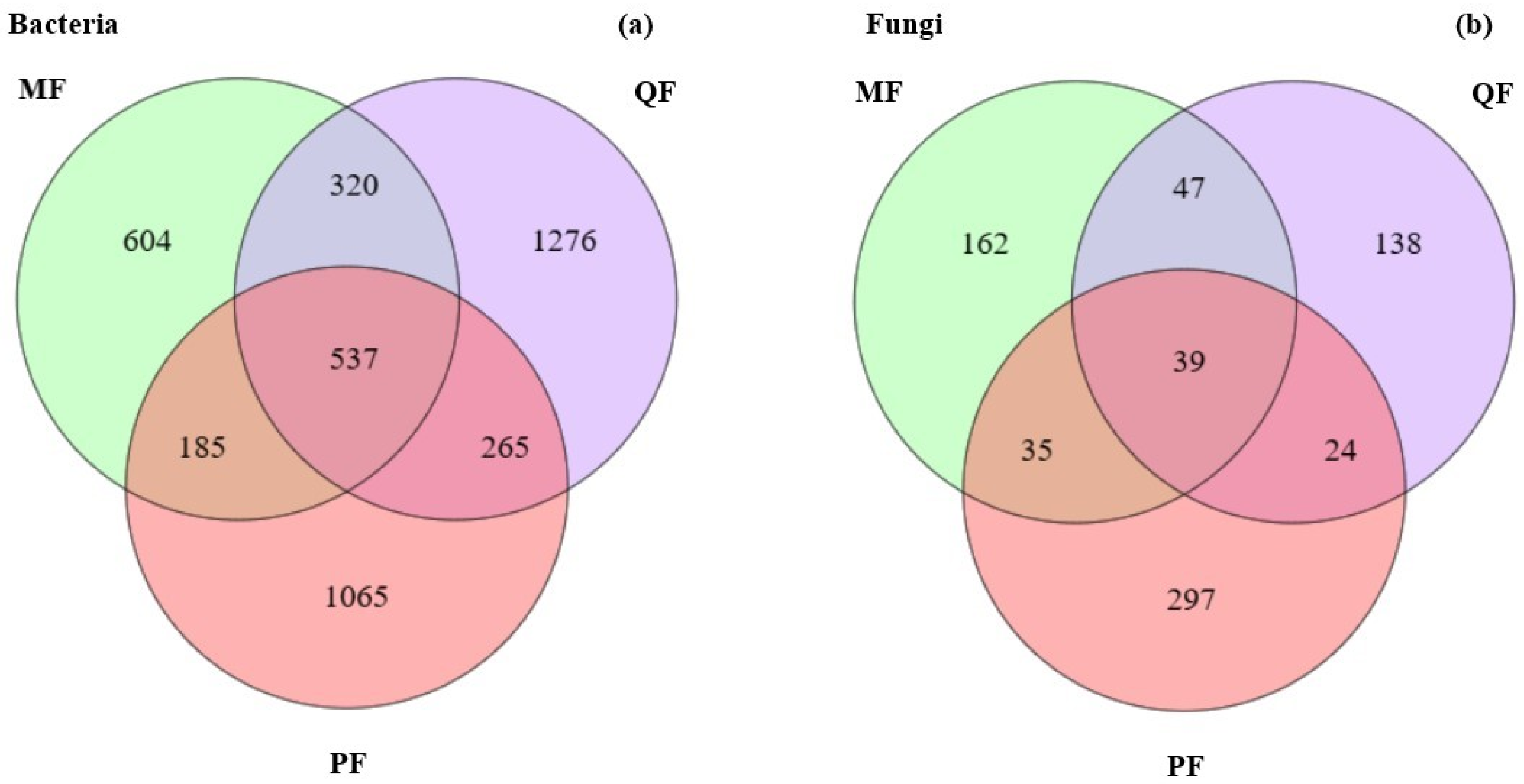
Microbial OTU analysis of sampled litter revealed distinct patterns. The numbers of unique bacterial OTUs were 1065, 1276, and 604 in PF, QF, and MF, respectively (Figure 1a). The three forest stands shared 537 bacterial OTUs, accounting for 12.62% of the total. For fungi, the numbers of unique OTUs were 297 in PF, 138 in QF, and 162 in MF (Figure 1b), with only 39 fungal OTUs shared across all three stands (5.25% of the total).
One-way ANOVA showed no significant differences in bacterial or fungal diversity indices among the three forest stand types (Table S1). Bacterial diversity metrics included the Chao1 index, which ranged from 1310.63 (PF) to 1832.59 (QF); the PD whole tree index, varying between 134.75 (MF) and 146.15; the Shannon index, ranging from 10.23 (MF) to 10.34 (QF); and the Simpson index, spanning 0.97 (MF) to 0.98 (QF). Fungal diversity metrics showed a Chao1 index from 933.50 (QF) to 988.00 (MF), a PD whole tree index from 228.84 (MF) to 238.96 (PF), a Shannon index between 4.92 (PF) and 5.57 (QF), and a Simpson index from 0.85 (PF) to 0.94 (QF). Across all forest types, mean fungal Chao 1, Shannon and Simpson indices were significantly lower than those of bacteria, whereas the mean fungal PD whole tree index was notably higher.

3.2. Litter Microbial Community Composition

Across all three forest stands, we identified 42 bacterial phyla, 51 classes, 118 orders, 209 families, and 462 genera, along with 9 fungal phyla, 36 classes, 65 orders, 137 families, and 178 genera (Table 2). Although microbial composition varied slightly among forest stands, bacterial taxa were consistently more abundant than fungal taxa at all taxonomic levels. Both bacterial and fungal communities exhibited the highest diversity in QF, followed by PF and then MF.
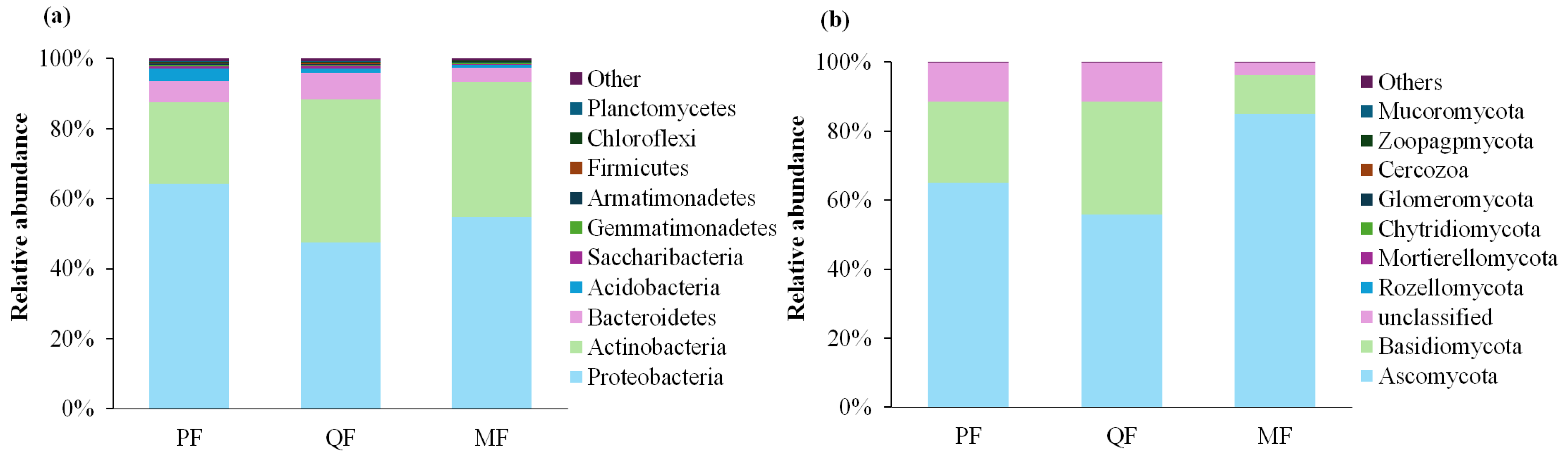
The top 10 dominant bacterial phyla differed across forest stands (Figure 2a). Overall, Proteobacteria, Actinobacteria, and Bacteroidetes were the most prevalent, with combined relative abundances of 93.57%, 95.89%, and 97.32% in PF, QF, and MF, respectively. Among the three forest stands, Proteobacteria was most abundant in PF litter (64.24%), while Actinobacteria reached its highest proportion in QF litter (40.9%).
Fewer fungal phyla were detected (Figure 2b). The dominant phyla across all stands were Ascomycota, Basidiomycota, and Unclassified, with the latter being markedly less abundant than the classified groups. Their combined relative abundances reached 98.88%, 98.95%, and 99.83% in PF, QF, and MF, respectively. Basidiomycota abundance peaked in QF litter (32.73%), whereas Ascomycota was most abundant in MF litter (84.88%). Chytridiomycota was uniquely detected in PF litter.
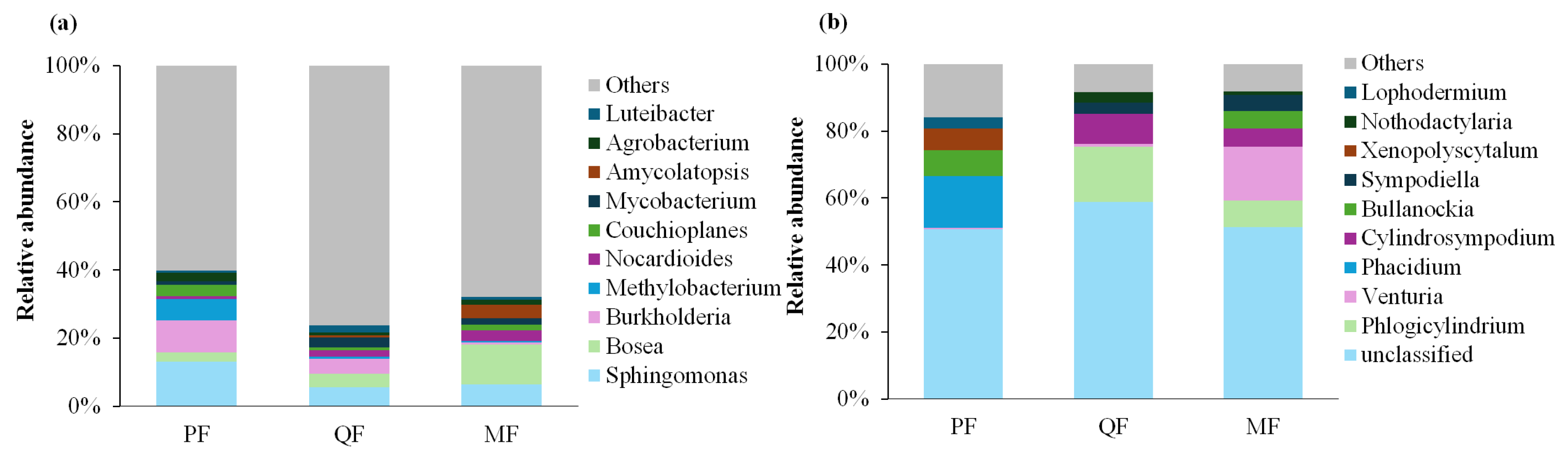
Analysis of dominant bacterial genera (Figure 3a) identified the top 10 as Sphingomonas, Bosea, Burkholderia, Methylobacterium, Nocardioides, Couchioplanes, Mycobacterium, Amycolatopsis, Agrobacterium, and Luteibacter. Among these, Sphingomonas, Bosea, and Burkholderia were the most dominant. Sphingomonas reached its highest abundance in PF litter (13.09%), Bosea in MF litter (11.52%), and Burkholderia in PF litter (9.35%), while showing the lowest abundance (0.60%) in MF litter.
The top 10 fungal genera varied considerably among forest types (Figure 3b). In PF litter, Phacidium, Bullanockia, and Xenopolyscytalum had relative abundances of 15.41%, 7.66%, and 6.56%, respectively, classifying them as subdominant genera. In QF litter, Phlogicylindrium and Cylindrosympodium were subdominant, with relative abundances of 16.47% and 8.89%, respectively. In MF litter, Phlogicylindrium and Venturia were subdominant, with abundances of 7.89% and 16.09%, respectively.

3.3. Chemical Characteristics of Forest Litter and Soil

Forest litter chemistry differed significantly among the three forest stands (Table 3). QF exhibited the highest LOC content, significantly greater than that in MF but not differing significantly from PF. LTN content was also highest in QF, significantly exceeding values in both PF and MF. LTP content was significantly lower in PF litter compared to both QF and MF, which did not differ significantly from each other. The C/N and C/P ratios were significantly higher in PF litter than in either QF or MF. Conversely, the N/P ratio was significantly lower in PF litter than in the other two forest stands.
We observed no significant differences in SOC, STP, or NO3-N content across the three forest stands (Figure S1). However, NH4+-N content was significantly higher in QF than in PF or MF, with no significant difference between the latter two.

3.4. Correlation Between Litter Microbial Community Composition and Chemical Properties of Litter and Soil

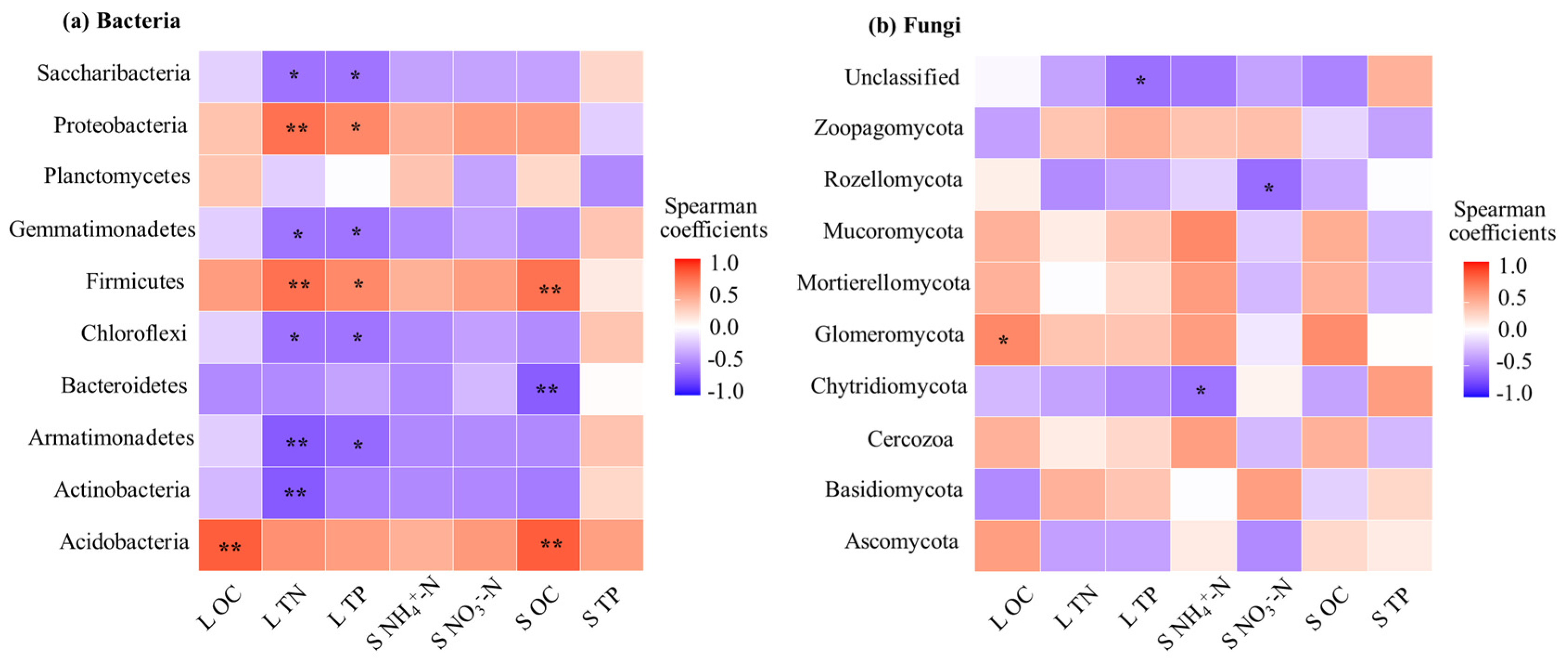
Spearman correlation analysis of the top 10 most abundant bacterial phyla in PF litter with litter and soil chemical properties revealed that LTN was positively correlated with Proteobacteria but negatively correlated with Actinobacteria, Armatimonadetes, Chloroflexi, Gemmatimonadetes, and Saccharibacteria (Figure 4a). LTP showed a positive correlation with Proteobacteria and negative correlations with Armatimonadetes, Chloroflexi, Gemmatimonadetes, and Saccharibacteria. SOC was negatively correlated with Bacteroidetes. For fungal phyla in PF litter, LTP was negatively correlated with unclassified fungi, NH4+-N was negatively correlated with Chytridiomycota, and NO3-N was negatively correlated with Rozellomycota (Figure 4b).
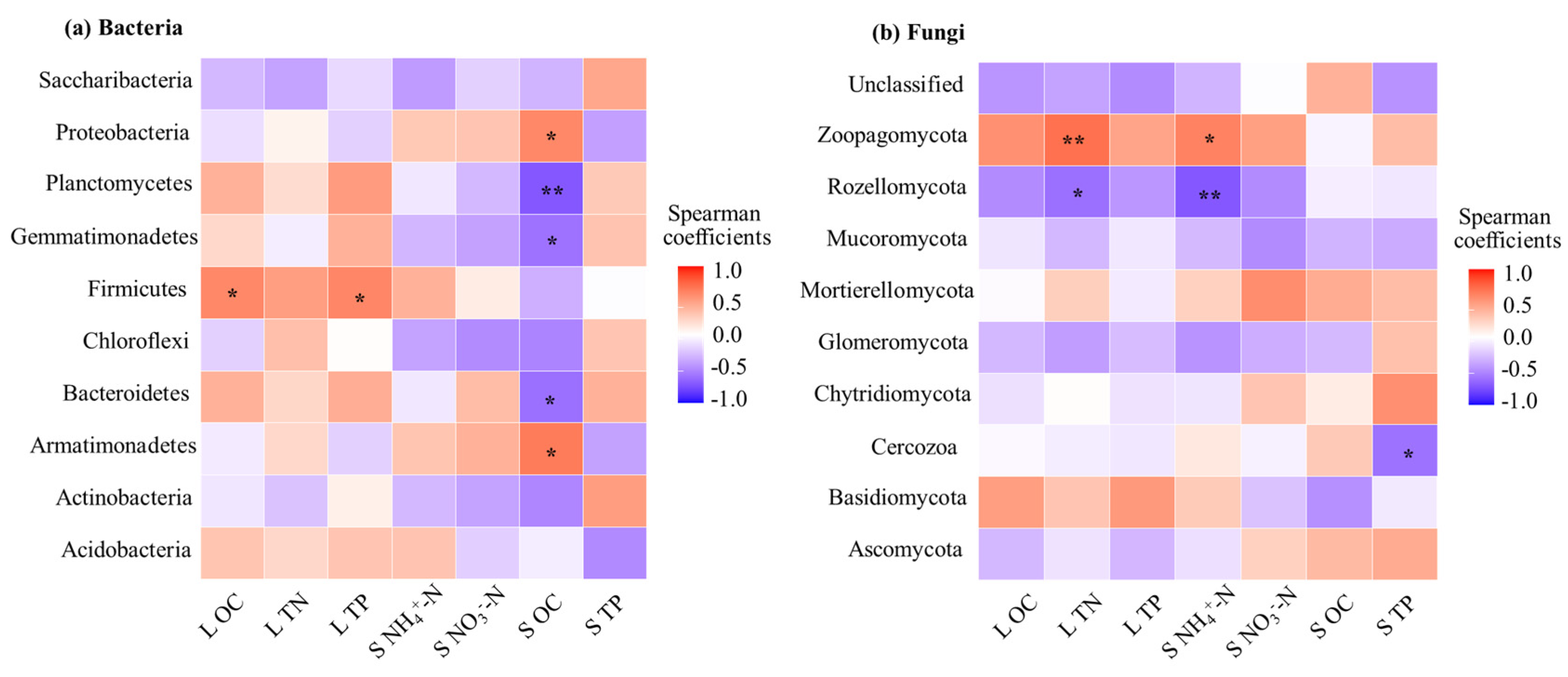
In QF litter, Spearman coefficients for the top 10 most abundant bacterial phyla indicated that SOC was negatively correlated with Bacteroidetes, Gemmatimonadetes, and Planctomycetes (Figure 5a). Among fungal phyla, both LTN and NH4+-N were positively correlated with Zoopagomycota but negatively correlated with Rozellomycota. Additionally, STP was negatively correlated with Cercozoan abundance (Figure 5b).
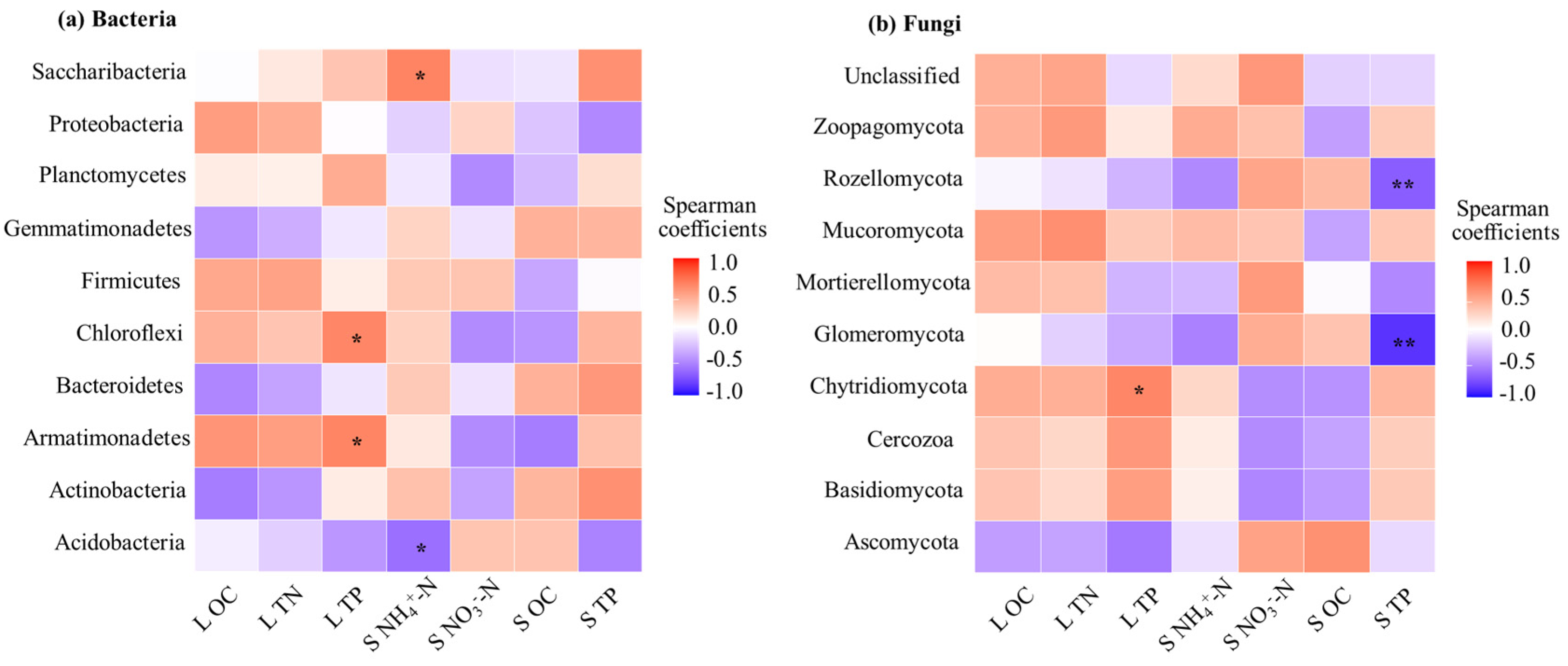
For MF litter, the top 10 most abundant bacterial phyla showed that LTP was positively correlated with Armatimonadetes and Chloroflexi, while NH4+-N was positively correlated with Saccharibacteria and negatively correlated with Acidobacteria (Figure 6a). In the fungal community, LTP was significantly positively correlated with Chytridiomycota, whereas STP was negatively correlated with Glomeromycota and Rozellomycota (Figure 6b).

3.5. Redundancy Analysis of Litter Microbial Diversity Indices and Chemical Properties of Litter and Soil

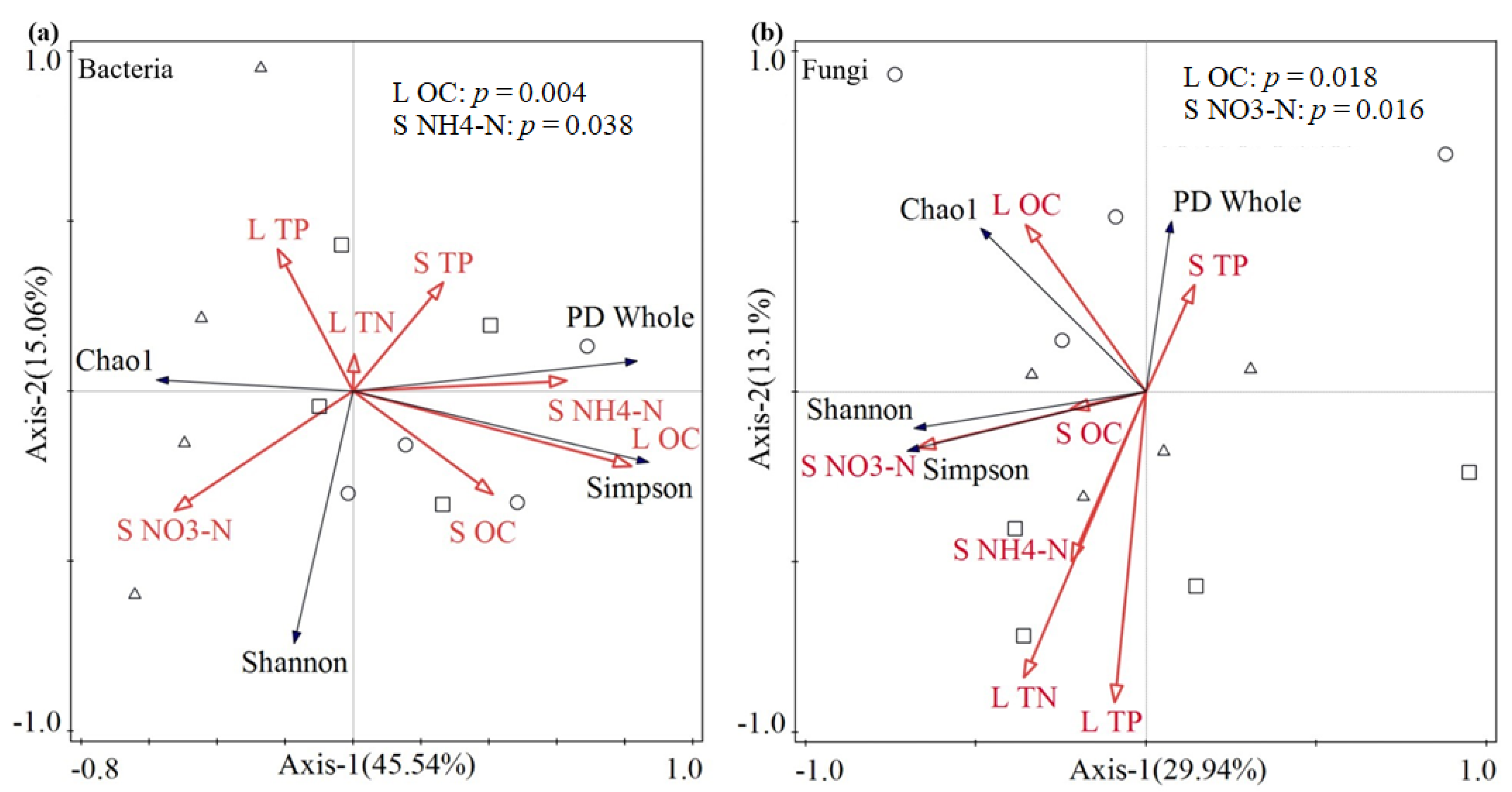
RDA results showed that the first and second axes explained 45.54% and 15.06% of the variance in bacterial communities, respectively (Figure 7a). For fungal communities, these values were 29.94% and 23.1% (Figure 7b). The primary environmental factors shaping bacterial community structure were LOC (p = 0.004) and NH4+-N (p = 0.038), while for fungal communities, the key drivers were LOC (p = 0.018) and NO3-N (p = 0.016).

4. Discussion

4.1. Litter Microbial Communities Across Three Forest Stands

Mixed-species litter significantly reshapes microbial community structure compared to single-species litter. While numerous studies have reported that microbial abundance generally increases with litter diversity—attributed to enhanced resource heterogeneity, niche complementarity, and broader nutritional spectra [10,12,13]. Our results revealed a contrasting pattern: mixed litter was associated with reduced microbial abundance. This deviation may stem from intensified inter-microbial competition or antagonistic interactions in chemically heterogeneous litter environments [40]. For instance, allelopathic compounds released by certain species in mixed litter could suppress specific microbial taxa, thereby offsetting the expected benefits of resource diversity. Alternatively, slower decomposition dynamics in mixed litter—due to chemical incompatibilities among component species—might limit substrate availability during early decay stages, constraining microbial proliferation. Future studies should explicitly link observed shifts in microbial abundance to litter chemistry and temporal decomposition trajectories.
Forest litter decomposition results from the synergistic activity of bacteria and fungi, whose relative abundance and community structure fluctuate in response to litter type. A study involving seven tree species found that bacterial communities were more diverse than fungal communities, particularly in litter, and exhibited higher evenness [10,11]. Consistent with those and other previous findings [11,41], we also observed a significantly greater number of bacterial taxa compared to fungal taxa. This pattern likely reflects the faster growth rates and broader metabolic versatility of bacteria in utilizing labile carbon compounds during early-stage decomposition. However, no significant variation in microbial diversity was detected across the three forest stands. We hypothesize that this convergence arises from functional redundancy and environmental plasticity among core decomposer taxa, enabling them to maintain similar diversity metrics under varying stand conditions [42]. Therefore, future research should investigate the complex relationships between microbial community diversity and forest stand characteristics, particularly across different ecological contexts.

4.2. Dynamics of Litter and Soil Nutrients Across Three Forest Stands

Our study revealed consistent changes in LOC and SOC content across the three forest stands. This pattern is primarily attributed to the direct influence of litter decomposition on essential soil nutrients required for plant growth [1,43]. Notably, however, variations in other soil chemical properties did not align consistently with changes in litter composition across the three forest stands. This inconsistency may result from a combination of factors, including differences in litter decomposition dynamics, soil microbial activity, and nutrient demands across the three forest stands. An additional factor contributing to the mismatch between litter and soil chemical characteristics is the leaching loss of available nutrients from the soil profile. Similarly, prior research has shown that SOC dynamics are closely coupled with LOC dynamics, whereas fluctuations in other nutrients are less synchronized, as they are more sensitive to complex interactions between litter and soil processes [44]. Furthermore, forest stands and understory vegetation exhibit differing competitive abilities for limited resources, which may further amplify the divergence between soil and litter chemical properties [45]. More competitive plant species may utilize nutrients more efficiently, altering their distribution within the soil matrix. To elucidate the underlying ecological mechanisms, future studies should examine how these factors collectively regulate nutrient cycling in both litter and soil compartments.

4.3. Main Variables Affecting Litter Microbial Community Characteristics

Litter pH and total carbon concentration are major determinants of bacterial and fungal community structure, as well as the abundance of functional genes [46]. In this study, we confirmed that litter carbon content is a key driver of microbial community composition. Additionally, in soil ecosystems, nitrogen and its transformations profoundly influence microbial community composition and diversity. Specifically, soil ammonium nitrogen serves as a critical nitrogen source for bacteria, directly promoting their growth and diversification [47]. In our study, both soil ammonium and nitrate nitrogen significantly influenced the composition and diversity of bacterial and fungal communities in forest litter. These findings align with previous reports demonstrating that elevated ammonium nitrogen levels increase the relative abundance of certain bacteria groups while inhibiting others [48]. Likewise, soil nitrate-nitrogen, produce through microbial nitrification, represents an important nitrogen source for fungi [47,49,50]. These findings underscore the central role of the soil nitrogen cycle in regulating litter microbiomes. Importantly, the effects of nitrogen are not uniform; they depend on its chemical form, concentration, and interaction with carbon availability. For instance, high NH4+ levels under low C:N ratios may accelerate bacterial turnover while suppressing fungal activity, thereby altering the balance between decomposition pathways [51,52]. Overall, our data corroborate previous studies and provide further evidence for the complex interplay between the soil nitrogen cycle and microbial community dynamics.
In summary, this study enhances understanding of how litter diversity, chemistry, and soil nutrient dynamics interact to shape microbial decomposer communities. However, the relatively small sample size and the reliance on a single sampling time point may constrain the generalizability of our findings and limit our ability to capture seasonal variability or longer-term successional dynamics in microbial communities and nutrient cycling. Future work with expanded spatial replication and repeated temporal sampling would help address these constraints and provide a more robust understanding of litter–microbe–soil interactions in restoration ecosystems.

5. Conclusions

This study revealed significant differences in litter microbial communities across the three forest stands, with bacterial taxa consistently outnumbering fungal taxa in all samples. The relative abundances of dominant microbial genera varied according to stand type, and both bacterial and fungal diversity followed a consistent pattern: mixed forest (MF) < pine forest (PF) < Quercus forest (QF). Notably, mixed-species litter was associated with lower microbial diversity and abundance compared to single-species litter—a pattern likely driven by intensified interspecific competition or chemical incompatibilities among litter types. Labile organic carbon (LOC) strongly influenced overall microbial community structure, while soil ammonium nitrogen (NH4+-N) has a stronger effect on bacterial communities, and nitrate nitrogen (NO3-N) showed as closer association with fungal community composition. These results advance our understanding of how tree species composition shapes litter microbiomes through chemical and nutrient-mediated mechanisms.

Supplementary Materials

The following supporting information can be downloaded at: https://www.mdpi.com/article/10.3390/f17010067/s1. Figure S1. Soil chemical properties in the three forest stands. Different lowercase letters indicate significant differences between forest types (LSD test, p < 0.05). PF: Pinus tabulaeformis, QF: Quercus acutissima, MF: Mixed of P. tabulaeformis and Q. acutissima. Table S1. Diversity indices of litter microbial communities across three forest stands.

Author Contributions

Conceptualization, L.X. and X.M.; methodology, L.X., X.M. and S.Y.; software, X.M. and P.Y.; validation, S.Y., P.L., Z.W. and P.Y.; investigation, L.X. and P.L.; resources, P.L. and Z.W.; data curation, L.X. and X.M.; writing—original draft preparation, L.X. and X.M.; writing—review and editing, S.Y., P.L., Z.W. and P.Y.; visualization, L.X. and X.M.; supervision, S.Y., P.L., Z.W. and P.Y.; project administration, L.X.; funding acquisition, L.X. All authors have read and agreed to the published version of the manuscript.

Funding

This study was financially supported by the National Natural Science Foundation of China (42330719, 42377350), and National Key Research and Development Program of China (2022YFF1300405).

Data Availability Statement

Data will be made available on request.

Acknowledgments

We thank all those who have contributed to this research.

Conflicts of Interest

The authors declare no conflicts of interest.

References

  1. Krishna, M.P.; Mohan, M. Litter decomposition in forest ecosystems: A review. Ecol. Environ. 2017, 2, 236–249. [Google Scholar] [CrossRef]
  2. Liu, Q.; Li, J.; Ye, S.; Guo, Y.; Wang, S. Characteristics and hotspots of forest litter decomposition research: A bibliometric analysis. Land Degrad. Dev. 2024, 35, 2684–2699. [Google Scholar] [CrossRef]
  3. Kubartová, A.; Ranger, J.; Berthelin, J.; Beguiristain, T. Diversity and decomposing ability of saprophytic fungi from temperate forest litter. Microb. Ecol. 2009, 58, 98–107. [Google Scholar] [CrossRef]
  4. Chang, L.; Li, B.; Liu, K.; Meng, W.J.; Zhang, Y.M.; Sun, H.; Huang, L. Forest composition and litter quality shape bacterial community dynamics and functional genes during litter decomposition. Appl. Soil Ecol. 2025, 215, 106465. [Google Scholar] [CrossRef]
  5. Kara, O.; Bolat, I.; Cakiroglu, K.; Senturk, M. Litter Decomposition and Microbial Biomass in Temperate Forests in Northwestern Turkey. J. Soil Sci. Plant Nutr. 2014, 14, 31–41. [Google Scholar]
  6. Bani, A.; Pioli, S.; Ventura, M.; Panzacchi, P.; Borruso, L.; Tognetti, R.; Tonon, G.; Brusetti, L. The role of microbial community in the decomposition of leaf litter and deadwood. Appl. Soil Ecol. 2018, 126, 75–84. [Google Scholar] [CrossRef]
  7. Zhang, P.; Tian, X.J.; He, X.B.; Song, F.Q.; Ren, L.L.; Jiang, P. Effect of litter quality on its decomposition in broadleaf and coniferous forest. Eur. J. Soil Biol. 2008, 44, 392–399. [Google Scholar] [CrossRef]
  8. Baldrian, P. Forest microbiome: Diversity, complexity and dynamics. FEMS Microbiol. Rev. 2017, 41, 109–130. [Google Scholar] [CrossRef]
  9. Stursová, M.; Zifcáková, L.; Leigh, M.B.; Burgess, R.; Baldrian, P. Cellulose utilization in forest litter and soil: Identification of bacterial and fungal decomposers. FEMS Microbiol. Ecol. 2012, 80, 735–746. [Google Scholar] [CrossRef]
  10. Bao, Y.Y.; Dolfing, J.; Guo, Z.Y.; Chen, R.R.; Wu, M.; Li, Z.P.; Lin, X.G.; Feng, Y.Z. Important ecophysiological roles of non-dominant Actinobacteria in plant residue decomposition, especially in less fertile soils. Microbiome 2021, 9, 84. [Google Scholar] [CrossRef]
  11. Urbanová, M.; Snajdr, J.; Baldrian, P. Composition of fungal and bacterial communities in forest litter and soil is largely determined by dominant trees. Soil Biol. Biochem. 2015, 84, 53–64. [Google Scholar] [CrossRef]
  12. Santonja, M.; Rancon, A.; Fromin, N.; Baldy, V.; Hättenschwiler, S.; Fernandez, C.; Montes, N.; Mirleau, P. Plant litter diversity increases microbial abundance, fungal diversity, and carbon and nitrogen cycling in a Mediterranean shrubland. Soil Biol. Biochem. 2017, 111, 124–134. [Google Scholar] [CrossRef]
  13. Chapman, S.K.; Newman, G.S. Biodiversity at the plant-soil interface: Microbial abundance and community structure respond to litter mixing. Oecologia 2010, 162, 763–769. [Google Scholar] [CrossRef] [PubMed]
  14. Tian, X.K.; Wang, M.Y.; Meng, P.; Zhang, J.S.; Zhou, B.Z.; Ge, X.G.; Yu, F.H.; Li, M.H. Native bamboo invasions into subtropical forests alter microbial communities in litter and soil. Forests 2020, 11, 314. [Google Scholar] [CrossRef]
  15. Pioli, S.; Sarneel, J.; Thomas, H.J.D.; Domene, X.; Andrés, P.; Hefting, M.; Reitz, T.; Laudon, H.; Sandén, T.; Piscová, V.; et al. Linking plant litter microbial diversity to microhabitat conditions, environmental gradients and litter mass loss: Insights from a European study using standard litter bags. Soil Biol. Biochem. 2020, 144, 107778. [Google Scholar] [CrossRef]
  16. Bray, S.R.; Kitajima, K.; Mack, M.C. Temporal dynamics of microbial communities on decomposing leaf litter of 10 plant species in relation to decomposition rate. Soil Biol. Biochem. 2012, 49, 30–37. [Google Scholar] [CrossRef]
  17. Prescott, C.E.; Grayston, S.J. Tree species influence on microbial communities in litter and soil: Current knowledge and research needs. For. Ecol. Manag. 2013, 309, 19–27. [Google Scholar] [CrossRef]
  18. Xu, S.; Liu, L.L.; Sayer, E.J. Variability of above-ground litter inputs alters soil physicochemical and biological processes: A meta-analysis of litterfall-manipulation experiments. Biogeosciences 2013, 10, 7423–7433. [Google Scholar] [CrossRef]
  19. Wu, X.; Ouyang, S.N.; Tan, X.P.; Bose, A.K.; Cheng, W.; Tie, L.H. Effects of understory vegetation and climate change on forest litter decomposition: Implications for plant and soil management. Plant Soil 2025, 515, 51–75. [Google Scholar] [CrossRef]
  20. Tripathi, B.M.; Stegen, J.C.; Kim, M.; Dong, K.; Adams, J.M.; Lee, Y.K. Soil pH mediates the balance between stochastic and deterministic assembly of bacteria. ISME J. 2018, 12, 1072–1083. [Google Scholar] [CrossRef]
  21. Ochoa-Hueso, R.; Delgado-Baquerizo, M.; King, P.T.A.; Benham, M.; Arca, V.; Power, S.A. Ecosystem type and resource quality are more important than global change drivers in regulating early stages of litter decomposition. Soil Biol. Biochem. 2019, 129, 144–152. [Google Scholar] [CrossRef]
  22. Yan, Y.; Wang, J.; Ding, J.Y.; Zhang, S.R.; Zhao, W.W. Afforestation promotes ecosystem multifunctionality in a hilly area of the Loess Plateau. Catena 2023, 223, 106905. [Google Scholar] [CrossRef]
  23. Zhang, Q.; Wang, Y.; Tao, S.Q.; Bilsborrow, R.E.; Qiu, T.; Liu, C.; Sannigrahi, S.; Li, Q.R.; Song, C.H. Divergent socioeconomic-ecological outcomes of China’s conversion of cropland to forest program in the subtropical mountainous area and the semi-arid Loess Plateau. Ecosyst. Serv. 2020, 45, 101167. [Google Scholar] [CrossRef]
  24. Dou, Y.H.; Zhen, L.; Yu, X.B.; Bakker, M.; Carsjens, G.J.; Xue, Z.J. Assessing the influences of ecological restoration on perceptions of cultural ecosystem services by residents of agricultural landscapes of western China. Sci. Total Environ. 2019, 646, 685–695. [Google Scholar] [CrossRef]
  25. Zhang, W.; Gao, D.X.; Chen, Z.X.; Li, H.; Deng, J.; Qiao, W.J.; Han, X.H.; Yang, G.H.; Feng, Y.Z.; Huang, J.Y. Substrate quality and soil environmental conditions predict litter decomposition and drive soil nutrient dynamics following afforestation on the Loess Plateau of China. Geoderma 2018, 325, 152–161. [Google Scholar] [CrossRef]
  26. Zhang, J.; Zhao, X.Z.; Zhou, R.; Tian, T.; Cui, J.Y.; Zhao, L.; Wang, G.R.; Xiong, Y.C. Labor force transfer, vegetation restoration and ecosystem service in the Qilian Mountains. J. Environ. Manag. 2021, 288, 112387. [Google Scholar] [CrossRef]
  27. Shi, Q.Q.; Chen, H.; Liu, D.; Zhang, H.; Geng, T.W.; Zhang, H.J. Exploring the linkage between the supply and demand of cultural ecosystem services in Loess Plateau, China: A case study from Shigou Township. Environ. Sci. Pollut. Res. 2020, 27, 12514–12526. [Google Scholar] [CrossRef]
  28. Tan, Q.Y.; Gong, C.; Li, S.J.; Ma, N.; Ge, F.C.; Xu, M.X. Impacts of ecological restoration on public perceptions of cultural ecosystem services. Environ. Sci. Pollut. Res. 2021, 28, 60182–60194. [Google Scholar] [CrossRef]
  29. Gao, T.; Song, X.Y.; Ren, Y.Z.; Liu, H.; Qu, H.F.; Dong, X.B. Thinning intensity affects carbon sequestration and release in seasonal freeze-thaw areas. J. For. Res. 2023, 34, 993–1006. [Google Scholar] [CrossRef]
  30. Bao, S.D. Soil and Agriculture Chemistry Analysis; China Agriculture Press: Beijing, China, 2010. [Google Scholar]
  31. Bremner, J.M.; Mulvaney, C.S. Nitrogen-total. In Methods of Soil Analysis, Part 2: Chemical and Microbial Properties; Page, A.L., Miller, R.H., Keeney, D.R., Eds.; Agronomy Monograph; Agronomy Society of America: Madison, WI, USA, 1982; Volume 9, pp. 595–624. [Google Scholar]
  32. Olsen, S.R.; Sommers, L.E. Phosphorous. In Methods of Soil Analysis, Part 2: Chemical and Microbial Properties; Page, A.L., Miller, R.H., Keeney, D.R., Eds.; Agronomy Monograph; Agronomy Society of America: Madison, WI, USA, 1982; Volume 9, pp. 403–430. [Google Scholar]
  33. Xiao, L.; Liu, G.B.; Li, P.; Xue, S. Ecological stoichiometry of plant-soil-enzyme interactions drives secondary plant succession in the abandoned grasslands of Loess Plateau, China. Catena 2021, 202, 105302. [Google Scholar] [CrossRef]
  34. Caporaso, J.G.; Lauber, C.L.; Walters, W.A.; Berg-Lyons, D.; Lozupone, C.A.; Turnbaugh, P.J.; Fierer, N.; Knight, R. Global patterns of 16S rRNA diversity at a depth of millions of sequences per sample. Proc. Natl. Acad. Sci. USA 2021, 108, 4516–4522. [Google Scholar] [CrossRef]
  35. Xu, D.L.; Yu, X.W.; Yang, J.B.; Zhao, X.P.; Bao, Y.Y. High-Throughput Sequencing Reveals the Diversity and Community Structure in Rhizosphere Soils of Three Endangered Plants in Western Ordos, China. Curr. Microbiol. 2020, 77, 2713–2723. [Google Scholar] [CrossRef]
  36. Bolyen, E.; Rideout, J.R.; Dillon, M.R.; Bokulich, N.A.; Abnet, C.C.; Al-Ghalith, G.A.; Alexander, H.; Alm, E.J.; Arumugam, M.; Asnicar, F.; et al. Reproducible, interactive, scalable and extensible microbiome data science using QIIME 2. Nat. Biotechnol. 2019, 37, 852–857. [Google Scholar] [CrossRef]
  37. Chong, J.; Liu, P.; Zhou, G. Using MicrobiomeAnalyst for comprehensive statistical, functional, and meta-analysis of microbiome data. Nat. Protocols 2020, 15, 799–821. [Google Scholar] [CrossRef]
  38. Kim, B.R.; Shin, J.; Guevarra, R.B.; Lee, J.H.; Kim, D.W.; Seol, K.H.; Lee, J.H.; Kim, H.B.; Isaacson, R.E. Deciphering Diversity Indices for a Better Understanding of Microbial Communities. J. Microbiol. Biotechnol. 2017, 27, 2089–2093. [Google Scholar] [CrossRef] [PubMed]
  39. Smith, K.S.; Morris, M.M.; Morrow, C.D.; Novak, J.R.; Roberts, M.D.; Frugé, A.D. Associations between changes in fat-free mass, fecal microbe diversity, and mood disturbance in young adults after 10-weeks of resistance training. Microorganisms 2022, 10, 2344. [Google Scholar] [CrossRef] [PubMed]
  40. Jousset, A.; Schmid, B.; Scheu, S.; Eisenhauer, N. Genotypic richness and dissimilarity opposingly affect ecosystem functioning. Ecol. Lett. 2011, 14, 537–545. [Google Scholar] [CrossRef]
  41. Ma, B.; Dai, Z.M.; Wang, H.Z.; Dsouza, M.; Liu, X.M.; He, Y.; Wu, J.J.; Rodrigues, J.L.M.; Gilbert, J.A.; Brookes, P.C.; et al. Distinct biogeographic patterns for archaea, bacteria, and fungi along the vegetation gradient at the continental scale in Eastern China. Msystems 2017, 2, e00174-16. [Google Scholar] [CrossRef]
  42. Tláskal, V.; Vorísková, J.; Baldrian, P. Bacterial succession on decomposing leaf litter exhibits a specific occurrence pattern of cellulolytic taxa and potential decomposers of fungal mycelia. FEMS Microbiol. Ecol. 2016, 92, fiw177. [Google Scholar] [CrossRef]
  43. Liu, S.Q.; Yang, R.; Peng, X.D.; Hou, C.L.; Ma, J.B.; Guo, J.R. Contributions of plant litter decomposition to soil nutrients in ecological tea gardens. Agriculture 2022, 12, 957. [Google Scholar] [CrossRef]
  44. Wang, M.; Tian, Q.X.; Liao, C.; Zhao, R.D.; Wang, D.Y.; Wu, Y.; Li, Q.X.; Wang, X.G.; Liu, F. The fate of litter-derived dissolved organic carbon in forest soils: Results from an incubation experiment. Biogeochemistry 2019, 144, 133–147. [Google Scholar] [CrossRef]
  45. D’Orazio, V.; Traversa, A.; Senesi, N. Forest soil organic carbon dynamics as affected by plant species and their corresponding litters: A fluorescence spectroscopy approach. Plant Soil 2014, 374, 473–484. [Google Scholar] [CrossRef]
  46. Wang, W.B.; Chen, D.S.; Sun, X.M.; Zhang, Q.; Koide, R.T.; Insam, H.; Zhang, S.G. Impacts of mixed litter on the structure and functional pathway of microbial community in litter decomposition. Appl. Soil Ecol. 2019, 144, 72–82. [Google Scholar] [CrossRef]
  47. Fierer, N.; Lauber, C.L.; Ramirez, K.S.; Zaneveld, J.; Bradford, M.A.; Knight, R. Comparative metagenomic, phylogenetic and physiological analyses of soil microbial communities across nitrogen gradients. ISME J. 2012, 6, 1007–1017. [Google Scholar] [CrossRef] [PubMed]
  48. Li, Y.B.; Bezemer, T.M.; Yang, J.J.; Lü, X.T.; Li, X.Y.; Liang, W.J.; Han, X.G.; Li, Q. Changes in litter quality induced by N deposition alter soil microbial communities. Soil Biol. Biochem. 2019, 130, 33–42. [Google Scholar] [CrossRef]
  49. Gao, W.L.; Fan, C.H.; Zhang, W.; Li, N.; Liu, H.R.; Chen, M. Heterotrophic nitrification of organic nitrogen in soils: Process, regulation, and ecological significance. Biol. Fertil. Soils 2023, 59, 261–274. [Google Scholar] [CrossRef]
  50. Gao, W.L.; Chen, M.; Xu, X.L. Tracing controls of autotrophic and heterotrophic nitrification in terrestrial soils. Eur. J. Soil Biol. 2022, 110, 103409. [Google Scholar] [CrossRef]
  51. Jiang, X.Y.; Cao, L.X.; Zhang, R.D.; Yan, L.J.; Mao, Y.; Yang, Y.W. Effects of nitrogen addition and litter properties on litter decomposition and enzyme activities of individual fungi. Appl. Soil Ecol. 2014, 80, 108–115. [Google Scholar] [CrossRef]
  52. Zhang, D.Q.; Hui, D.F.; Luo, Y.Q.; Zhou, G.Y. Rates of litter decomposition in terrestrial ecosystems: Global patterns and controlling factors. J. Plant Ecol. 2008, 1, 85–93. [Google Scholar] [CrossRef]
Figure 1. Venn diagrams of bacterial (a) and fungal (b) communities classified by OTUs in litter of three forest stands. PF: Pinus tabulaeformis, QF: Quercus acutissima, MF: P. tabulaeformis-Q. acutissima mixed.
Forests 17 00067 g001
Figure 2. Relative abundance of the top 10 most dominant bacterial (a) and fungal (b) phyla in litter across the three forest stands. PF: Pinus tabulaeformis forest, QF: Quercus acutissima forest, MF: Mixed of P. tabulaeformis and Q. acutissima forest.
Forests 17 00067 g002
Figure 3. Relative abundance of the top 10 most dominant bacterial (a) and fungal (b) genera in litter across the three forest stands. PF: Pinus tabulaeformis forest, QF: Quercus acutissima forest, MF: Mixed of P. tabulaeformis and Q. acutissima forest.
Forests 17 00067 g003
Figure 4. Correlation analysis between dominant microbial phyla and the chemical properties of litter and soil in the PF stand. Note: * indicates significant correlation at 0.01 ≤ p ≤ 0.05, ** indicate p ≤ 0.01. L indicates litter, and S indicates soil. OC, organic carbon; TN, total nitrogen; TP, total phosphorus.
Forests 17 00067 g004
Figure 5. Correlation analysis between dominant microbial phyla and the chemical properties of litter and soil in the QF stand. Note: * indicates significant correlation at 0.01 ≤ p ≤ 0.05, ** indicate p ≤ 0.01. L indicates litter, and S indicates soil. OC, organic carbon; TN, total nitrogen; TP, total phosphorus.
Forests 17 00067 g005
Figure 6. Correlation analysis between dominant microbial phyla and the chemical properties of litter and soil in the MF stand. Note: * indicates significant correlation at 0.01 ≤ p ≤ 0.05, ** indicate p ≤ 0.01. L indicates litter, and S indicates soil. OC, organic carbon; TN, total nitrogen; TP, total phosphorus.
Forests 17 00067 g006
Figure 7. Redundancy analysis of bacterial (a) and fungal (b) diversity indices in relation to the chemical properties of litter and soil across the three forest stands. L indicates litter, and S indicates soil.
Forests 17 00067 g007
Table 1. Basic habitat characteristics of different forest stands.
Forest TypeCanopy Density (%)Altitude (m)Slope (º)Main Understory Vegetation
PF61145024Glycyrrhiza uralensis Fisch
66148923Stipa bungeana Trin
67152025Glycyrrhiza uralensis Fisch
QF78141022Bothriochloa ischcemum Linn
81142523Bothriochloa ischcemum Linn
87143126Glycyrrhiza uralensis Fisch
MF56153519Artemisia gmelinii Pamp
63146721Artemisia gmelinii Pamp
50152623Bothriochloa ischcemum Linn
PF: Pinus tabulaeformis forest, QF: Quercus acutissima forest, MF: P. tabulaeformis-Q. acutissima mixed forest.
Table 2. Litter microbial community structure across three forest stands.
ClassificationBacteriaFungi
PFQFMFPFQFMF
Phylum394134997
Class455145252720
Order10111899615249
Family187205186126128119
Genus375438374154165141
Table 3. Chemical composition of litter in different forest stands.
Chemical CompositionPFQFMF
LOC (g/kg)347.65 ± 3.58 b373.73 ± 5.90 a271.03 ± 3.27 c
LTN (g/kg)7.18 ± 1.14 b11.38 ± 1.71 a9.20 ± 0.85 b
LTP (g/kg)15.43 ± 0.58 b18.82 ± 0.67 a17.78 ± 0.76 a
C/N49.59 ± 9.56 a33.46 ± 5.37 b29.63 ± 2.53 b
C/P22.56 ± 1.07 a19.88 ± 0.90 b15.26 ± 0.48 c
N/P0.46 ± 0.06 b0.60 ± 0.07 a0.52 ± 0.04 a
Data represents mean ± standard error, n = 3 in all cases, and different lowercase letters indicate significant differences among the three forest types (LSD test, p < 0.05). LOC, litter organic carbon; LTN, litter total nitrogen; LTP, litter total phosphorus.
Disclaimer/Publisher’s Note: The statements, opinions and data contained in all publications are solely those of the individual author(s) and contributor(s) and not of MDPI and/or the editor(s). MDPI and/or the editor(s) disclaim responsibility for any injury to people or property resulting from any ideas, methods, instructions or products referred to in the content.