Stand Properties Relate to the Accuracy of Remote Sensing of Ips typographus L. Damage in Heterogeneous Managed Hemiboreal Forest Landscapes: A Case Study

 ,
,  ,
,
Abstract
1. Introduction
2. Materials and Methods
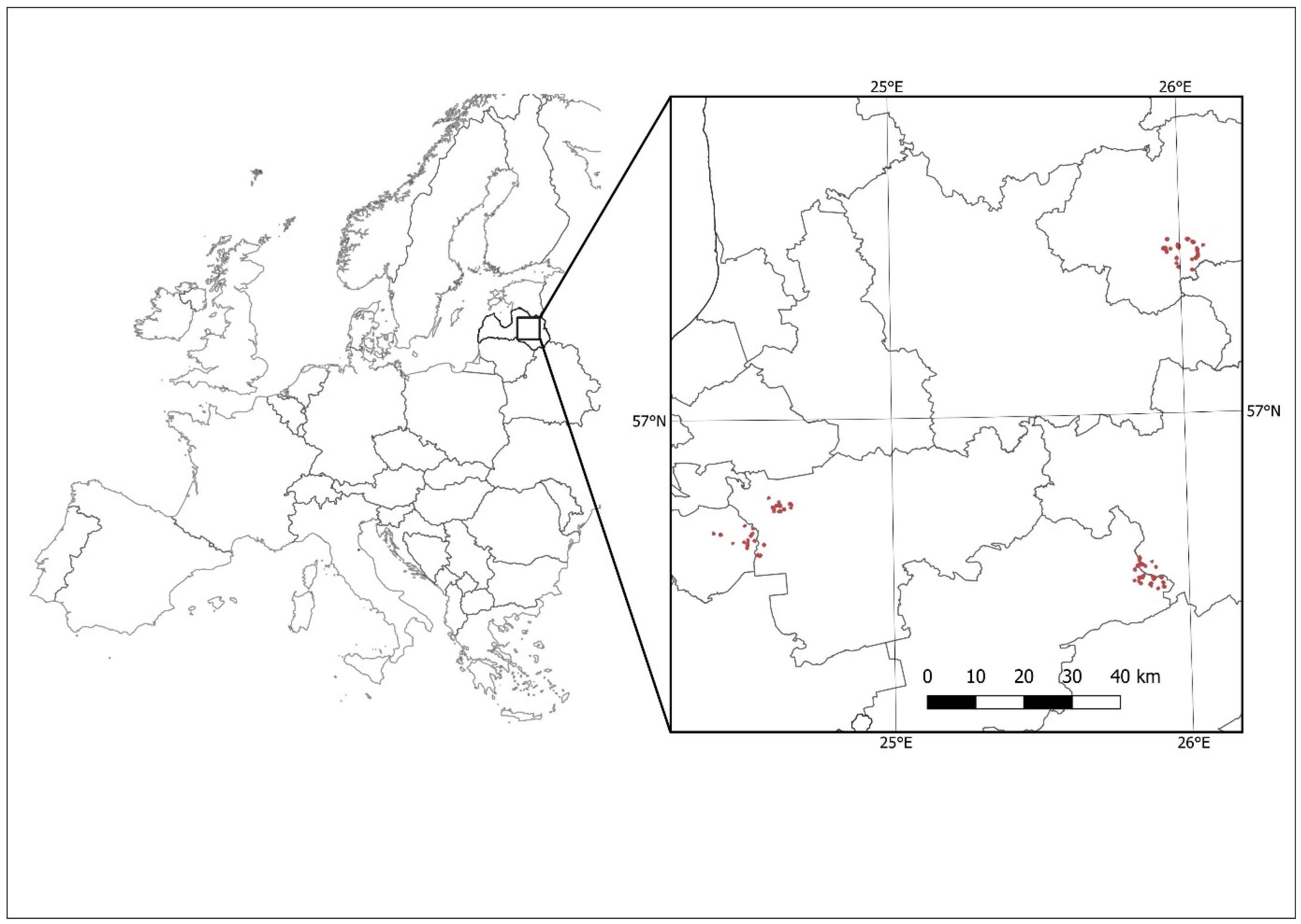
2.1. Dataset and Sampling
2.2. Tree Identification, Spectral Indices, and Accuracy Proxies
2.3. Data Analysis
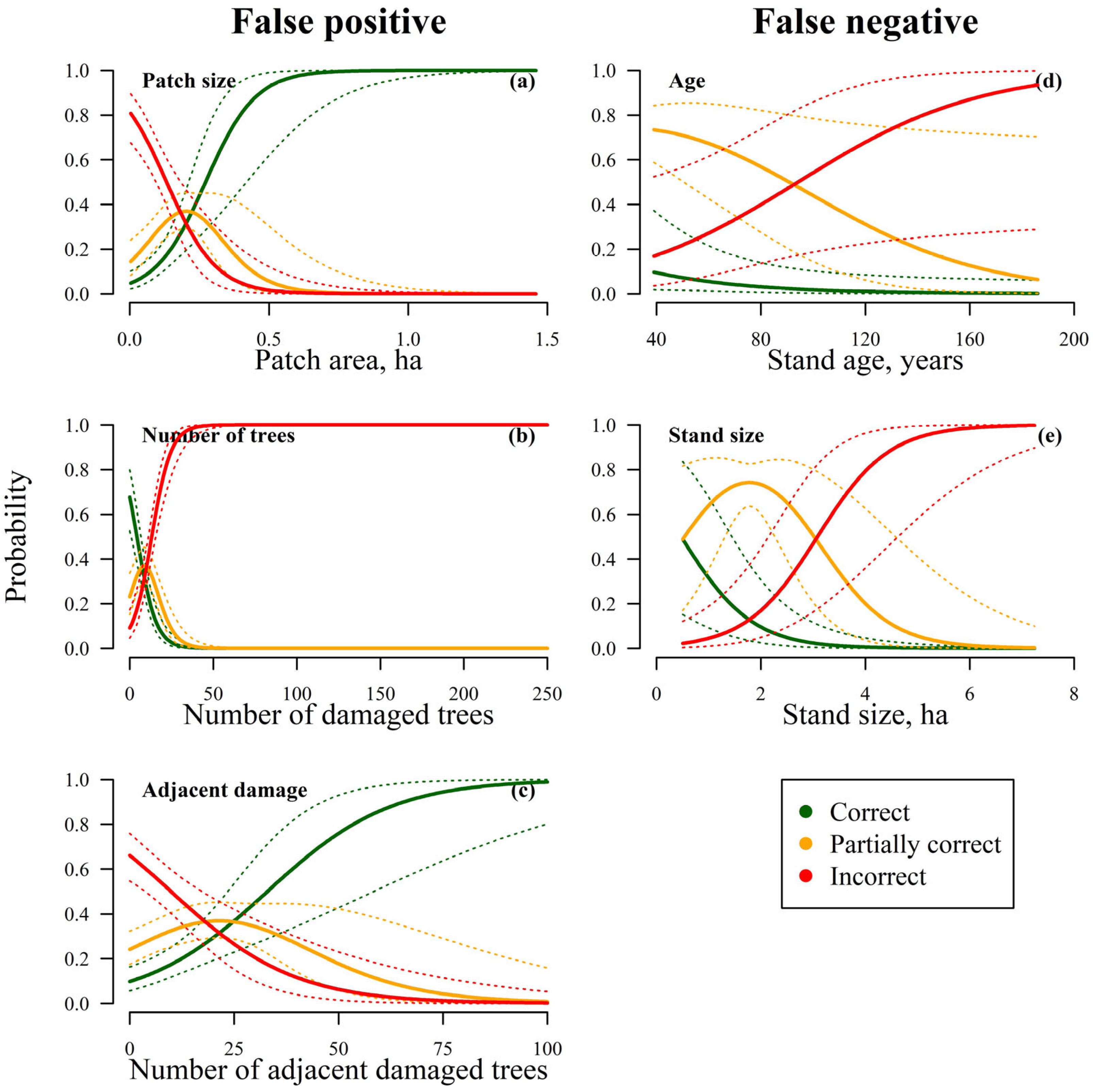
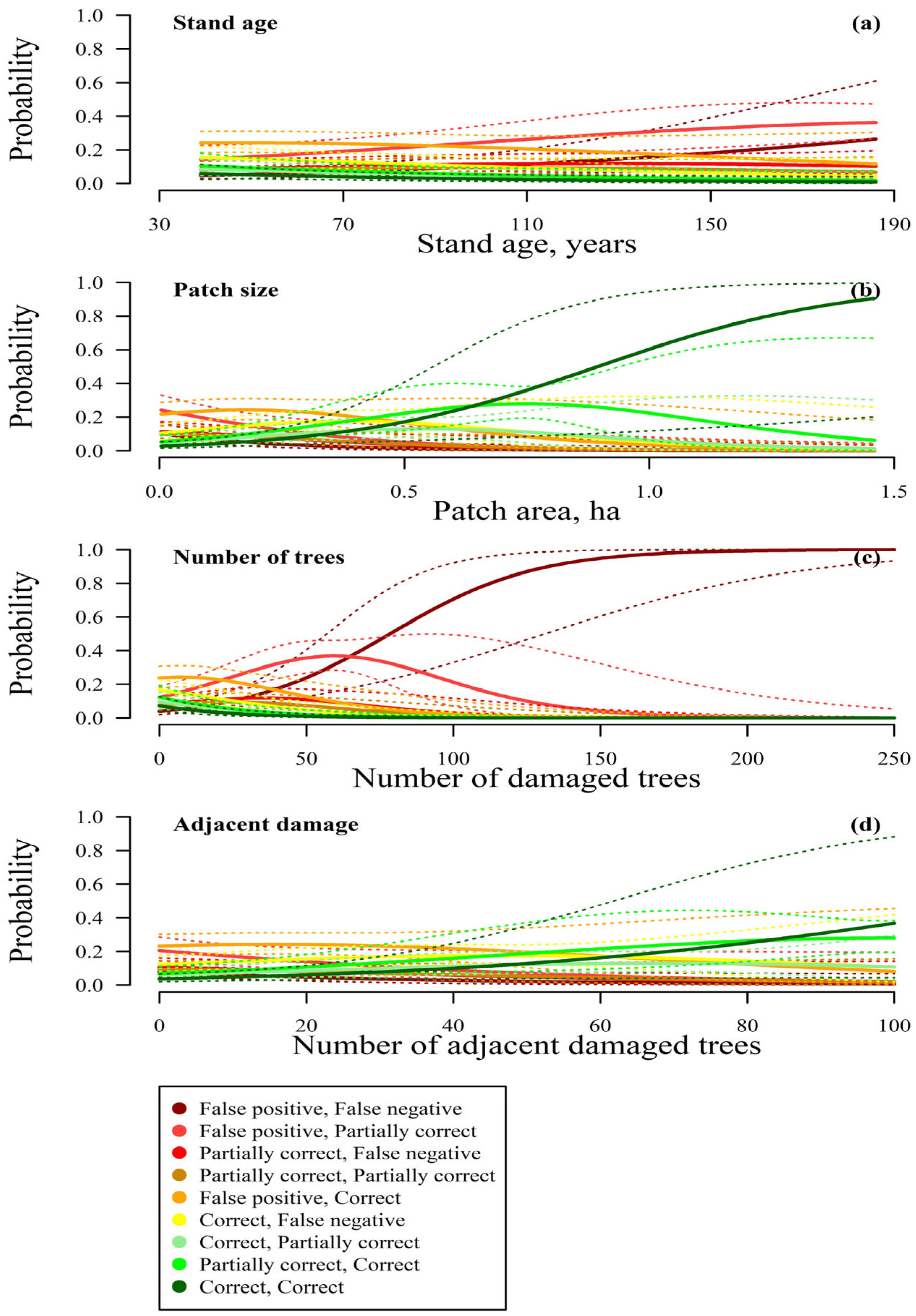
3. Results
4. Discussion
4.1. Overall Identification Accuracy
4.2. Stand- and Patch-Level Effects on Identification Accuracy
4.3. Limitations, Uncertainties, and Prospects
5. Conclusions
Author Contributions
Funding
Data Availability Statement
Conflicts of Interest
References
- Seidl, R.; Schelhaas, M.J.; Rammer, W.; Verkerk, P.J. Increasing forest disturbances in Europe and their impact on carbon storage. Nat. Clim. Change 2014, 4, 806–810. [Google Scholar] [CrossRef]
- Seidl, R.; Thom, D.; Kautz, M.; Martin-Benito, D.; Peltoniemi, M.; Vacchiano, G.; Wild, J.; Ascoli, D.; Petr, M.; Honkaniemi, J.; et al. Forest disturbances under climate change. Nat. Clim. Change 2017, 7, 395–402. [Google Scholar] [CrossRef]
- Hanewinkel, M.; Cullmann, D.A.; Schelhaas, M.J.; Nabuurs, G.J.; Zimmermann, N.E. Climate change may cause severe loss in the economic value of European forest land. Nat. Clim. Change 2013, 3, 203–207. [Google Scholar] [CrossRef]
- Arthur, G.; Jonathan, L.; Juliette, C.; Nicolas, L.; Christian, P.; Hugues, C. Spatial and remote sensing monitoring shows the end of the bark beetle outbreak on Belgian and north-eastern France Norway spruce (Picea abies) stands. Environ. Monit. Assess. 2024, 196, 226. [Google Scholar] [CrossRef]
- Dalponte, M.; Cetto, R.; Marinelli, D.; Andreatta, D.; Salvadori, C.; Pirotti, F.; Frizzera, L.; Gianelle, D. Spectral separability of bark beetle infestation stages: A single-tree time-series analysis using Planet imagery. Ecol. Indic. 2023, 153, 110349. [Google Scholar] [CrossRef]
- Marvasti-Zadeh, S.M.; Goodsman, D.; Ray, N.; Erbilgin, N. Early detection of bark beetle attack using remote sensing and machine learning: A review. ACM Comput. Surv. 2023, 56, 1–40. [Google Scholar] [CrossRef]
- Trubin, A.; Kozhoridze, G.; Zabihi, K.; Modlinger, R.; Singh, V.V.; Surový, P.; Jakuš, R. Detection of green attack and bark beetle susceptibility in Norway Spruce: Utilizing PlanetScope Multispectral Imagery for Tri-Stage spectral separability analysis. For. Ecol. Manag. 2024, 560, 121838. [Google Scholar] [CrossRef]
- Barta, V.; Lukeš, P.; Homolová, L. Early detection of bark beetle infestation in Norway spruce forests of Central Europe using Sentinel-2. Int. J. Appl. Earth Obs. Geoinf. 2021, 100, 102335. [Google Scholar] [CrossRef]
- Sun, H.; Xu, Z.; Liu, H. An evaluation of the response of vegetation greenness, moisture, fluorescence, and temperature-based remote sensing indicators to drought stress. J. Hydrol. 2023, 625, 130125. [Google Scholar] [CrossRef]
- Kovač, D.; Ač, A.; Šigut, L.; Peñuelas, J.; Grace, J.; Urban, O. Combining NDVI, PRI and the quantum yield of solar-induced fluorescence improves estimations of carbon fluxes in deciduous and evergreen forests. Sci. Total Environ. 2022, 829, 154681. [Google Scholar] [CrossRef]
- Rendenieks, Z.; Nita, M.D.; Nikodemus, O.; Radeloff, V.C. Half a century of forest cover change along the Latvian-Russian border captured by object-based image analysis of Corona and Landsat TM/OLI data. Remote Sens. Environ. 2020, 249, 112010. [Google Scholar] [CrossRef]
- Rendenieks, Z.; Tērauds, A.; Nikodemus, O.; Brūmelis, G. Comparison of input data with different spatial resolution in landscape pattern analysis—A case study from northern Latvia. Appl. Geogr. 2017, 83, 100–106. [Google Scholar] [CrossRef]
- Zhang, J.; Okin, G.S.; Zhou, B. Assimilating optical satellite remote sensing images and field data to predict surface indicators in the Western US: Assessing error in satellite predictions based on large geographical datasets with the use of machine learning. Remote Sens. Environ. 2019, 233, 111382. [Google Scholar] [CrossRef]
- Coops, N.C.; Tompalski, P.; Goodbody, T.R.; Achim, A.; Mulverhill, C. Framework for near real-time forest inventory using multi source remote sensing data. Forestry 2023, 96, 1–19. [Google Scholar] [CrossRef]
- Ecke, S.; Dempewolf, J.; Frey, J.; Schwaller, A.; Endres, E.; Klemmt, H.J.; Tiede, D.; Seifert, T. UAV-based forest health monitoring: A systematic review. Remote Sens. 2022, 14, 3205. [Google Scholar] [CrossRef]
- Fraser, B.T.; Congalton, R.G. Monitoring fine-scale forest health using unmanned aerial systems (UAS) multispectral models. Remote Sens. 2021, 13, 4873. [Google Scholar] [CrossRef]
- Alvarez-Vanhard, E.; Corpetti, T.; Houet, T. UAV and satellite synergies for optical remote sensing applications: A literature review. Sci. Remote Sens. 2021, 3, 100019. [Google Scholar] [CrossRef]
- Dash, J.P.; Pearse, G.D.; Watt, M.S. UAV multispectral imagery can complement satellite data for monitoring forest health. Remote Sens. 2018, 10, 1216. [Google Scholar] [CrossRef]
- Fassnacht, F.E.; White, J.C.; Wulder, M.A.; Næsset, E. Remote sensing in forestry: Current challenges, considerations and directions. For. Int. J. For. Res. 2024, 97, 11–37. [Google Scholar] [CrossRef]
- Gao, Y.; Skutsch, M.; Paneque-Gálvez, J.; Ghilardi, A. Remote sensing of forest degradation: A review. Environ. Res. Lett. 2020, 15, 103001. [Google Scholar] [CrossRef]
- Washaya, P.; Modlinger, R.; Tyšer, D.; Hlásny, T. Patterns and impacts of an unprecedented outbreak of bark beetles in Central Europe: A glimpse into the future? For. Ecosyst. 2024, 11, 100243. [Google Scholar] [CrossRef]
- Karvemo, S.; Huo, L.; Öhrn, P.; Lindberg, E.; Persson, H.J. Different triggers, different stories: Bark-beetle infestation patterns after storm and drought-induced outbreaks. For. Ecol. Manag. 2023, 545, 121255. [Google Scholar] [CrossRef]
- Gomez, D.F.; Ritger, H.M.; Pearce, C.; Eickwort, J.; Hulcr, J. Ability of remote sensing systems to detect bark beetle spots in the southeastern US. Forests 2020, 11, 1167. [Google Scholar] [CrossRef]
- Jansson, G.; Hansen, J.K.; Haapanen, M.; Kvaalen, H.; Steffenrem, A. The genetic and economic gains from forest tree breeding programmes in Scandinavia and Finland. Scand. J. For. Res. 2017, 32, 273–286. [Google Scholar] [CrossRef]
- Buras, A.; Menzel, A. Projecting tree species composition changes of European forests for 2061–2090 under RCP 4.5 and RCP 8.5 scenarios. Front. Plant Sci. 2019, 9, 1986. [Google Scholar] [CrossRef]
- Netherer, S.; Kandasamy, D.; Jirosová, A.; Kalinová, B.; Schebeck, M.; Schlyter, F. Interactions among Norway spruce, the bark beetle Ips typographus and its fungal symbionts in times of drought. J. Pest Sci. 2021, 94, 591–614. [Google Scholar] [CrossRef]
- Klisz, M.; Buras, A.; Sass-Klaassen, U.; Puchałka, R.; Koprowski, M.; Ukalska, J. Limitations at the limit? Diminishing of genetic effects in Norway spruce provenance trials. Front. Plant Sci. 2019, 10, 306. [Google Scholar] [CrossRef]
- Solberg, S.; Merlin, M.; Eriksen, R. Periodic site index and climatic stress for Norway spruce in Norway. Scand. J. For. Res. 2025, 40, 371–383. [Google Scholar] [CrossRef]
- Kramer, R.D.; Ishii, H.R.; Carter, K.R.; Miyazaki, Y.; Cavaleri, M.A.; Araki, M.G.; Azuma, W.A.; Inoue, Y.; Hara, C. Predicting effects of climate change on productivity and persistence of forest trees. Ecol. Res. 2020, 35, 562–574. [Google Scholar] [CrossRef]
- Hallas, T.; Steyrer, G.; Laaha, G.; Hoch, G. Two unprecedented outbreaks of the European spruce bark beetle, Ips typographus L. (Col., Scolytinae) in Austria since 2015: Different causes and different impacts on forests. Cent. Eur. For. J. 2024, 70, 263–274. [Google Scholar] [CrossRef]
- Okland, B.; Nikolov, C.; Krokene, P.; Vakula, J. Transition from windfall-to patch-driven outbreak dynamics of the spruce bark beetle Ips typographus. For. Ecol. Manag. 2016, 363, 63–73. [Google Scholar] [CrossRef]
- Kaminska, A.; Lisiewicz, M.; Kraszewski, B.; Stereńczak, K. Mass outbreaks and factors related to the spatial dynamics of spruce bark beetle (Ips typographus) dieback considering diverse management regimes in the Białowieża forest. For. Ecol. Manag. 2021, 498, 119530. [Google Scholar] [CrossRef]
- Planet Labs. PlanetScope. 2025. Available online: https://docs.planet.com/data/imagery/planetscope/ (accessed on 7 January 2026).
- Xue, J.; Su, B. Significant remote sensing vegetation indices: A review of developments and applications. J. Sens. 2017, 2017, 1353691. [Google Scholar] [CrossRef]
- Bryk, M.; Kołodziej, B.; Pliszka, R. Changes of Norway spruce health in the Białowieża forest (CE Europe) in 2013–2019 during a bark beetle infestation, studied with Landsat imagery. Forests 2020, 12, 34. [Google Scholar] [CrossRef]
- Fernandez-Carrillo, A.; Patočka, Z.; Dobrovolný, L.; Franco-Nieto, A.; Revilla-Romero, B. Monitoring bark beetle forest damage in Central Europe. A remote sensing approach validated with field data. Remote Sens. 2020, 12, 3634. [Google Scholar] [CrossRef]
- Xiao, Y.; Zhao, Z.; Huang, J.; Huang, R.; Weng, W.; Liang, G.; Zhou, C.; Shao, Q.; Tian, Q. The illusion of success: Test set disproportion causes inflated accuracy in remote sensing mapping research. Int. J. Appl. Earth Obs. Geoinf. 2024, 135, 104256. [Google Scholar] [CrossRef]
- R Core Team. R: A Language and Environment for Statistical Computing; R Foundation for Statistical Computing: Vienna, Austria, 2025; Available online: https://www.R-project.org/ (accessed on 1 January 2026).
- Christensen, R. ordinal: Regression Models for Ordinal Data, version 2023.12-4.1; R Foundation for Statistical Computing: Vienna, Austria , 2023. Available online: https://CRAN.R-project.org/package=ordinal (accessed on 1 January 2026).
- Zabihi, K.; Huettmann, F.; Young, B. Predicting multi-species bark beetle (Coleoptera: Curculionidae: Scolytinae) occurrence in Alaska: First use of open access big data mining and open source GIS to provide robust inference and a role model for progress in forest conservation. Biodivers. Inform. 2021, 16, 1–19. [Google Scholar] [CrossRef]
- Mullen, K.; Yuan, F.; Mitchell, M. The Mountain pine beetle epidemic in the black hills, south Dakota: The consequences of long term fire policy, climate change and the use of remote sensing to enhance mitigation. J. Geogr. Geol. 2018, 10, 69–82. [Google Scholar] [CrossRef]
- Kautz, M.; Feurer, J.; Adler, P. Early detection of bark beetle (Ips typographus) infestations by remote sensing—A critical review of recent research. For. Ecol. Manag. 2024, 556, 121595. [Google Scholar] [CrossRef]
- Müller, M.; Olsson, P.O.; Eklundh, L.; Jamali, S.; Ardö, J. Features predisposing forest to bark beetle outbreaks and their dynamics during drought. For. Ecol. Manag. 2022, 523, 120480. [Google Scholar] [CrossRef]
- Zwieback, S.; Young-Robertson, J.; Robertson, M.; Tian, Y.; Chang, Q.; Morris, M.; White, J.; Moan, J. Low-severity spruce beetle infestation mapped from high-resolution satellite imagery with a convolutional network. ISPRS J. Photogramm. Remote Sens. 2024, 212, 412–421. [Google Scholar] [CrossRef]
- Azmi, A.; Mazelan, N.; Fuazi, M.; Musa, M. Detection of dead trees with remote sensing technologies for assessing planted forests. In Progress of Remote Sensing Technology for Smart Future, Proceedings of the 40th Asian Conference on Remote Sensing (ACRS 2019), Daejeon, Republic of Korea, 14–18 October 2019; Korean Society of Remote Sensing (KSRS): Seoul, Republic of Korea, 2019; pp. 1–10. [Google Scholar]
- Kislov, D.E.; Korznikov, K.A.; Altman, J.; Vozmishcheva, A.S.; Krestov, P.V. Extending deep learning approaches for forest disturbance segmentation on very high-resolution satellite images. Remote Sens. Ecol. Conserv. 2021, 7, 355–368. [Google Scholar] [CrossRef]
- Abdollahnejad, A.; Panagiotidis, D.; Surový, P.; Modlinger, R. Investigating the correlation between multisource remote sensing data for predicting potential spread of Ips typographus L. spots in healthy trees. Remote Sens. 2021, 13, 4953. [Google Scholar] [CrossRef]
- Fritsche, L. Remote Sensing Analysis of the Impact of Spruce Bark Beetle (Ips typographus) on Forest Health in the Wildnispark Zürich. Master’s Thesis, Department of Geography, University of Zurich, Zurich, Switzerland, 2021; 52p. [Google Scholar]



| False Positive | False Negative | Both Errors Pooled | |
|---|---|---|---|
| Fixed Effects, χ2 | |||
| Stand age | 1.0 | 3.9 * | 4.5 * |
| Stand area | 3.1 | 16.0 *** | 0.1 |
| Share of spruce in the standing stock | 0.2 | 1.3 | 0.1 |
| Patch area | 20.7 *** | 1.8 | 8.7 ** |
| Number of damaged trees | 43.8 *** | 1.1 | 18.2 *** |
| Number of adjacent damaged trees | 18.9 *** | 0.8 | 4.2 * |
| Random Effects, Variance | |||
| Vicininty | 0.240 | 0.001 | 0.001 |
| Forest block | 0.001 | 22.09 | 1.069 |
| Forest stand | 0.001 | 0.001 | 0.001 |
| Model Performance | |||
| Pseudo-R2 (Nagelkerke; Cragg and Uhler) | 0.379 | 0.115 | 0.105 |
Disclaimer/Publisher’s Note: The statements, opinions and data contained in all publications are solely those of the individual author(s) and contributor(s) and not of MDPI and/or the editor(s). MDPI and/or the editor(s) disclaim responsibility for any injury to people or property resulting from any ideas, methods, instructions or products referred to in the content. |
© 2026 by the authors. Licensee MDPI, Basel, Switzerland. This article is an open access article distributed under the terms and conditions of the Creative Commons Attribution (CC BY) license.
Share and Cite
Šmits, A.; Champion, J.; Bargā, I.; Gulbe-Viļuma, L.; Legzdiņa, L.; Gricjus, E.; Matisons, R. Stand Properties Relate to the Accuracy of Remote Sensing of Ips typographus L. Damage in Heterogeneous Managed Hemiboreal Forest Landscapes: A Case Study. Forests 2026, 17, 121. https://doi.org/10.3390/f17010121
Šmits A, Champion J, Bargā I, Gulbe-Viļuma L, Legzdiņa L, Gricjus E, Matisons R. Stand Properties Relate to the Accuracy of Remote Sensing of Ips typographus L. Damage in Heterogeneous Managed Hemiboreal Forest Landscapes: A Case Study. Forests. 2026; 17(1):121. https://doi.org/10.3390/f17010121
Chicago/Turabian StyleŠmits, Agnis, Jordane Champion, Ilze Bargā, Linda Gulbe-Viļuma, Līva Legzdiņa, Elza Gricjus, and Roberts Matisons. 2026. "Stand Properties Relate to the Accuracy of Remote Sensing of Ips typographus L. Damage in Heterogeneous Managed Hemiboreal Forest Landscapes: A Case Study" Forests 17, no. 1: 121. https://doi.org/10.3390/f17010121
APA StyleŠmits, A., Champion, J., Bargā, I., Gulbe-Viļuma, L., Legzdiņa, L., Gricjus, E., & Matisons, R. (2026). Stand Properties Relate to the Accuracy of Remote Sensing of Ips typographus L. Damage in Heterogeneous Managed Hemiboreal Forest Landscapes: A Case Study. Forests, 17(1), 121. https://doi.org/10.3390/f17010121