1. Introduction
Accurate wood identification is fundamental to any study, conservation, or restoration activity involving wooden cultural heritage objects, including musical instruments [
1]. Wood is a natural material that offers unparalleled variety. The sheer number of different wood species employed in musical instruments is astonishing and these not only differ depending on the instrument type, but also on each single component. For example, Norway spruce (
Picea abies (L.) H.Karst.) is highly regarded for use in the construction of the resonance tops of stringed instruments and the resonance boards of keyboard instruments [
2]. Pernambuco (
Paubrasilia echinata (Lam.) Gagnon, H.C.Lima & G.P.Lewis) is considered the best wood in the manufacturing of high-quality bows for string instruments [
3]. Rosewoods, especially Brazilian rosewood (
Dalbergia nigra (Vell.) Allemão ex Benth.) and Indian rosewood (
Dalbergia latifolia Roxb.) have been the most sought-after woods for fingerboard, back and side material for classical guitars [
4,
5]. African blackwood (
Dalbergia melanoxylon Guill. & Perr.) is the most renowned wood for the manufacturing of woodwind instruments [
6]. Cedro (
Cedrela odorata L.) is a typical choice for the neck of classical guitars [
7].
This remarkable diversity of wood species used across instruments and components reflects a deliberate selection process grounded in functional performance, material aesthetics, and long-standing craft traditions [
8,
9], and in addition to the most traditional ones, many others can be found. For instance, a survey on the wood species used in guitar-making revealed that while the most common ones are limited to a range of 20 to 34 species, the overall number is of almost 450 different species [
10]. The species of wood used in musical instruments influence not only their properties, but also their cultural significance and conservation needs. Consequently, determining the wood species used in musical instruments is essential for both cultural documentation and informed restoration practice [
8].
However, identifying the wood used in musical instruments via traditional sampling and thin-section observation under the microscope is challenging because sampling can alter the instrument’s appearance and functionality [
11]. For historical instruments, even minimal sampling may be ethically and conservationally unacceptable, meaning that reliable wood identifications must often be achieved using only macroscopic characters visible on existing surfaces. As a result, identifications performed on musical instruments, such as the ones by [
12] on bow’s sticks and by [
11] on the “Luigi Cherubini” Conservatory’s collection are uncommon in the literature.
In this paper, we test the effectiveness of WoodScope [
13], a multi-scale interdisciplinary investigative process designed to maximize wood identification potential while preserving the object’s integrity, on three Japanese traditional chord instruments from the Edo Period (1600–1868). We follow the WoodScope structured workflow, which begins with non-invasive macroscopic observation and progresses to higher-resolution approaches only when strictly necessary, limiting micro-targeted sampling to cases where it does not impact the integrity of the object and the wood anatomical features crucial for reliable or more accurate taxonomic identification cannot be assessed non-invasively. The analyzed musical instruments, each composed of multiple wooden components selected for distinct acoustic and functional roles, constitute a valuable case study to demonstrate how WoodScope can be applied in practice.
2. Material and Methods
Three traditional Japanese chord instruments belonging to the Museo d’Arte Orientale E. Chiossone of Genova (Italy) undergoing restoration have been analyzed: a biwa (inventory N. SM03), a shamisen (inv. N. SM02), and a koto (inv. N. SM07). The first step of the investigation was conducted through observation to the naked eye and with a 10× magnifying lens of the longitudinal and transverse surfaces of the different components of each instrument, where not hidden by layers of paint or other materials. The aim of this stage was to detect macroscopic anatomical and non-anatomical characters, as described by [
14].
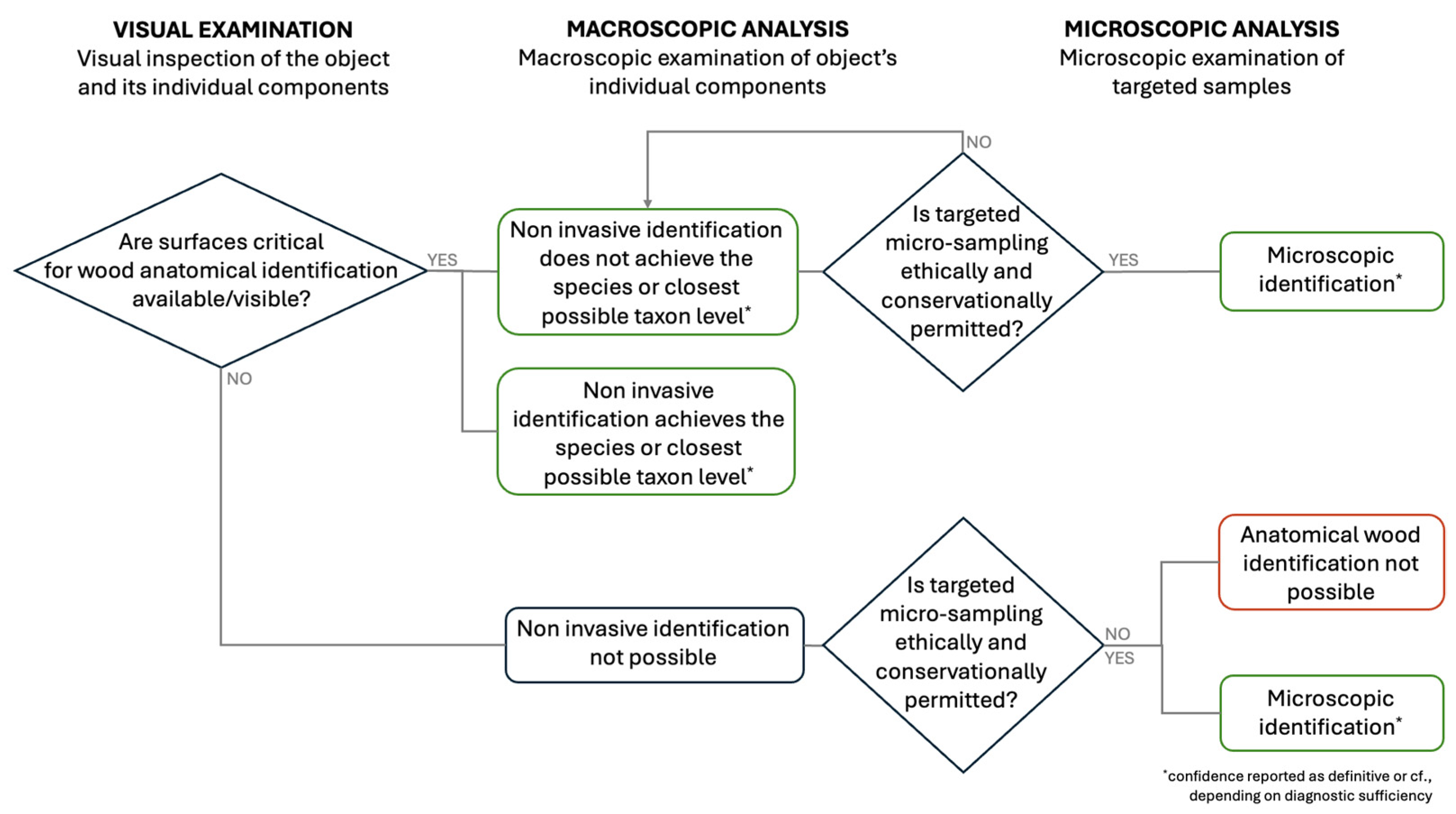
The investigation followed the WoodScope workflow, as detailed in
Figure 1, showing the stepwise progression from non-invasive macroscopic observation to targeted microscopic analysis, together with the decision criteria used to refine taxonomic identification and assign confidence levels. Particular attention was paid to the transverse surfaces, which are richer in characters useful for identification of hardwoods. This macroscopic stage followed the first step of the WoodScope workflow, which prioritises non-invasive examination of existing surfaces before any higher-resolution techniques are considered. For each instrument component, the observed characters were compared to atlases and other references on macroscopic wood identification [
14,
15,
16,
17] to achieve identification.
Character visibility depends mainly on the quality of the wood surfaces, which should ideally be prepared with a sharp blade for identification. In the case of the objects examined, the surfaces were neither altered nor prepared in any way for observation. Therefore, for each instrument component, the quality of the surface influenced the number of detectable characters and, consequently, the accuracy of the identification. Where possible, 20× magnification photos of the observed surfaces were taken. The images were taken using the built-in micro camera on an Oppo A98 mobile phone (Guangdong OPPO Mobile Telecommunications Corp. Ltd, Dongguan, China). These images were used exclusively for documentation and did not involve any modification of the original surfaces.
No samples were taken from the analysed objects. For a single wood element, two targeted thin sections were taken from a suitable surface hidden from view to conduct microscopic observation [
18] aimed at improving the identification accuracy. The observed characters were compared to references on microscopic wood identification [
19,
20,
21,
22] to achieve identification. The observation was conducted with a Leica DM750 light microscope (Leica Microsystems, Wetzlar, Germany) equipped with a Tucsen TCA-5.0 C camera (Tucsen Photonics Co., Ltd., Fuzhou, China). This micro-sampling step represented the final stage of the WoodScope approach and was performed only when macroscopic characters were insufficient for a reliable taxonomic assignment.
3. Results
A summary of all the identification results is reported in
Table 1.
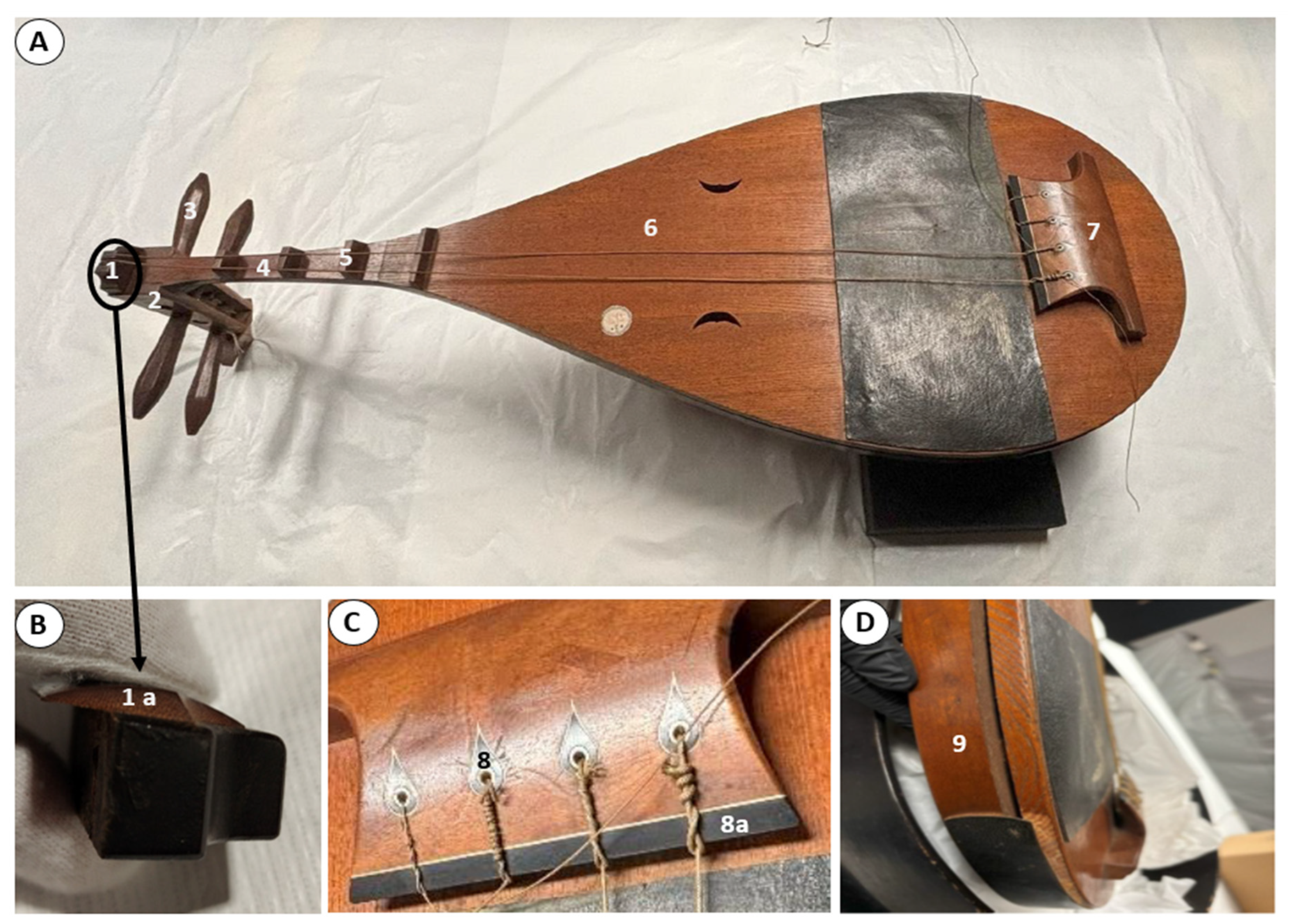
Figure 2 shows the different parts that were analysed on the biwa.
The torikuchi (1 of
Figure 2A) surface was completely coated in paint, except for the inner surface which showed brown in colour and signs of vessels. No other characters were visible, therefore the piece was identified as hardwood. Such minimal information illustrates a typical WoodScope scenario where surface coatings limit anatomical visibility and identifications must rely on the few accessible characters. On the element applied to the torikuchi for the passage of the strings (1a of
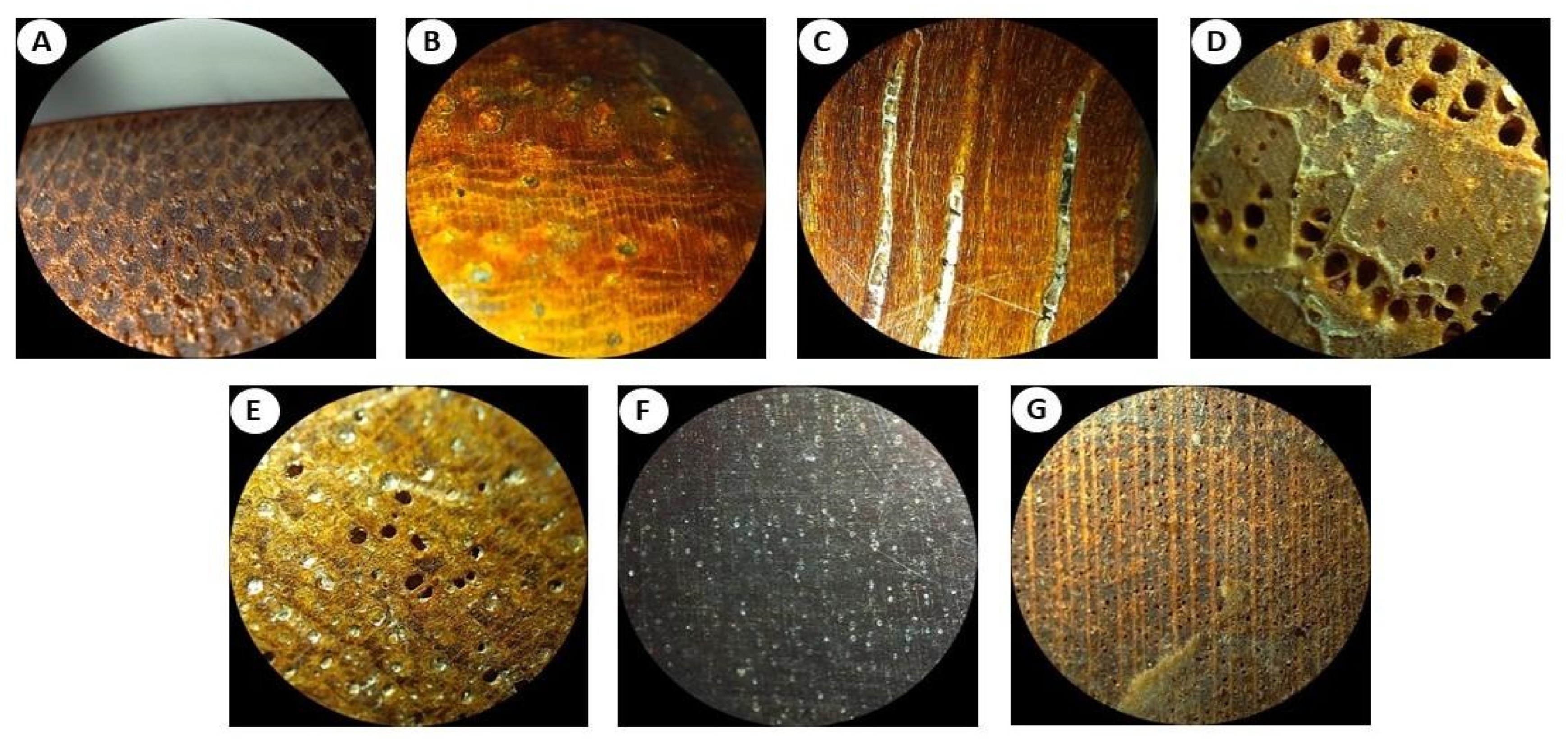
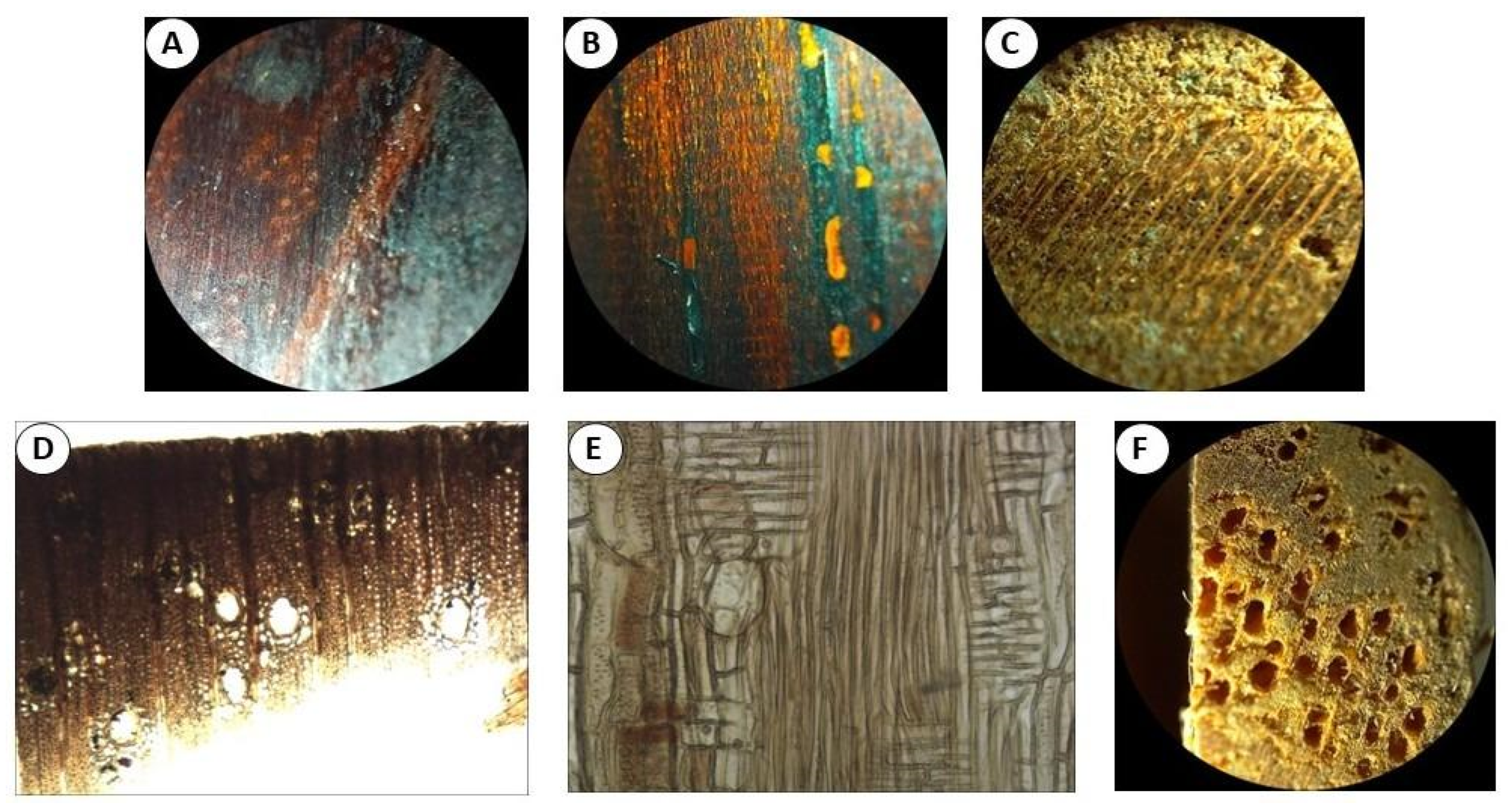
Figure 2B), a clear cross-section was visible, showing distinct vascular bundles (
Figure 3A), typical of bamboo.
On the head of the instrument (2 of
Figure 2A), a cross-section was available, showing small vessels (barely visible under a lens), scanty paratracheal axial parenchyma, rays not visible to the naked eye, and very narrow growth rings. The wood colour is yellow. The characters observed were consistent with the
Buxus genus. Although the number of diagnostic features was limited, the combination of vessel size, parenchyma type, and colour allowed a confident genus-level appraisal.
The four pegs inserted in the head (3 of
Figure 2A) presented similar macroscopic characters. On the cross-section (
Figure 3B), it was possible to detect vessels visible to the naked eye, frequent gums inside the vessel lumens and winged-aliform confluent axial parenchyma, visible to the naked eye. On the tangential surface, the rays were regularly storied and predominantly one cell wide (
Figure 3C). The four pegs were identified as
Pterocarpus sp. This identification was supported by both transverse and tangential characters, which were consistent across all pegs.
The same characters observed on the pegs were visible on the fingerboard (4 of
Figure 2A) and on the four nuts (5 of
Figure 2A) as well. Additionally, the part of the fingerboard that fits inside the sound box was not varnished and had been preserved from photo-oxidation, allowing us to detect the original colour of the wood, red. This detail provided an additional diagnostic character that supported the identification of
Pterocarpus.
On the soundboard (6 of
Figure 2A), a cross-section was available (
Figure 3D), showing a ring-porous structure with 2–3 rows of earlywood vessels, and latewood vessels solitary or in radial pairs, surrounded by vasicentric axial parenchyma. Rays were not visible to the naked eye on the cross-section. The soundboard was identified as
Fraxinus sp. The combination of ring-porosity, vessel arrangement, and parenchyma type is typical of ash and distinguishable from other ring-porous timbers traditionally used for biwa soundboards.
The wood of the bridge (7 of
Figure 2A) was characterized by very narrow rings, as visible on the cross-section (
Figure 3E), making it difficult to accurately assess the porosity, which nevertheless appeared to be ring-porous. The earlywood vessels were spaced apart, surrounded by vasicentric axial parenchyma, and sometimes filled with white gums. The characters observed were consistent with the
Tectona genus. Despite surface limitations, vessel distribution and gum presence allowed a tentative but informed identification.
Of the four black teardrop-shaped inlays decorating the bridge (8 of
Figure 2C), the two central ones were cross-sections. On these, it was possible to detect the presence of small (not visible to the naked eye), rather sparse, vessels, solitary or in short radial rows, as well as rays not visible to the naked eye (
Figure 3F). Traces of narrow bands of axial parenchyma were visible in some parts of the sections. The characters observed were consistent with the
Diospyros genus. These anatomical traits match ebony species traditionally used for decorative inlays.
The other two teardrop-shaped inlays and the rectangular one (8a of
Figure 2C) appeared to match the identified ones, but no cross-sections were available to confirm these as well. The white inlays were not made of wood, but most likely ivory. On a cross-section of the sound box (9 of
Figure 2D), it was possible to observe rather sparse small vessels (not visible to the naked eye), bands of marginal parenchyma, and rays visible to the naked eye, all of which were consistent with the
Magnolia genus. This contrasts with expectations from traditional biwa construction, in which mulberry is typically preferred for this component.
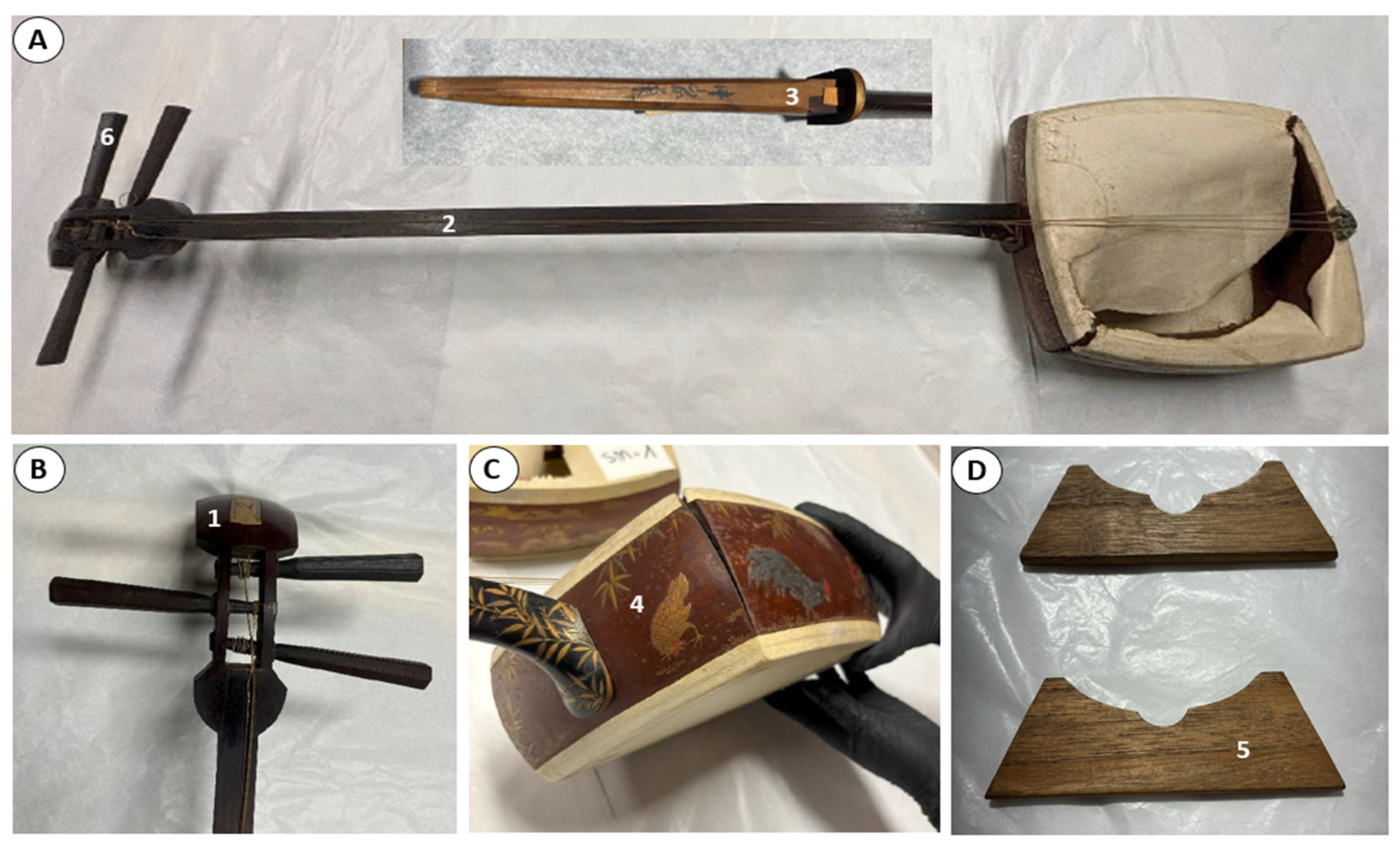
Figure 4 shows the different parts that were analysed on the shamisen.
The head (1 of
Figure 4B) presented a cross-section, showing diffuse-porous, solitary vessels surrounded by vasicentric parenchyma and arranged in a diagonal pattern, axial parenchyma in narrow bands, and some of the rays visible to the naked eye (
Figure 5A). It was identified as a
Quercus sp. belonging to the evergreen oak group. This was supported by the characteristic vessel arrangement and banded parenchyma, which aligned well with the anatomical profile of evergreen oaks.
On the fingerboard (2 of
Figure 4A) cross-section, most vessels and a thin, confluent, wing-shaped axial parenchyma were visible to the naked eye. Many vessels were occluded by yellow gums. Rays appeared regularly storied and 1–2 cells wide on the tangential surface (
Figure 5B). The characters observed were consistent with the Dalbergia genus. These features, including the presence of yellow gums, are typical diagnostic traits of several
Dalbergia species widely used in musical instruments.
The fingerboard joint in the sound box consisted of two parts (3 of
Figure 4A), both of which, in cross section, showed the same features (
Figure 5C) as those visible on the biwa sound box. These characters were consistent with the
Magnolia genus. The agreement of anatomical traits across both parts strengthened this identification.
The sound box (4 of
Figure 4C) consisted of four elements glued together. A preliminary macroscopic examination revealed the presence of vessels, indicating a hardwood, but no further details could be obtained. However, the recess where the fingerboard was inserted offered the opportunity to obtain thin sections for microscopic observation (
Figure 5D,E). The observed characters were vessels with both simple and scalariform perforation plates, the latter with less than 10 bars, average vessels diameter comprised between 50 and 100 µm, tyloses common in vessels, intervessel pits with an average diameter comprised between 4 and 7 µm, fibres thin- to thick-walled, vasicentric axial parenchyma, rays 1- to 3 cells wide, and oil cells associated with the axial parenchyma. The sound box was identified as belonging to the
Lauraceae family, Medang group. This identification required microscopic analysis and exemplified how WoodScope escalates to minimally invasive methods only when macroscopic examination is insufficient.
The wood of the two plectrum cases (5 of
Figure 4D) was very light, and on the cross section of both the distinctive pattern of
Paulownia was visible, with a ring-porous structure composed of several rows of earlywood vessels and latewood vessels surrounded by lozenge-aliform parenchyma (
Figure 5F). This matches the well-known use of
Paulownia in lightweight Japanese musical accessories. The three pegs (6 of
Figure 4A) were completely varnished, making any observation of the wood structure impossible. As a result, no identification could be attempted without removing the varnish, which was not permissible for conservation reasons.
Figure 6 shows the different parts that were analysed on the koto.
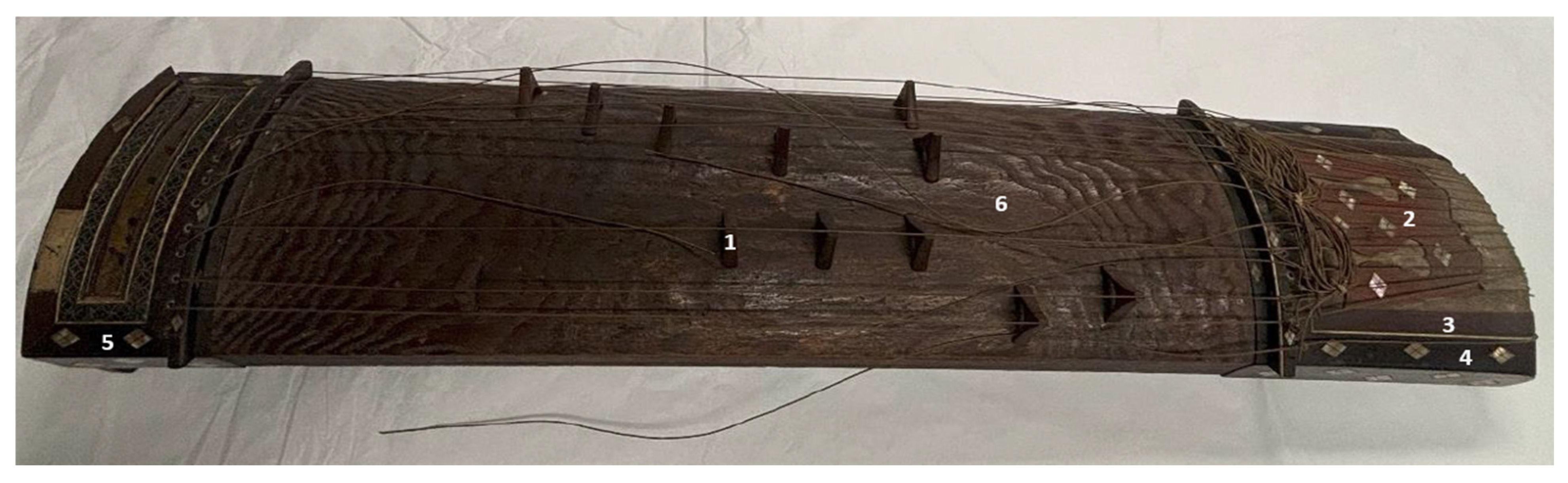
The elements supporting the strings (1 of
Figure 6) were removable and had similar macroscopic characteristics. The transverse surfaces showed vessels and confluent winged-aliform axial parenchyma, both visible to the naked eye. On the longitudinal surfaces, the rays were uniseriate and regularly storied. They were identified as
Pterocarpus sp. The repetition of the same anatomical traits across all eleven elements confirms the deliberate and consistent use of this genus for these components, in line with its known mechanical and aesthetic suitability.
The instrument featured several decorative inlays (2–5 of
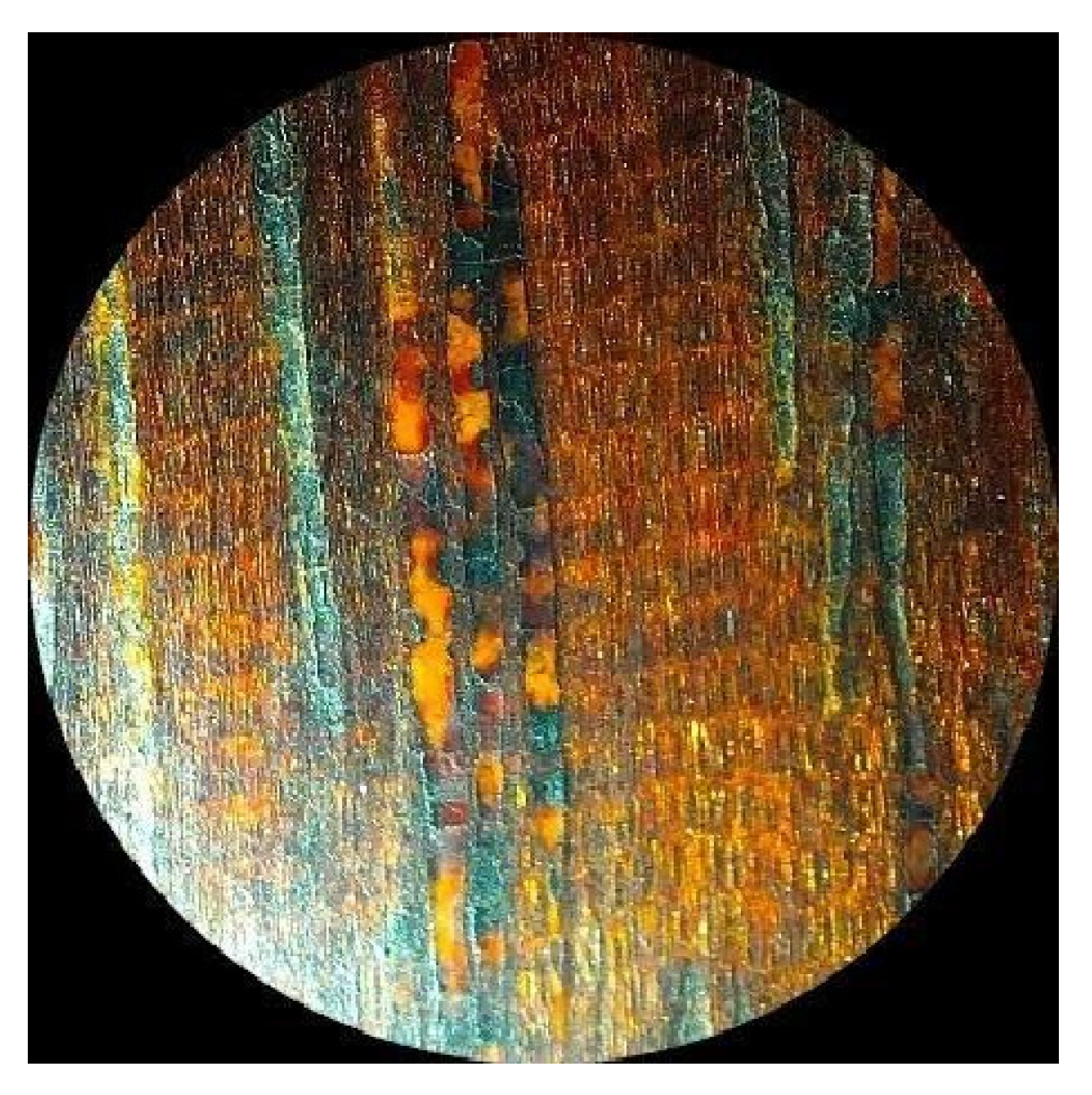
Figure 6). As they were all longitudinally oriented, no cross-sections were available for observation. The rays of all the analysed inlays were found to be regularly storied, and yellow substances were present in the vessels of inlays 4 and 5. Based on the characters observed, inlays n. 2 and 3 were consistent with
Pterocarpus sp., while inlays n. 4 and 5 were consistent with
Dalbergia sp. (
Figure 7). Although the lack of cross sections limited the number of observable characters, storied rays and vessel contents provided sufficient evidence for a reliable cf.-level identification.
A ring-porous structure could be observed on the cross-section of the instrument’s body (6 of
Figure 6), but the surface quality was not good enough to obtain other anatomical details. The wood was therefore identified as hardwood. Even this broad identification is informative, as the ring-porous pattern is consistent with the traditional use of
Paulownia for koto bodies and helps contextualise the material choices within established instrument-making practices (
Figure 7).
4. Discussion
The selection of wood species is of the utmost importance when making musical instruments [
23]. Each part of an instrument is traditionally crafted from a narrow range of wood species that have been selected for their acoustic, physical and aesthetic properties for centuries [
24,
25]. In our investigation, we conducted non-invasive wood identification on three types of traditional Japanese stringed instruments, analysing a total of 39 distinct parts. Twenty-five parts were identified with the greatest possible accuracy using anatomical analysis. Eleven were identified as consistent with a genus, and three were identified as hardwood or bamboo. In one case only, targeted micro-sampling was performed based on macroscopic observations to obtain additional information. These results show that most identifications can be achieved through macroscopic examination alone, with microscopic confirmation required only in a small minority of cases.
On the biwa, we analyzed the torikuchi, the head, the pegs, the fingerboard, the nuts, the soundboard, the bridge and its inlays, and the sound box. Our investigation confirmed the use of smoked bamboo to cover the surface of the torikuchi where the strings slide [
26]. The bridge inlays were also found to be consistent with traditional materials, ebony (
Diospyros sp.) and ivory [
26]. Our identification did not confirm the use of mulberry (
Morus sp.) for the sound box, which is considered the best wood for this component [
26,
27]. Instead, the sound box was found to be consistent with magnolia (
Magnolia sp.), which, although traditionally used in biwa crafting as well [
26], is not amongst the most common mulberry substitutes for the sound box, which are instead zelkova (
Zelkova sp.) and camphor wood (
Cinnamomum camphora (L.) J. Presl) [
26,
27]. Amongst the other traditional woods used for biwas [
26],
Pterocarpus was identified in both the pegs and the fingerboard, while boxwood (
Buxus sp.) was tentatively identified for the head. However, ref. [
26] reports the use of boxwood for the plectrum used to play the biwa, not the instrument itself. Finally, the ash (
Fraxinus sp.), identified for the soundboard, and the teak (
Tectona sp.), identified for the bridge, did not match any of the typical biwa woods [
26,
27]. However, it is interesting to note that ash shares the same ring-porous structure as mulberry, which, according to [
27], is the best wood for a biwa soundboard. This highlights that anatomical similarity, rather than strict species match, may have guided some historical substitutions.
Karin wood (
Pterocarpus indicus Willd.) is, according to [
27], the best wood for the body and the long neck of a shamisen. However, we identified rosewood (
Dalbergia sp.) and a wood belonging to the Medang group for the fingerboard and the sound box, respectively. These taxa are compatible with the mechanical and acoustic requirements of the instrument, even if not traditionally documented.
The ring-porous structure observed on the body of the koto is consistent with Paulownia (
Paulownia sp.), which is reported to be widely used for such instruments [
27]. In this case, even the broad identification of “ring-porous hardwood” is valuable, as it aligns the observed material with historically attested practices.
Overall, although several identifications confirmed the typical species used in the construction of the analyzed instruments, some uncommon or unreported ones were found as well. This is not surprising, given the limited literature on the woods used in traditional Japanese chord instruments and the fact that, as mentioned in the Introduction, well-documented instruments such as guitars have evidence of many species being used other than the traditional ones [
10]. The restorer ruled out the possibility that the components where we found ‘uncommon’ species were the result of later repairs or replacements.
The limited anatomical literature on the woods used in traditional Japanese chord instruments further increases the value of our observations. With few published references available, especially for components other than the soundboard, each reliable identification, whether definitive or expressed as “cf.”, helps fill a significant knowledge gap and contributes to building a more robust reference framework for future studies.
An important aspect of our method concerns the explicit reporting of identification accuracy. In cultural heritage wood identification, communicating whether a determination is definitive or expressed as “cf.” (i.e., a well-supported but not fully diagnostic match) is essential for transparency and reliability. The use of “cf.” does not weaken an identification; rather, it clearly defines the level of confidence based on the observable characters and the preservation state of the object. In many cases, especially when only non-invasive methods are allowed, genus-level or “cf.” identifications represent the highest responsible level of precision. These identifications are still highly informative: they enable meaningful comparison with historical sources, help verify or challenge assumptions about traditional materials, and guide conservation decisions even when complete anatomical visibility is lacking. Likewise, even broad determinations such as “ring-porous hardwood” contribute valuable contextual information by narrowing the range of plausible species and aligning the material with known traditions in instrument making. Within the WoodScope framework, stating accuracy is therefore not an expression of limitation, but a critical scientific practice that preserves both interpretative honesty and practical usefulness.
5. Conclusions
This study demonstrates the effectiveness of WoodScope, a multi-scale, non-invasive wood-identification strategy for analysing traditional Japanese chord instruments while preserving their integrity. Through macroscopic examination alone, we successfully identified 38 of the 39 components, and only one required targeted micro-sampling for microscopic confirmation. A few components could not be identified because of the absence of visible surfaces critical for wood anatomical identification.
Despite the accuracy of some identifications was limited to the “cf.” or hardwood/softwood/monocot level, they proved as valuable as definitive ones for contextualising material choices within historical practices and for challenging or confirming assumptions derived from textual sources. By clearly reporting confidence levels and working within the constraints of cultural heritage preservation, this approach balances scientific rigour with ethical responsibility.
These results show that a structured workflow can maximise diagnostic yield even when the condition of the surfaces or conservation constraints restrict the available anatomical information.
The identifications obtained provide new empirical data on the woods used in the construction of Japanese chord instruments, a field where, to our knowledge, no identifications are available in the literature to date. These results expand the literature base, which remains limited and often generalized, and provide new insights to support conservators, curators and researchers in understanding the materiality of this under-documented area.
Overall, our work demonstrates the potential of WoodScope to successfully identify wood species in the specific field of Japanese chord instruments. More broadly, it shows how this approach can support the retrieval of information on the materiality of any area of wooden cultural heritage, particularly where performing identifications is more challenging.