1. Introduction
In recent decades, high frequency heating technology has been widely used in the woodworking industry, particularly for drying, gluing, and thermal modification of wood. Owing to its mode of operation, high frequency heating enables selective and volumetric heating (the ability to heat the adhesive layer without heating the rest of the element) and, when used correctly, allows for rapid and uniform heating of wood, increases energy efficiency and provides simple control of thermal processes [
1,
2,
3]. Compared to traditional heating methods based on heat transfer, such as conduction, convection, and thermal radiation, high frequency (HF) heating is faster and more uniform [
4].
The interaction between wood and an electromagnetic field is determined by the dielectric properties of wood. The main dielectric properties that govern the conversion of electrical energy into thermal energy while wood is within an electromagnetic field are the dielectric constant (ε′) and the loss tangent (tan δ). These dielectric values depend strictly on the moisture content, density, chemical composition of the wood, and the anatomical direction in which the electromagnetic field is applied. All these parameters determine the efficiency, speed, and uniformity of wood heating within an electromagnetic field [
5,
6,
7,
8].
The value of the dielectric constant (ε′) indicates the capacity of wood to store electrical energy in an alternating current field, while the loss tangent (tan δ) indicates the proportion of this energy converted into thermal energy. Both values are intricately related to the frequency of the electric field and vary with changes in temperature and moisture content of wood. Increasing the frequency of the field, the temperature of the wood, and its water content leads to higher values due to increased interfacial polarization and enhanced dipolar mobility of the water molecules inside wood [
9,
10].
When an alternating electric field is applied to wood, the polarization mechanisms within the material lag behind the applied signal, and some of the electrical energy is converted into thermal energy through frictional and relaxation processes [
8]. The amount of absorbed power P per unit volume is proportional to the dielectric loss factor ε″ and can be expressed as (1):
where:
P absorbed power [W/m3]
ε″ dielectric loss factor
f frequency of electric field [Hz]
E electric field strength [V/m]
Because humidity and temperature alter the relative contributions of bound- and free-water polarization, their control is crucial for predicting and optimizing HF processing efficiency. Previous studies have shown that, for wood with increasing moisture content, ε′ may rise from about 4 (dry) to 100 at 1 MHz, while tan δ can increase by more than an order of magnitude [
9,
11].
Despite extensive research on softwoods [
12,
13], fewer studies have focused on hardwoods such as pedunculate oak (
Quercus robur L.), whose high density and complex structure may influence dielectric behaviour differently. Previous studies of the dielectric properties of oak wood [
14,
15] have shown that an increase in moisture content and the higher density of oak wood compared to other types of wood lead to an increase in the dielectric constant, while an increase in the frequency of the electric field leads to its decrease. However, these tests were conducted with limited variables. These studies were carried out either at a single specific frequency or within a limited range of moisture content in the samples. Furthermore, previous research rarely addressed the combined influence of parameters such as density, moisture content, and temperature. As it is evident in other types of wood that these parameters affect their behaviour when exposed to HF radiation, it is important to understand how oak wood behaves under HF exposure. The specific selection of these parameters can lead to the optimal heating of oak wood required for pre-bending, which has been shown to be most effective form of heating considering the success of bending of oak wood [
16]. For the reasons stated above, the aim of this work is to characterize the dielectric properties of oak wood under environmental conditions and material properties relevant to high-frequency heating prior to bending. Specifically, we investigated the influence of temperature, air humidity, and density on the dielectric properties of oak wood across the frequency range 0.079–25.1 MHz. The working hypothesis is that, under conditions relevant for wood bending, density has a dominant influence on dielectric behaviour, while temperature and relative humidity primarily modulate the response to changes in moisture content. The results are intended to help improve control and optimization of HF heating during the preheating phase of the oak wood bending process.
2. Materials and Methods
Radially oriented oak lamellas (R × T × L = 80 × 3 × 500 mm) were conditioned at 20 °C above saturated salt solutions and above distilled water at relative air humidity (RH) ranging from 10% to 100%. The reason for choosing this RH range is that during industrial bending processing, depending on the working conditions, there are fluctuations in the RH in the room, which can lead to changes of moisture contents of the elements meant for bending. There was also a group of samples steamed for 90 min before measurement at 90 °C. For each humidity level, we had five test specimens with density variability included (
Table 1).
To ensure equilibrium moisture content (EMC), all lamellas were weighed daily until the mass variation was less than 0.1% over 24 h. The conditioning procedure at 20 °C followed standard static equilibration above saturated salt solutions (LiCl, RH = 10%; MgCl
2, RH = 33%, NaNO
2, RH = 65%, NaCl, RH = 75%; ZnSO
4, RH = 87%) providing the six specified humidity levels (
Table 1). Density was determined for each lamella based on oven-dry mass and conditioned volume before measurement. The density was not experimentally controlled, but samples were taken to more closely mimic industrial conditions where it is not possible to experimentally control the density, but only the texture of the element, which is, for aesthetic reasons, radial as were the samples used in this experiment.
After conditioning, specimens were sealed in polyethylene bags to prevent moisture exchange prior to measurement. The steamed group was prepared separately by exposing lamellas to saturated steam at 90 °C for 90 min, after which they were cooled in sealed containers to avoid uncontrolled drying. This ensured that the steaming treatment primarily affected the softening of polymers without inducing large moisture gradients.
Measuring of Dielectric Properties
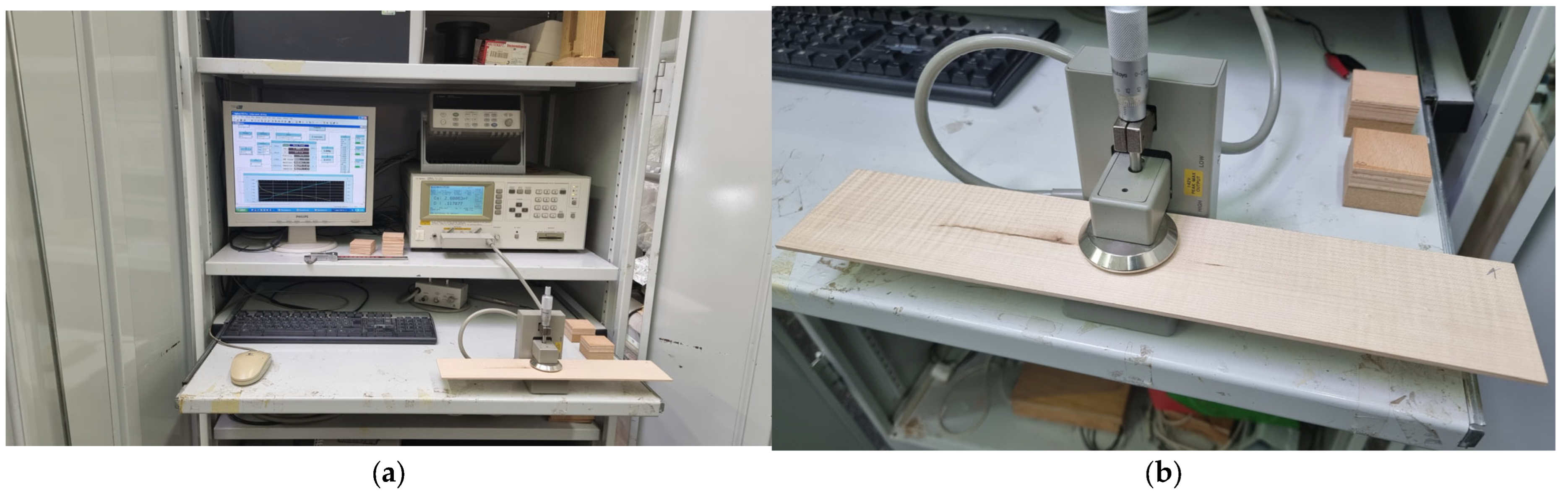
The dielectric properties were measured using an Agilent 4285A LCR metre (Agilent Technologies Inc., Santa Clara, CA, USA) and a 16451B Dielectric Test Fixture (Agilent Technologies Inc., Santa Clara, CA, USA) in accordance with ASTM D150-22 [
17]. Properties were measured at 20 °C and 90 °C, across six humidity levels and 26 frequencies. In this study, dielectric properties were measured with electric field frequencies ranging from 0.079 MHz to 25.119 MHz. During testing, the lamella samples were positioned between two capacitor plates (
Figure 1).
Before measurement, the capacitance and dissipation factor of the empty capacitor (C
1, D
1) were recorded at each frequency. The specimen was then placed between the electrodes, maintaining a constant spacing of 0.5 mm (verified by micrometer). Capacitance and dissipation factor with the sample (C
2, D
2) were measured under identical conditions. The relative dielectric constant (ε′) and dielectric loss tangent (tan δ) were calculated according to ASTM D150-22 as:
where:
Cs1 capacitance of the empty capacitor [F]
Cs2 capacitance with the test specimen inserted [F]
tg distance between the capacitor electrodes [m]
td average thickness of the test specimen [m]
D1 loss factor of the empty capacitor
D2 loss factor of the capacitor with the specimen.
The relative dielectric constant was calculated indirectly using Equation (2), while the dielectric loss factor was determined using Equation (3). Measurements were conducted at two sample temperatures: 20 °C and 90 °C. These two temperatures represent room temperature and the typical temperature used when preheating wood elements before bending [
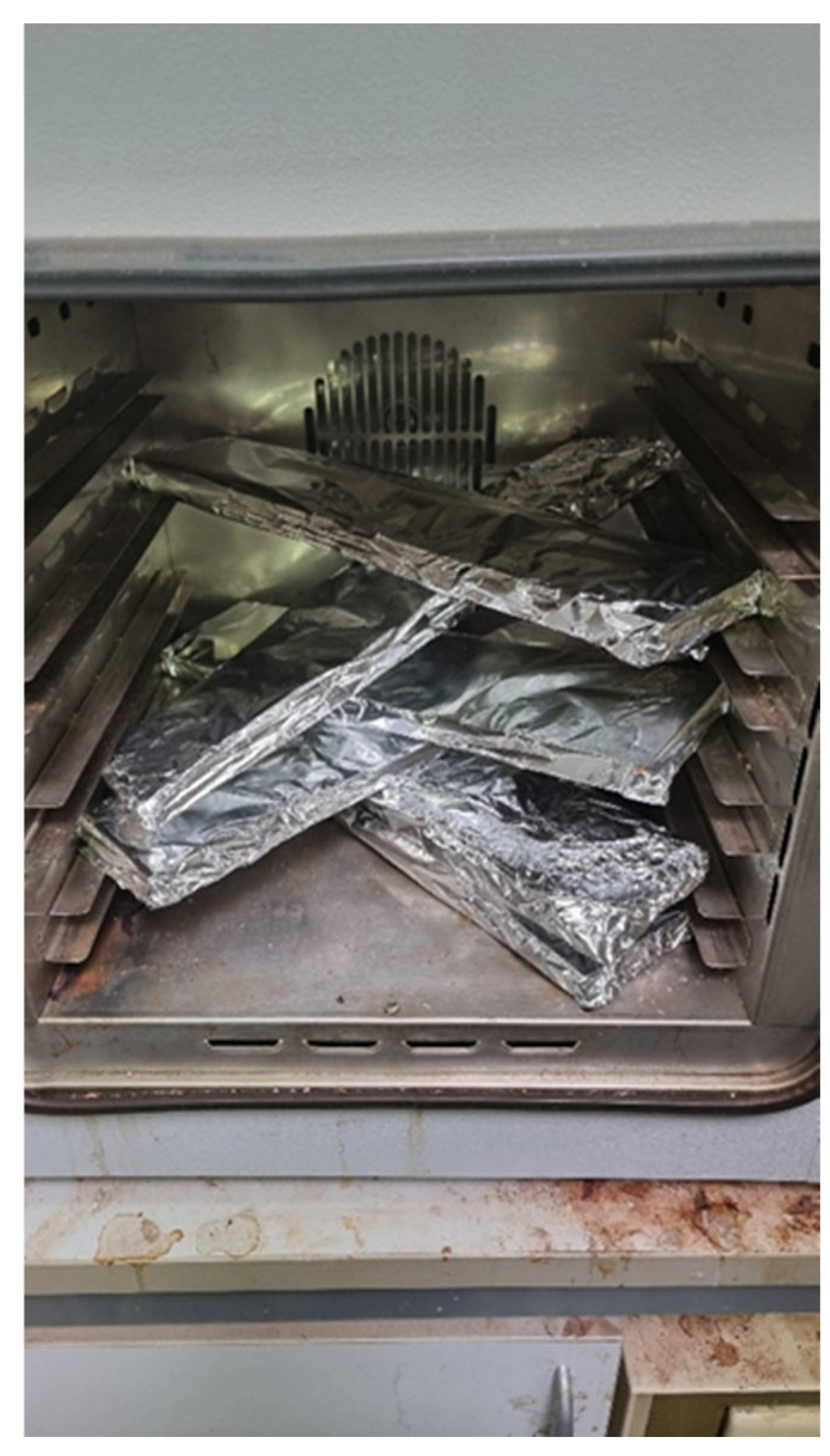
18]. A total of 26 electric field frequencies ranging from 0.079 MHz to 25.1 MHz were applied which represent lower industrial microwave and radio-frequency heating domain. Before the dielectric measurements at 90 °C, the oak lamellas were wrapped in aluminium foil and preheated to the target temperature in a laboratory oven (Kambič d.o.o., Semič, Slovenija), as shown in
Figure 2. This procedure ensured that the samples maintained their original moisture content and temperature during the test.
All measurements were performed with the fibre orientation aligned parallel to the electric field (longitudinal direction). Each frequency sweep was repeated twice to verify repeatability; the mean values were used for statistical analysis. The total data set included six humidity levels × two temperatures × five replicates = 60 specimens.
Previously mentioned test parameters such as RH, moisture content and test temperature are interrelated variables within the wood material. In this study, relative humidity was used as the primary conditioning parameter, while moisture content was treated as the resulting material state at equilibrium. Because of this, these factors were not considered fully independent, but rather as coupled variables influencing dielectric behaviour under defined environmental conditions.
The collected data were analysed using SPSS Statistics (IBM) (v2025) and Excel (Microsoft) (v2019). Statistical analysis was performed using multiple linear regression analysis to evaluate the effects of sample temperature, moisture content and measurement frequency on the dielectric constant and dielectric loss tangent. Statistical significance was set at p < 0.05. The appropriateness of the model was evaluated using the coefficient of determination (R2 and adjusted R2) where applicable. All analyses were performed using IBM SPSS Statistics 28.0 (IBM).
3. Results
The groups of lamella samples were divided according to the relative air humidity (RH) at which testing was conducted. The moisture contents of the lamella samples are shown in
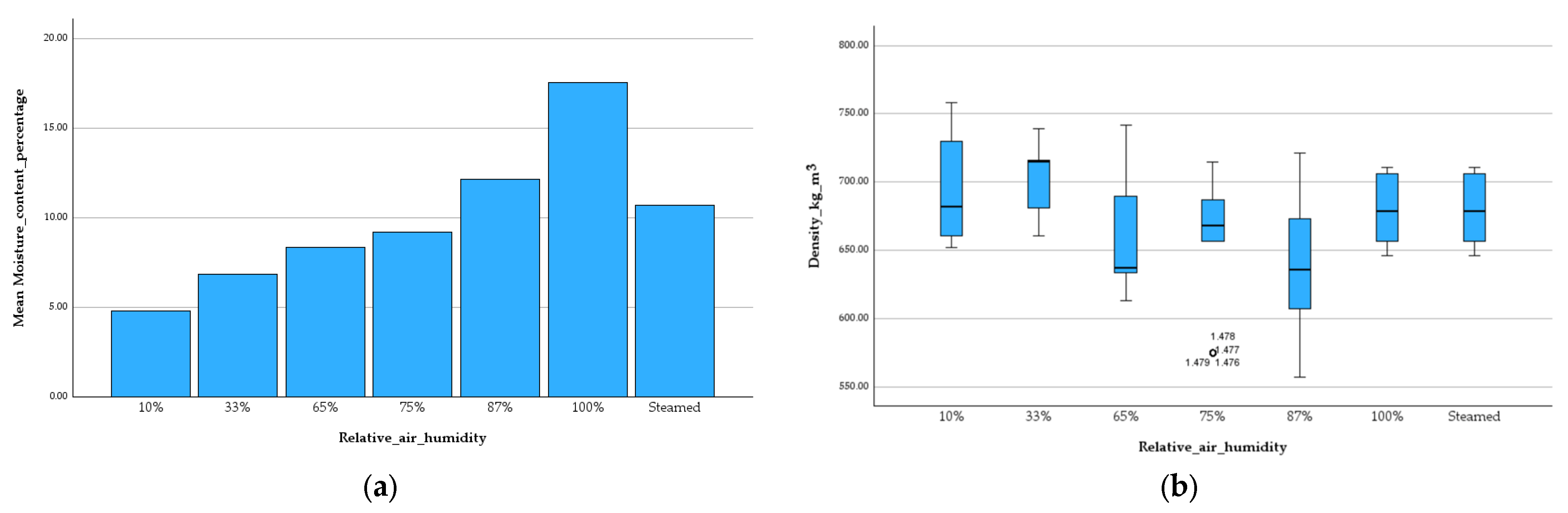
Figure 3. The lowest moisture content, 4.8%, was measured in samples tested at a RH of 10%, while the highest moisture content was measured in samples tested at a RH of 100%. The figure also shows that the moisture content of the lamella samples increases with rising RH. The lamella samples on which the dielectric properties were measured after steaming had a moisture content of 10.7%. The densities of the lamellas by group are also shown in
Figure 3. The densities were relatively similar, with only minor variations. The mean values ranged from 639 kg/m
3 to 702 kg/m
3, which can be explained by the heterogeneity of the anatomical structure of oak wood within the lamella samples.
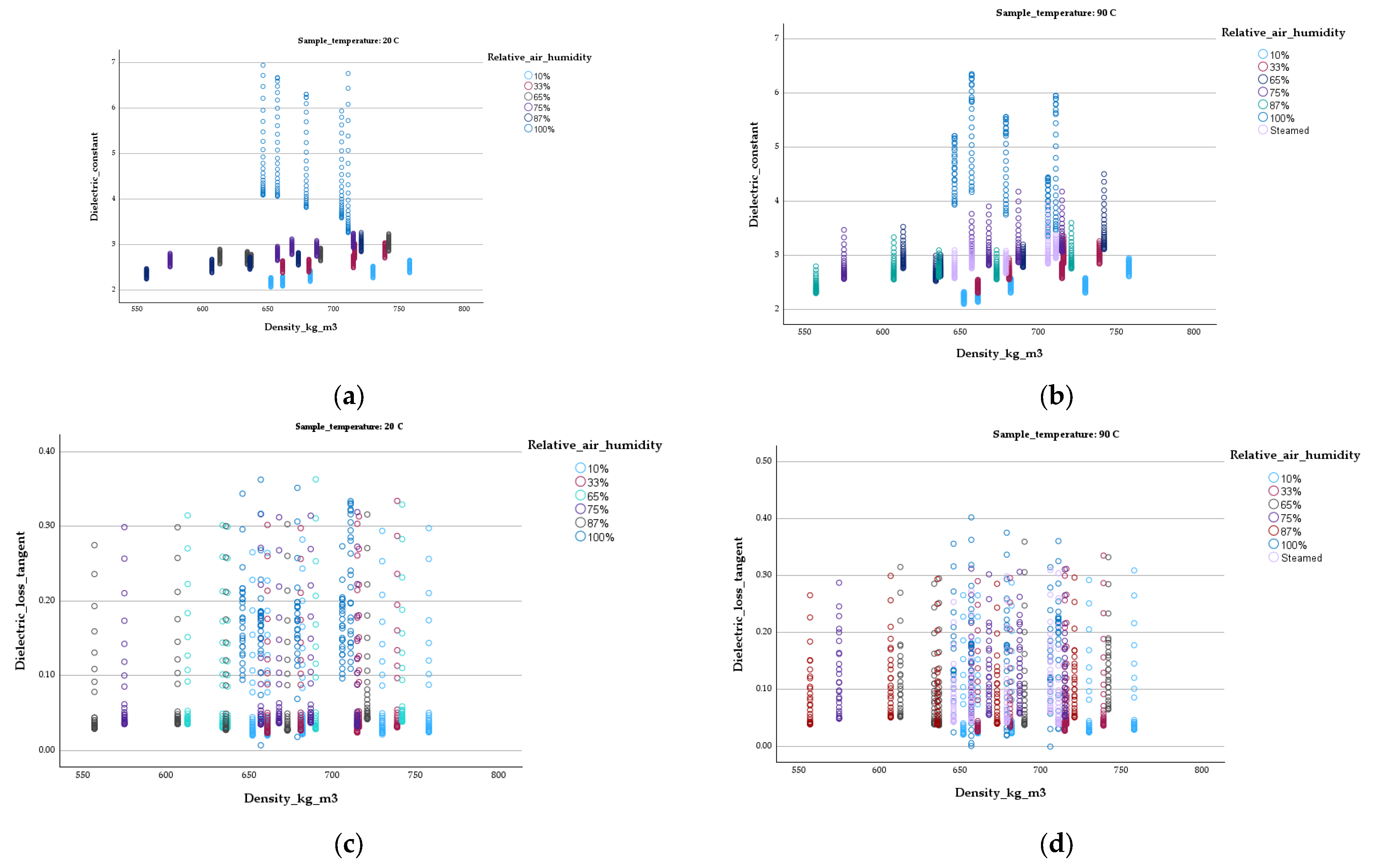
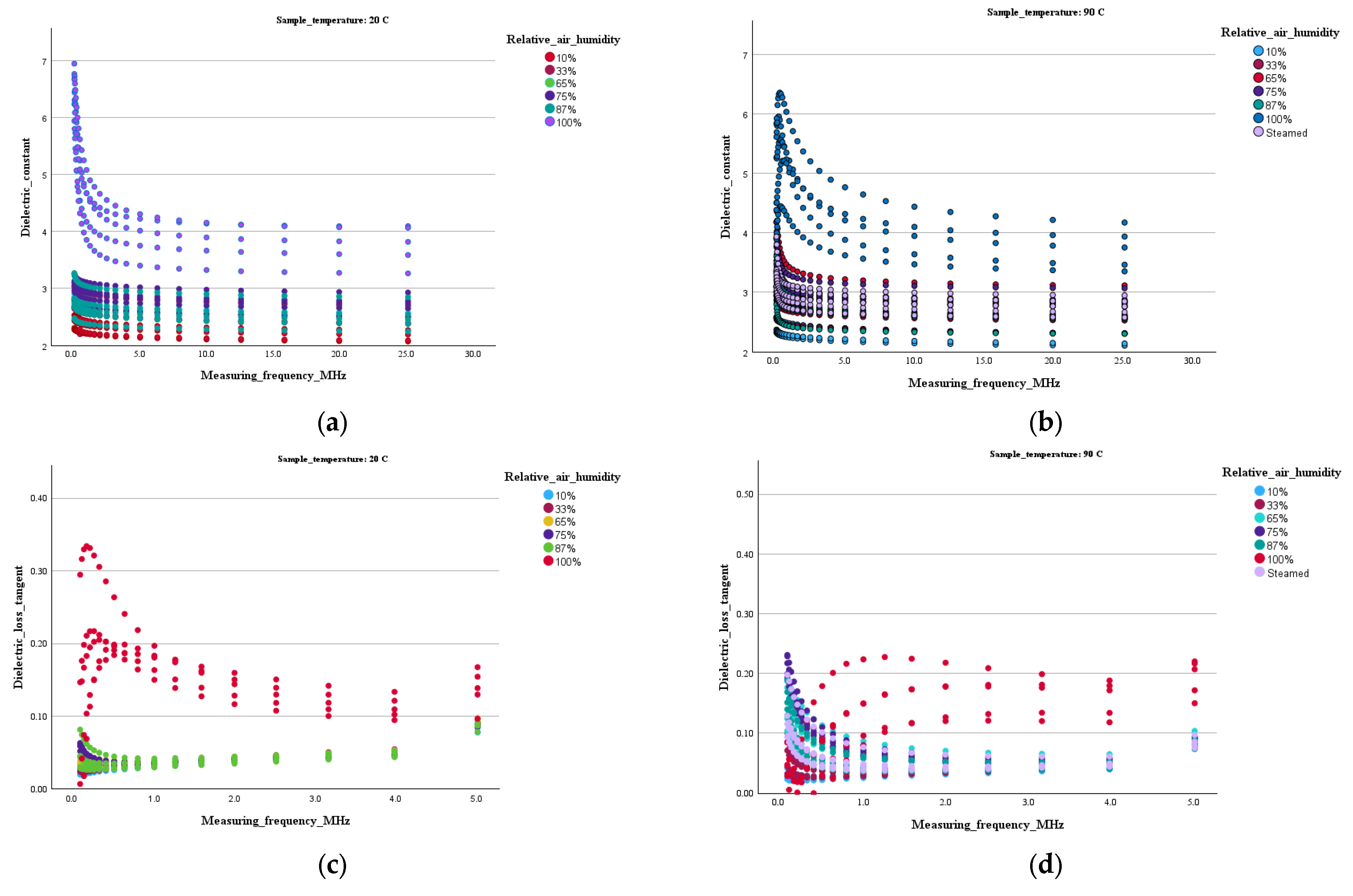
The dielectric constant (ε′) depended greatly on the relative humidity of the air during testing. This change was observed at both test temperatures, 20 °C and 90 °C, as shown in
Figure 4. Increasing the RH during testing led to higher measured values of the ε′. At 20 °C, the ε′ ranged from 2.29 at a RH of 10% to 4.62 at 100%, while at 90 °C it ranged from 2.43 at 10% to 4.69 at 100%. Increasing RH also resulted in a higher value of loss tangent (tan δ), from 0.07 at RH of 10% to 0.16 at RH of 100% (20 °C), and from 0.07 to 0.13 (90 °C). Increasing relative humidity from 10% to 100% resulted in an approximately twofold increase in the dielectric constant, corresponding to a rise of about 102% at 20 °C and 93% at 90 °C. Over the same RH range, the loss tangent increased by approximately 130% at 20 °C and 86% at 90 °C. The variability between samples within the same groups was, on average, greater at higher RH. As expected, higher values of ε′ and tan δ were recorded at 90 °C compared to those at 20 °C. The steamed samples did not particularly stand out compared to the other samples and on average measured similar values of ε′ and tan δ as samples measured at RH of 65% and 75%.
The effects of sample density on dielectric properties were pronounced under all measurement conditions. The results of dielectric properties measured by sample density are shown in
Figure 5. At 20 °C, ε′ ranged from 2.41 for the least dense lamellas (~575 kg m
−3) to 3.87 for the densest (~750 kg m
−3), and from 2.92 to 4.35 at 90 °C. Accordingly, an increase in ε′ of approximately 60% at 20 °C and 49% at 90 °C is observed within the tested density range. This corresponds to an average increase of roughly 0.005–0.006 in ε′ per 10 kg m
−3 increase in density. The tan δ followed a similar trend, ranging from 0.036 to 0.062 at 20 °C (an increase of 72%) and from 0.048 to 0.081 at 90 °C (an increase of 69%).
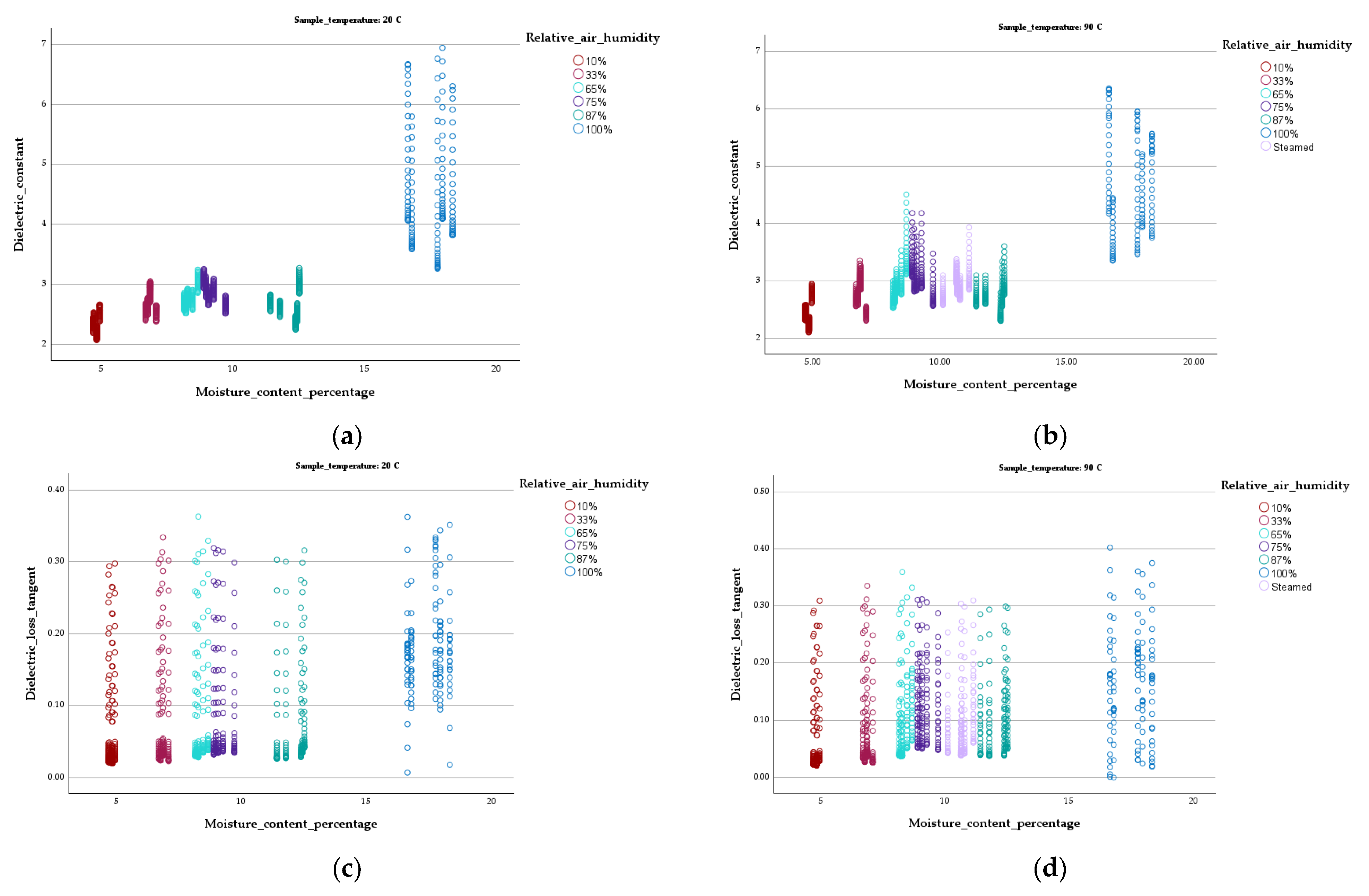
As is showed in
Figure 6, an increase in the value of dielectric properties is observed with increasing moisture content in wood samples. The values of the ε′ at lower moisture contents (4.7%–5%) showed low variability, ranging from 2.20 to 2.66. As the moisture content increases, the ε′ also increases (in the range of 6.7%–10%, it ranges from 2.63 to 3.12, while at moisture contents above 10% it exceeds 4.0, reaching up to 6.7 in the highest measured case). This represents an increase of more than 150% in ε′ between the lowest and highest moisture contents. An increase in variability within the sample groups is also evident as moisture content rises. This variability is much more pronounced at a measurement temperature of 90 °C. For the tan δ, this variability is even more pronounced and remains quite large at all moisture contents and both measurement temperatures. The values of the tan δ also increase with higher moisture content in the samples, but this increase is less pronounced. At lower moisture contents (4.7%–5%), the mean values ranged from 0.066 to 0.078, with maximum values reaching 0.3091. With increasing moisture content, the mean values and maximums of the tan δ show similar values, with a slight increase compared to lower moisture contents. At moisture contents above 15%, the highest maxima were measured, reaching up to 0.4, with the highest mean values (0.15–0.21). On average, higher values of the tan δ were measured at 90 °C but not significantly compared to 20 °C. Increasing the temperature of the samples from 20 °C to 90 °C led to an increase in ε′ from 5 to 15% (depending on the sample), while in the case of tan δ this increase was at the level of experimental variability.
A log
10 transformation of the electric field frequency values was performed before statistical analysis, as the response of dielectric properties scales logarithmically with frequency. Multiple linear regression showed that all four test parameters (frequency, density, moisture content, sample temperature) had a statistical effect on ε′, as shown in
Table 2. The model explains 70.4% of the variance in ε′ (adjusted R
2 = 0.704,
p < 0.001). Moisture content was the most statistically influential parameter (β = 0.808,
p < 0.001), followed by density (β = 0.284,
p < 0.001) and logarithmically transformed frequency (β = −0.260,
p < 0.001). The temperature of the samples had a statistically significant effect, although smaller than the other parameters (β = 0.048,
p < 0.001) No multicollinearity was detected among the predictors (VIF < 1.05).
For the statistical analysis of tan δ, a multiple linear regression was also conducted using the same test parameters (
Table 3). The model accounts for 45.0% of the total variance in tan δ (adjusted R
2 = 0.450,
p < 0.001). Logarithmically transformed frequency was the dominant predictor (β = 0.562,
p < 0.001), followed by moisture content (β = 0.352,
p < 0.001). Density (β = 0.094,
p < 0.001) and sample temperature (β = 0.056,
p = 0.002) were also statistically significant, but with a smaller effect. However, multicollinearity was detected among predictors (VIF < 1.05).
4. Discussion
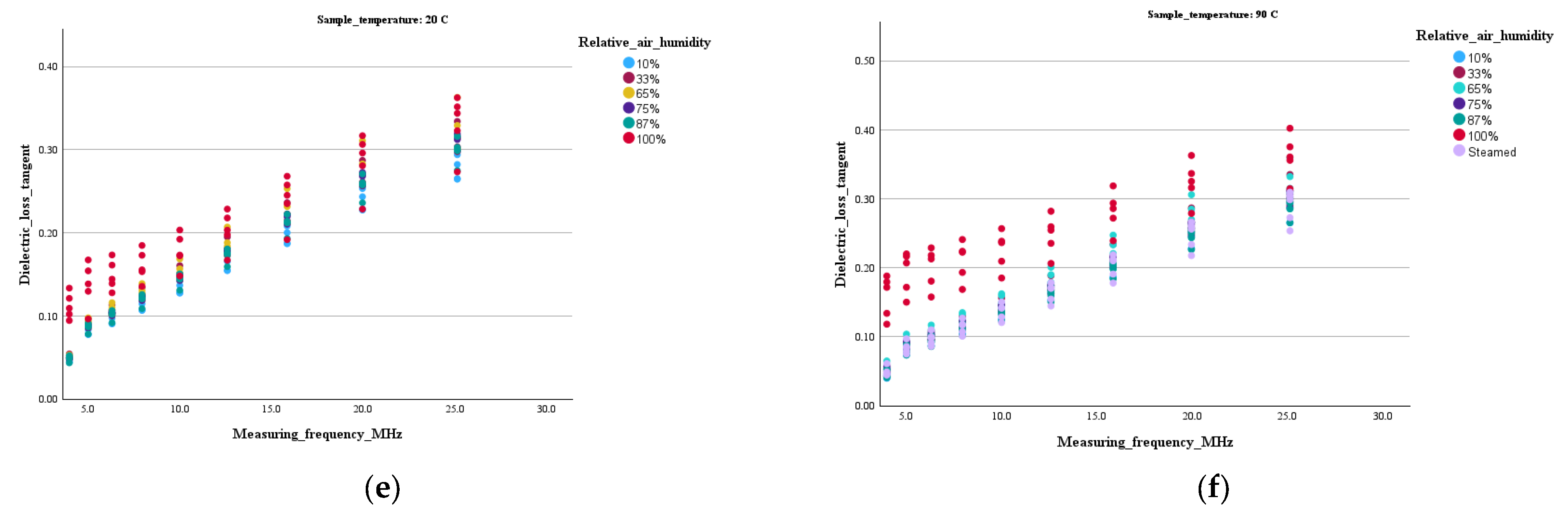
It is evident that each selected parameter has a certain statistical influence on the dielectric properties. The coefficient of determination was lower for the loss tangent model. This may be due to the moisture gradient within the lamellas and possible inconsistencies in electrode spacing during testing. The influence of frequency on the ε′ and tan δ was anticipated. Increasing the frequency caused a decrease in the ε′, which was particularly pronounced up to 1 MHz. The loss tangent at lower frequencies varied depending on the RH, with a clear trend of linear growth observed when the frequency exceeded 5 MHz. Therefore, it can be assumed that increasing the frequency of the electric field surrounding the oak wood results in greater heat release. These results are consistent with previous research done on hardwood like poplar [
11] and beech [
19].
When the frequency increases above 1 MHz up to 25 MHz, there is an initial sharp exponential decrease in the ε′, after which ε′ stabilizes and a very slight linear decrease appears. In contrast, the values of the tan δ increase. This phenomenon indicates greater heat release of the lamellae at higher electric field frequencies tested. However, for lamella samples tested at 100% RH, the phenomenon differs. For these samples, the highest tan δ values were measured at frequencies below 1 MHz. This can indicate that maximum release of heat of the oak lamellae under high humidity occurs at frequencies below 1 MHz. This phenomenon at 100% relative humidity results from the saturation of the wood’s porous structure at high humidity, leading to low-frequency dispersion caused by interfacial polarization at the boundaries between the conductive aqueous phases and the insulating cell wall matrices [
5,
20]. When the frequency increases above 1 MHz, the tan δ exhibits similar behaviour to that of other tested samples, but its value does not reach the maximum measured below 1 MHz. Similar behaviour of the tan δ has been reported in previous studies [
6,
7,
11,
21]. Such a phenomenon occurs because at higher frequencies polar water molecules inside wood cannot respond effectively, due to the limited capabilities of dipolar and interphase polarisation mechanisms and the rapid changes in the electric field. At lower frequencies, water molecules can follow the slower changes in the electric field, resulting in higher values of ε′. As the frequency increases, the ε′, decreases and the tan δ gradually increases, due to the previously mentioned mechanisms, leading to greater heat release [
9,
22,
23]. On average, higher values were recorded for lamella samples tested at higher RH. High RH increases the equilibrium water content, which leads to an increase in dielectric properties. Water molecules have a higher dielectric constant (~80 at 20 °C) than wood. At higher RH, free water accumulates in the cell cavities and enhances the dipolar and interfacial polarization mechanisms. This dual contribution results in a pronounced increase in ε′ with moisture content and increased dielectric losses due to additional relaxation and conduction paths [
22].
Steamed lamellas exhibited slightly higher ε′ and tan δ values compared to non-steamed samples of similar density and moisture content. It is known that steam treatment causes changes in the cell wall of wood (degradation of hemicellulose and changes in the structure of lignin) [
24]. These changes affect the hydroxyl groups, which leads to a change in the hygroscopicity of wood [
25]. These changes then affect the mobility of water molecules within wood [
26], which are one of the carriers of the dielectric properties of the material which could explain these slightly higher values.
The effect of measurement temperature was also statistically significant. At 90 °C, the ε′ values were on average higher than those at 20 °C. The tan δ values showed only marginal differences with respect to measurement temperature. These differences were much more pronounced in samples with higher moisture content. Similar results were obtained in previous studies [
27,
28,
29], which showed that the ε′ and tan δ increase up to 100 °C when measuring wood samples with the same properties. This increase is relatively small. The reason for the increase in dielectric values is that interfacial and dipolar mechanisms are thermally activated (in the first case, the migration of charge carriers through structural domains, and in the second, the general mobility of molecules). Due to this behaviour during heating and exposure to heat, the test temperature affects the dielectric properties of wood. Increasing temperature improves the orientation of polar molecules within the wood (primarily water, but also cellulose) towards the electric field, leading to an increase in dielectric values [
5,
21].
The significant increase in ε′ observed with increasing lamella sample density is consistent with previous findings. This dependence of ε′ on density is due to the lower porosity of wood with higher density and greater cell wall thickness [
14,
30]. In this context, density should be regarded as a macroscopic descriptor reflecting underlying anatomical characteristics of wood, such as porosity, cell wall thickness, and the relative proportions of earlywood and latewood, rather than as an independently controlled variable. The statistical significance of moisture content observed in the present analysis suggests that variations in bound water, even below the fibre saturation point, have a measurable influence on the dielectric properties of oak lamellae. While ionic conduction and polarization of free water are not expected under these conditions, the increased contribution of bound water to dipolar relaxation can explain the observed effects, in agreement with previous reports [
10,
31].
Compared to beech wood, which is most commonly used for the bending process, oak wood showed similar dielectric properties with increasing frequency. Beech wood has on average a slightly higher dielectric constant than oak wood at the same frequency [
32]. Their loss tangent is on average similar [
33]. The same parameters that had a statistically significant effect on the dielectric constant during heating before plasticization of beech [
34] were also significant for oak. Compared to other commercial hardwood species, oak wood has on average higher dielectric constant and loss tangent values under the same test conditions [
14]. These results mostly correlate with rise of average density of each species.
5. Conclusions
The results of this study confirmed that the dielectric properties of pedunculate oak (Quercus robur L.) depend on both structural properties (density, moisture content) and environmental factors (relative air humidity, temperature). Although density showed a strong statistical association with both dielectric constant and loss tangent, this dominance should be interpreted as reflecting structural heterogeneity inherent to the material rather than a direct effect of density alone. Moisture content did have a statistically significant effect on dielectric properties, although the moisture contents of the samples were below the fibre saturation point. The results also showed that relative air humidity, a conditioning parameter, closely aligned with moisture content’s effect on dielectric properties, which was expected, as higher relative air humidity leads to higher moisture in wood samples. A wider range of moisture contents should be examined in future studies, especially above the fibre saturation point.
Throughout the entire frequency range of the electric field used in this work, a decrease in the dielectric constant with increasing frequency is observed, which is especially pronounced up to 1 MHz. In contrast, the highest values of the loss tangent were recorded at higher frequencies, except for the sample with the highest moisture content and at the highest relative humidity (100%), in which the highest values of the loss tangent were recorded at frequencies below 1 MHz.
From an industrial perspective, the results of this work highlight the importance of controlling environmental factors and the physical properties of oak wood after the drying process and before exposure to the electric field. Improved control of these factors and properties enables a better understanding of how they affect dielectric properties and could contribute to more efficient dielectric heating. Future studies should investigate how the dielectric characteristics identified in this work can be incorporated into the design and control of heating processes for oak wood prior to bending.