


Abstract
Urban street greening structure plays a crucial role in promoting environmental justice and enhancing residents’ daily well-being, yet existing studies have primarily focused on vegetation quantity while neglecting how perception and governance interact to shape fairness. This study develops an integrated analytical framework that combines deep learning, machine learning, and spatial analysis to examine the impact of perceptual experience and socio-economic indicators on the equity of greening structure distribution in urban streets, and to reveal the underlying mechanisms driving this equity. Using DeepLabV3+ semantic segmentation, perception indices derived from street-view imagery, and population-weighted Gini coefficients, the study quantifies both the structural and perceptual dimensions of greening equity. XGBoost regression, SHAP interpretation, and Partial Dependence Plot analysis were applied to reveal the influence mechanism of the “Matthew effect” of perception and the Site governance responsiveness on the fairness of the green structure. The results identify two key findings: (1) perception has a positive driving effect and a negative vicious cycle effect on the formation of fairness, where positive perceptions such as beauty and safety gradually enhance fairness, while negative perceptions such as depression and boredom rapidly intensify inequality; (2) Site management with environmental sensitivity and dynamic mutual feedback to a certain extent determines whether the fairness of urban green structure can persist under pressure, as diverse Tree–Bush–Grass configurations reflect coordinated management and lead to more balanced outcomes. Policy strategies should therefore emphasize perceptual monitoring, flexible maintenance systems, and transparent public participation to achieve resilient and equitable urban street greening structures.
1. Introduction
Urban street landscapes contribute to climate mitigation, heat reduction, air purification, and public health, and they anchor everyday mobility, social interaction, and recreation in cities [1,2,3,4]. Within the environmental justice framework, distributive fairness requires that environmental benefits and burdens be shared equitably across populations, yet disparities in street greening indicate persistent socio-ecological inequality [5,6]. Traditional equity work often measures total vegetation or park access, but these measures can miss what people see at eye level and what they experience on daily routes. These gaps motivate an inquiry that links equity of street greening structure with perceptual and institutional dimensions in order to understand how justice is made tangible in streetscapes [7,8,9]. Many studies also point out that greening inequality often follows socioeconomic status and demographic patterns, and high Gini values in low-income areas with large ethnic minority populations can reflect broad exclusion from green amenities [10]. The Gini Index, has been frequently used in recent years to measure green inequality [11], is defined later in Section 3.2, where we describe its application methods to urban greening equity. In addition to economic characteristics, the type of land use and population composition of the site also directly or indirectly affect the fairness of the distribution of greening structures.
Studies of green equity commonly use accessibility, proximity, or cover metrics derived from remote sensing and network analysis, revealing socio-demographic gradients in exposure to urban vegetation and park resources [12,13]. However, Reviews also warn that a focus on large parks can hide the role of small greenery along streets, even though street exposure can dominate daily experience during routine travel [8,13]. Indices such as Normalized Difference Vegetation Index (NDVI) capture vegetation from overhead perspectives and miss qualities that matter at eye level, which limits their ability to represent what people actually see in streets [14,15]. A neighborhood can look green from above while sidewalks still feel exposed and hot. A neighborhood can also feel green at eye level while satellite pixels miss trees under shadows or near tall buildings. This point raises a practical question. Which measures can represent visible greenery and its makeup in a way that matches what pedestrians experience on streets [16,17]? This question matters for policy because street trees and street planting strips often sit under separate budgets and rules than parks.
Street greening structure concerns the composition and layering of vegetation, including single-layer tree configurations and multi-layer Tree–Bush–Grass systems that influence microclimate and visual order at the segment scale [12,18]. With street-view imagery, researchers quantify the Green View Index (GVI) to measure visible greenery from a pedestrian perspective, complementing and often diverging from overhead metrics such as NDVI [19,20]. DeepLabV3+ semantic segmentation can extract street vegetation and structure from large street-view image sets, and this approach can support repeatable city-scale measurement [21,22,23]. Comparative studies report that eye-level greenness can reflect visibility and exposure tied to heat risk and daily experience better than overhead greenness alone, so street-facing indicators can improve equity assessment [24,25]. This evidence suggests that equity work can gain detail when it treats the street as a key unit of exposure, not only the neighborhood.
Urban perception research uses street-view imagery and crowdsourced comparisons to model how people evaluate beauty, safety, and related attributes that shape behavior and well-being in public space [26,27]. Global datasets such as Place Pulse and associated deep learning models have advanced scalable prediction of perceived safety and esthetic quality across cities [28,29]. Perception has documented links to walkability, mental health, and urban vitality, indicating that how people see the street mediates how they use and benefit from it [30,31,32]. Few studies connect the equity of street greening structure to these perception measures, so the literature still provides limited direct evidence on how street greening inequality links to perceived street quality and to governance response. Although urban greening has long been recognized as a foundation for environmental justice, existing research has largely focused on vegetation quantity or accessibility while neglecting how perceptual experience and governance responsiveness jointly shape the fairness of greening distribution. Traditional approaches relying on static spatial indicators or subjective surveys fail to capture the interactive mechanisms linking street structure, visual perception, and institutional performance. To address the limitations of existing methods and bridge the identified research gaps, this study aims to assess the influence of perceptual experience and socioeconomic indicators on the equity of greening structure distribution, and to uncover the underlying mechanisms driving such equity. To this end, we first develop an equity assessment framework for greening structures. Using Chicago as a case study and integrating multi-source urban data, deep learning, and explainable machine learning, this framework elucidates the role of residents’ perceptual experience and governance responsiveness in shaping the equitable distribution of street greening structures. Furthermore, we introduce the concepts of “environmental recognition sensitivity” and “management-structure reciprocity” to characterize, respectively, the adaptive capacity of urban management systems to perceive and respond to environmental changes, and the interactive relationship between management practices and greening structures, both are key mechanisms through which governance influences greening equity. By establishing this integrated framework, the study provides a methodological pathway for understanding the mechanisms affecting equity in urban street greening, offering both theoretical insights and policy implications for building more inclusive and resilient urban environments.
2. Study Area and Data
2.1. Study Area
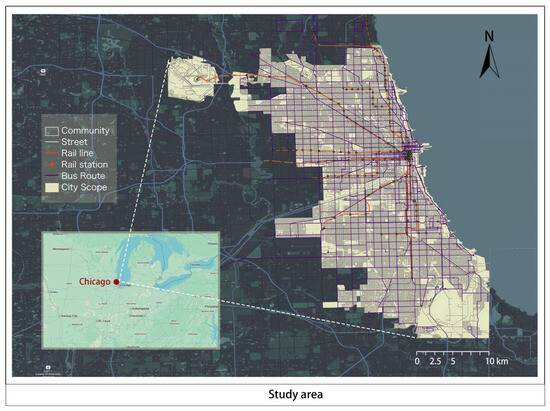
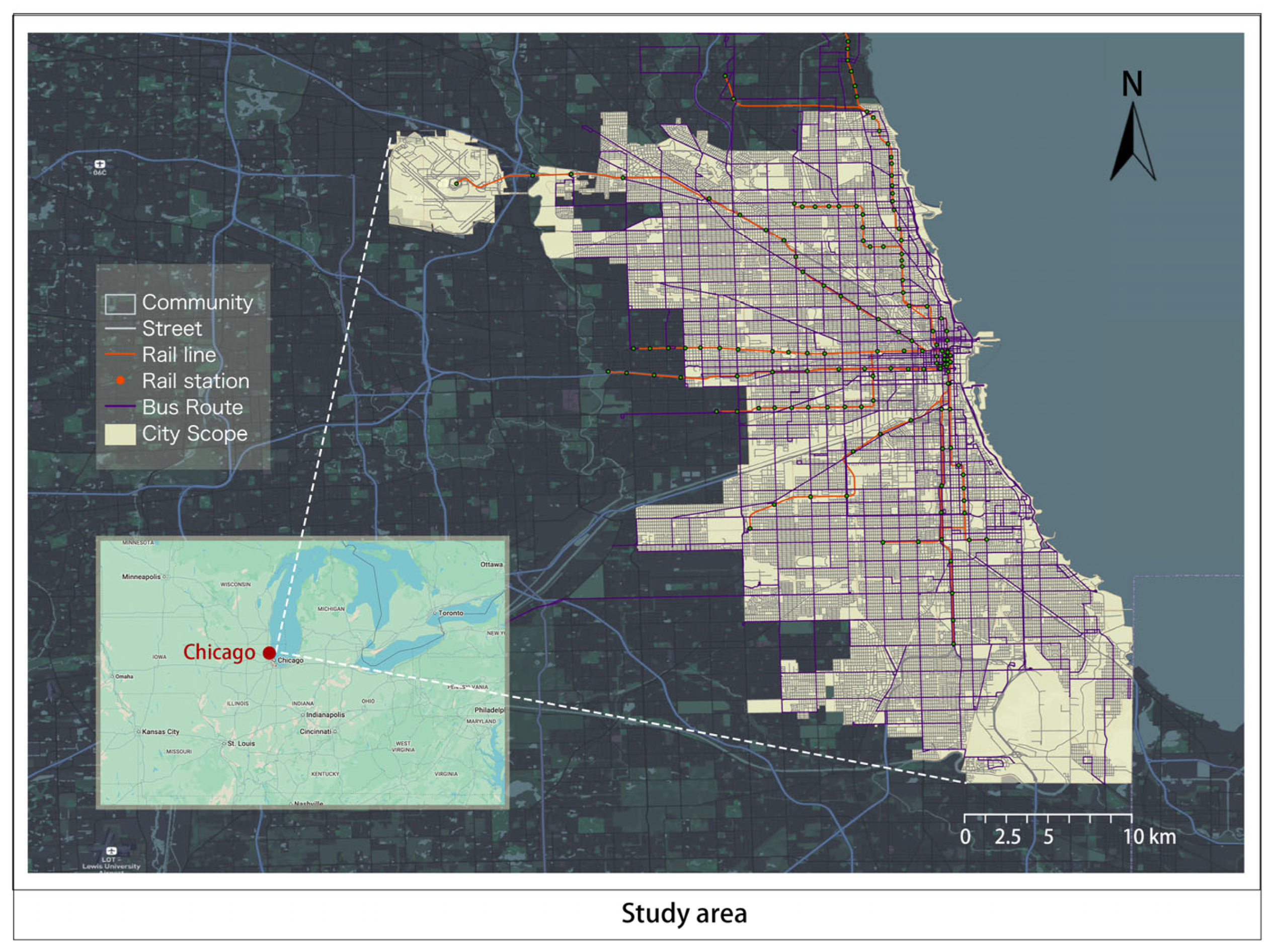
Chicago, as the third largest city in the United States, has become an ideal dynamic case for this study due to several key features. First, Chicago exhibits a certain degree of social and demographic diversity as well as spatial differentiation, featuring the characteristics of major global metropolitan areas. It has a population of over 2.7 million, which come from diverse racial backgrounds (29.2% are black or African Americans, and 33.3% are white [33], according to the 2022 American Community Survey (ACS) 5-year estimates, approximately 17.2% of Chicago residents lived below the federal poverty line. This diversity provides a valuable context for assessing fairness in environmental perception and resource allocation. Second, Chicago is currently confronted with typical urban process challenges low economic growth, widespread racial inequality, constantly and increasingly aging infrastructure, an aging and diverse population, etc. The city has made significant investments in green infrastructure and sustainable urban development, while addressing budget constraints and diverse community needs, offering valuable insights into how cities can balance Environmental development with place Governance. Third, the land use structure of Chicago is conducive to this study. Most of the land in Chicago is dedicated to residential areas and utility and transportation corridors [33], And various types of urban green Spaces, including park and street greening, etc. [34]. The diverse land use attributes are conducive to the comparison of differences in investment and greening structures among different types of regions. Overall, these factors make Chicago a rich and suitable environment for studying the intersection of urban greening, equity and social perception (Figure 1).
Figure 1.
Study Area.
2.2. Data
Urban road network data were obtained from OpenStreetMap (OSM), which pro-vides detailed and openly accessible street geometry for urban analysis. We processed the OSM road network in Python 3.8 using GeoPandas to repair invalid geometries, remove duplicated or irrelevant segments, and prepare street centerlines for distance-based sampling. This road-network preprocessing established a consistent spatial framework for generating streetscape sampling locations. We used Google Street View (GSV) as the imagery source because it offers standardized street-level coverage and supports a re-producible workflow that can be transferred to other cities beyond Chicago.
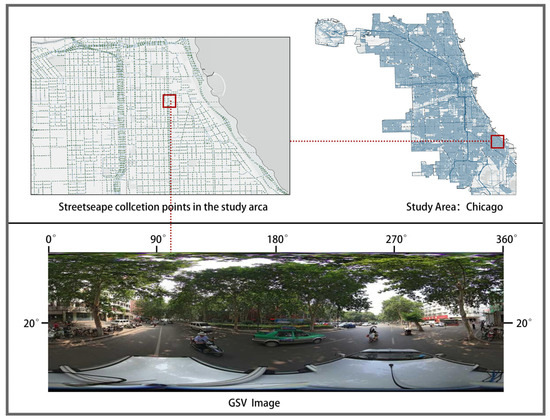
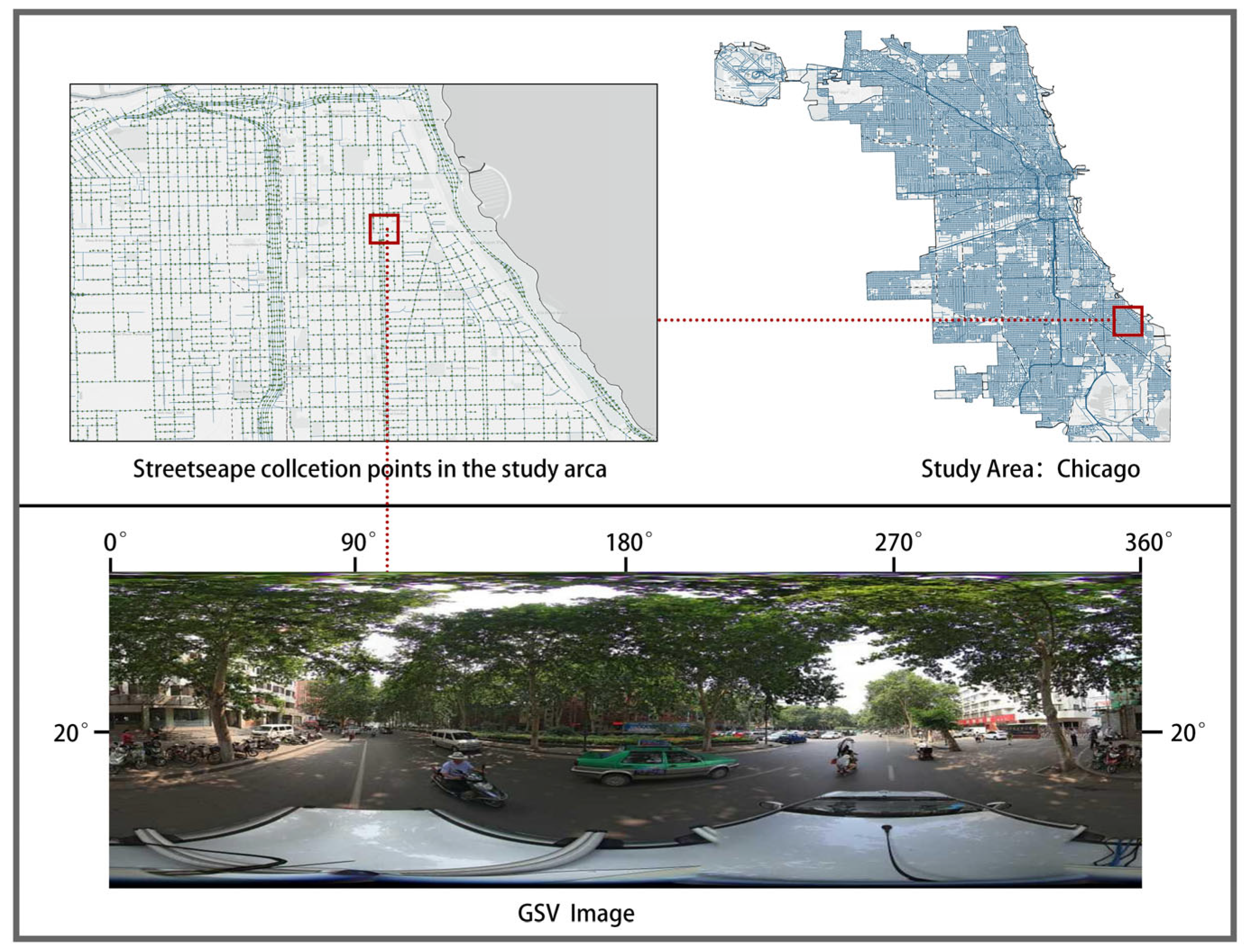
Based on the cleaned road network, we generated evenly spaced capture points along street centerlines in ArcGIS 10.8 at 50 m intervals, yielding 101,489 candidate lo-cations. These points were cleaned to ensure diverse representation across different street segments, neighborhoods and urban types in Chicago. We then crawled GSV imagery for each retained capture point using a Python based script that queries the Street View service by geographic coordinates and records the returned panorama metadata (e.g., panorama ID and capture status) to ensure traceability between locations and images. For points with valid coverage, multiple directional street view images were downloaded and stitched into panoramic images at a resolution of 2560 × 1440 pixels. In total, 734,592 street view images and 91,824 panoramic images were collected within the ten years from 2013 to 2023, to minimize the influence of extreme seasonal conditions on vegetation visibility, we screened and excluded street view images captured during the non-growing season, enabling high-definition visualization of urban details, which is vital for analyzing the structure of urban greening (Figure 2).
Figure 2.
Panoramic Street View Collection Process.
In addition, in this study, various socio-economic and social attribute data were selected to comprehensively explore the relationship between urban street greening equity and residents’ perceptions. Socio-economic attribute data provide key information about the economic conditions, income distribution, educational levels, and employment status of urban areas. These factors may directly affect the allocation of street greening resources in different regions. These data were primarily sourced from the American Community Survey (ACS) and local government statistical publications. social attribute data, including population size, gender ratio, age distribution, and ethnic composition, provide important perspectives for analyzing street greening equity and perception. This type of data was primarily sourced from the U.S. Census Bureau (Census), ACS, and local government statistics (Table 1).
Table 1.
Chicago Social Attribute Data Description.
The six perceptual dimensions are derived from the widely adopted and validated MIT Place Pulse 2.0 framework. Together, they cover key psychological dimensions relevant to urban greening equity. Although they vary in polarity (positive vs. negative), this design is intentional to comprehensively capture the complexity of environmental experience, thereby serving as critical affective indicators for assessing perceived justice in street space within this study. These data will help us better understand the relationship between urban street greening equity and perception, providing data support for urban planning and greening policies. By using these data, we can explore how different social groups, and regional characteristics affect residents’ perceptions of street greening, thereby providing evidence for improving urban greening equity and enhancing residents’ quality of life.
3. Methodology
3.1. Construction of Semantic Segmentation Model and Urban Street Sensing Model Based on DeepLabV3+
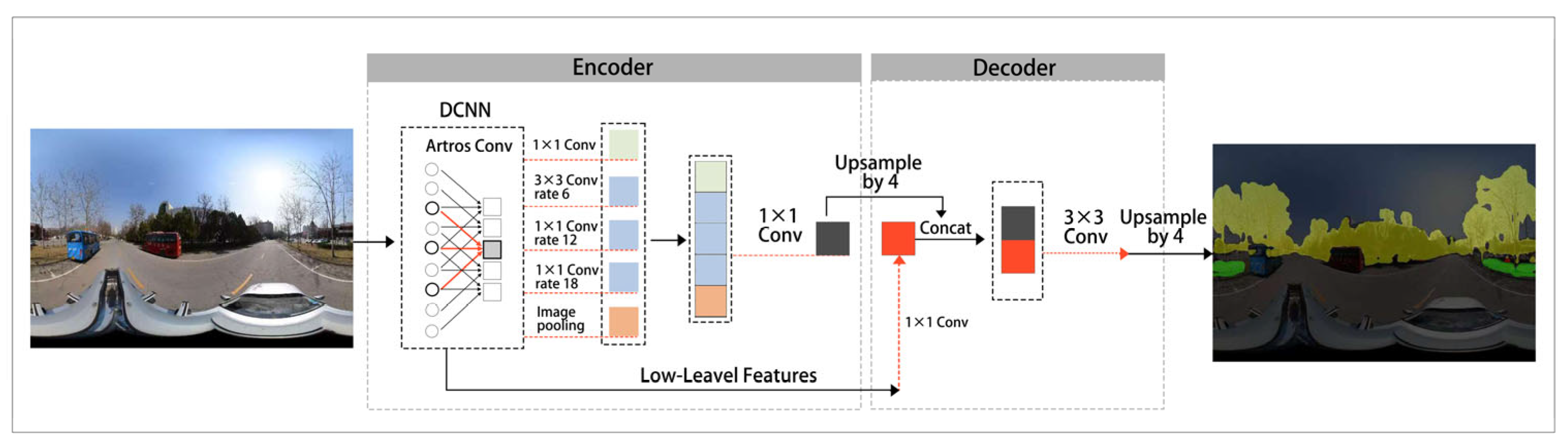
In this study, we used DeepLabV3+ for semantic segmentation of Google Street View (GSV) panoramas to extract streetscape elements, especially vegetation components. DeepLabV3+ is an encoder–decoder semantic segmentation framework proposed by Chen et al. (2018) [26]. In our implementation, DeepLabV3+ adopts a modified X ception backbone as the encoder and a lightweight decoder that fuses high-level semantic features with low-level spatial features to refine edges and restore details, producing a per-pixel class probability map through a softmax output (Figure 3).
Figure 3.
The process of DeepLabV3+ neural network model.
Based on the segmentation outputs, we constructed an urban street sensing procedure that converts pixel-level predictions into interpretable greening indicators. For each panorama, the predicted label map was used to compute the coverage ratio of each vegetation layer by counting the proportion of pixels belonging to the corresponding class. We focus on Tree, Bush, and Grass to represent the vertical layering of street greenery. These coverage ratios were then used to quantify the generalized street greening structure and to distinguish common structural compositions, including Single Tree (S-T), Tree–Bush (T-B), and Tree–Bush–Grass (T-B-G). This design provides a transparent link between model outputs and the downstream equity analysis, because all greening structure variables are directly computed from the segmentation maps rather than inferred indirectly.
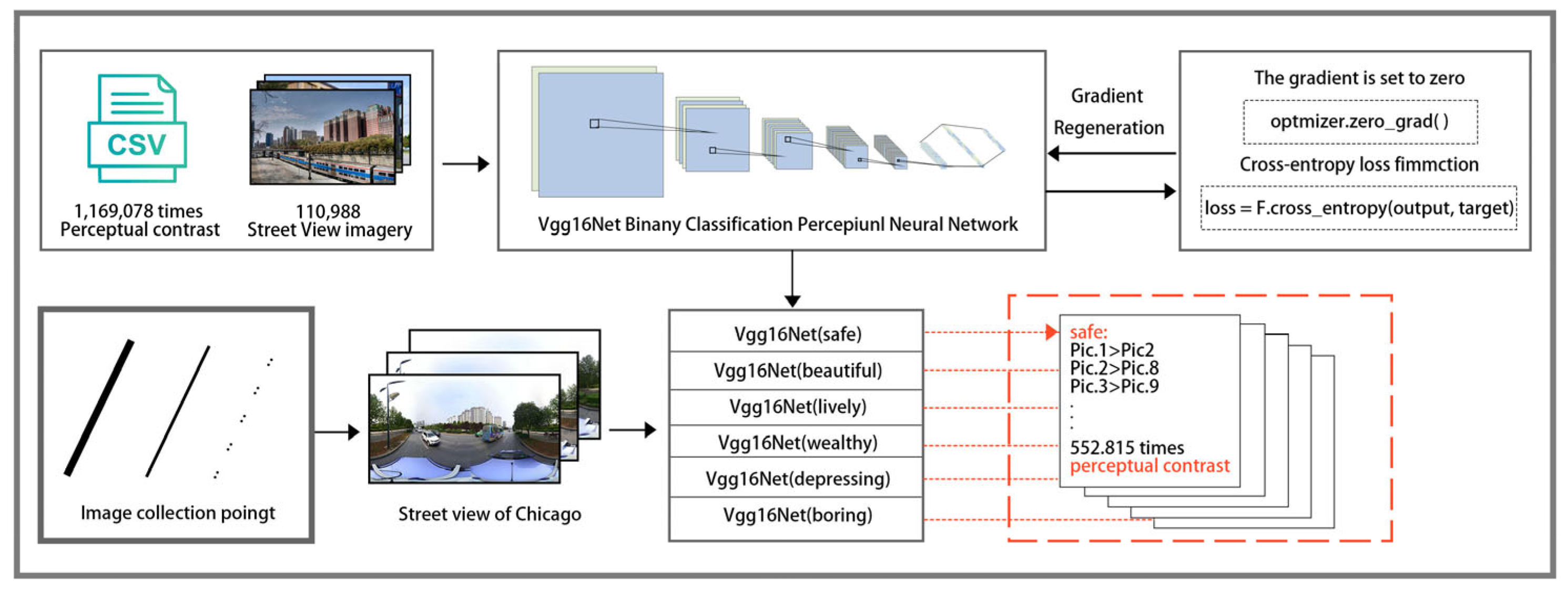
Following semantic segmentation, this study employed VGGNet, developed by the Visual Geometry Group at the University of Oxford, due to its simple and stable architecture for image representation learning. We implemented a perception network based on VGG16, which extracts hierarchical visual features using repeated 3 × 3 convolutions and max pooling, which is suitable for capturing streetscape patterns related to perceived safety, esthetics, and affective qualities. Compared with earlier classification networks, VGG16 provides a deeper feature hierarchy and strong transferability, which supports learning perception-related visual cues from large-scale street-view data.
Using the MIT Place Pulse dataset, we prepared pairwise comparison samples for six perception indicators. Each training sample contains a pair of street-view images and a binary outcome indicating which image “wins” the comparison for a given perception dimension. The network was trained as a binary classifier for each perception indicator using cross-entropy loss and backpropagation (Figure 4). The trained model outputs the probability that one image is perceived as safer, more lively, more beautiful, wealthier, more depressing, or more boring than the other image, which mimics the human pairwise evaluation process. The prediction accuracies on the training and validation sets were safety (81.25%), liveliness (78.13%), beauty (84.37%), wealth (81.25%), depression (81.25%), and boredom (7%).
Figure 4.
The process of VggNet neural network model.
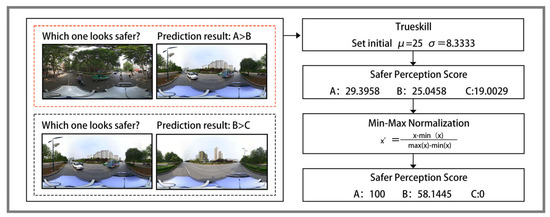
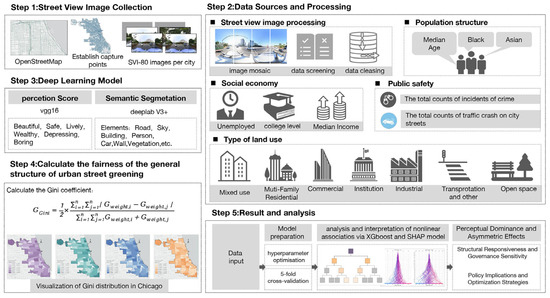
Since the perception results are derived from pairwise image comparisons, this study applies the Microsoft TrueSkill algorithm to rank the images and generate perception scores. (the original technical report is available at https://www.microsoft.com/en-us/research/publication/trueskilltm-a-bayesian-skill-rating-system-2/, accessed on 12 February 2024). The algorithm assumes that the perception score for each street view image follows a normal distribution N (µ, σ2), where the expected µ is set to 25 and the standard deviation σ is 25/3 across all images. In our study, 459,120 pairwise comparisons (five times the number of street view images) were made among 91,824 images. The resulting perception scores were then normalized and mapped to a [0, 1] range for further spatial econometric analysis. For example, if the safety comparisons indicate A > B and B > C, the normalized scores would satisfy A > B > C, and a rescaled illustration could yield 1.00 for A, 0.5814 for B, and 0.00 for C (Figure 5), consistent with transitive ordering and probabilistic updating.
Figure 5.
An example of TrueSkill algorithm computation.
3.2. Weighted Gini Coefficient to Calculate Greening Equity in Urban Street Space
The Gini coefficient is a tool for measuring inequality, commonly used to evaluate the disparity in wealth or resource distribution. To assess the distributive equity of street greening resources, we employed the Gini coefficient and its graphical representation, the Lorenz curve, standard metrics in economics for measuring inequality in resource or income distribution. We compute greening equity using a population-weighted Gini coefficient following standard inequality measurement formulations [35]. Specifically, the Gini coefficient reflects the degree of uneven distribution of street greening (GVI, Green Vegetation Index) across different regions, while the weighted Gini coefficient further accounts for population density, giving more importance to areas with higher populations in the calculation. The Lorenz curve provides a visual complement to the Gini coefficient. In our application, the x axis represents the cumulative proportion of the population, and the y axis represents the corresponding cumulative proportion of the total street greening resources (as measured by the Green View Index, GVI). The line of perfect equality (a 45-degree diagonal) would indicate that each percentile of the population receives the same percentile of greening resources. This approach allows for a more accurate evaluation of the fairness of green space distribution across different regions.
First, we define the greening index for each region, which is obtained from the semantic segmentation of the GVI, and weight it based on the population density of each region. The population of each region is denoted as and the total population of the city is from these, we calculate the population weight for each region, given by the formula:
Next, we calculate the weighted greening index Gweight,i for each region using the formula:
Then, the weighted Gini coefficient is used to calculate the inequality in the distribution of urban street greening resources. The formula for the weighted Gini coefficient is:
In this formula, the numerator represents the sum of the absolute differences between the weighted greening indices of all region pairs (The analytic units are the census tracts of the contiguous United States):
The denominator represents the sum of all pairs of weighted greening indices:
By calculating the differences between these weighted greening indices, the weighted Gini coefficient quantifies the inequality in the distribution of urban street greening resources. A lower Gini coefficient indicates a more equal distribution of green space across regions, while a higher Gini coefficient suggests an uneven distribution, with resources concentrated in certain areas. The reason for using this method is that it incorporates the population factor, giving more weight to areas with larger populations and thus better reflecting the actual demand for green space. This method allows for a more accurate assessment of the equity of urban greening resources and provides data support for the formulation of more sustainable and equitable urban greening policies.
3.3. Construction of Clustering Model with XGboost + SHAP Regression Model
In this study, we use the Extreme Gradient Boosting (XGBoost) algorithm combined with SHAP (Shapley Additive Explanations) values to perform a regression analysis of urban street greening equity. XGBoost is a gradient boosting algorithm that builds an ensemble of decision trees to predict outcomes [27]. It minimizes a loss function, typically the mean squared error for regression tasks, and includes a regularization term to prevent overfitting. The objective function is expressed as:
When is the loss function, is the true value, is the predicted value, and is the regularization term. The XGBoost algorithm effectively handles complex and nonlinear relationships, making it well-suited for analyzing urban data that include multiple socio-economic and environmental variables.
To interpret the model outputs, SHAP values are applied. SHAP provides a consistent and theoretically grounded approach for quantifying the contribution of each feature to the model’s predictions, based on Shapley values from cooperative game theory [36]. The Shapley value for a feature is calculated as:
where is the set of all features, is a subset of features excluding and is the model’s prediction using only the features in subset . By applying SHAP, we gain insight into how different urban factors such as population density, economic conditions, and public amenities contribute to the outcomes of each cluster.
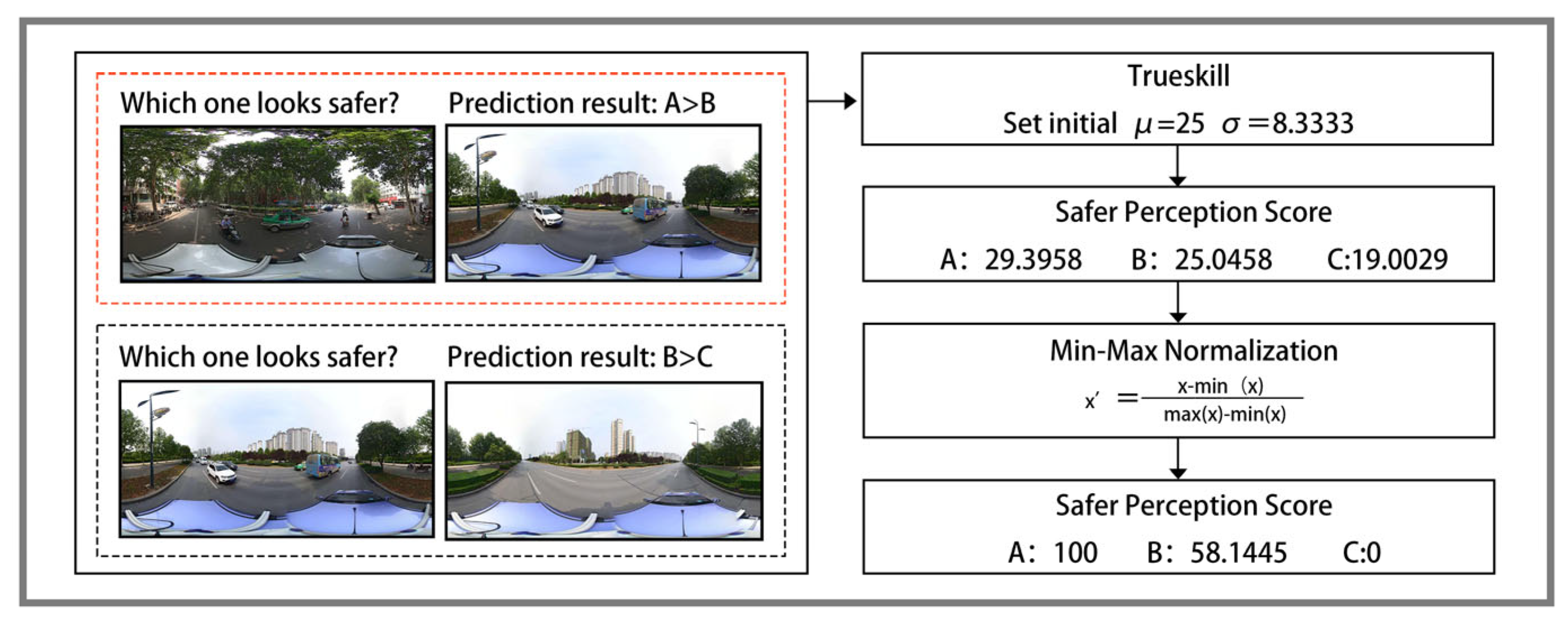
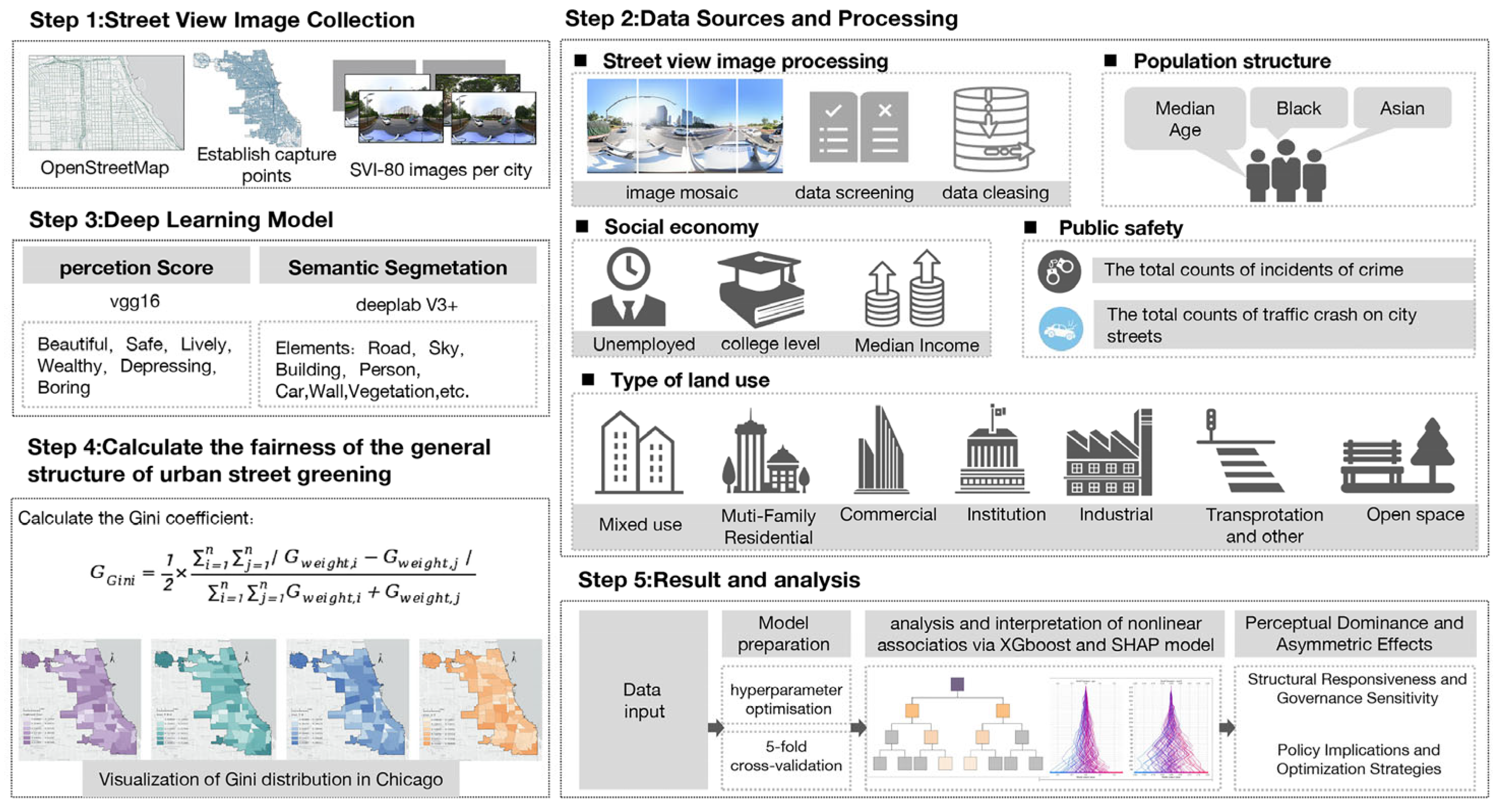
By combining XGBoost and SHAP, the analysis captures both predictive accuracy and interpretability. XGBoost identifies nonlinear interactions among factors such as population structure, economic status, land use composition, public safety, and perceptual scores, while SHAP explains how each of these variables contributes to changes in the population-weighted Gini coefficient, evaluate the relative importance and direction of each variable’s contribution. This integrated approach enables a comprehensive understanding of the socio-economic and perceptual mechanisms shaping street-greening equity in Chicago and provides a robust analytical framework for identifying policy-relevant drivers of urban environmental fairness (Figure 6).
Figure 6.
Research design and research framework.
4. Results
4.1. The Spatial Distribution of Greening Equity in Chicago
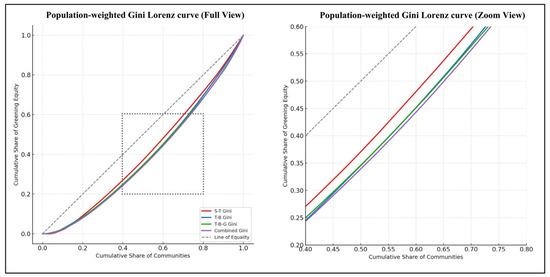
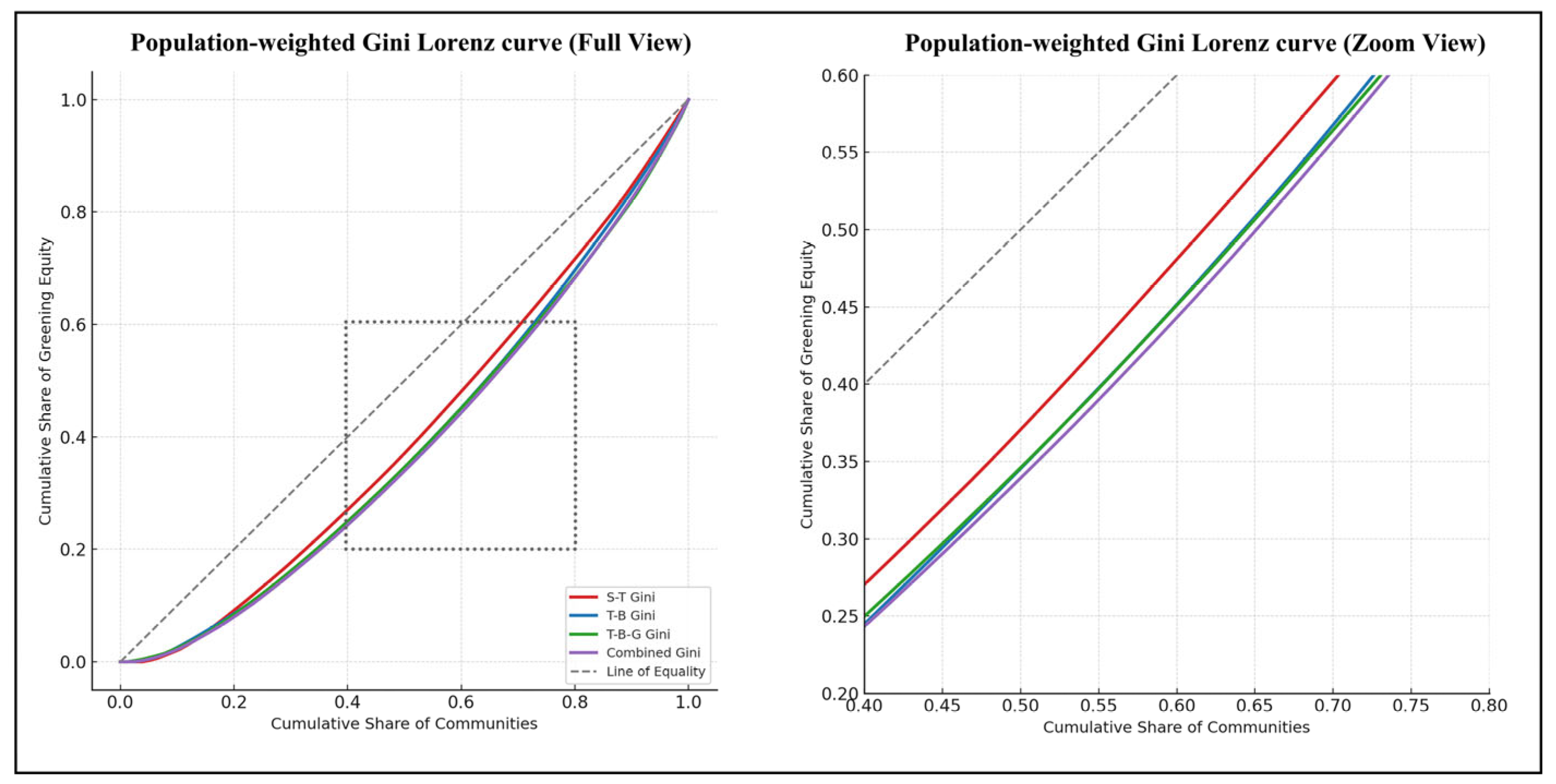
The population-weighted Lorentz curves (Figure 7) and the derived Gini coefficients (Methodology, Section 3.2) reveal significant spatial differentiation in the fairness of street greening in Chicago. This inequality is mainly driven by the uneven distribution of multi-layer vegetation structures with higher ecological benefits (such as T-B-G), rather than simply single-layer tree coverage. The left panel shows the overall distribution of greening equity among the seventy-seven community areas, while the right panel magnifies the range between 0.4 and 0.8 on the x-axis and 0.2 and 0.6 on the y-axis to highlight detailed differences. All four curves deviate from the line of equality, indicating the existence of inequality in the distribution of street greening resources. The S-T Gini curve lies closest to equality, reflecting a uniform but ecologically limited distribution of single trees. By contrast, the T-B-G and Combined Gini curves show greater deviation, indicating that multi-layer vegetation, while ecologically valuable, is concentrated in fewer communities. The population-weighted approach further reveals that densely populated areas do not necessarily receive proportionally greater greening benefits. The average Combined Gini value, approximately 0.32, indicates a moderate yet spatially uneven pattern of greening equity. These results demonstrate that while single-layer tree structures appear more evenly distributed relative to population, complex multi-layer vegetation systems provide greater ecological value but are spatially concentrated in fewer districts.
Figure 7.
Chicago GINI Lorenz Curve.
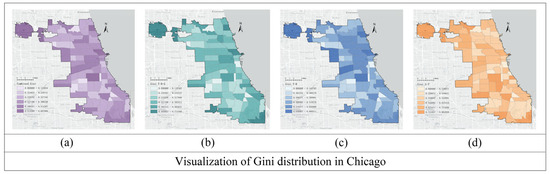
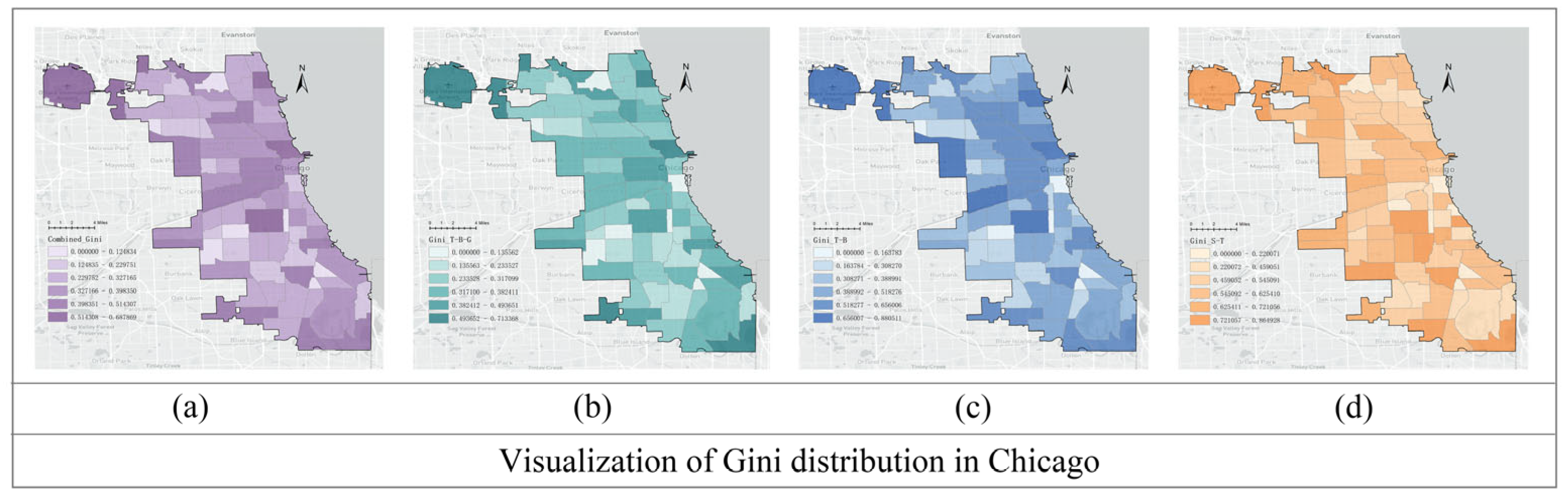
Figure 8 visualizes the spatial distribution of the population-weighted Gini coefficients for four greening structure categories—Combined_Gini, T-B-G_Gini, T-B_Gini, and S-T_Gini. The results reveal clear heterogeneity across the city. Communities in the northern and southern peripheries generally show lower Gini values, suggesting more balanced allocation of vegetation, while central and western districts display higher inequality where commercial and industrial land uses constrain planting space and disrupt the continuity of street vegetation. Among the structural types, S-T_Gini demonstrates the lowest inequality, consistent with its relatively uniform but simple distribution. T-B_Gini shows moderate inequality, reflecting partial structural improvement but persistent imbalance between arterial and local streets. T-B-G_Gini and Combined_Gini exhibit the highest values, representing the most uneven distribution of multi-layer vegetation. Thus, the spatial variation in greening equity is not only extensive but also structurally dependent, with complex configurations being spatially limited despite their greater ecological contribution.
Figure 8.
Visualization of Gini distribution in Chicago. (a) Combined_Gini; (b) T-B-G_Gini; (c) T-B_Gini; (d) S-T_Gini.
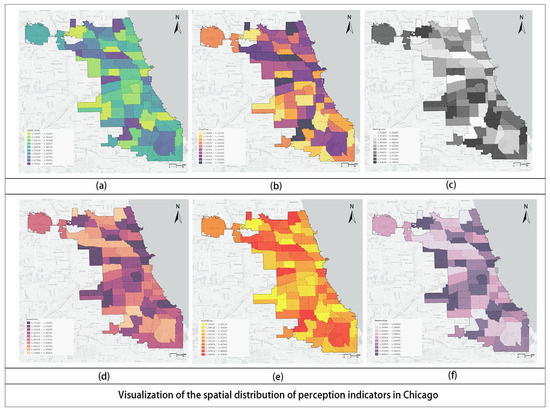
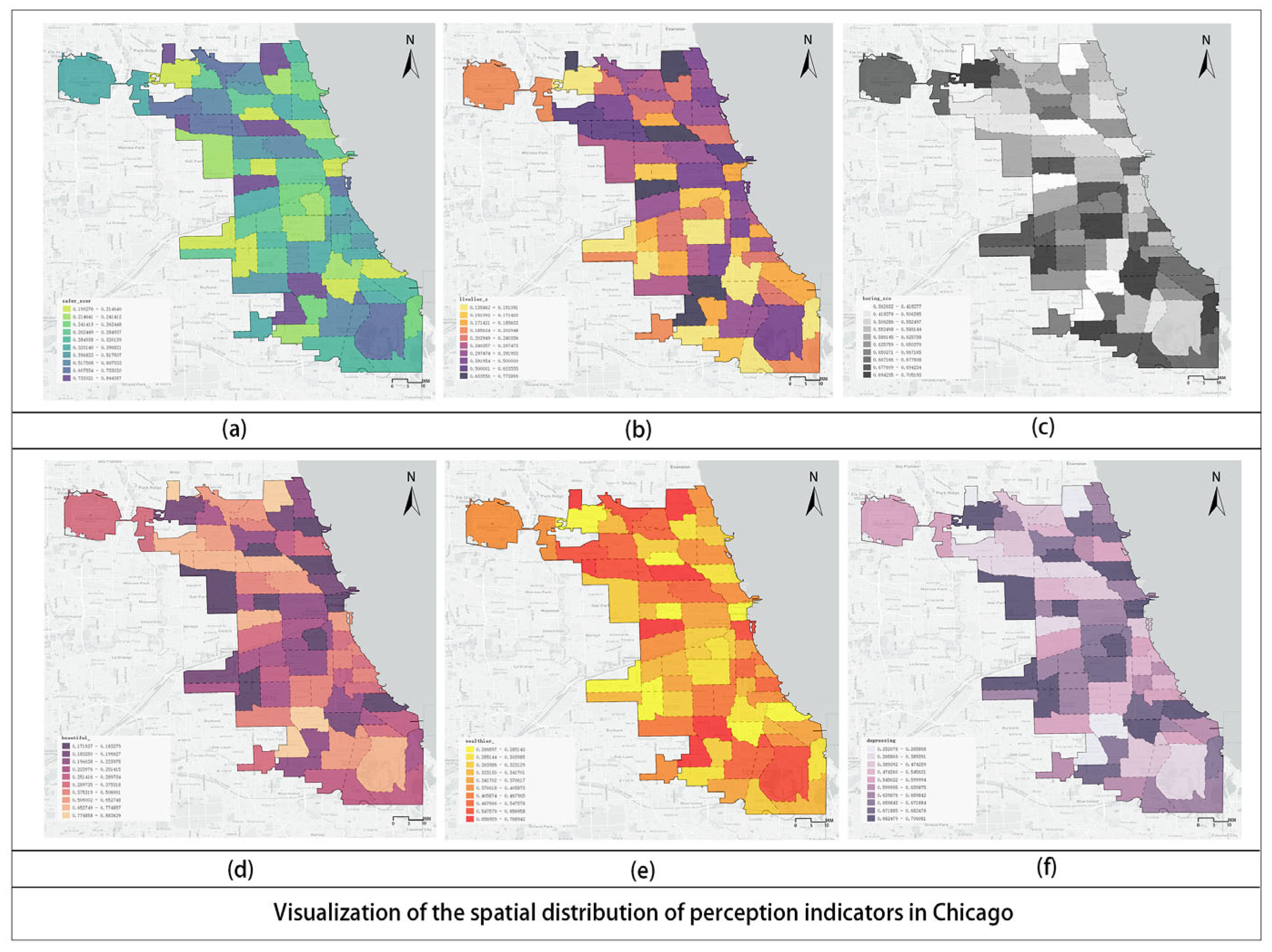
Figure 9 shows the distribution of six perception indicators derived from the Urban Street Perception Index (USPI): Beautiful, Safer, Livelier, Wealthier, Boring, and Depressing. Comparing Figure 8 and Figure 9 reveals that communities with lower Combined_Gini (higher equity) correspond to higher ‘Beautiful’ and ‘Safer’ scores, while areas with higher inequality (simplified vegetation) correlate with stronger ‘Boring’ and ‘Depressing’ perceptions. The alignment suggests that residents’ perception of urban streets reflects both visual quality and the underlying equity of greening distribution. Perceptual quality improves where vegetation is sufficiently available and evenly distributed, whereas fragmented or monotonous greening tends to generate negative perception.
Figure 9.
Visualization of the spatial distribution of perception indicators in Chicago. (a) Safer; (b) Livelier; (c) Boring; (d) Beautiful; (e) Wealthier; (f) Depressing.
In summary, the spatial analysis shows that equity in Chicago’s urban street greening depends on both the configuration and allocation of vegetation. Population-weighted Gini coefficients reveal significant disparities among communities and distinct inequality patterns across vegetation layers. The correspondence between positive perception and low Gini values confirms that urban greening equity cannot be evaluated solely by vegetation quantity; it must also incorporate structural continuity and spatial fairness. These findings establish the empirical foundation for subsequent analysis of structural typologies and perceptual differences in Section 4.2.
4.2. Structural Typologies and Their Perceptual Correlates
The study demonstrates that greening structural complexity is a key mediator variable linking street equity and perceptual quality. Communities with T-B-G configurations achieve the highest scores in both equity and perception, whereas S-T configurations are associated with greater inequality and more negative perceptions. The analysis of structural typologies provides further insight into how vegetation composition shapes equity and perception across Chicago’ street environments. Three dominant types of Urban Street Greening Structure (USGS) are identified: Single Tree (S-T), Tree-Bush (T-B), and Tree-Bush-Grass (T-B-G). The classification is based on the dominant vegetation composition within each community, defined as the vegetation layer with the highest proportional coverage extracted from semantic segmentation results. This typological approach allows for systematic comparison of spatial equity and perceptual outcomes under different greening configurations.
The results reveal distinct differences in the degree of equity among the three structural types. S-T configurations appear more evenly distributed across space but exhibit lower ecological value and limited perceptual quality. These areas are concentrated in the central and western districts, where dense urban development and limited planting space have long constrained vegetation continuity. T-B structures show moderate inequality, reflecting partial improvement in vegetation layering but ongoing imbalance between primary and secondary streets. T-B-G structures record the lowest Combined_Gini values, suggesting the most balanced distribution of greening among the three types. However, this apparent equity often coincides with low overall vegetation coverage, indicating that the balance achieved in many T-B-G communities is one of uniform scarcity rather than abundance. These findings demonstrate that the structural complexity of street vegetation directly determines both the degree and the quality of spatial equity.
Perceptual outcomes vary systematically across structural types. S-T dominated communities show lower scores in Beautiful and Safer and higher scores in Boring and Depressing. The monotony and fragmentation of single-layer vegetation reduce both esthetic appeal and perceived comfort. T-B communities achieve intermediate perceptual scores, benefitting from additional shrubs that enhance enclosure and visual depth. T-B-G communities record the highest Beautiful and Safer scores, corresponding to stronger visual richness and perceived security. Nevertheless, where overall vegetation coverage remains limited, perceptual improvement is modest, indicating that structural diversity alone is insufficient without adequate greening provision. The interplay between quantity and complexity of vegetation thus shapes residents’ sensory and emotional responses to the streetscape.
The spatial distribution of these structural types also reflects underlying socioeconomic conditions. S-T dominated areas are often associated with high-density residential or industrial zones, where insufficient greening maintenance reinforces negative perception. In contrast, T-B-G dominated areas are more common in middle-income residential neighborhoods with moderate population density and stable land use, where consistent public investment supports both ecological and perceptual quality. This relationship between vegetation structure, urban form, and social context highlights that equity and perception in street greening are co-determined by environmental design and community characteristics.
The comparative analysis of structural types confirms that vegetation layering is a one of the central determinants of both fairness and perception in urban streetscapes. S-T configurations correspond to higher inequality and weaker positive perception, whereas T-B-G systems achieve more balanced and visually appealing outcomes. Structural diversity therefore acts as a key intermediary connecting physical greening patterns with residents’ perceptual experience. These results establish the conceptual foundation for the regression-based mechanism analysis presented in Section 4.3.
4.3. Perception-Driven Mechanisms of Equity
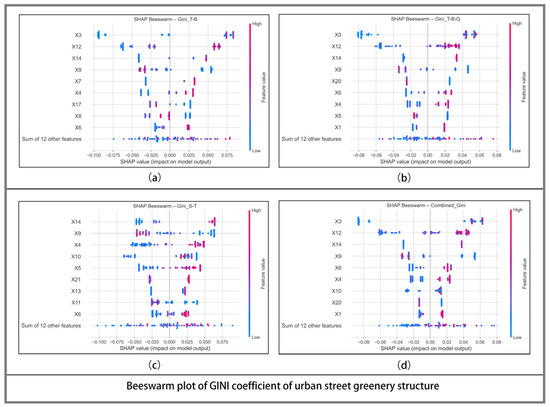
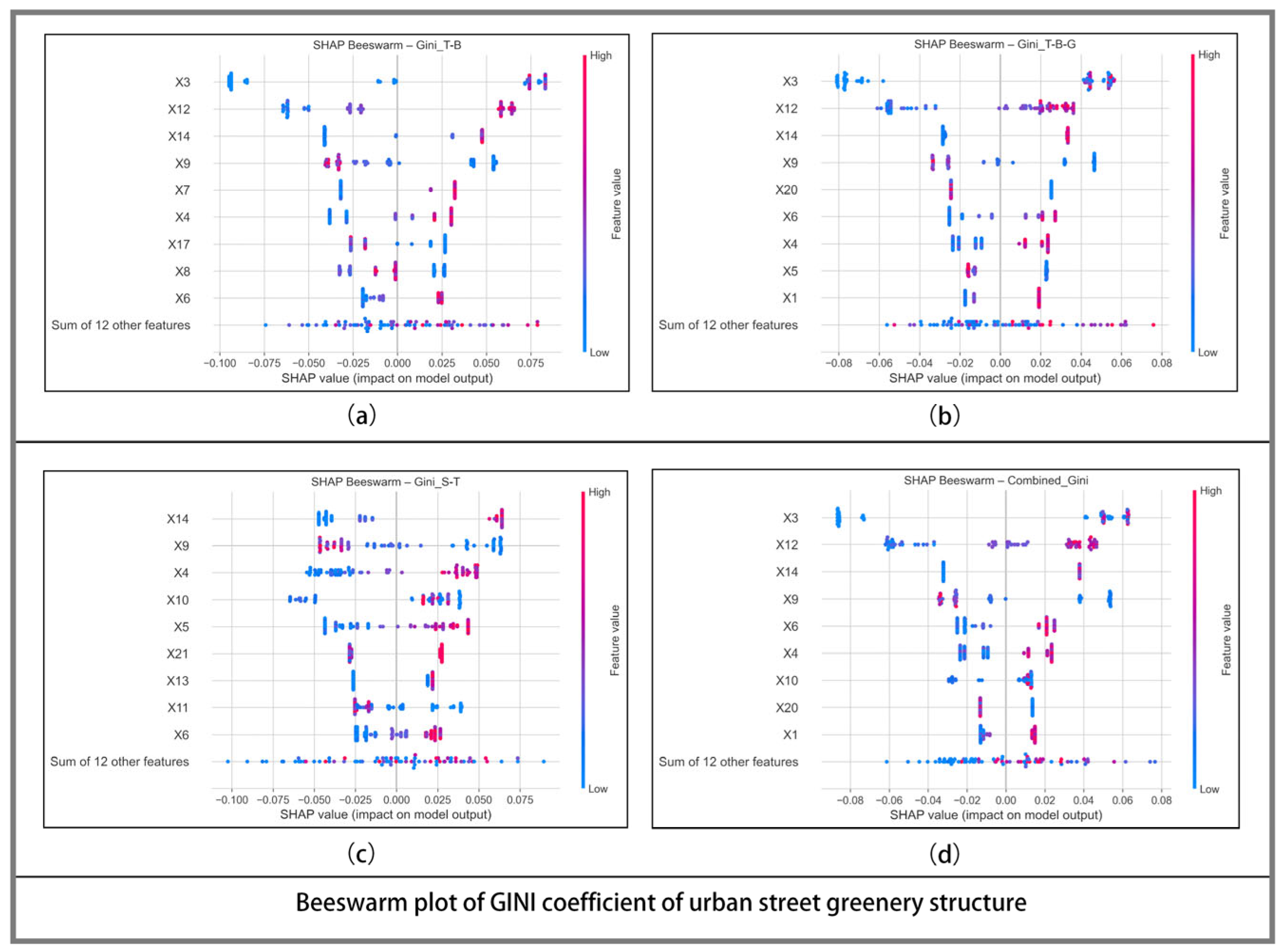
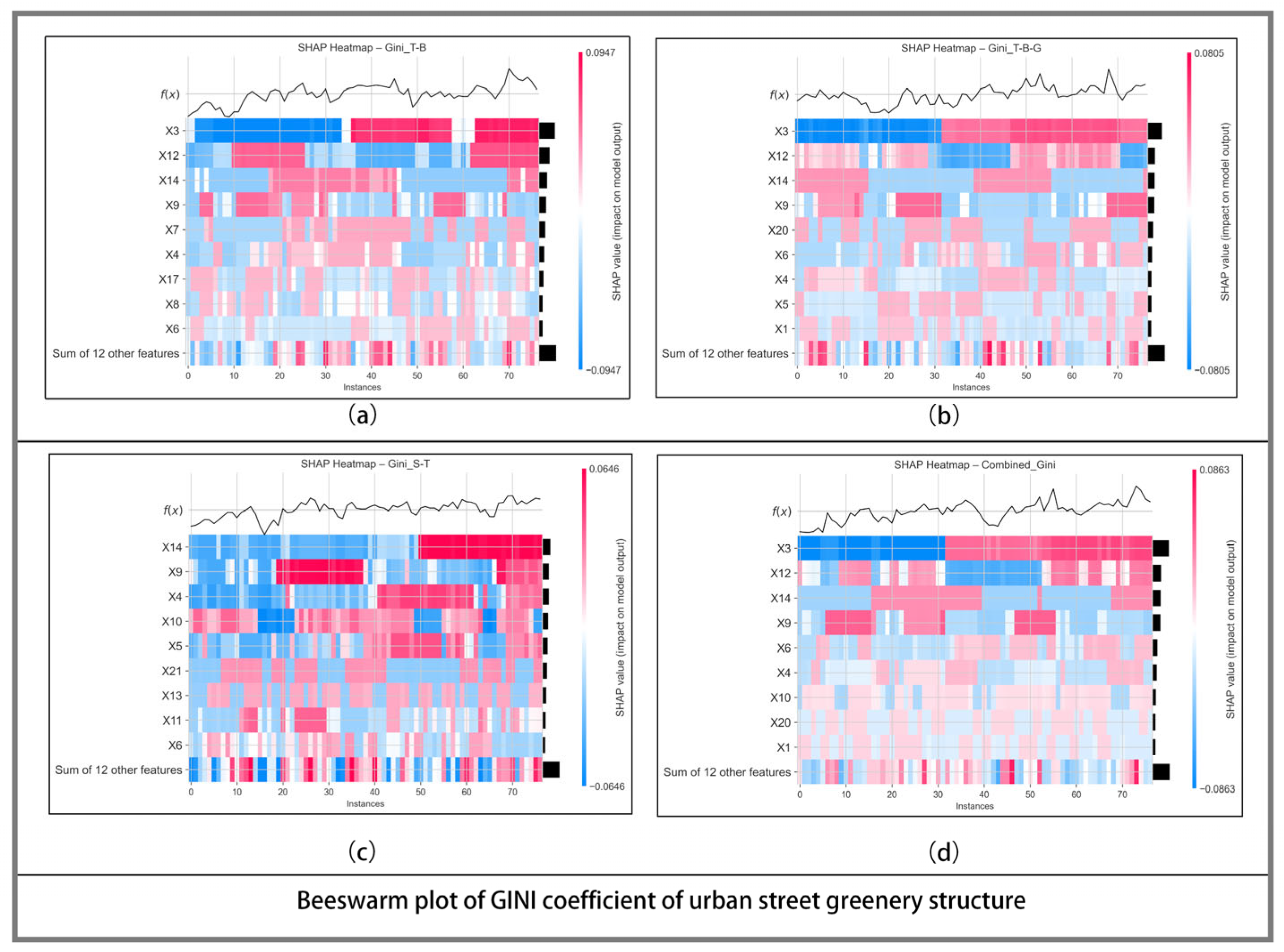
This section examines how perceptual and structural factors jointly influence the equity of urban street greening in Chicago. The mechanism analysis based on XGBoost and SHAP demonstrates that residents’ perceptual experience of streets is the most critical factor driving greening equity, with an influence that surpasses that of socioeconomic indicators alone. Among these perceptions, positive ones (such as beauty and safety) act as steady forces promoting equity, while negative perceptions (such as depression and boredom) exhibit a “nonlinear threshold effect” that intensifies inequality. Figure 10 presents the Beeswarm plot summarizing SHAP values for all variables in the Combined_Gini model. The results demonstrate that perceptual factors dominate the explanation of greening equity. Among them, Beautiful and Safer have strong negative SHAP values, showing that higher levels of positive perception are associated with lower inequality. In contrast, Boring and Depressing display strong positive SHAP values, meaning that higher negative perception corresponds to increased inequality. Structural variables also play a substantial role: greater T-B-G coverage and vegetation diversity contribute to lower Gini values, whereas dominance of single-tree (S-T) vegetation increases inequality. Socioeconomic indicators such as income and education contribute modestly compared with perceptual and structural factors, confirming that equity in street greening depends primarily on perceptual and physical attributes rather than demographic differences.
Figure 10.
Beeswarm Plot of Chicago. (a) Beeswarm Gini_T-B; (b) Beeswarm Gini_T-B; (c) Beeswarm Gini_S-T; (d) Beeswarm Combined_Gini.
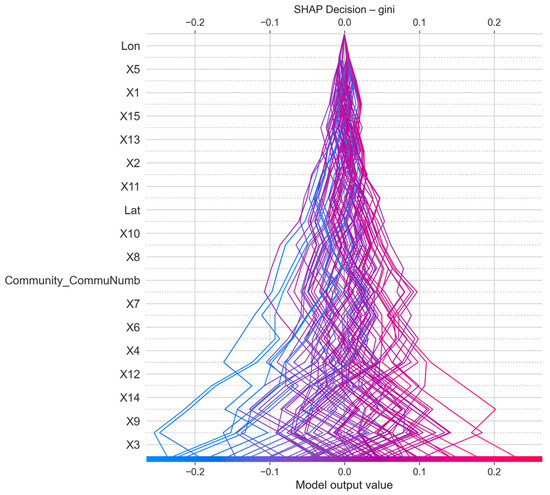
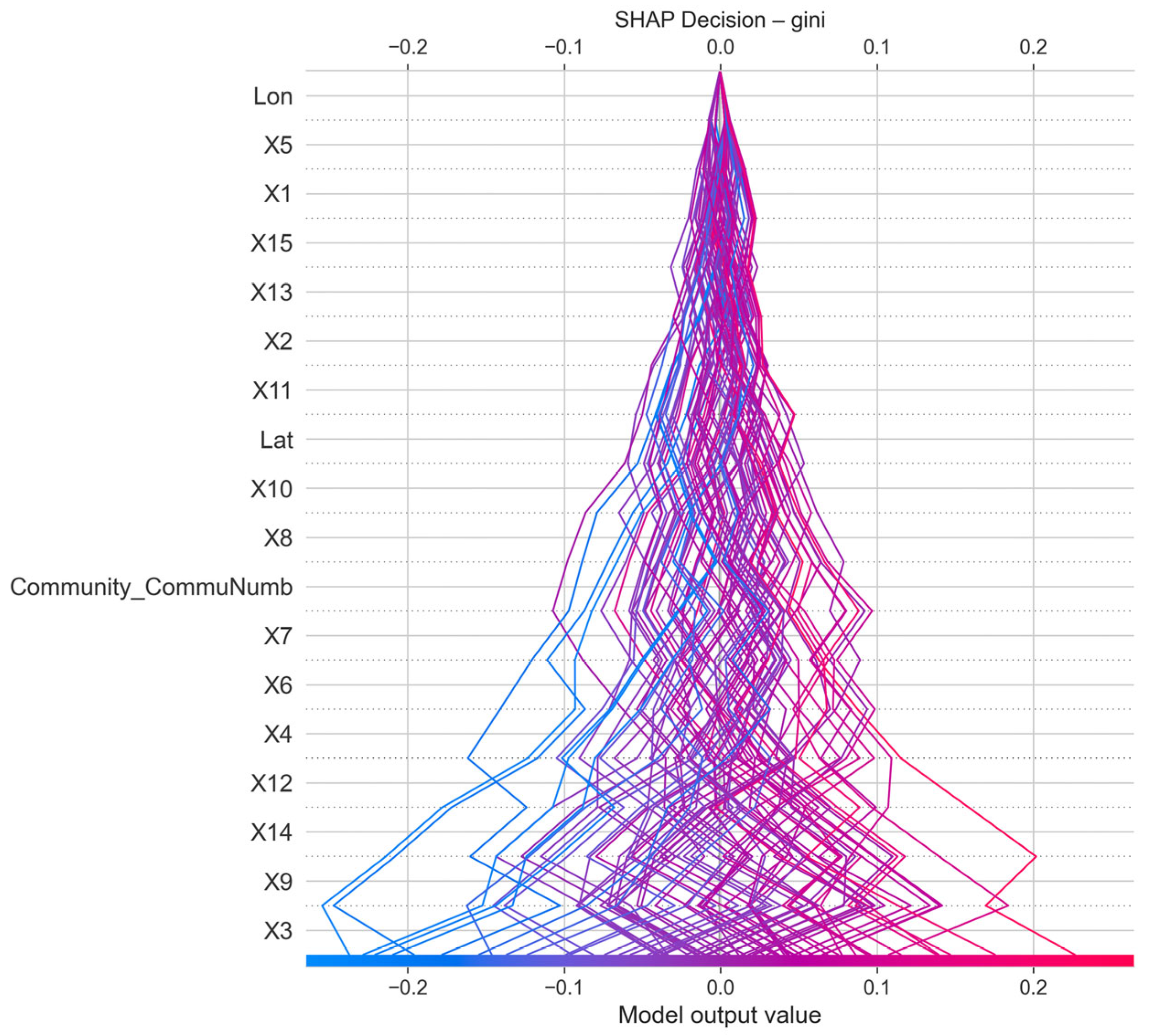
Figure 11 presents the SHAP decision plot illustrating how different socio-economic, land use, and perceptual variables influence the predicted Combined_Gini values. The results show that inequality in street greening is shaped by multiple interacting factors. Among socio-economic attributes, communities with higher median income (MEDINC, X6) and larger shares of Asian residents (ASIAN, X3) tend to exhibit lower predicted Gini coefficients, indicating that economic stability and demographic diversity are associated with fairer greening distributions. In contrast, higher unemployment rates (UNEMP, X4) and greater proportions of industrial or transportation land (INDperc, X11; TRANSperc, X12) increase inequality, reflecting structural disadvantages in less residential or heavily built-up areas. Land use intensity also plays a significant role: a higher share of commercial land (COMMperc, X9) is linked to higher Gini values, implying that business-dominated districts tend to concentrate greening resources unevenly, while greater proportions of open space (OPENperc, X13) contribute to reducing inequality by expanding accessible vegetation coverage. Perceptual indicators show the strongest and most direct effects, as higher Beautiful (X19) and Safer (X16) scores correspond to lower Gini coefficients, confirming that positive visual and emotional experiences coincide with more equitable greening. Negative perceptions such as Depressing (X21) and Boring (X18) raise Gini values, suggesting that visual discomfort and social detachment amplify inequity. Crime_Count (X14) also contributes positively, indicating that insecurity disrupts both perception and the spatial fairness of greening. Overall, the SHAP decision plot reveals that greening equity in Chicago is jointly determined by social composition, land use structure, and residents’ perceptions, where positive perceptual conditions and balanced land uses promote fairness, while economic stress, commercial concentration, and negative perception exacerbate spatial inequality.
Figure 11.
SHAP Decision-Gini Plot of Chicago.
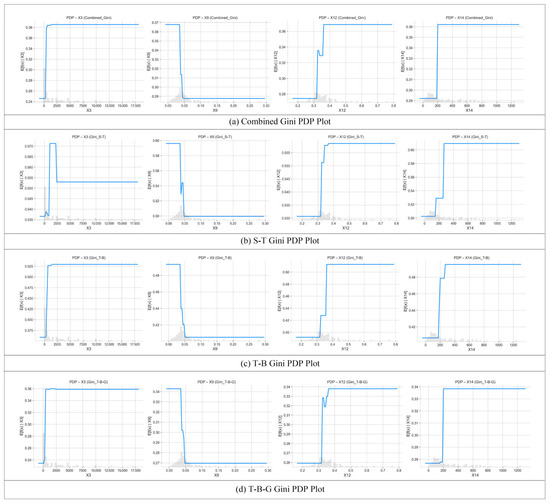
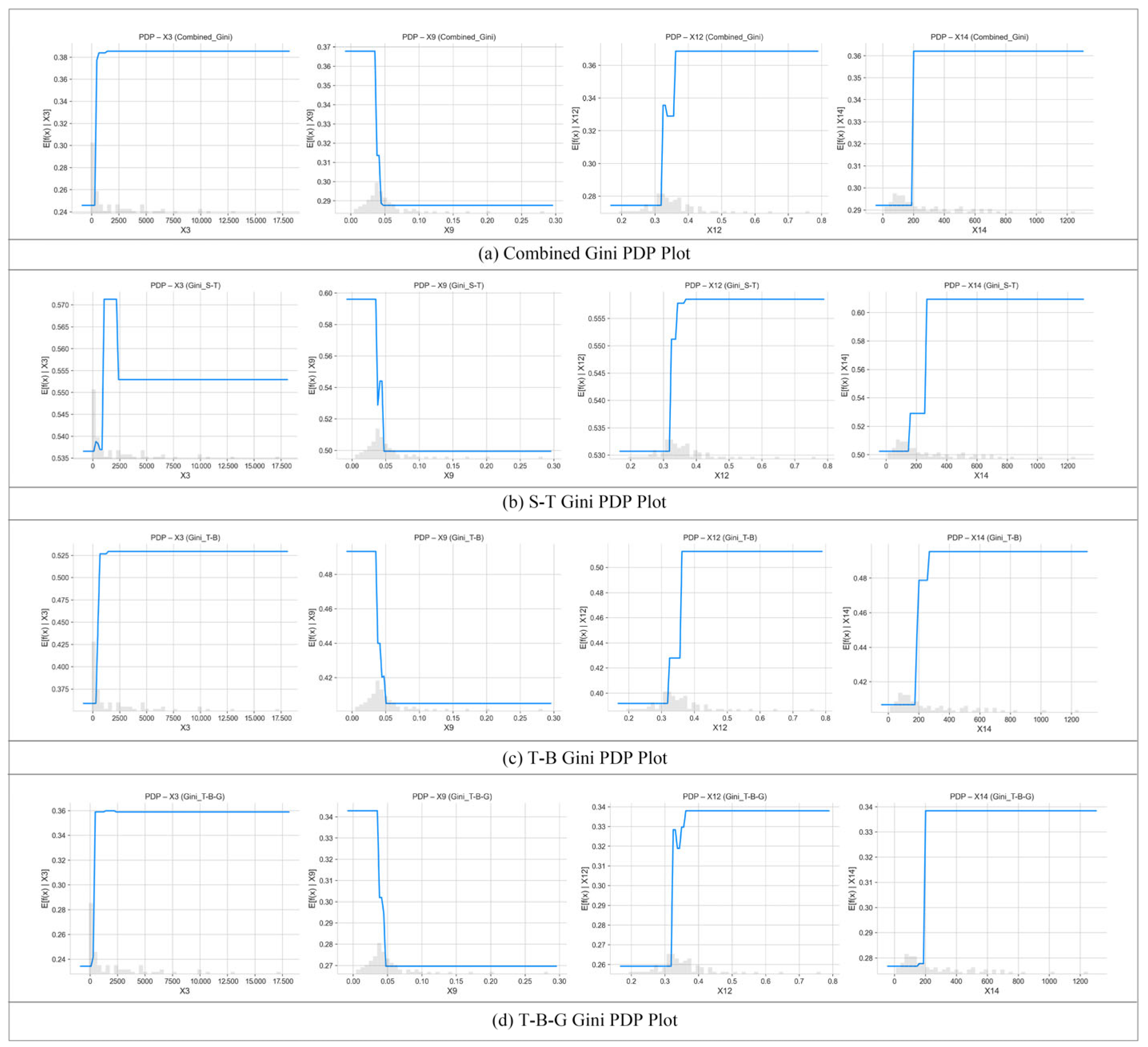
Figure 12 illustrates the partial dependence of population-weighted Gini coefficients on four explanatory variables: Asian population share (X3), commercial activity intensity (X9), transportation accessibility (X12), and crime incidents (X14), across different structural configurations including Combined, S-T, T-B, and T-B-G. The results reveal nonlinear responses of greening equity to socio-economic and environmental contexts, complementing the SHAP-based findings. In the Combined and T-B-G models, Gini values increase with higher commercial activity and transportation accessibility, suggesting that intense economic and mobility activity tends to aggravate spatial inequality. However, Gini values increase beyond moderate thresholds of crime incidents, indicating that social instability weakens greening fairness even in structurally complex systems. The S-T model maintains consistently high Gini values across all variable ranges, reflecting its limited capacity to buffer socio-economic disparities and its high sensitivity to external variation. The T-B model shows moderate equity improvement under increasing transportation and commercial activity, but this trend plateaus under high urban intensity. Overall, these patterns demonstrate that urban street-greening equity is jointly shaped by social composition, economic vitality, and safety conditions, with structural complexity enhancing stability, while socially vulnerable or high-crime areas remain prone to persistent inequality regardless of vegetation quantity.
Figure 12.
GINI Partial Dependence Plot (PDP) of Chicago. (a) Combined Gini PDP; (b) S-T Gini PDP; (c) T-B Gini PDP; (d) T-B-G Gini PDP.
Figure 13 visualizes the interaction effects between key variables using heatmaps. Areas with higher beautiful perception and larger proportions of T-B-G vegetation correspond to lower Combined_Gini values, indicating that positive perception aligns with more balanced greening in structurally complex areas. Conversely, high Depressing perception combined with dominant S-T configurations corresponds to higher Gini values, reflecting stronger inequality in visually monotonous and structurally simple environments. These patterns suggest that perceptual and structural factors jointly shape the spatial fairness of street greening. Good visual satisfaction and social participation encourage further investment and maintenance in street greening, thereby promoting the formation and fair distribution of a good street vegetation structure. Negative views, however, hinder such efforts and perpetuate spatial differences. This results from Figure 9, Figure 10, Figure 11 and Figure 12 collectively demonstrate that the mechanisms influencing equity in urban street greening are primarily driven by the combined variation in perceptual and economic and social structural attributes rather than by any single dimension.
Figure 13.
Heatmap Plot of Chicago. (a) Heatmap Gini_T-B; (b) Heatmap Gini_T-B; (c) Heatmap Gini_S-T; (d) Heatmap Combined_Gini.
Overall, the regression analysis reveals two essential mechanisms that define the dynamics of street greening equity in Chicago. First, perception exerts an asymmetric influence on equity formation: positive perceptions such as Beautiful and Safer contribute to gradual and sustained improvements, while negative perceptions such as Depressing and Boring trigger abrupt and nonlinear deterioration once they exceed a critical threshold. This pattern underscores the amplifying role of emotional experience in shaping urban environmental fairness. Second, the structure of vegetation reflects the degree of influence of perception on spatial design and multi-party management, as well as its decision-making reference value. Complex T-B-G configurations often align with stronger positive perceptions, indicating that fairer greening outcomes emerge where governance capacity and spatial design are more adaptive to residents’ sensory and psychological needs. Together, these findings suggest that achieving equitable urban greening requires both perceptual and institutional responsiveness, rather than physical adjustment alone.
5. Discussion
5.1. Interpreting the “Matthew Effect” of Perception on Equity
The results reveal that perception is the decisive factor influencing the equity of urban street greening in Chicago. Similar patterns of street-level greening inequality have been reported in recent international studies using Green View Index (GVI) and Gini-based assessments in cities such as Hangzhou and Fuzhou in China, indicating that uneven exposure to visible greenery is a widespread urban phenomenon rather than a city-specific condition [37,38].These finding challenges conventional views of fairness that rely primarily on material distribution or environmental quantity. However, existing research has pointed out that lower perceived economic mobility has an inhibitory effect on pro-environmental behavior, Equity in the urban context depends not only on how greenery is allocated but also on how residents cognitively and emotionally experience it. Perception functions as a social interpretation of spatial reality: it converts visible form into lived meaning. The stability of fairness therefore relies on maintaining a sense of safety, comfort, and beauty within daily urban life. When residents recognize their surroundings as dignified and cared for, social trust in the public realm strengthens, and equitable conditions are more likely to persist.
The positive drive of positive perception and the vicious cycle of negative perception, The dual inequality of green space exposure and perception in high-density built-up areas has been explored in existing studies [39], this two-way amplification effect of perception reflects the psychological imbalance in the current urban environmental experience. Positive feelings such as beauty and safety enhance attachment and participation, but their effects develop gradually through repeated exposure and sustained management. In particular, the identified perceptual “Matthew effect,” in which negative perceptions intensify inequality more rapidly than positive perceptions mitigate it, extends emerging multi-city findings on the disproportionate influence of negative environmental evaluations [40]. This imbalance means that the decline of perception can undo progress more rapidly than improvement can rebuild it. Equity is therefore highly sensitive to the loss of visual and emotional confidence. When people perceive their streets as unsafe or neglected, they reduce their presence in public space, and the collective attention that sustains maintenance weakens. Inequality begins as a perceptual withdrawal before it manifests as physical degradation.
Understanding perception as a dominant force also redefines the relationship between residents and greening structure governances. If fairness depends on how people perceive the environment, then managing perception is a matter of public responsibility. Designer and operator must cultivate environments that project care, consistency, and reliability. This does not involve manipulation of image but the genuine maintenance of conditions that make public space trustworthy. Urban managers need to respond to perceptual feedback with the same urgency as they respond to physical deterioration. Transparent communication, visible maintenance efforts, and timely responses to public concern reinforce confidence and slow the amplification of negative perception. By acknowledging perception as a civic dimension of fairness, governance expands from technical maintenance to ethical stewardship.
The asymmetric nature of perception reveals the fragility of equitable environments under social and economic stress. Once negative evaluations dominate collective discourse, rebuilding fairness requires more than material repair; it requires the restoration of confidence in public life. Urban policy should therefore treat perception as an early indicator of decline and integrate perceptual assessment into all stages of greening management. Interventions that enhance safety, order, and visual quality can prevent inequality before it emerges. Equitable greening is not sustained by physical abundance but by the continuity of positive meaning shared between citizens and their city. Recognizing this principle allows urban governance to move toward a form of fairness that is resilient, perceptually stable, and grounded in everyday experience.
5.2. Site Management Responses: Environmental Recognition Sensitivity and ‘Management—Structure’ Reciprocity
The structural dimension of urban street greening reflects how governance systems sustain fairness through coordination and adaptability. Physical structure is not only an environmental configuration but also a record of management capacity. Areas with complex vegetation layers, such as the combination of trees, shrubs, and grass, usually maintain consistent planning, regular maintenance, and coherent public participation. These conditions demonstrate that fairness in greening depends on the ability of urban institutions to organize long-term effort and maintain spatial coherence. International environmental justice research indicates that persistent greening inequities are often associated with fragmented governance and uneven maintenance capacity, particularly in commercially intensive or infrastructure-dominated areas [41]. Our results build on this perspective by showing that multi-layer Tree–Bush–Grass configurations reflect governance responsiveness and adaptive management rather than vegetation provision alone, aligning with recent discussions on urban visual–spatial intelligence and perceptual feedback in governance systems [42]. This interpretation also echoes the emphasis on social equity in the literature on urban greening and residents’ cognition, ensuring that all residents can enjoy the benefits of urban green Spaces while avoiding the exclusion of vulnerable groups due to green gentrification [43]. The continuity of structure, rather than its complexity alone, is what signals a governance system capable of maintaining equity under changing urban conditions.
Whether one can sensitively and accurately identify changes in the site’s environmental conditions and promptly make adjustment responses to a certain extent determines whether fairness can be maintained when external pressure occurs. Economic fluctuation, social transformation, or policy neglect can quickly undermine spatial balance if management practices remain rigid. Responsive governance requires flexibility in planning and the ability to identify emerging disparities before they accumulate. Effective institutions use continuous observation and feedback to guide adjustments in maintenance and resource allocation. Existing studies have discussed that Urban Vision-spatial Intelligence (UVSI) by integrating human perception and sensor perception can effectively enhance the effectiveness and responsiveness of urban management systems [42]. When cities are able to act promptly on early signs of decline—such as declining vegetation quality or community dissatisfaction—they prevent spatial inequities from becoming structural. Fairness in this sense is maintained not through expansion but through vigilance and timely action.
The responsiveness of site governance is also reflected in the operation and maintenance structure, which requires the ability to comprehensively interact and feedback from the natural environment to the social regulation process, that is, structured governance based on site adaptability. The coexistence of different vegetation forms within one city indicates that planning agencies can integrate technical knowledge with local context. When governance systems are sensitive to site-specific conditions, they generate patterns of diversity that correspond to both ecological requirements and community expectations. Homogeneity, in contrast, often reflects administrative rigidity and a lack of attention to local needs. The ability to maintain variation without disorder demonstrates maturity in urban governance, where structure serves as an outcome of institutional learning and collective coordination rather than as an isolated design choice.
From a policy perspective, strengthening structural responsiveness requires embedding continuous monitoring and multi-departmental cooperation within urban management routines. Maintenance data, street-view imagery, and public surveys should be integrated into a single decision-making platform. This allows environmental conditions and public feedback to be evaluated simultaneously. Budgetary mechanisms need to reserve capacity for rapid interventions in declining areas, ensuring that resource allocation aligns with real-time conditions rather than static plans. Institutional coordination between departments of greening, community affairs, and urban safety can prevent policy fragmentation and promote consistent standards across neighborhoods. A governance system that recognizes structure as a reflection of institutional awareness can sustain fairness more effectively than one that relies solely on physical investment.
5.3. Policy Implications for Responsiveness and Equitable Governance
The findings indicate that urban greening equity depends on two complementary dimensions: the “Matthew effect” of perception and the Site governance responsiveness. These dimensions operate together rather than sequentially, forming a framework in which environmental experience and institutional performance reinforce each other. Recent global reviews of urban green space equity research emphasize that distributive fairness cannot be adequately evaluated through quantitative provision alone, but must also account for lived experience, perception, and governance capacity [41,44]. In line with this international shift, our findings highlight the importance of integrating perceptual monitoring into adaptive street greening governance frameworks. This approach is in line with the concept of adaptive governance, emphasizing that when policymakers plan, they should not only consider the quantity of green Spaces in the physical environment but also pay attention to their fit with people’s actual daily activity scenarios [45]. Policy efforts should therefore move beyond physical expansion and emphasize how management systems sustain perceptual quality under changing social and economic conditions.
This study indicate that the environmental perception status should be taken as a reference condition for spatial quality and participatory design. Streets and neighborhoods that show low levels of esthetic satisfaction or safety should be treated as priority zones for intervention. Upgrading lighting, maintaining vegetation continuity, improving sidewalk comfort, and ensuring regular cleaning can immediately enhance perceptual quality. In addition, establishing community maintenance teams and feedback channels allows residents to express concerns about environmental conditions and to participate in monitoring. Such participation increases the visibility of management actions and fosters a sense of shared responsibility. By maintaining direct communication between residents and local authorities, cities can stabilize perceptual confidence and prevent the spread of negative evaluation.
The second policy direction focuses on strengthening environmental governance sensitivity and dynamic adjustment function. Urban management should incorporate real-time assessment tools that combine street-view imagery, environmental sensors, and field observation to monitor both vegetation condition and public feedback. When early signs of deterioration appear, maintenance and budget priorities should be adjusted promptly. Coordination between departments responsible for greening, transport, and community affairs can prevent fragmented decision-making and ensure consistent spatial quality. A responsive management framework enables small and timely adjustments that sustain fairness without requiring large-scale reconstruction. In this system, administrative awareness and rapid response are as important as technical capacity.
The third recommendation involves the institutionalization of monitoring and evaluation systems that integrate perceptual and structural data. Establishing a city-level greening observatory would allow policymakers to track environmental performance, public satisfaction, and social equity simultaneously. The results should be published regularly to increase transparency and public trust. Training programs for local officials and contractors can improve their ability to interpret perceptual data and incorporate it into everyday management. Long-term equity depends on maintaining this open feedback loop in which residents’ experiences inform policy refinement and institutions act with continuity and accountability. Urban greening policy must therefore evolve toward a governance model that values awareness, cooperation, and sustained attention as much as physical construction.
5.4. Limitation
Nevertheless, here are several limitations related to the methodology and data application that need to be addressed in future research. (1) Seasonal and annual variations in the collection time of street-view imagery affect the consistency of vegetation visibility and perceptual scores, particularly when comparing across climate zones; (2) The perception models are trained on global datasets and may not fully capture evaluation differences arising from local cultural and socio-demographic characteristics; (3) Reliance on open data sources (e.g., OpenStreetMap) and a single street-view imagery platform imposes constraints in terms of data update frequency and spatial coverage consistency; (4) Although the deep learning and machine learning models used exhibit strong predictive performance, their complex structures somewhat reduce model interpretability and the reproducibility of the methodology.
To address the limitations identified in this study on urban landscape perception, future research should focus on several key strategies for improvement. (1) Integrate multi-temporal street-view and remote sensing imagery to conduct longitudinal analysis capturing vegetation phenological changes and equity dynamics; (2) Calibrate perception models with localized survey data to enhance cultural sensitivity and contextual validity; (3) Incorporate multi-source urban data (e.g., municipal GIS, drone imagery, crowdsourced photos) to improve data coverage and robustness; (4) While maintaining predictive performance, explore more interpretable model architectures or combine experimental techniques such as eye-tracking technology and immersive virtual environments to validate and deepen the understanding of perceptual mechanisms.
5.5. Future Scope
Building upon the findings and addressing the limitations of this study, future research on distributional inequalities in urban greening may pursue three interconnected directions to advance both theoretical understanding and practical solutions. Frist, Expanding the Scope of Influential Factors. Future research should investigate a broader set of potential drivers of greening inequality beyond those examined in this study. Factors such as historical policy legacies, community organizing capacity, informal governance arrangements, and local cultural preferences for green space design may significantly shape distributional outcomes. Integrating these dimensions could provide a more contextualized and multi-layered explanation of why inequities persist and how they might be addressed through targeted interventions. Second, while this study relied primarily on quantitative and computational techniques, future work would benefit from combining these with qualitative methods. In-depth interviews, focus groups, and participatory mapping with residents, planners, and maintenance staff could uncover the lived experiences, decision-making processes, and institutional barriers that numbers alone cannot capture. It is also possible to incorporate three-dimensional data such as EEG tracking into the verification and evaluation process of greening structure distribution equity. The adoption of a multi-dimensional methodological design will help validate model-derived insights, clarify causal mechanisms, and ensure that equity strategies are grounded in local knowledge and needs. Third, Cross-regional comparative study. Applying the proposed framework to cities with different climatic, cultural and governance backgrounds, testing its universality and improving its theoretical basis, and conducting systematic comparisons among cities in different regions, governance models or development levels, is conducive to determining the universal principles and specific environmental factors for forming green equity, and obtaining more adaptive and transferable policy solutions.
6. Conclusions
The equity of urban street greening represents a critical dimension of environmental justice, linking spatial design with residents’ daily experiences and institutional performance. This study addressed the central question of how residents’ perceptual experiences and institutional sensitivity interact to produce or undermine the equity of urban street greening. The findings reveal that fairness in urban greening is not determined solely by physical provision but is continuously shaped by the psychological stability of perception and the adaptability of governances. Understanding this interaction is essential for advancing equitable, inclusive, and resilient cities where the distribution of green resources aligns with both environmental quality and collective well-being.
This research applied a deep learning and machine learning framework to evaluate the multi-layered structure and perceptual dimensions of street greening in Chicago. The USGGS was extracted through the improved DeepLabV3+ neural network model, and a regular clustering model was constructed using MATLAB 2024b to further subdivide the multi-layer structure distribution of trees—shrubs—grasses. On this basis, combined with the population-weighted Gini coefficient, the study integrated physical, perceptual, and social data into a unified equity assessment system. The use of XGBoost regression and SHAP interpretability provided quantitative insights into how perceptual and structural factors influence fairness, while the newly introduced Partial Dependence Plot (PDP) analysis identified nonlinear relationships and structural thresholds. This comprehensive approach advances urban greening research by linking environmental data with human experiences, offering a replicable model for evaluating equity in other metropolitan contexts.
Two key findings emerge from the analysis. First, perception exerts the “Matthew effect” on green equity formation. Positive perceptions such as beauty and safety gradually enhance fairness, while negative perceptions such as depression and boredom rapidly erode it once they surpass a threshold. This demonstrates that equity depends on perceptual stability and social trust rather than physical abundance alone. Second, the Site governance responsiveness embedded in vegetation structure determines whether fairness can persist under stress. Complex Tree–Bush–Grass configurations correspond to stronger institutional coordination and more balanced outcomes, while single-layer structures often indicate administrative rigidity. These findings suggest that equitable greening requires simultaneous attention to perceptual confidence and structural responsiveness. Therefore, urban policy should prioritize: the integration of perceptual monitoring into management systems to guide timely interventions; the promotion of structurally complex greening (e.g., Tree-Bush-Grass) to enhance equity; and the establishment of adaptive governance frameworks that can dynamically respond to environmental and social feedback. This calls for embedding continuous perception assessment into green infrastructure planning and creating flexible maintenance systems that respond as dynamically to shifts in community perception. The study provides a foundation for redefining urban greening equity as a dynamic system that depends on both human experience and governance adaptability. Building fair and resilient urban environments ultimately requires integrating perceptual awareness into the institutional logic of planning, ensuring that equity is sustained not only by physical design but also by continuous civic engagement and trust.
Author Contributions
Conceptualization, F.L. and L.Z.; methodology, L.Z. and F.T.; validation, F.L.; formal analysis, F.T. and L.Z.; data curation, F.L. and L.Z.; writing—original draft preparation, F.L.; writing—review and editing, F.L., L.Z. and J.L.; visualization, L.Z. and J.L.; supervision, J.L., Y.H. and Y.K.; funding acquisition, J.L. and F.L. All authors have read and agreed to the published version of the manuscript.
Funding
This research was funded by National Natural Science Foundation of China (NSFC), project title “The Mechanism of Community Public Space Formation Driven by Spatial-Behavioral Adaptation from the View of Informality “, grant number: 52308030. National Natural Science Foundation of China (NSFC), project title “Research on the Construction of Synergistic Mechanism and Generative Methods between Architecture Form and Site “, grant number: 52578036. Natural Science Foundation of Tianjin, project title” The Formation Mechanism and Locality Construction of Public Space in old City Blocks from the View of Informality”, grant number: 25JCQNJC01510.
Data Availability Statement
The data presented in this study are available on request from the corresponding author.
Conflicts of Interest
The authors declare that they have no known competing financial interests or personal relationships that could have appeared to influence the work reported in this paper.
References
- Bowler, D.E.; Buyung-Ali, L.; Knight, T.M.; Pullin, A.S. Urban Greening to Cool Towns and Cities: A Systematic Review of the Empirical Evidence. Landsc. Urban Plan. 2010, 97, 147–155. [Google Scholar] [CrossRef] [Scilit]
- Leibe, B.; Matas, J.; Sebe, N.; Welling, M. (Eds.) Deep Learning the City: Quantifying Urban Perception at a Global Scale. In Computer Vision; Lecture Notes in Computer Science; Springer International Publishing: Cham, Switzerland, 2016; Volume 9905, ISBN 978-3-319-46447-3. [Google Scholar]
- Ewing, R.; Ewing, R. Measuring the Unmeasurable: Urban Design Qualities Related to Walkability. J. Urban Des. 2009, 14, 65–84. [Google Scholar] [CrossRef] [Scilit]
- James, P.; Hart, J.E.; Banay, R.F.; Laden, F. Exposure to Greenness and Mortality in a Nationwide Prospective Cohort Study of Women. Environ. Health Perspect. 2016, 124, 1344–1352. [Google Scholar] [CrossRef] [Scilit]
- Kumakoshi, Y.; Chan, S.Y.; Koizumi, H.; Li, X.; Yoshimura, Y. Standardized Green View Index and Quantification of Different Metrics of Urban Green Vegetation. Sustainability 2020, 12, 7434. [Google Scholar] [CrossRef] [Scilit]
- Li, X.; Zhang, C.; Li, W.; Ricard, R.; Meng, Q.; Zhang, W. Assessing Street-Level Urban Greenery Using Google Street View and a Modified Green View Index. Urban For. Urban Green. 2015, 14, 675–685. [Google Scholar] [CrossRef] [Scilit]
- Deng, L.; Luo, H.; Ma, J.; Huang, Z.; Sun, L.-X.; Jiang, M.-Y.; Zhu, C.-Y.; Li, X. Effects of Integration between Visual Stimuli and Auditory Stimuli on Restorative Potential and Aesthetic Preference in Urban Green Spaces. Urban For. Urban Green. 2020, 53, 126702. [Google Scholar] [CrossRef] [Scilit]
- Li, X. Examining the Spatial Distribution and Temporal Change of the Green View Index in New York City Using Google Street View Images and Deep Learning. Environ. Plan. B Urban Anal. City Sci. 2021, 48, 2039–2054. [Google Scholar] [CrossRef] [Scilit]
- Long, Y.; Liu, L. How Green Are the Streets? An Analysis for Central Areas of Chinese Cities Using Tencent Street View. PLoS ONE 2017, 12, e0171110. [Google Scholar] [CrossRef] [Scilit]
- Liu, D.; Lu, Y.; Wei, D.; Hu, Y. Contrasting Inequalities in Collective Residence-Based and Pedestrian-Based Urban Greenery Exposure with Multi-Sourced Urban Big Data and Deep Learning. Appl. Geogr. 2025, 183, 103743. [Google Scholar] [CrossRef] [Scilit]
- Martin, A.J.F.; Conway, T.M. Using the Gini Index to Quantify Urban Green Inequality: A Systematic Review and Recommended Reporting Standards. Landsc. Urban Plan. 2025, 254, 105231. [Google Scholar] [CrossRef] [Scilit]
- Ma, Y.; Chen, P.; Qin, Y.; Yang, Z.; Li, S. From Sky to Ground: Monitoring Visible Street Greenery via Multisource Remote Sensing Imagery with Deep Learning. Urban For. Urban Green. 2025, 109, 128866. [Google Scholar] [CrossRef] [Scilit]
- Mohai, P.; Pellow, D.; Roberts, J.T. Environmental Justice. Annu. Rev. Environ. Resour. 2009, 34, 405–430. [Google Scholar] [CrossRef] [Scilit]
- Naik, N.; Philipoom, J.; Raskar, R.; Hidalgo, C. Streetscore—Predicting the Perceived Safety of One Million Streetscapes. In Proceedings of the 2014 IEEE Conference on Computer Vision and Pattern Recognition Workshops, Columbus, OH, USA, 23–28 June 2014; IEEE: Washington, DC, USA, 2014; pp. 793–799. [Google Scholar]
- Nesbitt, L.; Meitner, M.J.; Girling, C.; Sheppard, S.R.J.; Lu, Y. Who Has Access to Urban Vegetation? A Spatial Analysis of Distributional Green Equity in 10 US Cities. Landsc. Urban Plan. 2019, 181, 51–79. [Google Scholar] [CrossRef] [Scilit]
- O’Regan, A.C.; Hunter, R.F.; Nyhan, M.M. “Biophilic Cities”: Quantifying the Impact of Google Street View-Derived Greenspace Exposures on Socioeconomic Factors and Self-Reported Health. Environ. Sci. Technol. 2021, 55, 9063–9073. [Google Scholar] [CrossRef] [Scilit] [PubMed]
- Puppala, H.; Tamvada, J.P.; Kim, B.; Peddinti, P.R.T. Enhanced Green View Index. MethodsX 2022, 9, 101824. [Google Scholar] [CrossRef] [Scilit]
- Sánchez, I.A.V.; Labib, S.M. Accessing Eye-Level Greenness Visibility from Open-Source Street View Images: A Methodological Development and Implementation in Multi-City and Multi-Country Contexts. Sustain. Cities Soc. 2024, 103, 105262. [Google Scholar] [CrossRef] [Scilit]
- Seresinhe, C.I.; Preis, T.; Moat, H.S. Using Deep Learning to Quantify the Beauty of Outdoor Places. R. Soc. Open Sci. 2017, 4, 170170. [Google Scholar] [CrossRef] [Scilit]
- Song, J.; Gasparrini, A.; Fischer, T.; Hu, K.; Lu, Y. Effect Modifications of Overhead-View and Eye-Level Urban Greenery on Heat–Mortality Associations: Small-Area Analyses Using Case Time Series Design and Different Greenery Measurements. Environ. Health Perspect. 2023, 131, 097007. [Google Scholar] [CrossRef] [Scilit]
- Zhu, H.; Nan, X.; Yang, F.; Bao, Z. Utilizing the Green View Index to Improve the Urban Street Greenery Index System: A Statistical Study Using Road Patterns and Vegetation Structures as Entry Points. Landsc. Urban Plan. 2023, 237, 104780. [Google Scholar] [CrossRef] [Scilit]
- Tong, M.; She, J.; Tan, J.; Li, M.; Ge, R.; Gao, Y. Evaluating Street Greenery by Multiple Indicators Using Street-Level Imagery and Satellite Images: A Case Study in Nanjing, China. Forests 2020, 11, 1347. [Google Scholar] [CrossRef] [Scilit]
- Twohig-Bennett, C.; Jones, A. The Health Benefits of the Great Outdoors: A Systematic Review and Meta-Analysis of Greenspace Exposure and Health Outcomes. Environ. Res. 2018, 166, 628–637. [Google Scholar] [CrossRef] [Scilit]
- Wang, Y.; Yang, L.; Liu, X.; Yan, P. An Improved Semantic Segmentation Algorithm for High-Resolution Remote Sensing Images Based on DeepLabv3+. Sci. Rep. 2024, 14, 9716. [Google Scholar] [CrossRef] [Scilit]
- Xue, C.; Jin, C.; Xu, J. Inequality in Urban Green Space Benefits: Combining Street Greenery and Park Greenery. PLoS ONE 2022, 17, e0273191. [Google Scholar] [CrossRef] [Scilit] [PubMed]
- Chen, L.-C.; Zhu, Y.; Papandreou, G.; Schroff, F.; Adam, H. Encoder-Decoder with Atrous Separable Convolution for Semantic Image Segmentation. In Computer Vision—ECCV 2018; Springer: Cham, Switzerland, 2018. [Google Scholar]
- Chen, T.; Guestrin, C. XGBoost: A Scalable Tree Boosting System. In Proceedings of the 22nd ACM SIGKDD International Conference on Knowledge Discovery and Data Mining, San Francisco, CA, USA, 13–17 August 2016; ACM: New York, NY, USA, 2016; pp. 785–794. [Google Scholar]
- Friedman, J.H. Greedy Function Approximation: A Gradient Boosting Machine. Ann. Stat. 2001, 29, 1189–1232. [Google Scholar] [CrossRef] [Scilit]
- Biljecki, F.; Ito, K. Street View Imagery in Urban Analytics and GIS: A Review. Landsc. Urban Plan. 2021, 215, 104217. [Google Scholar] [CrossRef] [Scilit]
- Goel, R.; Garcia, L.M.T.; Goodman, A.; Johnson, R.; Aldred, R.; Murugesan, M.; Brage, S.; Bhalla, K.; Woodcock, J. Estimating City-Level Travel Patterns Using Street Imagery: A Case Study of Using Google Street View in Britain. PLoS ONE 2018, 13, e0196521. [Google Scholar] [CrossRef] [Scilit] [PubMed]
- Nowak, D.J.; Hirabayashi, S.; Bodine, A.; Greenfield, E. Tree and Forest Effects on Air Quality and Human Health in the United States. Environ. Pollut. 2014, 193, 119–129. [Google Scholar] [CrossRef] [Scilit]
- Rojas-Rueda, D.; Nieuwenhuijsen, M.J.; Gascon, M.; Perez-Leon, D.; Mudu, P. Green Spaces and Mortality: A Systematic Review and Meta-Analysis of Cohort Studies. Lancet Planet. Health 2019, 3, e469–e477. [Google Scholar] [CrossRef] [Scilit]
- Hardaway, K.C.; Choi, M.; Nateghi, R.; McMillan, S.K.; Ma, Z.; Hardiman, B.S. Vegetation Reduces Cooling Demand in Low-Income Neighborhoods on Hot Days in Chicago. Environ. Res. Commun. 2024, 6, 075019. [Google Scholar] [CrossRef] [Scilit]
- Liu, D.; Kwan, M.-P.; Kan, Z. Analysis of Urban Green Space Accessibility and Distribution Inequity in the City of Chicago. Urban For. Urban Green. 2021, 59, 127029. [Google Scholar] [CrossRef] [Scilit]
- Joseph, L. Gastwirth The Estimation of the Lorenz Curve and Gini Index. Rev. Econ. Stat. 1972, 54, 306–316. [Google Scholar] [CrossRef] [Scilit]
- Shapley, L.S. A Value for N-Person Games. Ann. Math. Stud. 1953, 28, 307–317. [Google Scholar] [CrossRef] [Scilit]
- Zhang, J.; Liu, C.; Xu, M.; Zheng, S. Equity Evaluation of Street-Level Greenery Based on Green View Index from Street View Images: A Case Study of Hangzhou, China. Land 2025, 14, 1653. [Google Scholar] [CrossRef] [Scilit]
- Huang, Z.; Tang, L.; Qiao, P.; He, J.; Su, H. Socioecological Justice in Urban Street Greenery Based on Green View Index-A Case Study within the Fuzhou Third Ring Road. Urban For. Urban Green. 2024, 95, 128313. [Google Scholar] [CrossRef] [Scilit]
- Yang, H.; Jin, C.; Li, T. Who Gets the Green, Who Feels the Equity? Dual Inequity in Exposure and Perception of Green Space in High-Density Built-up Areas. Cities 2026, 168, 106416. [Google Scholar] [CrossRef] [Scilit]
- Quintana, M.; Liu, F.; Torkko, J.; Gu, Y.; Liang, X.; Hou, Y.; Ito, K.; Zhu, Y.; Abdelrahman, M.; Toivonen, T.; et al. It Is Not Always Greener on the Other Side: Greenery Perception across Demographics and Personalities in Multiple Cities. arXiv 2025, arXiv:2512.17186. [Google Scholar] [CrossRef] [Scilit]
- Das, D.K. Exploring the Intersection of Environmental Justice and Urban Green Space Planning: A Systematic Review. Urban Sci. 2025, 9, 540. [Google Scholar] [CrossRef] [Scilit]
- Weng, Q.; Hou, Q.; Chen, Z.; Benediktsson, J.A.; Gamba, P.; Tuia, D.; Zhang, F.; Xu, Y.; Wu, M.; Li, N.; et al. Urban Visual-Spatial Intelligence: Linking Human and Sensor Perception for Sustainable Urban Development. NPJ Urban Sustain. 2025, 5, 65. [Google Scholar] [CrossRef] [Scilit]
- Tarashkar, M.; Qureshi, S.; Rahimi, A. Exploring Perceptions, Cognitive Factors, and Motivations: A Study on Green Structures on Residential Rooftops. Urban For. Urban Green. 2024, 96, 128356. [Google Scholar] [CrossRef] [Scilit]
- Yan, L.; Jin, X.; Zhang, J. Equity in Park Green Spaces: A Bibliometric Analysis and Systematic Literature Review from 2014-2023. Front. Environ. Sci. 2024, 12, 1374973. [Google Scholar] [CrossRef] [Scilit]
- Yu, C.; Kwan, M.-P.; Liu, Y. Does Activity Context and Its Temporality Matter in the Stress-Relieving Effect of Greenspace? Evidence Based on Individual Mobile Sensing. Cities 2026, 169, 106526. [Google Scholar] [CrossRef] [Scilit]

Disclaimer/Publisher’s Note: The statements, opinions and data contained in all publications are solely those of the individual author(s) and contributor(s) and not of MDPI and/or the editor(s). MDPI and/or the editor(s) disclaim responsibility for any injury to people or property resulting from any ideas, methods, instructions or products referred to in the content. |
© 2026 by the authors. Licensee MDPI, Basel, Switzerland. This article is an open access article distributed under the terms and conditions of the Creative Commons Attribution (CC BY) license.