Article

A Dynamic Model for Estimating Forest Carbon Storage: Application in Wuyishan Forests

1
College of Geographic Sciences, Fujian Normal University, Fuzhou 350007, China
2
College of Ecology and Resource Engineering, Wuyi University, Wuyishan 354300, China
3
College of Forestry, Fujian Agriculture and Forestry University, Fuzhou 350002, China
4
International College, Fujian Agriculture and Forestry University, Fuzhou 350002, China
*
Author to whom correspondence should be addressed.
Forests 2025, 16(12), 1758; https://doi.org/10.3390/f16121758
Submission received: 21 October 2025 / Revised: 14 November 2025 / Accepted: 19 November 2025 / Published: 21 November 2025
(This article belongs to the Special Issue Forest Management Planning and Decision Support)

Abstract

Accurate estimation of forest stand carbon storage is critical for assessing ecosystem functions and informing sustainable forest management. Most existing models depend heavily on stand age, a strategy that is often unreliable in natural forests, and they typically ignore species interactions, limiting their applicability across forest types. To overcome these issues, we developed a dynamic carbon storage model based on the Richards equation that replaces stand age with a growth interval period (defined as the time difference between two successive growth stages, Tn = T2T1) and explicitly incorporates site quality and species composition. This approach enables consistent estimation for both natural and plantation forests. Using field data from six dominant tree species in Wuyishan City, Fujian Province, we calibrated and validated the model through five-fold cross-validation. It achieved high accuracy, with an efficiency coefficient (EA) above 99% and a relative mean absolute error (RMA) under 7%, effectively reflecting how site conditions and mixed-species structures influence carbon dynamics. Total forest carbon storage in the study area was estimated at 7.32 million tons. Simulations show a gradual decline in carbon accumulation over time, consistent with natural growth saturation in aging stands. Scenario analyses further identified practical zones for sustainable harvesting in major plantation types, underscoring the model’s management relevance. The model does not yet include climate variability, disturbances, or below-ground carbon pools. Adding these components in future work would strengthen its utility for regional carbon assessment and support more robust carbon-neutral forestry planning.

1. Introduction

Climate change is among the most urgent challenges confronting international policy, economic planning, and environmental stewardship [1,2]. Forests, acting as the planet’s largest terrestrial carbon sinks, help stabilize atmospheric CO2 levels and are thus central to global mitigation efforts. Reliable estimates of forest carbon storage are therefore indispensable for advancing our understanding of the carbon cycle and for shaping credible climate policy [3,4].
Scholars around the world have responded with extensive research on forest ecosystem productivity, carbon storage dynamics, and sequestration potential [5,6,7,8,9,10,11,12]. This body of work spans continental-scale assessments down to plot-level studies of specific forest types, establishing foundational data for carbon accounting and management guidance. In China, such research has directly informed national climate commitments, notably the “Dual Carbon” goals and the broader framework of ecological civilization [13].
Among the range of methods available for estimating forest carbon, biomass inventories paired with allometric equations remain the most commonly used, largely because they are practical to implement and can be scaled across large areas. These approaches link tree dimensions to biomass through growth-based relationships and are well suited for periodic updates of national forest inventories. Despite their widespread use; however, such methods suffer from persistent shortcomings. A major limitation lies in their strong reliance on stand age, a variable that is often ambiguous or unavailable in natural forests and uneven-aged stands. Equally problematic is the frequent neglect of species interactions and compositional complexity, even though these ecological factors significantly influence growth patterns and carbon accumulation. When models ignore this diversity, their performance deteriorates in mixed-species or structurally varied forests. A further issue arises from the assumption that carbon accumulation follows a fixed trajectory tied strictly to age. Under this framework, models typically predict a steady decline in annual carbon uptake as stands mature, eventually approaching zero. Yet field observations often show continued sometimes even increasing carbon sequestration in older or naturally regenerated stands, particularly where management practices or ecological processes promote resilience and regeneration. Together, these constraints limit the predictive reliability and transferability of conventional biomass-based models across different forest types and environmental contexts.
A clear research gap persists in the development of a unified modeling framework that is both ecologically interpretable and dynamically applicable across forest types. Such a model must account for site quality and species composition while remaining robust to the uncertainties inherent in age-based approaches.
To bridge this gap, this study develops and validates an improved approach for estimating forest carbon storage. The work centers on a generalized formulation derived from the Richards equation, which replaces conventional stand age with a growth interval period and integrates site quality grade and species composition as explicit predictors. This design enables consistent application to both plantations and natural forests. Model performance is rigorously assessed through simultaneous cross-modeling and testing to ensure high predictive accuracy and stability. The approach is then applied to forest inventory data from Wuyishan City, where simulation-based techniques are employed to evaluate and address potential limitations in real-world implementation.
If successful, this research will deliver a reliable, transferable tool for carbon stock assessment in Fujian Province and other regions of southern China. It aims to support not only regional forest management but also broader efforts in global carbon cycle science and climate-smart forestry.

2. Materials and Methods

2.1. Study Area and Plots

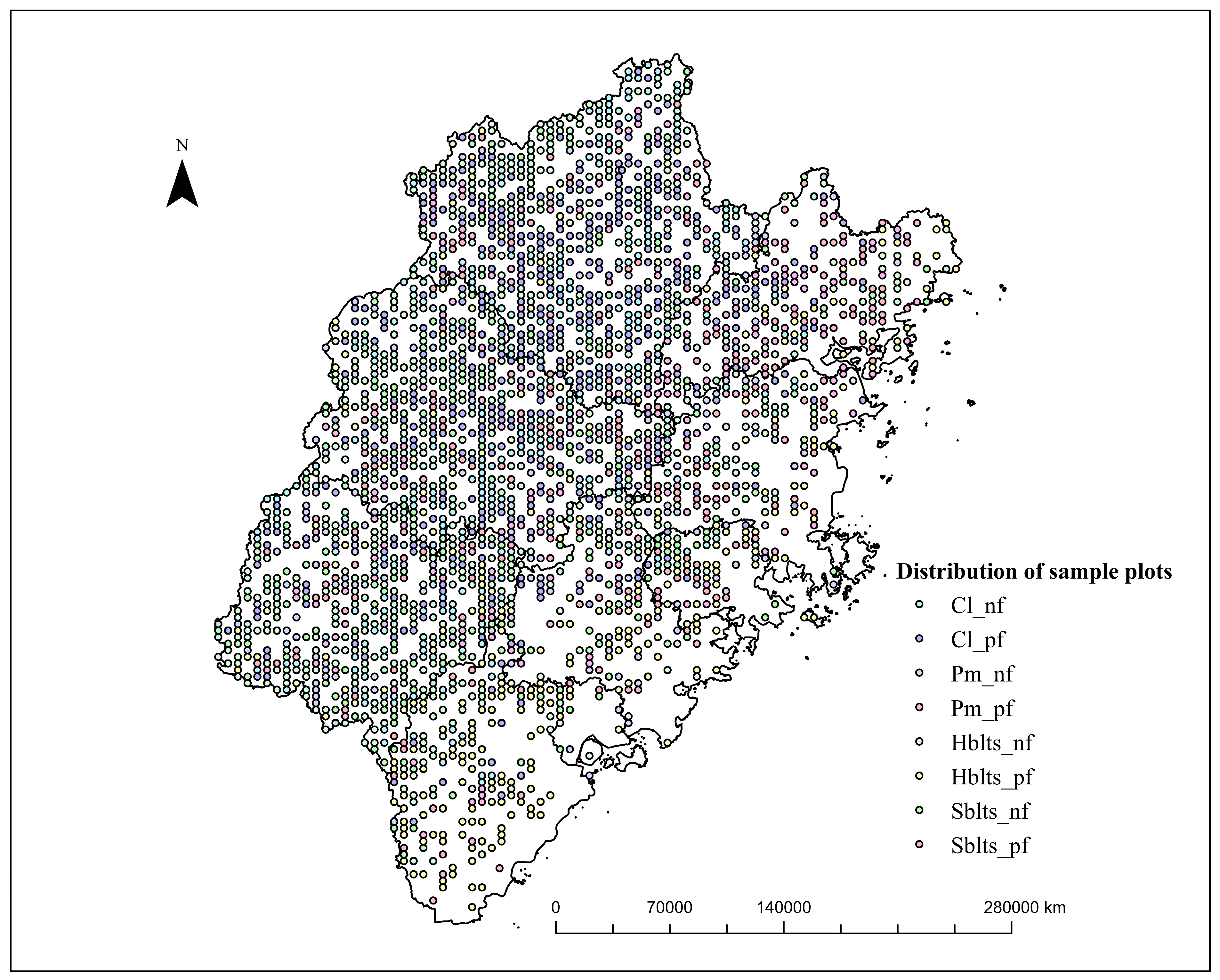
Sample plots were distributed across Fujian Province, as illustrated in Figure 1. These plots correspond to Type I permanent plots from the Ninth National Forest Resources Continuous Inventory in the province. The study drew on data from the First National Comprehensive Survey of Natural Disaster Risks (2021) and supplementary field surveys carried out in Fujian between March 2021 and February 2022. Standard plots were established to represent typical forest stands exhibiting a canopy density greater than 0.4 and normal growth conditions. Each plot covered an area of 0.067 hectares and was positioned away from edges such as roads or rivers to ensure ecological representativeness.
All trees with a diameter at breast height (DBH) ≥ 5 cm were measured and identified within each plot. A subset of these trees was used to develop height–diameter relationships and to derive average stand height [14,15]. Representative individuals were selected for destructive sampling; the fresh weights of trunks, branches, leaves, and roots were recorded in the field. These samples were subsequently oven-dried to determine moisture content and dry biomass. Biomass values were converted to carbon storage using standard conversion factors, and total plot-level carbon storage was obtained by summing contributions from all trees.
The dataset comprised 759–760 plots for each dominant tree species group, differentiated by origin (natural or plantation). The groups included Chinese fir (Cunninghamia lanceolata), Masson pine (Pinus massoniana), and broad classifications of hardwood and softwood species. Specifically, the categories were Cl_nf (natural C. lanceolata forest), Cl_pf (plantation C. lanceolata), Pm_nf (natural P. massoniana forest), Pm_pf (plantation P. massoniana), Hblts_nf (natural hardwood group), Hblts_pf (plantation hardwood group), Sblts_nf (natural softwood group), and Sblts_pf (plantation softwood group).
Additional stand-level variables including area, site quality grade, age, and species composition coefficients were sourced from the sub-compartment forest resource database of Wuyishan City. The total study area spans 171,393 hectares, with natural hardwood forests (Hblts_nf) occupying the largest share (63,778 ha), followed by Chinese fir plantations (Cl_pf, 43,801 ha) and natural Masson pine forests (Pm_nf, 43,663 ha). Plantation hardwoods (Hblts_pf), plantation softwoods (Sblts_pf), and natural softwoods (Sblts_nf) collectively constitute minor portions of the landscape, representing 1.15%, 0.58%, and 0.03% of the total area, respectively (Table 1).

2.2. Model Formulation

A dynamic model for estimating forest stand carbon storage must begin with a biologically sound growth function. The choice of this underlying equation is essential; it should not only fit observed growth patterns well but also yield parameters that reflect real ecological processes. Among the functions commonly used in forestry, the Richards equation stands out for its flexibility, empirical performance, and interpretable parameters, qualities that have made it a standard in growth and yield modeling. Accordingly, the Richards equation serves as the basis for the carbon storage model developed here. It is expressed as:
W = a × [ 1 exp ( b × T ) ] c + β
where W represents the forest stand-level carbon storage, T denotes the stand age. a, b, and c are model parameters to be determined. The term  β  captures model estimation error.
Ecologically, the parameter a corresponds to the theoretical upper limit of carbon storage a stand can achieve under ideal site conditions, effectively reflecting site productivity. The parameter b governs the rate at which carbon accumulates over time and is closely tied to intrinsic growth dynamics and the intensity of inter-tree competition. The parameter c captures the stand’s physiological responsiveness, essentially how efficiently it assimilates and retains carbon in response to environmental conditions and structural complexity. Together, these three parameters jointly encode both the biological trajectory of forest development and key aspects of stand structure that shape carbon sequestration.
To address the challenge of defining stand age in uneven-aged forests and to establish a unified framework applicable to both plantations and natural stands, a dynamic carbon storage estimation model was derived from Equation (1) by replacing absolute age with a growth interval period. This interval, denoted Tn = T2T1, represents the time elapsed between two successive growth stages of a stand. The resulting formulation is
W 2 = a × 1 [ 1 ( W 1 a ) 1 c ] × exp ( b × T n ) } c + β
where W1 and W2 denote the stand-level carbon storage at the initial and final points of the interval, respectively, and T1 and T2 are the corresponding stand ages. The term Tn = T2T1 thus serves as the effective time step for modeling carbon change.
The model parameter a, which represents the maximum carbon storage of a stand, is strongly influenced by site quality. To account for this, a is expressed as a linear function of site quality grade a = a1X1 + a2X2 + a3X3 + a4X4. Here, X1, X2, X3 and X4 are dummy variables indicating site fertility classes: fertile, moderately fertile, medium fertility, and poor fertility, respectively. Each variable takes a value of 1 if the plot belongs to that class and 0 otherwise. For instance, a plot on fertile land is coded as X1 = 1 and X2 = X3 = X4 = 0. The coefficients a1, a2, a3, and a4 represent the corresponding asymptotic carbon storage levels for each site class and are estimated from the data. Site quality classifications follow the National Criteria for Site Quality Classification of Forest Land [16]. In model implementation, these categories were encoded as a dummy variable (1 = presence, 0 = absence) when included in the modeling.
The parameter b, which governs the rate at which carbon storage changes with stand age, and the parameter c, which reflects aspects of the stand’s physiological efficiency in carbon assimilation and associated processes such as oxygen release, are both influenced by species composition. To capture this dependence, both parameters are formulated as linear functions of species composition coefficients: b = b1K1 + b2K2 + b3K3 + b4K4, c = c1K1 + c2K2 + c3K3 + c4K4. In these expressions, K1, K2, K3, and K4 denote the composition coefficients for Cunninghamia lanceolata, Pinus massoniana, the hardwood species group, and the softwood species group, respectively. These coefficients are scaled such that their sum equals 10. The coefficients b1b4 and c1c4 are estimated from the data and reflect how each species or group contributes to the dynamics of carbon accumulation and physiological response.
Together, these formulations embed both site quality and species composition directly into the model structure.
In summary, the dynamic model for forest stand carbon storage developed in this study integrates site quality and species composition through parameterization of the Richards growth function. The change in carbon storage over a defined growth interval is expressed as
W 2 = ( a 1 X 1 + a 2 X 2 + a 3 X 3 + a 4 X 4 ) × 1 [ 1 ( W 1 a 1 X 1 + a 2 X 2 + a 3 X 3 + a 4 X 4 ) 1 c 1 K 1 + c 2 K 2 + c 3 K 3 + c 4 K 4 ] × exp [ ( b 1 K 1 + b 2 K 2 + b 3 K 3 + b 4 K 4 ) × T n ] } c 1 K 1 + c 2 K 2 + c 3 K 3 + c 4 K 4 + β
where W1 and W2 denote stand-level carbon storage at the beginning and end of the interval, respectively; Tn is the length of the growth interval, defined as Tn = T2T1; X1X4 represent dummy variables for site quality grades I to IV; K1K4 are species composition coefficients for each dominant tree species group; ai, bi, ci are model parameters to be estimated; and β is a residual or correction term.

2.3. Parameter Estimation and Accuracy Evaluation

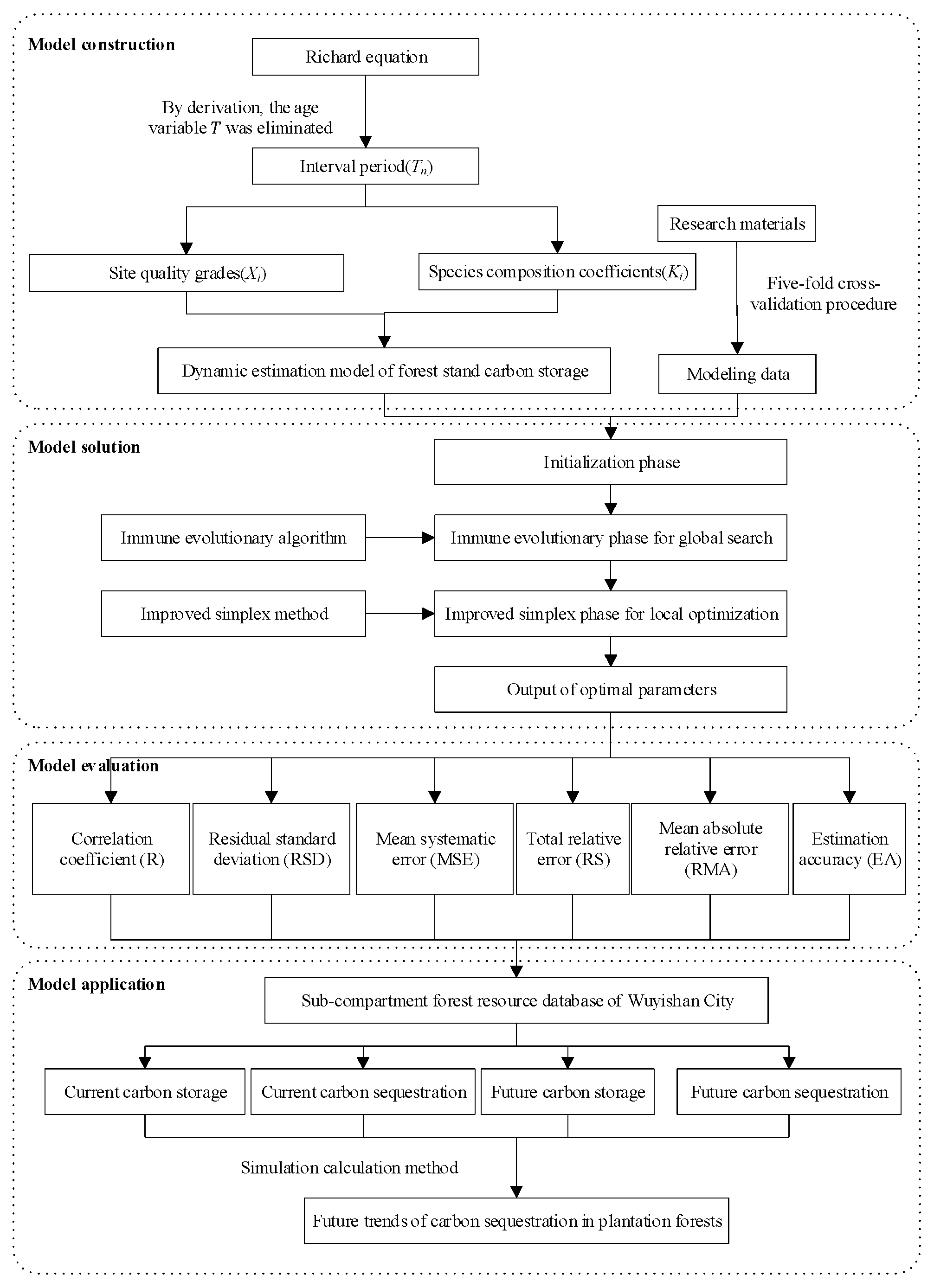
Parameter estimation and model validation were carried out in an integrated framework to maintain alignment between model fitting and predictive performance. A hybrid optimization strategy was adopted, combining the immune evolutionary algorithm with the improved simplex method [14]. This approach leverages the global exploration strength of biologically inspired algorithms and the fine-tuning precision of classical local optimizers, thereby improving both the reliability and convergence stability of the estimated parameters.
The immune evolutionary algorithm, motivated by principles of biological immunity, was used to conduct a broad search across the parameter space, effectively avoiding local optima. The improved simplex method then took the best candidate solutions and refined them through efficient local adjustments, significantly speeding up convergence [17,18].
Traditional approaches to parameter estimation in forest growth modeling typically depend on nonlinear regression methods, such as ordinary least squares (OLS) or the Levenberg–Marquardt algorithm. While these techniques perform well with smooth, well-behaved data, they often become trapped in local optima when applied to complex or nonconvex parameter spaces. In contrast, the hybrid strategy used in this study, combining an immune evolutionary algorithm with an improved simplex method, offers a more robust framework for global optimization. By exploring the parameter space more thoroughly, it reduces the risk of premature convergence and yields more stable estimates across diverse stand conditions.
Nevertheless, this approach is not without limitations. The immune evolutionary algorithm involves tuning several control parameters, such as population size and mutation rate, and its computational demand grows with dataset size and model complexity. Furthermore, if regularization or validation safeguards are inadequate, there remains a risk of overfitting, particularly when sample sizes are limited. Despite these challenges, the hybrid method strikes a practical balance between search efficiency and estimation accuracy. It proves especially valuable for ecological datasets characterized by strong nonlinearity, structural heterogeneity, and mixed-species dynamics, situations where conventional regression techniques often fall short.
To test whether the model generalizes well beyond the data used to fit it, and to guard against overfitting, we applied a stratified five-fold cross-validation scheme. The dataset was first grouped by dominant species (or species group), forest origin (natural or plantation), and site quality grade. This ensured that each fold preserved the same mix of ecological and management conditions found in the full sample. Within each group, plots were randomly split into five subsets. In every round of validation, four subsets were used to calibrate the model and the remaining one to test it. After five rounds, each plot had been used once for validation and four times for fitting, giving a balanced picture of both internal consistency and predictive performance [19].
We evaluated results using six standard metrics: Pearson correlation coefficient (R), residual standard deviation (RSD), total relative error (RS), mean systematic error (MSE), mean absolute relative error (RMA), and estimation accuracy (EA). Values from the calibration runs describe how well the model fits the data; those from the validation runs show how reliably it predicts new observations.
To check whether performance depended on a particular subset of the data, we compared the key metrics (R, RSD, RMA, and EA) across all five folds. Differences were minimal, with variation under 2% in every case. This consistency suggests the model is not latching onto quirks of a single sample but instead captures real, repeatable patterns. Moreover, because site quality and species composition are built directly into the model structure, it accounts for much of the natural variation among stands. That design choice not only reduces bias but also helps the model perform reliably across very different forest types.

2.4. Integrating the Carbon Storage Model with a Simulation-Based Calculation Approach

To better capture the trajectory and potential future shifts in forest carbon stocks, we coupled the dynamic carbon storage model with a simulation-based method for estimating harvest levels. This combined framework allows us to project carbon storage under different management scenarios across successive growth intervals. The simulation approach is grounded in regulated forest theory and operates by adjusting stand area over time to maintain a sustainable flow of timber while stabilizing total forest extent. In this system, harvesting is restricted to mature and over-mature stands, and the annual allowable cut is set below the stand’s annual increment to ensure net carbon accumulation. The harvested volume is converted into an equivalent harvested area, which is immediately replanted in the same year, thereby keeping the total forested area constant over the rotation cycle. Under this protocol, simulations show that after one full rotation period, mature and over-mature stands account for 42.8% of the total forest area. If the simulated proportion at the end of the rotation deviates from this target, either higher or lower, the annual harvest volume is iteratively adjusted and the simulation rerun until the desired equilibrium is achieved [20]. The specific computational steps follow established protocols in forest planning literature [21]:
Let A(T)t denote the area of forest stands in age class i during year T. At the start of the simulation T = 1, the initial area distribution across age classes is specified as:
A ( 1 ) t = A ( 1 ) i N i
where i includes young forest (YF), middle-aged forest (MOF), near-mature forest (NF), mature forest (MF), and over-mature forest (OF). Ni is the total area assigned to age class i, calculated as the difference between its terminal and starting ages plus one, and i takes values 1, 2, 3, etc.
Harvesting follows a strict rule: only MF and OF stands are eligible for cutting; younger stands are left untouched. Under this constraint, the harvested area A(T)LG in year T (T = 2, 3, 4, …) is given by:
A ( T ) LG = A ( T ) MF + A ( T ) OF
Immediately after harvest, an equal area is reforested, so the newly established young forest area A(T)UD in year T is:
A ( T ) UD = A ( T ) LG
Forest area then transitions through age classes as stands grow. For young forests, the state transition equation for the area is:
A ( T ) YF = A ( T 1 ) t + A ( T ) UD
where the upper limit of t is the terminal age of young stage minus one, and the lower limit is the starting age of young forests.
Similarly, for middle-aged and near-mature forests, the transition equations are:
A ( T ) J = A ( T 1 ) t + A ( T - 1 ) Z
where the upper limit of t is the terminal age of middle-aged (near-mature) stage minus one, and the lower limit is the starting age of middle-aged (near-mature) forests; Z represents the terminal age of the respective stage (middle-aged or near-mature).
The state transition equations for the area of mature and over-mature forests are:
A ( T ) J = A ( T 1 ) t + A ( T - 1 ) Z A ( T ) LG
where the upper limit of t is the terminal age of mature (over-mature) stage minus one, and the lower limit is the starting age of mature (over-mature) forests; Z represents the terminal age of the respective stage (mature or over-mature).
Given China’s current policy prohibiting commercial logging in natural forests, this simulation is applied exclusively to plantation forests. It thus reveals how carbon stocks might evolve under sustainable harvesting regimes. The change in carbon storage between two points in time is calculated as
Δ W = W T 2 W T 1 T 2 T 1
where  Δ W  is the net increase in carbon storage, and  W T 2  and  W T 1  are the total carbon stocks at the beginning and end of the interval, respectively.

2.5. Technical Route

The overall technical route of this study is presented in Figure 2.

3. Results

3.1. Analysis of Cross-Validation Results

The dataset was partitioned into five groups to enable simultaneous model calibration and validation. Cross-validation performance metrics for each dominant tree species (grouped by origin) are reported in Table 2, incorporating the species composition coefficient (WSC). In terms of model fit, all correlation coefficients (R) exceeded 0.960, residual standard deviations (RSD) remained below 260, total relative error (RS) and mean systematic error (MSE) fell within ±1%, mean absolute relative error (RMA) stayed under 7%, and estimation accuracy (EA) surpassed 99.00%. These results indicate a strong positive relationship between the predictors and observed carbon storage. Notably, the RS and MSE values were well below the ±10% threshold commonly accepted in forest modeling, confirming high internal consistency and fidelity of the Richards-based formulation.
Validation metrics derived from data not used in calibration also demonstrated favorable predictive capacity: R > 0.900, RSD < 400, RS and MSE within ±10%, RMA < 11%, and EA > 98.00%. As expected, validation accuracy was slightly lower than fitting accuracy, largely because each validation fold contained fewer observations than the combined calibration sets. Nevertheless, the predictive performance remained high, and for certain metrics and species groups, validation scores even exceeded those from calibration.
This consistently strong performance stems from two key factors, the explicit inclusion of ecologically meaningful predictors and the stratified cross-validation design. The low variability in metrics across folds further supports the conclusion that the model captures genuine ecological patterns rather than noise or idiosyncrasies in the data.
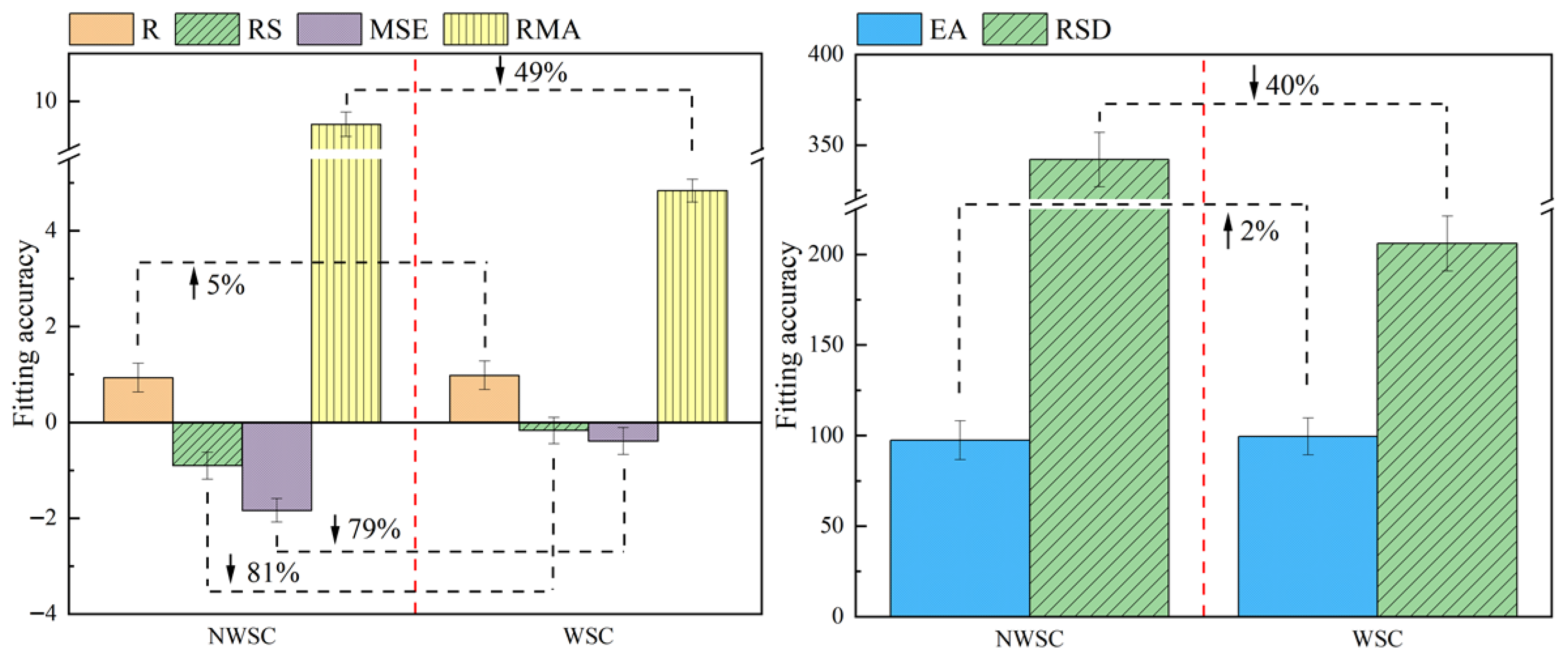
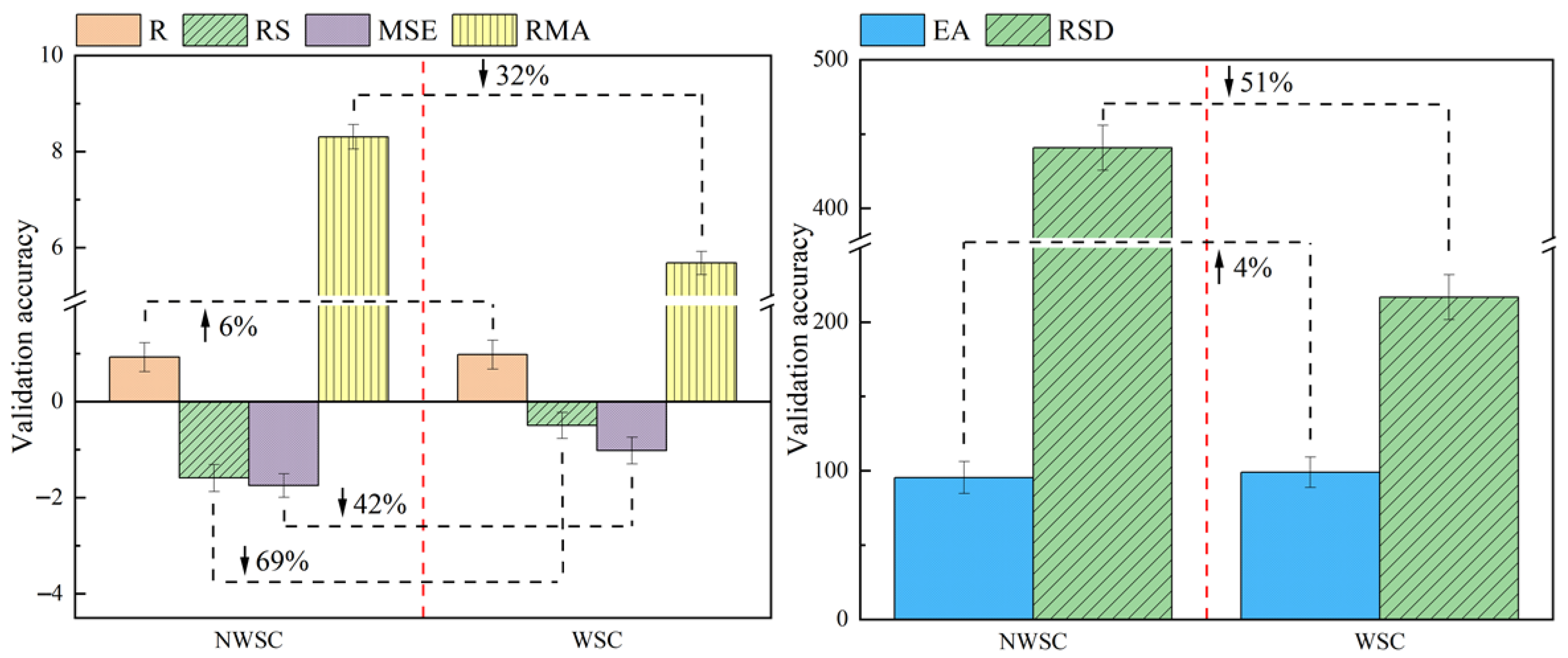
As shown in Figure 3 and Figure 4, incorporating WSC yielded consistent improvements in both model fit and predictive performance across all dominant species groups and origins. The R value increased by 0.03 to 0.05, EA rose by approximately 1.5 to 2%, and both RSD and MSE showed overall reductions, clear signs of enhanced model stability and more dependable predictions. A one-way ANOVA further supported these findings, showing that for most metrics, the differences between models with and without WSC were highly significant at the p < 0.01 level (***). This provides strong statistical evidence that explicitly representing species composition meaningfully strengthens model performance.
The improvements in R, RMA, and EA reflect an important ecological insight that, species composition captures real differences in how stands grow and accumulate carbon under mixed-species conditions. By accounting for the relative abundance of different tree types, the model better represents the structural and functional complexity of mixed forests, which in turn boosts both its ecological credibility and predictive skill.
These gains held across all dominant species groups and forest origins. Specifically, R increased by 0.03–0.05, RMA declined by 20–40%, and EA consistently remained above 99%. The effects were especially pronounced in natural mixed forests such as Hblts_nf, Sblts_nf, and Pm_nf, where interspecific interactions were more intense and stand structure more heterogeneous. In plantation forests, the inclusion of WSC led to greater consistency in predictions and reduced variability, even though baseline performance was already relatively high.
Together, these results indicate that species composition is not merely a descriptive attribute but a key driver of carbon dynamics. Integrating it into the model enables a more realistic representation of forest development processes and significantly improves the reliability of carbon storage estimates.
In terms of validation accuracy, the model incorporating WSC consistently outperformed the version without it (NWSC). Specifically, the WSC model yielded higher R and EA values, while RMA and MSE were markedly lower. These improvements were most pronounced for natural mixed forest types, particularly Hblts_nf, Sblts_nf, and Pm_nf, highlighting the stronger influence of species interactions in these systems. In plantation forests, the gains were more modest, yet the models still exhibited strong agreement between fitting and validation results, indicating reliable generalization.
One-way ANOVA results reinforced these observations. For most species groups, differences in fitting accuracy, especially in R, RSD, and EA, were statistically significant, confirming that including species composition meaningfully enhances model performance. The same pattern held for validation metrics: significant improvements appeared across nearly all key indicators, with only a few such as RS or MSE in certain cases failing to reach conventional significance thresholds. Even so, overall consistency remained high. Notably, Hblts_nf, Pm_nf, and Sblts_nf showed favorable gains in both calibration and validation phases, underscoring their sensitivity to species composition effects.
In summary, the dynamic carbon storage models developed for the eight dominant tree species groups, differentiated by origin and linked explicitly to site quality and species composition, achieve high levels of both modeling and predictive accuracy. This performance allows all available sample plots to be fully integrated into the modeling process without compromising reliability.

3.2. Modeling Result Analysis

All sample plots were included in the modeling process, and model parameters were estimated using a hybrid approach that combines the immune evolutionary algorithm with the improved simplex method. The resulting fitting accuracy metrics and parameter estimates for each dominant tree species group, differentiated by origin and incorporating the tree species composition coefficient, are presented in Table 3. The models demonstrated uniformly high fitting performance. R values were all above 0.970, RSD remained below 260, RS and MSE fell within ±0.9%, RMA was under 6.2%, and EA exceeded 99.40%. These values slightly surpassed those obtained during cross-validation, which is expected given the use of the full dataset for calibration. Variability in fitting accuracy across species groups was generally low. With the exception of RS, the coefficient of variation for all other accuracy metrics remained below 50%, indicating consistent model behavior. Among the eight categories, Sblts_nf achieved the best overall performance, showing the highest R, the lowest RSD, and superior results across all other indicators. This suggests the model captures carbon dynamics in natural softwood broadleaf stands with exceptional fidelity.
The estimated asymptotic parameter a followed a consistent pattern across site quality grades: a1 > a2 > a3 > a4. This reflects the expected increase in maximum carbon storage capacity as site fertility improves, progressing from poor to fertile conditions. The trend was aligned with well-established relationships between stand productivity and site environment. Across species groups, the soft broadleaf category exhibited the highest a values, followed by hard broadleaf, Pinus massoniana, and Cunninghamia lanceolata. Within each group, natural forests consistently yielded higher a than plantations, likely due to greater structural complexity and longer growth histories.
The growth rate parameter bi indicated that Cunninghamia lanceolata stands accumulated carbon more rapidly than those of Pinus massoniana, while the hard and soft broadleaf groups showed comparable growth rates. The shape parameter ci was related to physiological resistance in the carbon assimilation process. It was linked to the assimilation index m through the expression cᵢ = 1/(1 − m). Since all estimated values of m were less than 1, cᵢ remained positive, confirming that the modeled carbon accumulation exhibited the expected deceleration as stands approached their carrying capacity. This behavior is consistent with general forest growth patterns and supports the biological realism of the model formulation.

3.3. Carbon Stock Estimation Based on the Modeling Method

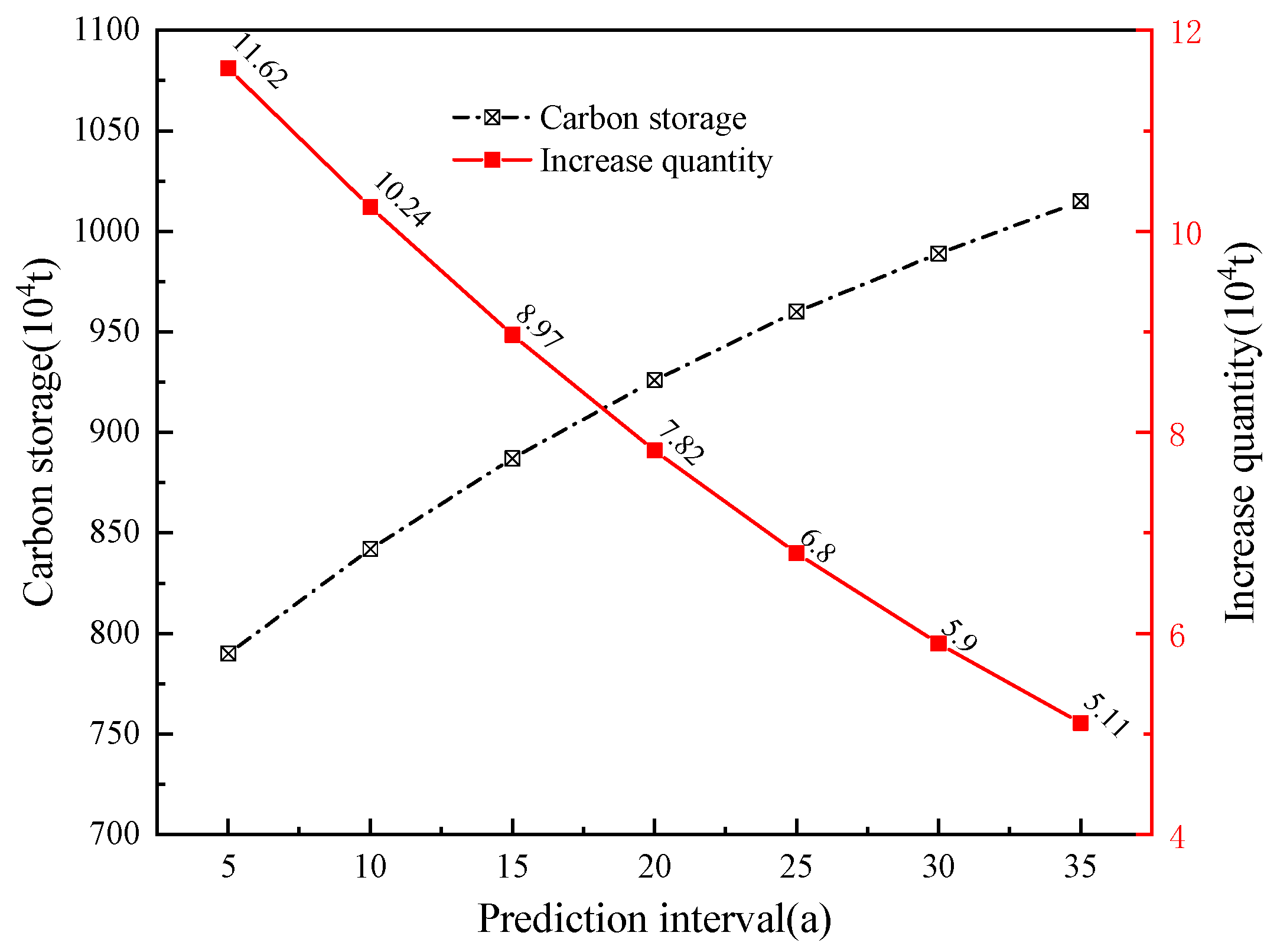
Taking the forest resources of Wuyishan City as a case study, the dynamic carbon storage model developed in this research was applied to project forest carbon stocks over successive time horizons, specifically at 5, 10, 15, 20, 25, 30, and 35 years into the future. The current spatial pattern of carbon storage was visualized using ArcGIS 10.2 (Figure 5), while temporal trends in total carbon and annual increments were illustrated with Origin 2021 (Figure 6).
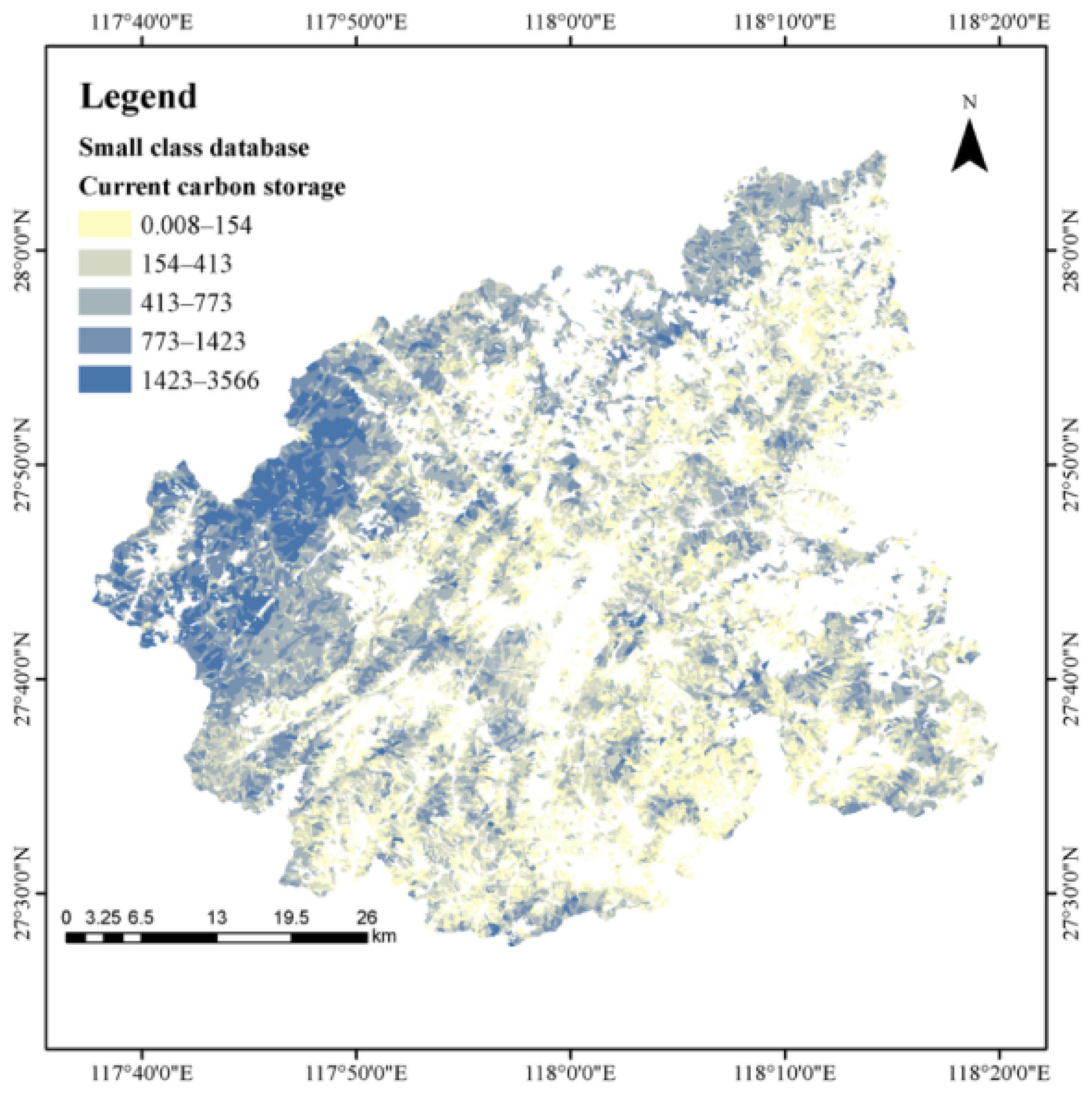
The spatial distribution revealed a clear west–east gradient across the study area. The western mountainous zone held the highest carbon stocks, ranging from 2545 to 7277 tons per unit area, whereas the eastern and central lowlands showed lower values, between 1382 and 2525 tons. This contrast stems largely from land use and conservation status. The western region falls within Wuyishan National Park and is dominated by old-growth evergreen broadleaf and mixed natural forests. These stands benefit from high site quality, dense canopy cover, and minimal human disturbance, all of which support sustained biomass accumulation over time. In contrast, the eastern lowlands are primarily covered by Cunninghamia lanceolata and Pinus massoniana plantations that undergo regular harvesting and replanting cycles. This management regime limits biomass buildup and introduces greater spatial variability in carbon density. Overall, the observed pattern reflects the interplay of topography, soil fertility, species composition, and the intensity of conservation versus production-oriented forestry.
According to inventory-based calculations, the total forest carbon storage in Wuyishan City currently stands at 7.3238 million tons. As shown in Figure 5, total carbon continued to rise over time, but the rate of increase diminished progressively. Over a 5-year interval, the net gain reached 116,200 tons, yet this increment declined to 51,100 tons over a 35-year span. This deceleration aligned with the biological trajectory of aging forests, where mature and over-mature stands approach growth saturation and add less new biomass due to physiological and structural constraints.
From a forest management standpoint, this trend underscores the need for timely interventions, such as thinning, selective harvesting, or regeneration treatments, to rejuvenate stand dynamics and avoid prolonged stagnation in carbon uptake. Well-timed silvicultural activities can stimulate growth in residual trees, accelerate succession, and maintain active carbon cycling, thereby supporting a more resilient and continuously increasing regional carbon sink.

3.4. Analysis of Carbon Trends Under Sustainable Harvesting Scenarios

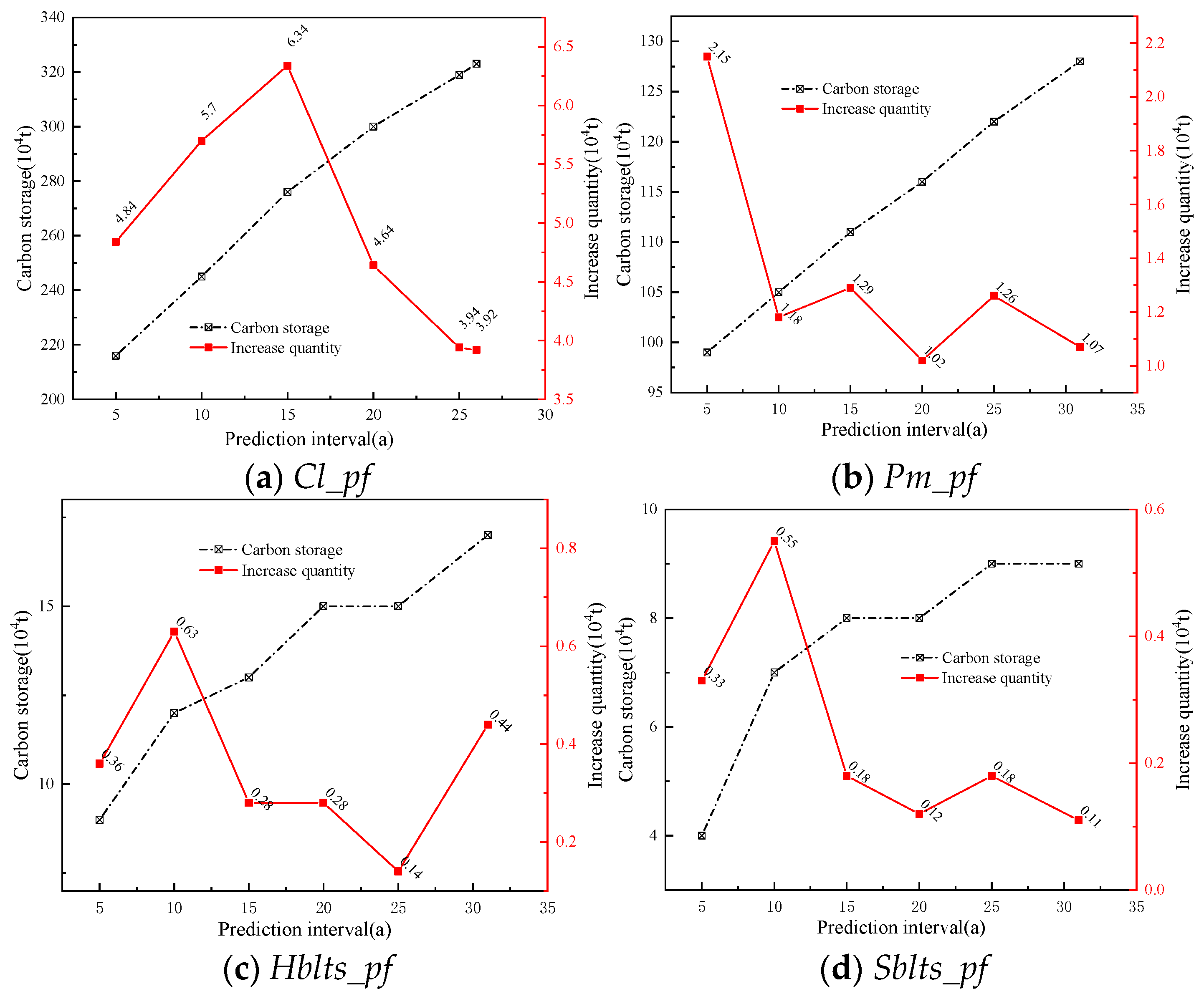
Using the simulation framework developed in this study, we identified reasonable annual harvesting areas for the four main plantation types in Wuyishan City: 1002.10 ha for Cunninghamia lanceolata (Cl_pf), 271.05 ha for Pinus massoniana (Pm_pf), 37.67 ha for the plantation hardwood group (Hblts_pf), and 22.87 ha for the plantation softwood group (Sblts_pf).
Under this regime, carbon stocks in all plantation types continued to rise over time, though the rate of increase slowed as stands mature. Cl_pf and Pm_pf showed steady, almost linear gains, consistent with their uniform stand structure and management history. Hblts_pf and Sblts_pf displayed more modest fluctuations, likely because their smaller areas and mixed-species composition led to greater variability in growth responses. Importantly, the gradual decline in accumulation rate reflected natural stand development rather than carbon loss, confirming that moderate harvesting does not undermine long-term sequestration.
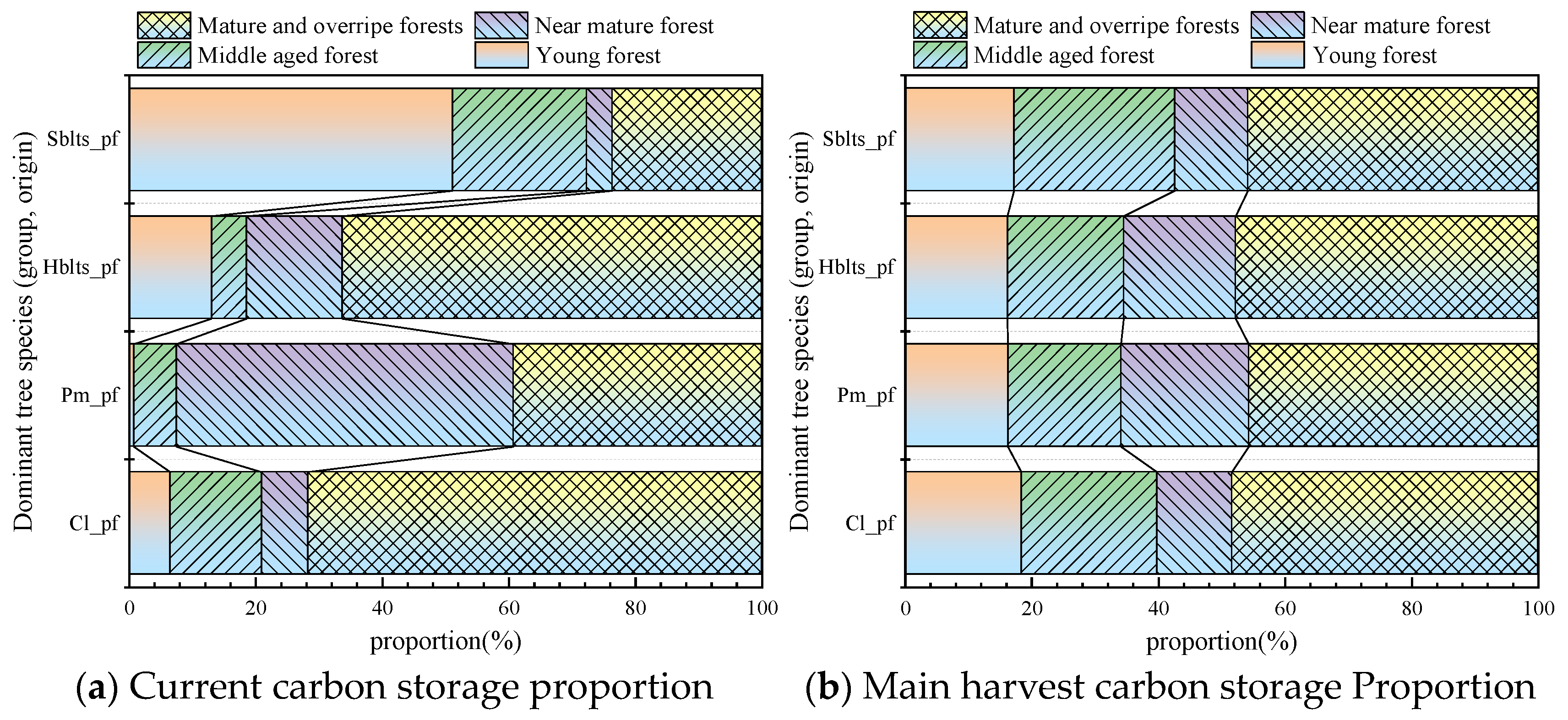
Figure 7 illustrates how carbon storage is distributed across age classes. Prior to adjustment, the age structure was markedly unbalanced, certain plantation types were dominated either by very young stands or by over-mature forests, making it difficult to sustain regular harvests without disrupting long-term yield. After optimization through simulation, the combined share of mature and over-mature stands stabilized at approximately 48%, yielding an age-class distribution that supports both continuous timber production and stable carbon storage.
From a management standpoint, these findings underscore several key principles. Harvest timing should be aligned with the inherent growth patterns of each species to avoid depleting future carbon stocks. Moderate interventions such as thinning or selective cutting can help counteract the natural slowdown in productivity that occurs as stands age, thereby maintaining higher rates of carbon retention. Equally important is prompt regeneration after harvest; without timely reestablishment of new stands, the system loses its capacity to rebuild biomass and continue sequestering carbon over successive rotations.
Together, the dynamic carbon storage model and the harvest simulation framework offer a practical, data-driven approach for subtropical plantation management. Rather than treating timber production and carbon sequestration as competing objectives, this integration enables strategies that achieve both, providing forest managers with a reliable basis for planning sustainable, climate-smart operations.
Figure 8 presents the current and target carbon storage distributions across age classes for the four plantation types. The existing age structure showed clear imbalances that hinder sustainable management. In Sblts_pf, young stands accounted for a disproportionately large share of total carbon. By contrast, Cl_pf and Hblts_pf were dominated by mature and over-mature stands. Pm_pf exhibited the opposite problem, that is, its young-forest carbon pool was critically low, leaving little capacity for future regeneration and sustained yield. After applying the simulation-based adjustment; however, the carbon allocation across age classes for all species groups fell within ecologically and operationally sound ranges. Notably, the combined proportion of mature and over-mature stands stabilized near 48%. This rebalanced structure ensures that forests remain harvestable over successive rotations while enhancing their overall carbon storage potential.

4. Discussion

4.1. Model Innovation and Comparison with Existing Approaches

Stand age is commonly used in forest growth and harvest models, but it is often difficult to determine reliably in natural forests due to complex age structures. To address this, the interval period defined as the time between two consecutive growth stages was adopted as the main temporal variable. This approach, originally proposed by Hua et al. (2023) [22], replaces absolute stand age and enables a consistent modeling framework for both plantations and natural forests. The high fitting accuracy achieved here (R > 0.97) confirms that the interval-period concept is well suited for dynamic carbon storage estimation.
Traditional allometric models estimate carbon stocks from tree diameter and height relationships [23,24]. Although simple and widely applied, they provide only static estimates and cannot represent temporal changes in carbon accumulation. In contrast, the model developed in this study is based on the Richards equation and offers dynamic, stand-level projections of carbon storage over time. Remote-sensing methods estimate carbon indirectly using canopy reflectance, LiDAR metrics, or vegetation indices [25,26]. While useful for broad-scale mapping, they often lack direct ecological interpretability and depend heavily on sensor quality and auxiliary data. Process-based models such as Biome-BGC or 3-PG simulate carbon fluxes through physiological processes [27,28], but they require extensive environmental and biological inputs that are rarely available for regional applications. The Richards-based dynamic model presented here avoids these limitations. It combines biological interpretability with modest data requirements and achieves high predictive accuracy, offering a practical alternative for carbon assessment in both natural and plantation forests.

4.2. Effects of Site Quality and Species Composition

Incorporating species composition coefficients improved model performance, reflecting the real-world influence of mixed-species interactions. Most forest stands are not pure, and accounting for differences in species mix helps capture how complementarity and competition shape carbon accumulation. This aligns with earlier work showing that diversity enhances the accuracy of growth and yield estimates [29].
The increases in R, EA, and RMA confirm that species composition explains meaningful variation in carbon storage patterns across stands. By integrating this factor, the model better represents actual forest conditions and provides a more ecologically grounded basis for estimation.

4.3. Model Limitations and Uncertainties

The Richards equation assumes a uniform, sigmoidal growth pattern, which fits even-aged stands well but may not capture the irregular dynamics of uneven-aged or highly mixed forests. In such stands, regeneration occurs at different times and competition varies across individuals, leading to more complex carbon trajectories that the current model tends to smooth out. Future versions could improve realism by incorporating stand structure variables such as canopy layers, species diversity, or stand density through mixed-effects or hierarchical approaches.
Uncertainty in carbon estimates also arises from field measurement errors, parameter estimation, and unmeasured variation in site conditions. Although five-fold cross-validation reduced overfitting, differences in soil, microclimate, and management history across the region may still affect accuracy. Furthermore, using fixed biomass-to-carbon conversion coefficients for all species likely introduces systematic bias, as true carbon content can vary with species and site. Quantifying these uncertainties using methods like Monte Carlo simulation or Bayesian modeling would make projections more transparent and reliable, especially when applied at larger scales.

4.4. Practical Implications for Forest Management and Policy

Beyond statistical performance, this study offers concrete ecological and management insights. It confirms that both site quality and species composition strongly influence carbon accumulation. Better sites support higher productivity and greater carbon storage, while mixed-species stands tend to be more resilient, likely due to complementary use of light, water, and nutrients, as well as more stable canopy structures. Together, these factors shape a forest’s capacity to sequester carbon and sustain ecosystem functions over time.
For forest managers, the dynamic carbon storage model provides a practical tool for planning sustainable operations. By projecting carbon trajectories across growth intervals, it helps identify when and how much to harvest without depleting long-term stocks. The observed slowdown in carbon accumulation in older stands suggests that moderate thinning or selective cutting can rejuvenate growth and maintain active sequestration. Likewise, preserving or promoting species diversity helps sustain carbon uptake across rotation cycles.
In subtropical regions like Fujian, where plantations dominate but natural forests remain ecologically vital, this approach supports dual objectives, timber production and climate mitigation. The model’s integration of site quality, species composition, and interval-based growth bridges empirical inventory data with ecological process understanding. It is not just a more accurate estimator, it is a decision-support framework that links stand-level management to regional carbon goals.

5. Conclusions

This study presents a dynamic model for estimating forest stand carbon storage based on the Richards equation, using the growth interval period as the temporal variable, site quality grade (encoded as dummy variables), and species composition coefficients as key predictors. By replacing absolute stand age with a growth interval, the model overcomes the challenge of age determination in natural forests and provides a unified framework applicable to both plantations and natural stands. It complements existing biomass-based and process-driven approaches by offering a practical, field-data–based tool that is both ecologically interpretable and operationally relevant for carbon accounting and climate mitigation.
Five-fold cross-validation confirmed the reliability of the hybrid parameter estimation method, combining the immune evolutionary algorithm and the improved simplex method. The model achieved high fitting and validation accuracy across all eight dominant tree species groups, demonstrating its ability to deliver precise carbon estimates even with limited sample sizes. Incorporating species composition consistently improved predictive performance, especially in mixed and natural forests, underscoring the ecological significance of structural and compositional diversity.
Both site quality and species composition strongly influenced carbon storage potential. Natural forests exhibited higher asymptotic carbon stocks and more gradual declines in accumulation rates, reflecting greater long-term stability. Although plantations showed rapid early growth, they reached saturation sooner, highlighting the need to enhance site conditions and promote mixed-species structures to sustain carbon uptake over time. These results reinforce the importance of managing forests as diverse, resilient ecosystems rather than uniform monocultures, particularly under changing environmental conditions.
From a management standpoint, coupling the carbon model with a simulation-based harvesting approach yields a quantitative basis for setting sustainable cut levels and optimizing age-class structure. The derived harvest volumes showed how timely regeneration and moderate disturbance can maintain carbon balance and avoid productivity stagnation. This supports adaptive, near-natural management practices that align timber production with climate goals in subtropical regions like Fujian Province.
In conclusion, the model provides a scalable, ecologically grounded framework for stand-level carbon estimation that links growth dynamics with real-world management. It offers actionable guidance for designing harvest regimes that enhance long-term sequestration. Future efforts should integrate this approach with multi-source remote sensing and continuous forest monitoring to enable regional- to national-scale carbon assessments and support China’s carbon neutrality commitments.

Author Contributions

Conceptualization, X.J., W.H., C.H. and B.L.; methodology, B.L. and W.H.; software, W.H., C.H. and T.Q.; validation, X.J., B.L. and B.C.; formal analysis, X.J., W.H., C.H., S.Z. and B.L.; investigation, B.L., W.H., C.H., T.Q., S.Z. and B.C.; resources, W.H., C.H., T.Q. and B.C.; data curation, B.C., C.H. and S.Z.; writing—original draft preparation, W.H. and C.H.; writing—review and editing, B.C., B.L., W.H., C.H. and T.Q.; visualization, X.J., W.H., C.H., S.Z. and B.L.; supervision, X.J., W.H., C.H. and B.L.; project administration, W.H. and B.L.; funding acquisition, W.H.; All authors have read and agreed to the published version of the manuscript.

Funding

This research was funded by the Fujian Philosophy and Social Sciences Planning Project (FJ2022X019), Fujian Provincial Department of Finance Project (CR-2304), Fujian Forestry Science and Technology Project (2023FKJ21), Nanping City Resource Chemistry Industry Technology Innovation Joint Project (N2021Z010), Wuyi University Talent Introduction and Research Start up Fund Project (YJ202435), the Major Programs of the National Social Science Foundation of China (2021MZD024).

Data Availability Statement

The original contributions presented in this study are included in the article. Further inquiries can be directed to the corresponding author.

Acknowledgments

The authors express their gratitude and appreciation to Fujian Provincial Forestry Survey and Planning Institute for the finance, facilities, and opportunity to conduct this research. The authors also thank Shangping Chi and Hua Jiang for their technical support during data survey and analysis. It is confirmed that all individuals mentioned herein have consented to be included in this acknowledgment.

Conflicts of Interest

The authors declare that they have no competing interests.

References

  1. Sitch, S.; Smith, B.; Prentice, I.C.; Arneth, A.; Bondeau, A.; Cramer, W.; Kaplan, J.O.; Levis, S.; Lucht, W.; Sykes, M.T.; et al. Evaluation of ecosystem dynamics, plant geography and terrestrial carbon cycling in the LPJ dynamic global vegetation model. Glob. Change Biol. 2003, 9, 161–185. [Google Scholar] [CrossRef]
  2. Falkowski, P.; Scholes, R.J.; Boyle, E.; Canadell, J.; Canfield, D.; Elser, J.; Gruber, N.; Hibbard, K.; Hogberg, P.; Linder, S.; et al. The global carbon cycle: A test of our knowledge of earth as a system. Science 2000, 290, 291–296. [Google Scholar] [CrossRef] [PubMed]
  3. Englhart, S.; Keuck, V.; Siegert, F. Aboveground biomass retrieval in tropical forests—The potential of combined X- and L-band SAR data use. Remote Sens. Environ. 2011, 115, 1260–1271. [Google Scholar] [CrossRef]
  4. Coomes, D.A.; Dalponte, M.; Jucker, T.; Asner, G.P.; Banin, L.F.; Burslem, D.F.R.P.; Lewis, S.L.; Phillips, O.L.; Turner, E.F. Area-based vs tree-centric approaches to mapping forest carbon in Southeast Asian forests from airborne laser scanning data. Remote Sens. Environ. 2017, 56, 77–88. [Google Scholar] [CrossRef]
  5. Li, J.; Wang, B.; Wang, C.; Gao, H.; Wu, H.L.; Zheng, X.; Peng, H.F. Spatial and temporal trends and influencing factors of forest carbon storage in Jiangxi Province from 2005 to 2020. For. Grassl. Resour. Res. 2024, 1, 17–24. [Google Scholar]
  6. Sileshi, G.W. A critical review of forest biomass estimation models, common mistakes and corrective measures. For. Ecol. Manag. 2014, 329, 237–254. [Google Scholar] [CrossRef]
  7. Khan, M.N.I.; Shil, M.C.; Azad, M.S.; Sadath, M.N.; Feroz, S.M.; Mollick, A.S. Allometric relationships of stem volume and stand level carbon stocks at varying stand density in Swietenia macrophylla King plantations, Bangladesh. For. Ecol. Manag. 2018, 430, 639–648. [Google Scholar] [CrossRef]
  8. Jagodziński, A.M.; Dyderski, M.K.; Gęsikiewicz, K.; Horodecki, P. Tree- and stand-level biomass estimation in a Larix decidua Mill. chronosequence. Forests 2018, 9, 587. [Google Scholar] [CrossRef]
  9. Jagodziński, A.M.; Dyderski, M.K.; Horodecki, P. Differences in biomass production and carbon sequestration between highland and lowland stands of Picea abies (L.) H. Karst. Fagus sylvatica L. For. Ecol. Manag. 2020, 474, 118329. [Google Scholar]
  10. Luo, Y.; Wang, X.; Ouyang, Z.; Lu, F.; Feng, L.; Tao, J. A review of biomass equations for China’s tree species. Earth Syst. Sci. Data 2020, 12, 21–40. [Google Scholar] [CrossRef]
  11. Zeng, W.S.; Sun, X.N.; Wang, L.R.; Wang, W.; Pu, Y. Development of models for stock volume, biomass, and carbon storage for 10 major forest types in the Northeast forest region. J. Beijing For. Univ. 2021, 43, 1–8. [Google Scholar]
  12. Xue, C.Q.; Chen, Z.X.; Yang, J.Z.; Zeng, W.S.; Lin, L.P.; Liu, Z.W.; Zhang, H.A.; Su, Z.Y. Integrated forest carbon storage estimation technical system at the provincial, municipal, and county levels: A case study of Guangdong Province. For. Resour. Manag. 2022, 4, 157–163. [Google Scholar]
  13. Guo, Z.X.; Hu, Z.Y.; Cao, C.; Liu, P. Development of forest stand biomass and carbon storage models for major forest types in Guangdong. For. Sci. 2023, 59, 37–50. [Google Scholar]
  14. Xu, Z.L.; Wang, Y.Q.; Lu, Y.F.; Yang, J. Comparison and analysis of two plot survey methods in the secondary forest resource inventory system. For. Resour. Manag. 2016, 3, 140–144+150. [Google Scholar]
  15. Li, X.J. Analysis of Wood Species Structure and Growth and Harvest Estimation Models in Northern Fujian Natural Broadleaf Forests. Ph.D. Thesis, Fujian Agriculture and Forestry University, Fuzhou, China, 2013. [Google Scholar]
  16. GB/T 26424—2010; Technical Regulations for Inventory for Forest Management Planning and Design. General Administration of Quality Supervision, Inspection and Quarantine of the People’s Republic of China, Standardization Administration of China: Beijing, China, 2011.
  17. Mirjalili, S.; Lewis, A. The whale optimization algorithm. Adv. Eng. Softw. 2016, 95, 51–67. [Google Scholar] [CrossRef]
  18. Abdelaziz, M.; Eweesc, A.A.; Hassanien, A.E. Whale optimization algorithm and moth-flame optimization for multilevel thresholding image segmentation. Expert Syst. Appl. 2017, 83, 242–256. [Google Scholar] [CrossRef]
  19. Hua, W.P.; Qiu, T.; Gai, X.M.; Huang, Y.Z.; Xu, M.Z.; Jiang, X.D. Cross-modeling test-based modeling technique of a binary volume model for Pinus hwangshanensis. J. Wuyi Univ. 2015, 34, 13–17. [Google Scholar]
  20. Gao, X.L. Application of the simulation calculation method in determining reasonable annual harvesting volumes during the “Eleventh Five-Year Plan” period. For. Resour. Manag. 2006, 1, 38–42. [Google Scholar]
  21. Hua, W.P.; Jiang, X.D.; Qiu, T.; Li, P.; Jiang, H.; Huang, S.Y. Determining harvesting volumes using simulation calculation method and its impact on value. J. Northwest AF Univ. (Nat. Sci. Ed.) 2016, 44, 79–84+92. [Google Scholar]
  22. Hua, W.; Pan, X.; Zhu, D.; Wu, C.; Chi, S.; Zhuang, C.; Jiang, X.; Liu, J.; Wu, J. Developing growth and harvest prediction models for mixed coniferous and broad-leaved forests at different ages. Forests 2023, 14, 1416. [Google Scholar] [CrossRef]
  23. Chave, J.; Réjou-Méchain, M.; Búrquez, A.; Búrquez, A.; Chidumayo, E.; Colgan, M.S.; Delitti, W.B.C.; Duque, A.; Eid, T.; Fearnside, P.M.; et al. Improved allometric models to estimate the aboveground biomass of tropical trees. Glob. Change Biol. 2014, 20, 3177–3190. [Google Scholar] [CrossRef] [PubMed]
  24. Jenkins, J.C.; Chojnacky, D.C.; Heath, L.S.; Birdsey, R.A. National-scale biomass estimators for United States tree species. For. Sci. 2003, 49, 12–35. [Google Scholar] [CrossRef]
  25. Lu, D.; Chen, Q.; Wang, G.; Liu, L.; Li, G.; Moran, E. A survey of remote sensing-based aboveground biomass estimation methods in forest ecosystems. Int. J. Digit. Earth 2016, 9, 63–105. [Google Scholar] [CrossRef]
  26. Chen, Q.; Vaglio Laurin, G.; Valentini, R. Uncertainty of remotely sensed aboveground biomass over an African tropical forest: Propagating errors from trees to plots to pixels. Remote Sens. Environ. 2015, 160, 134–143. [Google Scholar] [CrossRef]
  27. Running, S.W.; Thornton, P.E.; Nemani, R.; Glassy, J.M. Global terrestrial gross and net primary productivity from the Earth Observing System. In Methods in Ecosystem Science; Springer: New York, NY, USA, 2000; pp. 44–57. [Google Scholar]
  28. Landsberg, J.J.; Waring, R.H. Forests in Our Changing World: New Principles for Conservation and Management; Island Press: Washington, DC, USA, 2014. [Google Scholar]
  29. Zhang, Y.; Chen, H.Y.H.; Reich, P.B. Forest productivity increases with evenness, species richness and trait variation: A global meta-analysis. J. Ecol. 2012, 100, 742–749. [Google Scholar] [CrossRef]
Figure 1. Study area and plot distribution.
Forests 16 01758 g001
Figure 2. Technical route of the study.
Forests 16 01758 g002
Figure 3. Fitting accuracy of carbon storage models under NWSC and WSC conditions.
Forests 16 01758 g003
Figure 4. Validation accuracy of carbon storage models under NWSC and WSC conditions.
Forests 16 01758 g004
Figure 5. Current carbon storage distribution in the case study area (unit: tons).
Forests 16 01758 g005
Figure 6. Carbon storage and incremental amounts over different interval periods.
Forests 16 01758 g006
Figure 7. Trends in carbon storage and incremental changes considering reasonable harvesting volumes.
Forests 16 01758 g007
Figure 8. Current and main harvest age group carbon storage proportions for each dominant tree species (group, origin).
Forests 16 01758 g008
Table 1. Carbon storage characteristics of dominant tree species (grouped by origin).
Dominant Tree Species (Group, Origin)Site Quality Level (kg per ha)
12
Maximum ValueMinimum ValueAverage ValueMaximum ValueMinimum ValueAverage Value
Cl_nf7589621416260444803842
Cl_pf7680113287269131022975
Pm_nf91157564978354675751
Pm_pf818827146377251404189
Hblts_nf9326193651587831796094
Hblts_pf912131195176742691608
Sblts_nf8282433606347513723889
Sblts_pf6013526186461823961224
Dominant tree species (group, origin)Site quality level (kg per ha)
34
Maximum valueMinimum valueAverage valueMaximum valueMinimum valueAverage value
Cl_nf5830474356539692412881
Cl_pf54778623083434741788
Pm_nf666910151235115684166
Pm_pf55529933163683212229
Hblts_nf7879335589875321595687
Hblts_pf6835249155649411912171
Sblts_nf4744310258016162161616
Sblts_pf38912679261654154545
Table 2. Cross-validation accuracy values for each dominant tree species (group, origin) incorporating WSC.
Dominant Tree Species (Group, Origin)Modeling AccuracyTesting Accuracy
RRSDRSMSERMAEARRSDRSMSERMAEA
Cl_nf0.97201.70.35−0.124.7299.460.99151.2−3.44−5.399.2198.73
0.98167.20.38−0.154.1399.530.99109.0−0.151.044.3599.26
0.97253.90.02−0.46.3899.260.97211.1−0.43−0.864.9998.80
0.97235.2−0.25−0.576.0899.290.94273.10.16−0.515.7798.63
0.97211.8−0.23−0.455.7499.340.91343.31.730.676.6998.43
Cl_pf0.98206.2−0.36−0.354.699.500.99179.1−3.66−8.6210.5398.65
0.98201.7−0.8−0.515.0199.490.98184.70.292.086.1598.87
0.98201.7−0.75−0.555.3399.470.97201.5−0.190.514.9598.96
0.98205.6−0.75−0.545.3199.440.97225.8−0.68−0.54.5298.97
0.97247.2−0.71−0.626.3499.300.92334.20.840.726.7198.60
Pm_nf0.99200.30.27−0.233.8599.571.00130.1−3.57−6.848.3599.06
0.98259.10.9−0.225.6399.410.99155.6−0.231.555.4499.12
0.99193.50.08−0.494.9399.540.99161.60.020.393.8899.25
0.99205.90.16−0.455.0699.490.98245.30.79−0.353.8999.02
0.99200.00.2−0.445.199.480.96395.92.841.035.4498.59
Pm_pf0.99213.10.1−0.364.6699.530.99176.0−3.92−7.7710.7198.76
0.99203.6−0.06−0.635.5299.530.99178.20.112.146.2998.99
0.99212.20.08−0.625.9499.490.99192.70.330.344.6199.09
0.99214.5−0.02−0.65699.460.98230.80.51−0.394.599.05
0.99190.9−0.22−0.685.9799.510.97279.10.96−0.25.0698.97
Hblts_nf0.99172.30.01−0.163.1299.660.99147.8−4.02−7.898.2399.09
0.99175.5−0.08−0.253.6199.640.99156.60.352.665.3499.22
0.99184.7−0.22−0.314.2499.610.99177.10.41.163.899.26
0.99194.2−0.28−0.364.3899.570.98215.70.1−0.193.1899.21
0.99192.3−0.1−0.274.2499.560.93358.62.070.994.7298.81
Hblts_pf0.98206.9−0.05−0.274.2999.570.98215.7−4.21−8.2110.7598.66
0.98230.0−0.01−0.485.2499.500.98192.80.251.685.5399.01
0.98246.7−0.13−0.556.0299.450.97233.30.410.664.9698.98
0.98238.1−0.1−0.565.6599.450.96264.00.41−0.344.5998.97
0.98228.1−0.36−0.65.7899.460.95313.60.35−0.425.1498.88
Sblts_nf0.99163.10.02−0.082.7699.710.99186.6−3.93−7.177.9199.01
0.99185.0−0.01−0.092.9699.660.99166.00.492.024.1699.28
0.99147.2−0.08−0.093.299.720.99125.50.120.552.4399.53
0.99234.2−0.28−0.34.4399.540.97264.30.04−0.063.6299.13
0.99146.4−0.41−0.213.2999.700.99190.3−0.36−0.432.5899.43
Sblts_pf0.99225.4−0.29−0.244.1999.530.99201.2−3.81−7.469.3398.76
0.99217.2−0.7−0.424.6799.530.99211.70.642.215.4298.91
0.99210.1−0.62−0.435.0299.520.99216.80.211.184.7899.04
0.99205.2−0.76−0.444.8699.520.99227.1−0.95−0.354.0699.11
0.99211.9−0.82−0.455.1799.490.99251.5−0.75−0.44.5999.09
Table 3. Fitting accuracy and parameter estimates for carbon storage models of each dominant tree species (group, origin) incorporating WSC.
Dominant Tree Species (Group, Origin)RRSDRSMSERMAEA
Cl_nf0.989135.45−0.12−0.273.9199.65
Cl_pf0.977218.15−0.7−0.465.4299.49
Pm_nf0.983259.270.89−0.185.4399.45
Pm_pf0.983240.470.33−0.526.199.48
Hblts_nf0.988189.55−0.23−0.363.9799.64
Hblts_pf0.979228.43−0.24−0.575.5799.54
Sblts_nf0.995133.09−0.24−0.142.999.77
Sblts_pf0.991193.31−0.55−0.344.5899.61
Dominant tree species (group, origin)a1a2a3a4b1b2
Cl_nf121422.681110008.89097584.68581397.0950.001250.00407
Cl_pf117112.036106116.07089967.73461358.4800.003030.00243
Pm_nf140360.334126459.017102697.72780322.076−0.000240.00421
Pm_pf128519.760114728.70590182.14160510.8190.001670.0047
Hblts_nf144642.414133807.954122948.570119115.7010.001370.00302
Hblts_pf146117.528126323.569117295.93489963.6920.000250.00152
Sblts_nf177990.179157184.627133502.973103960.577−0.000060.00204
Sblts_pf179323.307135145.83690999.68952592.2560.001340.00323
Dominant tree species (group, origin)b3b4c1c2c3c4
Cl_nf0.003690.003660.088590.171590.119690.09024
Cl_pf0.003550.00190.120720.104110.088490.05096
Pm_nf0.002390.003550.038260.191890.062750.06033
Pm_pf0.001230.001150.087980.170310.017640.02909
Hblts_nf0.002440.003780.107240.152460.104990.11342
Hblts_pf0.002410.001930.058970.092480.092180.08313
Sblts_nf0.00180.002510.068050.122750.090920.09181
Sblts_pf0.002050.001940.080970.127320.067250.07903
Disclaimer/Publisher’s Note: The statements, opinions and data contained in all publications are solely those of the individual author(s) and contributor(s) and not of MDPI and/or the editor(s). MDPI and/or the editor(s) disclaim responsibility for any injury to people or property resulting from any ideas, methods, instructions or products referred to in the content.