3.2. Dynamic Fourier Alignment
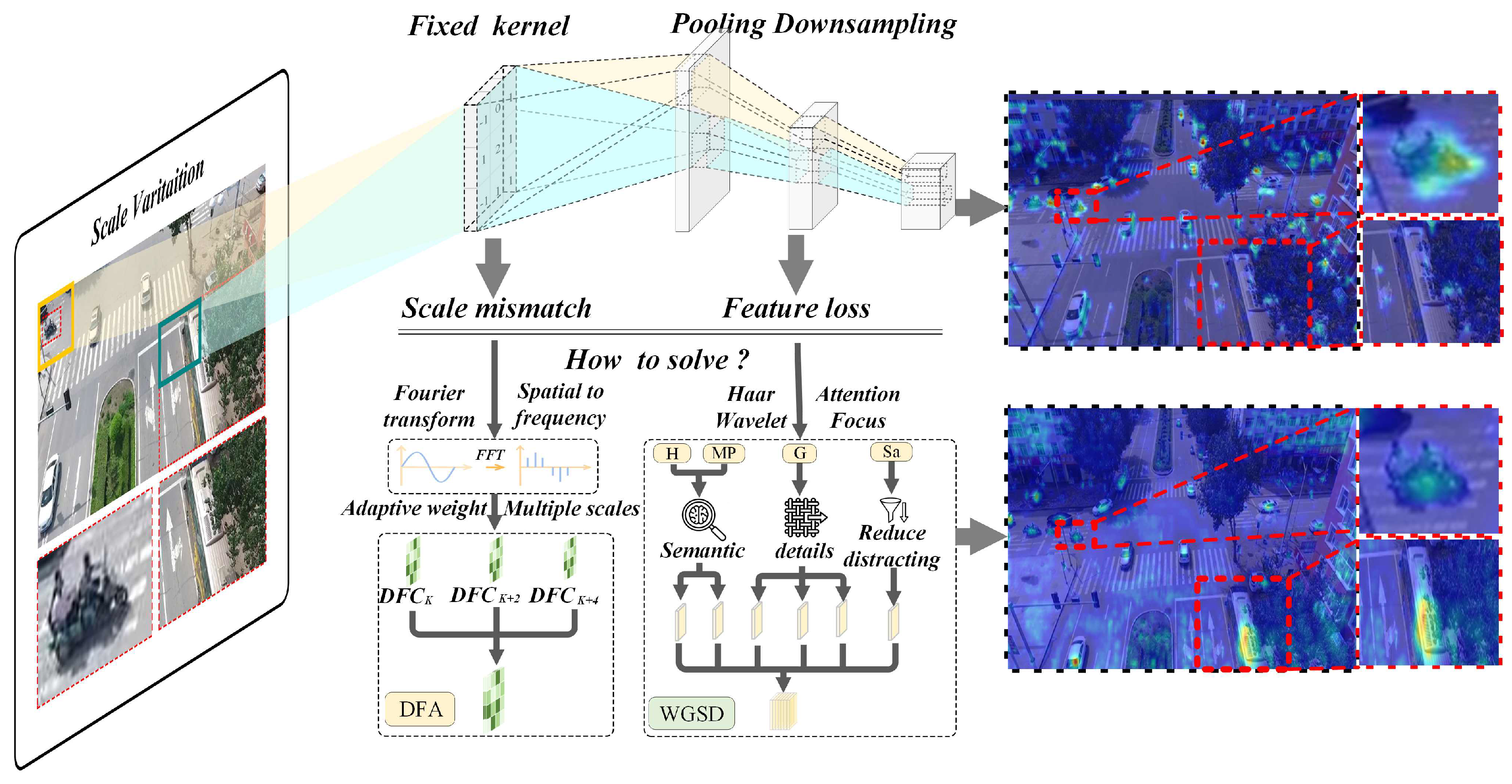
Standard convolutional neural networks rely on static kernels with fixed spatial receptive fields and invariant frequency responses. While effective for local pattern extraction, this design becomes problematic when handling objects with drastic scale variations. From a spectral perspective, large objects primarily occupy low-frequency components, whereas small objects are dominated by high-frequency details. A fixed kernel thus acts as a stationary filter that cannot simultaneously accommodate such divergent spectral characteristics. As a result, deep layers tend to over-smooth high-frequency cues essential for small objects while favoring larger structures, leading to the scale mismatch problem. To address this issue, a feature extractor should be capable of dynamically modulating its frequency response based on the input content.
Motivated by this, we propose the Dynamic Fourier Alignment (DFA) module. Unlike conventional layers, DFA integrates adaptive multi-scale alignment in the spatial domain with dynamic spectral modeling. By constructing convolution kernels conditioned on the global frequency content of the input, DFA explicitly strengthens high-frequency responses associated with small targets while suppressing background noise, ensuring robust feature alignment across scales. Specifically, DFA decomposes the input feature into multiple scale-aware branches and performs content-adaptive spectral modulation followed by self-aligned fusion.
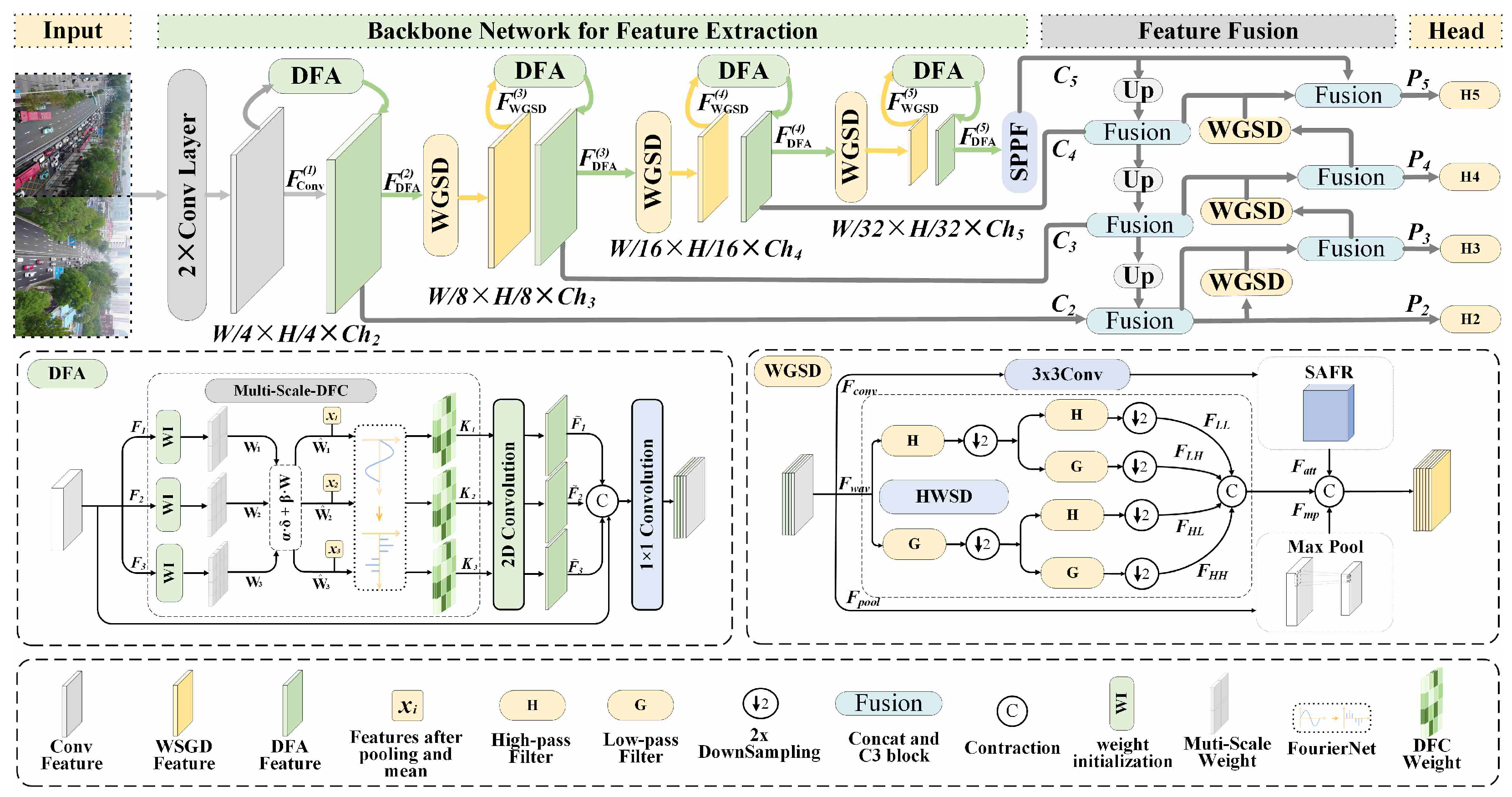
As illustrated in the bottom-left part of
Figure 2, the DFA module performs frequency-aware alignment through a multi-branch architecture, where each branch is responsible for modeling spectral patterns at a specific spatial scale. For clarity, we describe the formulation for a generic stage and omit the stage index
l in the following notation. Given an input feature
, we first project it via a
convolution and split it channel-wise into three scale-aware branches, denoted as
, where
. To capture hierarchical frequency patterns, each branch is assigned a distinct spatial receptive field by using convolution kernels of sizes
for
, respectively. This design allows the network to simultaneously model high-frequency local details with small kernels and low-frequency global structures with large kernels, forming the basis for cross-scale feature alignment.
Rather than adopting standard static convolutions, each branch is implemented with a content-adaptive convolution operator, termed Dynamic Fourier Convolution (DFC), which enables input-dependent frequency modulation and will be detailed in the following. After spectral modulation in each branch, the resulting multi-scale features are aggregated to form a unified representation. The fusion process is performed by channel-wise concatenation followed by a linear projection, as formulated below:
where
denotes the output feature of the
i-th scale-aware branch after dynamic spectral modulation, obtained by applying the Dynamic Fourier Convolution operator to the corresponding input feature, i.e.,
.
denotes channel-wise concatenation of multi-scale features together with the original input feature
, enabling joint aggregation of dynamically modulated and original representations. Finally,
is applied to fuse these aggregated representations and project the concatenated channels to the target output dimension
, producing the refined feature map
.
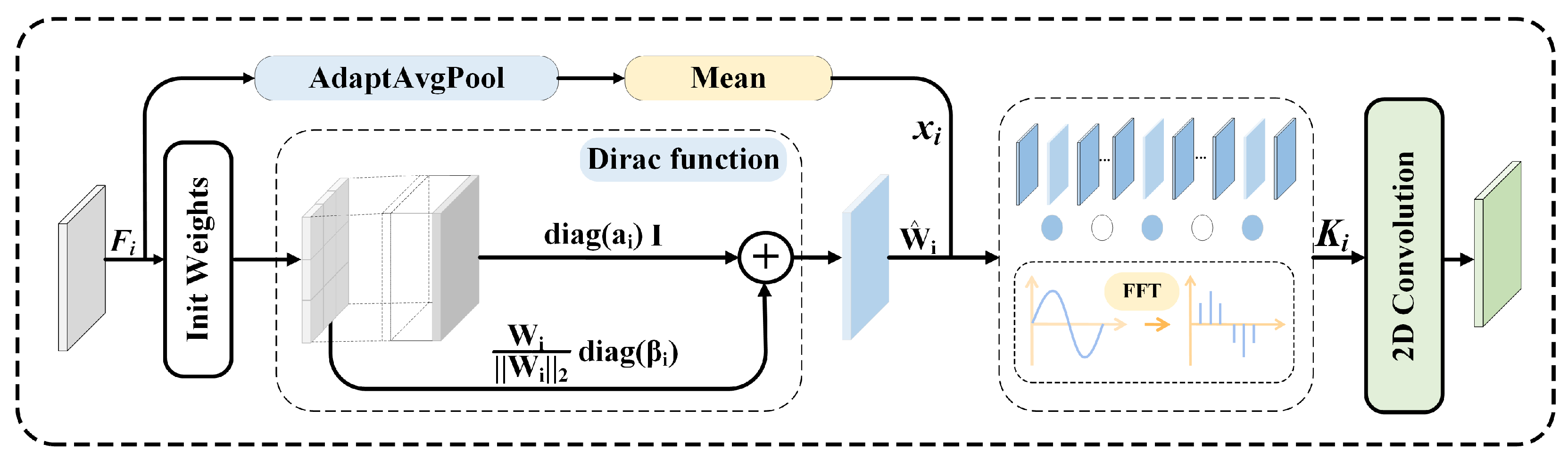
Dynamic Fourier Convolution. At the core of DFA lies a content-adaptive convolution operation, which enables each branch to dynamically adjust its spectral response according to the input. As shown in
Figure 3, each branch is equipped with a content-adaptive convolution mechanism to accommodate the distinct frequency characteristics of objects at different scales. Instead of applying a fixed convolutional kernel, the convolution operation in each branch is governed by a dynamically generated kernel whose response is conditioned on both the input feature and learnable convolutional weights. This design allows the convolution to flexibly emphasize high-frequency details or suppress low-frequency background components according to the input content. Formally, for the
i-th branch, the output feature
is obtained by applying a content-adaptive convolution with kernel
to the branch feature
:
where ⊛ denotes the convolution operation,
is dynamically generated based on the branch feature, and
denotes a learnable base convolutional weight.
To realize such a content-adaptive kernel in a stable and controllable manner, the key challenge lies in incorporating input-dependent information into the kernel generation process without introducing training instability. Directly conditioning convolution kernels on input features often leads to unstable optimization, as unconstrained kernel variations can cause abrupt changes in the effective filter response, resulting in gradient explosion and inconsistent feature transformations across samples. This instability not only hampers convergence but also undermines the structural inductive bias of convolution, degrading generalization performance.
To address this issue, we construct the dynamic kernel upon a well-conditioned base kernel that preserves the structural properties of conventional convolution, while allowing controlled input adaptivity. Specifically, input-dependent information is introduced only through smooth amplitude-frequency modulation in the spectral domain, which constrains kernel variations to be bounded and continuous, thereby ensuring stable optimization. Under this formulation, we re-parameterize the convolutional weights using a Dirac-residual scheme to obtain a stabilized base kernel:
where
denotes the Dirac identity kernel, and
and
are learnable scaling vectors whose diagonal forms
and
control the contribution of the identity and normalized convolution kernels, respectively. The scaling vectors are initialized to
and
.
Given the stabilized base kernel
, we further introduce input-dependent modulation to generate the final dynamic convolution kernel. Specifically, for each scale-aware branch, a compact global descriptor
is extracted from the corresponding feature
via adaptive average pooling followed by a mean operation, which summarizes the global statistics of
under a fixed receptive field and provides a stable conditioning signal for kernel modulation:
Here, denotes adaptive average pooling with receptive field size , and computes the channel-wise mean.
To enhance the expressive power and fitting capability of the convolution kernel, the proposed Fourier convolution adopts a network structure based on multiplicative filters. Let
u denote a generic input variable. Following the formulation of Multiplicative Filter Networks (MFN) [
47], all nonlinearities are introduced through sinusoidal filter functions applied directly to the input. The filter function at layer
i is defined as
where
denote the frequency and phase parameters.
Given the stabilized base kernel
, the multiplicative modulation process is initialized as
At each subsequent layer
, the intermediate representation is updated via element-wise multiplicative interactions:
where ∘ denotes element-wise multiplication,
is a nonlinear activation function, and
denotes the hidden representation at the
j-th layer of the network.
After
k layers of multiplicative modulation, the dynamic convolution kernel is obtained by a linear projection:
Since the element-wise product of sinusoidal functions can be rewritten as a linear combination of sinusoidal bases, the above recursive formulation admits an explicit Fourier expansion. Consequently, the resulting dynamic kernel can be equivalently expressed as
where
denote the effective frequencies and phase offsets induced by the multiplicative expansion,
are the corresponding amplitude coefficients, and
T is the number of resulting sinusoidal basis components.
By using DFC as the fundamental unit of DFA, we introduce MFN-style Fourier multiplicative modulation on a Dirac-residual–stabilized base kernel, with the frequency and phase parameters conditioned on a global descriptor to generate content-adaptive convolution kernels. This constrained frequency-domain modulation mitigates weight drift and scale sensitivity, enabling cross-scale feature alignment while enhancing high-frequency details of small objects and suppressing low-frequency background interference.
Novelty of DFA Compared with Existing Approaches. It is worth highlighting the key differences between DFA and existing frequency-domain or dynamic convolution methods. Standard dynamic convolution [
24] generates input-conditioned kernels by recombining static weight bases, but it does not explicitly control the frequency response of the generated kernel; the adaptivity is confined to the spatial domain without spectral regularization. The Spectral Enhancement for Tiny Object Detection (SET) [
26] applies spectral enhancement at the feature level by reweighting frequency components of the feature map, but the convolution kernel itself remains static. In contrast, DFA uniquely combines content-adaptive kernel generation with explicit frequency control via multiplicative filter networks: the kernel is dynamically generated while its spectral characteristics are simultaneously constrained through sinusoidal basis functions. This dual mechanism ensures that the modulation is both input-adaptive and frequency-controllable, which is fundamentally different from merely reweighting features or recombining spatial kernels.
3.3. Wavelet-Guided Spectral Downsampling
Spatial downsampling is a fundamental operation in convolutional neural networks, essential for expanding receptive fields and reducing computational complexity. However, standard pooling mechanisms impose critical limitations when processing small objects. From a signal processing perspective, downsampling effectively reduces the sampling rate of the feature map. According to the Nyquist–Shannon sampling theorem, if high-frequency components characterizing small objects are not properly handled, the reduction in sampling rate leads to aliasing. Specifically, Average Pooling functions as a low-pass filter that indiscriminately blurs high-frequency details, causing small targets to fade into the background. Conversely, Max Pooling performs non-linear sub-sampling by selecting peak values. While this preserves strong activations, it disrupts the spatial continuity of signals and induces severe aliasing artifacts, leading to structural distortion and the loss of weaker but distinct spatial cues. Since small objects are inherently sparse high-frequency impulses, these destructive operations result in irreversible feature loss in deeper layers.
To address this dilemma, we propose the Wavelet-Guided Spectral Downsampling (WGSD) module, as illustrated in the bottom-right part of
Figure 2. Departing from single-operator pooling, WGSD introduces a hybrid downsampling strategy centered on Haar wavelet spectral decomposition [
29] and complemented by spatial attention. This approach allows the network to explicitly separate and preserve critical high-frequency textures via orthogonal wavelet transformation while actively highlighting salient object regions via attention, thereby achieving information-preserving reduction suitable for small object detection.
Let denote the input feature map from the preceding DFA module. To enable efficient multi-branch processing, we split along the channel dimension into three parts, i.e., , , and , written as . Specifically, preserves half of the channels to retain stable structural cues, while and each take one quarter for spectral-detail and spatial refinement, respectively.
Haar Wavelet Sub-band Decomposition. We employ the 2D discrete Haar wavelet transform (DWT) on the first sub-feature
to capture frequency-domain characteristics. Unlike standard pooling which discards pixels, DWT performs a reversible orthogonal transformation based on the low-pass scaling function
and the high-pass wavelet function
. As a result,
is decomposed into four complementary spectral components:
where ∗ denotes the filtering operation via strided convolution with fixed Haar kernels. Intuitively,
corresponds to the low-frequency approximation, whereas the set
captures high-frequency components along the horizontal, vertical, and diagonal directions, explicitly preserving fine-grained boundary cues.
Spatially Adaptive Feature Refinement. Although the Haar decomposition in Equation (
10) preserves rich sub-band details, it may also retain undesired high-frequency clutter arising from complex backgrounds. To suppress irrelevant responses while emphasizing spatially salient regions during downsampling, we introduce a Spatially Adaptive Feature Refinement mechanism. Notably, this mechanism operates directly on
obtained from channel partitioning, rather than on the wavelet sub-bands, thereby providing complementary spatial selectivity that is decoupled from the spectral decomposition.
Specifically, we squeeze channel information of
using average and max pooling to form two spatial descriptors, which are concatenated to predict an attention map
:
where
and
denote pooling along the channel dimension, ∘ is element-wise multiplication, and
is the Sigmoid function. The stride-2 convolution aligns the output resolution with other downsampling branches.
Complementary to the spatially adaptive refinement, the
partition is processed via a standard max-pooling operator to capture the most prominent local activations and ensure translation-invariant cues, yielding
. Unlike the attention-based path that performs soft, spatially selective reweighting, max pooling functions as a deterministic “winner-take-all” operator that preserves peak signal intensities regardless of the learned attention weights. This mechanism is particularly effective when small objects manifest as sparse but high-magnitude impulses that might otherwise be smoothed. Finally, the WGSD module synthesizes a comprehensive representation by concatenating the wavelet sub-bands, the attention-refined features, and the max-pooled salient responses along the channel dimension:
By unifying spectral decomposition with Spatially Adaptive Feature Refinement, WGSD effectively mitigates feature degradation, ensuring that subsequent layers receive a feature representation that is both compact and rich in high-frequency details essential for small object recognition.
Novelty of WGSD Compared with Conventional Wavelet Downsampling. While Haar wavelet downsampling has been previously explored for semantic segmentation [
29], WGSD differs from it in several key aspects. First, the conventional approach [
29] retains only the low-pass approximation (
) and discards high-frequency sub-bands as “noise,” which is acceptable for segmentation where boundary precision is less critical but is detrimental for small object detection where high-frequency cues are indispensable. In contrast, WGSD explicitly retains all four wavelet sub-bands (
,
,
,
), preserving both low-frequency context and high-frequency boundary information. Second, WGSD further integrates a Spatially Adaptive Feature Refinement mechanism and a max-pooling branch, which work complementarily to suppress background clutter and highlight salient object regions during downsampling. This hybrid design is specifically tailored for small object detection and goes beyond simple wavelet-based resolution reduction.