



Determination of Backlash Value in the Feed Motion System of Machine Tools Using Shallow Neural Networks

Abstract
1. Introduction
2. Materials and Methods
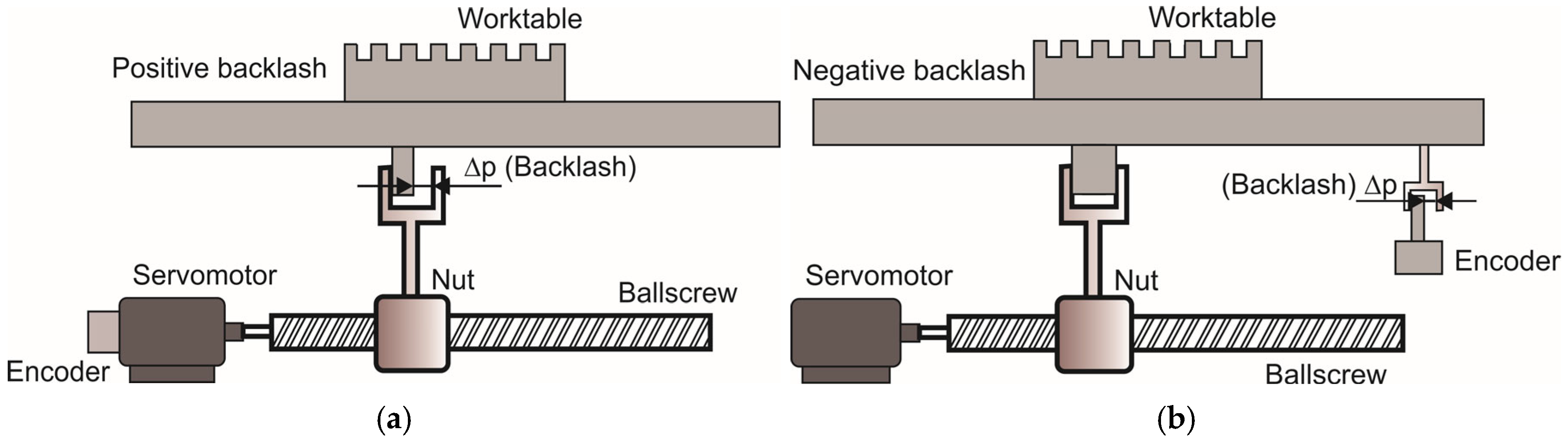
2.1. Backlash in the Feed Motion Subsystem of Machine Tools
- mechanical inaccuracies due to manufacturing or assembly errors and elastic deformation during motion,
- wear of components in the feed motion assembly,
- thermal deformation under operating conditions,
- mechanical oscillations during changes in feed rate along curved paths,
- inadequate maintenance, poor lubricant quality, and other random causes,
- drive-induced inaccuracies.
2.2. Testing the Positioning Accuracy of the Numerically Controlled Axes of Machine Tools and Determining the Backlash Value
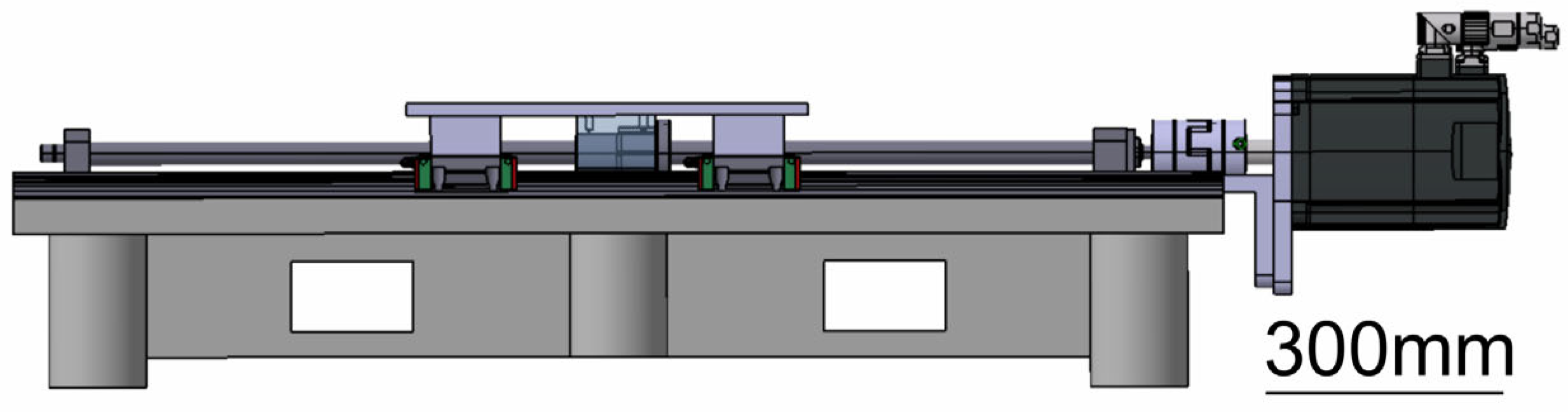
- unloaded machine operation with stable thermal and lubrication conditions,
- environmental parameters (temperature, humidity, pressure) close to reference values with continuous monitoring and compensation,
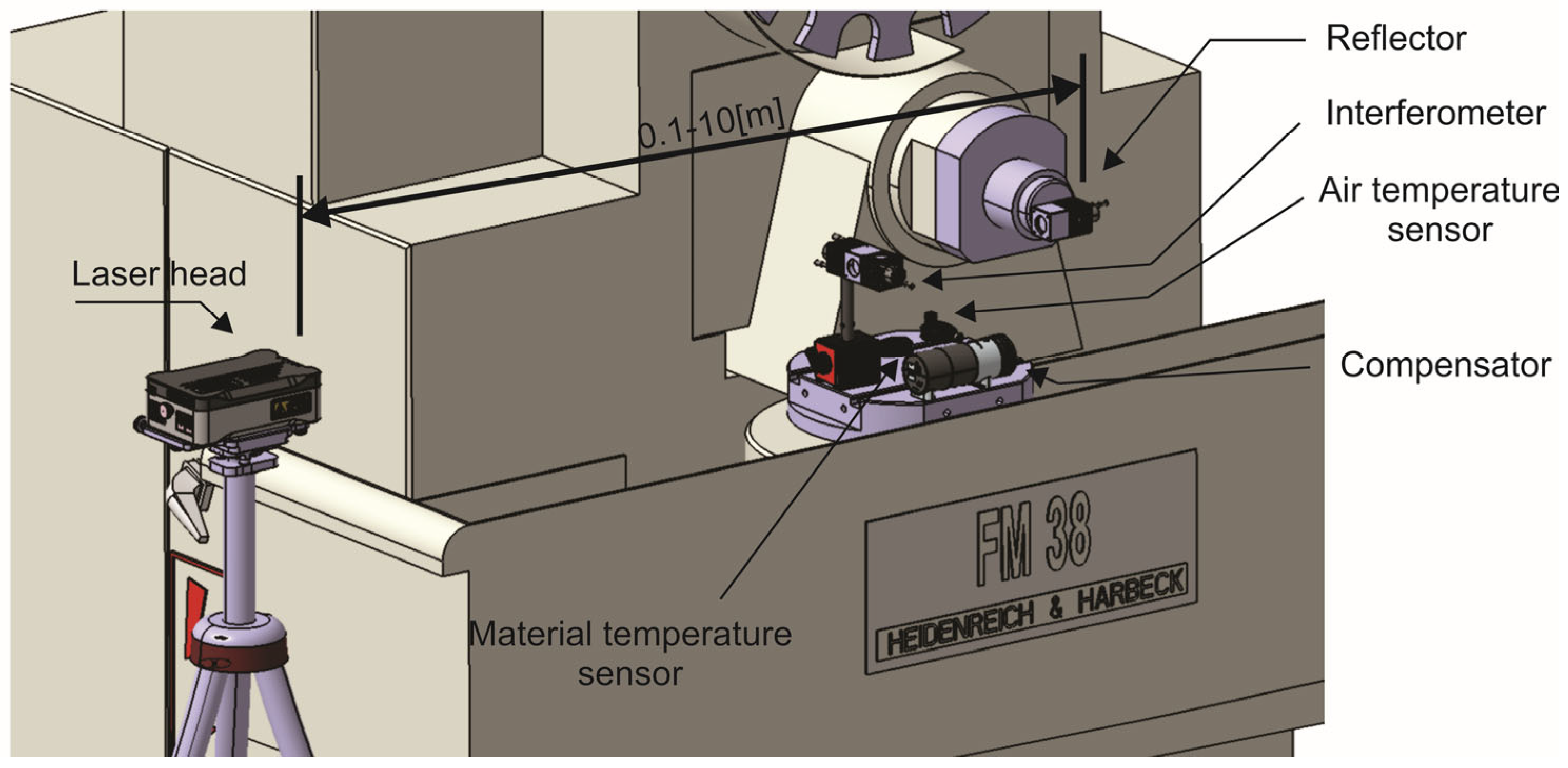
- use of certified measuring equipment with defined uncertainty [11],
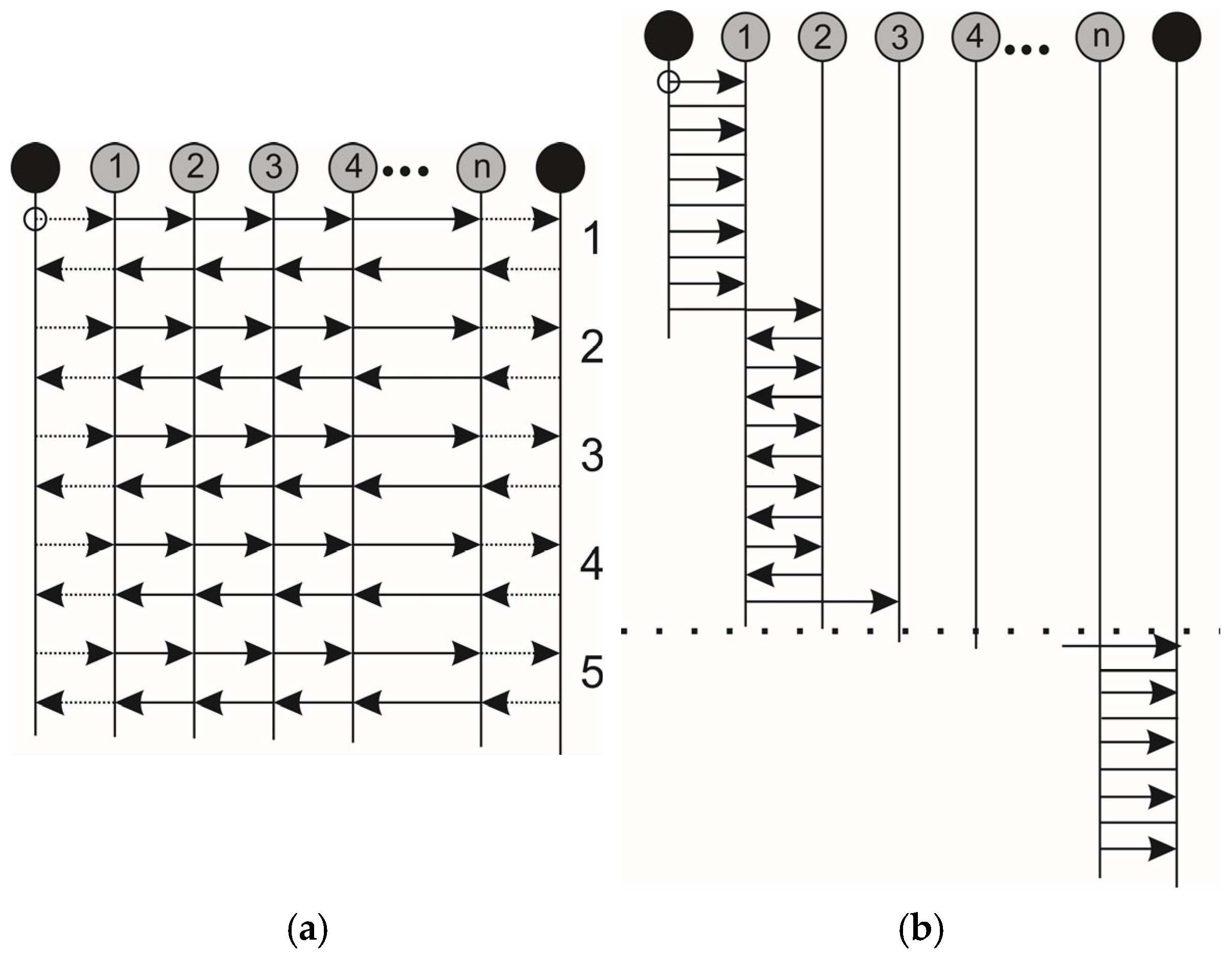
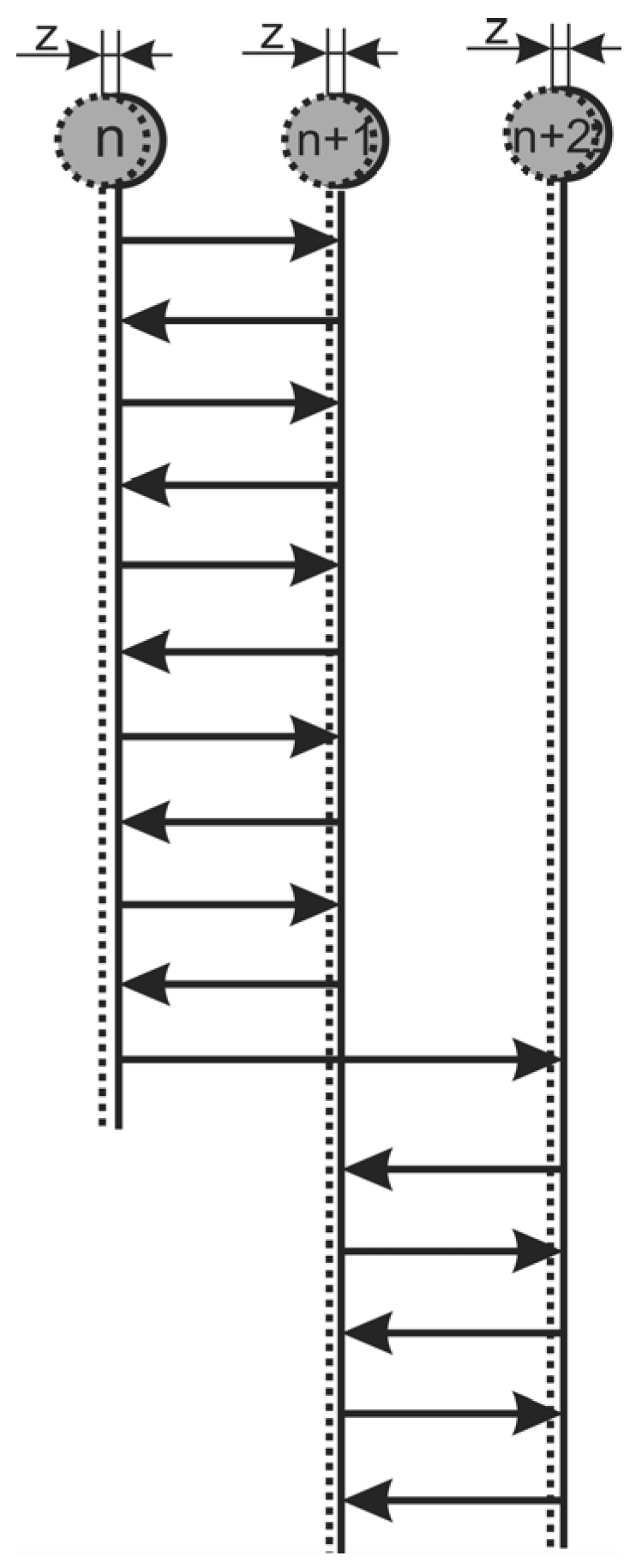
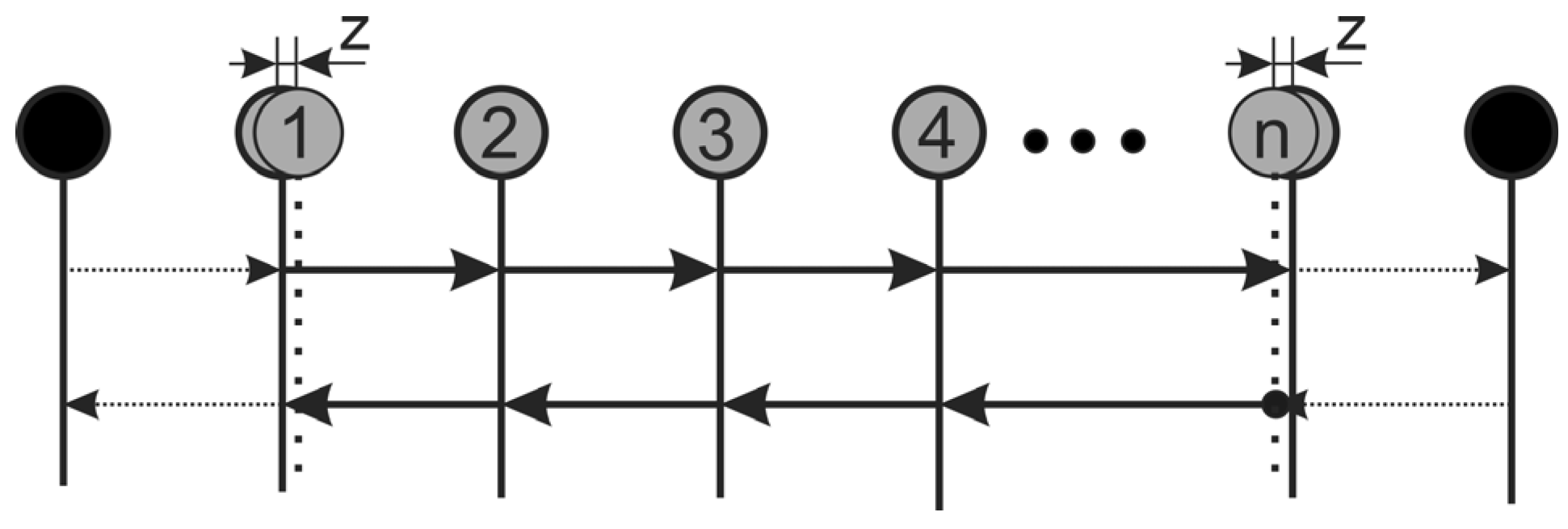
- adaptation of the testing procedure to the specific machine (number of measurement points, feed rate, etc.).
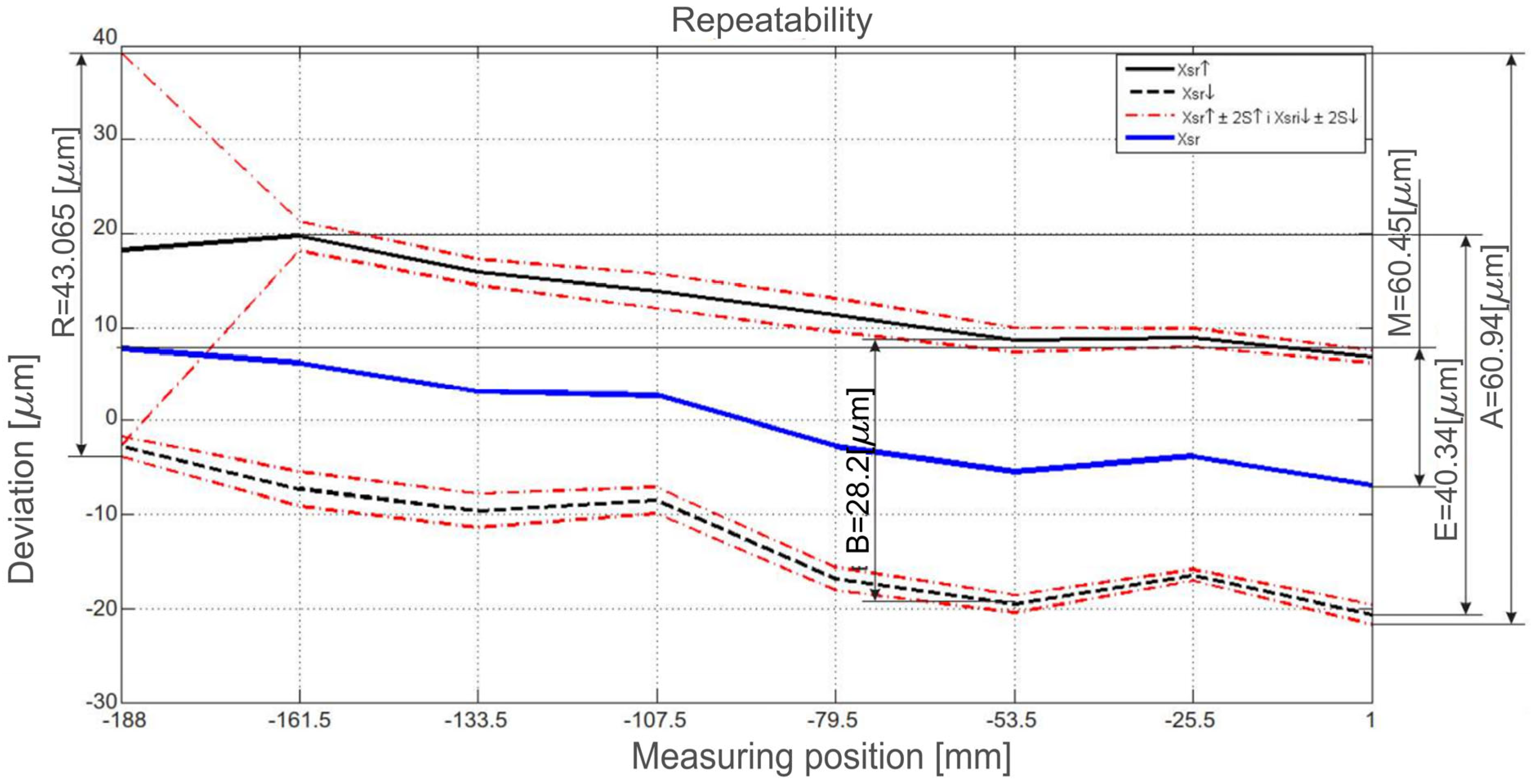
- Pi: reference (programmed) position,
- Pij: actual measured position at the i-th and j-th reference point,
- Xij = Pij − Pi: deviation from the target position.
- mean of measured values,
- central deviation value at bidirectional positioning,
- maximum and average deviation ranges,
- unidirectional and bidirectional repeatability,
- unidirectional and bidirectional systematic positioning errors (E),
- maximum bidirectional error (M).
3. Application of Machine Learning in Backlash Estimation
3.1. Methods for Backlash Determination
- development of standardised methods for accurate backlash determination for machine calibration,
- creation of software tools for real-time backlash estimation and compensation based on operational parameters such as power, noise, or vibration.
3.2. The Structure of the Neural Network for Determining the Backlash in the Feed Motion Subsystem
4. Results of Experimental Research
4.1. Experiment Setup
4.2. Database of Measured Values
4.3. Training, Validation and Testing of Neural Networks
5. Discussion
- the influence of measurement uncertainty (both equipment and environmental) on backlash prediction,
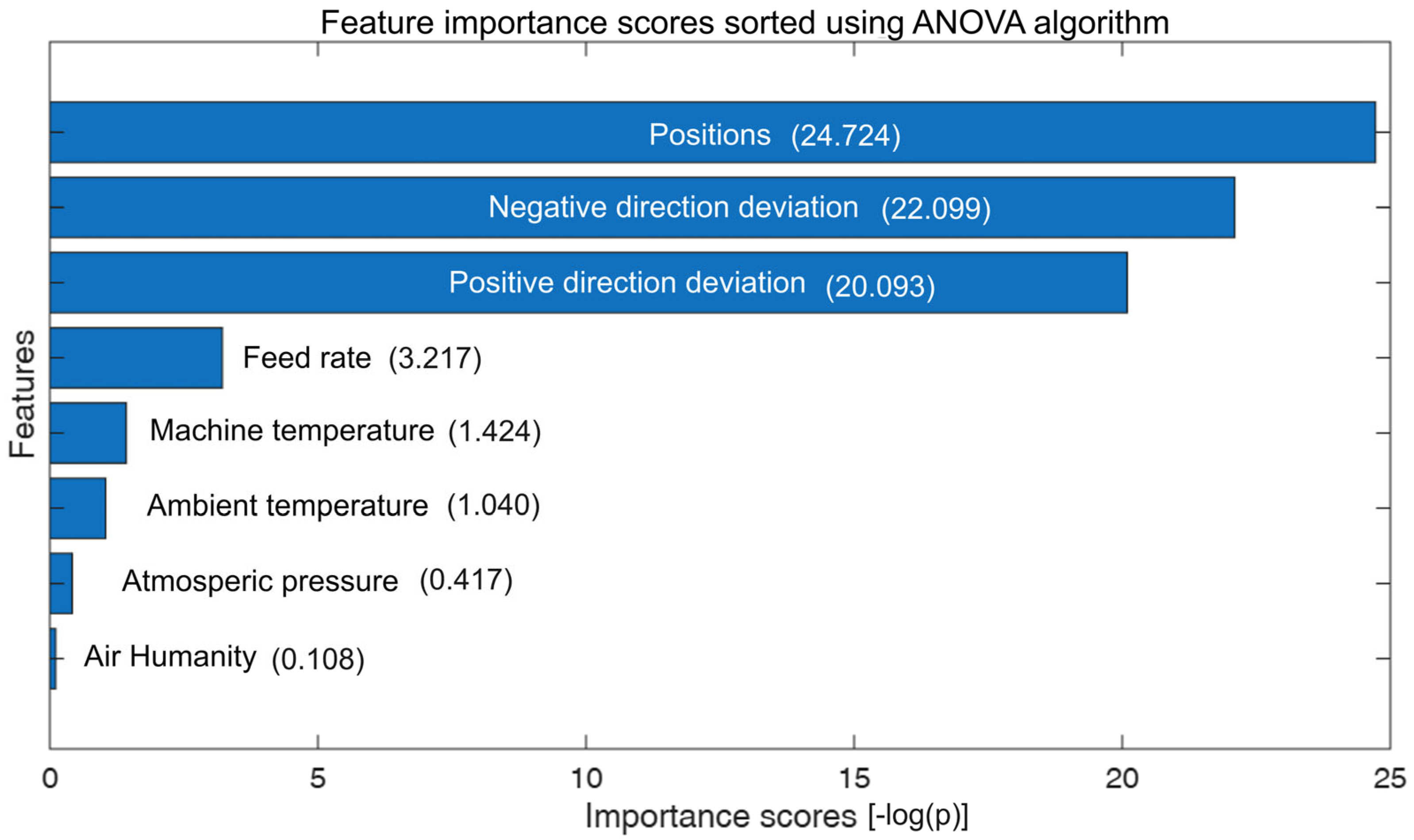
- the influence of individual input parameters on prediction results,
- the accuracy and robustness of predicted backlash values,
- the applicability of the defined procedure in real industrial environments.
6. Conclusions
Author Contributions
Funding
Data Availability Statement
Acknowledgments
Conflicts of Interest
References
- Li, L. China’s manufacturing locus in 2025: With a comparison of “Made-in-China 2025” and “Industry 4.0”. Technol. Forecast. Soc. Change 2018, 135, 66–74. [Google Scholar] [CrossRef] [Scilit]
- Terzi, A.; Sherwood, M.; Singh, A. European industrial policy for the green and digital revolution. Sci. Public Policy 2023, 50, 842–857. [Google Scholar] [CrossRef] [Scilit]
- Aguado, S.; Pérez, P.; Albajez, J.A.; Velázquez, J.; Santolaria, J. Inaccuracy of machine tools due to verification conditions. Measurement 2022, 188, 110629. [Google Scholar] [CrossRef] [Scilit]
- Wang, L.; Han, J.; Tang, Z.; Zhang, Y.; Wang, D.; Li, X. Geometric Accuracy Design of High Performance CNC Machine Tools: Modeling, Analysis, and Optimization. Chin. J. Mech. Eng. 2025, 38, 87. [Google Scholar] [CrossRef] [Scilit]
- Schwenke, H.; Knapp, W.; Haitjema, H.; Weckenmann, A.; Schmitt, R.; Delbressine, F. Geometric error measurement and compensation of machines—An update. CIRP Ann. 2008, 57, 660–675. [Google Scholar] [CrossRef] [Scilit]
- Weck, M. Werkzeugmaschinen Fertigungssysteme 1: Maschinenarten und Anwendungsbereiche; Springer: Berlin/Heidelberg, Germany, 2013. [Google Scholar]
- Zhang, Z.; Jiang, F.; Luo, M.; Wu, B.; Zhang, D.; Tang, K. Geometric error measuring, modeling, and compensation for CNC machine tools: A review. Chin. J. Aeronaut. 2024, 37, 163–198. [Google Scholar] [CrossRef] [Scilit]
- ISO 230-1; Test Code for Machine Tools—Geometric Accuracy. ISO: Geneva, Switzerland, 1973.
- ANSI B5.54; Methods for Performance Evaluation of NC Machine Tools. ANSI: Washington, DC, USA, 1975.
- Bryan, J.B. A simple method for testing measuring machines and machine tools Part 1: Principles and applications. Precis. Eng. 1982, 4, 61–69. [Google Scholar] [CrossRef] [Scilit]
- Tabakovic, S.; Zeljkovic, M.; Zivanovic, S.; Budimir, A.; Dimic, Z.; Kosarac, A. Calibration of a Hybrid Machine Tool from the Point of View of Positioning Accuracy. Appl. Sci. 2024, 14, 5275. [Google Scholar] [CrossRef] [Scilit]
- Rosemeyer, J.; Pinzone, M.; Metternich, J. Digital Assistance Systems to Implement Machine Learning in Manufacturing: A Systematic Review. Mach. Learn. Knowl. Extr. 2024, 6, 2808–2828. [Google Scholar] [CrossRef] [Scilit]
- Altintas, Y.; Verl, A.; Brecher, C.; Uriarte, L.; Pritschow, G. Machine tool feed drives. CIRP Ann. 2011, 60, 779–796. [Google Scholar] [CrossRef] [Scilit]
- Ma, J.; Lu, D.; Zhao, W. Assembly errors analysis of linear axis of CNC machine tool considering component deformation. Int. J. Adv. Manuf. Technol. 2016, 86, 281–289. [Google Scholar] [CrossRef] [Scilit]
- Wang, L.; Liu, X.; Tian, W.; Zhang, D. Geometric Accuracy Design and Tolerance Allocation of Precision Horizontal Machining Centers. Machines 2025, 13, 187. [Google Scholar] [CrossRef] [Scilit]
- Ramesh, R.; Mannan, M.A.; Poo, A.N. Error compensation in machine tools—A review: Part I: Geometric, cutting-force induced and fixture-dependent errors. Int. J. Mach. Tools Manuf. 2000, 40, 1235–1256. [Google Scholar] [CrossRef] [Scilit]
- ISO 230-2:2014; Test Code for Machine Tools—Part 2: Determination of Accuracy and Repeatability of Positioning of Numerically Controlled Axes. ISO: Geneva, Switzerland, 2014.
- Wang, K.-S.; Li, Z.; Braaten, J.; Yu, Q. Interpretation and compensation of backlash error data in machine centers for intelligent predictive maintenance using ANNs. Adv. Manuf. 2015, 3, 97–104. [Google Scholar] [CrossRef] [Scilit]
- Azamfar, M.; Li, X.; Lee, J. Intelligent ball screw fault diagnosis using a deep domain adaptation methodology. Mech. Mach. Theory 2020, 151, 103932. [Google Scholar] [CrossRef] [Scilit]
- Benker, M.; Zaeh, M.F. Condition monitoring of ball screw feed drives using convolutional neural networks. CIRP Ann. 2022, 71, 313–316. [Google Scholar] [CrossRef] [Scilit]
- Gao, W.; Ibaraki, S.; Donmez, M.A.; Kono, D.; Mayer, J.R.R.; Chen, Y.-L.; Szipka, K.; Archenti, A.; Linares, J.-M.; Suzuki, N. Machine tool calibration: Measurement, modeling, and compensation of machine tool errors. Int. J. Mach. Tools Manuf. 2023, 187, 104017. [Google Scholar] [CrossRef] [Scilit]
- Xie, Z.; Yu, D.; Zhan, C.; Zhao, Q.; Wang, J.; Liu, J.; Liu, J. Ball screw fault diagnosis based on continuous wavelet transform and two-dimensional convolution neural network. Meas. Control 2023, 56, 518–528. [Google Scholar] [CrossRef] [Scilit]
- Kumbhar, M.; Bandaru, S.; Karlsson, A. Condition Monitoring of a Machine Tool Ballscrew Using Wavelet Transform based Unsupervised Learning. Procedia CIRP 2024, 130, 342–347. [Google Scholar] [CrossRef] [Scilit]
- Soori, M.; Arezoo, B.; Dastres, R. Machine learning and artificial intelligence in CNC machine tools, A review. Sustain. Manuf. Serv. Econ. 2023, 2, 100009. [Google Scholar] [CrossRef] [Scilit]
- Kosarac, A.; Tabakovic, S.; Mladjenovic, C.; Zeljkovic, M.; Orasanin, G. Next-Gen Manufacturing: Machine Learning for Surface Roughness Prediction in Ti-6Al-4V Biocompatible Alloy Machining. J. Manuf. Mater. Process. 2023, 7, 202. [Google Scholar] [CrossRef] [Scilit]
- Kosarac, A.; Mladjenovic, C.; Zeljkovic, M.; Tabakovic, S.; Knezev, M. Neural-Network-Based Approaches for Optimization of Machining Parameters Using Small Dataset. Materials 2022, 15, 700. [Google Scholar] [CrossRef] [Scilit] [PubMed]
- ISO/TR 230-9:2005; Test Code for Machine Tools, Part 9: Estimation of Measurement Uncertainty for Machine Tool Tests According to Series ISO 230, Basic Equations. ISO: Geneva, Switzerland, 2005.
- Quan, L.; Zhao, W. Uncertainty analysis of motion accuracy on single-axis feed drive systems. Adv. Mech. Eng. 2024, 16, 16878132231222790. [Google Scholar] [CrossRef] [Scilit]


| i | 1 | 2 | … | 6 | 7 | 8 | ||||||
|---|---|---|---|---|---|---|---|---|---|---|---|---|
| Target position Pi [mm] | −188 | −161.5 | … | −53.5 | −25.5 | 1 | ||||||
| Approach direction | ↓ | ↑ | ↓ | ↑ | … | ↓ | ↑ | ↓ | ↑ | ↓ | ↑ | |
| Positioning deviations [μm] | j = 1 | −0.519 | −2.033 | 21.000 | −6.700 | … | 9.700 | −19.100 | 9.700 | −16.100 | 7.400 | −19.900 |
| 2 | 23.581 | −2.451 | 19.800 | −6.500 | … | 8.800 | −19.900 | 9.100 | −16.600 | 6.500 | −21.300 | |
| 3 | 23.396 | −2.951 | 19.700 | −6.700 | … | 8.400 | −19.400 | 8.700 | −16.200 | 6.700 | −20.400 | |
| 4 | 22.237 | −3.008 | 18.900 | −8.400 | … | 7.900 | −19.100 | 8.500 | −16.800 | 6.900 | −20.800 | |
| 5 | 22.530 | −3.372 | 19.300 | −8.200 | … | 8.600 | −20.100 | 8.600 | −16.700 | 6.900 | −20.800 | |
| Mean unidirectional positioning deviation [μm] | 18.245 | −2.763 | 19.740 | −7.300 | … | 8.680 | −19.520 | 8.920 | −16.480 | 6.880 | −20.640 | |
| Estimator of standard uncertainty si [μm] | 10.505 | 0.524 | 0.789 | 0.919 | … | 0.661 | 0.460 | 0.492 | 0.311 | 0.335 | 0.522 | |
| 2si [μm] | 21.010 | 1.047 | 1.579 | 1.838 | … | 1.322 | 0.921 | 0.984 | 0.623 | 0.669 | 1.045 | |
| − 2si [μm] | −2.765 | −3.810 | 18.161 | −9.138 | … | 7.358 | −20.441 | 7.936 | −17.103 | 6.211 | −21.685 | |
| + 2si [μm] | 39.254 | −1.716 | 21.319 | −5.462 | … | 10.002 | −18.599 | 9.904 | −15.857 | 7.549 | −19.595 | |
| Unidirectional repeatability Ri = 4si [μm] | 42.019 | 2.094 | 3.157 | 3.677 | … | 2.644 | 1.842 | 1.968 | 1.246 | 1.339 | 2.090 | |
| Reversal error Bi [μm] | 21.008 | 27.040 | … | 28.200 | 25.400 | 27.520 | ||||||
| Bidirectional repeatability Ri [μm] | 43.065 | 30.457 | … | 30.443 | 27.007 | 29.234 | ||||||
| Mean bidirectional [μm] | 7.741 | 6.220 | … | −5.420 | −3.780 | −6.880 | ||||||
| Number of Measurement Points Along the Axis | 8 (0–350 [mm]) |
|---|---|
| Feed rates | 3 (200, 500, and 1200 [mm/min]) |
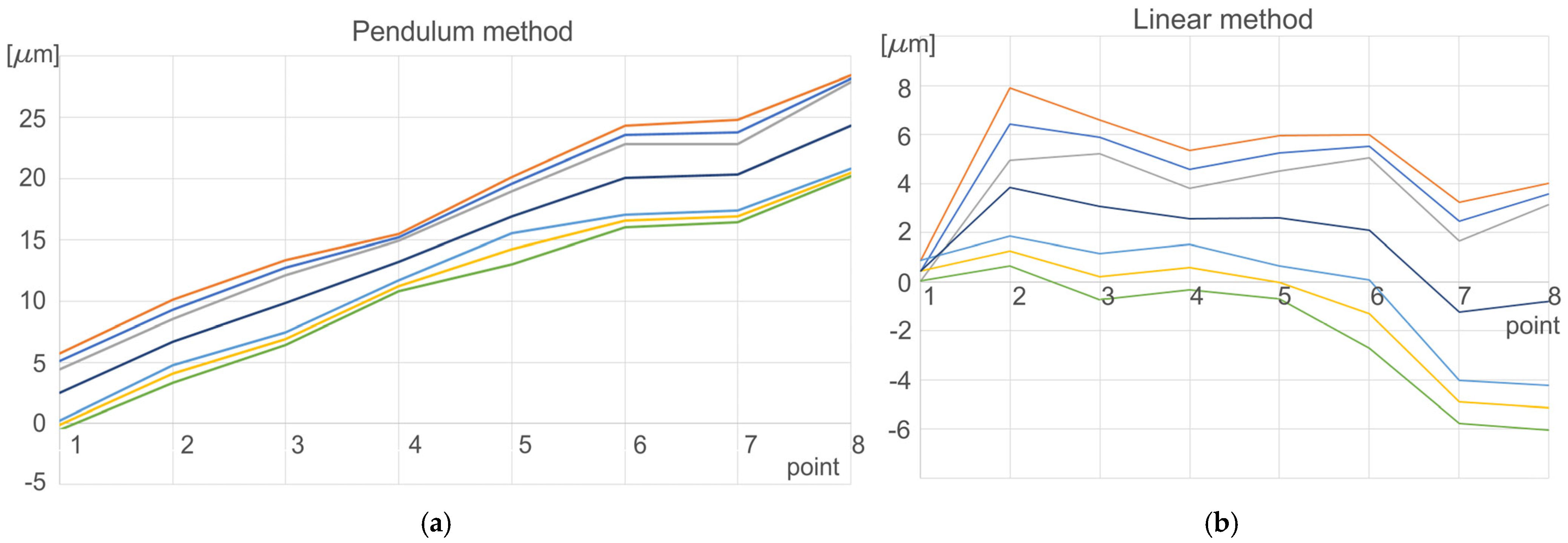
| Motion methods | 2 (linear and pendulum) |
| Dwell time at each point | 3, 5, and 7 s |
| Measured parameters | Machine temperature, ambient temperature, atmospheric pressure, air humidity |
| No | Pos. [mm] | Dev_lin_f [mm] | Dev_lin_r [mm] | S [mm/min] | T_e [°C] | … | Dev_pend_f [mm] | Dev_pend_r [mm] |
|---|---|---|---|---|---|---|---|---|
| 1 | 0 | −0.0001 | −0.0001 | 200 | 21.6 | … | 0.0028 | 6.96 × 10⁻⁵ |
| 2 | 0 | −0.00064 | −0.00064 | 200 | 21.6 | … | 0.003929 | 0.000261 |
| … | … | … | … | … | … | … | … | … |
| 180 | 250 | 249.9828 | 249.9765 | 500 | 26.9 | ... | 250.024 | 250.0181 |
| 181 | 250 | 249.9831 | 249.9767 | 500 | 26.9 | ... | 250.0243 | 250.0173 |
| … | … | … | … | … | … | … | … | … |
| 430 | 350 | 349.9747 | 349.9668 | 1200 | 19.7 | ... | 350.0373 | 350.0292 |
| 431 | 350 | 349.9745 | 349.9664 | 1200 | 19.7 | ... | 350.0374 | 350.0297 |
| Device—uD Uncertainty Due to the Measurement Device | X Axis | Units |
|---|---|---|
| L measurement length | 360 | mm |
| a accuracy of the measurement device | 3.4 | ppm |
| uaccuracy uncertainty due to accuracy of the measurement device | 0.1963 | μm |
| Wavelength stability | 0.04 | ppm |
| uwavelength uncertainty due to wavelength stability of the measurement device | 0.0023 | μm |
| udevice_estimate estimated uncertainty of the measurement device | 0.1986 | μm |
| r resolution of the measurement device | 0.1 | μm |
| uresolution uncertainty due to resolution of the measurement device | 0.0289 | μm |
| uD Uncertainty due to the measurement device | 0.2007 | μm |
| Misalignment—uM Uncertainty due to misalignment of measurement device to machine axis | ||
| Misalignment misalignment of measurement device to machine axis under test | 1 | mm |
| γ angle of misalignment | 0.2865 | ° |
| ΔLm the difference between measured and actual length due to misalignment | 2.5000 | μm |
| uM Uncertainty due to misalignment of measurement device to machine axis under test | 0.7217 | μm |
| Temperature—uT Uncertainty due to compensation of machine tool temperature | ||
| Standard uncertainty of sensor | 0.7 | °C |
| u(Θ)calculated the uncertainty of the temperature measurement device | 0.2021 | °C |
| uM_Machine tool the uncertainty due to temperature measurement of machine tool | 0.4850 | μm |
| uM_Device the uncertainty due to temperature measurement of the device | 0 | μm |
| TM—Machine temperature | 24 | °C |
| ΔT the difference to 20 C | 4 | °C |
| u(α) the uncertainty of expansion coefficient of machine tool | 0.0006 | μm/mm°C |
| uE_Machine tool the uncertainty due to the thermal expansion coefficient of machine | 0.4619 | μm |
| uE_Device the uncertainty due to the thermal expansion coefficient of the measurement device | 0 | μm |
| uT Uncertainty due to compensation of machine tool temperature | 0.6697 | μm |
| Environmental variation—uEVE Uncertainty due to environmental variation error | ||
| EVE environmental variation error or drift | 1 | μm |
| uEVE Uncertainty due to environmental variation error or drift | 0.2887 | μm |
| Repeatability of the setup—uS Uncertainty due to the repeatability of the measurement set-up | ||
| OABBE the Abbe offset between two possible lines of measurement | 50 | mm |
| Dangle the angular deviation (pitch/yaw) of axis under test | 50 | μm/m |
| ΔLS the change in measured length due to repeatability of measurement set-up | 3.5355 | μm |
| uS Uncertainty due to the repeatability of the measurement set-up | 1.0206 | μm |
| At the measuring length—uP Uncertainty of measured point | ||
| uP Uncertainty of measured point | 1.4610 | μm |
| Measurement Parameters | X Axis | Units |
|---|---|---|
| n—number of cycles | 5 | - |
| U(R+, R−) the uncertainty of unidirectional repeatability | 1.15 | μm |
| U(B) the uncertainty of reversal value | 4.12 | μm |
| U(R) the uncertainty of bi-directional repeatability | 4.27 | μm |
| U(E,E+,E−) the uncertainty of systematic deviations | 2:88 | μm |
| U(M) [n = 10] the uncertainty of systematic deviations | 2.87 | μm |
| U(A) the uncertainty of accuracy of positioning | 3.33 | μm |
Disclaimer/Publisher’s Note: The statements, opinions and data contained in all publications are solely those of the individual author(s) and contributor(s) and not of MDPI and/or the editor(s). MDPI and/or the editor(s) disclaim responsibility for any injury to people or property resulting from any ideas, methods, instructions or products referred to in the content. |
© 2026 by the authors. Licensee MDPI, Basel, Switzerland. This article is an open access article distributed under the terms and conditions of the Creative Commons Attribution (CC BY) license.
Share and Cite
Tabakovic, S.; Zeljkovic, M.; Budimir, A.; Zivanovic, S. Determination of Backlash Value in the Feed Motion System of Machine Tools Using Shallow Neural Networks. Algorithms 2026, 19, 49. https://doi.org/10.3390/a19010049
Tabakovic S, Zeljkovic M, Budimir A, Zivanovic S. Determination of Backlash Value in the Feed Motion System of Machine Tools Using Shallow Neural Networks. Algorithms. 2026; 19(1):49. https://doi.org/10.3390/a19010049
Chicago/Turabian StyleTabakovic, Slobodan, Milan Zeljkovic, Alexander Budimir, and Sasa Zivanovic. 2026. "Determination of Backlash Value in the Feed Motion System of Machine Tools Using Shallow Neural Networks" Algorithms 19, no. 1: 49. https://doi.org/10.3390/a19010049
APA StyleTabakovic, S., Zeljkovic, M., Budimir, A., & Zivanovic, S. (2026). Determination of Backlash Value in the Feed Motion System of Machine Tools Using Shallow Neural Networks. Algorithms, 19(1), 49. https://doi.org/10.3390/a19010049

