




Key Aspects to Promote the Safe Use of GenAI Tools by Undergraduate Education and Architecture Students: Similarities and Differences


Abstract
1. Introduction
- Do undergraduate Education and Architecture students use GenAI tools? (RQ 1)
- In what year did Education and Architecture students start using GenAI tools? (RQ 2)
- What digital devices and GenAI tools do Education and Architecture students use? (RQ 3)
- What advantages and disadvantages do Education and Architecture university students attribute to the safe use of GenAI tools? (RQ 4)
- What measures/guidelines do Education and Architecture students suggest to promote the safe use of GenAI tools? (RQ 5)
2. Materials and Methods
2.1. Participants, Instrument, and Data Collection
- If you use GenAI tools, in which year did you first come into contact with them? (RQ 1 and 2)
- What devices do you use to access GenAI tools? (RQ 3)
- What GenAI tools do you use/have you used to perform academic tasks? (RQ 3)
- What do you consider the main advantages of using GenAI tools? (RQ 4)
- What do you consider the main threats of using GenAI tools? (RQ 4)
- What measures or rules should be implemented by the university to ensure the safe use of GenAI in an academic context? (RQ 5)
2.2. Data Analysis
3. Results
3.1. Use, Devices, and Tools of GenAI According to the University Degree (RQ 1, 2, and 3)
3.2. Advantages, Disadvantages, and Measures for the Safe Use of GenAI (RQ 4 and 5)
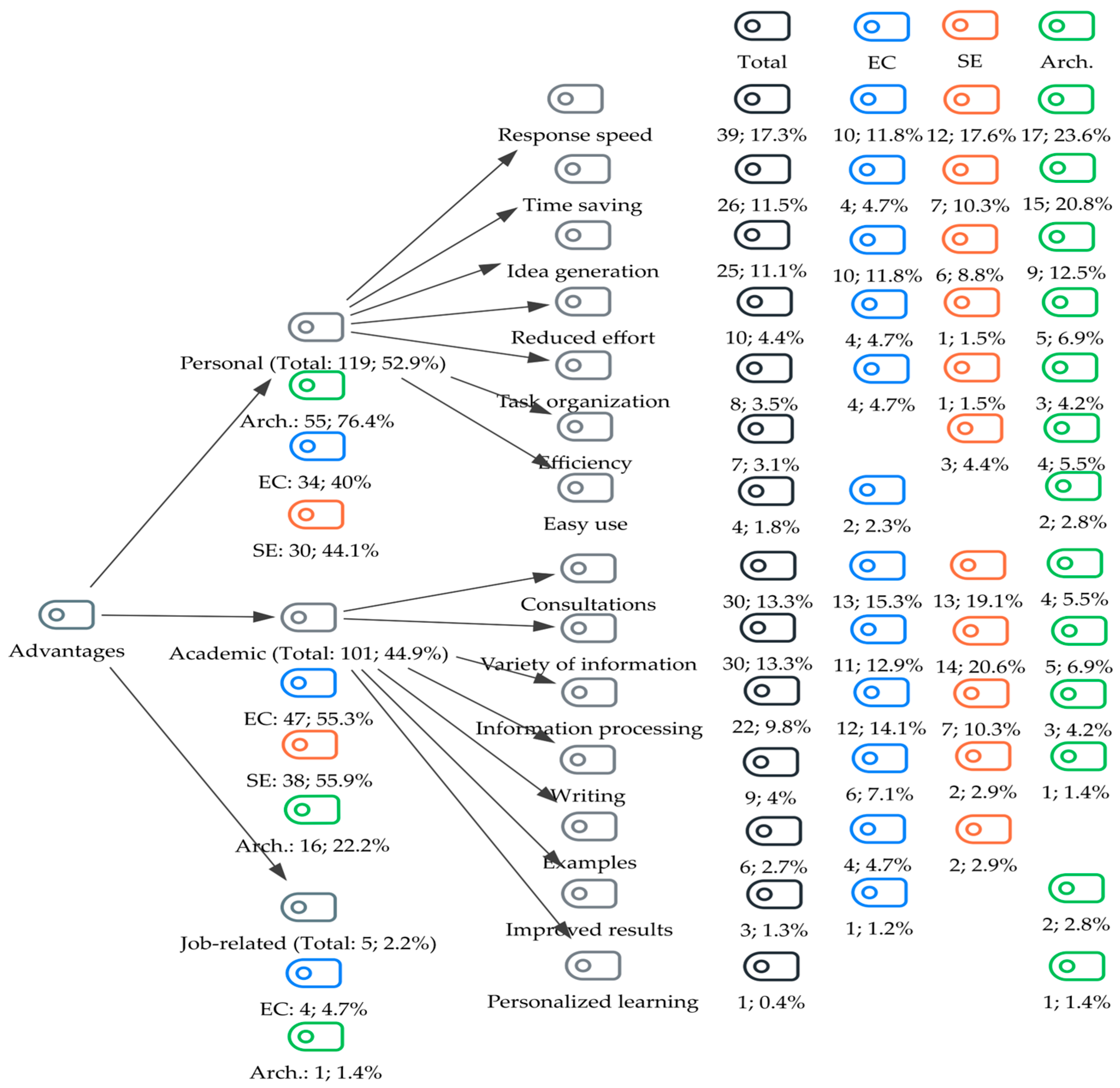
- “AI helps me better understand certain content or questions that I didn’t understand during the lessons” (participant no. 64, woman, 19 years old, Early Childhood Education student).
- “Through AI, I can easily access a large amount of different information” (participant no. 165, woman, 36 years old, Social Education student).
- “GenAI tools save me a lot of time when I have to search for information” (participant no. 9, woman, 20 years old, Architecture student).
- -
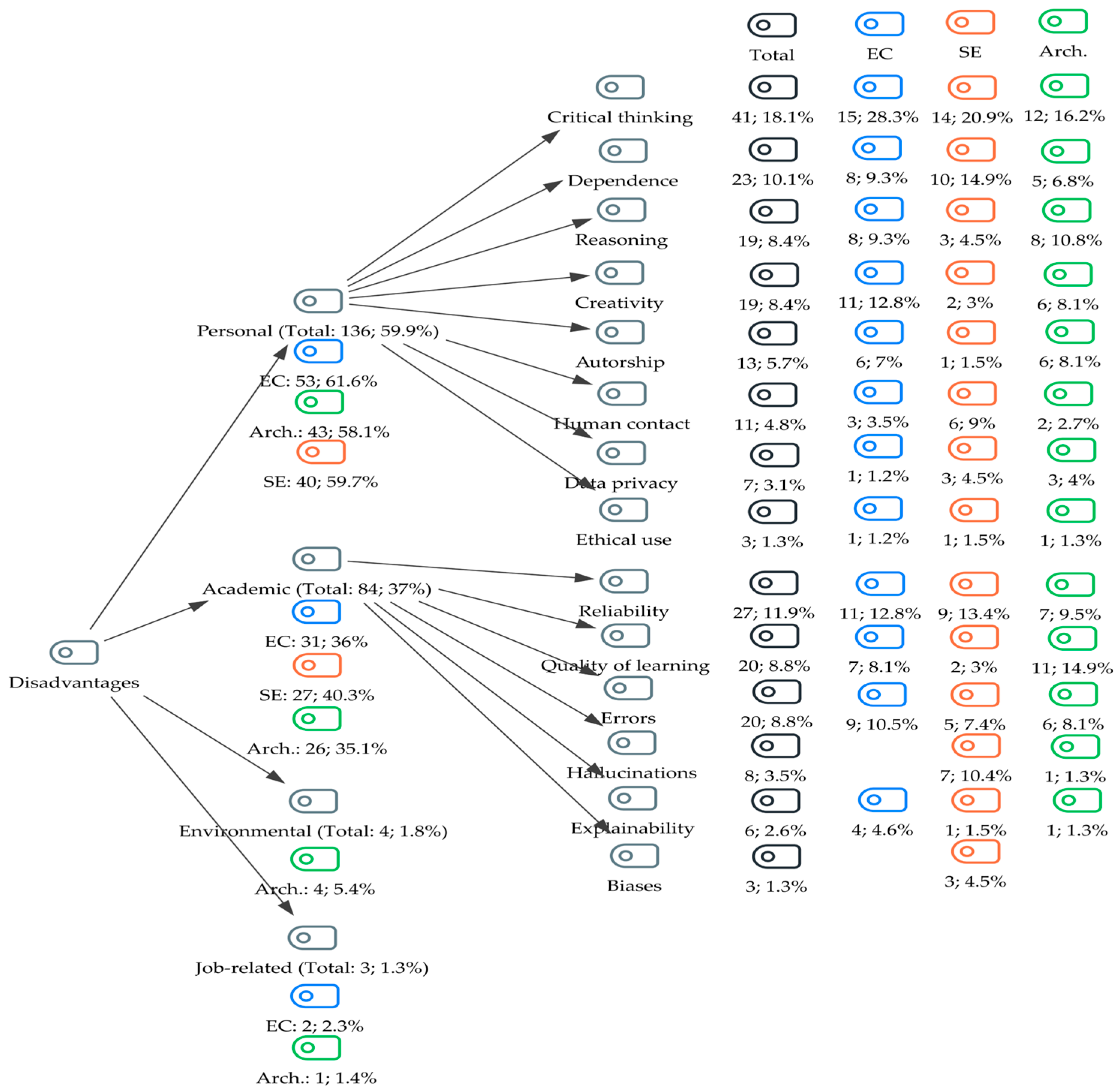
- “One threat when using AI tools is the lack of critical thinking and assimilation of concepts” (participant no. 67, man, 46 years old, Early Childhood Education student).
- -
- “I consider that it is dangerous not to know the criteria these tools use to search for information” (participant no. 123, man, 59 years old, Social Education student).
- -
- “One disadvantage is the excessive use of energy resources required by these systems and how this contributes negatively to the climate emergency” (participant no. 33, woman, 20 years old, Architecture student).
- -
- “GenAI is here to stay, and students cannot be excluded from this technological advance. Instead, we must get involved and commit to using it responsibly” (participant no. 123, man, 59 years old, Social Education student).
- -
- “AI must be banned because universities educate critical individuals capable of producing ideas and innovations. If GenAI does this for us, the creative process will disappear and we will end up being mere executors of an artificial system” (participant no. 61, woman, 50 years old, Early Childhood Education student).
4. Discussion
5. Conclusions
6. Practical Implications
7. Limitations and Prospects
Author Contributions
Funding
Data Availability Statement
Acknowledgments
Conflicts of Interest
Abbreviations
| AI | Artificial Intelligence |
| GenAI | Generative Artificial Intelligence |
| UNESCO | United Nations Educational, Scientific and Cultural Organization |
| XAI | Explainable Artificial Intelligence |
References
- Denning, P.J.; Tedre, M. Computational Thinking; Mit Press: Cambridge, MA, USA, 2019. [Google Scholar]
- Chan, C.K.Y.; Hu, W. Students’ voices on generative AI: Perceptions, benefits, and challenges in higher education. Int. J. Educ. Technol. High. Educ. 2023, 20, 43. [Google Scholar] [CrossRef]
- Laru, J.; Celik, I.; Jokela, I.; Mäkitalo, K. The antecedents of pre-service teachers’ AI literacy: Perceptions about own AI driven applications, attitude towards AI and knowledge in machine learning. Eur. J. Teach. Educ. 2025, 48, 964–986. [Google Scholar] [CrossRef]
- Samuelson, P. Generative AI meets copyright. Science 2023, 381, 158–161. [Google Scholar] [CrossRef]
- Trejo-Quinana, J. Más preguntas que respuestas. La inteligencia Artificial y la educación. Perf. Educ. 2023, 11, 43–55. [Google Scholar] [CrossRef]
- Amofa, B.; Kamudyariwa, X.B.; Fernandes, F.A.P.; Osobajo, O.A.; Jeremiah, F.; Oke, A. Navigating the Complexity of Generative Artificial Intelligence in Higher Education: A Systematic Literature Review. Educ. Sci. 2025, 15, 826. [Google Scholar] [CrossRef]
- Rama, C. Nueva fase educativa digital con inteligencia artificial. Perf. Educ. 2023, 45, 9–23. [Google Scholar] [CrossRef]
- Sun, L.; Zhou, L. Generative artificial intelligence attitude analysis of undergraduate students and their precise improvement strategies: A differential analysis of multifactorial influences. Educ. Inf. Technol. 2025, 30, 10591–10626. [Google Scholar] [CrossRef]
- Alier, M.; García Peñalvo, F.J.; Camba, J.D. Generative Artificial Intelligence in Education: From Deceptive to Disruptive. Int. J. Interact. Multimed. Artif. Intell. 2024, 8, 5–14. [Google Scholar] [CrossRef]
- Munaye, Y.Y.; Admass, W.; Belayneh, Y.; Molla, A.; Asmare, M. ChatGPT in Education: A Systematic Review on Opportunities, Challenges, and Future Directions. Algorithms 2025, 18, 352. [Google Scholar] [CrossRef]
- Cotton, D.R.; Cotton, P.A.; Shipway, J.R. Chatting and cheating: Ensuring academic integrity in the era of ChatGPT. Innov. Educ. Teach. Int. 2024, 61, 228–239. [Google Scholar] [CrossRef]
- UNESCO. Guidance for Generative AI in Education and Research; Unesco Publishing: Paris, France, 2023. [Google Scholar]
- Hendriks, F.; David, Y.B.-B.; Banse, L.; Fick, J.; Greussing, E.; Klein-Avraham, I.; Rakedzon, T.; Taddicken, M.; Baram-Tsabari, A. Generative AI in Science Communication: Fostering Scientists’ Good Working Habits for Ethical and Effective Use. Sci. Commun. 2025; early access. [Google Scholar] [CrossRef]
- Chau, T.; Yan, Y.; Liu, H. A systematic review of AI ethics in education: Challenges, policy gaps, and future directions. J. Glob. Inf. Manag. 2025, 33, 1–50. [Google Scholar] [CrossRef]
- García-López, I.M.; Trujillo-Liñán, L. Ethical and regulatory challenges of Generative AI in education: A systematic review. Front. Educ. 2025, 10, 1565938. [Google Scholar] [CrossRef] [PubMed]
- Feng, J.; Yu, B.; Tan, W.H.; Dai, Z.; Li, Z. Key factors influencing educational technology adoption in higher education: A systematic review. PLOS Digit. Health 2025, 4, e0000764. [Google Scholar] [CrossRef]
- Holzmann, P.; Gregori, P.; Schwarz, E.J. Students’ little helper: Investigating continuous-use determinants of generative AI and ethical judgment. Educ. Inf. Technol. 2025; early access. [Google Scholar] [CrossRef]
- Leite, H. Artificial intelligence in higher education: Research notes from a longitudinal study. Technol. Forecast. Soc. Change 2025, 215, 124115. [Google Scholar] [CrossRef]
- Duong, C.D.; Vu, T.N.; Ngo, T.V.N. Applying a modified technology acceptance model to explain higher education students’ usage of ChatGPT: A serial multiple mediation model with knowledge sharing as a moderator. Int. J. Manag. Educ. 2023, 21, 100883. [Google Scholar] [CrossRef]
- Malik, A.; Khan, M.L.; Hussain, K.; Qadir, J.; Tarhini, A. AI in higher education: Unveiling academicians’ perspectives on teaching, research, and ethics in the age of ChatGPT. Interact. Learn. Environ. 2025, 33, 2390–2406. [Google Scholar] [CrossRef]
- Xue, Y.; Chinapah, V.; Zhu, C. A Comparative Analysis of AI Privacy Concerns in Higher Education: News Coverage in China and Western Countries. Educ. Sci. 2025, 15, 650. [Google Scholar] [CrossRef]
- Chan, C.K.Y.; Tsi, L.H. Will generative AI replace teachers in higher education? A study of teacher and student perceptions. Stud. Educ. Eval. 2024, 83, 101395. [Google Scholar] [CrossRef]
- Gupta, M.; Akiri, C.; Aryal, K.; Parker, E.; Praharaj, L. From chatgpt to threatgpt: Impact of generative ai in cybersecurity and privacy. IEEE Access 2023, 11, 80218–80245. [Google Scholar] [CrossRef]
- Baig, M.I.; Yadegaridehkordi, E. Factors influencing academic staff satisfaction and continuous usage of generative artificial intelligence (GenAI) in higher education. Int. J. Educ. Technol. High. Educ. 2025, 22, 5. [Google Scholar] [CrossRef]
- Ghosh, S.; Kamal, M.S.; Chowdhury, L.; Neogi, B.; Dey, N.; Sherratt, R.S. Explainable AI to understand study interest of engineering students. Educ. Inf. Technol. 2024, 29, 4657–4672. [Google Scholar] [CrossRef]
- Albahli, S. Advancing sustainable educational practices through AI-driven prediction of academic outcomes. Sustainability 2025, 17, 1087. [Google Scholar] [CrossRef]
- Tucak-Roguljić, I.; Babić, I.Đ. Trends and Security Challenges of Artificial Intelligence Use in Higher Education: A Systematic Review. In Proceedings of the MIPRO 48th ICT and Electronics Convention, Opatija, Croatia, 2–6 June 2025. [Google Scholar] [CrossRef]
- Stöhr, C.; Ou, A.W.; Malmström, H. Perceptions and usage of AI chatbots among students in higher education across genders, academic levels and fields of study. Comput. Educ. Artif. Intell. 2024, 7, 100259. [Google Scholar] [CrossRef]
- Fontanillas, T.R.; Carbonell, M.R.; Catasús, M.G.; Quemada, P.B. Challenges of generative Artificial Intelligence in higher education: Promoting its critical use among students. RIED-Rev. Iberoam. Educ. Distancia 2025, 28, 209–231. [Google Scholar] [CrossRef]
- Bae, H.; Hur, J.; Park, J.; Choi, G.W.; Moon, J. Pre-Service Teachers’ Dual Perspectives on Generative AI: Benefits, Challenges, and Integration into Their Teaching and Learning. Online Learn. 2024, 28, 131–156. [Google Scholar] [CrossRef]
- Lim, E.M. Metaphor analysis on pre-service early childhood teachers’ conception of AI (Artificial Intelligence) education for young children. Think. Skills Creat. 2024, 51, 101455. [Google Scholar] [CrossRef]
- Su, J.; Zhong, Y. Artificial Intelligence (AI) in early childhood education: Curriculum design and future directions. Comput. Educ. Artif. Intell. 2022, 3, 100072. [Google Scholar] [CrossRef]
- Martínez-Carrera, S.; Sánchez-Martínez, C.; Fernandes, S.; Ricoy, M.C. The Use of AI by Undergraduate Students of Social Education in Spain and Portugal: A Case Study. Educ. Sci. 2025, 15, 390. [Google Scholar] [CrossRef]
- Rivera, P.R.; León, A.M. Competencias transversales e inteligencia artificial en educación superior: Percepciones y aplicaciones [Cross-cutting Competencies and Artificial Intelligence in Higher Education: Perceptions and Applications]. REDU 2024, 22, 31–47. [Google Scholar] [CrossRef]
- Almerich, G.; Suárez-Rodríguez, J.; Díaz-García, I.; Orellana, N. Structure of 21st century competences in students in the sphere of education. influential personal factors. Educ. XX1 2019, 23, 45–74. [Google Scholar] [CrossRef]
- Cabezas-González, M.; Casillas-Martín, S. Social educators: A study of digital competence from a gender differences perspective. Croat. J. Educ. 2018, 20, 11–42. [Google Scholar] [CrossRef]
- Alshahrani, A.; Mostafa, A.M. Enhancing the use of artificial intelligence in architectural education–case study Saudi Arabia. Front. Built Environ. 2025, 11, 1610709. [Google Scholar] [CrossRef]
- Dortheimer, J.; Schubert, G.; Dalach, A.; Brenner, L.; Martelaro, N. Think AI-side the Box. Exploring the Usability of Text-to-Image Generators for Architecture Students. In Proceedings of the 41st Conference on Education and Research in Computer Aided Architectural Design in Europe, Graz, Austria, 20–22 September 2023. [Google Scholar] [CrossRef]
- Memon, S.A.; Shehata, W.; Rowlinson, S.; Sunindijo, R.Y. Generative Artificial Intelligence in Architecture, Engineering, Construction, and Operations: A Systematic Review. Buildings 2025, 15, 2270. [Google Scholar] [CrossRef]
- Başarır, L. Modelling AI in architectural education. Gazi U. J. Sci. 2022, 35, 1260–1278. [Google Scholar] [CrossRef]
- Cao, Y.; Abdul-Aziz, A.; Mohd-Arshard, W.N. University students’ perspectives on Artificial Intelligence. IJERI-Int. J. Educ. Res. Innov. 2023, 20, 1–21. Available online: https://www.researchgate.net/publication/376561967_University_students'_perspectives_on_Artificial_Intelligence_A_survey_of_attitudes_and_awareness_among_Interior_Architecture_students (accessed on 12 November 2025).
- Daher, W.; Hussein, A. Higher Education Students’ Perceptions of GenAI Tools for Learning. Information 2024, 15, 416. [Google Scholar] [CrossRef]
- Dubey, P.; Sahu, K.K. Students’ perceived benefits, adoption intention and satisfaction to technology-enhanced learning: Examining the relationships. J. Res. Innov. Teach. Learn. 2021, 14, 310–328. [Google Scholar] [CrossRef]
- Gläser-Zikuda, M.; Hagenauer, G.; Stephan, M. The Potential of Qualitative Content Analysis for Empirical Educational Research. Forum Qual. Soc. Res. 2020, 21, 1–20. [Google Scholar] [CrossRef]
- García Peñalvo, F.J.; Llorens-Largo, F.; Vidal, J. The new reality of education in the face of advances in generative artificial intelligence. RIED-Rev. Iberoam. Educ. Distancia 2024, 27, 9–39. [Google Scholar] [CrossRef]
- Lim, W.M. What is qualitative research? An overview and guidelines. Australas. Mark. J. 2025, 33, 199–229. [Google Scholar] [CrossRef]
- Ursavaş, Ö.F.; Yalçın, Y.; İslamoğlu, H.; Bakır-Yalçın, E.; Cukurova, M. Rethinking the importance of social norms in generative AI adoption: Investigating the acceptance and use of generative AI among higher education students. Int. J. Educ. Technol. High. Educ. 2025, 22, 38. [Google Scholar] [CrossRef]
- Levy-Nadav, L.; Shamir-Inbal, T.; Blau, I. Digital Competencies for Effective GenAI Use in Secondary Schools: A Longitudinal Exploration of Teachers’ Perspectives and Classroom Practices. J. Comput. Assist. Learn. 2025, 41, e70123. [Google Scholar] [CrossRef]
- Almassaad, A.; Alajlan, H.; Alebaikan, R. Student perceptions of generative artificial intelligence: Investigating utilization, benefits, and challenges in higher education. Systems 2024, 12, 385. [Google Scholar] [CrossRef]
- Sousa, A.E.; Cardoso, P. Use of generative AI by higher education students. Electronics 2025, 14, 1258. [Google Scholar] [CrossRef]
- Lim, E.M. The effects of pre-service early childhood teachers’ digital literacy and self-efficacy on their perception of AI education for young children. Educ. Inf. Technol. 2023, 28, 12969–12995. [Google Scholar] [CrossRef]
- Yeung, R.S.K.; Tian, R.; Chiu, D.K.; Choi, S.P.M. University students’ perceptions on how generative artificial intelligence shape learning and research practices: A case study in Hong Kong. J. Acad. Libr. 2025, 51, 103082. [Google Scholar] [CrossRef]
- López-Noguero, F.; Romero-Díaz, T.; Gallardo-López, J.A. Smartphone como herramienta de enseñanza-aprendizaje en educación superior en Nicaragua [Smartphone as a Teaching-Learning Tool in Higher Education in Nicaragua]. RIED-Rev. Iberoam. Educ. Distancia 2023, 26, 307–330. [Google Scholar] [CrossRef]
- Namuddu, J.; Watts, P.N. Choice of device to view video lectures: An analysis of two independent cohorts of first-year university students. Res. Learn. Technol. 2020, 28, 1–11. [Google Scholar] [CrossRef]
- Baig, M.I.; Yadegaridehkordi, E. ChatGPT in the higher education: A systematic literature review and research challenges. Int. J. Educ. Res. 2024, 127, 102411. [Google Scholar] [CrossRef]
- Sanna, A.; Lamberti, F.; Paravati, G.; Demartini, C. Automatic assessment of 3D modeling exams. IEEE Trans. Learn. Technol. 2011, 5, 2–10. [Google Scholar] [CrossRef]
- Bhullar, P.S.; Joshi, M.; Chugh, R. ChatGPT in higher education-a synthesis of the literature and a future research agenda. Educ. Inf. Technol. 2024, 29, 21501–21522. [Google Scholar] [CrossRef]
- Colón-Aguirre, M.; Bright, K. The inevitability of AI: A study of undergraduate students’ perceptions of AI tools in their future careers. Inf. Res. 2025, 30, 443–449. [Google Scholar] [CrossRef]
- Malhotra, K.; Wiesenfeld, B.; Major, V.J.; Grover, H.; Aphinyanaphongs, Y.; Testa, P.; Austrian, J.S. Health system-wide access to generative artificial intelligence: The New York University Langone Health experience. J. Am. Med. Inf. Assoc. 2025, 32, 268–274. [Google Scholar] [CrossRef]
- Liu, Y.; Park, J.; McMinn, S. Using generative artificial intelligence/ChatGPT for academic communication: Students’ perspectives. Int. J. Appl. Linguist. 2024, 34, 1437–1461. [Google Scholar] [CrossRef]
- Khosravi, H.; Shum, S.B.; Chen, G.; Conati, C.; Tsai, Y.S.; Kay, J.; Knight, S.; Martínez-Maldonado, R.; Sadiq, S.; Gašević, D. Explainable artificial intelligence in education. Comput. Educ. Artif. Intell. 2022, 3, 100074. [Google Scholar] [CrossRef]
- Licht, K.d.F. Rethinking the Ethics of GenAI in Higher Education: A Critique of Moral Arguments and Policy Implications. J. Appl. Philos. 2025, 42, 1217–1337. [Google Scholar] [CrossRef]
- Magrill, J.; Magrill, B. Preparing Educators and Students at Higher Education Institutions for an AI-Driven World. Teach. Learn. Inq. 2024, 12, 1–9. [Google Scholar] [CrossRef]
- Al-Ali, S.; Miles, R. Upskilling teachers to use generative artificial intelligence: The TPTP approach for sustainable teacher support and development. Australas. J. Educ. Technol. 2025, 41, 88–106. [Google Scholar] [CrossRef]
- Guía de uso de las Herramientas de Inteligencia Artificial Generativa para el Estudiantado [User Guide for Generative Artificial Intelligence Tools for Students]. Available online: https://www.uned.es/universidad/dam/inicio/institucional/areas-direccion/vicerrectorados/innovacion-educativa/doc/Gu%C3%ADa-genIA-Estudiantes.pdf (accessed on 12 November 2025).
- Usos de IA Xerativa na Docencia. Documento Marco na Escola de Enxeñaría de Telecomunicación [Uses of Generative AI in Teaching: Framework Document at the School of Telecommunications Engineering]. Available online: https://teleco.uvigo.es/documentos/normativa/escola/usos-de-ia-xerativa-na-docencia-documento-marco-na-eet/ (accessed on 12 November 2025).

| Early Childhood Education (N = 55) | Social Education (N = 55) | Architecture (N = 55) |
|---|---|---|
| 52 women | 49 women | 32 women |
| 3 men | 5 men | 21 men |
| 1 non-binary | 2 non-binary | |
| Total = 165 | ||
| 1st Level | Definition |
|---|---|
| Year | The year the students came into contact with GenAI tools (deductive process). |
| Devices | Digital media used by higher education students to utilize GenAI tools (inductive process). |
| Tools | GenAI software used by higher education students (deductive [45] and inductive process). |
| Advantages | Benefits attributed by higher education students to the use of GenAI tools for academic tasks (deductive [45] and inductive process). |
| Disadvantages | Risks and concerns identified by higher education students when using GenAI tools to develop academic tasks (deductive [33] and inductive processes). |
| Measures | Proposals from higher education students for the safe integration of GenAI tools in the university context (inductive process). |
| Categories | Total (N = 146) | Early Childhood (N = 44) | Social Education (N = 52) | Architecture (N = 50) | ||||||
|---|---|---|---|---|---|---|---|---|---|---|
| 1st Level | 2nd Level | 3rd Level | f | % | f | % | f | % | f | % |
| Tools | Text generation | ChatGPT | 132 | 90.4 | 35 | 79.5 | 51 | 98.1 | 46 | 92 |
| Gemini | 17 | 11.6 | 6 | 13.6 | 4 | 7.7 | 7 | 14 | ||
| Copilot | 12 | 8.2 | 2 | 4.5 | 1 | 1.9 | 9 | 18 | ||
| Perplexity | 9 | 6.2 | 2 | 4.5 | 5 | 9.6 | 2 | 4 | ||
| Deepseek | 3 | 2.1 | - | - | 2 | 3.8 | 1 | 2 | ||
| Nanobanana | 2 | 1.4 | - | - | - | - | 2 | 4 | ||
| Image, video, and 3D generation | Leonardo | 7 | 4.8 | 1 | 2.3 | - | - | 6 | 12 | |
| Midjourney | 6 | 4.1 | - | - | 1 | 1.9 | 5 | 10 | ||
| DALL-E | 6 | 4.1 | - | - | 2 | 3.8 | 4 | 8 | ||
| Canva | 6 | 4.1 | 3 | 6.8 | - | - | 3 | 6 | ||
| Sora AI | 3 | 2.1 | 1 | 2.3 | 1 | 2.3 | 1 | 2 | ||
| Adobe Firefly | 2 | 1.4 | - | - | - | - | 2 | 4 | ||
| Meshy | 2 | 1.4 | - | - | - | - | 2 | 4 | ||
| Categories | Total (N = 122) | Early Childhood (N = 39) | Social Education (N = 37) | Architecture (N = 46) | ||||||
|---|---|---|---|---|---|---|---|---|---|---|
| 1st Level | 2nd Level | 3rd Level | f | % | f | % | f | % | f | % |
| Measures | Use | Limit | 37 | 30.3 | 9 | 23.1 | 13 | 35.1 | 15 | 32.6 |
| Regulate | 27 | 22.1 | 11 | 28.2 | 8 | 21.6 | 8 | 17.4 | ||
| Promote | 9 | 7.4 | 7 | 17.9 | 2 | 5.4 | - | - | ||
| Prohibit | 8 | 6.5 | 3 | 7.7 | 1 | 2.7 | 4 | 8.7 | ||
| Training | - | 38 | 31.1 | 9 | 23.1 | 12 | 32.4 | 17 | 37 | |
| Resources | - | 2 | 1.6 | - | - | - | - | 2 | 4.3 | |
| Security | - | 1 | 0.8 | - | - | 1 | 2.7 | - | - | |
| Degree Programs | Temporary Proposal | |||
|---|---|---|---|---|
| Early Childhood Education | Social Education | Architecture | ||
| Common |
| Beginning of the academic year. | ||
| ||||
| Specific |
|
| Beginning of the academic year and every 3 months. | |
|
|
| ||
|
|
| ||
Disclaimer/Publisher’s Note: The statements, opinions and data contained in all publications are solely those of the individual author(s) and contributor(s) and not of MDPI and/or the editor(s). MDPI and/or the editor(s) disclaim responsibility for any injury to people or property resulting from any ideas, methods, instructions or products referred to in the content. |
© 2025 by the authors. Licensee MDPI, Basel, Switzerland. This article is an open access article distributed under the terms and conditions of the Creative Commons Attribution (CC BY) license (https://creativecommons.org/licenses/by/4.0/).
Share and Cite
Ricoy, M.-C.; Delgado-Parada, J.; Feliz, S.; Feliz-Murias, T. Key Aspects to Promote the Safe Use of GenAI Tools by Undergraduate Education and Architecture Students: Similarities and Differences. Algorithms 2025, 18, 726. https://doi.org/10.3390/a18110726
Ricoy M-C, Delgado-Parada J, Feliz S, Feliz-Murias T. Key Aspects to Promote the Safe Use of GenAI Tools by Undergraduate Education and Architecture Students: Similarities and Differences. Algorithms. 2025; 18(11):726. https://doi.org/10.3390/a18110726
Chicago/Turabian StyleRicoy, María-Carmen, Joseba Delgado-Parada, Sálvora Feliz, and Tiberio Feliz-Murias. 2025. "Key Aspects to Promote the Safe Use of GenAI Tools by Undergraduate Education and Architecture Students: Similarities and Differences" Algorithms 18, no. 11: 726. https://doi.org/10.3390/a18110726
APA StyleRicoy, M.-C., Delgado-Parada, J., Feliz, S., & Feliz-Murias, T. (2025). Key Aspects to Promote the Safe Use of GenAI Tools by Undergraduate Education and Architecture Students: Similarities and Differences. Algorithms, 18(11), 726. https://doi.org/10.3390/a18110726

