Abstract
This study presents the fabrication and improved properties of an AlGaAs/InGaAs metal-oxide-semiconductor pseudomorphic high-electron-mobility transistor (MOS-PHEMT) using liquid phase deposited titanium dioxide (LPD-TiO2) as a gate dielectric. Sulfur pretreatment and postoxidation rapid thermal annealing (RTA) were consecutively employed before and after the gate dielectric was deposited to fill dangling bonds and therefore release interface trapped charges. Compared with a benchmark PHEMT, the AlGaAs/InGaAs MOS-PHEMT using LPD-TiO2 exhibited larger gate bias operation, higher breakdown voltage, suppressed subthreshold characteristics, and reduced flicker noise. As a result, the device with proposed process and using LPD-TiO2 as a gate dielectric is promising for high-speed applications that demand little noise at low frequencies.
1. Introduction
The performances of GaAs-based pseudomorphic high-electron-mobility transistors (PHEMTs) have drastically been improved, and have already been extensively used in both low-noise and high-power applications at microwave and millimeter-wave frequencies [1,2,3,4]. However, microwave device manufacturing is still being challenged to achieve high uniformity, high yield, and reliable stability. Hartnagel et al. [5] and Huang et al. [6] describe that major noises in PHEMTs contain thermal noise, shot noise, hot-electron noise, and generation-recombination noise. Shot noise related to the Schottky barrier affects the gate leakage current, and plays an important role in low-noise applications. Hot-electron noise, caused by energetic random electron motion, is associated with impact ionization. Electrons gain energy from supplied electric field and can be randomized by optical phonons, intervalley scattering. If electrons gain enough energy, they can collide with electron–hole pair or impurity and start ionization process. Impact ionization creates current fluctuations and thus is one of the strongest electronic noise sources. Generation-recombination noise induced by the surface recombination centers or defects at the gate terminal/Schottky layer interface can increase the ideality factor, and also produce traps that can contribute to flicker noise. Thus, the Schottky-gate PHEMTs have limited gate leakage current and noise performance levels.
High-κ materials are widely employed as insulators growing on semiconductor to fabricate metal-oxide-semiconductor (MOS) gates for larger gate swing voltages and lower leakage currents [7,8,9]. Titanium dioxide (TiO2) is one of the commonly applied high-κ insulators in the semiconductor industry. Numerous methods have been used to successfully deposit TiO2 films, such as low-pressure chemical vapor deposition (LPCVD) [10], plasma-enhanced chemical vapor deposition (PECVD) [11], sputtering [12], electron beam evaporation [13], sol-gel deposition [14], and liquid phase deposition (LPD) [15]. Among those methods, LPD is favorable for its low-cost and low-temperature process. LPD-TiO2 films have respectively been demonstrated on InP [16], polysilicon [17], glass [18], GaN [19], and AlGaAs [20]. We also previously conducted a preliminary study of LPD-TiO2 on AlGaAs without pretreatment [20], and made the LPD-TiO2 more compact through sulfide pretreatment [21] and postoxidation rapid thermal annealing (RTA) [22]. However, the low-frequency noise and microwave characteristics of AlGaAs/InGaAs MOS-PHEMT prepared with both ammonium-sulfide-pretreated AlGaAs and postoxidation RTA have not been investigated yet. In this study, an AlGaAs/InGaAs MOS-PHEMT using LPD-TiO2 as a gate dielectric after sulfide pretreatment and postoxidation RTA was fabricated, and dc characteristics and microwave performance were discussed.
2. Experimental
The proposed device structures were grown through metal-organic chemical vapor deposition on a semi-insulating GaAs substrate. The buffer layer consisted of a 100 nm layer of i-GaAs, followed by a 250 nm layer of i-Al0.2Ga0.8As, and a 60 nm layer of GaAs. A 10 nm layer of Al0.2Ga0.8As with a Si doping density of 4.5 × 1017 cm−3 and a 2 nm i-Al0.2Ga0.8As spacer layer were then grown on the buffer layer, followed by a 14 nm i-In0.15Ga0.85As channel layer, a 2 nm i-Al0.2Ga0.8As spacer layer, a 18 nm Al0.2Ga0.8As donor layer with a Si doping density of 1.2 × 1018 cm–3, a 70 nm Al0.2Ga0.8As Schottky layer with a Si doping density of 1 × 1017 cm−3, and a 60 nm GaAs cap layer with a Si doping density of 5 × 1018 cm−3. Hall measurements showed that the electron mobility was 5900 cm2/V·s and the electron sheet density was 2.1 × 1012 cm−2 at 300 K.
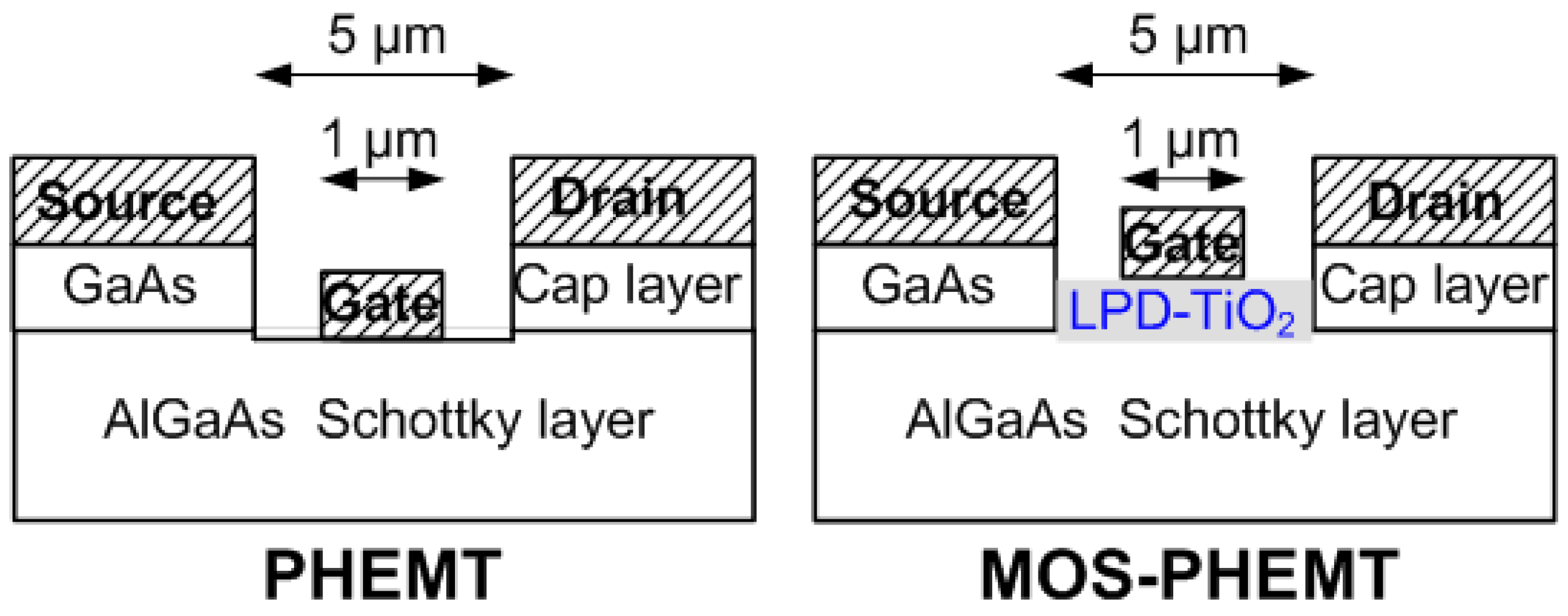
Wafers were first cleaned using acetone, methanol, and H2O for 5 min with each solvent. A NH4OH:H2O2:H2O (=3:1:50 by volume) solution was used to perform mesa etching, which reached the GaAs buffer layer. Ohmic contacts composed of a 400 nm layer of Au/Ge/Ni alloy (84:12:4 by weight) were deposited through evaporation and then patterned through lift-off processes, followed by RTA at 380 °C for 30 s. After the cap layer and part of the Schottky layer had been etched using the same etchant, the wafer was immediately dipped into a 5% (NH4)2Sx solution for 10 min. For the referenced PHEMT, Au was deposited directly on the sulfide-treated AlGaAs of the Schottky layer. For the MOS-PHEMT, following the (NH4)2Sx pretreatment, the LPD-TiO2 was applied on the sulfide-treated Schottky layer at 40 °C [19]. Oxide thickness was approximately 30 nm after postoxidation RTA at 350 °C for 1 min. Finally, the gate electrode was formed through lift-off with Au on the oxide layer. Figure 1 shows the structures of the referenced PHEMT and MOS-PHEMT. The gate length, gate width, and the drain-to-source spacing are 1 μm, 100 μm, and 5 μm, respectively. In addition, the oxide passivated the etched isolated surface wall simultaneously. Microwave on-wafer measurements were conducted from 0.45 to 50 GHz in a common-source configuration by using an Agilent E8364A PNA network analyzer at 300 K.
Figure 1.
Schematic structures of AlGaAs/InGaAs PHEMT and MOS-PHEMT.
3. Results and Discussion
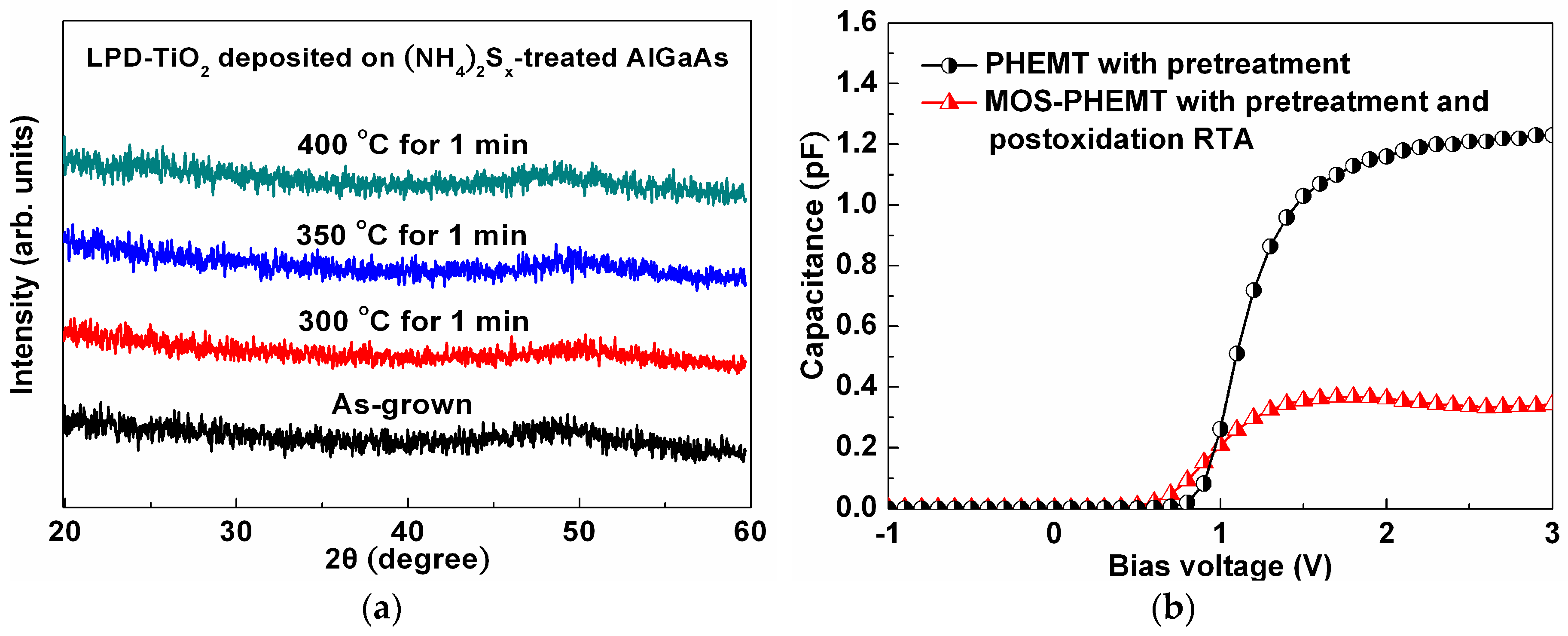
Figure 2a shows the X-ray diffraction (XRD) patterns of the LPD-TiO2 that was deposited on the sulfide-pretreated AlGaAs with and without postoxidation RTA for 1 min. The XRD patterns did not show peaks corresponding to the anatase or rutile phases when the annealing temperature was raised to 400 °C. The results indicate that the LPD-TiO2 lacked sufficient energy to form a single phase or a polycrystal phase at temperatures no greater than 400 °C during the annealing process. Figure 2b shows the 1 MHz capacitance-voltage (C-V) characteristics of the referenced PHEMT and the MOS-PHEMT. The capacitance of the MOS-PHEMT was lower than that of the PHEMT, because the LPD-TiO2was in series with the PHEMT. The relative dielectric constant () of the LPD-TiO2 can be calculated using the following equation:
where COX is the capacitance of the LPD-TiO2, is the permittivity of free space, A is the metal plate area, and is the oxide thickness. The calculated of the LPD-TiO2was approximately 21, fitting the range of amorphous TiO2, which was comparable to the value (24.4) for GaN using the same method [19] and to the value for polysilicon found by other group [17].
Figure 2.
(a) XRD spectra of LPD-TiO2 deposited on sulfide-pretreated AlGaAs with and without postoxidation RTA; (b) C-V comparison for sulfide-pretreated PHEMT and MOS-PHEMT with postoxidation RTA.
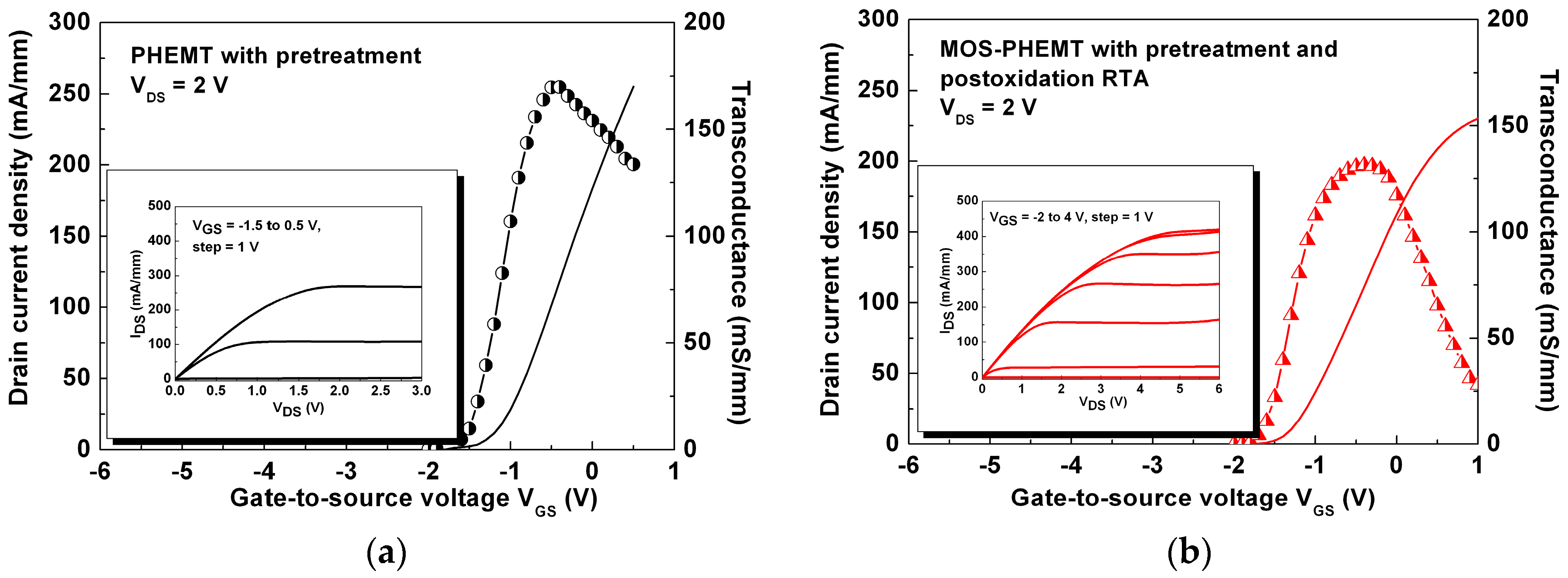
Figure 3a,b shows the transconductance (gm) and the drain current density (ID) as functions of the gate-to-source voltage (VGS) at a drain-to-source voltage (VDS) = 2 V. The maximum gm values were 170 mS/mm and 132 mS/mm for the referenced PHEMT and the MOS-PHEMT, respectively. However, the gate voltage swing (defined by a 10% reduction of the maximal gm) was 0.8 V for the MOS-PHEMT, which was higher than that of referenced case. The insets show the related ID-VDS characteristics for both devices. The maximal VGS of the MOS-PHEMT was larger than that of the referenced PHEMT because the MOS-PHEMT had a higher energy barrier between the metal gate and AlGaAs Schottky layer. The maximal ID was approximately 270 mA/mm at VGS = 0.5 V and VDS = 2 V for PHEMT. However, the maximal ID was approximately 200 mA/mm at VGS = 0.5 V and VDS = 2 V, and 420 mA/mm at VGS = 4 V and VDS = 6 V for MOS-PHEMT. The MOS-PHEMT saturation current was less than that of the referenced case at the same VGS because of the voltage drop of the LPD-TiO2 underneath the metal gate. However, it was able to induce carriers VGS from 0.5 to 4 V within the channel. By the way, the notable difference of the threshold voltages (Vth) between capacitor and PHEMT is owing to the different depth of gate recess by wet etchant from different batches.
Figure 3.
(a) Measured I–V characteristics and related transconductance curves for referenced PHEMT; (b) Measured I–V characteristics and related transconductance curves for MOS-PHEMT.
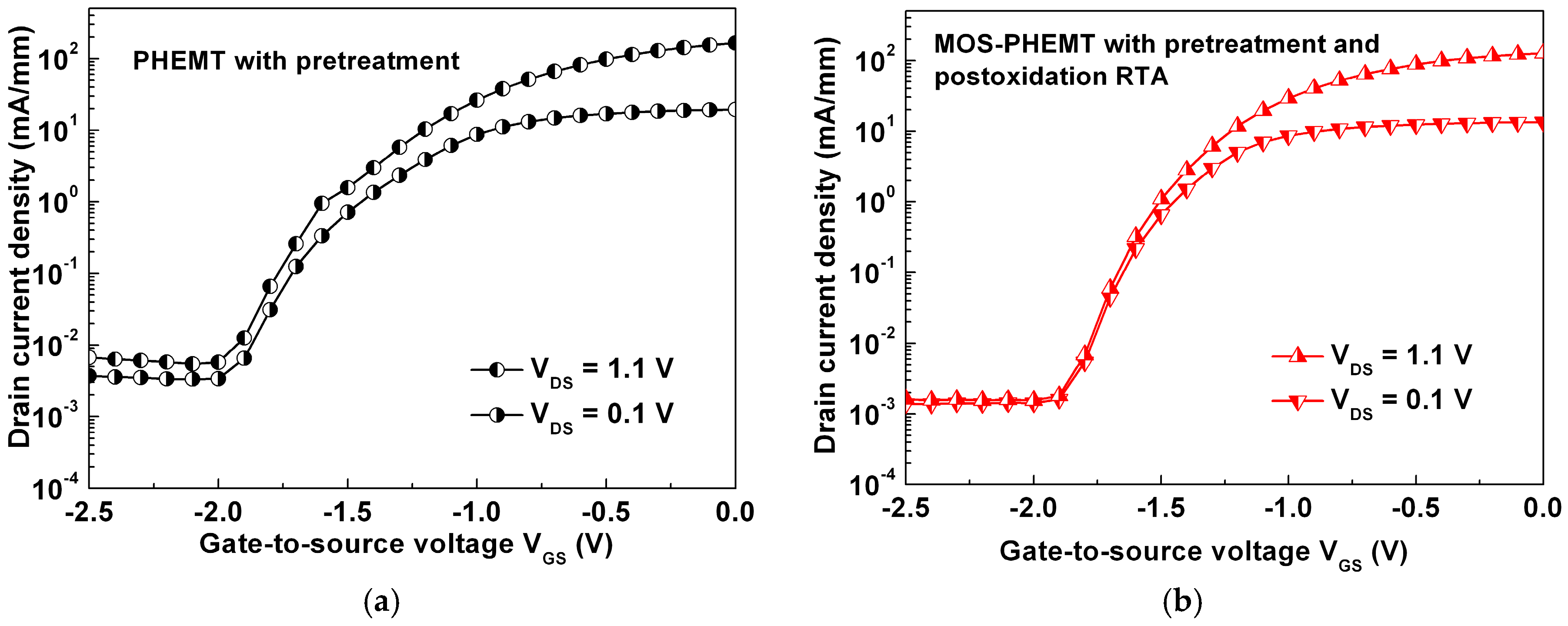
The subthreshold characteristics depend on the quality of oxide film and device structure. They determine the ideal off state, and they have effects on power dissipation and IC applications. Figure 4a,b shows the measured subthreshold currents of the referenced PHEMT and MOS-PHEMT, respectively. The subthreshold swing (SS) of the MOS-PHEMT (120 to 125 mV/dec) was lower than that (173 to 194 mV/dec) of the referenced PHEMT. The ION/IOFF ratio of the MOS-PHEMT (8.1 × 10³ to 4.1 × 10⁴) was higher than that (4.8 × 10³ to 1.5 × 10⁴) of the referenced case, where ION was ID at VGS = Vth + 0.5 V, and IOFF was ID at VGS = Vth − 1 V. These results clearly suggest that the MOS-PHEMT suppressed its subthreshold current by reducing the surface recombination current of the LPD-TiO2 around the ohmic contact region. That is, the undesirable carrier injection from the source terminal in an off state can be suppressed. Improvements of the SS and ION/IOFF ratio were also associated with suppressed gate leakage characteristics [23], and this association is consistent with the results shown in Figure 5.
Figure 4.
Subthreshold characteristics of: (a) referenced PHEMT; and (b) MOS-PHEMT with VDS = 0.1 V and 1.1 V.
Figure 5.
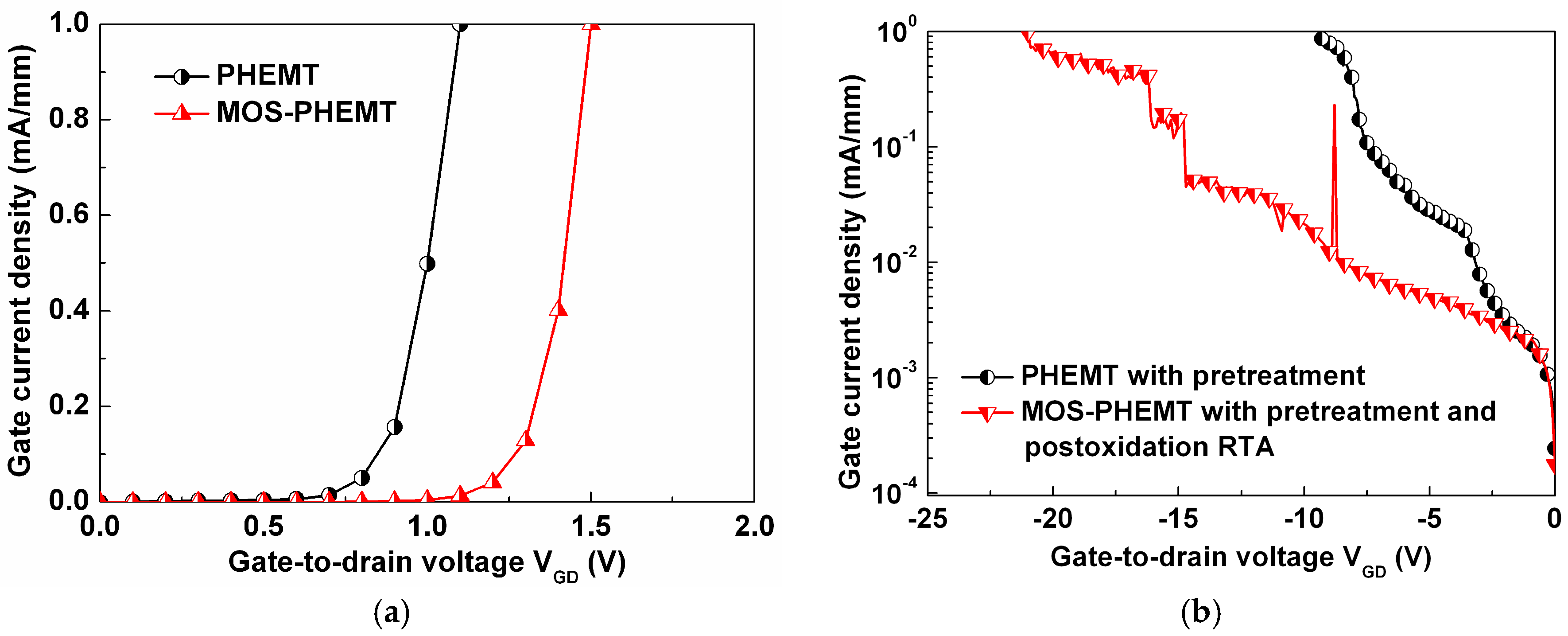
(a) Forward gate leakage current density; and (b) magnified section of reverse gate leakage current density of typical gate-to-drain diode characteristics for both devices.
The LPD-TiO2 caused an improvement in the breakdown voltage associated with the gate leakage current of the typical gate-to-drain diode characteristics, as shown in Figure 5. Figure 5a shows that the turn-on voltage (Von) of the MOS-PHEMT, 1.5 V, was obviously higher than that of the referenced PHEMT, 1.1 V. For the MOS-PHEMT, the gate leakage current density was suppressed by approximately two orders of magnitude, and the corresponding reverse gate-to-drain breakdown voltage (BVGD) was more than −21.2 V, as shown in Figure 5b. The Von and the BVGD were defined as the voltage at which the gate current reaches 1 mA/mm. Generally, an increased Von accompanies an improved gate voltage swing. The gate leakage current density of the MOS-PHEMT was lower because of the MOS structure and the elimination of the sidewall leakage path passivated by the LPD-TiO2.
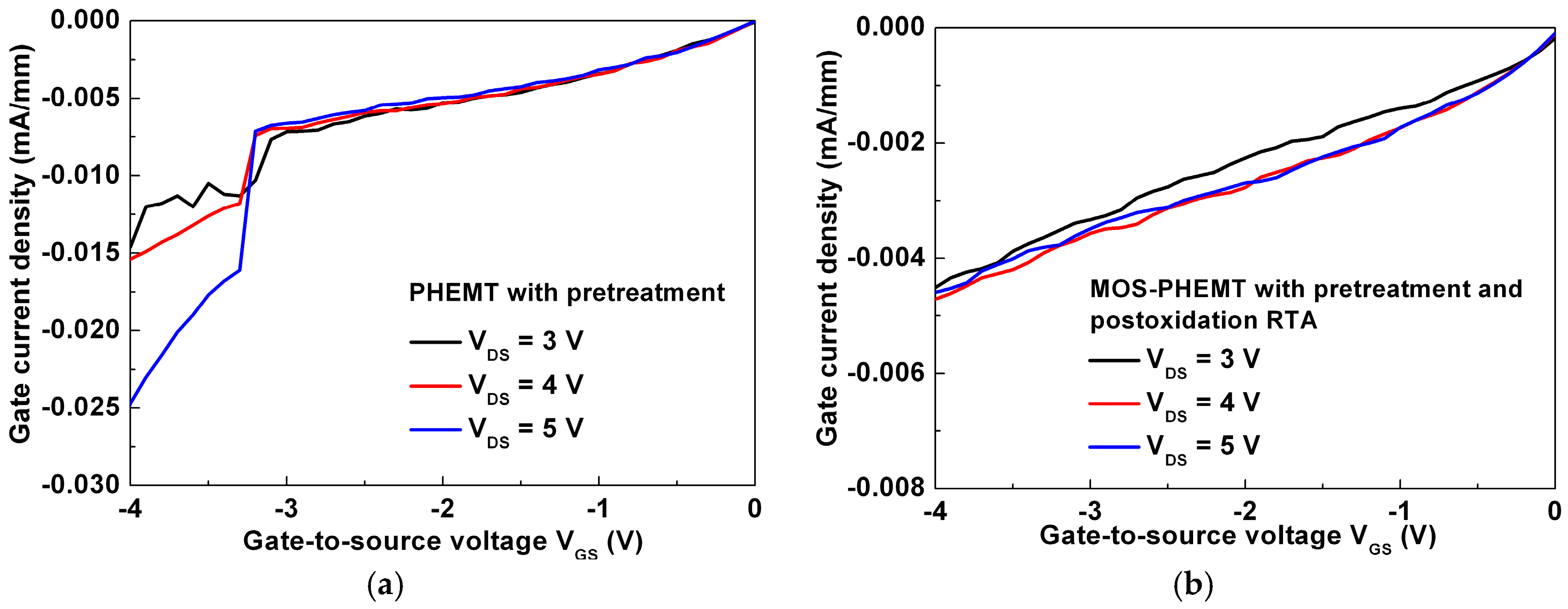
The gate current density, as a function of VGS, was measured to obtain insights on the influence of impact ionization. Because of the deep-complex (DX)-center and surface states of AlGaAs, the impact ionization or kink effect is key concern for the AlGaAs/InGaAs PHEMT. A roughly bell-shaped curve is the typical behavior of impact ionization, as shown in Figure 6a for the PHEMT. Marked increases in the gate current clearly occur when devices are biased at higher VDS. The gate current densities of the MOS-PHEMT and PHEMT were 4.59 × 10⁻³ mA/mm and 2.47 × 10⁻² mA/mm at VDS = 5 V and VGS = −4 V, as shown in Figure 6a,b, respectively; therefore the MOS-PHEMT device’s performance was approximately 5.4 times higher than that of the PHEMT. In the referenced PHEMT, significant hot-electron phenomena occurred in the InGaAs channel because of a high electric field near the gate-to-drain region; that is, electrons could obtain higher energy to generate electron–hole pairs through enhanced impact ionizations in the InGaAs channel, which facilitated injection of the holes into the gate terminal [24] or becoming trapped in pre-existing traps. Furthermore, the generation of holes by impact ionization and their further recombination could result in fluctuations of the charges pileup and thus the excess noise. These phenomena also led to increased high-frequency noise at corresponding voltages [25]. In the MOS-PHEMT, the electric field near the gate-to-drain region at the same VDS and VGS improved notably compared with the values of the referenced case, because of the high barrier height of LPD-TiO2 underneath the gate terminal. Thus, the improvements of the MOS-PHEMT resulted in a smaller channel electric field and a suppressed impact ionization that further reduced the leakage current density. As mentioned earlier, the suppressed leakage current and impact ionization effect in Figure 6b were expected to improve noise performance.
Figure 6.
Gate current density versus VGS with different VDS for: (a) referenced PHEMT; and (b) MOS-PHEMT.
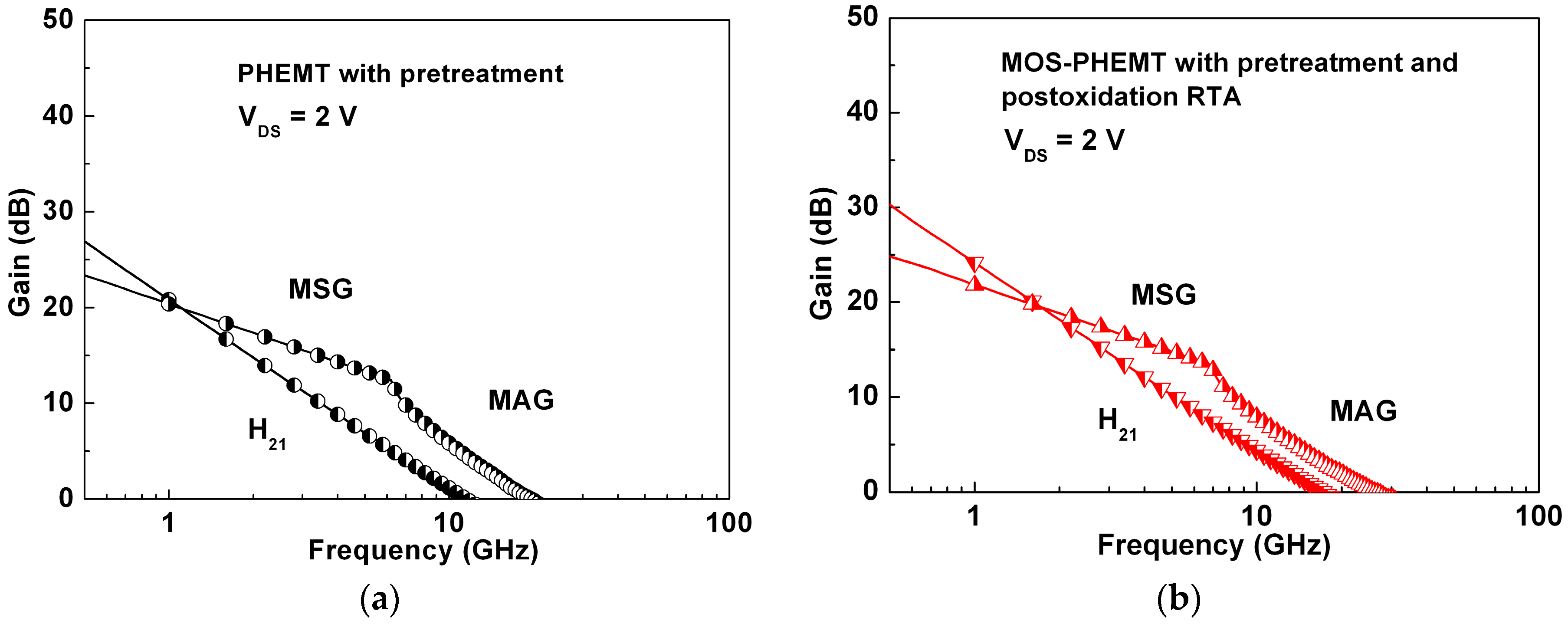
As shown in Figure 7 (different samples from those shown in Figure 3), the measured unity-current-gain cutoff frequency (fT) and the maximum oscillation frequency (fmax) were 17.3 (11.6) GHz and 26.4 (19.7) GHz at the maximum gm for the MOS-PHEMT (PHEMT). The trend is consistent with the results previously found for E-mode InGaP/InGaAs MOS-PHEMT with liquid phase oxidation (LPO) [26]. The increased microwave performances of the AlGaAs/InGaAs MOS-PHEMT may be attributed to the increase in the ratio of gm to gate-source capacitance (Cgs). Furthermore, the reduction of the surface recombination may also have contributed to the frequency response.
Figure 7.
Comparison of microwave characteristics at maximum gm for: (a) referenced PHEMT; and (b) MOS-PHEMT.
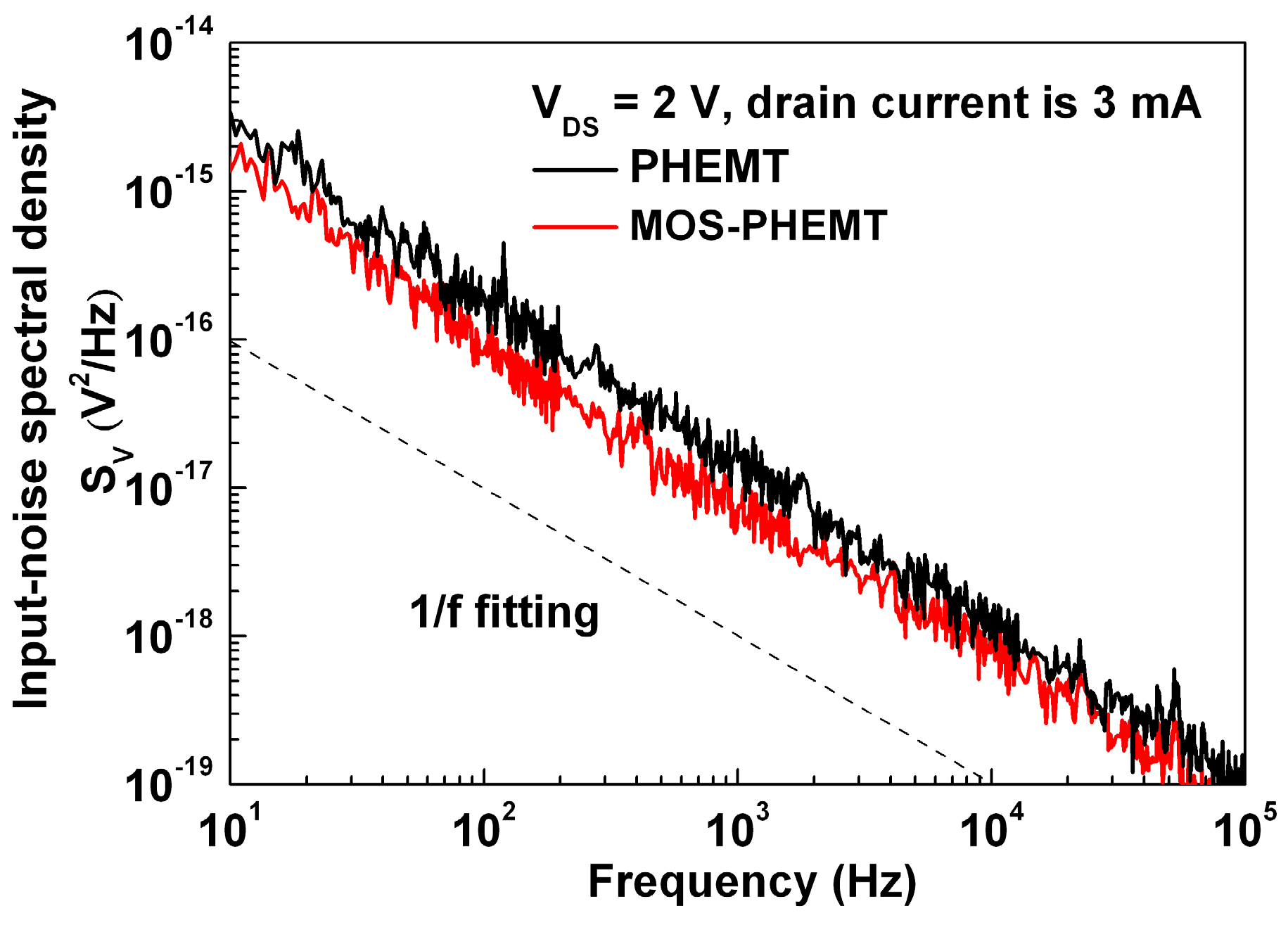
Figure 8 shows the low-frequency flicker noise spectral density (SV) characteristics, which were measured using a BTA 9812B noise analyzer and an Agilent 35670A dynamic signal analyzer. On-wafer flicker noise measurements of the referenced AlGaAs/InGaAs PHEMT and AlGaAs/InGaAs MOS-PHEMT were conducted under VDS of 2 V and drain current of 3 mA for frequencies between 10 Hz and 100 kHz. SV can be expressed as follows [27]:
where q is the elementary charge, αH is the Hooge parameter, vsat is the effective carrier saturation velocity, f is the frequency, γ is the frequency exponent, and is the effective gate length. The αH/SV values at 10 Hz for the referenced case and MOS-PHEMT were 2.8 × 10⁻⁴/3.4 × 10−15 V2·Hz−1 and 2.7 × 10⁻⁵/1.4 × 10−15 V2·Hz−1, respectively. The corresponding γ values were calculated to be 1.5 and 1.1, respectively. The higher γ was notably related to generation-recombination noise (i.e., γ = 2). In other words, the LPD-TiO2 could passivate dangling bonds to improve the surface state between the LPD-TiO2/AlGaAs interfaces, and a reduction of the surface state was observed with negligible low-frequency generation-recombination noise of the AlGaAs/InGaAs MOS-PHEMT.
Figure 8.
Comparison of low-frequency 1/f characteristics for both devices.
Table 1 summarizes the dc, low-frequency noise, and microwave characteristics for LPD in this study and previous studies [28,29] and for LPO [30] in AlGaAs/InGaAs MOS-PHEMTs with similar structures but different types of gate oxides. The use of high- LPD-TiO2 with both sulfide pretreatment and postoxidation RTA as a gate oxide and as an effective passivation layer on AlGaAs/InGaAs PHEMT provides new opportunities for low-noise applications.
Table 1.
Summary of dc, low-frequency noise, and microwave characteristics of AlGaAs/InGaAs MOS-PHEMTs with similar structures but different types of gate oxides.
4. Conclusions
This study demonstrates the feasibility of preparing an LPD-TiO2 gate with both sulfide pretreatment and postoxidation RTA on AlGaAs/InGaAs MOS-PHEMT near room temperature. Compared with the referenced PHEMT, the MOS-PHEMT had larger gate voltage swing, lower subthreshold characteristics, reduced gate leakage current (with a suppressed impact ionization), enhanced microwave performance, and reduced flicker noise. These features evidence that the proposed device with simple and low-temperature LPD-TiO2 gate is suitable for device applications.
Acknowledgments
The authors would like to thank Hsien-Cheng Lin and Tsu-Yi Wu of National Cheng-Kung University for their discussion and support. This work was also supported in part by the National Science Council of Taiwan under contract no. NSC100-2221-E-214-013.
Author Contributions
Kuan-Wei Lee conceived and designed the experiments; Yong-Jie Zou performed the experiments; Kuan-Wei Lee and Jung-Sheng Huang analyzed the data; Yeong-Her Wang contributed materials and analysis tools; Kai-Yuen Lam wrote the paper.
Conflicts of Interest
The authors declare no conflict of interest.
References
- Lee, H.L.; Moon, S.M.; Dong, H.J.; Lee, M.Q.; Yu, J.W. K-band 0/180° Balanced Phase Shifter with DC-Offset Cancellation. Electron. Lett. 2013, 49, 1234–1235. [Google Scholar] [CrossRef]
- Lin, Y.S.; Wu, J.F.; Hsia, W.F.; Wang, P.C.; Chung, Y.H. Design of Electronically Switchable Single-to-Balanced Bandpass Low-Noise Amplifier. IET Microw. Antennas Propag. 2013, 7, 510–517. [Google Scholar] [CrossRef]
- Nikandish, G.; Babakrpur, E.; Medi, A.A. Harmonic Termination Technique for Single- and Multi-Band High-Efficiency Class-F MMIC Power Amplifiers. IEEE Trans. Microw. Theory Tech. 2014, 62, 1212–1220. [Google Scholar] [CrossRef]
- Ding, X.; Zhang, L. A High-Efficiency GaAs MMIC Power Amplifier for Multi-Standard System. IEEE Microw. Wirel. Compon. Lett. 2016, 26, 55–57. [Google Scholar] [CrossRef]
- Hartnagel, H.; Katilius, R.; Matulionis, A. Microwave Noise in Semiconductor Devices; John Wiley & Sons, Inc.: Hoboken, NJ, USA, 2001. [Google Scholar]
- Huang, H.K.; Wang, C.S.; Chang, C.P.; Wang, Y.H.; Wu, C.L.; Chang, C.S. Noise Characteristics of InGaP-gated PHEMTs under High Current and Thermal Accelerated Stresses. IEEE Trans. Electron. Devices 2005, 52, 1706–1712. [Google Scholar] [CrossRef]
- Yagi, S.; Shimizu, M.; Inaga, M.; Yamamoto, Y.; Piao, G.; Okumura, H.; Yano, Y.; Akutsu, N.; Ohashi, H. High Breakdown Voltage AlGaN/GaN MIS-HEMT with SiN and TiO2 Gate Insulator. Solid State Electron. 2006, 50, 1057–1061. [Google Scholar] [CrossRef]
- Hu, C.C.; Lin, M.S.; Wu, T.Y.; Adriyanto, F.; Sze, P.W.; Wu, C.L.; Wang, Y.H. AlGaN/GaN Metal-Oxide-Semiconductor High-Electron Mobility Transistor with Liquid-Phase-Deposited Barium-Doped TiO2 as a Gate Dielectric. IEEE Trans. Electron. Devices 2012, 59, 121–127. [Google Scholar] [CrossRef]
- Choi, W.; Seok, O.; Ryu, H.; Cha, H.Y.; Seo, K.S. High-Voltage and Low-Leakage-Current Gate Recessed Normally-Off GaN MIS-HEMTs with Dual Gate Insulator Employing PEALD-SiNx/RF-Sputtered-HfO2. IEEE Electron. Device Lett. 2014, 35, 175–177. [Google Scholar] [CrossRef]
- Yokozawa, M.; Iwasa, H.; Teramoto, I. Vapor Deposition of TiO2. Jpn. J. Appl. Phys. 1967, 7, 96–97. [Google Scholar] [CrossRef]
- Ha, H.K.; Yoshimoto, M.; Koinuma, H.; Moon, B.K.; Ishiwara, H. Open Air Plasma Chemical Vapor Deposition of Highly Dielectric Amorphous TiO2 Films. Appl. Phys. Lett. 1996, 68, 2965–2967. [Google Scholar] [CrossRef]
- Martin, N.; Rousselot, C.; Savall, C.; Palmino, F. Characterizations of Titanium Oxide Films Prepared by Radio Frequency Magnetron Sputtering. Thin Solid Films 1996, 287, 154–163. [Google Scholar] [CrossRef]
- Yang, T.S.; Shiu, C.B.; Wong, M.S. Structure and Hydrophilicity of Titanium Oxide Films Prepared by Electron Beam Evaporation. Surf. Sci. 2004, 548, 75–82. [Google Scholar] [CrossRef]
- Sonawane, R.S.; Hegde, S.G.; Dongare, M.K. Preparation of Titanium (IV) Oxide Thin Film Photocatalyst by Sol-Gel Dip Coating. Mater. Chem. Phys. 2003, 77, 744–750. [Google Scholar] [CrossRef]
- Wang, X.P.; Yu, Y.; Hu, X.F.; Gao, L. Hydrophilicity of TiO2 Films Prepared by Liquid Phase Deposition. Thin Solid Films 2000, 371, 148–152. [Google Scholar] [CrossRef]
- Lee, M.K.; Huang, J.J.; Shih, C.M.; Cheng, C.C. Properties of TiO2 Thin Films on InP Substrate Prepared by Liquid Phase Deposition. Jpn. J. Appl. Phys. 2002, 41, 4689–4690. [Google Scholar] [CrossRef]
- Lee, M.K.; Lee, H.C.; Hsu, C.M. High Dielectric Constant TiO2 Film Grown on Polysilicon by Liquid Phase deposition. Mater. Sci. Semicond. Process. 2007, 10, 61–67. [Google Scholar] [CrossRef]
- Mallak, M.; Bockmeyer, M.; Löbmann, P. Liquid Phase Deposition of TiO2 on Glass: Systematic Comparison to Films Prepared by Sol-Gel Processing. Solid State Electron. 2007, 515, 8072–8077. [Google Scholar] [CrossRef]
- Wu, T.Y.; Lin, S.K.; Sze, P.W.; Huang, J.J.; Chien, W.C.; Hu, C.C.; Tsai, M.J.; Wang, Y.H. AlGaN/GaN MOSHEMTs with Liquid-Phase-Deposited TiO2 as Gate Dielectric. IEEE Trans. Electron. Devices 2009, 56, 2911–2916. [Google Scholar] [CrossRef]
- Lee, K.W.; Huang, J.S.; Lu, Y.L.; Lee, F.M.; Lin, H.C.; Wu, T.Y.; Wang, Y.H. Investigation of TiO2 on AlGaAs Prepared by Liquid Phase Deposition and Its Application. Solid State Electron. 2011, 68, 85–89. [Google Scholar] [CrossRef]
- Huang, J.S.; Lee, T.L.; Zou, Y.J.; Lee, K.W.; Wang, Y.H. Sulfide Pretreatment Effects of Liquid Phase deposited TiO2 on AlGaAs and Its Application. Vacuum 2015, 118, 100–103. [Google Scholar] [CrossRef]
- Hu, C.C.; Lee, T.L.; Zou, Y.J.; Lee, K.W.; Wang, Y.H. Postoxidation Thermal Annealing Effects of Liquid Phase Deposited TiO2 on (NH4)2Sx-treated AlGaAs. Thin Solid Films 2014, 563, 40–43. [Google Scholar] [CrossRef]
- Chung, J.W.; Roberts, J.C.; Piner, E.L.; Palacios, T. Effect of Gate Leakage in the Subthreshold Characteristics of AlGaN/GaN HEMTs. IEEE Electron. Device Lett. 2008, 29, 1196–1198. [Google Scholar] [CrossRef]
- Suemitsu, T.; Enoki, T.; Sano, N.; Tomizawa, M.; Ishii, Y. An Analysis of the Kink Phenomena in InAlAs/InGaAs HEMT’s Using Two-Dimensional Device Simulation. IEEE Trans. Electron. Devices 1998, 45, 2390–2399. [Google Scholar] [CrossRef]
- Wang, H.; Liu, Y.; Zeng, R.; Tan, C.L. Understanding of the Excess Channel Noise in InAlAs/InGaAs/InPHigh Electron Mobility Transistors in Impact Ionization Regime. Appl. Phys. Lett. 2007, 90, 103503. [Google Scholar] [CrossRef]
- Lee, K.W.; Chen, W.S. Improved Low-Frequency Noise and Microwave Performance of Enhancement-Mode InGaP/InGaAs PHEMT with a Liquid-Phase Oxidized GaAs without a Gate Recess. ECS Solid State Lett. 2012, 2, Q9–Q11. [Google Scholar] [CrossRef]
- Hughes, B.; Fernandez, N.G.; Gladstone, J.M. GaAs FET’s with a Flicker-Noise Corner below 1 MHz. IEEE Trans. Electron. Devices 1987, 34, 733–741. [Google Scholar] [CrossRef]
- Lee, K.W. Improved Impact Ionization in AlGaAs/InGaAs PHEMT with a Liquid Phase Deposited SiO2 as the Gate Dielectric. ECS J. Solid State Sci. Technol. 2012, 2, Q27–Q29. [Google Scholar] [CrossRef]
- Basu, S.; Singh, P.K.; Sze, P.W.; Wang, Y.H. AlGaAs/InGaAs Metal-Oxide-Semiconductor Pseudomorphic High-Electron-Mobility Transistor with Low Temperature Liquid Phase DepositedAl2O3Gate Insulator. J. Appl. Phys. 2008, 104, 054116. [Google Scholar] [CrossRef]
- Lee, K.W.; Sze, P.W.; Wang, Y.H.; Houng, M.P. AlGaAs/InGaAs Metal-Oxide-Semiconductor Pseudomorphic High-Electron-Mobility Transistor with a Liquid Phase Oxidized AlGaAs as Gate Dielectric. Solid State Electron. 2005, 49, 213–217. [Google Scholar] [CrossRef]
© 2016 by the authors; licensee MDPI, Basel, Switzerland. This article is an open access article distributed under the terms and conditions of the Creative Commons Attribution (CC-BY) license (http://creativecommons.org/licenses/by/4.0/).