


The Lithium-Ion Battery Recycling Trilemma: Bridging the Gap Between Material Science, Economic Reality, and Regulatory Policy


Abstract
1. Introduction
2. The Technological Dimension: The Material Science of Separation
2.1. The Binder Problem and Design for Disassembly
2.2. The Limits of Direct Recycling
2.3. Impurity Profiles in Hydrometallurgy
3. The Economic Dimension: Logistics and Valuation Models
3.1. The Logistics Tax and Class 9 Hazards
3.2. The LFP Conundrum
3.3. Commodity Volatility
4. The Regulatory and Geopolitical Dimension
4.1. The “Black Mass” Geopolitical Trap
4.2. Divergent Strategies: EU vs. US
4.3. The Digital Imperative
5. Pathways Forward: Integrating the System
- -
- -
- Regionalized Closed Loops and Second-Life Pathways: Co-locating recycling hubs with gigafactories reduces transportation emissions and enhances supply chain security [7,8,32]. This geographical synergy is also crucial for enabling the reuse of retired EV batteries in local energy storage systems, a strategy shown by life-cycle assessment to significantly improve environmental outcomes before final recycling [32]. Integrated system analyses therefore support such regionalized models [7,32] by demonstrating that co-locating pre-processing with refining hubs minimizes the high costs and risks of transporting hazardous battery waste over long distances. Policy must streamline permitting for domestic refining capacity to enable these loops.
- -
6. Conclusions
Funding
Data Availability Statement
Conflicts of Interest
References
- Gauß, R.; Gellermann, C.; Maurer, A. Raw Material Demands for the Green Transition: Risks, Opportunities, and Required Actions to Meet the 2030 Climate Targets; EIT RawMaterials: Berlin, Germany, 2023. [Google Scholar]
- Richa, K.; Babbitt, C.W.; Gaustad, G.; Wang, X. A future perspective on lithium-ion battery waste flows from electric vehicles. Resour. Conserv. Recycl. 2014, 83, 61–76. [Google Scholar] [CrossRef] [Scilit]
- Baldassarre, B.; Carrara, S. Critical raw materials, circular economy, sustainable development: EU policy reflections for future research and innovation. Resour. Conserv. Recycl. 2025, 215, 108060. [Google Scholar] [CrossRef] [Scilit]
- Thompson, D.L.; Hartley, J.M.; Lambert, S.M.; Shiref, M.; Harper, G.D.J.; Kendrick, E.; Anderson, P.; Ryder, K.S.; Gaines, L.; Abbott, A.P. The importance of design in lithium ion battery recycling—A critical review. Green Chem. 2020, 22, 7585–7603. [Google Scholar] [CrossRef] [Scilit]
- Melin, H.E. The Lithium-Ion Battery End-of-Life Market—A Baseline Study; World Economic Forum: Cologny, Switzerland, 2018; pp. 1–11. [Google Scholar]
- Bobba, S.; Carrara, S.; Huisman, J.; Mathieux, F.; Pavel, C. Critical Raw Materials for Strategic Technologies, and Sectors in the EU—A Foresight Study; European Commission: Brussels, Belgium, 2020. [Google Scholar]
- Harper, G.; Sommerville, R.; Kendrick, E.; Driscoll, L.; Slater, P.; Stolkin, R.; Walton, A.; Christensen, P.; Heidrich, O.; Lambert, S.; et al. Recycling lithium-ion batteries from electric vehicles. Nature 2019, 575, 75–86. [Google Scholar] [CrossRef] [Scilit] [PubMed]
- Sun, X.; Liu, Z.; Zhao, F.; Hao, H. Global Competition in the Lithium-Ion Battery Supply Chain: A Novel Perspective for Criticality Analysis. Environ. Sci. Technol. 2021, 55, 12180−12190. [Google Scholar] [CrossRef] [Scilit]
- Wesslkämper, J.; von Delft, S. Current status and future research on circular business models for electric vehicle battery recycling. Resour. Conserv. Recycl. 2024, 206, 107596. [Google Scholar] [CrossRef] [Scilit]
- Xu, C.; Dai, Q.; Gaines, L.; Hu, M.; Tukker, A.; Steubing, B. Future material demand for automotive lithium-based batteries. Commun. Mater. 2020, 1, 99. [Google Scholar] [CrossRef] [Scilit]
- Velázquez-Martínez, O.; Valio, J.; Santasalo-Aarnio, A.; Reuter, M.; Serna-Guerrero, R. A critical review of lithium-ion battery recycling processes from a circular economy perspective. Batteries 2019, 5, 68. [Google Scholar] [CrossRef] [Scilit]
- Zhang, X.; Li, L.; Fan, E.; Xue, Q.; Bian, Y.; Wu, F.; Chen, R. Toward sustainable and systematic recycling of spent rechargeable batteries. Chem. Soc. Rev. 2018, 49, 7226–7247. [Google Scholar] [CrossRef] [Scilit] [PubMed]
- Trivedi, S.; Pamidi, V.; Bautista, S.P.; Shamsudin, F.; Weil, M.; Barpanda, P.; Bresser, D.; Fichtner, M. Water-Soluble Inorganic Binders for Lithium-Ion and Sodium-Ion Batteries. Adv. Energy Mater. 2024, 14, 2303338. [Google Scholar] [CrossRef] [Scilit]
- Marshall, J.E.; Zhenova, A.; Roberts, S.; Petchey, T.; Zhu, P.; Dancer, C.E.J.; McElroy, C.R.; Kendrick, E.; Goodship, V. On the Solubility and Stability of Polyvinylidene Fluoride. Polymers 2021, 13, 1354. [Google Scholar] [CrossRef] [Scilit]
- Zheng, M.; Fu, X.; Wang, Y.; Reeve, J.; Scudiero, L.; Zhong, W.H. Poly(Vinylidene Fluoride)-Based Blends as New Binders for Lithium-Ion Batteries. Chem-ElectroChem 2018, 5, 2288–2294. [Google Scholar] [CrossRef] [Scilit]
- Schipper, F.; Erickson, E.M.; Erk, C.; Shin, J.; Chesneau, F.; Aurbach, D. Review—Recent Advances and Remaining Challenges for Lithium Ion Battery Cathodes. J. Electrochem. Soc. 2017, 164, A6220–A6228. [Google Scholar] [CrossRef] [Scilit]
- Wei, G.; Liu, Y.; Biao, B.; Chang, N.; Wu, M.; Liu, G.; Lin, X.; Weng, X.; Chen, J.; Zhang, L.; et al. Direct recycling of spent Li-ion batteries: Challenges and opportunities toward practical applications. iScience 2023, 26, 107676. [Google Scholar] [CrossRef] [Scilit]
- Kar, U.; Chu, P. Challenges and Innovations with Spent Battery Sorting. Adv. Sustain. Syst. 2025, 9, e00488. [Google Scholar] [CrossRef] [Scilit]
- Antony Jose, S.; Cook, C.; Palacios, J.; Seo, H.; Ramirez, C.; Wu, J.; Menezes, P.L. Recent Advancements in Artificial Intelligence in Battery Recycling. Batteries 2024, 10, 440. [Google Scholar] [CrossRef] [Scilit]
- Ranjan Das, A.; Koskinopoulou, M. Toward Sustainable Manufacturing: A Review on Innovations in Robotic Assembly and Disassembly. IEEE Access 2025, 13, 100149–100166. [Google Scholar] [CrossRef] [Scilit]
- Nong, C.; Yuan, H.; Liu, Z.; Liu, H.; Han, J.; Gu, J.; Chen, Y. Hydrometallurgical recycling technologies for spent LiFePO4 batteries: Recent advances and challenges. Renew. Sustain. Energy Rev. 2026, 231, 116725. [Google Scholar] [CrossRef] [Scilit]
- Esmaeilian, B.; Xiao, Y.; Goyal, G.; Zuo, L.; Chen, L.; Behdad, S. Electric Vehicle Batteries Recycling: A Review. Waste Manag. 2026, 212, 115302. [Google Scholar] [CrossRef] [Scilit]
- Wang, Y.; Goikolea, E.; Ruiz de Larramendi, I.; Lanceros-M’endez, S.; Zhang, Q. Recycling methods for different cathode chemistries—A critical review. J. Energy Storage 2022, 56, 106053. [Google Scholar] [CrossRef] [Scilit]
- Davis, K.; Demopoulos, G.P. Hydrometallurgical recycling technologies for NMC Li-ion battery cathodes: Current industrial practice and new R&D trends. RSC Sustain. 2023, 1, 1932–1951. [Google Scholar]
- Jefferson, T.E.; Rana, S.; Banerjee, N. Lithium-Ion Batteries: A Review of Materials, Design Advances, Sustainability Challenges, and Future Prospects. Energy Storage 2026, 8, e70320. [Google Scholar] [CrossRef] [Scilit]
- Schlott, L.; Gutsch, M.; Leker, J. Cost modelling and key drivers in lithium-ion battery recycling. Nat. Rev. Clean Technol. 2025, 1, 656–670. [Google Scholar] [CrossRef] [Scilit]
- Ekanayake, A.; Yu, S.S.; Hossain, S.T.; Su, H.; Chen, Y.; Fleming, J.; Zhang, Y.; Zhao, S. Technological pathways and sustainability insights into spent lithium-ion batteries. Sustain. Mater. Technol. 2026, 47, e01859. [Google Scholar] [CrossRef] [Scilit]
- BloombergNEF. Lithium-Ion Battery Pack Prices See Largest Drop Since 2017; Bloomberg Finance L.P.: New York, NY, USA, 2024. [Google Scholar]
- Harper, G.D.J.; Anderson, P.A.; Kendrick, E. Foreword: Towards a sustainable circular economy in lithium-ion and future battery technologies. J. Phys. Energy 2023, 5, 021501. [Google Scholar] [CrossRef] [Scilit]
- Cusenza, M.A.; Bobba, S.; Ardente, F.; Cellura, M.; Di Persio, F. Reuse of electric vehicle batteries in buildings: An integrated load match analysis and life cycle assessment. J. Energy Storage 2022, 52, 104678. [Google Scholar] [CrossRef] [Scilit]
- Hauschild, M.Z.; Jeswiet, J.; Alting, L. Design for Environment—Do We Get the Focus Right? CIRP Ann. 2005, 54, 1–21. [Google Scholar] [CrossRef] [Scilit]
- Fan, T.; Liang, W.; Guo, W.; Feng, T.; Li, W. Life cycle assessment of electric vehicles’ lithium-ion batteries reused for energy storage. J. Energy Storage 2023, 71, 108126. [Google Scholar] [CrossRef] [Scilit]
- Nsakabwebwe, C.; Wang, F.; Pandey, A.; Yu, B. Status of Critical Battery Metals Recovery from Various Sources and the Prospect of the Next Generation Precursor of Cathode Active Materials: A Review. Sep. Purif. Technol. 2026, 387, 136519. [Google Scholar] [CrossRef] [Scilit]
- Pugliese, D.; Staffieri, R.; Bella, F. From materials to management: The expanding role of design of experiments in advanced battery technologies. Energy Storage Mater. 2026, 85, 104890. [Google Scholar] [CrossRef] [Scilit]
- Srivastava, A.; Singh, A.; Meshram, A. Underlying advances in rare earth elements recovery from waste: A comprehensive review. J. Environ. Chem. Eng. 2026, 14, 120957. [Google Scholar] [CrossRef] [Scilit]
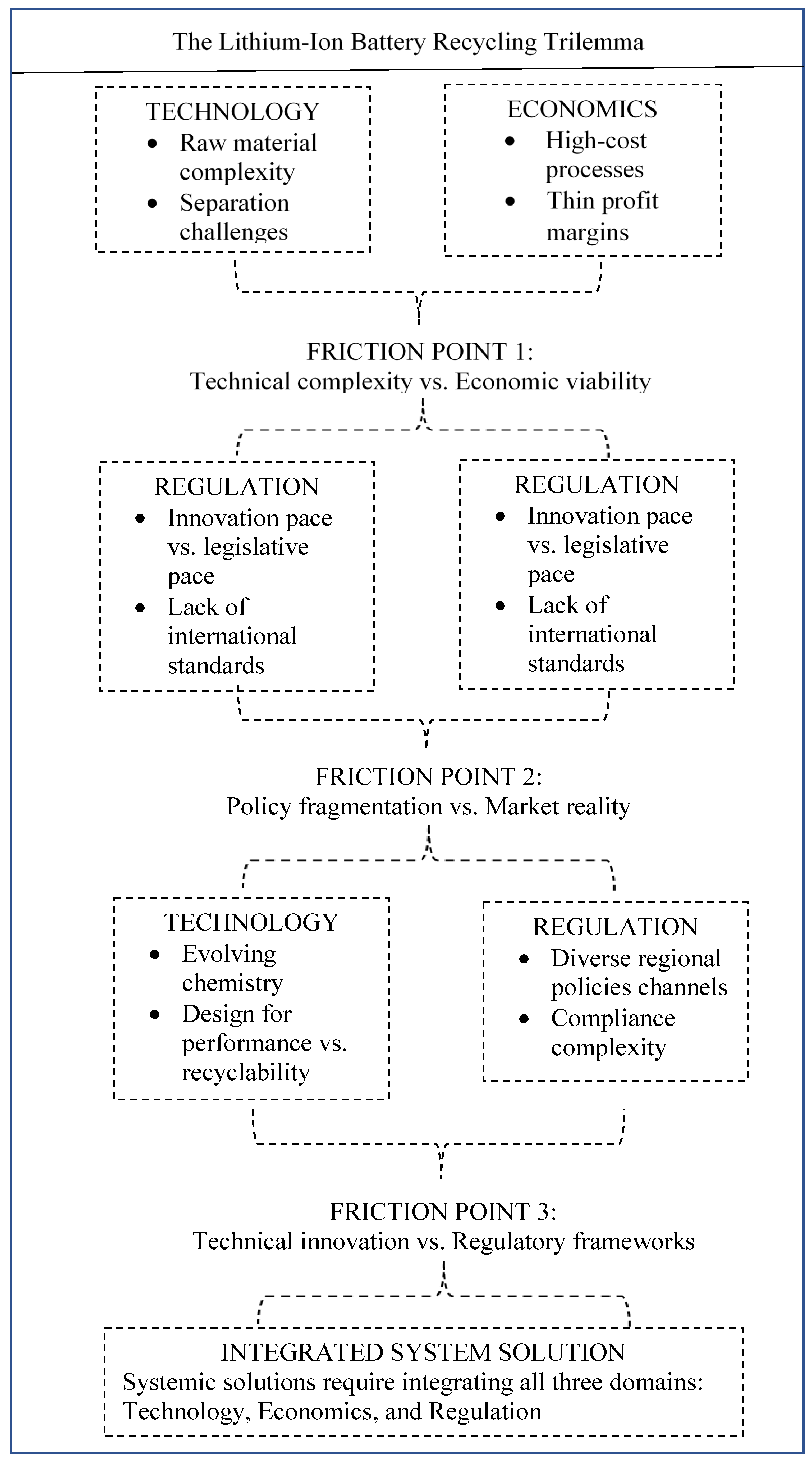
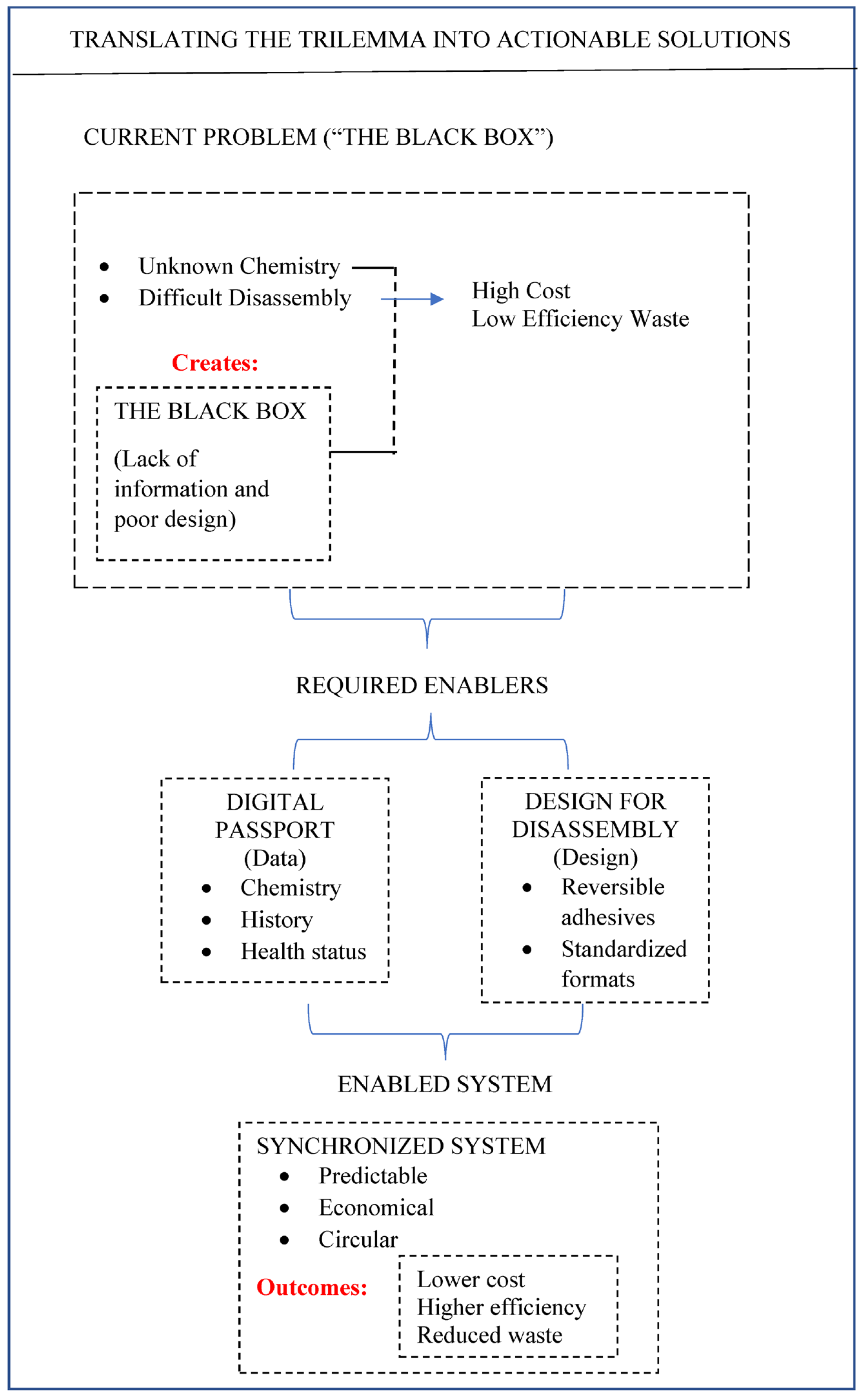

| Reference | Primary Focus | Identified Gap/Novelty Contribution |
|---|---|---|
| Harper et al. (2019) [7] | Comprehensive technical review of recycling processes, including pyrometallurgy, hydrometallurgy, and direct recycling. | Treats economics and policy as contextual background factors rather than as interconnected constraints that actively shape technological outcomes. |
| Wesslkämper and von Delft (2024) [9] | Circular business models and corporate strategy for electric vehicle battery recycling. | Focuses on firm-level value capture and strategic innovation, but does not address the systemic tension between material science limitations and regulatory frameworks. |
| This Work | The “Trilemma” Framework: Demonstrates how progress in one domain (Technology, Economics, or Regulation) is actively undermined by constraints in the other two. | Provides a systems-level perspective bridging the three silos; emphasizes the need for synchronized design-for-recycling, market stabilization mechanisms, and harmonized policy feedback loops. |
Disclaimer/Publisher’s Note: The statements, opinions and data contained in all publications are solely those of the individual author(s) and contributor(s) and not of MDPI and/or the editor(s). MDPI and/or the editor(s) disclaim responsibility for any injury to people or property resulting from any ideas, methods, instructions or products referred to in the content. |
© 2026 by the author. Licensee MDPI, Basel, Switzerland. This article is an open access article distributed under the terms and conditions of the Creative Commons Attribution (CC BY) license.
Share and Cite
Zhang, Q. The Lithium-Ion Battery Recycling Trilemma: Bridging the Gap Between Material Science, Economic Reality, and Regulatory Policy. Materials 2026, 19, 1235. https://doi.org/10.3390/ma19061235
Zhang Q. The Lithium-Ion Battery Recycling Trilemma: Bridging the Gap Between Material Science, Economic Reality, and Regulatory Policy. Materials. 2026; 19(6):1235. https://doi.org/10.3390/ma19061235
Chicago/Turabian StyleZhang, Qi. 2026. "The Lithium-Ion Battery Recycling Trilemma: Bridging the Gap Between Material Science, Economic Reality, and Regulatory Policy" Materials 19, no. 6: 1235. https://doi.org/10.3390/ma19061235
APA StyleZhang, Q. (2026). The Lithium-Ion Battery Recycling Trilemma: Bridging the Gap Between Material Science, Economic Reality, and Regulatory Policy. Materials, 19(6), 1235. https://doi.org/10.3390/ma19061235

